0022-538X/02/$04.00⫹0 DOI: 10.1128/JVI.76.21.11079–11090.2002 Copyright © 2002, American Society for Microbiology. All Rights Reserved.
Hepatitis C Virus Nonstructural 5A Protein and Interferon Resistance:
a New Model for Testing the Reliability of Mutational Analyses
Christoph Sarrazin,
1† Eva Herrmann,
1,2† Katharina Bruch,
1and Stefan Zeuzem
1*
Medizinische Klinik II, Johann Wolfgang Goethe-Universita¨t, 60590 Frankfurt am Main,1and Fachbereich Mathematik,
Technische Universita¨t, 64289 Darmstadt,2Germany
Received 1 March 2002/Accepted 2 July 2002
Presumably due to the capability of the hepatitis C virus (HCV) to evade the antiviral effects of alpha interferon, treatment is ineffective in more than half of chronically genotype HCV type 1 (HCV-1)-infected patients. Previous approaches to correlate the number of amino acid mutations within regions of HCV nonstructural (NS)-5A protein with virologic treatment response provided conflicting results. In the present study, we developed a new mathematical model to investigate NS5A sequences of HCV-1-infected patients. The mean number of all mutations within the complete NS5A protein was significantly higher in virologic
respond-ers compared to nonrespondrespond-ers (Pⴝ0.008 andPⴝ0.0001 for amino acid residues predicted on the surface
of the NS5A protein). Differences did not achieve statistical significance for NS5A regions that are currently assumed to be functionally relevant (e.g., the interferon sensitivity-determining region, the RNA-activated protein kinase-binding domain, etc.). Analyses of smoothed mutational frequencies showed that the number of mutations in other NS5A regions correlated with virologic response. Such a correlation was observed for both genuine and randomly generated NS5A sequences. The existence of local accumulations of mutations within genuine NS5A isolates that truly correlated with treatment response was defined by a refined test procedure. Upon considering the predicted residue accessibility, we identified the main focus of mutations correlating with treatment response to be the sequence from amino acids 2350 to 2370. Thus, evaluation of NS5A mutations in correlation with treatment response is improved by consideration of functional and predicted conformational amino acid properties. As shown by simulations with randomly generated sequences, multiple analyses of simple counts of local NS5A amino acid mutations and correlation with treatment response are insufficient. For improvement of mutational analysis, a refined specific functional data test procedure is proposed.
Chronic hepatitis C virus (HCV) infection frequently progresses to liver cirrhosis and is associated with an elevated risk for development of hepatocellular carcinoma (1, 30, 42). The only effective treatment is based on alpha interferon (IFN-␣). IFN-␣alone or in combination with ribavirin leads to sustained virologic response in 20 to 56% of patients with chronic hepatitis C (24, 26, 37, 53). The strongest predictive parameter for a sustained virologic response to treatment is the HCV genotype, with HCV genotype 1 (HCV-1) being the least sensitive to IFN-␣-based therapy (24, 37).
For HCV as for other eukaryotic viruses, including the in-fluenza, vaccinia, and human immunodeficiency viruses (6, 22, 27), the ability to evade the antiviral effects of IFN-␣has been reported. Both the HCV envelope (E) 2 protein and the non-structural (NS)-5A protein of HCV-1a/b isolates were shown to inhibit IFN-␣-induced double-stranded RNA-activated pro-tein kinase (PKR) in vitro (14, 51). Moreover, cellular expres-sion of the NS5A protein from HCV-1a/b isolates confirmed inhibitory effects on IFN-␣activity (13, 33, 34, 36).
In 1995 and 1996 Enomoto et al. demonstrated clinically that an increasing number of mutations within a restricted region of the HCV NS5A protein named the IFN sensitivity
determining region (ISDR; amino acids [aa] 2209 to 2248 according to HCV-J [18]) was correlated with treatment re-sponse in isolates of HCV-1b-infected patients (10, 11). The importance of mutations within the NS5A ISDR of HCV-1b-infected patients was confirmed by other investigations from Japan (7, 20). In several studies from Western countries, how-ever, the majority of HCV-1b-infected patients with sustained virologic response showed no or only a small number of mu-tations within the ISDR (19, 35, 44, 46, 49, 55). Furthermore, mutations within other regions of the NS5A protein (the PKR-binding domain and the variable region V3) were shown to correlate with virologic response in HCV-1-infected patients (31, 43). The methodological approach of counting the number of mutations within multiple regions of the NS5A protein for correlation with treatment response may be insufficient be-cause it does not consider the change of functional properties by amino acid mutations and the location of the amino acids with respect to the secondary structure of the resulting protein. Furthermore, multiple tests are inappropriate when proving an overall significance for the existence of local accumulations of mutations because the probability of observing a significant correlation increases with the number of regions tested.
In the present study, we sequenced full-length NS5A genes from 45 HCV-1b-infected patients for mutational analyses in cor-relation with treatment outcome on the basis of viral kinetics, functional properties of amino acid mutations, and the predicted secondary structure of the NS5A protein. A new statistical model was developed for testing the significant local accumulation of mutations with specific functional data analysis procedures (47).
* Corresponding author. Mailing address: Klinik fu¨r Innere Medizin II, Universita¨tskliniken des Saarlandes, Kirrberger Str., D-66421 Hom-burg/Saar, Germany. Phone: 23201. Fax: 49-6841-16-23264. E-mail: [email protected].
†Present address: Klinik fu¨r Innere Medizin II, Universita¨tskliniken des Saarlandes, D-66421 Homburg/Saar, Germany.
11079
on November 8, 2019 by guest
http://jvi.asm.org/
Moreover, statistical methods were evaluated by analogous inves-tigations on randomly generated sequences.
MATERIALS AND METHODS
Patients.In the present study, 45 consecutive patients (31 men; mean age, 47 years [range, 20 to 72 years]) chronically infected with HCV-1b were enrolled. The diagnosis of chronic hepatitis C was based on the presence of elevated levels of aminotransferase in serum for at least 6 months and the consistent detection of serum HCV RNA. All patients were negative for hepatitis B surface antigen and antibodies to human immunodeficiency virus. Therapy was either 3 MU of
recombinant IFN-␣ three times per week given subcutaneously for 24 to 48
weeks or 6 MU IFN-␣for the initial 24 weeks, followed by 3 MU IFN-␣given
thrice weekly for a total of 48 weeks (cumulative doses of 216 to 648 MU). Thirty-one patients were treated in combination with ribavirin given perorally
(1,000 mg/day for patients ofⱕ75 kg [body weight] or 1,200 mg/day for patients
of⬎75 kg).
Quantitative measurement of HCV RNA and HCV genotyping.Serum samples
were prepared in a laminar flow bench and frozen at⫺80°C. Quantitative
[image:2.587.46.541.83.250.2]detection of serum HCV RNA from pretreatment sera and during therapy for viral kinetics (three measurements between days 2 and 18, 5 and 32, and 13 and 166, respectively) was performed by branched DNA assay (Versant Quantitative HCV RNA 3.0; Bayer Diagnostics, Emeryville, Calif.). Genotyping of HCV
[image:2.587.80.507.460.677.2]FIG. 1. Location of different regions of interest within HCV NS5A protein. The NS5A protein (aa 1973 to 2419), the potential region for cytoplasmatic retention (aa 1973 to 1999), potential cleavage sites (aa 2126 to 2127, 2167 to 2173, and 2361 to 2362), binding to NS4A (aa 2135 to 2139), a region with potential hyperphosphorylation sites and amino acids important for replication initiation (aa 2197 to 2204), the ISDR (aa 2209 to 2248), the PKR-binding domain (aa 2209 to 2274), the HCV-1a basal phosphorylation site (aa 2321), the NLS (aa 2326 to 2334), and the V3 region (aa 2356 to 2379) are indicated according to the numbering system of HCV-1b prototype HCV-J (18).
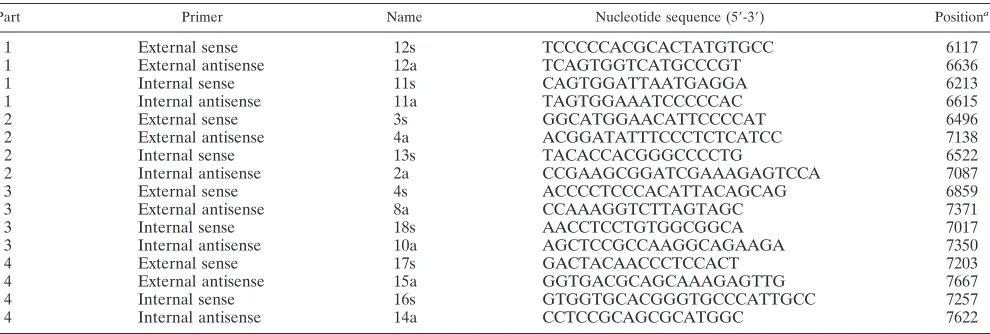
TABLE 1. Primers for NS5A sequencing
Part Primer Name Nucleotide sequence (5⬘-3⬘) Positiona
1 External sense 12s TCCCCCACGCACTATGTGCC 6117
1 External antisense 12a TCAGTGGTCATGCCCGT 6636
1 Internal sense 11s CAGTGGATTAATGAGGA 6213
1 Internal antisense 11a TAGTGGAAATCCCCCAC 6615
2 External sense 3s GGCATGGAACATTCCCCAT 6496
2 External antisense 4a ACGGATATTTCCCTCTCATCC 7138
2 Internal sense 13s TACACCACGGGCCCCTG 6522
2 Internal antisense 2a CCGAAGCGGATCGAAAGAGTCCA 7087
3 External sense 4s ACCCCTCCCACATTACAGCAG 6859
3 External antisense 8a CCAAAGGTCTTAGTAGC 7371
3 Internal sense 18s AACCTCCTGTGGCGGCA 7017
3 Internal antisense 10a AGCTCCGCCAAGGCAGAAGA 7350
4 External sense 17s GACTACAACCCTCCACT 7203
4 External antisense 15a GGTGACGCAGCAAAGAGTTG 7667
4 Internal sense 16s GTGGTGCACGGGTGCCCATTGCC 7257
4 Internal antisense 14a CCTCCGCAGCGCATGGC 7622
aNucleotide positions indicate the carboxy-terminal ends of the primers within the HCV gene according to HCV-J (18).
on November 8, 2019 by guest
http://jvi.asm.org/
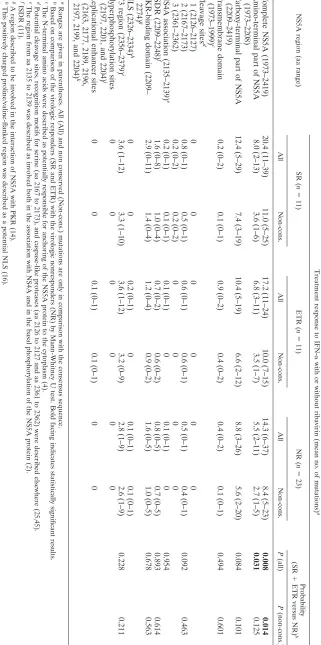
TABLE 2. Mutations in dif ferent parts of the NS5A region in 45 HCV-1b-infected patients NS5A region (aa range) Treatment response to IFN-␣ with or without ribavirin (mean no. of mutations) a SR ( n ⫽ 11) ETR ( n ⫽ 11) NR ( n ⫽ 23) Probability (SR ⫹ ETR versus NR) b All Non-cons. All Non-cons. All Non-cons. P (all) P (non-cons.) Complete NS5A (1973 –2419) 20.4 (11 –39) 11.0 (5 –25) 17.2 (11 –24) 10.0 (7 –15) 14.3 (6 –37) 8.4 (5 –23) 0.008 0.014 Amino-terminal part of NS5A (1973 –2208) 8.0 (2 –13) 3.6 (1 –6) 6.8 (3 –11) 3.5 (1 –7) 5.5 (2 –11) 2.7 (1 –5) 0.031 0.125 Carboxy-terminal part of NS5A (2209 –2419) 12.4 (5 –29) 7.4 (3 –19) 10.4 (5 –19) 6.6 (2 –12) 8.8 (3 –26) 5.6 (2 –20) 0.084 0.101 Transmembrane domain (1973 –1999) c 0.2 (0 –2) 0.1 (0 –1) 0.9 (0 –2) 0.4 (0 –2) 0.4 (0 –2) 0.1 (0 –1) 0.494 0.601 Cleavage sites d 1 (2126 –2127) 0 0 0 0 0 0 2 (2167 –2173) 0.8 (0 –1) 0.5 (0 –1) 0.6 (0 –1) 0.6 (0 –1) 0.5 (0 –1) 0.4 (0 –1) 0.092 0.463 3 (2361 –2362) 0.2 (0 –2) 0.2 (0 –2) 0 0 0 0 NS4A association (2135 –2139) e 0.2 (0 –1) 0.1 (0 –1) 0.1 (0 –1) 0 0.1 (0 –1) 0 0.954 ISDR (2209 –2248) f 1.6 (0 –8) 1.0 (0 –4) 0.7 (0 –2) 0.6 (0 –2) 0.8 (0 –5) 0.7 (0 –5) 0.893 0.614 PKR-binding domain (2209 – 2274) g 2.9 (0 –11) 1.4 (0 –4) 1.2 (0 –4) 0.9 (0 –2) 1.6 (0 –5) 1.0 (0 –5) 0.678 0.563 NLS (2326 –2334) h 0 0 0.2 (0 –1) 0 0.1 (0 –1) 0.1 (0 –1) V3 region (2356 –2379) i 3.6 (1 –12) 3.3 (1 –10) 3.6 (1 –12) 3.2 (0 –9) 2.8 (1 –9) 2.6 (1 –9) 0.228 0.211 Hyperphosphorylation sites (2197, 2201, and 2204) j 00 00 0 0 Replicational enhancer sites (2163, 2177, 2189, 2196, 2197, 2199, and 2204) k 0 0 0.1 (0 –1) 0.1 (0 –1) 0 0 a Ranges are given in parentheses. All (All) and non conserved (Non-cons.) mutations are only in comparison with the consensus sequence. b Based on comparison of the virologic responders (SR and ETR) with the virologic nonresponders (NR) by Mann-Whitney U test. Bold facing indicates stat istically signi ficant results. c The N-terminal amino acids were described as potentially responsible for anchoring of the NS5A protein to the cytoplasm (4). d Potential cleavage sites, recognition motifs for serine (aa 2167 to 2173), and caspase-like proteases (aa 2126 to 2127 and aa 2361 to 2362) were descri bed elsewhere (25,45). e The region from aa 2135 to 2139 was described as involved both in the association with NS4A and in the basal phosphorylation of the NS5A protein (2). f ISDR (11). g A region described to be involved in the interaction of NS5A with PKR (14). h This positively charged proline/valine-flanked region was described as a potential NLS (16). i V3 region within the carboxy-terminal part of NS5A (17). j Amino acid residues described as involved in NS5A hyperphosphorylation (50). k That is, dif ferent mutations described as important for ef ficient initiation of HCV RNA replication in a cell culture system (3,23).
on November 8, 2019 by guest
http://jvi.asm.org/
[image:3.587.135.456.78.723.2]FIG. 2. Smoothed mutational frequencies of all full-length NS5A sequences from HCV-1b-infected patients (A) and of a typical sample of simulated sequences randomly assigned to derive from virologic responders and nonresponders (B). Virologic responders (SR and ETR) are indicated in green, and virologic nonresponders are indicated in blue. The brown-shaded areas indicate the potential functional regions within the NS5A protein according to the data shown in Fig. 1.
on November 8, 2019 by guest
http://jvi.asm.org/
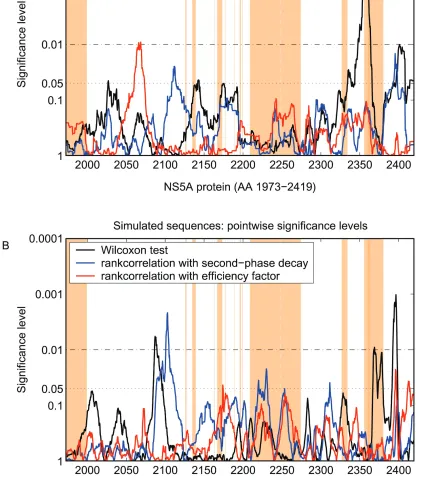
FIG. 3. Pointwise significance levels of mutations in correlation with early viral kinetics (efficiency factorεand second-phase decay2) and of
mutational frequencies in correlation with treatment response of full-length NS5A sequences from HCV-1b-infected patients (A) and of simulated sequences from Fig. 2B randomly assigned to belong to the genuine viral kinetic data (B). The black line indicates the significance levels from the correlation of mutational frequencies with treatment response. The blue and red lines indicate the significance levels from the correlation of the number of mutations with the efficiency factor and second-phase decay, respectively. Dotted horizontal lines indicate the 0.05 and 0.01 significance levels. The brown-shaded areas show the potential functional regions within the NS5A protein according to Fig. 1.
on November 8, 2019 by guest
http://jvi.asm.org/
(48) was performed by reverse hybridization assay (INNO LiPA HCV-II; Inno-genetics, Ghent, Belgium).
Amplification of HCV NS5A RNA by reverse transcription-PCR and sequence analysis.After extraction of HCV RNA from 100l of pretreatment serum, cDNA was generated by using appropriate specific antisense primers. The HCV NS5A gene (codons 1973 to 2419 according to HCV-J [18]) was am-plified by nested PCR in four overlapping parts with different sets of primers (Table 1). After an initial denaturation step of 95°C for 2 min, 35 cycles of 95°C for 30 s, 55°C for 50 s, and 72°C for 2 min were performed for the first-and second-round PCRs in a PE9700 thermocycler (Perkin-Elmer Cetus, Norwalk, Conn.). The resulting amplification product was analyzed on a 1.5% agarose gel stained with ethidium bromide.
For direct sequencing of the different parts of NS5A, 40l of the second round
PCR product was purified with Microcon 100 (Amicon, Witten, Germany). Sequence analysis was performed according to the manufacturer’s instructions (Big Dye Deoxy Terminators; Applied Biosystems, Weiterstadt, Germany). Se-quencing of the positive and the negative strands was performed by an automat (310 DNA Sequencer; Applied Biosystems). The deduced amino acid sequences of the NS5A region (codons 1973 to 2419) were compared with the NS5A sequences identified in the prototype isolates for HCV-1a (HCV-1 [8]), HCV-1b (HCV-J and HC-J4 [18, 32]), and the consensus sequence of all HCV-1b isolates (cons) investigated.
Phylogenetic and conformational analysis.Multiple alignment of amino acid sequences, calculation of the consensus sequence (cons), and phylogenetic analyses were performed as previously described (43). Residue accessibility (buried, exposed, and unknown) within the secondary structure of the NS5A protein on the basis of the 45 full-length NS5A sequences from the present study and 25 published full-length NS5A sequences (9, 31) was predicted by the PHD and PROFacc programs of B. Rost et al. (http://maple.bioc.columbia.edu/predictprotein/) (39). The methods and validity of the prediction programs were recently reviewed by Rost and Sander (41). Analyses of amino acid mutations according to their functional properties (conserved versus nonconserved mutations) were based on six different classes of amino acids with predicted similar properties: positive (R and K), negative (D and E), aromatic (H, F, W, and Y), polar (N, Q, S, and T), and aliphatic (A, I, L, M, V, and C) amino acids and amino acids with special conformational properties (G and P) (28).
In addition to the 45 sequences of the present study, published NS5A HCV-1b sequences were analyzed. Duverlie et al. reported full-length NS5A sequences from 11 nonresponder patients and from 8 patients who achieved a sustained virologic response (9). These sequences were retrieved from the EMBL nucle-otide sequence database (accession numbers AF033358 to AF033376). NS5A isolates AF033364 and AF033365 were identical and were regarded as one isolate for sequence analyses. Nousbaum et al. published HCV-1b full-length NS5A sequences from four patients with sustained virologic responses (patients 11 and 12 were as published previously and patients 10 and 19 were from S. Polyak [unpublished data]; AF265148, AF265151, AF265145, and AF265157) and from two virologic nonresponders (patients 1 and 13; AF265142 and AF265154) (31). For analysis of the NS5A sequence from patient 19, the inser-tion of one nucleotide (adenine at posiinser-tion 6441 according to the prototype sequence HCV-J) was removed.
Kinetic modeling.A biphasic model for the initial viral decay was used (29,
54). Estimates for the second-phase slope2were obtained by a least-squares
linear fit of the log viral load. Quantifications below the detection limit were included by using the Tobit approach. The resulting nonlinear minimization was performed numerically by using Matlab (MathWorks, Inc., Natick, Mass.). The quotient of pretreatment viral load and the estimated viral load 24 h after
starting therapy was used as an approximation of the efficiency factorεon viral
production (21, 29).
Functional data analysis and statistics.Local accumulations of mutations were analyzed on the basis of a nonparametric binomial regression model, assuming independent amino acid exchanges. This assumption was justified as a first-order approximation in the related context of sequence segmentation (5). A specific functional data analyses procedure (47) was defined to test whether differences between the mutational frequencies for responding and nonresponding patients can be explained by a constant shift only. The test was based on
T⫽
冕
1973 2419
w共t兲关pˆR共t兲⫺pˆNR共t兲⫺aˆ兴2dt (1)
where,pˆRandpˆNRare estimates of the mutational probability function for
sequences from responding and nonresponding patients, respectively, and␣ˆ is a
frequency estimator of the global shift.pˆRandpˆNRare estimated
nonparametri-cally by smoothing the local mutational frequencies with Gaussian kernel
weights, and bandwidthb⫽1.5. The asymptotic normal distribution ofTwas
derived analytically as:
T⬃AN
冉
冘
iciii2
冘
i
冘
jcij2ij
冊
(2)where
i⫽ 1
nRpR共i兲关1⫺pR共i兲兴⫹ 1
nNRpNR共i兲关1⫺pNR共i兲兴 (3) and
cij⫽
冕
1973 2419
w共t兲
冉
ki共t,b兲 ⫺ 1447
冊冉
kj共t,b兲⫺1
447
冊
dt (4)with the kernel weighting schemeki(t,b) fori⫽1973, . . ., 2419 (i.e., amino acid
positions of HCV NS5A). This distribution was used to calculate critical regions. The asymptotic results were confirmed by simulations of random sequences. Random generation of sequences was performed from independent binomially distributed pseudo random numbers with appropriately defined mutational prob-ability functions by using Matlab.
Standard pointwise tests for smoothed mutational frequencies (bandwidth 3) of the genuine sequences and of sets of random sequences were applied. Con-tinuous variables were compared by using the Mann-Whitney U test, and two continuous variables were analyzed by Spearman rank correlation. Unless
indi-cated otherwise, all tests were two-tailed andPvalues of⬍0.05 were considered
significant.
The clinical and biochemical characteristics of patients are expressed as the
mean⫾the standard deviation or median and range as appropriate.
RESULTS
NS5A amino acid sequences.The complete NS5A region of
HCV pretreatment isolates from 45 patients chronically in-fected with HCV-1b was investigated. Eleven patients achieved a long-time sustained virologic response (SR), with undetect-able HCV RNA 18 months after termination of therapy. In 11 patients a virologic response with undetectable HCV RNA at the end of treatment, but relapse thereafter was observed (ETR). Twenty-three patients showed no virologic response to antiviral therapy (NR). For mutational analyses virologic re-sponders (ETR and SR patients) were compared with virologic nonresponders (NR patients) to focus on effects that are cor-related with IFN-␣treatment. Mutations were defined always with respect to the consensus sequence of all investigated NS5A sequences. The different potentially functional regions of the NS5A protein are shown in Fig. 1.
The sequences of the complete NS5A protein (aa 1973 to 2419) of all 45 isolates are accessible in the EMBL database (accession numbers AJ507155 to AJ507199). Mutational fre-quencies within the different regions of the NS5A protein were compared with the treatment outcome of the different groups (SR, ETR, and NR; Table 2). The mean number of all (both conserved and nonconserved) and all nonconserved NS5A mu-tations in virologic responders (SR and ETR) was significantly higher than in virologic nonresponders (NR) (P⫽0.008 andP
⫽0.014, respectively; Table 2). In addition, the number of all amino acid exchanges within the amino-terminal part of the NS5A protein correlated significantly with treatment response (P⫽0.031; Table 2). However, for none of the different
on November 8, 2019 by guest
http://jvi.asm.org/
tionally relevant regions of the NS5A protein (the transmem-brane domain, cleavage sites, NS4A association, ISDR, PKR-binding domain, nuclear localization signal [NLS], and V3 region) was a significant correlation between the number of either all amino acid mutations or all nonconserved amino acid mutations and treatment response observed (Table 2).
Fur-thermore, hyperphosphorylation sites and amino acids shown to be important for replication initiation in the HCV replicon were highly conserved in the 45 isolates of HCV-1b-infected patients (Fig. 1 and Table 2).
[image:7.587.104.478.193.580.2]For 34 of 45 patients, serum samples were available for the calculation of viral kinetics during the first 12 weeks of therapy.
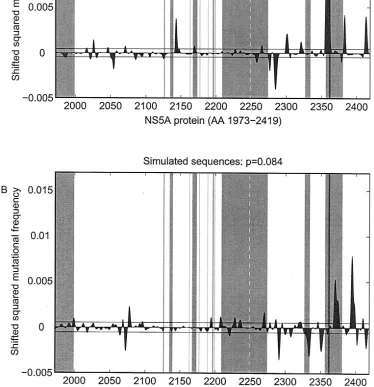
FIG. 4. Shifted squared differences (shown with the original sign [⫾]) of smoothed mutational frequencies from virologic responders and virologic nonresponders based on the full-length NS5A sequences from HCV-1b-infected patients (A) and on the simulated sequences from Fig. 2B (B). Significant local differences are present if the gray-shaded areas under the curve are larger than the area within the black horizontal lines. The gray-shaded vertical bars show the potential functional regions within the NS5A protein determined according to the data presented in Fig. 1.
on November 8, 2019 by guest
http://jvi.asm.org/
on November 8, 2019 by guest
http://jvi.asm.org/
The relative decay of HCV RNA during the first day after initiation of antiviral therapy, which approximates the effi-ciency factor on viral production (ε), and the second-phase slope (2) representing the degradation rate of infected
hepa-tocytes were estimated. A higher number of mutations within the complete NS5A protein correlated with a more rapid HCV RNA decay in the second phase (one tailedP⫽0.034). Fur-thermore, a trend toward a stronger clearance of HCV RNA in correlation with a higher number of mutations was observed (one-tailedP⫽0.125).
Phylogenetic analyses showed no differences between full-length NS5A isolates from virologic responders compared to nonresponders (data not shown).
Functional data analyses.The number of mutations did not
correlate with treatment response in any of the known putative functional NS5A regions. In contrast, several studies previ-ously reported a correlation between mutational frequencies within different NS5A regions and treatment response. The probability of observing significant correlations between the number of mutations within NS5A regions and treatment re-sponse increases with the number of regions tested. The over-all significance of these tests derived from pointwise signifi-cance levels within arbitrary regions is difficult to determine.
In the present study, mutational analyses from full-length HCV-1b NS5A sequences available from patients with known treatment outcomes (n ⫽ 70; 45 patients from the present study and 25 patients from earlier studies [9, 31]) were com-pared with analyses of mutational frequencies for simulated sequences. The 70 NS5A sequences were divided into two groups: virologic responders (SR and ETR,n⫽34) and viro-logic nonresponders (NR,n⫽36). The simulated sequences were assigned randomly to be from virologic responders (n⫽
34) or from nonresponders (n⫽36).
Figure 2 shows the smoothed mutational frequencies of gen-uine (Fig. 2A) and simulated sequences (Fig. 2B), respectively. For both genuine and simulated sequences within different NS5A regions, the number of mutations was higher for viro-logic responders than for nonresponders. Therefore, in a next step significance levels of the number of mutations in correla-tion with treatment response throughout the complete NS5A protein were calculated (Fig. 3). Different regions with a sig-nificant correlation between the number of mutations and the treatment response were observed for both genuine and sim-ulated sequences (Fig. 3). Furthermore, regions with signifi-cant correlation between the early viral decline and treatment response were observed by screening the complete NS5A of genuine and simulated sequences (Fig. 3). Indeed, such regions could be identified in the majority (94%) of 500 simulated samples of random sequences.
A refined test procedure was introduced to assess an overall significance level for the existence of local accumulations of
mutations truly correlated with treatment response. Genuine NS5A sequence analyses of shifted squared differences of smoothed mutational frequencies from virologic responders and virologic nonresponders showed a significant local accu-mulation of mutations (P⫽0.018) with a main focus upstream of the V3 region (aa 2350 to 2370; Fig. 4A). No such local accumulation of mutations was detected in 94% of 500 random samples of simulated sequences (Fig. 4B).
[image:9.587.302.543.75.415.2]Furthermore, the functional properties of amino acids and
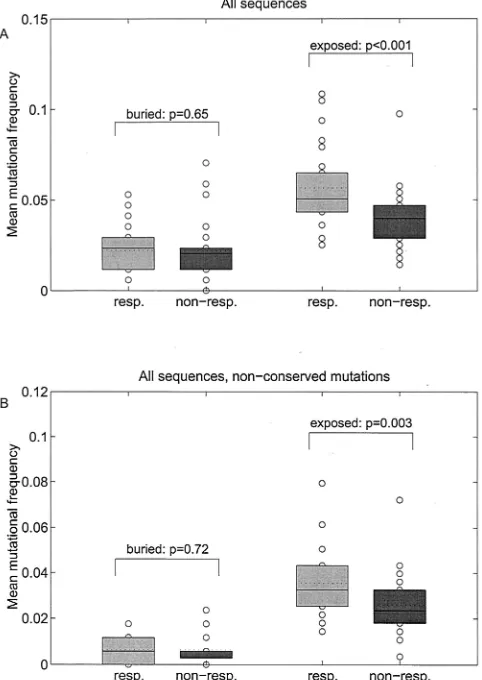
FIG. 6. Box plots of mean mutational frequencies of full-length NS5A sequences from HCV-1b-infected patients based on all muta-tions (A) and on all nonconserved mutamuta-tions (B). Horizontal joint and dotted lines indicate median and mean, respectively. The term “bur-ied” indicates analysis for amino acids that are predicted to be located within the buried core of the NS5A protein or with unknown localiza-tion; the term “exposed” indicates analysis for amino acids that are predicted to be located on the surface of the NS5A protein. Abbrevi-ations: resp., virologic responders to antiviral therapy (SR and ETR); non-resp., virologic nonresponders to antiviral therapy (NR).
FIG. 5. Smoothed mutational frequencies of full-length NS5A sequences from HCV-1b-infected patients with respect to the localization of amino acid residues within the secondary structure of the NS5A protein. Red-shaded areas indicate exposed amino acid residues, and white areas indicate buried amino acid residues or unknown localization. (A and B) Smoothed mutational frequencies based on all amino acid mutations (A) and based on nonconserved amino acid mutations only (B). Virologic responders (SR and ETR) are indicated in green, and virologic nonresponders are indicated in blue. The brown-shaded areas at the bottom indicate the potential functional regions within the NS5A protein according to the data presented in Fig. 1.
on November 8, 2019 by guest
http://jvi.asm.org/
also the predicted localization of amino acid mutations within the secondary structure of the resulting protein were consid-ered. Figure 5A shows the smoothed mutational frequencies throughout the complete NS5A protein based on the predicted localization of amino acids within the core (buried) or at the surface (exposed) of the NS5A protein. This analysis was also performed for nonconserved amino acid mutations only (Fig. 5B). The mean number of mutations within the complete NS5A protein for predicted buried amino acids was not differ-ent between virologic responders and virologic nonresponders (P⫽0.646). For predicted exposed amino acids, however, the number of mutations for virologic responders was significantly higher than for nonresponders (P ⫽ 0.0001, Fig. 6A). For analysis of nonconserved NS5A mutations only, no significant difference was detected between virologic responders and non-responders for predicted buried amino acids (P⫽0.725). For predicted exposed amino acids, the number of mutations was significantly higher in virologic responders than in nonre-sponders (P⫽0.003; Fig. 6B).
Local analysis based on the predicted residue accessibility (buried and exposed) showed a significant local accumulation of amino acid mutations (P⫽ 0.038). The main focus on aa 2350 to 2370 upstream of the V3 region was confirmed.
DISCUSSION
Four or more mutations within the ISDR of the HCV NS5A protein have been clinically correlated with sensitivity to
IFN-␣-based treatment (7, 11, 44, 46, 49, 52). However, in the majority of patients from western countries with a virologic response, fewer than four mutations within the ISDR are present, and sensitivity or resistance to antiviral therapy cannot be explained by the ISDR hypothesis (44, 46, 49, 55). Expres-sion in cell culture systems generally confirmed IFN-␣ resis-tance mechanisms of the NS5A protein (13, 33, 34, 36). How-ever, resistance to IFN-␣was independent of the presence or absence of mutations within the ISDR. Therefore, other re-gions within the NS5A protein outside the ISDR may be in-volved in IFN resistance mechanisms. Mutations in other re-gions of the NS5A protein (PKR-binding domain, V3 region, carboxy-terminal part) have been described as associated with virologic response (9, 15, 31, 43).
In the present study, full-length NS5A sequences of 45 pa-tients infected with HCV-1b were investigated for a possible correlation of mutational frequencies with treatment response. Patients were treated with IFN-␣with or without ribavirin, and the response to antiviral therapy was carefully characterized. Furthermore, the initial virologic response to antiviral therapy was assessed by first- and second-phase kinetic analysis (29, 54). Since putative NS5A treatment resistance mechanisms have been characterized as directed against IFN-dependent pathways, patients with a virologic treatment response (SR and ETR patients) were compared to virologic nonresponders (NR patients).
The number of mutations throughout the complete NS5A protein correlated positively with the virologic response to treatment (P⫽0.008). Furthermore, independent of different treatment regimens (3 to 6 MU of IFN-␣with or without the addition of ribavirin), a more rapid second-phase viral decline correlated significantly with multiple mutations within the
NS5A protein (one-tailedP⫽0.034). However, in none of the known presumably functional regions within the NS5A protein (transmembrane domain, cleavage sites, NS4A association, ISDR, PKR-binding domain, NLS, and V3 region) was any significant correlation between mutations and treatment re-sponse observed.
Therefore, in a next step, analyses in other regions of the NS5A protein were performed based on 70 full-length NS5A sequences (31). Screening multiple regions of the complete NS5A by pointwise significance levels showed several regions with significant correlations between the mutational frequen-cies and treatment response and significant correlations be-tween the mutational frequencies and the early viral decline for genuine sequences (Fig. 3A). Because the significance lev-els of multiple and correlated tests are difficult to interpret, random sequences were generated on the basis of a newly developed nonparametric binomial model and randomly as-signed to be from virologic responders or nonresponders (Fig. 3B). Indeed, regions with pointwise significant correlations between mutational frequencies and virologic response could be identified in 94% of 500 simulated samples of random sequences. These findings are neither restricted to specific model assumptions nor to the assumed mutational probability function. Hence, comparing results from genuine sequences with those from randomly generated sequences can help to avoid misinterpretations of statistical results in general and especially showed that the identification of local accumulations of mutations from pointwise significance levels as in previous studies is problematic.
For further analyses of NS5A isolates, the functional conse-quences of amino acid exchanges, as well as predictions of the localization of amino acid residues in the core or on the surface of the resulting NS5A protein were studied. Amino acids were grouped according to functional properties to differentiate be-tween conserved and nonconserved amino acid mutations (28). For conformational analysis, the amino acid residue accessi-bility within the secondary structure of the NS5A protein was predicted (39, 40). Exchange of amino acids with identical functional and conformational properties (conserved), as well as exchange of amino acids within the core of the resulting NS5A protein, should be of minor relevance, whereas noncon-served amino acid mutations and especially mutations for amino acids located on the predicted surface of the NS5A protein may be of functional importance. Analysis of the gen-uine NS5A isolates of the 70 HCV-1b-infected patients for predicted buried amino acid residues showed no differences between the virologic responders and nonresponders for the number of all (conserved and nonconserved) mutations, as well as all nonconserved mutations, in correlation with the treat-ment response. However, the number of all mutations and all nonconserved mutations was significantly higher for virologic responders compared to that for nonresponders for amino acids predicted to be located at the surface of the resulting NS5A protein (P⫽0.0001 andP⫽0.0029, respectively).
The existence of local accumulations of mutations truly cor-relating with the treatment response was analyzed by a new specific functional data analysis procedure. Significant local differences of mutational frequencies were detected for the complete NS5A protein (P⫽0.018), as well as on the basis of predicted buried and exposed amino acid residues (P⫽0.038),
on November 8, 2019 by guest
http://jvi.asm.org/
between virologic responders and nonresponders with a main focus upstream of the V3 region (aa 2350 to 2370) of the NS5A protein. At present, the functional relevance of this region is unknown. In a recent study, mutations in two variable regions within the carboxy-terminal part of the NS5A protein (a region downstream the PKR-binding domain and the V3 region) were characterized as correlated with the treatment outcome (31). Therefore, together with the results of the present study, the V3 region and flanking sequences may be involved in IFN-␣
resistance. The potential function of this NS5A region should be investigated in further studies, e.g., in the new HCV repli-con model.
In conclusion, we have shown with the help of randomly generated sequences that simple analysis of counts of muta-tions in different NS5A regions is an insufficient approach for identifying local accumulations of mutations correlated with treatment response. A new nonparametric binomial model was developed to overcome this problem. In addition to the present study of HCV isolates, this model and the proposed analytical method have potential implications for similar inves-tigations in other viruses (i.e., human immunodeficiency virus, hepatitis B virus) (12, 38).
The detection of significant mutational differences in regions within the NS5A protein of virologic responders and nonre-sponders is improved by consideration of functional properties of amino acid exchanges and the predicted accessibility of amino acid residues within the secondary structure of the re-sulting protein. Based on the investigations of nonconserved and predicted exposed amino acid mutations, one region (aa 2350 to 2370) within NS5A in particular was identified that showed significant differences between virologic responders and nonresponders to antiviral therapy.
ACKNOWLEDGMENTS
We are grateful to Andreas Heger for computational support and to Steve Polyak for critically reading the manuscript and helpful discus-sions.
REFERENCES
1.Alter, M. J., H. S. Margolis, K. Krawczynski, F. N. Judson, A. Mares, W. J. Alexander, P. Y. Hu, J. K. Miller, M. A. Gerber, and R. E. Sampliner, et al.
1992. The natural history of community-acquired hepatitis C in the United
States. N. Engl. J. Med.327:1899–1905.
2.Asabe, S. I., Y. Tanji, S. Satoh, T. Kaneko, K. Kimura, and K. Shimotohno.
1997. The N-terminal region of hepatitis C virus-encoded NS5A is important
for NS4A-dependent phosphorylation. J. Virol.71:790–796.
3.Blight, K. J., A. A. Kolykhalov, and C. M. Rice.2000. Efficient initiation of
HCV RNA replication in cell culture. Science290:1972–1975.
4.Brass, V., E. Bieck, R. Montserret, B. Wolk, J. A. Hellings, H. E. Blum, F. Penin, and D. Moradpour.2001. An aminoterminal amphipathic alpha-helix mediates membrane association of the hepatitis C virus nonstructural
pro-tein 5A. J. Biol. Chem.277:8130–8139.
5.Braun, J. V., and H. G. Mu¨ller.1998. Statistical methods for DNA sequence
segmentation. Stat. Sci.13:142–146.
6.Carroll, K., O. Elroy-Stein, B. Moss, and R. Jagus.1993. Recombinant vaccinia virus K3L gene product prevents activation of double-stranded RNA-dependent, initiation factor 2 alpha-specific protein kinase. J. Biol.
Chem.268:12837–12842.
7.Chayama, K., A. Tsubota, M. Kobayashi, K. Okamoto, M. Hashimoto, Y. Miyano, H. Koike, M. Kobayashi, I. Koida, Y. Arase, S. Saitoh, Y. Suzuki, N. Murashima, K. Ikeda, and H. Kumada.1997. Pretreatment virus load and multiple amino acid substitutions in the interferon sensitivity-determining region predict the outcome of interferon treatment in patients with chronic
genotype 1b hepatitis C virus infection. Hepatology25:745–749.
8.Choo, Q. L., K. H. Richman, J. H. Han, K. Berger, C. Lee, C. Dong, C. Gallegos, D. Coit, A. Medina-Selby, P. J. Barr, A. J. Weiner, and D. W. Bradley.1991. Genetic organization and diversity of the hepatitis C virus.
Proc. Natl. Acad. Sci. USA88:2451–2455.
9.Duverlie, G., H. Khorsi, S. Castelain, O. Jaillon, J. Izopet, F. Lunel, F. Eb, F. Penin, and C. Wychowski.1998. Sequence analysis of the NS5A protein of European hepatitis C virus 1b isolates and relation to interferon sensitivity.
J. Gen. Virol.79:1373–1381.
10.Enomoto, N., I. Sakuma, Y. Asahina, M. Kurosaki, T. Murakami, C. Yamamoto, N. Izumi, F. Marumo, and C. Sato.1995. Comparison of full-length sequences of interferon-sensitive and resistant hepatitis C virus 1b. Sensitivity to interferon is conferred by amino acid substitutions in the NS5A
region. J. Clin. Investig.96:224–230.
11.Enomoto, N., I. Sakuma, Y. Asahina, M. Kurosaki, T. Murakami, C. Yamamoto, Y. Ogura, N. Izumi, F. Marumo, and C. Sato.1996. Mutations in the nonstructural protein 5A gene and response to interferon in patients with
chronic hepatitis C virus 1b infection. N. Engl. J. Med.334:77–81.
12.Erhardt, A., U. Reineke, D. Blondin, W. H. Gerlich, O. Adams, T. Heintges, C. Niederau, and D. Ha¨ussinger.2000. Mutations of the core promoter and response to interferon treatment in chronic replicative hepatitis B.
Hepatol-ogy31:716–725.
13.Franc¸ois, C., G. Duverlie, D. Rebouillat, H. Khorsi, S. Castelain, H. E. Blum, A. Gatignol, C. Wychowski, D. Moradpour, and E. F. Meurs.2000. Expres-sion of hepatitis C virus proteins interferes with the antiviral action of interferon independently of PKR-mediated control of protein synthesis.
J. Virol.74:5587–5596.
14.Gale, M., Jr., C. M. Blakely, B. Kwieciszewski, S. L. Tan, M. Dossett, N. M. Tang, M. J. Korth, S. J. Polyak, D. R. Gretch, and M. G. Katze.1998. Control of PKR protein kinase by hepatitis C virus nonstructural 5A protein:
molecular mechanisms of kinase regulation. Mol. Cell. Biol.18:5208–5218.
15.Gerotto, M., F. Dal Pero, P. Pontisso, F. Noventa, A. Gatta, and A. Alberti.
2000. Two PKR inhibitor HCV proteins correlate with early but not
sus-tained response to interferon. Gastroenterology119:1649–1655.
16.Ide, Y., L. Zhang, M. Chen, G. Inchauspe, C. Bahl, Y. Sasaguri, and R. Padmanabhan.1996. Characterization of the nuclear localization signal and subcellular distribution of hepatitis C virus nonstructural protein NS5A.
Gene182:203–211.
17.Inchauspe, G., S. Zebedee, D. H. Lee, M. Sugitani, M. Nasoff, and A. M. Prince.1991. Genomic structure of the human prototype strain H of hepa-titis C virus: comparison with American and Japanese isolates. Proc. Natl.
Acad. Sci. USA88:10292–10296.
18.Kato, N., M. Hijikata, Y. Ootsuma, M. Nakagawa, S. Ohkoshi, T. Sugimura, and K. Shimotohno.1990. Molecular cloning of the human hepatitis C virus genome from Japanese patients with non-A, non-B hepatitis. Proc. Natl.
Acad. Sci. USA87:9524–9528.
19.Khorsi, H., S. Castelain, A. Wyseur, J. Izopet, V. Canva, A. Rombout, D. Capron, J. P. Capron, F. Lunel, L. Stuyver, and G. Duverlie.1997. Mutations of hepatitis C virus 1b NS5A 2209–2248 amino acid sequence do not predict the response to recombinant interferon-alfa therapy in French patients.
J. Hepatol.27:72–77.
20.Kurosaki, M., N. Enomoto, T. Murakami, I. Sakuma, Y. Asahina, C. Yamamoto, T. Ikeda, S. Tozuka, N. Izumi, F. Marumo, and C. Sato.1997. Analysis of genotypes and amino acid residues 2209 to 2248 of the NS5A region of hepatitis C virus in relation to the response to interferon-beta
therapy. Hepatology25:750–753.
21.Lam, N. P., A. U. Neumann, D. R. Gretch, T. E. Wiley, A. S. Perelson, and T. J. Layden.1997. Dose-dependent acute clearance of hepatitis C genotype
1 virus with interferon alpha. Hepatology26:226–231.
22.Lee, T. G., J. Tomita, A. G. Hovanessian, and M. G. Katze.1990. Purification and partial characterization of a cellular inhibitor of the interferon-induced
protein kinase ofMr68,000 from influenza virus-infected cells. Proc. Natl.
Acad. Sci. USA87:6208–6212.
23.Lohmann, V., F. Korner, A. Dobierzewska, and R. Bartenschlager.2001. Mutations in hepatitis C virus RNAs conferring cell culture adaptation.
J. Virol.75:1437–1449.
24.Manns, M. P., J. G. McHutchison, S. C. Gordon, V. K. Rustgi, M. Shiffman, R. Reindollar, Z. D. Goodman, K. Koury, M. Ling, and J. K. Albrecht.2001. Peginterferon alfa-2b plus ribavirin compared with interferon alfa-2b plus ribavirin for initial treatment of chronic hepatitis C: a randomised trial.
Lancet358:958–965.
25.Markland, W., R. A. Petrillo, M. Fitzgibbon, T. Fox, R. McCarrick, T. McQuaid, J. R. Fulghum, W. Chen, M. A. Fleming, J. A. Thomson, and S. P. Chambers.1997. Purification and characterization of the NS3 serine
pro-tease domain of hepatitis C virus expressed inSaccharomyces cerevisiae.
J. Gen. Virol.78:39–43.
26.McHutchison, J. G., S. C. Gordon, E. R. Schiff, M. L. Shiffman, W. M. Lee, V. K. Rustgi, Z. D. Goodman, M. H. Ling, S. Cort, J. K. Albrecht, et al.1998. Interferon alpha-2b alone or in combination with ribavirin as initial
treat-ment for chronic hepatitis C. N. Engl. J. Med.339:1485–1492.
27.McMillan, N. A., R. F. Chun, D. P. Siderovski, J. Galabru, W. M. Toone, C. E. Samuel, T. W. Mak, A. G. Hovanessian, K. T. Jeang, and B. R. Williams.1995. HIV-1 Tat directly interacts with the interferon-induced,
double-stranded RNA-dependent kinase, PKR. Virology213:413–424.
28.Mirny, L. A., and E. I. Shakhnovich.1999. Universally conserved positions in protein folds: reading evolutionary signals about stability, folding kinetics
and function. J. Mol. Biol.291:177–196.
on November 8, 2019 by guest
http://jvi.asm.org/
29.Neumann, A. U., N. P. Lam, H. Dahari, D. R. Gretch, T. E. Wiley, T. J. Layden, and A. S. Perelson.1998. Hepatitis C viral dynamics in vivo and the
antiviral efficacy of interferon-a therapy. Science282:103–107.
30.Niederau, C., S. Lange, T. Heintges, A. Erhardt, M. Buschkamp, D. Hu¨rter, M. Nawrocki, L. Kruska, F. Hensel, W. Petry, and D. Ha¨ussinger.1998. Prognosis of chronic hepatitis C: results of a large prospective cohort study.
Hepatology28:1687–1695.
31.Nousbaum, J., S. J. Polyak, S. C. Ray, D. G. Sullivan, A. M. Larson, R. L. Carithers, Jr., and D. R. Gretch.2000. Prospective characterization of full-length hepatitis C virus NS5A quasispecies during induction and
combina-tion antiviral therapy. J. Virol.74:9028–9038.
32.Okamoto, H., M. Kojima, S. Okada, H. Yoshizawa, H. Iizuka, T. Tanaka, E. E. Muchmore, D. A. Peterson, Y. Ito, and S. Mishiro.1992. Genetic drift of hepatitis C virus during an 8.2-year infection in a chimpanzee: variability
and stability. Virology190:894–899.
33.Paterson, M., C. D. Laxton, H. C. Thomas, A. M. Ackrill, and G. R. Foster.
1999. Hepatitis C virus NS5A protein inhibits interferon antiviral activity, but
the effects do not correlate with clinical response. Gastroenterology117:
1187–1197.
34.Podevin, P., A. Sabile, R. Gajardo, N. Delhem, A. Abadie, P. Y. Lozach, L. Beretta, and C. Brechot.2001. Expression of hepatitis C virus NS5A natural mutants in a hepatocytic cell line inhibits the antiviral effect of interferon in
a PKR-independent manner. Hepatology33:1503–1511.
35.Polyak, S. J., S. McArdle, S. L. Liu, D. G. Sullivan, M. Chung, W. T. Hofgartner, R. L. Carithers, Jr., B. J. McMahon, J. I. Mullins, L. Corey, and D. R. Gretch.1998. Evolution of hepatitis C virus quasispecies in hypervari-able region 1 and the putative interferon sensitivity-determining region
dur-ing interferon therapy and natural infection. J. Virol.72:4288–4296.
36.Polyak, S. J., D. M. Paschal, S. McArdle, M. J. Gale, Jr., D. Moradpour, and D. R. Gretch. 1999. Characterization of the effects of hepatitis C virus nonstructural 5A protein expression in human cell lines and on
interferon-sensitive virus replication. Hepatology29:1262–1271.
37.Poynard, T., P. Marcellin, S. S. Lee, C. Niederau, G. S. Minuk, G. Ideo, V. Bain, J. Heathcote, S. Zeuzem, C. Trepo, J. Albrecht, et al.1998.
Random-ised trial of interferon␣2b plus ribavirin for 48 weeks or for 24 weeks versus
interferon␣2b plus placebo for 48 weeks for treatment of chronic infection
with hepatitis C virus. Lancet352:1426–1432.
38.Ross, L., M. Johnson, R. DeMasi, Q. Liao, N. Graham, M. Shaefer, and M. St. Clair.2000. Viral genetic heterogeneity in HIV-1-infected individuals is
associated with increasing use of HAART and higher viremia. AIDS14:813–
819.
39.Rost, B., and C. Sander.1994. Combining evolutionary information and
neural networks to predict protein secondary structure. Proteins19:55–77.
40.Rost, B., and C. Sander.1994. Conservation and prediction of solvent
ac-cessibility in protein families. Proteins20:216–226.
41.Rost, B., and C. Sander.2000. Third generation prediction of protein
struc-tures. Methods Mol. Biol.143:71–95.
42.Saito, I., T. Miyamura, A. Ohbayashi, H. Harada, T. Katayama, S. Kikuchi, Y. Watanabe, S. Koi, M. Onji, Y. Ohta, Q. L. Choo, M. Houghton, and G.
Kuo.1990. Hepatitis C virus infection is associated with the development of
hepatocellular carcinoma. Proc. Natl. Acad. Sci. USA87:6547–6549.
43.Sarrazin, C., T. Berg, J. H. Lee, B. Ru¨ster, B. Kronenberger, W. K. Roth, and S. Zeuzem.2000. Mutations in the protein kinase-binding domain of the NS5A protein in patients infected with hepatitis C virus type 1a are
associ-ated with treatment response. J. Infect. Dis.181:432–441.
44.Sarrazin, C., T. Berg, J. H. Lee, G. Teuber, C. F. Dietrich, W. K. Roth, and S. Zeuzem.1999. Improved correlation between multiple mutations within the NS5A region and virological response in European patients chronically infected with hepatitis C virus type 1b undergoing combination therapy.
J. Hepatol.30:1004–1013.
45.Satoh, S., M. Hirota, T. Noguchi, M. Hijikata, H. Handa, and K. Shimo-tohno.2000. Cleavage of hepatitis C virus nonstructural protein 5A by a
caspase-like protease(s) in mammalian cells. Virology270:476–487.
46.Sa´iz, J. C., F. X. Lo´pez-Labrador, S. Ampurdane´s, J. Dopazo, X. Forns, J. M. Sa´nchez-Tapias, and J. Rode´s.1998. The prognostic relevance of the non-structural 5A gene interferon sensitivity determining region is different in infections with genotype 1b and 3a isolates of hepatitis C virus. J. Infect. Dis.
177:839–847.
47.Silverman, B. W.1996. Smoothed functional principal components analysis
by choice of norm. Ann. Statist.24:1–24.
48.Simmonds, P., E. C. Holmes, T. A. Cha, F. McOmish, B. Irvine, E. Beall, P. L. Yap, J. Kolberg, and M. S. Urdea.1993. Classification of hepatitis C virus into six major genotypes and a series of subtypes by phylogenetic
analysis of the NS-5 region. J. Gen. Virol.74:2391–2399.
49.Squadrito, G., F. Leone, M. Sartori, B. Nalpas, P. Berthelot, G. Raimondo, S. Pol, and C. Brechot.1997. Mutations in the nonstructural 5A region of hepatitis C virus and response of chronic hepatitis C to interferon alfa.
Gastroenterology113:567–572.
50.Tanji, Y., T. Kaneko, S. Satoh, and K. Shimotohno.1995. Phosphorylation of
hepatitis C virus-encoded nonstructural protein NS5A. J. Virol.69:3980–
3986.
51.Taylor, D. R., S. T. Shi, P. R. Romano, G. N. Barber, and M. M. C. Lai.1999. Inhibition of the interferon-inducible protein kinase PKR by HCV E2
pro-tein. Science285:107–110.
52.Witherell, G. W., and P. Beineke.2001. Statistical analysis of combined substitutions in nonstructural 5A region of hepatitis C virus and interferon
response. J. Med. Virol.63:8–16.
53.Zeuzem, S., S. V. Feinman, J. Rasenack, E. J. Heathcote, M. Y. Lai, E. Gane, J. O’Grady, J. Reichen, M. Diago, A. Lin, J. Hoffman, and M. J. Brunda.
2000. Peginterferon ␣-2a in patients with chronic hepatitis C. N. Engl.
J. Med.343:1666–1672.
54.Zeuzem, S., E. Herrmann, J. H. Lee, J. Fricke, A. U. Neumann, M. Modi, G. Colucci, and W. K. Roth.2001. Viral kinetics in patients with chronic
hep-atitis C treated with standard or peginterferon␣2a. Gastroenterology120:
1438–1447.
55.Zeuzem, S., J. H. Lee, and W. K. Roth.1997. Mutations in the nonstructural
5A gene of European hepatitis C virus isolates and response to interferon␣.
Hepatology25:740–744.