~lINING
ON THE HODGKINSON
Noreen Kirkman
The Hodgkinson Goldfield, extending over an area of approximately
2,000 square miles along the valley of the Hodgkinson River. was
proclaimed on 15 June 1876.
Although geologically similar to the great
alluvial producer to its north - the Palmer - the Hodgkinson was
predominantly a reefing field, with its major mines in the vicinity of
Kingsborough, Thornborough and Northcote.
1
It was however a "poor
relation" of the Palmer Goldfield, for while the gold output of the
Palmer well exceeded a million ounces in its first decade. the yield On
the Hodgkinson came to less than one-sixth that amount for a
correspond-ing period.
Though Robert Logan Jack proclaimed that
i twas "most
undeservedlya 'neglected goldfield''',2 and official reports retained an
optimistic outlook until the first decade of the twentieth century, it
was clear by 1908 that its small yield no longer justified separate
goldfield administration.
As the warden wrote:
"THE HODGKINSON, the
impoverished inheritor of former renown, rests its claim to distinction
as a goldfield of the past rather than on recent achievement". 3
Accordingly in 1909, it was incorporated into the Chillagoe Gold and
Ninera1 Field and the value of rare metals soon surpassed the earnings
from gold.
Yet just as Ravenswood and Charters Towers had been
responsible for Townsville's development as a major seaport, the
Hodgkinson gave life to Cairns and Port Douglas and prompted settlement
throughout the Cairns hinterland.
The circumstances in which payable gold tvas discovered on the
Hodgkinson River are still shrouded in mystery.
The river was named as
early as September 1874 by J. V. Hulligan in honour of the incumbent
member for Burke, W.O. Hodgkinson, once mining Narden on the Etheridge.
In the following year Mulligan led a government sponsored prospecting
party through "the country at the heads of the Mitchell and other rivers"
1.
See K. Levingston, Vol. I, Chapter I, pp.IO-12.
2.
R.L. Jack, Notes on the Present Condition of the Hodgkinson Gold
Field, GSQ bulletin 4, p.l.
NOREEN KIRKMAN
in search of payable gold, but after six months' trekking they failed to
report any find.
Despite the government's withdrawal of support and
instruction to disband the party, Mulligan and the government geologist,
Frederick Harner, persisted with their investigations.
4
In February
1876, the
QueensZander
reported that Mulligan had decided to focus on the
Hodgkinson River and await the wet season, anticipating a valuable
discovery.
Confident Mulligan asserted that there was a goldfield in the
region:
"The field is on the Hodgkinson, a river twice as wide as
the Palmer, and, as yet, known to very few people"
~
5
Of the "few people"
whose curiosity was aroused, Hilliam MacLeod was unknown to Mulligan,
but not for long.
MacLeod's party was already working the river in late
January 1876 when Mulligan's small group approached them only to be
greeted by a ragged volley of gunfire.
Afterwards MacLeod's men told
Mulligan that he had been mistaken for l1a blackfellow going to spear the
horses".6
Hhen the rain set in at the end of the month - extraordinarily
late for the wet - payable gold was found by both parties in different
7
locali ties during February.
According to Hulligan, a compromise was
reached as to publicly disclosing their finds:
MacLeod, Kennedy and ourselves understood each
other respecting the Hodgkinson River for some
time, and now understand each other respecting
the reporting of the field, which will be a
large reefing field.
8
4.
Memorandum, Department of Mines, 31 Harch 1875, 75/2022 A/87lI,
Q.S.A.;
Annotation dated 11 October 1875 on J.V. Hulligan to
H.E. King, 25 September 1875, 75/1750
ibid.
5.
QueensZander,
19 February, 25 March 1876.
6.
See reprint of Mulligan
Is diary,
ibid.,
1 April 1876.
The true
nature of this incident, which occurred on 26 January 1876, is not
clear.
But taken at face value, it is a revealing comment on the
nature of Aboriginal-European contact in the district.
" 7.
Mulligan noted in his diary that he discovered gold on 7 February
1876, and that when he encountered HacLeod's camp on 21 February
they were "getting payable gold in different gullies".
See
Cooktown
HeraZd,
18 Harch 1876.
r-IINING ON THE HOOGKINSON
An official statement by Mulligan was lodged with Thomas Coward, the
warden at Byerstown, administrative centre of the Upper Palmer.
It was
suggested that the reefs were "large and numerous and show freely in
the stone - the alluvial is payable in places but patchy".
9
News that rich discoveries had been made on the Hodgkinson River ..
almost equidistant from Maytown and the port of
Cooktown~spreadrapidly
throughout the Palmer.
The chief warden,
P. F.
Sellheim was ordered to
supervise the rush but was hampered by the flooding of the rlitchell
River.
By the time Sellheim's assistant,
tv.R.O. Hill, arrived on the
Hodgkinson on
19 April there were already 2,000 men on the ground, very
10
few of whom were "making wages".
The amount of alluvial gold was
limited, though three nuggets weighing
16, 20, 21 ounces respectively
were uncovered; this discouraged attempts to introduce methods other
than panning or dishing:
no cradles had been brought to the field by
late May
1876.
Soon however shortage of rations, the absence of
permanent administration and the fear of destitution in the face of
little or no gold, forced an early exodus of diggers from the field.
In fact Hill passed no fe\"er than
700 men returning to Byerstown,
1Ia11of whom gave most discouraging accounts of the rush".
11 Theinflux of
disillusioned miners to Byerstown placed a severe strain on the
settle-ment's facilities where nearly all stores had been exhausted by the
.
12
middle of
Apr~l.Amid the atmosphere of despair, Mulligan and MacLeod
were accused of misleading the far northern mining community and
absconding with alluvial gold accumulated on previous prospecting
excursions.
The Cook town Herald
reported rumours of a trswindle", and
that Hulligan had left· for Cardwell with a hundredweight of gold in tow.
13
9.
Statement in the names of Mulligan, Harner, Ableson, MacLeod,
Kennedy and Crosby,
9 Harch 1876, 76/429 A/8711
Q.S.A.
lD.
Iv.R.O. Hill to Minister for l'lines, 24 April 1876 76/9 HHO l3AIG1
Q.S.A.
It was estimated by one miner at Hemmants
TOtvn
that only
five percent were making adequate finds.
11.
Ibid.
12.
r:ooktol.Ji1. Herald,
12 April 1876.
NOREEN KIRKHAN
According to F.J.H. Beardmore, a leading Cooktown businessman. the area
was eXhausted:
"All the ground spoken of by Nulligan is old worked-out
ground, as McLeod and Kennedy had thoroughly worked it for nearly two
years, and others had also worked it, and left it as not payablelt. 14
Despite whispers of possible riots and grog-shanty talk of threats to
Hulligan's life, the disenchantment was not manifested in violence. IS
Neanwhile, Hil1 telegraphed the Hines Hinister that the position on the
Hodgkinson was grim:
"Alluvial no good, no large 'finds very few making
tucker.
Alluvial rush must be stopped if possible or starvation and
more serious results must issue.,,16
Sellheim also denounced the
gold-field as "a total failure ", and recommended that "every effort be made
to stop such an insane rush".17 Acting on Sellheim's urgings, the
Colonial Secretary urged his counterparts throughout the country to
display placards dissuading diggers from heading to North Queensland
and informing them that the Hodgkinson was a fizzer.
18
Notwithstanding the poor rewards for alluvial miners, some men
recognized the reefing potential of the field.
But they too encountered
difficulties arising from disputes over ground as miners' rights had
to be lodged at Byerstown, Maytown or Cooktown.
Rather than ameliorating
the confusion, Hill's short visit in April only served to alienate the
prospectors, locking up valuable claims and creating a conspicuous
clique of angry reefers.
The
CooktOliln Hel'ald
aired their grievances
on 21 June 1876:
14.
F.J.H. Beardmore to editor,
Brisbane Courier,
22 April 1876.
A
similar accusation was levelled by an unidentified special
correspondent in
Queenslander,
6 May 1876.
IS.
A meeting of diggers exonerated Mulligan of instigating a rush, on
the basis of the note of responsibility explicit in Hulligan
1s
calls for caution.
Cooktourn Herald,
3 Nay 1876.
16.
Telegram, H.R.O. Hill to Minister for /<1ines, 76/9 MHO 13A/G1
Q.S.A.
17.
Telegram, 21 April 1876, 76/1022 COLlA 221
Q.S.A.;
Queenslander~22.
29 April 1876.
TBE
NEW
BUSB
.s.
.
3CAUTION!
I'h.'
Pol
iff'
lIat;idraf4>
has
r~'l'M
illltr.dleu
t.
INNIlf'
f
ht,
'ftHowing
•••
fit,.,
: ••
..
Ih'JHlrl-.l
or
"""11"
,"'''f'I/,
"
...
f',
April
22,,11,
1"'1
••
..
H"lIaltl~
I.'
....
aflun
ha",
~II
reeeived
1111
".8
Depart_a'
'I'C".
fbI'
""I'd
..
n
.f
tlu'
PaIIDf'1'
Hlnl'
f~.W
FleW",
wlae
...
,
ret.ned
hID
a
t
....
f
I ..
Ih
..
lo«'allt,.
"at
tile
~E'"
R(;IIII
18
...
i'AlLVRE
•
•.
,"II
tll«'
8A1rIll'''1''11
al'«'
IDaklll!
the.
wlIq
IUlel!..
....
8fta'
1I'
••
atlllfaetl.n
a
ad
1I'16t1'f'",,,
,I'el'aJI
alll.a
..
",'
tlllf'aa.
1-..,.,
H_,
.aee"-;c::;
,4,...,
t-IINING ON THE HODGKINSON
This reefing district has been almost ruined by the
Government not sending us a
~"arden.£20,000 worth
of capital has been utterly wasted in the ground,
because the holders of numbers of reef can do
nothing in the shape of developement [sic] until
they are made certain of the ground they hold.
But once the goldfield had been proclaimed, reefing and dollying started
in parnest.
Howard St. George was despatched from Cooktown and was
kept busy laying off reefs and solving disputes.
Crushing machines were brought to the field with impressive haste.
inspired by the glowing descriptions of the reefs.
The first was
E.W. Spain's XL which
~"aslocated at Glen Mowbray, having been intended
for the Palmer.
19
It was quickly followed by others which were located
at centres of reefing activity - Tyrconnell, Watsonville (later
Wood-ville) and Beaconsfield - along with Plant and Jackson's Vulcan machine
at Kingston (Kingsborough) and Hartin's Hercules at Thornborough, the
.
20
latter having been hauled by seven teams from the EtherIdge.
A parcel
of ore from Nulligan and company1s King Attila P.C. was the first to be
crushed on the field on 1 December 1876 by the XL.
All told, eight
machines were operating on the Hodgkinson within a year of its discovery.
Another four arrived in the following twelve months.
21
Faith in the permanency of the reefs was reflected in building
activity:
by the end of 1876 there had been an influx of entrepreneurs.
As the
Cook town Courier
reported:
Shanty keepers are swarming in running up houses
with the usual bush accommodation, in great hopes
of good crushings and thirsty 'foolish' miners.
The 'ladies' are pretty well represented, but
nothing to what are expected to arrive.
22
19.
Cookto4!n
lIe'l'ald,
26
Augus t 1876.
20.
The Brisbane was situated at the Tyrconnell, the Magnet at
Watson-ville and the Monarch at Beaconsfield.
Hodgkinson Mining News
317
Harch
1877.
21.
1.J.J.H .•
111Ornborough, to editor.
Cooktown Cow>ieY' ,
2 May
1877;
A.R.
1877, p.ll.
NOREEN KlRKHAN
In almost every case settlements were located in close proximity to
major reefs at which machine sites were established.
By mid-l877,
.
23
Kingsborough had a population of 1,100 and 1hornborough 1,000;
no
other township was over 300.
The degree of confidence and optimism
was rare for northern goldfields.
lo1arden Mowbray, who succeeded St.
George, remarked that tlbusiness establishments on the field appear to be
fully equal to the requirements of double the population
r! .
24
Regular
church services were held in 1877, at least one Catholic chapel was
built, and committees were formed to finance others.
25
This contrasted
with the Palmer River field, where despite much gre'ater population and
heady prosperity no Christian church was ever constructed.
At
Thorn-borough, a school, two banks, hospital and school of arts were
established,26 and soon a vigorous campaign was underway to encourage
brick construction. At the forefront of the agitation was J.S. Reid,
pioneering newspaperman who had sold up his
Cook town Courier
and launched
the
Hodgkinson Mining News.
According to Reid:
23.
Hodgkinson Mining
News~30 June 1877.
24.
A.H.
1877, p.12.
The warden went on to say:
tlIn Thornborough there
are two banks, an assay office, two jewellers, two butchers, nine
general stores, and twenty public-houses; in lo1atsonville, four
general stores, five public-houses, and one butcher; Kingsb0rough,
eight general stores, two butchers, and twelve public-houses; in
Stewartown, four general stores, one butcher, and six public-houses;
in Northcote. one general store, two butchers, and three
public-houses; in Beaconsfield, one general store, four public-houses, and
one butcher; in Merton, two general stores. one butcher, and two
public-houses; and at Glen Mowbray, a general store, a butcher, and
two public-houses.
II25.
Hodgkinson Mining
News~9 June 1877, 19 January 1878.
The Anglican
clergyman from Port Douglas, Clifden Eager, also conducted services.
26.
A school was opened by Hr. Dodwell in October 1877, and the state
school in October the following year.
Hodgkinson
~ningNews,
20 October 1877, 14 September, 5, 20 October 1878.
Branches of the
Bank of New South Hales and Queensland National Bank were opened in
1877.
A.R.
1877, p.12.
The hospital was made of galvanized iron
and catered for twenty.
Hodgkinson Mining News,
11 August 1877.
At the end of 1878, Anderson's Club Hotel was purchased for £80 for
a School of Arts, Kingsborough, which eventually housed standard
works of poetry. fiction, and history.
Ibid.,
14 December 1878,
1'1INING ON THE HODGKINSON
'!lle promise of stability which Thornborough can
congratulate itself on enjoying, and the
reasonable price of bricks and bricklaying,
should induce intending builders to discard wood
altogether and erect permanent and seemly houses
straight away.
27
The second court house, finished in early 1878, with its white-washed
brick walls shaded by narrow verandahs, embodied the belief that the
Hodgkinson had a long life as a reefing field.
The demand for goods and machinery gave impetus to surveys for a
more direct route to the coast and a suitable port.
However the range
and coastal swamps made the task a difficult one.
By the end of 1877
the Hodgkinson was serviced by an untidy network of tracks leading to a
cluster of coastal settlements, namely Cairns, l.Jhite Cliffs, Port
Salisbury (soon known as Port Douglas) and Smithfield, allan Trinity
Bay.
After Cairns and Smithfield were severely damaged by cyclone in
Harch 1878, machine owners tended to favour Port Douglas.
In a
memorial to the Horks Hinister they argued for an access road to the
port.
As the
Hodgkinson Mining News
recordeci::
That Hessrs Plant and Jackson, Martin Bros., and
Nr Buls, machine O\vners on the Hodgkinson together
with the principal merchants on the gold-field,
have been here to inspect the road for themselves,
and now so thoroughly satisfied that this is the
road to which they must look to furnish them with
cheap carriage so essential to the development of
the Hodgkinson gold-fields, that they have ordered
all future shipments to be despatched to this
port.
28
However, the facility qf Port Douglas did not materially effect the
number of crushing plants or encourage new and efficient machinery.
Gold-bearing reefs on the Hodgkinson - of which approximately 400
distinct lines were identified - varied in width from twenty feet, ps
27. Ibid.,
28 July 1877.
NOREEN KIRKMAN
found at the Tyrconnell p.e., to extremely narrow "pipes
llwhich were
difficult to trace.
Their irregularity, and sometimes abrupt
pinching-out, discouraged many smaller miners without sufficient capital to
prospect shows at depth.
Often, claims were abandoned prematurely, and
in the absence of outside capital most mines were being worked on
revenue from crushing returns.
In an effort to conserve money, reefers
cut back on timbering, which was criticised by the Inspector of Mines,
.
29
and resorted to primitive handl1ng methods.
While wooden-handled
windlasses and greenhide buckets were only to be expected in the early
days of the field, smaller claims were still employ·ing them as late as
1884.
30
Invariably accounts of the field stressed the inefficiency of
mining techniques:
At the Explorer, Homeward Bound, Union and Home
Rule the water was pulled up by bucket,
necessitating two or three men
1s extra labour.
The stone in each and all the mines was
shovelled down the pass (the only shovelling
it should get), shovelled into buckets and
dumped into the paddock, shovelled again into
the drays, broken by hand labour in the
battery yard, and then shovelled into the
barrow to the battery....
31
By
1882
there were only four mines (two of which were later wound up)
worked by steam machinery, totalling twenty-six horsepower; there were
only nine with horse drawn whips or whims.
In contrast, however, the battery owners were highly mechanised.
By
1882
there were ten mills powered by steam engines aggregating
133
horsepower, as well as thirteen Berdans, six Wheeler pans, and other
appliances.
32
But to ensure a return on their outlay and to offset
their high operating costs, the machine owners were obliged to strike
29.
30.
A.R. 1883,
1877; A.R.
A.R. 1877,
p.72.
1884,
p.ll ;
See also
Hodgkinson Mining
News~27 October
p .69.
1884, p.69.
31.
G.J.E., "The Hodgkinson District",
The North Queensland Mining
Annual
(Charters Towers
1891), p.125.
NINING ON THE HODGKINSON
expensive crushing charges which, in turn, militated against the mines'
profitability.
(.Jith rates as high as £2 per ton in 1877, the
Hodgkinson Mining News
\.,Jas widely acclaimed for its criticism of the
machine owners for refusing to cut costs.
Their action had brought
"capital into contest with labour" and had left miners "utterly unable
to hold against the powerful combination ... who were evidently determined
to make the miners pay for the heavy cost of the erection of machines on
the field".33
Early in 1878, the Vulcan battery reduced rates to £1/2/6.
The ring having been broken,crushing rates came down dramatically and
thereafter fluctuated from between 12/- and 20/- per ton.
Hater supplies
were crucial for the machine owners, and only after sufficient dams were
built were they able to maintain continuous crushings; some mills
relocated for better water supplies. 34
Even so, the benefits of more
cost efficient batteries only went a small way in compensating the
miners, for carriage rates remained a major impost.
Carriers made up
for
the lack of feed and the uncertainty of consignments of stone by
averaging their rates which were as high as thirty shillings per ton in
1877 and £1/2/6 in 1879.
35
The advent of company mining in the early 1880s was a dismal
failure.
36
The first and longest lasting of these companies, Tyrconnell
33.
Hodgkinson Mining News,
3 November 1877.
Immediately after the first
crushing on the Hodgkinson miners talked of holding a meeting to
protest against the rate of crushing.
A year later the situation
was much the same despite the existence of 12 machines on the field.
Cooktown
Courier~2 December 1876, and
Hodgkinson Mining
News~31 March 1877.
34.
Small dams were built at the Beaconsfield, Hercules and Vulcan
machine sites.
The XL was removed to Northcote, and then to Deep
Creek because of the lack of water.
35.
Hodgkinson Mining
News~31 Harch 1877;
A.R.
1879, p.20.
NOREEN KIRKHIIN
Gold t-lining Co.,
\o1aSformed to purchase and work the Tyrconnell and
Lizzie Redmond lines of reef.
Considerable capital was invested
sinking the Tyrconnell to 430 feet, the deepest shaft on the field in
1884, and acquiring the Vulcan mill.
But operations were self-defeating:
the mill remained at Kingsborough and the cost of carriage was too high
to transport stone from the mine to the battery. Hith funds exhausted
in less than two years, the Tyrconnell mine was let on tribute and
the machinery was listed for auction.
The other companies had even
shorter lives.
The first crushing of the Home Rule Gold Mining Limited
of 459 tons for a miserable 178 ounces of gold was ·"about the poorest
crushings that have taken place on the Hodgkinson ".37 Like the Homeward
Bound Gold Mining Co. and the Hodgkinson Union Gold Mining Co. it folded
within twelve months.
The only other attempt at company mining in this
period was connected not with gold, but antimony.
A semi-metal similar
in appearance to zinc, antimony was added to lead as a hardening agent.
It had been mined at Northcote as early as 1877, and by 1882 there were
eight lease applications in force absorbing a sizeable labour force.
In response to the demand for a reduction works, the Northcote Antimony
Smelting Co. was formed and commenced operations in early 1884.
However,
inadequate capital outlay on plant and disappointing returns, over which
there had been long delays, compelled the board to close down at the end
38
of the year.
The failure of company mining and the prolonged drought
of 1883-85 influenced the downturn in the fortunes of the Hodgkinson.
European miners were attracted to tin discoveries on the Barron, t.Jild
and Tate Rivers, and silver at Silver Valley, and the population
decreased dramatically.
Chinese became correspondingly more conspicuous.
Despite the anti-Chinese vitriol of the
Hodgkinson Mining News,
Chinese were not involved to any great extent in alluvial mining.
As
the editor unwittingly admitted in April 1877:
I1This is a reefing
diggings, not alluvial, and there is not a single Chinaman that we know
37.
A.H. 1882, p.18.
P35:
Gilders'
picture
show
under
construction,
Wolfram
[Cairns
Historical
I'!INING ON THE HODGKINSON
of connected with mining of any sort on the field". 39
This was before
the failure of the Lukinville rush of 1878, after which the Chinese
population of the Hodgkinson climbed temporarily to 2,000.
Still the
1878 legislation which provided for a moratorium of three years from
the discovery of a field before miners' rights could be issued to
Asiatics or Africans was effective in reducing the number of Chinese to
220 by the end of 1879.
40
Those who remained found the service industry
more lucrative than gully-raking, and engaged in a wide range of
activities from providing firewood to offering a first class table at
41
Hah Lee's Canton Hotel in HacLeod
Street~Thornborough.
By 1885
Chinese market gardening was a prosperous industry, as the mining warden
noted:
"Besides
vegetables~they produced 137 tons maize worth £1,918;
38 tons of English potatoes worth £,760 and 37!"2: tons of sweet potatoes
worth £150.
1142
Hith a shortage of European labour at the batteries, at
least one major partnership recruited Chinese workers.
As Jackson
explained to a public meeting:
To prevent the entire suspension of work at his
mills he had been compelled to employ some
Chinamen to carry in wood to it - no teams being
procurable.
It was a matter of necessity or he
would never have employed Chinamen.
He was paying
them as much as he paid Europeans. and therefore
it was not for the sake of cheap labour he had
them - indeed he never thought Chinese labour
cheap.
43
By the mid-1880s as many as forty-three Chinese were engaged in
quartz-mining at the Union No. 1 Tunnel and the Black Ball.
This new source of labour, however, could not arrest the decline of
the field, which was exacerbated by rushes
to
Croydon and the Kimberleys
in 1886 and by attractive wages at the Montalbion silver mines.
Several
39.
Hodgkinson Mining News,
7 April 1877.
40.
A.H.
1878, p.24; 1879, p.19.
41.
Hodgkinson Mining
News~30 June 1877.
\vah Lee was from Ravenswood.
He worked his hotel for nearly forty years.
42.
A.H.
1885, p.28.
NOREEN KIRKMAN
mills were dismantled and removed to other fields.
44
Hithin fifteen
years of its discovery the yield had dwindled to just over five hundred
ounces for an entire year.
Though SellheiID contended that lithe
Hodgkinson cannot be said to be fairly tested yet
l1,
it was on the verge
of complete desertion by 1891.
45
For five years, during the depression of the 1890s, the field was
moribund apart from a few gougers.
Quite unexpectedly there was a
revival.
The opening of the Cairns-Nareeba railway in 1893 had made
the field more accessible; the increasing use of the cyanide process
throughout North Queensland promised improved returns for reefing
fields.
In 1896 there were new finds in the Kingsborough district
which led to the erection of the Reconstruction mill, formerly the Good
Hope battery from Limestone, and a cyanide plant.
The real spur came
in 1897 when British money - the Cecil Syndicate - focused on the General
Grant mine.
With an infusion of capital not previously witnessed in the
area, the syndicate erected sophisticated surface plant and sunk the
shaft to 580 feet.
Following close on the confidence generated by the
Cecil Syndicate, and partly inspired by a boom in gold scrip stimulated
by the West Australian boom, no fewer than eleven companies were
floated to work the Hodgkinson over the next few years.
These included
the Great Dyke Gold Mining Company, the Monarch Gold Mining Company and
the Cyanide Gold Recovery Company.
The Hodgkinson United Gold Mining
Company opened the General Grant No. 1 South to 735 feet, the deepest
shaft on the field, and soon the population began to return.
The revival
was reflected in the resurgence of building activity in the older almost
abandoned settlements. As the warden reported:
44.
The field in general appears to be steadily
progressing, and the population daily
increasing. Hany of the old hands are
The Nowbray mill was removed to the Etheridge and the
Harianne to Herberton. A.R. 1890, p.32; 1891, p.75.
was re-erected at "Sam the Roman's Campo.
A.R. 1896,
45.
A.H.
1891, p.6.
~lINING
ON THE HODGKINSON
returning here with their families, \.J'hich has
caused quite a demand for
d\~ellinghouses.
Judging from the activity they are showing in
the way of new buildings both at Thornborough
and Kingsborough, the latter place in
parti-cular, would lead one to believe they have
come to stay.
46
The revival, however, was as ephemeral as it was unexpected, not
least because of disappointing results.
The first crushing from the
deep General Grant No. 1 South yielded under fifteen pennyweights to
the ton.
The warden commented that lithe funds of the company were
completely exhausted and an effort
~asmade to reconstruct, but failing
the company went into liquidation".
The whole concern - mine, plant
47
and battery - went under the hammer for a paltry £650.
Similarly
the crushings from the Cecil Syndicate I
s mine did not even recoup the
£8,000 outlayed on a ten million gallons capacity dam and the erection
48
costs on the mill and cyanide plant.
Rather than waste public funds
on a goldfield with little yield, the Mines Department abolished the
separate administration and incorporated the Hodgkinson into the
Chillagoe Gold and Mineral Field in 1909.
It was a realistic move for
the local men were now turning to other forms of mining.
As the
Under-Secretary for Mines noted:
As a goldfield the Hodgkinson has ceased to command
much consideration, such prosperity as the field
enjoys and any attention that it receives being
due to its stores of wolfram, molybdenite and
antimony.
49
Demand for high grade wolfram, after the development of tungsten as
a lamp filament in 1904, and for molybdenite for use in patent alloys,
led to an early interest in rare metals by British firms, the most
46.
A.R.
1898, p.6 7.
47.
A.R. 1904, P .115.
NOREEN KIRKMAN
prominent being George G. Blackwell
&
Sons of Liverpool.50
Prices for
both metals
~"erehigh - up to £200 per ton for molybdenite and £140 per
ton for wolfram - and attracted many goldminers to "a very lucrative
occupation",
Of the 1,136 people on
rare metal miners working at Wolfram
the Hodgkinson in 1904, 700 were
51
Camp,
where molybdenite and
bismuth were found in association with the wolfram are.
By 1909, when
the field was abolished, wolfram was returning £41,820 compared to the
value of gold production at £7,089.
But the rare metals industry was
not as stable as statistics might indicate:
there was an insecurity in
unknown overseas markets where demand fluctuated erratically, and local
miners were never sure of their returns. A Holfram Co-operative
Association was formed to arrange advances and shipments through
intermediaries such as the New Zealand Loan
&
Mercantile Agency and
loJ.]. Lempriere
&Co., but generally the local industry was poorly
organised.
In 1907 the Irvinebank Hining Company bought into most of the
wolfram mines.
As the warden recorded:
Wolfram has undoubtedly been the saviour of this
field.
It has been accountable for nearly
three-fourths of the value of the mineral production of
the year, and has given employment to an average
of 550 men.
Applications by the individual miners
for a claim of one man's ground are, however,
becoming less frequent, and the Irvinebank
Mining Company are the owners of almost the whole
of \oJolfram Camp.
In fact, with the exception
of Larkin and Party's, p. Vallely's, and the
claim known as Nicholls's, there are
practically no other claims of any importance
in which the company named are not interested.
The company has not been slow either in taking
advantage of its chances, and has already
erected an a-h.p.
~"indingplant on one of the
principal claims, the
~1heate.They have also
erected a most effective and up-to-date plant
50.
A.R.
1904, pp. 79-80.
The names Tungsten and Wolfram are
inter-changeable, the chemical symbol being
\ol.See W. Alexander
&A. Street,
Metals in the Service of Man
(Harmondsworth 1979),
pp.275-6.
~lINING
ON THE HODGKINSON
for the treatment of their stone on the ground;
and, judging by present appearances, the
majority of the claims at Old Holfram Camp seem
to have fallen into very capable hands.
52
The company's output was substantially reduced in 1908-9 by a miners'
strike over hours and safety,53 COinciding with a sudden drop in the
. price of wolfram.
After the dispute was settled, the company was
obliged to spend additional funds on development before the mines could
be reworked.
Just prior to Horld Har I, new companies became involved in rare
metals, with disillusioning results.
In 1912, the Societe Francaise de
Hetaux Rares installed £50,000
to be liquidated the following
worth of
54
year.
machinery at Wolfram Camp, only
Soon after the Irvinebank
Mining Company withdrew; but the advent of the Thermo-Electric Ore
Reduction Corporation sustained the district through the war years with
the government paying fixed prices.
The company however failed to
survive the slump in metal prices after the return to free market forces
in Harch 1920.
Within weeks Holfram Camp was almost deserted:
It is improbable that the lessees of the richer
holdings at Wolfram Camp will reopen their mines
until molybdenite has increased to at least £3
per unit and a market offers for wolfram at not
less than £1.
The mines are full of water and
the expense of recomissioning them would be
heavy.
55
Holfram was worked periodically in the interwar years and during the
1940s, with government assistance, but the scale of operations
~asfar
f
rom
~mpress~ve..
.
56
52.
A.H.
1907,
p.B7.
53.
For details of the dispute, see
A.H.
1909, p.39j D.W. Hunt, "Hining
Unionism in the Far North",
Lectures in North Queensland
Histo:t'y~Third Series, pp.35ff.
54.
A.H.
1912, p.44; 1913, p.42.
55.
A.H.
1920, p.49.
NOREEN KIRKl'lAN
Neam"hile, Nount Nulligan had become the centre for yet another
branch of mining.
The possibility of cheap local coke for the ailing
base metal industry at Chillagoe and Irvinebank led to a vigorous
development programme at Haunt Mulligan and the construction of a
railway from Dimbulah to the mine.
The line passed close to
Thorn-borough, but hopes for a gold revival were not realised, partly due to
the outbreak of war in Europe, which drained the labour force of the
country's mining fields.
Despite the extraordinary expectations which
Mount Hulligan engendered, the coal mines had relatively little impact
on the surrounding district.
A metallurgical cokin'g proposal carne to
nothing, and the coal mine did little more than marginally reduce the
cost of local railway coal.
Even in its peak production period, the
mine accounted for less than four percent of the state's output.
The
1921 disaster was its chief historical claim, galvanising the entire
Hodgkinson community in the relief work that followed.
57
The mine
eventually closed in 1958, long after Thornborough, Holfram Camp and the
other settlements had been abandoned to the white-ants.
As a goldfield, the Hodgkinson had experienced a heady but brief
rush and had quickly evolved into a moderately successful reefing
district:
its gold averaged £3/10/0 per ounce and total output
aggregated 173,603 ounces to 1886.
Due to its remoteness, the Hodgkinson
still harbours a considerable amount of abandoned and derelict machinery,
Which escaped the scrap metal dealers of the interwar years, a testimony
to better days long past.
The Tyrconnell headframe, mill and surface
plant remains seemingly in working order, and Wah Lee's Canton Hotel is
still located in Thornborough, occupied by a long time resident.
Plans
to rework the Tyrconnell, abandoned in 1942, have proved fruitless, but
typical of most North Queensland goldfields, there are always a few
people with local knmJledge confident that a new discovery will be made
some day to restore the field to its former proportions.
4
o
i
,
,
N
-4
a
12 16 20! ! 1
,
,
Kl!omdrt:s
III INGHAM
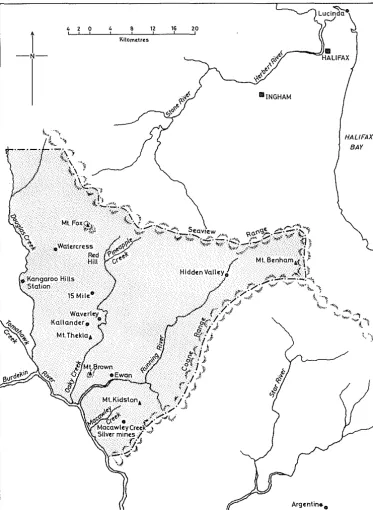
FIG 8:
Kangaroo Hills Field.
Argentin ...
HALIFAX BAY
[image:25.454.55.429.56.567.2]READINGS IN NORTH QUEENSLA1>1l llINING !IISTORY
CONSOLIDP.TED
Aborigines I: iii, 89, 89n,
114, 116, 116n, 124-125; 23-24, 156, 172n.
90n, 113,
IT: 3, 4.
Aclams, AleX I: 164.
Adelaide Tin Exploration Co II: 208n.
Admiral Sampson Chillagoe Co. No Liability II: 231-235.
Adventure ~!ine I: 170.
Alexandra Freeholds Gold Hining Co, No Liability II: 650.
Alexandra Reef, Charters Towers II: 52.
Alhambra South ~!ine I: 185.
Allan, Henry I: 217, 218.
Allen, J.B. 11: 289.
Allingham, John II: 196.
Almaden T: It., 104, 106, 187, 202, 203, 288; II: 27.
Amalgamated Copper Co, I: 224n.
Amalg;:nnated Harkers' Association 1: 186, 216, 258; II: 98n, 251, 251',-255, 262.
AmbrOse Silver-Gopper ~!ines, Chllrters Towers II: li6.
American Camp, Ravenswood II: 14.
Ampatti, Guiseppe I: 173.
Anaconda Copper Co. I: 237n.
Anglo-American Corp of South Africa 11:
281',.
Anglo-Saxon Nine, Palmer River I: 116.
Annan Ri ver Coy II: 17.
Anniversary ~line J: 211.
Anti-Chinese League I: 127-128, 128n.
Aplin, Wi!limn I: 313.
Arbouin I: 182, 217; II: 219.
Arbouin Hills Tin ~lining Co. No Liability
I: 182; II: 230.
Argentine-Town and Silver ~line II: 1, 33. Argylla Nine, Cloncurry 1: 222, 231',.
Armstrong, Herbert I: Inn.
Asarco Corp II: 275, 296, 300, 303, 301'"
305, 306.
Ashcroft, J.W.
Ashcroft Process
II: 205. II: 272.
,\shtonville II: 219.
Associated \~orkers Union II: 98, 98n.
Atherton I: 103, 287. Atberton, John I: 161.
Atherton }!ine, Chillagoe II: 218.
Aurora Galena Smelting Co. Ltd. I: 166n.
Austral ~lalay Ltd II: 208n.
limEX
Australian Gold Recovery Co. 100.
II: 14,
Australian Labor Federation 159, 160; II: 96.
I: 157, 158,
"Australian ~lining Standard" 1: 297; II: 236, 238, 239n, 21',0, 21',0n, 255, 256, 261.
Australian Natives' Association I: lSI',.
"Australian Republican, The" 158.
I: 157,
,\ustralian Steam Navigation Co. 57, 57n.
II: 39,
Back, Fred II: 237.
Bailey, W.!I.L. I, 128.
Baillieu, W.L. II: 285.
Baird, J.C. I, 128n.
IIall, L.C. I, 201, , 227, 248.
Ballard, Robert I, 275.
IIamford Holfram ~lines I: 287.
Band of Hope l<Jine, Charters Towers 77n.
Bank of New South Wales
Barnes, \~alter
Barry, \~i lliam Bashford, George
Batavia Deposits
II: 260.
I: 106.
I: 277.
II: 5.
II: 178n. 1I:
Beaconsfield - Town and Nine
II: 178n.
I: 166;
Beaconsfield Tin }!ining Co. J: 165. Beardmore, F.J.H. I: 128n; II: 171',.
Beatty, Chester 11: 285, 285n. Bedford, Randolph
297, 298.
II: 21',3n, 281, 282,
Bedford, Robert J: 287. Berry, J. I: 11',1n.
Bernick, Noreing and Co. I: 103n.
Better Luck ~line, Etheridge Bicknell, A.C.
Big Reef Co.
II: 42, 1',5.
T: 99n.
I: 91.
Big Reef Hine, Etheridge 99n, 104.
I: 21,91,99,
Binnie, J.H. II: 37.
Black, J.N. I: 305, 307n, 313,
Black Cap Tin Hining Co. II: 207.
"Black Dog" II: 52, 52n.
Black Eagle, Etheridge I: 105n.
Black Jack }line, Ravenswood 1',5, 56n, map-57, 11',8.
IIlack Star depOSits, Ht. 1sa 289, 293, 304.
1: 9, 1',0,
CONSOLIDATED INDEX
Boddington, Harden T: lOOn. Bolivia Nine I: 185.
Bolton, G.C. I: iv, 87, 134, 136, 169, 215, 296; II: 27, 49, 83n, 156. Bonnie Doon P.C. ~!ine, Charters Towers
II: 44.
Bonnie Dundee ~!ine, Charters To;.'ers
166; II: 42, 80, 83,
Boomerang Hine, Chillagoe
Boomerang Hine, Etheridge
II: 219.
T: 105n. Borghero, Emmanuel I: 133.
Bowen I: 265, 305, 306, 313, 319; II: 217.
Bowen Consolidated Coal Mining CO I: 264.
Bowen Consolidated Nine I: 268.
Bowen River Coal Co 1: 260.
Bowen River Coal Field 254, 257, 260, 264,
296-297; II: 2.
I: 31, 237n, 266, 270, 270n,
Bowes, Jim 11: 200.
Bowly, C.W. II: 46.
Boyd, A.A. II: 138.
Bradshaw, Henry ] , 174n. Brander, Peter I: 201; II: 249.
Brandon, Thomas ] , 161, 164. Brilliant Extended Gold Hining Co
210.
Brilliant Gold ~lining Co II: 96.
II:
Brilliant ~!ines, Charters Towers II:
96, 97, 104, 108, Ill, 112, 112n, 115, lI6, 116n, 117.
"Brisbane Courier" I: 127; II: 232.
British and Colonial Railway Co I: 224.
British Hetal Corporation 284.
I: 237; II: Broken Hill Proprietary
217, 220, 226, 235, 291.
II: 198, 208n, 248, 251, 272,
Brodziak and Rodgers Co II: 30.
Broughton Gold Field II: 70n.
Brown, John 1:
Brown and Broad Co 161, 163,
I: 327.
Browne, l~illiam Henry I: 160, 160n. Bryan O'Lynn Hine, Charters Towers
II: 66, 66n.
Buckland, Thomas II: 66n, 68, 69.
Burketown II: 5. Burma Corp II: 283.
Burns Philp Co II: 30.
Byerstown ] , 119, 133, 274, 277; 11:
173.
Caird, Patterson & Co I: 165,
"Cilirns Horning Post" I: 96n, 259.
"Cairns Post" II: 272.
f:alcifer II: 230, 234, 243, 244, 271. Caledonia C,old Hining Co. No Liability
II: i4n.
Caledonia ~!ine, Charters Towers 68.
1l: 52,
Caledonian ~!ine I: 91, !05n, 136. California Creek Deposits I: 165, 166,
178, 178n, 197; II: 15.
Callow, J.N. 106.
II: 293, 298, 299, 304,
Cameron, Nacdonald II: 196n, 201, 202, 202n, 205, 207n, 208.
Cameron, H.E. I: 204, 223, 224. Cnnadian Nine, Etheridge
Canary ].line, Oakey Creek
I: 99.
II: 210.
Canary Tin Nines No Liability II: 210,
213n, 214.
Chesterfield Hine I: 166.
Chieftain Nine I: 217-218.
Cnpe River Goldfield I: 2, 5, geology and mineralisation: 9; II: 5-6, 51, 58.
Cnrdross - Town and Deposit I: 12, 189, 216-218, 220, 265; I I : 29, 32.
Cardwell I: 106; II: 173.
Casey, Gilbert II: 97.
Cecil Syndicate II: 186, 189.
Chapman, Charles William I: 178, 179, 193, 201, 217; !T: 220-226 pacGim, 230, 231, 236, 242n.
Chapman, E.G. II: 14-15, 32, 37-38, 47.
Charleston see Forsayth.
Charters, William II: 50, 51, 53-54, 58,
59-60, 60n, 63, 141.
Charters Towers - Town and Goldfield I:
iii, 2, geology and mineralisation: 5-8, 9, 40n, 43, 44n, 46, 52n, 56, 62,65, 74, 79, 89, 90n, 96, 114,
115n, 116n, 145-160, 252, 260, 273, 274, 275, 304, 305, 314, 314n, 317, 319, 321, 322, 327; II: I, 2,5, 6, 9, IS, 16, 19, 22, 28, 29, 31, 41, 42, 45, 49-118, 133, 153, 164, 171, 197, 210, 213n.
Charters Towers Amalgamated Hiners' Association I: 151.
Charters Towers Employers' Union
"Charters Towers Herald" II: 19.
Charters Towers 1Hners' Protection Association II: 60, 60n.
1: 152.
Charters Towers ~!iners' Union I: 147-148, 159; II: 84, 85, 88, 88n, 97.
"Charters Towers ~liners Disaster Act 1904"
READINGS IN NORT!! QUEENSLAND !<lINING HISTORY
Charters Towers Republican Association 1: 153, 154, 157-158, 159, 160.
Charters Towers Volunteer Corps i: 158.
Chemical and ~!ineralogical Society, Charters Towers II: 90.
Chillagoe - Town, Gold and Hineral Fields
T: iii, 10, geology and mineralisation:
12-14, 103, IDS, Ill, 173, 177, 178, 180, 242, 252, 256, 258, 282, 290, 320; II: I, 5, 27, 29, 171, 189, 192, 243, 244.
Chillagoe and Etheridge Railway Act (1918)
I: 290.
Chillagoe Bedford and ~lount Carnet Ltd
I: 287.
Chillagoe Company Ltd TI: 248.
Chillagoe Proprietory Co I: to3, 103n, lOS, 105n, 108, 109-111, 178-179, 187, 189-220, 251-271
patmm,
283, 284, 287, 288, 289, 290, 298; 11: 30n,217-272 paooiJrr, 281n.
Chillagoe Railway I: 194, 203, 282-287,
288; II: 222, 224, 262, 263, 264.
Chillagoe Railway and Nines Ltd I: 179n,
193; II: 155, 225-272 paoiJim.
Chinese I: iii, 11, 91, 96n, 100, 113-114, 119, 120, 124, 125-131, 136, 136n, 146, 148, 151, 162, 275, 323;
II: 6, 9, 20, 20n, 23, 24, 30, 31, 32, 37, 45, 51, 57, 57n, 167-169, 182, 185.
"Chinese Immigrants Regulation Act of 1877,
The T: 129.
Christian, 1l1Omas II: 75, 75n. City of Glasgow ~!ine, Etheridge 1: 91. City of Pompeii Nine I: 166.
Clansman Hine T, 218. Clar!, , George II: 46.
Clarke, A.H. 11: 90, 90n.
Clar!,e, George II: 50, 54, 54n. Clarke, F.H. I, 164.
"Cleveland B" Express" II: 60.
Cloncurry - Town and Copper Field T: iii, 90n, 151, 221-250, 252, 253, 263-264,
265. 281, 290-295, 320; II: I, 5, l2n, 29, 117, 156,271,277,279.
Cloncurry Copper }lining and Smelting Co
I: 222, 222n, 224n; II: 199n.
Cloncurry Smelting and Railway Co Ltd
I: 229.
"Coal Hining Act 1925"
Cobar ~line, Etheridge
II: 136.
I: 105n.
Cobar \.Jest Nine, Etheridge I: 105n. Coen River Gold Field II: 5, 42, 70n. Collins, John I: 164.
Collins, R. II: 108n.
Collinsville
"e
Bowen River Coal Field.Columbia Lease Gold !-lining Co. No Liability II: 65n.
Comet Cold Hine, Palmer River I: 136,
141.
Comet Tin Nine, Ilerberton I: 170.
"Companies Act (1863)" II: 65, 152. "Company (\.Jinding-Up) Act of 1892" II:
152.
Comstock Gold ~liniog Co. Ltd. II: 74n. Conoor, IHlliam II: 244n.
Cook Coal Field I: 254, 257.
Cook town T: 113, 115, 124, 127, 128, 128n, 132, 133, 134, 138, 142, 152, 274, 277-278, 301, 303, 3070, 319, 323, 324;
II: 22, 30, 39.
"Cook town Courier" I: 120; II: 177, 178, 217.
"Cook town Herald" I: 128; II: 173, 174, 177 •
Coolgarra Deposits I: 165, 185.
Coolgarra Federal Tin Company I: 182,
Copper I: iii, 12, 13, 14, 17, 18, 20,
21, 27-30, 103, 104n, 161, 165, 172, 178, 179, 180, 189-220 pa8!Jim,
221-250 paouim, 252-253, 260, 263, 283;
II: 195, 197, 201-202, 205, 215n, 218, 237, 239, 249, 271, 275-311 paa:;im.
Copper Producers Association I: 234. Corbould, William I: iv, 230, 233, 236,
242, 2420, 248, 250; II: 278,
281-289 palJs~~ 306.
Corella Copper ~!ioes No Liability 235.
Cornish Jim's Rush II: 2.
T: 234,
Coward, Thomas 1, 900, 123, 1230, 127; II: 173.
Craven, Richard I: iv, 327; II: 68,
96,
96n.Cronin, K. I: 125.
Crowley, C.A. I: 128n.
"Crown Lands Alienation Acts of 1860 and
1868" II: 130.
Croydon - Town and Fields I: geology aod mineralisation: 21-24, 900, 96, 105, 106, 151, 203, 252, 280, 281, 290, 305, 319, 324, 327; II: I, 5, 18, 19, 22, 27, 28, 133, 185.
Crusader Hine, Cloncurry I: 234.
Cumberland I: 110, 324.
Cumberland Gold Company I: 92.
Cumberland ~line, Etheridge I: geology and mineralisation: 20, 91, 92, 92n, 93, 94.
Cuprite Consolidated Tin ~!ines No Liability I: 182.
Cusack, Kelly II: 197.
CONSOLIDATED INDEX
Dargalong deposit I: 12, 14.
Davis Carl II: 284-285, 286.
Dawn of Hope Mine, ~!t. Kidston II: 207n, 209n.
Dawson, Anderson II: 98. D:.n.Tson, A. II: 132n.
Dawson, Andrew I: 153, 153n, 159, 159n.
"Day Dawn filock and Wyndham Gold Hining Company's Railway Act 1888" 11: 154-155.
Day Dawn Gold ~Iining Co. Ltd. II: 74n, 75-76.
Day Dawn Hines, Charters Towers I: ISO,
151; II: 42, 75-76, 77n, 78, 80, 81,
83, 83n, 84, 85, 93n, 96, 96n, 97, 112, 116, 116n, Il7.
Deane, John II: 52, 69, 69n.
Delaney, S.J. I: 165, 173. Denham, Digby II: 260, 261.
Desailly, Charles II: 23-24.
Dickson, James II: 227.
"Divident Duty Act" (1890) II: 148, 151.
Dixon Mine I: 185.
Dobbyn and Cloncurry Copper Hines Ltd. I: 233, 236.
Dobbyn ~line I: 234, 244.
Donahue, James and William I: 180.
Donnybrook Hine I: 9, 43, 45, 89.
Dorothy Hine, Chillagoe II: 218, 219.
Dotswood II: 46.
Douglas, John I: 274.
Dow, John I: 165.
"Drainage of Hines Ac' 1912" II: 153. Drake, James II: 222.
Draper, F.W. II: 294, 294n.
Drury. Edward Robert [ , 135.
Duchess - Town and Mine I: geology and mineralisation; 28-29, 227, 227n, 233, 248, 294, 295; II: 282.
Duchess to Hount Isa Railway Act I: 295; II: 282, 292, 297.
Duffy, Patrick II: 235.
Duke of Edinburgh Mine, Ravenswood I: map-57, 61.
Dunlop, R.A. II: 297.
Dunsford, John I: 152, 152n, 153, 154, 159.
Dunstan, Benjamin II: 231-235.
Durham Consols Goldmining Co I: 105.
Durham Hine, Etheridge I: 21, 91, 92, 92n, 95, 95n, 96n, 105, 109, 110.
Dwight-Lloyd process II: 248n, 256.
Eager, Clifden II: 178n.
Edwards, J. I: 131.
Ed .... ·ardstown see ~!aytown.
Eicke, F.W. I: 128n.
Eidsvold I: 151.
Einasleigh Copper Hine, Etheridge I: 100,
103, 104, 104n, 110, 189, 202-207, 219, 219n, 220, 258, 288; II: 250, 255, 269, 271, 272.
Einasleigh Freehold Copper Hines Ltd I: 103, 103n, 202-203, 219, 220.
"Employers' Liability Act" (1886) II: 87. Emu Bay Railway Co II: 218.
Enterprise Mill, Charters Towers II; 68,
69n.
Etheridge Gold and ~lineral Fields I: iii, geology and mineralisation: 20-21, 86-III
pausm,
114, l1<'.n, 115n, 203, 282, 288-289, 320; II: I, 5, 9, 15, 23, 28, 133, 247, 252, 253, 255.Etheridge Gold Hines Ltd I: 104, 104n, 105, 105n.
Etheridge Goldfield Co I: 95.
Etheridge Railway I: 100, 102, 103, 103n, 104, 104n, 105, 105n, 106, 106n, 203,
288-290,293; II: 247,249,250, 251,
260, 262, 263, 264.
Etheridge Railway Act (1906) I: 104, 289;
II: 155.
Etheridge Reef Quartz Co I: 960.
Eureka Creek Tin Deposits I: 180, 181, 182, 287.
Eureka Gold Hine I: map-57, 61, 62.
Euriowie tinfields II: 218.
Ewan II: 198, 199, 200, 202, 203, 204, 207, 210, 213, 215.
Ewan Tin Syndicate II: 210.
Explorer Nine, Hodgkinson Field II: 180.
Fairplay Nine 1: 185.
Falstaff ~!ine I: 185.
Fanning River Gold Field II: 70n.
Farrington, T. II: 108n.
Feilburg, C.A. I: 128n.
Ferry, LA. II: 138.
Fifteen-mile II: 208, 209.
Fine Gold Hine, Palmer River I: 118.
Foreman, James II: 58.
Forrest, William I: 284.
Forsayth (Charleston) I: 87, 91, 102, 104, 105, 105n, llO, 258, 288, 289; II: 29, 29n, 37-38, 155, 250, 252.
Forsyth, James I: 206, 209.
Fortunata II: 230.
Fosbery, E.E. II: 281n.
READINGS IN NORTH QUEENSLAND MINING HISTORY
Freethinker Hine I, 170. Frew, A.S. II: 228.
Frew, Robert I, 186. Galena I,
44.
Garbutt, Charles I, 173. Garran, A. I, 314.
General Grant Hine, Kingsborough II: 183, 186, 189.
General Grant ~!ine, Ravenswood I: 40, 45, 46, 49, map-57, 61.
General Wyndham Mine, Charters Towers II: 66.
George G. Blackwell & Sons II: 190.
Georgetown I: 1, 2, 87, 88, 91, 96, 101, 104, 104n, 105, 110, 114, 111m, 151, 153, 203, 282, 288, 289, 307n, 323;
II: 4, 5, 27, 247, 250.
Giblet, Edward I: 172.
Gilbert Gold Field I: 87, 96n, 105, 114n:
II: 15.
Gilbert River Company I: 89.
Gilberton I: 87, 88, 89, lOOn, 105n, Ill" 115n, 305; II: 4, 5, 260, 261.
Girofla see Mungana.
Girofla Mine, Chillagoe I: geology and mineralisation: 13; II: 218, 219.
Gladstone Mine I: 178, 178n.
Glassey, Thomas I: 145.
Glen Linedale Deposits I: 164, 172, 177, 178, 193.
Glen Mowbray II: 178n.
Glen Smelting Co I: 165, 169, 170, 171.
Gold I: iii, 7, 8, 9, 10, 11, 12, 20, 21, 22,24,28,29,43,44,45,56,65, 87-111 passim, 161, 218, 264, 273, 281; II: 1-10 pauaim, 63, 68, 75, 78n, 79, 84, 96, 103, 106, 117, 119-169
passim, 171-194 passim~ 271, 275,
276.
"Gold Export Duty Repeal Act 1860" II: 120.
"Gold Fields Act of 1874, The" T: 120, 129;
II: 4, 53, 58, 59, 60,,120, 122-130,
131, 160-161, 162.
"Gold Fields Act Amendment Acts" T: 129, 129n, 130.
"Gold Fields Homestead Act of 1870, The" II: 120, 157, 158.
"Gold Fields Homestead Leases Act" (1886)
II: 158.
"Gold Fields Hanagement ,\ct 1852" II: 119.
"Gold Fields Hanagernent Act" (1856) II:
M.
"Gold Fields Nanagement Act" (1857) II: 119.
"Gold Fields Town Lands Act of 1869, The"
"Gold Mining Companies Act" (1875) II: 65, 73, 74, 151.
Golden Gate Hine, Croydon II: 28, 89.
Goldfields of North Queensland Ltd I: 95-96.
Goldsmith's Creek Mine, Etheridge I: 96, 96n.
Gordon Mine I: 172, 178, 178n.
Governor Norman Mine I: 186.
Govett, Francis II: 283.
Grand Junction Mine, Ravenswood I: 46,
47, 56, map-57.
Grand Papa Gold Mining Co I: 92.
Grant and Sunset Extended Mine, Ravenswood I: 46, map-57, 61.
Graveyard Hill II: 209.
Great Australia Mine, CIon curry I: 221, 222, 223, 224n, 226, 229, 234, 293.
Great Dyke Gold Hining Co II: 186.
Great Fitzroy Hines Lcd I, 250.
Great Northern Discovery I, 162-163, 164. Great Northern Gold Mine, Coen II: 149.
Great Northern Railway I: 295-296, 319.
Great Southern Mine I: 169, 170. Great Western Hine I: 164-165.
Great \~estern Railway I: 294; II: 156. Green, Christopher II: 253n.
Green, David I: 252.
Green, E. I: 39.
Green Hills Gold Field I: 87, 96. Greenway, T.S. II: 244, 247, 249.
Griffith, S.W. I: 133n.
Griffith ~Iine, Chillagoe II: 218, 219. Guess, !l.A. II: 300, 304, 305, 306.
Gurrumbah Deposits I: 182, 185.
Guy ~lannering Mine, Kangaroo Hills II: 200.
Gympie Gold Fields I: 151, 273; II: 4,
6n, IS, 20, 20n, 70n, 76.
Hackett, T.R. I: 87; II: SIn, 53, 60n.
ilaldane, A.C. I: lOOn, 146; 11: 108n. Hall, A.D. I: 228.
Hambridge, Frank II: 281, 299.
Hamburg Mine I: 185.
Hamilton, J. II: 132.
Hammond, Henry I: 165.
Hammond, Joe II: 108n.
Hampden-Cloncurry Copper Nines Ltd I:
221-250 pa$$im~ 265, 272, 293,
294-295.
CONSOLID,\TED INDEX
Hardacre, Herbert II: 225.
Hardman, Nicholas I: 174n, 177. Harper II: 230.
Harper Hine, Chillagoe II: 219.
Harrison, Hugh I: 164.
Harrison, L.~!. II: 52n. Hartley, \~,J. I: 128n. Harvey, James 1.' 324,
Havelock Nine, Etheridge I: 91, 104, IDS, 108.
Hawkins Creek Gold Hine, Etheridge I: 104.
Hawkin's lIi11 Nine, Etheridge I: 105n.
Hayden Stone and Co I: 241.
Hemsley, A.~!. JI: 281n.
Henning, Rachel II: 22-23, 37.
Henrigues, E. J: 128n.
Henry, Ernest I: 221, 222, 290, 293.
I!ensey Hine, Chillagoe Jl: 218.
Herbert A.O. II: 53.
Herberton - Town and Tin Fields I: geology and mineralisation: 14-18, 159, 162, 163, 165, 169, 170, 177, 185, 215, 252, 258, 282, 287; II: 1, 5, 27, 29, 133.
Herberton Bischoff Co. I: 165.
Herberton Tin Company I: 164.
Hidden Treasure Nine, Kangaroo Hills II:
197, 198,
Hides, G.P. I: 164.
Higgins, J .N. I: 201; II: 231.
Hill, ILR.O. I: 123, 123n, 127; II: 21,
58n, 173, 174.
Hishon, Warden I: 109n.
Hobson Nine, Chillagoe II: 219,- 244n.
Hodgkinson, W.O. I: 116, 1I6n, 123, 123n, 135, 136, 143; II: 37, 171.
Hodgkinson Goldfield I: geology and min-eralisation: 12, 89, 96n, I l l , 119, 125, 126, 130, 132, 133, 162, 165, 257, 274, 287; II: 5, 9, 15, 24, 38, 70n, 133, 171-194.
"Hodgkinson ~lining News" II: 178, 179,
181, 182, 217.
Hodgkinson Union Gold Hining Co II: 182.
Hodgkinson United Gold Hining Co II: 186.
Hogfleisch, John I: 165.
1I01thouse, Hector I: 142.
Home Rule Gold Hining Ltd II: 182.
Home Rule Hine, Hodgkinson JI: 180.
Homeward Bound Gold Hining Co JI: 182.
Homeward Bound Hine, Etheridge I: 105n.
Homeward Bound Hine, Hodgkinson II: 180.
Horsley, S. II: 89n.
Hudson, K. I: 39.
Hughenden I: 254; II: 197.
Hughes, Helen 1: 79.
Huntington Heberlein process I!: 248, 248n, 249.
Ida rline Scandal 1: 123n, 135-136.
[da P.C. ~fine, Palmer I: 132, 136, 141.
ldatown II: 28.
Identity Hine, Charters Towers II: 66n, 73.
levers, G.~l. II: 96, 96n.
Ingham II; 196, 196n, 197, 201, 202, 213.
InU"rnational mine, Rocky I: 21, 99, 105. International Order of Oddfellows, The
II: 88.
folanthe mne I: 185.
lrvinebank - Town, Nill and Tin }lines I: 17, 161, 164, 165, 169, 171, 173, 174, 176, 177, 177n, 185, 265, 288, 311n; II: 1, 15, 27, 29, 192.
Irvinehank Nining Co 1: 174, 177, 186, 187, 188, 217, 251, 257, 288; II: 190-191, 242n, 249.
Ivanhoe Nine, Stannary Hills II: 35.
Ivimey, A.J. II: 22.
Jack, R.L. J: 202, 212, 278; 11; 95, 171, 198-199, 219, 219n.
Jack, Inlliam I: 162, 163, 164.
Jack and Newell Co II: 30.
Jackson, C.F.V. II; 138.
Jackson, George I.' 160, 160n; II: 52.
James, John I: 173.
James Campbell and Sons I: 327.
Jardine, John II: 22, 51, 53n, 54, 57-58, 59-60.
Jewell, G.E. 11: 14.
John Bull mine 1: 44.
.fohn Darling and Co I: 182.
John Boffat and Co see Glen Smelting Co.
Johns, ,\.J. II: 297.
Johnson, Ralph II: 226.
Johnson, R.G. I: 297-298, 298n.
Jones, D.N. I: 131.
Josephson, J. J: 128n. Joss, Hilliam I: 163, 1M.
Jubilee ~line, Cumberland I: 99.
Jumna Extended Nine I: 185.
Just-in-Time Reef, Charters Towers II:
52.
READINGS IN NORTH QUEENSLAND NINING HISTORY
K3ng~roo Hills Mining and Smelting Co II: 202.
Kangaroo Hills Tin Mining Syndicate II: 207.
Karius, Carl I: 96, 99.
Kelly, Ellen II: 68.
Kenion & Co II; 196.
Kidston I: 106, 109, 318.
Kidston, William I: 289, 293.
King, H.E. I: 131n: II: 66n.
King Edwar