RIT Scholar Works
Theses Thesis/Dissertation Collections
2000
Perception vs. reality.. What do athletes really eat
and why?
John Kralles
Follow this and additional works at:http://scholarworks.rit.edu/theses
This Thesis is brought to you for free and open access by the Thesis/Dissertation Collections at RIT Scholar Works. It has been accepted for inclusion in Theses by an authorized administrator of RIT Scholar Works. For more information, please [email protected].
Recommended Citation
M.S. Service Management Presentation of ThesislProject Findings
Name: John Kralles, RD Date: 6130(00 SS#
Title of Research: Perception vs. Reality..What Do Athletes Really Eat And Why?
SpecIfic Recommendahons: (use other sIde It necessary)
Dr. James Jacobs
Thesis Committee: (1) (Chairperson)
'
-(2) Dr. Joseph LaLopaOR (3)
-Faculty Advisor:
Number of Credits Approved:
r/1~Lf/O
_1fat;
~
Date4
Committee Chairperson's Signature
Committee Chairperson's Signature
Note: This form will not be signed by the Department Chairperson until all corrections, as suggested in the specific recommendations (above) are completed.
cc. Department Student Record File - Original Student
Graduate Studies
M.S. Service Management
Statement Granting or Denying Permission to Reproduce Thesis/Graduate Project
The Author of a thesis or project should complete one of the following statements and include this statement as the page following the title page.
Title of Thesis/project: Perception vs. Reality: What DO Athletes Really Eat and Why?
I, John Kralles, RD
,hereb~eny)
permission to the WallaceMemorial Library ofR.I.T., to reproduce the document titled aboveinwhole or part.
Any reproduction will not be for commercial use or profit.
OR
I, ,prefer to be contacted each time a request
for reproduction is made. I can be reached at the following address:
cJ
o
'"2 ..
2-K
DateFORMK
Table of Contents.
Page 1 Title page
Page 2 Table of Contents
Page 3 Tables, charts and figures.
Page 4 Abstract
Page 5 I. Project Proposal
5 Intro
6 Problem Statement Background
7 Purpose 8 Significance
Methods
9 Literature review Hypothesis
10 Definition ofterms 11 Assumptions
12 Procedures
13 Consequences
Page 14 II. Literature Review
14 Intro
15 Established Guidelines
23 Misinformation 24 Case Study
30 Grandfather Dilemma
31 Summary
Page 32 III. Methodology
33 Procedures
34 Rational for Questioning 38 The interviews
Page 39 IV. Findings: Analysis ofdata
Page 43 V. Conclusion
43 Implications
44 Recommendations
Tables, Charts & Figures
Page 15 Figure 1 USDA Food Guide Pyramid
Page 16 Table 1 Recommended Dietary Allowances
Page 23, 32 Table 2 Nutritional Requirements of Athletes
Page 26 Table 3 Macronutrient Composition
Page 34 Figure 2 Interview Questionnaire
Page 36 Table 4 Actual 24-Hour Recall
Page 40 Table 5 Findings
Perception vs. Reality...
What do Athletes Really Eat And Why?
John Kralles rd
Abstract
This study demonstrated an inconsistency between perception
and reality concerning the diet of today's amateur athlete as well as
the reasons why this disparity may occur. Here, a gap opens between
perception and reality. A review of current literature and case study
sets the stage for parameters ofjudgment. This study also exhibits the
forms of misinformation that amateur athletes utilize to construct
tainted views on their dietary endeavor. This study established that
the perceptions of the amateur athletes studied concerning their diet
are skewed and the causation is the effect of poor hand me down
information, illegitimate press and Internet info, and poorjudgment.
I. Project Proposal
Introduction
Picture a young bodybuilder who is obsessed with his body. For
the sake ofthis story we'll name him Joe. Joe has been lifting weights
at the local gym for a few years now. He has listened to the advice of
various gym rats and popular muscle magazines. Joe is currently
consuming vast amounts of expensive powered protein and erogenic
aids as well as testosterone boosting supplements (Andro), creatine
monohydrate and glutamine in hopes of gaining size. Joe has stopped
eating a wide variety of foods and is relying on these bottled
supplements for his nutrition. He is also routinely starving himself to
"cut-up"
and is grossly
"over-trained."
Joe recently complained to his
doctor of severe fatigue and chronic constipation. Recently Joe
suffered an impacted blockage (mechanical ileus) ofthe sigmoid colon.
The Doctor referred Joe to a Registered Dietitian who counseled
him, explained the importance of a balanced diet and began to unravel
the mess caused by years of misinformation. Joe claimed that he
The Problem
Athletes now and in the next millennium are and will be faced
with a swell of dietary misinformation. Everyone claims to be an expert
and most shylocks claim to have the golden goose. Popular
bodybuilding magazines are chock full of false and misleading articles
written by unqualified authors and advertisements making
unsupported claims. TV abounds with infomercials aimed the
nutritionally uneducated amateur athletic masses. And with easy
access to the Internet and all its information sources, this problem can
only worsen. Before one can make suggestions to rectify this grave
situation it may be prudent to investigate habit patterns of this
population concerning food and supplement intakes as well as the how
and why of the matter.
This paper will attempt to uncover the gap between perception
and reality. Do amateur athletes eat what they perceive in their diet
today?
Background
Since the beginning of time man has sought ways to improve
performance of the human machine through dietary means. In ancient
Greece the athletes were adorned with sufficient foodstuffs to enhance
the poor forsaken Christians existed on insect infested gruel.
Olympians of the 20th
century relied on anabolic steroids and
dangerous carbo-loading techniques. When bodybuilding became
popular in the 60's and 70's weight lifters like Arnold Schwarzenegger
prescribed his diet to all. Today, magazines like Muscle and Fiction as
well as TV infomercials tout the advantages of their supplements with
unscientific studies and skewed representation of the facts.
What does this mean? The public at large is being misled and
athletes may not be eating a well-balanced healthy diet.
Purpose
The purpose of this project was to unearth any inconsistency
between perception and reality concerning the diet of today's amateur
athlete as well as the reasons why this disparity may occur.
Perception in this case describes the awareness of dietary habits
and their subsequent causation what one thinks one is eating, etc.
Reality, on the other hand, delves in the real or factual; what the
foodstuffs are really doing or what are you really eating.
Specifically speaking, what is contradictory between what is
Significance
The study of this problem is substantial as it may demonstrate
the effect of misinformation with respect to diet and safety of today's
American amateur athlete and perhaps shed light on the gap therein.
One major reason for performing this study is the need to know if
indeed a gap exists. Since no known studies have been discovered
dealing with amateur athletes which have investigated this problem,
the results may be quite revealing.
Methodology
This study polled amateur athletes by questionnaire and
completed a 24-hour average food recall on each athlete for the
purpose of acquiring the necessary demographic and dietary
information to accurately assess each subject. West Diet Analysis (an
accepted dietary computer program) will be utilized in analysis.
Questions developed focused on nutrients and their role in nutrition in
addition to sources of information used by the athletes. The results
Literature Review
Key terms for literature review will include perception, reality,
eating disorders, body image, psycho-social issues, forms of
misinformation, athletics and diet, supplements, erogenic aids, USDA,
FDA, & ADA guidelines.
Sources for review included...
Books/ text books
Journal articles
Popular magazines owned by bodybuilding supplement companies
Demographic studies on consumers
Popular press
Internet articles
Interviews with gym owners and sports nutritionists
Hypothesis
This study is expected to establish that perceptions of amateur
athletes concerning their diet are skewed and the causation is the
effect of varied information and knowledge sources along with rampant
media misinformation.
This study established that the perceptions of the amateur
athletes studied concerning their diet are skewed and the causation is
the effect of poor hand me down information, illegitimate press and
Definition of terms
Amateur Athlete: An athlete of amateur status who trains at least 7 hours per week, is involved in organized or unorganized sports and
prescribes to a specific diet.
Androstenedione (Andro): A supplement that increases testosterone (male hormone) levels in the body. Increases energy levels and
recovery time.
Anabolic steroids: Chemical compounds resembling testosterone that
cause a building up of the body's substance. These are used to
enhance performance. Use is illegal in most cases.
Carbo-Loading: Dietary manipulation to enhance stored muscle
glycogen (stored CHO in animals)
Creatine Monohydrate: Compound touted to enhance bodybuilding
along with muscle size and strength.
Cut up: Term used to signify extremely low body fat wherein the
muscles protrude freely, especially when flexed.
Erogenic aids: Substances to enhance performance and alertness;
caffeine, epinephrine, and guarna root, to mention a few.
Glutamine: Amino acid touted to enhance muscle size, strength and
recovery.
Sigmoid Colon: The part of the colon (large intestine) that is between
the descending colon and the rectum.
Supplement: Something added to complete a thing, make up for a
deficiency, or extend or strengthen the whole.
24hour Recall: Method used tin obtaining a 24 record of dietary intake.
USDA: United States Department of Agriculture
FDA: Food and Drug Administration
Assumptions
Ideological.
Insomuch as this author strongly believes that by and large,
amateur athletes are severely misinformed about healthy eating
practices and exhibits these misperceptions on a daily basis, he has
reduced this bias by relying on diets that have been shown acceptable
by major health organizations.
Procedural Assumptions
A. In order to guard against interviewer bias and leading
questions, the survey was standardized, taking care to ask all the
questions in the same manner. This inquisition was standardized
through painstaking scripting and rehearsing of the questions to be
asked.
B. In an attempt to purify the data, a standardized review was
administered and facts tallied in a tantamount manner of the highest
caliber.
Scope and Limitations
The focus of this study concerns the perceptions and information
concerning the diet of amateur athletes. For the purpose of this study,
Procedures
Subjects to be examined.
Amateur athletes who train at least 7 hours per week, participate
in one or more organized or unorganized sporting events and prescribe
to a specific diet.
Dependent variables.
Individuals'
sources of dietary information, perceptions of food
and supplement viability, and cognizance of dietary principles.
Independent variables.
The type and availability of information available at the lay level
that comes from the proliferation of professional nutrition advice.
Long Range Conseguences
This study may establish that perceptions of amateur athletes
concerning their diet are skewed and the causation is the effect of
varied sources along with rampant media misinformation. This being
duly discovered, nutrition professionals throughout the World may now
embark on a plan of attack to rid the airwaves, cyberspace, print
media of misconception, misinformation, misunderstanding and
This study provides hard evidence in the arena of information
clarification and satisfies the inquiry of dietetics professionals in
conjunction with providing a means of reaching individuals with said
perception disorders.
If the hypothesis being neither null and void and the results
unequivocal, further research may not be necessary, but rather
inquisitive in nature. The results may suggest a reasonable sample of
athletes, capable research design, and adequate interviewing
techniques. Whatever the case, further study may be desirable to
cement the foundation between dietetics professionals and the
community. If research were to continue and spread into more
specialized and categorized niches, the results could bolster more
knowledge of the subject and help arm the professional community in
II. Literature Review
Introduction
According to accredited professional nutrition experts, there is a
prudent diet that athletes should prescribe to. These learned scholars
have also given us a key to deciphering all the information that is
running rampant within today's multi-media cavalcade. The crux of the
dilemma is the defacto disregard of said professionals as to the
scientific study of nutrition and above all a complete lack of common
sense among the ranks of amateur athletes.
There is a gap between perception and reality concerning what
amateur athletes eat and what they think they are eating.
This literature review will...
1.) Discuss the established dietary guidelines relative to those of
athletic status and look into the supplement controversy.
2.) Uncover the where with all about all the misinformation
directly.
4.) Review several case studies uncovered in the literature search
which provide first hand theories and explanations recorded
during an interview with a local purported fitness expert.
Established Guidelines
Recommendations from American Dietetic Association (ADA) and
the United States Department of Agriculture's (USDA) Recommended
Dietary Allowances (RDA) allows an average American ample food
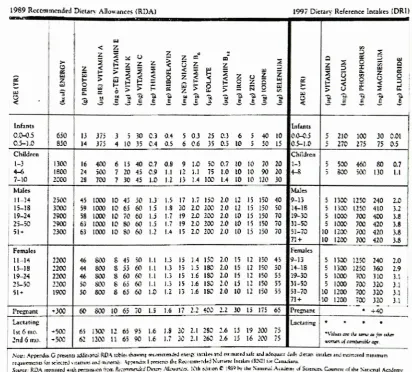
choices to survive and prosper nutritionally on a daily basis ( Table 1).
The USDA Food Guide Pyramid exemplifies a simple way of eating,
ensuring this level of nutrient success without supplementation (Figure
1).
For the typical amateur athlete, the prescribed levels of nutrient
consumption designated for sedentary Americans will in most cases
remain consistent with the addition of additional calories from
carbohydrates and/or protein. (ADA, 2K, Grandjean, 1994,
[image:17.545.42.546.16.734.2]Steinberg,1984 Escott-stump,1996).
Figure 1
The USDA
Food Guide Pyramid
FateOMk i5uils
USPAMftGLY
Ullk,>.ii|iir(A
^yi^
5qq= 4 HW<Q-WflMtiltGrouc
Table RDA
RECOMMENDED DIETARY INTAKES
?
Fwmure thanfiftyveans,nutritioncxpmthaveproducedjsetofnutrientandcnei^ standardsicnou-nastheRecommended Diet;iry Allowances(RDA). Amajor revisionis currentlyunderway toreplacetheRDA. Therevisedrccommeniatkiniare calledDie:arvRewrencc Intake? (DRI)and reflecithecoCabora^ve efc'oruofboAtheUnited SamandCanada Until 1997. theRDAuieretheonlystandard* available andtheyil!continue toserveha:thprcfeMionak untilDR)canbeestaWivhn;for all nurrients.Forrhi? reason,botht'r.e I9S9RDAand tive1997 DR: forsettlednutrient! arepresentedhere.
1989RccwiTncndedDician.AH Bwancti <RDA> 1997Dicui\ Ucfcrcncc In takes i'DRl)
< 2 Z 2 g > tjj H a 1
it o 7. 7 4 s
-> a. s.
i
< >1
z s c "3. > S3 i Z 1 > 1 z > i Z < P -J s M E Li' < 7. Qj /. El E 2 > J s K 1 > -V. C a u U V. E 2 5 g z w tr. 1 s < z 5 9 5 1 Z X s s X E r j: m Z o < i s b! "a E Infants lnf*nu0.0-0.5 6J0 13 373 3 5 10 03 0* 5 0 5 23 03 6 5 40 10 00-0.3 5 2)C 103 J0 001 0.5-!.5 8J0 14 J75 4 (0 15 C.4 0.5 6 0<i 35 0.5 10 5 50 15 05-1.0 i 270 275 75 0.5
Children C'ii
'
}ir:>i
1-3 I3C0 16 400 e 15 40 C.7 OS 9 IX 50 0.7 10 10 70 20 :-) 5 5 W<0 0 0.7 4-6 IfiCO 2 50? 7 20 45 0.9 1 1 12 l.l 75 1.0 10 10 'XI 20 4-S 3 goo soo 110 l.l 7-JO 2XO 28 700 7 30 45 1.0 1.2 13 M 100 1.4 10 10 120 30
Mal M^ra
II -M 2500 45 loco 10 43 SO 1J 1.5 17 1.7 ISO 2.0 12 15 ISO 40 9-15 5 BOO 1250 240 2.C 15-1S 30O0 5!) ICO? 10 65 60 15 IS 20 20 200 2 0 a 15 :SO 50 H-18 5 1500 1250 ''10 3.2 19-I 2500 58 1000 10 70 60 1.3 1.7 19 2.C 200 20 10 15 '.50 70 19-30 5 1000 700 400 5.8 25-50 29O0 63 1000 10 80 60 1.5 1.7 19 20 200 2.0 10 15 ISO 70 32-50 S I0OO 700 420 5.S i 51- 2300 65 ICOD 10 ;0 60 1.2 1.4 15 20 20C 2 0 10 15 ISO 70 51-70
71+ 10 10 1200 1200 70.-; 700 420 420 3.8 , Females Females
! U 14 2203 46 800 & 4) JO l.l 1.5 15 '.4 i?; 2.0 15 12 130 45 9-13 5 1330 225C 2-10 2.0 1 15-18 2200 44 SKI 6 53 60 1.1 1.5 15 U ISC 2.0 13 12 ISO 50 24-18 5 1530 1250 T 2.9 19 24 2203 46 809 8 60 60 l.l 1.5 15 1.6 ISC 2.0 15 12 ISO 55 29-30 5 1000 7.X 310 3.1 25-50 2203 50 ax fc 65 60 l.l 1.3 15 :.b ISC 2 0 13 12 150 55 31-50 5 1000 700 320 32
51+ 1900 50 &X) 65 60 l.C 1.2 13 U ISO 20 10 12 150 >> 51-70 71+ '.C '.0 1200 1200 TOO oc 320 320 3.1 ! 3-2 I
Z'regixinl ->JO0 60 wo 10 65 70 1.5 1.6 17 2.2 402 2.2 20 15 175 65 Presrurtt ( +*0
Lacutinjj Laeminc * *
lit6t*ni>. -502 r-i 1309 12 63 95 1.6 IS 20 2.1 290 7.6 13 19 2C0 75
*V*Jmiere
2nd6ino -503 6.' 1203 II 6; SO 1.6 l.J X 2.1 260 2.4. .: 16 kx ii
1 MCKt exniosiij at*
inirijr-Net?: Anf<?diBC;re*ft! tijuurzRTMubie>sHo*in tTi.*niren.Metetf]irillw.T"*lff.IlKt.uk*rJ*Joj-j.. : dlUJearb>iiVciJn^. *v.iT-.*\<Aa
rBqpimdcfiuWj seje<l*J. *.... inJ <Tt^rati \p-7rwsx1rK! l|i K,*.-i;t>-wsjm#ImikjnI -..-..!InrCiiu.l*IU. Sunt-RDA
nIVIIIICOAlt irrra5J3fivIT.PuCfrwiJt;r>i=r.ABov&ca :,'it, Mtrort K'h m-,jn;f. Ac*i*ni.1
1-.n:..rb..",int-.,,-fib#SknulAc?&RV
[image:18.545.67.480.178.550.2]Nutritional Requirements of Amateur Athletes
The following section examines nutrients and their application for
amateur athletes.
Fluid and Electrolytes
Adequate fluid and electrolyte status is essential during
workouts, training regiments and competitions. Depletion of body
water occurs through respiration and sweating. Inadequate fluid
replacement can lead to a sea of complications including impaired
performance and reduced work capacity. A 10% water loss in the
body threatens circulatory collapse. Most water lost through sweat
comes from the blood. Duration of exercise and degree of strenuity will
dictate to what extent rehydration is necessary.
To avoid dehydration and hypovolemia an amateur athlete must
be conscious of fluid intake. The recommended daily fluid intake is 2-3
liters/day for normal adults. Athletes should additionally consume 16oz
2hrs prior to exercise and 16oz just before exercise. During exercise
4-6oz every 15 minutes to total 26 oz/hr, following with 16oz per pound
lost afterwards.
Bodybuilders and some cyclists are notorious for
dehydrating
precontest strategy is to stop taking fluid and eating carbohydrate
(carbs have lots of water) in an attempt to "shrink wrap"
their muscles
and "cut up". Unwary cyclists may drink only sips of water during long
races to avoid having to urinate in transit. (Grandjean,1994, Steinberg,
1984, Nelson-Steen, 1991)
Electrolytes
Electrolytes lost during moderate exercise lasting 60 minutes or
less will generally require no electrolyte replacement since a normal
diet will supply the required nutrients. Serious events or extreme
conditions require sodium replacement and using sports drinks like
Gatorade will replenish the salt deficit. These sports drinks will also be
helpful in maintaining blood glucose levels. Salt tablets are not
recommended since they may lead to cramping and dehydration.
Vitamins and Minerals
If the diet is adequate, vitamin and mineral supplementation has
no enhanced effect (ADA,2000). Athletes who meet their requirements
for increased energy will also satisfy all mineral and vitamin needs.
Many athletes who eat a prudent diet consume large amounts of
vitamin and mineral supplements and far exceed their needs. Many
athletes take supplements for "nutritional
insurance"
scientific data or the advice of nutritionists or believe they may
possess certain erogenic qualities (Grandjean,l994).
Other"dietary supplements"
taken by athletes that purport to
enhance performance include: Creatine, Androsteindione Glutamine,
and mega-doses of amino acids.
Supplementation, fact or fiction?
ADA Position statement... It is the position of the ADA that the
best nutritional strategy for promoting optimal health and
reducing the risk of chronic disease is to obtain adequate
nutrients from a wide variety of foods. Vitamin and mineral
supplementation is appropriate when well-accepted,
peer-reviewed, scientific evidence shows safety and effectiveness.
(ADA, 1998)
Basically good nutrition comes from diet, not supplements.
Carbohydrates
Glycogen is the storage form of carbohydrate in muscle and
liver. Muscle glycogen is long branched chains of glucose molecules
and are the first source of energy for the exercising athlete. As these
stores become depleted, glycogenosis and gluconeogenesis begin in
Glucose is the preferred source of energy at the sub-cellular
level; exhaustion ensues with the depletion of glycogen and blood
glucose.
This exhaustion, a.k.a. "hitting the wall"
or "bonking" , can take the
form of tiredness, weakness, irritability, fatigue or the inability to
continue training or an event. This can be avoided by increasing carbohydrate intake and by improved timing to insure maximal
benefit.
Athletes who wish to remain "strong" and achieve maximum
repletion should consume 60-70% of their daily kilocalories from
carbohydrates.
One well-known fact is that most athletes don't eat enough
carbohydrates, the primary food for fuel. Most eat diets that contain
only 50% or less of total calories from carbohydrates when in essence
they should get around 70% (Kleiner, 1998). Bodybuilders today tend
shy away from carbohydrates falsely believing them to be fattening
and "puffafying". Most also falsely assume that protein is a major
energy source and that insulin levels should be controlled. Some
cyclists and runners believe that taking carbohydrates in transit will cause cramping and stomach distress. In a marathon race, less than
instead total glycogen depletion may occur during the activity. Sport
drinks are one way of combating low blood glucose levels.
Whatever the case, production of energy during intense
muscular effort depends mostly on availability of muscle glycogen and
blood glucose (Costill, 1990). A number figure of 6-10g of carbohydrate
per kilogram of body weight would be appropriate with respect to the
daily diet. This range allows for variance in intensity of exercise (ADA,
2k).
Fat
Fat is the fuel best suited for low to moderate activity. There are
plenty of fat stores in adipose tissue. Fat burns in the flame of
carbohydrates. With prolonged exercise, free fatty acids are released
from adipose tissue and can be used by muscle for fuel. Training over
65% of V02max increases the amount of carbohydrate needed. So, at
a moderate endurance level fat stores will be utilized along with
carbohydrate.
Fat in take should remain at 25% of total caloric intake or less.
Eating more fat will not help an athlete get more energy. High fat diets
are linked to heart disease. Many athletes follow high calorie diets that
Protein
The literature available generally points to the conclusion that
athletes need approximately 50-100% (l-1.6g/kg [a kg is 2.2lbs])
more protein than the current RDA (0.8g/kg). Protein is used for tissue
repair as well as in the formation of enzymes, hormones, antibodies,
and various fluids/ secretions. Proteins also participate in transport
within the circulatory system and contribute to homeostasis by
maintaining osmotic relations between body fluids.
More is once again not necessarily better. Eating more than the
calculated amount needed may produce baleful results. If consumed in
excess of caloric needs, protein is stored as fat, not muscle. As excess
proteins are broken down the nitrogen component must be excreted
via the urine and takes much water with it. This can cause strain on
the kidneys and may cause dehydration. Adequate protein intake
spares carbohydrates and visa-versa.
This concludes the section that examines the nutritional
requirements of Amateur Athletes. As noted, anecdotes from case
studies were intertwined with the information to create a "real time"
reading of some of the perceptive dietary discrepancies prevalent in
today's athletes.
Here is a summary of nutritional requirements of Athletes as discussed
Table 2 Nutritional requirements of Amateur Athletes
65/15/20 % breakdown CHO/Protein/Fat 60-70% CHO
15% protein (l-1.6g/kg)
15-25% fat
water 2-5L or more depending on exercise conditions vitamins/minerals see RDA Table 1
Misinformation
How would an amateur athlete distinguish one claim from another
or understand what information is true, false or questionable? First off
quackery and false information makes claims that sound too good to
be true, e.g. "take this pill and you'll run twice as fast". Quacks also
belittle the food supply. Quacks use false case histories, testimonials,
and subjective evidence to support their claims.
Identifying qualified nutrition sources is a simple procedure that
looks to scientific evidence for the truth. Scientists test ideas with
documented, controlled experiments and report in scientific journals.
They refrain from using generalized, anecdotal evidence or
testimonials.
Although the mainstream media can report true information,
credible sources include: The Federal Trade Commission, Food & Drug
Administration, United States Department of Agriculture, American
Association, American Medical Association and the society for Nutrition
education.
Misinformation will generally contain the following failings...
1. Too good to be true
2. Suspicious about food supply
3. Testimonials
4. False credentials
5. Unpublished studies
6. Persecution Claims
7. Un-cited authors
8. Motive: personal gain
9. Advertisement
10. Unreliable Publication
11. Logic without proof
Misinformation terms include anecdotal evidence, fraud, and quackery.
Case Study
Over the years myriad case studies have been published in
peer-reviewed journals throughout the world. The ensuing section will
recapitulate the salient facts of a few published cases and relate them
to the problem of perception in regards to nutrition matters, keeping
speculation to its'
This quote is offered to help set aside bias in review of case
study...
One must beware of the temptation to assume the contents of
everyone else's consciousness are like one's own; that, as
Thomas Hobbes puts it, 'whosoever looketh into himself...shall
thereby read and know what are the thoughts and passions [and
sense data] of all other men, upon like occasions'. Many errors
have been made by proceeding from this premise. (Mundle, 1971)
Study 1: In-Season Dietary Adequacy of Trained Male
Cross-Country Runners. (Niekamp & Baer, 1995)
The purpose ofthis study was to analyze the dietary adequacy of
a dozen collegiate cross-country
runners'
in-season. The opening
remarks of this study tout the nutritional guidelines mentioned earlier
in this exercise, expressing the "well known fact" that athletes
involved in intense daily training must consume a high-carbohydrate
diet to maintain optimal training and competitiveness. Pre- event
feeding should consist of -200-250 grams of CHO 2-3 hours prior to
the race to ensure maximum potential.
Post-exercise carbohydrate replenishment is quite important in
glycogen repletion and should contain the same amount as the
pre-exercise meal and begin within 2 hours after the event or training.
Remember our ratio of CHO/protein/fat... 65 or better/15/20.
The 12 runners were studied using the following scientific
methods. Dietary information was collected utilizing two 4-day diet
present and helped to clarify dietary matters during practice time.
Nutrients were analyzed and the findings were as follows in table 3.
Table 3 Macronutrient composition of Pre- & Post Competition Meals Time (hr) o/0 CHO % Protein % Fat
Pre Competition 3-4 71.7 6.7 22.2
Post Competition 2.5 48.5 17.8 33.3
As reported in Table 3, the ratio and timing of nutrients both pre
and post is unacceptable. Also weight quantities were reported to be below acceptable limits (82g CHO pre and 176 post). Fat consumption
was high post-competition due to the nature of food consumed (fast food). One positive aspect of this study is that the athletes consumed
plenty of calories daily and received an adequate amount of
micronutrients.
In this study it would appear that TV ads and peer pressure/
advice may be more accepted over the consult and suggestions of coaches, nutritionists and parents. This may be due to athletes'
just not paying adequate attention to nutrition.
Study 2: Diet and Weight Changes of Female Bodybuilders Before
Bodybuilding requires low body fat for increased muscularity.
Bodybuilders especially women become obsessed with food and are
more likely to use laxatives for weight control.
This examination looked into the nutritional and body weight
trends of six competitive amateur female bodybuilders. Scientific
evidence was compiled employing diet history, body weight and urine
samples as well as menstrual cycle information. Women with low body
weight and body fat tend to become a-menses.
All the subjects lost weight prior to competition by reducing CHO
and fat intake thus effecting overall caloric intake. All subjects gained
weight post-competition by doubling intakes of CHO and protein
coupled with a tenfold increase in fat consumption. Menstrual
interruption was common and tests revealed abnormal reproductive
hormone profiles.
In summation the women in this study practiced extremely
restrictive dietary practices pre-competition causing severe weight
loss. Post-competition they gained the lost weight back very quickly.
This rapid up and down weight disorder is called weight cycling. This
disorder could lead to a reduction in resting metabolic rate and
Case 3 Precontest Strategies of a male body builder.
(Nelson-Steen. 1991)
A 25 year old male bodybuilder's diet was studied as he prepared for a
contest. Accurate food records were kept over a six-month period that
included the bulking-up phase, weight reduction phase, and contest
time. Throughout training he ingested anabolic steroids (a subject
worthy of its own theses) and various other substances and
supplements unnecessary due to the quantity of food ingested.
During the first phase of training bulking-up requires strenuous
training and a high caloric intake that is low in fat. Food intake took
the form of a rigid and monotonous drudgery. The only food he ate
was lean poultry, tuna, egg whites, brown rice, pasta, cereal, banana
baby food, tea and water. These foods were eaten in combinations 5
times a day.
He was very accurate at keeping records since a more
experienced bodybuilder prescribed this diet and instructed him to
always keep accurate records. Average daily caloric intake was
4200kcal with 8.7g/kg body wt CHO and 2.8g/kg protein. The RDA for
these nutrients was exceeded through diet alone.
As the contest drew near the bodybuilder reduced carbohydrate
intake in a bid to lose weight and preserve muscle. Average daily
2.7g/kg protein. During this restriction of food he reported
feeling
irritable and difficult to get along with. As the starvation continued he
claimed that "personal relationships are impossible to cope
with."
Three weeks prior to the contest, the subject began eating
haddock, rice or potato every 2 hours and averaged 4g/kg protein
daily. During this pre-contest phase intake was restricted further and
fat was all but eliminated from his diet. Water and salt were also
severely restricted in a bid to "cut-up." Only 2 cups of distilled water
were allowed for the first 3 days of this phase then only 8 oz. per day
until the competition. The day after he ate a whopping 5500kcal
consisting mainly of fatty junk foods and beer.
Most of the information that the subject acted on was provided
from a more experienced successful bodybuilder. This "Grand
fathering"
of information is discussed in the next section.
Misinformation from articles in popular muscle magazines and from
"nutrition stores"
also helped to form misconceptions and dangerous
habits. Many of these bizarre practices might put him at risk of future
The Grandfather Dilemma
For as long as one can remember nutritional information has
been "grand fathered"
from experienced athletes to their green and
naive counterparts. These "wet behind the ears"
up and comers are
thirsty for information and will swallow any notion that they believe
will make them better, faster, or stronger. This is evident in the vast
profitability and volume sold of sports nutrition supplements.
According to Tom Renner, the proprietor of two popular health
and fitness facilities in the Rochester NY area, the struggling amateur
athlete will ask the biggest and strongest weight lifters their opinions
on how to grow larger. These "grandfathers" often make un-sound
nutritional and training advice. Most often the nutritional claims
constitute cause and effect scenarios that go against scientific study or
take the form of the "more is better" school of thought. The more is
better law when applied to nutrition states that if a nutrient or
substance is good and works, then more is better.
Currently, amateur athletes may be throwing their money away
on useless supplements. Several of the latest popular supplements on
the market are of little or no value nutritional and are quite expensive.
On the other hand some may be quite detrimental to health if taken in
large enough quantities. Still others are not proven safe and may
Renner continues... "the crux of this problem is not whether or
not the seasoned athlete is right or wrong, but that the information
gets twisted, misreported or passed on incorrectly and the
undiscriminating amateur athlete becomes brain washed. The amateur
athlete becomes so sure that the schemes of the veteran athlete are
so 100% sound that no amount of contrary evidence can sway
them."
(Renner,1999) Popular training magazines may substantiate this
advice or offer other biased opinion of supplement companies who
advertise in said magazines and may even write some of the articles.
Grandfathering is a prevalent form of communication in most
sports today. It is the most direct way for amateur athletes to receive
information. The time spent while training with other people create
bonds of trust not easily broken.
Summary
This review of the literature traversed many aspects of sports
nutrition as it pertains to the amateur athlete. The Section began by
reviewing the necessary nutrients and reviewing established
guidelines, examined forms of misinformation and included 3 case
studies and a direct interview conducted by this author. This
examination of the body of written work produced by scholars and
researchers in the field of nutrition will help to shed light on the
Nutritional Conclusions formed in the literature review.
Summary of Nutritional requirements of Athletes as discussed in the first section...
Table 2 Nutritional requirements of Amateur Athletes
65/15/20 % breakdown CHO/Protein/Fat
60-70% CHO
15% protein (l-1.6g/kg)
15-25% fat
water 2-5L or more depending on exercise conditions
vitamins/minerals see RDA Table 1
Three Pertinent Ideas
1.) Misinformation rampant in today's nutritional climate whether it be
via media or transmitted by word of mouth.
2.) A considerable number of athletes are not following recommendations of the scientific community.
3.) Amateur Athletes could learn to exhibit sound nutritional
tendencies if taught by nutritional professionals.
The following section will explain the methodology utilized in this study
in regards to the previous statements and information given.
III.
Methodology
Procedures
This study will poll amateur athletes by questionnaire and
complete a 24-hour recall. Questions would focus on nutrients and
their role in nutrition in addition to sources of information used by the
athletes. The results would be tabulated and compared to acceptable
To follow up on this promise, the studies'
questionnaire was
designed to unearth the information necessary to ratify or deny the
hypothesis. That means questions that pertain to the matter at hand.
Furthermore, the bias dial was set to neutral to remove any threat of
skewed results. Questionnaire design thoroughly covers the points in
table 2.
Considerations
a. Exactly what information is required and who are the target
respondents.
> Amateur Athletes w/ 7+ hours of training per week
b. Method of communication: Verbal interview
c. Factors concerning question content.
> Necessity and sufficiency of question content
> Can and will the respondent answer each question correctly
> Internal/ external bias
> Question phrasing and unstated assumptions
The design was designed to relate the collected information in a
qualitative manner. In gender fairness, ten males and ten females
were questioned.
The Questionnaire
The questionnaire used in this study follows on the next page,
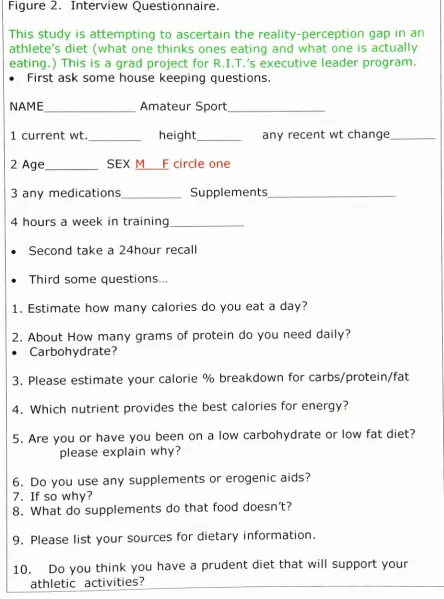
Figure 2. Interview Questionnaire.
This study is attempting to ascertain the reality-perception gap in an
athlete's diet (what one thinks ones eating and what one is actually
eating.) This is a grad project for R.I.T.'s executive leader program.
First ask some house keeping questions.
NAME Amateur Sport
1 current wt. height any recent wt change
2 Age SEX M F circle one
3 any medications Supplements
4 hours a week in training
Second take a 24hour recall
Third some questions...
1. Estimate how many calories do you eat a day?
2. About How many grams of protein do you need daily?
Carbohydrate?
3. Please estimate your calorie % breakdown for carbs/protein/fat
4. Which nutrient provides the best calories for energy?
5. Are you or have you been on a low carbohydrate or low fat diet?
please explain why?
6. Do you use any supplements or erogenic aids? 7. If so why?
8. What do supplements do that food doesn't?
9. Please list your sources for dietary information.
10. Do you think you have a prudent diet that will support your
Rationale for Questioning.
To begin the interview, the interviewer begins with a statement of
purpose in an attempt to inform the interviewee as to the reason
behind the interview and to disable extraneous discussion while the
interview takes place.
Section one: the questionnaire asks basic demographic questions
like name, age, gender, weight, height, weight change, meds,
supplements, and hours a week in training. Name, age and gender are
purely ranking questions. Height and weight will help in determining
prudence of diet. If one is over or under weight for their height,
prudence of diet can be decided. Significant weight change ( 25lbs)
can indicate eating disorders or other problems. Ascertaining
consumption of medications and supplements will assist in the
"reasons for" category. Amateur sport and hours a week in training will
let the interviewer reiterate if the respondent is indeed qualified to
continue.
Section two: Usual 24 hour recall. A 24 hour recall is a method of
determining the food consumption in a 24 hour period. With this
information, a dietetics professional can compare actual data to the
remarks ofthe subjects. This will be the gap between perception and
Typically, the questioner begins with "what is the first thing you
have to eat or drink in the day?"
As the interview progresses,
quantities are specified and descriptions made. Here is an example of
the results of a 24 hour recall (Table 4).
Table 4. Actual 24-hour recall of "Joe'
time quantity item
8:30a lea bagel
2T peanut butter
9:30a lea "Pure Protein bar"
12
noon
2ea bagel
1 can Tuna (white albacore water pack)
12ea Baby carrots
4:30p lea "Pure Protein bar"
8:00p 1 can Tuna (white albacore water pack)
12ea Baby carrots
The information obtained from the 20 subjects was then entered
into West Diet Analysis and became the basis of building the difference
between perception and reality when compared to questions asked in
part three as well as a FGP analysis. West Diet Analysis is a computer
program that allows the user to computate amounts of nutrients
quickly by entering the names and quantities of foods consumed.
There are many such programs on the market. West was chosen due
[image:38.545.49.485.188.440.2]Part three: some questions. The first three questions ask the subject to estimate dietary intake in numbers and percent. When comparing to actual results a 10% will be allowed as the range.
Question 1 asks... Estimate how many calories do you eat a day.
This discovers if the athlete knows how much he/she is eating and can
be compared to the diet analysis results directly.
Question 2 A. About how many grams of protein do you need daily? B. About how many grams of carbohydrate do you need daily? Question 3 Please estimate your % breakdown for CHO/protein/fat. These questions will test the athlete to determine if they know the amounts of these key nutrients they need to ingest for optimal
performance and can be compared to the diet analysis results directly.
Question 4 Which nutrient provides the best calories for energy? The correct answer is carbohydrate. This question will determine if the player know anything about nutrient usage and energy is key to sport performance.
Questions 5 thru 9 will help determine if the athlete is following a fad
fathered information. This will allow the study uncover the reasons for
prudent and non-prudent dietary practices.
Question 10 asks the subject to directly judge their diet. This also can
be compared to the diet analysis results.
The interviews
The 20 interviews were completed with no variance from the
questionnaire, in a non-leading fashion. Fifty percent of the
questionnaires for each gender group were completed in person and
the other half via landline. This was strictly a matter of convenience
for the parties involved. No difference in result quality could be
distinguished.
The subjects were chosen from the membership at Flex Gym on
Rochester New York's east side. The interviewer "asked
around"
during
peak hours about which members were involved in amateur sports.
The interviewer then made appointments for interviews. In most all
instances, the interviewer was familiar with the interviewee and was
IV. Findings
Analysis of data
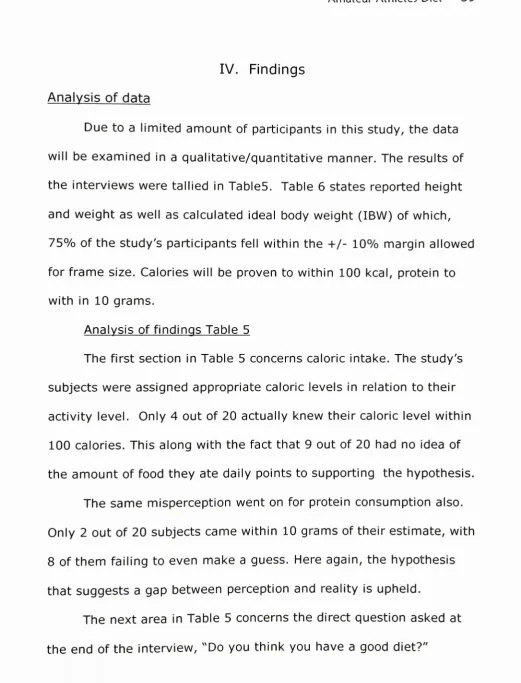
Due to a limited amount of participants in this study, the data
will be examined in a qualitative/quantitative manner. The results of
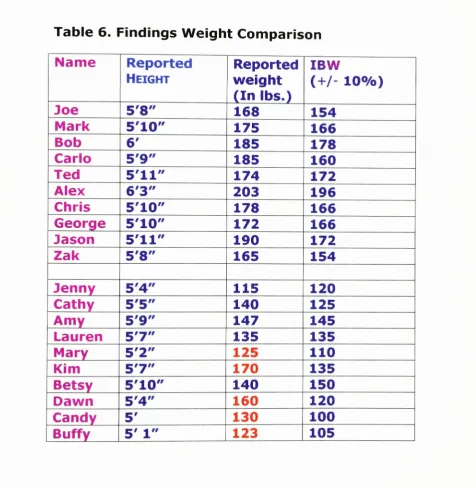
the interviews were tallied in Table5. Table 6 states reported height
and weight as well as calculated ideal body weight (IBW) of which,
75% of the study's participants fell within the +/- 10% margin allowed
for frame size. Calories will be proven to within 100 kcal, protein to
with in 10 grams.
Analysis of findings Table 5
The first section in Table 5 concerns caloric intake. The study's
subjects were assigned appropriate caloric levels in relation to their
activity level. Only 4 out of 20 actually knew their caloric level within
100 calories. This along with the fact that 9 out of 20 had no idea of
the amount of food they ate daily points to supporting the hypothesis.
The same misperception went on for protein consumption also.
Only 2 out of 20 subjects came within 10 grams oftheir estimate, with
8 of them failing to even make a guess. Here again, the hypothesis
that suggests a gap between perception and reality is upheld.
The next area in Table 5 concerns the direct question asked at
the end of the interview, "Do you think you have a good
[image:41.545.11.533.30.714.2](71 =3 03 LT> .O 03 c C 01 CD
V. to F 0* rn O
w 5 :. > >- m3 >^ J
o
X5 l. > 4-<
ro o > m > OJ F a> .> 0) <v
-- a: ro "O L. a u <u cn <J u r u
< W o CO L r- 3 r-i IX. o co 5 a to O LO 3 a: O X o I o CO o X
a (A (A
0 (A <A0 (A
(A 0
(A (A (A (A <3i
(A
> O
(A
O O (A(1) (A (A
1)
(A
> >- z > > >- >- >- >- >- >- z >- z z >- > >- >
Ss
Ao W
8
IA (A01 (A O8
<A (A3
o O (A (A (VO-O > z > > >- > r*. > > z >" > y > z >" z >
>-Oi
c E
J-"3 *j (A 51 M_ LL LL > LL J-> ro
E
>. >
>
yr
4-1
y E ^2 >.
-11 ^5 4-* ro ID (J >
5.2 2: 2: LLro LL > 2: O < z LL > >
c
O fj > sf sf
a. (A
(9 o o o o o O <D o o O o O o O O o 0 o o o
u_ * z z z z z >- z z Z z Z z z z z z z z z
c OJ
o
CL
VO LP) c
<a-UD CM tH rx o GO
v cn r^ r>. fN in cn tH v> Cn cn \D 00
tf-"<t fNI tH rM cn ro LO .o
< o- T-l rH T-i rH rH tH iH rn cn OJ y> CO cn rv T-l <> rv MD
ai
c OJ
o O O o
-LD
to t: m o o CM O LO CO o O CM o O
LU Q. rN iX) T-l T-i t-H fX. f>- <N t\. rH r-- \) o- U3 o-- r- r^- CO 0
* IN o ro (0 in O IS ro IN IN M IN o ro O to IS, rH
OJ cn to to ro IN in Cn ro 00 IN ^"
ro IS m o 00 in H H 00 00 M rs ro 00 ro Cn 00 (0 ro O rt H IS ro iH in in IN IN IN IN ro ro CM IN IN IN H IN IN IN IN iH IN IM IN IN
O O o O o o o O o o o
O in o O o o o o o o
00 IS in rs 00 IN o 1-1 in IN in
IU aIN IN IN IN ro o. r* IN O- M Pi. r IN o. O. o. IN (\. IN IN
is
O o (0 N IN o 00 (0 to IS H o O (0 m in so o Sf N in IN in m 00 M ro in IN <0 ro ^,t o IS a> IS
1/5
00 0* 0> o is o 00 00 o 00 01 o H O 00 IN o H o at IN CM IN ro ro M IN IN ro N H IN IN IN r4 IN tN IN IN -iJ
C
0>
E 1> A
o
"O X
-C
c > 3
:.--E (A C >
^
(0 o o ro (W JC .
ro ,. ro
ro ro 01 ro ro 3
z 5. CO u H < u u> n N n U < -J 2. ^ (0 0 U CO
c E o U a. C ^ l-H S P- c .E (A u (A 4-' ._ TO (A 10 ro = t 14 ro *-.2 O "-^ T3 Ol II CL O i_ cn c o QJ 4-1 to OJ i* 'c cn LO c o to to CD 4-> f-(D .r cn CD CD CJl C >- (U
C CTi >
At this juncture only 4 out of 20 could answer this question
correctly. When the diets were analyzed according to the USDA Food
Guide Pyramid, again perception had gone astray. Most all the
contestants ate an unbalanced diet deficient in one or more categories
contained in the FGP. Only 1 of 20 ate prudently. 3 others knew they
ate poorly and replied correctly. The results are plain as the nose on
your face. Again the hypothesis stands alone on it's own two feet.
Last and least, 75% of the bunch reverted to supplements to
obtain better nutrition when all could have eaten regular food instead.
Most thought that "better living through chemistry"
would help them.
Reasons ranged from being sure to get all vitamins and minerals to
being to lazy to cook or purchase real food.
Question 9 concerning sources of dietary information revealed
startling information concerning the where with all how these
American Amateur Athletes decide to consume nutrients and energy.
Keeping with previous results, there are those who operate in a
knowledgeable fashion by accessing proven journals, periodicals,
experts in the field, college courses, and textbooks. But as the
hypothesis stated, the overwhelming majority looked to peers,
unqualified trainers, TV infomercials, un-substantiated books,
magazine and Internet articles, and
[image:44.545.8.485.132.621.2]misleading package labels.
Table 6. Findings Weight Comparison
Name Reported Height Reported weight (In lbs.) IBW (+/-lOo/o) Joe 5'8" 168 154 Mark 5'10" 175 166 Bob 6' 185 178 Carlo 5'9" 185 160
Ted 5'11" 174 172
Alex 6'3"
203 196
Chris 5'10"
178 166
George 5'10" 172 166
Jason 5'11"
190 172
Zak 5'8"
165 154
Jenny 5'4" 115 120
Cathy 5'5" 140 125
Amy 5'9" 147 145
Lauren 5'7" 135 135
Mary 5'2" 125 110
Kim 5'7" 170 135
Betsy 5'10" 140 150
Dawn 5'4"
160 120
Candy 5' 130 100
V. Conclusion
As a result of this study, it is demonstrated, unequivocally, that there
is indeed a perception gap between what an amateur athlete thinks
they are eating and what an amateur athlete is
actually eating. Hence,
a gap between perception and reality has been shown to be open.
Also as a result ofthis study it has been determined that this is gap is
due to rampant misinformation assimilated from sources stated above.
Implications
Since the results of this study show a gap between perception
and reality caused by the rampant dissemination of misinformation, it
would lend the suspicion that the perpetrators of this disservice for
reasons of fame or fortune are acting inappropriately. This shores up
the skepticism surrounding for-market press and belittles the grounds
for "Grand fathering" information.
The discovery of this problem and its implications points at
health professionals to be on watch when mouthing unsubstantiated
opinion and innuendo. When in contact with the public at large
appropriate measures should be swiftly taken to ensure future safety
This study also holds momentous opportunity for the de-facto
amateur athlete at large. Hearing the call and summoning the courage
today's amateur athlete can set aside false prophets and rest assured
that her or his nutrition can be obtained in a balanced and prudent
manner.
Recommendations for Further Study
Further study may be deemed apropos if a larger sample
population is necessary to open the eyes of nay Sayers across the
fruited plain and beyond. Perhaps the health professional and the
advertising executive could be placed vis-a-vis to show the gap
between truth and fiction or documented study and the whims of
frustrated salesmen.
As before mentioned further study may be desirable to cement
the foundation between dietetics professionals and the community. If
research were to continue and spread into more specialized and
categorized niches, the results could bolster more knowledge of the
subject and help arm the professional community in combat against
Reference List
1. American Diet Association. (1996). Manuel ofClinical Dietetics.
Chicago: Chicago Dietetic Association, South Suburban Dietetic
Association.
2. Grandjean, Ann EdD. & Ruud, J. MS RD. (Jan 94). Nutrition for
Cyclists. Clinical Sports Medicine, Vol. 13 #1, 235-247.
3. Steinberg, M. (1984). Nutritional Needs of Female Athletes. Clinics
in Sports Medicine, Vol. 3, #3, 649-670.
4. Escott-stump, S & Mahan, L. (1996). Krause's Food, Nutrition, &
Diet Therapy. Philly: Saunders.
5. Kleiner, Susan M PhD RD. (1998). Power Eating. Champlain III:
6. Coleman Ellen RD, MA, MPH. (1997). Eating for Endurance. Palo
Alto Ca: Bull Publishing.
7. Nelson-Steen, Suzanne. (1991). Precontest Strategies of a male
body builder, fnternational Journal ofSport Nutrition. Jan 69-78.
8. Costill, David L, Ph.D. (1990). Medical aspects of nutrition,
Carbohydrate for Athletic Training and Performance. Contemporary
Nutrition, Vol. 15, 350-353.
9. Mundle, C. (1971). Perception: facts and theories. NY: Oxford
University Press.
10. Volek J et.al. (1997). Creatine supplementation enhances
muscular performance during high-intensity resistance exercise.
Journal ofthe American Dietetic Association, 97:765-770.
11. Niekamp R & Baer J. (1995). In-Season Dietary Adequacy of
Trained Male Cross-Country Runners. InternationalJournal ofSport
12.Walberg-Rankin et al. (1993). Diet and Weight Changes of Female
Bodybuilders Before an After Competition. International Journal of
Sport Nutrition, 3, 87-102.
13. Interview. Tom Renner, Flex Gym/ Nautilus of Pittsford