City, University of London Institutional Repository
Citation
:
Endress, A. and Szabo, S. (2017). Interference and memory capacity limitations. Psychological Review, doi: 10.1037/rev0000071This is the accepted version of the paper.
This version of the publication may differ from the final published
version.
Permanent repository link:
http://openaccess.city.ac.uk/id/eprint/17003/Link to published version
:
http://dx.doi.org/10.1037/rev0000071Copyright and reuse:
City Research Online aims to make research
outputs of City, University of London available to a wider audience.
Copyright and Moral Rights remain with the author(s) and/or copyright
holders. URLs from City Research Online may be freely distributed and
linked to.
Ansgar D. Endress
Department of Psychology, City University, London, UK
Szil´
ard Szab´
o
Department of Mathematics, Budapest University of Technology and Economics, Budapest, Hungary
Abstract
Working memory (WM) is thought to have a fixed and limited capacity. However, the origins of these capacity limitations are debated, and gen-erally attributed to active, attentional processes. Here, we show that the existence of interference among items in memory mathematically guarantees fixed and limited capacity limits under very general conditions, irrespec-tive of any processing assumptions. Assuming that interference (i) increases with the number of interfering items and (ii) brings memory performance to chance levels for large numbers of interfering items, capacity limits are a simple function of the relative influence of memorization and interference. In contrast, we show that time-based memory limitations do not lead to fixed memory capacity limitations that are independent of the timing properties of an experiment. We show that interference can mimic both slot-like and continuous resource-like memory limitations, suggesting that these types of memory performance might not be as different as commonly believed. We speculate that slot-like WM limitations might arise from crowding-like phe-nomena in memory when participants have to retrieve items. Further, based on earlier research on parallel attention and enumeration, we suggest that crowding-like phenomena might be a common reason for the three major cognitive capacity limitations. As suggested by Miller (1956) and Cowan (2001), these capacity limitations might thus arise due to a common reason, even though they likely rely on distinct processes.
Keywords: Working memory; Interference; Temporary Memory; Memory Capacity
Introduction
A central tenet of the cognitive neurosciences holds that working memory (WM)
ca-pacity is severely limited, typically to about four items (Miller, 1956; Cowan, 2001; for re-views, see e.g., Conway et al., 2005; Cowan, 1995, 2005). These memory capacity limitations
have profound effects on many aspects cognitive processing, and WM capacity correlates
with various measures of language comprehension, reasoning, educational achievement and even general intelligence (e.g., Barrouillet, 1996; Conway, Kane, & Engle, 2003; Daneman
& Carpenter, 1980; Daneman & Green, 1986; Engle, Tuholski, Laughlin, & Conway, 1999; Engle, Carullo, & Collins, 1991; Engle, Cantor, & Carullo, 1992; Fukuda, Vogel, Mayr, &
Awh, 2010; King & Just, 1991; Kyllonen & Christal, 1990).
While there is a general agreement that WM is limited, there is substantial debate
on why it is limited. For example, is WM better characterized as a set of discrete memory “slots” in which items can be placed (see, among many others, Cowan, 2001; Hartshorne,
2008; Luck & Vogel, 1997; Piazza, Fumarola, Chinello, & Melcher, 2011; Rouder et al., 2008;
W. Zhang & Luck, 2008) or rather as a continuous resource (e.g., Alvarez & Cavanagh, 2004; Bays & Husain, 2008; van den Berg, Shin, Chou, George, & Ma, 2012; Just & Carpenter,
1992; Ma, Husain, & Bays, 2014)?
Specifically, many authors hold that memory capacity limitations stem from active
processes that allow a limited number of items to be encoded in an all-or-none fashion, and that these processes rely on some form of attention (e.g., Cowan, 1995, 2005; Conway
& Engle, 1994; Kane & Engle, 2002; Oberauer, 2002; Rouder et al., 2008). For example,
on the person) because we remember them by attending to them, and we have an attentional
capacity of only 3 or 4 items. When we have to remember more items, we pick 3 or 4 of them, attend to those, while the rest does not enter WM. This is because, following Miller’s
(1956) suggestion that different cognitive capacity limitations might have a common source,
WM, subitizing and parallel individuation might all rely on a system of parallel attention such as the one proposed by Trick and Pylyshyn (1994) (Cowan, 2001; see Cowan, 2015 for
a historic overview, and Piazza et al., 2011, for a recent discussion of this model). According
to such views, WM is better characterized as a set of discrete memory slots, and these slots are made available by a parallel attention system.
However, the evidence for the role of such active, attentional processes in WM is mixed, and seems to depend on the type of experiment used to measure WM capacities.
While there is little doubt that WM tasks such as complex span tasks are effortful and
require active manipulation of items (see e.g. Engle, 2002, for a review, but see Oberauer, Lewandowsky, Farrell, Jarrold, & Greaves, 2012, for an interference-based model of such
tasks), other WM tasks such as the change detection paradigm (see below) show little to no
interference with tasks testing parallel attention (e.g., Fougnie & Marois, 2006; Hollingworth & Maxcey-Richard, 2013; H. Zhang, Xuan, Fu, & Pylyshyn, 2010).
Accordingly, other scholars propose that WM is a continuous resource that can be
utilized either for processing or for temporarily storing a limited number of items with
varying precision, and that this resource can hold fewer items when more detailed memory representations are required (e.g., Alvarez & Cavanagh, 2004; Bays & Husain, 2008; van den
Berg et al., 2012; Just & Carpenter, 1992; Ma et al., 2014). Still other scholars propose
interpretations ( ¨Oztekin & McElree, 2007; ¨Oztekin, Davachi, & McElree, 2010). Specifically,
these authors propose that we can keep a single item in the focus of attention (and hence in WM), but that all other items need to be retrieved from LTM.
Based on these discrepant data, we believe that is important to identify the
psycholog-ical mechanisms that are responsible for memory capacity limitations. Here, we contribute to this goal by showing what isnotdiagnostic of the underlying psychological mechanisms:
the existence of capacity limitations and their mathematical form. Specifically, we provide
mathematical proofs that, in the presence of interference among memory items, fixed and finite memory capacity limitations are largely a mathematical consequence of the presence
of interference even in the absence of active maintenance mechanisms (that are generally
as-sumed to explain capacity limitations), and that interference-based capacity limitations can mimic the signatures of both slot-based and resource-based capacity limitations. We will
then speculate under which psychological conditions either type of memory limitation might be observed, and suggest that the three major cognitive capacity limitations — WM, parallel
attention and subitizing — might have a common source even if the underlying mechanisms
are different: All three capacity limitations might be due to interference among items, but the interference might take place among distinct representations that might not be shared
across capacities.
Slot- vs. resource-based models of WM
In the last years, the strongest evidence for fixed WM limitations in terms of the
number of items arguably came from research on visual WM, especially since Luck and
view an array of items (e.g., color patches) for 100 ms, and then view another array. They
have to decide whether or not the two arrays are identical. Results show that performance is at ceiling for array-sizes up to 3, and then decreases for greater set-sizes. Participants’
memory thus seems to be capacity-limited as predicted by a slot-model. In this and the
following literature, fixed and limited capacities have thus been used as diagnostic of slot-like memory representations vs. continuous resource-slot-like representations, often based on
sophisticated mathematical analyses (e.g., van den Berg et al., 2012; Rouder et al., 2008;
W. Zhang & Luck, 2008).
However, the psychological interpretation of either type of model is not always clear.
First, despite the sophisticated mathematical analyses, such analyses can sometimes be ambiguous. For example, W. Zhang and Luck’s (2008) influential slot-based model turns
out to be mathematically equivalent to a continuous resource-based model with slightly
different assumptions (see Appendix A). Second, and as mentioned above, the slot-based model has a clear, parsimonious and elegant interpretation, where WM, subitizing and
parallel individuation might all rely on the system of parallel attention proposed by Trick
and Pylyshyn (1994). However, given that taxing visual parallel attention does not seem to impair visual WM (e.g., Fougnie & Marois, 2006; Hollingworth & Maxcey-Richard, 2013;
H. Zhang et al., 2010), a parallel attention system cannot be the basis for memory limitations either.
With respective to resource-based models, it is not always clear what these resources represent psychologically. In fact, memory capacity limitations can have a variety of sources,
and sometimes appear in surprising contexts. For example, Nairne and Neath (2001) asked
completed a filled 5-min retention interval, participants were given a surprise memory test
for the lists. They had a span of about 5 items for each list — although the lists were encoded into long-term memory (LTM).
We thus believe that it is important to identify the cognitive mechanisms responsible for WM limitations. To start this endeavor, we show below what isnotdiagnostic of the
un-derlying cognitive mechanisms: the mathematical shape of the capacity limitations. Based
on assumptions that amount to little more than the definition of interference, we provide mathematical proofs that fixed and finite capacity limitations are a natural consequence
of the existence of interference among items, even in the absence of active maintenance
mechanisms. We then show that interference-based capacity limitations can mimic both continuous-resource models and slot-based models, suggesting that these models might not
be as distinct as commonly believed, and that the same psychological mechanism can
re-sult in either response profile. We then speculate about the psychological conditions under which interference might lead to slot-like limitations, and suggest that capacity limitations
in WM and parallel attention might be due to a common principle — representations that
are nearby in (representational) space might interfere with each other. We also prove that memory limitations based on decay do not lead to fixed capacity limitations across retention
intervals, though they do lead to fixed an finite capacity limitations as long as the timing properties of an experiment are kept constant.
The claim that interference is sufficient to produce memory capacity limitations even in the absence of active maintenance should not be interpreted as more general claims
that attention plays no role in WM. In fact, there is substantial evidence that attention is
Craik & Lockhart, 1972; Lepsien & Nobre, 2007; Majerus et al., 2014; Morey & Bieler, 2013;
Vergauwe, Camos, & Barrouillet, 2014). Rather, we show that attention is not necessary to account for fixed and finite memory limitations, and that the involvement of attention,
as well as the cognitive mechanisms that can lead to slot-like representations, need to be
established from psychological manipulations. Further, while our work is primarily inspired by research on visual WM, the proofs apply to memory in other modalities as well.
Memory and interference
Interference has long been known to play a crucial role for memory limitations. For example, in an experiment testing memory for numbers, participants might hear the list 4
7 2 3 9. . . and then the list 5 3 8 6 1. . . , and have to decide whether the number ‘2’ was in
the second list. Participants thus face the problem to decide that ‘2’ was not in the current list, although it was in previous lists. In other words, there is interference with other items
in memory. This type of “proactive interference” (PI) is such a pervasive feature of WM
experiments that some authors proposed that the function of WM processes is to counteract it (Engle, 2002), and the role of interference is central to several computational models of
WM (e.g., Oberauer et al., 2012; Oberauer & Lin, 2017; Sengupta, Surampudi, & Melcher, 2014). Further, even a single previous item can lead to massive interference (Keppel &
Underwood, 1962), while, when interference is minimized, virtually no capacity limitations
are observed (Endress & Potter, 2014a). Accordingly, memory capacity estimates are much larger when observers can recall objects embedded in a naturalistic scene (e.g., the objects
found in a kitchen presented in a picture of a kitchen), presumably because the objects’
Melcher, 2001). Further, it has been shown that the ability to deal with interference in WM
task predicts measures of intelligence (e.g., Braver, Gray, & Burgess, 2008; Burgess, Gray, Conway, & Braver, 2011). Hence, it seems clear that interference has a major influence on
how many items can be retained in memory.1
Goals and limitations of the current proofs
Before presenting our model in more detail, it is important to be clear about its goals. We will show that fixed and finite memory capacities are a largely automatic consequence
of inter-item interference, even without positing capacity-limited active maintenance
mech-anisms (e.g., Cowan, 1995, 2005; Conway & Engle, 1994; Kane & Engle, 2002; Oberauer, 2002; Rouder et al., 2008), or a finite resource (e.g., Alvarez & Cavanagh, 2004; Bays &
Husain, 2008; van den Berg et al., 2012), and that interference functions can mimic both slot-like and continuous memory limitations. We do not claim, however, that attention is
not involved in memorizations, and there is a wealth of evidence showing that attention (or
at least active processing) is used in memorization, starting with the levels of processing theory (see, among many others, e.g., Chen & Cowan, 2009; Craik & Lockhart, 1972;
Lep-sien & Nobre, 2007; Majerus et al., 2014; Morey & Bieler, 2013; Vergauwe et al., 2014).
What our proofs show is that such mechanisms are not necessary to explain fixed and fi-nite capacity limitations, and that fixed capacities are not necessarily diagnostic of active
mechanisms such as a parallel attention system.
Further, given the generality of our proofs, the model makes few processing
predic-1
tions on its own. Rather, we see it as a theoretical baseline with minimal assumptions
against which more elaborate models should be compared: our analyses reveal the logical consequences of assumptions that are little more than the very definition of interference.
Such abstract descriptions are quite common in other fields. For example, in many physical systems, we just need to know the relative energies and the temperature of two
states of a system to calculate their relative probabilities (i.e., we can use the Boltzmann
distribution); the system’s internal details are often (but not always) irrelevant. Similarly, our model reveals the conditions under which interference leads to capacity limitations,
irrespective of how interference “works” in terms of the underlying psychological mechanisms.
In fact, there is a wealth of models of memory that describe different aspects of
memory, many of which account for interference effects. We will discuss some of these
models after having presented our analysis. We will argue that models that account for interference effects are special cases of our analyses with respect to the specific relation
between memory capacity and interference. However, these models account for many other
memory phenomena about which our analysis is completely silent.
The model
We consider a simple model, where participants are presented withP items such that
they can usefully retrieveMP of them. (We consider here some form of short-term memory.
If this type of memory reflects the activated part of LTM (e.g., Endress & Potter, 2014b; Ranganath & Blumenfeld, 2005),MP reflects the expected number of items activated from
LTM, and not all items in LTM.) When an additional item is presented, it has a probability
items, and are presented with an additional item, we will rememberMP+1=MP+Ritems.
For example, ifR= 1(i.e., perfect encoding), and if we already remember 3 out 3 presented items, presenting an additional items will lead to remembering 4 items.
However, this formula ignores interference. The number of retrievable items MP+1
will thus be reduced by some interference function I(MP), and is given by
MP+1 = MP +R− I(MP) (1)
with M1 =R. For example, if encoding is perfect (R = 1), if I(M) =.25×M, and
if we remember already (on average) 2.3 out of 3 presented items, we will remember (on average)2.3+1−.25×2.3≈2.7items after viewing an additional item. (We use a recurrence
relation to calculate the number of items in memory out of mathematical convenience, but
we do not propose that actual humans represent such a recurrence relation.) 2
We note that this model is agnostic as to whether interference reduces the number of
items that can be maintained in memory, or acts only at retrieval (see Nairne, 2002a, for
arguments that remembering involves both the status of the memory trace and retrieval), as to whether there is a separate short-term memory store or not, and about many other
important distinctions. For the proofs below, we just need to assume that interference is
a growing function of the number of items in memory.3 Further, while we assume that
2
It should be noted that the functionI depends onMP and not onP, and it describes the cumulative
effect of all the previously presented items, taking into account their various memory strengths.
3While we assume that items are presented sequentially rather than simultaneously, most WM paradigms
interference is additive, the model covers multiplicative interference as well.4
It should be noted that our model might not be applicable to phenomena of verbal
working memory such as time-based capacity limitations (e.g., Schweickert & Boruff, 1986). This might be because verbal memory has at least partially different properties from
mem-ory in other domains (e.g., Baddeley, 1996; though see Nairne, 2002b, for an alternative interpretation), and it is important to ask whether memory limitations in verbal memory
can also be derived from minimal assumptions such as those presented here. However, we
will prove below that pure time-based memory constraints do not lead to fixed capacity limitations in terms of the number of retrievable items, and that, with time-based decay,
memory capacity is a function of the timing properties of an experiment, at least in the
absence of active refreshing mechanisms.
Three cases of memory capacity limitations — theory
In the proofs below, we make only very basic assumptions about the interference
function I. First, and most importantly, we assume that I is strictly increasing (i.e., ∀M ≥ 0 : I0(M) > 0). In other words, we assume that interference is more pronounced
when more items are active in memory, which, we believe, is an uncontroversial assumption
and might be considered to be part of the definition of interference. Second, we assume that there is no interference when there are no active memory items, i.e. I(0) = 0.However, this
assumption is not necessary5, and just a matter of convenience. Third, we assume that I
4
For multiplicative interference, the equation corresponding to equation (1) would be MP+1 = MP +
RI(MP), where our assumptions translate toI(0) = 1and a negative derivative ofI. By considering the
functionIˆ(M) = 1− I(M), this equation becomesMP+1=MP+R−RIˆ(MP). Given thatRIˆ(0) = 0and
thatRIˆ0
(MP)>0,RIˆ(MP)is an interference function as defined below.
is continuously differentiable. This is just a technical assumption that does not restrict the
psychological generality of our model.
With these assumptions, we consider three situations that result in different memory
capacities. First, I might cross R once a certain number of items is active in memory. Psychologically, this means that, if the number of interfering items is large enough,
inter-ference becomes so strong that memory retrieval performance drops to the chance level in a
recognition memory task (although our model is agnostic as to whether a recognition task or a recall task is chosen).6 This assumption is implicitly present in many models of WM. In
all-or-none models (Cowan, 2001; Rouder et al., 2008), this is because only a limited
num-ber of items (e.g., 4) is placed in WM. When more items are presented, those additional items cannot be memorized, which, in turn, will bring retrieval performance eventually to
chance. In continuous resource models (e.g., Alvarez & Cavanagh, 2004; Bays & Husain, 2008; van den Berg et al., 2012; Just & Carpenter, 1992), this is because the memory
resource will be depleted at some point.
Under these conditions, memory capacity is fixed and finite. It is given by K = I−1(R),whereI−1 is the inverse function ofI. In other words, no matter how many items
are presented, observers will remember onlyI−1(R) of them (though, for some implausible
interference functions, there might be oscillations around K, with sometimes slightly more
and sometimes slightly fewer items in memory, but always less than K+R).
Second, I might converge to R without crossing it. Practically, this means that
6
performance almost goes to chance when the number of presented items is increased, but
there is always a (very) small residual ability to store additional information in memory. Under this condition, the memory capacity is what we call “practically limited.” In principle,
the number of retained items converges to infinity, but so slowly that it has no relevance in
practice. For instance, if for remembering a single additional item, we need to present 10 million additional items, the number of retained items is constant for all practical purposes.
Third, and unsurprisingly, if interference remains low, and never comes in the vicinity of the memory strength of a new item, it will never prevent new items from being added
to memory. Hence, the number of remembered items will clearly grow indefinitely as more
items are presented. We will now prove these assertions in turn. Hence, the remainder of this section does not add any new information. All theorems cited below are well known
in analysis, and can found in handbooks such as Bronstein and Semendjajew (1996). In
Appendix B, we provide some preliminary proofs that we will use below.
Before proving these assertions, it is critical to ask whether our psychological
inter-pretation of these properties in terms of interference is the only one, or whether there are plausible alternative psychological interpretations of a function that impairs memory
per-formance and grows with the number of items in memory. For example, in principle, one might interpret Equation (1) in terms of a finite resource or a finite set of slots that get
filled up. If so, the “interference function” would reflect that it becomes increasingly hard
to add items to memory as more items already reside in memory. However, while such in-terpretations are consistent with our formalism from a mathematical perspective, they are
more problematic from a psychological perspective. After all, why should items that already
slots are still largely empty? It is thus not clear why a limited resource or a limited number
of slots would predict a per-item cost for storing information, nor how a limited resource or a limited number of slots should be interpreted when the per-item cost is small (i.e.,
when there is little interference), because the storage capacity is fundamentally unlimited.
In contrast, these properties fit well with a psychological interpretation of interference func-tions in terms of interference, based on known and probably uncontroversial properties of
interference.
Definition. Interference function. A function I is called an interference function if it is
continuously differentiable, strictly monotonic and increasing, withI(0) = 0. This definition
just gives a name to the assumptions discussed above (i.e., more interference with more
items, and no interference with no items).
Memory capacity for interference functions that cross R
Theorem 1. Let I be an interference function as defined above. Further, let I cross R
(i.e., the memory efficacy) for some M, i.e., limM→∞I(M) > R. As mentioned above,
this means that, for a large enough number of items, memory performance is at chance.7
Under these conditions,MP will tend to a fixed and finite capacity. This memory capacity is
given byK=I−1(R),where I−1 is the inverse function ofI. (We will illustrate this result
with example functions below.) In the case of some psychologically implausible functions
(where adding one item to memory removes several items from memory; see proof below),
the number of remembered items oscillates around K, but is still bounded by K+R.
7This condition is also necessary. If aK exists such thatlim
n→∞Mn =K, equation (1) implies that
Proof. For the proof, we define a function g ofM:
g(M) =M+R− I(M) (2)
With this notation, equation (1) can be written as MP+1 = g(MP). For the proof,
we will use a well-know theorem about fixed-points of functions. (Fixed-points are numbers
for which the value of a function is equal to its argument.) If the function g has such a fixed-pointK whereg(K) =K, it is atK =I−1(R). This can be seen by plugging K into
equation (2) above. The fixed-point K exists, as I(M) crosses R. Further, it is unique, as I is strictly increasing. From Banach’s fixed-point theorem, the condition |g0(K)| < 1 is
sufficient for the sequenceM1,M2,M3, . . . to converge toK. In other words, if we start with
some value forM1and repeatedly applyg, the sequencesM1,M2 =g(M1),M3 =g(g(M1)),
M4 =g(g(g(M1))), . . . will tend to K if this condition is fulfilled. Given that applying the
function g just means calculating the number of remembered items after presenting an
additional item, this sequence corresponds to the number of remembered items after each number of presented items. We show below that the condition |g0(K)|< 1 is fulfilled for
psychologically plausible interference functions:
|g0(K)| = |1− I0(K)| (3)
=
1− I0(K) if0<I0(K)≤1;
I0(K)−1 if1<I0(K).
In the first case, |g0(K)| is clearly smaller than 1, since I0(M) is strictly positive by
2, which means that, for any additional item that is presented for memorization, two items
stop being retrievable, and we would consider such interference functions psychologically implausible.
However, even if such interference functions seem psychologically implausible, we will now show that the number of remembered items is still bounded forI0(K)≥2as well. The
lower bound of the sequence {MP} is clearly zero, as we cannot remember fewer than zero
items (but see below). Lemma 1 (see Appendix) shows that for any MPˆ > K, subsequent
MP’s will be smaller (if and until they cross K again). As a result, if such a Pˆ exists, the
local maxima of the sequence are elements MP such that MP−1 < K. From Weierstrass’
theorem, we further know that the continuous function g has a finite maximum U in the
closed interval [0, K]. Further, for any MP−1 < K, we know that g(MP−1)≤U ≤K+R.
As a result, if Pˆ exists, MPˆ ≤K+R. Hence, MP will remain below K+R in this case as
well.
For I0(K) >2, we now show that the sequence {MP} oscillates aroundK. We will
first show that a Pˆ exists such that MPˆ > K, and then that the sequence {MP} will drop
below K at some point after crossing it. The proof proceeds by contradiction. Assume that {MP} never crosses K. Then {MP} is bounded and increases monotonically, and
should converge according to the monotone convergence theorem. However, in Lemma 3,
we proved that {MP} does notconverge for I0(K)>2. Hence, the assumption that{MP}
never crosses K leads to a contradiction. As a result, for somePˆ,MPˆ > K.
We will now show that{MP}will drop belowK again after crossing it. Assume that
ˆ
P exists, and that{MP}does not crossK for someP >Pˆ. Then the subsequence of{MP}
decreasing.) By the monotone convergence theorem, this subsequence converges. This,
however, contradicts the result of Lemma 3 that {MP} does not converge. Hence, {MP}
crosses K again for some P > Pˆ. A similar argument shows that {MP} will cross K
again after it dropped belowK. Hence, the sequence oscillates around this fixed point for I0(K)>2.
For I0(K)≥2, it is possible that, for some pathological interference functions (that are massively accelerated after crossing K), there exists an MP below zero. This is only a
mathematical problem of course, as actual humans cannot remember fewer than zero items.
In such case, we thus replace the functiong with
ˆ g(M) =
g(M) for M ≤K
max(g(M),0) otherwise
.
For such interference functions, we thus end up with an oscillation that starts withM0 = 0,
crosses K at some point (but remains below K+R), and then returns to 0 at some point,
to start over again.
For the caseI0(K) = 2, the divergence proof from Lemma 3 is not applicable. In this case, {MP} might stay below K, converge to K, or oscillate around K, potentially with
convergence toK. Importantly, however, {MP} remains bounded byK+R.
of convergence towards K, withq =I0(K):
|K−MP| ≤ qP
1−q|M1−M0| (4) = q
P
1−qR
Technical remark 2. As we assume that I crosses R, it might seem as if we retained
fewer items upon presentation of more items once I crossed R. This is because I crossing
R just means that the interference becomes stronger than the memory strength of a new
item. This situation seems implausible from a psychological perspective. However, it does
not arise in practice. Indeed, as long as M is not larger than K (i.e., in the interval
[0, K]), I does not exceed R either. If the convergence is monotonic, M will not exceed
K, and thus I will not cross R either. This is guaranteed as long as I0(K) ≤ 1, and
thus for most “reasonable” interference functions. In fact, if I0 exceeds 1 for some value
below K, g can momentarily have a negative slope, which is just to say that there is an
overshoot and a correction towards K. Convergence can thus become oscillatory. However,
interference functions with this property are implausible to begin with, because they predict
that sometimes the number of items we have in memory is reduced upon encountering an
additional item.
Be that as it might, it easy to handle such cases as well. For I0(K) > 1, one can
consider the function
ˆ I(M) =
I(M) for M < K
R otherwise
This function simply capsI. Hence, if theQth presented item is the first item for whichMQ
overshoots (i.e., for which MQ > K), then all MP will be equal to MQ for P ≥Q (because
I has been capped). In other words, replacing I with Iˆ leads to convergence to the first
MQ> K. Further, MQ will differ from K by at mostR, as MQ=MQ−1+R− I(MQ−1)≤
K+R− I(0) =K+R.
Memory capacity for interference function that converge to, but do not crossR
In the previous section, we considered the case where the interference function crosses
R for some finite number of presented items, which is just to say that recognition perfor-mance will reach chance for some finite number of presented items. Our analysis shows
that, in this case, participants can retain a fixed and finite number of items.
We will now consider a slightly more complex situation, whereI converges toR but does not cross it. As mentioned above, this means that, as many items are presented,
average memory performance will almost be at chance, but performance will remain (very)
slightly and decreasingly above chance (though this above-chance component is unlikely to be detected except in experiments with extremely high statistical power). Under these
assumptions, the memory capacity is practically limited: While the number of retained items converges to infinity, the convergence is so slow that it is practically irrelevant. To
take the example above, if for remembering a single additional item, we need to present 10
million additional items, the number of retained items is constant for all practical purposes. Technically speaking, we show that one can always find a number of presented itemsP such
that the number of retained items changes by less than some threshold (1 in the example
example), no matter how small the threshold and how large the number of additional items.
Theorem 2. Let I be an interference function as defined above. Further, letI converge to,
but never crossR (i.e., the memory efficacy), i.e.,limM→∞I(M) =R,withI(M)< R for
allR. Under these assumptions, the memory capacity is practically limited: for any number
of additionally presented itemsA and any threshold , there is a number of presented items
P such that the number of retained items MP changes by less than if A more items are
presented:
∀A >0,∀ >0∃P :MP+A−MP < (5)
Proof. To make this proposition plausible, we first note that the difference between
subse-quent MP goes to zero. Indeed, the difference betweenMP+1 and MP is justR− I(MP).
As I converges to R, this difference converges to zero. Next, we rewrite equation (1) for
P >1:
MP = R+ P−1
X
k=1
R− I(Mk) (6)
Using equation (6), we can rewrite the differenceMP+A−MP:
MP+A−MP =
"
R+
P+A−1
X
k=1
R− I(Mk)
#
−
"
R+
P−1
X
k=1
R− I(Mk)
#
(7)
=
P+A−1
X
P
R− I(Mk) (8)
Since I converges to R, there is an x such that R− I(x) < /A. This follows from
the definition of convergence. Further, sinceIdoes not cross R, we know from the previous section that MP is unbounded. Hence, to satisfy equation (5), we just have to pick a P
such thatMP is greater thanx.
Technical remark 3. From equation (9), it is clear that MP will be practically constant
for smaller numbers of presented items when I reaches the vicinity of R earlier.
A simple interpretation of the memory capacities
Our analyses so far suggest that people can retain a fixed and finite number of items if
their recognition performance converges to chance for a finite number of presented items, and
that their memory capacity is practically limited if their recognition performance converges to chance while retaining a (very) small residual above chance component. We will now
show that these memory capacities have a very simple interpretation. They are a function
of the relative efficiency of committing items to memory and the interference between items in memory. For example, with linear interference I(M) = αM, K is R/α. We will now
prove this assertion.
Proof. In the situation where I crosses R, the derivative of I−1 is given by I−10
(x) =
1/I0(I−1(x)). AsI0(M)>0∀M ∈[0, K], I−10
is strictly positive as well. Hence,K is a
growing function ofR.
use the Taylor expansion ofI−1 around zero. The first order approximation is given by:
I−1(x) ≈ I−1(0) +I−10(0)×x
= 0 + 1 I0(I−1(0))x
= 1
I0(0)x (10)
Hence, the larger the slope of the interference function, the smaller the resulting memory
capacity. Since the interference with zero items is zero, this is equivalent to say that, the
larger the interference at R, the smaller the memory capacity.
In the situation whereIdoes not crossR, it is clear from equation (6) that, for allP,
MP is a growing function of R. Further, it is clear that MP will be larger if I grows more
slowly.
In sum, the memory capacity is a function of the relative efficiency of committing
items to memory and the interference between items in memory.
Can decay result in fixed memory capacities?
So far we analyzed the role of interference in memory capacity limitations. However, it is also interesting to consider the consequences if the main limitation of memory is
time-based decay. We consider a model similar to equation (1), except that we replace the
interference function by some decay function Dthat denotes the loss in retrievability of an individual item from memory. That is, if an item has some probability of being retrieved
at some time point, this probability is reduced after a delay ∆t by D(∆t). We make no
the magnitude of decay depends on the time during which items are kept in memory. For
simplicity, we assume that memory items are presented at some regular interval ∆t. The model then becomes:
MP+1 = MP +R−MP × D(∆t) (11)
(12)
In the equation above, D(∆t) must be multiplied with MP, since D is the decay function
for an individual item, and decay applies to all items in memory. A fixed-point such that
MP+1 = MP exists only if R−MP × D(∆t) is zero. If it exists, it is at M∗ =R/D(∆t).
Hence, memory capacity is constant for a given presentation rate, but not for different presentation rates. Under the (implausible) assumption that R does not depend on the
presentation rate, more items than M∗ can be remembered for faster presentation rates,
and fewer items for slower presentation rates. However, given that both R and D(∆t) likely depend on the presentation rate, there is no capacity limits in terms of the number
of items that applies across presentation rates.8 Maybe more surprisingly, for a given
presentation rate, there is convergence towards the memory capacity. Formally, we can
8Empirically, memory performance is often better with slower presentation rates, in both vision and
treat decay as if it were an interference term in equation (1); if so, I(MP) = D(∆t)MP,
and thus I0(MP) = D(∆t), which meets the condition for convergence to M∗ as long as
0<D(∆t)< R≤1.
Hence, in the absence of refreshing mechanisms, pure time-based decay leads to
con-stant capacity at a given presentation rate, but cannot account for concon-stant memory ca-pacities across presentation rates, a conclusion that fits well with the observation that
in-terference is much more important for memory processes than decay in the first place (e.g.,
Berman, Jonides, & Lewis, 2009; da Costa Pinto & Baddeley, 1991; Wixted, 2004, though decay sometimes seems to take place as well, see e.g., McKeown & Mercer, 2012). However,
in a situation where only decay but not interference is operational, and the presentation
rate is kept constant, constant memory capacities in terms of the number of retained items would be expected.
Three cases of memory capacity limitations — prior empirical evidence
We derived three situations in which memory capacity behaves differently as a func-tion of the number of items we try to store in memory. First, if interference becomes so
strong that it reduces recognition performance to chance after a certain number of items is
presented, we can remember only a fixed number of items that is a simple function of the relative strength of interference and memorization.9
Second, if interference impairs recognition performance as more items are presented,
bringing it almost to chance while remaining very slightly above chance (though it is doubt-ful that this could be measured experimentally), memory capacity ispractically limited. In
9
principle, the number of remembered items grows indefinitely as more items are presented,
but the growth is so slow that memory capacity will appear constant for all practical pur-poses.
Third, if interference never grows enough to come in the vicinity of the memory strength of a newly encoded item, memory capacity is unbounded.
Hence, the interplay between memorization and interference can produce limited
memory capacities in the absence of the specialized mechanisms or resources that are
usu-ally postulated for its explanation. That said, attentional mechanisms might well be used to counteract interference (e.g., Kane & Engle, 2000; Engle, 2002), and there is substantial
evidence that active, attentional processes are used in and helpful for memorization (see,
among many others, e.g., Chen & Cowan, 2009; Craik & Lockhart, 1972; Lepsien & Nobre, 2007; Majerus et al., 2014; Morey & Bieler, 2013; Vergauwe et al., 2014). However, what
our model shows is that one does notneedto appeal to limited-capacity attentional mecha-nisms to explain limited memory capacities. Rather, such limited memory capacities might
be an inevitable consequence of the presence of interference. Interestingly, we also showed
that pure time-based memory constraints lead to convergence to a memory capacity for a given presentation rate, but they cannot account for fixed memory capacity limitations
across presentation rates.
Importantly, all three situations are experimentally attested. First, when interference
among items is massive, capacity estimates are constant irrespective of how many items are presented, at least in the change detection experiments described above (though see
e.g. Bays & Husain, 2008; Bays, Catalao, & Husain, 2009; van den Berg et al., 2012, for
as mentioned above, in Luck and Vogel’s (1997) classic change-detection Experiment 1,
stimuli were drawn from just seven different colors, and were then reused throughout the experiment, and even within trials. As a result, participants had to remember that a given
test item was presented in the current trial rather than a prior trial, which likely led to
substantial PI across trials. Accordingly, memory capacity estimates were severely limited (see Endress & Potter, 2014a, for discussion).
The other extreme case — that of apparently open-ended memory capacities — is illustrated by Endress and Potter’s (2014a) experiments. In these experiments, participants
viewed rapid sequences of everyday objects at 250 ms per image, and completed a yes/no
recognition test after each sequence. Importantly, interference was minimized by presenting new images on every trial, such that no image was repeated across trials. This manipulation
contrasts markedly with traditional WM tasks such as the change detection paradigm, where
items are repeated in numerous trials and thus lead to substantial proactive interference. When interference was minimized in this way, Endress and Potter (2014a) observed no clear
capacity limitations. For example, when 100 items were presented, participants remembered
about 30 of them. These results should not be taken as evidence for a memory capacity of 30. If participants had a memory capacity of 30, they should show ceiling performance when
presented with less than 30 items. However, this was not the case. Rather, Endress and Potter (2014a) showed that, when interference is minimized, the probability of remembering
any single item shows only a weak dependence on the total number of items to be memorized
(see also Banta Lavenex, Boujon, Ndarugendamwo, & Lavenex, 2015 for similar results in spatial WM, and Sands & Wright, 1980, for similar observations in rhesus monkeys).
where interference brings recognition performance almost to chance, but does not
com-pletely prevent the addition of new information to memory (see also Sands & Wright, 1980). Endress and Potter (2014a) included a condition where, in each trial, they picked
the memory items from a set of only 22 items. As a result, the items were repeated across
trials, but less so than in Luck and Vogel’s (1997) experiments. Under these conditions, the number of retained items remained in the range of traditional capacity limitations, but
increased slowly as more items were added. It thus seems that the situations we derived
us-ing rather general assumptions describe different experimental situations that are observed empirically.
Illustrations
So far, we presented our results in terms of abstract classes of functions. We will
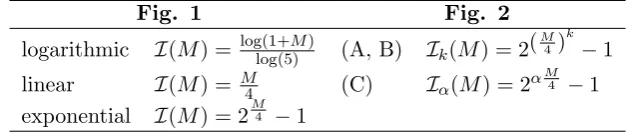
now choose some example interference functions to illustrate the emergence of capacity limitations in the first of our situations. Specifically, and as shown in Table 1, we will
use logarithmic, linear and exponential interference, respectively. Following these general
illustrations, we turn to the debate among proponents of slot-based vs. resource-based memory limitations, and show that there are interference functions that can mimic either
type of memory model, and that suggest different psychological interpretations. Table 1
Details of the functions used in Figures.
Fig. 1 Fig. 2
logarithmic I(M) = log(1+log(5)M) (A, B) Ik(M) = 2(M4) k
−1 linear I(M) = M4 (C) Iα(M) = 2αM4 −1
exponential I(M) = 2M4 −1
[image:28.595.147.462.602.670.2]claim that they reflect actual interference functions. For illustrative purposes, we will setR
to 1 (i.e., perfect remembering), andKto 4. Hence, the memory capacities converge to 4 not due to some intrinsic property of the model, but because we chose the functions accordingly.
As mentioned above, we converted the number of retrievable item to the percentage of
correct responses in a recognition experiment, by inverting the two-high-threshold formula that is generally used to calculate memory capacities (e.g., Cowan, 2001; Rouder et al.,
2008), as calculated for a recognition experiment, where participants are shown a single test
item on each trial, and have to decide whether it was part of the memory set, and where there is an equal number of “old” and “new” test items.10
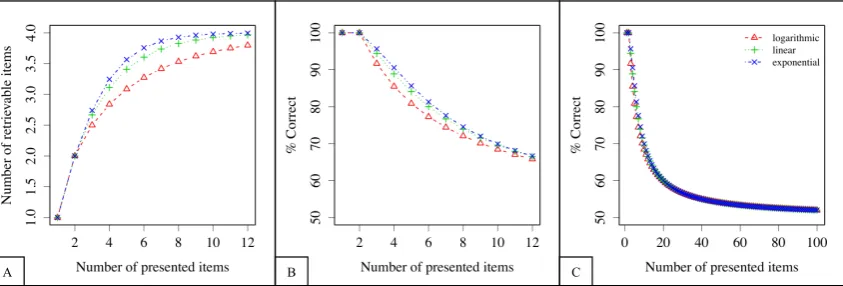
As shown in Figures 1(A) through (C), for all three functions, the number of
retriev-able items asymptotically approaches a capacity of 4; conversely, the percentage of correct responses fell as more items were presented, and fell to 50% for large numbers of presented
items.
However, even when just two items are presented, this model predicts that not all pre-sented items are fully retrievable, which might underestimate human performance for small
numbers of presented items. This issue can be addressed in two ways. First, and as dis-cussed below, this behavior depends on the interference function, and can be changed with
suitably chosen interference functions; as discussed in more detail below, the interference
function just needs to be sufficiently upwardly curved, which, we suggest, has a straight-forward psychological interpretation in terms of crowding of items in memory. Second, we
10
This model assumes that participants have a certain probability to successfully recognize an “old” item and to successfully recognize a “new” item; in-between, participants guess. With these assumptions, the estimated memory capacityK is given byP×(H−FA),whereP is the total number of presented items, andH andFAare the hit rate and the false alarm rate, respectively (see e.g. (Rouder et al., 2008)). With an equal number of “old” and “new” test items, the formula can be written asK=P(2pcor−1),wherepcor is the proportion of correct responses. Inverting this formula yieldspcor=12 1 +MP
P
A B C
Figure 1. Number of retained items and percentage of correct responses in a recognition experiment when no focus of attention is included in the model. The figures show three different interference functions (logarithmic, linear and exponential).
note that it has long been recognized that people can keep at least one item in the focus of
attention while retaining memory items (e.g., Lewis-Peacock, Drysdale, Oberauer, &
Pos-tle, 2012; Oberauer, 2002; ¨Oztekin & McElree, 2007; ¨Oztekin et al., 2010), which might or might not be related to rehearsal in the case of memory for verbal items (Baddeley, 1996).
Our model can thus be amended by using the most conservative estimate of the focus of
attention, namely a single item. In other words, the model is identical to the one above, except that the first memory item is assumed to be placed in the focus of attention and,
therefore, does not interact with the other items that are retained.
The results with the same interference functions as before, but including the focus of attention, are shown in Figures 2(A) through (C). As in the previous model, the number
of retrievable items converges to 4 items. In this model, however, performance is still at
about 95% correct for 3 items (except for logarithmic interference, where it reached only 92%). Hence, this model accounts for the hypothesis that people can retain between 3 and
4 items (Cowan, 2005).
A B C
Figure 2. Number of retained items and percentage of correct responses in a recognition experiment when one item is placed in the focus of attention. The figures show three different interference functions (logarithmic, linear and exponential).
importantly, they show that interference can mimic a slot-like all-or-none model and a
continuous resource model. We also show that it can mimic chunking.
Modeling an all-or-none encoding in WM
Our model can approximate a slot-like all-or-none WM model (Cowan, 1995, 2005; Luck & Vogel, 1997; Rouder et al., 2008; W. Zhang & Luck, 2008). According to this model,
we can remember 3 or 4 items. If we have to remember more items, we pick 3 or 4 of them,
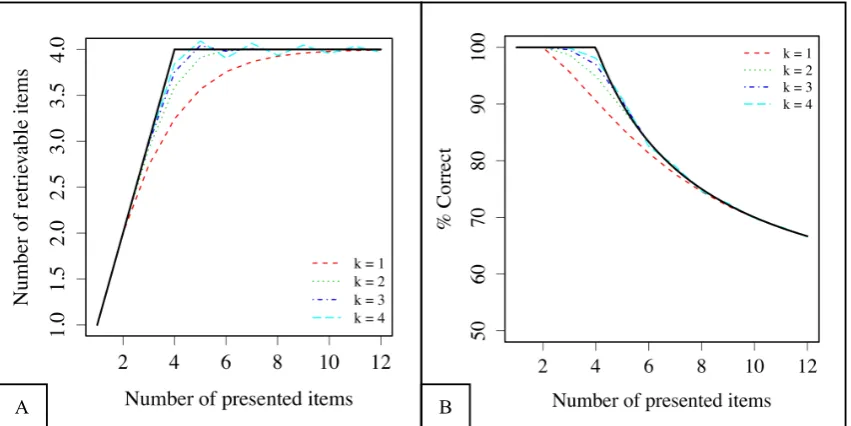
and do not place the rest in WM. This is illustrated in Figures 3(A) and (B). The prediction of Cowan’s (2001) all-or-none model is that the number of retrievable items should be equal
to the number of presented items up to the capacity, and constant afterwards (thick solid line). In other words, forP < K,MP ≈P, and for P ≥K,MP ≈K.
SettingR to 1 (i.e., perfect encoding of the memory items), and writing out equation (1) for the different iterations reveals that this condition is equivalent to assuming negligible
interference below the memory capacity, and full interference when more items are presented
the interference function should have an upwardly curved slope.
This is illustrated in Figure 3(A) and (B). We plotted interference functions with
increasingly upward-curved slopes (parameter k, see Table 1 for details). By choosing an
interference function with a suitably upward-curved slope, it is possible to approximate the all-or-none view of memory (black thick line) arbitrarily closely. In other words, to
approximate the all-or-none encoding in WM, interference needs to be benign when few items are presented, and should have a noticeable effect only once the number of presented
items approaches the memory capacity.
Such behavior is well known from other areas of perception where neighboring items
interfere with each other. For example, visual crowding refers to impaired recognition
of visual objects when these objects are surrounded by other, similar, objects. However, crowding effects are observed only when the objects are separated by less than a critical
distance (that tends to be half the objects’ eccentricity; see e.g., Pelli, Palomares, & Majaj, 2004; van den Berg, Roerdink, & Cornelissen, 2007), while crowding does not occur beyond
that distance. We thus suggest that, in experimental conditions that yield the slot-like
all-or-none pattern of WM encoding, interference might similarly be noticeable only once a critical number of items has been presented so that they can interfere in memory. In other
experimental situation, the interference function might be different.
Importantly, this conjecture suggests a simple psychological interpretation of the
all-or-none pattern of WM encoding: in such situations, there might be crowding of memory representations, especially if these representations overlap in features that are relevant for
retrieval, and thus possibly comprise a combination of object features and of a representation
Brown, Neath, & Chater, 2007; Glenberg & Swanson, 1986; Neath & Crowder, 1990; Neath,
1993; Unsworth, Heitz, & Parks, 2008). In analogy to the well-documented difficulties for identifying (but not detecting) items in crowded visual displays (e.g., Whitney & Levi, 2011),
the all-or-none pattern of performance might be due to retrieval processes that find it hard
to correctly identify a target item among crowded memory representations. In contrast to current slot-based WM models, however, this pattern might arise at retrieval, and not due
to slot-like memory representations. In line with this view, other authors have suggested
that WM performance might be best conceived of as a decision problem that evaluates the evidence provided by memory representations (e.g., Pearson, Raskevicius, Bays, Pertzov, &
Husain, 2014).
[image:33.595.95.521.368.581.2]A B
Figure 3. Approximations of an all-or-none memory encoding. With increasingly upward-curved interference functions (parameter k), it is possible to approximate an all-or-none memory encoding (thick black line). The curves are based on models including the focus of attention.
However, these considerations raise an important question. According to slot-based
other items, while we suggest that slot-like performance profiles might result from
crowding-like interference among items. As a result, while the performance profile as a function of the number of memory items is similar here and in traditional slot-based models, the
psychological interpretations are radically different, and need to be teased apart empirically.
Modeling a continuous resource model
As mentioned above, some prominent models of WM hold that the size of WM
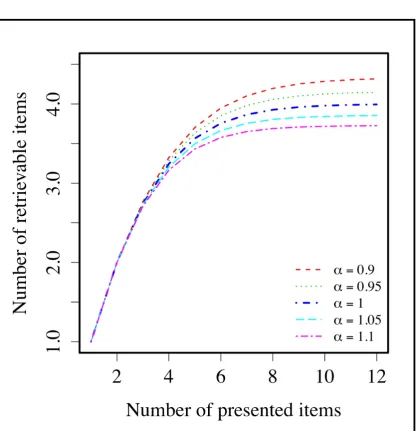
ca-pacity depends on the amount of detail that needs to be stored (Alvarez & Cavanagh, 2004; Bays & Husain, 2008). As shown in Figure 4, this can be modeled by manipulating the
strength of interference (parameterα). After all, we need to encode more detail about items
when the items are more similar to each other, which, in turn, might increase interference among those items because they are more confusable (e.g., Baddeley, 1966, 1968; Conrad,
1963; Conrad & Hull, 1964; Walker, Hitch, & Duroe, 1993). With stronger interference (or weaker memory encoding), capacities are smaller than with weaker interference. This
follows from the fact that the memory capacity in our model is a function of the relative
efficacy of memorization and interference. If interference is relatively stronger, the resulting capacities will be reduced.
This idea also readily accounts for the observation that the precision of memory encoding is variable (see Ma et al., 2014, for a review). The more confusable memory items
are, the higher the precision required to keep them apart. Hence, when a memory task
requires a high precision, we would expect relatively few items to be retained.
Importantly, while slot-based models and resource-based models are often treated as
illus-trations show that an interference account can mimic either pattern of data. Crowding-like
phenomena during retrieval might lead to WM performance that fits slot-like models while varying levels of interference might lead to the more flexible response profile of
resource-based models. In the General Discussion, we will suggest that this view also leads to a new
interpretation of Miller’s (1956) suggestion that different cognitive capacity limits might share a common underlying reason, even when the different capacities do not form a single
system.
Chunking
Chunking strategies have long been recognized as central to memory (e.g., Chase
& Simon, 1973; Cowan, Chen, & Rouder, 2004; Feigenson & Halberda, 2008; Rosenberg
& Feigenson, 2013; Simon, 1974). For example, chunking the letters C, I and A into the chunk CIA substantially facilities memorization. According to an interference-based account
of memory limitations, chunking might increase apparent memory capacity by reducing
interference, both by reducing the number of items that need to be memorized, and by making the items that are effectively memorized (i.e., the chunks) more distinct.
The chunking view also presents an alternative interpretation to previous results that lead to the suggestion that humans might have distinct memory stores, such as for language
vs. visual information (e.g., Baddeley, 1996; Endress & Potter, 2012; Fougnie, Zughni,
Godwin, & Marois, 2015), for agents vs. their actions (Wood, 2008), for view-dependent vs. view-invariant representations (Wood, 2009; see also Endress & Wood, 2011, for
sim-ilar conclusions in sequence memory), and faces vs. other objects (e.g., Wong, Peterson,
memory items when they came from different categories as opposed to the same category.
However, at least for the within-vision stores, an alternative interpretation is that items from different categories show less interference than items from the same category, especially if,
as recent brain imaging studies suggest, memory items are stored in those brain regions
where they are processed to begin with (e.g., Lee, Kravitz, & Baker, 2013; Riggall & Postle, 2012; Sreenivasan, Vytlacil, & D’Esposito, 2014; Sreenivasan, Curtis, & D’Esposito, 2014):
if items are stored in areas that are separated anatomically in the brain, it is plausible that
they also have a reduced tendency to interfere with each other psychologically. In line with this view, other research shows that, when memorizing visual information on top of verbal
information (or vice versa), memorizing additional items from another modality only leads
to a small decrease in memory performance compared to when only the items from the first modality have to be remembered (e.g., Cowan & Morey, 2007; Cowan, Saults, & Blume,
2014), though these studies also show that memory uses some central, amodal components
as well. However, it should be noted that these experiments used stimuli from a limited set of items, and it is unclear how interference in different modalities interacts with each other.
While other memory phenomena might be explained with an interference account
(e.g., Brown et al., 2007), our analysis is too general to make specific processing predic-tions. Importantly, this is not its goal either: rather, we see it as a meta-model with no
processing assumptions at all (except that interference increases as a function of the number
of interfering items, which is basically the definition of interference), showing that memory capacity limitations are largely inevitable as soon as interference is noticeable, even in the
absence of active control mechanisms that are often assumed to be necessary to explain
Relationship to earlier formal models
There is a wealth of formal models of memory, many of which account for interfer-ence phenomena (see, among many others, Anderson, 1983; Brown et al., 2007; Dennis &
Humphreys, 2001; Lewandowsky & Murdock Jr, 1989; Oberauer et al., 2012; Oberauer &
Lin, 2017; Raaijmakers & Shiffrin, 1981; Sengupta et al., 2014). While these models ac-count for many aspects of memory functions about which our analysis is completely silent,
they are special cases of our analysis when it comes to the relationship between interference
and memory capacity. As we present necessary and sufficient conditions for interference to lead to fixed and finite memory capacities, we can make the following generalizations.
Those models that yield fixed memory capacities use interference functions covered by our
first case. Those that yield practically limited memory capacities use interference functions covered by our second case. Those models that do not show limited memory capacities as a
function of interference use interference functions that do not rise to the memory strength
of a new item.
We illustrate these generalizations with two well-known models of memory for which
sufficient detail was given to calculate interference functions: Anderson’s (1983) and Dennis and Humphreys’s (2001) models. Finally, we will discuss Sengupta et al.’s (2014) and Knops,
Piazza, Sengupta, Eger, and Melcher’s (2014) model because it provides a computation illustration of how interference among items can limit WM.
Anderson (1983)
Anderson’s (1983) model is concerned, among other phenomena, with (proactive and
associate an item A with an item B, either after having associated A with D, or after
having associated C withD. In the first case, A is associated with both B and D, which leads to proactive interference upon recall of B. In the second case, no such interference
arises; hence, recall ofB should be better compared to the first situation.
In Anderson’s (1983) model, an item is retrieved if it receives sufficient activation
from other items. For example, whenA is presented,B can be retrieved by activation sent from A. Crucially, the activation A sends to B (called fAB in Anderson’s (1983) model)
is proportional to the relativestrength of association between A andB among all items to
which A sends activation:
fAB = ` sAB
P
ksAk
(13)
where`is some constant, thesare strengths of associations, and the sum in the denominator is over all associations ofA. By rewriting equation (13), we can turn it into a similar form
as equation (1):
fAB = `
sAB +Pk6=BsAk−Pk6=BsAk
P
ksAk
= ` 1−
P
k6=BsAk
P
ksAk
!
≈ `
1− Nsˆ (N + 1)ˆs
= `−` N N+ 1
fAB ≡ R− I(N) (14)
approximately equal toˆs, and that there areN interfering associations (excluding that with
B). One can verify that I(0) = 0, that the slope ofI is strictly positive, and thatI tends toRfor largeN without ever reaching it. Hence, to the extent that a pair-associate task is
suitable for measuring memory capacity, capacity in Anderson’s (1983) model would likely
fall into the practically limited case.
Dennis and Humphreys (2001)
Dennis and Humphreys’s (2001) model works by associating items (e.g., words) to
their context. Specifically, a word is represented by a single (binary) node in the input array of nodes. Its context is represented by a set of binary nodes in the output array of
nodes. If nodes in the input array and in the output array are active simultaneously, their
connection is set to one with probabilityr. This is how learning occurs.
When presented with a test item, the model by Dennis and Humphreys (2001) decides
whether it has seen the item in the following way. The model has two independent memories of the context, one in the pattern of associations between the input array and the output
array (called the “retrieved” context by Dennis and Humphreys’s (2001)), and one memory
that is stored independently of the associations (called the “reinstated” context by Dennis and Humphreys (2001)). Upon presentation of a test item, the model activates the retrieved
context. This is compared to the reinstated context. If the two memories of the context
are sufficiently similar, the model concludes that the test item has been seen before. In Appendix C, we show that this model likely falls into our first category, where memory
capacity reaches a fixed limit.11
11Dennis and Humphreys (2001) specifically argue that their model shows limited “cumulative proactive
Sengupta et al.’s (2014) and Knops et al.’s (2014)
Sengupta et al. (2014) and Knops et al. (2014) proposed that mutual inhibition among
neurons can account for limited WM capacities. (They also investigated the relationship between WM and number processing; we will discuss this aspect of their work in the General
Discussion.) Specifically, they described a network of neurons coding for spatial positions of
memory items. Each neurons excites itself, and inhibits all other neurons. Similar “saliency maps” are thought to exist in the human posterior parietal cortex (e.g., Bays, Singh-Curry,
Gorgoraptis, Driver, & Husain, 2010; Gottlieb, 2007; Roggeman, Fias, & Verguts, 2010).
If the ith neuron has the activation xi, the activation change is governed by the
following differential equation:
dxi
dt =−λxi+αF(xi)−β N
X
j=1,j6=i
F(xj) +Ii+noise (15)
The first term represents (exponential) decay, the second term self-excitation of theith
neuron, the third term inhibition from all other neurons, and the fourth term the external input to the ith neuron. F(x) is the activation function x/(1 +x) for non-negative x, and
zero otherwise.
Equation (15) shows that the inhibition a neuron receives is proportional to the
ac-tivation of the other neurons (after application of the acac-tivation function). As a result,
based on our analyses, we would expect the network’s memory capacity to be limited for sufficiently high β (i.e., inhibition) values. In line with these expectations, Sengupta et al.