City, University of London Institutional Repository
Citation
:
Asad, M. and Slabaugh, G. G. (2016). Learning Marginalization through
Regression for Hand Orientation Inference. 2016 IEEE Conference on Computer Vision and
Pattern Recognition Workshops (CVPRW), pp. 1215-1223. doi: 10.1109/CVPRW.2016.154
This is the accepted version of the paper.
This version of the publication may differ from the final published
version.
Permanent repository link:
http://openaccess.city.ac.uk/id/eprint/15008/
Link to published version
:
http://dx.doi.org/10.1109/CVPRW.2016.154
Copyright and reuse:
City Research Online aims to make research
outputs of City, University of London available to a wider audience.
Copyright and Moral Rights remain with the author(s) and/or copyright
holders. URLs from City Research Online may be freely distributed and
linked to.
Learning Marginalization through Regression for Hand Orientation Inference
Muhammad Asad and Greg Slabaugh
City University London, EC1V 0HB, London, UK
{Muhammad.Asad.2, Gregory.Slabaugh.1}@city.ac.uk
Abstract
We present a novel marginalization method for multi-layered Random Forest based hand orientation regression. The proposed model is composed of two layers, where the first layer consists of a marginalization weights regressor while the second layer contains expert regressors trained on subsets of our hand orientation dataset. We use a la-tent variable space to divide our dataset into subsets. Each expert regressor gives a posterior probability for assigning a given latent variable to the input data. Our main con-tribution comes from the regression based marginalization of these posterior probabilities. We use a Kullback-Leibler divergence based optimization for estimating the weights that are used to train our marginalization weights regressor. In comparison to the state-of-the-art of both hand orienta-tion inference and multi-layered Random Forest marginal-ization, our proposed method proves to be more robust.
1. Introduction
In recent years, real-time depth cameras have been the center of attention for novel natural interaction methods [1]. These cameras, however, have limited availability on mo-bile devices due to the consideration of power consump-tion, cost and form-factor [2]. In contrast, 2D monocular cameras are readily available in majority of the mobile de-vices. Therefore, methods that utilize 2D monocular images in new ways can significantly contribute towards novel in-teraction on such devices.
Furthermore, Augmented Reality (AR) based methods can make the interaction experience more natural as the real-world orientation extracted from these methods can be used to blend inthe virtual objects [3]. A hand orienta-tion based AR provides the user direct control of the vir-tual objects, resulting in more natural interaction [4]. In this paper, we address the inference of hand orientation angles, resulting from flexion/extension of the wrist and pronation/supination of the forearm measured along the az-imuth and elevation axes [4,5]. The proposed method infers hand orientation using only a single 2D monocular camera,
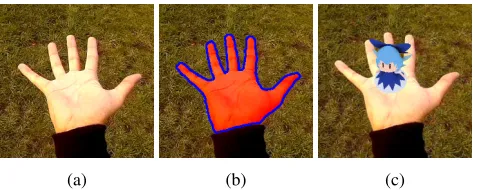
[image:2.612.309.548.212.307.2](a) (b) (c)
Figure 1: The proposed hand orientation regression enables interaction with augmented object where, (a) hand images with an outstretched pose are acquired, (b) shape features from a hand segmentation are extracted to infer (c) hand orientation angles, enabling a user to control the orientation of the object.
which can be used to interact with augmented objects (see Fig. 1). Furthermore, the inferred hand orientation can also be used to simplify the estimation of hand pose and articu-lation in 3D model based methods [6, 7].
Marginalization Weights Regression Layer
….
…. ….
…
.
…. ….
Expert Regression Layer
…
.
…. …. … .
…. …. … .
…. …. … .
…. ….
[image:3.612.57.291.77.216.2]Latent Variable Space
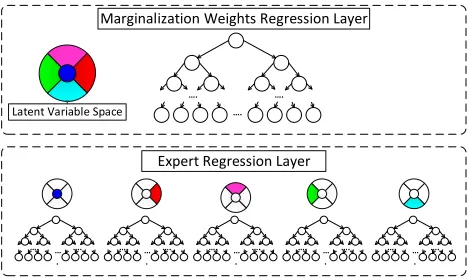
Figure 2: The proposed multi-layered marginalization through regression method utilizes marginalization weights regressor in the first layer to infer the weights for marginal-izing posterior probabilities from each expert regressor in the second layer.
To address the hand orientation inference problem and to better couple the multiple layers in aML-RF regressor, we propose a method for learning the marginalization of a
ML-RF regressor. This method is applied for learning the mapping of hand silhouette images onto hand orientation angles. We extract and use contour distance features from hand silhouette images [4]. The proposed ML-RF regres-sor contains two layers, where the first layer consists of a marginalization weights regressor while the second layer contains expert regressors trained on subsets of our hand orientation dataset (see Fig. 2). We use a latent variable space to divide our hand orientation dataset into subsets, which are then used to train regressors in expert regression layer. Given an input training sample, each expert regres-sor gives a posterior probability for assigning it to a given latent variable. Our main contribution comes from the re-gression based marginalization of these posterior probabili-ties. Given the training data, we use a Kullback-Leibler di-vergence based optimization for estimating weights for ex-pert regressor. These weights, along with the features from training set, are used to train our marginalization weights re-gressor. To the best of our knowledge, our proposed method is the first to learn marginalization using regression for ML-RFregression.
The rest of the paper is structured as follows. We present an overview of related work on hand pose estimation, ori-entation inference and marginalization of ML-RF in Sec-tion 2. Our proposed method, including assumpSec-tions, latent variable generation, expert regression layer and marginal-ization through regression, is detailed in Section 3. Section 4 presents the experimental validation and Section 5 con-cludes the paper.
2. Related Work
This section presents a review of the previous methods involving hand pose and orientation estimation. We include the review of hand pose estimation methods as these could be related to single-shot hand orientation estimation, where some of these methods also exploit the quantized orienta-tion of the hand [11]. However, accurate hand orientaorienta-tion estimation is addressed only by a few methods [3, 4, 12]. To achieve their goals, researchers have employed different modes of input data, including colored gloves, color and depth images [13]. The following sections present a brief overview of generative and discriminative hand pose esti-mation methods. This is followed by the presentation of ex-isting work on hand orientation inference. We then present the methods that utilize marginalization ofML-RF.
2.1. Generative Methods
Generative methods use a model-based approach to ad-dress the problem of hand pose estimation. By optimiz-ing the parameters of a hand model to the input hand im-age, these methods can simultaneously estimate the artic-ulated hand pose and orientation. A major limitation of 2D monocular cameras is that the projected 2D image loses vital depth information, which gives rise to an ambiguity problem where it becomes difficult to differentiate two dif-ferent postures with similar 2D image projections. Genera-tive methods are capable of addressing this ambiguity prob-lem in a 2D image by utilizing a fully articulated 3D hand model [6,7]. de La Gorce et al. [6] optimized the texture, il-lumination and articulations of a 3D hand model to estimate hand orientation and pose from an input 2D hand image. A similar method was proposed in [7], where generative mod-els for both the hand and the background pixmod-els were used to jointly segment and estimate hand pose. Some of the recent generative methods also utilized depth images and advanced optimization techniques such as particle swarm optimiza-tion [14–16]. The multi-camera based generative method in [15] recovered hand postures in the presence of occlu-sion from interaction with physical objects. Although these generative techniques are capable of estimating the under-lying articulations corresponding to each hand posture, they are plagued by the drifting problem. The errors in the pose estimation are accumulated over time, which degrades the performance as the model drifts away from the actual hand pose [11]. Moreover optimizing the parameters with up to 27 degrees of freedom (DOF) for 3D hand models is com-putationally expensive [13], and in some cases requires im-plementation on a GPU to achieve close to real-time execu-tion [14].
2.2. Discriminative Methods
parameter space. Their ability to infer a given parameter from a single input [17] has been a major factor in their recent popularity. Furthermore, these methods are compu-tationally lightweight as compared to generative approaches [18].
A number of discriminative methods have been previ-ously proposed to estimate hand pose [9, 11, 19, 20]. Wang et al. [19] used nearest neighbor search to infer hand pose from 2D monocular images. The approach relied on colored glove and a large synthetic dataset of hand poses. In [20], a Random Forest classifier was trained on a large dataset of labelled synthetic depth images to estimate the hand pose. Keskin et al. [9] showed that the performance of the method in [20] can be improved by dividing the dataset into clusters and using a multi-layered Random Forest (ML-RF) classi-fication. A major challenge faced by methods relying on synthetic datasets are their lack of generalization for unseen data. Tang et al. [11] addressed this issue by proposing a semi-supervised transductive Regression Forest for articu-lated hand pose estimation. This approach learned hand pose from a combination of synthetic and realistic dataset of depth images. In [17], generalization for human body pose was addressed by incorporating real scenario based varia-tions into the synthetic data generation method.
2.3. Orientation estimation
There have been a limited number of methods in the lit-erature that estimate hand orientation [3, 4, 12]. Most of these methods use camera calibration and hand features to build a relationship between camera pose and hand orien-tation. These methods do not address the generalization problem and hence require a calibration step for every new user and camera setup. Regression has only been applied to hand orientation in [4], which used limited orientation an-gles. This method utilized two single-variateRFregressors based on an assumption that the orientation angles vary in-dependently. However, in reality, hand orientation angles are highly dependent on each other. To exploit this depen-dence, we use aML-RFregression method that uses multi-variate regressors to regress the orientation angles together. Additionally, we use a hand orientation dataset that covers a more detailed orientation space. Furthermore, the proposed method does not require camera calibration which renders it suitable for a wider array of applications across different devices. The dataset used for training the proposed method comes from multiple people, which enables it to naturally handles person-to-person hand variations.
2.4. Marginalization of multi-layered Random
For-est
Previous work on hand pose estimation have utilized
ML-RF, where complex problems have been divided and solved by a number of expert regressors trained on simpler
subsets of the data. Keskin et al. [9] proposed a ML-RF
classification for hand pose estimation, which was divided into two classification layers, namely, shape classification and pose estimation layer. Three most significant poste-rior probabilities from the first layer were used to marginal-ize the posterior probabilities in the second layer. A sim-ilarML-RFregression method was proposed in [2], where the first layer performed coarse classification and the sec-ond layer achieved fine regression. Marginalization in this method was done using posterior probabilities from coarse classification layers as weights for predictions at the fine regression layer. Dantone et al. [8] proposed Conditional Random Forest for detecting facial features. This method also used all posterior probabilities from both layers for marginalization. All these methods relied on posterior prob-abilities from the first layer which tends to underestimate the true posteriors, making these methods prone to errors [10]. Furthermore, as the first layer is trained independent to the second layer, these methods cannont recover from inaccuracies arising from the posterior probabilities of the second layer. To the best of our knowledge, our proposed method is the first to use a marginalization weights regres-sor that utilizes marginalization weights extracted from pos-terior probabilities of the expert regressors using the train-ing data.
3. Proposed method
LetSbe a dataset of input hand silhouette images cap-tured from an uncalibrated 2D monocular camera such that it contains variations in the hand orientation, shape and size. GivenSwe extract the contour distance featuresDfor each silhouette image [4]. The problem of hand orientation esti-mation aims at usingDto infer the azimuth (φ) and eleva-tion (ψ) angles of the hand along its two major axes, namely, the azimuth and elevation rotation axes.
In our proposed method, the ML-RF regressor is split into two layers, namely, marginalization weights and expert regression layer (shown in Fig. 3). A latent variable space is used to split the input data into a number of subsets, that are used to train Random Forest regressors in the expert re-gression layer. The posterior probabilities corresponding to each sample in the training set are acquired from each of these regressors. Our main contribution comes from the use of a marginalization weights regressor that learns the mapping of silhouette images to marginalization weights. We derive and apply a Kullback-Leibler divergence based optimization technique that estimates the marginalization weights for training data.
3.1. Assumptions
cam-Contour Distance Feature Extraction Hand
Silhouette
GT Hand Orientations
Marginalization Weights Regressor
Training Subset Division
Kullback-Leibler Divergence based
Weight Estimation Expert Regressors
Training Training Framework
Prediction/Evaluation Framework
Contour Distance Feature Extraction
Marginalization Weights Regression Layer
Expert Regression Layer Hand Silhouette
Predicted Hand Orientation Marginalization
through Regression
(a)
α
β
(b)
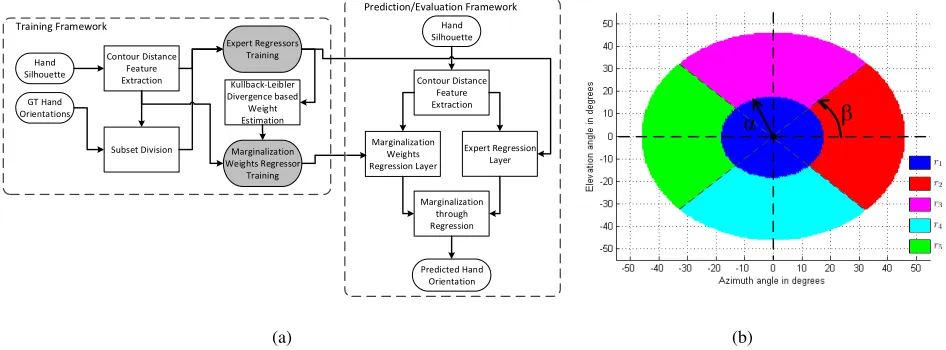
Figure 3: (a) Flowchart for training and evaluation of the proposed marginalization through regression for hand orientation inference, and (b) latent variable space showing the different latent variables with different colors.
eras due to the consideration of power consumption, cost and form-factor. Most existing state-of-the-art methods uti-lize depth data, where the main focus is to infer detailed articulated hand pose [9, 11, 14]. Such methods are not suit-able for a mobile scenario where, in addition to the absence of depth sensors, limited computational resources are avail-able. The proposed method for hand orientation estimation assumes only 2D monocular cameras and limited compu-tational resources are available and real-time performance is required. We use a planar hand pose and assume that a hand orientation can be represented with a single 3D nor-mal vector. Skin and hand segmentation have a long his-tory in computer vision and many techniques have been devised [21–23]. As our aim is to present a hand orienta-tion inference method therefore we assume the segmenta-tion problem is already solved.
3.2. Latent variables generation
We define a latent variable space to divide our dataset into subsets. This space is based on the simple observation that the hand orientation can be broadly categorized with re-spect to the camera as being: (i) fronto-parallel or facing (ii) right, (iii) left, (iv) upwards or (v) downwards, which also corresponds to the maximum distinctive hand shape varia-tions.
Each set ofGTorientation angles(φg, ψg)are first
trans-formed into polar coordinates(γ, ϕ)and are then used to generate latent variables for dividing the target space into
five different regions as
ra=
r1 ifγ≤α◦,
r2 ifγ > α◦:ϕ∈(0◦−β,90◦−β], r3 ifγ > α◦:ϕ∈(90◦−β,180◦−β], r4 ifγ > α◦:ϕ∈(180◦−β,270◦−β], r5 ifγ > α◦:ϕ∈(270◦−β,360◦−β],
(1)
whereαandβ are adjustable parameters defining the ra-dius of the central region and the offset for the latent vari-able space, respectively, andra∈ {r1, r2, r3, r4, r5}are the latent variables dividing the dataset forML-RFregression (Fig. 3(b)).
3.3. Expert regression layer
A set of multi-variate Random Forest regressors are trained on the subset of data to learn the mapping of hand silhouette images onto orientation angles. These regres-sors use a standard Random Forest regression method [24]. Given an input contour distance feature vectord, the
pos-terior probabilities for orientation angles(φ, ψ)for a given latent variableraare given by this layer as
p(φ, ψ|ra,d) = 1
T
X
t
pt(φ, ψ|ra,d), (2)
wherept(φ, ψ|ra,d)is the posterior probability from leaf
node of treetandTare the total number of trees in a given Random Forest model. Then the marginalized posterior probability is defined as
p(φ, ψ|d) =X
a
p(φ, ψ|ra,d)ωa, (3)
whereωaare weights corresponding to each latent variable
such thatP
[image:5.612.65.538.84.259.2]3.4. Marginalization through regression
We formulate prior probability for the training samples using theGTorientation angles(φgt, ψgt)in a multi-variate
normal distribution as
p(φgt, ψgt) =N((φgt, ψgt),Σ), (4)
whereΣis the covariance that can be adjusted to control the spread ofp(φgt, ψgt).
Given the prior probability p(φgt, ψgt) and the
corre-sponding posterior probabilitiesp(φ, ψ|ra,d), we propose
a novel optimization method, where the marginalization er-ror is based on Kullback-Leibler divergence [25]. This erer-ror is optimized to estimate theGTmarginalization weightsωa
for all latent variablesra ∈ {r1, r2, r3, r4, r5}. We define this error as
E=
Z Z
p(φgt, ψgt) log
p(φgt, ψgt)
p(φ, ψ|d) dφdψ. (5)
DerivationHere we present the derivation of partial
deriva-tives from Equation 5 that can be used to get optimal weightsωa.
E=
Z Z
p(φgt, ψgt) log
p(φgt, ψgt)
p(φ, ψ|d)dφdψ, (6)
= Z Z
p(φgt, ψgt) [log p(φgt, ψgt)
−log "
X
a
p(φ, ψ|ra,d)ωa #
]dφdψ. (7)
The partial derivative w.r.tωacan then be defined as
∂E ∂ωa
=−
Z Z p(φ
gt, ψgt)p(φ, ψ|ra,d) P
ap(φ, ψ|ra,d)ωa
dφdψ. (8)
OptimizationWe use a standard gradient descent with
∇E=
∂E ∂w1
, ∂E
∂w2
, ∂E
∂w3
, ∂E
∂w4
, ∂E
∂w5
, (9)
for which the optimization is iteratively evolved for a solu-tion given by
ωan+1=ω n
a −λ∇E n
, (10)
whereλis the step size along the negative gradient direc-tion andnis the iteration number.
Marginalization weights regressor We use a
multi-variate Random Forest regressor to learn the mapping of contour distance features to marginalization weights ωa. This regressor is used during prediction to infer
marginalization weightsωa for marginalizing the posterior
probabilities p(φ, ψ|ra,d) from each expert regressors
using Equation 3.
-45 -30 -15 0 15 30 45
Azimuth (φ) angle in degrees
-45 -30 -15 0 15 30 45
Elevation (
ψ
[image:6.612.318.540.68.249.2]) angle in degrees
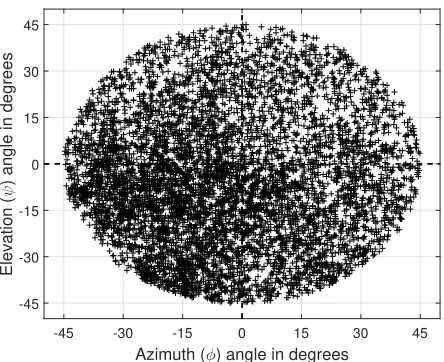
Figure 4: Orientation space plot showing the orientation an-gles captured by our dataset.
4. Experimental evaluation
To the best of our knowledge, hand orientation regres-sion has only been proposed before in [4]. To this end, while some existing discriminative hand pose estimation methods have used quantized orientation of hands to achieve view-point invariance [11], a method for defining accurate hand orientation from 2D monocular images does not exist. Fur-thermore, the existing datasets for hand pose estimation do not provide accurateGThand orientation [1, 4].
Our dataset contains 7059 samples collected for an open hand pose from 15 different participants. The range of the orientation angles captured by our dataset are restricted to a circular space with a radius of45◦(as shown in Fig. 4). This gives us an appropriate ratio for the number of sam-ples against the variations within this defined orientation space. We show experimental results that demonstrate the ability of our proposedML-RFregression method to apply marginalization through regression for estimating hand ori-entation on this dataset.
-50 0 50
Predicted azimuth (φ) angle
-50 0 50
GT azimuth (
φ
) angle
Single-fold for Azimuth angle
(a)
-50 0 50
Predicted elevation (ψ) angle
-50 0 50
GT elevation (
ψ
) angle
Single-fold for Elevation angle
(b)
-50 0 50
Predicted azimuth (φ) angle
-50 0 50
GT azimuth (
φ
) angle
Single-fold for Azimuth angle
(c)
-50 0 50
Predicted elevation (ψ) angle
-50 0 50
GT elevation (
ψ
) angle
Single-fold for Elevation angle
[image:7.612.87.507.68.435.2](d)
Figure 5: Single-fold validation showsGTvs predicted angle results for azimuth and elevation angles using (a)-(b)ML-RF MtR(proposed) and (c)-(d)SL-SV RFmethod [4]. It can be seen that the proposedML-RF MtRmethod infers hand orientation angles without a bias, which is the main source of error inSL-SV RF.
methods only differ in marginalization whereML-RF1uses the predicted latent variable in the coarse layer to select the corresponding expert regressor for prediction. ML-RF2
uses posterior probabilities of each latent variable in the coarse layer as marginalization weights for predicted an-gles from each expert regressor, whereasML-RF3uses pos-terior probabilities from both the coarse and the expert lay-ers to present the marginalized posterior probability. In this section, we denote our proposed Marginalizationthrough
Regression method asML-RF MtR.
4.1. Parameter selection
The proposedML-RFregression has a number of differ-ent training parameters. These include the number of trees (T), depth of each tree (δt), minimum number of samples
in each leaf node (ηj), the number of features selected at
each split node (ǫ) and the parametersαandβdefining the
latent variable based label generation. In our experimental evaluation, we found that the parameters related to theRF
classifier and regressors simultaneously improves the per-formance of all the comparison methods. Therefore, we empirically set these parameters to the following values for all experiments,T = 100,δn = 15,ηj = 5andǫ = 1,
α= 15◦andβ= 45◦.
4.2. Single-fold validation
Table 1: Mean absolute error (MAE) in degrees for experi-ments in Section 4.
Evaluation
method Method used
Azimuth
(φ)
Elevation
(ψ)
ML-RF MtR
(proposed) 8.12◦ 7.36◦
SL-RF SV[4] 9.43◦ 8.60◦ Single-fold ML-RF1 8.80◦ 8.18◦
ML-RF2 11.31◦ 9.58◦
ML-RF3 8.69◦ 7.79◦
ML-RF MtR
(proposed) 7.89◦ 7.29◦
SL-RF SV[4] 8.19◦ 7.94◦ User-specific ML-RF1 8.11◦ 7.45◦
ML-RF2 9.20◦ 8.50◦
ML-RF3 8.12◦ 7.72◦
[image:8.612.49.288.106.275.2]error (MAE) of all comparison methods in Table 1. The pro-posedML-RF MtRmethod outperforms the state-of-the-art in hand orientation inference due to its ability to learn expert regressors on subsets of dataset. Furthermore, as opposed to training single-variate regressors for each orientation angles in [4], the proposed method utilizes multi-variate regressors to exploit the interdependence of orientation angles. From Fig. 5 we observe that theML-RF MtRmethod is able to in-fer orientation angles without introducing any bias, which is the main source of errors inSL-SV RF[4] (as shown in Fig. 5(c)-(d)). Moreover, from Table 1, we note that the proposedML-RF MtR method also outperforms the state-of-the-art in marginalization due to its ability to learn the marginalization weights with a regressor. Furthermore, as the marginalization weights are extracted using posterior probability distributions from expert regressors, therefore they also tend to address inaccuracies in the these posterior probabilities. In contrast, the state-of-the-art directly uses the posterior probabilities for marginalization which tend to underestimate the true posterior [10]. The errors in pre-diction come from symmetrically opposite latent variable spaces i.e. hand facing left/right or up/down, as can be seen in Fig. 5 (a)-(b) at around−40◦and40◦GT orientation an-gles. This is due to the depth ambiguity of 2D silhouette im-ages where two symmetric hand orientation produce similar results (as shown in Fig. 6). Nevertheless, these errors are few in number and do not affect the overall performance of our method as depicted in Table 1. Furthermore the symme-try problem can be solved by exploiting temporal coherence in a sequence of images using dynamic system models such as Kalman Filter or Particle Filter [26]. We aim to address this in our future work.
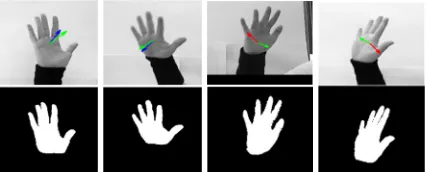
Figure 6: Success and failure cases with normal vector su-perimposed where green shows GT normal vectors, blue shows predicted normal vector for success cases and red shows predicted normal vector for failure cases. It can be seen that the predicted normal vectors for failure cases are symmetrically opposite to the GT normal vectors. Silhou-ette images show how different orientations can result in similar shape of hand.
4.3. User-specific validation
User-specific validation results of the proposed frame-work are shown in Table 1, where the training and testing is done using the same participant’s data. This depicts an ap-plication scenario where a one-time model calibration will require the user to provide a user-specific hand orientation dataset. Once trained, our proposed approach would be able to infer the hand orientation. For this validation, we divide each participants data into training (70%) and test-ing (30%) sets. From Table 1 we see that the proposed method performs even better than single-fold validation, as now the marginalization is fine-tuned for a particular users hand where variations in shape and size are limited.
5. Conclusion
work by exploiting temporal coherence using dynamic sys-tem models.
References
[1] James Steven Supancic III, Gregory Rogez, Yi Yang, Jamie Shotton, and Deva Ramanan, “Depth-based hand pose estimation: methods, data, and challenges,”
arXiv preprint arXiv:1504.06378, 2015.
[2] Sean Ryan Fanello, Cem Keskin, Shahram Izadi, Pushmeet Kohli, David Kim, David Sweeney, Antonio Criminisi, Jamie Shotton, Sing Bing Kang, and Tim Paek, “Learning to be a depth camera for close-range human capture and interaction,”ACM Transactions on Graphics (TOG), vol. 33, no. 4, pp. 86, 2014.
[3] Taehee Lee and Tobias H¨ollerer, “Handy ar: Mark-erless inspection of augmented reality objects using fingertip tracking,” inIEEE International Symposium on Wearable Computers. IEEE, 2007, pp. 83–90.
[4] Muhammad Asad and Greg Slabaugh, “Hand orien-tation regression using random forest for augmented reality,” inAugmented and Virtual Reality, pp. 159– 174. Springer, 2014.
[5] Andrew K Palmer, Frederick W Werner, Dennis Mur-phy, and Richard Glisson, “Functional wrist motion: a biomechanical study,”The Journal of hand surgery, vol. 10, no. 1, pp. 39–46, 1985.
[6] Martin de La Gorce, David J Fleet, and Nikos Para-gios, “Model-based 3d hand pose estimation from monocular video,” IEEE Transactions on Pattern Analysis and Machine Intelligence, vol. 33, no. 9, pp. 1793–1805, 2011.
[7] Martin de La Gorce and Nikos Paragios, “A varia-tional approach to monocular hand-pose estimation,”
Computer Vision and Image Understanding, vol. 114, no. 3, pp. 363–372, 2010.
[8] Matthias Dantone, Juergen Gall, Gabriele Fanelli, and Luc Van Gool, “Real-time facial feature detection using conditional regression forests,” inIEEE Con-ference on Computer Vision and Pattern Recognition (CVPR). IEEE, 2012, pp. 2578–2585.
[9] Cem Keskin, Furkan Kırac¸, Yunus Emre Kara, and Lale Akarun, “Hand pose estimation and hand shape classification using multi-layered randomized deci-sion forests,” inComputer Vision–ECCV 2012, pp. 852–863. Springer, 2012.
[10] S. Hallman and C. C. Fowlkes, “Oriented edge forests for boundary detection,” inIEEE Conference on Com-puter Vision and Pattern Recognition, 2015.
[11] Danhang Tang, Tsz-Ho Yu, and Tae-Kyun Kim, “Real-time articulated hand pose estimation using semi-supervised transductive regression forests,” in
IEEE International Conference on Computer Vision, 2013, pp. 3224–3231.
[12] Yoshiaki Mizuchi, Yoshinobu Hagiwara, Akimasa Suzuki, Hiroshi Imamura, and Yongwoon Choi, “Monocular 3d palm posture estimation based on feature-points robust against finger motion,” in Inter-national Conference on Control, Automation and Sys-tems (ICCAS). IEEE, 2013, pp. 1014–1019.
[13] Ali Erol, George Bebis, Mircea Nicolescu, Richard D Boyle, and Xander Twombly, “Vision-based hand pose estimation: A review,”Computer Vision and Im-age Understanding, vol. 108, no. 1, pp. 52–73, 2007.
[14] Iason Oikonomidis, Nikolaos Kyriazis, and Antonis A Argyros, “Efficient model-based 3d tracking of hand articulations using kinect.,” inBritish Machine Vision Conference, 2011, vol. 1, p. 3.
[15] Iasonas Oikonomidis, Nikolaos Kyriazis, and Anto-nis A Argyros, “Full dof tracking of a hand interacting with an object by modeling occlusions and physical constraints,” in2011 IEEE International Conference on Computer Vision (ICCV). IEEE, 2011, pp. 2088– 2095.
[16] Toby Sharp, Cem Keskin, Duncan Robertson, Jonathan Taylor, Jamie Shotton, David Kim, Christoph Rhemann, Ido Leichter, Alon Vinnikov, Yichen Wei, et al., “Accurate, robust, and flexible real-time hand tracking,” in Proceedings of the 33rd Annual ACM Conference on Human Factors in Computing Systems. ACM, 2015, pp. 3633–3642.
[17] Jamie Shotton, Toby Sharp, Alex Kipman, Andrew Fitzgibbon, Mark Finocchio, Andrew Blake, Mat Cook, and Richard Moore, “Real-time human pose recognition in parts from single depth images,” Com-munications of the ACM, vol. 56, no. 1, pp. 116–124, 2013.
[18] R´omer Rosales and Stan Sclaroff, “Combining gen-erative and discriminative models in a framework for articulated pose estimation,” International Journal of Computer Vision, vol. 67, no. 3, pp. 251–276, 2006.
[19] Robert Y Wang and Jovan Popovi´c, “Real-time hand-tracking with a color glove,” inACM Transactions on Graphics (TOG). ACM, 2009, vol. 28, p. 63.
depth sensors,” inConsumer Depth Cameras for Com-puter Vision, pp. 119–137. Springer, 2013.
[21] Cheng Li and Kris Kitani, “Pixel-level hand detec-tion in ego-centric videos,” inIEEE Conference on Computer Vision and Pattern Recognition, 2013, pp. 3570–3577.
[22] M. J Jones and J. M Rehg, “Statistical color mod-els with application to skin detection,” International Journal of Computer Vision, vol. 46, no. 1, pp. 81–96, 2002.
[23] Vladimir Vezhnevets, Vassili Sazonov, and Alla An-dreeva, “A survey on pixel-based skin color detec-tion techniques,” inProc. Graphicon. Moscow, Rus-sia, 2003, vol. 3, pp. 85–92.
[24] Antonio Criminisi and Jamie Shotton, Decision forests for computer vision and medical image anal-ysis, Springer Science & Business Media, 2013.
[25] Solomon Kullback and Richard A Leibler, “On infor-mation and sufficiency,” The annals of mathematical statistics, vol. 22, no. 1, pp. 79–86, 1951.
[26] M Sanjeev Arulampalam, Simon Maskell, Neil Gor-don, and Tim Clapp, “A tutorial on particle filters for online nonlinear/non-gaussian bayesian tracking,”
![Figure 5: Single-fold validation shows GTangles without a bias, which is the main source of error inMtR vs predicted angle results for azimuth and elevation angles using (a)-(b) ML-RF (proposed) and (c)-(d) SL-SV RF method [4]](https://thumb-us.123doks.com/thumbv2/123dok_us/1440125.96401/7.612.87.507.68.435/figure-single-validation-gtangles-predicted-results-elevation-proposed.webp)