A RESEARCH ROADMAP FOR MEGAPROJECT SUSTAINABILITY
ASSESSMENT
Z. Chen and A. Agapiou
Department of Architecture, University of Strathclyde, 75 Montrose Street, Glasgow G1 1XJ, UK Email: [email protected]
Abstract: The characteristics of sustainability within megaprojects (typically worth over $1bn each) can make gigantic impacts on the society, the economy, and the environment at local, regional, national, and even international level depending on the nature of the project in short and longer term, and the pursuit of megaproject sustainability in development and operation is to satisfy the need for a sufficient address on dynamically interactive issues relating to social, technical, economic, ecological and political (STEEP) aspects throughout project lifecycle. Therefore it’s an important but challenging task to do a reliable assessment on the overall sustainability of individual megaprojects to ensure the target is met in practice. This paper presents recent research findings about megaproject assessment on sustainability (MAS). The research has been conducted by using a new research method underpinned by TRIZ (Theory of Inventive Problem Solving) to facilitate the adoption of evidence-based learning (EBL) in further research into MAS. Findings from this TRIZ driven research include a knowledge framework, a research roadmap, and research tasks to support improved MAS in practice. It’s expected that this paper can be useful for research advancement towards reliable MAS to support decision making at work stages of megaprojects.
Keywords: Megaproject, Methodology, Research Roadmap, Sustainability
1. INTRODUCTION
In the construction sector, a megaproject, which is typically worth over $1bn, is a large scale new construction or redevelopment project that can make gigantic impacts on the society, the economy, and the environment at local, regional, national, and even international level in short and longer term. The sustainability of megaprojects, with regard to their continuous abilities at particular levels through lifecycle, is therefore crucial for not only individual but also consensus decision making in both engineering and management across interactive layers and clusters at various project stages.
While there are discussions worldwide on the need for implementing integrated sustainability reporting at corporate level, an integrated sustainability measurement for either existing or new megaprojects throughout lifecycle is in need to fill in the gap in the theory and practice of megaproject management in terms of developing and using new advanced techniques for integrated MAS. In response to this need, a new research project on an analytic approach to sustainability assessment in urban megaprojects has been set up recently at the University of Strathclyde, and this paper describes preliminary findings from research into a research roadmap for the technical advancement of MAS in the next decade or longer term.
This paper focuses on the description about how such a research roadmap was developed and what has been included in this research roadmap with regard to its usefulness in the integrative measurement of megaproject sustainability at the eight project stages well defined by RIBA (2013) in its latest Guide on plan of work. In order to achieve this goal, this paper aims to explore key research areas in MAS so as to draw a technical roadmap to inform further research and practice with regard to making a good contribution to the body of professional knowledge in terms of effectively tackling technical challenges such as cost and time overruns in short and longer term, effective lessons learning and knowledge use, as well as the coordinated use of building information modelling (BIM) in megaproject practice. In particular, this paper presents a new research methodology underpinned by TRIZ (Gadd, 2011), which has been used to explore areas of further research into MAS through evidence-based learning (EBL) (Cranney and McDonald, 2012). Key research findings are described here to draw a technical roadmap for further research and practice into MAS.
2. BACKGROUND
A preliminary literature review has been conducted at the early stage of this research in order to justify the aim and objectives of the research so as to establish a concrete background to further deploy research activities. The literature review has focused on two issues, including the assessment of megaproject sustainability, and the development of research roadmaps in related areas. This section describes findings from this literature review.
2.1 Megaproject sustainability assessment
The consideration, decision making, and actions on megaproject sustainability (Chen and Whitehead, 2016) within an ideal circumstance need to sufficiently address interactive STEEP issues in an effective manner throughout project lifecycle, and the complexity caused by the integrative effects of STEEP forces (Chen, 2010) has therefore continuously made it a challenging task not only in practice to achieve specified sustainability goals but also in research to measure the sustainability in a reliable way.
relation to processes and results in one urban redevelopment project in the Samen District of Mashhad in Iran. It has been found that that both qualitative and quantitative methods have been applied in academic research into MAS, and there have been many discussions on key issues such as how to define a suitable set of assessment criteria and what the ideal evaluation techniques could be used in order to make reliable assessment.
The pursuit on sustainability in megaprojects through lifecycle has become more popular in the construction sector. One particular demonstration is the UK Government Construction Strategy 2016-20, which was recently produced by the Infrastructure and Projects Authority (IPA) (2016) seeking to improve delivery, efficiency and performance across economic and social infrastructure projects in the public, private and regulated sectors, and has set up one prioritised area on whole-life approaches to pursuing sustainability in construction. Although there has been no industry-wide tool for MAS at either work-stage level or life-cycle level, professional development on sustainability oriented assessment for construction projects has been continuously growing over the past more than 20 years. For example, the BREEAM (Building Research Establishment Environmental Assessment Method) (BRE, 2016) for the assessment of buildings and infrastructures at main work stages covering new build, operation and refurbishment, the sustainability checkpoints specified for individual work stages in RIBA (2013) Plan of Work, and the SPeAR® (Sustainable Project Appraisal Routine) (Arup, 2012), which is the tool used by sustainability consultants and sustainable buildings and sustainable infrastructure designers at Arup for sustainability appraisal to support decision-making and communicate in project development. In the meantime, there are many sustainability oriented industry awards prompting the best practice in the construction sector at global scale each year. These professional initiatives have demonstrated that it has been widely accepted by the construction industry across the world that sustainability is essential for projects no matter which stage they might be at, and it has become a necessary part of work to pursue sustainability towards specified levels in all types of projects including new construction, reconstruction, and redevelopment projects. From this point of view, there is an anticipated demand for tools for MAS in order to support better decision making by professionals at either engineering or management positions to work towards specified milestones in accordance to sustainability checkpoints specified by RIBA (2013) throughout project lifecycle. It is therefore a research task to develop work stage oriented tools for MAS.
2.2 Need for research roadmap
It is assumed for this research that nine milestones can be established in accordance to nine work stages specified with sustainability checkpoints given by RIBA (2013), and these milestones are dependable in developing a research roadmap for MAS, although there might be some alternations to be made for specific sustainability checkpoints through either modifying the existing ones or adding new ones to reflect the nature of megaprojects which are normally different from small projects. In order to put the nine milestones of megaproject sustainability onto a research roadmap, a further literature review was conducted to find answers to two essential questions, including whether there is already such a research roadmap for MAS, and what a new research roadmap for MAS should cover; and the answers to the two questions can further justify the need for and the contents of the research.
“mega project” AND sustainability AND “research roadmap”, and
megaproject AND sustainability AND “research roadmap”.
It was therefore assumed that the described research into MAS for a research roadmap has its originality to make a contribution to the body of knowledge of megaproject sustainability, which is one important part of professional practice on megaprojects.
In order to find the answer to the second question, the literature review was conducted to look into representative research roadmaps developed in related areas. The following research roadmaps were reviewed regarding their structures and contents in specific areas:
Arup (2013) Research Roadmap 2013,
BSRIA (2015) BIM roadmap - a building owners' guide to implementing BIM,
CIE (2016) Research roadmap for healthful interior lighting applications.
DTI (2007) Roadmap for the development of intelligent monitoring of concrete structures.
ICCPM (2011) Global Perspectives and the Strategic Agenda to 2025.
It has been found from the review into these research roadmaps that the generic contents need to be considered and covered include Research themes and areas, and Research timescale and milestones. As a result, findings on the generic format adopted in research roadmaps have provided useful information for developing a new research roadmap for MAS.
The literature review into megaproject sustainability assessment and research roadmaps has justified the need for a new research roadmap for MAS. It has been identified that the new research roadmap will need to specify research themes and areas in relation to sustainability assessment in megaprojects throughout the lifecycle, and it is also necessary for the research roadmap to clarify the timescale to achieve milestones set up for MAS.
3. METHODOLOGY
3.1 Research strategy
The strategy made for the research described in this paper focuses on the aim and objectives of research and the methodology to ensure the use of appropriate methods to derive reliable outcomes. The literature review conducted for this research has focused on the assessment of megaproject sustainability and the need for planning on the development of innovative solutions with clear identities on a research roadmap so as to improve sustainability oriented practice in megaprojects, and this has eventually led to this research into a roadmap for a comprehensive understanding and guide of further research relating to MAS, which also has numerous connections to other tasks throughout the whole life of megaprojects. The research towards such a roadmap was conducted through considering the following three objectives:
To identify a set of research areas through a comprehensive literature review to form the theoretical framework of the body of knowledge for MAS.
To specify technical details of MAS at different work stages alongside the chosen work procedure such as RIBA Plan of Work 2013.
In order to achieve the goal of this research, a set of research methods was used. The preliminary research findings described here have been derived through the use of TRIZ integrated with EBL and system analysis and design. An extensive literature review sustained by TRIZ was used to justify research aim and objectives as well as essential research themes and areas to establish a framework of the body of knowledge for megaproject sustainability (MSBOK). A process on system analysis and design was then used to derive a research roadmap for MAS, and this include a technical framework as the procedure of MAS, and its related research tasks in short, medium and long term. It was considered when the research roadmap was developed to reflect the progress of current research and practice with regard to the best practice in related areas for megaproject sustainability.
3.2 TRIZ led EBL
TRIZ as a useful tool to establish a comprehensive understanding of problem under solving was chosen as a research method to identify themes and specific areas so as to form the research roadmap. TRIZ is the Russian acronym for "Teoriya Resheniya Izobretatelskikh Zadatch" and means the 'Theory of Inventive Problem Solving' in English. It was developed in 1946 by soviet inventor Genrich Altshuller and his colleagues (Gadd, 2011), and has been widely adopted in many industry sectors. For research in the built environment, TRIZ has been introduced in the past decade. For example, an integration of TRIZ with ANP for the multicriteria assessment of façade systems with regard to the whole life value of the design (Chen, et al., 2007), a holistic literature review approach underpinned by TRIZ to forming a technical framework of facilities management with regard to the body of knowledge and the principles (Chen, 2017). These researches have informed further research into areas where a comprehensive literature review is in need to derive the scope and directions of further research. In this regard, the TRIZ was chosen for the research described in this paper with a particular focus on essential themes and related areas of a research roadmap for MAS.
The literature review on knowledge driven assessment for the sustainable built environment indicated a lack of research into EBL to support decision making in lifecycle oriented facilities management and the necessity of new research to bridge over the gap between EBL and knowledge driven multicriteria assessment for the design (Clipson and Johnson, 1987) and management (Kovner and Rundall, 2006). In this regard, the EBL was adopted to support reliable and consistent assessment in developing the research roadmap for MAS. The integrative use of these methods in this research has shown effectiveness in identifying research themes and areas to establish a new research roadmap for MAS.
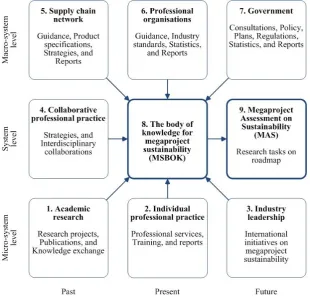
Figure 1 illustrates the diagram of nine windows that were named and used to derive the MSBOK framework and research tasks described in this paper.In principle, the nine-window approach looks on the horizontal direction into the history, the present, and the future of the problem to be solved through a review into related information at microcosmic and macroscopic level as well as system level across the vertical direction. Based on the theory of the nine-window approach, Figure 1 presents an evolutionary process to derive the terminal goal through a middle window which collects all findings from the rest of seven windows. As illustrated in Figure 1, the window of MAS was set up as the goal of this entire nine-window analytic process and achieved through the establishment of MSBOK in the middle window to collect feedback from the following other seven windows for review on:
Window 1: Academic research. The review focuses on research projects, publications, and knowledge exchange activities.
Window 2: Individual professional practice. The review focuses on professional services, training, and reports.
Window 3: Industry leadership. The review focuses on international initiatives on megaproject sustainability.
Window 4: Collaborative professional practice. The review focuses on strategies, and interdisciplinary collaborations.
Window 5: Supply chain network. The review focuses on guidance, product specifications, strategies, and reports at macro-system level.
Window 6: Professional organisations. The review focuses on guidance, industry standards, statistics, and reports at macro-system level.
[image:6.595.144.455.437.734.2] Window 7: Government. The review focuses on consultations, policy, plans, regulations, statistics, and reports at macro-system level.
It is expected that this dedicated review can ensure a systematic study on MSBOK from the past through present to the future at three main levels on micro-system, system and macro-system in the scope of MAS related practice and research, and derive useful solutions of the knowledge framework of MSBOK and the clusters of research tasks for MAS.
4. KNOWLEDGE FRAMEWORK
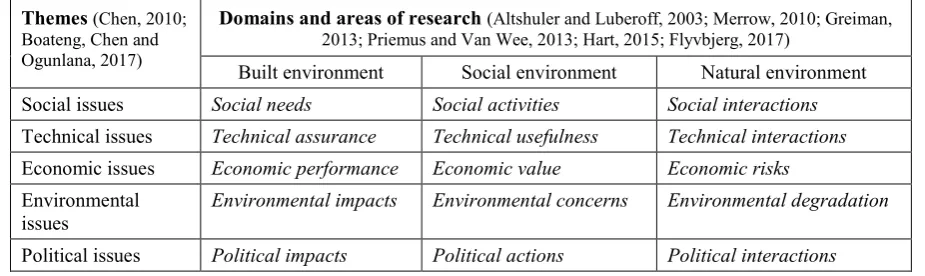
[image:7.595.67.530.390.528.2]For the framework of MSBOK, this research has identified three knowledge domains across five research themes through the TRIZ driven literature review described above. The three knowledge domains include the built environment, the social environment, and the natural environment, which are recognised as critical technical domains relating to MAS. The five research themes focus on social issues, technical issues, economic issues, environmental issues, and political issues, i.e., STEEP issues, in megaproject development and management when sustainability is under consideration across the whole life. Table 1 provides a matrix to summarise the themes and associated areas of research for MAS within the framework of MSBOK, for which all identified research areas are allocated across three domains and five themes. Findings from the TRIZ driven process of literature review have identified key areas of research for MAS, and these findings were further used to design research tasks to establish the research roadmap to achieve the nine milestones indicated in response to sustainability checkpoints at nine work stages specified by RIBA (2013).
Table 1: Themes and areas of research for MAS within MSBOK framework
Themes (Chen, 2010; Boateng, Chen and Ogunlana, 2017)
Domains and areas of research (Altshuler and Luberoff, 2003; Merrow, 2010; Greiman, 2013; Priemus and Van Wee, 2013; Hart, 2015; Flyvbjerg, 2017)
Built environment Social environment Natural environment Social issues Social needs Social activities Social interactions
Technical issues Technical assurance Technical usefulness Technical interactions
Economic issues Economic performance Economic value Economic risks
Environmental
issues Environmental impacts Environmental concerns Environmental degradation Political issues Political impacts Political actions Political interactions
5. RESEARCH ROADMAP
The procedure of MAS is a series of connected actions to be taken at individual work stages in the whole project life to achieve the particular milestones on sustainability assessment in megaprojects. Figure 2 illustrates a generic procedure of MAS underpinned by EBL with an integration with a normal plan of work (RIBA, 2013) for megaprojects. It has been used to develop the research roadmap according to outlined processes across project work stages, and can be used as a roadmap to inform further research activities in related themes and areas summarised in Table 1 through a TRIZ driven literature review.
professionals working on sustainability in megaproject practice but also academics doing research into useful tools such as models, toolkits, and systems for sustainability assessment. Research focusing on key elements of the procedure of MAS is at the position to facilitate its implementation in megaproject practice, and the MAS oriented research is further described below on specific research tasks and targeted outcomes with regard to an overall support to MAS in practice in longer term.
Figure 2: The procedure of MAS
6. RESEARCH TASKS
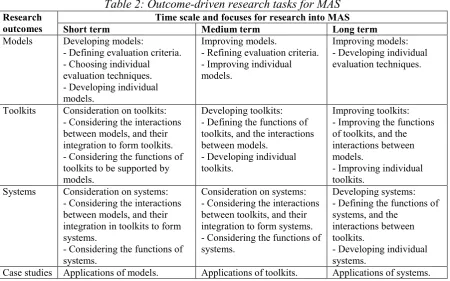
The research to support the implementation of MAS according to its procedure illustrated in Figure 2 needs to focus on several key tasks in order to achieve targeted outcomes that are useful in the practice on megaproject sustainability. A simplified description about research tasks and their outcomes for MAS is given in Table 2, which summarises, in a matrix format, the authors’ perceptions on the essentials of MAS oriented research at various time scales, and was based on research themes and areas identified from TRIZ driven literature review.
Main tasks of research into MAS, as described in Table 2, has been allocated into three time periods including short term, medium term, and long term. Highlighted research work to be done at these three terms is described below:
For short term, the research into MAS is expected to focus on developing models that can be used to conduct reliable assessment on specific targets on either specific or overall aspects relating to STEEP issues at individual work stages, and research work will need to deal with key technical issues such as assessment criteria, evaluation techniques, and useful tools, i.e., models for MAS through experimental case studies; in addition, research work at this term will also need to consider how models developed at initial time period can still be useful in the longer term with regard to their integrations with toolkits and systems for assessment.
relation to various work stages, and consideration on how toolkits under development can still be useful in the longer term with regard to their integrations with systems for assessment. Moreover, an evidence base will be ideally developed during this time period towards computer aided assessment, and it could be rely on a commercial software tool at an initial stage.
For long term, the research into MAS is expected to focus on continuous all-round improvements of models and toolkits developed already, in addition to developing systems that are integrations of models as well as toolkits including the evidence base towards a powerful tool for assessment.
For case studies, the research into MAS is expected to focus on continuous tests of tools including models, toolkits and systems developed at individual time periods, and trying to find problems and potentials for further improvement through experiments on case projects.
[image:9.595.75.526.408.689.2]The general view on research tasks and outcomes over three time periods described above is to outline what research can do to support implementing the procedure of MAS. Due to the constraints on available resources for research, there will be a long way to achieve the goal of long-term research that can provide an integrated assessment tool at system level. With regard to identified need for MAS, it is therefore necessary to specify all research tasks and expected outcomes at individual work stages so that the time length of knowledge exchange from research to practice can be reduced. Based on this consideration, outcome-driven research tasks described in Table 2 are further specified into five clusters of small research tasks for immediate usages at individual work stages.
Table 2: Outcome-driven research tasks for MAS
Research
outcomes Short term Time scale and focuses for research into MAS Medium term Long term
Models Developing models:
- Defining evaluation criteria. - Choosing individual evaluation techniques. - Developing individual models.
Improving models.
- Refining evaluation criteria. - Improving individual models.
Improving models: - Developing individual evaluation techniques.
Toolkits Consideration on toolkits: - Considering the interactions between models, and their integration to form toolkits. - Considering the functions of toolkits to be supported by models.
Developing toolkits: - Defining the functions of toolkits, and the interactions between models.
- Developing individual toolkits.
Improving toolkits: - Improving the functions of toolkits, and the interactions between models.
- Improving individual toolkits.
Systems Consideration on systems: - Considering the interactions between models, and their integration in toolkits to form systems.
- Considering the functions of systems.
Consideration on systems: - Considering the interactions between toolkits, and their integration to form systems. - Considering the functions of systems.
Developing systems: - Defining the functions of systems, and the
interactions between toolkits.
- Developing individual systems.
Case studies Applications of models. Applications of toolkits. Applications of systems.
7. DISCUSSION
The research described in this paper for a research roadmap for MAS has focused on two topics covering research themes and related areas, and specified research tasks at individual work stages within the BIM pervasive working environment throughout the whole life of megaprojects. Besides its originality in the subject field of megaproject sustainability, the research roadmap was built upon a novel procedure of MAS in reflection to megaproject practice. The purpose of developing a procedure for MAS was to ensure that the research roadmap can reflect true need for and real-world requirements on sustainability assessment in megaproject practice across all work stages. From this point of view, the research roadmap presented here has achieved the goal and has a good potential on its usefulness.
The four clusters of research tasks have been specified under four types of research outcomes to fulfil the need for practical tools and evidence to justify their usefulness. All types of research outcomes including models, toolkits, and systems for MAS and case studies using these tools were targeted with a thorough consideration on their necessary connections to all identified research themes and related areas alongside the nine milestones to achieve sustainability in megaprojects. From this point of view, the research roadmap described in this paper provides a comprehensive coverage to various demands for practice oriented deliverables through research advancement with this research roadmap.
The time scale of research for MAS has been divided into three parts, including short term for around three years, medium term for around five years, and long term for around ten years. This time oriented arrangement for research development alongside research milestones has been adopted in many research roadmaps in the past according to literature review, and has also adopted in developing the new research roadmap at professional level. In setting up this time scale, actions (research tasks) and deliverables specified in this research roadmap have therefore been allocated under a thorough consideration against workloads and achievability. From this point of view, the research roadmap developed from this research has demonstrated a practical meaning as a guide for further research into megaproject sustainability assessment.
8. CONCLUSIONS
9. REFERENCES
AECOM (2016) Sustainability Report 2015. AECOM, Los Angeles, USA.
Altshuler, A.A., and Luberoff, D.E. (2003) Mega-Projects: The Changing Politics of Urban Public Investment. Brookings Institution Press, USA.
Bechtel (2016) Sustainability Report 2015. Bechtel Corporation, San Francisco, USA. Arup (2012) SPeAR® Handbook 2012, External Version, Arup, London, UK. Arup (2013) Research Roadmap 2013, Arup, London, UK.
Boateng, P., Chen, Z., and Ogunlana, S. (2015) An analytical network process model for risks prioritization in megaprojects. International Journal of Project Management, 33(8), 1795-1811.
Boateng, P., Chen, Z., and Ogunlana, S. (2017) Megaproject Risk Analysis and Simulation: A Dynamic Systems Approach. Emerald Group Publishing Limited, UK.
BRE (2016) BREEAM International New Construction 2016: Technical Manual. BRE Global Ltd., UK. BSRIA (2015) BIM roadmap - a building owners' guide to implementing BIM. Building Applications Guide BG
60/2015. BSRIA Limited, UK.
Carillion (2016) Sustainability Report 2015. Wolverhampton, UK.
Chen, Z., and Li, H. (2006) Environmental Management in Construction: A Quantitative Approach. ISBN: 978-0-415-37055-4 (hardback). Taylor & Francis, London and New York.
Chen, Z. (2007) Multicriteria Decision-Making for the Sustainable Built Environment. ISBN: 0-7049-1209-0. University of Reading, Reading, UK.
Chen, Z., Clements-Croome, D.J., Li, H., Shen, G.Q.P., and Chung, J.K.H. (2007) A TRIZ based ANP approach to value management in façades assessment. The Value Manager, 13(2), 3-8.
Chen, Z., and Khumpaisal, S. (2009) An analytic network process for risks assessment in commercial real estate development. Journal of Property Investment and Finance, 27(3), 238-258.
Chen, Z. (2010) ANP models and STEEP criteria. ARCOM Doctoral Research Workshop on Decision Making, 10/02/2010, University of Manchester, Manchester, UK. 46-56.
Chen, Z., Li, H., Ren, H., Xu, Q., and Hong, J. (2011) A total environmental risk assessment model for international hub airports. International Journal of Project Management, 29(7), 856-866.
Chen, Z., and Whitehead, C. (2016) Themed issue on Megaproject Sustainability: Call for papers, Proceedings of the ICE - Engineering Sustainability, ICE, UK.
Chen, Z. (2017) The principles of facilities management and case studies. Proceedings of Doctoral Workshop in Building Asset Management, Association of Researchers in Construction Management (ARCOM), 21/01/2017, Glasgow, UK.
CIE (2016) Research roadmap for healthful interior lighting applications. Technical Report 218/2016. International Commission on Illumination (CIE), Austria.
Clipson, C.W., and Johnson, R.E. (1987) Integrated approaches to facilities planning and assessment. Planning for Higher Education, 15(3), 12–22.
Cranney, J., and McDonald, F. (2012) Evidence-Based Learning. In Encyclopedia of the Sciences of Learning, edited by Seel, N.M., Springer, 1185-1188.
DTI (2007)Roadmap for the development of intelligent monitoring of concrete structures. Department of Trade and Industry (DTI), London, UK.
Flyvbjerg, B. (2017) The Oxford Handbook of Megaproject Management. Oxford University Press, UK. Greiman, V.A. (2013) Megaproject Management: Lessons on Risk and Project Management from the Big Dig.
John Wiley & Sons, USA.
Hart, L. (2015) Procuring Successful Mega-Projects: How to Establish Major Government Contracts Without Ending up in Court. Routledge, UK.
HS2 (2016) Annual Report and Accounts 2015/16. High Speed Two (HS2) Ltd., UK.
Kovner, A.R., and Rundall, T.G. (2006) Evidence-based management reconsidered. Frontiers of Health Services Management, 22(3), 3-22.
Gadd, K. (2011) TRIZ for engineers: enabling inventive problem solving. John Wiley & Sons, Inc., Oxford, UK. ICCPM (2011) Global Perspectives and the Strategic Agenda to 2025, Complex Project Management Task Force
Report, the International Centre for Complex Project Management (ICCPM), Deakin West, Australia. IPA (2016) Government Construction Strategy 2016-20, Infrastructure and Projects Authority (IPA), London,
UK.
Merrow, E.M. (2010) Industrial Megaprojects: Concepts, Strategies, and Practices for Success. John Wiley & Sons, USA.
Sarkheyli, E., Rafieian, M., and Taghvaee, A.A. (2016) Qualitative Sustainability Assessment of the Large-Scale Redevelopment Plan in Samen District of Mashhad. International Journal of Architecture and Urban Development, 6(2), 49-58.
Skanska (2016) Skanska Sustainability report 2015. Skanska AB, Sweden.
Appendix: Clusters of research tasks for MAS
Project stage and
sustainability milestones
Time scale and focuses for research into MAS
Short term Medium term Long term
Planning stage: MA: Assessment of strategy. MB: Assessment of preparation and brief.
- Defining criteria to evaluate project strategies, specifications, and feasibility, etc.
- Developing evaluation models for possible usage by developers and local authorities.
- Collecting evidence for MAS at planning stage.
- Improving criteria and models to evaluate project strategies, specifications, and feasibility, etc.
- Developing evaluation toolkits for developers and local authorities.
- Collecting more evidence for developing an evidence base for MAS at planning stage.
- Improving models and toolkits to evaluate project strategies, specifications, and feasibility, etc.
- Developing evaluation systems for possible usage by developers and local
authorities.
- Developing an evidence base for MAS at planning stage. Design stage: MC: Concept design assessment. MD: Developed design assessment. ME: Technical design assessment.
- Defining criteria to evaluate architectural and engineering design with specifications.
- Developing evaluation models for possible usage by designers, other contractors and developers. - Collecting evidence for MAS at design stage.
- Improving criteria and models to evaluate
architectural and engineering design with specifications. - Developing evaluation toolkits for possible usage by designers, other contractors and developers.
- Collecting more evidence for developing an evidence base for MAS at design stage.
- Improving models and toolkits to evaluate architectural and engineering design with specifications.
- Developing evaluation systems for possible usage by designers, other contractors and developers.
- Developing an evidence base for MAS at design stage.
Construction stage: MF: Assessment of construction MG: Assessment of handover
- Defining criteria to evaluate construction strategies, plans, activities, and resources usages, etc. - Developing evaluation models for possible usage by construction contractors and developers.
- Collecting evidence for MAS at construction stage.
- Improving criteria and models to evaluate
construction strategies, plans, activities, and resources usages, etc.
- Developing evaluation toolkits for possible usage by construction contractors and developers.
- Collecting more evidence for developing an evidence base for MAS at construction stage.
- Improving models and toolkits to evaluate construction strategies, plans, activities, and resources usages, etc.
- Developing evaluation systems for possible usage by construction contractors and developers.
- Developing an evidence base for MAS at construction stage.
Operation stage: MH:
Assessment of operation
- Defining criteria to evaluate operation strategies, plans, activities, and resources usages, etc. - Developing evaluation models for possible usage by developers and/or owners.
- Collecting evidence for MAS at operation stage.
- Improving criteria and models to evaluate operation strategies, plans, activities, and resources usages, etc.
- Developing evaluation toolkits for possible usage by developers and/or owners. - Collecting more evidence for developing an evidence base for MAS at operation stage.
- Improving models and toolkits to evaluate operation strategies, plans, activities, and resources usages, etc.
- Developing evaluation systems for possible usage by developers and/or owners. - Developing an evidence base for MAS at operation stage.
Demolition stage: MI:
Assessment of demolition
- Defining criteria to evaluate demolition strategies, plans, and activities, and resources usages, etc.
- Developing evaluation models for possible usage by developers and demolition contractors. - Collecting evidence for MAS at demolition stage.
- Improving criteria and models to evaluate demolition strategies, plans, and activities, and resources usages, etc. - Developing evaluation toolkits for possible usage by developers and demolition contractors.
- Collecting more evidence for use at demolition stage.
- Improving models and toolkits to evaluate demolition
strategies, plans, and activities, and resources usages, etc. - Developing evaluation systems for possible usage by developers and demolition contractors.