City, University of London Institutional Repository
Citation:
Broom, M. & Rychtar, J. (2016). Evolutionary games with sequential decisions
and dollar auctions. Dynamic Games and Applications, doi: 10.1007/s13235-016-0212-4
This is the accepted version of the paper.
This version of the publication may differ from the final published
version.
Permanent repository link:
http://openaccess.city.ac.uk/16079/
Link to published version:
http://dx.doi.org/10.1007/s13235-016-0212-4
Copyright and reuse: City Research Online aims to make research
outputs of City, University of London available to a wider audience.
Copyright and Moral Rights remain with the author(s) and/or copyright
holders. URLs from City Research Online may be freely distributed and
linked to.
City Research Online: http://openaccess.city.ac.uk/ [email protected]
DOI 10.1007/s13235-016-0212-4
Evolutionary Games with Sequential Decisions
and Dollar Auctions
Mark Broom1 ·Jan Rychtáˇr2
© The Author(s) 2016. This article is published with open access at Springerlink.com
Abstract Conflict occurs throughout the animal world. Such conflicts are often modelled by evolutionary games, where individual animals make a single decision each within the game. These decisions can be sequential, in either order, or simultaneous, and the outcome of the game can depend strongly upon which case is assumed to occur. Real conflicts are generally more complex, however. A fight over a territory, for instance, can involve a succession of different stages and, therefore, choices to be made by the protagonists. In this paper we thus introduce a method of modelling a more complex class of interactions, where each individual can make a sequence of decisions. We show that despite the inherent complexity, under certain assumptions, the resulting game often leads to the case where both animals fight to the fullest extent or where one concedes immediately, thus mirroring the outcomes of simpler single decision games. However, for other cases we see that the outcome is not so simple, and intermediate level contests can occur. This happens principally in cases where the duration of contests is uncertain, and partially governed by external factors which can bring the contest to a sudden end, such as the weather or the appearance of a predator. We thus develop a theory grounded in simple evolutionary models, but extending them in various important ways.
Keywords Game theory·Nash equilibrium ·Animal conflict·Hawk–Dove game· Extensive form games
B
Mark Broom[email protected] Jan Rychtáˇr
1 Department of Mathematics, City, University of London, Northampton Square, London EC1V 0HB, UK
1 Introduction
Conflict is ubiquitous throughout the animal world, taking many different forms (see e.g. [22]). Such conflicts can be modelled using evolutionary game theory, where different behaviours within the conflict, for example be aggressive or passive, are represented by the game strategies [4,19,29,31]. A common feature of evolutionary game theoretical mod-els is that contests are often assumed to involve only a single decision by each participant. These decisions can be taken simultaneously, without knowledge of the other player’s choice, or in sequence, so that the second player observes the choice of the first before making its own decision. It is well known that whether the decisions are simultaneous or sequential, and if sequential which order the decisions are made, can fundamentally change the outcome of the game [21].
A classic example of the type of behaviour that we are interested in involves stags, which compete for territories and the associated mating opportunities with females. These contests can be complex, involving observation of the size of opponents, parallel walking, pushing and potentially lethal fighting. The contests are thus not just single events, but go through stages, where the protagonists can make decisions at different points. Such a situation was first modelled by Maynard Smith [29], Maynard Smith and Price [32] using the Hawk–Dove game, one of the most important games in biology. In the classical game, two individuals compete over a resource of valueV, with two available strategies, the aggressive Hawk strategy and the passive Dove strategy. If one player plays Hawk and the other Dove, the Hawk-player gainsVand the Dove player 0. If both play Dove, the winner is selected at random, so each receives an average reward ofV/2. If both play Hawk, they fight until one receives an injury of costC, the other then receiving the reward; the winner is decided at random, so the average reward is(V −C)/2. Assuming that C > V, if each simultaneously chooses a strategy, for indistinguishable individuals, the unique evolutionarily stable strategy (ESS) is a mixed strategy, where Hawk is played with probabilityV/C(and Dove with probability 1−V/C). For a sequential game, the unique ESS is that the first player plays Hawk and the second Dove, so that the first to play always gains the reward. Here the initial choice by the first player of Hawk commits that player to fight if the other also chooses Hawk, so that the second player knows that a choice of Hawk commits it to obtain the negative reward(V−C)/2, forcing it to choose Dove. The Hawk–Dove game was extended to involve asymmetries with the owner–intruder game [31] and this has been elaborated more recently in a number of ways (see e.g. [42], for a review).
An alternative situation that can lead to complex contests is animal foraging. Whlist for-aging, animals may discover patches of resources, the value of which can vary considerably, and they must balance out the benefit of staying in the patch and continuing to feed, or to leave and seek a potentially richer patch elsewhere. If there is a single individual only and the patch becomes increasingly depleted though time, the individual does not have to consider the choices of an opponent (though the value of patches elsewhere may depend upon some population strategy of others), and it must simply pick the best time to leave [8]. However, if there is more than one individual, the choices of others are important. For a non-depleting patch with no movement costs, this relates to the Ideal Free Distribution [11,13]. When resources become depleted, then individuals play a game where costs and benefits change through time, and this becomes a generalized war of attrition [3]. This is a development of the classical war of attrition [2] where two individuals compete for a reward by trying to outwait the other individual, see also [18,31]. A specific example with parasitiod wasps visiting a patch of host larvae is given in [16].
In this paper we introduce a method of analysing an animal conflict over an indivisible valuable resource, as in the Hawk–Dove game, involving a potentially long sequence of decisions. These are binary in form, where individuals choose to persist in the contest (at some additional cost) or concede, concession allowing the opponent to take the resource. The costs may vary, depending upon the stage of the contest, for example if the nature of the contest changes (as in the case of the mentioned stags above). Each possess a level of resources which may prevent them from competing indefinitely. Similarly the contest may eventually stop due to some external influence, for example the arrival of night or a predator, and at that point the resource will be allocated to one of the individuals at random (generally not uniformly at random, however). We analyse our game under a number of scenarios, and also connect it to the dollar auction, a game from economics with some similar features.
2 The Model
Two individualsI1andI2compete for a valuable resource, which is worthVito individual
i fori = 1,2. The contests follow a sequence of alternating decisions, one at each time step, starting withI1, where the individual can remain in the game at a cost, or concede the
resource to its opponent. As individuals have to pay a cost any time they decide to remain in the contest, we will also refer to the decision to stay in the contest as aninvestmentand we will denote the cost of the jth investment of individualIi byci,j. We assume thatci,j ≥ε,
for some 0< ε <min(a1V1,a2V2)and alli,j. We assume that the game may continue for
up toT ∈N∪ {∞}time steps.
IfT <∞, then the game ends no later than after stepT by either (a) an individual giving up at any stepT≤T, or (b) the contest reaching thestopping pointjust after stepT. IfTis odd, the stopping point happens afterI1’s investment; ifTis even, the stopping point happen
afterI2’s investment. In any case, an individualIi can invest up to a maximum ofJi times
where
J1=int
T +1
2 , (1)
J2=int
T
2. (2)
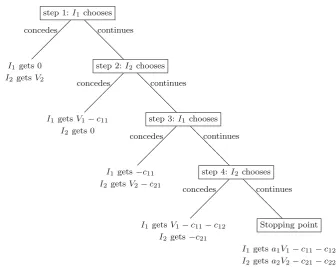
At the stopping point, Ii gains the reward with probabilityai, so thata2 = 1−a1. See
step 1:I1chooses
I1gets 0 I2getsV2
concedes
step 2:I2chooses continues
I1getsV1−c11 I2 gets 0
concedes
step 3:I1chooses continues
I1gets−c11
I2getsV2−c21 concedes
step 4:I2chooses continues
I1getsV1−c11−c12 I2gets−c21
concedes
Stopping point continues
I1getsa1V1−c11−c12 I2getsa2V2−c21−c22
Fig. 1 An example of the game forT=4 where each individual can make (up to) two choices
Ci,j =
j
k=1ci,k. Each individual has a maximum level of resourcesRithat they can invest,
so thatCi,j can never exceedRi. WhenRi <∞, this condition together with the minimum
investment levelε >0 guarantees that individuals have to eventually concede at some point. There are three distinct cases for the payoffs in this game.
1. IfI1concedes at itsjth decision, thenI1receives payoff−C1,j−1andI2receivesV2−
C2,j−1.
2. If I2 concedes at its jth decision, then I1 receives payoffV1 −C1,j andI2 receives
−C2,j−1.
3. If neither concedes and the game reaches the stopping point after stepT, I1 receives
payoffa1V1−C1,J1 andI2receivesa2V2−C2,J2.
We are interested in finding the optimal strategy for each player. Assuming that an indi-vidual can find itself in theI1orI2 role, a strategy is then a combination of what to do as
I1, and what to do asI2. Each player only has the chance to play if all previous investments
of both players have been made, so that a pure strategy is simply the round in each case that an individual would concede, assuming it was reached, asI1orI2. This can be reduced to a
pair of integers (including infinity as an allowable choice), so thatSj1,j2represents invest in the first ji−1 rounds and then concede asIi.
We shall consider a number of cases. In Sect.3we consider the case where all parameters Vi,ci,j,ai,RiandTare a priori fixed and known to both players. In Sect.4we will consider
parametersVi,ci,j,ai,Ri fixed and known but will assume thatT follows a random
[image:5.439.49.386.50.317.2]individuals to choose the cost of staying in the game themselves (under the condition that if the game reaches stepT, their total investment must reach an a priori known and fixed value Ci). Finally, in Sect.6, we will consider thedollar auctiongame [43], as a special case of our
game and in particular we will solve a variant of the dollar auction game where individuals are assumed to have no memory.
3 Fixed and Known Parameter Values
In this section consider the gameΓ = T,Vi,Ri,ai,ci,j described above where the values
ofVi,ci,j,ai,Ri andT < ∞are a priori fixed and known to both players. Since theci,j
andTare fixed and known,Iiknows how much it will have to invest to reach the end of the
contest, which we denote byC1 =C1,J1 andC2 =C2,J2, for I1andI2, respectively; here J1andJ2are given by (1) and (2).
We can work from the end of the contests, using the standard backwards induction method (see e.g. [4]), to solve the game. We shall take this approach throughout the paper; when applying this method we shall use the shorthand “working backwards”. Note that, less often, we shall need to work from the start of the game, denoted as “working forwards”.
LetBi,jdenote theexpected future payoff toIibefore its jth choice and letAi,j denote
the expected future payoff after its jth choice (assuming that it has not conceded). At any step j, the individualIi chooses the better of the following two options
1. to concede, get no reward (and pay the costCi,j−1after already investing j−1 times),
or
2. to continue, pay the costci,j (plus the costCi,j−1of already investingj−1 times), and
expect to get payoffBi,j.
However, the individual can continue only if it has sufficient resources to do so. Consequently,
Bi,j =
⎧ ⎪ ⎨ ⎪ ⎩
0, ifRi <Ci,j,
−ci,j+Ai,j, ifRi ≥Ci,jandAi,j>ci,j,
0, otherwise,
(3)
where
A1,j =
V1 ifB2,j =0, and
B1,j+1 otherwise;
(4)
A2,j =
V2 ifB1,j+1=0,and
B2,j+1 otherwise.
(5)
In (3) the cases appropriately correspond to (a) inability to continue due to not having suf-ficient resources, (b) ability to continue and a profitability of doing so, and (c) ability to continue but not a profitability of doing so. If (a) happens, we say that Ii reached apoint
of concession by inability. If (c) happens, we say that Ii reached apoint of concession by
unprofitability. Ablockis a point of concession by unprofitability whereci,j ≥Vi(note that
Ai,jis never more thenVi).
Table 1 Summary of the results for the case of fixed and known parameter values
Conditions Outcomes
R1,R2,P1,P2 I1,I2invest at every step
R1,R2,P1,¬P2 I2concedes immediately
R1,R2,¬P1,P2 I1concedes immediately
R1,R2,¬P1,¬P2 and (15) and (16) hold for somej I1concedes immediately
R1,R2,¬P1,¬P2 and neither (15) nor (16) hold for anyj I2concedes immediately
R1,¬R2 I2concedes immediately
¬R1,R2 I1concedes immediately
¬R1,¬R2 and (11) holds for somej I1concedes immediately
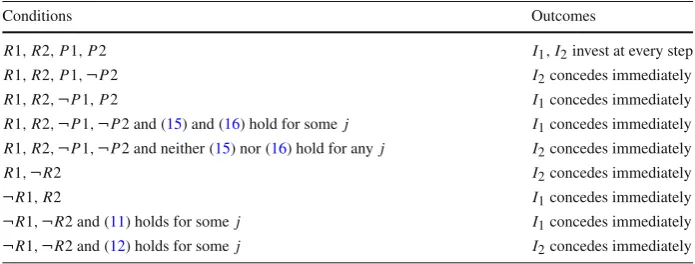
¬R1,¬R2 and (12) holds for somej I2concedes immediately For strict inequality of parameter conditions these are strict NEs and so ESSs, otherwise they are NEs
as payoffs occur from nature, following some natural variation, such ties never occur. This assumption is reasonable for games where there is a clear end point, which we consider in the rest of this section, Sect.5and the first part of Sect.6.1. There are complications when there is not such an end point, as then the selection of mixed strategies (allowing concession at a given position with a probability between 0 and 1) can generate equalities. In cases with clear roles, such mixtures are unstable [41], so that the assumption is valid for the rest of the paper too, with the exception of Sect.6.3, where extremely limited memory but infinite resources allows a game without roles and which carries on indefinitely (and where we see that such mixed strategies feature).
3.1 Blocks and Unblocking
Here, we present the main four results for games without blocks. The games in this section are all examples of truly asymmetric finite extensive form games, and thus, following Theorem 4.5.3 of Cressman [10], there is a one-to-one correspondence between ESSs and strict Nash equilibria (NE). If we assume generic games and no equalities, then the solutions for each of our main results yields a unique strict NE, which is thus the unique ESS. Without this assumption, they are (perhaps non-strict) Nash equilibria only. The results are summarised in Table1.
Theorem 1 The first individual that would reach a concession point must concede immedi-ately, i.e. before making its first investment.
Proof Suppose without loss of generality thatI2reaches the concession point first and that
it happened at itsjth investment,j>1. In this case, we have:
1. B2,j=0 (I2reached a concession point),
2. B2,j−1>0 (it was the first concession point forI2),
3. B1,j>0 (I1has not reached a concession point yet).
HenceI1invests at the previous step and thusA2,j−1 =B2,j =0 which leads to
B2,j−1=max(−c2,j−1,0)=0, (6)
and soI2should concede at its j−1th step, which is a contradiction. Thus ifI2would reach
In general, a game may contain a number of blocks, say at time stepsTb1,Tb2, . . .. However, the game must stop atTb=minj{Tbj}. Any game can beunblockedby considering a game with identical parameters except thatTbreplacesT and(0,1)(or(1,0)) replaces(a1,a2)if
Tbis odd (or even). Here the outcome (i.e. the optimal strategies and eventual payoffs) of the
unblocked game is the same as the original one.
3.2 Solving Games with No Blocks or Unblocked Games
The solution of the unblocked game depends upon two types of conditions:
Condition R1: R1≥C1; (7)
Condition R2: R2≥C2; (8)
Condition P1: a1V1>C1; (9)
Condition P2: a2V2>C2; (10)
Note that condition R holds if the individual has enough resources to continue to the end and condition P holds if it is profitable for the individual to do so.
Theorem 2 In the unblocked game, if either condition R1 or condition R2 (or both) does not hold, then at least one individual would run out of resources before T is reached and the first individual who would run out of resources must concede immediately. Specifically, if, for some j
R1−
j
k=1
c1,k<0while R2−
j−1
k=1
c2,k≥0 (11)
then I1should concede immediately. If, for some j ,
R2−
j
k=1
c2,k<0while R1−
j
k=1
c1,k≥0 (12)
then I2should concede immediately.
Note that it is clear that at most one of (11) and (12) can hold.
Proof The first individual to run out of resources has reached a concession point. Assume that it is individualI2. As the game is an unblocked game, individualI1has not yet reached
a block or a point of concession by inability. Working backwards, there is no earlier point of concession by unprofitability.
Indeed, onceB2,j = 0, then A1,j = V1 > 0. Since there is no block, V1 > c1,j and so
B1,j = V1−c1,j > 0, i.e. it is not a point of concession by unprofitability for I1. Also,
A2,j−1 =B2,j =0 and thusB2,j−1=0 and so on. Thus,I2reaches a first concession point,
and must thus concede before making the first investment by Theorem1.
Proof Suppose thatTis even, and thusJ1= J2=T/2. We letJ =J1. Then we have
B2,J =max(0,a2V2−c2,J). (13)
Assuming thatA2,J >0 we then obtain
B1,J =max(0,a1V1−c1,J). (14)
Supposing that, working backwards, the first time that the expected future reward to either individual becomes negative is forI1 at the point where it would make its jth investment.
Sequential application of (3)–(5) yields
B2,j =max
⎛
⎝0,a2V2−
J
k=j
c2,k
⎞
⎠>0, (15)
B1,j =max
⎛
⎝0,a1V1−
J
k=j
c1,k
⎞
⎠=0. (16)
This means thatI1should concede at stagej, which then yieldsA2,j−1=V2−c2,j−1>0
because there are no blocks. Working then follows that for Theorem1, and so I1 should
concede at the very start of the game. Working is similar whetherT is odd, or ifI2’s future
expected reward becomes negative first.
We note that here the individual which would make large investments towards the end of the contest is the one that has to concede. Thus an individual that would make large investments at the beginning of the contest might never have to make them, as its opponent concedes immediately. We revisit this idea in Sect.5.
Theorem 4 If conditions R1, R2 and P1, P2 hold, then each player has positive expected future reward at the start of the contest no matter what the other player does, so both should continue to the end of the contest.
Proof Suppose again thatT is even and thusJ1= J2=T/2. We letJ = J1. Then we have
B2,J =a2V2−c2,J >0, (17)
B1,J =a1V1−c1,J >0. (18)
Sequential application of (3)–(5) yields
B2,j =a2V2−
J
k=j
c2,k >0, (19)
B1,j =a1V1−
J
k=j
c1,k>0. (20)
SinceaiVi ≥Ci =kJ=1ci,k, both individuals should clearly invest at every stage. A similar
4 A Variable Stopping Time
Now suppose thatTfollows a random distribution. In particular, we shall assume that con-ditional upon not having stopped prior to this point, the probability that the game stops after the jth investment ofIi isγi,j.
This leads to a modification of Eqs. (3)–(5) into
Bi,j=
⎧ ⎪ ⎨ ⎪ ⎩
0, ifRi<Ci,j,
−ci,j+γi,jaiVi+(1−γi,j)Ai,j, ifRi≥Ci,jandγi,jaiVi+(1−γi,j)Ai,j>ci,j,
0, otherwise;
(21)
A1,j=
V1 ifB2,j =0 and (1−γ2,j)B1,j+1+γ2,ja1V1 otherwise;
(22)
A2,j=
V2 ifB1,j+1=0 and
(1−γ1,j+1)B2,j+1+γ1,j+1a2V2 otherwise.
(23)
4.1 Bounded Games
There are a number of ways in which a contest can have a clear endpoint, and we describe each of these below. In these cases, we can work backwards, as usual.
(1) If there is a first block at timeTb(i.e. no block at timeT <Tb), then, as we have seen in
Sect.3.1, this is equivalent to a game with a fixed endpointT =Tband(a1,a2)=(0,1)
or (1,0), and we analyse the game following the method from Sect.3. We note that in this case theoretically the game could continue indefinitely, if a player mistakenly invests at a block, but optimal play leads to termination of the game.
(2) If there is at least oneγi,j which takes value 1, thenT is bounded above. IfγI,J is the
earliest suchγ, then we have a fixed endpoint atT =2J+I−2.
(3) IfRiis finite fori=1,2, then there will be a point when one player must concede
(assum-ing that the contest reaches this point), so the future values at the point of concession will either be(V1,0)or(0,V2).
If there are both finite resources andTis bounded above, the earliest such occurrence deter-mines which of the cases 2) and 3) occurs.
We thus have the following procedure for determining the optimal strategy.
Working backwards, as identified by 1–3) above, we find the expected future reward following Eqs. (21), (22) and (23). If this is ever 0, then an individual would concede, and so the expected future values when concession occurs will be either(V1,0)or(0,V2). We can thus find the
expected future rewards for all positions in the game. Now, working forwards, individuals should play until they reach the first value of Ai,j which takes value no greater than 0, at
which point the individual in question should concede.
We note that Theorems2,3and4follow from a special case of the above procedure, since asγi,j =0 for all positions in the game, if ever A1,j <=0, then this leads to A2,k>0 and
A1,k<=0 fork< j, and a similar result forA2,j.
step 1:I1 chooses
I1 gets 0
I2 gets 4 concedes
step 2:I2 chooses continues
I1 gets 3
I2 gets 0 concedes
Nature continues
I1 gets 1
I2 gets 1 stop (γ)
step 3:I1 chooses continue (1−γ)
I1gets−1
I2 gets 3 concedes
Stopping point continues
I1 gets−2
I2 gets 1
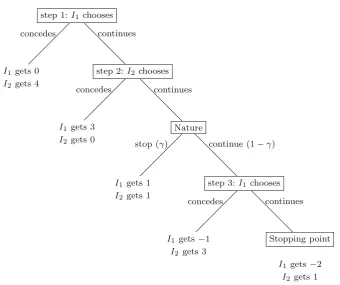
Fig. 2 A scheme of the game withT = 3,V1 = V2 =4,a1(= a2) = 1/2,c1,1 = c2,1 = 1,c1,2 = 3, γ1,1=0, γ2,1=γ. Note that at step 3I1would gain−2 by investing, and−1 by conceding, so it should concede. This means that the expected rewards afterI2invests at step 2 are 2γ−1 and 3−2γ, respectively. The latter is clearly greater than 0, so thatI2should invest at step 2. ThusI1should invest at step 1 if and only if 2γ−1>0, i.e.γ >1/2. ThusI1should initially invest if the chance of the contest stopping at this intermediate point is sufficiently large, and if the subsequent decision is reached, it should concede
until the end of the contest. In Sect.3, however, the fact that games could only end by the concession of one of the players led to a deterministic process that meant that ifIi would
concede, it would do so at the start of the contest. Here this is not so, because individuals doomed to eventually concede can hope that chance intervenes and ends the contest before that concession is necessary. We can see this in the example in Fig.2.
4.2 Unbounded Contests with Infinite Resources
Now we shall assume thatγi,j < 1 for alli,j, so thatT has no upper bound, and that
resources are infinite. This case with unbounded contests is more complicated, as the game could potentially carry on indefinitely. Thus our game becomes an infinite extensive form game and the results from [10] do not extend to this case. In particular we shall make no claim about ESSs here (or in later sections where there are an infinite number of available strategies), and we claim only that solutions are Nash equilibria.
We shall only consider the case where:
1. γi,j is constant, so thatγi,j =γ for alli,j(this corresponds toT having a geometric
[image:11.439.51.392.48.333.2]2. costs of investments are constant for each individual, so thatci,j =cifor all j.
As we shall see this can present us with significant complications, and without such assumptions it is hard to make progress in any generality.
In this case, Eqs. (21)–(23) become
Bi,j =max
0,−ci+γaiVi+(1−γ )Ai,j
(24)
A1,j =
V1 ifB2,j =0 and
(1−γ )B1,j+1+γa1V1 otherwise;
(25)
A2,j =
V2 ifB1,j+1=0 and
(1−γ )B2,j+1+γa2V2 otherwise.
(26)
At any given step 2j−1,I1should concede whenever
c1> γa1V1+(1−γ )Ai,j. (27)
Similarly,I2should concede whenever
c2> (1−γ )a2V2+(1−γ )A2,j. (28)
If (27) holds, andI1concedes at step 2j−1, this means thatA2,j =V2, and thus assuming
V2 >c2as above,I2should invest at time 2j−2. This in turn means thatA1,j−1=0. Hence
(28) holds at step 2j−3 and consequentlyI1should never invest.
Alternatively, if (27) does not hold, and (28) holds, I2does not invest (while I1would
invest if given a chance). This means thatA1,j=V1and thusI1should invest at time 2j−1.
This yieldsA2,j−1=0 and hence thatI2should never invest.
If (27) and (28) do not hold, thenI1(I2)should invest at step 2j−1(2j). Expressing the
reward forTiat its jth step in terms of that at its j+1st step yields
Bi,j = −ci+(γ +(1−γ )γ )aiVi+(1−γ )2Bi,j+1. (29)
We shall now use the above equations to find the solution to our game under four distinct cases. We note that Case 4 has close links to the classicaldollar auctionof [43], and we discuss this is Sect.6.
4.2.1 Case 1
Firstly let us assume that
c1 < (2−γ )γa1V1, (30)
c2 < (2−γ )γa2V2. (31)
Then, (27) and (28) never hold and thus individuals always invest. Here, the inclusion of the uncertainty of ending makes the individuals continue rather than concede. The formula (29) is a recurrence relation of the type
xj =αxj+1+β (32)
with 0< α <1 andβ >0. Denotingx∗=β/(1−α)we obtain
xj+1−x∗=
1
α(xj−x∗)=
1 α
(j+1)
As 1/α >1, then it is clear that unlessxj =x∗for all j, then|xj| → ∞as j → ∞. But
the latter clearly cannot occur, as from (24)xjis bounded, so we must have thatxj=x∗for
all j. Consequently, the expected payoffs forIiare given by
Bi,j =
aiVi−
ci
1−(1−γ )2
. (34)
4.2.2 Case 2
Now, assume that
c1≥(2−γ )γa1V1, (35)
c2< (2−γ )γa2V2. (36)
Thus,I2should always invest, but perhapsI1 should not invest. If that is the case, thenI1
should not invest at the beginning; whereas if I1invests at the beginning it should always
invest. IfI1always invests, it obtains the expected reward
a1V1−
c1
1−(1−γ )2
= (2−γ )γa1V1−c1
(2−γ )γ ≤0. (37)
Consequently,I1should concede at the beginning.
4.2.3 Case 3
Similarly, if we assume that
c1 < (2−γ )γa1V1, (38)
c2 ≥(2−γ )γa2V2. (39)
thenI2will have to concede at the beginning.
4.2.4 Case 4
It remains to investigate the case of
c1≥(2−γ )γa1V1, (40)
c2≥(2−γ )γa2V2. (41)
Suppose thatI2 does not concede. Then since inequality (40) holds, following Case 2 we
obtain the same expected reward as in inequality (37). ThusI1should concede. Moreover,
ifI1concedes, it will clearly be best for I2 not to concede. Now suppose thatI1 does not
concede. Then since inequality (41) holds, following Case 3 we obtain the expected reward as in the equivalent inequality to (37). ThusI2should concede. Similarly, ifI2concedes, it
will clearly be best forI1not to concede.
So it is clear that one of the individuals must concede, but which should be the first to do so? In the biological case that underlies this paper, this can be solved using the idea of roles as previously discussed. IfI1chooses to (always) invest andI2to concede immediately, the
strategyS∞,1, then this is a strict NE. SimilarlyS1,∞, I1conceding immediately with I2
5 Individuals Can Choose How to Allocate Their Investments
In this game we again consider fixed total costsCi, but further develop the model by allowing
individuals to choose how to split their investment, i.e. to chooseci,jso that
ci,j =Ci.
Here we set no maximum number of movesT, though there will be an effective maximum as we see below. Should the players pay a little or a large amount initially?
At first sight it would appear that any individual should simply either concede, or pay the smallest cost possible to be able to remain in the contest. What benefit is there in paying more? As we shall see below (see Theorem6), however, there are situations where an individual should pay more than this minimum value.
We again assume that individuals have to invest at least some minimalε >0, unless they have already invested more thanCi−ε, in which case they have to simply complete their
investment up toCi. Specifically,ci,jhave to satisfy
ci,j ≥min{ε,Ci−Ci,j−1}, (42)
for someε >0 and alli,j. Here the length of the game tree is finite, but as any investment can be chosen, there are an infinite number of choices at most vertices, and so we again make no claim about evolutionary stability.
For a moment, assumeRi <Ci, for somei=1,2, i.e. at least one individual, namelyIi,
does not have resources to invest to the end of the game. So the end of the game will not be reached and thus both individuals should needs to invest as little as possible, i.e. at any point they should either give up or will have to investε. This turns the game into the game from Sect.3and we can solve it through the methods presented there.
If Ri <Ci, thenIi cannot make more than ji =int(Ri/ε)investments. Firstly assume
that Ri < Ci fori = 1,2. If j1 ≤ j2 then I1 must concede immediately, otherwiseI2
must concede immediately. IfRi < Ci for precisely one ofi = 1,2, following arguments
analogous to those of Theorem2, the individual with insufficient resources must concede immediately.
So, for the rest of the section, we will assume that
Ri ≥Ci, i=1,2, (43)
and we will also consider only strategies for whichci,j < Vi. This way, we have a game
without blocks.
Theorem 5 a) If aiVi ≤ Ci holds for exactly one individual, then that individual must
concede at the start of the contest. If I2will be giving up, I1will invest c1,1=ε.
b) If (9)and(10)both hold, then both individuals invest until the end of the contest.
Proof a) follows from Theorem3, and b) follows from Theorem4.
Theorem 6 Assume aiVi ≤Ci for both i . Let jibe such that
Ci−jiVi <aiVi≤Ci−(ji−1)Vi i=1,2. (44)
Then, I1should concede immediately if and only if j1 > j2. Otherwise I2 should concede
immediately. More specifically, if j1 < j2, then I1 should invest c1,1 = εand I2 should
concede immediately. If j1= j2, then I1invests (slightly more than) C1−(j1−1)V1−a1V1
Proof Assume that, during its first j moves, an individual Ii has already investedCi,j =
j
k=1ci,jsuch that
Ci,j >Ci−aiVi. (45)
Then, no matter what the other individual does,Ii now has to investCi −Ci,j < aiVi in
order to get to the end of the contest and at the end it expects to win eitheraiVi (when the
other individual continues to the end of the contest) orVi (if the other individual gives up
before the end of the contest). In other words, when the condition (45) is satisfied for an individualIiafter jmoves, then the individualIiwill continue to the end of the contest since
the expected future reward is positive.
Also, note that if (45) is not satisfied for an individualIi, then it has to invest at leastaiVi
to get to the end of the contest. Now, assume that for somej,
C1,j >C1−a1V1, (46)
C2,j−1≤C2−a2V2, (47)
andI2is currently deciding whether and how much to invest. It follows that (a)I1will stay
in the contest to its end, (b)I2would have to invest at leasta2V2in order to stay to the end
of the contest, and (c)I2’s expected reward at the end of the contest isa2V2, i.e.I2’s future
reward at thejth decision is not positive. Consequently,I2has to give up. Similarly, if
C1,j ≤C1−a1V1, (48)
C2,j >C2−a2V2, (49)
andI1is currently deciding whether and how much to invest, thenI1should give up.
Note that (44) means that Ii can achieve (45) in ji but not in ji −1 investments (each
investment would have to be almostVi). So, if j1 > j2, then I2can get to (45) faster than
I1and at that pointI1will be forced to concede, following an inductive argument analogous
to that from the proof of Theorem3. It follows that I1 should concede at the beginning.
Consequently,I2will never have to invest overV2unlessI1invests overV1first. SinceI1is
not going to do that,I1should concede at the beginning of the game.
By a similar argument, ifj1≤ j2, thenI1can get to (45) faster thanI2and at that pointI2
should concede. Thus,I2should concede at the beginning. It remains to identify how much
I1should invest beforeI2gives up. Note that after an investment ofc1,1byI1, the game can
be seen as the game with changed roles,I2starts first and has to investC2,I1plays second
and has to investC1−c1,1. Consequently, if j1< j2,I1just needs to investε(because even
afterI2investsV2in the first round,I1can get to (45) faster thanI2). However, when j1= j2,
thenI1needs to invest just overC1−(j1−1)V1−a1V1, to make sure that whenI2invests
close toV2,I1still gets to (45) faster thenI2.
Remark 1 If, within the setting of Theorem6, j1 = j2, the exact amount of how much I1
should invest at the beginning may vary. Ifai =1/2,Ci ≈Vi, thenI1needs to invest a bit
overV1/2. Whenai =1/2 andCi=3/2∗Vi−δ(for some smallδ >0), thenI1needs to
invest almostV1, but whenCi =3/2∗Vi+δ, thenI1just needs to invest “a little bit” over
δ.
Remark 2 Consider the case whenaiVi ≤Ci fori = 1,2,C1 =C2,a1 =a2 =1/2 and
V1 >V2. Then the resource is more valuable to individualI1 and according to Theorem6,
anda1 >a2, thenI1is more likely to win the resource at the end of the game thanI2and
according to Theorem6,I2should concede immediately.
Remark 3 The advantage of a significant early investment can be clearly seen from the following example. Suppose thata1=a2=1/2,C1=0.7V,C2=0.6V, ε=0.11V.
The expected reward for reaching the end of the contest isV/2. Thus any individual whose remaining investment falls belowV/2 should continue to invest rather than concede. Further, if an individual to choose has a remaining investment of greater thanV/2 whilst its opponent has less than this, it knows its opponent will continue to the end, and so must concede.
Thus how should our first playing individual above proceed?
– If it concedes, it of course receives 0.
– If it invests less than 0.2V it will still have more than 0.5V to invest. Thus player 2 should keep investing, its minimum investment would take it within 0.5V so the first player would then have to concede. Thus this choice yields player 1 a negative return. – If it invests more than 0.2V, it will then have remaining investment under 0.5V, so that
player 2 will then have to concede, thus the expected return for player 1 will beVminus this initial investment.
Thus the best investment level is “just over” 0.2V, i.e. almost twice the minimal required levelε.
6 The Dollar Auction
The classical dollar auction was introduced by Shubik [43]. In this game a number of players are invited by an auctioneer to bid for a dollar. In Shubik’s game there were potentially many players, and any bids were allowed (although these had to be in a multiple of 5 cents). The person who won the auction got the dollar minus the value of their winning bid, but crucially the second highest bidder also had to pay the value of their own bid. If bids jump in small amounts, at any stage a player has the potential of winning the “large” prize of a dollar for a small extra outlay. If a player was convinced that their next bid would be the last, then any bid up to (but not including) a dollar is worthwhile. An initial dollar bid is clearly a bad idea, as 0 is obtained if no other player bids, and less than 0 otherwise (this would be a non-optimal further bid, but we can assume this will happen with a very small probability, using the classical idea of the “trembling hand” [36,40]). If any player is convinced that their next bid would be the last, then any bid up to (but not including) a dollar is worthwhile; however, for a player that is currently second highest bidder, any bid, including a bid of up to (but not including) a dollarabove their previous bidis worthwhile (if their bid will be the last one). If a player was convinced that some other player will keep bidding then it is not worth bidding themselves. There seems no sensible solution to such a game, at first sight.
We shall consider a variant of the dollar auction, where there are only two players, who bid alternately (with one nominated to start), and are only allowed to raise the previous bid by one cent (or bid one cent if it is the start of the auction). We thus have the game as described in Sect.4withc1,1=1,ci,j=2 otherwise,γi,j =0,V1=V2=100. We shall first consider
two cases a) with infinite resources,Ri = ∞fori=1,2, and b) with finite resources. Then,
6.1 A Dollar Auction with Full Memory and Infinite Resource
We start with the infinite resources case; this corresponds to the original idea from [43]. As we have discussed previously, for a biological population, we can consider this as a game with two distinct roles, where a strategy is a combination of what to do as the first player, and what to do as the second.
The strategySj1,j2represents invest in the first j1−1 (j2−1) rounds and then concede as playerI1(I2). It is clear thatS1,j2is a Nash equilibrium for any strategyj2wherej2>50 and Sj1,1is a Nash equilibrium for any j1wherej1 >51, since in each case one player concedes immediately, but would need to invest over a dollar to “win” if it changed its strategy. Within a population comprised of individuals of this type, in Shubik’s terminology we would have a (credible) threat, which is enough to force an opponent to concede. This is very similar to the situation from Theorem4, Sect.4.2.4. See also [12] for a generalisation of this scenario.
6.2 A Dollar Auction with Full Memory and Finite Resource
Now consider the case with finite resources,Ri <∞fori=1,2.
Clearly here the game cannot carry on indefinitely and must be terminated by the conces-sion of one of the players. We can reformulate this game in the form of a game with a fixed contest end from Sect.3, but where the end time is such thatRi <Cifori=1,2, which can
never be reached. Thus, following Theorem2, the first player to run out of resources must concede immediately (and since we have applied Theorem2, this is a strict NE/ESS). Unless both players have identical wealth, this will be the poorer of the two players. In the unlikely case that the players are equally rich, the first to play must concede immediately if they possess an even number of cents, otherwise the second to play must concede immediately. Note that for any two players with given wealth, swapping their positions in the game does not affect the result, unless their wealth is the same; this thus emphasises the symmetry of the game. As in the previous section, see [12] for a generalisation of this scenario.
6.3 A Dollar Auction with No Memory
The idea of the original dollar auction was that the players kept returning to the identical situation but with positions reversed. We interpret this as a game with no memory, where a player sees only the choice ahead of them. Thus the rolesI1andI2can no longer be
distin-guished, and we obtain a different kind of solution. Here we do not have a truly symmetric game, and so the result of [10] cannot be applied, and so again we seek Nash equilibria only. In this case there are effectively three positions, two of which require the player to make a decision:
1. S: A player (eitherI1orI2selected at random) is about to start the game by potentially
investing a cent, or conceding;
2. D: A player (eitherI1orI2) is about to make an investment after the game has started,
which must be of two cents, given it must go from one down to one up, or to concede; 3. U: A player (eitherI1orI2) is a cent up, and waiting to see if its opponent keeps investing.
We denote the expected future rewards for a playerIiin the three positions asBi,S,Bi,Dand
Bi,U, respectively, measured in cents.
cannot depend upon what the other player might do in the initial position. Thus they depend only upon the choice of the other player in positionD. Without loss of generality, we can thus restrict ourselves to considering the two choices ofI1against the possible choice ofI2.
Now, assume that player I2 employs a strategy p2,D, i.e. concedes at position Dwith
probabilityp2,D. We are looking for an optimal response of playerI1, i.e. we are looking for
optimal values of probabilities to concede at stageS,p1,S, and at stageD,p1,D.
Assume that at S a playerI1 concedes with probability p1,S. If it invests, it is in the U
position, so that
B1,S= p1,S0+(1−p1,S)(B1,U−1). (50)
Similarly at D a playerIi concedes with probabilitypi,D. If they invest they are again in the
U position, so that
B1,D= p1,D0+(1−p1,D)(B1,U−2). (51)
At U players wait upon the decision of the other player, and it either receives 100 if the other one concedes, or it moves to D if the other player continues. Thus,
B1,U = p2,D100+(1−p2,D)B1,D. (52)
First, observe that if we assumeB1,U ≤ 2, we get, by (51), B1,D = 0. Thus, by (52),
B1,U =100p2,D. Consequentlyp2,D≤ 501.
Similarly, if we assume thatB1,U≥2, we get, by (51),B1,D=B1,U−2 and thus, by (52),
B1,U =102− p22,D. Consequentlyp2,D≥ 501.
Also, it follows from (51) that whenever B1,U <2, it is optimal to pick p1,D =1 (i.e.
always concede), (b) wheneverB1,U>2, it is optimal to pickp1,D=0 (i.e. always invest),
and (c) ifB1,U =2, then any value ofp1,DyieldsB1,D=0 (and, from (50), it is optimal to
havep1,S=0).
Putting the above observations together, we find that
– ifp2,D< 501, then the optimal response isp1,D=1,
– ifp2,D> 501, then the optimal response isp1,D=0,
– ifp2,D= 501, then the optimal response is any value forp1,D.
Consequently,pD(= p1,D = p2,D) = 501 is the unique Nash equilibrium value. This then
givesB1,U =2 and from (50) it follows thatpS =1.
Thus an individual should invest at the first step and, then, invest at each subsequent step with probability 49/50. Thus after the first step, each individual concedes following a geometric distribution with parameterp=1/50. Note that this solution is similar to that of the war of attrition [2,3,29] where the solution follows an exponential distribution (in each case the stopping time follows a distribution with the lack of memory property, discrete in our case, continuous for the war of attrition, with a mean that yields an expected reward of zero).
7 Discussion
7.1 Our Model and its Conclusions
made by each protagonist. This is a natural extension of previous models such as the Hawk– Dove game or the owner–intruder game, which can be regarded as overly simplistic, and not allowing for dynamic interaction between the contestants.
An important conclusion of our work is that, under many circumstances, individuals should fight to the end of the contest, or one should concede immediately. These are thus no more complex than the solutions of the original simple games from, e.g. [29], and provides in our view a strong justification for employing these simple models as approximations of more complex situations.
The exception to the above in our model is when the contest lasts a variable time, governed by random events as well as by strategic decisions of the players, and so an individual may continue to invest in the hope of a short contest, but when it becomes clear that the contest will not be stopped by some early random occurrence and be protracted, it may then concede. We note that in the model of Mesterton-Gibbons et al. [35] there was also a similar possibility of random events terminating the contest. In their model, if termination probability was low, then the classical Bourgeois solution to the owner–intruder model where the intruder always concedes was stable, but other solutions were possible for higher termination probabilities.
An interesting prediction is that if individuals have a choice of how much they invest at a given stage, they should often choose to invest heavily early on, even if this does not imme-diately help them gain the reward, but means that their remaining investment is sufficiently small that it demonstrates to their opponent that they will fight to the end of the contest, thus forcing that opponent to concede. This at first sight appears to fall foul of the concorde fallacy [46], namely the error of making decisions based upon past already lost investments, when only future returns should matter. However, it works in this case precisely because there is a direct correlation between past investments and required future investments, and choices are made by both players based upon the future values rather than the past ones.
The one example in our paper where there was a stochastic solution was in a special case of the classical dollar auction game discussed in [43], see also [9,15,24,37] and for an overview see [44]. This is a game in economics with sequential investment which occurs in a similar way to our model, and we obtain the stochastic solution by making the individuals have no memories of past events, introduced as being in the spirit of the original problem. As soon as individuals remember the sequence of bids, with a fixed starting point, then the familiar solution of one individual conceding immediately appears.
7.2 Related Models
The extended contests considered in our model are of a particular kind, namely contests where each individual has a set of potential exit points, and at each point it decides whether to continue, making a suitable investment, or concede the resource to its opponent. This is thus reminiscent of the classical war of attrition [2,3], but with discrete stages which are sequential, and so our game does not have this aspect of symmetry of the war of attrition. This leads to a completely different character of solution, where the war of attrition has a probability density function over the stopping times, our individuals either concede with probability 1 or do not concede (although in the contests with an uncertain finish time, the time of the contest follows a probability distribution due to a natural random contest duration). We note that when other asymmetries, e.g. of reward values or costs, or even of perceived role [18,31] are considered, mixed strategies similarly disappear (they are only maintained through, for example, uncertainty of role).
Whilst simultaneous choices are perhaps natural for the passive waiting game that is assumed in the war of attrition, more active contests might be better modelled using a sequen-tial game as we consider here. We would contend that in many circumstances, such contests would indeed involve a sequence of moves and counter moves, and so often this asymmetry will be more representative of the real situation. This could happen in the fast timescale of actual fights, such as those involved in food stealing [5,6,23], but can also be seen in con-tests over a longer timescale, for example in the classical owner intruder type games, where the dispossessed animal may subsequently rechallenge the resident; in these cases it is the previous loser that has the first move [35]. An alternative type of contest where sequential moves would also be appropriate is the modelling of brood care and desertion, as modelled in Houston and McNamara [21]. Maynard Smith and Harper [30] argued that the standard constant cost situation of the war of attrition is rarely satisfied in biology, and more complex strategies than the simple memoryless “sit and wait” type as in the war of attrition would be more appropriate. This provides some justification for our type of model, where a sequence of distinct choices are made. Note that such complex animals interactions are demonstrated in Hack [17], who considers many tactics of crickets in an “active” war of attrition type fight. Even the classical real example of the war of attrition, between dung flies [38], involved an active contest between the participants, rather than mere waiting.
In the economic literature, the concept of an all pay auction is discussed, which is equiv-alent to the war of attrition (the dollar auction with two players is an all pay auction). Dekel et al. [12] considered an all pay auction with alternating moves, which featured a minimum investment level of, as in our game. They considered different values of the rewardV1and
V2, including versions with finite and infinite budgets. This paper is actually a generalization
of our game in Sects.6.1and6.2(our simplified versions were actually relatively straightfor-ward, so we only discussed these briefly). Their work includes results which have similarities to our Theorem 6 for this different case. An alternative model of an all pay auction/ war of attrition is given in Hörner and Sahuguet [20], who consider a game with incomplete informa-tion where individuals can choose effort levels, and need to match efforts in sequence. Their model yields similar results to some of ours; one player immediately concedes, so that the stronger player wins at no cost. Note that this is also similar to the standard asymmetric war of attrition which this can be considered a version of, as we have alluded to above (e.g. see [18]). The original modelling work on choosing resource levels to invest in a contest was carried out by Tullock [45] (see [6] for a biological model of this type).
in Libich and Stehlík [26], who consider a specific game (the “time inconsistency game”) but in a general move setting with a series of move points, not necessary alternating between the players (see also [25,27]).
7.3 Future Work
We note, finally, that a number of other generalisations of the single stage game are possible, not just a sequence of choices of “continue to invest or concede”. It may be that individuals can adjust their level of aggression at any time in a contest, and this may directly affect the time of the end of the contest, and also the costs of both players to remain in the contest in terms of energy usage or risk of injury. More generally individuals might have a range of strategies and they might employ any given sequence of them, as in iterated games such as the iterated prisoner’s dilemma [1] or in the ownership games of [34,35], with some reward received at every potential decision point. The game we have considered here is thus just one example (albeit, we would argue, an important one) of a game of this type, and there are a number of other interesting cases which can and should be considered as the subject of future research.
Acknowledgements The research was supported by Simons Foundation Grant 245400 to JR and by funding from the European Unions Horizon 2020 research and innovation programme under the Marie Skodowska-Curie Grant Agreement No 690817.
Open Access This article is distributed under the terms of the Creative Commons Attribution 4.0 Interna-tional License (http://creativecommons.org/licenses/by/4.0/), which permits unrestricted use, distribution, and reproduction in any medium, provided you give appropriate credit to the original author(s) and the source, provide a link to the Creative Commons license, and indicate if changes were made.
References
1. Axelrod R (1981) The emergence of cooperation among egoists. Am Polit Sci Rev 75(02):306–318 2. Bishop D, Cannings C (1976) Models of animal conflict. Adv Appl Probab 8:616–621
3. Bishop D, Cannings C (1978) A generalized war of attrition. J Theor Biol 70(1):85–124 4. Broom M, Rychtáˇr J (2013) Game-theoretical models in biology. CRC Press, Boca Raton
5. Broom M, Luther R, Ruxton G (2004) Resistance is useless?—Extensions to the game theory of klep-toparasitism. Bull Math Biol 66(6):1645–1658
6. Broom M, Johanis M, Rychtáˇr J (2015) The effect of fight cost structure on fighting behaviour. J Math Biol 71(4):979–996
7. Cannings C, Whittaker J (1995) The finite horizon war of attrition. Games Econ Behav 11(2):193–236 8. Charnov EL (1976) Optimal foraging, the marginal value theorem. Theor Popul Biol 9(2):129–136 9. Colman AM (2014) Game theory and experimental games: the study of strategic interaction. Elsevier,
Amsterdam
10. Cressman R (2003) Evolutionary dynamics and extensive form games, vol 5. MIT Press, Cambridge 11. Cressman R, Kˇrivan V, Garay J (2004) Ideal free distributions, evolutionary games, and population
dynamics in multiple-species environments. Am Nat 164(4):473–489
12. Dekel E, Jackson M, Wolinsky A (2007) Jump bidding and budget constraints in all-pay auctions and wars of attrition. Discussion Paper: Center for Mathematical Studies in Economics and Management Science, Northwestern University
13. Fretwell SD, Lucas H (1969) On territorial behavior and other factors influencing habitat distribution in birds. Acta Biotheor 19(1):16–36
14. Fudenberg D, Tirole J (1991) Game theory. MIT Press, Cambridge
15. Greenberg J (1990) The theory of social situations: an alternative game-theoretic approach. Cambridge University Press, Cambridge
17. Hack MA (1997) The energetic costs of fighting in the house cricket,Acheta domesticusl. Behav Ecol 8(1):28–36
18. Hammerstein P, Parker G (1982) The asymmetric war of attrition. J Theor Biol 96:647–682
19. Hofbauer J, Sigmund K (1998) Evolutionary games and population dynamics. Cambridge University Press, Cambridge
20. Hörner J, Sahuguet N (2011) A war of attrition with endogenous effort levels. Econ Theory 47(1):1–27 21. Houston AI, McNamara JM (1999) Models of adaptive behaviour: an approach based on state. Cambridge
University Press, Cambridge
22. Huntingford FA (2013) Animal conflict. Springer, Berlin
23. Iyengar E (2008) Kleptoparasitic interactions throughout the animal kingdom and a re-evaluation, based on participant mobility, of the conditions promoting the evolution of kleptoparasitism. Biol J Linn Soc 93(4):745–762
24. Leininger W (1989) Escalation and cooperation in conflict situations the dollar auction revisited. J Confl Resolut 33(2):231–254
25. Leininger W (1991) Patent competition, rent dissipation, and the persistence of monopoly: the role of research budgets. J Econ Theory 53(1):146–172
26. Libich J, Stehlík P (2008) Macroeconomic games on time scales. Dyn Syst Appl 5:274–278
27. Libich J, Stehlík P (2010) Incorporating rigidity and commitment in the timing structure of macroeconomic games. Econ Model 27(3):767–781
28. Maskin E, Tirole J (1988) A theory of dynamic oligopoly, I: overview and quantity competition with large fixed costs. Econometrica 56(3):549–569
29. Maynard Smith J (1982) Evolution and the theory of games. Cambridge University Press, Cambridge 30. Maynard Smith J, Harper D (2003) Animal signals. Oxford University Press, Oxford
31. Maynard Smith J, Parker G (1976) The logic of asymmetric contests. Anim Behav 24:159–175 32. Maynard Smith J, Price G (1973) The logic of animal conflict. Nature 246:15–18
33. McNamara JM, Szekely T, Webb JN, Houston AI (2000) A dynamic game-theoretic model of parental care. J Theor Biol 205(4):605–623
34. Mesterton-Gibbons M, Karabiyik T, Sherratt TN (2014) The iterated Hawk–Dove game revisited: the effect of ownership uncertainty on bourgeois as a pure convention. Dyn Games Appl 4(4):407–431 35. Mesterton-Gibbons M, Karabiyik T, Sherratt TN (2016) On the evolution of partial respect for ownership.
Dyn Games Appl 6(3):359–395
36. Myerson RB (1978) Refinements of the nash equilibrium concept. Int J Game Theory 7(2):73–80 37. O’Neill B (1986) International escalation and the dollar auction. J Confl Resolut 30(1):33–50
38. Parker G, Thompson EA (1980) Dung fly struggles: a test of the war of attrition. Behav Ecol Sociobiol 7(1):37–44
39. Samuelson L (1997) Evolutionary games and equilibrium selection. MIT Press, Cambridge
40. Selten R (1975) Reexamination of the perfectness concept for equilibrium points in extensive games. Int J Game Theory 4(1):25–55
41. Selten R (1980) A note on evolutionarily stable strategies in asymmetric animal conflicts. J Theor Biol 84(1):93–101
42. Sherratt T, Mesterton-Gibbons M (2015) The evolution of respect for property. J Evol Biol 28(6):1185– 1202
43. Shubik M (1971) The dollar auction game: a paradox in noncooperative behavior and escalation. J Confl Resolut 15(1):109–111
44. Stark RM, Rothkopf MH (1979) Competitive bidding: a comprehensive bibliography. Oper Res 27(2):364–390
45. Tullock G (1980) Efficient rent-seeking. In: Buchanan J, Tollison R, Tullock G (eds) Toward a theory of the rent-seeking society. Texas A&M Press, Texas, pp 269–282