0022-538X/91/042037-10$02.00/0
Copyright (C 1991, American Society for Microbiology
Ontogeny of the
v-erbA Oncoprotein
from the
Thyroid
Hormone
Receptor:
an
Alteration in
the DNA
Binding
Domain
Plays
a
Role
Crucial for v-erbA Function
BEVERLY G. BONDE, MOHAMMED SHARIF, AND MARTIN L. PRIVALSKY* Department ofMicrobiology, University of California atDavis, Davis, California95616
Received 2 October 1990/Accepted16 January1991
The avian erythroblastosis virus v-erbA oncogene is imprecisely derived from a cellular gene (c-erbA)
encoding a thyroid hormone receptor: the v-erbA protein has sustained both small terminal deletions and internal amino acidsequencechanges relativetoc-erbA.Wereportherethatoneofthesemissensedifferences between v-and c-erbA proteins, located in a zinc finger DNA binding domain, has dramatic effects on the
biologicalactivitiesofthe encoded protein. Back mutation of the viral codingsequence toresemble c-erbA at
thissiteseverelyimpairs erythroid transformation and produces subtle changes in DNAbinding by the encoded
protein, suggesting thatdifferencesin DNA binding by the viral and cellular proteinsmay be involved in the
activationofv-erbA asan oncogene.
Avianerythroblastosis virus (AEV) transforms both
fibro-blasts and erythroid cells to an oncogenic state. The AEV genome contains two loci involved in establishing the
neo-plastic phenotype: v-erbA and v-erbB(16).The v-erbBgene
product is a tyrosine-directed protein kinase and is
abso-lutely essential for transformation of either cell type by
AEV. The v-erbA oncogene, on the other hand, is not
essential foroncogenic transformation, but insteadaltersthe
neoplastic phenotype by blocking the differentiation of
in-fectederythroid cells and by altering the growth properties
ofinfected fibroblasts (13, 16). v-erbA represents a
trans-ducedderivativeofahostgeneencodingathyroidhormone
(T3/T4-thyronine) receptor(38, 44).
Thyroid hormonereceptorsaremembers ofalargerfamily
ofligand-regulated transcriptionalfactors that includes the
steroid and retinoic acid receptors (1, 11). All members of
this nuclear receptorfamily have a modular structure
con-sistingofaDNAbindingdomain, definedbytwozinc finger
motifs and accompanying flanking sequences, one or more
nuclearlocalization signals, andaC-terminal hormone
bind-ing domain (Fig. 1A). Upon binding ofcognate hormone,
these nuclear receptors interact with specific sequences in
the cell genome and modulate thetranscription ofadjacent
target genes; the DNA binding sites for thyroid hormone receptor are referred to as thyroid hormone response ele-ments(TREs).
Thev-erbA locus isatransducedand altered viralcopyof
the host cell gene (c-erbAoa) from which it is derived (Fig.
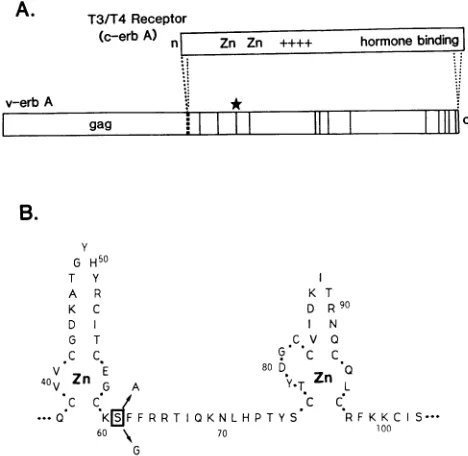
1A). Thev-erbAproteinisfusedtoretroviralgagsequences atits N terminus and hassustained small N- and C-terminal deletions and13 internal amino acidchanges relativetothe chickenc-erbAotprogenitor (38).Asaconsequenceof these
changes, the v-erbA protein has a severely diminished
ca-pacity tobind thyroid hormones, and although itis able to
bindtoTREsequencesandactasatranscriptionalactivator
inyeastcells, v-erbAcannotactivatetranscriptioninanimal cells (8, 27, 33, 37). Instead, the v-erbA gene in vertebrate cells actsas arepressorandinhibitsactivation of
hormone-responsive genesby the normalthyroid hormone receptor.
*Correspondingauthor.
The v-erbA gene may therefore represent a novel form of
oncogenethatactsnotby mimicking,butbyinterfering with,
thefunction of itsnormal cell counterpart (8, 37, 46, 47).
It isprincipally the alterations sustained by the C terminus
of the v-erbAprotein, relativetothec-erbAprogenitor,that
appearresponsible for the loss ofhormone binding by the
viral protein and for its conversion into a constitutive
transcriptional repressor(8, 27, 37, 47). Nonetheless, there
are additional sequence differences between the c- and
v-erbA proteins that may be important. One of the most
provocativeof these isat thebaseof the first zincfinger: all
knownthyroid hormonereceptorsencode
Cys-Glu-Gly-Cys-Lys-Gly at this site, whereas the viral erbA gene encodes
Cys-Glu-Gly-Cys-Lys-Ser (38; Fig. 1). This domain playsa
crucial role in recognition of, and discrimination between,
the different hormone response elements by the different steroid andthyroidhormonereceptors(2, 9, 26, 41).
Intrigu-ingly, the estrogen receptor, which in common with the
v-erbAproteinbindstobut doesnotactivatetranscriptionat TREsequences,divergesfrom thethyroid hormonereceptor
at this same site: Cys-Glu-Gly-Cys-Lys-Ala (15).
Wereportherethatalterationof theserine in the first zinc
finger of the v-erbA protein back to the c-erbA-encoded
glycine results both in an alteration in the DNA binding
properties oftheviralprotein and inadramaticimpairment
in its ability tofunction in neoplasia. In contrast, av-erbA
genematchingtheestrogenreceptoratthissite, encodingan
alanine,actsinneoplasiainamannerverysimilar to that of
the wild-type v-erbA gene. We suggest that, in addition to
changes in the C-terminal hormone binding domain,
alter-ations in the DNAbindingpropertiesof the viralprotein play
acritical role in thegenesisof the v-erbAoncogenefrom the c-erbA hormone receptor.
MATERIALS AND METHODS
Construction of theS61G, S61A,and82-t v-erbA mutations.
Subclones of the molecularly clonedAEVgenome, eithera
1.7-kb SstI-to-SaIl fragment for the S61A mutation or a
1.2-kb XhoI-to-SalI fragment for the S61G mutation (43),
were introduced into M13mpl8 and subjected to
site-di-rected mutagenesis utilizing the dut ung methodology of
2037
on November 10, 2019 by guest
http://jvi.asm.org/
Kunkel (Bio-Rad Mutagene kit). The sequence of the
com-plementary oligonucleotide was either 5'-GACGG AAAAA
GCCCT TGCAG CCCTC-3' for the S61G mutation or
5'-GGTCC GACGG AAAAA GGCCTTGCAGCCCTC-3' for
the S61A mutation (underscored bases are
noncomplemen-tary to the wild-type v-erbA sequence) (38). Mutant M13
vector clones wereidentified by DNA sequence analysis, the
double-stranded replicative forms were isolated, and the
portions of the mutagenized v-erbA sequence represented
within a 349-bpScaI-to-PvuII fragment were engineered in a
multistep process into the pAEV-11-3L infectious form of
the cloned AEV genome. Correct transfer of the mutant
lesions into the infectious plasmid vector was confirmed by
a second round of DNA sequence analysis. A v-erbA null
mutant,designated 82-t, was createdby the introduction of a
prematuretermination codonat thebeginning of the v-erbA
sequence (31).
Cells and virus. Chicken fibroblasts were isolated from
embryonatedSPAFAS eggs and werepropagatedin
Dulbec-co's modified Eagle medium (GIBCO) supplemented with
10% fetal bovine serum, 10% tryptose phosphate broth
(Difco), and antibiotics (100 U of penicillin per ml, 1 mg of
streptomycin per ml, and 2.5 pLgofFungizone [amphotericin
B] perml). The fibroblasts were transfected with wild-type
and mutant forms of the pAEV-11-3L infectious molecular
clone by calciumphosphate precipitation in the presence of
pRAV-1OR, an infectious molecular clone of the
Rous-associated virus-1 (RAV-1) genome (29, 39). Bone marrow
cells were isolated from the femurs of 6- to 8-day-old
SPAFASchicken neonates and wereused inthe
methylcel-lulose medium assays (see below).
Biological assays. The ability of mutant viruses to induce
erythroid colonies was assayed by a methylcellulose
medi-um-bone marrow cell technique (31). Theability of infected
fibroblasts to display anchorage-independent growth was
assayed by colonyformationinsoft agar medium (29). Titers
of AEV stocksweredetermined by serial dilution and colony
formation insoft agar medium.
Biochemical assays. The v-erbA proteins synthesized in
AEV-infected fibroblastswereanalyzed by radiolabeling the
cells for 2 h with 35S-amino acids, followed by lysis and
immunoprecipitation analysis; radiolabeled proteins were
resolved by sodium dodecyl sulfate (SDS)-polyacrylamide
gel electrophoresisandwerevisualized byfluorography(32).
The amountof each cell lysate subjected to
immunoprecip-itation was normalized relative to total protein synthesis as
measured by hot trichloroacetic acid precipitation;
normal-izationrelative to total cell number yielded virtually identical results (data not shown).
Immunofluorescent localization of the v-erbA proteins in
infected fibroblasts was performed on Formalin-fixed and
detergent-permeabilized cells as described, using an
poly-clonal antibody raised against a bacterially synthesized
portionof the v-erbA polypeptide(4-6).
DNA binding by mutant and wild-type v-erbA proteins
was determined by a McKay-type immunoprecipitation
as-say with twomodifications from our previous protocol: KCl
wasusedinstead of NaCl in the DNA binding buffer, and the
agarose gels were usually dried and autoradiographed
di-rectly, rather than first subjected to capillary blot transfers
(4).
The ability of v-erbA to repress transcription of a TRE
reporter gene was tested in transient transfections of CV-1
cells, using the same expression and reporter vector
con-structs previously described (8). Chloramphenicol
acetyl-A.
v-erbA n
T3/T4Receptor
(c-erb
A)n
-
Zn Zn ++++ hormonebinding C-2
.ga
gag
*
vI-I-1
111
: ::
IllUc
B.
y
G H50
T Y
A R K T
K C D R90
D N
G T CV Q
.C C.
Zn E 80D
ZnQ
40V Zn G ZnL
C C'/ CC
Q K F RR T Q K N L H P TYS S--CR F K KC
60 70 1 00
G
FIG. 1. Schematic ofthev-and c-erbAproteins. (A)Comparison
ofthe primary structures of the v- and c-erbA (T3/T4 receptor) proteins. Thelocations of two zinc finger domains (Zn), ahighly basic domain (++ ++) that includesa nuclear localization signal, and the hormonebinding domainareillustrated withinthediagram ofthe c-erbAprotein. Below,withinthev-erbA protein schematic, are shown the locations of gag sequences, N- and C-terminal deletions, and internal amino acid sequence differences (vertical
lines) relative to the c-erbA protein. The codon 61 position is starred. (B) Expanded schematic and sequence ofthe zinc finger domainof v-erbA.A highly schematic two-dimensionaldiagram of the two zinc fingers within the v-erbA protein is represented in single-letteraminoacidcode. Thelocations ofthecysteines thought tobecoordinatedtozinc ions(Zn)areshown.Codon 61,aserinein the wild-type v-erbA protein, is boxed, and the two mutations analyzed in this report, serine to glycine (S61G), and serine to
alanine(S61A),areindicated.
transferase(CAT)reportergeneexpressionwasquantitated
byasolvent partitioning protocol (30).
RESULTS
Asequencewithin the firstzincfingerinv-erbA was altered
tothatof c-erbAand to thatoftheestrogenreceptor gene.The
serine-61 codon at the base of the first zinc finger in the
v-erbA genewaschanged to aglycine codon mimicking the
c-erbA sequence at this site (designated S61G) or to an
alanine codon mimicking the estrogen receptor sequence
(designated S61A) (11; Fig. 1B). The genetic lesions were
reconstructed into infectious clones of the full-length AEV
genome and were introduced into chicken embryo
fibro-blasts in the presence ofaRAV-1 genome; AEV is
replica-tion defective and requires an appropriate helper virus for
production of infectious virus particles (17). Virusreleased
bythese primary transfectantswas used toinfecterythroid
cells and secondary culturesoffibroblasts.
Fibroblasts infected by AEV possessing a wild-type or
mutant v-erbA genewere first analyzed for thesynthesis of
the appropriate polypeptides by immunoprecipitation with
erbA-directed serum and SDS-polyacrylamide gel
electro-phoresis (Fig.2). Abundantproteins oftheexpected size for
on November 10, 2019 by guest
http://jvi.asm.org/
[image:2.612.324.558.68.296.2]1 2 3 4 5 6 7 8
erb A
_
______-Lp75
< <
Preimmune erb A-directed
FIG. 2. Immunoprecipitationanalysis of v-erbAproteins
synthe-sized by the wild-type and codon 61 AEV mutants. Fibroblasts
infected bythe 82-t v-erbA nullmutant(lanes1and5),bywild-type (wt) AEV (lanes 2 and 6), by theS61G v-erbA mutant(lanes3 and 7),orby the S61A v-erbAmutant(lanes 4 and 8)weremetabolically
radiolabeledwith35S-aminoacids for 2 h, washed, lysed by
sonica-tion, and analyzed by immunoprecipitation and SDS-polyacryl-amide gel electrophoresis. Eitherpreimmune serum(lanes 1to4)or
erbA-directed antiserum(lanes 5to8)wasused. The location ofthe
75,000-molecular-weight gag-v-erbA proteinis indicated (p75erbA). Each sample was normalized to total protein synthesis as
deter-mined by hot trichloroacetic acidprecipitation.
thegag-v-erb A polypeptide (75,000 Da inapparent molec-ular size; designated p75v-erbA) were detected in lysates of
cells infected by the wild-type, S61G, and S61A viruses but not in cells infected by AEV bearing a null mutation in
v-erbA (82-t;Fig. 2)orby theRAV-1helpervirusalone (data not shown). The 75,000-Mr proteins were not detected by preimmune serum (Fig. 2). The S61G and S61A mutant v-erbA proteins were synthesized at levels comparable to
thatof the wild-type protein;the slightly reduced level ofthe S61A protein seenin Fig. 2wasnotareproducible featureof
our assays. Pulse-chase experiments demonstrated that the
turnover rate of the mutant proteins was identical to or
slightly slower than that of the wild-type protein (data not
shown). These results indicate that neither the S61Anorthe
S61G mutation had adverse effects on the synthesis or the
stability of the encoded polypeptides.
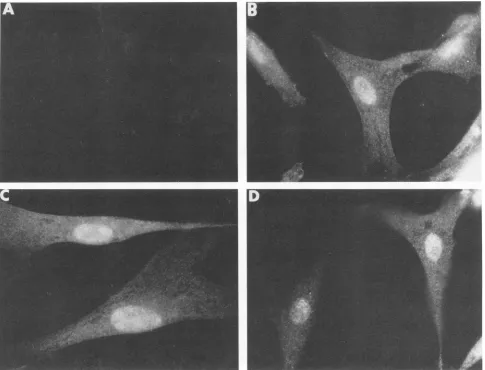
Themutantv-erbA proteinsexhibitedasubcellular localiza-tion identicaltothatof the wildtype.Althoughthemajorityof the wild-type v-erbA protein is found in the nucleus ofthe infected cell, aconsistent 30to40%of the v-erbA protein is found as a separate, nonexchangeable cytoplasmic subpop-ulation of unknown function (3, 5, 6). Analysis of linker insertion mutations has demonstrated that nuclear
accumu-lation ofthe v-erbA proteinis essential foritsfunctioninthe
neoplastic cell and requires both a nuclear targeting
se-quence, flankingcodon 122 in the v-erbA sequence, and the
integrity of the zinc finger(DNA binding)domains (5,6). A similar phenomenon has been observed for the c-erbA pro-tein (21).
Because of the close apparent linkage between DNA binding and nuclear accumulation, we tested the effects of ourcodon 61 mutationsonthesubcellulardistribution of the v-erbA protein as visualized by immunofluorescence. As in
previous studies, the majority of the wild-type v-erbA
pro-tein was found in the nucleoplasm of AEV-infected
fibro-blasts,withthe remainder uniformly distributed in the
cyto-plasm (Fig. 3D). Both the S61G and S61A mutant v-erbA
proteins exhibited apattern virtually identical to that of the
wild-type polypeptide (Fig. 3B and C), suggesting that
nei-ther genetic lesion had a significant effect on nuclear
trans-port orretention. Cells infected by the 82-t null mutant and
visualized with erbA-directed antibodies (Fig. 3A), orcells
infected by the wild-type virus but visualized with
preim-mune serum (data not shown), demonstrated very low
back-ground levels offluorescence.
Both the alanine and glycine v-erbA mutants exhibited
altered DNAbinding properties. We tested the effects ofthe
S61GandS61A v-erbAmutationsonDNAbinding byuseof
a coupled DNA binding-immunoprecipitation (McKay-type)
procedure. In this assay, a mixture of radiolabeled DNA
restrictionfragments was incubated with an unlabeledlysate
of AEV-infected cells. The v-erbA protein, and any DNA
fragments bound by it, were subsequently
immunoprecipi-tated by erbA-directed antibodies and washed, and the
bound DNAfragments were resolved by gel electrophoresis
and visualized by autoradiography. As the substrate we used
a restrictiondigest of the rat growth hormone gene, athyroid
hormone-responsive locus that contains severalthyroid
hor-mone receptor(c-erbA protein) binding sites (4).
As demonstrated in our previous work, the wild-type
v-erbA protein bound most strongly to three particular
fragments derived from the rat growth hormone gene: C, F,
and H (Fig. 4). These three fragments contain known or
near-consensus binding sites for the c-erbA protein, and we
have previously shown that the binding of all three can be
specifically abolished by use of an artificial TRE
oligonucle-otide. No DNA binding was seen with extracts of cells
infected by the v-erbA 82-t null mutant (Fig. 4A),indicating
that c-erbA proteins, expressed at very low levels in these
cells, do not contribute to the observed DNA binding
pattern.
Both the S61A andS61G mutant v-erbAproteins exhibited
DNA bindingpatterns that were related, but not identical, to
that displayed by the wild-type protein (Fig. 4). The S61A
protein was most divergent in this assay from the wild-type
protein, binding fragments C and F but not H. In addition,
theS61A mutant protein strongly bound fragments A and B
(derived largely from plasmid vector sequences) as well as
weakly binding fragment D; none of these latterfragments
were bound at significant levels by the wild-type v-erb A
protein (Fig. 4). In contrast to the S61Amutation, the S61G
mutation demonstrated a more subtle effect on DNA
bind-ing, exhibiting a consistent increase in the binding of
frag-ment D and a reproducible decrease in the ability to bind
fragments E and H relative to thewild-type v-erbA (Fig. 4).
These alterations in the DNA bindingpatternsof the v-erbA
mutant proteins most likely reflect a shift intheiraffinities for
different subsets of binding sites rather than a general
increase in non-sequence-specific DNA binding: the
muta-tions do not lead to a general increase in the affinity ofthe
v-erbA protein for all input DNA fragments, the DNA
binding observed was stable to salt concentrations that
eliminate nonspecific DNA binding by other v-erbA mutant
proteins (6), and the observed binding was not readily
abolished by the introductionof lambda DNA in thebinding
mixtures (data not shown). In addition to the qualitative
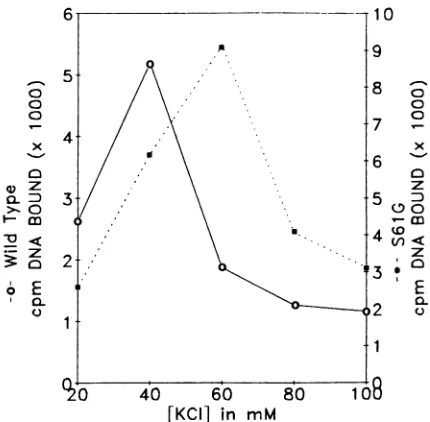
changes detailed above, observable over a range of KC1
concentrations, the S61G mutant appeared to display a
higher salt optimum overall for DNA binding than did the
wild-type protein (Fig. 5). Taken together, these results
on November 10, 2019 by guest
http://jvi.asm.org/
[image:3.612.110.265.70.252.2]FIG. 3. Immunofluorescenceanalysis ofthesubcellular location of mutant andwild-type v-erbAproteins. Infectedfibroblasts,grownon
coverslips,werefixedwithFormalin andpermeabilized with TritonX-100. Thelocation ofthe v-erbAproteinwassubsequently visualized by incubation ofthe fixed cells with erbA-directedantisera, followed by incubation with rhodamine-conjugated secondary antibodyand photomicroscopy with epifluorescent illumination.(A)Cellsinfectedbythe 82-t(v-erbA null)mutant;(B) cells infectedbytheS61Gmutant; (C)cellsinfected bytheS61Amutant; (D) cellsinfectedby wild-typeAEV.
suggestthat our mutant v-erbA proteins retain the ability to
recognize DNA in a sequence-specific manner and that
alteration of serine 61 has subtle but detectable effectsonthe
DNA recognition properties of the v-erbA protein.
The S61G back mutation, but not S61A, severely impairs
v-erbA functionintransformederythroid cells.Theability of
ourcodon 61mutantv-erbAproteinstofunction inerythroid
transformation was tested by a methylcellulose colony
as-say: chicken bone marrow cells were infected by the
dif-ferent AEV viruses and were plated in medium
supple-mented only with fetal bovine serum, chicken serum, and
tryptose phosphate broth. Only cells transformed by virus
bearing a functional v-erbA gene, in addition to the v-erbB
gene, can propagate and form a macroscopic colony under
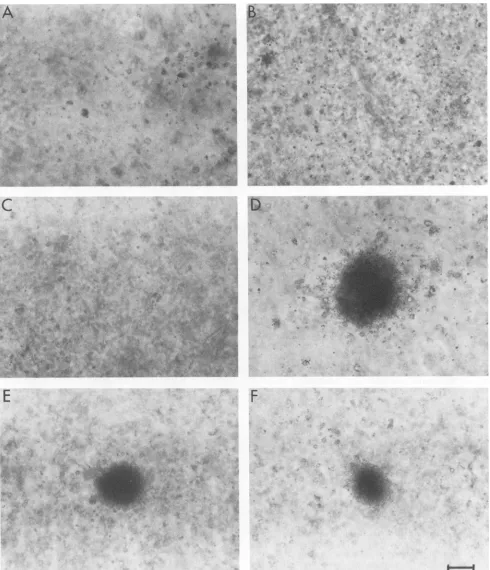
these conditions (7, 12, 23, 31). The wild-type virus gave rise
to visible erythroid colonies in this assay, whereas the
RAV-1 helper virus alone, or AEV bearing the v-erbA 82-t
null mutation, yielded no colonies (Fig. 6 and 7).
The S61G back mutant was sharply impaired in its ability
to function in erythroid transformation, producing
approxi-mately 15-fold-fewer colonies inourbone marrow assay than
did the wild-type v-erbA virus (Fig. 6). The results ofthree
independent assays are presented. Therare erythroid
colo-nies that did appear in bone marrow assays of the S61G
mutant were morediffuse andmorelooselystructuredthan those induced bythewild-typevirus (Fig. 7). In contrast to
erythroidtransformation, fibroblast transformationbyAEV
is conferred principally by the v-erbB oncogene, and the
v-erbA gene has only modesteffects detectable on long-term
propagation of fibroblasts in low-serum medium (12, 13, 16).
Consistent with thisobservation, in high-serummediumthe S61G AEV mutantinducedthe sametransformed
morphol-ogy andanchorage-independent growth properties in
fibro-blasts asdid wild-type AEV andexhibited titers,measured
asfibroblast-transforming units,equalto orgreaterthan that
ofthewild-typevirus(Fig. 6). These resultsconfirm that the
impairment of erythroid colony formation by the S61G
mutationwasdueto aspecific effectonv-erbA functionand
didnot reflect aninhibition of viral replicationorofv-erbB
activity.
Unlike the S61G mutant, the S61A mutant was virtually
fullyfunctional in theerythroidassay,yieldingbonemarrow
on November 10, 2019 by guest
http://jvi.asm.org/
[image:4.612.74.559.68.438.2]A B
2-_ _n-a
_
_a-b
U1) c
-r _-d1-
-o
e c
J .0
rn~. 5 f <
\h
co tn --
0-U)
c
a) c 1-.0E
C S61AA
a b
D
(0 c
0
c 1
-(U
Q
Ci S61G
h
d
WT C
.0~~~~~~~
f~~~~~~f
d e h e
FIG. 4. DNAbindingbymutantandwild-typev-erbA proteins. (A)CoupledDNAbinding-immunoprecipitation (McKay)analysis. Lysates of fibroblasts infected by mutant orwild-type AEV were incubated with 32P-labeledrestriction fragments derived fromtherat
growth hormonegene (input). The v-erbA proteins, andanyDNA fragments bound tothem, were subsequently immunoprecipitated with erbA-directed antiserum and washed, and the bound DNA fragmentswerereleasedandanalyzed byagarosegel electrophore-sis. An autoradiogram of the gel is presented; the different rat
growth hormoneDNArestriction fragmentsarelabeledatoh,asin ourprevious report (4). Equal numbers of total 32P counts were loaded for each sample. (B) Scanning densitometer analysis, in arbitrary absorbance units, of the DNA fragments bound by the S61G v-erbA protein. (C) Scanning densitometer analysis of the DNAfragmentsbound by the S61A v-erbA protein. (D) $canning densitometeranalysisof the DNAfragmentsboundby the wild-type v-erbAprotein.
colonies nearly equal in number and indistinguishable in
appearance from those induced by the wild-type v-erbA
protein (Fig. 6and7). Fibroblast transformationbythe S61A
mutantwasalso identicaltothat induced by wild-typevirus
(Fig. 6).
TheS61Gmutantisabletorepresstranscription despite its
loss offunctioninerythroid transformation.Theabilityof the
v-erbA proteinto actas atranscriptionalrepressorhas been
proposedastheprobablemechanismthroughwhich the viral
oncoprotein blockserythroid differentiation (8, 37, 47). We
therefore tested theabilityofourmutantproteinstoserve as
transcriptionalrepressors, andtoinhibit the function of the
c-erbA protein, in transient transfections assays (8). As
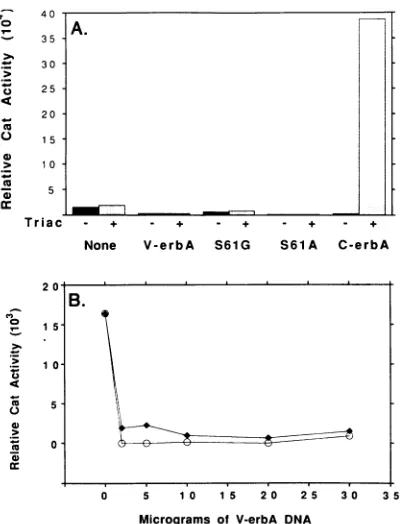
previously noted, in the absence of hormone, both the
c-erbA protein and thewild-type v-erbAproteinfunctioned
asrepressorsand inhibited basalexpressionofaTRE-linked
reporter gene (Fig. 8A). Addition ofthyroid hormone
con-verted the c-erbA protein intoa strong transcriptional
acti-vator, greatly stimulating expression of the TRE reporter
0 0 0
_s
x
0
o~
oE
(.Z
>
._ z
6 E
C-60 [KCI] in mM
10
0
O 0
x 0 z
00
'-m
(D
z
'0
E
Q
FIG. 5. Effects ofKCl on DNA binding by the wild-type and S61G v-erbA mutant proteins. The McKay assay described in the legendtoFig.4 wasrepeated withdifferent KCIconcentrations in thebinding and wash buffers, and the total amount ofDNAboundat each salt concentration was determined by a Cerenkov method. DataforDNAbinding bythewild-type protein (-), and by the S61G protein (---)areshown.
gene, whereas the wild-type v-erbA protein remained a
repressor independent of hormone status (Fig. 8A).
Intro-duction of the wild-type v-erbA gene together with the
c-erbA gene abolished c-erbA-mediated stimulation of
re-porter geneexpression (Fig. 8B).
Both theS61G and S61Amutantsfunctionedmuchlike the
wild typein the transcription assay, repressing basal
expres-sion of the TRE reporter gene both in the presence and inthe
absence of thyroid hormone (Fig. 8A). The S61A mutant
behaved in a manner indistinguishable from that of the
wild-type protein, whereas the S61G mutant exhibited a
slightreduction in itsabilitytorepress reporter gene
expres-sion relative to the wild-type protein. Both the S61A and
S61Gmutants wereabletoinhibit c-erbA action when viral
and cellular genes were cointroduced into the CV-1 cells
(Fig.8B and datanotshown). Inhibitionbyeither the S61G
mutant orthe wild-type v-erbA gene demonstrated avery
similar concentration dependence
(Fig.
8B). These resultsindicate that the ability of the v-erbA protein to repress
c-erbA function in transient
transfection
assays does notparallel the ability of v-erbA protein to function in the
transformederythroid cell and suggest thata more
complex
mechanism ofv-erbA actionmaybe operativein
neoplasia.
DISCUSSION
Structural alterations involved in theetiologyof the v-erbA
oncogene protein. v-erbA, an altered host cell gene for a
thyroid hormone receptor, blocks the differentiation of
erythroidcellsand alters thegrowthproperties offibroblasts
inlow-serum conditions(13, 16).Whatis themolecular basis
behindtheconversionofa
thyroid
hormone receptor into thev-erbA oncogene protein? It has been
previously
demon-strated thatchanges in the Cterminus of the v-erbA
poly-peptide,
consisting
ofa deletion and five amino acidalter-ationsrelativetothec-erbA
protein,
haveimpaired
the viralon November 10, 2019 by guest
http://jvi.asm.org/
[image:5.612.328.543.67.278.2] [image:5.612.69.282.68.356.2]
40-30
20
10l
82-t S61 G S61/
Viral Stock
WT
10000
1000
100
*10
FIG. 6. Transforming propertiesof mutant andwild-typeAEVs.
Erythroid cell-transforming activity (U)wasassayed by a methyl-cellulosemedium-bonemarrowassay;presentedarethenumber of erythroidcolonies inducedbyeach virus stock per 35-mm dish(5x
106 bone marrow cells). Fibroblast-transforming activity (O) was
determinedbyserial dilution of each virusstock,followedbyasoft agar colony-anchorage-independent growth assay; presented are thefibroblast-transformingtiters(softagar colonies permilliliter)for the same virus stocks as used in the erythroid assays. Both fibroblast and erythroiddatarepresent theaverages of two (S61A and 82-t)orthree(RAV-1,S61G,andwild-type AEV) independent assays.
protein's abilitytobindhormone(27). Unabletorespondto
thyroid hormone but able to bind to TRE sequences, the
v-erbA protein functions as a constitutive repressor in
ani-malcells (8, 37).Thisabilityof v-erbA to actas a transcrip-tional repressor appears to be closely linked to its role in
blocking erythroid differentiation: restoration of the c-erbA
C terminus to the v-erbA protein restores
hormone-stimu-latedtransactivationtothechimeric proteinandrendersthe
erbA-mediatedblock to differentiation reversiblebyaddition
ofthyroid hormones (47).
Thework describedhere demonstratesthat,inaddition to
the alterationssustainedby the v-erbA Cterminus, asingle amino acid difference betweenv-and c-erbAproteinsatthe
base of the firstzinc fingermotif has critical effects onthe
ability of v-erbA to participate in establishing the
trans-formed phenotype. Thus, at least two structural changes,
involving alterations in hormone response and perhaps in
DNA recognition, appear crucial for the viral protein's
actions in the neoplastic cell.
Aclearprecedentformultiple structuralchanges
contrib-uting to the activation of a proto-oncogene comes from
analysis of the c-src protein. Althoughloss ofaregulatory
phosphotyrosine at position 527 in the c-src protein is
sufficientto convert the relatively quiescent c-src polypep-tideintoanactivatedoncoprotein (reviewedin reference22),
additional changes at a number of different sites withinthe
c-src coding region can either autonomously activate the
oncogenic potential ofc-src or act synergistically with the
tyrosine 527 alteration to generate a more strongly
trans-forming protein (20, 24, 28, 35, 45). The v-src gene appears
to have accumulated more than one of these activating
genetic lesions (24). Similarly, activation of the
fibroblast-transforming potential of the v-erbB gene, the second
onco-gene in the AEV genome, appears to involve both N- and
C-terminal changes relative to the c-erbB protein from which
it is derived (34, 40). It is likely that multiple independent
events lie behind the conversion of many proto-oncogenes
into viral oncogenes and that under continued propagation
and selection, increasingly virulent oncogene derivatives
appear. These multiple steps in the etiology of the viral
oncogenes may parallel in some ways the phenomenon of
tumor progression in spontaneous neoplasia.
DNA recognition bythe v- andc-erbAproteins. The amino
acid difference betweenc- and v-erbA thatwe examined in
these experiments, at codon 61 in the viral erbA sequence,
occurswithin the first oftwocysteine-rich motifs which are
presentin allmembersofthenuclearreceptorfamily.These
cysteine motifs, sometimes referredto aszincfingers,along
with flanking regions, define a DNA binding domain (11).
Models basedonbiophysicalstudies suggest thatthe
cyste-inemotifs donotactuallyform extendedfingersso muchas
a more compact structure, with the coordinated zincatoms
stabilizing the overall conformation (19). In this model,
ct-helicalregions extending downstream from the cysteines
appeartomake the actualcontactswith the DNAmolecule,
with thehelixassociatedwith the firstcysteine motif lyingin
the major grove and the helix associated with the second
cysteinemotifcontacting the DNA backbone.
Three amino acids in the first cysteine motif, which
include the serine 61 of interest here, appear to have the
strongest effects on the specificity of DNA recognition by
the nuclear receptors; in the proposed three-dimensional
structure ofthe cysteine motif domain, these three amino
acids are in an appropriate position to make base-specific
contactswith the DNA(9, 19, 26, 41). Thus,it isperhapsnot
surprisingthat alteration ofserine 61 in the v-erbA protein
canhave measurable effectsonthe DNAbinding properties
of the
polypeptide.
In our hands, back mutation of thev-erbA serine to the c-erbA-encoded glycine is associated
with ahighersaltoptimum forDNAbinding. Thiselevated
saltoptimamaynotnecessarily reflectanincreasedaffinity
constantfor DNA but is consistent with a previous
obser-vation that c-erbAproteinbinds TREs with higher apparent
affinity
than does the wild-typev-erbA protein (37).The ability to bind to individual rat growth hormone
restriction fragments also appears to differ, if subtly,
be-tweenthe wild-type and codon61 mutant v-erbA proteins.
Naturally occurring TREs, such as in the rat growth
hor-mone gene used in our studies, share common sequence
motifs but nonethelessdivergein their exact sequencesand
intheir relativeaffinities forthethyroid hormone receptor.
The disparities in the binding patterns of our position 61
mutantandwild-type proteinsarepresumablyreflectionsof
thesedifferences in the individualratgrowth hormone TRE
sequences and their relative abilities to interact with the
different amino acids introduced at position 61. The low
abundance of c-erbA protein in most cells has made it
difficult to directly test whether the DNA binding pattern
manifestedbytheS61G backmutation resembles that of the
c-erbA protein, and further studies using a baculovirus
expression system are under way. Intriguingly, however,
oneeffect of the S61G mutation is an enhanced binding of
fragment Dfrom the ratgrowth hormone gene; the c-erbA
proteinis knowntobindtosites withinfragmentD, whereas
a
uRAV
1on November 10, 2019 by guest
http://jvi.asm.org/
[image:6.612.93.269.65.293.2]...
*i
.4.
4
;'
*br - i.i*_S v* w X V
_. ^s :
t
W e_ AS 4
4-F f w *V+, ,
rf * ;14t.s
'.jZ
,'Vo
-*
AL
f.
4.6
:1+1i:
...'
:1
-?.
D.
l,
AA
.A -(
0-0
tF.
F
.-f.WY
[image:7.612.61.551.87.657.2]-~~~~~~~~~~~~~
FIG. 7. Erythroid colonies induced bymutant and wild-type AEV. Micrographs of bonemarrow-methylcelluloseassays performed by usingmutantorwild-type AEV stocksareshown. (A)Typical field resulting from infection with the RAV-1 helper alone; (B) typical field resultingfrominfection with the 82-t v-erbA nullmutant; (C) typical field resulting from infection with the S61Gmutant;(D)rare, diffuse
erythroid colony resulting from infection with the S61Gmutant;(E) typical erythroid colony resultingfrom infection with the S61A mutant;
(F) typical erythroid colony resulting from infection with wild-type AEV.
A
r
4'
.5
C
1'
.4S
4
E
i
w .1
... 4'
*:.
A.1
16.
.p:
ib.
.4
.
.1
't
0
.4.1. .0
4
ll. I'If
.,
.9-4i,
I
... .i4n
" A.10,
4-',
Al.
on November 10, 2019 by guest
http://jvi.asm.org/
40 35 30
25
20 1 5- 10-
5-Triac - + - + - + None V-erbA S61G
1 5
10
5
0
- C- A
S61 A C-erbA
[image:8.612.87.288.70.332.2]3 5
FIG. 8. Transcriptional repression mediated by wild-type and
mutantv-erbAproteins.Molecular clones of c-erbAorv-erbAwere
introduced into CV-1 cells together with a TRE-tk-CAT reporter genebyacalciumchloridetechnique (8). After 12h,thecellswere
transferredtohormone-strippedmedium(-)ortomedium
contain-ing10,uMtriac(+), incubatedforanadditional 36h,andassayedfor CATactivityasdescribed in Materials and Methods. CATactivity
isexpressedrelativetothat ofaRoussarcomavirus-lacZconstruct
cotransfected intothesamecellsas an internal control.(A)Effects ofdifferentc-and v-erbA constructsonexpressionof the TRE-tk-CATreportergene. Fifteenmicrogramsof eithercarrier DNA alone
(None), thewild-type v-erbAgene,the serine61-to-glycinemutant (S61G),the serine61-to-alaninemutant(S61A),orthe c-erbAgene
wereindividually introduced into CV-1 cells alongwith 7.5 ,ug of the
TRE-tk-CAT reporter, the cells were maintained as described
above,andthe CATactivitywas determined. All erbAgeneswere expressed by usinga Rous sarcomavirus-promoter construct(8). (B) Suppression of c-erbA action by cotransfection of v-erbA. A fixedamountof c-erbA DNA(5 ,ug)wasintroduced into CV-1 cells inthepresenceof variousamountsof cotransfectedwild-type (0)or
S61G (*)v-erbA DNA. All culturesweretreated with 10,uMtriac
hormone,the cellswereharvested 32 hlater,andthe CATactivity,
relativetothat ofaninternal Roussarcomavirus-lacZ control,was
determined.
thewild-typev-erbAprotein recognizesthisfragment poorly
or notat all(4, 14, 25).
Alteration of the v-erbAsequenceatcodon 61toresemble that of the estrogen receptorgene had little or no effect on
theabilityoftheproteintofunction inerythroid
transforma-tion or to repress transcription. This result indicates that either alanine orserineatthisposition,twoamino acids with similar-size prosthetic groups, are consistent with v-erbA
function andrulesoutthepossibilitythatphosphorylationof
the wild-type v-erbA serine is in some manner responsible
for its biological activity. It is perhaps intriguing that both theestrogen receptor and the v-erbAproteinappeartoshare
theability to bindtoTREs but not toactivate transcription
from these sites (15). The relationship of this observation,
however,to structureof these receptors andtoregulationof
transcription remains unclear; despite the resemblance of
thebiological phenotypeof the S61Amutationtothat of the
wild-type gene, its DNA binding properties inour
McKay-type assayaredifferent in detail from those of thewild-type
v-erbA protein.
It isperhaps important to note that DNA binding by the
v-erbA protein may not be a fully autonomous function:
sequence-specific DNA binding by the v-erbA protein
ap-pears to be enhanced by the presence ofother, host cell
factors(4); the effects ofourv-erbA mutations on onDNA
binding may reflect changes in
protein-protein
interactionsaswellasdirect effectson DNArecognition.
Whatisthetarget of v-erbA actionin theneoplastic cell?It
isintriguingthat efficient v-erbAfunction in the transformed
celldepends,in part,on achangein the sequence of its DNA
bindingdomain fromthat of the c-erbA gene. One
possible
explanationis that theserine in thewild-type v-erbAprotein
confers a higher affinity for TREs and thereby permits the
viral protein to more effectively compete with the c-erbA
polypeptide forbinding to DNA. However, this
hypothesis
does not agree with results demonstrating that both the
c-erbA protein and theS61G v-erbA back mutant can
actu-ally bind certain TRE sequences moretightly than can the
wild-type v-erbA protein and that the S61G mutant
effi-ciently interferes with c-erbA action in transient
transfec-tions.
We suggestthat the changeof v-erbAcodon 61to aserine
may have altered the DNA binding characteristics of the
v-erbApolypeptide topermit itto promiscuously recognize
analternative hormone response element. Thus,the v-erbA
protein
may operateinneoplasia
notbyblocking
theactionofc-erbA
proteins (thyroid
hormonereceptors)
butby
inter-fering
with the actions ofsomeothermember of thesteroid/thyroid
hormone/retinoic acid receptorfamily
oftranscrip-tion factors. Becauseof theirknown roles indifferentiation
and close similarities tothe
thyroid
hormone receptors, theretinoic acidorvitaminD receptors may representplausible
targets for this
promiscuous
interference byv-erbA,
orperhaps an asyetunidentified memberofthe nuclear
recep-tor
superfamily
is involved (18, 42).Indeed,
we havere-cently
determined that thewild-type
v-erbAprotein
canefficiently
block the action of retinoic acid receptors,whereas the S61Gmutantcannot, suggestingthat the target
of v-erbA action in the
neoplastic
cell may be a retinoicacid-mediated differentiation process (39a).
Our data and
general
conclusions are consistentwith theobservations of Zenke et al.
(47),
who demonstrated thatchimeric constructsofthe c-erbA gene
containing
the DNAbinding
domain ofv-erbA induced apartial
block toeryth-roid differentiation distinct inphenotype fromthat induced
either by authentic c-erbA or by authentic v-erbA. The
analyzed
constructcontained v-erbA sequencesencompass-ing
both the site ofour ownmutation,
at codon61,
and asecond
site,
codon87,
atthebase of the second zincfinger
that also differs in sequence between v-and c-erbA. Itwas
not determined in these earlier experiments which amino
acid contributedtothe
partial phenotype.
Theimportance
ofthecodon61
position
wasalsorecently
underscoredby
theresults of de Verneuil and Metzger,
demonstrating
that athyroidhormone receptor-estrogen receptorchimera
bearing
a
glycine
atthis locationfunctionedas anefficienttranscrip-tional
activator,
whereas substitution ofa serine into thisposition
inhibited thetranscriptional activity
ofthechimera(10).
0 (3
0-C.)
0)
a)
0)
cr
A.
-I
B.
-0
a)
a) co 4)
0 5 10 1 5 20 25 30
Micrograms of V-erbA DNA
on November 10, 2019 by guest
http://jvi.asm.org/
ACKNOWLEDGMENTS
M.L.P. emphasizesthat both B.G.B. and M.S. contributed sub-stantially to the workpresented here. We gratefully acknowledge theextremely generous and skilled technical assistance of Catherine Judelson, and we thank C. C. Thompson and R. M. Evans for their kindness in supplying the erbA expression and reporter vectors used inthetransienttransfections.
This research wassupported by grant 47142 from the American Cancer Society and by grant CA38823 from the National Cancer Institute. B.G.B. was supported in part by a National Institutes of Healthpredoctoraltraining grant.
REFERENCES
1. Beato, M. 1989. Gene regulation by steroid hormones. Cell 56:335-344.
2. Berg, J. M. 1989. DNA binding specificity of steroid receptors. Cell57:1065-1068.
3. Bigler, J., and R. N. Eisenman. 1988. c-erbA encodes multiple proteinsinchickenerythroid cells. Mol. Cell. Biol.8:4155-4161. 4. Bonde, B. G., and M. L. Privalsky. 1990. Sequence-specific DNAbindingby the v-erbA oncogene protein of avian erythro-blastosisvirus. J. Virol. 64:1314-1320.
5. Boucher, P., A. Koning, and M. L. Privalsky. 1988. The avian erythroblastosis virus erbA oncogene encodes a DNA-binding protein exhibitingdistinct nuclear and cytoplasmic subcellular localizations.J. Virol.62:534-544.
6. Boucher, P., and M. L.Privalsky. 1990. Mapping of functional domains withinthe v-erbA oncogene protein: the remnants of the hormonebindingdomainplaymultiple,vital roles inprotein action.Oncogene 5:1303-1311.
7. Damm, K., H.Beug, T. Graf, and B.Vennstrom. 1987. A single point mutation in erb A restores the erythroid transforming potentialof a mutant avianerythroblastosisvirus (AEV) defec-tive in both erb A and erb B oncogenes. EMBO J.6:375-382. 8. Damm, K., C. C. Thompson, and R. M. Evans. 1989. Protein
encoded by v-erb A functions as a thyroid-hormone receptor antagonist. Nature (London) 339:593-597.
9. Daneilsen, M., L. Hinck, and G. M.Ringold. 1989. Twoamino acids within the knuckle ofthe first zinc finger specify DNA responseelementactivationby theglucocorticoidreceptor.Cell 57:1131-1138.
10. deVerneuil, H., and D. Metzger. 1990. The lack of transcrip-tional activation ofthe v-erb A oncogene is in part due to a mutation present in the DNA binding domain of the protein. Nucleic AcidsRes. 18:4489-4497.
11. Evans, R. M. 1988. The steroidand thyroidhormone receptor superfamily.Science 240:889-895.
12. Frykberg, L., S. Palmieri, H. Beug, T. Graf, M. J. Hayman, and B.Vennstrom.1983.Transformingparametersofavian erythro-blastosisvirus mutantsdeletedin the erb A or erb Boncogenes. Cell32:227-238.
13. Gandrillon, O., P. Jurdic, M. Benchaibi, J.-H. Xiao, J. Ghys-dael, and J.Samarut. 1987. Expression ofthev-erb A oncogene in chicken embryo fibroblasts stimulates their proliferation in vitroand enhancestumorgrowth in vivo. Cell49:687-697. 14. Glass, C. K., R. Franco, C. Weinberger, V. R. Albert, R. M.
Evans, and M. G. Rosenfeld. 1987. Ac-erbAbindingsite inrat
growth hormonegenemediatestransactivation bythyroid hor-mones. Nature(London)329:738-741.
15. Glass, C. K., J. M. Holloway, 0. V. Devary, and M. G. Rosenfeld. 1988. The thyroid hormone receptor binds with opposite transcriptional effectsto acommonsequencemotifin thyroidhormone and estrogen response elements. Cell 54:313-323.
16. Graf, T.,andH. Beug. 1983. Role of the v-erb A andv-erb B
oncogenes of avian erythroblastosis virus in erythroid cell transformation.Cell 34:7-9.
17. Graf, T., B.Royer-Pokora, G.E.Schubert,and H. Beug. 1976. Evidence for the multipleoncogenic potential of cloned leuke-mia virus:invitroandin vivostudies with avianerythroblastosis virus. Virology 71:423-433.
18. Grauper, G., K. N. Wills, M. Tzukerman, X.-K. Zhang,and M.
Phahl.1989. Dualregulatoryrole forthyroidhormonereceptors
allow control of retinoic-acid receptor activity. Nature (Lon-don)340:653-656.
19. Hard, T., E.Kellenbach,R.Boelens, B. A. Maler, K. Dahlman, L. P. Freedman, J. Carlstedt-Duke, K. R. Yamamoto, J.-A.
Gustafsson, and R. Kaptein. 1990. Solution structure of the glucocorticoidreceptor DNAbindingdomain. Science 249:157-160.
20. Hirai, H., and H. Varmus. 1990. Site-directed mutagenesis of the SH-2 and SH-3 coding domains of c-src produces varied phenotypes, including oncogenic activation of p60c3rc. Mol. Cell. Biol. 10:1307-1318.
21. Horowitz, Z. D., C. R. Yang, M. Forman, J. Casanova, and H.H. Samuels. 1989. Characterization ofthedomain structure of chick c-erb A by deletion mutation: in vitrotranslationand celltransfection studies. Mol. Endocrinol. 3:148-156.
22. Hunter, T. 1987. A tail of two src's: mutatis mutandis. Cell 49:1-4.
23. Kahn, P., L. Frykberg, C. Brady, I. Stanley, H. Beug, B.
Vennstrom,andT.Graf.1986. v-erb A cooperates with sarcoma oncogenes in leukemic celltransformation. Cell 45:349-356. 24. Kato, J. Y., T. Takeya, C. Grandori, H.Iba,J. B. Levy,and H.
Hanafusa. 1986. Aminoacid substitutions sufficientto convert thenontransforming p60c-srcprotein to atransformingprotein. Mol.Cell. Biol. 6:4155-4160.
25. Lavin, T. N., J. D. Baxter, and S. Horita. 1988. The thyroid hormone receptorbindsto multipledomainsofthe ratgrowth hormone5'-flankingsequence. J. Biol. Chem. 263:9418-9426. 26. Mader, S., V. Kumar, H. de Verneuil, and P.Chambon. 1989.
Three aminoacids oftheoestrogenreceptor areessentialtoits ability to distinguish an oestrogen from a glucocortiocid
re-sponse element. Nature(London)338:271-274.
27. Munoz, A., M. Zenke, U. Gehring, J. Sap, H. Beug, and B.
Vennstrom. 1988. Characterization of the hormone binding domain ofthe chicken c-erb A/thyroidhormone receptor pro-tein. EMBO J. 7:155-159.
28. Nemeth, S.P.,L.G.Fox,M. DeMarco, andJ. S. Brugge. 1989. Deletions within the amino terminal half of the c-src gene product that alter the functional activity ofthe protein. Mol. Cell. Biol. 9:1109-1119.
29. Ng, M., and M. L. Privalsky. 1986. Structural domains ofthe avianerythroblastosisvirus erb Bprotein required for fibroblast transformation: dissectionby in-frame insertionalmutagenesis. J. Virol. 58:542-553.
30. Nordeen, S. K., P. P. Green 1II, and D. M. Fowlkes. 1987. A rapid, sensitive, and inexpensive assay for chloramphenicol
acetyl transferase. DNA6:173-178.
31. Privalsky,M.L., P. Boucher,A.Koning,andC.Judelson.1988. Genetic dissection of functional domainswithin the avian
eryth-roblastosis virus v-erbA oncogene. Mol. Cell. Biol. 8:4510-4517.
32. Privalsky, M. L., L. Sealy, J. M. Bishop, J. P. McGrath, and
A.D.Levinson. 1983. Theproduct oftheavianerythroblastosis virus erb B locusisaglycoprotein. Cell 32:1257-1267. 33. Privalsky, M. L., M. Sharif, and K. R. Yamamoto. 1990. The
viral erbA oncogeneprotein,aconstitutiverepressor in animal cells, isa hormone-regulated activator in yeast. Cell 63:1277-1286.
34. Raines, M. A., N. J. Maihle, C. Moscovici, G. Moscovici, and H.-J. Kung. 1988. Molecular characterization of three erbB transducing viruses generated during avian leukosis virus-in-duced erythroleukemia: extensive internal deletion near the kinase domain activates the fibrosarcoma- and
hemangioma-inducingpotentialsof erbB. J. Virol. 62:2444 4252.
35. Reddy, S., P. Yaciuk,T. E. Kmiecik, P. M. Coussens, and D.
Shalloway. 1988. v-src mutations outside the carboxy-coding
region are not sufficient to fully activate transformation by
pp6Oc-srcin NIH 3T3 cells.Mol. Cell. Biol. 8:704-712. 36. Sap, J., L. de Magistris, H. Stunnenberg, and B. Vennstrom.
1990. Amajor thyroidhormone response element in the third intronof theratgrowthhormonegene. EMBO J. 9:887-896. 37. Sap, J., A. Munoz, J. Schmitt, H. Stunnenberg, and B.
Vennstrom. 1989. Repression of transcription mediated by a
thyroid hormone response element by the v-erb A oncogene
on November 10, 2019 by guest
http://jvi.asm.org/
product. Nature (London)340:242-244.
38. Sap, J., A. Munoz, K. Damm, Y. Goldberg, J. Ghysdael, A. Leutz, H. Beug,and B. Vennstrom. 1986. The erb Aprotein isa high affinity receptor for thyroid hormone. Nature (London) 324:635-640.
39. Sealy,L., M. L.Privalsky, G. Moscovici, C.Moscovici,and J. M.
Bishop. 1983. Site directedmutagenesis of avian erythroblasto-sis virus: v-erb B is required foroncogenicity. Virology 130:
155-177.
39a.Sharif, M., and M. L. Privalsky. Unpublished data.
40. Tracy, S.E., B.A.Woda, and H. L. Robinson. 1985. Induction of angiosarcomas by a c-erbB transducing virus. J. Virol. 54:304-310.
41. Umesono, K., and R. M. Evans. 1989. Determinants oftarget
gene specificity for steroid/thyroid hormone receptors. Cell 57:1139-1146.
42. Umesono, K., V.Giguere, C. K. Glass, M. G. Rosenfeld, and
R. M. Evans. 1988. Retinoic acid and thyroid hormone induce geneexpression througha commonresponse element. Nature (London) 336:262-265.
43. Vennstrom, B., L. Fanshier, C. Moscovici, and J. M. Bishop. 1980. Molecular cloning of the avian erythroblastosis virus
genome and recovery of oncogenic viruses by transfection of
chicken cells. J. Virol. 36:575-585.
44. Weinberger, C., C. C. Thompson, E. S. Ong, R. Lebo,D. J. Gruol, and R. M. Evans. 1986. The c-erb A gene encodes a thyroid hormone receptor.Nature(London)324:641-646. 45. Wilkerson,V. W.,D. L.Bryant, and J. J. Parson. 1985. Rous
sarcomavirus variantsthatencodesrcproteins withanaltered
carboxy terminusare defectivefor cellular transformation. J.
Virol.55:314-321.
46. Zenke, M., P. Kahn, C. Disela, B. Vennstrom, A. Leutz, K.
Keegan,M.J. Hayman,H.-R.Choi, N. Yew, J. D.Engel, andH.
Beug. 1988. V-erbAspecifically suppressestranscription ofthe
avianerythrocyte aniontransporter(band 3)gene. Cell 52:107-119.
47. Zenke,M., A. Munoz, J.Sap,B.Vennstrom,and H. Beug.1990. v-erb Aoncogeneactivationentails the loss of hormone-depen-dent regulatoractivity of c-erb A. Cell61:1035-1049.