Volume *, Number *, * *, 1–18 DOI:10.11948/*.1
STABILITY ANALYSIS OF HIGHLY
NONLINEAR HYBRID MULTIPLE-DELAY
STOCHASTIC DIFFERENTIAL EQUATIONS
∗Chen Fei
1, Weiyin Fei
2,†, Xuerong Mao
3, Mingxuan Shen
2and Litan
Yan
1Abstract Stability criteria for stochastic differential delay equation (SDDE) have been studied intensively for the past few decades. However, most of these criteria can only be applied to delay equations where their coefficients are either linear or nonlinear but bounded by linear functions. Recently, the stability of highly nonlinear hybrid stochastic differential equations with a single delay is investigated in [Fei, Hu, Mao and Shen, Automatica, 2017], whose work, in this paper, is extended to highly nonlinear hybrid stochastic differential equations with variable multiple delays. In other words, this paper establishes the stability criteria of highly nonlinear hybrid variable multiple-delay stochastic differential equations. We also discuss an example to illustrate our results.
Keywords Variable multiple-delay stochastic differential equation; nonlin-ear growth condition; asymptotic stability; Markovian switching; Lyapunov functional.
MSC(2010) 60H10, 34K20, 93E15.
1. Introduction
In many practical systems, such as science, industry, economics and finance etc., we will encounter the systems with time delay. Differential delay equations (DDEs) have been employed to model such time-delay systems. Since the time-delay often causes the instability of systems, stability of DDEs has been explored intensively for more than 50 years. Generally, the stability criteria are classified into the delay-independent and delay-dependent stability criteria. When the size of delays of the systems is incorporated into the dependent stability criteria, the delay-dependent systems are generally less conservative than the delay-indelay-dependent ones which work for any size of delays. There exists a very rich literature in this topics
†The corresponding author. Email address: [email protected](W. Fei)
1Glorious Sun School of Business and Management, Donghua University,
Shanghai, 200051, China
2School of Mathematics and Physics, Anhui Polytechnic University, Wuhu,
Anhui, 241000, China
3Department of Mathematics and Statistics, University of Strathclyde,
Glas-gow, G1 1XH, U.K.
(see, e.g., [3,11–13,16,17,21,36]).
Since 1980’s, stochastic differential delay equations were investigated in order to model practical systems which are subject to external noises (see, e.g., [27]). Since then, the study of the stability on SDDEs has been one of the most important topics (see, e.g., [5,10,15,19,20,24]).
In 1990’s, hybrid SDDEs (called also SDDEs with Markovian switching) were developed to model real-world systems since they may experience abrupt changes in their parameters and structure in addition to uncertainties and time lags. One of the important issues in the research of hybrid SDDEs is the analysis of stability of control systems. Moreover the delay-dependent stability criteria have been erected by many authors (see, e.g., [2,4,22,23,25,26,28,33–35]). To our best knowledge, the existing delay-dependent stability criteria are mainly created for the hybrid SDDEs where their coefficients are either linear or nonlinear but bounded by linear functions. Based on highly nonlinear hybrid SDDEs (see, e.g., [6–9,14,15,30–32]), [7] has recently established the delay-dependent stability criterion where they solve the stability of a single delay system. However, many real systems has multiple time-delay states (see, e.g., [1,18,29]). Therefore we further develop the stability criteria of highly nonlinear hybrid SDDEs with variable multiple delays.
Specifically, we first discuss the following SDDE with two delays δ1(t), δ2 with
δ1(t)≤τ (see Example 4.1)
dx(t) =
(−10x3(t)−x(t−δ1(t)))dt+1 4x
2(t−δ2(t))dB(t), ifr(t) = 1,
(−4x3(t) +1
2x(t−δ1(t)))dt+ 1 2x
2(t−δ2(t))dB(t),ifr(t) = 2, (1.1)
ont≥0 with initial data
{x(u) = 2 + sin(u) :−τ≤u≤0} ∈C([−τ,0];R), r(0) =i0∈S. (1.2)
Here B(t) is a scalar Brownian motion, r(t) is a Markovian chain with space S= {1,2}and its generator Γ given by
Γ = −1 1
8 −8
. (1.3)
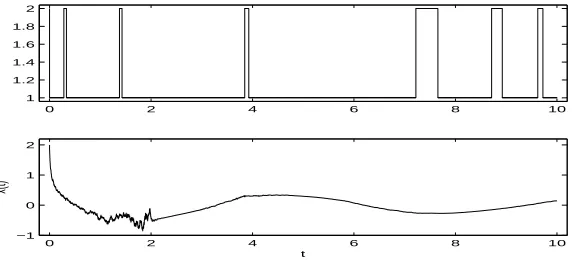
The above system (1.1) will switch from one mode to the other according to the probability law of the Markovian chain. Ifδ1(t)≤τ= 0.01, the computer simulation shows it is asymptotically stable (see Figure 4.1 ). If the time-delay is large, say
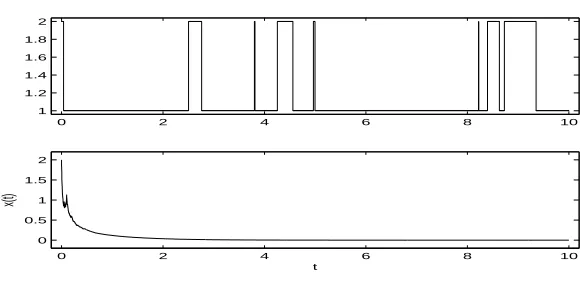
δ1(t)≤τ= 2, the computer simulation shows that the hybrid multiple-delays SDE (1.1) is unstable (see Figure 4.2 ). In other words, whether the hybrid multiple-delay SDE is stable or not depends on how small or large the time-multiple-delay is. On the other hand, both drift and diffusion coefficients of the hybrid SDE with multiple delays affect the stability of systems due to highly nonlinear. However, there is no delay dependent criterion which can be applied to the SDE with multiple delays to derive a sufficient bound on the time-delay τ such that the SDDE is stable, although the stability criteria of the highly nonlinear hybrid SDE with single delay have been created in [7]. This paper first established delay dependent criteria for highly nonlinear hybrid SDEs with variable multiple delays.
• This paper takes the variable multiple delays into account to develop a new theory on the robust stability and boundedness for highly nonlinear hybrid SDDEs.
• The new theory established in this paper is applicable to hybrid SDDEs with different delays in drift and diffusion coefficient of SDDEs with multiple delays (see (2.1)). Especially, we found that the sizes of delays in drift coefficient only affect the stability of the system, but the sizes of delays in the diffusion coefficient do NOT. This result has a significant importance.
• A significant amount of new mathematics has been developed to deal with the difficulties due to different delays in drift and diffusion coefficient of SD-DEs with multiple delays and those without the linear growth condition. For example, a more complicated Lyapunov function will be designed in order to deal with the effects of the different delays. A lot of effort has also been put into showing the bounds of the sizes of delays.
To develop our new theory, we will introduce some necessary notation in Section 2. We will discuss in Section 3 the delay-dependent asymptotic stability of SDEs with variable multiple delays, and give main results on robust boundedness and stability. We will present an example in Section 4 to illustrate our theory. We will finally conclude our paper in Section 5.
2. Notation and Assumptions
Throughout this paper, unless otherwise specified, we use the following notation. If
Ais a vector or matrix, its transpose is denoted by A⊤. Ifx∈Rd, then|x|is its Euclidean norm. For a matrixA, we let|A|=√trace(A⊤A) be its trace norm and ∥A∥ = max{|Ax| : |x| = 1} be the operator norm. Let R+ = [0,∞). For τ > 0, denote by C([−τ,0];Rd) the family of continuous functionsη from [−τ,0] → Rd with the norm ∥η∥ = sup−τ≤u≤0|η(u)|. If A is a subset of Ω, denote by IA its indicator function. Let (Ω,F,{Ft}t≥0,P) be a complete probability space with a filtration{Ft}t≥0 satisfying the usual conditions. LetB(t) = (B1(t),· · · , Bm(t))⊤ be anm-dimensional Brownian motion defined on the probability space. Letr(t),
t≥0, be a right-continuous Markov chain on the probability space taking values in a finite state spaceS={1,2,· · ·, N}with generator Γ = (γij)N×N given by
P{r(t+ ∆) =j|r(t) =i}= {
γij∆ +o(∆) ifi̸=j, 1 +γii∆ +o(∆) ifi=j,
where ∆ > 0. Here γij ≥ 0 is the transition rate from i to j if i ̸= j while
γii = − ∑
j̸=iγij. We assume that the Markov chain r(·) is independent of the Brownian motion B(·). Let τj,¯δj ∈ [0,1), j = 1,· · · , n, be constants with τ =: maxn1
j=1τj. The delays δj(·) are differential functions fromR+ →[0, τ], such that ˙
δj(t) :=dδj(t)/dt≤δ¯j for allt≤0, andτj≥δj(t). For Borel measurable functions
f :Rd(n1+1)×S×R
+→Rd and g:Rd(n−n1+1)×S×R+→Rd×m, we consider ad-dimensional hybrid SDE withn-delays
+g(x(t), x(t−δn1+1(t)),· · ·, x(t−δn(t)), r(t), t)dB(t) (2.1)
ont≥0 with initial data
{x(t) :−τ≤t≤0}=η∈C([−τ,0];Rd), r(0) =i0∈S. (2.2)
The classical conditions for the existence and uniqueness of the global solution are the local Lipschitz condition and the linear growth condition (see, e.g., [24]). In this paper, we need only the local Lipschitz condition. However, we will con-sider highly nonlinear hybrid SDEs with multiple delays which, in general, do not satisfy the linear growth condition in this paper. Therefore, we impose the polyno-mial growth condition, instead of the linear growth condition. Let us state these conditions as an assumption for our aim.
Assumption 2.1. Assume that for anyh >0, there exists a positive constantKh such that
|f(x, y1,· · ·, yn1, i, t)−f(¯x,y¯1,· · ·,y¯n1, i, t)| ∨ |g(x, yn1+1,· · ·, yn, i, t)−g(¯x,y¯n1+1,· · ·,y¯n, i, t)|
≤Kh(|x−x¯|+ n ∑
j=1
|yj−y¯j|)
for allx, y1,· · · , yn,x,¯ y¯1,· · · ,y¯n∈Rdwith|x|∨|y1|∨· · ·∨|yn|∨· · ·∨|x¯|∨|y¯1|∨· · ·∨ |y¯n| ≤hand all (i, t)∈S×R+. Assume moreover that there exist three constants
K >0,q1≥1 andq2≥1 such that
|f(x, y1,· · ·, yn1, i, t)| ≤K(1 +|x| q1+
n1 ∑
j=1 |yj|q1),
|g(x, yn1+1,· · ·, yn, i, t)| ≤K(1 +|x| q2+
n ∑
j=n1+1
|yj|q2) (2.3)
for allx, y1,· · · , yn∈Rd,(i, t)∈S×R+.
If q1 = q2 = 1, then condition (2.3) is the familiar linear growth condition. However, we emphasise once again that we are here interested in highly nonlinear multiple-delay SDEs which have either q1 >1 or q2 >1. We will refer condition (2.3) as the polynomial growth condition. It is known that Assumption 2.1 only guarantees that the SDDE (2.1) with the initial data (2.2) has a unique maximal solution, which may explode to infinity at a finite time. To avoid such a possible ex-plosion, we need to impose an additional condition in terms of Lyapunov functions. For this purpose, we need more notation.
LetC2,1(Rd×S×R+;R+) denote the family of non-negative functionsU(x, i, t) defined on (x, i, t)∈Rd×S×R
+ which are continuously twice differentiable in x and once int. For such a functionU(x, i, t), letUt= ∂U∂t,Ux=
( ∂U ∂x1,· · ·,
∂U ∂xd
) , and
Uxx= (
∂2U ∂xk∂xl
)
d×d. LetC(R
d×[−τ,∞);R+) denote the family of all continuous
Assumption 2.2. Assume that there exists a pair of functions ¯U ∈C2,1(Rd×S×
R+;R+) andG∈C(Rd×[−τ,∞);R+), as well as positive numbersc
1, c2, c3,j and
q≥2(q1∨q2), such that n ∑
j=1
c3,j 1−δ¯j
< c2, |x|q≤U¯(x, i, t)≤G(x, t)
for∀(x, i, t)∈Rd×S×R+, and
LU¯(x, y1,· · ·, yn, i, t) := ¯Ut(x, i, t) + ¯Ux(x, i, t)f(x, y1,· · · , yn 1, i, t) +1
2trace[g T(x, y
n1+1,· · · , yn, i, t) ¯Uxx(x, i, t)g(x, yn1+1,· · ·,· · ·, yn, i, t)]
+ N ∑
j=1
γijU¯(x, j, t)
≤c1−c2G(x, t) + n ∑
j=1
c3,jG(yj, t−δj(t))
for allx, y1,· · · , yn∈Rd,(i, t)∈S×R+.
Similar to the discussion in [14], we have the following claim.
Lemma 2.1. Under Assumptions 2.1 and 2.2, the variable multiple-delay SDE (2.1) with the initial data (2.2) has the unique global solution x(t) on t≥ −τ and the solution has the property that
sup
−τ≤t<∞
E|x(t)|q<∞.
3. Delay-Dependent Asymptotic Stability of SDEs
with Variable Multiple Delays
In Lemma 2.1, we used the method of Lyapunov functions to study the existence and uniqueness of the solution of the highly nonlinear hybrid SDE (2.1). In this section, we will use the method of Lyapunov functionals to investigate the delay-dependent asymptotic stability. We define two segments ¯xt:={x(t+s) :−2τ ≤s≤0} and ¯
rt := {r(t+s) : −2τ ≤ s ≤ 0} for t ≥ 0. For ¯xt and ¯rt to be well defined for 0≤t <2τ, we setx(s) =η(−τ) for s∈[−2τ,−τ) and r(s) =r0 fors∈[−2τ,0). We construct the Lyapunov functional as follows
V(¯xt,r¯t, t) =U(x(t), r(t), t)
+ n1 ∑
j=1
θj ∫ 0
−τj ∫ t
t+s [
τj|f(x(v), x(v−δ1(v)),· · · , x(v−δn1(v)), r(v), v)| 2
+|g(x(v), x(v−δn1+1(v)),· · ·, x(v−δn(v)), r(v), v)| 2]dvds
fort≥0, whereU ∈C2,1(Rd×S×R+;R+) such that
lim
|x|→∞ [(t,i)inf∈R+×S
andθj, j= 1,· · ·, nare positive numbers to be determined later while we set
f(x, y1,· · ·, yn1, i, s) =f(x, y1,· · ·, yn1, i,0),
g(x, yn1+1,· · ·, yn, i, s) =g(x, yn1+1,· · · , yn, i,0)
for allx, y1,· · · , yn∈Rd,(i, s)∈S×[−2τ,0). Applying the generalized Itˆo formula (see, e.g., [26, Theorem 1.45 on page 48]) toU(x(t), r(t), t), we get
dU(x(t), r(t), t) = (
Ut(x(t), r(t), t)
+Ux(x(t), r(t), t)f(x(t), x(t−δ1(t)),· · ·, x(t−δn1(t)), r(t), t)
+1 2trace[g
T(x(t), x(t−δ
n1+1(t)),· · · , x(t−δn(t)), r(t), t)
×Uxx(x(t), r(t), t)g(x(t), x(t−δn1+1(t)),· · ·, x(t−δn(t)), r(t), t)]
+ N ∑
j=1
γr(t),jU(x(t), j, t) )
dt+dM(t),
for t ≥0, where M(t) (see, e.g., [26, Theorem 1.45 on page 48]) is a continuous local martingale withM(0) = 0. Rearranging terms gives
dU(x(t), r(t), t)
= (
Ux(x(t), r(t), t)[f(x(t), x(t−δ1(t)),· · · , x(t−δn1(t)), r(t), t) −f(x(t), x(t),· · · , x(t), r(t), t)]
+LU(x(t), x(t−δn1+1(t)),· · · , x(t−δn(t)), r(t), t) )
+dM(t),
where the functionLU :Rd×Rd×S×R
+→Ris defined by LU(x, yn1+1,· · ·, yn, i, t) =Ut(x, i, t) +Ux(x, i, t)f(x, x· · · , x, i, t)
+1 2trace[g
T(x, y
n1+1,· · ·, yn, i, t)Uxx(x, i, t)g(x, yn1+1,· · · , yn, i, t)] + N ∑
j=1
γijU(x, j, t).
(3.1)
Moreover, the fundamental theory of calculus shows, forj= 1,· · · , n,
d
( ∫ 0
−τj ∫ t
t+s [
τj|f(x(v), x(v−δ1(v)),· · · , x(v−δn1(v)), r(v), v)| 2
+|g(x(v), x(v−δn1+1(v)),· · ·, x(v−δn(v)), r(v), v)|
2]dvds)
= (
τj [
τj|f(x(t), x(t−δ1(v)),· · · , x(t−δn1(v)), r(t), t)| 2
+|g(x(t), x(t−δn1+1(v)),· · · , x(t−δn(v)), r(t), t)| 2]
− ∫ t
t−τj [
τj|f(x(v), x(v−δ1(v)),· · · , x(v−δn1(v)), r(v), v)| 2
+|g(x(v), x(v−δn1+1(v)),· · ·, x(v−δn(v)), r(v), v)|
Lemma 3.1. With the notation above,V(¯xt,r¯t, t) is an Itˆo process on t≥0 with
its Itˆo differential
dV(¯xt,¯rt, t) =LV(¯xt,¯rt, t)dt+dM(t),
whereM(t)is a continuous local martingale withM(0) = 0and
LV(¯xt,¯rt, t) =Ux(x(t), r(t), t)[f(x(t), x(t−δ1(t)),· · · , x(t−δn1(t)), r(t), t) −f(x(t), x(t),· · ·, x(t), r(t), t)]
+LU(x(t), x(t−δ1(t)),· · ·, x(t−δn(t)), r(t), t)
+ n1 ∑
j=1
θjτj [
τj|f(x(t), x(t−δ1(t)),· · ·, x(t−δn1(t)), r(t), t)| 2
+|g(x(t), x(t−δn1+1(t)),· · ·, x(t−δn(t)), r(t), t)| 2]
− n1 ∑
j=1
θj ∫ t
t−τj [
τj|f(x(v), x(v−δ1(v)),· · ·, x(v−δn1(v)), r(v), v)| 2
+|g(x(v), x(v−δn1+1(v)),· · ·, x(v−δn(v)), r(v), v)| 2]dv.
To study the delay-dependent asymptotic stability of the SDDE (2.1), we need to impose several new assumptions.
Assumption 3.1. Assume that there are functionsU ∈ C2,1(Rd×S×R +;R+),
U1 ∈ C(Rd ×[−τ,∞);R+), and positive numbers α, αj (j = 1,· · ·, n) and βk (k= 1,2,3) such that
n ∑
j=1
αj 1−¯δj
< α (3.2)
and
LU(x, y1,· · · , yn, i, t) +β1|Ux(x, i, t)|2 +β2|f(x, y1,· · ·, yn1, i, t)|
2+β3|g(x, y
n1+1,· · ·, yn, i, t)| 2
≤ −αU1(x, t) + n ∑
j=1
αjU1(yj, t−δj(t)), (3.3)
for allx, y1,· · · , yn∈Rd,(i, t)∈S×R+.
Assumption 3.2. Assume that there exists positive numberswj, j= 1,· · · , nsuch that
|f(x, x,· · · , x, i, t)−f(x, y1,· · ·, yn1, i, t)| ≤ n1 ∑
j=1
wj|x−yj|
for allx, y1· · · , yn∈Rd,(i, t)∈S×[−2τ,∞).
Theorem 3.3. Let Assumptions 2.1, 2.2, 3.1 and 3.2 hold. Assume also that
n1 n1 ∑
j=1
w2jτj2≤2β1β2 and n1 n1 ∑
j=1
Then for any given initial data (2.2), the solution of the SDDE (2.1) has the
prop-erties that ∫
∞
0
EU1(x(t), t)dt <∞ (3.5)
and
sup 0≤t<∞
EU(x(t), r(t), t)<∞.
Proof: Fix the initial dataη∈C([−τ,0];Rd) andr
0∈Sarbitrarily. Letk0>0 be a sufficiently large integer such that∥η∥:= sup−τ≤s≤0|η(s)|< k0. For each integer
k > k0, define the stopping time
σk = inf{t≥0 :|x(t)| ≥k},
where throughout this paper we set infϕ=∞(as usual ϕdenotes the empty set). It is easy to see thatσk is increasing as k→ ∞ and limk→∞σk =∞ a.s. By the generalized Itˆo formula we obtain from Lemma 3.1 that
EV(¯xt∧σk,r¯t∧σk, t∧σk) =V(¯x0,r¯0,0) +E ∫ t∧σk
0
LV(¯xs,r¯s, s)ds (3.6)
for anyt≥0 andk≥k0. Letθj =n1wj2/(2β1). By Assumption 3.2, it is easy to see that
Ux(x(t), r(t), t)[f(x(t), x(t−δ1(t)),· · ·, x(t−δn1(t)), r(t), t) −f(x(t), x(t),· · ·, x(t), r(t), t)]
≤β1|Ux(x(t), r(t), t)|2+n1 n1 ∑
j=1
w2j
4β1|
x(t)−x(t−δj(t))|2. (3.7)
By condition (3.4), we also have
n1 ∑
j=1
θjτj2≤β2 and n1 ∑
j=1
θjτj≤β3.
It then follows from Lemma 3.1 that
LV(¯xs,r¯s, s)≤ LU(x(s), x(s−δ1(s)),· · ·, x(t−δn(s)), r(s), s) +β1|Ux(x(s), r(s), s)|2 +β2|f(x(s), x(s−δ1(s)),· · ·, x(t−δn1(s)), r(s), s)|
2
+β3|g(x(s), x(s−δn1+1(s)),· · · , x(t−δn(s)), r(s), s)| 2
+n1 n1 ∑
j=1
w2 j 4β1
|x(s)−x(s−δj(s))|2
−n1 n1 ∑
j=1
w2 j 2β1
∫ s
s−τj [
τj|f(x(v), x(v−δ1(v)),· · ·, x(v−δn1(v)), r(v), v)| 2
By Assumption 3.1, we then have
LV(¯xs,¯rs, s)≤ −αU1(x(s), s) + n ∑
j=1
αjU1(x(s−δj(s)), s−δj(s))
+n1 n1 ∑
j=1
w2j
4β1|
x(s)−x(s−δj(s))|2
−n1 n1 ∑
j=1
w2j
2β1 ∫ s
s−τj [
τj|f(x(v), x(v−δ1(v)),· · ·, x(v−δn1(v)), r(v), v)| 2
+|g(x(v), x(v−δn1+1(v)),· · ·, x(v−δn(v)), r(v), v)| 2]dv.
Substituting this into (3.6) implies
EV(¯xt∧σk,¯rt∧σk, t∧σk)≤V(¯x0,r¯0,0) +H1+ n1 ∑
j=1
(H2j−H3j), (3.8)
where
H1=E ∫ t∧σk
0 [
−αU1(x(s), s) + n ∑
l=1
αlU1(x(s−δl(s)), s−δl(s)) ]
ds,
H2j= n1w 2 j 4β1
E
∫ t∧σk
0
|x(s)−x(s−δj(s))|2ds,
H3j= n1w 2 j 2β1 E
∫ t∧σk
0 ∫ s
s−τj [
τj|f(x(v), x(v−δ1(v)),· · ·, x(v−δn1(v)), r(v), v)| 2
+|g(x(v), x(v−δn1+1(v)),· · · , x(v−δn(v)), r(v), v)| 2]dvds.
Noting that, forl= 1,· · · , n,
∫ t∧σk
0
U1(x(s−δl(s)), s−δl(s))ds≤
∫ t∧σk−δl(t∧σk)
−δl(0)
U1(x(v), v) 1−δ¯l
dv≤
∫ t∧σk
−τl
U1(x(v), v) 1−¯δl
dv,
we have
H1≤ n ∑
l=1
αl 1−¯δl
∫ 0
−τl
U1(η(v), v)dv−α¯E ∫ t∧σk
0
U1(x(s), s)ds,
where ¯α=α−
n ∑ l=1
αl/(1−δ¯l)>0 by Assumption 3.1. Substituting this into (3.8) yields
¯
αE
∫ t∧σk
0
U1(x(s), s)ds≤C1+ n1 ∑
j=1
(H2j−H3j), (3.9)
whereC1is a constant defined by
C1=V(¯x0,¯r0,0) + n ∑
l=1
αl 1−δ¯l
∫ 0
−τl
Applying the classical Fatou lemma and letk→ ∞in (3.9) to obtain
¯
αE
∫ t
0
U1(x(s), s)ds≤C1+ n1 ∑
j=1
( ¯H2j−H¯3j), (3.10)
where
¯
H2j =n1w 2 j 4β1 E
∫ t
0
|x(s)−x(s−δj(s))|2ds,
¯
H3j =n1w 2 j 2β1 E
∫ t
0 ∫ s
s−τj [
τj|f(x(v), x(v−δ1(v)),· · · , x(v−δn1(v)), r(v), v)| 2
+|g(x(v), x(v−δn1+1(v)),· · ·, x(v−δn(v)), r(v), v)|
2]dvds. (3.11)
By the well-known Fubini theorem, we have
¯
H2j =n1w 2 j 4β1
∫ t
0
E|x(s)−x(s−δj(s))|2ds.
Fort∈[0, τj], we have
¯
H2j≤ n1w
2 j 2β1
∫ τj
0
(E|x(s)|2+E|x(s−δj(s))|2)ds
≤ n1w 2 jτj
β1 (
sup
−τj≤v≤τj
E|x(v)|2 )
≤ n1wj2τj
β1 (
sup
−τ≤v≤τ
E|x(v)|2 )
.
Fort > τj, we have
¯
H2j ≤n1w
2 jτj
β1 (
sup
−τ≤v≤τ
E|x(v)|2 )
+n1w 2 j 4β1
∫ t
τj
E|x(s)−x(s−δj(s))|2ds. (3.12)
Noting that
|x(s)−x(s−δj(s))|
≤ | ∫ s
s−τj
f(x(v), x(v−δ1(v)),· · · , x(v−δn1(v)), r(v), v)dv
+ ∫ s
s−τj
g(x(v), x(v−δn1+1(v)),· · ·, x(v−δn(v)), r(v), v)dB(v)|,
we have
E|x(s)−x(s−δj(s))|2
≤2E ∫ s
s−τj
[τj|f(x(v), x(v−δ1(v)),· · ·, x(v−δn1(v)), r(v), v)| 2
Notice also that ∫ t
τj
E|x(s)−x(s−δj(s))|2
≤2E ∫ t
τj ∫ s
s−τj
[τj|f(x(v), x(v−δ1(v)),· · ·, x(v−δn1(v)), r(v), v| 2
+|g(x(v), x(v−δn1+1(v)),· · · , x(v−δn(v)), r(v), v)| 2]dvds.
Thus from (3.11) and (3.12) we get
¯
H2j≤ n1w
2 jτj
β1 (
sup
−τ≤v≤τ
E|x(v)|2 )
+ ¯H3j. (3.13)
Substituting (3.13) into (3.10) yields
¯
αE
∫ t
0
U1(x(s), s)ds≤C1+ 2β3 sup
−τ≤v≤τE|
x(v)|2:=C2.
Lettingt→ ∞gives
E
∫ ∞
0
U1(x(s), s)ds≤C2
¯
α. (3.14)
Now we see from (3.8) that
EU
(
x(t∧σk), r(t∧σk), t∧σk )
≤C1+ n1 ∑
j=1
(H2j−H3j). (3.15)
Lettingk→ ∞we get
EU(x(t), r(t), t)≤C2<∞,
which shows
sup 0≤t<∞E
U(x(t), r(t), t)<∞. (3.16)
Thus the proof is complete. 2
Corollary 3.1. Let the conditions of Theorem 3.3 hold. If there moreover exists a pair of positive constantscandpsuch that
c|x|p≤U1(x, t), ∀(x, t)∈Rd×R+,
then for any given initial data (2.2), the solution of the multiple-delay SDE (2.1) satisfies
∫ ∞
0
E|x(t)|pdt <∞. (3.17)
That is, the multiple-delay SDE (2.1) isH∞-stable inLp.
Theorem 3.4. Let the conditions of Corollary 3.1 hold. If, moreover,
p≥2 and (p+q1−1)∨(p+ 2q2−2)≤q,
then the solution of the multiple-delay SDE (2.1) satisfies
lim t→∞E|x(t)|
p= 0
for any initial data (2.2). That is, the variable multiple-delay SDE (2.1) is asymp-totically stable inLp.
Proof: Fix the initial data (2.2) arbitrarily. For any 0≤t1< t2<∞, by the Itˆo formula, we get
E|x(t2)|p−E|x(t1)|p
=E ∫ t2
t1 (
p|x(t)|p−2x(t)⊤f(x(t), x(t−δ1(t)),· · ·, x(t−δn1(t)), r(t), t)
+p 2|x(t)|
p−2|g(x(t), x(t−δ
n1+1(t)),· · ·, x(t−δn(t)), r(t), t)| 2
+p(p−2) 2 |x(t)|
p−4|(x(t)⊤g(x(t), x(t−δ
n1+1(t)),· · ·, x(t−δn(t)), r(t), t)| 2)dt,
which implies
E|x(t2)|p−E|x(t1)|p
≤E
∫ t2
t1 (
p|x(t)|p−1|f(x(t), x(t−δ1(t)),· · ·, x(t−δn1(t)), r(t), t)|
+p(p−1) 2 |x(t)|
p−2|g(x(t), x(t−δ
n1+1(t)),· · ·, x(t−δn(t)), r(t), t)| 2)dt
≤E
∫ t2
t1 (
pK|x(t)|p−1[1 +|x(t)|q1+ n1 ∑
j=1
|x(t−δj(t))|q1 ]
+(n−n1+ 2)p(p−1)K 2
2 |x(t)|
p−2[1 +|x(t)|2q2+ n ∑
j=n1+1
|x(t−δj(t))|2q2 ])
dt.
By inequalities,
|x(t)|p−1|x(t−δj(t))|q1 ≤ |x(t)|p+q1−1+|x(t−δj(t))|p+q1−1, |x(t)|p−1≤1 +|x(t)|q,
we can obtain
E|x(t2)|p−E|x(t1)|p≤C3(t2−t1), where
C3=pK(1 + 2(n1+ 1) sup
−τ≤t<∞E|
x(t)|q)
+1
2(n−n1+ 2)p(p−1)K
2(1 + 2(n−n
1+ 1) sup
−τ≤t<∞
E|x(t)|q)<∞.
4. An Example for Muptiple-delay SDEs
Let us now discuss an example to illustrate our theory.
Example 4.1. Let us consider the SDDE with two delays (1.1), we consider two case: δ1(t) ≤ τ = 0.01 and δ1(t) ≤ τ = 2 for all t ≥ 0. Let ¯δ1 = ¯δ2 = 0.1 and
δ2(t) = 2 (in fact, the stability of system is independent on the size of δ2(t)). In caseτ = 0.01, let the initial datax(u) = 2 + sin(u) foru∈[−0.01,0], r(0) = 2, the sample paths of the Markovian chain and the solution of the multiple delay SDE are shown in Figure 4.1, which indicates that the multiple delay SDE is asymptotically stable. In the case τ = 2, let the initial data x(u) = 2 + sin(u) for u ∈ [−2,0], r(0) = 2, the sample paths of the Markovian chain and the solution of the multiple-delay SDE are plotted in Figure 4.2, which indicates that the multiple-multiple-delay SDE is asymptotically unstable. From the example we can see SDDE (1.1) is stable or not depends on how long or short the time-delay is.
0 2 4 6 8 10
1 1.2 1.4 1.6 1.8 2
0 2 4 6 8 10
−1 0 1 2
t
[image:13.612.148.434.282.415.2]x(t)
Figure 4.1: The computer simulation of the sample paths of the Markovian chain and the SDDE (1.1) withτ = 0.01 using the Euler–Maruyama method with step size 10−3.
0 2 4 6 8 10
1 1.2 1.4 1.6 1.8 2
0 2 4 6 8 10
−1 0 1 2
t
x(t)
[image:13.612.149.435.497.630.2]We can see coefficients defined by (1.1) satisfy Assumption 2.1 withq1= 3 and
q2= 2. Define ¯U(x, i, t) =|x|6 for (x, i, t)∈R×S×R+. It is easy to show that
LU¯(x, y1, y2, i, t) = 6x5f(x, y
1, i, t) + 15x4|g(x, y2, i, t)|2 for (x, y1, y2, i, t)∈R3×S×R+. We have
LU¯(x, y1, y2,1, t) =6x5(−y
1−10x3) + 15 16x
4(1 4y
2 2)
2
≤5x6+y16+ 15 128y
6
2−(60− 15 128)x
8
and
LU¯(x, y1, y2,2, t) =6x5(1
2y1−4x 3) +15
4 x 4(y2
2) 2
≤2.5x6+ 0.5y16−22.125x8+ 1.875y28.
Thus, we can obtain
LU¯(x, y
1, y2, i, t)≤5x6+y16−22.125x
8+ 1.875y8 2 ≤c1−10(1 +x8) + (1 +y81) + 2(1 +y
8 2), where
c1= sup x∈R{
8 + 5x6−12.125x8}<∞
and G(x, t) = 1 +x8, c
2 = 10, c3,1 = 1, c3,2 = 2. Therefore, Assumption 2.2 is satisfied. From Lemma 2.1, solution of the SDDE (1.1) has the that
sup
−τ≤t<∞E|
x(t)|6<∞.
To verify Assumption 3.1, we define
U(x, i, t) =
x2+x4, ifi= 1, 2x2+ 3x4, ifi= 2
(4.1)
which shows
Ux(x, i, t) =
2x+ 4x3, ifi= 1, 4x+ 12x3, ifi= 2
for (x, i, t)∈R×S×R+. By the equation (3.1), we have
LU(x, y2,1, t) =(2x+ 4x3)(−x−10x3) + 1 32(y
2 2)
2(2 + 12x2)−(x2+x4) + (2x2+ 3x4)
≤ −x2−22x4−39.875x6+ 1 16y
4
2+ 0.25y 6 2
and
LU(x, y2,2, t) =(4x+ 12x3)( 1 2x−4x
3) +1 8(y
2 2)
≤ −6x2−26x4−46.5x6+1 2y
4 2+ 3y
6 2.
Moreover
|Ux(x, i, t)|2=
4x2+ 16x4+ 16x6, ifi= 1,
16x2+ 96x4+ 144x6,ifi= 2. (4.2)
|f(x, y1, i, t)|2=
| −y1−10x3|2≤2y21+ 200x
6,ifi= 1, |1
2y1−4x 3|2≤ 1
2y 2 1+ 32x
6, ifi= 2. (4.3)
|g(x, y2,1, t)|2=
1 16|y
2
2|2,ifi= 1, 1
4|y 2
2|2, ifi= 2.
(4.4)
Settingβ1= 0.05,β2= 0.1,β3= 4, using (4.2)-(4.4), we obtain that
LU(x, y1, y2, i, t) +β1|Ux(x, i, t)|2+β2|f(x, y1, y2, i, t)|2+β3|g(x, y1, y2, i, t)|2
≤
−0.8x2−21.2x4−19.075x6+ 0.2y2 1+165y
4 2+14y
6
2, ifi= 1, −5.2x2−21.1x4−36.1x6+ 0.05y2
1+ 1.5y42+ 3y62, ifi= 2. This implies
LU(x, y2, i, t) +β1|Ux(x, i, t)|2+β2|f(x, y1, i, t)|2+β3|g(x, y2, i, t)|2 ≤ −0.8x2−21.1x4−19.075x6+ 0.2y21+ 1.5y
4 + 3y6
≤ −6(0.1x2+ 3x4+ 3x6) + 2(0.1y12+ 3y14+ 3y61) + 0.1y22+ 3y42+ 3y26.
LettingU1(x, t) = 0.1x2+ 3x4+ 3x6,α= 6,α
1= 2, α2= 1,, we get condition (3.2). Noting thatn1= 1, n= 2 and w1= 1, then condition (3.4) becomes
τ ≤0.1
By Theorem 3.3, we can therefore conclude that the solution of the SDDE (1.1) has the properties that
∫ ∞
0
(x2(t) +x4(t) +x6(t))dt <∞a.s. and ∫ ∞
0
E(x2(t) +x4(t) +x6(t))dt <∞.
Moreover, as|x(t)|p≤x2(t) +x4(t) +x6(t) for anyp∈[2,6], we have ∫ ∞
0
E|x(t)|pdt <∞.
Recallingq1= 3, q2= 2 andq= 6, we see that forp= 4, all conditions of Theorem 3.4 are satisfied and hence we have
lim t→∞E|x(t)|
4 = 0.
0 2 4 6 8 10 1
1.2 1.4 1.6 1.8 2
0 2 4 6 8 10
0 0.5 1 1.5 2
t
[image:16.612.143.435.86.227.2]x(t)
Figure 4.3 : The computer simulation of the sample paths of the Markovian chain and the SDDE (1.1) withτ= 0.1 using the Euler–Maruyama method with step size 10−3.
5. Conclusion
In real world applications, the stability and boundedness of stochastic differential delay equations are interesting topics. In this paper, we established the criteria of stability and boundedness of the solutions to SDDEs with variable multiple delays. To this end, we investigated the highly nonlinear hybrid multiple-delay SDEs. In fact, the stability of SDDEs have been studied for many years, most of the results in this topic require that the coefficients of equations are linear or nonlinear but bounded by linear functions. Recently, without the linear growth condition, Fei et al. [7] was the first to establish the delay-dependent stability criteria for highly nonlinear SDDEs by the method of Lyapunov function with a single time delay. In this paper, we obtained the results of hybrid highly nonlinear SDE with variable multiple delays. An illustrative example was given for our theory.
References
[1] A. Ahlborn and U. Parlitz, Stabilizing unstable steady states using multiple delay feedback control, Phys. Rev. Lett., 2014, 93, 264101.
[2] C. Briat, Stability analysis and stabilization of stochastic linear impulsive, switched and sampled-data systems under dwell-time constraints, Automatica, 2016, 74, 279–287.
[3] H. B. Chen, P. Shi and C. Lim, Stability analysis for neutral stochastic delay systems with Markovian switching, Syst. Control Lett., 2017, 110, 38–48. [4] V. Dragan and H. Mukaidani, Exponential stability in mean square of a
sin-gularly perturbed linear stochastic system with state-multiplicative white-noise perturbations and Markovian switching, IET Control Theory Appl., 2016, 9, 1040–1051.
[6] C. Fei, M. X. Shen, W. Y. Fei, X. R. Mao and L. T. Yan, Stability of highly nonlinear hybrid stochastic integro-differential delay equations, Nonlinear Anal. Hybrid Syst., 2019, 31, 180–199.
[7] W. Y. Fei, L. J. Hu, X. M. Mao and M. X. Shen,Delay dependent stability of highly nonlinear hybrid stochastic systems, Automatica, 2017, 28, 165–170. [8] W. Y. Fei, L. J. Hu, X. R. Mao and M. X. Shen, Structured robust stability
and boundedness of nonlinear hybrid delay systems, SIAM J. Control Optim., 2018, 56, 2662–2689.
[9] W. Y. Fei, L. J. Hu, X. R. Mao and M. X. Shen,Generalised criteria on delay dependent stability of highly nonlinear hybrid stochastic systems, Int. J. Robust. Nonlin., DOI: 10.1002/rnc.4402.
[10] M. Frederic,Stability analysis of time-varying neutral time-delay systems, IEEE Trans. Automat. Control, 2016, 60, 540–546.
[11] E. Fridman, Introduction to Time-Delay Systems: Analysis and Control, Birkhauser, 2014.
[12] A. Garab, V. Kovcs and T. Krisztin Global stability of a price model with multiple delays, Discrete Contin. Dyn. Syst. A., 2016,36(12),6855C6871. [13] J. K. Hale and S. M. Lunel,Introduction to Functional Differential Equations,
Springer-Verlag, 1993.
[14] L. J. Hu, X. R. Mao and Y. Shen,Stability and boundedness of nonlinear hybrid stochastic differential delay equations, Syst. Control Lett., 2013, 62, 178–187. [15] L. J. Hu, X. R. Mao and L. G. Zhang, Robust stability and boundedness of
nonlinear hybrid stochastic delay equations, IEEE Trans. Automat Control, 2013, 58(9), 2319–2332.
[16] V. B. Kolmanovskii and V. R. Nosov, Stability of Functional Differential E-quations, Academic Press, London, 1986.
[17] M. L. Li and M. C. Huang,Approximate controllability of second-order impul-sive stochastic differential equations with state-dependent delay, J. Appl. Anal. Comput., 2018, 8(2), 598–619.
[18] X. D. Li, Q. X. Zhu and D. O’Reganc, pth Moment exponential stability of impulsive stochastic functional differential equations and application to control problems of NNs, J. Franklin Inst., 2014, 351, 4435–4456.
[19] J. Lei and M. Mackey,Stochastic differential delay equation, moment stability, and application to hematopoitic stem cell regulation systems, SIAM J. Appl. Math., 2007, 67(2), 387–407.
[20] J. Liu,On asymptotic convergence and boundedness of stochastic systems with time-delay, Automatica, 2012, 48, 3166–3172.
[21] K. Liu, Almost sure exponential stability sensitive to small time delay of s-tochastic neutral functional differential equations, Appl. Math. Lett., 2018, 77, 57–63.
[22] X. R. Mao, Razumikhin-type theorems on exponential stability of stochastic functional differential eqautions, Stoch. Process. Appl., 1996, 65, 233-250. [23] X. R. Mao, Exponential stability of stochastic delay interval systems with
[24] X. R. Mao,Stochastic Differential Equations and Their Applications, 2nd Edi-tion, Chichester: Horwood Pub., 2007.
[25] X. R. Mao, J. Lam, and L. R. Huang, Stabilisation of hybrid stochastic d-ifferential equations by delay feedback control, Syst. Control Lett., 2008, 57, 927–935.
[26] X. R. Mao and C. G. Yuan,Stochastic Differential Equations with Markovian Switching, Imperial College Press, 2006.
[27] S.-E.A. Mohammed, Stochastic Functional Differential Equations, Longman Scientific and Technical, 1984.
[28] C. Park, N. Kwon and P. Park,Optimal H∞ filtering for singular Markovian jump systems, Syst. Control Lett., 2018, 118, 22–28.
[29] A. Rathinasamy and M. Balachandran,Mean-square stability of semi-implicit Euler method for linear stochastic differential equations with multiple delays and Markovian switching, Appl. Math. Comput., 2008, 206, 968–979.
[30] M. X. Shen, C. Fei, W. Y. Fei and X. R. Mao,The boundedness and stability of highly nonlinear hybrid neutral stochastic systems with multiple delays, Sci. China Inf. Sci., revised.
[31] M. X. Shen, W. Y. Fei, X. R. Mao and S. N. Deng, Exponential stability of highly nonlinear neutral pantograph stochastic differential equations, Asian J. Control, DOI: 10.1002/asjc.1903.
[32] M. X. Shen, W. Y. Fei, X. R. Mao and Y. Liang,Stability of highly nonlinear neutral stochastic differential delay equations, Syst. Control Lett., 2018, 115, 1–8.
[33] S. Y. Xu, J. Lam and X. R. Mao, Delay-dependent H∞ control and filtering for uncertain Markovian jump systems with time-varying delays, IEEE Trans. Circuits Syst. I, 2007, 54(9), 2070–2077.
[34] S. R. You, W. Liu, J. Q. Lu, X. R. Mao and J. W. Qiu,Stablization of hybrid systems by feedback control based on discrete-time state observation, SIAM J. Contrl Optim., 2015, 53(2), 905–925.
[35] D. Yue and Q. Han,Delay-dependent exponential stability of stochastic systems with time-varying delay, nonlinearity, and Markovian switching, IEEE Trans. Automat. Control, 2005, 50, 217–222.