City, University of London Institutional Repository
Citation:
Lea, S., Pothos, E. M., Wills, A., Leaver, L., Ryan, C. & Meier, C. (2018). Multiple feature use in pigeons’ category discrimination: The influence of stimulus set structure and the salience of stimulus differences. Journal of Experimental Psychology: Animal Learning and Cognition, 44(2), pp. 114-127. doi: 10.1037/xan0000169This is the accepted version of the paper.
This version of the publication may differ from the final published
version.
Permanent repository link:
http://openaccess.city.ac.uk/18952/Link to published version:
http://dx.doi.org/10.1037/xan0000169Copyright and reuse: City Research Online aims to make research
outputs of City, University of London available to a wider audience.
Copyright and Moral Rights remain with the author(s) and/or copyright
holders. URLs from City Research Online may be freely distributed and
linked to.
City Research Online: http://openaccess.city.ac.uk/ [email protected]
Structure and the Salience of Stimulus Differences
Stephen E. G. Lea
University of Exeter
Emmanuel M. Pothos
Swansea University
Andy J. Wills, Lisa A. Leaver,
Catriona M. E. Ryan, and Christina Meier
University of Exeter
Manuscript XAN-2015-1267, revised and resubmitted to Journal of Experimental
Psychology: Animal Learning and Cognition. Please do not cite or quote without permission
from one of the authors. This draft prepared 22 January 2018.
© Copyright 2017 S. E. G. Lea, E. M. Pothos, A. J. Wills, L. A. Leaver, C. M. E.
Ryan, & C. Meier
Author Notes
Stephen E. G. Lea, School of Psychology, University of Exeter, UK; Emmanuel M.
Pothos, School of Psychology, Swansea University, UK; Andy J. Wills, Lisa A. Leaver,
Catriona M. E. Ryan, and Christina Meier, School of Psychology, University of Exeter, UK.
Emmanuel Pothos is now at the Department of Psychology, City University of
London; Andy Wills is now at the School of Psychology, University of Plymouth, UK;
Experiment 1 was supported by the New and Emerging Science and Technologies
activity of the European Community Framework Programme 6, under grant no. 516542,
“From Associations to Rules in the Development of Concepts” (FAR). We are grateful to
Eloise Nicklin, Dominique Pender and Kelly Warr for conducting a pilot experiment for
Experiment 2; to Ruth Dakin and Guido de Filippo for helping run the pigeons in Experiment
2; and to Catherine Bryant for the initial development of the client programs used in the
experiments. All animal housing and testing procedures were in accordance with the
guidelines of the Association for the Study of Animal Behaviour and applicable UK and EU
law. The authors declare that they have no conflict of interest.
Correspondence concerning this article should be addressed to S. E. G. Lea,
University of Exeter, Department of Psychology, Washington Singer Laboratories, Exeter
under the control of multiple relevant visual stimulus dimensions. Experiment 1 investigated
the effect of stimulus set structure, using a conditional discrimination between circles that
differed in both hue and diameter. Two training conditions differed in whether hue and
diameter were correlated in the same way within positive and negative stimulus sets as
between sets. Transfer tests showed that all pigeons came under the control of both
dimensions, regardless of stimulus set structure. Experiment 2 investigated the effect of the
relative salience of the stimulus differences on three visual dimensions. Pigeons learned a
multiple simultaneous discrimination between circular patches of sinusoidal gratings that
differed in hue, orientation and spatial frequency. In initial training, each stimulus only
included one positive or negative feature, and the stimulus differences on the three
dimensions were adjusted so that the rates of learning about the three dimensions were kept
approximately equal. Transfer tests showed that all three dimensions acquired control over
behavior, with no single dimension dominating consistently across pigeons. Subsequently the
pigeons were trained in a polymorphous category discrimination using all three dimensions,
and the level of control by the three dimensions tended to become more equal as
polymorphous training continued. We conclude that the salience of the stimulus differences
on different dimensions is an important factor in whether pigeons will come under the control
of multiple dimensions of visual stimuli.
Keywords: Category learning, attention, conditional discrimination, polymorphous categories,
Multiple Feature Use in Pigeons’ Category Discrimination
The experiments described in the present paper investigate the circumstances under
which multiple stimulus dimensions acquire equal, or unequal, control over pigeons’
discrimination behavior. This question has both an empirical and a theoretical motivation.
Empirically, it has been found that in some experiments pigeons come under the control of all
stimulus dimensions whose variation is correlated with reinforcement, whereas in other
experiments they do not; in the extreme case, a single stimulus dimension controls behavior.
As will be explained further below, two quite different theoretical interpretations have been
placed upon the finding of control by a limited number of stimulus dimensions. On the one
hand it has been seen as a sign of cognitive limitation (the inability to attend to multiple
dimensions), on the other it is taken as a sign of an advanced cognitive process
(categorization by rules). Our aim in this paper is to identify some conditions that favour
control by multiple or single dimensions, and thereby to clarify the appropriate theoretical
interpretation of such limited-dimension control.
Three experimental approaches have been adopted to address this question so far:
(1) Provision of multiple dimensions, none of which is individually perfectly
predictive of reinforcement, but which together allow optimal discrimination. This is the
approach of setting pigeons to learn polymorphous discriminations (e.g. Jitsumori, 1993,
1996; Lea & Harrison, 1978; Lea, Lohmann, & Ryan, 1993; von Fersen & Lea, 1990),
conjunctive discriminations (e.g. Teng, Vyazovska & Wasserman, 2015; Vyazovska, Teng &
Wasserman, 2014), or other multidimensional discriminations (e.g. Herbranson, Fremouw, &
Shimp, 1999, 2002; Smith, Ashby, Berg, et al., 2011)..
(2) Provision of multiple dimensions, all of which are equally and perfectly predictive
of reinforcement. This was the approach taken in much of the older literature (e.g. Butter,
1965; Reynolds, 1961) and also in some more recent papers (Lea, Wills, Leaver, Ryan,
Bryant, & Millar, 2009, Experiments 1a, 1b & 2; Wills, Lea, Leaver. et al., 2009).
(3) Provision of multiple dimensions that differ in how well they predict
reinforcement, so that the impact of validity can be assessed in relation to other relevant
variables such as salience and attention. This approach was taken in the experiments of Lea
et al. (2009, Experiments 3a & 3b) and Nicholls, Ryan, Bryant, & Lea (2011, Experiment 2).
Taken together, these three strands of experimental work show that control by
multiple stimulus dimensions is much more likely to be seen when it is necessary for perfect
discrimination. In polymorphous or conjunctive tasks, control by all or at least several of the
available dimensions is commonly seen (e.g. Jitsumori, 1993, 1996; Lea & Harrison, 1978;
Teng et al., 2015; Vyazovska et al., 2014). Where control by a single dimension is sufficient
for perfect discrimination, however, experiments from the classic studies of Reynolds (1961)
to more recent ones such as those of Wills et al. (2009) and Nicholls et al. (2011) concur in
finding that some birds seem to come under the control of only a single dimension. This
suggests that, for pigeons, coming under the control of multiple dimensions is in some sense
difficult or effortful, so it will only happen when it is necessary to maximise reward rate.
But this is not the whole story. Making multiple dimensions necessary for perfect
discrimination is not always sufficient to ensure that they will all be used: sometimes one or
more dimensions never acquire control over behavior (e.g. Lea et al., 1993), and sometimes
special training is required to ensure that all of them do (e.g. von Fersen & Lea, 1990).
Furthermore, when multiple dimensions have different levels of correlation with reward,
pigeons do not always direct their behavior towards the best correlated cues (Lea, et al., 2009;
Nicholls et al., 2011).
On the other hand, there is at least one experiment in which pigeons might be using
dimension. Smith et al. (2011) used a large set of stimuli drawn from a two-dimensional
stimulus space (specifically, Gabor patches differing in bar width and orientation). They
reported that pigeons learned a single-dimension classification and a multi-dimensional
classification at rates that were not significantly different from each other (in contrast, adult
humans would be expected to learn the single-dimension classification much more quickly).
Smith et al. (2011) interpret their results as showing that pigeons treated these stimuli as
unanalyzed wholes, and hence (in a holistic sense) were using both dimensions even when
only one was diagnostic.
The question of when multiple dimensions will be used in categorization has
theoretical significance because an influential account of human categorization (Ashby,
Alfonso-Reese, Turken, & Waldron, 1998) claims that when humans are discriminating
categories by means of a verbal rule, a single-dimensional rule is the most likely choice, at
least initially. However, when we solve the task by associative learning, all available
dimensions will typically influence categorization responses; this is referred to as overall
similarity or family resemblance categorization. This account has been challenged: for
example, Milton, Longmore, and Wills (2008) showed that some conditions that putatively
favor more advanced cognitive processing in human categorization nonetheless lead to less
unidimensional control. Lea and Wills (2008) therefore argued that unidimensional control
could not be taken as an unambiguous indicator of rule use. However, the idea that
associative acquisition of discrimination will automatically use all available information
remains highly influential (e.g. Ashby & Maddox, 2011); and since it seems much more
likely that pigeons will solve a task by associative learning than by anything analogous to a
verbal rule, we would expect pigeons to rely consistently on all available dimensions.
So at the theoretical level, we have a paradox: on the one hand, control by a single
learning), and on the other, it seems to be a sign of a limited cognitive capacity (inability to
attend to multiple dimensions). At the empirical level, we have some confusion, with control
by multiple dimensions occurring in some experiments but not others. The present paper
aims to reduce this confusion, by investigating two manipulations that might make control by
multiple dimensions more or less likely. We introduce two relatively novel procedures, both
designed to bring factors not considered in previous research under experimental control, so
that clearer predictions can be made. In both procedures, we ensured that control by a single
dimension could not result from the pigeons simply not seeing some aspects of the stimulus,
by using stimuli in which all dimensions were properties of the entire stimulus, rather than
parts of it (a possible criticism of some of our earlier experiments, e.g. Lea et al., 2009, Wills
et al., 2009).
In Experiment 1, we used two completely valid dimensions, and sought to control the
impact of stimulus set structure. Several investigators have argued that the same kind of
stimuli can bias towards either unidimensional or multidimensional classification, depending
on the particular similarity relations between the stimuli employed (Ashby & Gott, 1988;
Pothos & Close, 2008; cf. Herbranson et al., 1999, 2002, for arguments that Ashby and Gott’s
procedures can be adapted for use with pigeons). Potentially, this might explain why some
authors obtain unidimensional and others multidimensional classification. We sought to test
this possibility by training two groups of pigeons with stimulus sets of quite different
structure (illustrated in Fig. 1). To ensure that any differences were not due to gross
differences in average similarity, we controlled the similarity relations between the stimuli of
Experiment 1 so that no preference for unidimensional rather than multidimensional
classification was predicted on the basis of two formal models (those of Pothos & Chater,
In Experiment 2, we combined the multiple valid dimensions approach with the
polymorphous training approach, and sought to control the impact of the relative salience of
the stimulus differences on the different dimensions. Pigeons were first trained to solve three
separate unidimensional discriminations, as in the “features in parallel” condition of Lea,
Wills and Ryan (2006). The training procedure used allowed the stimulus control achieved
by each dimension to be measured as training progressed, and the conditions were adjusted to
ensure that control was equated across all three. We then introduced two further training
conditions, using stimuli in which all three dimensions were varied. In the first of these new
conditions, all dimensions were valid. In the second, the dimensions were combined so as to
form a polymorphous training set. This allowed us first to examine whether control by all
three dimensions continued despite the preceding training with all dimensions valid, and then
to examine whether control by multiple dimensions would be further strengthened by the
polymorphous contingencies, which require control by all dimensions if complete accuracy is
to be achieved.
Across the two Experiments, therefore, we consider two factors that both potentially
affect unidimensional vs. multidimensional classification, and that complement each other, in
that one focusses on stimulus relations and the other on individual stimulus properties.
Experiment 1
In the first experiment, stimuli were defined in a two-dimensional stimulus space, as
in the experiments of Smith et al. (2011) and many previous experiments with humans. As
shown in Figure 1, the stimulus categories were defined on two dimensions, in such a way
that the category boundary could be placed parallel to either stimulus dimension, or
diagonally, and still allow perfect discrimination. To allow a more sensitive test of the
models, two different stimulus sets were used. The application of formal models can help
set, is there a prediction that individuals will learn at different rates, depending on whether
they come under control of a single dimension or both ? Second, is the learning rate for one
stimulus set predicted to be equivalent or not to the learning rate for the other set?
Figure 1 about here
Formal modelling may challenge intuition in the following way. Both sets have the
property that each dimension on its own is sufficient for perfect discrimination. However, in
Figure 1(a), the two stimulus dimensions are monotonically related across the entire set of
stimuli, but in Figure 1(b) this is not the case. When only one of the stimulus dimensions is
considered, the distributions of intra-category and inter-category similarities between stimuli
are identical. But when both dimensions are considered, those distributions differ between
the two kinds of stimulus set. At an intuitive level, it might be expected that, if both
dimensions are involved in the discrimination, rates of learning to discriminate the two kinds
of stimulus set might differ. For example, with the non-monotonically related dimensions,
we have a visual impression of two distinct clusters of stimuli when they are viewed in two
dimensions, but not when they are viewed in a single dimension, suggesting that an
unsupervised learning mechanism should favor two dimensions. Alternatively,
monotonically related dimensions may facilitate the emergence of synthetic dimensions,
which may aid learning.
More detailed theoretical analysis, however, suggests a different prediction. Two
distinct computational frameworks predict that, regardless of whether one or two dimensions
are used to solve the problem, it should be equally easy to learn to discriminate the two kinds
of stimulus set and, moreover, that there should be no difference in category learning
difficulty between the two stimulus sets. Both models are based on the same idea, comparing
within-category similarity to between-category similarity, with ‘better’ (easier to learn and
within-category similarity. Regarding the prediction of unidimensional classification vs.
classification using both dimensions, the approach in both models is to compare
‘intuitiveness’ of a categorization when the stimuli are represented with each dimension and
with both dimensions (Pothos & Close, 2008). For example, if a required categorization is
predicted to be most intuitive using only the y dimension, instead of x or x and y, then this is
the prediction for the way the stimuli would be represented.
The first computational framework is Pothos and Chater’s (2002) simplicity model.
The model assumes that grouping behavior is driven by a prerogative to compress the
information contained in the similarity relations between a set of objects (cf. Atick, 1992). An
information code is constructed for describing all similarity relations in a stimulus set without
categories vs. with categories, assuming that categories imply all within category similarities
to be greater than between category ones (if there are erroneous constraints, then a further
information code is required for correction and a code is required to specify the classification
as well).
The second computational framework is based on Rosch and Mervis’s (1975)
proposal that more intuitive categories are those with greater within-category similarity and
lower between-category similarity. This approach is similar to Pothos and Chater’s (2002),
except for the fact that instead of employing information theory to balance a description with
and without categories, a simple index of category intuitiveness is computed as an average of
within vs. between category similarities (details in Pothos, Perlman, Bailey et al., 2011b).
These two models for categorization do not always converge (Pothos et al., 2011b),
but they do so when applied to the stimulus sets shown in Figure 1. The models make the
surprising prediction that the two kinds of discrimination should be equally easy, and that it
should be equally easy to make either kind of discrimination based on one dimension or on
While it is fruitful to motivate categorization predictions from formal models, several
complications arise. First, Figure 1 is based on the physical properties of the stimuli, and we
do not know the precise relationship between distance on a physical stimulus dimension and
psychological similarity for pigeons. Second, we do not know how the overall similarity
between two stimuli might depend on their similarity in separate dimensions – for example,
whether similarity would be determined by e.g. a Euclidean, city-block or Tchebyshev
metric. Soto and Wasserman (2010) suggest that different metrics will apply with different
combinations of stimulus dimensions. Third, the predictions from such categorization
models tend to be more robust with greater numbers of stimuli. Notwithstanding the above
points, to a reasonable approximation, the basic prediction that these stimulus structures
create no bias between single- and multiple-dimensional learning, and no bias between each
stimulus structure, should not depend much on these issues.
Our formal models thus make two predictions:
(i) There should be no difference in the ease of learning the two kinds of
discrimination shown in Figure 1(a) and 1(b). This prediction was tested by comparing the
rate of learning by separate groups of pigeons, trained with the two categorizations.
(ii) There should be no bias towards using either a single dimension, or both
dimensions, in making the discrimination: unidimensional and overall similarity
categorization should be equally likely, and roughly equal numbers of individuals should
therefore show the two types of control. This prediction stands in contrast to what we would
expect from previous research: according to the conclusions of Smith et al., (2011), there
should be a strong bias towards control by both dimensions; and according to the conclusions
of Lea and Wills (2008), there should be a strong bias towards unidimensional control. These
contrasting predictions were tested by carrying out transfer tests once training was complete,
In addition to examining the effect of stimulus structure, in Experiment 1 we took
steps to avoid either of the dimensions we were studying dominating behavior because of
differences of perceptual salience. In some previous experiments with animals, color cues
have proved to be highly salient (e.g. Wills et al., 2009). Although we used color in
Experiment 1, we used relatively small color differences, to avoid any bias towards
unidimensional control due to simple stimulus factors.
Method
Subjects. Eight pigeons were used. They were obtained as discards from local
fanciers, and had no previous experimental experience of discriminating the stimulus
dimensions used in the present investigation. The pigeons were housed in an indoor aviary,
measuring 2.2 m by 3.4 m by 2.4 m, and given constant access to water and grit. Prior to
testing each day, the pigeons were held in individual cages in which they had access to water
and were released back into the aviary when testing had finished for the day. All pigeons
were maintained on a 12:12 hr light/dark cycle at 95% of their free-feeding weight.
Apparatus. Four identical operant chambers (internal size; 640 mm x 430 mm x 470
mm) were used. Each consisted of a plywood box, with a 15-inch (39-cm) resistive
touch-monitor (Elo Touchsystems Accutouch model 1547L) mounted in the front wall; its base was
18.5cm above the grid floor of the box. The screen resolution was set to 1024 x 768 pixels, so
that 1 cm on the screen corresponded to 30 pixels. The monitor was controlled by software
written in Visual Basic using the Whisker control system (Cardinal and Aitken 2001) running
on a computer supplied by Quadvision (Quadvision Ltd., Dorset, UK). Two food hoppers,
positioned one on each side of the main screen, could be used to deliver a 2:1 mixture of
hemp seed and conditioner to the pigeons, for 2.5 seconds. Each box had a webcam fitted into
the side wall, 250 mm above the floor, allowing the pigeons’ behavior to be observed from
Imaging, Ltd.). Each pigeon was assigned its own test chamber for all stages of the
experiment.
Stimulus Materials. The stimuli were drawn from a population of 49 colored
circular patches, which differed in diameter and hue, with 7 levels of each dimension. The
diameters used ranged from 100 to 400 pixels (3 to 12 cm), in a logarithmic series in which
each successive diameter was 26% greater than the previous one. The hues were generated
using only the green and blue guns in the computer display, in the following series: (168, 70),
(166, 126), (164, 147), (163, 164), (159, 180), (153, 205), (143, 252). These were selected by
visual matching to Munsell chips of constant brightness to the normal human eye, across a
range from a definite green to a definite blue. There are many uncertainties in mapping
between an RGB coding for a monitor and its perceptual effect for an eye whose fundamental
receptors are different from those of a human, but by using only two of the monitor’s three
guns, and restricting the ranges at which they were used, we aimed to generate stimuli that for
both pigeons and humans showed a smooth gradation between two distinct hues. Wright and
Cumming (1971) argue that the pigeon has a transition point between hues at around 545nm,
somewhat lower in wavelength than the transition between yellow and green to the normal
human eye, but higher than the wavelength that would be matched, by a human, to the hue
obtained by using the green gun alone on a typical monitor. In the rest of this paper, the
stimuli are designated by number pairs (Hue-x, Diameter-y) where x designates a level of hue,
from the greenest stimulus (168,70) as 1, to the bluest (143, 252) as 7 and y designates a level
of diameter, from 100 pixels as 1, to 400 pixels as 7.
Experimental Design. The pigeons were trained on a conditional discrimination in
which discriminative stimuli were displayed in a central area of the touchscreen; in the
presence of some stimuli, reinforcement was available for pecks on a white target area to the
similar area to the right of the stimulus. Each pigeon was trained with a different set of
stimuli as right-positive. For four of the pigeons, larger diameter circles were right-positive
and smaller diameter circles were left-positive, and for the other four pigeons these
contingencies were reversed. Similarly, for four of the pigeons bluer circles were
right-positive and greener circles were left-right-positive, and for the other four pigeons these
contingencies were reversed. These two assignments were counterbalanced, generating four
groups of two pigeons. Within each of these groups, one of the pigeons was trained with
monotonically related stimulus dimensions (as in Panel a of Figure 1), and the other with
non-monotonically related dimensions (Panel b). For example, for Pigeons Le and Sf,
greener, larger circles signalled that food was available on the left, while bluer, smaller
circles signalled that food was available on the right. Pigeon Le had monotonically related
stimulus dimensions, so stimuli (Hue-1, Diameter-5), (Hue-2, Diameter-6) and (Hue-3,
Diameter-7) signalled food on the left and stimuli (Hue-5, Diameter-1), (Hue-6, Diameter-2)
and (Hue-7, Diameter-3) signalled food on the right. Pigeon Sf had the corresponding
non-monotonically related stimulus dimensions sets, so stimuli (Hue-1, Diameter-7), (Hue-2,
Diameter-6) and (Hue-3, Diameter-5) signalled food on the left, and (Hue-5, Diameter-3),
(Hue-6, Diameter-2) and (Hue-7, Diameter-1) signalled food on the right.
Procedure. The pigeons were trained by conventional means first to find food in both
the food hoppers, then to peck a white circular target area next to each food hopper to obtain
food from that hopper, and finally to peck a white circular target area to turn on one or other
of the side targets, which they could then peck to obtain food.
Discrimination training sessions each consisted of 96 trials, separated by a variable
inter-trial interval of between 10 and 30s during which the touch screen was blank. At the
beginning of each trial, one of the training stimuli appeared in the central target area. The 6
three consecutive stimuli would be drawn from one set (left-positive or right-positive). Pecks
at the stimulus were reinforced, on a tand FT 10s VI 3s schedule, by the presentation of both
the white target areas. The first peck to the correct target area was reinforced by the
presentation of the food hopper, with illumination, with the touch screen going blank. Pecks
to the incorrect target area were recorded but had no scheduled consequences.
Discrimination training continued for each pigeon until it reached a criterion of 80%
correct in 3 successive sessions. Following this, three transfer sessions were given. Four
different types of stimuli were included in the transfer tests, and their relationships are
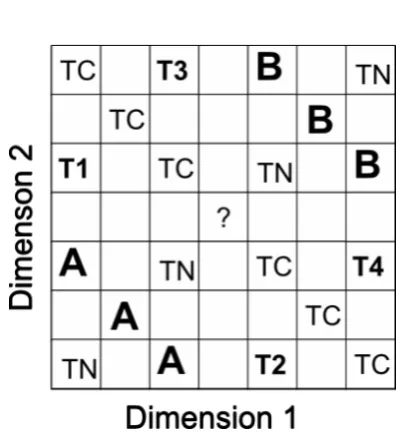
illustrated in Figure 2.
Figure 2 about here
(a) The 6 training stimuli, used under test contingencies of reward (stimuli marked
“A” and “B” in Figure 2)
(b) Four non-conflict stimuli that combined the stimulus dimensions in the same
general way as the training stimuli, but used combinations not seen during training (stimuli
marked “TN” in Figure 2). In practice the combinations used were those that had been used
in training for the other stimulus dimension relationship group using the same stimulus
dimension assignments. So, for example, the pigeons that had been trained with the
monotonically related stimulus dimensions (Hue-1, Diameter-1), (Hue-2, Diameter-2) and
(Hue-3, 3) versus (Hue-5, 5), (Hue-6, 6) and (Hue-7,
7) were tested with the stimuli (Hue-3, 1), (Hue-1, 3), (Hue-5,
Diameter-7) and (Hue-7, Diameter-5), which had been used in training with the corresponding
non-monotonically related stimulus dimensions.
(c) The ambiguous stimulus (Hue-4, Diameter-4), using the middle values of both
stimulus dimensions, neither of which was used in any training stimulus (stimulus marked
(d) Ten stimuli in which the dimensions that had been used in training were put into
conflict (stimuli marked as “T1”, “T2”, “T3”, “T4”, and “TC” in Figure 2). The stimuli
chosen were those that had been used in training other pigeons with different assignments of
the stimulus dimension, with both monotonic and nonmonotonic relationships between the
stimulus dimensions. So, the pigeons that had been trained with the monotonically related
stimulus dimensions (Hue-1, Diameter-1), (Hue-2, Diameter-2) and (Hue-3, Diameter 3)
versus (Hue-5, Diameter-5), (Hue-6, Diameter-6) and (Hue-7, Diameter-7), and those that
had been trained with the nonmonotonically related stimulus dimensions (Hue-1,
Diameter-3), (Hue-2, Diameter-2) and (Hue-3, Diameter-1) versus (Hue-5, Diameter-7), (Hue-6,
6) and (Hue-7, 5), were all tested with the ten stimuli (Hue-1,
Diameter-7), (Hue-3, Diameter-6), (Hue-2, Diameter-5), (Hue-1, Diameter-5), (Hue-3, Diameter-5),
(Hue-7, Diameter-1), (Hue-7, Diameter-3), (Hue-5, Diameter-2), (Hue-5, Diameter-1) and
(Hue-5, Diameter-3).
For each pigeon there were thus 15 transfer stimuli, plus the 6 training stimuli used
under test conditions. Each of these stimuli was used in three trials, making 63 test trials in
all. These were distributed between six test sessions, with the tests of the non-conflict and
ambiguous stimuli occurring in the first and the conflict tests in the second, and so on. Test
sessions were separated by at least two sessions of training conditions to ensure that
performance remained at criterion. Each test session included an opening and closing block
of 24 trials using training stimuli and contingencies only. Test trials were separated by at
least two trials in which normal training stimuli and contingencies were presented. On all test
trials, the first choice peck made was reinforced regardless of which target was pecked. The
sessions involving non-conflict and ambiguous stimulus tests consisted of a total of 88 trials,
Results
Training. The number of sessions required to meet criterion ranged from 6 to 13 in
the group with monotonically related stimulus dimensions, and from 7 to 13 in the group with
non-monotonically related stimulus dimensions (including the three sessions at about 80%
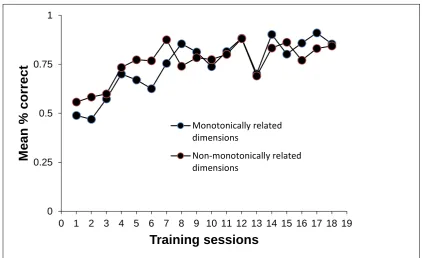
performance that were required to meet the criterion) Figure 3 shows the mean performance
of the pigeons in the first 18 training sessions (the number that the fastest-learning pigeon
received); these included some sessions given after transfer had started. It can be seen that in
the first few sessions, the pigeons trained with monotonically related stimulus dimensions
performed slightly less well than those trained with the nonmonotonically related stimulus
dimensions, but performance converged by Session 8. By Session 12 mean performance for
both groups was at 90% accuracy. The number of sessions required to reach criterion did not
differ significantly between the groups (2-tailed Mann-Whitney test, U = 6, N1 = N2 = 4, P >
.05), and a Bayesian t-test indicated that the data provided little evidence either against or in
favour of the null hypothesis (Bayes factor10 = 0.541 against a non-informative prior).
Figure 3 about here
Transfer. Mean accuracy of responding to the training stimuli under test conditions
was 91% (range 85% to 97%). This did not differ from the mean accuracy of responding to
the same stimuli under training conditions during the test sessions (mean 89%, range 83% to
95%; 2-tailed Wilcoxon test, T = 11, N = 8, P > 0.05). Accuracy of response to the
non-conflict transfer stimuli was high. Its mean over all pigeons was 88% (range 56% to 100%).
The low value for one pigeon was traced to a procedural error, in which the pigeon was given
some training sessions with the wrong reinforcement contingencies for Hue; it has been
retained as a conservative assumption). This mean did not differ significantly from the
accuracy of response to training stimuli under test conditions (2-tailed Wilcoxon test, T = 16,
The ambiguous stimulus (Hue-4, Diameter-4), involving the middle value of both
stimulus dimensions, was responded to in the way that was appropriate for a greener stimulus
on 54% of trials (range across pigeons 20% to 83%), and in the way that was appropriate for
a smaller stimulus on 46% of trials (range 17% to 80%). Neither of the means differed
significantly from 50% (2-tailed 1-sample Wilcoxon tests, T = 10 and T = 12 respectively, N
= 8, P > 0.05 in each case).
Responses to the conflict stimuli were classified as hue-appropriate or
diameter-appropriate. For example, if a pigeon that had been trained with small green circles as
right-positive pecked to the right when given a large green circle, that response was classified as
hue-appropriate. The mean proportion of hue-appropriate responses was 38%. Proportions
for individual pigeons were 68%, 25%, 15%, 40%, 35%, 58%, 32% and 35%. The trend
towards a majority of diameter-appropriate responses was not significant across pigeons
(one-sample Wilcoxon test, T = 5, N = 8, P > 0.05). However the proportion of responses
that were hue-appropriate differed significantly from 50% for four of the individual pigeons
(χ2(1) values > 3.84); by virtue of the additive property of the chi-square distribution
(Weatherburn, 1957, p. 177), the sum of the χ2(1) values for the eight pigeons can be tested as
a χ2(8) value. Pooling in this way gives a χ2(8) value of 43.21 (P < 0.001), confirming that
the individually significant results can be accepted despite the lack of significance in the
other subjects. In three of the pigeons the significant tendency was for diameter-appropriate
responses, in the fourth it was for hue-appropriate responses. The proportions of conflict
stimuli responded to in a hue-appropriate way did not differ significantly between the training
conditions (2-tailed Mann-Whitney test, U = 7.5, N1 = N2 = 4, P > .05).
The conflict tests were subdivided into those where, in terms of the physical
properties of the stimulus, the hue dimension gave a relatively strong cue while the diameter
the hue dimension a weaker one, and those where the two dimensions gave equally strong
cues. For example, for pigeons trained with the monotonically related stimulus sets (Hue-1,
Diameter-1), (Hue-2, Diameter-2) and (Hue-3, Diameter-3) versus (Hue-5, Diameter-5),
(Hue-6, Diameter-6) and (Hue-7, Diameter-7), the conflict stimulus (Hue-1, Diameter-5) was
one where the hue dimension gives the stronger cue; the stimulus (Hue-3, Diameter-7) was
one where the diameter dimension gives the stronger cue; and in the stimuli (Hue-1,
Diameter-7), (Hue-2, Diameter-6) and (Hue-3, Diameter-5) the two dimensions are equally
strong. In all, 73% of the responses to test stimuli where hue gave the stronger cue were
hue-appropriate (range across pigeons 38% to 100%), and only 14% (range 0% to 38%) of the
responses to test stimuli where diameter gave the stronger cue were hue-appropriate. All
eight pigeons made more hue-appropriate choices when hue was the stronger cue than when
diameter was the stronger cue, so the trend was significant (2-tailed binomial test, P < 0.01).
For the stimuli where the two dimensions gave equally strong cues, 34% (range 8% to 67%)
of responses were hue-appropriate.
Discussion
The training results did not detect any difference in speed of acquisition between the
monotonically related stimulus dimensions condition and the non-monotonically related
stimulus dimensions condition. This makes it unlikely that the pigeons were basing their
discrimination on any kind of perceptual synthesis of the two dimensions, since that would
have been easier to achieve with the monotonically related stimulus dimensions. This null
result is consistent with the predictions of our formal models. Given our small sample size, it
is of course possible that there might be a small difference in ease of learning between the
two groups, which we did not detect
The transfer results imply that the pigeons consistently came under the control of both
et al. (2011) about pigeons, even though our procedure was quite different, with a much
smaller total population of stimuli involved in training, and it confirms that multidimensional
control can occur under conditions where it is not necessary for perfect discrimination. Like
the results of Smith et al., our data contrast with results from non-human primates (e.g.
(Smith, Beran, Crossley, Bloomer & Ashby, 2010; Smith, Crossley, Boomer, Church, Beran
and Ashby, 2012), They also contrast with the predictions of our formal models, which
predicted that categorization should have been equally likely to be single-dimensional or
two-dimensional. So, the conclusion from the present results is that it is not stimulus set structure
that predicts whether pigeons come under unidimensional or multidimensional control.
The results of our transfer tests contrast also with many previous results from birds
learning multidimensional discriminations. For example, Lea et al. (2006) exposed chickens
to a 5-dimensional polymorphous discrimination, and found that behavior when all
dimensions were available was largely controlled by a color cue, despite the fact that the
chickens could be shown to be able to discriminate all five dimensions. Wills et al. (2009,
Experiment 2a) found that when pigeons had three perfectly valid stimulus dimensions
available, five out of six pigeons classified conflict stimuli in terms of a single dimension,
and for all five it was color. The results of the present experiment show that color will not
always be the most salient dimension in a multidimensional discrimination task; the high
levels of salience for color in some previous experiments may have resulted from using very
large differences of hue, whereas in the present experiment the differences were deliberately
made moderate.
Moreover, it was not just the case that either dimension could acquire control over
behavior; the behavior of individual pigeons came under the control of both stimulus
dimensions. For every pigeon, behavior in cue-conflict transfer trials was more likely to be
and the diameter value was weak, and more likely to be controlled by the diameter dimension
than the hue dimension when the reverse was the case. Thus, the pigeons had learned about
both dimensions. Unlike the preponderance of the pigeons (and squirrels and
undergraduates) studied by Wills et al. (2009), but like the rhesus monkeys studied by
Couchman, Coutinho and Smith (2010) and the pigeons studied by Smith et al. (2011), the
pigeons in the present experiment responded to the cue conflict stimuli according to “Family
Resemblance” or “Overall Similarity” rather than unidimensionally. This result contrasts with
the prediction of no bias for unidimensional vs. multidimensional behavior, from the
categorization models we employed: the pigeons showed a clear bias towards using multiple
dimensions.
As discussed in our General Introduction, pigeons sometimes come under the control
of multiple dimensions when they are available, and sometimes do not. The present
experiment suggests that in at least some cases, unidimensional control may result from
uncontrolled differences in the salience of the stimulus differences on the different
dimensions involved. With the saliences of the differences along two dimensions carefully
balanced, and with stimulus sets that should not be biasing towards either unidimensional or
multidimensional control, we found reliable and consistent multidimensional control. In our
next experiment we pursued the question of balancing salience between dimensions
experimentally.
Experiment 2
Experiment 1 showed that, if the differences between stimulus values on dimensions
were moderate, each of two dimensions would acquire roughly equal control over pigeons’
behavior in a category discrimination task, even though a single dimension would be
sufficient for perfect discrimination. Experiment 2 continued the approach of controlling the
reinforcement for control by multiple dimensions. To allow more sensitive tests of the use of
different stimulus dimensions, the number of relevant dimensions was increased from two to
three. During initial training, the pigeons could discriminate individual stimuli by using a
single stimulus dimension, but different dimensions were relevant to different stimuli. This
procedure allowed an independent assessment of the salience of different stimulus
dimensions. An adaptive procedure was used so that if one dimension seemed to be
acquiring more (or less) control over behavior than the others, the difference between its
positive and negative stimulus values could be decreased (or increased). Then in subsequent
training we used stimulus sets in which all stimuli could be discriminated using only a single
dimension, to see whether control by multiple dimensions would be stable when it was no
longer enforced. Finally we introduced a training procedure using polymorphous stimulus
sets, to examine whether multidimensional control could be further increased by making it
necessary for perfect discrimination
In all phases of the experiment, we presented multiple positive and negative stimuli
simultaneously, with different cues available in each. The procedure was similar to that used
by Wills et al (2009, Experiment 2b), Nicholls et al. (2011), Lea, De Filippo, Dakin and
Meier (2013) and Lea, Poser-Richet and Meier (2015); see also Huber, Apfalter, Steurer, &
Prossinger, (2005). In this procedure, discrimination is demonstrated if the subject responds
by pecking at the positives rather than the negatives. In the initial training phase of the
present experiment, each positive stimulus contained the positive value of only a single
stimulus dimension, and each negative stimulus contained the negative value of only a single
dimension. The salience of the stimulus differences on the dimensions could therefore be
assessed by recording (a) which kinds of positive stimuli were pecked first and (b) which
stimulus dimension was discriminated most accurately. If the stimulus difference on one of
criteria, the difference between its positive and negative values was reduced, and conversely
if the difference between the stimuli on one dimension appeared to be less salient than the
others, the difference was increased.
After successful training with only a single relevant dimension in each stimulus, the
pigeons were transferred to stimulus sets in which all three dimensions were relevant, and all
provided valid information, as in Wills et al. (2009). As in that experiment, following
successful discrimination training, tests were carried out with “one-away” stimuli, in which
one of the three stimulus dimensions was put into conflict with the other two (so that, for
example, it took its negative value in a stimulus where the other two dimensions took positive
values). This allows an assessment of the extent to which the pigeons’ behavior is under the
control of a particular one of the three stimulus dimensions, or whether behavior is controlled
roughly equally by all dimensions, which is referred to as “Overall Similarity” control.
Finally, the pigeons were transferred to a 2-out-of-3 artificial polymorphous category
task, formally similar to that used by Lea and Harrison (1978). In this task, all the stimuli are
“one-aways”, in which one of the stimulus dimensions is in conflict with the other two.
Perfect performance in such a task requires discrimination according to Overall Similarity.
While birds can be trained in such tasks (e.g. Lea and Harrison, 1978; Lea et al., 1993;
Jitsumori, 1993), learning in these experiments has typically been slow, and frequently not all
the stimulus dimensions involved acquire control over behavior, so that performance is never
perfect (e.g. Lea et al, 1993; Lea, et al., 2006). In the present experiment, we were interested
to see whether previous training on each of the stimulus dimensions separately, and careful
balancing of the saliences of the stimulus differences on them, would allow more rapid and
complete acquisition of a polymorphous category discrimination than is usually found. We
also investigated whether the polymorphous condition would increase control by multiple
Method
Subjects. Eight pigeons were acquired as discards from local fanciers. They had no
previous experimental experience. They were maintained in the same way as the subjects in
Experiment 1.
Apparatus. Four test chambers were used, identical to those used in Experiment 1
except that they were fitted with infra-red touchscreens. As before, 30 pixels on the screen
corresponded to 1 cm. The control apparatus was the same as in Experiment 1.
Stimulus materials. The stimuli were circular patches, 80 pixels (2.4 cm) in
diameter, consisting of sinusoidal gratings that varied in three dimensions. In each
dimension, two extreme values and a neutral value were defined, as follows; additional
intermediate values were also used.
Hue. Hue was varied from Red to Orange. The blue pixel value was set to zero in all
stimuli. The strongest Red hue was produced by setting the pixel values used to red 255 (the
maximum value) and green 0. The strongest Orange hue was produced by setting them to red
180 and green 75. A neutral hue was produced by setting red to 218 and green to 37.
Intermediate hues were produced by increasing the green value and reducing the red value,
while maintaining their total at 255. Because the stimuli were gratings, intensity varied
across them according to a sinusoidal function; at minimum intensity, the pixel values were
zero for both red and green, and at intermediate intensities, the proportions of the red and
green values were always the same as for the maximum intensity for the stimulus concerned.
Orientation. The orientation of the grating was varied from 0° (Horizontal) to 90°
(Vertical). The neutral orientation was 45°. Only orientations in the positive quadrant were
used, i.e. between 0° and 90° anti-clockwise from horizontal.
Spatial frequency. The spatial frequency of the grating was varied from 7 (Low) to
cycles/pixel. The neutral value of spatial frequency was defined as 11 cycles across the
diameter of the stimulus (.138 cycles/pixel), the approximate geometric mean of the extreme
values.
Different combinations of these stimulus values were used for different pigeons at
different stages of the experiment, as detailed below.
Procedure.
Pretraining. The pigeons were trained by conventional means to peck an Observing
Key, a circular white patch of diameter 80 pixels (2.4cm) located centrally on the touch
screen and with its centre 238 pixels (8 cm) above the base of the screen; and then to peck
either of two Side Keys, each consisting of a circular white patch of diameter 80 pixels
centred 60 pixels (3 cm) from one side of the touch screen and 100 pixels (3 cm) above its
base. Pecking a Side Key always led to a 3-s presentation of the food hopper at the
corresponding side of the touch screen; the food hopper recess was illuminated while the
hopper was presented. Following completion of pretraining on the Observing and Side Keys,
the pigeons were exposed to a procedure in which a single peck on the Observing key led to
the presentation of a circular array of 12 white outline circles. The individual circles were
100 pixels in diameter; the ring of circles was 225 pixels (13.4 cm) in diameter. Within each
circle, a white hexagon, 80 pixels in diameter, was displayed. If the pigeon made two pecks
at the same hexagon, without any intervening pecks at any other member of the array, that
hexagon disappeared (but its surrounding circle remained), and the nearer Side Key was
illuminated; a single peck on that key led to hopper presentation. The array remained in
place until all the hexagons had been removed in this way, after which there was an inter-trial
interval of between 1 and 5 s, followed by the presentation of the Observing Key allowing the
pigeon to obtain the next array. Sessions consisted of the presentation of four such arrays.
pigeons required 5 sessions before they were removing all the hexagons from each array
rapidly and smoothly, but one bird required 6 and another 18. Once the pigeons were
performing smoothly with 12 hexagons, they were given a single session in which only 6 of
the circles in each array contained hexagons. Some pigeons did not transfer smoothly from
pretraining to the discrimination training that followed: these pigeons were given a small
amount of additional pretraining using only the positive stimuli from the discrimination
procedure, in some cases at reduced saturation. Data from these sessions are not included in
the analyses that follow.
Discrimination training: general. The experiment involved discrimination training
and test sessions using several different sets of stimuli, but the general procedure was the
same for all of them. As in the pretraining with the hexagon stimuli, it involved the
presentation of a series of circular arrays of 12 stimuli, with each stimulus contained within a
white circle. However, in discrimination training, some of the stimuli were positive and
others were negative, so that the pigeon’s task was to identify and peck the positive stimuli
while ignoring the negative stimuli. Positive and negative stimuli were arranged in
pseudo-random order around the array, with the constraint that no more than three stimuli of one
category could occur without an intervening stimulus of the other category.
Procedure within trials was the same as in Wills et al. (2009, Experiment 2b),
Nicholls et al. (2011) and Lea et al. (2013, 2015). As in pretraining, two successive pecks to
a positive stimulus led to its disappearance and the presentation of a side key and access to
food reward. Two successive pecks to a negative stimulus led to its disappearance, but no
side key was presented; instead, the touchscreen became inactive for a time equal to that of
the hopper presentation. Once all six positive stimuli had been removed, the array
disappeared, and the inter-trial interval began. Discrimination training sessions consisted of
of Herrnstein, Loveland, and Cable (1976), which compares ranks assigned to positive and
negative stimuli on the basis of the subject’s tendency to respond to them. The first stimulus
pecked was assigned the highest rank, the second stimulus peck the next highest, and so on.
Negative stimuli that were removed unpecked when all the positive stimuli in an array had
been pecked were all assigned the mean of the remaining, unassigned ranks. For each
session, overall discrimination performance was assessed by the mean value of rho across the
eight arrays.
Discrimination training: dimensions in parallel. The first stage of discrimination
training involved stimulus sets similar to those used in the “Features in parallel” procedure of
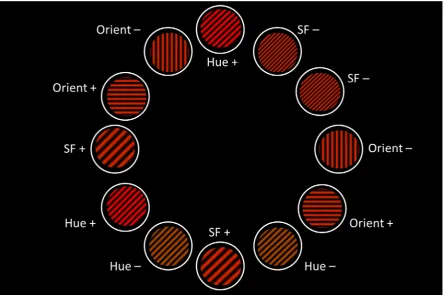
Lea et al. (2006). An example of the training arrays used is shown in Figure 4. In each array
there were six positive and six negative stimuli. In all stimuli, a single stimulus dimension
took either its positive or its negative value, and the remaining two dimensions took their
neutral value. Two of the positive stimuli contained a positive value of Hue, two contained a
positive value of Orientation, and two contained a positive value of Spatial Frequency; and
similarly two of the negative stimuli contained the negative value of Hue, two the negative
value of Orientation, and two the negative value of Spatial Frequency. In the example shown
in Figure 4, the positive values of Hue, Orientation and Spatial Frequency are Red,
Horizontal and Low respectively; the positive values of the three dimensions were
counterbalanced across the eight pigeons.
Figure 4 about here
To assess performance on each stimulus dimension, a rho value was calculated using
only the four stimuli containing positive or negative values of that dimension. To assess
whether the pigeons tended to peck the stimuli with positive values on specific dimensions
more readily than those with positive values on the other dimensions, the mean ranks
array, and the consistency of differences between these means across the arrays in a session
was assessed using Kendall’s W coefficient of concordance.
Stimulus difference adjustment. Initially, the extreme values of each stimulus
dimension were used in all stimuli. However, if a pigeon showed a sustained or substantial
tendency to discriminate one dimension better or worse than the other two, or to peck the
positive stimuli in which one dimension was relevant consistently earlier or later in an array
than those in which the other two dimensions were relevant, the stimulus values were
adjusted for the next training session, using criteria defined below. Hue adjustments were
made by changing the pixel levels of red and green by 9, maintaining their total at 255.
Angle adjustments were made by changing the angles by 10°. Frequency adjustments were
made by changing the spatial frequency by 1 cycle across the diameter of the stimulus (2
cycles if the frequency was above 12 cycles across the stimulus diameter). Initial
adjustments were necessarily in the direction of reducing the stimulus difference on one or
two of the dimensions; subsequent adjustments were made in the direction of increasing a
stimulus difference if possible. The criteria for making an adjustment were developed in the
light of experience but remained subjective, since the two factors of equal discrimination and
equal salience of the three dimensions had to be balanced, while maintaining high levels of
discrimination. The aim was to continue training and adjustment until rho values for
discrimination performance on all three dimensions exceeded 0.8 in a session, the W value
for consistency of the order of pecking the three different kinds of positive stimulus fell to
0.20 or below, and there was no dimension for which the stimuli in which it was positive
tended to be pecked either before, or after, both of the others. For one pigeon (Mo) the
attempt to achieve all these criteria seemed to be leading to increasing instability, so
adjustment and training were terminated when the first criterion (rho values on all dimensions
values of each stimulus dimension used were those in use at the end of the stimulus
adjustment procedure.
Prototype training. The pigeons were then exposed to stimuli in which all three
dimensions took their positive values, or all three took their negative values. Sessions
consisted of 8 arrays each containing six identical positive stimuli and six identical negative
stimuli. Two such sessions were given.
One-away tests. Test sessions followed. Each test session consisted of 7 arrays. Odd
numbered arrays included only prototype stimuli, as in the immediately previous training, six
positive and six negative. Even-numbered arrays (test arrays) included four positive and four
negative prototype stimuli, plus four test stimuli. In two of the test stimuli, two of the
stimulus dimensions took their positive values and the remaining one (the anomalous
dimension) took its negative value; in the other two test stimuli, two dimensions took their
negative values and one took its positive value. To ensure that there were equal numbers of
stimuli associated with positive and negative contingencies in each array, one of each kind of
test stimulus was associated with the contingencies appropriate to a positive stimulus, and
one with the contingencies appropriate to a negative stimulus. The anomalous dimension was
the same for all the stimuli in a given array, and was different in each of the three test arrays
in a session. Three test sessions were given to each pigeon, separated by a single prototype
training session; an additional prototype training session was given after the final test session.
The order in which the dimensions were used as anomalous was varied across pigeons and
counterbalanced between the three test sessions for a given pigeon.
Polymorphous training. Following completion of the one-away tests, the pigeons
were given further training sessions, with 8 arrays per session, in which all the stimuli
included one anomalous dimension. Stimuli were associated with positive reinforcement
two dimensions took their negative values. There were 6 positive and 6 negative stimuli in
each array, with each stimulus dimension taking its anomalous value (negative in a positive
stimulus, or positive in a negative stimulus) in two of the stimuli of each category. 10
sessions of this type were given.
Results
Training with dimensions in parallel and stimulus difference adjustment. Table 1
includes a summary of performance in the initial training and stimulus adjustment
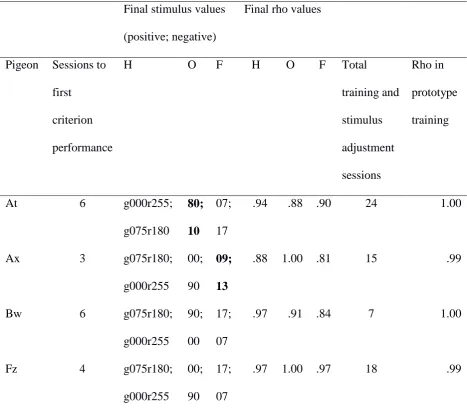
procedures The rho values for each dimension show that all pigeons came under control of
all three dimensions in this procedure. However, as the final stimulus values show, five of
the eight pigeons required some adjustment of the stimulus values on one of the stimulus
dimensions to ensure roughly equal control of behavior by all three of them. At the end of
training, no pigeon was requiring adjustment on two dimensions, though some experienced
adjustment on more than one dimension during the course of training.
Prototype training. Table 1 also summarises performance in the two sessions of
prototype training that followed initial discrimination training. It can be seen that all pigeons
showed effectively perfect performance under this condition.
Table 1 about here
One-away tests. Table 2 summarises performance in the one-away test sessions,
using the same form of analysis as Wills et al (2009, Tables 1 & 4). That is to say, a stimulus
is counted as being treated as positive if it was one of the first 6 that the pigeon removed, out
of the 12 available in an array, and the table records the number of test stimuli whose positive
or negative categorization is correctly predicted by each of the three dimensions on its own,
or by the Overall Similarity rule (treat a stimulus as positive if it has a majority of positive
features). It can be seen that for seven of the eight pigeons, the overall similarity rule made
However for at least three of the pigeons (Bw, Hy and Ax), one of the three dimensions
individually did notably better than the others.
Table 2 about here
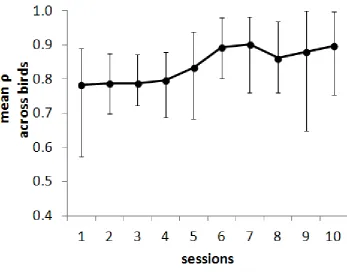
Polymorphous training. Figure 5 summarises performance in the final
polymorphous concept training. As would be expected from their performance in one-away
tests, all pigeons showed above-chance performance from the beginning of training (a
significant proportion: binomial test, P<.01 two-tailed). Mean performance improved across
the sessions (Spearman’s rho between mean rho and session number = 0.86, N=10, P<.01
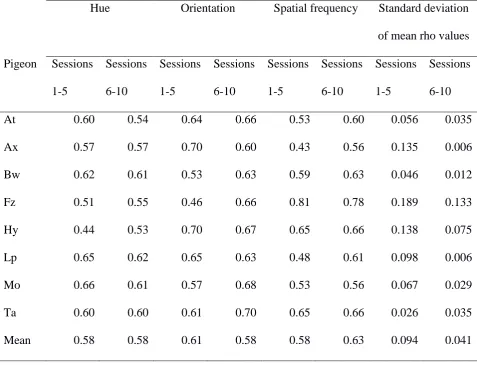
two-tailed). Table 3 shows the level of discrimination of each stimulus dimension during the
first and second five sessions of polymorphous concept training. In a polymorphous
categorization, the positive value of each stimulus dimension occurs in some negative stimuli,
and the negative value of each dimension occurs in some positive stimuli. As a result, fully
accurate performance on the overall discrimination can only occur if the mean rho value with
reference to each individual dimension is 0.67; higher single-dimension rho values than this
reflect excessive control by one dimension, which must be at the expense of one or both of
the other dimensions. Values of rho for a single dimension of 0.5 or below reflect failure to
come under control of a dimension. The table also shows the standard deviation of the mean
rho values for the three dimensions in each session block. A lower standard deviation
indicates more equal control by the three dimensions. It can be seen from the table that, by
the second session block, no mean rho values lower than 0.5 were recorded for any
dimension. The standard deviation of mean rho values was more than halved between the
first and second blocks of training, a significant reduction (Wilcoxon test, T=1, N=8, P<.02
2-tailed).
Discussion
Experiment 2 demonstrated, in agreement with Experiment 1, that when differences in
dimensional perceptual salience are made relatively small, pigeons’ behavior will come under
the control of more than one stimulus dimension simultaneously and to a roughly equal
extent. The experiment extended the number of dimensions for which we could demonstrate
this from two to three.
The later sessions of polymorphous training demonstrate some tendency for the
contingencies to overcome differences in salience, in a way that does not always happen
when birds are trained under polymorphous contingencies from the beginning, or even with
training on individual dimensions (see, for example, Lea et al., 2006). But even that process
was incomplete, with new instances of excessive control by a single dimension opening up
even in the later sessions of polymorphous training (e.g. pigeon Ta on orientation).
General Discussion
The current experiments throw further light on the circumstances under which discrimination
in terms of multiple stimulus dimensions will be obtained reliably in pigeons. It was already
known that this can, but does not always, happen. Evidence for control by all available
dimensions has been reported when it is required for accurate performance (e.g. Lea &
Harrison, 1978; Teng et al., 2014; von Fersen & Lea, 1990; Vyazovska et al., 2015). It is
unlikely when a single dimension is sufficient for discrimination (e.g. Reynolds, 1961; Wills
et al., 2009). However, the need to use all dimensions to obtain 100% accuracy is not a
sufficient condition to ensure that they will all be used (e.g. Lea et al., 1993), at least unless
special training is provided (e.g. von Fersen & Lea, 1990). Nor is it a necessary condition, as
The present Experiment 1 suggests that stimulus set structure is unlikely to be a key
factor in biasing pigeons towards the use of multiple stimulus dimensions, contrary to what is
known from human categorization and learning (e.g., Milton et al., 2008; Pothos & Close,
2008). However both experiments suggest that a key factor is controlling the saliences of the
stimulus differences on the different dimensions. A lack of control over salience may thus
explain why inconsistent results have been obtained in the past, with some experiments
showing unidimensional control and others showing multidimensional control. In particular,
we used relatively small color differences, and the fact that multidimensional control
emerged reliably suggests that the large color differences typically used in experiments with
pigeons may be so salient that they block control over behavior by other dimensions. For
example, Wills et al. (2009) found that 5 out of 6 of their pigeons categorized
multidimensional stimuli in terms of color alone. It should be noted, though, that failures of
control by all dimensions can occur with purely monochromatic stimuli (e.g. Lea et al.,
1993).
Theoretical accounts of human categorization do not fare well in accounting for the
results of these experiments. In Experiment 1, if the pigeons had used rules, in the way that
Ashby et al. (1998) suggest humans do, they would have consistently used single dimensions;
none of them did, in either experiment. If they had categorised according to either Pothos
and Chater’s (2002) or Rosch and Mervis’s (1975) principles, they should have shown no
bias between unidimensional and multidimensional classification; they all tended to use
multidimensional classification. The work on human categorization processes basically
reveals a flexible categorization mechanism, which can accommodate different biases or
approaches, depending on the structure of the environment (assuming stimulus dimensions of
broadly equivalent salience). Do non-human animals lack this flexibility? The present results
formal categorization models (including the ones above) typically make predictions on the
basis of the similarity structure of the stimuli (that is, their relative similarities to each other)
and are therefore sensitive to issues such as the scaling of the dimensions; despite our
controls, it is possible that our assumptions about those were incorrect. In addition, in
designing the two category structures, we also considered whether the stimuli could relate to
each other in a way that would make it easier to categorize in terms of an overall synthetic
dimension or not, but no evidence for this possibility emerged (e.g., Experiment 1).
At first glance, this seems to be what Ashby et al. (1998) would expect of an animal
that only has associative learning mechanisms available, and indeed what Smith et al. (2011)
observed in a direct test of the differential predictions of the Ashby approach for humans and
pigeons. Both Chase (1968) and Blough (1972) have advanced theories about the
determination of pigeons’ response to multidimensional stimuli, which essentially rely on
associative processes alone. But the present results are not entirely comfortable from the
point of view of such theories. Although we succeeded in getting balanced control of
pigeons’ behavior from two or three stimulus dimensions, the process seemed to be easily
thrown out of balance: These results suggest that a more sophisticated theory of animal
attention may be required. We do not suggest that pigeons formulate rules, and they clearly
do learn about multiple stimulus dimensions provided salience differences are controlled.
But it does appear that strong control by a single dimension may in some sense shut down
control by other available dimensions, so that response is not determined by a static
combination of information available across the available dimensions, but by a more dynamic
process. Such processes have of course been actively considered in theories of animal
attention, from Krechevsky (1932) and Sutherland and Mackintosh (1971) onwards; it may