Rochester Institute of Technology
RIT Scholar Works
Theses Thesis/Dissertation Collections
8-12-2014
Meaningful Objects Through Process-Oriented
Form Research
Heechan Kim
Follow this and additional works at:http://scholarworks.rit.edu/theses
This Thesis is brought to you for free and open access by the Thesis/Dissertation Collections at RIT Scholar Works. It has been accepted for inclusion in Theses by an authorized administrator of RIT Scholar Works. For more information, please [email protected].
Recommended Citation
Rochester Institute of Technology
A Thesis Submitted to Faculty of
The College of Imaging Arts and Sciences
School for American Crafts, Furniture Design
In Candidacy for the Degree of
Master of Fine Arts
MEANINGFUL OBJECTS THROUGH PROCESS-ORIENTED
FORM RESEARCH
by
Heechan Kim
Final Approvals
Chief Advisor Andy Buck ________________________ (signature)
________________________ (date)
Advisor Richard Tannen ________________________ (signature)
________________________ (date)
Advisor Michael Rogers ________________________ (signature)
________________________ (date)
Chairperson Juan Carlos Caballero-‐Perez ________________________ (signature)
________________________ (date)
Abstract
This work concentrates on the relationships between shapes and the lines those
shapes are composed of as well as the process by which they are created. In this
thesis, I intend to explore the different characteristics of wood and to visualize the
language and meaning of the work which results both from those characteristics
and from the artist.
As a maker, I have always been fascinated by the use of wood in the creation of
objects. Man can control a material against its own intrinsic attributes to create
something very different from that material’s natural shape. My works
concentrate on illustrating how wood reacts to external manipulation or physical
force and how it can accordingly be transformed and yet still keep its original
characteristics. Therefore, the process of the construction of the final piece is
crucial in my work. The process embodies the relationship between outward
control or manipulation and reaction from a material, and it creates the tension
between the two entities, producing a physical structure and also a visual
presentation. Additionally, this relationship encapsulates a deeper meaning; in
the same manner in which the wood strains against the making act of the artist,
so also does human nature strive against the outward influences which seek to
control it. Through the work, I intend to clarify how human beings interact with
Discussion of Sources and Research
Meaningful objects through process-oriented form research
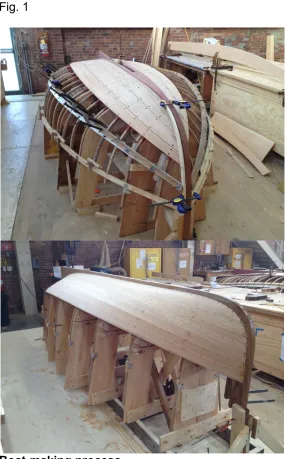
The wood-band-technique introduced in the furniture-design curriculum impacts
my work deeply. The same technique is also commonly used in traditional boat
construction. To give volume to a boat, series of wooden strips are laminated to
form a curve. Afterwards, they are glued and fastened with steel wires. The
measurement of each unit of wooden parts should be carefully calculated, and
each must be fastened in a specific way. After the gluing process, the steel wires
are removed from the wood strips. It is critical to follow a proper process to make
an object which functions as a boat, i.e., which is waterproof and will float in the
water. (fig.1)
In functional objects such as a boat, material, technique, and form are organically
intertwined because all these factors are working together toward the main goal:
its function. In his book A Theory of Craft, Howard Risatti writes that “in early age
at which craft objects (functional objects) appear, discovery of form, material, and
technique seems to have coincided with the conceptualization of purpose and
His observationexplains why functional objects can be universally recognized
and are constructed along the same basic lines even in widely differing cultures
or societies. Form has to satisfy function. In other words, two objects are unlikely
to have significant differences in shape and yet serve the same function.
Because of this characteristic of a functional object, it is easy to overlook
opportunities that material, technique, and form could offer when those
opportunities do not meet the ultimate goal: to be functional.
However, my interest lies in the method and its form-giving possibilities rather
than practical function itself. In other words, in my work, I sought to eliminate a
pursuit of the function from which the method of creation had risen in order to
ensure that my expressive desire was not limited to strict rules. This allows me to
concentrate on how wood as a material reacts to various forces and to
manipulation, or the process of making. Hence, I am able to fully explore the
limits and boundaries of the material, technique, and form. However, to make my
investment in my methodological approach to object-making worthy and
meaningful, I needed to search for my own purpose for the object in order to fill
the remaining space once the requirement for the object to serve a specific
function has been eliminated . When I was first exposed to the bending
technique, I was fascinated by how the characteristics of the wood were, in a
way, similar to human nature itself. When certain force is applied to wood, it
creates very visible physical tension. When released, wood springs back,
between the natures of wood and of the human person is my starting point in
developing the subject matter of my objects.
In my objects, various physical reactions that occurred during the process have
close connections with subject matter, and the process itself becomes a
significant part of the content of the object. The term process art has been used
by critics to describe process-oriented works of art. In her essay Fabrication and
Encounter, Paula Owen, president of Southwest School of Art and Crafts, points
out a few of the dominant characteristics of process art. Process art can be a
form of aesthetic discovery evident in the finished product, as in the action
paintings of Jackson Pollock or the poured-color canvases of Morris Louis, which
are as much about the novel and physical process as they are about the final
image. Also, consider how the process of fabrication is significant to the artist’s
intent; the process of making and the material may be crucial to the content and
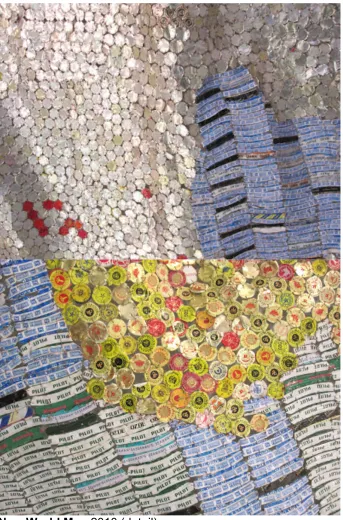
meaning of the work. (2) One excellent example of a process artist is El Anatsui.
Anatsui notes that, “Exploring techniques and media is, I believe, a potent way of
generating new content”. (3) (fig.4)
This body of work is the process of finding meaning in non-functional objects, themselves inspired by traditional woodworking technique. Through this
numbers, so that the viewer can easily follow the journey described by the
separate pieces and do it in the correct order. Additionally, I wish to eliminate the possibility that viewers of the pieces might imprison themselves mentally when viewing the piece due to the presence of a title; i.e., the work will be
contemplated only through the lens of said title. This, of course, is not ideal.
Critical Analysis
Understanding the conventional technique: band lamination and boat making: #1
Using the band-lamination technique is inspiring in and of itself because the maker has perfect control over what the final shapes and result of the process are. The lamination technique in many ways represents the symbolic triumph of a human being who uses tools and overcomes obstacles in nature. Wood strips are manipulated in a particular order to create beautiful curves. (fig.5)
In the process of creating #1, I followed all the traditional processes of band lamination. Curves and forms are predetermined, carefully calculated, and laid out, achieving the shape of an exaggerated human body. Seven layers of thin
(1) Risatti, Howard. A Theory of Craft. From Chapter 6. Nature and the Origin of Craft Object, Page 61.
(2) Owen, Paula. Fabrication and Encounter. From Extra/Ordinary: Craft and Contemporary Art. Page 88
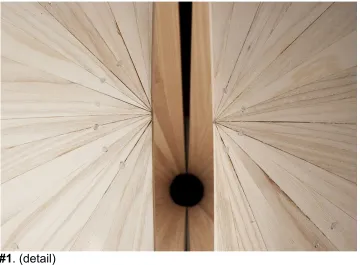
wooden strips are laminated on an MDF jig with a number of clamps. Thirty-two laminated wooden bands are beveled for coopering. They are glued and stitched together with steel wires to create the volume. The gluing process is painfully long. First, the bands are glued as pairs. Two became four, and four became eight. Finally, #1 ends up as two pieces, half-round shapes which contain 16 laminated pieces each. All the stitches are removed from the piece after gluing, and holes are filled with wooden dowel, leaving trace of construction. This whole process requires tremendous patience and a considerable amount of time in order for the glue to set. (fig.6)
My initial plan was to close the shape as full circle. However, at the midway point of the process, despite the great advantage of this technique, I recognized that this was the wrong direction in which to take the piece; it too deeply reflected my control over the work. Being in control is an absolute necessity to make
something functional, but it results in losing visual and conceptual storytelling when those do not contribute to its function. Even though object #1 gains its ability to be read as a human-like form, the properties of the material seemed to be too static to embody the complexity and interactivity of a human relationship. I finish #1 as two parts with steel wires wrapped around the narrow part of the shape to accentuate the curve of the form and to create tension.
I appreciate the lines, volume, and shapes that this technique offers. The end result is unexpectedly exciting because the wood is able to not only create dramatic curves and volume but also to hold its shape rigidly. However, through the form-giving process, the power of control mainly lies in the maker's hands, and the attributes of the material are mostly lost. A maker sometimes
Having a close encounter with the material: #2
For #2, I intended to embrace the key property of a thin strip of wood: its ability to spring back to its original position when bent. The lamination process, of course, was invented to remove this character because, in most cases, the springiness of the wood works against the function of the finished object. Therefore, I modified the laminating process, eliminating multiple layers and glue. I used multiple single layers and forced them into a closed form, stitching with steel wire. Each strip was tapered in width in order to create a pot-like volume. I created three different shapes and volumes with variously placed stitching. (fig.7.8)
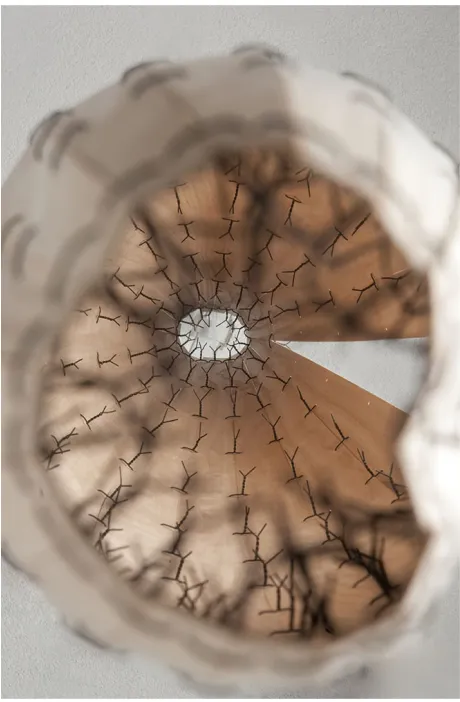
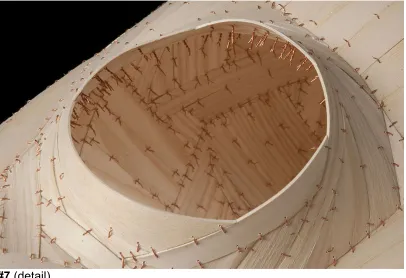
The main focus is on tension and subtlety. In order to achieve subtlety, finding the proper thickness of the strip is crucial. If the strip of wood is too thin (less than 1/16”), it becomes very bendable, but the strength of the wood decreases. On the other hand, if it is too thick (thicker than 1/8”), it becomes too rigid to bend without considerable force. Flexibility and strength are incompatible with one another. The subtle tension in the piece comes from its equilibrium, the balance of power between strength and flexibility. Wire stitching also contributes tension, not only physically but also visually. Stitching reveals the physical construction of the object and works as a counter-force against the springing-back of the wood. Visually, wire stitching typically creates an effect like that of prison bars or of a cage; it is violent. It embodies the idea of unavoidable struggle between human beings or in human society. (fig.9)
visible than it might be in a darkly colored wood. Furthermore, since the forms of my objects evolve according to the change of methodologies, the other element, the type of wood, should be controlled in order to obtain clarity in my study. This is applied throughout the thesis work.
Pushing the limit: #4
Because the curves of #2 are quite gentle, in #4, I examine the limits of the wood’s ability to bend. Wood, of course, becomes much easier to bend when it is moist. Additionally, it is also easier to bend when it is heated. The
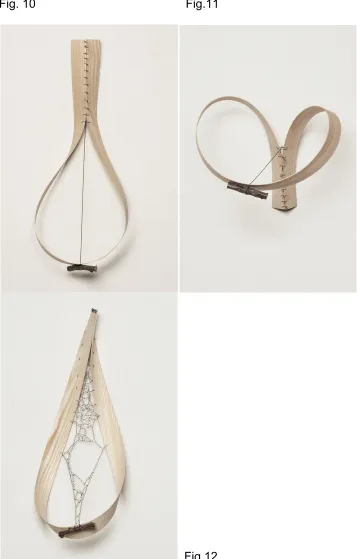
steam-bending technique, of course, was invented to utilize these characteristics. But, without using steam, how far I can push the limits of the wood – and what kind of reaction would the wood have? First, I made a series of ribbon-like pieces. (fig.10~12) I bent one wooden strip into a round shape and stitched it with wire. Found branches function as a crank gear, accelerating the shape of the bend. This process is close to a drawing, but three-dimensional. It is fast, direct and intuitive. The experience is very stimulating, as feedback from the material is rapid and instinctive. Since this approach allows one to see results quickly, I tested various types of force on the strip of wood. For example, in #2_03, I introduced a crochet technique in the process. Crochet wire is physically holding the form in the same manner as steel wire would, but it is less aggressive and has a domestic and feminine appearance.
In #1 and #2, my objects are symmetrical. These objects are composed of the repetition of a single shape. In other words, the objects are symmetrical because of the method of their construction. To develop a more organic form, the process of creation must also be organic. After the refreshing break of #4, I started to explore irregular and organic shapes rather than symmetrical ones. After numerous failures, I realized that it was the right time to introduce the two elements that I mentioned earlier: moisture and heat.
Heat and moisture transforms the wood to a semi-plastic state, and when the wood has cooled and dried, it retains its bent shape. I researched various ways to apply heat and moisture. One tool that I found particularly useful was the bending iron. A bending iron is, simply, an electrically heated pipe. It is commonly used for making musical instruments such as violins or guitars. The bending iron has a huge advantage over other methods. It creates curves in the wood almost immediately. I quickly grasped my ability to control the curvature of the wood using this device. A mastery of the requisite skill is significant in the organic making process. To make my form-giving process truly organic, this newly introduced device should be almost an extension of my hand. It may seem that using a bending pipe is similar to using lamination technique in terms of control over the wood. However, this process is explicitly distinct from lamination mainly because it doesn’t require a predetermined plan. It is a more open-ended and free-form experience. With the bending iron, my hand and the material are closely integrated. Constant feedback is generated when my hand meets the wood.
With the confidence gained from a considerable amount of practice, I applied my new skill to the task of making a more complex shape. To formalize the
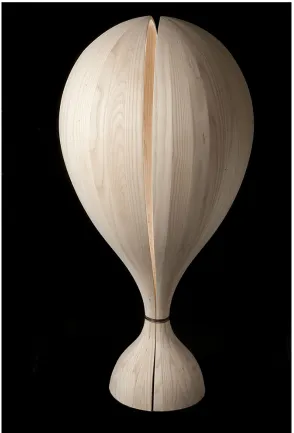
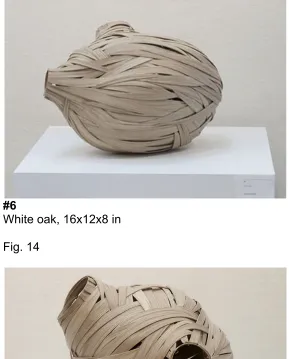
taking. Visually, weaving can also stand as a metaphorical illustration of how people are connected and bound to each other physically and emotionally. I used HMA (Hot Melt Adhesive, also known as hot glue) to set the basic structure of #6. Despite the negative connotations of hot glue in the craft field (some complaints are that it is not resistant to weathering or that it is only a temporary method of construction), it has one great advantage: that is, the drying or curing step is eliminated. It was critical that I did not overthink the next steps in order to keep the process intuitive and integrated with the material. For #6, I intentionally didn’t plan anything beforehand; I had only the abstract idea of something hollow with openings.
Most of my objects are hollow. As a hollow form, the object becomes a container. A container has the conceptual possibility to contain something whether it is fully functional or not. As a container, the object makes a boundary between the inside and the outside, creating spatial tension. Specially, when the wall of the container is thin, it creates the eggshell-like quality that enhances the tension in the object. This delicate quality provides the intimate experience to the viewer.
Synthesizing stitching and weaving, #7 and #8
horizontal belt sander. As a result, the two pieces meet perfectly level to each other, creating a smooth surface.(figs.15.18.19) I used thinner-gauge copper wire, which is more malleable than steel. Copper wire has much different qualities than steel wire. While steel wire is violent, muscular, and forceful, copper wire is
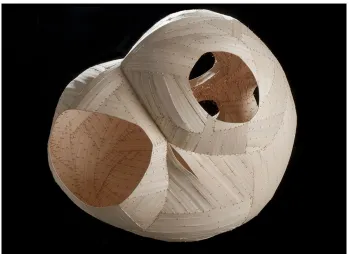
inviting, feminine, and subtle. Because using copper wire decreases the visual impact of the individual stitches, the piece is more likely to be seen as a whole, creating texture. Visually, two contradictory textures are normally quite intriguing to the viewer. In #7 and #8, texture is a big part of the visual perception of the respective pieces. (fig.17.21) It emphasizes tension, creating two conflicting surfaces. Also, it heightens the sense of space in an object, one surface being inside and the other outside. Especially in #8, it evokes the question of what is inside and what is outside. (fig. 20)
With continuous use of the bending iron, my technical, manual skill has become highly trained and largely unconscious. I have reached the stage where I do not have to think about the result, the final work. Each piece comes naturally and almost automatically. In the process of this technique, I will sometimes lose track of time and fall into a deep, almost-meditative state. It is an amazing experience; hand and material and my consciousness become one. This transcendent
experience corresponds to the work of a number of surrealists, who developed what they called “automatic techniques” as a way to tap into the unconscious mind. (1) I had a similar aim: avoiding too much control over the piece as a result
of the band-lamination technique.
Additionally, it represents the anatomy of human society and the inherent tension between private and public life.
Conclusion
My work starts with a new interpretation of a traditional technique. By eliminating practical function, the relationship between material, technique, and form are decomposed. This new relationship reforms the organic structure of the final piece with meaning. The process itself is integrated within the content of work. Traces of the process influence and become its visual and formal language, revealing the method by which the final work was created. Through making a series of objects, as a maker, I had a very intimate experience with my work. I respected the material and paid close attention to the feedback the material gave. As a result, this journey provided me with a new perspective on what it means to create a piece of art. My desire is that the viewer be able to see my journey in its entirety through consideration of the final pieces. Finally, I have designed and fully intend for my work as a whole to stand by itself, process and form integrated into one another, but without context or title, so that viewers may experience the works for themselves and create their own meaning out of that experience.
My works are considered as objects because of the small scale and the utilitarian-like formal language of the work. And my focus was the intimate
relationship with each other and how they function in the space. For the future, I plan to examine the boundaries of the object in scale and the relationship
between the object and the space.
(1) Gale, Matthew. Dada & Surrealism A&I
He explains how the Surrealists developed various procedures, such as automatic drawing and writing, in which one purposely did not concentrate on what one was doing. It is an attempt to release the unconscious from rational control.
(2)) LeWitt, Sol, Paragraphs on Conceptual Art, Art Forum, June 1967.
Illustrations
Fig. 1
Boat-making process
Fig.2
Bethel Fish Traps, 1896
Roming Collection, Moravian Archives, Bethlehem, PA
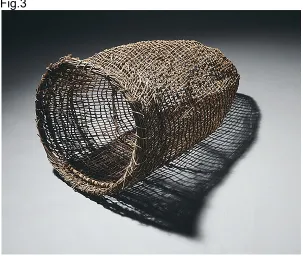
Fig.3
Basket, Mary Marbamba, 1938
[image:18.612.92.492.126.384.2] [image:18.612.90.393.422.678.2]Fig.4
New World Map,2010 (detail)
[image:19.612.92.435.124.644.2]Fig.5
#1
[image:20.612.90.384.125.558.2]Fig.6
[image:21.612.91.451.98.363.2]#1. (detail)
[image:21.612.88.458.123.713.2]Fig.7 #2_03(left)
Maple, steel wire, 55x15x15 in #2_01(right)
Ash, steel wire (right)
Fig.8 #2_02
Ash, steel wire, found wood branch, 60x12x12 in
Fig.9
[image:22.612.91.321.235.586.2]Fig. 10 Fig.11
Fig.10 #4_01
Ash, steel wire, found wood branch, 27x10x5 in Fig.11
#4_02
Ash, steel wire, found wood branch, 15x12x12 in Fig.12
#4_03
Ash, copper wire, found wood branch, 27x10x5 in
Fig.13
#6
[image:24.612.87.376.245.604.2]White oak, 16x12x8 in
Fig. 14
White oak, 16x12x8 in
Fig. 15
#7
Ash, copper wire, 30x23x20 in
Fig. 16
[image:25.612.90.439.418.672.2]Fig. 17
[image:26.612.90.502.314.688.2]#7 (detail)
#8
[image:27.612.91.455.137.376.2]Ash, copper wire, 40x30x36
Fig.19
#8 (different angle)
Fig. 20
[image:27.612.90.458.445.692.2]Fig. 21
Works Cited
Adamson, Glenn. Thinking Through Craft. New York: Berg, 2007
Buszek, Maria Elena. Extra/Ordinary: Craft and Contemporary Art. London: Duke
University, 2011
Elderfield, John. Martin Puryear. New York: Museum of Modern Art, 2009
Gale, Mathew. Dada & Surrealism A&I. London: Phaidon, 1997
LeWitt, Sol. Paragraphs on Conceptual Art. Artforum, June 1967
Fariello, M. Anna and Owen, Paula. Objects & Meaning. Scarecrow, 2005
Risatti, Howard. A Theory of Craft. University of North Carolina, 2007
Sennett, Richard. The Craftsman. Yale University, 2008