I·
I
I!
'•
··o .
•
-·
~)(
w
(,)DIRECTORATE GENERAL XV Internal Market and Financial Services
General matters and coordination, free movement of persons and direct taxation
External dimension of the internal market and financial services
THAILAND
Rue de la Loi 200: B-1049 Brussels, Belgium - Office: C 107 8/4327.
Brussels, 19 June 1995
Ref: N /gg - jv\tcr\thailand XV-A-2
Telephone: direct line (+32-2)296.30:34, secretariat: 295.22.45, exchange 299.11.11. Fax: 295.66.95.
Introduction
In 1993, GDP at current prices in Thailand was 3,132 bn THB (ECUI 109 bn). With a population of 58.3 mn, GDP per capita represented 53,723 THB (ECU 1875). A real GDP growth of 8.2% is expected for 1994.
Rapid economic growth, illustrated by an average 7.4% GDP growth a year over the last
20 years, and increasing sophistication of the Thai economy have had significant impact
on the structure of the financial sector. Alongside the traditional activities of loan
financing dominated by domestic Thai banks, equity financing has been nurtured by a
tremendous expansion of the Stock Exchange of Thailand. 4:~
£
'
CREDIT INSTITUTIONS
Promotion of Thailand's role as a regional financial center has been enhanced by the issuing in 1993 of offshore licences to foreign and domestic banks under the Bangkok International Banking Facility (BIBF). This action has been prolonged by the subsequent granting, at the beginning of January 1995, of offshore banking licences under the Provincial International Banking Facility. This will allow foreign banks to establish up to two branches in five provinces, as a contribution to rural development.
Controls over foreign exchange movements have been relaxed since 1990. And the government is keen to encourage the establi~hment of a baht zone in Indochina. The
stability of the baht, which has varied by only 5% in the past two decades, is undoubtedly
an asset in this respect.
Efforts of the Bank of Thailand to promote the competitiveness and soundness of the financial market have been maintained.
Banks have been required to publish general lending rates, which levels are set by the market, and reduce spreads between borrowing and lending rates, in an effort to narrow the current domestic savings-investment gap. Although the Thai savings rate is substantial, it has indeed fallen behind investment demand. Savings represent 33% of GDP in 1993, but investment projects were valued at 41-42%. Deposits grew only 12% in the year to September, compared with lending growth of 17%, and the difference between bank loans and savings doubled from 12 billion dollars to 24.8 billion dollars. Commercial banks have continued to profit from interest margins averaging 4.5%, and posted average earnings increases of 50-60% for the third quarter.
Capital adequacy standards have closely followed those set by the Basle Committee: as ( of 1 January 1995, Thai banks will indeed be required to maintain a capital to risk-weighted assets ratio of at least 8% .
. I
Exchange rates :
Commercial banks
Commercial bank activity traditionally dominates deposit taking in Thailand. However, commercial bank deposits, while continuing to grow in real terms, have seen their share relative to total financial assets dramatically fall from 74% in 1990 to 37% in 1993. This is explained by the substantial shift in the composition of financial portfolios in favour of stockholding that was induced by the high returns generated by investment in Bangkok's stock market.
Commercial banks are now. allowed to diversify into lines of activity ,that, until now, were reserved to finance and securities companies: underwriting of debt instn.µnents,
. .
.
.
..
....secuntJ.Zation, and asset management. . £ ·
The 15 Thai commercial banks account in 1993 for 93% of banking assets (compared to 95.3% in 1990), 97.7% of total deposits with commercial banks.
To strengthen their networks and to reduce their almost total dependency on interest-based trading, Thai banks are lobbying for underwriting licenses and expanding into overseas markets. Bangkok Bank and Thai Farmers have both handled recent bond issues, formerly a preserve of finance firms, and started restructuring their retail systems. They are also seeking to expand their operations overseas, mainly in . China and Indochina.
Finance companies
The second largest category of financial institutions are the 91 finance and securities companies, which accounted for assets of 516 billion bah,t at the end of 1993, representing 12.5% of total financial assets, compared to 14% in 1990.
Their activities include short-term finance, hire purchase, underwriting and security trade and other investment and advisory services. The recently allowed access of commercial banks to some of these areas will increase competition and restructuring of a sector where consolidation through mergers and takeovers has been actively encouraged by the government.
Other
Table 1 - Thai Financial market - Year 1993
Assets %
(bn THB)
Total commercial banks 3291 79
Goverment Banking institutions 354 8,5
Finance companies · I
516 12,5
Total 4161 100
Source : Bank of Thailand
Table 2 - Banking sector indicators - June 1994 .
Number Assets Deposits
(bn THB) (bn THB)
Domestic commercial banks 15 3324 2526
Non-EU foreign commercial banks 11 186 39
EU foreign commercial banks 3 47 13
BIBF foreign Units of which 20 83
-.
EU BIBF Units 6 7-Total 3640 2578
.Source: Bank of Thailand
PRESENCE AND MARKET SHARE OF EC FINANCIAL INSTITUTIONS
At the end of 1994, there were 14 foreign owned or controlled banks operating onshore in Thailand. Of this number, 3 foreign owned banks were EU owned or controlled. There were also a further 11 EU banks that maintained representatives offices in Thailand, out of a total of 38 foreign representative offices.
At the end of 1993 commercial. banks incorporated in Thailand operated 794 branches within Thailand and a network of 1762 Automatic Teller Machines. The 14 foreign banks had a total of 14 branches within Thailand. ·
[image:4.597.21.580.17.634.2]contrast, the bnaking sector is highly concentrated, with the five largest domestic banks
accounting for 65% of total banking assets.
In March 1993, the Thai financial authorities established the Bangkok International Banking Facility (BIBF) with a view mainly to promote Thailand as a regional offshore center ("out-out" access) and to a lesser extent to provide low-cost foreign loans to Thai
businesses ("out-in" access). In this context, 47 licences have been issued to commercial
banks to operate offshore banking units. All 15 domestic banks, 12 of the 14 foreign commercial banks already . operating in Thailand, and 22 other foreign banks with representatives offices in the country received BIBF licenses. Offshore banking units are limited in their operations and cannot make baht loans and take domestic deposi~ in the domestic market. By June 1994, there were 20 BIBF foreign units operating in£the Thai offshore market. Their assets reached 83 bn of THB (2.3% of total banking assets). Assets of EU offshore·banking units were 7 bn of THB. In June 1994, onshore lending of foreign exchange totalled $12. 7 bn, with foreign banks accounting for 4 7% of the total. International lending amounted to $5.3 .bn with foreign bnaks accounting to 800/o of the total.
This scheme has been extended in January 1995 to 5 Thai provinces under the name of Provincial International Banking Facility. 22 foreign banks, of which 8 were EC controlled or owned, have been granted offshore banking licences to operate 37 offices. A maximum of two offices was allowed for each applicant.
MARKET ACCESS AFFORDED TO EU CREDIT INSTITUTIONS
Establishment and acquisition
New foreign bank entry into commercial banking system is not allowed in Thailand. No new onshore banking license has been granted since 1978. However, the recent granting of offshore banking licenses to foreign commercial banks under the .BIBF and PIBF schemes can be viewed as a potential opening, though a limited one, of the Thai banking market. It allows some foreign currency lending to Thai enterprises ("out-in" transactions). In addition, Thailand has committed itself under the GATS to grant up to 5 full banking licences with a deposit-taking capacity by 1997 to some BIBF/PIBF foreign banks. However, their granting will be conditional to the achievement by these banks of
· the general objective set by the Thai authorities of promoting Thailand
as
a regionaloffshore center. Though consideration is being given by the Thai government on the possibility to grant more full banking licences, there is no clear indication about figures or calendar.
Consideration is given to the granting of additional BIBF licenses: at the end of January 1995, 25 banks had already sent a letter applying for a second round.
The
limitation on branching and the use of the ATM network severely hinders the right of establishment of foreign banks and their ability to gain effective market access, since this discriminatory treatment prevents foreign banks from competing effectively withdomestic banks.
It
also results in higher financing costs for foreign banks in relation tothe inter-bank market due to the inability to operate an effective retail network.
The limitation on licences and branching might be avoided by the purchase of existing
domestic banks and finance and securities companies. However, total foreign ownership of commercial banks and financial companies is limited to 25% of the shareholder capital; in addition, the non-discriminatory limitation on shareholdings prevents this. Both Thai and foreign entities are limited to a maximum equity shareholding of~% in a locally incorporated commercial bank and a I 0% shareholding in a locally incrirporated finance company.
Activity
Stringent loan-to-capital ratios and the limit on lending to one individual of 25% of branch capitalization, place foreign banks at a relative disadvantage. The Royal Thai Government also requires that capital of foreign banks must be invested in Government securities or held in deposits in State financial institutions. Similar requirements apply to domestic banks. However, BIBF banks are required to keep assets of 100 mn bt only, versus thel25mn bt required for regular commercial banks.
BIBF/PIBF operations can only be foreign currency denominated. Under the PIBF,
offshore banks will only be allowed to provide loans to a maximum of the equivalent of I billion baht outstanding per office. As for Eurodollars loans, each customer should borrow at least $500,000. BIBF/PIBF offices are permitted to take· foreign exchange deposits, both savings and term accounts from local and foreign residents and can offer investment banking services.
The Thai revenue code imposes a 10% withholding tax on foreign funds brought into Thailand but exempts Thai-owned banks with branches overseas from the withholding. There is a 10% witholding tax on interest on off-shore loans from banks and 25% in cases of loans from non banks. However there is no withholding tax if the lender is a state agency, a branch of a Thai bank, or the lender is in a country which has double taxation agreements on loan interest with Thailand. BIBF banks enjoy a I 0% corporate income tax rate (vs. the standard 30%) and are exempt of the 3.3% business tax. But the banks are still liable to withholding tax of 10% or 15% on repatriated interest from "out-in" transactions, depending upon negotiated double-taxation agreements.
INSURANCE
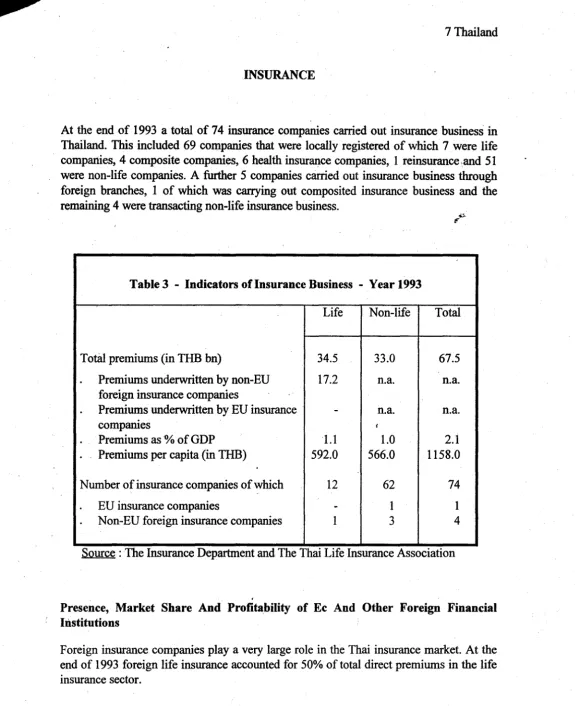
At the end of 1993 a total of 74 insurance companies carried out insurance business
in
Thailand. This included 69 companies that were locally registered of which 7 were life companies, 4 composite companies, 6 health insurance companies, 1 reinsurance :and 51
were non-life companies. A further
5
companies carried out insurance business throughforeign branches, 1 of which was carrying out composited insurance business and the remaining 4 were transacting non-life insurance business.
Table 3 - Indicators of Insurance Business - Year 1993
Life Non-life Total
Total premiums (in THB bn) 34.5 33.0 67.5
.
Premiums underwritten by non-EU 17.2 n.a . n.a.foreign insurance companies
Premiums underwritten by EU insurance
-
n.a. n.a.companies f
.
Premiums as% of GDP 1.1 1.0 2.1.
Premiums per capita (in THB) 592.0 566.0 1158.0Number of insurance companies of which 12 62 74
EU insurance companies
-
1 1Non-EU foreign insurance companies 1 3 4
Source: The Insurance Department and The Thai Life Insurance Association
.
Presence, Market Share And Profitability of Ee And Other Foreign Financial Institutions
[image:7.599.10.585.23.729.2]MARKET ACCESS PROBLEMS FACED BY EC INSURANCE COMPANIES
Establishment and acquisition
No new licences to operate life or non-life insurance companies are being granted. The only form of commercial presence allowed is a up to 25% participation in joint ventures for both insurance sectors.
Activity
A branch of a foreign insurance company is not· allowed to conduct the business of
insurance brokerage and agent. £ .. ~
SECURITIES MARKET
The Stock Exchange of Thailand (SET), established in 1975, has experienced a very strong deve~opment fostered by rapid growth in the Thai economy in the 1980s and a sustained interest of foreign investors.
The Securities and Exchange Commission (SEC) was established in 1992 to regulate and develop Thailand's security industry. Programmes of market reform were pursued through 1993 to enhance Thailand's claim to regional financial status. Reforms include deregulation of debt instruments and private funds and improved access for pension funds and other institutional investors.
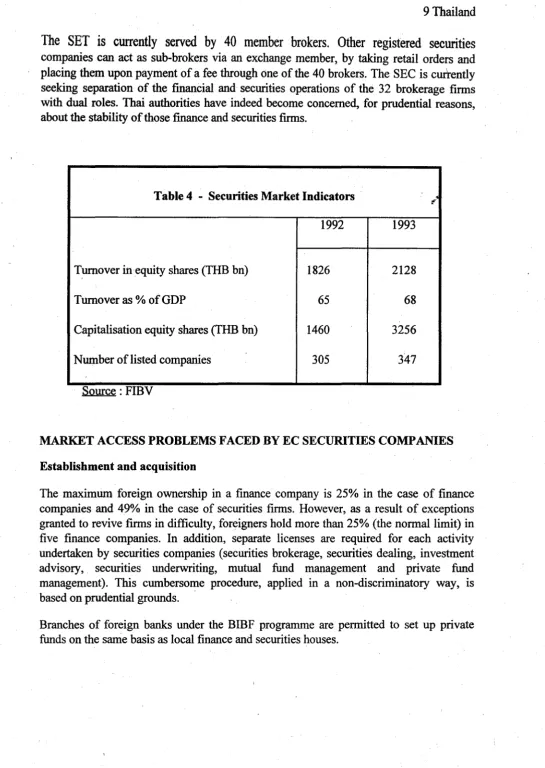
By end of 1993, the SET had listed 347 companies and total market capitalization at market value amounted to $131 billion, compared to $24 billion in 1990. Expected privatization of large state entreprises would certainly contribute to the expansion of the stock market. However, because of the size of the state sector, these would have to be very progressive. Indeed, the 15 strongest state enterprises account for 55% of GDP and contribute 20 billion dollars a year (16% of GDP) to government income. According to the World Bank, just four simultaneous flotations would account for 16% of total market capitalisation.
Foreigners held 40% or more in 40 listed companies as of mid-1993. Thaj.land became a
market favourite with international investors in 1993 largely because of its undervalued1
The SET is currently served by 40 member brokers. Other registered securities
companies can act as sub-brokers via an exchange member, by taking retail orders and placing them upon payment of a fee through one of the 40 brokers. The SEC is currently seeking separation of the financial and securities operations of the 32 brokerage firms with dual roles. Thai authorities have indeed become concerned, for prudential reasons, about the stability of those finance and securities firms.
Table 4 - Securities Market Indicators t".
1992 1993
Turnover in equity shares (THB bn) 1826 2128
Turnover as% of GDP 65 68
Capitalisation equity shares (THB bn) 1460 3256
Number of listed companies 305 347
Source :
FIBVMARKET ACCESS PROBLEMS FACED BY EC SECURITIES COMPANIES
Establishment and acquisition
The maximum foreign ownership in a finance company is 25% in the case of finance companies and 49% in the case of securities firms. However, as a result of exceptions granted to revive firms in difficulty, foreigners hold more than 25% (the normal limit) in five finance companies. In addition, separate licenses are required for each activity undertaken by securities companies (securities brokerage, securities dealing, investment advisory, securities underwriting, mutual fund management and private fund management). This cumbersome procedure, applied in a non-discriminatory way, 1s based on prudential grounds. ·
[image:9.596.28.573.38.806.2]I
I
I
I •
I
t
I
!
Activity and acquisition
Foreign citizens are prohibited from taking part in brokerage (or sub-brokerage) activities by the Alien Business Law of 1972. Only those finance and securities firms with less than 25% foreign ownership may participate in brokerage activities, with the exception of those companies established before 1979, which may have up to 50% foreign ownership.