This is a repository copy of
Implementing Digital Twins of Smart Factories with Interval
Algebra
.
White Rose Research Online URL for this paper:
http://eprints.whiterose.ac.uk/139603/
Book Section:
Dziurzanski, Piotr orcid.org/0000-0001-9542-652X, Swan, Jerry, Soares Indrusiak,
Leandro orcid.org/0000-0002-9938-2920 et al. (1 more author) (Accepted: 2018)
Implementing Digital Twins of Smart Factories with Interval Algebra. In: IEEE International
Conference on Industrial Technology. . (In Press)
[email protected] https://eprints.whiterose.ac.uk/ Reuse
Items deposited in White Rose Research Online are protected by copyright, with all rights reserved unless indicated otherwise. They may be downloaded and/or printed for private study, or other acts as permitted by national copyright laws. The publisher or other rights holders may allow further reproduction and re-use of the full text version. This is indicated by the licence information on the White Rose Research Online record for the item.
Takedown
If you consider content in White Rose Research Online to be in breach of UK law, please notify us by
Implementing Digital Twins of Smart Factories with Interval Algebra
Piotr Dziurzanski
1, Jerry Swan
1, Leandro Soares Indrusiak
1and J. M. Ramos
21
University of York, Deramore Lane, York, YO10 5GH, UK.
{
firstname.lastname
}
@york.ac.uk
2ONA Electroerosion S.A., Barrio de Eguzkitza 1,48200 Durango, Spain
Abstract— This paper presents an interval algebra that can be used to create an analytic description of a smart factory. Such a description (recently termed a ‘digital twin’ of the factory) is used to evaluate alternative manufacturing configurations as part of a search-based optimisation process. Several extensions are proposed to the interval algebra for specifying smart factory production line details. A number of real-life manufacturing scenarios are described, related to Wire-cut Electrical Discharge Machining. The experimental results show the applicability and scalability of the proposed method.
I. INTRODUCTION
With myriad practical applications, the Job-shop Schedul-ing Problem (JSP) is arguably one of the most widely studied optimisation problems [1]. In the JSP, jobs are assigned to resources at particular times in order to optimise certain key objectives, such as makespan or total workload of machines. However, the classic JSP and its popular extensions do not scale well to the problem sizes found in industry [2]. Due to the NP-hard nature of the problem, exact solutions are not generally possible for real-world problems. In practice, relatively simple dispatch heuristics are often used, where each temporal property (arrival time, processing time etc) is characterised with some degree of uncertainty [3]. Such heuristics assign a priority to each manufacturing process queued in each machine, which are then used to fetch these processes from the queue and thus determine the processing order [4]. Such rules are particularly applicable to the Dynamic Job-shop Scheduling problem (DJSP), in which manufacturing jobs are released over time, in contrast to typical JSP, when the whole jobset is known a priori [3]. When exact algorithms are applied to the DJSP, each new release of a job requires re-execution of the costly scheduling algorithm. Similarly, a new schedule needs to be determined when any process behaves different than expected (e.g. needs longer processing) or some unexpected event occurred in a plant (e.g. a machine failure). Since the scheduling process must respond to these anomalies, this approach is named reactive scheduling [5]. A num-ber of heuristic approaches has been proposed to find a quasi-optimal schedule in reasonable time for DJSP [6]. Recently, a method for trading schedule optimisation time against expected schedule quality was proposed [7]. When the scheduling algorithm is responsive enough, it is possible to schedule in reaction to each unexpected event, assign-ing priorities to each manufacturassign-ing job explicitly, rather than craft more general and thus less effective dispatching rules [8]. By this means, a problem-specific job dispatching
(schedule) is determined using ahybrid modeling approach, when a metaheuristic optimisation routine is coupled with a simulation or analytical model of a plant. The metaheuristic optimiser generates a set of candidate solutions evaluated by the plant model. Since that model mimics the physical plant behaviour, it is often referred to as itsdigital twin[9]. Since a digital twin of a plant respects all known manufacturing constraints, it always yields feasible solutions [8].
Regarding the two components of the hybrid modeling ap-proach, metaheuristic optimisation routines have been widely analysed and surveyed, for example in [1]. The creation of adequate digital twins has attracted far less attention. Usually, general-purpose discrete-event simulation software is used, as surveyed in details in the ‘Related Work’ Section. How-ever, some algebraic formalities, such as max-plus algebra [10] or interval algebra [11], are extensible enough to satisfy all the requirements imposed by the problem presented in this paper. In particular, this paper reviews and extends interval algebra. The applicability of the proposed method is demonstrated on real-world industrial scenarios.
The main contribution of this paper is the extension of the interval algebra. It extends previous applications of interval algebra to scheduling in many-core real-time systems [11], [12] into a formalism capable of acting as a digital twin of smart plants, characterised with sophisticated spatial and temporal dependences between resources and manufacturing stages. A number of real-life scenarios are presented, de-scribed and evaluated to highlight some possible applications of the proposed method.
The rest of the paper is organised as follows. After the brief survey of the related works in Section II, the problem to be solved is described in Section III. The interval algebra from [11] is reviewed and extended in Section IV and Section V, respectively. Real-world use cases are presented in Section VI, followed by conclusions in Section VII.
II. RELATED WORK
packages have been applied there to one small practical prob-lem and the obtained results have been promising enough to conclude that the practice of simulation-based optimisation would grow significantly. This prophecy has fulfilled since and especially recent years yielded in numerous related publications [13]. For example, in [8], a simulation model has been built using a discrete-event simulation software named Anylogic [14], a commercial tool to simulate complex business systems. A plant can be modeled using process flowcharts, statecharts, action charts or stock & flow di-agrams, integrated with 2D and 3D visualisers. Although useful in its application domain, it is not open and operates at too coarse scale to be applied in the flow proposed in this paper, not mentioning its commercial license. In a similar way, Klemmt describes a discrete event simulation system from the Simcron company named Modeller [15]. Klemmt stresses that the number of available simulation elements is limited, but thanks to the scripting capabilities even complex manufacturing systems could be modeled. The simulation engine speed of the GUI-less version is reportedly sufficient to perform multiple simulations as required by heuristic optimisation algorithms. A couple of plant features found in real plants was implemented, for example release dates, due dates, branches or setup times. However, it does not appear to be possible to model some plant features required by the real-world use cases presented in this paper, such as various machine operating modes or job preemptions.
Zho et al [16] applied the popular simulation soft-ware ARENAcimplementing complex simulation logic and controlling data flow via the Visual Basic for Applica-tions (VBA) environment embedded in that tool. A Multi-Objective Genetic Algorithm (MOGA) was employed to find Pareto-optimal solutions in terms of economic performance and green yield measures.
Despite being so widely applied, simulation-based hybrid systems are characterised with lengthy response times in comparison with analytical models [17]. Simulation models are also often characterised with the lack of clear structure and often cannot reach an acceptable level of performance [18]. In contrast, an advantage of analytical techniques is the ease of computing using explicit mathematical formulas and numerical computation methods [19]. As observed by Shao et al [20], simulation-based evaluations are customised for special purposes and are difficult to apply them to other scenarios. Although all these drawbacks are significant, applying analytical techniques as alternative way of perfor-mance evaluation seems to be far less popular in manufac-turing optimisation. This is in contrast with other application domains, e.g. performance evaluation of complex computing systems, where analytical methods are used predominantly [21]. Nevertheless, a number of analytical alternatives have been proposed. For example, in [22] a rather simple 3-step objective function evaluation algorithm has been described. The evaluation technique proposed in that paper does not consider such features as multi-modal resource behaviour or multi-objective optimisation, but the authors stress that these features could be added in future. Some techniques popular
in other domains are more expressive. One such technique is Network calculus, a theory of deterministic queuing systems proposed by Cruz [23]. It offers an alternative approach to queuing theory, using upper bounds to characterize arrivals and lower bounds to describe services. Using this approach, bounds can be easily computed for network performance metrics such as delay or backlog. Since this formalism is aimed at computer networks, a considerable modification would be needed to consider all the requirements imposed by the problem considered in this paper.
From this literature survey, it may be concluded that hybrid modeling approach coupled with analytical evaluation is not well explored in the field of smart factories and that applying extended formalities known from other fields can be promising.
The formalism of interval algebra [11], previously used for computer-system resource scheduling, is more general and expressive enough to deal with the majority of these requirements. As it is shown in this paper, this algebra can be extended to express the remaining requirements in a relatively simple way.
III. PROBLEM FORMULATION
The problem considered in this paper is an extended version of the classic flexible Job-shop Scheduling Problem (EFJSP), in which a set ofnjobs needs to be processed in a plant equipped withm machines so that the makespan or financial cost is minimised. The set of jobs is denoted asΓ, Γ ={τ1, τ2, . . . , τn}. The set of machines is denoted asΠ, Π ={π1, π2, . . . , πm}.
The problem has the following constraints:
1) There are different types of machines in a plant, Πα1, . . . ,Παt.
2) Each job τi can only be executed by a subset of machines in a plantΠi⊂Π, possibly of various types. 3) The processing of a job may require it to be allocated
to more than one machine.
4) Two jobs τi1 and τi2 can be dependent or directly
dependent on each other. The dependency relation de-notes thatτi2 cannot start beforeτi1 finishes, whereas
the direct dependency requires that τi2 starts exactly
when τi1finishes.
5) Each job can be preempted at certain time points. 6) Machine πj can operate in one of a set of modes,
each mode differing in processing time and economical costs.
7) Some machinesπj1andπj2cannot be used at the same
time.
8) Allocation of jobτi1to a certain machine can decrease
the set of machines which can process the jobs depen-dent onτi1.
9) Certain sequences of two jobs τi1 andτi2 scheduled
The analytical formalism used for makespan evaluation of EFJSP needs to be expressive enough to consider all these assumptions. In the following section, the principles of interval algebra [12] are presented, followed by the necessary extensions to comply with the above constraints.
IV. INTERVAL ALGEBRA FOR REAL-TIME SCHEDULING Interval algebra (IA) was introduced by Indrusiak et al [12] for task scheduling in real-time computer-based systems. To handle the constraints associated with EFJSP, some exten-sions are required. For the sake of self-consistency of this paper, the most important features of IA are described in this section, followed by the required new features presented in the subsequent section.
In EFJSP, a manufacturing process is viewed as a set of jobs Γ = {τ1, τ2, τ3, . . .}. Jobs which appear exactly once
during the whole considered time horizon are often referred to as singletons. Periodic or sporadic jobs can be treated as an infinite series of singleton occurrences that are released periodically or less often than the provided inter-release time, respectively. Such jobs can represent e.g. a periodic maintenance operation of a resource. Thej-th occurrence of a periodic or sporadic job τi is denoted withτi,j. Jobs are mapped to plant resources, such as conveyors or machines, using a selected scheduler (e.g. FIFO or priority-preemptive). In IA, jobs are represented using tuples that include their name, release time or task dependencies, and the interval length. In the assumed notation, each tuple element starts with symbol #. The simplest case, a singleton job, can be represented by the time interval it requires from a notional resource as follows:
#τ1#0#50, (1)
where the first element of the tuple is a unique job identifier, the second is a non-negative real number representing the release time of the job and the third is a positive real number representing the actual length of the time interval. In the example above, job τ1 is released at time 0 and requires
50 time units of a resource. Using traditional mathematical notation, this interval can be written as left-closed right-open bounded interval[0,50).
Using the notation shown in formula (1), any singleton job can be expressed. A set of such intervals can represent independent jobs. An indirect dependency between two jobs
τ1 andτ2, i.e., the situation whenτ2 can start only afterτ1
has been executed, is denoted with a job identifier as the second element of a tuple, instead of the release time of a job:
#τ2#τ1#100. (2)
The extension of IA presented in the following section can also express other inter-job relations found in industrial plants.
The notation shown in formula (2) is capable of denoting single dependency jobs. Multiple dependencies are specified as a dependency set:
#τ3#{τ1, τ2}#150. (3)
This notation assumes that the starting point of the interval corresponding to job τ3 lies not earlier than at the highest
endpoint among all the intervals it depends on. In this example, assuming that jobs τ1 and τ2 are defined as in
formulæ (1) and (2), this leads to: τ1 = [0,50), τ2 =
[50,150),τ3= [150,300).
The intervals described with formulæ (1) - (3) are single-appearance and have a fixed release time. In case of a strictly periodic job, its instances are released every fixed amount of time, known as a period. Such a job occurrence series is denoted with the notation exemplified below, which is exactly the same as the notation of a singleton followed by the period (equal to 100 in this case):
#τ4#0#20#100. (4)
Mathematically, formula (4) represents an infinite series of intervals, such as: τ4 = [0,20),[100,120),[200,220), . . ..
The release time of sporadic jobs is not deterministic but has well defined the minimal time between two consecutive releases. In case of aperiodic jobs, those bounds do not exist. To model those cases, the release times can be represented with so-called aleatory variables. Those variables are associ-ated with probability distributions that can constrain assumed values. More details on them can be found in Indrusiak et al [12].
A resource can be represented by an algebraic operation over all the jobs mapped onto it, each represented by its respective interval, corresponding to a selected dispatching heuristic γ. The algebraic operation determines how the resource is shared between the jobs mapped to it, and how the sharing affects their timings. In the used notation, the dispatching heuristicγ acts as an operator that is applied to the set of intervals surrounded by brackets
γ(#τ1#0#50). (5)
If more than one job is presented to a dispatching heuristic, the corresponding intervals are separated with a comma, as shown below
γ(#τ1#0#50,#τ2#0#100) =
γ(#τ1&50,#τ2&150) =γ([0,150)),
(6)
whereγ is realised with the FIFO dispatching heuristic. In this example, two different ways to evaluate operator γ are presented. The first evaluation of the operator preserves the identities of the mapped jobs, and it indicates the comple-tion times of each one of them after the symbol &. This type of evaluation is referred to as information-preserving (or simply preserving). The second way to evaluate the operator is equivalent to the first, but it does not preserve any information about the individual operands. It simply determines the busy period(s) of the resource with one or more intervals. This type of evaluation is referred to as information-collapsing (or simply collapsing).
job. All the earlier examples (1) - (6) presented untyped jobs only. If a job can be executed only on a single type of resources, it is a single-typed job. A multi-typed job can be executed on several (enumerated) resource types, possibly with different processing time. To describe a single-typed or multi-typed job, the notation supports the definition of different types of resources and different types of resource affinity. This can be expressed as follows, where each scalar in pointy brackets denotes a different type and the absence of type constraints implies untyped jobs or resources
γ(#τ10<Πα1>#0#15,
#τ11<Πα2,Πα3,Πα8>#0#20,#τ12#0#14).
(7)
By allowing the definition of resource types and resource requirements, it is also possible to present transport jobs between two machines (e.g. using a conveyor) by modelling the job as two fully dependent intervals with distinct resource requirements, e.g. a resource of typeΠα1for processing and
Πα2 for transporting. In this situation, the job can only be
connected over the resource of typeΠα2once it has finished
being processed by resource belonging to Πα1, which can
be described as
#τ13<Πα1>#0#14, (8)
#τ14<Πα2>#τ13#340. (9)
The representation of load as an interval length, denoted by a positive real number, is already capable of representing a fixed load. To represent a typed fixed load, the specification of different interval lengths for different resource types uses a similar notation as the one introduced in formula (7), namely
#τ15<Π2,Π4,Π6>#0#<10,20,20> . (10)
Aleatory variables can be used to represent a probabilistic load or typed probabilistic load for both typed and untyped jobs. The details of stochastic interval algebra can be found in Indrusiak et al [12].
V. INTERVAL ALGEBRA EXTENSION FOREFJSP
When applied to industrial plants, IA should be capable of solving job scheduling problems with different manufac-turing process topologies, including both single and multiple stages. In the latter, commodities can be manufactured on a range of alternative resources using different routes. This implies that additional relations have to be defined between certain resources, describing their affinity or anti-affinity. Another requirement is related to changeovers which can be dependent, requiring that the feature of sequence-dependent setup should be introduced. Another required feature stems from the material transfer requirements, as in a plant it is possible that certain jobs have to be executed immediately one after another. As a result, the general precedence relationship natively supported by IA needs to be extended to distinguish immediate precedence relationships. The new features required are described below.
A. Mutual exclusiveness of resources
In plants, certain resources cannot be used at the same time. For example, two conveyors may transport a raw material from different silos to the same weighing scale. To prevent resources π1 andπ2 being active at the same time,
it is necessary to define a mutex (mutual exclusion) relation between them. This relation is symmetric and transitive.
B. Different routes
In the multiproduct topology, different routes between pro-cessing machines are possible. However, equipment connec-tivity can be limited (partial), for example defined by existing conveyors or pipes. It is therefore necessary to constrain which resources can be used sequentially by jobs belonging to a single manufacturing. Two relations are introduced:
• An affinity relation between resource π1 and resource
π2 means that for two different jobsτ1andτ2 realising
the same manufacturing order andτ1< τ2with respect
to the topological order, where π1 is compatible with
job τ1 and τ2 is compatible with resource π2, if τ1 is
allocated toπ1 thenτ2 can be allocated toπ2.
• An anti-affinity relation between resource π1 and
re-sourceπ2. For two different jobs τ1 and τ2 associated
with the same manufacturing order such that τ1 <
τ2 with respect to the topological order, where π1
is compatible with job τ1 and π2 is compatible with
resourceπ2, then ifτ1is allocated toπ1thenτ2cannot
be allocated toπ2.
C. Sequence-dependent setup
In real-world scheduling problems, changeovers can be sequence dependent [24]. An example is when in the same resource π1 (e.g. mixer) two jobs τ1 and τ2 are to be
processed one after another, each belonging to a different manufacturing order producing a different commodity (e.g. different colour paint). In such situations, an additional job
τ3has to be processed byπ1betweenτ1andτ2(e.g. cleaning
of the mixer). In IA, a new function has to be introduced that takes as parameters: a resource, the job currently processed by that resource, the job subsequently to be processed by that resource. This function returns the job to be processed byπ1betweenτ1andτ2. This function returns the empty job
(i.e. an untyped job with processing time 0) if the sequence-dependent setup is not defined for given parameters.
D. Intra-job relations
similarly to single dependency in formula (2), but using an appropriate relation symbol in from of the first operator, for example τ1 mτ2 can be specified as
#τ2#m{τ1}#50, (11)
where the processing time ofτ2 equals 50 time units.
VI. REAL-WORLD USE CASES
The considered real-world use case is based on the dis-crete manufacturing process of Wire Electrical discharge machining (WEDM), in which a thermo-electric sparking process removes material using a wire to cut the desired shape of a part. Complex profiles with tight tolerances in hard conductive materials can be obtained. Minimising the cost per part while maintaining the required quality is the key objective.
The wire is unwound from a spool and it is the most expensive consumable in the process, so to select the opti-mum wire type is economically essential. Similarly, the cost per part can be decreased significantly with the right choice of the machine type and, if possible, applying ‘eco mode’ functionalities.
In the first considered scenario, a plant includes three WEDM machines suitable for various sizes of parts (‘small’, ‘medium’ and ‘large’). Small workpieces can be manufac-tured on any machine size, medium parts require a medium or large machine, and large parts can be set up only on large machines. The cost of machine usage increases with the machine size within a series.
The processing time for each machine can be computed by considering the total profile length for the sequence of cuts required by the quality specification. The process parameters set for each cut in the sequence is selected from a data base (WEDM ‘technology’) indexed by the type of wire and the material of the part. The commodity cost is determined from the wire speed together with the wire price.
All parts can be manufactured in one from four ways named Manufacturing Ways (MWs). MW 1 denotes 0.25mm brass wire and the standard mode of the machine, whereas MW 2 assumes the same wire type and the eco mode of the machine. MW 3 and MW 4 denotes technologies employ-ing 0.25 mm brass coated and copper wires, respectively. Considering (approximate) part processing time provided by a business partner and assuming market wire costs and the real wire consumption, the total wire cost for manufacturing each part can be estimated as the cost of using a machine of a particular size during the computed total manufacturing time. This way, the total manufacturing cost can be computed and used for the optimisation purposes.
To demonstrate the IA extensions proposed earlier in this paper, four real-world-based manufacturing scenarios are presented. The first of them demonstrates job allocation and scheduling via a multi-objective optimisation process. To model various modes (manufacturing ways) of the machines, separate abstract machines are created for each mode of a certain machine and mutual exclusiveness of resources
450000 500000 550000 600000 650000 700000 750000 800000 850000 900000 950000
5000 5500 6000 6500 7000 7500 8000
M
ak
es
pa
n
[s
]
[image:6.612.317.562.58.207.2]Total cost [euro]
Fig. 1. Pareto front for scenario with manufacturing 6 parts using three machines of different size
is used to prevent concurrent allocation to various abstract machines corresponding with the same physical machine. In the second scenario, intra-job relations and sequence-dependent setups are applied. The third scenario investi-gates the extensions related to different routes and direct dependency in the manufacturing process. The final scenario demonstrates the scalability of the proposed approach.
In the first example scenario, it is assumed that there is only one machine of each size in the plant. Two small and four medium parts have been ordered. All parts are ready to be processed at any time of the analysed time horizon.
The trade-off between two conflicting objectives, makespan and cost per part, has been investigated for this example scenario and the associated Pareto front visualised in Fig. 1. All the solutions in the Pareto front are notdominatedby any other solution, where solution M
dominates solution N if M is at least as good as N in all objectives, and superior toN in at least one objective.
Presented with the Pareto front, it is therefore possible for the end-user to choose the solution that is most suitable, based on business priorities. For example, the leftmost point (which favors cost) allocates work to medium sized machines 75% of the time and small machines 25%. In contrast, the rightmost point (which favors makespan) assigns equally to all three machine sizes.
de-TABLE I
BINARY RELATIONS INALLEN’S INTERVAL ALGEBRA
Relation Symbol Equivalent relation on endpoints Illustration
τ2earlier thanτ1 τ2< τ1 τ2+< τ1
τ1
τ2
τ2sinceτ1 τ2sτ1 (τ2−=τ1−)∧(τ1+< τ2+)
τ1
τ2
τ2finishτ1 τ2fτ1 (τ2+ =τ1+)∧(τ2−< τ1−)
τ1
τ2
τ2equalsτ1 τ2=τ1 (τ2−=τ1−)∧(τ2+ =τ1+)
τ1
τ2
τ2overlapsτ1 τ2oτ1 (τ2−< τ1−)∧(τ2+> τ1−)∧(τ2+< τ1+)
τ1
τ2
τ2meetsτ1 τ2mτ1 τ1+ =τ2−
τ1
τ2
τ2duringτ1 τ2dτ1 ((τ2
−> τ1−)∧(τ2+ = (τ1+))∨((τ2−>= τ1−)∧
(τ2+< τ1+))
τ1
τ2
scribed earlier in this paper. In this scenario, the jobs are ready to be manufactured in the decreasing order of priori-ties. It means that at the beginning only the lowest-priority part is ready to be processed and thus the manufacturing process is initiated. After some time a higher-priority part is ready to be produced. At this moment, two manufacturing decisions are possible. Either the manufacturing of the lower-priority part manufacturing is preempted and the higher-priority part begins to be manufactured, or the higher-higher-priority part manufacturing is suspended until the lower-priority part is finished. The first strategy decreases the makespan, as there is no time-consuming preemption modeled with a sequence-dependent setup, but the part finishing order violates the order as determined by the parts’ priorities. There are hence two conflicting objectives: the makespan and the number of the given order priority violations. As shown in Fig. 2, during the optimisation process three alternative solutions have been found for this scenario. The makespan is inversely proportional to the number of priority order violations, since each preemption inserted some time gap to change the part in the machine. The leftmost Pareto-optimal point corresponds to the solution in which the parts are finished in the preferred order, but imposing that order requires two preemptions. The middle Pareto-optimal point corresponds to a solution with
1.1226x10⁶
1.1228x10⁶
1.123x10⁶
1.1232x10⁶
1.1234x10⁶
1.1236x10⁶
1.1238x10⁶
0 1 2
M
ak
es
pa
n
[s
]
#Order priority violations
Fig. 2. Pareto front for scenario with preemption
one preemption, but using this schedule one part with a lower-priority is finished earlier than a higher-priority part. Finally, the rightmost Pareto-optimal point corresponds to a solution resulting with the fastest manufacturing without preemptions, but two lower-priority parts are finished before other parts with higher priorities.
M3 M1
M2
M4
[image:8.612.119.237.56.156.2]M5
Fig. 3. An example plant architecture
500000 550000 600000 650000 700000 750000 800000 850000
1.305 x10
6
1.3 1x10
6
1.315 x10
6
1.3 2x10
6
1.325 x10
6
1.3 3x10
6
1.335 x10
6
1.3 4x10
6
1.345 x10 6 M ak es pa n [s ]
[image:8.612.316.556.58.208.2]Total cost [euro]
Fig. 4. Pareto front for scenario with two manufacturing stages
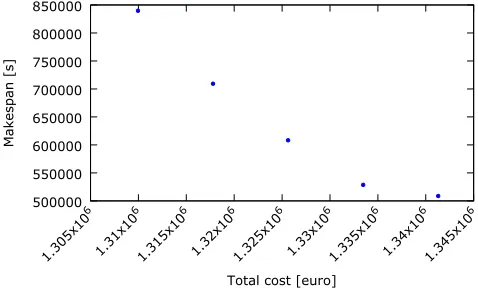
on machines M1-M3, whereas the second one requires M4 or M5. Each part can be manufactured on any machine. However, due to the plant architecture shown if Fig. 3, M4 can be used only when the first manufacturing stage has been performed on M1 or M2, whereas M5 can be used only after M3. These dependencies have been modelled with the affinity relations described earlier in this paper. As the part needs to be manufactured immediately at the second stage after stage 1 (there is no possibility of storing unfinished parts), the direct dependency (modelled by the intra-job ‘meet’ relational constraint) is used rather than the general dependency used in the previous scenario. The optimisation has been performed for two objectives, makespan and total cost. The Pareto-front for manufacturing 10 parts is presented in Fig 4.
The final scenario consists of a much larger plant and order and aims to show the scalability of the proposed optimisation method. Fig. 5 shows the optimisation time for tasksets ranging from 20 to 200 jobs. Despite the fact that above-linear complexity can be observed, the optimisation time even for the largest considered cases is close to 10 minutes, which is at least 3 orders of magnitude lower than the corresponding makespans and acceptable for the industrial partner. In case of shorter deadlines, value-based optimisa-tion stopping criteria presented in [7] may be applied.
VII. CONCLUDING REMARK
In this paper, a previous formulation of an interval algebra is extended to create a novel analytic description (or ‘digital
0 100 200 300 400 500 600 700
20 40 60 80 100 120 140 160 180 200
O pti m is ati on ti m e [s ] #Jobs
Fig. 5. Optimisation time for assorted job number in an example plant
twin’) of a smart factory. The extended interval algebra is used to model a real-life manufacturing application Wire-cut Electrical Discharge Machining. In contrast to previous work, the extended interval algebra models described constraints such as mutual exclusion and (anti-)affinity of resources, together with sequence-dependent resource allocation and temporal ordering relations. These constraints are used to model 4 real-world manufacturing scenarios. The schedules obtained via (multi-objective) metaheuristic optimisation are demonstrated to scale process 200 jobs in about 10 minutes — well beyond the current requirements of the industrial partner.
ACKNOWLEDGEMENT
The authors acknowledge the support of the EU H2020 SAFIRE project (Ref. 723634).
REFERENCES
[1] C. I. Ali and K. A. Ali, “A research survey: review of flexible job shop scheduling techniques,” International Transactions in Operational Research, vol. 23, no. 3, pp. 551–591. [Online]. Available: https://onlinelibrary.wiley.com/doi/abs/10.1111/itor.12199 [2] K. Wang and S. Choi, “A holonic approach to flexible flow
shop scheduling under stochastic processing times,” Computers & Operations Research, vol. 43, pp. 157 – 168, 2014. [Online]. Available: http://www.sciencedirect.com/science/article/pii/S0305054813002839
[3] S. R. Lawrence and E. C. Sewell, “Heuristic, optimal,
static, and dynamic schedules when processing times are
uncertain,” Journal of Operations Management, vol. 15,
no. 1, pp. 71 – 82, 1997. [Online]. Available:
http://www.sciencedirect.com/science/article/pii/S0272696396000903 [4] J. Branke, T. Hildebrandt, and B. Scholz-Reiter, “Hyper-heuristic
evolution of dispatching rules: A comparison of rule representations,” Evol. Comput., vol. 23, no. 2, pp. 249–277, Jun. 2015.
[5] D. Karunakaran, Y. Mei, G. Chen, and M. Zhang, “Toward evolving dispatching rules for dynamic job shop scheduling
under uncertainty,” in Proceedings of the Genetic and
Evolutionary Computation Conference, ser. GECCO ’17. New York, NY, USA: ACM, 2017, pp. 282–289. [Online]. Available: http://doi.acm.org/10.1145/3071178.3071202
[image:8.612.57.296.198.343.2][7] P. Dziurzanski, J. Swan, and L. S. Indrusiak, “Value-based manufacturing optimisation in serverless clouds for industry 4.0,” in Proceedings of the Genetic and Evolutionary Computation Conference, ser. GECCO ’18. New York, NY, USA: ACM, 2018, pp. 1222–1229. [Online]. Available: http://doi.acm.org/10.1145/3205455.3205501
[8] K. Kulkarni and J. Venkateswaran, “Hybrid approach using simulation-based optimisation for job shop scheduling problems,” Journal of Simulation, vol. 9, no. 4, pp. 312–324, 2015. [Online]. Available: https://doi.org/10.1057/jos.2014.40
[9] M. Grieves and J. Vickers,Digital Twin: Mitigating Unpredictable, Undesirable Emergent Behavior in Complex Systems. Cham: Springer International Publishing, 2017, pp. 85–113. [Online]. Available: https://doi.org/10.1007/978-3-319-38756-7 4
[10] P. Dziurzanski and L. Indrusiak, “Value-based allocation of docker containers,” in Parallel, Distributed and Network-Based Processing (PDP), 26th Euromicro International Conference on. IEEE, 2018. [11] L. S. Indrusiak and P. Dziurzanski, “An interval algebra for
multi-processor resource allocation,” in2015 International Conference on Embedded Computer Systems: Architectures, Modeling, and Simula-tion (SAMOS), July 2015, pp. 165–172.
[12] L. Indrusiak, P. Dziurzanski, and A. Singh,Dynamic Resource Alloca-tion in Embedded, High-Performance and Cloud Computing. River Publishers, 2016.
[13] R. Liu, X. Xie, K. Yu, and Q. Hu, “A survey
on simulation optimization for the manufacturing system
operation,” International Journal of Modelling and Simulation,
vol. 38, no. 2, pp. 116–127, 2018. [Online]. Available:
https://doi.org/10.1080/02286203.2017.1401418
[14] I. Dmitry, Operations and supply chain simulation with AnyLogic: Decision-oriented introductory notes for master students., 2nd ed. Berlin School of Economics and Law (preprint), 2017. [Online]. Avail-able: https://www.anylogic.com/upload/pdf/Ivanov AL book 2017.pdf [15] A. Klemmt, S. Horn, G. Weigert, and K.-J. Wolter, “Simulation-based optimization vs. mathematical programming: A hybrid approach for optimizing scheduling problems,” Robotics and Computer-Integrated Manufacturing, vol. 25, no. 6, pp. 917
– 925, 2009, 18th International Conference on Flexible
Automation and Intelligent Manufacturing. [Online]. Available:
http://www.sciencedirect.com/science/article/pii/S0736584509000362 [16] M. Zhou, Y. Pan, Z. Chen, and W. Yang, “Optimizing green production
strategies: An integrated approach,” Computers & Industrial Engineering, vol. 65, no. 3, pp. 517 – 528, 2013. [Online]. Available: http://www.sciencedirect.com/science/article/pii/S0360835213000715 [17] H. Zisgen, I. Meents, B. R. Wheeler, and T. Hanschke, “A queueing
network based system to model capacity and cycle time for semicon-ductor fabrication,” in2008 Winter Simulation Conference, Dec 2008, pp. 2067–2074.
[18] E. Valentin, A. Verbraeck, and H. Sol, “Advantages and disadvantages of building blocks in simulation studies,” inSimulation in Industry 15th European Simulation Symposium. SCS-European Publishing House, 2003, pp. 141–148.
[19] R. Briesemeister and A. G. N. Novaes, “Comparing an approximate queuing approach with simulation for the solution of a cross-docking problem,”Journal of Applied Mathematics, vol. 2017, p. 11, 2017. [20] G. Shao, A. Brodsky, and R. Miller, “Modeling and optimization
of manufacturing process performance using modelica graphical rep-resentation and process analytics formalism,” Journal of Intelligent Manufacturing, vol. 29, no. 6, pp. 1287–1301, 2018.
[21] A. E. Kiasari, A. Jantsch, and Z. Lu, “Mathematical formalisms for performance evaluation of networks-on-chip,” ACM Comput. Surv., vol. 45, no. 3, pp. 38:1–38:41, Jul. 2013. [Online]. Available: http://doi.acm.org/10.1145/2480741.2480755
[22] V. Nguyen and H. Bao, “An efficient solution to the mixed shop scheduling problem using a modified genetic algorithm,” Procedia Computer Science, vol. 95, pp. 475 – 482, 2016, complex Adaptive Systems Los Angeles, CA November 2-4, 2016. [Online]. Available: http://www.sciencedirect.com/science/article/pii/S1877050916324978 [23] R. L. Cruz, “A calculus for network delay. i. network elements in
isolation,”IEEE Transactions on Information Theory, vol. 37, no. 1, pp. 114–131, Jan 1991.
[24] C. A. M´endez, J. Cerd´a, I. E. Grossmann, I. Harjunkoski, and M. Fahl, “State-of-the-art review of optimization methods for short-term scheduling of batch processes,” Computers & Chemical Engi-neering, vol. 30, no. 6-7, pp. 913–946, 2006.