Int. J. Electrochem. Sci., 5 (2010) 828 - 851
International Journal of
ELECTROCHEMICAL
SCIENCE
www.electrochemsci.org
The Surface Active Site Model for Formic Acid Electrooxidation
at Palladium in Aqueous Acid Solution
S. Garbarino and L. D. Burke,*
Chemistry Department, University College Cork, Cork, Ireland *
E-Mail:[email protected]
Received: 29 April 2010 / Accepted: 12 June 2010 / Published: 20 June 2010
Electrocatalysis at palladium surfaces in acid solution is of significant interest with regard to fuel cell development, especially in the case of direct formic acid fuel cell (DFAFC) systems. The present work underlines the importance of protruding atom-type active sites at the metal surface and that these sites undergo an interfacial, quasi-reversible, redox transition in aqueous acid solution at ca. 0.24 V (RHE). The interfacial mediator mode of electrocatalysis, which was discussed recently for gold and copper, is extended here to palladium in acid where the anodic behaviour of formic acid is of considerable interest.
Keywords: palladium, premonolayer oxidation, electrocatalysis, formic acid oxidation.
1. INTRODUCTION
The direct formic acid fuel cell (DFAFC)[1, 2] yields high power densities and uses a liquid fuel, which is relatively safe from a health viewpoint. Since unlike hydrogen/air fuel cells it does not involve gas storage, and its electrocatalytic oxidation and membrane crossover performances are far superior to those of the direct methanol/air fuel cell, the DFAFC is regarded as one of the most viable candidates to replace batteries as a source of portable power.
The fundamentals of DFAFC chemistry and the mechanism of formic acid oxidation in acid solution were discussed recently by Yu and Pickup [1]. Two oxidation pathways are possible, one involving dehydrogenation, viz.
HCOOH = CO2 + 2H+ + 2eˉ (1)
HCOOH = COads + H2O = CO2 + 2H+ + 2e- (2)
The standard potential for formic acid oxidation [1], E° (HCOOH/CO2, H+) at 298 K, is ca. -0.25 V (SHE), quite a negative value compared with that of hydrogen or methanol oxidation; however, this is of little advantage as the formic acid electrode does not behave in a reversible manner, the oxidation response being determined mainly by the electrocatalytic properties of the anode.
Pd (usually supported on carbon) seems to be the most active electrocatalyst for the anodic oxidation of formic acid in solutions of low pH [1, 3]. However, the activity of the noble metal decays with cell operating time and, although this loss may be reversed by applying a potential of 1.2 V (RHE) for a few seconds [3, 4], it is a significant inconvenience. The source of the electrocatalyst deactivation is uncertain; it may be due to the chemisorption of CO or some other surface deactivating species, or the loss of surface active sites due to restructuring or dissolution of these localized active states.
Interest in the electrochemistry of Pd, especially with regard to the electrocatalysis of organic oxidation reactions, is not as widespread as that of Pt. Pd is unusual with regard to its ability to absorb hydrogen [5]; two hydride phases (designated α and β) have been identified; these co-exist at ca. 0.05 V (RHE) and above this value only adsorbed hydrogen and some α-phase hydride exist at the electrode/solution interface. H-saturated Pd in aqueous media at E=0.0 V (RHE), p(H2) = 1.0 atmosphere, 298 K, has a composition [5] of PdH0.69. Since the properties of Pd hydride were not of interest here, the hydride region was largely avoided, the lower limit of most potential sweeps being set at (or above) 0.15 V (RHE).
The objective of the present investigation was to explore the surface active states (or sites) of Pd in acid solution (related work with Pd in base was discussed recently [6]). Such sites are usually regarded as low coordination number, or protruding, surface metal atoms [7]; according to Ertl [8] the coordination, energetic and kinetic properties of active site atoms are different from those (for the same metal) at perfectly ordered, well defined surfaces. It was pointed out recently for both gold [9] and copper [10] that quasi-reversible redox transitions at metastable surface sites play a major role in surface electrocatalysis. This approach is applied here to electrocatalysis at palladium in acid, with particular reference to formic acid oxidation. Basically it is assumed that while with most of the noble metals activated chemisorption is important (in some cases, e.g. hydrogen oxidation at Pt, it is evidently the dominant feature), there are processes, even at platinum metal electrodes, where surface redox transitions of active site species play an important role in electrocatalytic behaviour.
[12], i.e. “the reactive intermediates on the surfaces of most catalysts are present [especially at active sites] at such low concentrations that their identities remain largely unknown”.
A similar, but more general, proposal, referred to as the incipient hydrous oxide/adatom mediator (IHOAM) model of electrocatalysis, was made earlier [13, 14] in this laboratory. Since this model was outlined recentlyin some detail [9], only a few important points will be made here, viz.
(i) The coverages and responses of high energy, metastable metal surface (MMS), active site atoms, are usually quite low (possibly less than 1% of the surface metal atoms [8] are involved), but these levels may be accentuated by disordering or energizing the surface, e.g. by cathodic [9], abrasive [9] or thermal [15] pretreatment.
(ii) Oxidation of surface active site atoms in aqueous media often results in the formation of low coverage, incipient, hydrous (or β) oxide species at unusually low potentials. The MMS/β oxide active site redox transition is unusual as it occurs in a fast, quasi-reversible manner, both species involved being thermodynamically unstable at the transition potential. The states in question often act as electrocatalytic mediators, the MMS atoms for reduction and the β oxides for oxidation processes.
(iii) As mentioned above in (i), surface active state transitions are often difficult to detect. However, in some instances, e.g. with copper in base [14], multilayer β oxide films (grown to significant thicknesses using multicycling pretreatment) undergo reduction at the same potential as that involved in the active state transition and the onset of electrocatalytic responses.
A clear distinction between the high energy (MMS) and low energy (EMS, equilibrated metal surface) states of an electrode surface was demonstrated recently by Scholz et al. [16] in the case of gold in acid. It was observed that selective dissolution of a polycrystalline gold surface occurred in the presence of hydroxy radicals present in Fenton’s reagent, the attack being confined to small asperities (evidently the main MMS states) present at the surface after mechanical polishing of the latter. Smooth (EMS) regions of the electrode surface remained undissolved, these reacting to form a passivating α oxide film. The loss of the active zones at the gold surface resulted in a decrease in electrode surface area, a smoothening of the surface and (as reported recently [17]) a severe loss of electrocatalytic activity for reactions such as oxygen gas reduction, hydrogen gas evolution and hydroquinone oxidation. Clearly the loss due to dissolution of the MMS states, or active sites, at the electrode surface is responsible for the loss of catalytic activity of gold in acid. According to Scholz et al. [16, 17] gold present at surface defect sites contain partially filled d orbitals which can stabilize free radical intermediates and thus, in appropriate cases, promote reaction rates.
2. MATERIALS AND METHODS
The working and counter electrodes consisted of lengths of palladium wire (1.0 mm diam, ca. 0.7 cm2 exposed area, Johnson Matthey, Puratronic grade) sealed directly into soda glass. As before [6, 19] fresh electrodes were subjected to a few cycles (typically 0.15 to 1.30 V, 50 mV sˉ1) in the cell electrolyte to ensure that the expected cyclic voltammetric response was observed; in this work the value of the lower limit was chosen to minimize (ideally avoid) the formation of absorbed hydrogen. Palladium black surfaces were produced by cathodizing a bright Pd electrode at 50 mA cmˉ2 for 1 min in a solution containing 1.0 g PdCl2 dissolved in 100 ml of 0.1 mol dmˉ3 aqueous HCl solution. Experiments were carried out using a thermostatted cell (Metrohm, type EA880R-20) containing a central working electrode and a nearby counter electrode. The Pt/H2 reference electrode was contained in a separate vessel which was connected to the main cell via a Luggin capillary whose tip was placed ca. 1.0 mm away from the surface of the working electrode. The cell and reference electrode compartment were suspended in a water bath whose temperature was controlled at 25±0.1ºC. All solutions were made up using Analar grade chemicals and triply distilled water; they were deoxygenated before use with a flow of high purity nitrogen gas for a period of 15 min; CO gas was supplied by Air Products Ltd. All potentials in this work, unless specifically designated otherwise (e.g. when discussing independent work), relate to a hydrogen electrode in the same solution, i.e. to the RHE scale. All current densities are given with respect to geometric surface area.
Cyclic voltammograms were obtained with the aid of a potentiostat (Wenking, model LB95M), a function generator (Metrohm, E612) and an X-Y recorder (Rikadenki, RW21); the resulting plots were transferred with the aid of an HP scanjet 2300c scanner to a computer and are reproduced directly here. As described earlier [19], the palladium surfaces were activated, i.e. disrupted, as desired by in situ growth of a multilayer hydrous oxide deposit using a potential cycling technique; the resulting deposit was then reduced to the active state of the metal by applying a slow negative sweep to a low potential.
3. RESULTS
3.1. The surface electrochemistry of palladium
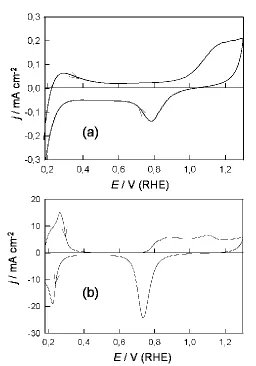
formation/removal responses were much more clearly defined and a conjugate pair of peaks appeared just above 0.2 V in the adsorbed hydrogen region.
Figure 1. (a) Cyclic voltammogram (0.175-1.300 V, 50 mV sˉ1) for a bright Pd electrode in 1.0 mol dmˉ3
H2SO4 at 298 K. (b) Repeat of (a) after subjecting the electrode to in situ surface
activation; the latter involved multicycling [6] (0.68-2.82 V at 10 V sˉ1 for 6.0 min) followed by a slow sweep to a low potential (1.0-0.1 V at 10 mV sˉ1) to reduce the hydrous oxide deposit, thus yielding a disrupted Pd surface.
[image:5.596.172.428.132.498.2][image:6.596.170.427.130.384.2]
V is largely ignored in the present work; it is assumed to be due to a redox transition of palladium cations in protruding groups in the monolayer oxide film.
Figure 2. Cyclic voltammogram (0.175-1.300 V, 10 mV sˉ1) for a palladized Pd electrode in 1.0 mol dmˉ3
H2SO4 at 298 K.
[image:6.596.194.402.440.715.2]
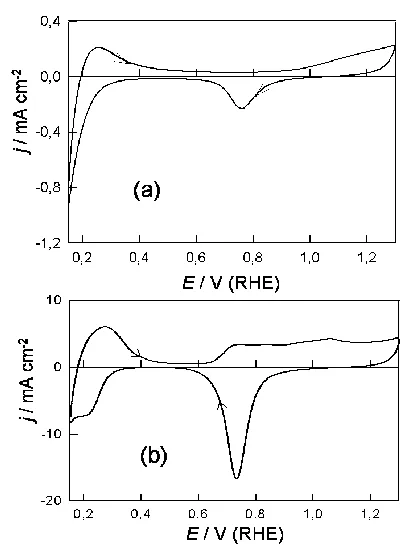
Data for experiments similar to those outlined in Fig. 1 for palladium in perchloric acid solution are shown in Fig. 3. Again, the electrode surface area was substantially increased following the activation process and the monolayer oxide formation/removal response is more clearly defined in (b) than in (a) in Fig. 3.
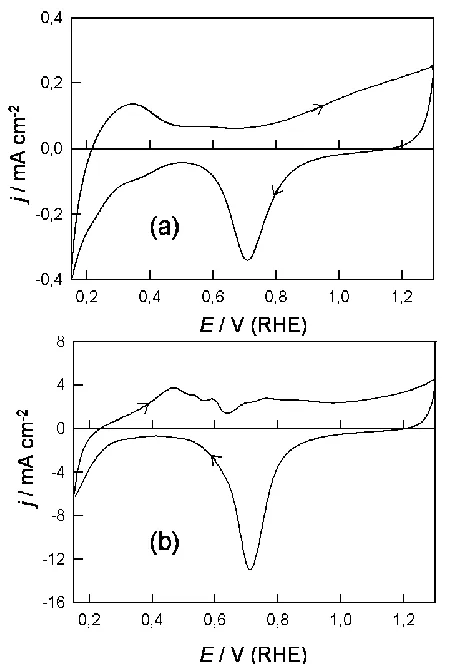
In the case of the activated electrodes the monolayer oxide formation reaction commenced at a slightly lower potential (0.64 V, Fig. 3(b)) in perchloric, as compared with sulphuric (0.74 V, Fig. 1(b)), acid solution. While the charge for the hydrogen region of the CV, below 0.4 V, was quite marked in Fig. 3(b), the conjugate peaks at ca. 0.24 V were far less marked in this case. Similar data for a palladium electrode in base is shown in Fig. 4. The various features in the positive sweep in this case, e.g. the hydrogen desorption, premonolayer oxidation and α oxide formation response, are not clearly resolved and there is no indication of either a peak in the positive sweep at ca. 1.1 V or a pair of sharp conjugate peaks in the adsorbed hydrogen region.
Figure 4. Repeat of the experiments outlined in Fig. 1 in 1.0 mol dmˉ3 NaOH; the multilayer oxide growth conditions in base were 0.48-2.82 V at 10 V sˉ1 for 6 min.
Examples of reduction sweeps for oxide films grown on Pd in 1.0 mol dmˉ3
[image:7.596.184.413.302.634.2]
part (a), showed a small cathodic response (probably due to a Pd (IV) to Pd (II) oxide/oxide transition) at ca. 1.4 V and a monolayer oxide reduction response at ca. 0.6 V.
(c)
0,2 0,4 0,6 0,8 1,0 1,2 1,4 1,6
j / m A c m -2 -18 -16 -14 -12 -10 -8 -6 -4 -2 0 2 (b)
E / V (RHE)
0,2 0,4 0,6 0,8 1,0 1,2 1,4 1,6 -1,4 -1,2 -1,0 -0,8 -0,6 -0,4 -0,2 0,0 (a)
E / V (RHE)
0,2 0,4 0,6 0,8 1,0 1,2 1,4 1,6 -0,8
-0,6 -0,4 -0,2 0,0
E / V (RHE)
[image:8.596.61.521.124.267.2]j / m A c m -2 j /m A c m -2
Figure 5. Reduction sweeps (1.60-0.15 V, 10 mV s-1) for oxide-coated Pd electrodes in 1.0 mol dm-3 H2SO4 at 298 K. The oxide deposits were produced anodically by polarization at (a) 1.9 V, (b) 2.0 V and (c) 2.1 V; for periods (in each case) of (---) 5, (. . .) 10 and (—) 15 minutes.
Films grown at 2.0 V, part (b), again showed a peak at ca 1.4 V, as in (a), a new, rather ill-defined, feature at 1.0 to 0.8 V and again the α oxide reduction response at ca. 0.6 V. At the longest growth time in this case the peak at ca. 0.6 V was unusually large; evidently along with the α oxide, another component (which is assumed to be a precursor of the β oxide species) was produced under these conditions. Finally, with films grown at 2.1 V, part (c), the main product is evidently the β oxide which undergoes vigorous reduction at ca. 0.3 V; there is again an α oxide reduction peak just above 0.6 V while the low level peaks above 0.7 V are not clearly evident in this case as the current sensitivity used was quite low.
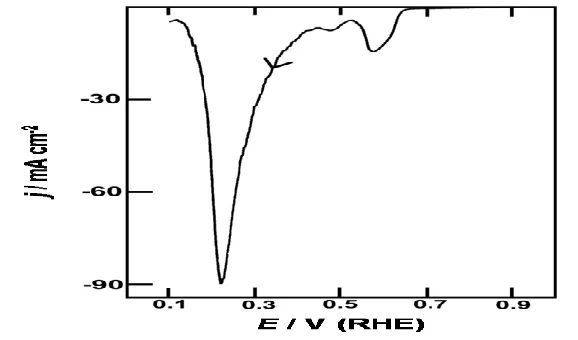
An example of a reduction response for an oxide film grown in H2SO4 solution under repetitive potential cycling conditions is shown in Fig. 6.
[image:8.596.154.443.548.718.2]
The main feature is the β oxide reduction response which has a maximum at ca. 0.24 V; there are lesser cathodic features in this case at ca. 0.6 and 0.5 V. The magnitude of the latter peaks remained independent of the oxide growth cycling time (data not shown) while the charge for the peak at ca. 0.24 V increased rapidly, to a constant value, over the first 10 min period of oxide growth cycling; at the limiting film thickness the charge for reduction of the β oxide component amounted to ca. 95% of the total oxide reduction charge. Multilayer oxide growth and reduction behaviour at Pd in HClO4 solution (not shown here) also appeared to be complex; after oxide growth on cycling (0.68-2.82 V, 10 V sˉ1
) for 1-2 min, small oxide reduction peaks were observed at 0.5 and 0.35 V; however, the main β oxide reduction responses commenced in this case (especially with thicker films) at ca. 0.2 V.
3.2. Some electrocatalytic responses for palladium in acid solution
As compared with platinum, palladium seems to be a particularly poor electrocatalyst from a methanol oxidation viewpoint. As is evident from Fig. 7, methanol is almost totally inactive (especially within the double layer region) at an activated palladium electrode in acid solution.
Figure 7. Cyclic voltammogram (0.15-1.30 V, 10 mV sˉ1) for an activated Pd electrode in 1.0 mol dmˉ3
H2SO4 containing 0.05 mol dmˉ3 methanol at 298K.
[image:9.596.162.436.374.586.2][image:10.596.173.422.131.351.2]
occurred well within the monolayer oxide formation region which commenced at ca. 0.75 V (see the second cycle, shown by the dotted line, in Fig. 8).
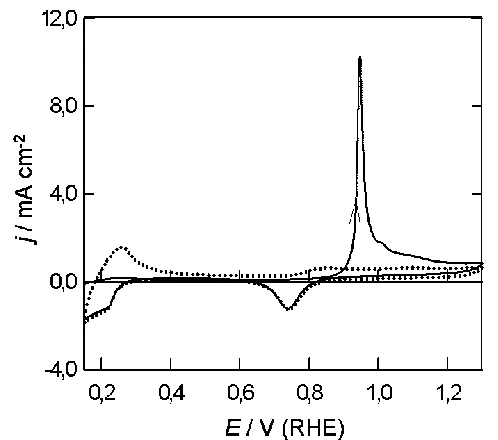
Figure 8. Cyclic voltammogram (0.15-1.30 V. 10 mV sˉ1) for a COads-coated activated Pd electrode in CO-free 1.0 mol dmˉ3 H2SO4 solution at 298 K (full line); the dotted line shows the response for the second cycle run immediately after the first.
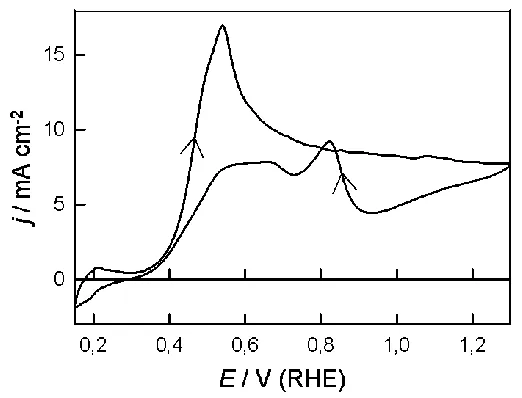
Palladium is not totally inert from a catalytic viewpoint within the double layer region. As illustrated in Fig. 9, a large anodic response was observed for formic acid oxidation at an activated palladium surface in acid solution.
Figure 9. Cyclic voltammogram (0.15-1.30 V, 10 mV sˉ1) for an activated Pd electrode in 1.0 mol dmˉ3
[image:10.596.179.419.496.681.2][image:11.596.166.427.251.450.2]
The response below 0.3 V is complicated by the fact that here the oxidation of the organic acid may be accompanied by the reaction of species such as adsorbed (and even absorbed) hydrogen. The onset of monolayer oxide formation at ca. 0.8 V in the positive sweep is accompanied by a decay of formic acid oxidation current; however, this trend is reversed in the negative sweep, the oxidation current increasing steeply as the oxide film is reduced (largely via a local cell reaction) at ca. 0.8 V. Over the range 0.7 to 0.3 V the oxidation rate decreased only slightly with decreasing potential, but below 0.3 V there was a rapid decrease in anodic current with decreasing potential (there may well be a contribution to this decrease due to the cathodic deposition of some adsorbed hydrogen). The response for hydrazine oxidation at palladium in acid is shown in Fig. 10.
Figure 10. Cyclic voltammogram (0.15-1.30 V, 50 mV sˉ1) for an activated Pd electrode in 1.0 mol dmˉ3
H2SO4 containing 0.05 mol dmˉ3 hydrazine at 298 K.
Vigorous oxidation was again observed in both the positive and negative sweep but, compared with the results for formic acid, two unusual features are worth noting: (i) little oxidation of hydrazine was observed at E ≤ 0.4 V, and (ii) the inhibition of oxidation above 0.8 V, which was quite marked (especially in the negative sweep) in the case of formic acid, was far lower with hydrazine. A CV response for an activated palladium electrode in acid solution containing dissolved dichromate is shown in Fig. 11. In the positive sweep the reduction current remained virtually constant until the onset of the monolayer oxide formation reaction at ca. 0.8 V.
Figure 11. Cyclic voltammogram (0.15-1.30 V, 50 mV sˉ1) for an activated Pd electrode in 1.0 mol dmˉ3
H2SO4 containing 0.02 mol dmˉ3 potassium dichromate at 298 K.
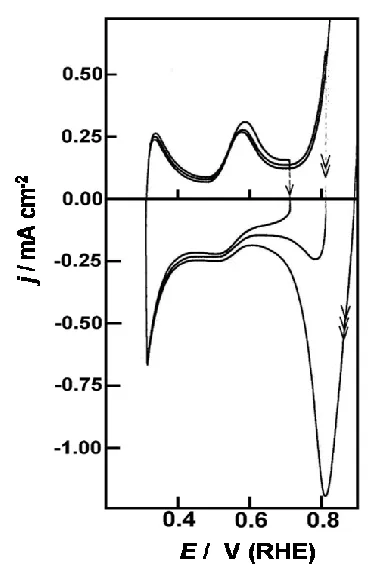
Figure 12. Three consecutive cyclic voltammograms (0.3-EU V, 50 mV sˉ1) for an activated Pd electrode in 1.0 mol dmˉ3 H2SO4 at 298 K; the upper limit (EU) was raised at the end of each cycle over the following range of values: 0.72, 0.82 and 0.90 V.
[image:12.596.170.429.65.266.2] [image:12.596.204.392.319.605.2]
4. DISCUSSION
4.1. The basic electrochemistry of palladium in acid media
The anodic behaviour of palladium in aqueous media has been summarized by Pourbaix [25], Woods [26] and, quite recently, Czerwinski et al. [27]; however, none of these authors discussed the electrocatalytic behaviour of the metal. The system is surprisingly complex as apart from dissolution in acid solution, three different oxide species, usually represented as PdO, PdO2 and PdO3, are assumed to be involved [28, 29]. Attempts to analyze such deposits using X-ray Photoemission Spectroscopy (XPS) [28, 30, 31] have achieved only very limited success as some of the species involved, e.g. PdO3, are not very stable (they may still function as intermediates in reactions such as oxygen gas evolution); strong evidence was obtained for the presence of large quantities of excess oxygen in the form of adsorbed water, hydroxy species {Pd(OH)2 and Pd(OH)4} and hydrated oxides {PdO.xH2O and PdO2.yH2O}; however, the overlap of the O 1s and Pd 3p3/2 peaks [28, 30] hindered the determination of the stoichiometry and degree of hydration of the anodically generated oxide species. It is interesting to note that while most authors assume that the monolayer oxide involves a PdO deposit, Birss et al. [32] claimed, on the basis of quartz crystal microbalance (QCMB) data, that such a film consists of Pd(OH)2.H2O species when grown in base and PdO.H2O species when formed in neutral aqueous sulphate solution; similar work with palladium in acid was not possible due to electrode dissolution.
The formation of monolayer oxide films on palladium in acid, over the range 0.80 to 1.80 V, was discussed in detail earlier by Jerkiewicz et al. [33]. The deposit in question was assumed to consist mainly of PdO at 0.95≤ E ≤1.40 V while for 1.40≤ E ≤1.80 V PdO2 was formed on top of the PdO layer. The formation of these thin anodic oxide deposits in both acid and base was investigated using ac impedance by Birss et al. [34] who noted that such films exhibited dielectric properties. Under potential cycling conditions the α oxide film can grow to an appreciable thickness (ca. 5 monolayers [35]) prior to the onset of β oxide growth. The mechanism of β oxide growth under such conditions is a matter of some debate: according to Birss et al. [35] a combination of oxidation and hydration is involved, whereas Burke et al. [36, 37] assumed that reduction of α oxide species at the lower limit of the oxide growth cycle yields active (MMS) palladium atoms which are oxidized in the next positive sweep to Pd β oxide species. The precise identity of the latter is unknown; the material in question is usually formed in a porous, largely amorphous, dispersed state [38] which may be regarded in simple terms as an agglomerate of PdO2.xH2O, although a variety of ligands, e.g. O2ˉ, OHˉ, HSO4ˉ, may be involved.
technique [42]. In this case the α oxide reduction response was absent, the main cathodic feature being a sharp oxide reduction peak at ca. 0.4 V. In this case also the conjugate pair of peaks at ca. 0.24 V (as in Fig. 1(b) of the present work) was observed, obviously growth and reduction of the multilayer oxide film activated the palladium surface. Bolzan et al. attributed these peaks at 0.24 V to the reaction of hydrogen atoms; however, no direct evidence was provided to support this assumption and since these unusual peaks appear readily in sulphuric but not perchloric acid (compare Fig. 1(b) with Fig. 3(b) in the present work), it appears to us that bisulphate (HSO4ˉ) and/or sulphate (SO42ˉ) anion plays an important role in these conjugate peak reactions.
4.2. The surface electrochemistry of palladium at low potentials
One of the main items of interest in the present investigation is the conjugate pair of peaks at ca. 0.24 V which is particularly prominent in the response recorded for the palladized palladium electrode in acid solution, Fig. 2. This feature is evidently an MMS state response, i.e. it only appears in the case of a polycrystalline palladium electrode when the surface of the latter is in a high energy state. For instance, these sharp peaks are absent in cyclic voltammograms recorded for palladium in sulphuric acid solution by both Jerkiewicz et al. (Fig. 1 in ref. no.27) and Burke and Roche (Fig. 1 in ref. no. 37); other examples of their absence in the case of unactivated electrodes are provided here in Fig. 1(a) and Fig. 3(a).
One procedure for generating the active state, and hence the response at ca. 0.24 V, was described in some detail earlier [19]; it involved perturbing (or disrupting) the outer layers of the metal lattice by growing and subsequently reducing a multilayer hydrous oxide deposit at the palladium surface. This procedure leaves the surface in a finely divided, active, palladium black-type state, and evidently a similar state may be achieved by electrodepositing palladium black on the initially bright metal surface. Although the active state is intrinsically unstable, it does not decay very rapidly [19]: a residue of this state (in the form of low coverage active sites) may be quite persistent. The complex nature of the spontaneous recrystallization of metal electrodeposits was described earlier, for copper at room temperature, by Buckley et al. [44, 45].
The active surfaces produced on palladium by repetitive potential cycling techniques [19, 20, 42] are of a rough, nanoparticulate character. The same type of surface morphology may be produced by palladization [46, 47] and according to Petrii et al. [47] the resulting nanoheterogeneous palladium electrodeposits in sulphuric acid solution yield marked responses at ca. 0.24 and 1.1 V; these two peaks in the positive sweep are also evident in Fig. 2 of the present work (they are superimposed on the conventional response for palladium in acid solution; Petrii et al. did not show the negative sweep in Fig. 1 of ref. no. 47). Mesoporous (or nanostructured) palladium electrodeposits produced using surfactant molecules as templates also show marked quasi-reversible redox transitions, in acid solutions [48, 49], at ca. -0.45 V (SMSE) or ca. O.22 V (RHE) (the latter value is based on the assumption that 1.0 mol dmˉ3
H2SO4 has a pH≈0.5). Given the nature of both the deposition process and the resulting deposit, it is assumed that freshly electrodeposited mesoporous palladium is a rather active, energy-rich form of the metal.
It seems from the data in Fig. 1(b) and Fig.2 that the CV response at low potentials (0.175 to 0.40 V) for palladium in sulphuric acid solution is composed of three main contributions. There is the conventional double layer charging/discharging of the EMS/solution interface, the adsorption/desorption of hydrogen (this is probably confined largely to the EMS sites and some involvement of absorbed hydrogen may occur close to the lower end of this potential range), and the redox (or premonolayer oxidation/reduction) responses of MMS Pd atoms at the electrode/solution interface. The latter reaction occurs at ca. 0.24 V and may be regarded as a pseudocapacitive process which is only observed when some of the surface metal atoms are in a high energy state. In an earlier discussion of surface active site behaviour, Somorjai [7] highlighted the unique chemistry of surface irregularities (similar ideas have been expressed by Ertl [8]) and stressed that low coordination surface metal atoms readily lose electrons to the bulk lattice (or in the present case to the external circuit), the active site atoms are readily converted to a cationic form, an assumption that is supported by theoretical studies [50]. The involvement of cationic sites in the catalytic behaviour of metal surfaces has been acknowledged in other areas, e.g. it was discussed recently with regard to the use of supported gold CO oxidation catalysts by Gates et al. [51].
The quasi-reversible premonolayer oxidation response at ca. 0.24 V is observed mainly with activated palladium surface atoms, Pd*surf, in sulphuric acid solution. The potential in question seems to be of considerable significance as it also coincides approximately with (a) the reduction potential of the main hydrous oxide layer formed on palladium in sulphuric acid solution [19] (see also Fig. 6 in the present work), (b) the onset (positive sweep)/termination (negative sweep) potential for formic acid oxidation, Fig. 9, and (c) a significant drop in the rate of dichromate reduction in the positive sweep, Fig. 11. While the general uncertainty with regard to the nature and chemical behaviour of surface active sites should be borne in mind [12], and the possible involvement of a hydride species cannot be totally discounted, it seems that the basic reaction at 0.24 V is an interfacial redox process involving the active surface state of the metal, viz.
The cations thus produced interact strongly with sulphate or bisulphate anions, thus giving rise to the sharp redox peaks. Perchlorate anions evidently react less strongly, in a non-specific manner, and hence the redox peaks are less well defined in this case, Fig. 3(b). These peaks at the lower end of the double layer region in the case of palladium in acid resemble those referred to by Conway [52] in the case of gold in acid as “preoxidation anion adsorption peaks”; it is interesting to note that Conway postulated the involvement of OH species in the adsorbed layer in some instances, i.e. an element of oxide formation may also be involved.
In the case of activated palladium in base, Fig. 4(b), there was no indication of a conjugate pair of peaks at ca. 0.24 V. The monolayer (or α) oxide formation reaction commenced in the positive sweep at ca. 0.6 V, and anodic responses at lower potentials are attributed to premonolayer reactions, i.e. active palladium atoms undergo oxidation at low potentials and the resulting cationic sites attract OHˉ counterions, in some cases apparently forming palladate, [Pd(OH)6]2ˉads, species. As outlined in more detail earlier [53], anionic hydroxides tend to be highly base-stabilized; hence their reduction is sluggish and occurs in this case, without the appearance of a well resolved cathodic peak, below ca. 0.2 V (a more complete account of the electrochemistry of palladium in base was published recently [6]).
It was demonstrated by Bartlett et al. [48] that hydrogen absorption into mesoporous palladium in acid solution occurs most dramatically just below -0.65 V (SMSE), whereas the conjugate pair of peaks occurred in their case 0.2 V higher at ca. -0.45 V (SMSE). As the equilibrium potential for the PdHx electrode, with the α and β phases in equilibrium in acid solution, occurs [5] at ca. 0.05 V (RHE), the conjugate pair of peaks in the case of mesoporous palladium evidently occurs (as in the present work, see Fig. 2) at ca. 0.25 V (RHE). The absence of this conjugate pair of peaks in base is also evident in work carried out by other authors using single crystal [54] and mesoporous [49] palladium electrodes in base. On the basis of such results it seems unlikely that the conjugate peaks are due to the formation and removal of adsorbed hydrogen as if this was the case then similar peaks should be observed at about the same potential (in the RHE scale) in base (indeed at all pH values) as in acid. Two pairs of peaks, attributed to the reaction of strongly and weakly bound hydrogen, occur in the case of platinum [55, 56] at approximately the same potential values (RHE scale) in acid and base. Palladium behaves differently: clearly it can adsorb hydrogen, but apparently does not yield a distinctive peak for the adsorption or desorption of the latter under CV conditions. The quasi-reversible response at ca. 0.24 V is most evident with highly activated (MMS) palladium surface states in sulphuric acid solution; these states undergo oxidation at low potentials, the reaction being accompanied by field assisted specific adsorption of sulphate and/or bisulphate anions (perchlorate, possibly accompanied by hydroxide, anions may well behave in a similar manner, but the response is less dramatic).
The interpretation of data reported earlier for palladium single crystal electrodes in aqueous media is conflicting. Itaya et al. [60] attributed the sharp peaks at 0.26 V to the adsorption/desorption of a monolayer of hydrogen, coupled with the desorption/adsorption of sulphate ions (most of the attention in the work in question was concerned with a small feature at ca. 0.45 V which was attributed to an order/disorder phase transition in the sulphate adlayer on a Pd(111) surface in 10 mmol dmˉ3 H2SO4). Hoshi et al. [57, 58] investigated a series of stepped Pd single crystal surfaces in both 0.5 mol dm-3 H2SO4 and 0.1 mol dm-3 HClO4 solutions. As mentioned previously, the conjugate pair of peaks at ca.0.25 V were absent in all cases in the presence of HClO4 as the sole electrolyte, the anion of the latter being only weakly adsorbed. With stepped Pd(111) surfaces in the presence of H2SO4 sharp peaks were observed at 0.25 V, the peak intensity dropping with decreasing terrace width. The authors attributed these peaks to the adsorption/desorption of sulphate/bisulphate anions and this assumption was supported by infrared reflection spectroscopy studies [61, 62]. A curious feature of this work is that, as discussed here earlier, the peaks at 0.25 V apparently require the presence of MMS states which are not expected to exist at well-defined single-crystal surfaces. It may be that the final electrode pretreatment step, annealing the palladium surface in a H2/O2 flame at 1300oC, followed by cooling in an argon atmosphere [61], leaves some of the surface in a non-ideal, active, state (as pointed out elsewhere [8, 63], the presence of surface defects in such systems is unavoidable).
The electrochemical behaviour of pseudomorphic overlayers of palladium electrodeposited on gold single crystal surfaces has received considerable attention, especially from Kolb et al. [64, 65]. The lattice constant of Pd is ca. 4.8% smaller than that of Au and unlike Au(100) and Au(110), Au(111)does not readily form an alloy with electrodeposited Pd [64]. The conjugate pair of peaks was observed in this case [64] (without the use of prior surface activation) with both a freshly-prepared Pd(111) electrode and Au(111) electrodes coated with 1-3 monolayers of Pd. The electrolyte involved was 0.1 mol dmˉ3
H2SO4 (pH≈1) and the main pair of conjugate peaks occurred at ca. -0.07 V (SCE), i.e. ca. 0.23 V (RHE) (a much smaller set of conjugate peaks, also mentioned by Itaya et al. [60], was noted at ca.0.4 V (RHE)). Kolb attributed the feature in question to sulphate ion desorption (in the negative sweep) accompanied by hydrogen adsorption, these two processes being reversed in the positive sweep. As outlined here earlier, the fact that the conjugate pair of peaks are absent with palladium in base suggests that adsorption/desorption of hydrogen is not involved in these sharp transitions. Evidently the palladium atoms on the Au(111) surface are intrinsically active as the Pd monolayers are in a dilated state [66] and generally gold (being a very weak chemisorber) does not interact strongly with, and thus fails to stabilize, other atoms on its surface. Hence it is assumed here that the active palladium atoms on the surface undergo oxidation, accompanied by uptake of sulphate anions, at ca. 0.25 V.
4.3. Electrocatalytic responses for palladium in acid solution
Activated chemisorption is a widely accepted route for reaction in the case of electrocatalysis at platinum-type metal surfaces. It is assumed to be involved for instance in the absorption of hydrogen (present as the dissolved gas) by palladium in aqueous media, chemisorption favoring the dissociation of hydrogen molecules prior to the entry of hydrogen atoms into the palladium lattice, viz.
H2(aq.) = H2(ads.) = 2 H (ads.) = 2 H (abs.) (4)
Palladium hydride formation may also be achieved [69] by immersing a palladium electrode in a solution of formic acid, the decomposition of the latter, viz.
HCOOH (aq.) = HCOOH (ads.) = 2 H (ads.) + CO2 (5)
involving activated chemisorption of formic acid molecules which decompose to yield adsorbed, and hence absorbed, hydrogen. The reaction (at a palladized surface) was initially quite rapid but the rate soon decreased with time apparently due to deactivation of the surface by adsorbed CO produced via the following reaction, viz.
CO2(ads.) + 2 H (ads.) = CO (ads.) + H2O (6)
CO(ads.) is a well known surface deactivating species which (at monolayer coverage) is oxidatively removed from the surface in the positive sweep only above 0.90 V, Fig. 8. The absence of a large anodic peak in this region in Fig. 7 indicates that the inhibition of methanol oxidation at palladium in acid solution is not due to the presence of large quantities of adsorbed CO. However, close inspection of this diagram indicates that there is a minor anodic feature in the region in question; hence it is not clear whether the low activity of palladium in acid with regard to methanol oxidation (which was noted earlier [70]) is due to the intrinsically low electrocatalytic activity of the metal for this reaction or that the low coverage active sites on the surface (which are the vital catalytic entities present) are deactivated due to preferential formation of adsorbed CO species at such sites. There may be a further contribution to the inhibition of electrocatalysis at low potentials due to the strong electrostatic bonding of sulphate species (SO42ˉ and/or HSO4ˉ) at surface active sites; the latter (Pd*) are assumed to exist in an oxidized state at E> ca. 0.24 V.
Formic acid is a strong reducing agent, E0(HCOOH/CO2,H3O+) at 298 K = -0.25 V (SHE) [1]; however, it is clear from Fig. 9 that the rate of oxidation (especially in the negative sweep) below 0.20 V is quite slow (for 1.0 mol dmˉ3 H2SO4 potential values in the SHE and RHE scales are virtually identical). It is assumed here that below ca. 0.24 V formic acid reacts in a sluggish manner via activated chemisorption, i.e. in terms of an extension of the process shown in Eqn. (5) in which the hydrogen formed on dissociation is anodically oxidized, see Eqn (1). The voltammetric response just above 0.2 V for this reaction seems to be somewhat distorted in the positive sweep (possibly due to co-oxidation of Hads, active Pd and formic acid, the latter being temporarily at high levels in the boundary layer close to the electrode surface); the negative sweep is assumed to be a more characteristic initial response for formic acid oxidation in the absence of both side-reactions and surface deactivation.
The major change in formic acid oxidation rate at ca. 0.24 V is attributed to the change in the nature of the surface active sites (or MMS state). As the potential is raised above 0.2 V the active sites become oxidized, see Eqn. (3); however, the resulting surface oxidant reacts rapidly with the dissolved reductant, viz.
Pdn+surf. + 0.5n HCOOH = Pd*surf. + n H+ + 0.5n CO2 (7)
but above 0.24 V the active site species is immediately reoxidized, i.e. an interfacial cyclic redox (or mediator) mechanism of electrocatalysis begins to operate. This approach explains the dramatic change in formic acid oxidation rate at ca.0.24 V and links this change to the highly reversible responses observed for active Pd surfaces in CVs recorded in the absence of formic acid, see for instance Fig. 2. The involvement of quasi-reversible interfacial electron-transfer mediators in electrocatalytic processes at gold was demonstrated recently by Bond et al. [9] using large amplitude Fourier transformed ac voltammetry; it is assumed here that a similar mechanism is involved in formic acid oxidation at a palladium surface in aqueous acid solution.
As far as the oxidation of organics at Pd in acid solution in general is concerned the behaviour of formic acid seems unusual (and possibly unique). In the reaction of formaldehyde [71, 72] under similar conditions oxidation commenced in the positive sweep only at a much higher potential, ca. 0.85 V; the reaction rate was slow and decayed rapidly with increasing potential as the monolayer oxide film further passivated the surface. In the subsequent negative sweep rapid oxidation recommenced as the passivating oxide film was reduced at ca. 0.8 V but severe inhibition of the formaldehyde oxidation recommenced, evidently due to CO adsorption, below 0.7 V; reaction virtually ceased at 0.6 V. Surface deactivation due to CO adsorption is far less prevalent during the same type of reaction with formic acid; however, it is still involved to some degree (the CO being produced by partial reduction of CO2 and/or by a side-reaction in which HCOOH dissociates into CO and H2O), being responsible for the decay of the formic acid oxidation rate under chronoamperometric (constant potential) conditions [73, 74].
access of HCOOH species to the oxidized, cationic (Pdn+), form of the surface active sites. Formic acid is unlikely to be dissociated to a significant degree in 1.0 mol dmˉ3
H2SO4; however, a proton displacement step, viz.
Pdn+surf + HCOOH (aq.) = Pdn+surf HCOOˉ + H+ (aq.) (8)
may lead to appreciable electrostatic interaction between the dissolved reductant and the active site. It is interesting for instance that while hydrazine, which is also a strong reductant, reacts (Fig. 10) in a similar manner to formic acid, the oxidation of the amine only commences at ca. 0.3 V and is still quite sluggish at 0.4 V. Hydrazine is a highly reactive substance, but it cannot form anionic species and is thus incapable of interacting strongly, in an electrostatic manner, with the oxidized form of the active site; hence its oxidation rate below 0.4 V is quite sluggish. Indeed in the negative sweep in Fig. 10 the rate of hydrazine oxidation begins to decrease at ca. 0.55 V. The data in Fig. 12 suggests that there is another interfacial cyclic redox transition or active site mediator (different from that reacting at 0.24 V) involved in this region. Active site behaviour is complex and obviously requires further work.
The response observed for dichromate reduction at palladium in acid solution, Fig. 11, support the model of the interface expressed here. As demonstrated earlier [77], this reaction occurs in accordance with the interfacial mediator model in the case of gold and platinum electrodes in acid solution. The behaviour in the case of palladium is different; as illustrated in the positive sweep in Fig. 11, dichromate reduction in this case is catalytically non-demanding, i.e. it occurs with little hindrance (in contrast to the behaviour at platinum [77]) until the start of monolayer oxide deposition –the presence of the latter film is a source of severe inhibition. Below 0.8 V in the positive sweep the dichromate reduction rate is virtually constant, the process evidently being mass transport controlled. However, there are two regions of significant current decay in the double layer region, one just above 0.2 V and the other (which is less sharp) commencing at ca. 0.55 V. The decay potential values obviously coincide with the mediator generation potentials discussed here earlier. Evidently dichromate reduction can occur at all palladium surface atoms (active sites are involved below 0.2 V but reaction is not confined to the latter). As the potential increases above 0.24 V active site atoms are oxidized, see Eqn. (3), and are no longer available as sites for dichromate reduction; the effective surface area of the metal electrode is reduced and hence the drop in cathodic current. The second decay in reduction rate at ca. 0.6 V supports the assumption of a separate type of active site or mediator system in this region.
5. CONCLUSIONS
terminate under potential sweep conditions only at ca. 0.25 V, Fig. 9) and (ii) the rate of formic acid oxidation at a Pd anode, at a constant potential, decays with time [1]. Thus there is a clear need, and plenty of scope, for improved catalytic performance in the DFAFC area and one of the main objectives of the present work was to examine the basic properties, (which are of broad interest [79, 80]) of palladium electrocatalysts in acid solution.
2. The underlying assumption in the present work is that electrocatalysis occurs at surface active sites where protruding, high energy (MMS) Pd atoms or clusters undergo oxidation at unusually low potentials. Disrupting the metal surface, by growth and reduction of multilayer oxide films (or simply by using an intrinsically disrupted Pd black surface), yields a marked quasi-reversible response at ca. 0.25 V when the electrode (in aqueous sulphuric acid solution) is cycled between wide potential limits. Evidently the active site atoms are in the oxidized state at E ≥ 0.25 V but formic acid is a strong reductant and reduces the active state back to its neutral form, the formic acid species being simultaneously oxidized. However, at E ≥ 0.25 V the active site is spontaneously reoxidized and an interfacial cyclic redox mode of formic acid electrooxidation operates. An interesting aspect of this work is that evidence for unusual surface redox behaviour at 0.25 V was observed, Figs. 1, 2 and 11, in the absence of formic acid. Since a marked change in the rate of formic acid oxidation also occurs at ca. 0.25 V, is seems reasonable to assume that both effects (the background interfacial redox mediator process and the electrocatalysis reaction) are interrelated –this type of interrelationship was described earlier for both gold [9] and copper [10] electrodes in aqueous media.
ACKNOWLEDGMENTS
This work was supported by EU funding; it is part of a Research Training Project for Young Researchers entitled “Surface Active Sites and Emission Control Catalysis”; Contract No. HPRN-CT-2002-00191.
References
1. X. Yu and P.G. Pickup, J. Power Sources, 182 (2008) 124
2. S.L. Blair and W.L. Law (2009) In: Liu H, Zhang J (eds). Wiley-VCH, Weinheim, pp. 527-566 3. X. Ha, R. Larsen, Y. Zhu and R.I. Masel, Fuel Cells, 4 (2004) 337
4. Y. Zhu, Z. Khan and R.I. Masel, J, Power Sources, 139 (2005) 15
5. F.A. Lewis, The palladium hydrogen system, Academic Press, New York, (1967)
6. L.C. Nagle and L.D. Burke, J. Solid State Electrochem., DOI 10.1007/s10008-009-0975-2
7. G.A. Somorjai, Active sites in heterogeneous catalysis. In: Eley DD, Pines H, Weisz PB (eds) Advances in catalysis, vol 26. Academic, New York, p 60 (1977)
8. G. Ertl, Dynamics of reactions at surfaces. In: Gates BC, Knözinger H (eds) Advances in catalysis, vol 45. Academic, New York, pp 49-51(2000)
9. B. Lertanantawong, A.P. 0’Mullane, W. Surareungchai, M. Somasundrum, L.D. Burke and A.M. Bond, Langmuir, 24 (2008) 2856
10. L.D. Burke and R. Sharna, J. Electrochem. Soc., 155 (2008) D83
11. B.E. Hayden and J-P. Suchsland, Support and particle size effects in electrocatalysis. In: Koper MTM (ed) Fuel cell electrocatalysis, Wiley, Hoboken, New Jersey, pp. 567-592(2009)
12. B.C. Gates, Catalytic chemistry, Wiley, New York, p. 352(1992) 13. L.D. Burke and P.F. Nugent, Gold. Bull., 31 (1998) 39
14. L.D. Burke, J.A. Collins and M.A. Murphy, J. Solid State Electrochem., 4 (1999) 34 15. L.D. Burke and L.M. Hurley, J. Solid State Electrochem., 4 (2000) 353
16. A.M. Nowicka, U. Hasse, M. Hermes and F. Scholz, Angew. Chem. Int. Ed., 49 (2010) 1061 17. A.M. Nowicka, U. Hasse, G. Sievers, M. Donten, Z. Stojek, S. Fletcher and F. Scholz, Angew.
Chem. Int. Ed., 49 (2010) 3006
18. G. Bond and D. Thompson, Gold. Bull., 42 (2009) 247
19. L.D. Burke and L.C. Nagle, J. Electroanal. Chem., 461 (1999) 52
20. Z. Liu, Z.L. Yang, L. Cui, B. Ren and Z.Q. Tian, J. Phys. Chem. C, 111 (2007) 1770 21. J.F. Llopis, J.M. Gamboa and L. Victori, Electrochim. Acta, 17 (1972) 2225
22. S.H. Cadle, J. Electrochem. Soc., 121 (1974) 645
23. A.E. Bolzan, M.E. Martins and A.J. Arvia, J. Electroanal. Chem., 172 (1984) 221
24. K. Juodkazis, J. Juodkazyte, B. Sebeka, G. Stalnionis and A. Lukinskas, Russ. J. Electrochem., 39 (2003) 954
25. M. Pourbaix, Atlas of electrochemical equilibria in aqueous solutions. Pergamon, Oxford, pp 358-363 (1966)
26. R. Woods, Chemisorption at electrodes: hydrogen and oxygen on noble metals and their alloys. In: Bard AJ (ed) Electroanalytical chemistry. Vol 9 Dekker, New York, pp 1-162 (1976).
27. M. Grden, M. Lukaszewski, G. Jerkiewicz and A. Czerwinski, Electrochim. Acta, 53 (2008) 7583 28. J.M. Tura, P. Regull, L. Victori and M.D. de Castellar, Surf. Interfac. Anal., 11 (1988) 447
29. A.E. Bolzan, A.C. Chialvo and A.J. Arvia, J. Electroanal. Chem., 179 (1984) 71 30. K.S. Kim, A.F. Gossmann and N. Winograd, Anal. Chem., 46 (1974) 197
31. V. Chausse, P. Regull and L. Victori, J. Electroanal. Chem., 238 (1987) 115
32. V.I. Birss, M. Chan, T. Phan, P. Vanysek and A. Zhang, J. Chem. Soc. Faraday Trans., 92 (1996) 4041
35. A.J. Zhang, M. Gaur and V.I. Birss, J. Electroanal. Chem., 389 (1995) 149
36. L.D. Burke, M.M. McCarthy and M.B.C. Roche, J. Electroanal. Chem., 167 (1984) 291 37. L.D. Burke and M.B.C. Roche, J. Electroanal. Chem., 186 (1985) 139
38. V.I. Birss, V.H. Beck, A.J. Zhang and P. Vanysek, J. Electroanal. Chem., 429 (1997) 175 39. A.E. Bolzan, M.E. Martins and A.J. Arvia, J. Electroanal. Chem., 157 (1983) 339
40. A.E. Bolzan and A.J. Arvia, J. Electroanal. Chem., 322 (1992) 247 41. A.E. Bolzan and A.J. Arvia, J. Electroanal. Chem., 354 (1993) 243
42. T. Kessler, A. Visintin, A.E. Bolzan, G. Andreasen, R.C. Salvarezza, W.E. Triaca and A.J. Arvia, Langmuir, 12 (1996) 6587
43. A.E. Bolzan, J. Electroanal. Chem., 437 (1997) 199
44. D.N. Buckley and S. Ahmed, Electrochem. Solid-State Lett., 6 (2003) C33
45. S. Nakahara, S. Ahmed, T.T. Ahmed and D.N. Buckley, J. Electrochem. Soc., 154 (2007) D145 46. M.Yu. Rusanova, G.A. Tsirlina, O.A. Petrii, T.Ya. Safonova and S. Yu. Vasil’ev, Russ. J.
Electrochem., 36 (2000) 457
47. O.A. Petrii, T. Ya. Safonova, G.A. Tsirlina and M. Yu. Rusanova, Electrochim. Acta, 45 (2000) 4117
48. P.N. Bartlett, B. Gollas, S. Geurin and J. Marwan, Phys. Chem. Chem. Phys., 4 (2002) 3835 49. G. Denuault, C. Milhano and D. Pletcher, Phys, Chem, Chem, Phys,, 7(2005) 3545
50. L.L. Kesmodel and L.M. Falicov, Solid State Commun,, 16 (1975) 1201
51. J.C. Fierro-Gonzalez, J. Guzman and B.C. Gates, Topics in Catal., 44 (2007) 103
52. B.E. Conway, Electrochemical oxide film formation at noble metals as a surface-chemical process. In: Davidson SG (ed) Progress in Surface Science, vol. 49. Elsevier, New York, pp 422-426 (1995) 53. L.D. Burke and M.E.G. Lyons, Electrochemistry of hydrous oxide films. In: R.E. White, J.O’M Bockris, B.E. Conway (eds) Modern aspects of electrochemistry, no. 18. Plenum, New York, pp 169-248 (1986)
54. N. Hoshi, M. Nakamura, N. Maki, S. Yamaguchi and A. Kitajima, J. Electroanal. Chem., 624 (2008) 134
55. L.D. Burke and M.B.C. Roche, J. Electroanal. Chem., 159 (1983) 89 56. L.D. Burke and D.T. Buckley, J. Electroanal. Chem., 366 (1994) 239 57. N. Hoshi, K. Kagaya and Y. Hori, J. Electroanal. Chem., 485 (2000) 55 58. N. Hoshi, M. Kuroda and Y. Hori, J. Electroanal. Chem., 521 (2002) 155 59. L.D. Burke and L.M. Hurley, J. Solid State Electrochem., 7 (2003) 327
60. L-J. Wan, T. Susuki, K. Sashikata, J. Okada, J. Inukai and K. Itaya, J. Electroanal. Chem., 484 (2000) 189
61. N. Hoshi, M. Kuroda, O. Koga and Y. Hori, J. Phys. Chem. B, 106 (2002) 9107 62. N. Hoshi, M. Kuroda, T. Ogawa, O. Koga and Y. Hori, Langmuir, 20 (2004) 5066 63. D.M. Kolb and M.A. Schneeweiss, The Electrochem. Soc. Interface, 8 (1999) 26
64. L.A. Kibler, A.M. El-Aziz and D.M. Kolb, J. Molec. Catal. A: Chemical,199 (2003) 57 65. L.A. Kibler, M. Kleinert, V. Lazarescu and D.M. Kolb, Surf. Sci., 498 (2002) 175
66. L.A. Kibler, A.M. El-Aziz, R. Hoyer and D.M. Kolb, Angew. Chem. Int. Ed., 44 (2005) 2080 67. C. Lebouin, Y. Soldo Olivier, E. Sibert, P. Millet, M. Maret and R. Faure, J. Electroanal. Chem.,
626 (2009) 59
68. B. Alvarez, J.M. Feliu and J. Clavilier, Electrochem. Commun., 4 (2002) 379 69. L.D. Burke, F.A. Lewis and C. Kemball, J. Catal., 5 (1966) 539
70. H. Li, Q. Xin, W. Li, Z. Zhou, L. Jiang, S. Yang and G. Sun, Chem. Commun., (2004) 2776 71. M.I. Manzanares, A.G. Pavese and V.M. Solis, J. Electroanal. Chem., 310 (1991) 159 72. A. Pavese and V. Solis, J. Electroanal. Chem., 310 (1991) 117
73. X. Yu and P.G. Pickup, J. Power Sources, 187 (2009) 493
76. H. Miyake, T. Okada, G. Samjeske and M. Osawa, Phys. Chem. Chem. Phys., 10 (2008) 3662 77. L.D. Burke and P.F. Nugent, Electrochim. Acta, 42 (1997) 399
78. R.V. Niquirilo, E.Teixeira-Neto, G.S. Buzzo, and H.B. Suffredini, Int. J. Electrochem. Sci, 5 (2010) 344
79. R. N. Singh, D.Mishra and Anindita, Int. J. Electrochem. Sci, 4 (2009) 1638 80. K. Ding, Int. J. Electrochem. Sci., 5 (2010) 668