White Rose Research Online URL for this paper:
http://eprints.whiterose.ac.uk/128565/
Version: Published Version
Article:
Cuadrado, Ramón, Oroszlány, László, Szunyogh, László et al. (3 more authors) (2018) A
multiscale model of the effect of Ir thickness on the static and dynamic properties of
Fe/Ir/Fe films. Scientific Reports. 3879. ISSN 2045-2322
https://doi.org/10.1038/s41598-018-21934-5
[email protected]
https://eprints.whiterose.ac.uk/
Reuse
This article is distributed under the terms of the Creative Commons Attribution (CC BY) licence. This licence
allows you to distribute, remix, tweak, and build upon the work, even commercially, as long as you credit the
authors for the original work. More information and the full terms of the licence here:
https://creativecommons.org/licenses/
Takedown
If you consider content in White Rose Research Online to be in breach of UK law, please notify us by
A multiscale model of the e ect
of Ir thickness on the static and
dynamic properties of Fe Ir Fe lms
Ramón Cuadrado
László
Oroszlány
László Szunyogh
Gino Hrkac
Roy W Chantrell
Thomas A
Ostler
The complex magnetic properties of Fe/Ir/Fe sandwiches are studied using a hierarchical multi-scale
model The approach uses rst principles calculations and thermodynamic models to reveal the equilibrium spinwave magnetization and dynamic demagnetisation properties Finite temperature calculations show a complex spinwave dispersion and an initially counter intuitive increasing exchange sti ness with temperature a key quantity for device applications due to the e ects of frustration at the interface which then decreases due to magnon softening Finally the demagnetisation process in these structures is shown to be much slower at the interface as compared with the bulk a key insight to interpret ultrafast laser induced demagnetization processes in layered or interface materials
he properties of interfaces between diferent materials that are made to exist side-by-side oten difer signif-icantly from the bulk. he aim of creating such interfaces is oten to attempt to exploit the properties of one material or another, or to functionalise or tailor speciic properties1. he possible combinations of e.g. diferent materials, thicknesses and number of layers is almost ininite and provides huge opportunities for the develop-ment of new technologies for a wide range of applications. Such examples include; control of skyrmions and vortex cores for spintronic applications2–4; next generation storage devices5–8; magnetic tunnel junctions9–11; or even low energy electric ield control of magnetism in composite multiferroics12–14.
Whilst there is huge potential to engineer these types of multilayer structures they are notoriously challenging to control. Control and growth of sharp, clean interfaces requires a painstakingly large amount of work and exper-tise. Due to lattice mismatch it can be extremely diicult to create “well behaved” interfaces and this inevitably means that strain is present8,15 which results in localised modiications of the underlying electronic structure and therefore magnetic properties. Furthermore, many materials that are proposed for technological applications must be in the “ultrathin” regime so that they can be eiciently integrated into devices. his poses a further prob-lem in that the properties that initially existed in the bulk can be completely destroyed in this limit.
A further, rather interesting scientiic problem in developing new materials, is how one can understand the microscopic structural, electronic and magnetic degrees of freedom in such interface systems as well as their ther-modynamic properties. A number of experimental methods have been developed to characterise atomic struc-tures and interfaces, using for example, x-ray difraction15–17 or electron microscopy17,18. Spatial magnetic contrast can oten be gained using the magneto-optical kerr efect19, magnetic force microscopy20 or even using X-ray scattering measurements21. Temporal information is also achievable using pump-probe setups22 or time-resolved x-ray difraction16,23 (for structural properties). Complex combinations of some of these measurement techniques
Catalan Institute of Nanoscience and Nanotechnology ICN CSIC and BIST Campus UAB Bellaterra Barcelona Spain Universitat Autonoma de Barcelona Cerdanyola del Valles Bellaterra Spain Department of Physics of Complex Systems Eötvös University Pázmány Péter Sétány A Budapest H Hungary
Department of Theoretical Physics Budapest University of Technology and Economics Budafoki út H Budapest Hungary MTA BME Condensed Matter Research Group Budapest University of Technology and Economics Budafoki út H Budapest Hungary College of Engineering Mathematics and Physical Sciences The University of Exeter Exeter EX SB United Kingdom Institute for Analysis and Scienti c Computing TU Wien Vienna Austria Department of Physics The University of York Heslington York YO DD UK Faculty
of Arts Computing Engineering and Sciences She eld Hallam University Howard Street She eld S WB UK Départment de Physique Université de Liège Liège B Belgium Correspondence and requests for materials should be addressed to R C email ramon cuadrado icn cat or T A O email T Ostler shu ac uk
Received: 8 August 2017
Accepted: 13 February 2018
also allow for time, spatial and even element resolved measurements simultaneously21,24, though these tend to require advanced experimental facilities.
he presence of interfaces that are embedded in a sample provides an extra layer of complexity to understand the resulting magnetic properties. In such structures, atoms become inequivalent due to the absence of trans-lational invariance perpendicular to the interface. his means that each plane of atoms experiences diferent electronic and structural environments. Zakeri and co-workers developed a method for measuring collective magnetic excitations (magnons) using spin-polarised electron energy loss spectroscopy25 in an embedded inter-face of Fe on Ir, allowing access to the underlying magnetic exchange interactions. hese kinds of challenging experiments can provide a great deal of information about the magnetic system in a quasi-equilibrium measure-ment, but achieving time and spatial (depth and in-plane) measurements of magnetic interfaces remains a key challenge.
In the present study, we have combined electronic structure calculations with a thermodynamic model to investigate the detailed electronic, structural and magnetic properties of Fe/Ir/Fe systems. hese types of systems have received attention recently due to their potential to be used to engineer skyrmions for spintronics applica-tions2. Electronic structure calculations show highly non-trivial exchange interactions which lead to frustration at the interface between Fe and Ir. Our thermodynamic spin dynamics calculations have been used to calculate the quasi-equilibrium and dynamic properties of the magnetic system. By extracting the exchange stifness – the resistance of magnetisation to twists or noncollinearities – we have demonstrated an unexpected increase with temperature, where usually thermal luctuations lead to sotening of the spinwaves (a decrease in stifness). he exchange stifness is an important property to be able to engineer as it hugely afects the dynamics of the spins. As well as afecting the dynamics, it also afects the presence of topological ground state structures, such as vortex cores or skyrmion structures. We conclude the work by investigating the layer-by-layer ultrafast demagnetisation process, which has been widely investigated in the bulk, but recent experiments have shited towards multilayer structures5,6,26,27. Our results reveal that the demagnetisation process is strongly dependent on the environment for the spins and in particular the interface spins demagnetise much more rapidly than the bulk. hese obser-vations will be important for understanding ultrafast laser-induced demagnetisation experiments on layered structures.
Electronic structure methods based on density functional theory28,29 (DFT) are widely used in condensed matter physics and beyond and can give detailed information of the optimized atomic structure and their elec-tronic and magnetic ground states. However, standard DFT does not generally describe time-resolved informa-tion (dynamics), with the excepinforma-tion of its time dependent form30 (time-dependent density functional theory, or TDDFT), which is oten limited to just a few unit cells due to the high computational cost. Here, we use a multiscale approach involving a combination of ab-initio methods and atomistic models with ab-initio param-eterisation to study the structural, electronic, magnetic and thermodynamic properties of four diferent bcc-Ir thicknesses sandwiched by two semi-ininite Fe regions: … Fe/nIrIr/Fe … [nIr= 2, 4, 6, 8], where nIr represents the number of Ir planes between the Fe slabs.
The methodology applied here is based on three consecutive steps: (1) Structural optimization; (2) Selfconsistent electronic and magnetic parameter calculation, followed by; (3) Spinwave and thermodynamic and spin dynamics calculations. he irst step was carried out by means of fully ionic conjugate gradient relaxation at the scalar–relativistic level using the SIESTA based DFT package31. In the second step the fully relativistic screened Korringa-Kohn-Rostoker32 (SKKR) method is used to determine plane-by-plane anisotropy, magnetic moments (MMs) and magnetic exchange tensor, ij. he magnetic anisotropy (MAE) is deined as the energy that it takes to rotate the magnetization direction from the easy into the hard direction of the system. In the present work it will be obtained by means of the magnetic force theorem and further details about the calculation proce-dure can be found within the Methods section. he magnetic exchange interactions between atoms represent the largest energy term in our magnetic Hamiltonian and is responsible for the type of magnetic ordering (ferromag-netic, antiferromagnetic or exchange spirals). Information on how the exchange magnetic tensors are calculated can be found in the Methods section. his ab–initio information is then used in the third step where we carried out spin dynamics simulations based on an extended Heisenberg model to calculate spinwave and thermody-namic properties as well as dythermody-namic properties. Some of the important details of the calculations are presented in the main part of the article, where necessary, with full details outlined in the methods section.
Electronic Structure Calculations
As described above and in the methods section, we have relaxed the ionic positions of each Ir thickness in Fe/ Ir/Fe using the SIESTA code. Figure 1 shows the out–of–plane distances between adjacent Ir planes from the interface to the center of the sandwich. Ater inspection we observe that the dispersion in the global out–of–plane Ir-Ir distance, ater the optimization, is less than 0.03 Å for all the conigurations depicting, in general, small deviations. Furthermore, the deviations are more pronounced close to the interfaces, i.e., for the irst interfacial Ir layers (nIr> 2). In addition, it is clear that the out-of–plane distances in the middle stabilize for thicker geometries (black squares), resulting in a disappearance of the dIr−Ir oscillations seen for nIr< 8.
hese relaxed and symmetrized coordinates (see methods) are then passed to the SKKR code. his relaxation step is important to ensure that the magnetic properties are continuous and correctly described. As was shown in Ref.33, in the absence of structural relaxation, the domain wall proile becomes much sharper accompanied by a reduced coercivity.
K K
(1) i
i
∑
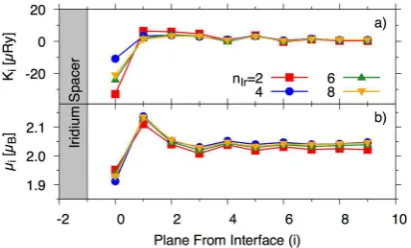
=he plane–by–plane anisotropy constants are shown in Fig. 2a), shown as a function of distance from the Ir interface for nIr= 2, 4, 6 and 8 (red square, blue circle, green upwards triangles and gold downwards triangles respectively). For full details of the method used to calculate the anisotropy see the methods section and refer-ences therein.
he anisotropy at the interface is strongly negative (preferentially in–plane) as compared to the bulk value. Ater the irst Fe from the interface, the anisotropy remains positive and shows only a weak variation with dis-tance. he interface anisotropy is almost an order of magnitude larger than in the bulk. he MMs are also shown in Fig. 2b) and display a similarly strong variation with distance from the interface, though the relative change with nIr is smaller. here is an immediate reduction of around 0.1 µB (compared to bulk) in the atomic magnetic moment within the irst Fe atomic plane and an increase in the second followed by small oscillations that quickly become bulk-like from the third plane. he hybridization between Fe and Ir d states will promote the rearrange-ment of the up/down Ir states by means of charge transfer between them leading to the population of iron minor-ity states at the interface, and consequently, a reduction of their MMs. his Fe–d hybridization tends to stabilize ater the third Fe plane, meaning that the Ir inluence on Fe is mainly up to two unit cells towards the Fe bulk.
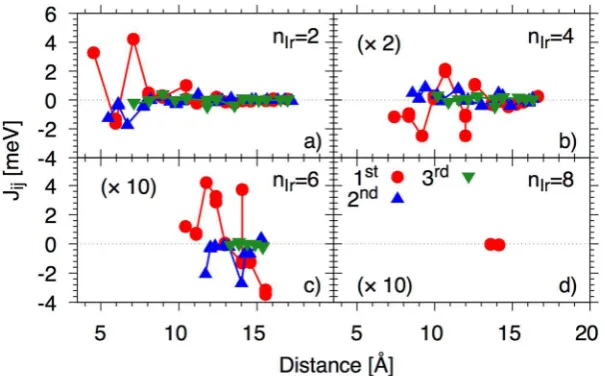
he tensorial exchange interactions are calculated within the SKKR code in the spirit of Liechtenstein34 (see methods). Due to the lack of translational invariance in the direction perpendicular to the plane, each plane of Fe interacts diferently with the other planes (both towards and away from the interface). he focus of the present work is on the efects of the Ir thickness and how the exchange interactions govern the ground state and thermal properties of the system. Figure 3 therefore shows the isotropic part of the exchange interactions between one Fe magnetic moment located at the interface with Ir and the Fe spins at the other side of the interface for each Ir thickness (nIr).
Panels a–d of Fig. 3 show the exchange across the interface of thickness 2, 4, 6 and 8 planes of Ir respectively, with the nearest (1st, red circles), second nearest (2nd, blue upwards triangles) and third nearest (3rd, green downwards triangles) planes. For nIr= 2, the interaction with the nearest plane is dominated by irst and third Figure 1. Out–of–plane distances between diferent Ir planes for … Fe/nIrIr/Fe … [nIr= 2, 4, 6, 8] geometries. he center of each coniguration has been shited to the vertical dashed line that represents the central out–of– plane distance for any coniguration. he x-axis values depict each Ir layer pair, i and i± 1.
Figure 2. (a) Plane–by–plane irst order uniaxial anisotropy constant, Ki and (b) magnetic moments, as a
[image:4.595.158.360.46.196.2] [image:4.595.155.361.266.390.2]nearest neighbour ferromagnetic interactions and shows a highly oscillatory behaviour consistent with an RKKY interaction mediated by the conduction electrons. he exchange quickly decays beyond 10 Å and there is a rather small interaction in the third plane. Interaction with the second plane remains negative, though small.
For nIr= 4, the interaction with the nearest plane is mostly antiferromagnetic, though this also oscillates in a similar way as for nIr= 2, though the magnitude is much smaller and the total number of neighbours should also be taken into consideration when considering the inal ground state spin structure. For nIr= 6 the value of the exchange is greatly reduced but is dominated by ferromagnetic interactions and for nIr= 8, the two layers are almost decoupled. It should be noted that in the nIr= 2, 4 and 6 cases there is a competition between the ferro-magnetic and antiferroferro-magnetic contributions at diferent distances, thus we expect (and indeed observe) the interface to be somewhat frustrated.
It should also be noted that the ground state will be determined by, not only the size and sign of the exchange at the interface spin moment with the layers at the opposite side, but by all of the exchange interactions across the interface and the total number of neighbours should also be taken into consideration. However, the data presented in Fig. 3 will be used to interpret the results of the spin dynamics calculations shown in the following section. It is also important to note that in the spin dynamics model (see proceeding section) we do not account for the Ir atoms. his is justiied if we consider; (i) the largest Ir moment at the interface (with the largest induced moment) was 0.081 µB for nIr= 4 (similar values for 6 and 8) and the lowest value was 0.039 µB for nIr= 2; and (ii) the Fe/Ir exchange was signiicantly smaller than the bulk (less than 1% taking the nearest out-of-plane distance) as shown on Fig. 4.
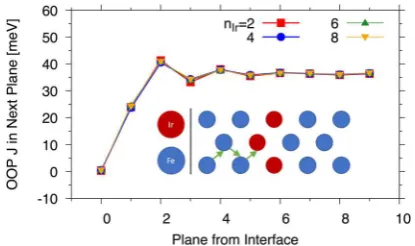
Figure 4 shows the nearest neighbour out-of-plane exchange on the Fe sites as a function of distance from the interface. he exchange that is plotted is shown on the inset schematic. As compared to the exchange across the interface (see Fig. 3), for example for nIr= 6, the Fe-Ir exchange at the interface is around 15–20% that of the Fe-Fe exchange across the interface. he Ir would therefore have a very small efect on the thermodynamic quantities in the spin model. Overall, the Fe-Ir exchange is much smaller than that of the Fe-Fe interactions and this, combined with the very small induced moment of Ir, lead us to neglect the Fe-Ir interactions. Furthermore, the induced moment of the Ir is not trivially described within the atomistic spin dynamics formalism and would require a more advanced theoretical construct.
All of the quantities presented until now are calculated without the presence of thermal luctuations. In the proceeding section we outline a spin dynamics model based on the Heisenberg Hamiltonian. his thermody-namic model takes, as input, the quantities calculated using ab-initio calculations and introduces thermal luctu-ations to determine the temperature dependence of the magnetic properties.
Equilibrium Thermodynamic Properties
he equilibrium thermodynamic properties (and the dynamic properties in the proceeding section) make use of a spin model with the energetics based on the calculated Heisenberg Hamiltonian. he time-resolved dynamics are found by solving the Landau-Lifshitz-Gilbert (LLG) equation, which allows one to include on-site parameters, such as, anisotropy (Ki), thermal bath coupling (λi), gyromagnetic ratio (γi) and exchange (ij), making the
approach ideal to look at inite temperature properties of the Fe/Ir/Fe system. Furthermore, it is possible to deter-mine layer-by-layer thermodynamic properties. We should point out here that we do not simulate the Ir magnetic moments which only appear due to the Weiss ield from the Fe, however the efect of the presence of the Ir inter-face is represented in the Hamiltonian for each of the Fe planes. Full details of the spin dynamics model can be found in the methods section. In Fig. 5 we present numerically determined magnetization curves for two thick-nesses of Ir; nIr= 2 and 8 planes.
[image:5.595.155.458.45.233.2]he data shown in Fig. 5 is for the two Fe planes nearest to (Int and Int-1) the interface with Ir and one in the centre of the Iron layer (bulk-like). We take the critical damping regime (λi= 1.0) which is the spin dynamics
analogy of quenched molecular dynamics and equilibrate the magnetization for 20 ps followed by a further (max-imum) of 30 ps whereby the average of the magnetization is taken, unless convergence in both the mean and variance of the reduced magnetization of each plane reached 10−6 and 10−7 respectively. For n
Ir= 2, 4, 6 and 8 the magnetization curves are similar with similar phase transition (Curie) temperatures. he interface layer shows a largely reduced magnetization over the bulk planes due mostly to “loss” of exchange because of the presence of Ir. In all four cases the phase transition temperature is dominated, as expected, by the bulk exchange interactions, though there is a slight reduction in the magnetization (diference between dashed and solid lines in Fig. 5 of the same colour) for a given plane. he exchange does, however, modify the ground state. For each value of nIr we have calculated a ferromagnetic () and an antiferromagnetic () alignment to check for the stability as a func-tion of temperature (see example spin conigurafunc-tions in Fig. 6).
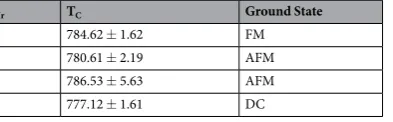
As shown for nIr= 2 and 4 in Fig. 6, modifying the size of the Ir spacer modiies the efective exchange inter-action across the interface. For nIr= 2 and 4 the ground state was found to be FM and AFM respectively, whereas for nIr= 6 the case was again FM. For nIr= 8 (beyond 2 nm) the separation between the Fe atoms at either side of the interface was so large that the two sides of the interface were essentially exchange decoupled, though the long-range dipole-dipole interaction would still lead to some coupling. Whilst we predicted from Fig. 2 that the ground state for nIr= 2 and 4 would be FM and AFM respectively, the competition of exchange interactions leads to some frustration and a reduced magnetization as we saw in Fig. 5, thus it is not trivial to predict the ground state as it is the result of the exchange interactions at either side of the interface (including taking into account the total number of neighbours at a given distance). Table 1 shows the Curie temperature dependence on the Ir thickness as well as the ground state coniguration, which can be either ferromagnetic (FM), antiferromagnetic (AFM) or decoupled (DC).
Table 1 shows that, as a function of nIr, the Curie temperature does not vary much within the itting error. However, by varying the thickness, the ground state coniguration changes from FM to AFM and then to a decou-pled state due to the low exchange in the nIr= 8 case.
In Ref.25 the spinwave modes in an Fe/Ir/substrate system were measured experimentally (acoustic branch only) and theoretically. heoretical modeling predicted that the modes at the interface are localized at this inter-face, which manifests as a higher spinwave intensity in the spectral function of the transverse susceptibility for the interface Fe. In Fig. 7 we show the spinwave modes for Fe bulk (let) and for Fe at the Ir interface in the case of nIr= 2 (right). he path is presented in the 2D Brillouin zone and is calculated for 10 planes of Fe at either side of the interface, though we present here just two of those planes. For an interface, one expects as many branches as there are atoms, however, as the atoms at either side of the interface are equivalent there is a degeneracy for each branch except at Γ where a splitting is seen.
he modes for nIr show a similar localisation of the lowest energy mode at the interface close to Γ. Furthermore, the higher energy optical modes are less localised for the interface layers (right) as demonstrated by the lack of contrast, consistent with Ref.25. For the curves in Fig. 7 we normalise the amplitude at each k-point so that the branch with the highest amplitude has a value of 1 allowing us to compare the relative amplitudes for a given k.
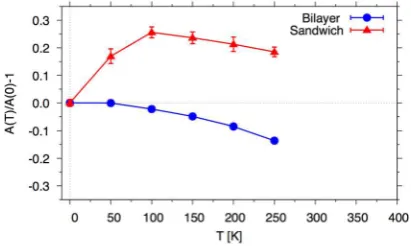
he spinwave dispersion for the other Ir thicknesses are quite similar (not shown) in their structure. However, for the other thicker Ir sandwich structures the splitting that occurs towards the Γ point does not occur (or we do not have the resolution to resolve it) due to the rather weak coupling across the interface, meaning that they almost act as individual interfaces (rather than sandwiches) in terms of the spinwave properties in the plane. Whilst these low temperature calculations reveal the complex behaviour of the spinwave dispersion, the more experimentally accessible quantity is the exchange stifness, A, which is usually found by itting the spinwave dispersion to ω=Ak2 at low-k, requiring, for example, neutron scattering measurements. he stifness can also be found using Bloch’s law from the equilibrium magnetization curve35 or using ferromagnetic resonance exper-iments35, though both of these measure very long wavelength efects close to Γ. Due to increasing spin disorder due to thermal luctuations, the exchange stifness generally decreases with temperature (it becomes easier to induce twists in the magnetic structure).
[image:6.595.153.361.45.168.2]We have analysed the spinwave data from the spin dynamics calculations by itting the lowest branch to the function, ω=Ak2 up to ka= 1.2 (note that this is the in-plane stifness constant only). In Fig. 8 we show the change in the stifness compared to the value at 0 K (i.e. the relative change), A(T)/A(0) − 1, as a function of temperature.
he data in Fig. 8 is presented for nIr= 2 and interestingly, as a function of temperature, there is an initial increase in the exchange stifness (red triangle points in Fig. 8). his increase, we believe, arises from the frustra-tion at the interface which decreases with increasing thermal energy and leads to an increased relative alignment in the planes. his increased alignment means that it is more diicult to induce long-range variations in the magnetic order resulting in an increased in-plane stifness. Ater around 100 K the thermal luctuations become dominant and the normal decrease in the stifness is seen. To verify that the presence of the interface is resulting in an increased stifness we performed the same calculations but only including one side of our sandwich to make an Fe/Ir bi-layer. We note that we did not repeat the electronic structure calculations meaning that it is more of a computational thought experiment. Indeed, in this case we observe an increase in the stifness for all tempera-tures (blue circle points in Fig. 8) demonstrating the importance of the interface.
Figure 5. Layer-wise temperature dependent magnetization as a function of temperature. he interface magnetization (Int) has a largely reduced magnetization as compared with the centre of the Iron layer (Bulk). he second plane from the interface (Int-1) recovers its magnetization rather rapidly as the number of missing exchange interactions are reduced.
Figure 6. Spin conigurations for nIr= 2 and 4 layers, depicted by the grey cuboid boxes between the Fe spins represented by coloured cones. For nIr= 2 (let) the two sides of the interface are aligned (FM) and for nIr= 4 (right) the two sides are overall antiferromagnetically coupled.
nIr TC Ground State
2 784.62 ± 1.62 FM
4 780.61 ± 2.19 AFM
6 786.53 ± 5.63 AFM
8 777.12 ± 1.61 DC
[image:7.595.156.358.45.169.2] [image:7.595.159.551.249.412.2] [image:7.595.164.361.478.539.2]Dynamic Properties
So far we have presented purely static/equilibrium irst principles and thermodynamic results. In the inal part of this article we present layer resolved dynamics of our interface system ater excitation with short laser pulses. It has been previously shown36 that the time-scale of the dynamics of magnetic materials ater short laser pulses are governed primarily by a combination of the magnetic moment and the exchange interaction, τ∼µ/J. In Ref.36, a
systematic study of a range of samples of diferent magnetic ordering (ferromagnetic and ferrimagnetic), and alloyed with diferent elements showed a linear scaling of the demagnetization time with magnetic moment. As we saw in Fig. 2, there is a reduction of the Fe magnetic moment directly at the interface and a slight increase in the next layer before becoming bulk-like. he variation in the magnetic moment is rather small but a reduction in the moment should see a slight decrease in the relaxation time. On the other hand, there is a reduction in the exchange interaction at the interface which would see an increase in the relaxation time. Here we focus on the nIr= 2 system. We assume that the value of the coupling constant, λi, is the same for each plane so as to compare
the efects of the exchange and the magnetic moment.
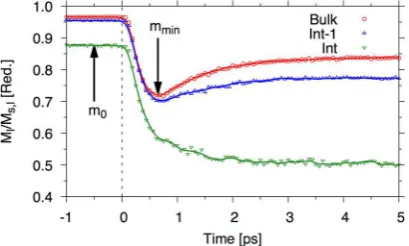
To model the heating efect we take a simple two-temperature model which allows us to deine an electron and a phonon temperature which is required for the correlator (see methods). Transient changes in the electronic temperature due to a laser pulse give rise to increasing thermal luctuations in the spin system. Our focus here is on the diference between the relaxation times at diferent sites from the interface. Figure 9 shows an example of the magnetization dynamics for the bulk, interface (Int) and plane next to the interface (Int-1) for a moderate pump luence corresponding to a temperature increase of around 250 K.
As we see from Fig. 9 the dynamics of the diferent layers are quite diferent. In the bulk, the magnetization initially demagnetises and then begins to recover. For the interface layer the magnetization shows the same initial rapid drop but then continues to decrease at a slower rate and never recovers. To determine the relaxation time we normalise the data for each layer (l) by = −
−
m tnl( ) m t m m m
( )
l minl l
min l 0
, so that the initial mn
l value is 1 and decreases to zero at
the point where the magnetization is at a minimum. We then it a single exponential to the data and extract the characteristic demagnetization time associated with the initial part of the demagnetization. his method allows us to consistently deine a demagnetization time independently of what the form of the magnetization curve is. Figure 7. Layer resolved spinwave dispersion (in-plane) along the pseudo-cubic path Γ →X →M → Γ. Let is for a bulk layer and the right is for the Fe at the interface with Ir. he lowest energy mode is much more localised in the interface Fe.
[image:8.595.153.475.47.183.2] [image:8.595.154.360.266.389.2]In Fig. 10 we present demagnetization rates and the minimum magnetization (note mmin=M /M l
min l
s l,, where Ms,l is the saturation magnetization of that layer, l) ater the action of a 50 fs heat pulse starting at 82 K, as a
func-tion of the inal temperature ater the laser, Tinal.
As we see from Fig. 10a) the interface demagnetises at a much slower rate than the other planes. Interestingly, the relaxation time actually reaches a maximum value at around Tinal= 700 K. What is clear from the demagneti-sation times is that the exchange contribution is much larger than that of the magnetic moment. he minimum in the magnetization is taken up to a maximum of 25 ps ater the pulse. For the interface plane, as expected, is much lower than that of the bulk values (see panel b). For high temperatures (pump luence) the magnetisation does not quite reach zero ater 25 ps due to critical slowing down.
Discussion
We have applied a hierarchical multiscale procedure to model the electronic, structural and magnetic properties of Fe/Ir/Fe sandwiches. SKKR calculations revealed the plane-by-plane magnet moments, anisotropies and exchange interactions that govern the ground state magnetic coniguration. Spin dynamics simulations show that the ground state changes from FM to AFM and inally a decoupled state as the thickness of Ir is increased with a frustration efect present at the interface, which manifests as a reduced magnetisation in the interface Fe planes (and also due to the reduced exchange interaction due to the presence of the interface). he spinwave dispersion is in good agreement with previous measurements. Our theoretical calculations of an embedded interface, how-ever show a splitting of the frequencies approaching the Γ point for the strongly coupled nIr= 2 case, disappearing as the Ir spacer increases in thickness.
Our temperature-dependent spinwave calculations show that the presence of the interface can lead to an ini-tially counter-intuitive increase in the in-plane spinwave stifness with temperature. Generally, in bulk materials, the increasing thermal luctuations leads to a reduction in the spinwave stifness as there is an efective reduction in the exchange due to thermal luctuations meaning that the system can “twist” more readily (become more non-collinear). For the interface system presented here, we ascribe the initial increase with temperature to a decrease in frustration which leads to a more collinear state. his could be used to engineer the stifness of sys-tems for magnonics applications or skyrmion based spintronics.
Finally, we investigated the laser-induced demagnetisation process on a plane-by-plane basis. he demagnet-ization times, which are not measurable experimentally, show a strong diference at the interface, compared with the bulk, and show that the exchange dominates the dynamics in this region. he variation in magnetic moment as a function of distance from the interface is rather small and does not play a large role in the variation in demag-netisation times. In this type of spin model, the thermal bath coupling can also afect the demagdemag-netisation times. his coupling is a phenomenological parameter that attempts to describe the transfer of angular momentum from the magnetic moments to the electronic and phononic degrees of freedom, and could be rather diferent for each plane. Whilst there are experimental measurements available to measure time, element and spatially resolved dynamics, the resolution is oten limited and obtaining information on a plane-by-plane basis with this level of detail is not yet available. herefore our results will be useful to interpret and understand the ine details of exper-iments coming from ultrafast demagnetisation experexper-iments on layered structures.
Methods
Structural Relaxation with SIESTA
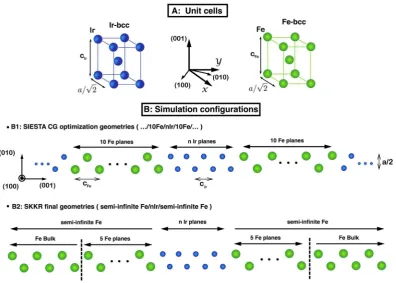
Structural relaxation of each of the Fe/Ir/Fe systems was carried out by means of fully ionic conjugate gradient relaxation at the scalar–relativistic level using the SIESTA DFT package31. We used the local spin density approximation (LSDA) as the exchange correlation potential based on Ceperley and Alder’s parametrization37. As a basis set, we have employed double-ζ polarized (DZP) strictly localized numerical atomic orbitals. [image:9.595.156.361.47.170.2]we carry out the optimization process for each Ir thickness as shown schematically in Fig. 11–B1 for 8 Ir planes. Each supercell contains 20 Fe planes plus nIr plus 20 Fe planes and repeated periodically along Z coordinate. Ater the relaxation, the forces per atom were less than 0.02 eV/Å and the energy tolerance on each self–consistent cycle was less than 10−4 eV. he mesh cut-of to calculate the real space integrals was 700 Ry and 12 × 12 × 10 k-points were used. It is worth mentioning that during the optimization process, the atomic out–of–plane Ir distances close to the interface had tiny asymmetries of at most ±0.005 Å. his could be due to the uneven character of our conigurations that are are not completely symmetric in the simulation unit cell since as is shown in Fig. 11–B1 where perfect mirror symmetry with respect to the xy plane (center of the sandwich) is missing. In order to avoid these small deviations in any of the calculated magnetic properties we decided to mirror the let out–of–plane distances with respect to the center of the Ir slice, the results of which are shown in Fig. 1.
Calculations of Magnetic Properties with SKKR
The fully relativistic screened Korringa–Kohn– [image:10.595.154.359.45.197.2]Rostoker32 (SKKR) code was used to calculate the tensorial exchange interactions as well as layer resolved MMs and anisotropies of the relaxed Fe/nIr Ir/Fe structures. he LSDA exchange and correlation potential37 Figure 10. Demagetisation times (a) and minimum magnetisation (b) as a function of temperature ater a 50 fs laser pulse for atoms at (Int) and one plane away from (Int-1) the Ir interface and bulk planes.
[image:10.595.157.554.251.534.2]was employed in the SKKR calculations making use of the atomic sphere approximation39. As a first step, self-consistent calculations were performed to converge the potentials which were performed in the fully rel-ativistic mode, solving the full Dirac equation with angular momentum cutof lmax= 2, which incorporates the d-electrons and we ind that this gives good convergence of the exchange parameters (diagonal and of-diagonal) for Fe based systems, though for other properties (e.g. transport properties) this may not be the case. A semi-circular contour with 16 energy points was used for the energy integration and 1680 k-points were used for the self-consistent cycles with a progressive increase above this value used for the calculation of the exchange. he self–consistent calculations were converged to within an energy tolerance of 10−8 Ry. We note that this set of parameters corresponds to well converged magnetic model parameters.
In order to investigate the magnetic properties of the Fe/nIrIr/Fe system at inite temperatures, we use a map-ping of the energy of the itinerant electron system onto a classical spin Hamiltonian of Heisenberg form truncated to bilinear term. Writing the spin-spin interactions up to bilinear terms, the Hamiltonian can be written:
∑
∑
∑µ
= − K( )S − 1 S S − ⋅B
2 (2)
i i
ij i ij j
i i
H J
where the irst term is the on-site anisotropy energy and the second term is the exchange, with ij being 3 × 3 matrices, and the inal term is the Zeeman energy due to the applied magnetic ield, B.
For the calculation of the magnetic anisotropy energy we used the magnetic force theorem, where the total energy of the system can be replaced by the single–particle (band) energy. Employing the torque method40, in leading (second) order of the spin-orbit coupling, the uniaxial magneto-crystalline anisotropy constant, K, can be calculated as (see Ref.33):
K E E dE
d
( 90 ) ( 0 )
(3)
45
θ θ
θ = = − = = |θ=
where θ is the angle of the magnetization direction with respect to the [001] direction (i.e. perpendicular to the interface). Within the SKKR formalism, K can be decomposed into site–resolved contributions, Ki:
∑
= K K (4) i iFull details on the torque method can be found in Ref.41. he plane–by–plane anisotropy constants are shown in Fig. 2a), shown as a function of distance from the Ir interface for nIr= 2, 4, 6 and 8 (red square, blue circle, green upwards triangles and gold downwards triangles respectively).
he ij matrices are less straightforward to calculate. he exchange tensor can be divided into three terms42:
=J ⋅ + + ⋅ × .
Si ij jS ij iS Sj Si ijSSj Dij (Si Sj) (5)
Here the irst and second terms on the right hand side are the isotropic and symmetric anisotropic exchange interactions, respectively and the third term is the Dzyaloshinsky-Moriya (DM) interaction43,44, where the D
ij are
deined as:
D 1 J J D J J D J J
2( ),
1
2( ),
1
2( ) (6)
ijx= ijyz− ijzy ijy= ijzx − ijxz ijz= ijxy− ijyx
he components of the exchange tensor, ij can be conveniently found by taking second derivatives of the Hamiltonian with respect to polar and azimuthal angles of the spins:
H
J J
∑
α β δ δ δ
∂
∂ ∂ = + + −
αβ αβ α β
≠
K ( )S S S (1 )S S
(7) i k
ik i ik
j i
i ij j ik i ik k
2
( )
where α or β can be either θ or φ (polar and azimuthal angles respectively) and
α β α α β
= ∂ ∂ ∂ = ∂ ∂ = ∂ ∂ ∂
αβ α αβ
K ( )S K( )S , S S , S S
(8) i i i i i i i i i i i 2 2
As was shown in Ref.42, the full exchange matrix and anisotropy contributions can be obtained by taking combinations of the derivatives of the Hamiltonian with respect to the angles and constraining the magnetization along diferent reference orientations, which are calculated (in the spirit of Lichtenstein34) through integration over the scattering path operators to the Fermi energy (see Ref.42 for full details). he full exchange tensor was calculated up to a maximum number of 4.5 times the in-plane lattice constant for all the nIr thicknesses.
Atomistic Spin Dynamics
For the spin dynamics we use a model based on the LLG equation for each spin,i, which can be written as45:
γ
λ µ λ
= − +
× + ×
S S H S H
(1 ) [ ] (9)
i i
i s i
i eff i i i eff i
2 ,
, ,
where γi, λi and µs,i are the gyromagnetic ratio, thermal bath coupling constant and the magnetic moment (at site
he LLG equation allows one to include on-site parameters, such as, anisotropy (Ki), thermal bath coupling
(λi), gyromagnetic ratio (γi) and exchange (ij), making the approach ideal for investigating inite temperature
properties of the Fe/Ir/Fe system. Furthermore, it is possible to determine layer-by-layer thermodynamic proper-ties. We should point out here that we do not simulate the Ir magnetic moments which only appear due to the Weiss ield from the Fe (see discussion in main text). Our simulations use the whole exchange tensor (more than 1000 neighbours per spin). In systems with translational invariance the exchange ield can be conveniently calcu-lated using fast Fourier transforms and taking advantage of the convolution theorem. However, here due to the lack of this translational invariance (at least for out of plane interactions), no such method can be applied. We use graphical processing units (GPUs) to accelerate the calculations, however, they still remain computationally rather expensive. We simulate 48 × 48 × 1 repetitions of our SKKR supercell (with 10 Fe planes at either side of the interface). We use the Heun numerical scheme to integrate the LLG equation of motion and use a time-step of 0.1 fs to ensure numerical stability.
Fitting Procedure to Determine the Curie Temperature
To calculate the Curie temperatures we used a itting procedure, itting to the equilibrium magnetization of the bulk planes to the expansion52:∑
= − + − =M T a T T
T a T T T ( ) (12) p p p 0 C C 1 8 C C
Spinwave Calculatons
he spinwave dispersion, using the spin dynamics code, can be calculated by calcu-lating the dynamic structure factor53:S ω
∑
∫
π
= ω − ′
′ ⋅ − ′
∞
+∞ −
N e e C t dt
k r r
( , ) 1
2 ( , ) (13)
i i t
r r k r r
,
( )
where C(r − r′, t) =〈S+(r, 0)S−(r′, t)〉 is the spin-spin correlation function of the transverse spin values (S
y and
Sz in this case). he stochastic thermal term allows the spin system to sample all modes and the resulting spectra
are analyzed to determine the frequencies. To calculate Eq. 13, a low value of the coupling to the thermal bath was used (λi= 0.001) giving narrow line -widths for the spinwave eigenfrequencies. A high damping regime was
ini-tially used to relax the magnetization to equilibrium followed by 200 ps calculations of the time integral in Eq. 13.
Two Temperature Model of Laser Heating
To model the heating effect we take a simple two-temperature model which allows us to define an electron and a phonon temperature through the coupled equation: τ = − − + = − − − CdT
dt G T T P t
CdT
dt G T T C
T T
( ) ( )
( ) ,
(14)
e e e p
p p
e p p
p eq
p
where Ce and Cp are the electron and phonon speciic heats and Ce=γeTe. P(t) is a laser source which we assume
to be a Gaussian with a width of 50 fs. For the electron phonon coupling factor, G, we use a value of 10 × 1017 W/ m3 K54,55. γ
e takes a value of 225 Jm3 K
−1 55 and a constant lattice speciic heat, C
p= 3.1 × 10⁶. We add an extra term
that removes heat from the phonon system at a rate of τp(=1 ns) which would bring the temperature back to
equi-librium, Teq, on a longer time-scale. Our focus here is on the diference between the relaxation times at diferent
sites from the interface, rather than an accurate description of the two-temperature model56.
References
1. L’vov, V. A., Chernenko, V. A. & Barandiaran, J. M. Novel Functional Magnetic Materials, vol. 231 of Springer Series in Materials Science. https://doi.org/10.1007/978-3-319-26106-5_110.1007/978-3-319-26106-5 (Springer International Publishing, Cham, 2016). 2. Dupé, B., Bihlmayer, G., Blügel, S. & Heinze, S. Engineering skyrmions in transition-metal multilayers for spintronics. Arxiv Preprint
1503.08098, https://doi.org/10.1038/ncomms11779 (2015).
4. Ostler, T. A., Cuadrado, R., Chantrell, R. W., Rushforth, A. W. & Cavill, S. A. Strain Induced Vortex Core Switching in Planar Magnetostrictive Nanostructures. Physical Review Letters 115, 067202, https://doi.org/10.1103/PhysRevLett.115.067202 (2015). 5. Mangin, S. et al. Engineered materials for all-optical helicity-dependent magnetic switchin. g. Nature materials 13, 286–92, https://
doi.org/10.1038/nmat3864 (2014).
6. Xu, C., Ostler, T. A. & Chantrell, R. W. hermally induced magnetization switching in Gd/Fe multilayers. Physical Review B - Condensed Matter and Materials Physics 93, 054302, https://doi.org/10.1103/PhysRevB.93.054302 (2016).
7. Ostler, T. A., Barton, C., homson, T. & Hrkac, G. Modeling the thickness dependence of the magnetic phase transition temperature in thin FeRh ilms. Physical Review B 95, 064415, https://doi.org/10.1103/PhysRevB.95.064415 (2017).
8. Barton, C. W. et al. Substrate induced strain ield in ferh epilayers grown on single crystal mgo (001) substrates. Scientiic Reports 7, 44397, https://doi.org/10.1038/srep44397 (2017).
9. Mizunuma, K. et al. MgO barrier-perpendicular magnetic tunnel junctions with CoFe/Pd multilayers and ferromagnetic insertion layers. Applied Physics Letters 95, 21–24, https://doi.org/10.1063/1.3265740 (2009).
10. Park, J.-H. et al. Copt multilayer based magnetic tunnel junctions using perpendicular magnetic anisotropy. Journal of Applied Physics 103, 07A917, https://doi.org/10.1063/1.2838754 (2008).
11. Ikeda, S. et al. A perpendicular-anisotropy CoFeB-MgO magnetic tunnel junction. Nature materials 9, 721–724, https://doi. org/10.1038/nmat2804 (2010).
12. Yang, S.-W. et al. Non-volatile 180° magnetization reversal by an electric ield in multiferroic heterostructure. Advanced Materials
26, 7091–7095, https://doi.org/10.1002/adma.201402774 (2014).
13. Wang, Y., Hu, J., Lin, Y. & Nan, C.-W. Multiferroic magnetoelectric composite nanostructures. NPG Asia Materials 2, 61–68, https:// doi.org/10.1038/asiamat.2010.32 (2010).
14. Heron, J. T. et al. Deterministic switching of ferromagnetism at room temperature using an electric ield. Nature 516, 370–3, https:// doi.org/10.1038/nature14004 (2014).
15. Parkes, D. E. et al. Magnetostrictive thin films for microwave spintronics. Scientific reports 3, 2220, https://doi.org/10.1038/ srep02220 (2013).
16. Mariager, S. O. et al. Structural and Magnetic Dynamics of a Laser Induced Phase Transition in FeRh. Physical Review Letters 108, 087201, https://doi.org/10.1103/PhysRevLett.108.087201 (2012).
17. Wadley, P. et al. Tetragonal phase of epitaxial room-temperature antiferromagnet CuMnAs. Nature Communications 4, 2322, https:// doi.org/10.1038/ncomms3322 (2013).
18. Ghasemi, A. et al. Atomic-level structural and chemical analysis of Cr-doped Bi2Se3 thin ilms. Scientiic Reports 6, 26549, https:// doi.org/10.1038/srep26549 (2016).
19. Mozooni, B., von Hofe, T. & McCord, J. Picosecond wide-ield magneto-optical imaging of magnetization dynamics of amorphous ilm elements. Physical Review B 90, 054410, https://doi.org/10.1103/PhysRevB.90.054410 (2014).
20. Pinilla-Cienfuegos, E. et al. Switching the Magnetic Vortex Core in a Single Nanoparticle. ACS Nano 10, acsnano.5b06776, https:// doi.org/10.1021/acsnano.5b06776 (2016).
21. Graves, C. E. et al. Nanoscale spin reversal by non-local angular momentum transfer following ultrafast laser excitation in ferrimagnetic GdFeCo. Nature Materials 12, 293–8, https://doi.org/10.1038/nmat3597 (2013).
22. Teichmann, M., Gahl, C., Carley, R. & Weinelt, M. Transient Bandstructures in the ultrafast demagnetization of gadolinium and terbium. Physical Review B - Condensed Matter and Materials Physics 014425, 2–6, https://doi.org/10.1103/PhysRevB.91.014425 (2015).
23. Jia, C., Zhang, N., Sukhov, A. & Berakdar, J. Ultrafast transient dynamics in composite multiferroics. New Journal of Physics 18, 023002, https://doi.org/10.1088/1367-2630/18/2/023002 (2016).
24. Hashimoto, Y. et al. Ultrafast resolved magneto-optical imaging of all-optical switching in GdFeCo with femtosecond time-resolution and a µm spatial-resolution. Review of Scientiic Instruments 85, 063702, https://doi.org/10.1063/1.4880015 (2014). 25. Zakeri, K. et al. Direct probing of the exchange interaction at buried interfaces. Nature Nanotechnology 8, 853–858, https://doi.
org/10.1038/nnano.2013.188 (2013).
26. El Hadri, M. S. et al. Two types of all-optical magnetization switching mechanisms using femtosecond laser pulses. Phys. Rev. B 94, 064412, https://doi.org/10.1103/PhysRevB.94.064412 (2016).
27. Lambert, C.-H. et al. All-optical control of ferromagnetic thin films and nanostructures. Science, https://doi.org/10.1126/ science.1253493 (2014).
28. Hohenberg, P. & Kohn, W. Inhomogeneous Electron Gas. Phys. Rev. 136, B864–B871, https://doi.org/10.1103/PhysRev.136.B864 (1964).
29. Jones, R. O. Density functional theory: Its origins, rise to prominence, and future. Rev. Mod. Phys. 87, 897–923, https://doi. org/10.1103/RevModPhys.87.897 (2015).
30. Marques, M. A. L., Ullrich, C. A., Nogueira, F., K., Rubio, A. & Gross, E. K. U. Time-Dependent Density Functional heory, vol. 706 (11) of Lecture Notes in Physics, https://doi.org/10.1007/b11767107 (Springer Berlin Heidelberg, Berlin, Heidelberg, 2006). 31. Soler, J. M. et al. he SIESTA method for ab initio order-N materials simulation. Journal of Physics: Condensed Matter 14, 2745–2779,
https://doi.org/10.1088/0953-8984/14/11/302 (2002).
32. Zabloudil, J., Hammerling, R., Szunyogh, L. & Weinberger, P. Electron Scattering in Solid Matter (Springer, Berlin, 2005). 33. Aas, C. J. et al. Exchange coupling and magnetic anisotropy at Fe/FePt interfaces. Physical Review B 88, 174409, https://doi.
org/10.1103/PhysRevB.88.174409 (2013).
34. Liechtenstein, A. I., Katsnelson, M. I. & Gubanov, V. A. Exchange interactions and spin-wave stifness in ferromagnetic metals. J. Phys. F: Metal Phys. 14, L125–L128, https://doi.org/10.1088/0305-4608/14/7/007 (1984).
35. Yin, Y. et al. Ferromagnetic and spin-wave resonance on heavy-metal-doped permalloy ilms: Temperature efects. IEEE Magnetics Letters 8, 1–4, https://doi.org/10.1109/LMAG.2016.2630663 (2017).
36. Radu, I. et al. Ultrafast and Distinct Spin Dynamics in Magnetic Alloys. SPIN 5, 1550004, https://doi.org/10.1142/ S2010324715500046 (2015).
37. Ceperley, D. M. & Alder, B. J. P. Ground state of the electron gas by a stochastic method. Physical Review Letters 45, 566 (1980). 38. Ph. Bauer, O. L., Andrieu, S. & Piecuch, M. Local magnetism of Fe in Felr(100) superlattices studied by 57Fe Mössbauer spectrometry.
Journal of Magnetism and Magnetic Materials 165, 220–223, https://doi.org/10.1016/S0304-8853(96)00514-8 (1997).
39. Skriver, H. L. he Atomic-Sphere Approximation (ASA), 82–99, https://doi.org/10.1007/978-3-642-81844-8_6 (Springer Berlin Heidelberg, Berlin, Heidelberg, 1984).
40. Wang, X., Wu, R., Wang, D.-s & Freeman, A. J. Torque method for the theoretical determination of magnetocrystalline anisotropy. Physical Review B 54, 61–64, https://doi.org/10.1103/PhysRevB.54.61 (1996).
41. Staunton, J. B. et al. Temperature dependence of magnetic anisotropy: An ab initio approach. Physical Review B 74, 144411, https:// doi.org/10.1103/PhysRevB.74.144411 (2006).
42. Udvardi, L., Szunyogh, L., Palotás, K. & Weinberger, P. First-principles relativistic study of spin waves in thin magnetic ilms. Physical Review B 68, 104436, https://doi.org/10.1103/PhysRevB.68.104436 (2003).
43. Moriya, T. Anisotropic Superexchange Interaction and Weak Ferromagnetism. Physical Review 120, 91–98, https://doi.org/10.1103/ PhysRev.120.91 (1960).
temperature dependence of spinwave stifness. Submitted (2017).
54. Carpene, E. et al. Dynamics of electron-magnon interaction and ultrafast demagnetization in thin iron ilms. Physical Review B 78, 174422, https://doi.org/10.1103/PhysRevB.78.174422 (2008).
55. Atxitia, U., Ostler, T. A., Chantrell, R. W. & Chubykalo-Fesenko, O. Optimal electron, phonon, and magnetic characteristics for low energy thermally induced magnetization switching. Applied Physics Letters 107, 192402, https://doi.org/10.1063/1.4935416 (2015). 56. Waldecker, L., Bertoni, R., Ernstorfer, R. & Vorberger, J. Electron-Phonon Coupling and Energy Flow in a Simple Metal beyond the
Two-Temperature Approximation. Physical Review X 6, 021003, https://doi.org/10.1103/PhysRevX.6.021003 (2016).
Acknowledgements
Gino Hrkac (GH) acknowledges support from the Vienna Science and Technology Fund (WWTF) under Grant No. MA14-44, through the EPSRC Grant No. EP/K008412/1, and from the Royal Society under Grant No. UF080837. homas A Ostler (TAO) gratefully acknowledges the support of the Marie Curie incoming BeIPD-COFUND fellowship program at the University of Liège. Ramon Cuadrado (RC) acknowledges the funding from the European Union’s Horizon 2020 research and innovation programme under the Marie Sklodoswa-Curie grant agreement No. 665919. ICN2 is supported by the Severo Ochoa program from Spanish MINECO (Grant No. SEV-2013-0295). László Oroszlány (LO) and László Szunyogh (LS) are grateful for the support by the Hungarian National Scientiic Research Fund (NKFIH) under project Nos. K115575, K108676, K115608 and FK124723. L. O. also acknowledges support from the Janos Bolyai Scholarship of the Hungarian Academy of Sciences as well as the National Quantum Technologies Program 2017-1.2.1-NKP-2017-00001 of the NRDI Oice of Hungary. his project has received funding from the European Union’s Horizon 2020 research and innovation programme under grant agreement No 737093, FEMTOTERABYTE as well as the inancial support of the Advanced Storage Technology Consortium and Seagate Technology.
Author Contributions
T.A.O. and R.C. conceived the project, T.A.O., G.H. and R.W.C. performed the atomistic spin dynamics calculations. R.C. performed the structural optimisation of the geometries with SIESTA. R.C., L.O. and L.S. performed the SKKR calculations. All authors contributed to the writing of the manuscript.
Additional Information
Competing Interests: he authors declare no competing interests.
Publisher's note: Springer Nature remains neutral with regard to jurisdictional claims in published maps and institutional ailiations.
Open Access This article is licensed under a Creative Commons Attribution 4.0 International License, which permits use, sharing, adaptation, distribution and reproduction in any medium or format, as long as you give appropriate credit to the original author(s) and the source, provide a link to the Cre-ative Commons license, and indicate if changes were made. he images or other third party material in this article are included in the article’s Creative Commons license, unless indicated otherwise in a credit line to the material. If material is not included in the article’s Creative Commons license and your intended use is not per-mitted by statutory regulation or exceeds the perper-mitted use, you will need to obtain permission directly from the copyright holder. To view a copy of this license, visit http://creativecommons.org/licenses/by/4.0/.