CHARACTERIZATION OF FUEL ADDITIVE FOR FUEL SAVING AND INJECTOR OPTIMIZATION
MUHAMMAD HAZIM BIN MOHD YUNUS
CHARACTERIZATION OF FUEL ADDITIVE FOR FUEL SAVING AND INJECTOR OPTIMIZATION
MUHAMMAD HAZIM BIN MOHD YUNUS
This report is submitted
in fulfillment of the requirement for the degree of Bachelor of Mechanical Engineering (Automotive)
Faculty of Mechanical Engineering
UNIVERSITI TEKNIKAL MALAYSIA MELAKA
ii
DECLARATION
I declare that this project report entitled “Characterization of Fuel Additive For Fuel Saving And Injector Optimization” is the result of my own work except as cited in the references.
Signature : ...
iii APPROVAL
I hereby declare that I have read this project report and in my opinion this report is sufficient in terms of scope and quality for the award of the degree of Bachelor of Mechanical Engineering (Automotive).
Signature : ...
Name of Supervisor : PROF. MADYA DR. NOREFFENDY BIN TAMALDIN
iv
DEDICATION
v
ACKNOWLEDGEMENT
I would like to express my deepest appreciation to my supervisor Prof. Madya Dr. Noreffendy Bin Tamaldin for giving me this opportunity to do final year project with him. He never hesitated to give me advice and guidance whenever I have problems when doing this project. I am very thankful for his patience and advice while leading me to complete this project.
Secondly, I would like to thank all the senior named Aizzuddin, Lee, Ain and Humairah for spending their time to guide me along this project. They also share their knowledge in the automotive field and guide me to handle experiment and writing the report. Also, I would like to thank laboratory assistant, En. Izwan and Pn. Rusni for their kindness and help me a lot when handling the experiment and show me the proper ways to use laboratory equipment.
vi
ABSTRACT
vii
ABSTRAK
viii CONTENT
CHAPTER CONTENT PAGE
DECLARATION ii
APPROVAL iii
DEDICATION iv
ACKNOWLEDGEMENT v
ABSTRACT vi
ABSTRAK vii
TABLE OF CONTENT viii
LIST OF FIGURES xi
LIST OF TABLES xiii
LIST OF SYMBOLS xiv
CHAPTER 1 INTRODUCTION 1
1.1 Background 1
1.2 Problem Statement 2
1.3 Objective 4
1.4 Scope of Project 4
CHAPTER 2 LITERATURE REVIEW 5
2.1 Introduction 5
2.2 Fuel Additives 5
ix
2.3.4 High Performance Petrol (HPP) 8 2.4 Spray Characteristics 9 2.5 Internal Combustion Engine 11
2.6 Engine Parameter 13
2.6.1 Power 13
2.6.2 Torque 13
2.6.3 Brake Specific Fuel Consumption (BSFC)
14
2.7 Types of Emission 14
2.7.1 Hydrocarbon (HC) 14 2.7.2 Carbon Monoxide (CO) 15 2.7.3 Nitrogen Oxides (NOx) 15
CHAPTER 3 METHODOLOGY 16
3.1 Introduction 16
3.2 Project Flow Chart 17
3.3 Experimental Method 18
3.3.1 Properties of Fuel Additives 18
3.3.1.1 Hydrometer 18
3.3.1.2 Working Principle for Hydrometer 19 3.3.1.3 Oxygen Bomb Calorimeter 20 3.3.1.4 Working Principle for Oxygen
Bomb Calorimeter
21
3.3.2 Engine Performance Testing 23 3.3.2.1 Engine Dynamometer 23 3.3.2.2 Working Principle for Engine
Dynamometer
24
3.3.3 Emission Testing 27
3.3.3.1 Automobile Gas Analyzer 27 3.3.4 Test Matrix for Engine Performance and
Emission Test
x
CHAPTER 4 RESULTS AND ANALYSIS 31
4.1 Introduction 31
4.2 Hydrometer Test 32
4.2.1 Density Results 32 4.3 Analysis of Hydrometer Result 32 4.4 Oxygen Bomb Calorimeter Test 33 4.4.1 Energy Content Results 33 4.5 Analysis of Energy Content Result 34 4.6 Engine Performance Testing Result 34 4.6.1 Power and Torque Results 35 4.6.2 Brake Specific Fuel Consumption
(BSFC) Results
37
4.7 Analysis of Engine Performance Test 39 4.7.1 Analysis of Power 39 4.7.2 Analysis of Torque 42 4.7.3 Analysis of Brake Specific Fuel
Consumption (BSFC)
44
4.8 Emission Testing Result 47 4.8.1 Automobile Gas Analyzer Results 47 4.9 Analysis of Emission Test Results 49
CHAPTER 5 CONCLUSIONS AND RECOMMENDATION 52
5.0 Conclusion 52
5.1 Recommendation 53
REFERENCES 35
xi
LIST OF FIGURES
FIGURE TITLE PAGE
1.1 V1 Fuel Booster 3
1.2 Advertisement of V1 Fuel Booster 3
2.1 Types of Additives in Commercial Market 6
2.2 Types of spray cone angle 10
2.3 The process of four stroke cycle 12
3.1 Flow chart of methodology 17
3.2 Hydrometer 18
3.3 Parts of Hydrometer 19
3.4 Oxygen Bomb Calorimeter 20
3.5 Digital Analytical Balance 21
3.6 Sample result for bomb calorimeter 22
3.7 Engine Dynamometer 23
3.8 Control Unit of Engine Dynamometer 24
3.9 Mitsubishi Mivec 1.8 Engine 25
3.10 Fuel Tank 26
3.11 Automobile Gas Analyzer 27
xii
4.1 Graph of Power and Torque against Speed for RON 95 35 4.2 Graph of Power and Torque against Speed for RON 95 + V1
Booster
35
4.3 Graph of Power and Torque against Speed for RON 97 36 4.4 Graph of Power and Torque against Speed for RON 97 + V1
Booster
36
4.5 Graph of BSFC against Speed for RON 95 37 4.6 Graph of BSFC against Speed for RON 95 added with V1
Booster
37
4.7 Graph of BSFC against Speed for RON 97 38 4.8 Graph of BSFC against Speed for RON 97 with V1 Booster 38 4.9 Graph of Power for RON 95 and RON 95 with V1 Booster 39 4.10 Graph of Power for RON 97 and RON 97 with V1 Booster 40 4.11 Graph of Power for RON 95 and 97 before and after added
with V1 Booster
41
4.12 Graph of Torque for RON 95 and RON 95 with V1 Booster 42 4.13 Graph of Torque for RON 97 and RON 97 with V1 Booster 43 4.14 Graph of BSFC for RON 95 and RON 95 with V1 Booster 44 4.15 Graph of BSFC for RON 97 and RON 97 with V1 Booster 45 4.16 Graph of BSFC for RON 95 and 97 before and after added
with V1 Booster
46
4.17 Comparison of Hydrocarbon (HC) for two engine condition 49 4.18 Comparison of Carbon Monoxide (CO) for two engine
condition
50
4.19 Comparison of Nitrogen Oxide (NOx) for two engine condition
xiii
LIST OF TABLES
TABLES TITLE PAGE
2.1 Trace Elements in Fuel Additives 7
3.1 Engine specification 26
3.2 Automobile Exhaust Gas Analyzer Specification 28 3.3 Test Matrix for Engine Performance and Emission Testing 30 3.4 Comparison Matrix of Fuel RON with Additives 30
4.1 Results of Density 32
4.2 Result of Energy Content 33
4.3 Data Emission Test for RON 95 47
4.4 Data Emission Test for RON 95 added with V1 Booster 48
4.5 Data Emission Test for RON 97 48
xiv
LIST OF SYMBOL
Ẇ = Engine power Ẇb = Brake power
Vd = Displacement volume
n = Number of revolution per cycle
N = Number of revolution per minute(RPM) Nc = Number of cylinder
B = Bore size S = Stroke size
ṁf = Mass flow rate of fuel
ṁa = Mass flow rate of air
𝜌𝑎 = Air density evaluated at atmospheric conditions outside the engine 𝜂f = Fuel conversion efficiency
𝜂c = Combustion efficiency
Ap = Piston area
mep = Mean effective pressure bmep = Brake mean effective pressure Ūp = Piston speed
1 CHAPTER 1
INTRODUCTION
1.1 BACKGROUND
For many decades, fuel additives have played a major role in improving engine performance and quality of fuels for use in motor vehicles, transportation, aircraft and marine vessels. Fuel additives are chemical substance or preparation added to fuel, in concentrations typically less than 1%, to impart or enhance desirable properties or to suppress undesirable properties. Some examples include combustion improvers, detergents, cold flow additives and lubricity additives. The petrol fuel additives began to be commercially introduced in 1923 to provide the octane rating needed to enable vehicle designers to increase engine compression ratios to levels which gave acceptable efficiency and performance. During 1950 and 1960, the focus of additives use was changed to automotive fuel system, because the carburetor cleanliness and efficient operation became more important. In 1980s, the used of deposit control additives rapidly increase because of emissions problem cause by the deposits and to reduce deposit build-up within the engine inlet system. Since 1923 until today, different additives and additives package have been developed and produced because of the need for petrol fuel has grown, for economic as well as legislative reasons (ATC, 2013).
2
imports and give positive impact to domestic cost balance. Nowadays, modern gasoline or petrol fuels contain more olefins and aromatics. These olefins and aromatics may worsen engine cleanliness and also increase engine deposits that lead to less stable combustion. Additives are added as a means of stabilizing and improving these fuels, bringing them to the required regulated standards (B.Duboc, 2014).
Legislation has been a major influence on the additives market in the past few years. Because of climate change and air quality have become the serious issue, there are many countries focusing on reducing emission and improving air quality. The government released the requirements to limit the emissions of carbon monoxide (CO), nitrous oxides (NOx) and encourage the use of additives in diesel and petrol fuel. The
United States was the first country to mandate the use of deposit control in its gasoline. This directive was specifically introduced to reduce emissions in United States as the test carry out by EPA clearly shows the link between deposit control and emissions. The use of deposit control additives will improve the efficiency of the engine and produce environmentally friendly vehicles (AFTON, 2015).
1.2 PROBLEM STATEMENT
3
Figure 1.1: V1 Fuel Booster
4 1.3 OBJECTIVES
The objectives of this project are as follows:
1. To study the properties of V1 Booster in term of density and energy content.
2. To investigate the influence of V1 Booster fuel additive on the engine performance and emission level of Spark Ignition gasoline engine.
3. To provide a complete analysis of fuel consumption before and after using V1 Booster fuel additive.
1.4 SCOPE OF PROJECT
The scopes of this project are:
1. This project use V1 Booster as fuel additive and tested on Petronas RON 95 and 97.
2. This project involved the analysis of engine performance in term of power, torque, and brake specific fuel consumption. The emission produce by the fuel additive will be analysed as well.
3. The engine test is carry out using step test on engine dynamometer from 2000 rpm until 6000 rpm.
5 CHAPTER 2
LITERATURE REVIEW
2.1 INTRODUCTION
Due to the competitive nature in the market, the information on the specific contents and compositions of the additives are kept confidential by the manufacturer. Only some general knowledge of additive compositions can be obtained from the patents of additive groups. The general methods of operation for the additives such as combustion improvers, fuel savers and clean emission are often known. However, the specific effects of the additives on the combustion process and efficiency of the engine are rarely available in the open literature.
2.2 FUEL ADDITIVES
6
This act has empowered the Environmental Protection Agency (EPA) to require manufacturers of fuel and fuel additives to register their products (Jungers et al., 1975).
The additives in the fuel have multifunctional acting such as antioxidants, metal deactivators, corrosion inhibitors, and carburetor and valve deposit detergents. These additives also ordinarily act as third party, means used to supplement the additives already present in fuel and may not blended at the refinery (Jungers et al., 1975).
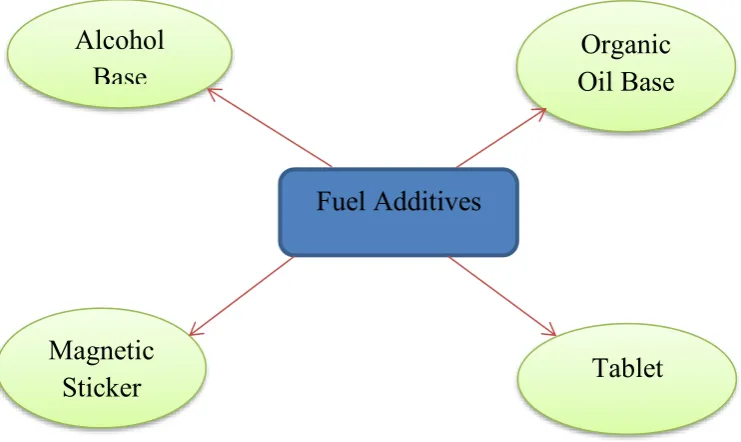
2.2.1 Types of Additives in Market
Figure 2.1: Types of Additives in Commercial Market
2.2.2 Elements in Fuel Additives
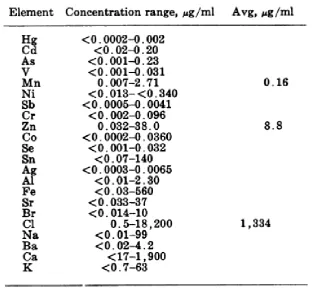
After the eighteen commercial fuel additives in the market have been analyzed by neutron activation analysis, there are several levels of elements have been found. These elements are Hg, As, V, Mn, Sb, Cr, Zn, Co, Se, Sn, Ag, Al, Fe and Sr as in table 2.1. Apparently, the predominant source of the Sn and Fe in the fuel additives may because of the solder connection in metal container. The intensive use of market
Fuel Additives
Alcohol
[image:21.595.145.516.320.541.2]Base
Oil Base
Organic
Magnetic
7
[image:22.595.164.478.190.483.2]additives can lead to environmental trace metal burden and increase the potential for poisoning exhaust catalytic (Jungers et al., 1975).
Table 2.1: Trace Elements in Fuel Additives (Jungers, 1975)
2.3 RESEARCH OCTANE NUMBER (RON)
8
condition using ASTM D908 while MON is measured under high speed condition using ASTM D357. The lower number of RON used the easier for it to ignite in the engine. Therefore, the fuels with a higher number of RON will eliminate knocking, as it has high compression ratio and gain more power in the engine (Albahri et al., 2002).
2.3.1 Unleaded Petrol (ULP)
The petrol that has a RON number between 91 and 93 are categorized as Unleaded Petrol. Vehicles that use this type of RON need to install the catalytic converter because the gas emitted from the exhaust are high and hazardous to environment.
2.3.2 Premium Unleaded Petrol (PULP)
The Premium Unleaded Petrol is the petrol that has a RON number of 95. This PULP is a special blend of petrol created to bring high octane and knock free performance to unleaded cars. It gives more performance to the engine and run at maximum efficiency.
2.3.3 Ultimate Unleaded Petrol (UUP)
The Ultimate Unleaded Petrol (UUP) has a RON number of 98. This UUP is an advanced performance fuel designed to be better for any type or model of the vehicles. Formulated to clean the engine and reduce exhaust emissions, UUP keep the engine clean, give more performance and less harmful to the environment.
2.3.4 High Performance Petrol (HPP)
9
car. This HHP also contains organic combustion enhancer and friction modifier to provide the fuel operates efficiently. Therefore, the new Petron Blaze 100 Euro 4 is formulated to meet the European specification for cleaner, make it environment-friendly fuel.
2.4 SPRAY CHARACTERISTICS
The fuel spray and atomization play an important role to the performance and emission characteristic of the engine. The air-fuel mixture formation in the combustion chamber is affected by the characteristic of the fuel spray. The main parts of fuel spray characteristic are fuel injection pressure, cone angle, spray length and droplet size distribution. The higher fuel injection pressures encourage the engine for better fuel atomization and combustion characteristics. It also gives advantageous in terms of uniform distribution of droplets. However, the spray penetration should not hit the walls of cylinder as it may cause the problem of wall wetting and leads to uncountable loss (Prabhakara et al., 2015).