Article
Design Optimisation of a Magnetic Field Based Soft
Tactile Sensor
Gregory de Boer1,* ID, Nicholas Raske2, Hongbo Wang3 ID, Junwai Kow1, Ali Alazmani1, Mazdak Ghajari4, Peter Culmer1and Robert Hewson2
1 School of Mechanical Engineering, University of Leeds, Woodhouse Lane, Leeds LS2 9JT, UK;
[email protected] (J.K.); [email protected] (A.A.); [email protected] (P.C.)
2 Department of Aeronautics, Imperial College London, South Kensington Campus, London SW7 2AZ, UK;
[email protected] (N.R.); [email protected] (R.H.)
3 Center for Micro-BioRobotics, Istituto Italiano di Tecnologia, Viale Rinaldo Piaggio 34, 56025 Pontedera,
Italy; [email protected]
4 Dyson School of Design Engineering, Imperial College London, 10 Princes Gardens, Kensington Princes
Gardens, London SW7 1NA, UK; [email protected] * Correspondence: [email protected]; Tel.: +44-113-343-2206
Received: 28 September 2017; Accepted: 2 November 2017; Published: 3 November 2017
Abstract:This paper investigates the design optimisation of a magnetic field based soft tactile sensor, comprised of a magnet and Hall effect module separated by an elastomer. The aim was to minimise sensitivity of the output force with respect to the input magnetic field; this was achieved by varying the geometry and material properties. Finite element simulations determined the magnetic field and structural behaviour under load. Genetic programming produced phenomenological expressions describing these responses. Optimisation studies constrained by a measurable force and stable loading conditions were conducted; these produced Pareto sets of designs from which the optimal sensor characteristics were selected. The optimisation demonstrated a compromise between sensitivity and the measurable force, a fabricated version of the optimised sensor validated the improvements made using this methodology. The approach presented can be applied in general for optimising soft tactile sensor designs over a range of applications and sensing modes.
Keywords:tactile sensing; sensitivity; optimisation; magnetic fields; force measurement
1. Introduction
Tactile sensors enable robots to interact with humans and the environment with a high level of accuracy and enhance their abilities for dexterous manipulations. Concurrently, technical challenges
remain for soft tactile sensing systems to reach human-level performance [1]. Various physical
transducer mechanisms (e.g., resistive, capacitive, magnetic, piezoelectric, piezoresistive) have been
introduced to develop soft tactile sensors [2], with each design exhibiting their own set of advantages
and disadvantages. In general, resistive, capacitive, piezoelectric/piezoresistive tactile sensors have
high spatial resolution and performance [2,3], which are easy to implement on ultra-thin layers,
but they do not measure tri-axis force nor are they deformable. An encapsulation of soft skin on the working surface protects the sensor electronics and wires but this lowers the performance (in terms
of hysteresis, sensitivity, and bandwidth) and requires a complex fabrication process [4]. Optical
tactile sensors such as TACTIP [5] are durable and have high spatial resolution but are limited by
complex computation between inputs and outputs, high power consumption, and are difficult to use to
investigate a large sensing area. BioTac [6] is a bio-inspired fingertip which uses a conductive liquid to
transfer force to resistance and is capable of force, contact, temperature, and vibration measurements.
BioTac has been integrated into a range of robotic hand fingertip devices but remains expensive, complicated, and difficult to use over a large sensing area.
Originally presented by Clark [7], magnetic field-based tactile sensors use a remote sensing
approach which is inherently durable, deformable, low-cost, easy to fabricate, and easy to integrate
with existing robotic systems [8]. Wang et al. [9] introduced a comprehensive design methodology to
enable researchers from different disciplines to design high performance soft tactile sensors for specific
applications. A single element soft tri-axis tactile sensor, MagOne (Figure1a), was fabricated as a
prototype case study and achieved a force measurement resolution of approximately 1 mN with good repeatability and low hysteresis (3.4%). The performance of MagOne was comparable to commercial rigid force/torque sensors and cost about £10 to fabricate. All aspects, including geometry, fabrication, calibration, performance evaluation, advantages and disadvantages, were investigated to design a high performance soft tactile sensor based on the magnetic field measurement. However, given the complex relationship between magnetic field and force, the MagOne design was not optimised for the multiple design objectives associated with a range of diverse applications. The effect of a range of design variables (e.g., geometry and material properties) on the sensor performance needed to be characterised and from this an optimal design could be determined. Multi-element magnetic
field based soft sensors such as Tomo et al. [10] for soft-skin applications, de Oliveria et al. [11] for
multimodal sensing and Wang et al. [12] as an extension of MagOne have been recently established.
The optimisation principles developed in this work are also applicable to these cases, leading to a means of establishing improvements and optimising the performance of these sensors.
measurements. BioTac has been integrated into a range of robotic hand fingertip devices but remains expensive, complicated, and difficult to use over a large sensing area.
Originally presented by Clark [7], magnetic field-based tactile sensors use a remote sensing approach which is inherently durable, deformable, low-cost, easy to fabricate, and easy to integrate with existing robotic systems [8]. Wang et al. [9] introduced a comprehensive design methodology to enable researchers from different disciplines to design high performance soft tactile sensors for specific applications. A single element soft tri-axis tactile sensor, MagOne (Figure 1a), was fabricated as a prototype case study and achieved a force measurement resolution of approximately 1 mN with good repeatability and low hysteresis (3.4%). The performance of MagOne was comparable to commercial rigid force/torque sensors and cost about £10 to fabricate. All aspects, including geometry, fabrication, calibration, performance evaluation, advantages and disadvantages, were investigated to design a high performance soft tactile sensor based on the magnetic field measurement. However, given the complex relationship between magnetic field and force, the MagOne design was not optimised for the multiple design objectives associated with a range of diverse applications. The effect of a range of design variables (e.g., geometry and material properties) on the sensor performance needed to be characterised and from this an optimal design could be determined. Multi-element magnetic field based soft sensors such as Tomo et al. [10] for soft-skin applications, de Oliveria et al. [11] for multimodal sensing and Wang et al. [12] as an extension of MagOne have been recently established. The optimisation principles developed in this work are also applicable to these cases, leading to a means of establishing improvements and optimising the performance of these sensors.
(a) (b)
Figure 1. Photographs of the MagOne sensor designs. (a) As developed by Wang et al. [9]. (b) From the optimisation of sensitivity considered in this study.
This paper investigates the design optimisation of the MagOne sensor, for this purpose Finite element (FE) simulations were developed to determine the magnetic field and structural behaviour under load. Optimisation studies have been conducted using simulated results of magnetic fields [13,14] and compliant structures/mechanisms [15–17]; however, this paper is the first to apply design optimisation techniques in order to simultaneously address these interactions. Studies have also been conducted exploring the optimisation of soft sensors [18,19]. However, the sensors investigated have different operating modes to that of MagOne and the research outcomes did not produce optimised designs, but rather strategies for optimising the output sensing range by control of the input parameters. Genetic programming (GP) was used in this work as a metamodel to produce accurate relationships of the non-linear sensor response over the range of parameters investigated, which is a well-established approach in design optimisation [20]. The optimised designs presented were calculated using a combination of genetic algorithms (GAs) and heuristic solvers based on the relationships generated by GP; such solution procedures have been used previously for this purpose [21].
The motive for the optimisation was to improve the function of the sensor, as defined by its ability to accurately characterise an applied force. For the MagOne device this means a small change in applied load corresponds to a large change in the sensed magnetic field where the relationship between applied force and sensed magnetic field was defined as the sensitivity. The objective of the
Figure 1.Photographs of the MagOne sensor designs. (a) As developed by Wang et al. [9]. (b) From the optimisation of sensitivity considered in this study.
This paper investigates the design optimisation of the MagOne sensor, for this purpose Finite element (FE) simulations were developed to determine the magnetic field and structural behaviour
under load. Optimisation studies have been conducted using simulated results of magnetic
fields [13,14] and compliant structures/mechanisms [15–17]; however, this paper is the first to apply
design optimisation techniques in order to simultaneously address these interactions. Studies have also
been conducted exploring the optimisation of soft sensors [18,19]. However, the sensors investigated
have different operating modes to that of MagOne and the research outcomes did not produce optimised designs, but rather strategies for optimising the output sensing range by control of the input parameters. Genetic programming (GP) was used in this work as a metamodel to produce accurate relationships of the non-linear sensor response over the range of parameters investigated,
which is a well-established approach in design optimisation [20]. The optimised designs presented
were calculated using a combination of genetic algorithms (GAs) and heuristic solvers based on the relationships generated by GP; such solution procedures have been used previously for this
purpose [21].
applied load corresponds to a large change in the sensed magnetic field where the relationship between applied force and sensed magnetic field was defined as the sensitivity. The objective of the optimisation study was, therefore, to minimise sensitivity over a range of design variables. A second, and conflicting, objective was introduced to maximise the largest applied load that the sensor can characterise. This ensured that it will have a useful operating range. The design variables were selected to parametrise the geometry and material properties of the sensor, which can be altered as part of the fabrication process. Constraints on the measureable force, given as part of the sensor specification, were imposed and included in the design strategy. Shear loading conditions were investigated in order to optimise the sensor design over a representative range of operational displacements. The optimised designs
were subsequently validated by fabricating and experimentally testing the new sensor (Figure1b),
thus demonstrating the accuracy of the computational simulations and the improvements in sensitivity obtained by design optimisation.
The application of this approach to the optimisation of sensitivity subject to a load range (or conversely the optimisation of a sensing range subject to the load range, or a multi-objective optimisation process where both sensitivity and sensing range are considered in combination) can be readily applied to different sensing modalities, such as those based on capacitive based sensing where compression of a soft material and its mechanical response forms the basis of converting the
sensor deformation to the resulting force [22]. Indeed, the check for the uniqueness of response
and computational electro-mechanical characterisation of the response of a wide range of sensors
could potentially be characterised and optimised in terms of geometry [23] so long as a deterministic
computational model of the sensor can be derived [24–26]. The general method described in this paper,
where the sensor is parametrised by design variables which are then optimised based on numerical simulations and metamodels of the input/output response, is applicable to the design of a range of soft tactile sensors.
2. Materials and Methods
2.1. Sensor Concept
This work is focused on the optimisation of a magnetic sensor concept developed by Wang et
al. [9] which comprised of a 3D Hall module, a deformable elastomer body and an embedded magnet
as illustrated in Figure2a. The sensor, known as MagOne, worked by measuring the magnetic field
produced at the origin 0, by means of the induced electric field in the Hall effect module. By displacing the magnet from A, the change in magnetic field was identified and then the force applied was determined from knowledge of the mechanical behaviour of the elastomer under load.
Sensors 2017, 17, 2539 3 of 20
optimisation study was, therefore, to minimise sensitivity over a range of design variables. A second, and conflicting, objective was introduced to maximise the largest applied load that the sensor can characterise. This ensured that it will have a useful operating range. The design variables were selected to parametrise the geometry and material properties of the sensor, which can be altered as part of the fabrication process. Constraints on the measureable force, given as part of the sensor specification, were imposed and included in the design strategy. Shear loading conditions were investigated in order to optimise the sensor design over a representative range of operational displacements. The optimised designs were subsequently validated by fabricating and experimentally testing the new sensor (Figure 1b), thus demonstrating the accuracy of the computational simulations and the improvements in sensitivity obtained by design optimisation.
The application of this approach to the optimisation of sensitivity subject to a load range (or conversely the optimisation of a sensing range subject to the load range, or a multi-objective optimisation process where both sensitivity and sensing range are considered in combination) can be readily applied to different sensing modalities, such as those based on capacitive based sensing where compression of a soft material and its mechanical response forms the basis of converting the sensor deformation to the resulting force [22]. Indeed, the check for the uniqueness of response and computational electro-mechanical characterisation of the response of a wide range of sensors could potentially be characterised and optimised in terms of geometry [23] so long as a deterministic computational model of the sensor can be derived [24–26]. The general method described in this paper, where the sensor is parametrised by design variables which are then optimised based on numerical simulations and metamodels of the input/output response, is applicable to the design of a range of soft tactile sensors.
2. Materials and Methods
2.1. Sensor Concept
This work is focused on the optimisation of a magnetic sensor concept developed by Wang et al. [9] which comprised of a 3D Hall module, a deformable elastomer body and an embedded magnet as illustrated in Figure 2a. The sensor, known as MagOne, worked by measuring the magnetic field produced at the origin 0, by means of the induced electric field in the Hall effect module. By displacing the magnet from A, the change in magnetic field was identified and then the force applied was determined from knowledge of the mechanical behaviour of the elastomer under load.
(a) (b)
Figure 2. Cross-sectional sketch of the MagOne sensor. (a) Unloaded. (b) Loaded in both normal and shear directions.
Both normal (z-axis) and shear (r-axis) loading were considered, in which contact and friction
occurred between the upper and lower surfaces of the sensor and the rigid surfaces used for
indentation. Figure 2b illustrates normal and shear loading of the sensor due to a displacement =
u , u of the magnet, where = ∆ , ∆ is the distance between the magnet and the Hall effect
module, θ is the shear angle, = B , B is the magnetic field, = F , F is the force, and =
Γ , Γ is the sensitivity.
Figure 2.Cross-sectional sketch of the MagOne sensor. (a) Unloaded. (b) Loaded in both normal and shear directions.
Both normal (z-axis) and shear (r-axis) loading were considered, in which contact and friction
Figure2b illustrates normal and shear loading of the sensor due to a displacementu = (ur, uz)of
the magnet, where∆ = (∆r,∆z)is the distance between the magnet and the Hall effect module,
θis the shear angle,B = (Br, Bz)is the magnetic field,F = (Fr, Fz)is the force, andΓ = (Γr,Γz)is
the sensitivity.
The sensitivityΓ= (Γr,Γz)describes the magnitude of the derivatives of Frand Fzwith respect
to Brand Bz, as given in Equations (1) and (2). For the sensor design optimisation, the objective was
to minimise the change in the output of the sensorFfor any given change in the inputB, or in other
words to minimiseΓ. This ensured a robust sensor response, withFbeing less sensitive to noise in
the measuredB. Sensitivity was affected by the choices made in the design of the sensor such as the
geometry, material properties and component selection. In the concept developed here, the magnet and Hall effect module were chosen leaving the geometry and material properties as design variables. This decision was made because it provides the simplest means of varying parameters in the design while demonstrating the complexity of delivering an optimised sensor.
Γr=
s
∂Fr
∂Br
2
+
∂Fr
∂Bz
2
(1)
Γz=
s
∂Fz
∂Br
2
+
∂Fz
∂Bz
2
(2)
2.1.1. Sensor Mechanics
When the magnet was displaced byuthe distance between the Hall effect module and magnet∆
was changed. The relationship betweenuand∆was described by Equations (3) and (4),
uz=∆z+Hm−H−Hg (3)
ur =∆r (4)
where urand uzare the displacement components,∆zand∆rare the r and z distances from the magnet
to the Hall effect module, H is the sensor base height, Hmis the height of the magnet, and Hgis a
geometrical height for the sensor. At a given∆zthe reading of the Hall effect module became saturated,
this limit∆z,sat. defined the depth to which the indentation reached. The magnet was displaced linearly
with a non-dimensional variable t where 0≤t≤1, leading to Equations (5) and (6).
uz=t ∆z,sat+Hm−H−Hg (5)
ur =−t ∆z,sat+Hm−H−Hgtanθ (6)
The shear angleθwas limited to a value which was determined by an assumption derived from
the frictional characteristics of the sensor and indenting surfaces. The coefficient of frictionµfbetween
the sensor and indenting surfaces was defined by Equation (7),
Fr,slip
Fz,slip
=µf (7)
where Fr,slipand Fz,slipare the shear and normal force components at slip. Beyond this limit the
sensor material slips along the indenting surfaces, thus providing the limiting case under shear. Setting the ratio of displacement components equal to that of the force components at slip allowed an
approximation for the maximum shear angleθmaxto be determined, as described by Equation (8).
Structural mechanics simulations of the sensor under normal and shear loading, as described in
Section2.1.3, were conducted to ensure that this limit did not result in the elastomer material slipping
along the indenting surface. The variables t andθfully parameterised the range of displacements
urequired for a given sensor design. The space defined by the ranges of t andθis continuous and
bounded by t∈[0, 1]andθ∈[0,θmax].
2.1.2. Magnetic Field
A model was developed to obtain the magnetic field in a fixed position and from whichBwas
obtained as a function of the magnet displacement. This approach was applicable because the structural mechanics of the sensor under load does not have an effect on the magnetic field distribution. A 2D
axially-symmetric cylindrical coordinate system was employed for developing the model becauseBis
independent of the orientation of the shear direction r. The solution forBwas described by Equation (9),
and Equation (10) described the relationship between the magnetized fieldHand magnetic scalar
potential V.
∇·B=0 (9)
H=−∇V (10)
In the space surrounding the magnet,Bwas described by Equation (11) and within the magnet it was
described by Equation (12),
B=µ0µrH (11)
B=µ0(H+M) (12)
whereµ0is the permeability of free space,µris the relative permeability, andMis the magnetisation
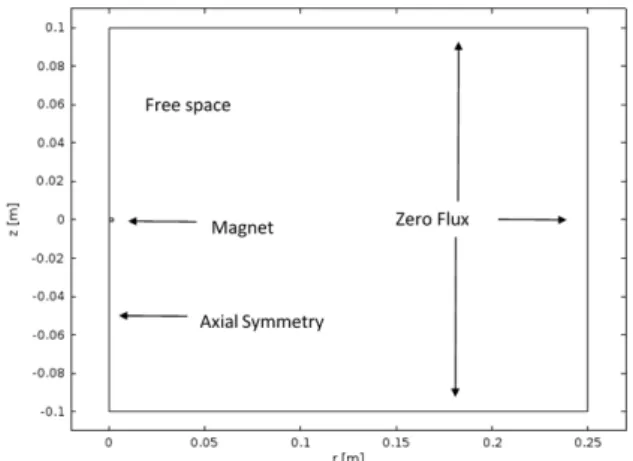
as governed by the magnet selection. A zero flux condition,n·B = 0 was applied at a boundary
far from the sensor (+100 Rm in r and±50 Hmin z), wherenis the surface normal vector and an
axial-symmetry condition was applied through the z-axis of the magnet centre (r = 0), as shown
in Figure3. The magnetic field was not affected by the material properties of the elastomer such
that the relative permeability of the elastomer and space surrounding the sensor isµr =1, i.e., no
shielding effect [27]. Using these operating and boundary conditions and solving Equations (9) and
(10) together with Equations (11) and (12) for V produced the magnetic fieldB. This was subsequently
assessed for all displacements and sensor designs by varying the distance between the magnet and assessment location.
Sensors 2017, 17, 2539 5 of 20
2.1.2. Magnetic Field
A model was developed to obtain the magnetic field in a fixed position and from which B was
obtained as a function of the magnet displacement. This approach was applicable because the structural mechanics of the sensor under load does not have an effect on the magnetic field distribution. A 2D axially-symmetric cylindrical coordinate system was employed for developing the
model because B is independent of the orientation of the shear direction r. The solution for B was
described by Equation (9), and Equation (10) described the relationship between the magnetized field
H and magnetic scalar potential V.
∇ ∙ = 0 (9)
= −∇V (10)
In the space surrounding the magnet, was described by Equation (11) and within the magnet it
was described by Equation (12),
= μ μ (11)
= μ + (12)
where μ is the permeability of free space, μ is the relative permeability, and is the
magnetisation as governed by the magnet selection. A zero flux condition, ∙ = 0 was applied at
a boundary far from the sensor (+100 Rm in r and ± 50 Hm in z), where n is the surface normal vector
and an axial-symmetry condition was applied through the z-axis of the magnet centre (r = 0), as shown in Figure 3. The magnetic field was not affected by the material properties of the elastomer
such that the relative permeability of the elastomer and space surrounding the sensor is μ = 1, i.e.,
no shielding effect [27]. Using these operating and boundary conditions and solving Equations (9) and (10) together with Equations (11) and (12) for V produced the magnetic field . This was subsequently assessed for all displacements and sensor designs by varying the distance between the magnet and assessment location.
Figure 3. Diagram of the magnetic field model.
2.1.3. Structural Mechanics
During indentation the sensor material underwent large strains leading to a requirement for nonlinear structural mechanics to be used to describe the problem. The elastomer used was a rubber-like silicone (Ecoflex 00-30) for which the stress-strain relationship was known to be hyperelastic [28]. For the sensor design an incompressible Neo-Hookean model was used to define the material properties. Wang et al. [9] demonstrated that this model was sufficiently accurate to describe the mechanical behaviour of MagOne under load. The incompressible Neo-Hookean model derives the
Figure 3.Diagram of the magnetic field model.
2.1.3. Structural Mechanics
a rubber-like silicone (Ecoflex 00-30) for which the stress-strain relationship was known to be
hyperelastic [28]. For the sensor design an incompressible Neo-Hookean model was used to define the
material properties. Wang et al. [9] demonstrated that this model was sufficiently accurate to describe
the mechanical behaviour of MagOne under load. The incompressible Neo-Hookean model derives the stress-strain relationship for the material from a strain energy density function W, as given in Equation (13),
W= G
2
λ21+λ22+λ23−3 (13)
where G is the shear modulus of the elastomer, andλ1,λ2,λ3are the principle stretches. Stresses in the
material can be obtained by calculating the derivatives of W with respect to strains, which themselves relate to the principle stretches. Variation of G can be achieved by changing the silicone used in the fabrication process, thus varying the elastomer stiffness. A steady-state assumption is made in the analysis such that no dynamic behaviour (viscoelasticity or inertia) was modelled. This was confirmed
by experimental validation of the sensor showing 3.4% hysteresis [9].
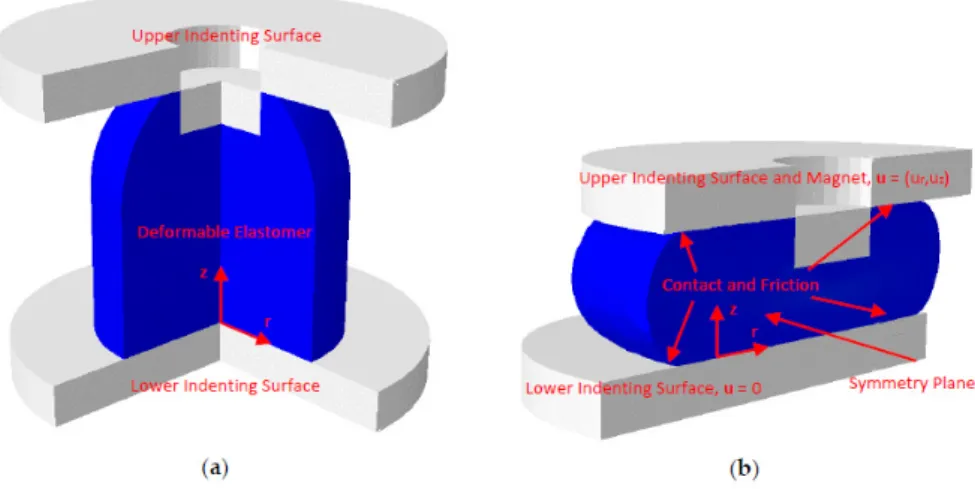
In order to model indentation of the sensor to include both normal and shear loading a full three-dimensional description of the sensor was required, this was because as the sensor deformed in shear the shape of the sensor was not axially-symmetric, and thus, the dimension cannot be reduced as in the case for the magnetic field calculation. The magnet was modelled as a rigid body which
was rigidly connected to the elastomer material surrounding it, and was displaced by ur, uzin the
r-axis andz-axis, respectively, to produce normal and shear loads. The base of the elastomer was
fixed such that the displacement was constrained to zerou = 0, and the sides of the sensor were
allowed to freely deform. A symmetry condition was specified in the plane to which shear was applied. Contact mechanics was considered to model the interaction between the freely deforming surfaces of the elastomer and the indenting surfaces, which were themselves considered rigid bodies. Friction was generated during indentation and this effect was modelled by specifying a coefficient of friction
µffor the contact. Figure4a,b show the structural model of the sensor for when it was unloaded
and loaded, respectively. Equation (13) was solved according to these operating and boundary conditions to give the stress distribution under load over the required ranges of displacement and
sensor designs. The value ofF= (Fr, Fz)was then given by determining the reaction force at the lower
indenting surface.
Sensors 2017, 17, 2539 6 of 20
stress-strain relationship for the material from a strain energy density function W, as given in Equation (13),
W =G
2 λ + λ + λ − 3 (13)
where G is the shear modulus of the elastomer, and λ , λ , λ are the principle stretches. Stresses in
the material can be obtained by calculating the derivatives of W with respect to strains, which themselves relate to the principle stretches. Variation of G can be achieved by changing the silicone used in the fabrication process, thus varying the elastomer stiffness. A steady-state assumption is made in the analysis such that no dynamic behaviour (viscoelasticity or inertia) was modelled. This was confirmed by experimental validation of the sensor showing 3.4% hysteresis [9].
In order to model indentation of the sensor to include both normal and shear loading a full three-dimensional description of the sensor was required, this was because as the sensor deformed in shear the shape of the sensor was not axially-symmetric, and thus, the dimension cannot be reduced as in the case for the magnetic field calculation. The magnet was modelled as a rigid body which was
rigidly connected to the elastomer material surrounding it, and was displaced by u , u in the r-axis
and z-axis, respectively, to produce normal and shear loads. The base of the elastomer was fixed such
that the displacement was constrained to zero = 0, and the sides of the sensor were allowed to
freely deform. A symmetry condition was specified in the plane to which shear was applied. Contact mechanics was considered to model the interaction between the freely deforming surfaces of the elastomer and the indenting surfaces, which were themselves considered rigid bodies. Friction was
generated during indentation and this effect was modelled by specifying a coefficient of friction μ
for the contact. Figure 4a,b show the structural model of the sensor for when it was unloaded and loaded, respectively. Equation (13) was solved according to these operating and boundary conditions to give the stress distribution under load over the required ranges of displacement and sensor
designs. The value of F = F , F was then given by determining the reaction force at the lower
indenting surface.
Figure 4. Diagram of the structural mechanics simulation domain. (a) Unloaded. (b) Loaded in both normal and shear directions.
2.2. Design Specification
For the design optimisation of MagOne two variables were investigated: (i) the sensor base height H, and (ii) the elastomer shear modulus G. Together these variables describe the sensor design in terms of geometry and material properties. It is feasible to fabricate sensors over reasonable ranges of the height H and the shear modulus G making them appropriate design variables for an optimisation study. Any number of parameters could be selected as design variables for the sensor, including the choice of components not investigated here, but H and G have been chosen to
Figure 4.Diagram of the structural mechanics simulation domain. (a) Unloaded. (b) Loaded in both normal and shear directions.
2.2. Design Specification
of geometry and material properties. It is feasible to fabricate sensors over reasonable ranges of the height H and the shear modulus G making them appropriate design variables for an optimisation study. Any number of parameters could be selected as design variables for the sensor, including the choice of components not investigated here, but H and G have been chosen to demonstrate how this type of sensor can be optimised by design. The ranges used for each of the design variables were
chosen as H∈ [3, 7]mm and G∈ [1, 5]kPa as to span reasonable values of the identified variables,
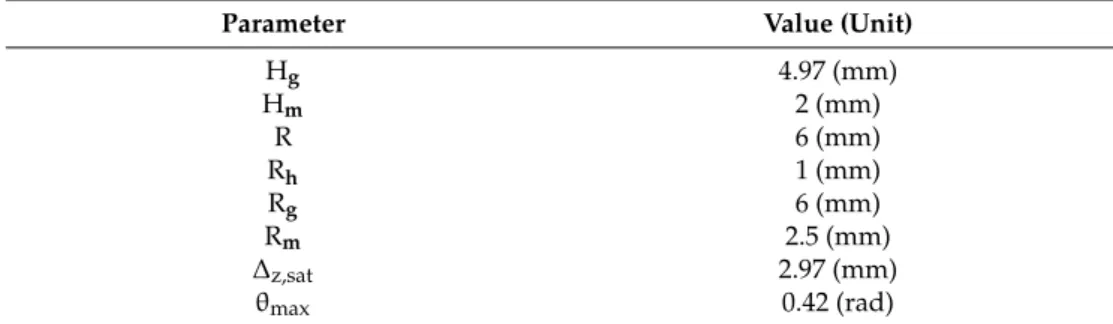
the sensor designed by Wang et al. [9] used H = 3 mm and G = 2.94 kPa. The remaining parameters
required for the sensor design and mechanics are given in Table1.
Table 1.Fixed design characteristics of the MagOne sensor.
Parameter Value (Unit)
Hg 4.97 (mm)
Hm 2 (mm)
R 6 (mm)
Rh 1 (mm)
Rg 6 (mm)
Rm 2.5 (mm)
∆z,sat 2.97 (mm)
θmax 0.42 (rad)
2.2.1. Parameterisation
The magnetic fieldBand forceFwere determined over the range of the design variables and
displacements. The responses were subsequently characterised by Equations (14) and (15) as functions
of the parameters G, H, t, andθ. The sensitivityΓwas calculated by taking partial derivatives ofF
with respect toB, leading to Equation (16).
B=f(t,θ, H) (14)
F=f(B, t,θ, G, H) (15)
Γ=f(B, t,θ, G, H) (16)
GP was used to derive phenomenological expressions representing each of Equations (14) and (15), and from which Equation (16) was subsequently determined. The form of these expressions used any mathematical operator with any combination of the input variables. The expressions were derived based on an evolutionary bio-inspired algorithm similar to that used in GAs for optimisation
problems [29], which accurately describe complex non-linear trends in the response that were not
simple (or even possible) to derive from first principles [30]. Due to the non-linearity associated
with the magnetic field and force responses of MagOne under load, GP provided a useful means for
obtaining the algebraic relationships required [20].
2.2.2. Loading Stability
As the sensor is displaced in both the normal and shear directions it is known that the normal
force Fzwill monotonically increase; however, the shear force Frdoes not exhibit the same type of
response and as such the stable region for sensing where an increase in displacement correlates to
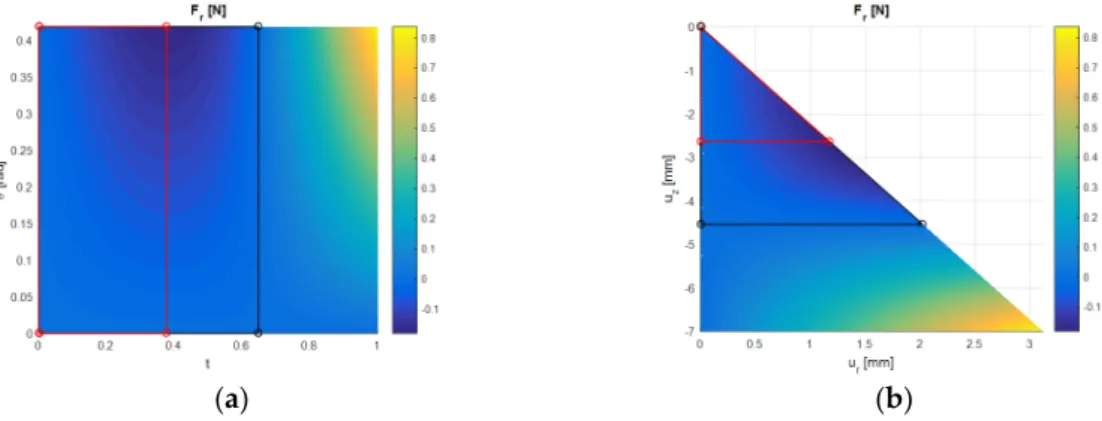
an increase in Fris therefore reduced. The effect of t andθon Fris shown in Figure5a and the effect
of urand uzon Fris shown in Figure5b for when H = 7 mm and G = 5 kPa. The region indicated in
black identifies where Fr is always monotonically decreasing with urfor any given uz, which itself
corresponds to when Fr is negative in value. Further to this, the region identified in red shows the
range of displacements for when Fr is monotonically decreasing from zero to the minimum value
force and normal force are monotonically changing with displacement and reach peak values at the
same instance.Sensors 2017, 17, 2539 8 of 20
(a) (b)
Figure 5. Response of F in N for H = 7 mm and G = 5 kPa. Region of stable shear loading bounded
in red, point placed at the location the minimum F . Region of negative F bounded in black, point
placed at the location of F = 0 for θ = θ . (a) F shown as a function of t and θ. (b) F shown as
a function of u and u .
With shear loading considered in the design this stability condition was imposed and the bounds
of the feasible displacements reduced to t′ ∈ [0, t ] and θ′ ∈ [0, θ ], where t and θ are the
values of t and θ corresponding to F, for any given value of H and G (see Equation (17)). The
optimisation is performed within these bounds (see Section 2.2.3) but this does not limit the operation of the sensor, only the range of stable displacements which the design is optimised for.
Corresponding to these reduced bounds, the maximum normal force F , and maximum
shear/normal sensitivities Γ, , Γ, can be determined for any given value of H and G by
Equation (18).
: F
: 0 ≤ t ≤ 1, 0 ≤ θ ≤ θ : F, t , θ = f H, G
(17)
: F , Γ , Γ : 0 ≤ t ≤ t , 0 ≤ θ ≤ θ
: F, , Γ, , Γ, = f H, G
(18)
2.2.3. Design Optimisation
The optimisation objective for the sensor design was to minimise the sensitivity Γ over the ranges
of the design variables H and G. In order to achieve this the worst sensitivity (maximum value of Γ)
over all stable displacements was used. The worst sensitivity corresponds to the maximum value of
Γ because this implies the greatest rate of change of F with the measured B. By minimising the worst
sensitivity achieved during displacement ensures that the optimised design has the best possible sensitivity for all displacements considered. By using the stable range of displacements the optimised
sensor was also ensured to produce a monotonically changing F with measured B.
For each case a measureable maximum/minimum force = F, , F, was specified which
subsequently constrained the optimisation such that this force could at least be measured. These force
constraints ensured that the minimum possible shear force the sensor measured F, was less than
or equal to the constrained value F, , and the maximum possible normal force the sensor measured
F , was greater than or equal to the constrained value F , . Given that both force components were
constrained by design, the objective for the optimisation corresponded to minimising the worst
sensitivity in both directions (that is minimising Γ, and Γ, ) as described by the multi-objective
problem, Equation (19). This produced optimal values of the design variables H∗ and G∗ with
corresponding obejctives Γ∗, , Γ∗, and constraints F∗, , F∗, .
Figure 5.Response of Frin N for H = 7 mm and G = 5 kPa. Region of stable shear loading bounded in red, point placed at the location the minimum Fr. Region of negative Frbounded in black, point placed at the location of Fr=0 forθ=θmax. (a) Frshown as a function of t andθ. (b) Frshown as a function of urand uz.
With shear loading considered in the design this stability condition was imposed and the bounds
of the feasible displacements reduced to t0 ∈[0, tm]andθ0∈[0,θm], where tmandθmare the values of
t andθcorresponding to Fr,minfor any given value of H and G (see Equation (17)). The optimisation
is performed within these bounds (see Section2.2.3) but this does not limit the operation of the
sensor, only the range of stable displacements which the design is optimised for. Corresponding to
these reduced bounds, the maximum normal force Fz,maxand maximum shear/normal sensitivities
Γr,max,Γz,maxcan be determined for any given value of H and G by Equation (18).
minimise: Fr
subject to: 0≤t≤1, 0≤θ≤θmax
to yield: Fr,min(tm,θm) =f(H, G)
(17)
maximise: Fz,Γr,Γz
subject to: 0≤t≤tm, 0≤θ≤θm
to yield: Fz,max,Γr,max,Γz,max=f(H, G)
(18)
2.2.3. Design Optimisation
The optimisation objective for the sensor design was to minimise the sensitivityΓover the ranges
of the design variables H and G. In order to achieve this the worst sensitivity (maximum value of
Γ) over all stable displacements was used. The worst sensitivity corresponds to the maximum value
ofΓbecause this implies the greatest rate of change ofFwith the measuredB. By minimising the
worst sensitivity achieved during displacement ensures that the optimised design has the best possible sensitivity for all displacements considered. By using the stable range of displacements the optimised
sensor was also ensured to produce a monotonically changingFwith measuredB.
For each case a measureable maximum/minimum forceFc = (Fr,c, Fz,c)was specified which
subsequently constrained the optimisation such that this force could at least be measured. These force
constraints ensured that the minimum possible shear force the sensor measured Fr,minwas less than
or equal to the constrained value Fr,c, and the maximum possible normal force the sensor measured
Fz,max was greater than or equal to the constrained value Fr,z. Given that both force components
were constrained by design, the objective for the optimisation corresponded to minimising the worst
problem, Equation (19). This produced optimal values of the design variables H∗ and G∗ with
corresponding obejctivesΓ∗r,max,Γ∗z,maxand constraints F∗r,min, F∗z,max.
minimise: Γr,maxandΓz,max
subject to: 3≤H≤7[mm], 1≤G≤5[kPa]
Fr,min−Fr,c ≤0, Fc,z−Fz,max≤0
to yield: Γ∗r,max, Γ∗z,max, Fr,min∗ , Fz,max∗ =f(H∗, G∗)
(19)
2.3. Numerical Simulations
2.3.1. Magnetic Field Simulation
In order to calculate the magnetic field components Br, Bz, Equations (9)–(12) were solved and
from whichBwas determined in a fixed cylindrical coordinate system according to the boundary
conditions outlined in Section2.1.2. This was undertaken using the FE method as implemented in the
software COMSOL Multiphysics [31]. The magnetisationMwas chosen based on the characteristics
specified by the manufacturer and the orientation of the magnetic poles. For the sensor concept
developed by Wang et al. [9] Mz=1.2×10⁶A/m and the remaining components were set to zero.
The permeability of free space was given byµ0=1.257×10⁻⁶(m.kg)/(s.A)2.
In the simulation 18,555 second-order triangular elements were used to discretise the domain, with the smallest elements placed on the magnet and grown in size toward the external boundary. This number of elements was shown to be significant in producing grid independent results, with an
increase in accuracy in the measurement ofBof less than 1.34% produced when a greater number of
elements was used. The calculation took approximately 2 min to run on a 2.8 GHz 4-core CPU with
16 GB of RAM. Once the solution was achieved a post-processing stage allowedBto be given as a
function of t,θ, H from the fixed position solution.
2.3.2. Structural Mechanics Simulations
The shear and normal forces Fr, Fz were calculated using a model developed with Abaqus
CAE [32] which employs the FE method. The incompressible Neo-Hookean hyperelastic model was
specified for the material properties, and the boundary conditions implemented were according to
those outlined in Section2.1.3. The magnet and indenting surfaces were represented by rigid bodies
such that they did not deform under load, and the elastomer was rigidly connected to the magnet surfaces such that they had the same displacement. The penalty contact algorithm was used to describe the normal contact pressures due to the interaction of the elastomer and rigid bodies. Tangential
contact tractions were modelled by assigning a coefficient of frictionµf=0.45, which is a known value
for rubber-like silicone on a hard surface and represents frictional behaviour similar to that of human
skin [33]. The standard settings for the explicit (time-dependent) solver were used. The time period
for indentation (1 s) was assumed to be large enough for inertia to have no dynamic effect and as such the results produced were quasi-static.
The number of elements used in the structural mechanics simulations varied because the geometry was parameterised by the variable H, therefore a minimum and maximum element size were chosen
to use across all geometries. Minimum and maximum element length scales of 7.5µm and 100µm
were used, respectively, and the resulting discretised domains varied in number from 127,877 to 285,150 second-order tetrahedral elements over the range of H. These values were found to produce
grid-independent results with an increase in accuracy in the measurement ofFof less than 1.88%
found when using smaller element sizes. The meshing procedure ensured that the smallest elements were placed in regions where high stress and strains are produced under load, as such the corner and edge regions on the domain were more densely populated than regions far from boundaries. For each
indenting surface. The time to compute varied based on the values ofθ, G, H. The longest simulation occurred at the maximum for each parameter and took approximately 3 h 40 min using the same
computer hardware as described in Section2.3.1.
2.3.3. Genetic Programming
The open source toolbox GPTIPS [34] was used to derive phenomenological expressions
representing Equations (14) and (15) by GP. The toolbox is written using the Matlab [35] programming
language. The data required by GPTIPS to calculate these expressions must span the ranges of t,θ, G,
and H; additionally, the corresponding values ofBandFmust be calculated from the simulations as
described in Sections2.3.1and2.3.2. For this purpose a full factorial Design of Experiments (DOE) was
used to select the values of t,θ, G, and H as to ensure that the entire design space was populated in
an evenly-distributed manner. The number of experiments in each dimension were chosen as: 21 in
t; 5 inθ; 5 in H; and 5 in G. The total number of DOE points in theBresponse was 525 which were
obtained from 1 simulation, and the total number of DOE points in theFresponse was 2625, obtained
from 125 simulations (taking approximately 2 weeks to compute using the same computer hardware
as outlined in Section2.3.1).
For each of the expressions generated by GPTIPS the types of mathematical operators which can be used is controlled by the user. The combination of these as functions of the input variables is
chosen to best represent the output data via the use of an evolutionary algorithm [20]. In the case of
deriving equations to represent Equations (14) and (15), the operators were limited to those which can be continuously differentiated so that the derivatives also take analytical forms and can be used in the
optimisation procedure, as outlined in Section2.3.4. The GPTIPS algorithm also allowed control of
parameters relating to the number of genes (or component part of each expression), the complexity of each gene, population size, and solution tolerances. An increase in the number of genes, their complexity, and the population size or decrease in the solver tolerances will increase the likelihood that a more accurate expression is generated; however, this becomes a trade-off with the length of time which the solution takes. In each instance that GPTIPS fits an expression to a data set it is likely that a different solution will be generated. This is because the total number of different combinations of the input and mathematical expressions is very large and by random number generation it is unlikely that the same combinations will be produced. In the case of Equations (14) and (15) the solver
tolerances were reduced to 10−9and the remaining parameters set to their default values. The solver
was subsequently run for 4 h to derive each of the expressions for Br, Bz, Fr, and Fz. These tolerances
and time to compute has been used in previous studies to obtain sufficiently accurate relationships [25].
After calculating these expressions they were differentiated using Matlab to provide the sensitivity
Γr,Γz(Equation (16)) and higher derivatives needed for the optimisation studies.
2.3.4. Optimisation Procedure
The optimisation studies were conducted using the Matlab optimisation toolbox [35]. For each
study the objective formed a minimax type problem with nonlinear constraints [36]. The minimax
condition was satisfied by solving forΓr,maxandΓz,maxas functions of H and G and then subsequently
minimising this value. Similarly, Fr,minand Fz,maxwere determined as functions of H and G for use
in the constraints. Underlying each of these optimisation studies was a sub-optimisation sequence
in whichΓr,max, Γz,max, Fr,minand Fz,maxwere determined as functions of t andθ. Therefore, each
optimisation study was separated into two parts: (i) unconstrained optimisation of sensitivity and force to find the maximum/minimum values for all displacements (Equations (17) and (18)), and (ii) force-constrained optimisation of sensitivity to find the minimum values for all design variables (Equation (19)).
In (i) values of H and G were specified and for whichΓr,max, Γz,max, Fr,minand Fz,maxare to be
determined as functions of t andθ. This was achieved using a GA in combination with a heuristic-based
heuristic solver; this process ensured that the minimum identified by the GA was refined to the exact
global minimum [21]. Where a maximum was to be found the identity max
x (f(x)) =−minx (−f(x))was
used. The Matlab functiongawas implemented to find the initial guess for the heuristic solver which
was itself the Matlab functionfmincon, for both all tolerances were set to 10−12. Forgathe population
size was set to 200, and withinfminconthe trust-region-reflective-algorithm was chosen to which the
gradients and Hessian ofΓandFwith respect to t andθwere supplied. Due to stability conditions,
Fr,minand the corresponding tmandθmwere solved for first because t0andθ0were required for the
calculation of theΓr,max,Γz,maxand Fz,max.
A GA was used in (ii) to find the minimum values ofΓr,maxand Γz,max returned from (i) as
functions of H and G. This was subject to force constraints for which Fr,min and Fz,max were also
given from (i) as functions of H and G. The Matlab functiongamultiobjwas used in combination with
nonlinear constraints to solve the multi-objective optimisation problem. An equal weighting was applied to the objective function components in order to generate a single cost function which the optimisation algorithm minimises. This subsequently produced a Pareto set of designs which minimise both components without bias. Each part of the Pareto set is equally optimal and a decision making
process was required to establish the optimal design solutionΓr,max∗ , Γ∗z,max, F∗r,min, F∗z,max=f(H∗, G∗).
In each case all tolerances in the solver were specified as 10−12and the population size was set to 200.
For the purpose of this study the force constraints were specified as Fr,c =−0.25 N and Fz,c=5 N,
respectively. The optimisation procedure and corresponding data required for visualisation took approximately 23 h 35 min to compute.
A flow chart outlining the optimisation procedure developed in this work is given in AppendixA
(FigureA1).
2.4. Design Validation
In order to validate the optimised design a set of four new sensors were fabricated according to the
optimised sensor height H∗and material stiffness G∗, as given by the result of the method described in
Section2.3.4. To achieve this a mould was printed using stereolithography at a 25µm resolution [37].
The mould was then cast with a silicone elastomer [38] and left to cure at room temperature. Once
cured, magnets were embedded into the nodes of the sensor bodies with a silicone adhesive [39]. After
ensuring that the magnets were fully encapsulated into the sensor bodies, the sensors were mounted
onto custom designed 3D printed circuit boards for experimental testing [9].
The new sensors (Figure1b) were tested experimentally through a custom test platform consisting
of a force/torque (F/T) sensor [40], mounting brackets, the magnetic sensor and two motorised linear
stages [41] positioned to provide compression in thez-axis and shear force about thex-axis. The linear
stages had a minimum step of 0.01 mm, travel range of 75 mm, and repeatability of 2.5µm, while
the F/T sensor has a measuring range of±35 N in the z-axis,±25 N inx/y–axis, and a resolution of
6.25 mN in all axes. A custom program was developed using LabView [42] to calibrate and control the
movement of the motorised linear stages; this was used to digitally acquire the measurements from the F/T sensor and the magnetic sensor. The step size for the linear stage in all axes was set to the minimum 0.01 mm and the total time taken for each of the indentation tests was ~3 h. This allowed for a high resolution data capture and also assisted in minimising transient and slip effects of the sensor under load. With the aim of ensuring that the observed experimental behaviour is as close as possible to the steady-state assumptions underpinning the simulated response.
Two repeats were made for each indentation test conducted on each of the four newly fabricated sensors, this number was used to ensure that the results obtained were a true representation of the repeatability of the sensor. Results generated from each repeat test were then processed using a
high-band/low-band filter (available from the online Matlab file exchange [43]) in order to reduce
cut-off bandwidths were specified in the software. Using the filtered data, the mean and standard deviation of the force and magnetic field responses were calculated across all repeats as a function
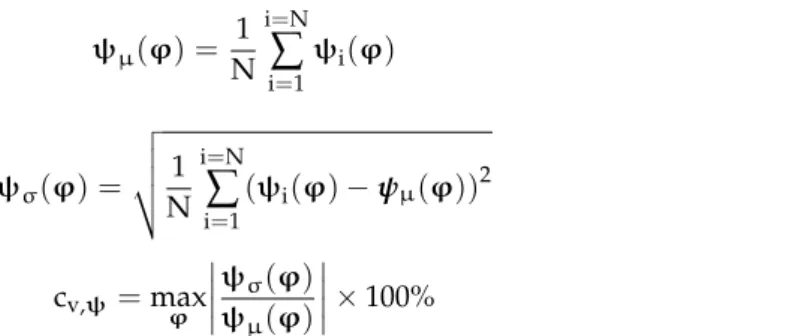
of the indentation displacement using Equations (20) and (21), respectively. Where N=8 (4 sensors
times 2 repeats) is the total number of indentation tests,ϕare the parameters describing indentation
(displacement for a given shear angle),ψiare the response variables (force and magnetic field) for
the I’th repeat test,ψµis the mean of the response variables over the number of repeats, andψσis
the standard deviation of the response variables over the number of repeats. In order to assess the
variability in the experimental responses the maximum coefficient of variation cv,ψover the full range
of displacements was calculated using Equation (22). This gives a measure for the variation about
the mean value obtained, with cv,ψapproaching zero implying that the mean is close to all values
obtained over the number of repeats and displacements considered.
ψµ(ϕ) = 1
N
i=N
∑
i=1
ψi(ϕ) (20)
ψσ(ϕ) =
v u u
t1
N
i=N
∑
i=1
(ψi(ϕ)−ψµ(ϕ))2 (21)
cv,ψ=max
ϕ
ψσ(ϕ)
ψµ(ϕ)
×100% (22)
The mean values obtained experimentally were subsequently compared to those generated from GP under the same conditions. This was undertaken by calculating the maximum absolute percentage error between the mean experimental and computational results over the range of displacements,
as described by Equation (23). Whereψare the maximum absolute percentage errors andψare the
response variables obtained computationally from GP. An analysis was then made investigating the sensitivities of the optimised and original designs, in which the percentage difference between the two sets of data obtained from GP for these conditions were calculated and compared.
ψ=max ϕ
ψµ(ϕ)−ψ(ϕ)
ψ(ϕ)
×100% (23)
3. Results
3.1. Magnetic Field
Figure 6a,b illustrate Br and Bz distributions, respectively, calculated from the 2D
axially-symmetric FE simulation of the magnetic field as described in Section 2.3.1. Each figure
shows the magnetic field components in the region close to the magnet by means of filled, coloured
contours in units of Tesla. It is demonstrated that the strength of Brand Bzdiminishes with increasing
distance from the magnet in both the r and z directions. Figure6b shows that the distribution of Bzis
symmetric about the centre of the magnet at z = 0 mm, and Figure6a shows that Bris anti-symmetric
about the centre of the magnet where z = 0 mm. The responses generated by GP as a result of the
magnetic field simulation were of a high level of accuracy, with the errors in Brand Bzshown to be
Sensors2017,17, 2539 13 of 20
the I’th repeat test, is the mean of the response variables over the number of repeats, and is
the standard deviation of the response variables over the number of repeats. In order to assess the
variability in the experimental responses the maximum coefficient of variation c , over the full
range of displacements was calculated using Equation (22). This gives a measure for the variation
about the mean value obtained, with c , approaching zero implying that the mean is close to all
values obtained over the number of repeats and displacements considered.
=1
N (20)
= 1
N − (21)
c , = max × 100% (22)
The mean values obtained experimentally were subsequently compared to those generated from GP under the same conditions. This was undertaken by calculating the maximum absolute percentage error between the mean experimental and computational results over the range of
displacements, as described by Equation (23). Where ϵ are the maximum absolute percentage
errors and are the response variables obtained computationally from GP. An analysis was then made investigating the sensitivities of the optimised and original designs, in which the percentage difference between the two sets of data obtained from GP for these conditions were calculated and compared.
ϵ = max − × 100% (23)
3. Results
3.1. Magnetic Field
Figure 6a,b illustrate B and B distributions, respectively, calculated from the 2D
axially-symmetric FE simulation of the magnetic field as described in Section 2.3.1. Each figure shows the magnetic field components in the region close to the magnet by means of filled, coloured contours in
units of Tesla. It is demonstrated that the strength of B and B diminishes with increasing distance
from the magnet in both the r and z directions. Figure 6b shows that the distribution of B is
symmetric about the centre of the magnet at z = 0 mm, and Figure 6a shows that B is anti-symmetric
about the centre of the magnet where z = 0 mm. The responses generated by GP as a result of the
magnetic field simulation were of a high level of accuracy, with the errors in B and B shown to be
two orders of magnitude smaller than the values obtained from FE.
(a) (b)
Figure 6. Magnetic field distribution in the near magnet region. (a) Coloured by B. (b) Coloured by
B.
Figure 6.Magnetic field distribution in the near magnet region. (a) Coloured by Br. (b) Coloured by Bz.
3.2. Strcutural Mechanics
An example of the structural mechanics results of the MagOne sensor under normal and shear
loading is presented in Figure7, which illustrates the distribution of displacement magnitude in the
elastomer at t = 1,θ= 0.423 rad, H = 7 mm and G = 5 kPa. Due to normal loading the elastomer material
is compressed in the z-direction between the rigid surfaces which due to the boundary conditions
imposed results in±displacement of material in the r-direction. Material is displaced further in the
positive r-direction than the negative because this is the shear loading orientation. It is also shown that under load the elastomer contacts the upper and lower indenting surfaces and since material cannot deform past these locations the shape of the sensor is significantly changed. The responses generated
by GP as a result of the structural mechanics simulations were accurate, with the errors in Frand Fzan
order of magnitude smaller than the values obtained from FE over the full range of t andθ. The shear
force Frobtained from the structural mechanics simulations as a function of the displacements urand
uzis presented in Figure5a and as a function of t andθin Figure5b, corresponding to this the normal
force Fzcalculated monotonically increased with t and remained constant for allθ.
Sensors 2017, 17, 2539 13 of 20
3.2. Strcutural Mechanics
An example of the structural mechanics results of the MagOne sensor under normal and shear loading is presented in Figure 7, which illustrates the distribution of displacement magnitude in the
elastomer at t = 1, θ = 0.423 rad, H = 7 mm and G = 5 kPa. Due to normal loading the elastomer material
is compressed in the z-direction between the rigid surfaces which due to the boundary conditions imposed results in ± displacement of material in the r-direction. Material is displaced further in the positive r-direction than the negative because this is the shear loading orientation. It is also shown that under load the elastomer contacts the upper and lower indenting surfaces and since material cannot deform past these locations the shape of the sensor is significantly changed. The responses generated by GP as a result of the structural mechanics simulations were accurate, with the errors in
F and F an order of magnitude smaller than the values obtained from FE over the full range of t
and θ. The shear force F obtained from the structural mechanics simulations as a function of the
displacements u and u is presented in Figure 5a and as a function of t and θ in Figure 5b,
corresponding to this the normal force F calculated monotonically increased with t and remained
constant for all θ.
Figure 7. Response of displacement magnitude shown in m for the sensor under load at t = 1, θ = 0.423 rad, H = 7 mm and G = 5 kPa.
3.3. Sensitivity
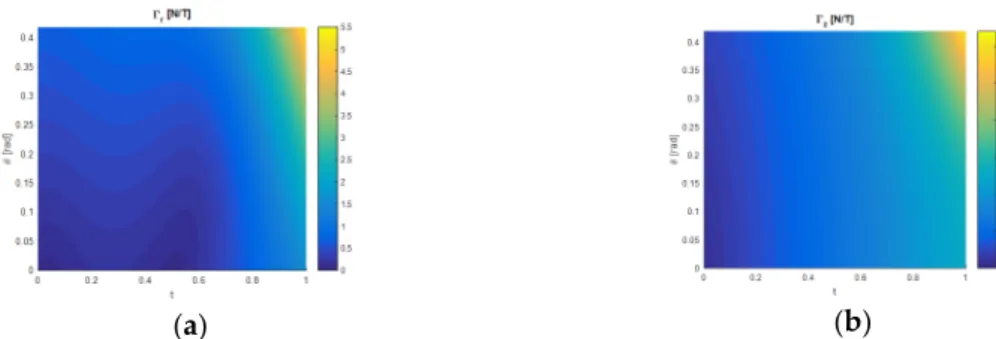
An example of the sensitivity components Γ and Γ produced under load are given in Figure
8a,b, respectively, for H = 7 mm and G = 5 kPa. Each relationship is derived from the force and magnetic field equations generated by GP and are shown as functions of the displacement described
by t and θ. Because the results presented in Sections 3.1 and 3.2 are shown to be accurate it follows
that the sensitivity is also accurately described. Figure 8a,b show that the sensitivity has a non-linear
response as a function of t and θ which can only be described by the solutions obtained
computationally. Figure 8a illustrates that Γ tends to increase with increasing t but the response is
not always monotonic. Γ increases with increasing θ and the response is monotonic. Figure 8b
shows that Γ increases monotonically with both t and θ and is an order of magnitude larger than
Γ.
(a) (b)
Figure 8. Sensitivity responses generated from GP showing the effect of t and θ for H = 7 mm and G
= 5 kPa. (a) Coloured by Γ. (b) Coloured by Γ.
Figure 7.Response of displacement magnitude shown in m for the sensor under load at t = 1,θ= 0.423 rad, H = 7 mm and G = 5 kPa.
3.3. Sensitivity
An example of the sensitivity componentsΓrandΓzproduced under load are given in Figure8a,b,
respectively, for H = 7 mm and G = 5 kPa. Each relationship is derived from the force and magnetic field equations generated by GP and are shown as functions of the displacement described by t
andθ. Because the results presented in Sections 3.1and 3.2are shown to be accurate it follows
that the sensitivity is also accurately described. Figure8a,b show that the sensitivity has a non-linear
response as a function of t andθwhich can only be described by the solutions obtained computationally.
Figure8a illustrates thatΓrtends to increase with increasing t but the response is not always monotonic.
Γr increases with increasingθ and the response is monotonic. Figure8b shows thatΓzincreases
Sensors2017,17, 2539 14 of 20 3.2. Strcutural Mechanics
An example of the structural mechanics results of the MagOne sensor under normal and shear loading is presented in Figure 7, which illustrates the distribution of displacement magnitude in the
elastomer at t = 1, θ = 0.423 rad, H = 7 mm and G = 5 kPa. Due to normal loading the elastomer material
is compressed in the z-direction between the rigid surfaces which due to the boundary conditions imposed results in ± displacement of material in the r-direction. Material is displaced further in the positive r-direction than the negative because this is the shear loading orientation. It is also shown that under load the elastomer contacts the upper and lower indenting surfaces and since material cannot deform past these locations the shape of the sensor is significantly changed. The responses generated by GP as a result of the structural mechanics simulations were accurate, with the errors in
F and F an order of magnitude smaller than the values obtained from FE over the full range of t
and θ. The shear force F obtained from the structural mechanics simulations as a function of the
displacements u and u is presented in Figure 5a and as a function of t and θ in Figure 5b,
corresponding to this the normal force F calculated monotonically increased with t and remained
constant for all θ.
Figure 7. Response of displacement magnitude shown in m for the sensor under load at t = 1, θ = 0.423 rad, H = 7 mm and G = 5 kPa.
3.3. Sensitivity
An example of the sensitivity components Γ and Γ produced under load are given in Figure
8a,b, respectively, for H = 7 mm and G = 5 kPa. Each relationship is derived from the force and magnetic field equations generated by GP and are shown as functions of the displacement described
by t and θ. Because the results presented in Sections 3.1 and 3.2 are shown to be accurate it follows
that the sensitivity is also accurately described. Figure 8a,b show that the sensitivity has a non-linear
response as a function of t and θ which can only be described by the solutions obtained
computationally. Figure 8a illustrates that Γ tends to increase with increasing t but the response is
not always monotonic. Γ increases with increasing θ and the response is monotonic. Figure 8b
shows that Γ increases monotonically with both t and θ and is an order of magnitude larger than
Γ.
(a) (b)
Figure 8. Sensitivity responses generated from GP showing the effect of t and θ for H = 7 mm and G
= 5 kPa. (a) Coloured by Γ. (b) Coloured by Γ.
Figure 8.Sensitivity responses generated from GP showing the effect of t andθfor H = 7 mm and G = 5 kPa. (a) Coloured byΓr. (b) Coloured byΓz.
3.4. Design Optimisation
Figure9a,b show under stable shear loading conditions, the responses of the objectivesΓr,maxand
Γz,maxand responses of the constraints Fr,minand Fz,maxas functions of the design variables H and
G, respectively. Both Figure9a,b were generated by assessing the sub-optimisation procedure (i) as
described in Section2.3.4over a 10×10 grid of H and G values, and subsequently linearly interpolated
to produce the result between the known locations. Figure9a shows that there is a nonlinear response
ofΓr,maxandΓz,maxas functions of H and G. Toward the bounds of H both functions are shown to
decrease with increasing H, whereas, in the regions near H = 4 mm there are sharp turning points where both functions suddenly increase with increasing H. The effect of increasing G increases both functions.
Figure9b shows that Fz,maxhas a similar type of response asΓr,maxandΓz,maxover the ranges of H
and G, whereas, Fr,mindecreases monotonically with increasing H and increases monotonically with
increasing G. The turning points identified correspond to the values of H and G for which Fr,minis no
longer at the maximum t andθ, that is, when shear loading becomes unstable and there is a change in
the bounds, t andθfrom the measurements of Fz,max, Γr,maxandΓz,maxare refined.
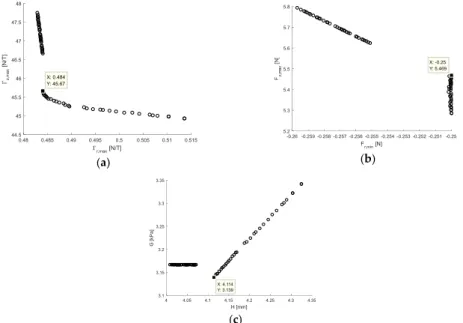
The multi-objective optimisation procedure (ii) as described in Section2.3.4was conducted with
force constraints Fr,c =−0.25 N and Fz,c = 5 N used as an example. The Pareto optimal set of
objectives generated as a result of the optimisation is presented in Figure10a, and subsequently
Figure10b,c present the corresponding constraints and design variables. The Pareto set was shown to
be disconnected in the design space due to the competing objectives and constraints with two regions
identified: (i) where theΓz,max changed linearly with theΓr,max; and (ii) where theΓr,maxchanged
with an increasing rate with Fz,max. In (i) Fr,mindecreases linearly with Fz,maxand both constraints are
satisfied, also G is constant for all H. Whereas, in (ii) Fr,minis always equal to the constraint value for
all Fz,maxand the value of G produced increases linearly with H.
The optimal sensor design under shear loading was determined by assuming equal weighting of the solutions over the norms of the Pareto set and selecting the design which produced the lowest value.
This corresponded to the lowest value ofΓr,maxand highest value ofΓz,maxin region (ii). The optimal
design and corresponding objectives, constraints, and design variables are highlighted in Figure10a–c,
respectively. Under stable loading conditions and the specified force constraints, the optimal sensor
design was selected as H∗= 4.11 mm and G∗= 3.14 kPa. This corresponded toΓ∗r,max= 0.48 T/N and
Γ∗
z,max= 45.7 T/N, with F∗r,min=−0.25 N and F∗z,max= 5.47 N.
This result compares well to the sensitivities ofΓr,max= 0.81 T/N andΓz,max= 50.5 T/N for the
design as originally proposed by Wang et al. [9] where H = 3 mm and G = 2.94 kPa. It is of note that
their design did not consider the force constraints as imposed by the optimisation such that for their
design Fr,min =−0.34 N and Fz,max = 7.03 N; this further demonstrates how the optimised design
improves sensitivity at the expense of the constrained measureable force. Setting the constraint force to
Fr,c =−0.34 N and Fr,c =7.03 N and evaluating the optimisation study again yielded optimal values
of H∗= 4.17 mm and G∗= 4.51 kPa, which gives a taller and stiffer sensor than that of Wang et al. [9]
![Figure 1. Photographs of the MagOne sensor designs. (a) As developed by Wang et al. [9]](https://thumb-us.123doks.com/thumbv2/123dok_us/7745578.166091/2.892.152.746.561.743/figure-photographs-magone-sensor-designs-developed-wang-et.webp)