Eliciting Expertise
Nigel Shadbolt, Dept. of Electronics and
Computer Science, University of Southampton,
U.K.
Introduction
Since the last edition of this book there have been rapid developments in the use and exploitation of formally elicited knowledge. Previously, (Shadbolt and Burton, 1995) the emphasis was on eliciting knowledge for the purpose of building expert or knowledge-based systems. These systems are computer programs intended to solve real-world problems, achieving the same level of accuracy as human experts. Knowledge engineering is the discipline that has evolved to support the whole process of specifying, developing and deploying knowledge-based systems (Schreiber et al., 2000)
Now there is a much wider interest in capturing and modelling knowledge and expertise. This has arisen because the importance of Knowledge Management (KM) is universally recognised by organisations large and small. There are many different characterizations of KM but the central assumption is that knowledge is a valuable asset that must be managed (Nonaka and Takeuchi, 1995; Stewart, 1997). What we are looking for in KM is a means to get the right knowledge to the right people at the right time and in the right form. These are difficult challenges many of them identical to those encountered when building early knowledge-based systems (Hayes-Roth, Waterman and Lenat, 1983). Acquiring, documenting, distributing, reusing and maintaining knowledge are all difficult and time-consuming tasks. We have argued elsewhere that the tools and techniques, methods and approaches of knowledge engineering are well suited to the KM enterprise (Milton et al., 1999)
This chapter will discuss the problem of knowledge elicitation for knowledge intensive systems in general. These systems range from classical knowledge-based systems through to structured intranets, from workflow support tools through to best practice guidelines. The content elicited from experts does not have to exist in an electronic format at all. However, increasingly the results of hard won knowledge elicitation and expertise modelling find their way into some form of digital system.
content on the web is changing the way might think about aspects of the knowledge acquisition problem.
There is still no comprehensive theory of knowledge acquisition available. It remains an art as much as a science. It is not the purpose of this chapter to investigate the theoretical shortcomings of knowledge acquisition but to deliver practical advice and guidance on performing the process.
Knowledge Intensive Systems
In the early days of Artificial Intelligence much effort went into attempts to discover general principles of intelligent behaviour. Newell and Simon's (1963) General Problem Solver exemplified this approach. They were interested in uncovering a general problem solving strategy that could be used for any human task.
In the early 1970s this position was challenged. A new slogan came to prominence - 'in the knowledge lies the power'. A leading exponent of this view was Edward Feigenbaum of SRI. He observed that experts are experts by virtue of domain specific problem solving strategies together with a great deal of domain specific knowledge. Programs that attempted to implement detailed knowledge about tasks and the subjects to which they applied came resulted in the class of programs called Expert or Knowledge-Based Systems. These are now widely used and often quite invisible to the end user. The spelling and grammar checker that is being used to write this chapter owes its origins to knowledge-based systems technology. There are systems that look for patterns to detect credit card fraud, classify radar tracks, interpret patient vital signs and support in the design of aero engines.
There are a variety of ways in which expertise is encoding in run time systems. Many systems will incorporate some of rule based or object orientated representation. For a review of the major types of knowledge based system architecture and of different knowledge representation formalisms see Stefik, 1993.
The Problem of Elicitation
The people who build knowledge intensive systems are typically not people with a deep knowledge of the application domain. However, it is they who must gather the domain knowledge and then implement it in a form that the machine can use.
In the simplest case, one may be able to gather information from a variety of non-human resources: textbooks, technical manuals, case studies and so on. However, in most cases one needs actually to consult a practising expert. This may be because there isn't the documentation available, or because real expertise derives from practical experience in the domain, rather than from a reading of standard texts. The task of gathering information generally, from whatever source is called knowledge acquisition.(KA). The sub-task of gathering information from the expert is called
Many problems arise before elicitation of the detailed domain knowledge. We need to understand the purpose and requirements for any knowledge intensive system. Sometimes the failure is in formulating the role of the system, on other occasions it is a failure to appreciate what it is realistic to build. Systems can fail because no one has thought of the social and organisational problems that must be resolved in deploying a system. Very often the effort and resources required to build systems are underestimated: this occurs in both the development and maintenance of systems. A particularly nasty situation arises when one is expected to conjure up knowledge for areas in which no evidence of systematic practice exists at all. Here one is expected to provide theories for domains where there is no theory. Providing we can resolve these issues then we get down to KE in the expectation that it will be time well spent.
Two questions dominate in KE. How do we get experts to tell us, or else show us, what they do? How do we determine what constitutes their problem solving competence? This is a hard enough problem in itself but there are a variety of circumstances that contrive to make the problem even harder. Much of the power of human expertise lies in laid-down experience, gathered over a number of years, and represented as heuristics1. Often the expertise has become so routinised that experts no longer know what they do or why. In many cases the knowledge required to build a system is distributed across an organisation and in the heads of a number of experts. Experts do not always agree so there is the problem of reconciling conflicting or differing views.
There are obviously clear commercial reasons to try to make KE an effective process. We would like to be able to use techniques that will minimise the effort spent in gathering, transcribing and analysing an expert's knowledge. We would like to minimise the time spent with expensive and scarce experts. And, of course, we would like to maximise the yield of usable knowledge.
There are also sound engineering reasons why we would like to make KE a systematic process. We would like the procedures of KE to become common practice and conform to clear standards. This will help ensure that the results are robust. Robust methods are ones that can be used on various experts in a wide range of contexts by any competent knowledge engineer or KE practitioner. We also hope to make our techniques reliable. This will mean that different practitioners can apply them with the same expected utility. Placing elicitation on such a systematic footing will also be important in the development of methodologies that direct the process of specifying, constructing and maintaining systems.
We will begin by describing, in sufficient detail for the reader to apply them, examples of major KE methods. We will mention other techniques and where the reader can find out more about them. We will then review aspects of expertise and human information processing that are likely to directly affect the KE process. We will also indicate various software tools that implement or support some of these KE methods. We will describe the methodologies for acquisition and modelling expertise
1An heuristic is defined as a rule of thumb or generally proven method to obtain a result given
that are beginning to emerge. Finally, we will discuss the effect that the presence of evermore content on the web is having on the knowledge acquisition problem
Elicitation Techniques
The techniques we will describe are methods that we have found in our previous work to be both useful and complementary to one another. We can subdivide them into
natural and contrived methods. The distinction is a simple one. A method is described as natural if it is one an expert might informally adopt when expressing or displaying expertise. Such techniques include interviews or observing actual problem solving. There are other methods we will describe in which the expert undertakes a contrived task. The task elicits expertise in ways that are not usually familiar to an expert. The first two categories of elicitation method are both natural under this definition and are varieties of interview and protocol analysis.
The Structured Interview
Almost everyone starts in KE by determining to use an interview. The interview is the most commonly used knowledge elicitation technique and takes many forms, from the completely unstructured interview to the formally-planned, structured interview.
The structured interview is a formal version of the interview in which the person eliciting the knowledge plans and directs the session. A significant benefit of the structured interview is that it provides structured transcripts that are easier to analyse than unstructured conversation. In reality the structured interview is a class of techniques (Hoffman et al., 1995).
The formal interview specified here constrains the expert-elicitor dialogue to the general principles of the domain. Experts do not work through a particular scenario extracted from the domain by the elicitor; rather experts generate their own scenarios as the interview progresses.
A template for such an interview is as follows.
1. Ask the expert to give a brief (10 minute) outline of the target task, including the following information:
An outline of the task, including a description of the possible solutions or outcomes of the task;
A description of the variables that affect the choice of solutions or outcomes;
A list of major rules or procedures that connect the variables elicited to the solutions or outcomes.
3. Repeat Stage 2 until it is clear that the expert will not produce any additional information.
A useful way of obtaining a domain overview (stage 1 of the structured interview) is to ask probe questions that relate to an individuals specific experience. It is also important in this technique to be specific about how to perform stage 2. We have found that it is helpful to constrain the elicitor's interventions to a specific set of
probes, each with a specific function. Here is a list of probes (P) and functions (F) that can help in stages 1 & 2.
P1.1 Could you tell me about a typical case?
F1.1 Provides an overview of the domain tasks and concepts
P1.2 Can you tell me about the last case you encountered?
F1.2 Provides an instance based overview of the domain tasks and concepts
P2.1 Why would you do that?
F2.1 Converts an assertion into a rule
P2.2 How would you do that? F2.2 Generates lower order rules
P2.3 When would you do that? Is <the rule> always the case?
F2.3 Reveals the generality of the rule and may generate other rules
P2.4 What alternatives to <the prescribed action/decision> are there? F2.4 Generates more rules
P2.5 What if it were not the case that <currently true condition>? F2.5 Generates rules for when current condition does not apply
P2.6 Can you tell me more about <any subject already mentioned> F2.6 Used to generate further dialogue if expert dries up
P2.7 Can you tell me about an unusual case you encountered/heard about from some other expert?
F2.7 Refines the knowledge to include rare cases and special procedures
The sample of dialogue below is taken from a real interview of this kind. It is the transcript of an interview by a knowledge engineer (KE) with an expert (EX) in the domain of geological analysis2.
KE What would you do at this stage?
EX I would look at the grain size of the hand specimen and see how fine it was KE Why would you look at the grain size?
EX That will tell me if the rock has been formed near to the surface or deep inside the earth. The finer the grain size the faster it cooled. Coarse crystals indicate that the rock was cooling slowly + forming deeper down + we say its emplacement is plutonic + if it cooled near the surface its emplacement is volcanic.
KE Are there any alternatives to coarse and fine grain size?
EX There are glasses + you can’t see any structure here because the rock cooled so fast
KE What would you look at next?
EX Colour is important + the lighter the rock the more acidic it is. KE Why is a lighter rock more acidic?
EX Acidic rocks are higher in quartz and colour is a good indicator of quartz content – leucocratic or light things have a lot of quartz - melanocratic that is darker rocks have olivines and pyroxines.
This is quite a rich piece of dialogue. From this section of the interview alone we can extract numerous rules such as
IF grain size is large THEN rock is plutonic
IF rock is leucocratic
THEN rock has high quartz content
Of course these rules may need refining in later elicitation sessions, but the text of the dialogue shows how the use of the specific probes has revealed a well-structured response from the expert3.
Semi-Structured Interviews
Techniques exist to impose a lesser amount of structure on an interview. We mention two examples here. One of these is the Knowledge Acquisition Grid (LaFrance, 1987). This is a matrix of knowledge types and forms: examples of knowledge forms are layouts and stories; examples of question types are grand tour and
cross-checking. A grand tour involves such things as distinguishing domain boundaries and the overall organization of goals; cross-checking involves the engineer attempting to validate the acquired knowledge by, for example, playing devil's advocate.
2 In the transcripts we use the symbol + to represent a pause in the dialogue.
3 In fact, a possible second-phase elicitation technique would be to present these rules back to the
Secondly, there is the teachback technique of (Johnson and Johnson, 1987). In this technique when formulates a representation of the knowledge that has been acquired in an interview. This is then 'taught back' to the expert, who can then check or, when necessary, amend the information.
Unstructured Interviews
Unstructured interviews have no agenda (or, at least, no detailed agenda) set either by the knowledge elicitor or by the expert. Of course, this does not mean that the elicitor has no goals for the interview, but it does mean that she has considerable scope for proceeding; there are few constraints and herein lie its advantages. Firstly, the approach can be used whenever one of the goals of the interview is to establish a rapport between the expert and the knowledge elicitor. There are no formal barriers to the discussion covering whatever material either participant sees fit. Secondly, one can get a broad view of the topic easily; the knowledge elicitor can 'fill in the gaps' in her own perceived knowledge of the domain. Thirdly, the expert can describe the domain in a way with which he is familiar, discussing topics that he considers important and ignoring those he considers uninteresting.
The disadvantages are clear enough. The lack of structure can lead to inefficiency. The expert may be unnecessarily verbose. He may concentrate on topics whose importance he exaggerates. The coverage of the domain may be patchy. The data acquired may be difficult to integrate, either because it does not form a coherent body of content, or because there are inconsistencies. This last will be an even more likely occurrence if the information provided by several experts is to be collated.
In all of the interview techniques mentioned so far (and in some of the other generic techniques as well) there exist a number of dangers that have become familiar to practitioners of knowledge elicitation.
One problem is that in an interview experts will only produce what they can verbalise. If there are non-verbalisable aspects to the domain, the interview will not recover them. It may be that the knowledge was never explicitly represented or articulated in terms of language (consider, for example, pattern recognition expertise). Then there is the situation where the knowledge was originally learnt explicitly in a propositional or language-like form. However, in the course of experience such knowledge can become routinised or automatised4. This can happen to such an extent that experts may regard the complex decisions they make as based only on hunches or intuitions. In actual fact, these decisions are based upon large amounts of remembered data and experience, and the continual application of that knowledge. In this situation they tend to give black box replies 'I don't know how I do that....', 'It is obviously the right thing to do....'.
Another problem arises from the observation that people (and experts in particular) often seek to justify their decisions in any way they can. It is a common experience of
4We often use a computing analogy to refer to this situation and speak of the expert as having compiled
the knowledge elicitor to get a perfectly valid decision from an expert, and then to be given a spurious justification as to why it was made and how it originated.
For these and other reasons one should always supplement interviews with additional elicitation methods. Elicitation ought always to consist of a programme of techniques and methods. This brings us on to consider another family of techniques much favoured by knowledge engineers.
Protocol Analysis
Protocol Analysis (PA) is a generic term for a number of different ways of performing some form of analysis of the expert(s) actually solving problems in the domain. In all cases the elicitor takes a record of what the expert does - preferably by video or audio tape - or at least by written notes. Transcripts or protocols are then made from these records and the elicitor tries to extract meaningful structure, rules and processes from the protocols.
We can distinguish two general types of PA -on-line and off-line. In on-line PA the expert is being recorded solving a problem, and concurrently a commentary is made. The nature of this commentary specifies two sub-types of the on-line method. The expert performing the task may be describing what they are doing as problem solving proceeds. This is called self-report. A variant on this is to have another expert provide a running commentary on what the expert performing the task is doing. This is called
shadowing.
Off-line PA allows the expert(s) to comment retrospectively on the problem solving session - usually by being shown an audio-visual record of it. This may take the form of retrospective self-report by the expert who actually solved the problem. It could also be a critical retrospective report by other experts, or there could be group discussion of the protocol by a number of experts including its originator. In the case in which only a behavioural protocol is obtained then obviously some form of retrospective verbalisation of the problem-solving episode is required.
Before PA sessions can be held, a number of pre-conditions should be satisfied. The first of these is that the elicitor is sufficiently acquainted with the domain to understand the expert's tasks. Without this the elicitor may completely fail to record or take note of important parts of the expert’s behaviour.
A second requirement is the careful selection of problems for PA. This sampling of problems is crucial. PA sessions may take a relatively long time, only a few problems can be addressed in any programme of acquisition (Shadbolt and Burton, 1989). Therefore, the selection of problems should be guided by how representative they are. Asking experts to sort problems into some form of order (Chi et al., 1981, 1982 ) may give an insight into the classification of types of problems and help in the selection of suitable problems for PA (see also the next two sections on concept sorts and laddering for methods that can be used to help structure a classification of types of problem).
A further condition for effective PA is that the expert(s) should not feel embarrassed about describing their expertise in detail. It is preferable for them to have experience in thinking aloud. Uninhibited thinking aloud has to be learned in the same way as talking to an audience. One or two short training sessions may be useful. In these training sessions a simple task can be used as an example. This puts the expert at ease and familiarises them with the task of talking about their problem solving.
Where a verbal or behavioural transcript has been obtained we next have to undertake its analysis. Analysis might include the encoding of the transcript into 'chunks' of knowledge (actions, assertions, propositions, key words, etc.), and should result in a rich domain representation with many elicited domain features together with a number of specified links between those features. The example below is from a self-report of an expert geologist. It is immediately apparent that protocols can be extremely dense sources of information. A very significant amount of work is required to analyse and structure the content in this very small fragment of a self report on one specimen.
To start off with it's obviously a fairly coarse-grained rock ... and you've got some nice big orthoclase crystals in here - this is actually SHAP GRANITE - I know it just because everybody's seen SHAP GRANITE - or it's a very strong possibility that it's SHAP GRANITE ... it's a typical teaching specimen - as I say the obvious things are these very big orthoclase crystals pink colouration and you can certainly see some cleavage in some of them - you can certainly make out there are feldspar cleavages in there - it's a coarse-grained rock anyway, you can see the crystals nice and coarsely - these large porphyritic crystals - you can see, in the ground mass, you can see quartz - get some light on it (HOLDS SPECIMAN UP TO WINDOW) quartz, which is this fairly clear mineral you can actually look into it and see through it as opposed to calcite or feldspars where it's more cloudy - you can't actually see any good crystal faces on these cut sections - small flakes of biotite, black micacious looking - small plates, you can certainly see some on this specimen even without a hand lens.
There are a number of principles that can guide the protocol analysis. For example, analysis of the verbalization resulting in the protocol can distinguish between information that is attended to during problem-solving, and that which is used implicitly. A distinction can be made between information brought out of memory (such as a recollection of a similar problem solved in the past), and information that is produced 'on the spot' by inference. The knowledge chunks referred to above can be analysed by examining the expert's syntax, or the pauses he takes, or other linguistic cues. Syntactical categories (e.g. use of nouns, verbs, etc.) can help distinguish between domain features and problem-solving actions, etc.
gives you a complete episode of problem solving. It can be useful as a verification method to check that what people say is what they do. It can take you deep into a particular problem. However, it is intrinsically a narrow method since usually one can only run a relatively small number of problems from the domain.
When actually conducting a PA the following are a useful set of tips to help enhance its effectiveness. Present the problems and data in a realistic way. The way problems and data are presented should be as close as possible to a real situation. Transcribe the protocols as soon as possible, the meaning of many expressions is soon lost, particularly if the protocols are not recorded. In almost all cases an audio recording is sufficient, but video recordings have the advantage of containing additional and disambiguating information. Avoid long self-report sessions. Because of the need to perform a double task the process of thinking aloud is significantly more tiring for the expert, than being interviewed. This is one reason why shadowing is sometimes preferred. In general, the presence of the elicitor is required in a PA session. Although the elicitor adopts a background role, her very presence suggests a listener to the interviewee, and lends meaning to the talking aloud process. Therefore, comments on audibility, or even silence by the elicitor, are quite acceptable.
Protocol analyses share with the unstructured interview the problem that they may deliver unstructured transcripts that are hard to analyse. Moreover, they focus on particular problem cases and so the scope of the knowledge produced may be very restricted. It is difficult to derive general domain principles from a limited number of protocols. These are some of the practical disadvantages of protocol analysis. However, there are more subtle problems.
Two actions, which look exactly the same to the knowledge elicitor, may be very different in their extent and intent. For example, our geologist who performs a particular test to a specimen may apply that same test to another but with a quite different purpose. The knowledge elicitor simply does not know enough to discriminate the actions. The obverse to this problem can arise in shadowing and the retrospective analyses of protocols by experts. Here the expert(s) may simply wrongly attribute a set of considerations to an action after the event. This is analogous to the problems of misattribution in interviewing.
A particular problem with self-report, apart from being tiring, is the possibility that verbalisation may interfere with performance. The classic demonstration of this is for a driver to attend to all the actions involved in driving a car. If one consciously monitors such parameters as engine revs, current gear, speed, visibility, steering wheel position and so forth, the driving invariably gets worse. Such skill is shown to its best effect when performed automatically. This is also the case with certain types of decision making expertise. By asking the expert to verbalise, one is in some sense destroying the point of doing protocol analysis - to access procedural, real-world knowledge.
Finally, when performing PA it is useful to have a set of conventions for the actual interpretation and analysis of the resultant data. Ericsson and Simon (1993) provide the classic exposition of protocol analysis although it is oriented towards cognitive psychology. Useful additional references are Kuipers and Kassirer (1983), Belkin, Brooks and Daniels (1987), McGraw and Harbison-Briggs (1989), Scott et al. (1991) and Firlej and Hellens (1991).
Critical Decision Method
This method contains elements of both interviewing and protocol analysis but in a context that stresses the examination of problem solving in natural decision making contexts (Zsambok and Klein, 1997). Klein and his colleagues developed a set of opening queries to stimulate recall of salient cases – cases that involved critical decisions (K1ein et al 1986). A set of probe questions that were designed to elicit specific, detailed information about the important cues, choice points, options, actions plans and the role of experience in decision making. A distinctive feature of this approach was that it seemed well suited to eliciting knowledge relating to highly dynamic situations where the requirement was to rapidly a situation and identify an effective and feasible course of action (Klein, 1993a, 1993b). Domains examined using the approach included acute clinical care, military planning, fire fighting and industri.al process control.
A CDM session is organised around an account of a specific incident from the expert’s own experience. The expert is guided in the recall and recounting of the incident and its context. There then follow three information-gathering passes back through the incident. First a time line is built that verifies the points at which decisions are made. Second there is a phase of deepening that produces a more comprehensive and contextually rich account of the incident – focusing for example, on the cues used to recognise salient features of the incident. A final information sweep uses a “what if” approach to identify potential errors, alternative decision points, and expert/novice differences.
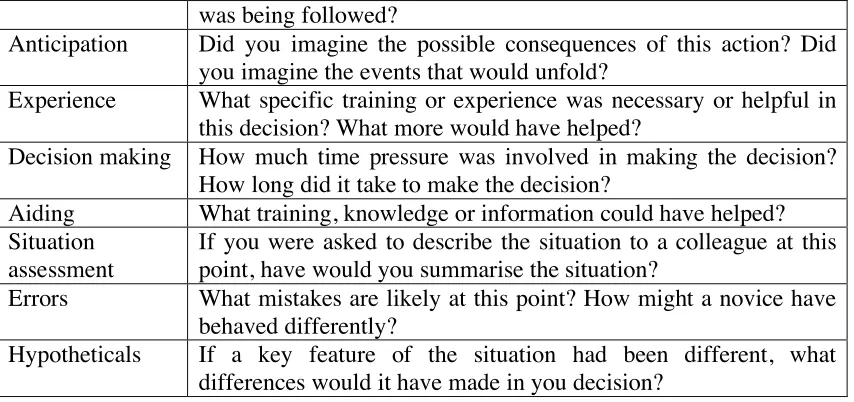
The table below contains a range of probe questions types with exemplars that we have found to be particularly useful in various phases of the CDM. There is no reason to use these questions exclusively for an individual phase although it is clear that the
options and choice probe types are likely to feature substantially in the “what if” phase of information gathering
Probe Type Probe Examples
Cues What were you seeing, hearing, smelling?
Knowledge What information did you use in making this decision? How was it obtained?
Analogues Were you reminded of any previous incidents?
Scenarios Does this case fir a standard or typical scenario? Does it fit a scenario you were trained to deal with?
Goals What were your specific goals and objectives at the time? Options What other courses of action were considered or available?
was being followed?
Anticipation Did you imagine the possible consequences of this action? Did you imagine the events that would unfold?
Experience What specific training or experience was necessary or helpful in this decision? What more would have helped?
Decision making How much time pressure was involved in making the decision? How long did it take to make the decision?
Aiding What training, knowledge or information could have helped? Situation
assessment
If you were asked to describe the situation to a colleague at this point, have would you summarise the situation?
Errors What mistakes are likely at this point? How might a novice have behaved differently?
[image:12.595.86.513.72.273.2]Hypotheticals If a key feature of the situation had been different, what differences would it have made in you decision?
Table 1 Sample CDM Probe Questions
A typical CDM session can last around 2 hours and depending on the domain more or less time might be spent on recollecting a rich complex incident whilst in another setting the majority of the effort is devoted to examining counterfactual situations. The CDM does have limitations. In distributed problem solving no one individual may handle more than one element of a task. They would never know whether their judgements or assessments were correct. In high workload environments we have observed that incidents and events can become merged. When responding to an opening query one sometimes sees an expert recount an incident but then become confused when asked for a time line or other details. Despite these shortcomings the style of interview and problem solving reflection provides a rich output from which the elicitor can extract important task relevant knowledge – a more detailed account of the method can be found in Hoffman et al 1998.
The techniques discussed so far are natural and intuitively easy to understand. Experts are used to expressing their knowledge in these sorts of ways. The techniques that follow are what we what we have termed contrived and permit the expression of knowledge in ways that are likely to be unfamiliar to the expert.
Concept Sorting
Concept sorting is a technique that is useful when we wish to uncover the different ways an expert sees relationships between a fixed set of concepts.
In the version we will present an expert is presented with a number of cards on each of which a concept word is printed. The cards are shuffled and the expert is asked to sort the cards into either a fixed number of piles of else to sort them into any number of piles the expert finds appropriate. This process is repeated many times.
Performing a card sort requires the elicitor to have some basic conception of the domain. Cards have to be made with the appropriate labels before the session. However, no great familiarity is required as the expert provides all the substantial knowledge in the process of the sort. We now provide an example from our geology domain to show the detailed mechanics of a sort.
The concepts printed on the cards were the names of igneous rocks drawn from a structured interview with the expert. He had described 18 rock types
1 adamellite
2 andesite
3 basalt
4 dacite
5 diorite
6 dolerite 7 dunite
8 gabbro
9 granodiorite
10 granite 11 lherzolite 12 microgranite 13 peridotite 14 picrite basalt 15 rhyodacite 16 rhyolite 17 syenite 18 trachyte
The expert was shown possible ways of sorting cards in a toy domain, as part of the briefing session, and then asked to sort the real elements in the same way.
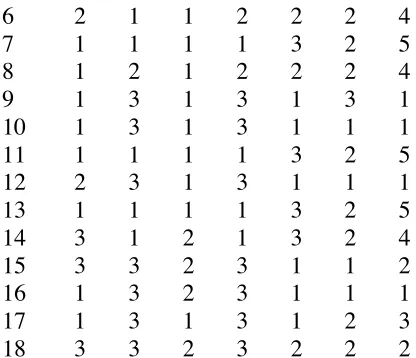
The dimensions/piles which the expert used for the various sorts were as follows:
Sort 1: grain size Piles 1=coarse, 2=medium, 3=fine
Sort 2: colour Piles 1=melanocratic, 2=mesocratic, 3=leucocratic
Sort 3: emplacement Piles 1=intrusive, 2=extrusive
Sort 4: presence of olivine Piles 1=always, 2=possibly, 3=never
Sort 5: presence of quartz Piles 1=always, 2=possibly, 3=never
Sort 6: % of silica Piles 1= >68%, 2= <68%, 3= about 68%
Sort 7: density Piles 1=v.light, 2=light, 3=medium, 4=dense,5=v.dense
Here is a table showing the pile of each sort for each element. You will see that many of the elements are distinguishable from one another - even with these few sorts.
SORT
ROCK 1 2 3 4 5 6 7
6 2 1 1 2 2 2 4 7 1 1 1 1 3 2 5 8 1 2 1 2 2 2 4 9 1 3 1 3 1 3 1 10 1 3 1 3 1 1 1 11 1 1 1 1 3 2 5 12 2 3 1 3 1 1 1 13 1 1 1 1 3 2 5 14 3 1 2 1 3 2 4 15 3 3 2 3 1 1 2 16 1 3 2 3 1 1 1 17 1 3 1 3 1 2 3 18 3 3 2 3 2 2 2
Table 1: Tabulated results from the card sort
Using this information we can attempt to extract decision rules directly. An example of a rule extracted from the sorting is :
IF the grain size is fine (sort 1/pile 3)
AND the colour is mesocratic (sort 2/pile 2)
AND its emplacement is extrusive (sort 3/pile 2) AND it does NOT contain olivine (sort 4/pile 3) AND may possibly contain quartz (sort 5/ pile 2) AND it contains less than 68% silica (sort 6/ pile 2)
AND its density is medium (sort 7/ pile 3)
THEN the rock is andesite (outcome 2)
As you can see from the example such sorts produce long and cumbersome rules. In fact many of the clauses may be redundant - once you have established that the grain size is small, then it is going to be an extrusive rock.
However, the utility of this technique does not reside solely in the production of decision rules. We can use it, as we have said, to explore the general inter-relationships between concepts in the domain. We are trying to make explicit the implicit structure that experts impose on their expertise.
When using any of these KE methods knowledge elicitors should beware a type of semantic mindset whereby the expert or elicitor focuses on only one type of knowledge element. To derive the full benefit of a KE method one should play many variations on the theme. For example, in concept sorting the cards can name knowledge elements of any type not just objects in a domain. The cards might name tasks, goals, actions, resources etc. The restriction is that in any sorting session the cards should be of the same knowledge type.
you have isolated a higher order concept that can be used as a basis for future elicitation.
The advantages of concept sorting can be characterised as follows. It is fast to apply and easy to analyse. It forces an explicit format on the constructs that are underlie an experts understanding. In fact it is often instructive to the expert. A sort can lead the expert to see structure that he himself has not consciously articulated before. Finally, in domains where the concepts are perceptual in nature (i.e. x-rays, layouts and pictures of various kinds) then the cards can be used as a means of presenting these images and attempting to elicit names for the categories and relationships that might link them.
There are, of course, features to be wary of with this sort of technique. Experts can often confound dimensions by not consistently applying the same semantic distinctions throughout an elicitation session. Alternatively, they may over simplify the categorisation of elements, missing out important caveats.
An important tip with all of the contrived techniques we are reviewing is to always audiotape these sessions. An expert makes many asides, comments and qualifications in the course of sorting ranking and so on. In fact one may choose to use the contrived methods as a means to carry out auxiliary structured interviews. The structure this time is centred on the activity of the technique.
It is worth noting that we have found (Schweikert et al., 1987) an expert's own opinion of the worth of a technique no guide to its real value. In methods such as sorting we have a situation in which the expert is trying to demonstrate expertise in a non-natural or contrived manner. He might be quite used to chatting about his field of expertise, but sorting is different and experts may be suspicious of it. Experts may in fact feel they are performing badly with such methods. However, on analysis one finds that the yield of knowledge is as good and sometimes better than for non-contrived techniques (Shadbolt and Burton, 1990).
Laddered Grids
Another somewhat contrived technique that you will need to explain carefully to the expert before starting. The expert and elicitor construct a graphical representation of the domain in terms of the relations between domain or problem solving elements. The result is a qualitative, two-dimensional graph where nodes are connected by labelled arcs. No extra elicitation method is used here, expert and elicitor construct the graph together by negotiation.
In using the technique the elicitor enters the conceptual map at some point and then attempts to move around it with the expert. A formal specification of how we use the technique is shown below together with an example of its use.
Start the expert off with a seed item
To move DOWN the expert's domain knowledge:
Can you give examples of <ITEM>?
To move ACROSS the expert's domain knowledge:
What alternative examples of <CLASS> are there to <ITEM>?
To move UP the expert's domain knowledge:
What have <SAME LEVEL ITEMS> got in common?
What are <SAME LEVEL ITEMS> examples of?
To elicit essential properties of an item:
How can you tell it is <ITEM> ?
To discriminate items:
What is the key difference between <ITEM 1> and <ITEM 2>?
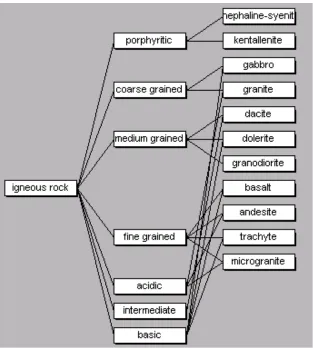
The elicitor may move around the knowledge map in any order which seems appropriate or convenient. As the session progresses, the elicitor keeps track of the elicited knowledge by drawing up a network on a large piece of paper or if computer supported via some other graphical characterisation. This representation allows the elicitor to make decisions (or ask questions) about what constitutes higher or lower order elements in the domain, what differences exist between elements in the network. In order to give the reader the flavour of the technique, there follows an extract from a laddered grid elicitation session. Once again, the knowledge domain is geology.
KE So how could you tell something was dacite?
EX Well + examine the fresh surface and the weathered surfaces first + looking at grainsize, the relationship between the grains
KE Can I just stop you there. What type of grain size is it?
EX Coarse, medium, fine grain, oh, you want me to actually say what dacite is?
KE The grain, in dacite what would it be? EX Er + medium grained.
KE Medium grained, right. So can you give me other examples of medium grained rocks?
EX Medium grained rocks + dolerite... Granodiorite as well... And we'll stay with that.
KE Right, erm, what alternative is there to a medium grained rock? EX Well, you can have a coarse grained one or a fine grained one,
those are sort of the three major ones.
EX Er, gabbro, granite... hmm, yeah, those two. KE And any examples of fine-grained rocks?
EX Er, basalt... er andesite, trachyte...microgranite as well. KE Right, erm so. What about others
EX Some of these are sort of a metamorphic ones where you're going to get large grains in a fine-grained matrix. There are phenocrysts in them, that's what we call the large grains
KE Is, is there a word for that kind of texture or? EX Porphyritic mixture
KE Can you give me the examples of the porphyritics... EX Nepheline-syenite, oh and Kentallenite
KE How would you go about telling the difference between dolerite and granodiorite? What is the key difference?
EX Whether it's got quartz or hasn't got quartz or the percentage of quartz present will define whether it's an acidic rock or a basic rock, basic not having any quartz in it at all, and then er if there's a low amount, that's going to be an intermediate rock
KE Which, which are the intermediate?
EX Dacite + you've got high quartz are granite, microgranite, and andesite, and no quartz gabbro, basalt, dolerite and trachyte, intermediate dacite.
Figure 1 Laddered Grid in the geology domain
This hierarchy gives rise to the following set of rules that could be included in the knowledge base of a knowledge intensive system for geological rock classification.
IF the rock is of medium grain size AND the rock is intermediate
THEN the rock may be dacite
IF the rock is of coarse grain size AND the rock is acidic
THEN the rock may be granite
IF the rock is of coarse grain size AND the rock is basic
THEN the rock may be gabbro
We have found that this form of knowledge elicitation is very powerful for structured domains. As with other contrived techniques we have found that whilst an expert may think this technique is revealing little of interest, subsequent analysis provides good quality content.
The Limited Information Task
A technique which can prove an excellent complement to the methods already outlined does not provide a spatial representation of the domain, but rather a set of hints or suggestions which may prove useful in the construction of knowledge intensive systems is a technique called the limited information task (Hoffman et al, 1995) or 20 questions (Grover, 1983). The expert is provided with little or no information about a particular problem to be solved. The expert must then ask the elicitor for specific information that will be required to solve the problem. The information that is requested, along with the order in which it is requested, provides the elicitor with an insight into the expert's problem solving strategy. One difficulty with this method is that the elicitor needs a good understanding of the domain in order to make sense of the experts' questions, and to provide meaningful responses. The elicitor should have forearmed themselves with a problem from the domain together with a crib sheet of appropriate responses to the questions.
In one of the versions of the limited information task that we use we tell the expert that the elicitor has a scenario in mind and the expert must determine what it is. The scenario might represent a problem, a solution or a problem context. The expert is told that they may ask the elicitor for more information, though what the elicitor gives back is terse and does not go much beyond what was asked for in the question. The expert may be asked to explain why each of the questions was asked.
An example of the kind of interaction produced by this technique is shown below. Here the problem domain is in the construction of lighting systems for the inspection of industrial products and processes.
EX: Is this in the manufacturing industry? KE: Yes
EX: So we've ruled out things like fruit, vegetables, cows? KE: Yes
EX: Is it the metal industry? KE: The material is wood
EX: So we could be dealing with a large object here like a chair or table KE: The object is large
EX: It's likely to be a 3-D object, you've got to pick it up and turn it over KE: That's right
EX: So what I need now are the dimensions of this object in terms of the cube that will enclose it
KE: It would have similar dimensions to the table top EX: Do I inspect one surface or all the surfaces? KE: All of them
EX: Can you describe it for me?
KE: It's pencil marks about half an inch long EX: What colour is the wood?
KE: Dark unfinished wood
EX: We've got a contrast problem here. At this point I'd go and look at the job + to see if the graphite pencil marks reflect light + sometimes it does, but it
depends on the wood + if it does you can select the light to increase the contrast between the fault and the background
: : :
EX: I'd be doing this in three phases: first a general lighting, then specific for surface lighting, and then some directional light [expert then gives technical specifications for these types of light]
This interview gives us an interesting insight into the natural line of enquiry of an expert in this domain. Often traditional knowledge-based systems gather the right data but the order in which it is gathered and used can be very different from how an expert works. This can decrease the acceptability of any implemented system if other experts are to use it, and it also has consequences for the intelligibility of any explanations the system offers in terms of a retrace of its steps to a solution.
It will be seen that we can once again extract decision rules directly from the dialogue:
IF fault colour is black AND object colour is dark THEN contrast is a problem
The drawbacks to this technique are that the elicitor needs to have constructed plausible scenarios and the elicitor has to be able to cope with questions asked of him. The experts themselves are sometimes uncomfortable with this technique; this may well have to do with the fact that, as with other contrived techniques, it is not a natural means of manifesting expertise. Whilst a few scenarios may reveal some of the general rules in a domain the elicitation is very case specific. In order to get a broad range of knowledge for a sweep of situations many scenarios would need to be constructed and used.
A Taxonomy of KE Techniques
We have sampled some of the major approaches to elicitation and where appropriate given a detailed description of techniques that are likely to be of use. There are many variants on the methods we have described. Below we have provided a taxonomy of methods with which we are familiar together with a primary reference for each one.
Non-contrived Interviews
Structured
Fixed Probe (Shadbolt and Burton, this volume) Focused Interviews (Hart, 1986, Clayton et al 1991) Forward Scenario Simulation (Grover, 1983)
Critical Decision Method (Klein et al. 1998) Semi-Structured
Knowledge Acquisition Grid (LaFrance, 1987) Teach Back (Johnson & Johnson, 1987) Unstructured (Weis & Kulikowski, 1984) Protocol Analysis
Verbal
On line (Johnson, Zualkerman and Garber, 1987) Off line (Elstein, Shulman and Sprafka, 1978) Shadowing (Clarke, 1987)
Behavioural (Ericsson and Simon, 1984) Contrived
Conceptual Mapping
Sorting and Rating (Gammack, 1987) Repertory Grid (Shaw and Gaines 1987) Pathfinder (Schvaneveldt et al. 1985) Goal Decomposition
Laddered Grid (Hinkle, 1965)
Limited-Information Task (Grover, 1983, Hoffman, 1987)
Table 2 A taxonomy of elicitation methods
Having discussed the principle methods of elicitation we should spend a little time reflecting on the nature of two other major components of the KE enterprise, namely - the experts and the expertise they possess.
On Experts
Experts come in all shapes and sizes. Ignoring the nature of your expert is another potential pitfall in KE. A coarse guide to a typology of experts might make the issues clearer. Let us take three categories we shall refer to as academics, practitioners,
How are we to tell these different types of expert apart when we encounter them? The academic type regards their domain as having a logically organised structure. Generalisations over the laws and behaviour of the domain are important to them. Theoretical understanding is prized. Part of the function of such experts may be to explicate, clarify and teach others. Thus they talk a lot about their domains. They may feel an obligation to present a consistent story both for pedagogic and professional reasons. Their knowledge is likely to be well structured and accessible. These experts may suppose that the outcome of their deliberations should be the correct solution of a problem. They believe that the problem can be solved by the appropriate application of theory. They may, however, be remote from every day problem solving.
The practitioner class on the other hand are engaged in constant day-to-day problem solving in their domain. For them specific problems and events are the reality. Their practice may often be implicit and what they desire as an outcome is a decision that works within the constraints and resource limitations in which they are working. It may be that the generalised theory of the academic is poorly represented in and articulated by the practitioner. For the practitioner heuristics may dominate and theory is sometimes thin on the ground.
The samurai is a pure performance expert - their only reality is the performance of action to secure an optimal performance. Practice is often the only training and responses are often automatic.
One can see this sort of division in any complex domain. Consider for example medical domains where we have professors of the subject, busy doctors working the wards, and medical ancillary staff performing many important but repetitive clinical activities.
The knowledge elicitor must be alert to these differences because the various types of expert will perform very differently in KE situations. The academic will be concerned to demonstrate mastery of the theory. They will devote much effort to characterising the scope and limitations of the domain theory. Practitioners, on the other hand, are driven by the cases they are solving from day to day. They have often compiled or
routinised any declarative descriptions of the theory that supposedly underlies their problem solving. The performance samurai will more often than not turn any KE interaction into a concrete performance of the task - simply exhibiting their skill.
But there is more to say about the nature of experts and this is rooted in general principles of human information processing5. Psychology has demonstrated the limitations, biases and prejudices that pervade all human decision-making - expert or novice. To illustrate consider the following facts, all potentially crucial to the enterprise of KE.
It has been shown repeatedly that the context in which one encodes information is the best one for recall. It is possible then, that experts may not have access to the same information when in a KE interview, as they do when actually performing the task. So
5An excellent review of the psychology of expertise is Chi et al (1988) and a fascinating glimpse into
there are good psychological reasons to use techniques that involve observing the expert actually solving problems in the context in which they normally work. In short, protocol analysis techniques may be necessary, but will not be sufficient for effective knowledge elicitation.
Consider now the issue of biases in human cognition. One well-known problem is that humans are poor at manipulating uncertain or probabilistic evidence. This may be important in KE for those domains that require a representation of uncertainty. Consider the rule:
IF the engine will not turn over AND the lights do not come on
THEN the battery is flat with probability X
This seems like a reasonable rule, but what is the value of X, should it be 0.9, 0.95, 0.79? The value that is finally decided upon could have important consequences for the working of any knowledge intensive system, but it is very difficult to decide upon it in the first place. Medical diagnosis is a domain full of such probabilistic rules. However, even expert physicians cannot accurately assess probability values in their own domains of expertise.
In fact there are a number of documented biases in human cognition that lie at the heart of this problem (see for example the classic work of Kahneman, Slovic and Tversky, 1982). People are known to undervalue prior probabilities, to use the ends and middle of the probability scale rather than the full range, and to anchor their responses around an initial guess. Cleaves (1987) lists a number of cognitive biases likely to be found in knowledge elicitation, and makes suggestions about how to avoid them. Faced with these difficulties many knowledge elicitors prefer to avoid the use of uncertainty wherever possible.
Cognitive bias is not limited to the manipulation of probability. A series of experiments has shown that systematic patterns of error occur across a number of apparently simple logical operations. For example, Modus Tollens states that if 'A implies B' is true, and 'not B' is true, then 'not A' must be true. However people, whether expert in a domain or not, make errors on this rule. This is in part due to an inability to reason with contrapositive statements. Also in part it depends on what A and B actually represent. In other words, they are affected by the content. This means that one cannot rely on the veracity of experts' (or indeed anyone's) reasoning.
All this evidence suggests that human reasoning, memory and the representation of knowledge is rather more subtle than might be thought at first sight. The knowledge engineer should be alert to some of the basic findings emanating from cognitive psychology. Whilst no text is perfect as a review of bias in problem solving the book by Meyer and Booker (1991) is reasonably comprehensive.
On Expertise
different types of knowledge will be uncovered which will have very different roles in the system.
There are a number of analyses available of the epistemology of expertise. Our analysis is based to a large extent on that of CommonKADS (Schreiber et al, 2000).
Firstly, we can distinguish what is called domain level knowledge. This term is being used in the narrow sense of knowledge that describes the concepts and elements in the domain and relations between them. This sort of knowledge is sometimes called declarative, it describes what is known about things in the domain. The propositions below can all be seen as domain level knowledge in this sense.
Granite is a coarse grained rock Andesite has a high quartz content
Extract 1 Domain Knowledge from an analysis of a laddered grid obtained from an expert geologist
There is also knowledge and expertise that has to do with what we might call the inference level. This is knowledge about how the components of expertise are to be organised and used in the overall system. It tells us the type of inferences that will be made and what role knowledge will play in those inferences. This is quite a high level description of expert behaviour and may often be implicit in expert practice. The following is a description of knowledge about part of an inference level structure called systematic diagnosis.
To perform systematic diagnosis we will have knowledge about a complaint, and knowledge about observables from the patient or object. We select some aspect of the complaint and using a model of how the system should be performing normally we look to see if a particular parameter of the system is within normal bounds.
Extract 2 Analysis of verbal and behavioural protocols obtained from an expert in abdominal pain
Another type of expert knowledge is the task level. This is sometimes called procedural knowledge. This is knowledge to do with how goals and sub-goals, tasks and sub-tasks should be performed. Thus in a classification task there may exist a number of tasks to perform in a particular order so as to utilise the domain level knowledge appropriately. This type of knowledge is present in the following extract.
First of all perform a general inspection of the object. Next examine the sample with a hand lens. Next use a prepared thin-section and examine that under a cross-polarising microscope.
Extract 3 Analysis of a verbal protocol obtained from an expert geologist
found to be inappropriate in some way. What to do when faced with incomplete or insufficient data. Such information is contained in the following extract from an interview.
If I had time I would always check the disc head alignments. If its a BRAND X machine I'd always check that because they are notorious for going wrong.
Extract 4 Part of a structured interview transcript obtained from an expert computer technician
Any field of expertise is likely to contain these various sorts of knowledge to greater or lesser extents. At any particular knowledge level the information may be explicit or implicit in an experts' behaviour. Thus in some domains the experts may have no real notion of the strategic knowledge they are following whilst in others this knowledge is very much in the forefront of their deliberations. Also, of course, the requirements on any knowledge intensive system about how far it needs to implement these various levels will vary. It is almost universally acknowledged that significant reasoning about problem domains requires more than just modelling simple relationships between concepts in the domains. It may require causal models of how objects influence and affect one another, models of the processes in which objects participate. This is a hard problem. And often the limitations of implementation technologies first means that sophisticated domain models cannot be supported.
This brings us to a final important feature of KE. Since knowledge elicitation is such a time consuming and expensive business, not all of whose results can be immediately used, there is an increasing interest in developing ways of storing, archiving and retrieving knowledge that makes the best use of the elicitation investment (Neches et al., 1991). The key to this lies in a change in our way of thinking about the content of knowledge-based systems. This has already been outlined earlier in this section. It is called the knowledge level view and was originally conceived by Alan Newell (1982).
Managing knowledge in this way requires using an expressive and unambiguous intermediate representation of the knowledge to be stored. A number of candidates exist for this including graphical and language oriented representations – many of these draw inspiration from knowledge representation languages developed in AI (Young and Gammack, 1987; Rich and Knight, 1991; Sowa, 1999; Norvig and Russell, 2003). One of the major deliverables in many projects we have worked on has not been any implemented system but a set of knowledge documents that describe in a structured way the knowledge in a particular domain. In these cases we use CommonKADS as a modelling and representational standard (Schrieber et al, 2000).
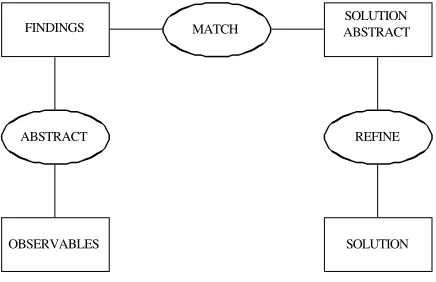
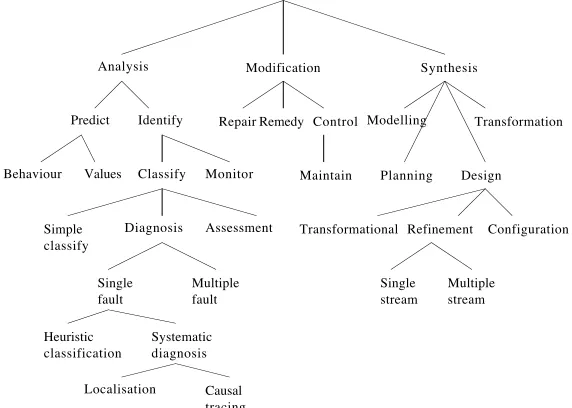
and use knowledge in this way. Not all systems would be examples of heuristic classification, but some important ones were.
FINDINGS
ABSTRACT
OBSERVABLES
MATCH
SOLUTION ABSTRACT
REFINE
[image:26.595.189.407.114.255.2]SOLUTION
Figure 2 Heuristic Classification
One system which Clancey characterised as heuristic classification was the classic MYCIN medical knowledge-based system (Shortliffe, 1979). We shall illustrate his approach using MYCIN-like knowledge. Figure 2 is to be understood as a structure at what we have termed earlier as the inference level. It tells us what kinds of inferences are performed in this domain and the type of knowledge used by these inferences. The rectangles should be seen as types of data and the ellipses as types of inferences.
Let us take the left hand side of this structure that contains a process called abstraction. This is the process by which observations or data are transformed into abstract observations or findings. The process of abstraction can be realised using a number of methods. One of these is qualitative abstraction. Examples are shown below – in this example we move from quantitative observations to qualitative findings.
if patient has white blood cell count < 2500 then patient has low white blood cell count
if patient has temperature > 101 then patient has fever
What we have provided above is the actual domain level knowledge that plays the inference layer role of abstraction. Much of the knowledge in MYCIN's knowledge base as to do with this type of knowledge level processing - the process of abstraction, moving from a quantitative description of data to a qualitative one.
The top part of Figure 2 involves inferences from findings to abstract solutions. This type of inference is called match - and is understood as a type of association knowledge. An example of such knowledge might be a rule such as:
if patient has fever
The concept of gram negative infection might be viewed as a diagnosis or solution but it is not a very specific one. What sort of gram negative infection is it? The right hand side of the heuristic classification structure deals with inference types that refine general to specific solutions. Such knowledge might consist of hierarchical typologies containing knowledge such as
gram negative infection has sub types
e. coli infection :
:
To establish a particular infection the system is likely to use knowledge that discriminates the sub-types.
Notice that in this account although we have talked about the inference structure from left to right no explicit control knowledge has been given. We might have stipulated that the system start with patient data and reason forward to a possible solution. We might have stated that the system should hypothesise a solution and see if there was evidence from the patient's condition to support the hypothesis. Or else a mixture of these ways of moving around the structure of Figure 2 might have been adopted. This additional knowledge is, of course, the task layer we mentioned earlier. Sometimes the standard method of moving around the inference structure is modified. This might arise if when a particular disease is suspected then one immediately looks for a particular piece of supporting observational data. Such knowledge comprises the strategic layer.
What we have described was exemplified via a MYCIN-like example. But heuristic classification as a type of problem solving might apply to many domains; financial assessment of an individual's credit worthiness, the likelihood of finding a mineral resource at a particular location, classifying a particular work place setting as conforming to a particular health and safety standard etc.. It is this generality that is the power of these knowledge level approaches. If we know what kind of application we are building we can use the models to indicate the type of knowledge we need to acquire, how we might structure the knowledge base, how we can archive and index knowledge for future use.
These knowledge level models have formed the basis for a number of important methodologies that aim to support the knowledge engineering process (Shadbolt and O’Hara, 1997). A similar attempt to exploit structured templates can be found in modern approaches to designing software – for example the work on Design Patterns (Gamma et al., 1995) and Object Oriented Design (Booch, 1993). The principles from OOD are ones that can be usefully adopted in any knowledge modelling exercise. In particular the concentration on acquiring hierarchical descriptions of a domain in the form of class hierarchies of the sort we see in Figure 1. OOD stresses the importance of associating with each class the necessary properties to distinguish it from other objects. It also holds that the classes should represent the most general levels of abstraction consistent with discriminating between objects.