www.esri.ie
Working Paper No. 367
January 2011
A Cost-Benefit Analysis of the EU 20/20/2020 Package
Richard S.J. Tol
Abstract: The European Commission did not publish a cost-benefit analysis for its 2020 climate package. This paper fills that gap, comparing the marginal costs and benefits of greenhouse gas emission reduction. The uncertainty about the marginal costs of climate change is large and skewed, and estimates partly reflect ethical choices (e.g., the discount rate). The 2010 carbon price in the ETS can readily be justified by a cost-benefit analysis. Emission reduction is not expensive provided that policy is well-designed, a condition not met by planned EU policy. It is probably twice as expensive as needed, costing one in ten years of economic growth. The EU targets for 2020 are unlikely to meet the benefit-cost test. For a standard discount rate, the benefit-cost ratio is rather poor (1/30). Only a very low discount rate would justify the 20% emission reduction target for 2020.
Key words: European Union; climate policy; cost-benefit analysis
Corresponding Author: [email protected]
Economic and Social Research Institute, Dublin, Ireland
Institute for Environmental Studies, Vrije Universiteit, Amsterdam, The Netherlands Department of Spatial Economics, Vrije Universiteit, Amsterdam, The Netherlands
A Cost-Benefit Analysis of the EU 20/20/2020 Package
1. Introduction
The European Union aims to limit its 2020 greenhouse gas emissions to 80% of its 1990 emissions (European Parliament and Council of the European Union 2009a;European Parliament and Council of the European Union 2009c) and to meet 20% of its energy needs by renewables (European Parliament and Council of the European Union 2009b). The European Commission has published an impact assessment (CEC 2008a;CEC 2008b), but not a benefit analysis – an earlier cost-benefit analysis (CEC 2005a;CEC 2005b) covered the eventual target but not the intermediate ones, let alone the details of policy implementation. This paper fills the gap, estimating the costs and the benefits of reducing greenhouse gas emissions by 20% in a decade.1
Climate policy is one of the cornerstones of the European Union. It seeks to be a world leader in this area, an ambition which is broadly supported by the public (TNS Opinion and Social 2009). The “climate and energy package” for 2020 implements European climate policy in the medium-term. The Emissions Trading System (ETS) for carbon dioxide will be expanded in scope, the cap will be tightened, and permits will increasingly be auctioned. There are, for the first time, firm targets for greenhouse gas emissions outside the ETS. There are targets for the market share of renewable energy too. These policies will raise the price of energy, slow down economic growth, and reduce welfare. In return, emissions will fall, climate will change less, and the impacts of climate change will be reduced. It is reasonable to ask whether the benefits – i.e., the avoided damages of climate change – outweigh the costs. Maybe European climate policy is too ambitious, or maybe it is not ambitious enough.
The results of cost-benefit analyses should always be interpreted with care, because estimates of the costs and the benefits of an intervention are never complete and rarely do justice to the complexity of the situation (Pearce 1976). These problems are
1
Note that total emissions in 2008 were very close to those in 1990. Note also that EU emissions were reasonably stable because emissions are increasingly outsources to other countries, particularly in Asia (Davis and Caldeira 2010;Helm et al. 2007;Peters 2008;Peters and Hertwich 2008a;Peters and Hertwich 2008b;Yunfeng and Laike 2010)
particularly pronounced for evaluations of such problems as climate change, which is global, diffuse, unequal, long-lived, and uncertain (van den Bergh 2004). Nevertheless, cost-benefit analysis is far superior as a guide to good policy than the hand-waving practised by some politicians. The results of this paper should therefore be treated with caution but not dismissed out of hand.
The analysis in this paper is about climate change. The policy package also refers to the benefits of improved energy security, higher employment, and accelerated innovation. I do not attempt to quantify these benefits, or even argue about the likely sign.
In Section 2, I survey the economic impacts of climate change. In Section 3, I study the impacts of greenhouse gas emission reduction. In Section 4, I combine the two in a cost-benefit analysis of the EU 20/20/2020 package. Section 5 concludes.
2. Benefits of climate policy
(Tol 2009b) reviews the total economic impacts of climate change. There are positive and negative impacts of climate change. Positive impacts dominate in the short run (when climate change is largely beyond human control), but negative impacts dominate in the medium and long run. Impact estimates are uncertain, incomplete and controversial but the available evidence suggests that a century of climate change is most likely about as bad as losing one year of economic growth and probably less bad than losing a decade of growth. In the course of decade, the European Union can only have a small effect of climate change. Therefore, estimates of the marginal damage costs are more relevant than estimates of the total damage costs.
The marginal damage cost of carbon dioxide, also known as the “social cost of carbon,” is defined as the net present value of the incremental damage due to a small increase in carbon dioxide emissions. For policy purposes, the marginal damage cost (if estimated along the optimal emission trajectory) would be equal to the Pigouvian tax that could be placed on carbon, thus internalizing the externality and restoring the market to the efficient solution.
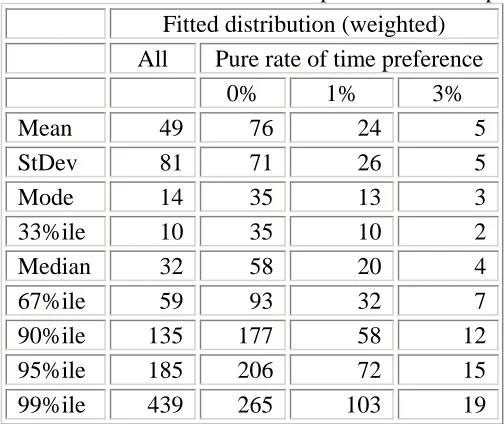
(Tol 2009b) reports 47 studies with 232 estimates of the social cost of carbon. Table 1 shows some characteristics of a meta-analysis of the published estimates of the social cost of carbon. One key issue in attempting to summarize this work is that just looking at the distribution of the medians or modes of these studies is inadequate, because it does not give a fair sense of the uncertainty surrounding these estimates – it
is particularly hard to discern the right tail of the distribution which may dominate the policy analysis (Tol 2003;Tol and Yohe 2007;Weitzman 2009). Because there are many estimates of the social cost of carbon, this can be done reasonably objectively. The idea here is to use one parameter from each published estimate (the mode) and the standard deviation of the entire sample—and then to build up an overall distribution of the estimates and their surrounding uncertainty on this basis using the methodology in (Tol 2008).2 The results are shown in Table 1.
Table 1 reaffirms that the uncertainty about the social costs of climate change is very large. The mean estimate in these studies is a marginal cost of carbon of €49 per metric tonne of carbon dioxide, but the modal estimate is only €14/tCO2 – close to the
EU ETS price of €15/tCO2. Of course, this divergence suggests that the mean estimate
is driven by some very large estimates—and indeed, the estimated social cost at the 95th percentile is €185/t CO2 and the estimate at the 99th percentile is €439/t CO2.
This large divergence is partly explained by the use of different pure rates of time preference in these studies. Table 1 divides up the studies into three subsamples which use the same pure rate of time preference. A higher rate of time preference means that the costs of climate change incurred in the future have a lower present value, and so for example, the mean social cost of carbon for the studies with a 3 percent rate of time preference is €5/ tCO2, while it is €76/ tCO2 for studies that choose a zero
percent rate of time preference. 3 But these columns also show that even when the same discount rate is used, the variation in estimates is large. Table 1 shows that the estimates for the whole sample are dominated by the estimates based on lower discount rates.
2
I fitted a Fisher-Tippett distribution to each published estimate using the estimate as the mode and the sample standard deviation. The Fisher-Tippett distribution is the only two-parameter, fat-tailed
distribution that is defined on the real line. A few published estimates are negative, and given the uncertainties about risk, fat-tailed distributions seem appropriate (Tol 2003;Weitzman 2009). The joint probability density function follows from addition, using weights that reflect the age and quality of the study as well as the importance that the authors attach to the estimate – some estimates are presented as central estimates, others as sensitivity analyses or upper and lower bounds. See
http://www.fnu.zmaw.de/Social-cost-of-carbon-meta-analy.6308.0.html 3
Note that the estimates with a discount rate of zero percent are not much higher than the estimates with a discount rate of 1%. The main reason is that most estimates are (inappropriately) based on a finite time horizon. With an infinite time horizon, the social cost of carbon would still be finite, because fossil fuel reserve are finite and the economy would eventually equilibrate with the new climate, but the effect of the zero discount rate would be more substantial. For the record, there is even one estimate (Hohmeyer and Gaertner 1992) based on a zero consumption discount rate (Davidson 2006;Davidson 2008) and thus a negative pure rate of time preference.
Although Table 1 reveals a large estimated uncertainty about the social cost of carbon, there is reason to believe that the actual uncertainty is larger still. First of all, the social cost of carbon derives from the total economic impact estimates – and I argue above that their uncertainty is underestimated too. Second, the estimates only contain those impacts that have been quantified and valued – and I argue below that some of the missing impacts have yet to be assessed because they are so difficult to handle and hence very uncertain. Third, although the number of researchers who published marginal damage cost estimates is larger than the number of researchers who published total impact estimates, it is still a reasonably small and close-knit community who may be subject to group-think, peer pressure and self-censoring.
3. Impacts of emission reduction: A survey
The IPCC4 periodically surveys the costs of emission abatement (Barker et al. 2007;Hourcade et al. 1996;Hourcade et al. 2001); there are the EMF5 overview papers (Weyant 1993;Weyant 1998;Weyant 2004;Weyant et al. 2006;Weyant and Hill 1999), and there a few recent meta-analyses as well (Barker et al. 2002;Fischer and Morgenstern 2006;Kuik et al. 2009;Repetto and Austin 1997). There are two equally important messages from this literature. First, a well-designed, gradual policy can substantially reduce emissions at low cost to society. Second, ill-designed policies, or policies that seek to do too much too soon can be orders of magnitude more expensive. While the academic literature has focussed on the former, policy makers have opted for the latter.
The costs of emission reduction increase, and the feasibility of meeting a particular target decreases if:
• different countries, sectors, or emissions face different explicit or implicit carbon prices (Boehringer et al. 2006b;Boehringer et al. 2006a;Boehringer et al. 2008;Manne and Richels 2001;Reilly et al. 2006);
• the carbon prices rises faster or more slowly than the consumption discount rate (Manne and Richels 1998;Manne and Richels 2004;Wigley et al. 1996);
• climate policy is used to further other, non-climate policy goals (Burtraw et al. 2003); and
• climate policy adversely interacts with pre-existing policy distortions (Babiker et al. 2003;Parry and Williams III 1999).
4
Intergovernmental Panel on Climate Change; http://www.ipcc.ch/ 5
Energy Modeling Forum; http://emf.stanford.edu/
Unfortunately, each of these four conditions is likely to be violated in reality. For instance, only select countries have adopted emissions targets. Energy-intensity sectors that compete on the world market typically face the prospect of lower carbon prices than do other sectors. Climate policy often targets carbon dioxide but omits methane and nitrous oxide. Emission trading systems have a provision for banking permits for future use, but not for borrowing permits from future periods. Climate policy is used to enhance energy security and create jobs. Climate policy is superimposed on energy and transport regulation and taxation.
The costs of emission reduction would also increases if emissions grow faster, if the price of fossil fuels is lower, or if the rate of technological progress in alternative fuels is slower than anticipated. This risk is two-sided. Emissions may grow more slowly, the price of fossil energy may be higher, and the alternative fuels may progress faster than expected.6
There are only a handful of studies that estimate the economic impact of the EU emissions and energy targets for 2020 – roughly, the EU strives for a 20% reduction in greenhouse gas emissions and a 20% share of renewables in total energy supply. The European Commission commissioned an impact assessment (Capros and Mantzos 2000), and the Energy Modeling Forum organised an independent review (Bernard and Vielle 2009;Böhringer et al. 2009a;Böhringer et al. 2009b;Kretschmer et al. 2009). To the best of my knowledge, no Member State ordered a separate impact assessment; and no academic (outside the EMF) studied the implications of the policies.
(Capros and Mantzos 2000) report cost estimates for every single country of the European Union. They report results for a large number of scenarios; I here use two, one that is slightly more economically sophisticated than the actual policy and one that is slightly less sophisticated. (Bernard and Vielle 2009;Kretschmer et al. 2009) and (Bernard and Vielle 2009) report estimates for a number of regions of the EU, while (Boeters and Koornneef 2010) and (Böhringer et al. 2009a) report for the EU as a single region. I assume homogeneity within the modelled regions, that is, every Member State within a region has the same impact as the region as a whole. Thus, there are six estimates for each country.
6Note that the rate of technological progress is largely beyond the control of policy makers, at least
between now and 2020.
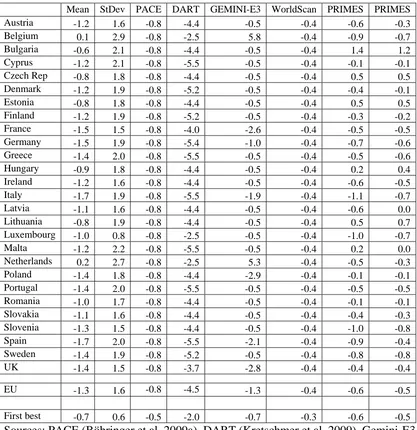
Figure 1 shows the average of the five estimates for the welfare loss per country in 2020. Table 2 has all the results. The EU as a whole would lose 1.3% of welfare, with a range of 0.4% to 4.5%. Spain and Italy would be hit hardest with a mean loss of 1.7%. Belgium and the Netherlands would see positive impacts (when average across the five studies) of 0.1% and 0.2%. Note that 4 out of 5 models estimate a negative effect for these countries. (Bernard and Vielle 2009) are the exception, predicting a substantial improvement in the competitive position of these countries. The Netherlands particularly benefits from a lower oil price (the feedstock for its export-oriented chemical industry) and higher (absolute) margins on transport and re-export. For the EU as a whole, however, climate policy is costly. A loss of 1.3% is of course not dramatic, but it is projected to occur over the space of only eight years (2013-2020), so that roughly one in every ten years of growth is lost. I’ll discuss below whether this investment is justified.
(Böhringer et al. 2009b) show that the 1.3% loss is at least a factor two higher than it could be. This is because of the EU pays lip service only to cost-efficacy in the regulation of greenhouse gas emissions. Particularly, instead of one price for carbon, there are at least 28 prices: one in the ETS, and at least one per Member State for non-ETS emissions. Furthermore, climate policy is also used to serve other policy targets, particularly on renewables and energy security. Besides, climate policy is placed on top of pre-existing regulations.
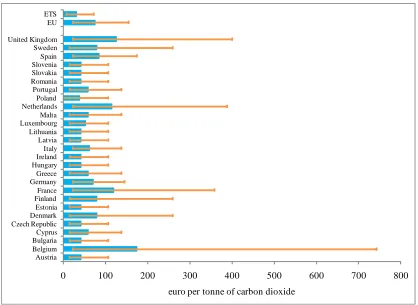
Figure 2 shows the price of carbon in 2020. Table 3 shows the detailed results. The price in the EU Emissions Trading System (ETS) is some €32/tCO2, with a range
from €7/tCO2 to€71/tCO2. The (unweighted) average price outside the ETS is much
higher: €75/tCO2. The non-ETS carbon price exceeds €32/tCO2 in four countries:
Belgium (€175/tCO2), UK (€126/tCO2), France (€120/tCO2) and the Netherlands
(€116/tCO2). Although some Eastern and Southern European countries have been
allocated more non-ETS emission rights than they will likely need, the non-ETS price of carbon is zero in one country (Poland) in one model (Bernard and Vielle 2009) only. This is because there is a restricted trade in non-ETS allowances. The non-ETS market price settles on €42/tCO2; this creates a scarcity in all countries and scenarios
but one.
4. A benefit-cost analysis of EU climate policy for 2020
4.1. Introduction
To a first approximation, a benefit-cost analysis of greenhouse gas emission reduction policy requires that the marginal costs of emission reduction be equal to the marginal benefits of emission reduction. When evaluating climate policy for a single continent over an eight year period, the approximation is in fact fairly accurate.
Note that EU emissions are a small and shrinking fraction of global emissions. Therefore, emission reduction in the EU only, and only between 2013-2020, necessarily has a minimal effect on climate change and its impacts. This argument is irrelevant, however, as it militates against any long-term investment programme. For example, by the same reasoning, it is pointless to teach children how to write the letter “a” as it is useless without the rest of the alphabet, or if no other children would learn how to read and write. Emission reduction by any jurisdiction in any legislative period necessarily has a small effect. That is no reason not to do it. It is a reason, though, to evaluate costs and benefits at the margin.
4.2. Marginal costs and benefits
Section 2 estimates the marginal damage costs of climate change. Section 3 estimates the marginal costs of emission reduction in the EU. The question whether EU policy passes the benefit-cost test is, at first sight, simply a matter of comparing the two estimates. However, there are complications. Firstly, EU policy is not cost-effective. The same target can be met at a much lower cost (Böhringer et al. 2009b). As cost-effectiveness is a condition for efficiency, this alone means that EU policy fails the benefit-cost test. I therefore compare the marginal damage costs of climate change (Table 1) to the marginal abatement costs for the ideal policy (Table 3, bottom row) rather than for the actual policy.
Secondly, both marginal costs and marginal benefits are rather uncertain. I therefore compute the probability that EU policy meets the benefit-cost test. I take the probability density function of the marginal damage costs of climate change from (Tol 2009a). Table 1 displays some of the characteristics. Note that, for this study, I converted the estimates of the social cost of carbon to 2007 Euro per tonne of carbon dioxide.
I derive the probability density function of the marginal abatement costs in the same manner as (Tol 2009a) derived the uncertainty about the social cost of carbon.
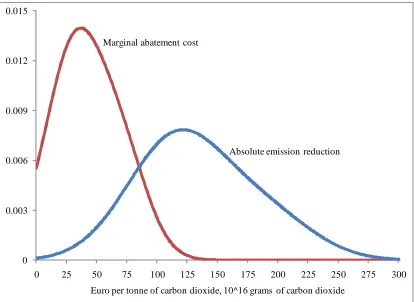
Each of the six estimates of the marginal abatement costs in Table 3 is assumed to be the central estimate of a Normal distribution.7 The standard deviation of each of the six estimates is assumed to be equal to the standard deviation between the six estimates. The joint probability density is the rescaled sum of the individual probability densities.8 See Figure 3.
As the probability densities of the marginal abatement costs and the marginal damages costs are mutually independent, the bivariate probability density is the outer product of the two. The chance of meeting the benefit-cost test is then the integral over the bivariate probability density under the condition that the marginal abatement costs is less than or equal to the marginal damage cost.
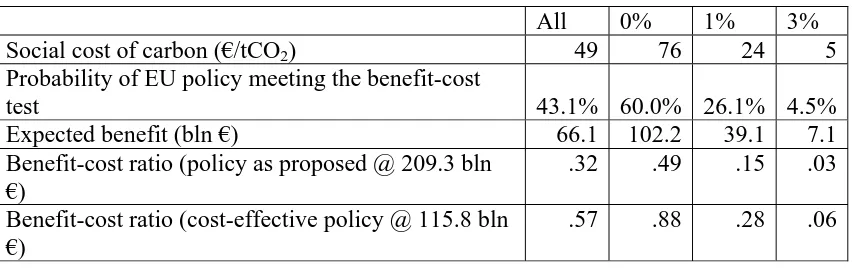
If all estimates of the marginal damage costs are used, there is a chance of 43% that the benefit-cost test is met (cf. Table 4). If only estimates with a zero percent pure rate of time preference are used, this chance increases to 60%. It falls to 26% for a one percent pure rate of time preference, and to 4.5% for a three percent pure rate of time preference. EU climate policy can be justified by great care for the future (i.e., a low discount rate) and by substantial aversion to risk (i.e., accepting a low probability of passing the benefit-cost test).
4.3. Total costs and benefits
Table 4 also shows the expected value of the benefits, which follows from the bivariate distribution of absolute abatement9 (Figure 3) and social cost of carbon. The expected benefit varies between 7 and 102 billion euro, depending on the pure rate of time preference assumed (if any). The expected cost is 209 billion euro, 1.3% of projected GDP in 2020,10 if emission abatement is implemented as planned. The benefit-cost ratio ranges between 0.03 and 0.49. If emission abatement is implemented in the cost-effective manner, expected costs fall to 116 billion euro, 0.7% of GDP. The benefit-cost ratio increases to between 0.06 and 0.88.
7
Unlike the impacts of climate change, there is no reason to believe that the uncertainty about the costs of emission reduction is asymmetric or fat-tailed.
8
Vote-counting as used here, while not entirely appropriate, leads to a wider spread than using Bayes’ rule.
9
The distribution of absolute abatement is constructed as above: there are four best guesses, one each from the four models; the standard deviation of each best guess is assumed to be equal to the standard deviation between the best guesses; each individual estimate is assumed to be normally distributed; and the joint distribution is based on aggregating and rescaling the individual distributions.
10
The models were all calibrated to the same scenario of economic and population growth.
At first sight, the benefit-cost ratios seem to be at odds with the estimated probabilities of meeting in the benefit-cost test, also displayed in Table 4. This illustrates the third problem with doing a benefit-cost analysis of a regional solution to a global problem. The results of the marginal/probability and total/expected cost analysis deviate from one another because the former implicitly assumes that the same carbon tax is applied outside the EU whereas the latter only considers the costs and benefits of emission reduction in Europe – that is, the benefits of emission reduction elsewhere are omitted. Equating the marginal costs of emission reduction to the marginal benefits would increase welfare – if the Pigou tax is applied to all emissions. However, only European emissions are regulated. Therefore, the benefits are only a fraction of the benefits of a global abatement policy – but the costs to Europe are the same.11
4.4. The optimal level of abatement
Cost-benefit analysis would recommend that level of emission abatement for which the expected marginal damage cost equals the expected marginal abatement cost.12 The latter is difficult to ascertain as much of the variation between my six estimates of the marginal abatement costs is explained by differences in the no-additional-climate-policy scenarios used by the models. Therefore, I do the cost-benefit analysis separately for each model. I assume that the abatement cost curve is quadratic in emission reduction from baseline. The marginal abatement cost curve is therefore linear, and the “optimal” abatement level follows from rescaling the abatement level used by each model.
Table 5 shows the results. The EU target is to cut 2020 emissions to 20% below 1990 emissions. This implies a cut of 19% to 30% below baseline emissions, depending on the model. If the pure rate of time preference is 3% per year, the target falls to 1.4-2.5% from the base year (1990), which is 1.6-2.7% from the baseline. For a 1% pure rate of time preference, the optimal target is 6.9 to 12% from base year (7.6 to 13% from baseline). For a 0% pure rate of time preference, the optimal target exceeds the EU target: 22% to 38% from base year (24% to 42% from baseline). If all estimates of the social cost of carbon are considered regardless of the discount rate,
11
In fact, costs are higher because of leakage (Bernard and Vielle 2009). 12
Assuming, as above, that all emissions are regulated.
two models suggest that the EU target is too stringent and two models suggest that it is too lenient. The optimal target is 14% to 24% from base year (15% to 27% from baseline). As above, the EU emission reduction targets can be justified only with a low discount rate.
5. Discussion and conclusion
In this paper, I survey the marginal impacts of climate change and the (marginal) impacts of greenhouse gas emission reduction, particularly in the European Union. I then bring the two strands together in a cost-benefit analysis of the EU targets for 2020. The marginal costs of climate change are uncertain, with negative surprises more likely than positive surprises. Estimates also depend on ethical choices, such as the discount rate. A modest carbon tax can be easily justified. The current carbon price in the ETS is well within the range of available estimates. Emission reduction can be done cheaply, but this requires that emissions gradually deviate from the baseline scenario and that policy is well-designed and takes account of previous regulations. I find that planned EU policy does not meet these conditions. It is twice as expensive as needed, and would cost the equivalent of one in ten years of economic growth.
Comparing the orders of magnitude of the costs of emission reduction and the impacts of climate change suggests that the EU emissions targets for 2020 are not likely to meet the cost test. Indeed, for a standard discount rate, the benefit-cost ratio is rather poor (1/30). The EU targets become more attractive if policy implementation would be improved or if substantial weight would be placed on the remote future, but one would need a very low discount rate to justify the 20% emission reduction target for 2020.
As EU climate policy for 2020 cannot stand on its climate merits, could the targets be justified in another manner? There are separate targets for renewable energy, which would promote “energy security”. Energy security is a fluid concept. Wind and solar power are less reliable than thermal power generation. Energy security may also be interpreted as diversification of supply. If so, promoting renewables is a second-best policy. Costs are unnecessarily high, and benefits have yet to be quantified (Roques et al. 2008). Energy security may also be interpreted as reducing the import of energy. Again, promoting renewables is a second-best policy, and costs are higher than need be. Benefits are unquantified – and may actually be negative as is usually the case
with import substitution (Bruton 1998). More informally, politicians regularly argue that climate policy would stimulate economic growth, innovation, and employment. Raising the costs of an essential input to the economy is unlikely to accelerate economic growth (Weyant 1993). Climate policy would redirect innovation rather than enhance it (Smulders and Gradus 1996). While appropriate tax reform may stimulate job creation (Patuelli et al. 2005) , actual policies are different. It is therefore unlikely that the EU greenhouse gas emission reduction targets would pass the cost-benefit test even if the scope is widened.
Acknowledgements
All errors and opinions are mine.
Table 1. The mean and standard deviation of social cost of carbon (euro/tonne CO2)
for a Fisher-Tippett distribution fitted to 232 published estimates, and to three subsets of these estimates based on the pure rate of time preference.
Fitted distribution (weighted) All Pure rate of time preference
0% 1% 3%
Mean 49 76 24 5
StDev 81 71 26 5
Mode 14 35 13 3
33%ile 10 35 10 2
Median 32 58 20 4
67%ile 59 93 32 7
90%ile 135 177 58 12
95%ile 185 206 72 15
99%ile 439 265 103 19
Table 2. The impact of the EU 20/20/2020 package on welfare (%) in 2020.
Mean StDev PACE DART GEMINI-E3 WorldScan PRIMES PRIMES Austria -1.2 1.6 -0.8 -4.4 -0.5 -0.4 -0.6 -0.3
Belgium 0.1 2.9 -0.8 -2.5 5.8 -0.4 -0.9 -0.7
Bulgaria -0.6 2.1 -0.8 -4.4 -0.5 -0.4 1.4 1.2
Cyprus -1.2 2.1 -0.8 -5.5 -0.5 -0.4 -0.1 -0.1
Czech Rep -0.8 1.8 -0.8 -4.4 -0.5 -0.4 0.5 0.5 Denmark -1.2 1.9 -0.8 -5.2 -0.5 -0.4 -0.4 -0.1
Estonia -0.8 1.8 -0.8 -4.4 -0.5 -0.4 0.5 0.5
Finland -1.2 1.9 -0.8 -5.2 -0.5 -0.4 -0.3 -0.2
France -1.5 1.5 -0.8 -4.0 -2.6 -0.4 -0.5 -0.5
Germany -1.5 1.9 -0.8 -5.4 -1.0 -0.4 -0.7 -0.6
Greece -1.4 2.0 -0.8 -5.5 -0.5 -0.4 -0.5 -0.6
Hungary -0.9 1.8 -0.8 -4.4 -0.5 -0.4 0.2 0.4
Ireland -1.2 1.6 -0.8 -4.4 -0.5 -0.4 -0.6 -0.5
Italy -1.7 1.9 -0.8 -5.5 -1.9 -0.4 -1.1 -0.7
Latvia -1.1 1.6 -0.8 -4.4 -0.5 -0.4 -0.6 0.0
Lithuania -0.8 1.9 -0.8 -4.4 -0.5 -0.4 0.5 0.7 Luxembourg -1.0 0.8 -0.8 -2.5 -0.5 -0.4 -1.0 -0.7
Malta -1.2 2.2 -0.8 -5.5 -0.5 -0.4 0.2 0.0
Netherlands 0.2 2.7 -0.8 -2.5 5.3 -0.4 -0.5 -0.3
Poland -1.4 1.8 -0.8 -4.4 -2.9 -0.4 -0.1 -0.1
Portugal -1.4 2.0 -0.8 -5.5 -0.5 -0.4 -0.5 -0.5 Romania -1.0 1.7 -0.8 -4.4 -0.5 -0.4 -0.1 -0.1 Slovakia -1.1 1.6 -0.8 -4.4 -0.5 -0.4 -0.4 -0.3 Slovenia -1.3 1.5 -0.8 -4.4 -0.5 -0.4 -1.0 -0.8
Spain -1.7 2.0 -0.8 -5.5 -2.1 -0.4 -0.9 -0.4
Sweden -1.4 1.9 -0.8 -5.2 -0.5 -0.4 -0.8 -0.8
UK -1.4 1.5 -0.8 -3.7 -2.8 -0.4 -0.4 -0.4
EU -1.3 1.6 -0.8 -4.5 -1.3 -0.4 -0.6 -0.5
First best -0.7 0.6 -0.5 -2.0 -0.7 -0.3 -0.6 -0.5 Sources: PACE (Böhringer et al. 2009a), DART (Kretschmer et al. 2009), Gemini-E3 (Bernard and Vielle 2009), WorldScan (Boeters and Koornneef 2010), PRIMES (Capros et al. 2008); PRIMES appears twice as it published estimates based on an overly optimistic and an overly pessimistic interpretation of the rules on CDM.
Table 3. The cost of carbon (€/tCO2) inside and outside the EU ETS in 2020.
Mean StDev PACE DART
GEMINI-E3
WorldScan PRIMES PRIMES
Austria 42 33 106 33 15 44 22 30
Belgium 175 281 106 103 743 44 22 30
Bulgaria 42 33 106 33 15 44 22 30
Cyprus 59 51 106 137 15 44 22 30
Czech Republic
42 33 106 33 15 44 22 30
Denmark 79 94 106 259 15 44 22 30
Estonia 42 33 106 33 15 44 22 30
Finland 79 94 106 259 15 44 22 30
France 120 128 106 158 357 44 22 30
Germany 72 48 106 83 145 44 22 30
Greece 59 51 106 137 15 44 22 30
Hungary 42 33 106 33 15 44 22 30
Ireland 42 33 106 33 15 44 22 30
Italy 63 48 106 137 35 44 22 30
Latvia 42 33 106 33 15 44 22 30
Lithuania 42 33 106 33 15 44 22 30
Luxembourg 53 41 106 103 15 44 22 30
Malta 59 51 106 137 15 44 22 30
Netherlands 116 139 106 103 389 44 22 30
Poland 39 36 106 33 0 44 22 30
Portugal 59 51 106 137 15 44 22 30
Romania 42 33 106 33 15 44 22 30
Slovakia 42 33 106 33 15 44 22 30
Slovenia 42 33 106 33 15 44 22 30
Spain 86 63 106 137 174 44 22 30
Sweden 79 94 106 259 15 44 22 30
United Kingdom
126 143 106 151 400 44 22 30
EU 75 52 106 95 155 44 22 30
ETS 32 22 15 35 71 7 30 30
First best 44 22 37 68 72 17 30 39
Sources: PACE (Böhringer et al. 2009a), DART (Kretschmer et al. 2009), Gemini-E3 (Bernard and Vielle 2009), WorldScan (Boeters and Koornneef 2010), PRIMES (Capros et al. 2008) ; PRIMES appears twice as it published estimates based on an overly optimistic and an overly pessimistic interpretation of the rules on CDM.
Table 4. Cost-benefit analysis of the EU 20/20/2020 package: Four alternative estimates of the social cost of carbon (cf. Table 2), the probability of the EU policy meeting the benefit-cost test, the expected value of the benefit, and the benefit-cost ratio for planned and cost-effective implementation of the EU policy.
All 0% 1% 3%
Social cost of carbon (€/tCO2) 49 76 24 5
Probability of EU policy meeting the benefit-cost
test 43.1% 60.0% 26.1% 4.5%
Expected benefit (bln €) 66.1 102.2 39.1 7.1
Benefit-cost ratio (policy as proposed @ 209.3 bln €)
.32 .49 .15 .03
Benefit-cost ratio (cost-effective policy @ 115.8 bln €)
.57 .88 .28 .06
Table 5. Proposed (EU) and optimal (all, N%) emission reduction in 2020. Mean StDev PRIMES PACE DART Gemini-E3
From base year (1990)
EU 20.0% - 20.0% 20.0% 20.0% 20.0%
All 20.7% 4.9% 24.4% 24.6% 19.6% 14.2% 0% 32.1% 7.6% 37.8% 38.2% 30.4% 22.0%
1% 10.1% 2.4% 11.9% 12.1% 9.6% 6.9%
3% 2.1% 0.5% 2.5% 2.5% 2.0% 1.4%
From base line (2020)
EU 22.9% 4.9% 18.8% 20.3% 29.9% 22.7%
All 22.6% 5.4% 26.6% 26.9% 21.5% 15.5% 0% 35.1% 8.4% 41.3% 41.7% 33.3% 24.0% 1% 11.1% 2.6% 13.0% 13.2% 10.5% 7.6%
3% 2.3% 0.5% 2.7% 2.7% 2.2% 1.6%
-6 -4 -2 0 2 4 6 Austria
[image:18.595.97.497.120.392.2]Belgium Bulgaria Cyprus Czech RepublicDenmark Estonia Finland France Germany Greece Hungary Ireland Italy Latvia Lithuania Luxembourg Malta Netherlands Poland Portugal RomaniaSlovakia Slovenia Spain Sweden United Kingdom EU
Figure 1. The 2020 welfare impact (percentage) of the EU 20/20/2020 package per Member State and for the EU as a whole; the bars show the average of six published estimates; the lines indicate the range of results.
0 100 200 300 400 500 600 700 800 Austria
Belgium Bulgaria Cyprus Czech Republic Denmark Estonia Finland France Germany Greece Hungary Ireland Italy Latvia Lithuania Luxembourg Malta Netherlands Poland Portugal Romania Slovakia Slovenia Spain Sweden United Kingdom EU ETS
[image:19.595.89.507.83.388.2]euro per tonne of carbon dioxide
Figure 2. The 2020 price of carbon (2005 euro per tonne of carbon dioxide) for the EU 20/20/2020 package per Member State ETS), for the EU one average (non-ETS) and for the Emissions Trading System ((non-ETS); the bars show the average of six published estimates; the lines indicate the range of results.
0 0.003 0.006 0.009 0.012 0.015
0 25 50 75 100 125 150 175 200 225 250 275 300
Euro per tonne of carbon dioxide, 10^16 grams of carbon dioxide Marginal abatement cost
[image:20.595.91.505.84.386.2]Absolute emission reduction
Figure 3. The probability density functions of the marginal abatement costs and the absolute emission reduction in the EU in 2020.
References
Babiker, M.H., G.E.Metcalf, and J.M.Reilly (2003), 'Tax distortions and global climate policy', Journal of Environmental Economics and Management, 46, 269-287. Barker, T., I.Bashmakov, A.Alharthi, M.Amann, L.Cifuentes, J.Drexhage, M.Duan, O.Edenhofer, B.P.Flannery, M.J.Grubb, M.Hoogwijk, F.I.Ibitoye, C.J.Jepma, W.A.Pizer, and K.Yamaji (2007), 'Mitigation from a Cross-Sectoral Perspective', in Climate Change 2007: Mitigation -- Contribution of Working Group III to the Fourth Assessment Report of the Intergovernmental Panel on Climate Change, B. Metz et al. (eds.), Cambridge University Press, Cambridge, pp. 619-690.
Barker, T., J.Koehler, and M.Villena (2002), 'The Costs of Greenhouse Gas Abatement: A Meta-Analysis of Post-SRES Mitigation Scenarios', Environmental Economics and Policy Studies, 5, 135-166.
Bernard, A. and M.Vielle (2009), 'Assessment of European Union transition scenarios with a special focus on the issue of carbon leakage', Energy Economics, 31, (S2), p. S274-S284.
Boehringer, C., T.Hoffmann, and C.Manrique-de-Lara-Penate (2006a), 'The Efficiency Costs of Separating Carbon Markets under the EU Emissions Trading Scheme: A Quantitative Assessment for Germany', Energy Economics, 28, (1), 44-61. Boehringer, C., H.Koschel, and U.Moslener (2008), 'Efficiency Losses from
Overlapping Regulation of EU Carbon Emissions', Journal of Regulatory Economics,
33, (3), 299-317.
Boehringer, C., A.Loeschel, and T.F.Rutherford (2006b), 'Efficiency Gains from "What"-Flexibility in Climate Policy: An Integrated CGE Assessment', Energy Journal (Multi-Greenhouse Gas Mitigation and Climate Policy Special Issue), 405-424.
Boeters, S. and J.Koornneef (2010), Supply of Renewable Energy Sources and the Cost of EU Climate Policy, Discussion Papers 142 ,Netherlands Bureau for Economic Policy Analysis, The Hague.
Böhringer, C., A.Löschel, U.Moslener, and T.F.Rutherford (2009a), 'EU Climate policy up to 2020: An economic impact assessment', Energy Economics, 31, (S2), p. S295-S305.
Böhringer, C., T.F.Rutherford, and R.S.J.Tol (2009b), 'The EU 20/20/2020 Targets: An overview of the EMF22 assessment', Energy Economics, 31, (S2), p. S268-S273. Bruton, H.J. (1998), 'A Reconsideration of Import Substitution', Journal of Economic Literature, 36, (2), pp. 903-936.
Burtraw, D., A.Krupnick, K.Palmer, A.Paul, M.Toman, and C.Bloyd (2003),
'Ancillary benefits of reduced air pollution in the US from moderate greenhouse gas mitigation policies in the electricity sector', Journal of Environmental Economics and Management, 45, 650-673.
Capros, P. and L.Mantzos (2000), 'Kyoto and technology at the European Union: Costs of emission reduction under flexibility mechanisms and technology progress', International Journal of Global Energy Issues, 14, (1-4), pp. 169-183.
Capros, P., L.Mantzos, V.Papandreou, and N.Tasios (2008), Model-based Analysis of the 2008 EU Policy Package on Climate Change and Renewables ,E3M Lab, National Technical University, Athens.
CEC (2005a), Winning the Battle Agains Global Climate Change -- Background Paper ,Commission of the European Communities, Brussels.
CEC (2005b), Winning the Battle Against Global Climate Change, Communication from the Commission to the Council, the European Parliament, the European
Economic and Social Committee and the Committee of the Regions COM(2005) 35 final ,Commission of the European Communities, Brussels.
CEC (2008a), Package of Implementation Measures for the EU's Objectives on Climate Change and Renewable Energy for 2020 -- Annex to the Impact Assessment, Commission Staff Working Document SEC(2008) 85 vol II ,Commission of the European Communities, Brussels.
CEC (2008b), Package of Implementation Measures for the EU's Objectives on Climate Change and Renewable Energy for 2020 -- Impact Assessment, Commission Staff Working Document SEC(2008) 85/3 ,Commission of the European
Communities, Brussels.
Davidson, M.D. (2006), 'A social discount rate for climate damage to future generations based on regulatory law', Climatic Change, 76, (1-2), 55-72.
Davidson, M.D. (2008), 'Wrongful Harm to Future Generations: The Case of Climate Change', Environmental Values, 17, 471-488.
Davis, S.J. and K.Caldeira (2010), 'Consumption-based accounting of CO2 emissions', Proceedings of the National Academy of Sciences, 107, (12), pp. 5687-5692.
European Parliament and Council of the European Union (2009a), 'Decision No 406/2009/EC of the European Parliament and of the Council of 23 April 2009 on the Efforts of Member States to Reduce their Greenhouse Gas Emissions to Meet the Community's Emission Reduction Commitments up to 2020', Official Journal of the European Union, L140, 136-148.
European Parliament and Council of the European Union (2009b), 'Directive 2009/28/EC of the European Parliament and the of the Council of 23 April 2009 on the Promotion of the Use of Energy from Renewable Sources and Amending and Subsequently Repealing Directives 2001/77/EC and 2003/30/EC', Official Journal of the European Union, L 140, pp. 16-62.
European Parliament and Council of the European Union (2009c), 'Directive 2009/29/EC of the European Parliament and of the Council of 23 April 2009 Amending Directive 2003/87/EC so as to Improve and Extend the Greenhouse Gas
Emissions Allowance Trading Scheme of the Community', Official Journal of the European Union, L140, 63-87.
Fischer, C. and R.D.Morgenstern (2006), 'Carbon Abatement Costs: Why the Wide Range of Estimates?', Energy Journal, 272, 73-86.
Helm, D., R.Smale, and J.Phillips (2007), Too Good To Be True? The UK's Climate Change Record ,Dieter Helm, Oxford.
Hohmeyer, O. and M.Gaertner (1992), The Costs of Climate Change - A Rough Estimate of Orders of Magnitude ,Fraunhofer-Institut fur Systemtechnik und Innovationsforschung, Karlsruhe.
Hourcade, J.-C., K.Halsneas, M.Jaccard, W.D.Montgomery, R.G.Richels, J.Robinson, P.R.Shukla, and P.Sturm (1996), 'A Review of Mitigation Cost Studies', in Climate Change 1995: Economic and Social Dimensions -- Contribution of Working Group III to the Second Assessment Report of the Intergovernmental Panel on Climate Change, J.P. Bruce, H. Lee, and E.F. Haites (eds.), Cambridge University Press, Cambridge, pp. 297-366.
Hourcade, J.-C., P.R.Shukla, L.Cifuentes, D.Davis, J.A.Edmonds, B.S.Fisher,
E.Fortin, A.Golub, O.Hohmeyer, A.Krupnick, S.Kverndokk, R.Loulou, R.G.Richels, H.Segenovic, and K.Yamaji (2001), 'Global, Regional and National Costs and
Ancillary Benefits of Mitigation', in Climate Change 2001: Mitigation -- Contribution of Working Group III to the Third Assessment Report of the Intergovernmental Panel on Climate Change, O.R. Davidson and B. Metz (eds.), Cambridge University Press, Cambridge, pp. 499-559.
Kretschmer, B., D.Narita, and S.Peterson (2009), 'The economic effects of the EU biofuel target', Energy Economics, 31, (S2), p. S285-S294.
Kuik, O.J., L.Brander, and R.S.J.Tol (2009), 'Marginal abatement costs of greenhouse gas emissions: A meta-analysis', Energy Policy, 37, (4), pp. 1395-1403.
Manne, A.S. and R.G.Richels (1998), 'On Stabilizing CO2 Concentrations --
Cost-Effective Emission Reduction Strategies', Environmental Modeling and Assessment,
2, 251-265.
Manne, A.S. and R.G.Richels (2001), 'An alternative approach to establishing trade-offs among greenhouse gases', Nature, 410, 675-677.
Manne, A.S. and R.G.Richels (2004), 'US Rejection of the Kyoto Protocol: The Impact on Compliance Costs and CO2 Emissions', Energy Policy, 32, 447-454.
Parry, I.W.H. and R.C.Williams III (1999), 'A second-best evaluation of eight policy instruments to reduce carbon emissions', Resource and Energy Economics, 21, 347-373.
Patuelli, R., P.Nijkamp, and E.Pels (2005), 'Environmental tax reform and the double dividend: A meta-analytical performance assessment', Ecological Economics, 55, (4), pp. 564-583.
Pearce, D.W. (1976), 'The Limits of Cost-Benefit Analysis as a Guide to Environmental Policy', Kyklos, 29, (1), 97-112.
Peters, G.P. (2008), 'From Production-Based to Consumption-Based National Emission Inventories', Ecological Economics, 65, 13-23.
Peters, G.P. and E.G.Hertwich (2008a), 'CO2 Embodied in International Trade with Implications for Global Climate Policy', Environmental Science and Technology, 42, (5), 1401-1407.
Peters, G.P. and E.G.Hertwich (2008b), 'Post-Kyoto Greenhouse Gas Inventories: Production versus Consumption', Climatic Change, 86, 51-66.
Reilly, J.M., M.Sarofim, S.Paltsev, and R.Prinn (2006), 'The Role of Non-CO2 GHGs in Climate Policy: Analysis Using the MIT IGSM', Energy Journal
(Multi-Greenhouse Gas Mitigation and Climate Policy Special Issue), 503-520.
Repetto, R. and D.Austin (1997), The Costs of Climate Protection: A Guide for the Perplexed ,World Resources Institute, Washington, D.C.
Roques, F.A., D.M.Newbery, and W.J.Nuttall (2008), 'Fuel mix diversification incentives in liberalized electricity markets: A Mean-Variance Portfolio theory approach', Energy Economics, 30, (4), pp. 1831-1849.
Smulders, S. and R.Gradus (1996), 'Pollution abatement and long-term growth', European Journal of Political Economy, 12, (3), pp. 505-532.
TNS Opinion and Social (2009), Europeans' Attitudes towards Climate Change, Special Eurobarometer ,CEC Directorate General Communication, Brussels. Tol, R.S.J. (2003), 'Is the uncertainty about climate change too large for expected cost-benefit analysis?', Climatic Change, 56, (3), 265-289.
Tol, R.S.J. (2008), 'The Social Cost of Carbon: Trends, Outliers and Catastrophes', Economics -- the Open-Access, Open-Assessment E-Journal, 2, (25), 1-24.
Tol, R.S.J. (2009a), 'The Economic Effects of Climate Change', Journal of Economic Perspectives, 23, (2), 29-51.
Tol, R.S.J. (2009b), 'Why Worry About Climate Change?', Research Bulletin, 09, (1), 2-7.
Tol, R.S.J. and G.W.Yohe (2007), 'Infinite Uncertainty, Forgotten Feedbacks, and Cost-Benefit Analysis of Climate Change', Climatic Change, 83, (4), 429-442.
van den Bergh, J.C.J.M. (2004), 'Optimal climate policy is a utopia: from quantitative to qualitative cost-benefit analysis', Ecological Economics, 48, 385-393.
Weitzman, M.L. (2009), 'On Modelling and Interpreting the Economics of Catastrophic Climate Change', Review of Economics and Statistics, 91, (1), 1-19.
25
Weyant, J.P. (1993), 'Costs of Reducing Global Carbon Emissions', Journal of Economic Perspectives, 7, (4), 27-46.
Weyant, J.P. (1998), 'The Costs of Greenhouse Gas Abatement', in Economics and Policy Issues in Climate Change, W.D. Nordhaus (ed.), Resources for the Future, Washington, D.C., pp. 191-214.
Weyant, J.P. (2004), 'Introduction and overview', Energy Economics, 26, 501-515. Weyant, J.P., F.C.de la Chesnaye, and G.J.Blanford (2006), 'Overview of EMF-21: Multigas Mitigation and Climate Policy', Energy Journal (Multi-Greenhouse Gas Mitigation and Climate Policy Special Issue), 1-32.
Weyant, J.P. and J.N.Hill (1999), 'Introduction and Overview of the Special Issue', Energy Journal Special Issue on the Costs of the Kyoto Protocol: A Multi-Model Evaluation, vii-xliv.
Wigley, T.M.L., R.G.Richels, and J.A.Edmonds (1996), 'Economic and
Environmental Choices in the Stabilization of Atmospheric CO2 Concentrations',
Nature, 379, 240-243.
Year Number Title/Author(s) ESRI Authors/Co-authors Italicised
2011
366 The Distributional Effects of Value Added Tax in Ireland
Eimear Leahy, Seán Lyons, Richard S.J. Tol
2010
365 Explaining International Differences in Rates of Overeducation
in Europe
Maria A. Davia, Seamus McGuinness and Philip, J. O’Connell
364 The Research Output of Business Schools and Business Scholars
in Ireland
Richard S.J. Tol
363 The Effects of the Internationalisation of Firms on Innovation
and Productivity
Iulia Siedschlag, Xiaoheng Zhang and Brian Cahill
362 Too much of a good thing? Gender, ‘Concerted cultivation’ and
unequal achievement in primary education
Selina McCoy, Delma Byrne, Joanne Banks
361 Timing and Determinants of Local Residential Broadband
Adoption: Evidence from Ireland
Seán Lyons
360 Determinants of Vegetarianism and Partial Vegetarianism
in the United Kingdom
Eimear Leahy, Seán Lyons and Richard S.J. Tol
359 From Data to Policy Analysis: Tax-Benefit Modelling using SILC
2008
Tim Callan, Claire Keane, John R. Walsh and Marguerita Lane
358 Towards a Better and Sustainable Health Care System –
Resource Allocation and Financing Issues for Ireland
Frances Ruane
357 An Estimate of the Value of Lost Load for Ireland
Eimear Leahy and Richard S.J. Tol
356 Public Policy Towards the Sale of State Assets in Troubled
Times: Lessons from the Irish Experience
355 The Impact of Ireland’s Recession on the Labour Market Outcomes of its Immigrants
Alan Barrett and Elish Kelly
354 Research and Policy Making
Frances Ruane
353 Market Regulation and Competition; Law in Conflict: A View
from Ireland, Implications of the Panda Judgment Philip Andrews and Paul K Gorecki
352 Designing a property tax without property values: Analysis in
the case of Ireland
Karen Mayor, Seán Lyons and Richard S.J. Tol
351 Civil War, Climate Change and Development: A Scenario Study
for Sub-Saharan Africa
Conor Devitt and Richard S.J. Tol
350 Regulating Knowledge Monopolies: The Case of the IPCC
Richard S.J. Tol
349 The Impact of Tax Reform on New Car Purchases in Ireland
Hugh Hennessy and Richard S.J. Tol
348 Climate Policy under Fat-Tailed Risk:
An Application of FUND
David Anthoff and Richard S.J. Tol
347 Corporate Expenditure on Environmental Protection
Stefanie A. Haller and Liam Murphy
346 Female Labour Supply and Divorce: New Evidence from Ireland
Olivier Bargain, Libertad González, Claire Keane and Berkay Özcan
345 A Statistical Profiling Model of Long-Term Unemployment Risk in
Ireland
Philip J. O’Connell, Seamus McGuinness, Elish Kelly
344 The Economic Crisis, Public Sector Pay, and the Income
Distribution
Tim Callan, Brian Nolan (UCD) and John Walsh
343 Estimating the Impact of Access Conditions on
Service Quality in Post
Gregory Swinand, Conor O’Toole and Seán Lyons
342 The Impact of Climate Policy on Private Car Ownership in
Ireland
Hugh Hennessy and Richard S.J. Tol
341 National Determinants of Vegetarianism
Eimear Leahy, Seán Lyons and Richard S.J. Tol
340 An Estimate of the Number of Vegetarians in the World
Eimear Leahy, Seán Lyons and Richard S.J. Tol
339 International Migration in Ireland, 2009
Philip J O’Connell and Corona Joyce
338 The Euro Through the Looking-Glass:
Perceived Inflation Following the 2002 Currency Changeover
Pete Lunn and David Duffy
337 Returning to the Question of a Wage Premium for Returning
Migrants
Alan Barrett and Jean Goggin
2009 336 What Determines the Location Choice of Multinational Firms in
the ICT Sector?
Iulia Siedschlag, Xiaoheng Zhang, Donal Smith
335 Cost-benefit analysis of the introduction of weight-based
charges for domestic waste – West Cork’s experience
Sue Scott and Dorothy Watson
334 The Likely Economic Impact of Increasing Investment in Wind
on the Island of Ireland
Conor Devitt, Seán Diffney, John Fitz Gerald, Seán Lyons and
Laura Malaguzzi Valeri
333 Estimating Historical Landfill Quantities to Predict Methane
Emissions
Seán Lyons, Liam Murphyand Richard S.J. Tol
332 International Climate Policy and Regional Welfare Weights
Daiju Narita, Richard S. J. Tol, and David Anthoff
331 A Hedonic Analysis of the Value of Parks and
Green Spaces in the Dublin Area
Karen Mayor, Seán Lyons, David Duffy and Richard S.J. Tol
330 Measuring International Technology Spillovers and Progress
Towards the European Research Area
Iulia Siedschlag
329 Climate Policy and Corporate Behaviour
Nicola Commins, Seán Lyons, Marc Schiffbauer,and Richard S.J.
Tol
328 The Association Between Income Inequality and Mental Health:
Social Cohesion or Social Infrastructure
Richard Layte and Bertrand Maître
327 A Computational Theory of Exchange:
Willingness to pay, willingness to accept and the endowment effect
Pete Lunn and Mary Lunn
326 Fiscal Policy for Recovery
John Fitz Gerald
325 The EU 20/20/2020 Targets: An Overview of the EMF22
Assessment
Christoph Böhringer, Thomas F. Rutherford, and Richard S.J. Tol
324 Counting Only the Hits? The Risk of Underestimating the Costs
of Stringent Climate Policy
Massimo Tavoni, Richard S.J. Tol
323 International Cooperation on Climate Change Adaptation from
an Economic Perspective
Kelly C. de Bruin, Rob B. Dellink and Richard S.J. Tol
322 What Role for Property Taxes in Ireland?
T. Callan, C. Keane and J.R. Walsh
321 The Public-Private Sector Pay Gap in Ireland: What Lies
Beneath?
Elish Kelly, Seamus McGuinness, Philip O’Connell
320 A Code of Practice for Grocery Goods Undertakings and An
Ombudsman: How to Do a Lot of Harm by Trying to Do a Little Good
Paul K Gorecki
319 Negative Equity in the Irish Housing Market
David Duffy
318 Estimating the Impact of Immigration on Wages in Ireland
Alan Barrett, Adele Bergin and Elish Kelly
317 Assessing the Impact of Wage Bargaining and Worker
Preferences on the Gender Pay Gap in Ireland Using the
National Employment Survey 2003
Seamus McGuinness, Elish Kelly, Philip O’Connell, Tim Callan
316 Mismatch in the Graduate Labour Market Among Immigrants
and Second-Generation Ethnic Minority Groups
Delma Byrne and Seamus McGuinness
315 Managing Housing Bubbles in Regional Economies under
EMU: Ireland and Spain
Thomas Conefrey and John Fitz Gerald
314 Job Mismatches and Labour Market Outcomes
Kostas Mavromaras, Seamus McGuinness, Nigel O’Leary, Peter Sloane and Yin King Fok
313 Immigrants and Employer-provided Training
Alan Barrett, Séamus McGuinness, Martin O’Brien
and Philip O’Connell
312 Did the Celtic Tiger Decrease Socio-Economic Differentials in
Perinatal Mortality in Ireland?
Richard Layte and Barbara Clyne
311 Exploring International Differences in Rates of Return to
Education: Evidence from EU SILC
Maria A. Davia, Seamus McGuinness and Philip, J. O’Connell
310 Car Ownership and Mode of Transport to Work in Ireland
Nicola Commins and Anne Nolan
309 Recent Trends in the Caesarean Section Rate in Ireland
1999-2006
Aoife Brick and Richard Layte
308 Price Inflation and Income Distribution
Anne Jennings, Seán Lyons and Richard S.J. Tol
307 Overskilling Dynamics and Education Pathways
Kostas Mavromaras, Seamus McGuinness, Yin King Fok
306 What Determines the Attractiveness of the European Union to
the Location of R&D Multinational Firms?
Iulia Siedschlag, Donal Smith, Camelia Turcu, Xiaoheng Zhang
305 Do Foreign Mergers and Acquisitions Boost Firm Productivity?
Marc Schiffbauer, Iulia Siedschlag, Frances Ruane
304 Inclusion or Diversion in Higher Education in the Republic of
Ireland?
Delma Byrne
303 Welfare Regime and Social Class Variation in Poverty and
Economic Vulnerability in Europe: An Analysis of EU-SILC Christopher T. Whelan and Bertrand Maître
302 Understanding the Socio-Economic Distribution and
Consequences of Patterns of Multiple Deprivation: An Application of Self-Organising Maps
Christopher T. Whelan, Mario Lucchini, Maurizio Pisati and
Bertrand Maître
301 Estimating the Impact of Metro North
Edgar Morgenroth
300 Explaining Structural Change in Cardiovascular Mortality in
Ireland 1995-2005: A Time Series Analysis
Richard Layte, Sinead O’Hara and Kathleen Bennett
299 EU Climate Change Policy 2013-2020: Using the Clean
Development Mechanism More Effectively
Paul K Gorecki, Seán Lyons and Richard S.J. Tol
298 Irish Public Capital Spending in a Recession
Edgar Morgenroth
297 Exporting and Ownership Contributions to Irish Manufacturing
Productivity Growth
Anne Marie Gleeson, Frances Ruane
296 Eligibility for Free Primary Care and Avoidable Hospitalisations in
Ireland
Anne Nolan
295 Managing Household Waste in Ireland:
Behavioural Parameters and Policy Options
John Curtis, Seán Lyons and Abigail O’Callaghan-Platt
294 Labour Market Mismatch Among UK Graduates;
An Analysis Using REFLEX Data
Seamus McGuinness and Peter J. Sloane
293 Towards Regional Environmental Accounts for Ireland
Richard S.J. Tol , Nicola Commins, Niamh Crilly, Sean Lyons and
Edgar Morgenroth
292 EU Climate Change Policy 2013-2020: Thoughts on Property
Rights and Market Choices
Paul K. Gorecki, Sean Lyons and Richard S.J. Tol
291 Measuring House Price Change
David Duffy
290 Intra-and Extra-Union Flexibility in Meeting the European
Union’s Emission Reduction Targets
Richard S.J. Tol
289 The Determinants and Effects of Training at Work:
Bringing the Workplace Back In
Philip J. O’Connell and Delma Byrne
288 Climate Feedbacks on the Terrestrial Biosphere and the
Economics of Climate Policy: An Application of FUND Richard S.J. Tol
287 The Behaviour of the Irish Economy: Insights from the HERMES
macro-economic model
Adele Bergin, Thomas Conefrey, John FitzGerald and Ide
Kearney
286 Mapping Patterns of Multiple Deprivation Using
Self-Organising Maps: An Application to EU-SILC Data for Ireland
Maurizio Pisati, Christopher T. Whelan, Mario Lucchini and
Bertrand Maître
285 The Feasibility of Low Concentration Targets:
An Application of FUND
Richard S.J. Tol
284 Policy Options to Reduce Ireland’s GHG Emissions
Instrument choice: the pros and cons of alternative policy instruments
Thomas Legge and Sue Scott
283 Accounting for Taste: An Examination of Socioeconomic
Gradients in Attendance at Arts Events
Pete Lunn and Elish Kelly
282 The Economic Impact of Ocean Acidification on Coral Reefs
Luke M. Brander, Katrin Rehdanz, Richard S.J. Tol, and Pieter J.H. van Beukering
281 Assessing the impact of biodiversity on tourism flows: A model
for tourist behaviour and its policy implications
Giulia Macagno, Maria Loureiro, Paulo A.L.D. Nunes and Richard
S.J. Tol
280 Advertising to boost energy efficiency: the Power of One
campaign and natural gas consumption
Seán Diffney, Seán Lyons and Laura Malaguzzi Valeri
279 International Transmission of Business Cycles Between Ireland
and its Trading Partners
Jean Goggin and Iulia Siedschlag
278 Optimal Global Dynamic Carbon Taxation
David Anthoff
277 Energy Use and Appliance Ownership in Ireland
Eimear Leahy and Seán Lyons
276 Discounting for Climate Change
David Anthoff, Richard S.J. Tol and Gary W. Yohe
275 Projecting the Future Numbers of Migrant Workers in the Health
and Social Care Sectors in Ireland
Alan Barrett and Anna Rust
274 Economic Costs of Extratropical Storms under Climate Change:
An application of FUND
Daiju Narita, Richard S.J. Tol, David Anthoff
273 The Macro-Economic Impact of Changing the Rate of
Corporation Tax
Thomas Conefrey and John D. Fitz Gerald
272 The Games We Used to Play
An Application of Survival Analysis to the Sporting Life-course
Pete Lunn
2008
271 Exploring the Economic Geography of Ireland
Edgar Morgenroth
270 Benchmarking, Social Partnership and Higher Remuneration:
Wage Settling Institutions and the Public-Private Sector Wage Gap in Ireland
Elish Kelly, Seamus McGuinness, Philip O’Connell
269 A Dynamic Analysis of Household Car Ownership in Ireland
Anne Nolan
268 The Determinants of Mode of Transport to Work in the Greater
Dublin Area
Nicola Commins and Anne Nolan
267 Resonances from Economic Development for Current Economic
Policymaking
Frances Ruane
266 The Impact of Wage Bargaining Regime on Firm-Level
Competitiveness and Wage Inequality: The Case of Ireland
Seamus McGuinness, Elish Kelly and Philip O’Connell
265 Poverty in Ireland in Comparative European Perspective
Christopher T. Whelan and Bertrand Maître
264 A Hedonic Analysis of the Value of Rail Transport in the Greater
Dublin Area
Karen Mayor, Seán Lyons, David Duffy and Richard S.J. Tol
263 Comparing Poverty Indicators in an Enlarged EU
Christopher T. Whelan and Bertrand Maître
262 Fuel Poverty in Ireland: Extent,
Affected Groups and Policy Issues
Sue Scott, Seán Lyons, Claire Keane, Donal McCarthy and
Richard S.J. Tol
261 The Misperception of Inflation by Irish Consumers
David Duffy and Pete Lunn
260 The Direct Impact of Climate Change on Regional Labour
Productivity
Tord Kjellstrom, R Sari Kovats, Simon J. Lloyd, Tom Holt,
Richard S.J. Tol
259 Damage Costs of Climate Change through Intensification of
Tropical Cyclone Activities: An Application of FUND
Daiju Narita, Richard S. J. Tol and David Anthoff
258 Are Over-educated People Insiders or Outsiders?
A Case of Job Search Methods and Over-education in UK
Aleksander Kucel, Delma Byrne
257 Metrics for Aggregating the Climate Effect of Different
Emissions: A Unifying Framework
Richard S.J. Tol, Terje K. Berntsen, Brian C. O’Neill, Jan S.
Fuglestvedt, Keith P. Shine, Yves Balkanski and Laszlo Makra
256 Intra-Union Flexibility of Non-ETS Emission Reduction Obligations in the European Union
Richard S.J. Tol
255 The Economic Impact of Climate Change
Richard S.J. Tol
254 Measuring International Inequity Aversion
Richard S.J. Tol
253 Using a Census to Assess the Reliability of a National Household
Survey for Migration Research: The Case of Ireland
Alan Barrett and Elish Kelly
252 Risk Aversion, Time Preference, and the Social Cost of Carbon
David Anthoff, Richard S.J. Tol andGary W. Yohe
251 The Impact of a Carbon Tax on Economic Growth and Carbon
Dioxide Emissions in Ireland
Thomas Conefrey, John D. Fitz Gerald, Laura Malaguzzi Valeri
and Richard S.J. Tol
250 The Distributional Implications of a Carbon Tax in Ireland
Tim Callan, Sean Lyons, Susan Scott, Richard S.J. Tol and
Stefano Verde
249 Measuring Material Deprivation in the Enlarged EU
Christopher T. Whelan, Brian Nolan and Bertrand Maître
248 Marginal Abatement Costs on Carbon-Dioxide Emissions: A
Meta-Analysis
Onno Kuik, Luke Brander and Richard S.J. Tol
247 Incorporating GHG Emission Costs in the Economic Appraisal of
Projects Supported by State Development Agencies
Richard S.J. Tol and Seán Lyons
246 A Carton Tax for Ireland
Richard S.J. Tol, Tim Callan, Thomas Conefrey, John D. Fitz
Gerald, Seán Lyons, Laura Malaguzzi Valeri and Susan Scott
245 Non-cash Benefits and the Distribution of Economic Welfare
Tim Callan and Claire Keane
244 Scenarios of Carbon Dioxide Emissions from Aviation
Karen Mayor and Richard S.J. Tol
243 The Effect of the Euro on Export Patterns: Empirical Evidence
from Industry Data
Gavin Murphy and Iulia Siedschlag
242 The Economic Returns to Field of Study and Competencies
Among Higher Education Graduates in Ireland
Elish Kelly, Philip O’Connell and Emer Smyth
241 European Climate Policy and Aviation Emissions
Karen Mayor and Richard S.J. Tol
240 Aviation and the Environment in the Context of the EU-US Open
Skies Agreement
Karen Mayor and Richard S.J. Tol
239 Yuppie Kvetch? Work-life Conflict and Social Class in Western
Europe
Frances McGinnity and Emma Calvert
238 Immigrants and Welfare Programmes: Exploring the
Interactions between Immigrant Characteristics, Immigrant Welfare Dependence and Welfare Policy
Alan Barrett and Yvonne McCarthy
237 How Local is Hospital Treatment? An Exploratory Analysis of
Public/Private Variation in Location of Treatment in Irish Acute Public Hospitals
Jacqueline O’Reilly and Miriam M. Wiley
236 The Immigrant Earnings Disadvantage Across the Earnings and
Skills Distributions: The Case of Immigrants from the EU’s New Member States in Ireland
Alan Barrett, Seamus McGuinness and Martin O’Brien
235 Europeanisation of Inequality and European Reference Groups
Christopher T. Whelan and Bertrand Maître
234 Managing Capital Flows: Experiences from Central and Eastern
Europe
Jürgen von Hagen and Iulia Siedschlag
233 ICT Diffusion, Innovation Systems, Globalisation and Regional
Economic Dynamics: Theory and Empirical Evidence Charlie Karlsson, Gunther Maier, Michaela Trippl, Iulia
Siedschlag, Robert Owen and Gavin Murphy
232 Welfare and Competition Effects of Electricity Interconnection
between Great Britain and Ireland
Laura Malaguzzi Valeri
231 Is FDI into China Crowding Out the FDI into the European Union?
Laura Resmini and Iulia Siedschlag
230 Estimating the Economic Cost of Disability in Ireland
John Cullinan, Brenda Gannon and Seán Lyons
229 Controlling the Cost of Controlling the Climate: The Irish
Government’s Climate Change Strategy
Colm McCarthy, Sue Scott
228 The Impact of Climate Change on the
Balanced-Growth-Equivalent: An Application of FUND
David Anthoff, Richard S.J. Tol
227 Changing Returns to Education During a Boom? The Case of
Ireland
Seamus McGuinness, Frances McGinnity, Philip O’Connell
226 ‘New’ and ‘Old’ Social Risks: Life Cycle and Social Class
Perspectives on Social Exclusion in Ireland
Christopher T. Whelan and Bertrand Maître
225 The Climate Preferences of Irish Tourists by Purpose of Travel
Seán Lyons, Karen Mayor and Richard S.J. Tol
224 A Hirsch Measure for the Quality of Research Supervision, and
an Illustration with Trade Economists
Frances P. Ruane and Richard S.J. Tol
223 Environmental Accounts for the Republic of Ireland: 1990-2005
Seán Lyons, Karen Mayor and Richard S.J. Tol
2007 222 Assessing Vulnerability of Selected Sectors under Environmental
Tax Reform: The issue of pricing power
J. Fitz Gerald, M. Keeney and S. Scott
221 Climate Policy Versus Development Aid
Richard S.J. Tol
220 Exports and Productivity – Comparable Evidence for 14
Countries
The International Study Group on Exports and Productivity
219 Energy-Using Appliances and Energy-Saving Features:
Determinants of Ownership in Ireland
Joe O’Doherty, Seán Lyons and Richard S.J. Tol
38
218 The Public/Private Mix in Irish Acute Public Hospitals: Trends
and Implications
Jacqueline O’Reilly and Miriam M. Wiley
217 Regret About the Timing of First Sexual Intercourse: The Role of
Age and Context
Richard Layte, Hannah McGee
216 Determinants of Water Connection Type and Ownership of
Water-Using Appliances in Ireland
Joe O’Doherty, Seán Lyons and Richard S.J. Tol
215 Unemployment – Stage or Stigma?
Being Unemployed During an Economic Boom
Emer Smyth
214 The Value of Lost Load
Richard S.J. Tol
213 Adolescents’ Educational Attainment and School Experiences in
Contemporary Ireland
Merike Darmody, Selina McCoy, Emer Smyth
212 Acting Up or Opting Out? Truancy in Irish Secondary Schools
Merike Darmody, Emer Smyth and Selina McCoy
211 Where do MNEs Expand Production: Location Choices of the
Pharmaceutical Industry in Europe after 1992
Frances P. Ruane, Xiaoheng Zhang
210 Holiday Destinations: Understanding the Travel Choices of Irish
Tourists
Seán Lyons, Karen Mayor and Richard S.J. Tol
209 The Effectiveness of Competition Policy and the Price-Cost
Margin: Evidence from Panel Data
Patrick McCloughan, Seán Lyons and William Batt
208 Tax Structure and Female Labour Market Participation: Evidence
from Ireland