Education Transforms —
Papers and Reflections
The Peter Underwood Centre for Educational Attainment
Occasional Publication No. 1
Copyright 2015
ISBN 978-1-86295-845-6
i
EDUCATION TRANSFORMS — PAPERS AND REFLECTIONS
CLICK FOR TABLE OF
CONTENTS
The Peter Underwood Centre for Educational Attainment
Education
perhaps more
than anything
is the passport
to a better life.
For an individual, education means increased pros-perity, more opportunities to travel, and a longer life. For society, it means improved economic outcomes, better social environments, and a more thoughtful and aspiring community. Here in Tasmania, we know that we have some opportunities to improve educational outcomes.
We have opportunities to improve education attain-ment.
The Tasmanian challenge is a shared responsibility for education that affects all of us. It speaks to the need for common purpose. We must have the courage to put the student firmly at the centre of our thinking. We must have the wisdom both to learn from our experiences and our shared history, and to draw on the knowledge and ideas of beyond our shores.
It was in this spirit that the late Governor, the Honour-able Peter Underwood, started a conversation with the University about what could be done to assist Tasma-nia and TasmaTasma-nians. We discussed the need to bring people together to find long-term solutions, the need for partnership across the educational and political spectrum, and the need for neutral space where ideas could be explored free from short term pressures. In 2013 he wrote to me:
“We spoke about the community having serious con-versation about how to improve its functional literacy. Such a conversation needs to be informed by relevant factual opinion before it starts and it needs to avoid the blame game. Maybe such a conversation should at least start under Chatham House Rules. I thought…”
This is Peter, “…that maybe that conversation should
begin at Government House.”
Peter’s thinking was fundamental to the creation of The Peter Underwood Centre for Educational Attainment as a partnership between the University of Tasmania and the State Government, strongly supported by Uni-versity Council and Government House. His thinking informed the Centre’s first international symposium, and is reflected throughout the e-collection that has resulted from it.
Peter Underwood
Former Governor of Tasmania
Peter Rathjen
ii
EDUCATION TRANSFORMS — PAPERS AND REFLECTIONS
CLICK FOR TABLE OF
CONTENTS
The Peter Underwood Centre for Educational Attainment
Launched in
February 2015,
The Peter Underwood
Centre for Educational
Attainment is a joint
initiative between the
University of Tasmania
and the Tasmanian
State Government.
The Centre’s name honours the commitment to educa-tion and social progress made by the late Governor of Tasmania, Peter Underwood AC. Fittingly, our Patron is Mrs Frances Underwood, herself a committed educator. Our Advisory Committee is chaired by Her Excellency Professor the Honourable Kate Warner AM, Governor of Tasmania, for which we are most grateful.
The Underwood Centre’s aim is to be a ‘centre of excel-lence’ providing independent and non-partisan exper-tise to benefit Tasmanians and help them to flourish; its key focus is upon raising aspirations for educational attainment from birth to grade twelve in particular. There are many exciting opportunities to support Tas-manians’ successes and choices in work, study, and life. Such opportunities, well-met, will enable us all to ensure Tasmanians’ sustained achievements in learn-ing, educational attainment, and cultural transforma-tion. Strong foundations for individuals, families, com-munities, and the Tasmanian economy should result. Over time, our success will be measured by the ways in which our communities flourish, and by reference to a range of local, national, and international indicators and a robust evidence base.
Thus the Underwood Centre is founded on a vision to lead a process of positive and sustained transfor-mation in Tasmanian education to benefit the whole community. The Centre epitomises the University’s enduring commitments to Tasmanians now and in the future, exemplified by our capacity to draw upon a wide and collegial base of expertise in research, workforce development and planning, and community aspiration and outreach. This transformational vision is made material by a significant partnership with the Tasma-nian State Government.
Elaine Stratford
iii
EDUCATION TRANSFORMS — PAPERS AND REFLECTIONS
CLICK FOR TABLE OF
CONTENTS
Education Transforms — Papers and Reflections
This edited e-collection
brings together individual
and collective insights
shared by international,
national, and Tasmanian
scholars, policy-makers,
and advocates for
educational attainment.
Together we are committed to demonstrating and nurturing the transformational power of learning over the life-course—and most especially for children and young people.
More than a conference proceedings, this e-collection is framed by prefatory comments on the critical impor-tance of educational attainment and aspiration by the Governor of Tasmania, the Tasmanian Minister for Education and Training, and the Patron of the Peter Underwood Centre for Educational Attainment. Its purpose is introduced by the University of Tasmania’s Deputy Vice-Chancellor (Students and Education) and Pro Vice-Chancellor (Students). The balance of the work comprises papers originally presented at the inaugural Education Transforms Symposium held in Hobart, Tas-mania, over 14–16 July 2015. The work also captures reflections by several session chairs, panellists, and participants—all of whom share their views about how the symposium transformed their own thinking. These varied contributions are augmented by short commen-taries from the coordinators of Children’s University Tasmania and Bigger Things, two of the Centre’s key aspiration programs. A final section by the Centre’s Interim Director both closes the work and opens up a space for further and ongoing conversations about edu-cational attainment and lifelong aspirations to learn.
Elaine Stratford is the Interim Director of the Peter
Underwood Centre for Educational Attainment at the University of Tasmania.
Sue Kilpatrick is Pro Vice-Chancellor (Students) at the
iv
EDUCATION TRANSFORMS — PAPERS AND REFLECTIONS
Table of contents
The Peter Underwood Centre
for Educational Attainment
. . . .i
Education Transforms:
Papers and Reflections
. . . .iii
Contributors
. . . .iv
Message from Her Excellency Professor
the Honourable Kate Warner AM,
Governor of Tasmania
. . . .1
Minister’s Message
The Honourable Jeremy Rockliff,
Minister for Education . . . .
4
Patron’s Message
Frances Underwood . . . .
6
1 Introduction
David Sadler and Sue Kilpatrick . . . .
7
2 New literacy and the changemaker
generation: Why empathy is as
important as reading and math
Honorable Henry De Sio . . . .
10
3 Transitions from school in Australia –
the winners and losers
John Polesel . . . .
17
4 Making connections: research, teacher
education, and educational improvement
Ian Menter . . . .
31
5 From rhetoric to reality: creating a
culture of success in secondary schools
Christine Cawsey AM . . . .
41
6 The shared work of learning:
achieving transformative
outcomes through collaboration
Tom Bentley . . . .
55
7 Features of effective education systems:
learnings from the OECD
Andreas Schleicher and Sue Kilpatrick . . . .
66
8 Reflections from keynote
session chairs and panellists
. . . .68
9 Global challenges and the
importance of involving teachers
in transforming schools
Jeff Garsed. . . .
75
10 What should you tell them?
Evidence-based guidance for students
Angela O’Brien-Malone and
Mark R. Diamond . . . .
82
11 Factors that influence students’
educational aspirations
Ian Hay, Jane Watson, Jeanne Allen,
Kim Beswick, Neil Cranston, and Suzie Wright . . . .
89
12 Students’ school engagement:
‘stickability’, risk-taking,
educational attainment
Joan Abbott-Chapman . . . .
94
13 Opening the gate: improving
mathematics attainment
Kim Beswick and Rosemary Callingham . . . .
100
14 Tasmania’s hidden dragons:
tackling education participation
equity beyond Year 10
Deborah Brewer . . . .
106
15 Reflections from session chairs,
panellists, and stakeholders
. . .113
16 The Children’s University
at the University of Tasmania
Susannah Coleman Brown . . . .
138
17 Bigger Things
Stuart Thorn . . . .
141
18 Metaphors to think about a
future that wants to come
Elaine Stratford . . . .
145
v
EDUCATION TRANSFORMS — PAPERS AND REFLECTIONS
CLICK FOR TABLE OF
CONTENTS
Contributors
Joan Abbott-Chapman is Professor Emerita, Faculty
of Education, University of Tasmania, and Fellow of the Australia College of Educators. Her expertise includes analysis of factors encouraging educational engage-ment among disadvantaged youth.
Megan Alessandrini is Senior Lecturer and Director,
Gender Policy and Strategy Group, University of Tas-mania, and has expertise in political activism, public and social policy, and political theory.
Jeanne Allen is Associate Professor of Education
(Academic Director, Professional Experience) in the Faculty of Arts and Education at Deakin University in Melbourne.
Tom Bentley is a writer and policy advisor, and served
as Deputy Chief of Staff to Julia Gillard when she was Prime Minister of Australia. His international policy experience includes being an advisor to the Bill and Melinda Gates Foundation education program.
Kim Beswick is Professor in Mathematics Education
at the University of Tasmania. In 2014, Kim received the Research Award of the Mathematics Education Research Group of Australasia and was appointed to the Australian Research Council College of Experts.
Peter Brett is Lecturer in Humanities and Social
Sciences Education at the University of Tasmania. He serves on the Steering Committee of the Social and Citizenship Education Association of Australia and is co-editor of its journal, The Social Educator.
Deborah Brewer is a doctoral candidate in the Faculty
of Education at the University of Tasmania, whose dis-sertation is a critical social ecology case study inves-tigating education participation and adolescent educa-tional identity following Year 10.
Rosemary Callingham is an Associate Professor at
the University of Tasmania with expertise in mathe-matics education, including assessment, multi-layered teaching tasks, and strands of the curriculum, notably statistics and probability.
Christine Cawsey AM is the Principal at Rooty Hill
High School, the immediate past president of the NSW Secondary Principals’ Council (NSWSPC), and a former member of the executive of the Australian Secondary Principals’ Association.
Susan Chen is a member of the University of
Tasmania Council, is on a number of boards and works with organisations serving education and com-munity. For the last 11 years of her career she was Principal of Marist Regional College in Burnie.
Susannah Coleman-Brown is Coordinator of the
Children’s University Tasmania, a key part of the aspi-ration program of the Peter Underwood Centre for Edu-cational Attainment at the University of Tasmania.
Stephen Conway presently serves as Secretary,
Department of Education, Tasmanian Government, and has been CEO, TasTAFE. Stephen is also Chair of TAFE Directors Australia and has represented SA on the National TDA Board since early 2000.
Neil Cranston is an Adjunct Professor in the Faculty
of Education at the University of Tasmania, whose major interests include school principalship, organi-sational change, and ethical dilemmas in educational leadership.
Honorable Henry F. De Sio, Jr is Global Chair for
Framework Change at Ashoka and author of Campaign
Inc.: How Leadership and Organization Propelled Barack Obama to the White House. Henry served as deputy
assistant to President Obama and as Chief Operating Officer for 2008 Obama for America.
Mark Diamond is interested in applying novel
sta-tistical techniques to hard problems in the social sci-ences and in putting publicly available data to new use. He writes an occasional blog on research matters, at www.markdiamond.com.au.
Kwong Lee Dow AO is a member of the University
of Tasmania Council. He retired from the University of Melbourne as Vice-Chancellor in 2004, having earlier been Deputy Vice-Chancellor and Dean of Education over a 20 year period.
Jill Downing is Course Coordinator for the Bachelor of
Education (Applied Learning) and the Bachelor of Adult and Applied Learning at the University of Tasmania. Prior to joining UTAS in 2007, she was employed as a management consultant in Singapore.
Janet Dyment is Senior Lecturer in the Faculty of
Edu-cation at the University of Tasmania, with expertise in curriculum, pedagogy and assessment in teacher edu-cation, reflective practice, health and physical educa-tion, leadership and outdoor learning.
Jeff Garsed is currently Research Officer with the
vi
EDUCATION TRANSFORMS — PAPERS AND REFLECTIONS
CLICK FOR TABLE OF
CONTENTS
Contributors
Scott Harris has been the Chief Executive of the
Beacon Foundation for the last 15 years, taking the work of the Foundation from a Tasmanian only organ-isation to a truly national group working with over 200 schools across Australia in lifting the educational and employment opportunities of young people.
Ian Hay is Professor Emeritus and the former Dean
of the Faculty of Education, University of Tasmania. Among his areas of expertise are language acquisi-tion and social and emoacquisi-tional relaacquisi-tionships, and their effects on educational attainment.
Sue Kilpatrick is an expert in the economics of
edu-cation and Pro Vice-Chancellor (Students), University of Tasmania, whose responsibilities include access and outreach, and pathways to the University from schools and vocational education and training.
Ted Lefroy is Director of the Centre for Environment
at the University of Tasmania. The Centre was set up in 2005 to foster collaborative research between the Uni-versity, government, industry and community.
Lynden Leppard is a doctoral candidate at the
Univer-sity of Tasmania, with a particular interest in improving organisation feedback systems and helping leaders to effectively manage under-performing staff members.
Yue Ma (Melody) is a doctoral candidate in the
Tas-manian School of Business and Economics at the Uni-versity of Tasmania.
Michelle Louise Mendoza-Enan is a doctoral
candi-date in the School of Land and Food at the University of Tasmania.
Ian Menter (FAcSS) is Professor of Teacher Education
and Director of Professional Programmes at the Univer-sity of Oxford with expertise in comparative research on teacher education policy across the United Kingdom.
Adam Mostogl, Tasmanian Young Australian of the
Year (2015), is the Principal, Illuminate Education & Consulting, which inspires young people to embrace creativity in finding business solutions to simple prob-lems, and to rethink approaches to learning.
Marion Myhill is Associate Dean International in the
Faculty of Education, University of Tasmania with expertise in educational psychology and applied psy-cholinguistics, human development, learning, cogni-tion, and first and second language acquisition.
Rosie Nash is a doctoral candidate and associate
lecturer in the School of Pharmacy at the University of Tasmania.
Angela O’Brien-Malone is in the School of Psychology
at the University of Tasmania, and has a long-standing interest in program evaluation and research method-ology, as it applies to examining efforts to improve access and participation in higher education.
Olumide A. Odeyemi is a doctoral candidate in
Fish-eries and Aquaculture at the Institute for Marine and Antarctic Studies at the University of Tasmania.
Christopher Orchard is Course Director in Creative
Industries at Charles Sturt University, and a PhD can-didate at the University of Tasmania within the Tasma-nian College of the Arts, working to generate interdisci-plinary dialogue on landscape.
John Polesel is a Professor in the Melbourne
Gradu-ate School of Education with expertise in education and training structures and policy, comparative education, post-school destination studies, curriculum, equity, and the sociology of education.
Annalise Rees is a doctoral candidate at the
University of Tasmania within the Tasmanian College of the Arts with interests in how artists research and develop bodies of work through experimentation and exploration.
The Honourable Jeremy Rockliff MP is the Deputy
Premier of Tasmania and Deputy Leader of the Liberal Party in Tasmania, and Minister for Education and Training, Minister for Primary Industries and Water, and Minister for Racing.
Michael Rowan is an adjunct professor in the Division
of the Deputy Vice-Chancellor (Students & Education) at the University of Tasmania and was Pro Vice-Chan-cellor of the Division of Education, Arts and Social Sci-ences, University of South Australia.
David Sadler is Deputy Vice-Chancellor (Students
& Education) at the University of Tasmania. Profes-sor Sadler heads up a large Division responsible for enabling quality learning and student experiences at the University.
Andreas Schleicher is Director for Education and
Skills, and Special Advisor on Education Policy to the Secretary-General at the Organisation for Economic Co-operation and Development (OECD) in Paris.
Elaine Stratford is the Interim Director of the Peter
vii
EDUCATION TRANSFORMS — PAPERS AND REFLECTIONS
CLICK FOR TABLE OF
CONTENTS
Contributors
Karen Swabey is Associate Professor and Head of the
School of Education at the University of Tasmania. She is passionate about teaching in the health and physical education field, and about coaching and mentoring to enhance professional experience.
Stuart Thorn is the Coordinator of Bigger Things, a
partnership between the Tasmanian Government and University of Tasmania, which forms part of the Under-wood Centre’s aspirations program.
Judy Travers works in the Tasmanian Department of
Education as the General Manager of schools, colleges and child and family centres in the south of the state, and has been a teacher, Principal, District Superinten-dent, Manager Learning, and Director–Centre for Excel-lence in online learning.
Frances Underwood is Patron of the Peter
Under-wood Centre for Educational Attainment, and served Tasmania during her late husband’s tenure as Gover-nor of Tasmania. Mrs Underwood was also a passionate educator in music and English and former head of the junior school at the Friends’ School.
Indira Venkatraman is enrolled in a Masters of
Com-merce by Research at the University of Tasmania, examining the impact of changes in corporate strategy on the accounting treatment of IT expenditure and the management of IT investments.
Her Excellency Professor the Honourable Kate Warner AM is Tasmania’s 28th Governor, and was
sworn to Office at Government House on Wednesday 10 December 2014. Previously she was Professor, Faculty of Law, at the University of Tasmania and Director of the Tasmanian Law Reform Institute.
Jane Watson is Professor Emerita at the University
of Tasmania, with expertise in mathematics education. A Fellow of the Academy of the Social Sciences, she is also recipient of the Vice-Chancellor’s Research Excel-lence Medal.
John Williamson is Dean of the Faculty of Education
at the University of Tasmania. His present research includes how principals and teachers perceive account-ability, the development of a professional teacher iden-tity, the development of pedagogy skills in the class-room, and the nature of school leadership in different contexts.
Suzie Wright is a research assistant in the Faculty
1
EDUCATION TRANSFORMS — PAPERS AND REFLECTIONS
CLICK FOR TABLE OF CONTENTS
Getting into the education conversation:
learning about GERM, PISA, TEMAG and more
Her Excellency
Professor the Honourable
Kate Warner AM,
Governor of Tasmania
Introduction
I was delighted that my schedule allowed me to attend the first day of the Education Transforms Symposium. My first impression was to register a feeling of relief-tinged satisfaction in the strong attendance that is promising for the success of Underwood Centre. There was such a good cross-section—so many teachers from across the state—from primary and secondary schools and colleges, from public and private schools, from the Launch into Learning programmes for babies, toddlers and pre-school kids to TAFE teachers and University administrators and academics. It was school holidays— a time when teachers are taking a well-earned break. To see so many giving up their holidays to attend such an event is testament to their dedication. And the attendance of politicians from across the political spectrum was particularly encouraging. Many of them attended most, if not all, sessions. The cross-party support shown was promising.
For me, the symposium was a learning opportunity— one of listening to and absorbing the context for better understanding the challenges and opportunities we face in Tasmania to improve educational aspirations and outcomes, and to harness the transformative potential of education. To give my observations some structure, I will first mention a few points that struck a chord with me. I will then share what I gained from networking during the day. And, while being aware it may be better not to reveal my rather startling igno-rance, I will then detail my new-found knowledge of three acronyms that will better place me to understand the education conversation. It is at least possible that there are others with an interest in the education issue who are similarly learning.
Some chance observations
An impressive array of international experts addressed the conference. For example, we heard from Ian Menter, Professor of Teacher Education at Oxford. He spoke about the influences and paradigms of teacher education and was critical of the craft based view of teacher training with the consequent withdrawal of some universities from teacher education. His point that research, policy and practice should be brought together is central to the aims of the Underwood Centre. Partnerships between schools, policy makers and the University are important.
2
EDUCATION TRANSFORMS — PAPERS AND REFLECTIONS
CLICK FOR TABLE OF CONTENTS
Getting into the education conversation:
learning about GERM, PISA, TEMAG and more
In one Hothouse session I attended, Scott Harris from the Beacon Foundation asked: ‘Do we agree there is a problem?’1 He added, ‘This does not seem to be clear’.
The importance of how we answer this question was highlighted for me by the presentation from the former Secretary of the Education Department, Colin Pettit, and his colleague, Liz Banks. Colin Pettit was concerned by the tone of press reports about education in recent times, noting that there was much good in what is done here that is not receiving the same exposure. Aware of the need for evaluation and evidence, nevertheless he was also concerned that such press adversely affects public confidence in our schools. He argued that four out of ten Tasmanians rely upon social welfare and suggested that when analysis of outcomes controls for socio-economic status, Tasmanians fare as well as other Australians of similar SES, and do better in some aspects such as school attendance in the early years. Either way, his larger point is well made: striving to improve educational outcomes in Tasmania should be done constructively.
Pettit and Banks also referred to Launch into Learning and the adult literacy program 26Ten. I have visited a number of Launch into Learning programs at schools and Child and Family Centres. This program has been evaluated and been shown to improve learning out-comes. However, the challenge is to attract the 10 per cent who never attend and engage them. This is the group that has the most need for early interven-tion. Tackling adult literacy issues is an important way to improve educational aspirations and outcomes for the next generation. The 26Ten program with its 23 literacy co-ordinators and 1000 volunteers is tack-ling this issue. It seems there has been a tendency to not persist with promising new programs, initiatives and policies, sometimes even before they have been properly tried or resourced. This tendency is something we should think about in relation to the initiative for some regional secondary schools to offer Year 11 and 12 subjects.
What this presentation from the Department of Educa-tion highlighted for me was the importance of cross-party support. Education must not be a political foot-ball. The current momentum in relation to improving educational outcomes must not be lost. In aiming to improve outcomes and aspirations we must be con-structive and careful not to denigrate the current system and our current teachers.
Networking
With all conferences, chatting and networking during tea and lunch breaks is always valuable. In the one day that I attended I met a principal of a State primary school, whose breadth of experience and wisdom was inspiring. I spoke with a secondary teacher who related her experience of teaching in a disadvantaged school which left her at first tearful and anxious and led her to transform the way she approached her task and to do so successfully.
I also spoke with two people who were passionate about the way reading is taught and who were con-cerned that the currently accepted approach was failing our children. They raised the issue of reading philoso-phy a number of times during the conference. I am no literacy expert and have no expertise to determine whether phonics or whole language is the best method or whether the answer is in a balanced approach. However, I think it important that the symposium pro-vided the opportunity to canvass these issues.
3
EDUCATION TRANSFORMS — PAPERS AND REFLECTIONS
CLICK FOR TABLE OF CONTENTS
Getting into the education conversation:
learning about GERM, PISA, TEMAG and more
In my role as Governor, I have had the opportunity to meet with a speech pathologist, Rosie Martin, who has had great success in being able to teach illiterate pris-oners how to read. She contends that speech patholo-gists have a lot to offer in the field of remedial literacy. Without taking sides in the ‘reading wars’ I believe the Underwood Centre has the potential to promote col-laboration among researchers from diverse fields, including education, psychology and speech pathology, so they can get together and work in ways that cross over boundaries on literacy and other issues. In here focusing on literacy, I should note that in the first sessions of the day the Honorable Henry de Sio reminded us of the skills and knowledge that young people will need in our fast changing world, stressing that empathy is as important as reading and maths in any learning framework.
What are GERM, PISA, the TEMAG report and Essential Learnings?
The symposium was a learning exercise for me. In asking the question above, I am exposing an embar-rassing ignorance of many terms and concepts about which everyone seemed to be well-informed. From Dr Jeff Garsed of the Australian Education Union, I learnt of GERM, the Global Education Reform Move-ment that claims schools and teachers are failing and that underfunding is not the problem but teacher quality is. GERM has a number of symptoms, one of which is a focus on standardised tests such as NAPLAN. Dr Garsed argued that NAPLAN is being misused, that it not a diagnostic tool, that it only examines fragments of learning and that it is inappropriately used to evalu-ate schools. It seems that there is a strong argument that teaching effectiveness should not be measured
using standardised tests and that focusing on them has increased teaching to the test and narrows curricula to prioritise reading, maths and mechanistic instruc-tion. Another symptom of GERM and standardised testing is increased competition between schools, and it is argued that when there is increased competition schools co-operate less. Finland and Canada, it seems, have resisted GERM and instead have individualised curricula that emphasise equity and achievement for all, as opposed to the standardisation characterised and promoted by GERM.
I was aware that PISA was some kind of test to assess educational outcomes. So when following up, I discov-ered that it stands for the Program of International Student Assessment, and is a survey conducted by the OECD that aims to evaluate education systems world-wide, testing the skills and knowledge of fifteen-year-old students.
Essential Learnings or ELs were mentioned in one of several Hothouse discussions. One person observed that many teachers liked the flexibility of Essential Learnings. I had a recollection of the Essential Learn-ings debate that raged some ten years ago. I silently asked, ‘What exactly was that scheme?’ So I have refreshed my memory. It was a new curriculum to be phased in from 2005 across all Tasmanian schools from kindergarten to Grade 10, and it was to be fully imple-mented by 2009.
The five ELs were umbrellas under which students’ work was organized. These were Thinking, Communicat-ing, Personal Futures, Social Responsibility, and World Futures. The curriculum was controversial. Supported by a strong research base, which included sound work on child development, it was heavily criticised on the
grounds that it gave insufficient prominence to key aca-demic areas, particularly English, maths and science, and there were concerns about consistency in assess-ment. It was dumped after the 2006 state election. The school curriculum thus became intensely political— and there are lessons to be learnt in the story of this attempted educational reform, which should be heeded in the present and in future education debates.
The TEMAG report was mentioned by Professor Ian Menter, who described it as ‘encouraging’. TEMAG, oh dear! Another gap in my knowledge! I now know that it is the Teacher Education Ministerial Report, Action
Now: Classroom Ready Teachers, released by the then
Australian Government Education Minister, Christopher Pyne, on 13 February 2015. TEMAG deals with initial training to better prepare teachers with the skills they need for the classroom. The report has suggested various refinements, including more rigorous selection, more structured practical experience and more robust assessment of classroom readiness. I note that whilst some aspects of the report have gained approval, such as stronger partnerships between universities, school systems and schools and portfolios for pre-service teachers, there is scepticism in some quarters about more measuring and processing for accreditation of teacher education programs.
4
EDUCATION TRANSFORMS — PAPERS AND REFLECTIONS
CLICK FOR TABLE OF
CONTENTS
Minister’s Message
The Honourable
Jeremy Rockliff,
Minister for Education
Earlier this year I had the opportunity to share in the international symposium, entitled Education –
Under-pinning Social and Economic Transformations.
With diverse representation—at state, national and international levels—the symposium provided a valu-able opportunity to inspire, share information, and to test and enrich our understanding of how we can meet the challenges of the 21st century within our education and training sectors and more broadly.
The Tasmanian Government is committed to improv-ing outcomes for all Tasmanians and recognises that addressing the needs of our regional communities and economies is paramount.
The Tasmanian Government also recognises that edu-cation has a critical role to play in social and economic transformation, so the focus of this symposium was of immediate relevance to our Tasmanian context. It com-plemented the opening of Tasmania’s Peter Underwood Centre for Educational Attainment. Peter Underwood’s passion and belief in the transformative power of edu-cation made the focus of the symposium all the more pertinent both in timing and in content.
Education underpins progress at individual, societal and economic levels and is, undoubtedly, a powerful and effective means to ensure a bright future for this generation and for future generations.
Events such as the symposium exemplify the impor-tance of bringing together international leaders in the field and reinforce the value and importance of the Peter Underwood Centre for Educational Attainment. The Centre has three high-level, integrated and
com-plementary functions: research; professional develop-ment for the workforce; and participation and aspira-tion. Centralising and utilising the University’s proven capacity to undertake research and attract funds is very important.
Developing our workforce across education is a priority. High quality teaching, leadership and support is funda-mental to improving outcomes. The strategy develops the skills of those working in education, with a focus on driving school improvement and student learning. The workforce development activities of the Centre will have a critical focus on improving the effectiveness of our educators, understanding their skills and qualifica-tion needs, and delivering and evaluating courses and training accordingly.
Education is everyone’s business and everyone’s responsibility, and an essential component of this entails our communities placing a priority value on educational participation, aspiration, achievement and attainment. Improving pre-tertiary educational aspira-tions, participation and attainment is an important part of shifting culture in ways that ensure all Tasmanians recognise the value of education.
5
EDUCATION TRANSFORMS — PAPERS AND REFLECTIONS
CLICK FOR TABLE OF
CONTENTS
Minister’s Message
The Honourable
Jeremy Rockliff,
Minister for Education
Quality teaching, supported by quality leadership, is critical to ensuring success, effecting positive edu-cational outcomes and, indeed, raising standards. Through openness, transparency, collaboration, inno-vation and progress, influenced by research and evi-dence of what works and directed always at improving educational outcomes for our students, we will increase our capacity to transform educational outcomes for all and, in doing so we will strengthen Tasmania’s future. The Tasmanian Government has a strong focus on the importance of students completing and valuing Year 12, with a highlighted emphasis on attainment, supported by UTAS and by TasTAFE. Life’s opportunities stem from effective educational engagement and achieve-ment and, without doubt, high achieveachieve-ment across education and training sectors enables individuals to effectively embrace the challenges and opportunities of the 21st century.
Supporting students to identify their interests, strengths and aspirations, with an essential focus on how to use this knowledge to make good choices for their future is very important. Programmes such as My Education aim to ensure that young Tasmanians are job-ready and have the knowledge and skills to compete in a rapidly changing world and global economy.
6
EDUCATION TRANSFORMS — PAPERS AND REFLECTIONS
CLICK FOR TABLE OF
CONTENTS
Patron’s Message
Frances Underwood
Peter Underwood was a passionate believer in the trans-formative power of education. In his words “the most important infrastructure of any nation is an educated and functionally literate population”. The Peter Under-wood Centre, named in his honour, aims to draw on the best international evidence available about effective ways to improve educational aspirations, participation and attainment within the Tasmanian context.Educa-tion – Underpinning Social and Economic Transforma-tion was an important meeting in Hobart in July 2015,
which focussed on these issues. It was a positive col-laborative effort between the University of Tasmania and the State Government, and the Centre’s first inter-national symposium.
It was clear from those who addressed the symposium that the issues affecting high educational attainment are universal. All nations struggle to find effective solutions within their own cultural contexts, many— including our own—nevertheless do so with consider-able success, from which we can learn. In the words of one keynote speaker, Tom Bentley, “it is the job of the system to think about the whole student—but different methods, and different structures, are needed to make that happen”.
We are not alone in our quest to lift aspiration and ensure that our young people thrive in a culture of success and sound relationships; experience the joy of learning; benefit from the daily contribution of excep-tional teachers; and are the recipients of all the good that arises from effective coordination between family, school and community. The symposium itself was a fine example of how sharing knowledge, effort and resources can stimulate creative thought processes, and build trust-based relationships and social capital in the pursuit of a shared goal.
In achieving such ends, I believe the symposium lifted both the bar and the spirits, and certainly convinced me that we can make a difference by working together across social, academic and political boundaries to build a culture of success in the pursuit of our common goal, and support teachers in what is our most impor-tant national work.
1
Introduction
CLICK FOR8
EDUCATION TRANSFORMS — PAPERS AND REFLECTIONS
CLICK FOR TABLE OF CONTENTS
1
Introduction
David Sadler and
Sue Kilpatrick
It is our pleasure to introduce Education Transforms, a compilation of papers, reflections, notes, and commentaries from Education—Underpinning Social
and Economic Transformation, the first
interna-tional symposium of the Peter Underwood Centre for Educational Attainment.
In February 2015, working in partnership with the Tas-manian State Government, the University of Tasmania established the Peter Underwood Centre for Educational Attainment as a new major centre of excellence. Its principal aim is to investigate, better understand, and improve pre-tertiary educational aspirations, participa-tion and attainment, and to reflect on and influence the ways in which education underpins progress for indi-viduals, communities, and the political economy: this work is fundamentally about cultural transformation of the most profound kind.
The Underwood Centre bears the name of Tasma-nia’s late Governor, Peter Underwood AC, a University alumnus, accomplished lawyer, esteemed judge and passionate champion of the power of education. The Centre was established in recognition that education in Tasmania must meet people’s needs and rights to be supported as they work to ensure their successes and choices in future work, study and social contexts—and thus give back to the communities and places that com-prise this island-state. This recognition is underpinned by an understanding that presently Tasmanians experi-ence sustained underachievement in areas of strategic priority—literacy, reading, science and maths—as mea-sured by a range of national and international indica-tors. Such circumstances are caused by a complex mix of historical, cultural and organisational factors, and will require the advent of Tasmania-specific or endog-enous solutions, drawing on the best international
evi-dence available as to proven and effective approaches to educational and cultural transformation. The sympo-sium was among the Centre’s first major public events, and focussed on education as a key determinant of social and economic transformation in regional econo-mies and societies.
One of the objectives of the Underwood Centre is to bring together international leaders in several fields informing aspiration, education and cultural transfor-mation to learn from successes in other regions and, in time, to share our own successes. The symposium was instrumental in beginning this international con-versation. Drawing on international research and case studies, the meeting provided a high-level forum to exchange ideas and reflect upon what has worked, why it has worked, and how.
Symposium speakers whose subsequent written work is featured in this publication included leading interna-tional thinkers, educators and policy makers.
Henry de Sio was the Chief Operations Officer of US President Obama’s 2008 election campaign, is a promi-nent advocate of empathy in transformational change, and now works with Ashoka. His messages are that innovation happens everywhere, that everyone is able to lead, that there is no room for smallness, and that the job of educators and leaders is to help people step into their bigness.
University of Melbourne Professor John Polesel has as a key focus research on comparative education, school-based vocational education and high stakes testing. John Polesel asks what are we doing about education and training for the 60 per cent of young people nation-ally, and as many as 70 per cent in Tasmania who do not [yet] go on to university after school?
9
EDUCATION TRANSFORMS — PAPERS AND REFLECTIONS
CLICK FOR TABLE OF CONTENTS
1
Introduction
Oxford University Professor Ian Menter has longstand-ing expertise embraclongstand-ing policy for teacher educa-tion and teachers’ work, and has carried out several competitively-funded projects on ‘home international’ comparative studies. He sets us the challenge of helping teachers move from regarding teaching as a craft, to being reflective teachers, and then enquiring, research-oriented professionals and transformative change agents.
Andreas Schleicher is the Director for Education and Skills, and Special Advisor on Education Policy to the Secretary-General of the Organisation for Economic Co-operation and Development. He draws on a wealth of international experience when he notes that learn-ing is a social experience. Thus, there are critical rela-tionships and expectations we have and place on our children, and crucial and high expectations we need to have of our educational leaders. Effective teachers are themselves active learners who innovate, take risks and share their practices.
Tom Bentley is a writer and policy adviser presently Education Advisor to the Melinda and Bill Gates Foun-dation and was Deputy Chief of Staff to the Australian Prime Minister Julia Gillard, where he was responsible for long term policy planning and implementation. He notes that the costs and risks of educational failure are growing, and that parents are voting with their mortgages to move to where local schools success-fully engage their students. He introduces a number of innovative models from around the world that work in today’s diverse communities.
Christine Cawsey AM, the Principal of Rooty High School, Victoria, spoke of her innovative team and the ways in which it has been transforming educational outcomes at the school. Cawsey conveyed how, at the centre of the work to create a culture of success at Rooty Hill High School, is a novel collaborative approach to school planning and evaluation, based around a capability-driven curriculum; personalised learning; and leading for innovation driven by a research-based culture, and underpinned by partnerships and professional practice. Several colleagues based at the University of Tasma-nia and in the TasmaTasma-nian State Government, as well as those at other Australian universities also provided stimulating papers at the symposium, and some of these are also in this collection. In addition, we are able to showcase the views of many of our speakers, panel-lists and symposium guests in short reflections on the transformative potential of education.
2
New literacy and the
changemaker generation:
Why empathy
is as
important
as reading
and math
2
2 © Ashoka | Innovators for the Public CLICK FOR
11
EDUCATION TRANSFORMS — PAPERS AND REFLECTIONS
CLICK FOR TABLE OF CONTENTS
2
New literacy and the changemaker generation:
Why empathy is as important as reading and math
The Honorable
Henry De Sio
Key insights
The Changemaker Effect is accelerating the transi-tion to a world characterized by change, which is the polar opposite of the world of repetition society has long known.
Social entrepreneurs are uniquely positioned to help facilitate societal understanding of the learning needs of young people in a world where changemaking is the new norm.
Every child must master empathy and teens must be practised at the new requisite skills of cognitive empa-thy-based ethics, working in teams of teams (a different type of teamwork), new leadership, and changemaking. Transformative education must begin with a fresh look at the societal landscape our children and youth are stepping into. A historical shift has radically changed the complexion and complexity of the world our chil-dren must learn to command. While most of us still see the world as it was when we entered (allowing for some expected evolutionary change), it is really quite dissimilar to the one our young people will soon navi-gate as adults. In fact, in many ways the two are polar opposites, each requiring a very different skill set and outlook. Rising generations must be equipped with an entirely new learning framework for life success and contribution that is aligned with the transformed stra-tegic environment that awaits.
12
EDUCATION TRANSFORMS — PAPERS AND REFLECTIONS
CLICK FOR TABLE OF CONTENTS
2
New literacy and the changemaker generation:
Why empathy is as important as reading and math
This level of individual empowerment has given rise to the Changemaker Effect on society. A simple explana-tion of this phenomenon follows:
In the everyone-leads system, the speed of change accelerates relative to our one-leader-at-a-time past. Why? Leaders make change. If you agree that every-thing you change changes everyevery-thing, and everyone is doing it—then it follows that we live in an everyone-a-changemaker world.
The rapid increase in the number of changemakers is producing unprecedented omnidirectional change in society, and it is occurring at a rapidly accelerat-ing rate. Evolutionary adaptation has long existed, but this transition from a world defined by repetition to one uniquely defined by change is as dramatic as making the shift from a flat world to a round one.
Let’s consider this differently with a story that is obvi-ously American in context, but suitably illustrative of the broader point. Imagine it is approaching game time as the football player makes his final preparations. Alone in the locker room, he slips his pads over his head and fits them perfectly on his shoulders. Next, he throws on his jersey, the large numbers tightly wrapping around the bulky armor that frames him. Finally, he pulls on a helmet and carefully fastens the strap across his chin. Now ready, the athlete gives the hard protective shell a slap with both hands and storms out of the locker room to join his teammates. He sprints through the tunnel toward a deep green playing field washed in the warm glow of a bright spotlight. It is a moment for which he has prepared his whole life.
As he approaches the others, his pace slows. Some-thing is clearly wrong. The goal posts that typically mark each end of the field are down. In their places are two large nets. The brown ‘pigskin’ football he knows has been substituted with a football of another sort— one that is rounded and spins out a black and white pattern. The players warming up on the field are unfa-miliar. They don’t sport the same heavy gear he does. Instead, their hair flies freely in the wind and they are wearing shorts and light clothing that enables them to be nimble.
The game has changed.
There are three likely reactions that follow when the game you know has changed. The first is to freeze in place, watching in fear and confusion as this strange new activity plays out before you. It is a helpless feeling that will keep you a fixture on the sidelines and make you quickly irrelevant. The second is to dig in stubbornly and double down on what you know. In this instance, that might entail lowering your helmet and running full steam into those unsuspecting players. Of course, that would make you worrisome and even dan-gerous. You would soon find yourself marginalized and cast aside by the others. The third is to see differently so you can do differently—a mindset shift that facili-tates framework change.
13
EDUCATION TRANSFORMS — PAPERS AND REFLECTIONS
CLICK FOR TABLE OF CONTENTS
2
New literacy and the changemaker generation:
Why empathy is as important as reading and math
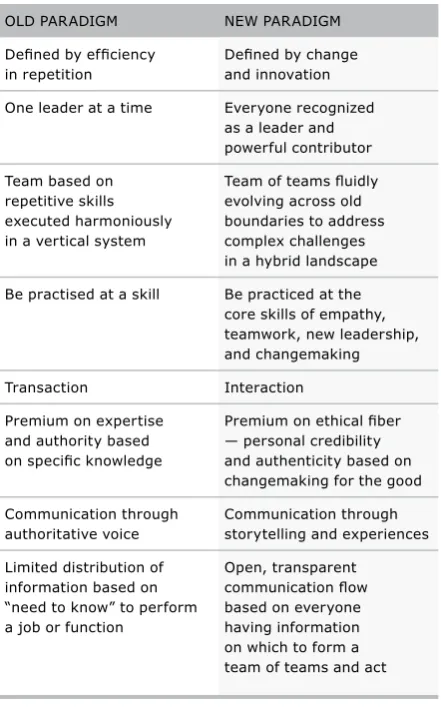
Playing in the new game must begin with a personal recalibration to one’s environment or circumstance. Real transformation is possible only after mindset shift. This is a daunting prospect, but less so once it is widely understood there is a new game requiring a wholly dif-ferent set of rules. The old rules will not work in the new game.
We are similarly faced with a game-changing moment as society shifts from a longstanding model based on repetition to the polar-opposite game of change. This process will challenge all of our existing notions for how we work together and participate effectively in society. For example, teamwork in the repetitive system was based on contribution to the team along narrow lines of position or function. The new game requires a very dif-ferent kind of teamwork—a team-of-teams approach— to command an environment of rapidly accelerating change. In this system, everyone must have the capac-ity to form into an open, fluid team of teams working across old boundaries to confront complex challenges and to create new possibilities. Different from the old team built on specialized skills, individuals are valued for their unique range of competencies, perspectives, passions, and experiences that can be brought to the opportunity at hand.
This observation gets to a second point about the dif-ferences between the two paradigms. In the new game, the premium is on innovation as a function of change, not repetition. If innovation had long been associated with advances in technology to create more efficiency in repetition—the assembly line, for example—we must now rethink that connotation in this new context. Innovation is, in fact, the ultimate result of a wall falling between two sides that would not otherwise connect. Sometimes technology assists in this transformation, at other times it is an outcome, but innovation is a very human activity. In the team-of-teams way of working, the value-add in any moment is the new team added to an existing one to act on the ever-changing nature of today’s problems and opportunities. The ability to tear down walls and connect others into a team of teams is, therefore, a requisite new leadership skill.
14
EDUCATION TRANSFORMS — PAPERS AND REFLECTIONS
CLICK FOR TABLE OF CONTENTS
2
New literacy and the changemaker generation:
[image:22.765.26.247.122.476.2]Why empathy is as important as reading and math
Table 2.1.
Comparing old and new paradigm characteristics
OLD PARADIGM NEW PARADIGM
Defined by efficiency in repetition
Defined by change and innovation
One leader at a time Everyone recognized
as a leader and powerful contributor
Team based on repetitive skills executed harmoniously in a vertical system
Team of teams fluidly evolving across old boundaries to address complex challenges in a hybrid landscape
Be practised at a skill Be practiced at the
core skills of empathy, teamwork, new leadership, and changemaking
Transaction Interaction
Premium on expertise and authority based on specific knowledge
Premium on ethical fiber — personal credibility and authenticity based on changemaking for the good
Communication through authoritative voice
Communication through storytelling and experiences
Limited distribution of information based on “need to know” to perform a job or function
Open, transparent communication flow based on everyone having information on which to form a team of teams and act
With changemaking as the new norm, the pace of change in every sector and in every individual’s life will accelerate. In order to navigate and command this new landscape, everyone must be a skilled and practised changemaker. Herein lie the stakes for the new learning needs of our children and youth.
In a world of interaction and complexity—one that relies on collaboration for success and contribution—the stakes for every child mastering empathy have never been higher. Team-of-teams is a way of working that is highly interactive, and individual integrity, a premium standard in this system, is directly proportional to change pursued for the good. Also, rules cannot keep up with this level of change, making cognitive empathy-based ethics essential in our everyday leadership and changemaking.
Innovation is the ultimate result of walls falling between two sides that would not otherwise connect. The ability to tear down walls and connect others into a team of teams is, therefore, a requisite new leadership skill.
Youth learning must, therefore, be calibrated so teens are practising cognitive empathy-based ethics, co-cre-ative teamwork (team-of-teams), a new kind of lead-ership in which everyone on the team is an initiatory player, and changemaking. Learning in the early grades must be focussed on the mastery of empathy as a fun-damental skill needed for success and contribution in today’s dynamically changing world.
15
EDUCATION TRANSFORMS — PAPERS AND REFLECTIONS
CLICK FOR TABLE OF CONTENTS
2
New literacy and the changemaker generation:
Why empathy is as important as reading and math
To this end, social impact leaders are uniquely posi-tioned to help facilitate a global mindset shift that will lead to societal framework change. Thirty-five years ago, Bill Drayton (2013), a pioneer of social entrepre-neurship, introduced the notion that there is nothing more powerful than a bold new idea in the hands of an exceptional entrepreneur innovating for the good of all. Behind his visionary leadership, the field of social entrepreneurship has grown. Today, the organization he founded, Ashoka, has a fellowship comprised of the world’s leading social entrepreneurs, numbering more than 3,200 innovators in 85 countries.
Social entrepreneurs are systems changers who work tirelessly for the public. Drayton describes these indi-viduals as society’s ‘essential corrective force’. In addi-tion to the ideas they bring to bear on the world’s most complex issues, leading social entrepreneurs have mastered the key skills needed for the new societal paradigm, and they apply them to tackle these seem-ingly intractable social challenges. Ashoka social entre-preneurs everywhere—regardless of culture, religion, or political system—act on their empathy and inspire other changemakers by removing obstacles that hinder innovation and create the conditions for changemaking. Twenty-five per cent of the Ashoka fellowship work on issues directly related to the health and well-being of young people, advancing powerful ideas and approaches aimed at giving agency to a generation of confident contributors in the world. They are trans-forming classrooms, playgrounds, neighborhoods, and communities. Individually, these leading social entre-preneurs command the foundational skills critical for success in the new strategic landscape. Collectively, they model and promote the ‘how-to’ for living in a changemaker world. However, more is needed to help society through this shift.
In recent years, Ashoka has devoted new resources and attention to carefully identifying, selecting, and collab-orating with teams of educators in primary and second-ary schools that are helping young people to develop the strategies and abilities needed for a changemaker world. In aspiration and practice, students are culti-vated as active contributors.
The emergence of this worldwide network of Change-maker Schools offers a model others can look to for prioritizing empathy and changemaker skills in student outcomes. The teams in these schools have demon-strated their ability and willingness to develop and test new ideas, rather than just follow established norms. Beyond their local focus, they are also global frame changers with the obvious commitment, influence, and reputation to persuade others to follow their lead. The Changemaker Schools network and the world’s leading social entrepreneurs—in conjunction with parents and social impact leaders in higher educa-tion, citizen-sector organizations, business, media, and youth venture entrepreneurship—are contributing to a growing global awareness that the learning framework for young people must be aligned with the new societal landscape.
Everyone A ChangemakerTM is not an alternative model
16
EDUCATION TRANSFORMS — PAPERS AND REFLECTIONS
CLICK FOR TABLE OF CONTENTS
2
New literacy and the changemaker generation:
Why empathy is as important as reading and math
The new learning framework will follow societal mindset shift. We will see evidence when principals, board members, and others in and around the educa-tion community know that the primary school’s success or failure is based on children in the early grades grasp-ing and practisgrasp-ing empathy. Cognitive empathy-based ethics will be elevated as a foundational skill on a level with reading and math.
Teens in middle and high school will be mindful that they must be changemakers practised at the four core skills needed for the new game (empathy, teamwork, new leadership, and changemaking). Stakeholders will count the number of student-created and student-run groups on their campuses as critical preparation indica-tors. Parents will actively evaluate if the culture of the school is can and students are instilled with a dream it,
do it belief. Finally, learning outcomes will reflect the
new imperative that graduating students must demon-strate the capacity to command the open, fluid team-of-teams landscape awaiting them.
3
Transitions from school
in Australia –
the winners
and losers
18
EDUCATION TRANSFORMS — PAPERS AND REFLECTIONS
CLICK FOR TABLE OF CONTENTS
3
Transitions from school in Australia – the winners and losers
John Polesel
Thinking about the transitions of young people from school to further study and employment is critically important. Let me say upfront that most young people make a successful transition from school to vocational education and training or to higher education, but the outcomes for a significant minority are worrying. Moreover, we know that gender, socio-economic status and location all have an impact on the quality of tran-sitions. Some groups are much more vulnerable than others to poor transitions. I want to focus particularly on those who don’t go to university or into any form of VET, because these are the ones most likely to be in what researchers like Castles and Standing have called in various publications the ‘precariat’—that is the group made up of employees in short-term contract positions, insecure jobs, with no paid holidays or sick leave, and receiving little training. Castles and colleagues have also noted the decline of secure, full-time jobs for young people in modern OECD economies.Just a note first on the data sources. I will be focussing on data collected in the first three states here.
• Victoria and Queensland – population surveys
• New South Wales – sample survey 2014
• Western Australia and South Australia – limited or pilot tracking
• Australian Capital Territory – no tracking
• Northern Territory – trial survey in 2005 involving seven schools
• Tasmania – one-off survey of 2002 Year 10, followed up through Years 11 and 12, involving approximately 6,700 students
19
EDUCATION TRANSFORMS — PAPERS AND REFLECTIONS
CLICK FOR TABLE OF CONTENTS
3
Transitions from school in Australia – the winners and losers
However, I am going to argue that the patterns of transition and differences for different sub-groups are probably pretty similar across Australia, and that the situation in Tasmania is likely to be close to what I will discuss below. Reports from the Victorian, New South Wales and Queensland surveys are all available online and they are a rich and accessible source of data via Google.
Starting with New South Wales, it is useful to consider two main questions—study status and labour market status (Figure 3.1) Behind these questions are many others: what course was a student taking, what job did he or she secure at how many hours, and so on?
Figure 3.1
Destinations of New South Wales’ Year 12 students completing, 2013
Source: Polesel et al. (2013)
Note: NILFET is Not in the labour force,
employment, or training.
Bachelor degree
51.8%
VET Cert IV+
9.3%
VET Cert I-III
6.7%
Apprenticeship
4.6%
Traineeship
3.0%
F/T Work
6.4%
P/T Work
12.1%
Looking for work
5.0%
20
EDUCATION TRANSFORMS — PAPERS AND REFLECTIONS
CLICK FOR TABLE OF CONTENTS
3
Transitions from school in Australia – the winners and losers
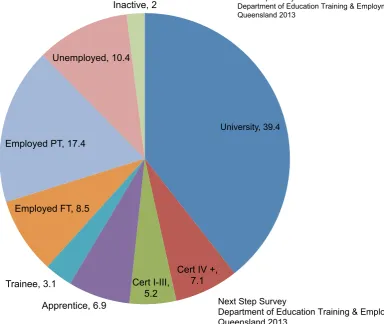
[image:28.765.351.736.95.419.2]Note the similarities and differences between Queens-land and New South Wales (Figure 3.2). The main dif-ference is the latter’s lower transition to university and consequently the higher proportion making a direct entry to the labour market.
Figure 3.2
Destinations of Queensland Year 12 students completing, 2013
Source: DET (2013)
University, 39.4
Cert IV +,
7.1
Cert I-III,
5.2
Apprentice, 6.9
Trainee, 3.1
Employed FT, 8.5
Employed PT, 17.4
Unemployed, 10.4
Inactive, 2
Next Step Survey
Department of Education Training & Employment
Queensland 2013
University, 39.4
Cert IV +, 7.1 Cert I-III,
5.2 Apprentice, 6.9
Trainee, 3.1 Employed FT, 8.5 Employed PT, 17.4
Unemployed, 10.4 Inactive, 2
Next Step Survey
21
EDUCATION TRANSFORMS — PAPERS AND REFLECTIONS
CLICK FOR TABLE OF CONTENTS
3
Transitions from school in Australia – the winners and losers
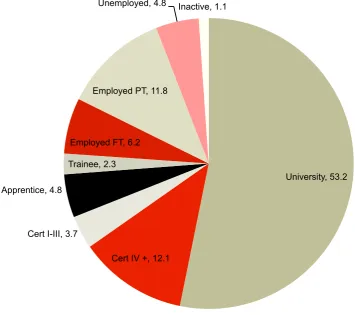
[image:29.765.289.645.100.415.2]Victoria is probably more similar to New South Wales, with almost identical proportions going into university (Figure 3.3).
Figure 3.3
Destinations of Victorian Year 12 students completing, 2013
Source: DEECD (2013)
University, 53.2
Cert IV +, 12.1
Cert I-III, 3.7
Apprentice, 4.8
Trainee, 2.3
Employed FT, 6.2
Employed PT, 11.8
22
EDUCATION TRANSFORMS — PAPERS AND REFLECTIONS
CLICK FOR TABLE OF CONTENTS
3
Transitions from school in Australia – the winners and losers
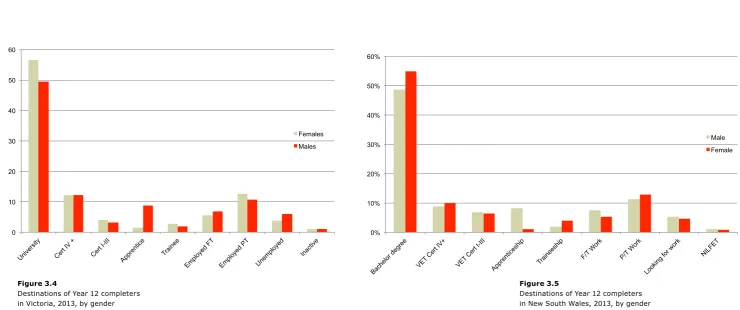
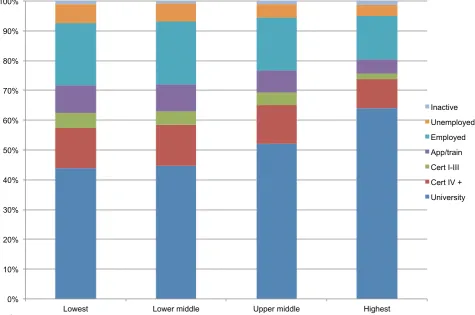
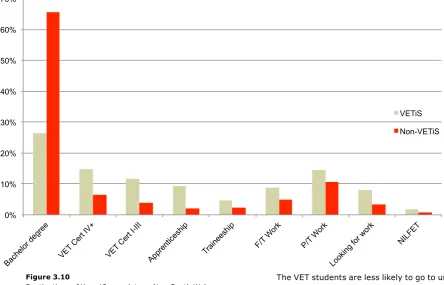
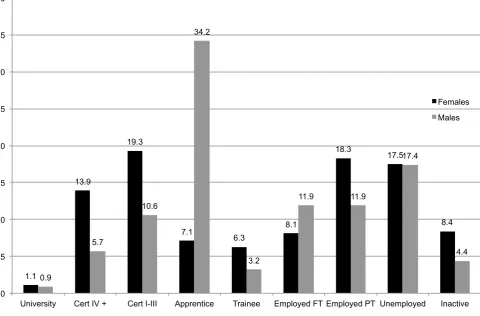
Here, I want to make some general comments that apply to all three states and, by extension, they prob-ably apply to the rest of Australia, including Tasmania. First of all, most young people make a relatively suc-cessful transition from school into university, post-school vocational education and training (VET), appren-ticeships and traineeships. The most common pathway among those surveyed is to university; this accounts for approximately half the school completer cohort. The next largest destination comprises vocational pro-grams or apprenticeships and traineeships. Overall, the proportion entering different VET or work-based pathways is about one quarter. However, the transi-tions for the remainder—usually about one quarter of the cohort—are more problematic. This remaining one quarter of the cohort comprises those not in accredited education or training of any kind. Most are in the labour market, and the larger proportion of these is working part-time. Note that only a minority find full-time work. This discussion of the post-school destinations of young people needs to be grounded in the context of an overall apparent retention rate from Year 7 to Year 12 of 76.7 per cent in Australia. In other words, a sig-nificant proportion of the secondary school cohort does not even complete school, and the rate varies consid-erably across the states, regions and equity groups. These apparent retention rates are relatively low by international standards and have barely changed over the last 20 years. Moreover, the destinations of the early leavers are more worrying than that evident with the school completers.
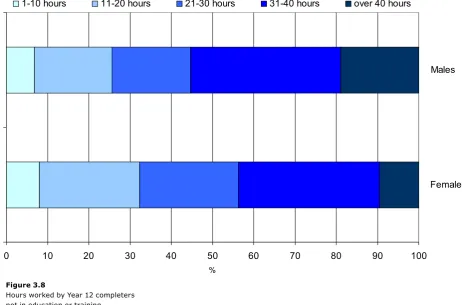
So do these outcomes represent a problem? Should our schools and our policy makers be worried? Is there a problem for this one quarter entering the labour market without any further education or training? I would argue that it depends on what kind of job they are doing and how many hours they are working and I will come back to that. But first, I would like to point out some of the differences for different subgroups of students.
23
EDUCATION TRANSFORMS — PAPERS AND REFLECTIONS
CLICK FOR TABLE OF CONTENTS
[image:31.765.8.749.127.437.2]3
Transitions from school in Australia – the winners and losers
Figure 3.4
Destinations of Year 12 completers in Victoria, 2013, by gender
[image:31.765.354.750.176.435.2]Source: DEECD (2013)
Figure 3.5
Destinations of Year 12 completers in New South Wales, 2013, by gender
Source: Polesel et al. (2013) 0
10 20 30 40 50 60
University Cert IV + Cert I-III Apprentice Trainee
Employed FT Employed PT Unemployed
Inactive
Females Males
0% 10% 20% 30% 40% 50% 60%
Bachelor degree VET Cert IV+
VET Cert I-III
Apprenticeship Traineeship F/T W
ork P/T W
ork
Looking for work
NILFET
24
EDUCATION TRANSFORMS — PAPERS AND REFLECTIONS
CLICK FOR TABLE OF CONTENTS
3
Transitions from school in Australia – the winners and losers
[image:32.765.263.744.122.390.2]Regional differences are important to consider as well. Figure 3.6 shows the situation in New South Wales, and again these patterns are broadly repeated in Victoria and Queensland. I suspect they represent the situation on other states, as to differences between the capital cities and regional areas.
Figure 3.6
Destinations of Year 12 completers in New South Wales, 2013, by region
Source: Polesel et al. (2013)
Sydney school students are much more likely to go to university, a trend that declines among those in near regional centres in the Hunter and Illawarra north and south of the capital, and drops again for the remote areas of the state. These surveys consistently show that school completers living in the metropolitan areas such as Sydney, Brisbane and Melbourne are more likely to enter higher education than those in the regional and rural locations in those states.
0% 10% 20% 30% 40% 50% 60% 70% 80% 90% 100%
North & East Sydney South & West Sydney Hunter & Illawarra Remainder NSW