The Reality of the Semantic
Gap in Image Retrieval
Tutorial held in conjunction with the
1st International Conference on Semantic and
Digital Media Technologies
Athens, Greece
Wednesday 6
thDecember 2006
The Reality of the Semantic Gap in Image Retrieval
The semantic gap is referred to frequently in papers on image retrieval or multimedia information handling.
However, whilst many authors have been happy to make reference to it, few have attempted to characterize
the gap in any detail. This tutorial will attempt to rectify this situation by characterizing the semantic gap in
image retrieval rather more specifically than hitherto. It will summarise current attempts to begin to bridge
the gap both through developments in content-based techniques, the application of semantic web and
knowledge technologies and recent progress in auto image annotation. The tutorial will consist of
presentations/demonstrations partly based on research in recent European and UK projects, and particularly
on a project to investigate the semantic gap funded by the Arts and Humanities Research Council in the UK
involving the four presenters.
This tutorial aims to provide valuable insights for those involved in research and development on image or
multimedia retrieval and who wish to understand and address the concerns of real end-users and exploit
recent research results in the field. In particular, the tutorial will provide practical insights into the problems
associated with bridging the communication gap between the computer science/vision research community
and the image management/practitioner community.
The first presentation will summarise research into the way picture searchers articulate real queries, how they
are typically resolved through a combination of traditional metadata and the knowledge of the searcher. This
section will include our own investigations into query categorization and image categorization and the
identification of recurring semantic issues in image search such as significance of events, abstract and
emotive concepts and unwanted features.
The second presentation, will explore the ways in which textual description of images is prescribed in theory
and applied in practice within image collections, through the use of cataloguing schemas, metadata schemas,
controlled vocabularies thesauri, etc. These approaches can be regarded as addressing issues at the semantic
end of the semantic gap.
The third presentation will review progress in content-based image retrieval, automatic annotation and
extraction of semantics in recent years and explore the types of query that they are able to address. The
semantic gap between features that can be extracted directly from images and the semantics that the human
searcher attaches to the visual information will be revisited and various staging posts across the gap will be
identified such as raw data to features, features to objects, objects to labels and labels to semantics. The ways
in which these sub gaps can be bridged in some instances will be discussed together with the substantial
current interest in machine learning and auto annotation.
The final presentation will show how the application of ideas from cross language latent semantic indexing
can be extended to build multimedia semantic spaces in which visual and conceptual “terms” are mapped to
similar locations in the space. This means that images can be retrieved using either textual or visual
descriptors whether or not they have collateral textual annotations.
Presenter Biographies:
Peter Enser, Computing, Mathematical and Information Sciences, University of Brighton, UK.
[email protected]
http://www.cmis.brighton.ac.uk/Research/vir/VIR2.HTM
Peter Enser is Professor of Information Science and Head of the Computing, Mathematical & Information
Sciences (CMIS) Research Centre at the University of Brighton, U.K. He has had many years of
engagement with research in the field of visual image retrieval, with a particular focus on user studies. He
has directed a number of funded projects in this field, and his many publications and presentations on the
topic have addressed international audiences within the library and archive management, cultural heritage
and computer science communities.
Criss Sandom, Computing, Mathematical and Information Sciences, University of Brighton, UK.
[email protected]
http://www.cmis.brighton.ac.uk/Research/vir/VIR2.HTM
Criss Sandom is a Research Officer in the School of Computing, Mathematical & Information Sciences at
the University of Brighton, U.K. She has worked since 1999 on the VIRAMI and Semantic Gap research
projects in image retrieval, under the direction of Peter Enser.
Paul Lewis, Electronics and Computer Science, University of Southampton, UK.
[email protected]
http://www.ecs.soton.ac.uk/~phl
Paul Lewis is a professor in the Intelligence, Agents, Multimedia Group within the School of Electronics and
Computer Science at the University of Southampton. His main research interests are currently centred on the
broad area of multimedia knowledge management. In particular he is addressing problems in image and
video processing and analysis, multimedia annotation and semantic description of media. He is particularly
involved with designing and developing novel facilities for multimedia information retrieval, navigation and
browsing with applications in both the medical and the cultural heritage domains. His research is building on
ideas from low-level media processing and knowledge management and emerging semantic web
technologies.
Jonathon Hare, Electronics and Computer Science, University of Southampton, UK.
[email protected]
http://www.ecs.soton.ac.uk/~jsh2
Peter G.B.Enser, Christine J.Sandom
School of Computing, Mathematical and Information Sciences,
University of Brighton, U.K.
Paul H. Lewis and Jonathon S. Hare
School of Electronics and Computer Science,
University of Southampton
THE REALITY OF THE SEMANTIC GAP IN
IMAGE RETRIEVAL
Session 1
Peter Enser
Scoping the semantic content of images
Session 2
Christine Sandom
Textual subject description in practice
Session 3
Paul Lewis
Characterising the semantic gap
Session 4
Jonathon Hare
Scoping the semantic content of images
Peter Enser
Content
•
What do we understand by ‘the semantic content of
images’?
•
Characterising the semantic content of images
facet structure
•
Seeking the semantic content of images
faceted queries
•
The relationship between structured semantic content
Image understanding from the human perspective
inferential reasoning
semantic
content
perceptual
content
Personal knowledge
Personal experience
Cultural conditioning
Collective memory
perception
IMAGE
image
subject
metadata
Title
Caption / Description
Keywords
Summary
Shot list
image
subject
metadata
search statement
vocabulary control
text matcher
Image retrieval: semantic paradigm
Title
Caption
Keywords
Summary
Shot list
attributes
colour
texture
shape / region
spatial distribution
spatio-temporal
distribution
Image retrieval: content-based paradigm
colour
texture
shape / region
spatial distribution
spatio-temporal
distribution
digital
image
subject
metadata
digital
image
local / global feature
similarity computation
Semantic
Retrieval
Content-based
Retrieval
Pixel-encoded
content
Semantic
content
“… the lack of coincidence
between the information
that one can extract from
the visual data and the
interpretation that the same
data have for a user in a
given situation”
(Smeulders et al., 2000)
Characterisation of the semantic content of images / queries
Eakins & Graham (1999); Greisdorf & O’Connor (2002)
Panofsky (1962)
Shatford (1986)
Jaimes & Chang (2000); Jörgensen et al. (2001)
Enser & McGregor (1992); Armitage & Enser (1997)
Specific
Generic
Abstract
Bridging the Semantic Gap in Visual
Information Retrieval
MRG-AN6770/APN174290; 1/02/2004 – 31/01/2007
Peter G. B. Enser, Christine J. Sandom
School of Computing, Mathematical and Information Sciences, University of Brighton
Paul H. Lewis, Jonathon S. Hare
Shatford Layne (1994)
Characterisation of the semantic content of images
Object facet
Spatial facet
Temporal facet
Event/activity facet
I
M
A
G
E
Generic Object Instance
blob interpreted at a basic level as man,
building, tree, vehicle, ...
Generic Object Instance
blob interpreted at a basic level as man,
building, tree, vehicle, ...
Generic Object Class Hierarchy
successively refined classification of an
object employing knowledge-based
inference drawn from visual
attribute-values: man-in-uniform – policeman –
traffic cop; residential dwelling
-condominium; conifer – fir tree; …
The object facet
Generic Object Instance
blob interpreted at a basic level as man,
building, tree, vehicle, ...
Generic Object Class Hierarchy
successively refined classification of an
object employing knowledge-based inference
drawn from visual attribute-values:
man-in-uniform – policeman – traffic cop; residential
dwelling - condominium; conifer – fir tree; …
Specific Named Object Class
high-level interpretation of an object as a
member of an object class to which a
proper name may be applied: Korresia (a
variety of floribunda); Chippendale table;
Cunarder, ...
Generic Object Instance
blob interpreted at a basic level as man,
building, tree, vehicle, ...
Generic Object Class Hierarchy
successively refined classification of an
object employing knowledge-based inference
drawn from visual attribute-values:
man-in-uniform – policeman – traffic cop; residential
dwelling - condominium; conifer – fir tree; …
Specific Named Object Class
high-level interpretation of an object as a
member of an object class to which a proper
name may be applied: Korresia (a variety of
floribunda); Chippendale table; Cunarder, ...
Specific Named Object Instance
unique identification and appellation of an
object: George W. Bush, Taj Mahal, Queen
Mary 2, ...
The object facet
Generic Object Instance
building, water, person, tree
Generic Object Class Hierarchy
mausoleum, tomb, dome,
minaret
Specific Named Object Class
World Heritage Site
Specific Named Object Instance
Taj Mahal
Generic Object Instance
animals from movies
Generic Object Class Hierarchy
(very cute) dog
guide dog; ‘sniffer’ dog
Specific Named Object Class
Norfolk Terrier
Rottweiler
Specific Named Object Instance
the Shetland Sheepdog ‘Champion
Skye of Whytelaw’
Examples of requests which include the
object facet
Generic Location
the background to the image, the
spatial context in which the
object(s) within the image are
placed; e.g. inside, outside, urban,
countryside, field, lake, kitchen …
Specific Location Hierarchy
successively refined geographical
area, identified by proper name,
e.g., Europe, Britain, England,
London, Tottenham, Higham
Road…
Generic Location
outside
Specific Location Hierarchy
India, Uttar Pradesh, Agra
Examples of requests which include the
spatial
facet
Generic Location
Specific Location
Hierarchy
American air force in France
Welsh mining c. 1930
Nancy Astor - if possible
campaigning in Plymouth
Ruins of Dresden after bombing
Wigan unemployment
New York buses
…various aspects of holiday making.
Seaside, mountain or countryside
Generic Time
natural periods, e.g., day, night, winter,
summer…
periods of time expressed in other than
standard temporal measurements,
such as epochs or eras, e.g.,
Renaissance, Pleistocene, medieval,
Victorian, …
Specific Time
time expressed in terms of standard
quantifications: date, year or multiples
thereof, e.g., twenty-first century,
1950s, 1896, September 2005, 12 June
2006,
…
The temporal facet
Generic Time
autumn, dusk, evening
Examples of requests which include the
temporal
facet
Houses of Parliament at night
Frost fairs: ice on river in "olden days"
Turkish troops in World War 1
Houses of Parliament, c. 1900
Churchill and Lord Halifax - walk to
Parliament, March 28, 1938
1920s/30s/40s Really packed grounds or
queuing at turnstiles of football grounds
New York police cops. Must be in summer,
1950s-1960s, in caps
Generic time
Specific time
Generic Activity
gerunds associated with the object(s) in
the image, e.g. running, bending,
dancing.
Generic Event
a
temporal and/or spatial relationship
between a set of objects and a set of
activites or actions which share a
common purpose, e.g., basketball
match, demonstration, wedding, …
Specific Named Event Class
a type of event to which a proper name
may be applied, e.g., Olympic Games,
Rio Carnival, Papal Investiture, …
Specific Event Instance
a unique occurrence of an event, e.g.,
2006 Olympic Games, Investiture of
Pope Benedict XVI, sinking of the
‘Titanic’, …
Ordination
© Getty Images
Archbishop of Canterbury Doctor Robert Runcie ordains the first women
Deacons in the Church of England at Canterbury Cathedral. 27/02/87
Examples of requests which include the
event/activity/significance facet
Generic Activity
Generic Event
Specific Named Event Class
Specific Event Instance
Stirling Moss winning Kentish 100 Trophy at
Brands Hatch, 30 August 1968
1967 Aberfan disaster
West Ham v Bolton Wanderers - 1923 First
Wembley cup final
Bannister breaking tape on 4 minute
hop picking
registry office weddings
Characterisation of the semantic content of images
Object facet
Spatial facet
Temporal facet
Event/activity facet
Topic
Related concept/object class
Abstract concept
Context
I
M
A
G
E
Topic
Indian Architecture
Related concept/object class
Shah Jehan, Mumtaz Mahal, Islam
Abstract concept
love, death, devotion, remembrance
Context
built in memory of his wife Mumtaz
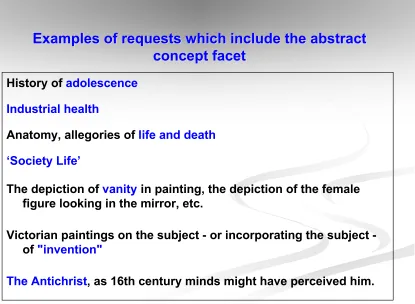
Examples of requests which include the abstract
Examples of requests which include the abstract
concept facet
concept facet
History of
adolescence
Industrial health
Anatomy, allegories of
life and death
‘Society Life’
[image:20.595.98.513.79.383.2]The depiction of
vanity
in painting, the depiction of the female
figure looking in the mirror, etc.
Victorian paintings on the subject or incorporating the subject
-of
"invention"
The Antichrist
, as 16th century minds might have perceived him.
Examples of requests which include affective content
Examples of requests which include affective content
Death, grief, mourning
- 19th C British
… depictions of
happiness
– smiling, laughing, etc. together with
more abstract representations in any period of art
Images which show a range of emotions, eg series of photographs
showing someone in stages from
miserable
to
happy
…
some irresponsible parents still purchase dogs for presents for
children...
images … to illustrate [this]
Very
cute
dog, preferably a Heinz variety
Examples of requests which include features which
Examples of requests which include features which
must not be visible
must not be visible
Posters of agricultural scenes - but preferably
without any
machinery or horses
in it - needs to be “timeless”
George V's coronation but
not procession or any royals
J F Kennedy with woman - but
not Jacqueline or mother Rose
Scoping the semantic content of images
Summary
The semantic content of images, as inferred by their
viewers, and sought by their users, is multi-facetted
and many-layered.
Representing and retrieving the richness of semantic
content poses a very considerable challenge in
Textual subject description in practice
Christine Sandom
Content
•
Cataloguing and Classification of pictures:
In theory
In practice
•
The Project’s first phase: some results
Non-subject metadata; includes
:
•
administrative metadata - to do with the
management of the collection
•
technical metadata - to do with the
physical properties of the images
•
Creator metadata – to do with the
origination of the images
Subject metadata
:
•
Titles, captions, descriptions, keywords
Cataloguing pictures isn’t just keywording
Image requests may be for any of these data
•
Visual Resources Association, VRA Core Categories,
(
http://www.vraweb.org/vracore3.htm
)
•
Dublin Core Element Set
(
http://dublincore.org/
)
•
Categories for the Description of Works of Art (CDWA)
(
http://www.getty.edu/research/conducting_research/standards/cdwa/
)
But many picture collections have developed their own
cataloguing systems
– there is little uniformity in cataloguing
practice.
Title
Title
View of the
View of the
Taj Mahal
Taj Mahal
, built by Emperor Shah
, built by Emperor Shah
Jahan
Jahan
(1592-1666), completed in 1643 (photo)
(1592-1666), completed in 1643 (photo)
Additional Info
Additional Info
built in memory of his wife
built in memory of his wife
Mumtaz Mahal
Mumtaz Mahal
(d.1631);
(d.1631);
Artist
Artist
Lahori
Lahori
,
,
Ustad
Ustad
Ahmad (fl.1630-47)
Ahmad (fl.1630-47)
Location
Location
Agra, India
Agra, India
Century
Century
C17th
C17th
Nationality
Nationality
Persian
Persian
Classification:
Classification:
INDIA & NEIGHBOURING COUNTRIES
INDIA & NEIGHBOURING COUNTRIES
Keywords:
Keywords:
mausoleum; minaret; minarets;
mausoleum; minaret; minarets;
islamic
islamic
architecture;
architecture;
Indian;
Indian;
muslim
muslim
; dome; domes; pool; reflection; India;
; dome; domes; pool; reflection; India;
Jehan
Jehan
Cataloguing (metadata) in practice
Cataloguing (metadata) in practice
Metadata from Bridgeman Art Library
http://www.bridgeman.co.uk
Cataloguing (metadata) in practice
Cataloguing (metadata) in practice
Description
Description
:
:
Taj Maha
Taj Maha
, Agra, India, 17th century. Marble
, Agra, India, 17th century. Marble
mausoleum built by Shah
mausoleum built by Shah
Jahan
Jahan
for his favourite
for his favourite
wife,
wife,
Mumtaz Mahal
Mumtaz Mahal
. Photograph.
. Photograph.
Subjects:
Subjects:
People
People
Keywords
Keywords
:
:
17th century; architectural; burial; burial chamber;
17th century; architectural; burial; burial chamber;
century; colour; concept; death; decorative; dome;
century; colour; concept; death; decorative; dome;
Islam; Islamic;
Islam; Islamic;
Jahan
Jahan
, Shah; mausoleum; monument;
, Shah; mausoleum; monument;
Mughal
Mughal
empire; people; religion; religious; royal;
empire; people; religion; religious; royal;
royalty; seventeenth century; Shah
royalty; seventeenth century; Shah
Jahan
Jahan
;
;
Taj Mahal
Taj Mahal
;
;
tomb
tomb
Metadata from: Heritage Image Partnership
(Ann Ronan Picture Library)
Subject metadata in practice
Subject metadata in practice
–
–
6 images of the
6 images of the
Taj Mahal
Taj Mahal
15
15
16
16
Contextual, non-keyword
Contextual, non-keyword
8
8
8
8
Specific Time
Specific Time
3
3
3
3
Generic time
Generic time
5
5
9
9
Specific Location Hierarchy
Specific Location Hierarchy
1
1
1
1
Generic Location
Generic Location
15
15
19
19
Adjectives
Adjectives
17
17
18
18
Related concept
Related concept
3 *
3 *
8
8
Specific Named Object Instance
Specific Named Object Instance
20
20
35
35
Generic Object Class Hierarchy
Generic Object Class Hierarchy
8
8
14
14
Generic Object Instance
Generic Object Instance
12
12
12
12
Abstract Meaning/Mood
Abstract Meaning/Mood
terms
terms
used
used
total
total
* Taj Mahal; Taj; Mahal
Describing the content of images isn’t just keywording
natural language
– titles, captions, descriptions
controlled language
– keywords, topics
thesauri / ontologies
subject heading lists
authority lists
Picture number: PERA000970
Title: Amy Johnson, British aviator, 12 May 1930.
Caption: In 1930 Johnson (1903-1941) became the first woman to fly solo from England to Australia, winning £10,000 from the 'Daily Mail' newspaper. Her plane was a De Havilland Gipsy Moth aircraft (nicknamed 'Jason'). In 1932, she set a record for the fastest solo flight from England to Capetown and broke that record four years later. In 1933, with her husband, James Mollison (1905-1959) she flew in a De Havilland biplane non-stop across the Atlantic in 39 hours. She joined the Air Transport Auxilary as a pilot in WWII and died when her plane was lost over the Thames estuary.
Credit: NMPFT/Daily Herald Archive/Science & Society Picture Library
Image description – natural and controlled language
Image and metadata from the Science and Society Picture Library
free text, natural language
Picture number: PERA000970
Subject: PERSONALITIES
Title: Amy Johnson, British aviator, 12 May 1930.
Caption: In 1930 Johnson (1903-1941) became the first woman to fly solo from England to Australia, winning £10,000 from the 'Daily Mail' newspaper. Her plane was a De Havilland Gipsy Moth aircraft
(nicknamed 'Jason'). In 1932, she set a record for the fastest solo flight from England to Capetown and broke that record four years later. In 1933, with her husband, James Mollison (1905-1959) she flew in a De Havilland biplane non-stop across the Atlantic in 39 hours. She joined the Air Transport Auxilary as a pilot in WWII and died when her plane was lost over the Thames estuary.
Keywords:
Personalities Johnson,Amy Woman Women Aviators Aviati
on DH60 Moth
Jason
Firsts
Solo Flights
Flying
Pioneers
De
Havilland Gipsy Moth
James Mollison
Biplanes
Air
Transport Auxilary
Pilots
Record Breakers
Lost
Mysteries
Airplanes
Aeroplanes
Unattributed
United Kingdom
The 1930s
(1930-1938)
Image description – natural and controlled language
Image and metadata from the Science and Society Picture Library
free text, natural language
Example of thesaurus entry (TGMI)
Dogs
Used For:
Puppies
Broader Term:
Animals
Narrower Term:
Bloodhounds; Bulldogs; Chow chows (Dogs); Collies;
Dachshunds; Greyhounds; Hunting dogs; Irish
wolfhounds; Poodles; Watchdogs; Working dogs
Related Term:
Dog breeders; Dog licenses; Dog racing; Dog shows;
Dog teams; Dog walking; Dogcatching; Dogs of war;
Dogsledding; Fetch (Game); Kennels; Sled dog racing
Source: Library of Congress, (2006) Thesaurus for Graphic Materials I: Subject Terms
http://www.loc.gov/rr/print/tgm1/
“ICONCLASS is a subject specific international
classification system for iconographic research
and the documentation of images. …
ICONCLASS is a collection of ready-made
definitions of objects, persons, events,
situations and abstract ideas that can be the
subject of an image.”
From the ICONCLASS website: What is ICONCLASS. http://www.iconclass.nl
Example of classification scheme: ICONCLASS
Composed as follows:
7
Bible
73
New Testament
73C
public life of Christ: from
his baptism until the
Passion
73C1
story of John the Baptist
(Matthew 3;Mark 1:4-11;
Luke 3:1-22; John 1:19-34)
73C13 martyrdom and death of
John the Baptist (Matthew
14:3-12; Mark 6:17-29)
73C133 Salome dancing during the
banquet of Herod
ICONCLASS classification
B. Gozzoli, Dance of Salome (Image from CGFA http://cgfa.sunsite.dk/)
Content of an image may be
classified using one code …
73C133
Or many codes …
4 Society, Civilization, Culture 41 material aspects of daily life 41C nutrition, nourishment
41C5 celebration meal, feast, banquet
Feast – 41C5
7 Bible
73 New Testament
73A (scenes from the life of) John the Baptist and Mary
73A(JOHN THE BAPTIST) series of scenes from the life of John the Baptist
John the Baptist
-73A(JOHN THE
BAPTIST)
ICONCLASS classification
4 Society, Civilization, Culture 43 recreation, amusement
43C sports, games and physical performances
43C9 dancing
43C91 one person dancing alone 43C912 woman dancing alone
43C912 - woman
dancing alone
Full ICONCASS classification (but more could be added)
73C133; 41C5; 73A(JOHN THE BAPTIST); 43C912
Bridging the Semantic Gap in Visual
Information Retrieval
MRG-AN6770/APN174290; 1/02/2004 – 31/01/2007
Peter G. B. Enser, Christine J. Sandom
School of Computing, Mathematical and Information Sciences, University of Brighton
Paul H. Lewis, Jonathon S. Hare
School of Electronics and Computer Science, University of Southampton
Bridging the Semantic Gap in Visual Information Retrieval Project
Case study collections
Birmingham Central Library
Public Library
The Bridgeman Art Library
Commercial Library
BBC, News & Stills Archive
Private library
The Map Library, British Library
National Library
Centre for the Study of Cartoons and Caricature
Academic collection
East Sussex Record Office
County Archive
Edina (Hulton Getty)
Education Images
Guildhall Library Map and Print Collection
Public Library
Institution of Electrical Engineers
Private Library
The Kennel Club Picture Library
Private Library
National Monuments Record, English Heritage
National Collection
Photonica
Commercial
Bridging the Semantic Gap in Visual Information Retrieval Project
Information gathered
Requests:
492
Images + metadata
1058
Number of collections
17
Collections with computer catalogues
13
Number with significant numbers of digitised images
8
Bridging the Semantic Gap in Visual Information Retrieval Project
facet use in the collections
Title:
Isadora Duncan
Description: Isadora Duncan (1878 - 1927) performing a
classical Greek dance.
Subject:
Dance, Personality
Keywords:
black & white, format portrait, clothing,
costume, female, single, dancing,
American, Isadora Duncan, dancer,
Dancer, Dance
Date:
circa 1905
A typical catalogue record
Isadora Duncan © Getty Images
black & white, format portrait black & white, format portrait Picture Attributes Picture Attributes dancing dancing Generic Activity Generic Activity American American Adjectives Adjectives Isadora Duncan Isadora Duncan Specific Named Object Instance
Specific Named Object Instance
costume, dancer costume, dancer Generic Object Class Hierarchy
Generic Object Class Hierarchy
clothing, female, single clothing, female, single Generic Object Instance
Generic Object Instance
Dance, Personality Dance, Personality Topic
Requests have facets too
the Trinity Church
(1)in
Paris
(2), 1930-1980
(3), where
Messaien lived and was the
organist
(4).picture of the Portugese court
or royal family
(1)in Lisbon
(2),
in the 1720s
(3), showing in
particular Princess Maria
Barbara
(4).
(1) Specific Named Object Instance
(2) Specific Location Hierarchy:
(3) Specific Time
(4) Contextual, non-keyword
(1) Generic Object Class Hierarchy
(2) Specific Location Hierarchy
(3) Specific Time
(4) Specific Named Object Instance
I need some posters
(1)of
agricultural scenes
(2)- but
preferably without any
machinery
(3)or horses
(3)in it
-needs to be “timeless”
(4)(1) Picture attribute
(2) Topic
(3) Generic Object Class Hierarchy
[things not wanted]
(4) Abstract Meaning/Mood
8 40 38 407 Topic 14 66 16 170 Specific Time 23 111 22 237
Specific Named Object Instance
1
56 15
154 Specific Named Object Class
12 7
2
18 Specific Named Event Class
12 60
19 197
Specific Location Hierarchy:
4 17
2
17 Specific Event Instance
17 177 Related concept 4 19 22 231 Generic time 5 23 21 223
Generic Object Instance
18 89
60 637
Generic Object Class Hierarchy
4 17 25 261 Generic Location 4 19 10 105 Generic Event 7 34 24 252 Generic Activity 8 37 26 221 Contextual, non-keyword 7 33 27 284 Adjectives 3 15 12 122 Abstract Meaning/Mood Requests % Requests Number Images % Images Number
Requests
Requests
–
–
Facet analysis summary
Facet analysis summary
–
–
non-subject facets
non-subject facets
Requests aren’t always for subjects – many include
reference numbers or creators
<1 <1 2 2 Publication Publication <1 <1 1 1 Embedded Text Embedded Text 1 1 6 6 Picture example Picture example 2 2 11 11 Date Date 14 14 67 67 Id number Id number 17 17 81 81 Title Title 22 22 108 108 Creator Creator 23 23 111 111 Picture attributes Picture attributes % % numbers numbers
Bridging the Semantic Gap in Visual Information Retrieval Project
Both natural and controlled language are important for image
retrieval, as is the mediation of the picture librarian
In the
Bridging the Semantic Gap in Visual Information Retrieval Project
Of the requests received by collections that keyworded their images:
•
72% were subjects requests
•
16% were non-subject requests (e.g. for image reference numbers,
creators, etc)
Both natural and controlled language are important for image
retrieval, as is the mediation of the picture librarian
In the
Bridging the Semantic Gap in Visual Information Retrieval Project
Of the images retrieved in response to ‘subject’ or mixed requests:
•
17% had all their search terms in controlled language
•
30% had all their search terms in natural language
•
53% had their search terms fully or partially in a combination of
natural and controlled language
Both natural and controlled language are important for image
retrieval, as is the mediation of the picture librarian
In the
Bridging the Semantic Gap in Visual Information Retrieval Project
Of the images retrieved in response to ‘subject’ requests:
•
18% either had none of the request’s search terms in their
metadata or had no subject metadata at all
•
29% needed the search term(s) to be modified in order to
The Kennel Club
The first major case study
Small image collection: around 60,000 images, of which some
7,000 digitised, and 3,000 have descriptive metadata
Single domain: all dog and dog-show related
©Kennel club
The Kennel Club – descriptive terms – problems
encountered in natural language indexing
Spelling, etc
Dalmation
Puppys
Best of Show (s/b Best in Show)
Ambiguities
Chocolate (noun or adjective)
Synonyms
Alsatian; German Shepherd Dog
Behind; bottom; rump; rear
Acronyms
BSD / Belgian Shepherd Dog
BIS / Best in Show
An extract from the KC Thesaurus
Sad
BT: Appearance
Path: Sad > Appearance > Dog Attributes > Dogs
Safe and Sound
BT: Demonstrations
Used for:
SAS
Path: Safe and Sound > Demonstrations > Events > Dog Shows
Saluki
BT: Hounds
Path: Saluki > Hounds > Dogs
Samoyed
BT: Pastoral Dogs
Path: Samoyed > Pastoral Dogs > Dogs
Which was then converted to an ontology, but that’s Paul’s
story...
Characterising the Gap
The Challenge for Image Retrieval
• Representing and retrieving the richness of semantic
content poses a very considerable challenge in metadata
construction -
for humans
• Developing systems to extract rich semantic descriptions
from low level image features
automatically
(using
content analysis, prior knowledge, machine learning etc)
poses a monumental challenge and in the general case
is far from being achieved
Queries and Images
Query representation
- typically a textual expression of the required semantics
- in reality query by example is an uncommon paradigm
Image representation
- a 2-D array of pixels
- only colour and/or brightness of each pixel is explicit
To extract the semantics
we need
What is the Semantic Gap in Image Retrieval?
The gap between information extractable automatically from the
visual data and the interpretation a user may have for the same
data
…typically between low level features and the image semantics
Representations for Image Understanding
LOW LEVEL
Raw image - pixel level
Low level descriptors (edge, colour, texture etc)
Segmented regions, Salient regions
Region descriptors (shape, colour, texture etc)
Individual objects (region groupings?)
Object labels
Relations between labeled objects
Scene descriptions
Full semantics
HIGH LEVEL
These representations are effectively staging posts
across the semantic gap
Characterising the Gap
A hierarchy of levels between media and semantics
Characterising the Gap
Of course, its not that simple...
Descript
Descript
ors
ors
Raw
Raw
Media
Media
Objects
Objects
Labels
Labels
SKY MOUNTAINSTREES
Photo of Yosemite
Photo of Yosemite
valley showing El
valley showing El
Capitan and Glacier
Capitan and Glacier
Point with the Half
Point with the Half
Dome in the
Dome in the
distance
distance
Semantics
Semantics
Inter-object relationships and more prior knowledge sub/super
Analysing the Gap
Instructive to break the gap into two parts...
Analysing the Gap
from descriptors to labels
Descript
Descript
ors
ors
Objects
Objects
Labels
Labels
SKY MOUNTAIN
S
TREE S
Generic Object Instance blob interpreted at a basic level as man, woman, building, tree, vehicle, ...
Generic Object Class Hierarchy successively refined classification of an object employing knowledge-based inference drawn from visual attribute-values: man-in-uniform – policeman – traffic cop; residential dwelling -condominium; conifer, ...
Specific Named Object Class high-level interpretation of an object as a member of an object class to which a proper name may be applied: Korresia (a variety of floribunda);
Chippendale table; Cunarder, ...
Specific Named Object Instance unique identification and appellation of an object: George W. Bush, Taj Mahal, Queen Mary 2, ...
The object facet
Increasing requirement for specific prior knowledge
Analysing the Gap
from labels to semantics
Labels
Labels
SKY MOUNTAINSTREES
However, user queries are typically formulated in terms of
semantics
Photo of Yosemite
Photo of Yosemite
valley showing El
valley showing El
Capitan and Glacier
Capitan and Glacier
Point with the Half
Point with the Half
Dome in the distance
Dome in the distance
Semantics
Remember the other Facets of Semantics
The Spatial Facet
Generic Location
Specific Location Hierarchy
The Temporal Facet
Generic Time
Specific Time
The Activity/Event Facet
Generic Activities and Events
Specific Named Event Class
Specific Named Event Activity
And… topics, related concepts, and context
Bridging the Gap
Involves Transforming Representations
and Injecting a lot of Prior Knowledge
At the bottom end of the gap
Most CBIR research has been here,
bridging between raw media and low level descriptors representing
image content in the QBE paradigm
Larger Bridges
-Some approaches (eg object detection/recognition
and image annotation) go from raw media to objects and labels
- very little work on on extracting higher level semantics directly
At the top end of the gap
Use of knowledge structuring techniques
At The Bottom End of The Gap
CBIR Research
Active research area for at least 20 years
Some progress in general CBIR
Better progress in specific domains
Still no significant CBIR in major web search engines
Basic idea -use image content extracted from pixel data, as
opposed to metadata, to assist retrieval
Motivation - labour intensive nature and limitations in coverage of
textual annotations
At the Bottom End of the Gap
Query By Example
Most popular CBIR paradigm
-find me an image similar this one
find me part of an image (a sub-image) like this one
find me a sub-image like this sub-image
What might searchers mean by “similar”?
similar in every respect
similar colours, textures, shapes, objects
The QBE Approach
Extract image descriptors (feature vectors) from the images in the
collection
Extract same descriptor(s) from the query image
Calculate similarity between query descriptors and descriptors for
the image collection (typically based on distance in some feature
space)
Return best n matches from image collection in decreasing order of
similarity
Descriptors
Wide variety - some defined in MPEG 7 standard
Are they trying to describe the whole image specific objects or aspects
of the image?
Global descriptors versus local descriptors
Regions from segmentation versus salient regions from interest points
Colour based descriptors have been the most popular
Colour histograms, colour coherence vectors, colour layout
Edge histograms/curvature scale space for shape, wavelets and more
for texture
Invariance properties: Colour invariants, Rotation, Scale, Translation
CBIR System Survey (2001)
Remco C. Veltkamp
,
Mirela Tanase
http://www.aa-lab.cs.uu.nl/cbirsurvey/cbir-survey/cbir-survey.html
Compare 42 - mainly research systems - a few commercial ones
TODAI
TODAI
VIR Image Engine
VIR Image Engine
VisualSeek
VisualSeek
VP Image Retrieval
VP Image Retrieval
WebSEEK
WebSEEK
WebSeer
WebSeer
Wise
Wise
MIR
MIR
NETRA
NETRA
Photobook
Photobook
Picasso
Picasso
PicHunter
PicHunter
PicToSeek
PicToSeek
QBIC
QBIC
Quicklook
Quicklook
SIMBA
SIMBA
SQUID
SQUID
Surfimage
Surfimage
SYNAPSE
SYNAPSE
Excalibur
Excalibur
FIDS
FIDS
FIR
FIR
FOCUS
FOCUS
ImageFinder
ImageFinder
ImageMiner
ImageMiner
ImageRetro
ImageRetro
ImageRover
ImageRover
ImageScape
ImageScape
Jacob
Jacob
LCPD
LCPD
MARS
MARS
ADL
AltaVista Photofinder
Amore
ASSERT
BDLP
CANDID
Blobworld
CANDID
C-Bird
Chabot
CBVQ
DrawSeaarch
Features Compared
Colour
global histogram
Correlation histogram
Average Colour Vector
Colour Coherence vector
Fixed subimage Histogram
Region Histogram
Dominant Colour
Eigen Image
Texture
Wavelet
Atomic texture features
Random fields
Local binary patterns
Edge statistics
Shape
Shape
Template matching
Template matching
Fourier descriptors
Fourier descriptors
Elastic models
Elastic models
Curvature scale space
Curvature scale space
Example QBE Using Global Colour
Multiscale - CCV (MCCV)
“Where does this image
fragment come from?”
Example QBE Using CCV and Sub Image Matching
Query Image
QBE Using Wavelet Based Descriptor and Sub-image Matching
Best Matches
Global RGB Histogram
DoG Peaks RGB
Histograms
Global Colour Histogram Compared with
Salient Region Matching
Larger Bridges across the Gap
Images to objects
Increasing awareness of the need to work with semantics in image
and video retrieval
Movement from QBE to text driven modes
Increasing number of papers on “so called” semantic retrieval
Typically identify and label objects
Computer Vision
The ideal solution?
Active research area for longer than CBIR
Still no general solution
Emphasis has shifted to motion
Research overlaps with CBIR research (image descriptors, matching,
segmentation, recognition, learning)
Like CBIR -good progress in specific domains
Industrial “machine vision” (robot vision/autonomous vehicle
guidance/inspection)
Model based vision/ Specific object recognition (eg faces)
Ideas feed into CBIR research
Example of Face Recognition
Images to Labels: Auto-annotation
(attacking the gap from below
)
Takes us further across the semantic gap
Basic idea - use training set of annotated images to learn relationship
between image features and annotations
Use learned relationships to predict annotations for un-annotated images
Global approaches: - Learning without segmentation
Local approaches:- Learning with segments or salient regions
Many techniques:
Typically involve clustering descriptors as visterms Co-occurrence of keywords and visterms
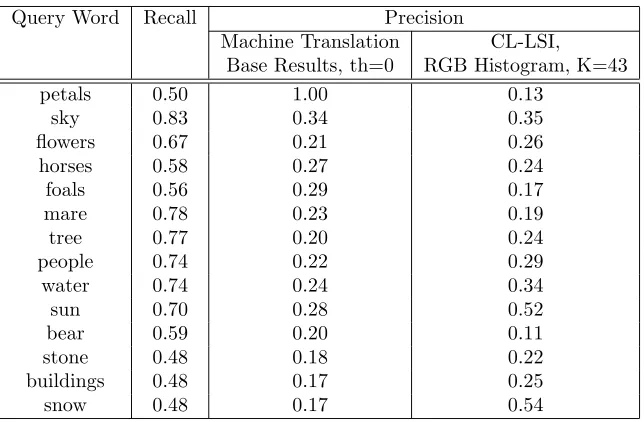
Machine translation
Cross-media relevance model Probabilistic methods
Latent-spaces
mountain, scotland, snow, winter
military, sky, tree lake, mountain, scotland,
water Predicted NN
frozen, ice, snow buildings, church, town, tree
people, pool, swimmers, water
Original bad
building, sky, street, tree costume, street, village,
buildings, people arctic, fox, head, snow
Predicted NN
buildings, sculpture, street, tree
buildings, clothes, shops, street
arctic, fox, snow Original
good
Example of Global (Nearest Neighbour) Annotation
Tree, Bush, Flower, Ground, Building Clear sky, Rock, Snow,
Tree, Building Tree, Cloudy sky, Bush,
Overcast sky, Post Saliency-based
CMRM Annotations
Tree, Building, Bush, Flower, People Tree, Building, People,
Clear sky, Cloudy sky Tree, Flower, Building,
Bush, Overcast sky Region-based
CMRM Annotations
Flower, Bush, Tree, Ground Steps, Wall
Tree, Bush, Grass, Sidewalk LSI Annotations
Flower, Bush, Tree, Building, Partially Cloudy
Sky Tree, Building, Grass,
Sidewalk, Pole, People, Clear Sky Tree, Bush
Vector-Space Annotations
Tree, Building, People, Bush, Grass Tree, Building, People,
Bush, Grass Tree, Building, People,
Bush, Grass Empirical
Annotations
Flower, Bush, Tree, Sidewalk, Building Temple, Sky
Tree, Bush, Sidewalk True Annotations
Example of Region Based Annotations
Images
At the Top End of the Gap
Increasing use of ontologies in connection with image annotation to
provide structured domain knowledge
A popular knowledge representation scheme
Impetus from semantic web activity
A shared conceptualisation of a domain
Can structure and enhance the semantics of the image and its
content
Spatial relations between features in the image can help us infer
relations between objects in the real world
Ontologies can help us try to capture high level knowledge by
modeling relations between concepts in the real world
For image retrieval it is useful to consider the ontology in two parts:
content
ontologies and
context
ontologies
Context Ontology
The SCULPTEUR project
SCULPTEUR was a large three year European project
Finished last year Aimed to develop multimedia handling facilities for museums The CIDOC CRM was used to model contextual
Content Ontology
The MIAKT project
MIAKT was a two year
UK (EPSRC) funded
project formed from the
AKT and MIAS IRCs
Aimed to develop software to support the breast cancer screening process
Used (manual)
ontology-mediated image
annotation to mark-up the
image content
Image Descriptor
Image Descriptor
Texture
Texture MarginMargin ShapeShape ...
Region-of-interest Region-of-interest image-id image-id Mammogram Mammogram contains contains graphic-region graphic-region has-descriptor has-descriptor has-descriptor has-descriptor has-descriptor has-descriptor has-descriptor has-descriptor
Project at NTUA (National technical University of
Athens)
Use MPEG-7 (XML schema) to define visual descriptors
Visual descriptor Ontology specifies how descriptors are defined
through relations with their components
Descriptors related to higher level concepts through inference rules
defined in description logic
System provides semantic segmentation and links labels with
(Some) Other Projects and Systems
aceMedia
http://www.acemedia.org/
eCHASE http://www.echase.org/
(Uses semantic web technologies for cultural heritage MM)
MUSCLE http://www.muscle-noe.org/
SCHEMA
http://www.schema-ist.org/
PASCAL
http://www.pascal-network.org
BOEMIE
http://www.boemie.org/
K-Space
http://kspace.qmul.net/
The Knowledge Web http://knowledgeweb.semanticweb.org/
MARVEL
http://www.research.ibm.com/marvel/details.html
MediaMill
http://www.mediamill.nl/
How is the bridging of the gap progressing?
In some domains- ok
In general - not well
Better descriptors, machine learning, ontology based knowledge
structuring may be a way forward
Multimodal Searching and
Semantic Spaces
…or how to find images of Dalmatians
when there is no metadata
Jonathon Hare
Contents
Introduction
The problem: un-annotated images
A brief introduction to textual information techniques: Bags-of-words,
the Vector-space model and Latent Semantic Indexing
The image-to-semantics pipeline
Modelling image content
Visual terms and the bag-of-words for image content
Semantic-Spaces
Problems associated with auto-annotation w.r.t search
Underlying theory and justification
A simple example
Experimental results
K9 Search demo
Introduction
The previous sessions have described the issues associated with
image retrieval from the practitioner perspective -- a problem that
has become known as the ‘semantic gap’ in image retrieval.
In the previous session, Criss described a number of techniques for
improving the ability to search image collections using thesauri and
ontological techniques.
Unfortunately, these techniques require the image collection to be
extensively annotated.
This final session aims to explore how the use of novel
computational and mathematical techniques can be used to help
improve content-based multimedia search by enabling textual
search of un-annotated imagery.
Un-annotated Imagery
Manually constructing metadata in order to index
images is expensive.
Estimates of US$50-$100 per image for the level of
detail involved in a typical Getty archival image
(keywords, caption, title, description, dates, times,
events).
Every day, the number of images is increasing.
In many domains, manually indexing everything is
Un-annotated Imagery - Example
Kennel club image collection.
relatively small (~60,000 images)
~7000 of those digitised.
~3000 of those have subject metadata (mostly keywords),
remainder have no information.
Each year, after the Crufts dog show they expect to receive an
additional 4000-8000 (digital) images with no metadata other
than date/time (and only then if the camera is set-up correctly)
A brief introduction to (textual) information retrieval
techniques
“Information retrieval (IR) is the art and science of searching for
information in documents, searching for documents themselves,
searching for metadata which describe documents, or searching
within databases, whether relational stand alone databases or
hypertext networked databases such as the Internet or intranets, for
text, sound, images or data.” --wikipedia
Traditionally in IR, documents represented as sets/bags of terms.
Bag: allows multiple instances of the same term.
terms normally equate to words in the document.
Document structure ignored.
Bag of Words Example
The quick brown fox jumped over the lazy dog’s back.
Document 1
Document 2
Now is the time for all good men to come to the aid of their party.
the quick brown fox over lazy dog back now is time for all good men to come jump aid of their party 0 0 1 1 0 1 1 0 1 1 0 0 1 0 1 0 0 1 1 0 0 1 0 0 1 0 0 1 1 0 1 0 1 1
Indexed
Term
Docum en t 1 D oc um en t 2
Stop Word
List
‘scourtesy of Phillip Resnik
Vector-space model
A collection of n documents with t distinct terms can be represented
by a (sparse) matrix.
Documents are row vectors of the matrix.
Elements, w, are a function of the number of times term i occurs in
document j.