Sigma Multi-Beneficiary
Programme
September 2007
The views expressed are those of the MWH Consortium and do not necessarily reflect those of the European Commission.
This report has been prepared as a result of an independent evaluation by the MWH Consortium contracted under the Phare programme.
EUROPEAN COMMISSION
DG
E
NL A RGEM E NTE
VALUATIONU
N I TTABLE OF CONTENTS
GLOSSARY OF ACRONYMS
PREFACE
EXECUTIVE SUMMARY
MAIN REPORT ...1
1. INTRODUCTION ...1
1.1. Objectives ...1
1.2. Sigma programmes ...1
1.3. Project sample methodology...2
1.4. Limitations affecting evaluation ...3
2. PERFORMANCE OF PHARE ASSISTANCE...5
2.1. Needs assessment and design...5
2.2. Extent to which inputs/activities have produced outputs ...7
2.3. Extent to which outputs have produced intended results ...11
2.4. Extent to which the results/impacts contributed to achieving wider objectives...13
2.5. Long-term viability of institutional reforms following withdrawal of Phare support ...15
3. THEMATIC/ CROSS-CUTTING FINDINGS...17
3.1. Sigma successfully addressed ex post needs of strengthening civil service reform and financial management and control. ...17
3.2. Sigma interventions have provided impetus for development of government-wide systems of resource management and control. ...17
3.3. Sigma has been a successful multi-beneficiary programme delivering tailor-made services. ...17
3.4. Sigma has played a complementary role, despite potential overlaps ...18
4. CONCLUSIONS AND RECOMMENDATIONS ...20
4.1. Conclusions...20
4.2. Recommendations...22
ANNEXES...24
Annex 1. Terms of Reference...25
Annex 2. Sigma’s comments on EMS findings - Evaluation of April 2003...30
Annex 3. Project information of the 2002 and 2004 Sigma programmes ...34
Annex 4. Project sample - Results achieved...54
Annex 5. List of Documents...59
GLOSSARY OF ACRONYMS
acquis acquis communautaire
CC Candidate Country
CEE Central and Eastern Europe CHU Central Harmonisation Unit
CMR Consolidated Monitoring Report(s)
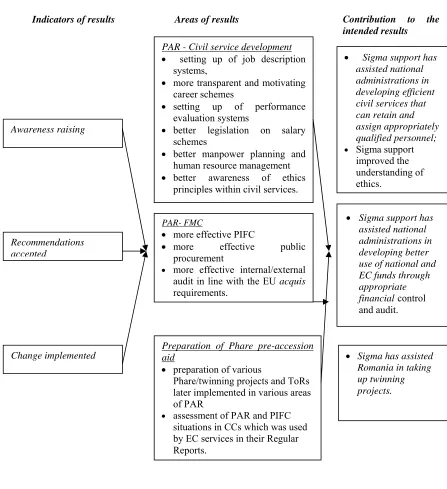
DG Directorate General
EDIS Extended Decentralised Implementation System
EU European Union
FM Financing Memorandum(a)
FMC Financial Management and Control GIA General Inspector for Internal Audit
Logframe Logical framework (matrix), as used in Project Cycle Management
MBP Multi-Beneficiary Programme
M€ Millions Euros
MS Member State(s)
NAC National Aid Coordination (Unit)
NISPAcee Network of Institutes and Schools of Public Administration in Central and Eastern Europe OECD Organisation for Economic Co-operation and Development
PAR Public Administration Reform
PDS Project Decision/Definition Sheet PIFC Public Internal Financial Control
RR Regular Report(s)
SAI Supreme Audit Institutions
SAPARD Special Accession Programme for Agriculture and Rural Development SME Small and Medium Size Enterprise(s)
PREFACE
This Ex-post Evaluation Report has been prepared by the MWH Consortium between August
and October 2005,1 and reflects the situation of the Phare assistance provided through the Sigma multi-beneficiary programmes between 1996 and 2004. It examines the performance of Sigma in addressing the programme objectives and intended results, provides a general assessment of the programme and draws conclusions and lessons learned from approximately 10 years of Sigma assistance.
The evaluation is based on an analysis of documents produced at the start, during and on completion of the Sigma programmes, on the results of questionnaires and on interviews with EC Services, the Sigma team at the OECD, project beneficiaries, and National Aid Coordination Units.
1 The report was prepared by Corinne Lévêque, lead evaluator, assisted by Short-Term International Expert, Dimitrios Sfikas.
EXECUTIVE SUMMARY
Background and context
Between 1996 and 2001, Sigma assistance was provided through four consecutive programmes, ZZ-9605, ZZ-9706, ZZ-9808, and ZZ-0008 with a total value of M€ 28.4. Two additional Phare Sigma programmes were adopted in 2002 and 2004 (CRIS2002/27-564 and CRIS 2004/006-097) totalling M€ 8.
The overall objective of the ex-post evaluation of Sigma programmes is to provide
accountability with respect to use of European Commission funds, and lessons learned for decision-making on improvements of pre-accession aid to remaining and future candidate countries. This evaluation focuses mainly on outputs, results and impacts of Sigma on development of relevant public administration policy and legal frameworks, civil service management, and financial control and external audit.
Key evaluation findings
Continuously provided assistance well focused on the objectives of pre-accession strategy. From 1993, the general focus of Sigma assistance has been to assist partner countries in building sound, efficient and effective public institutions that would enable them to satisfy the Copenhagen criteria for accession to the EU. In 1996, Sigma assistance was further refined to be in line with conclusions of the Madrid Council, which stressed the importance of candidate countries having administrative capacities to implement and enforce the acquis communautaire. Sigma support for financial control, audit and public procurement addressed
the acquis needs (Chapters 1 and 28) identified in the EC Comprehensive Monitoring and
Regular Reports. However, consistency between the 2002 and 2004 Sigma Financing Memoranda and the corresponding Sigma contracts would have benefited from using the same objectives and Logframe matrix. Good project ownership was ensured by involvement of project beneficiaries at the outset of project design.
Continuously produced outputs that were highly appreciated by beneficiaries. Sigma assistance has always been mobilised at the request of public administrations in candidate countries or EC services, thereby resulting in tailor-made small-scale activities with diversified outputs. These activities under the 2002 and 2004 Sigma programmes can be divided into three broad categories: technical assistance projects; review and assessment projects; and support to preparation of other Phare projects (e.g. twinning projects). Beneficiaries expressed
a high level of satisfaction about Sigma interventions due to their technical relevance, high responsiveness and flexibility, and high quality of the expertise delivered. However good outputs were the result of numerous short missions and high costs incurred by the Sigma Secretariat that negatively affected efficiency.
provide ad hoc technical input targeted at specific aspects of these reforms. Substantive results
on public administration reform (including financial management and control) depend primarily on commitment of the beneficiary authorities to the reform process, and require more Phare actors than Sigma alone.
Fragmented but strategic impact on development of cross-ministerial administrative capacities. Sigma has contributed to strategic changes in candidate country public administrations in a number of areas: (i) in policy making and stimulating definition of new policy orientations or development of strategic planning; (ii) development of relevant legislative and regulatory frameworks such as in the field of civil service development (experience shows that review, assessment and diagnosis activities often generate positive impacts on the development of appropriate institutional frameworks in the candidate countries); and (iii) human resource development, and more exceptionally resource allocation, although the link between institutional change and Sigma inputs is not always clearly evidenced, and impact can be lost given the large public administration reform issues to be addressed in candidate countries.
Deeper involvement of stakeholders had a positive effect on long-term sustainability. Implementation of public administration reforms in the long term and deployment of sufficient and continuous budgetary and human resources are the primary responsibility of beneficiary countries. Although Sigma can provide advice and has some impact, it has no control in this area. Previous evaluations concluded that potential for sustainability could be improved through greater ownership of results if stakeholders were more involved at the outset of project design. This has been taken on board for 2002 and 2004 Sigma programmes, and stakeholders have been involved in project design. These later programmes, which are expected to make an impact on legislative, institutional and organisational changes, are therefore also expected to have a positive effect on long-term sustainability.
Successful beneficiary programme delivering tailor-made services. The multi-beneficiary dimension exists at programme level (Sigma’s approach is accession and demand driven), at project level (Sigma performs multi-country activities such as assessments and reviews), and at expert level (Sigma provides multi-cultural expertise from experts from different member states). On the other hand, Sigma is tailor-made to needs of each beneficiary country and institution. Tailor-made and small-scale projects allow Sigma to be highly responsive and to adapt to changing needs. It is a strength that makes the Sigma multi-beneficiary approach favourably accepted by beneficiaries, and facilitates Sigma interventions on public administration reforms, even on sensitive issues.
Sigma, TAIEX and twinning are complementary instruments providing assistance for institution building, but each has a specific role to play. Sigma usually provides support for development of horizontal cross-sectoral capacities; whereas the main focus of TAIEX and twinning is provision of support in various sectors of the acquis (e.g. agriculture, environment).
Main Conclusions
Successful programme with a good overall performance. Early Sigma programmes included initial weaknesses, but most of these issues have been addressed. In the past three years, Sigma has aligned its work much more closely with Phare priorities on accession. Steering of Sigma activities has improved as well, and are now better defined at a planning level, notably through annual programme outlines. Overall, EC/OECD cooperation has resulted in establishment of an instrument that functions well, producing effective results with public administration reforms (including financial management and control), which is highly appreciated by the beneficiary countries as well as by the Commission Services. Although Sigma programmes do not fund large public administration reform projects, they are important for providing effective momentum for institutional changes and a strategic impetus for public administration reform.
But some areas of the programme cycle require further attention. In some cases a Logical Framework Matrix was not sufficiently developed, and relevant indicators were not identified. Programme monitoring was incomplete, with little assessment of interim progress at programme level, identification of areas of success and failure and their reasons, and immediate actions were not taken to improve further programme performance where necessary. At an implementation level, National Aid Coordination Units were not well informed about Sigma operations in their country. Short-term missions on demand are successful but do not impact well on efficiency. In the early period, there was sometimes a lack of continuity between different Phare funds allocated to Sigma that led to staff resourcing difficulties within the Sigma team, but this has been subsequently been addressed.
Recommendations
Given the successful development of the OECD/EC cooperation in the framework of Sigma, the experience accumulated by the Sigma team, notably in the accession context, Sigma expertise should continue to be mobilised in the framework of EC support to the present and potential candidate countries. The level of resources for Sigma should be substantially increased to enable it to serve a widening geography, and an increasing demand (already apparent in the Western Balkans and the neighbourhood countries, where Sigma currently cannot fulfil all the requests it receives).
Programme design should be further improved with the systematic adoption of a well-prepared logical framework matrix for each new Sigma programme, and the identification of relevant indicators of achievement. These design elements should be an integral part of the implementation contract between the EC and OECD.
Financial reporting by Sigma should provide better information on project costs, such as project duration in terms of man-days/months of work, whether the expertise was provided by Sigma or external experts, and travel costs.
The Sigma team should perform effective and regular programme monitoring in order to assess interim progress at a programme level, identify areas of failure and their reasons, and any immediate action to be taken to improve programme performance further.
MAIN REPORT
1. INTRODUCTION
1.1. Objectives
1. The overall objective of the ex-post evaluation of Sigma multi-beneficiary programmes is
to provide accountability with respect to the value for money and use of European Commission funds, and lessons learned for decision-making on improvements of pre-accession aid to remaining and future candidate countries (CCs). This evaluation focuses mainly on outputs, results and impacts of Sigma on development of relevant public administration legal frameworks, improved civil service management, upgraded financial control and external audit and increased capacities of national administrations to access and absorb Community funds.
2. Results of the evaluation of the Sigma multi-beneficiary programme (MBP) will provide a sample contribution to a consolidated evaluation of Phare multi-beneficiary programmes. In turn this will form part of a consolidated ex post evaluation of the Phare programme.
3. As indicated in the evaluation terms of reference, given in Annex 1, the evaluation of Sigma is based mainly on a desk study of the previous evaluation reports. The present evaluation mainly focuses on the 2002 and 2004 Sigma programmes. The methodology and evaluation questions are described in Annex 1.
1.2. Sigma programmes
4. Sigma assistance started in 1992 when the EC and the OECD launched the first Sigma programme to help Central and Eastern European (CEE) countries modernise their public administrations. From 1993, the general focus of Sigma assistance has been to assist partner countries in building sound, efficient and effective public institutions that would enable them to satisfy the Copenhagen criteria for accession to the EU. This concept was further refined at the Madrid Council, which stressed the importance of CCs having administrative capacities to implement and enforce the acquis communautaire.
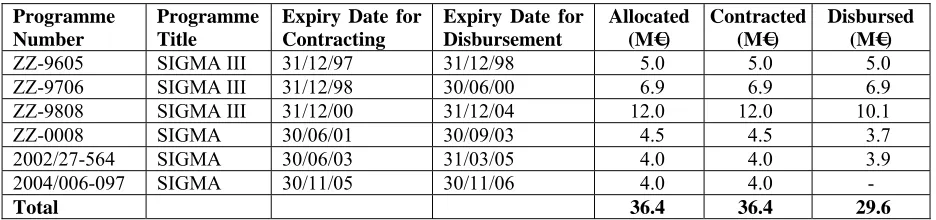
[image:8.595.67.535.595.705.2]5. Between 1996 and 2001, Sigma assistance was provided through four consecutive programmes, ZZ-9605, ZZ-9706, ZZ-9808, and ZZ-0008 with a total value of M€ 28.4. After 2001, two Sigma programmes were adopted in 2002 and 2004 (2002/27-564 and 2004/006-097) totalling M€ 8.
Table 1.- Sigma programmes between 1996 and 2004
Programme Number
Programme Title
Expiry Date for Contracting
Expiry Date for Disbursement
Allocated (M€)
Contracted (M€)
Disbursed (M€)
ZZ-9605 SIGMA III 31/12/97 31/12/98 5.0 5.0 5.0
ZZ-9706 SIGMA III 31/12/98 30/06/00 6.9 6.9 6.9
ZZ-9808 SIGMA III 31/12/00 31/12/04 12.0 12.0 10.1
ZZ-0008 SIGMA 30/06/01 30/09/03 4.5 4.5 3.7
2002/27-564 SIGMA 30/06/03 31/03/05 4.0 4.0 3.9
2004/006-097 SIGMA 30/11/05 30/11/06 4.0 4.0 -
Total 36.4 36.4 29.6
Source: CRIS extract 04/2005 and Sigma documents August 2005.
Sigma assistance for new Member States through the Transition Facility, and for Bulgaria, Romania and Turkey, through Phare.
7. Sigma programmes were evaluated three times by the OMAS and EMS Consortia.2,3,4 These evaluations concluded that performance of the Sigma programmes was ‘Satisfactory’2,3 or 'Highly Satisfactory’.4 In particular they found Sigma “to be a catalyst to making CEEC
public administrations more efficient, politically independent and democratically
accountable”2 that Sigma “has provided impetus to the improvement of governance and
management and to reform public administrations in the beneficiary countries”;3 and that
Sigma has been an "…appropriate vehicle for channelling accession driven
changes…complementing twinning and providing technical assistance”.4
8. These evaluations noted that Sigma support was effective and provided a high level of expertise, but could be further improved notably with regard to:
• programme design in terms of weaknesses in logical framework matrices (Logframe), and lack of relevant indicators;
• impact and sustainability in terms of the need for enhanced project ownership, improved communication notably about programme results, lack of a strategic framework, and the absence of need for some of the Sigma networks after accession.
9. The EMS evaluation report of April 2003 raised a number of issues given below. Chapter 2 of the present report assesses whether these different issues have been addressed, and Annex 2 provides an update of the views of the Sigma Secretariat on them:
• Ownership of results would be increased if stakeholders were more involved at the outset in project design;
• Impact and sustainability would be reinforced by development and implementation of a more comprehensive strategy as regards communication and dissemination of results;
• The need to develop clear exit strategies for projects that will become redundant on accession (e.g. networking projects where participants will become eligible for participation in Member State activities on accession);
• The role of Sigma in the accreditation process for the Extended Decentralised Implementation System (EDIS) and Special Accession Programme for Agriculture and Rural Development (SAPARD) should be clarified to avoid misunderstandings or unrealistic expectations regarding deliverables;
• With regard to technical content, Sigma has yet to develop a network of experts that can support its input into the technical content (rather than process) of accreditation of EDIS and SAPARD agencies.
1.3. Project sample methodology
10. For the evaluation of 2002 and 2004 programmes a sample of projects was selected, in agreement with the OECD and with the DG ELARG Task Manager in charge of Sigma, and in line with the evaluation ToR. 2002 and 2004 programmes have a wide geographical distribution (10 countries for the 2002 programme and three countries for the 2004 programme) and included a large number of projects (approximately 85). In agreement with the EC services, it was decided to select a representative sample of projects according to the following criteria given in Table 2.
2 Report R/ZZ/PAD/9701.
Table 2.- Selection criteria used for the identification of an evaluation project sample
Programmes Projects from 2002 as well as 2004 programmes
Work areas Projects in the area of PAR as well as FMC including public procurement. One
major multi-country assessment was also selected.
Countries All countries mentioned in the evaluation ToR (i.e. EE, HU, PL, SK, BG, RO)
should be covered, with more emphasis on acceding countries. In this case, and in agreement with Sigma, Romania was selected as a key country to be visited by the Short-Term Technical Evaluator on PAR.
Implementation stage Most of the selected projects are closed since the present evaluation is aimed at
contributing to the ex post evaluation of Phare. However the sample also includes a
few on-going projects representing the activities currently performed by Sigma within the 2004 programme.
Project costs The sample of projects includes small projects as well as large projects in terms of
project costs.
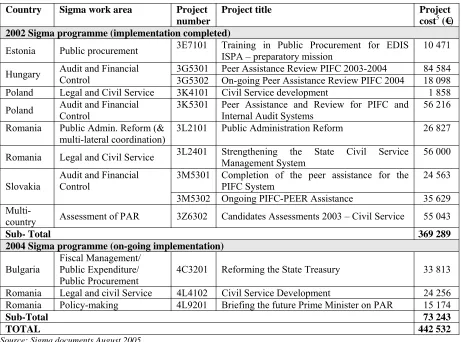
11. As a result, the following 13 projects were selected as being representative of Sigma activities carried out in the framework of the 2002 and 2004 programmes.
Table 3.- Project sample selected for evaluation purposes
Country Sigma work area Project
number
Project title Project
cost5 (€) 2002 Sigma programme (implementation completed)
Estonia Public procurement 3E7101 Training in Public Procurement for EDIS ISPA – preparatory mission 10 471 3G5301 Peer Assistance Review PIFC 2003-2004 84 584 Hungary Audit and Financial Control
3G5302 On-going Peer Assistance Review PIFC 2004 18 098 Poland Legal and Civil Service 3K4101 Civil Service development 1 858 Poland Audit and Financial Control 3K5301 Peer Internal Audit Systems Assistance and Review for PIFC and 56 216 Romania Public Admin. Reform (&
multi-lateral coordination) 3L2101 Public Administration Reform 26 827 Romania Legal and Civil Service 3L2401 Strengthening the State Civil Service Management System 56 000
3M5301 Completion of the peer assistance for the PIFC System
24 563 Slovakia
Audit and Financial Control
3M5302 Ongoing PIFC-PEER Assistance 35 629
Multi-country Assessment of PAR 3Z6302 Candidates Assessments 2003 – Civil Service 55 043
Sub- Total 369 289
2004 Sigma programme (on-going implementation)
Bulgaria Fiscal Management/ Public Expenditure/
Public Procurement 4C3201 Reforming the State Treasury 33 813 Romania Legal and civil Service 4L4102 Civil Service Development 24 256 Romania Policy-making 4L9201 Briefing the future Prime Minister on PAR 15 174
Sub-Total 73 243
TOTAL 442 532
Source: Sigma documents August 2005
1.4. Limitations affecting evaluation
12. All the stakeholders contacted in the framework of the present evaluation have provided high quality information on their Sigma experience. All countries included in the evaluation sample have been covered by the survey. However, the level of analysis that could be achieved by this ex post evaluation was restricted by constraints in the field, namely limited availability
5 These costs include the cost of external experts, mission costs, operational costs, but not the costs of permanent staff,
[image:10.595.68.529.301.643.2]2. PERFORMANCE OF PHARE ASSISTANCE
2.1. Needs assessment and design
13. Sigma assistance between 1996 and 2001 maintained a continuous focus on development of administrative capacity at central government level, gradually adjusted to take account of accession priorities. The focus of central government was promoting adherence of public staff to democratic values, ethics, and respect of the rule of law. Coordination of Sigma activities with other Phare instruments and donors in the field was also a continuous goal. With the increasing importance of the enlargement process, the objectives of the Sigma support were adjusted to direct them towards preparation of CCs for accession to the EU. These objectives have been regarded by successive evaluations as being relevant to the wider Phare context.
14. However, there was a need for improvement in programme design. Previous evaluations identified a number of programme design issues amongst which were weaknesses in the way the Logframe matrixes (e.g. objectives) were formulated, and the lack or poor definition of programme indicators. Lack of involvement of project beneficiaries in project design was also an issue pointed out in the evaluation of ZZ-0008.
15. Programme design for the 2002 and 2004 programmes still needs to be improved in a number of respects. The evaluators were not provided with the Logframe of the 2004 programme. It is not clear whether this document exists or was never drafted. The Logframe for the 2002 programme included too few indicators of achievement that could be used to ensure proper programme monitoring. Therefore, and as for any other Phare programme, Sigma financing proposals should systematically include a Logframe matrix indicating the milestones of the proposed assistance, and indicators of achievement of objectives that allow actual measurement of progress made by Sigma against specific and wider programme objectives.6
16. Relevant assistance focused on objectives of pre-accession strategy. The Copenhagen criteria defined the EU membership requirements with which the CCs had to comply. This concept was refined at the Madrid Council, which stressed the importance of CC administrative capacity to enforce the acquis communautaire. The need for administrative capacity was
further reinforced by the subsequent decision to decentralise and eliminate EC ex ante control
of the management of Phare and pre-accession funds where national administrations were sufficiently equipped to ensure sound and efficient financial management.7
17. In this context, Sigma 2002 and 2004 programmes provided relevant support to financial control and audit capacity in line with the acquis (Chapter 28). Public procurement is dealt
with in the Chapter 1 of the acquis on the free movement of goods. In these areas, Sigma
supported the CCs in finalising the adoption of relevant legislation, and in enhancing relevant administrative capacity at central policy-making and operational levels (see Sections 2.3 and 2.4). Strictly speaking, there is no acquis on public administration reform (PAR) but the
conclusions of the Madrid Summit and major institution building needs identified in the EC Regular Reports strongly justified the provision of Sigma assistance in this area.
6 In their comments of April 2007 on the draft report, the Institutional Building Unit of DG ELARG pointed out that the two
current contracts include the matrix.
18. In 1999, in consultation with the EC Services, the Sigma team defined baselines for the development of central administrative capacities in line with obligations of EU membership8. Since then, these baselines have been used by Sigma for benchmarking exercises to assess the readiness of CCs in the areas of Civil Service Development; Policy-Making and Coordination Machinery; External Audit; Financial Control; Public Expenditure Management; and Public Procurement Management.
19. Sigma contracts did not follow programme documents closely enough. Sigma Financing Memoranda (FM), based on pre-accession priorities, serve as a basis for the definition of Sigma contracts. Analysis of the 2002 and 2004 Sigma contracts revealed that FM requirements had been transposed in a misleading or incomplete way. For instance, the 2002 Sigma contract did not include the Logframe matrix attached to the corresponding FM, and the 2004 Sigma contract included a different programme background, and a different overall objective than the corresponding FM. These points are important since the EC contracts with Sigma are reference documents on which the Sigma team base their work.
20. ‘Programme outlines’ were a useful planning tool. Since 2002, priorities for Sigma support are agreed annually between the EC Services and Sigma, in co-operation with EC Delegations or the European Agency for Reconstruction and Country Desks in DG ELARG. To this end, the EC Services produce ‘programme outlines’, setting strategic directions for the Sigma work to be carried out over the year to come.9 These outlines require from Sigma that they focus on areas where EC Regular Reports identified PAR needs (including on financial management and control); and define the kind of activity to be performed during the year (e.g. peer reviews, technical assistance, etc.). Considering the lack of strategic focus identified by previous evaluations, programme outlines have been a useful tool that has provided Sigma activities with an enhanced strategic and planning framework.
21. Key stakeholders were involved in project design resulting in proper project ownership. Sigma activities are subject to ex ante approval by the EC Services. This means that all Sigma
projects are agreed by the EC at HQ as well as by relevant EC Delegations before their implementation can start. Requests for Sigma assistance are either made by EC Services or CCs. In the latter case, CCs are directly involved in project definition, in close dialogue with Sigma staff members. Project Definition Sheets (PDS) are drafted on this basis. Sometimes, there is a need that has not been identified by a CC, and if the EC is willing to launch a project, Sigma and the EC will work together to raise the awareness of the CC concerned, and convince it of the need to be addressed. In these circumstances, project ownership is not an issue under 2002 and 2004 programmes.
22. Peer reviews on Public Internal Financial Control (PIFC) and multi-country assessments are two major multi-country activities carried out by Sigma quite regularly.10 These exercises are less demand driven since they are based on a pre-determined approach defined some years ago in close consultation with the Commission Services (DG ELARG and DG Budget). Nevertheless, multi-country assessments, which are at the request of the Commission, require the active participation of the CCs, and in the case of PIFC peer reviews, which are at the
8 “
Control and management system baselines for European Union Membership”, Sigma 1999. 9 2004 Outline Programme Sigma/DG Enlargement “…
this outline agreement sets out strategic orientations for Sigma work through 2004 … Concrete project implementation will be in line with this agreement and will be initiated and authorised by the standard Project Definition Sheet…”.
10 In their comments of June 2007 on the draft report, SIGMA pointed out that as a result of a political/terminological issue in
request of CCs, institutions concerned are asked for their prior approval and views on the key areas to be analysed before the project is launched.
2.2. Extent to which inputs/activities have produced outputs
23. Implementation of the Sigma between 1996 and 2001 produced consistent outputs. Activities and outputs of ZZ-9605, ZZ-9706, ZZ-9808 and ZZ-0008 are described in previous evaluation reports. On this basis, it appears that Sigma work areas, although refined in every Sigma programme, remained more or less the same over time, (i.e. support to policy-making, public expenditure and management, civil service development, financial control and audit). Provision of Sigma support also remained more or less unchanged. Projects focused on one CC or multi-country projects (e.g. multi-country reviews), provision of technical advice through missions, workshops, peer reviews etc., either at the request of CCs or the EC Services. Sigma programmes between 1996 and 2001 financed a large number of small-scale projects.
24. The most noticeable change within the Sigma activities between 1996 and 2001 was that Sigma support to NISPAcee (Network of Institutes and Schools of Public Administration in Central and Eastern Europe) was phased out.11 Support to Supreme Audit Institutions (SAIs) was also re-oriented, and the SAI network built in the eight CCs that acceded to the EU in 2004 was integrated into the EU Member State network. Furthermore, from 1999 onwards, Sigma assistance is regularly mobilised by the EC services for the performance of multi-country assessments in various areas of PAR. Since 2002, Sigma expertise is regularly mobilised by EC Services for the performance of peer reviews in the field of PIFC.
25. Sigma programmes between 1996 and 2001 produced quite consistent outputs. These included, mainly, orientation papers, institutional diagnosis, comments on draft laws, training strategies, information material on EU good practice, workshops, and project ToRs. Beneficiaries always appreciated these outputs, notably because of the high quality of expertise involved.
26. Previous evaluations reported satisfactory financial performance, but a lack of clarity in the role for Sigma in the accreditation process for EDIS and SAPARD. Previous evaluations found that Sigma was very efficient in terms of overall cost and financial management. For ZZ-0008 it was concluded that management costs appeared to bear a reasonable relationship to the total project costs. However, the evaluations also noted that it was not easy to identify the total cost of each project because time of Sigma staff was not systematically allocated to projects.
27. The 2003 evaluation stated that the role of Sigma in the accreditation process for EDIS and SAPARD had to be clarified to avoid misunderstandings or unrealistic expectations regarding deliverables. With regard to technical content, Sigma had yet to develop a network of experts that could support its input to the technical content (rather than process) of accreditation of EDIS and SAPARD agencies.
28. Regarding 2002 and 2004 programmes, project beneficiaries expressed a clear understanding of the role of Sigma in the fields of EDIS and SAPARD. Verification of the financial control system (covering financial management and control systems and procedures, including accounting and auditing) is an important part of the overall EDIS and SAPARD accreditation processes. In the framework of 2002 and 2004 programmes, Sigma contributions
Box 2: Examples of Sigma outputs
• Strategic plan for the future development of the State Treasury (BG)
• Recommendations on the training needs identified and immediate actions to be undertaken on public procurement (EE)
• PIFC Reports (HU, PL, SK)
• Notes on PAR strategy, policy-papers (RO)
• Project fiches (RO)
• Assessment report on PAR (Multi-country).
largely consisted of PIFC reviews. These interventions were pre-defined in consultation with EC services in 2002 (see § 36) in order to ensure that they would meet EC expectations and that they would be properly coordinated with other EC activities in the field. The validity of the approach was confirmed by interviewed project beneficiaries who stated that they were clear about differences and complementarity between Sigma and other EC support to EDIS and SAPARD preparation. Sigma’s views on these issues are reported in Annex 2.
29. Well-organised activities and well-focused outputs, which were highly appreciated by beneficiaries, indicate that Sigma programmes have been effective. For evaluation purposes, identification of project outputs was based on sample described in § 11, on information provided by PDS, project material (i.e. technical reports, concept/policy/strategy papers, mission reports etc.), and a panel of project beneficiaries approached through interviews or questionnaires. Most project outputs examined consisted of concept papers, action plans, comments on draft legislation, and diagnoses
(see examples in Box 2). Outputs were often concise working papers, although some documents were not drafted to a high presentational standard. However, all outputs seemed to be technically well focused, to provide useful recommendations, and were appreciated by country beneficiaries who were inclined to take them into account in their reform strategies. Analysis of peer PIFC reviews showed that they resulted in valuable
and detailed comprehensive reports, with a good impact on project beneficiaries. Analysis of the 2003 multi-country assessment indicates that this exercise relied on provision of well-focused expertise and was given great credit by the EC Services that used this material for preparation of their EC Regular Reports.
30. Some criticisms were made regarding short lengths of missions. Sigma short-term interventions (usually a few days up to one week) were sometimes questioned by beneficiaries who believed that more time should be devoted to complex issues dealt with by Sigma.12 In addition, some beneficiaries mentioned that impact of Sigma advice was sometimes weakened due to too many recommendations.
31. Implementation was delegated to the Sigma team at the OECD. In September 2002, the EC and OECD signed a ‘European Contribution Agreement with an International Organization’ transferring implementation of Sigma 2002 programme to the Sigma team, as in previous years.13 Implementation covered needs of the ten CEE CCs. This work, with 46 projects in eight work areas, as shown in Table 4, is completed.
12 In their comments of April 2007 on the draft report, the Institutional Building Unit of DG ELARG pointed out that longer
missions mean higher costs, and Sigma looks for optimal allocation of resources.
13 also called ‘Candidate Countries Contract’ by the Sigma Secretariat (the Agreement refers to the EC as being the
Table 4.- Projects funded by Sigma 2002 programme
Work Area (implementation completed)
BG CZ EE HU LT LV Pl RO SK SL ZZ14 Total
Audit & Financial Control 2 1 2 2 1 2 2 1 6 19
Public Admin. Reform 2 1 3
Legal & Civil Service 1 2 1 1 1 6
Policy-Making 1 2 3
Public Expenditure
Management 1 1
Public Procurement 2 1 3 6
ZZ Assessments 4 4
Programme Management15 4
4
Total 9 1 1 2 4 2 6 2 1 18 46
Source: Sigma documents as of August 2005
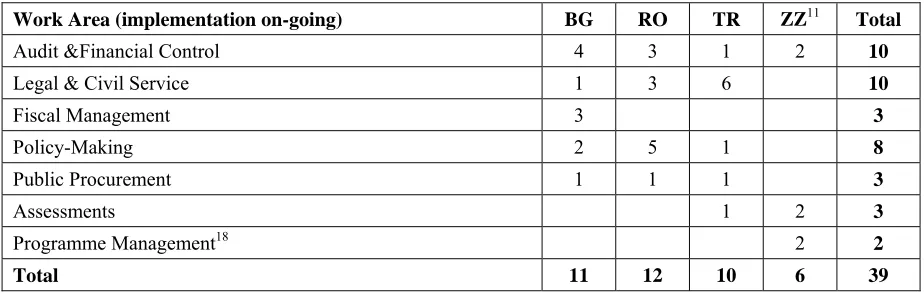
32. In May 2004, the EC and OECD signed a second ‘European Contribution Agreement with an International Organization’ transferring implementation of the Sigma 2004 programme to the Sigma team.16 Implementation only covered three countries: Bulgaria, Romania and Turkey.17 At the time of writing, 39 projects have been undertaken in seven work areas, as shown in Table 5 below.
Table 5.- Projects funded by Sigma 2004 programme
Work Area (implementation on-going) BG RO TR ZZ11 Total
Audit &Financial Control 4 3 1 2 10
Legal & Civil Service 1 3 6 10
Fiscal Management 3 3
Policy-Making 2 5 1 8
Public Procurement 1 1 1 3
Assessments 1 2 3
Programme Management18 2
2
Total 11 12 10 6 39
Source: Sigma documents as of August 2005
33. Implementation has taken place through a series of diversified and small-scale projects carried out in a coherent manner. Each Sigma project is described in a Project Decision/Definition Sheet (PDS) in terms of justification, objectives, implementation, intended results, milestones, and project resources. Projects are limited in time, but Sigma reported that this allows CCs to assimilate assistance and to think more effectively about what they want to
14 Multi-country activities mainly consist of assessment activities in several countries, leading to country specific analysis and
recommendations usually with an overview. These may address a single sector or be multi-sectoral.
15 ‘Programme management’ does not refer to any Sigma project in particular, but takes into account resources mobilised to
cover general management costs.
16 Also called the ‘BURT Contract’ by the Sigma Secretariat.
17 In 2004, Sigma was contracted for M€ 5 to provide services to the new member states under the EC Transition Facility.
Sigma should also provide support to Croatia through Phare for M€ 0.6, and to the Western Balkan countries through CARDS for M€ 2.4. This contract ended in December 2006.
18 ‘Programme management’ does not refer to any Sigma project in particular, but concerns resources mobilised to cover
[image:16.595.67.529.402.549.2]achieve. Furthermore, Sigma projects are not taking place separately, but are conceived as a successive sequence of interventions with a longer-term perspective on PAR strategies, including financial management and control (FMC).
34. Being demand driven, projects funded by Sigma are highly diversified. However, in consultation with the Sigma team, and for the purposes of this evaluation, these projects were grouped into three broad categories: provision of technical advice to one beneficiary country; peer reviews of PIFC systems and multi-country assessment projects; and support to preparation of other Phare projects (e.g. twinning projects).
35. Provision of technical advice consists of advice to one or a group of institutions in one beneficiary country through provision of comments on draft laws, reviews and identification of possible orientations for reorganisation of PAR or FMC systems and structures, support for development of human resources, sharing of good practice, etc. These various kinds of advice are delivered during missions, at meetings, through participation of Sigma experts at events, during study visits, workshops, exchange of emails, and telephone conversations.
36. In 2002, Sigma with support of DG ELARG and DG Budget developed a methodology to carry out “peer assistance reviews” of PIFC systems. The peer assistance concept includes a
reporting stage and assistance for implementation of any agreed recommendation from the peer review. Multi-country assessment exercises are undertaken by Sigma at the request of the EC and are usually performed in several countries in one or more PAR areas.
37. Support to preparation of other Phare projects includes provision of support for drafting of Phare programming documents, terms of reference (ToR), or project fiches (e.g. twinning projects).
38. Implementation has involved provision of multi-cultural expertise to the satisfaction of beneficiaries. Sigma provides technical expertise from a whole range of countries in Europe. Selection of the most appropriate expertise to be delivered is largely determined by the reform direction of the country to be supported (e.g. a ‘continental’ approach, a ‘northern’ approach, or a ‘federal’ approach, etc.), and by availability of experts. Overall, Sigma has provided expertise from a wide range of EU member state as well as CCs,19 and beneficiaries have often expressed great satisfaction regarding this multi-cultural knowledge.
39. Projects well monitored financially. The PDS reflect the presence of a financial monitoring system, and each divergence of cost vis-à-vis the initial planned project costs have
to be justified. At project level, efforts are made to reduce project costs in that financial savings are ‘re-injected’ into the Sigma programme and used on other projects. Sigma programmes are fully governed by OECD financial rules, regulations, and practices.
40. However efficiency has been negatively affected by numerous short missions in beneficiary countries. Project costs are highly variable from one project to another,20 depending on the type of activity to be carried out and on the number of inputs to be provided by Sigma. Furthermore, although PDS include information on the costs of external experts, and mission and operational costs, they do not include information on the costs of Sigma staff nor on the duration of each project (in terms of man days/month). In these circumstances, it is
19 E.g. Austria, Belgium, Bulgaria, the Czech Republic, Denmark, Estonia, Finland, France, Germany, Greece, Hungary,
Ireland, Italy, Lithuania, Netherlands, Poland, Portugal, Slovenia, Spain, Sweden, and the UK.
not possible to determine an average project cost. However, numerous short missions in beneficiary countries work against low project costs.
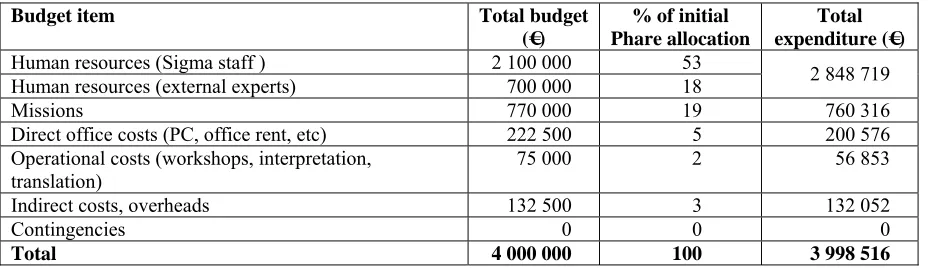
[image:18.595.68.532.236.370.2]41. Moreover, implementation involves high costs to remunerate the services of the Sigma Secretariat. Sigma financial reporting indicates that a high proportion of Sigma funds (approximately 50%) are devoted to financing of the Sigma Secretariat, a core team of 10 experts and assistants.21 The Sigma Secretariat emphasised that these costs correspond to management inputs but also to provision of technical expertise – the Sigma Secretariat being the primary source of expertise on the programmes. Cost-efficiency is nevertheless negatively affected by these high costs.
Table 6.- Financial breakdown of the 2002 Programme
Budget item Total budget
(€)
% of initial Phare allocation
Total expenditure (€)
Human resources (Sigma staff ) 2 100 000 53
Human resources (external experts) 700 000 18 2 848 719
Missions 770 000 19 760 316
Direct office costs (PC, office rent, etc) 222 500 5 200 576
Operational costs (workshops, interpretation,
translation) 75 000 2 56 853
Indirect costs, overheads 132 500 3 132 052
Contingencies 0 0 0
Total 4 000 000 100 3 998 516
[image:18.595.69.533.405.534.2]Source: Sigma documents- August 2005
Table 7.- Financial breakdown of the Sigma 2004 programme
Budget item Total
budget (€)
% of initial Phare allocation
Total expenditure (€)
Human resources (Sigma staff) 2 371 000 58
Human resources (external experts) 700 000 18 1 242 273
Missions 710 000 17 322 300
Direct costs 116 600 3 37 039
Operational costs 51 500 1 23 911
Indirect costs, overhead 132 500 3 4 725
Contingencies 0 0 0
Total 4 081 600 100 1 630 248
Source: Sigma documents – situation as of 10-08-2005
42. Numerous short missions and high costs incurred by the Sigma Secretariat are not good indicators of cost efficiency, but lack of data on actual management and project costs do not allow any definite judgement. On the other hand, sound financial management of projects together with the high value of project outputs reflect well on Sigma performance.
2.3. Extent to which outputs have produced intended results
43. Performance of 1996-2001 programmes always rated positively. Immediate objectives of Sigma programmes between 1996 and 2001 were formulated differently in each programme. However core ideas supported by these objectives remained more or less the same (i.e. development of high quality public policies, laws and regulations, development of efficient and impartial civil services, and sound public resource management and control), although support
21 The remuneration of the Sigma Secretariat is governed by the OECD personnel rules. In their comments of April 2007 on
Box 3: Examples of Sigma results
• Strategic direction to the future structure and operations of the State Treasury (BG);
• Peer recommendations resulted in a Ministry of Finance action plan for change (HU);
• DG Budget used the peer review for the negotiations on Chapter 28 of the acquis (HU);
• The Central Harmonisation Unit developed a plan to implement changes and significant activities are underway (SK);
• Improved awareness understanding and commitment to practical measures that were needed to improve PIFC (SK);
• Substantial increase in resources allocated to the Financial Control and Internal Audit coordination service (PL);
• The recommendations made by Sigma on the CHU were integrally reproduced in the General Inspector for Internal Audit strategy (PL);
• Regulations for the Government Control Office were revised accepting Sigma advice (HU);
• Production of project fiches on PAR (RO);
• Enhancement of the understanding and
commitment of the Prime Minister for PAR (RO).
to policy-making was cut by the Commission Services in the 2000 renewal, and subsequently reinstated.22
44. Evaluation of Sigma 1996, 1997, 1998 and 2000 programmes concluded that these had been effective, funding activities and achieving results in line with immediate objectives. It was emphasised that these programmes had delivered well-focused and high-level expertise in an effective way. It was also noted that Sigma programmes had been a catalyst to making beneficiary administrations more efficient, politically independent and democratically accountable,2 had provided impetus to improvement and management of government and to reform of public administration in beneficiary countries,3 and had been very efficient and effective.4 Their overall performance was rated satisfactory or highly satisfactory, depending on the evaluated programme.23
45. Positive results of 2002 and 2004 programmes in line with intended results. Identification of results of institutional building programmes is always difficult, because of the difficulty of establishing direct causality between reforming steps undertaken by beneficiary authorities and programme support. In the case of Sigma, the Evaluators have classified indicators of results as follows:
• Awareness of beneficiaries raised;
• Sigma advice/recommendations accepted by beneficiaries;
• Institutional change realised.
46. On this basis, the Evaluators identified results for each of the projects included in the evaluation sample, as described in Annex 4 and in Box 3. Evaluated projects indicate that Sigma was successful in pushing PAR and FMC reforms in CCs,
with some projects being more effective than others.
47. Overall, 2002 and 2004 programmes made positive contributions to intended results in areas of civil service systems, FMC, and Phare pre-accession aid. Sigma achieved positive results in the development of civil service systems. In different individual cases, Sigma succeeded in positively supporting establishment of job description systems, more transparent and motivating career schemes, performance evaluation systems, better legislation for salary schemes, or better manpower planning and human resource management. Moreover, and especially in countries like Romania and Bulgaria, Sigma efforts are gradually contributing towards better awareness of ethical principles within the civil service, for example through definition of better civil service legislation safeguards, professionalism and impartiality. All these developments are in line with EU public administration standards as measured by Sigma baselines for accession to the EU (see § 18).
Box 4: Examples of incomplete Sigma projects
• The beneficiary of Project 4C3201 did not request all the planned assistance because of the close start of a twinning project in the same field (BG).
• Insufficient commitment to institutional reforms (Project 3K4101)(PL).
• A preparatory mission was planned to prepare the ground for follow up support, but neither Estonia nor the
Commission Services requested follow up support, because there were no clear gaps to be covered (Project 3E7101)(EE).
• Some missions had to be shortened or postponed (Projects 3G 5301 & 5302) due to shortage of finance at Sigma (HU).
• PAR was difficult, and progress was less than that initially foreseen (Project 3L2401)(RO).
48. In the area of FMC, Sigma contributed to positive achievements as well, even though this was a more advanced area in CCs. 2002 and 2004 programmes provided significant support to development and awareness raising in relation to more effective PIFC and public procurement systems in line with EU acquis requirements. In some countries, Sigma contributed to better
risk management and to development of training for financial controllers and internal auditors. Overall, Sigma support has assisted national administrations in developing better use of national and EC funds through appropriate financial control and audit.24
49. For preparation of Phare pre-accession aid, Sigma made useful contributions through preparation of various Phare/twinning project fiches and ToRs, which were later implemented in various areas of PAR and FMC, as well as through assessment of the situation of PAR and PIFC in CCs, which was used by the EC services in their Regular Reports.
50. Positive effectiveness was reduced slightly by failure of some evaluated projects to produce expected results. It is noted that out of the thirteen sampled projects, five were not fully implemented or that their results
did not fully meet initial expectations (see Box 4). In other words, just over a third of the sampled projects did not produce the expected results, which slightly reduces programme performance with regard to effectiveness. As part of programme monitoring, the Sigma team should assess whether similar findings exist for Sigma assistance at a global level (i.e. outside the evaluation sample), and seek to improve programme performance in this regard.
51. Overall effectiveness of Sigma is good. Despite the above-mentioned limitation, Sigma has effectively increased awareness of project beneficiaries of steps to be undertaken in their own systems to develop PAR and FMC in line with EU requirements, standards and practices. The project sample shows that Sigma findings and recommendations usually increase the interest of policy-makers, who take them into account in their deliberations on new policy and strategy. In some cases, further Sigma assistance is requested to facilitate implementation of recommendations, which is another indicator of success.
2.4. Extent to which the results/impacts contributed to achieving wider objectives
52. Previous evaluations concluded that Sigma assistance between 1996 and 2001 had a fragmented but effective impact on PAR in beneficiary countries (see 44). The 1998 evaluation reported that Sigma had a catalytic function in the PAR process. The 2000 evaluation considered that Sigma programmes provided impetus to improvement of governance and management and to reform of public administration as initiated by beneficiary countries. However, many of the activities undertaken ‘on demand’ by Sigma were regarded as stand-alone activities, thus lacking strategic frameworks. Moreover, the evaluation issued in
2003 found that impact would be reinforced by development and implementation of a more comprehensive strategy as regards communication and dissemination of results.25
53. Issues identified by previous evaluations have improved. The lack of strategic focus described by the 2000 evaluation is not an issue any more. PDS show that Sigma short-term activities are part of strategies discussed by Sigma with beneficiary countries to address wider areas of PAR. Furthermore, and as mentioned in § 18, baselines and programme outlines provide Sigma with strategic frameworks for development of their activities in CCs. There is no evidence that a more comprehensive communication and dissemination strategy has developed as such, but a Sigma web site is now operational (within the OECD web site) that contributes to dissemination of programme results.
54. 2002 and 2004 programmes made an impact on development of cross-ministerial administrative capacities. Results identified in Section 2.3, combined with information on reforming steps undertaken by CCs, indicate that, depending on the project, Sigma had an effect on policy-making at the highest decision-making level (e.g. 4L9201 in Romania), contributed to general PAR/FMC direction (e.g. 3L2101 in Romania), and had an effect on policy-options and strategic planning (e.g. 4C3201 in Bulgaria). Another area of impact was development of relevant legislative and regulation frameworks,26 such as in the field of civil service development (e.g. 3L 2101 in Romania).
55. Experience shows that review, assessment and diagnosis activities have often generated positive impacts on development of appropriate institutional frameworks in CCs (e.g. PIFC Review in Slovakia). In these cases, Sigma support contributed to setting up of new structures or upgrading/strengthening of existing structures (e.g. Central Harmonisation Units (CHUs), National Aid Coordination (NAC) Units, etc.), and to development of their role, functions and responsibilities, or to re-organization of systems (e.g. PIFC and internal audit systems in Hungary).
56. Human resource developmentis another area of impact from Sigma programmes. In the past, Sigma used to provide quite substantial support to Schools for Public Administrations in CCs (i.e. NISPAcee projects). More recently, under the 2002 and 2004 programmes, Sigma has diversely impacted on development of training strategies (e.g. in public procurement in Estonia, and in civil service development in Romania). Although it may be more of an exception, the project sample indicates that Sigma may sometimes have a positive impact on resource allocation as well (e.g. PIFC in Poland).27
57. Projects had an impact on development and implementation of Phare accession aid in the field of PAR (including FMC). Sigma diagnoses and assessments provided data effectively used by the Commission Services in their Regular Reports. Moreover, Sigma, either through their projects or support to preparation of other Phare projects, directly contributed to implementation of Phare aid in the field of institution building.
25 This comment was made on the basis of the need to improve communication between the Commission Services (i.e.
headquarters and EC Delegations), and Sigma and beneficiaries at an early stage of project design, as well as of the fact that the Sigma website was suspended in 2001.
26 Including primary and secondary legislation.
27 Further to Sigma interventions, the resources allocated to the Financial Control and Internal Audit coordination service
58. Although analysed in less detail, similar impacts were identified by previous evaluations of Sigma programmes. In this respect, evaluation of ZZ-0008 concluded that Sigma projects led to a modification in an element of the structure, systems and/or resources of public administrations.
59. However it is sometimes difficult to determine whether these impacts are fully attributable to Sigma. Project information and the ex post survey indicate clearly that Sigma
has affected positively policy, legal, institutional and operational frameworks in CCs, but the link between changes and support provided by Sigma is not always clearly evidenced making the effect/causality relationship tenuous.
60. Enhanced cross-ministerial capacities should facilitate implementation of the acquis, but this cannot be substantiated. As shown in the chart in Figure 1 in Annex 4, registered impacts should directly contribute to development of administrative capacities at central government level. Given the areas where Sigma achieved positive results (see Section 2.3), these impacts should positively affect development of cross-ministerial/horizontal government capacities.
61. The Sigma approach builds on the idea that development of cross-ministerial capacities should in turn have a positive effect on implementation of the acquis by line ministries. These
capacities should facilitate organisation of appropriate means and resources (e.g. decision-making and enforcement, staff allocation and budgetary resources) in relevant sectors of the
acquis (e.g. agriculture, environment, internal market etc.). Improvement of cross-ministerial
capacities should indeed lead to improving line ministries’ capacities to implement the acquis
as a natural consequence. However, the causality effect between improvements in institutions with cross-ministerial responsibilities and performance of line ministries in implementing the
acquis is difficult to assess, and the causality effect between Sigma projects and this
performance is even more difficult to determine. Under these circumstances, it was not possible to assess whether Sigma makes a difference in practice at the level of line ministries for implementation of the acquis.
62. Overall, impact is strategic, specific and technical. In the light of the above, Sigma’s impact can be considered as:
• strategic - Sigma has an impact at a strategic level of PAR (including FMC), i.e. on development of cross-ministerial capacities;
• specific in terms of time and scope - Sigma targets specific aspects of institutional reforms in certain institutions;
• technical by nature - Sigma provides technical expertise from technical public administration experts.
63. As a result, Sigma is often a catalyst for change, providing impetus at a strategic level for central government reforms. Sigma has provided relevant stimulus to public administration and FMC reforms in CCs, and is often regarded by beneficiaries as a highly credible reference point. Sigma results have positively impacted on establishing appropriate legal frameworks, institutions and procedures for managing public service and a suitable environment for legal control.
greater ownership by project stakeholders and a more comprehensive communication strategy. Some projects involved creation of networks whose raison d’être was questioned after
accession (e.g. the SAI network). In relation to these networks, it was underlined that absence of a clear strategy for dealing with withdrawal of Phare support left doubts about how positive aspects would survive. Previous evaluations also noted that sustainability of Sigma results was largely dependant on commitment of CCs to sustain PAR.
65. Progress has been made in ensuring project ownership (see § 21) and in the definition of a clear strategic framework (see § 53). Sigma activities with NISPAcee and the SAI networks were phased out after accession, the latter being integrated into similar networks in EU Member States (see § 24).
66. Positive effect of 2002 and 2004 programme outputs in the long term. The Sigma Secretariat mentioned that Sigma always provided support with a view to make beneficiaries become as autonomous as possible (e.g. Sigma does not write new laws, but provides coaching support/advice so that new laws drafted by beneficiaries are good and in line with the acquis).
3. THEMATIC/ CROSS-CUTTING FINDINGS
3.1. Sigma successfully addressed ex post needs of strengthening civil service reform and financial management and control.
68. Sigma interventions were initiated in 1991, and throughout the enlargement process, more than ten years of Sigma operations were undertaken more or less in the same way. Feedback received from project beneficiaries indicates that the Sigma approach was always well appreciated, which therefore justifies maintaining the same modus operandi. From an
ex post perspective, the present evaluation demonstrates that Sigma was successful in
delivering valuable outputs, in producing positive results and in affecting institutional reforms positively, particularly in strengthening civil service and financial management and control. These findings also argue for a continuation of Sigma activities as they are.
69. Since 1996, Sigma’s objectives have been relatively similar over time, while adapting to the accession strategy. Experience gained through successive programmes shows that these objectives were appropriately set given the needs to prepare CCs for accession to the EU.
70. Short interventions at the request of beneficiaries make Sigma support well accepted, even on sensitive or highly strategic issues, which is an achievement in itself. These interventions should be considered in the wider context of Phare assistance to institution building (i.e. together with other Phare instruments – see Section 3.4).
3.2. Sigma interventions provided impetus for development of government-wide systems of resource management and control.
71. In the area of FMC, Sigma assessments in CCs aimed at gradually improving a number of issues: whether systems, principles and procedures for financial control, including mechanisms for internal audit, were in place; whether an independent internal audit mechanism with relevant mandate and using internationally recognised auditing standards was operational; and whether these systems had the capacities to prevent and take action against irregularities and to recover amounts lost as a result of irregularity or negligence. These assessments have led to recommendations providing guidance to the countries as to how improve FMC.
72. In the area of civil service development, Sigma interventions encouraged CCs in developing responsibility and accountability of public officers, their impartiality and integrity, their professionalism and stability, and cross government structures and systems for personnel management.
73. All these Sigma interventions are institutionally cross-sectoral by nature, thereby contributing to development of government-wide systems of resource management (including personnel), control and external audit, and should ultimately contribute to improve quality, reliability and sustainability of administrative capacities in line with the European integration process. Given the small scale of Sigma interventions, they cannot sustain the reforms significantly, but provides strategic impetus for institutional change.
3.3. Sigma was a successful multi-beneficiary programme delivering tailor-made
services.
75. The MBP approach seems to be highly appreciated by project beneficiaries who regard advice from experts with different public administration backgrounds as added value, giving them the possibility of having an overview of different public administration practices implemented in different member states and to decide the best options for their own country.
76. Sigma is highly tailor-made to the needs of each specific country and even beneficiary institution. Tailor-made and small-scale projects allow Sigma to be highly responsive and to adapt to changing needs. The demand-driven approach gives this programme the characteristics of a facility from which EC services and beneficiary countries can mobilise resources whenever needed. It is a strength that makes Sigma well accepted by beneficiaries and facilitates its involvement in PAR (including FMC), even on sensitive issues. This approach reflects the strategy of Sigma which seeks to achieve strategic movement, through small, multiple and continuous interventions in partnership with central governments of beneficiary countries.
3.4. Sigma played a complementary role, despite potential overlaps
77. Sigma assistance and other Phare institution building instruments covered sometimes similar areas of interventions. Phare has deployed a range of institution building instruments to strengthen CC administrative capacities. These instruments include Sigma, twinning, TAIEX, national programmes for PAR, and other technical assistance projects. All these instruments operate in the same field, sometimes leading to potential overlaps between Sigma and other areas of intervention.28 In some cases, this had led to the non start or termination of Sigma support (see § 50). In other cases, Sigma interventions were designed to prepare or support other institution building interventions. In all cases, Sigma has tried to complement other Phare instruments in the best possible way.
78. Sigma and twinning, two inter-related instruments. Although core activities of Sigma focus on development of cross-ministerial capacities and core activities of twinning concentrate on sectoral reform, the evaluation sample showed that Sigma and twinning interventions might lead to provision of inputs in the same areas (e.g. Bulgaria project 4C3201, Estonia project 3E7101, and Romania project 3L2401). In such cases, complementarity was achieved by Sigma at three different stages:
• Ex ante: Sigma provided support to beneficiary countries in defining needs for twinning
support and in preparing twinning fiches.29
• During the twinning process: Sigma briefed future twinning experts about the country situation, or made close contacts with them in the course of Sigma project operations.30
• Ex post: When gaps occurred between two Phare or twinning projects, Sigma provided
bridging support.31
28 In their comments of April 2007 on the draft report, the Institutional Building Unit of DG ELARG pointed out that this had
been addressed by putting all the institution building instruments in their unit.
29 The Sigma team also mentioned that when a twinning project is subject to conditionality (e.g. passage of a law prior to the
start of the twinning support), Sigma can assist the country to meet the pre-conditions. Sigma may also advise the EC Services on the relevance of particular national experiences for a twinning project.
30 Sigma may also organize activities important for the twinning project to continue (e.g. peer reviews, workshops, etc).
Sigma may provide additional expertise from different sources (e.g. from other countries) for comparative analysis purposes (but in this case, the EC services expressed concern about the risk of double Phare funding for expertise in the same field).
31 The Sigma team also mentioned that Sigma might be asked to evaluate twinning projects, or to advise on the necessary