I
ntroductionThe two main ways in which authors can provide open access to their work are (i) by publishing in open access journals and (ii) by depositing their trad-itional journal articles in eprint archives (‘self-archiving’). Early in 2004 we carried out a study of the experiences and opinions of authors who had published work in open access journals, and compared these with authors who had not published work in this way. The study was funded by the Joint Information Systems Committee and the Open Society Institute, who wished better to understand such issues as authors’ aware-ness of open access publishing opportunities, the reasons why some authors have chosen this route while others have not, the con-cerns authors express about the concept of open access publishing, and the experiences of authors who have published work in open access journals to date. Some of the findings are presented here.
The study
Two online questionnaires were developed, one for authors who had published in open access journals (OA authors) and one for those who had not (NOA authors). Just over 3,000 invitations to respond were sent to OA authors and 5,000 were sent to authors who had published in traditional subscription-based journals and whose names were purchased from ISI Inc. The ISI sample was matched to the OA author sample as far as possible for subject area but in all other respects constituted a random-selected sample. 154 responses were received from the first group and 160 from the second. Of the latter, three respondents indicated that they had published work in an open access journal and so we discounted their responses, leaving a database of 157 NOA respondents.
In all tables, figures refer to the
per-Authors and open
access publishing
Alma Swan and Sheridan Brown
Key Perspectives Ltd
© Alma Swan and Sheridan Brown 2004
ABSTRACT: Surveys were carried out to learn more about authors and open access publishing. Awareness of open access journals among those who had not published in them was quite high; awareness of ‘self-archiving’ was less. For open access journal authors the most important reason for publishing in that way was the principle of free access; their main concerns were grants and impact. Authors who had not published in an open access journal attributed that to unfamiliarity with such journals. Forty per cent of authors have self-archived their traditional journal articles and almost twice as many say they would do so if required to.
Learned Publishing(2004)17, 219–224
Sheridan Brown Alma Swan
centages of respondents in that category. Where figures do not exactly add up, this is due to rounding of percentage points.
Authors’ awareness of OA publishing opportunities
We tested our authors’ awareness of the two ways of providing open access. Obviously, all members of the OA author population were familiar with the concept of open access journals, but so too were 62% of NOA authors. The OA authors had been aware of OA journals for longer than the NOA authors (Table 1).
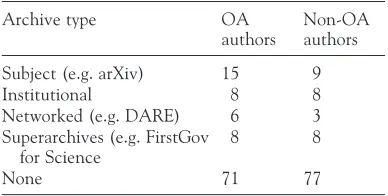
The level of awareness of eprint archives is much lower. Respondents were asked to indicate if they were familiar with any of various types of eprint archive. They were permitted to check any or all of the options, i.e. some individual respondents may be familiar with several of the archive categ-ories. Less than 30% of authors in each group are not familiar with these in any form, and then they tend to know mostly about subject archives such as arXiv (Table 2). The issue of eprint archives is discussed again later in this article.
Reasons for publishing in OA journals
Respondents were presented with a list of possible reasons for publishing their work in open access journals and asked to indicate which were important. Almost all (92%) of the OA authors said the principle of free access for all readers was an important reason. Eighty-seven per cent said they perceive OA journals to have faster publication times than other types of journal and 71% perceive the readership to be larger than for subscription-based journals. As a corollary of
this last point, 64% believe articles will be more frequently cited. Additionally, 56% of OA authors are concerned about the cost to their institution of traditional journals.
The questionnaire also asked respondents whether they would have published in the same journal if it had not been open access. This was included to test the premise that people are choosing open access journals on a point of principle about open access rather than for some other quality of the journal concerned. Twenty per cent of respondents said they would still have published in that journal even if it had not been open access, 46% said they would not have published in the journal if it had not been open access and 31% said they didn’t know.
Reasons for not publishing in OA journals
NOA authors were presented with a list of reasons why they have not chosen to publish in an OA journal and asked to say which were important. The reason that scored highest (70%) was that authors were not familiar enough with OA journals in their field; 69% said theyperceived OA journals in their field to have low impactand the same proportion said theyperceive the OA journals in their field to have low prestige. Sixty-four per cent said theyperceive the readership to be smaller than for subscription-based journals and 56% said theycould not identify an open access journal in which to publish. Nevertheless, 71% of NOA authors would publish in an open access journal if it overcame their percep-tions about its shortcomings.
Identification of OA journals to publish in
[image:2.595.347.541.145.243.2]Despite the fact that more than half the
Table 1 Length of time authors have been aware of open access journals
For how long OA authors (%)
Non-OA authors (%)
<1 year 9 19
2 years 37 26
3 years 34 9
>3 years 20 8
[image:2.595.141.334.145.231.2]Total 100 62
Table 2 Authors’ awareness of eprint archives by type
Archive type OA
authors
Non-OA authors
Subject (e.g. arXiv) 15 9
Institutional 8 8
Networked (e.g. DARE) 6 3 Superarchives (e.g. FirstGov
for Science
8 8
None 71 77
NOA authors could not identify an open access journal in which to publish, 46% of OA authors found it very easy to do this. A further 36% said they found it easy, and only 14% had found it not very easy. How do they find them? Nearly half (47%) had identified an open access journal to publish in on the recommendation of a colleague, 6% on the advice of a librarian and 12% by using the Directory of Open Access Journals compiled and maintained by Lund Univer-sity (http://www.doaj.org).
Concerns about publishing in OA journals
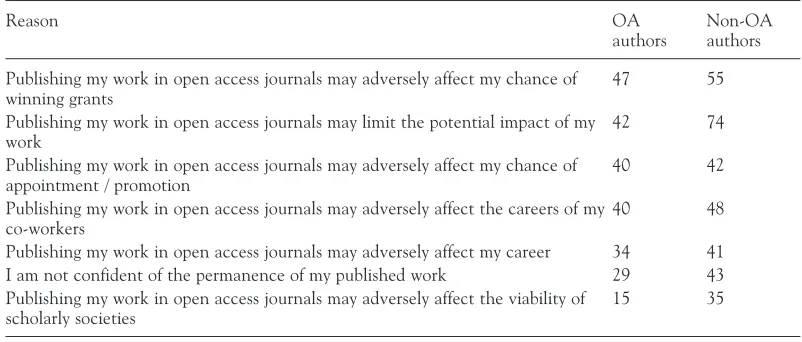
One of the most important areas of the questionnaire probed the issue of concerns authors have about open access journals. Discussions about open access publishing always raise the issues of impact factor scores (the majority of OA journals do not yet have an impact factor), career im-plications of publishing in such journals, archiving worries and concerns about the effect of open access on learned societies. These issues, and others, were placed before the respondents and they were asked to say how important each factor was. The main findings are shown in Table 3.
With a couple of exceptions, none of the concerns figured as important for more than half the authors surveyed. Nonetheless, almost half of the OA authors – and just over half of the NOA authors – felt that publishing in open access journals may in
some way adversely affect their chance of winning research grants. The NOA re-sponses differ only in small ways from those of OA authors with the exception that they have a much greater level of concern that publishing in open access journals may limit the potential impact of their work.
Publication fees
The situation for our respondent OA author population with respect to publication fees was that 36% had not paid a fee because it was not required and 19% had it waived by the publisher. Twenty-five per cent had paid the fee from their research grant, 8% from departmental funds and 9% from other institutional funds. In 4% of cases the fee was paid by the author. The majority (66% of OA authors and 71% of NOA authors) think that when a fee must be paid it should come from their research grant.
Peer review
Seventy-seven per cent of OA authors reported that the feedback from referees of open access journals was about the same as with traditional journals. Thirteen per cent reported that they received greater feedback and 7% that it was less.
Feedback after publication
[image:3.595.54.455.137.308.2]Authors were asked about the feedback they received from readers after publishing in
Table 3 The main concerns of authors about publishing in open access journals
Reason OA
authors
Non-OA authors
Publishing my work in open access journals may adversely affect my chance of winning grants
47 55
Publishing my work in open access journals may limit the potential impact of my work
42 74
Publishing my work in open access journals may adversely affect my chance of appointment / promotion
40 42
Publishing my work in open access journals may adversely affect the careers of my co-workers
40 48
Publishing my work in open access journals may adversely affect my career 34 41 I am not confident of the permanence of my published work 29 43 Publishing my work in open access journals may adversely affect the viability of
scholarly societies
15 35
open access journals. Forty-two per cent reported that it was about the same as for articles published in traditional journals, 15% said they received more feedback and 7% said it they received less. Three-quarters (76%) of OA authors felt the standards of peer review implemented by the open access journal in which they had published were about the same as a traditional journal.
Overall, 71% of OA authors said they would be more likely to choose to publish in an open access journal again after their experience. The same proportion would willingly publish in open access journals if required to do so by a granting body. Fifty-three per cent of NOA authors indicated that they concurred with this (even though at present a large proportion of NOA authors know of no suitable OA journal in which to publish).
Eprint archives
Finally, authors were asked about their atti-tude towards eprint archives, since depositing articles in such archives is the other main way to providing open access. Table 4 shows authors’ experience to date with respect to archiving their own articles in such repos-itories. Respondents could check any or all of these categories.
Whilst these figures suggest that only small minorities in each respondent popu-lation have self-archived their work, exam-ination of the data at the individual level shows that the actual proportion of authors who self-archive is higher than it appears. Of the NOA author population of 157 (the OA author population cannot be used
because it was not randomly selected), 59 individuals (38%) have self-archived their articles in one form or another. The three respondents eliminated from the original NOA author database because they had published in an open access journalalsohad self-archived their work. Since the NOA author population was randomly selected from authors publishing in traditional sub-scription-based journals, it is legitimate to extrapolate this finding to conclude that currently the overall fraction of authors self-archiving is 62/160, or 39%. We can further deduce from these same data that 2% of authors have published in an open access journal (3 individuals out of 160). A final statistic of importance here is that 69% of NOA authors wouldwillinglydeposit their articles in an open repository if required to do so (by their employer or funder): a further 8% would do so but not willingly, and only 3% would not be prepared to do so. After the collection of responses for this study was complete, the surveys remained at their original URLs and an open invitation to participate was placed on the websites of PLoS, BMC, ALPSP and Open Access News. An additional 87 responses were added to the NOA cohort, bringing the total to 247 altogether.
Discussion
We see this study as setting a baseline for understanding author attitudes and behav-iour towards the concept of open access publishing. Because of the specific aims of the study, most emphasis has been placed on open access journals rather than
self-Table 4 Self-archiving behaviour of respondents
Archiving behaviour OA authors (%) Non-OA authors (%)
Preprint form
Final peer-reviewed form
Preprint form
Final peer-reviewed form
Posted an article on my personal web page 13 24 11 12 Posted an article on my department’s website 8 17 9 8 Deposited an article in an electronic
institutional repository
7 8 3 9
Deposited an article in an electronic subject repository
11 18 5 9
[image:4.595.142.537.137.264.2]archiving of eprints, though we are now turning our attention to the latter and will report our findings at a later date.
In a previous study on behalf of ALPSP, we reported that a large proportion of randomly selected authors were not familiar with the concept of open access at all,1so we
were prepared for the same finding in our NOA sample here. In fact, this was no longer the case; almost two-thirds of NOA authors said they were familiar with open access journals, a finding that meant they were able to express their views in the light of an understanding of the issues involved.
At the heart of the study was the matter of why some authors have chosen to publish in open access journals while others have not yet opted to do so. Over 90% of OA authors published in this way because of the principle of free access. They also associate other values with publishing in open access journals: they perceive them to be faster than traditional journals, to have a larger readership and consequently to be cited more frequently, and to have high prestige and quality than traditional journals avail-able to them. The perceptions of NOA authors tend to be opposed: they perceive open access journals as having a smaller readership and lower citation rates, and of generally being of lower quality and prestige than the traditional journals they publish in. The main reason, however, for not publish-ing their work in open access journals is that they are unfamiliar with any suitable open access journals in their field.
Both groups have some concerns about publishing their work in this way. We select just one of these to discuss here – the issue of impact. While over 40% of OA authors think that publishing their work in open access journals may limit its impact, a far greater proportion (74%) of NOA authors share this view. The question is why they should feel this to be so. The most obvious answer is that they are using the journal impact factor criterion alone, and it is true that most open access journals have not (yet) attained a high rating in this respect. The other side of the coin, though, is that with free access to all potential readers, open access journals do stand to benefit from higher citations frequencies over time.
There have already been three studies that show that making research results freely available online increases readership and thus citations.2–4This issue of citation rates
is a critical one for open access, for the most persuasive argument of all for the practice lies in the potential for increased impact of each piece of published research if it can be made available to all potential users for free. New studies of the relationship between open access and citation are underway and their findings will be important.
Publication fees are a more complex issue with respect to open access than might at first seem to be the case. The argument put forward against the fee model by opponents of open access is that it is likely to discrim-inate against researchers from developing countries, researchers in fields that do not attract financial support, and young re-searchers who do not have the means to pay for publication. In this study, more than half the OA authors had not paid to publish their work in open access journals. One of the main reasons for this may be that a large number of institutions (around 400) are now ‘members’ of BioMed Central (BMC), as a result of which authors at those institutions are not required to pay a fee to publish in BMC journals. In addition, commercial open access publishers like BMC and the Public Library of Science (PLoS) will waive fees in the case of financial hardship in the same spirit as publishers have commonly been prepared to waive page charges.
Authors do think that, where required, fees should not be paid by themselves but by their research grant or institution, and this seems to be what is actually happening. Here, one-quarter of OA respondents re-ported paying the publication fee from their research grant, and a further 8% paying it from institutional funds. This depends upon the willingness of institutions and grant-awarding bodies to allow their funds to be used for this purpose and increasing numbers of both are agreeing to do so. An example of each type are the Howard Hughes Medical Institute, which has announced that it will pay open access publishing fees on behalf of its authors, and the Wellcome Foundation, which accepts that authors it funds may use money from their grants for this purpose.5
Finally, on this issue, it is rather disin-genuous to argue against open access pub-lishing on the grounds that publication fees are discriminatory. Certainly they could be, when pitched at excessively high levels, but PLoS charges US$1500 per article and BMC only US$525 for most of the articles pro-cessed for its journals, figures that are within the realm of page or colour charges currently levied by many traditional journals as a matter of course (and which are commonly funded from research grants on behalf of the author).
Open access journals are one of the two ways to achieve open access to research results. The other is self-archiving by authors. Authors self-archive by depositing copies of their articles in eprint archives. Authors can deposit preprints – i.e. articles in a form prior to being peer-reviewed – or reprints, which are copies of peer-reviewed articles in the final, published form. A third possibility, when an author is denied permission to deposit a reprint by the publisher of that article, is for the author to deposit the preprint plus a list of further modifications or revisions that effectively equate to the reprint version.
Currently, though the numbers both of archives and of articles being deposited is growing, the verdict on eprint archive activity must be ‘could do better’. The present survey shows that awareness of eprint archives amongst authors is not great, however, as we have shown, the number actually depositing articles is higher than appears at first glance. There are a number of reasons put forward to explain why these archives are not burgeoning and filling as they might. Harnad suggests that author inertia is probably the greatest of them and that authors frequently rationalize their inertia by invoking arguments about other open access publishing issues such as journal impact factor scores and publication fees, despite the fact that these are not related to self-archiving but to publishing in open access journals. There are other author-related factors that come into play, too; Pinfield6,7 has highlighted some of these,
including anxiety about the technical aspects of actually depositing an article in an eprint archive, concerns about ‘quality’ issues and worries about intellectual property rights
and copyright infringement. Since none of these issues constitute real barriers, author resistance may be seen as a cultural problem that will need to be overcome by education and persuasion – and, possibly, coercion.8,9
Institutional resistance also plays a part and probably requires analogous measures.
Open access is an issue that is currently the focus of much attention and activity. It is of great significance to the research community, to research funders, to scholarly publishers and, ultimately, to the public. Developments in this area may result in profound changes to the way research is re-ported and used. This study for JISC/OSI sets the scene for open access journals at the beginning of 2004; we expect much to change over the coming 12 months.
References
1. Swan, A and Brown, S. Authors and electronic publishing: what authors want from the new technology.Learned Publishing 2002:16(1), 28–33. URL: www.ingentaselect.com/rpsv/catchword/alpsp/ 09531513/v16n1/s6/p28
2. Lawrence, S. Online or invisible? Nature 2001: 411(6837), 521.
3. Kurtz, M. Restrictive access policies cut readership of electronic research journal articles by a factor of two. Presented at National Policies on Open Access (OA) Provision for University Research Output: An International meeting, Southampton, 19 Feb 2004. http://opcit.eprints.org/feb19oa/kurtz.pdf
4. Brody, T., Stamerjohanns, H., Harnad, S. Gingras, Y. and Oppenheim, C. The effect of Open Access on Citation Impact. Presented at National Policies on Open Access (OA) Provision for University Research Output: An International meeting, Southampton, 19 February 2004. http://opcit.eprints.org/feb19prog.html 5. http://www.wellcome.ac.uk/en/1/awtvispolpub.html 6. Pinfield, S. How do physicists use an e-print archive?
Implications for institutional e-print services.D-Lib Magazine 7(12). URL: http://www.dlib.org/dlib/ december01/12contents.html
7. Pinfield S. Scholarly publishing and the e-print initiative. 2003. http://eprints.nottingham.ac.uk/ briefing.html
8. Harnad, S. Departmental research self-archiving policy (a draft departmental self-archiving policy offered as a potential model for adoption by universities). http://software.eprints.org/handbook/departments.php 9. Harnad, S. The self-archiving initiative. Nature
2001:410: 1024–5.
Nature WebDebates version: http:// www.nature.com/ nature/debates/e-access/Articles/ harnad.html
Alma Swan and Sheridan Brown
Key Perspectives Ltd
48 Old Coach Road, Playing Place Truro TR3 6ET, UK
Email: [email protected]