COUNCIL
* TOM.~S F. (5 COFAIGH. President of the Institttte. * EUGENE McCAl(TI4Y.’Chairman of the Council.
KEVIN BONNER. Secretary. Department (~f Enterprise and Employment. VANI K. BOROOAH. Professor. Department of Applied Economics and Human
Resource Management. University of Ulster at Jordanstown.
JAMES CAWLEY. Managing Partner. Cawley & Company, Solicitors. LIAM CONNELLAN. Vice-President. Royal Dublin Society.
* SEAN CROMIEN. SecretutT. Department of Finance.
WILLIAM 13. DILLON. Chief Exec:aive. Amdahl h’eland Limited. * MARGARET DOWNES. Deputy Governor. Bank ofh’eland, * MAURICE F. DOYLE. Governor. Central Bank of Ireland.
DERMOT EGAN. Deputy Chief Executive. AIB Group.
* CONNELL FANNING, Professor, Department of Economics. University College,
Cork.
IAN GRAHAM. Consultant Cardiologist. The Charlemont Clinic. Dublin. GRAHAM GUDGIN. Director. Northern h’eland Economic Research Centre. JOSEPH HARFORD. Chief Executive. Yamanouchi h’eland Company Limited. JOHN HURLEY. SecretaJ3’. Department of Heahh
* KIERAN A. KENNEDY. Director of the Institute. PATRICK LYNCH. Chairman of the Institute. 1983-1988. JOSEPH MORAN. Chief Executive. Electricity Supply Board.
DONAL MURPHY. Director. Central Statistics Office.
* DERMOT F. McALEESE. Whately Professor of Political Economy. Trinity College.
D:tblin.
EDWARD F. McCUMISKEY. Secretat3’. Department of Social Welfare. FERGUS McGOVERN. Chief Executive, Telecom Eireann.
* DONAL NEVIN.former General SecretalT. h’ish Congress of Trade Unions. JOYCE O’CONNOR. Director. The National College of lndttstrial 1(elations.
PATRICK O’REILLY. Chief Executive. EBS BuiMing Socieo,. * W.G.H. QUIGLEY. Chairman. Ulster Batik Limited.
* NOEL SHEEHY. Professor. Department of Psycholog)’ Queen’s University of Belfast, MICHAEL J. SOMERS. Chief Executive. National Treastcrv Management Agem\v. REV. CONOR K. WARD. Social Scien(:e Research Centre. UniversiO’ College,
Dublin.
T.K. WHITAKER. PresMent ~f the Institute 1971-1987.
* PADRAIC A. WHITE. Director. Dresdner International Finance plc.
ISSUES IN IRISH ENERGY POLICY
Copies of this paper may be obtained from The Economic and Social Research Institute (Limited Company No. 18269) (Registered Office) 4 Burlington Road. Dublin 4.
Price IR£8.00
ISSUES IN IRISH ENERGY POLICY
Edited by John Fitz Gerald and Daniel McCoy
THE ECONOMIC AND SOCIAL RESEARCH INSTITUTE DUBLIN, 1993
The authors would like to thank Mai’y McElhone for her help in bringing this paper to publication. The authors are grateful to the Electricity Supply Board, An Bord G~iis, Bord Na M6na and the Irish National
Chapter I
INTRODUCTION
John Fitz Gerald and Daniel McCoy Chapter 2
ENERGY POLICY IN THE EUROPEAN CONTEXT Dieter Helm
Chapter 3
ISSUES IN IRISH ENERGY POLICY John Fitz GeraM and Daniel McCoy
Chapter 4
ENERGY CONSERVATION IN THE HOME - ARE WE CONTRARY?
Sue Scott Chapter 5
THE IMPACT OF A CARBON TAX ON THE COST OF PEAT ELECTRICITY GENERATION
Ona Nic Giolla Choille Chapter 6
ENERGY ELASTICITY ESTIMATES AND THE STABILITY OF THE RELATIONSHIP WITH GDP
Denis Conniffe
15
43
59
INTROD UCTION
John Fitz Gerald and Daniel McCoy
In the past public interest in energy policy has fluctuated with movements in energy prices; when prices were exceptionally high intemst peaked. Since 1986, when energy prices fell precipitately, energy policy has attracted much less public attention or scrutiny both internationally and in Ireland. However, the cost of energy to the economy still remains substantial to both the househokl and the productive sector. As an important input to industry, movements in domestic energy prices can significantly affect Irish competitiveness. The Report of the Industrial Policy Review Group (1992), among others, has highlighted this issue. In addition, technical change, the growing attention to the environmental consequences of burning fossil fuels, and developments in the EC are posing new challenges for policy requiring a re-examination of our traditional outlook.
This Policy Research Paper examines the changing context for energy policy in Imland, in particular the implications of developments at an EC~ level for how we organise the production and distribution of euergy. It publishes in revised form the papers presented at a conference organised by the Energy Policy Research Centre in the Economic and Social Research Institute in Mamh 1993. EC Policy
At a European level there has been an increase in the pace of development of energy policy over the last five years arising from a number of different factors:
the changes made in Ihe Single European Act which increased the EC’s responsibilities; increased attention to the promotion of competition to reduce costs; a growing concern lor tbe environmenlul impact of the processing and consumption of energy and, finully, tbe Maastricht Treaty.
These developments in the EC have focused attention on the issues of competition policy, environmental policy and long-term security of supply
(Surrey, 1992). However, progress has been slow and in Chapter 2 Helm argues that one of the most importaut tasks for EC policy makers, the development of the European energy transmission network, has attracted little attention.
The European Commission on the strength of the Single European Act, published its proposals for a single energy market (SEM) in 1988 (European Commission, 1988b). These proposals were intended to create a unified internal energy market without barriers to trade and competition, not by seeking to
introduce co-ordinated energy policies, but rather by extending competition policy to the previously excluded area of energy.
The most significant proposal to date by the European Commission relating to the energy market is the recommendation on common rules for internal markets in electricity and natural gas (European Commission, 1992). Negotiations on these proposals have been hampered by the divergent nature of the energy infrastructures across menlber states which have led, in turn, to pronounced differences in domestic energy policies.
There has been some progress on the adoption of directives on competition and public procurement in the energy sector. Transit directives, to facilitate the exchange of power and gas between utilities, were adopted in both the electricity and natural gas sectors in 1990 and 1991 respectively. The EC has also adopted a directive on price transparency in the gas and electricity utilities in 1990, which requires notification of the rates charged to all categories of customers.
A more contentious proposal in the "market-oriented" approach is the issue of third party access (TPA) to the European gas and electricity networks. TPA would oblige companies operating transmission and distribution networks for gas and electricity to offer terms for use of the grid to individual consumers or other distribution companies if there is capacity available (European Parliament, 1992).
Four general principles lie behind the EC Commission’s approach to developing Community energy policy.:
¯ the need for a gradual approach, ¯ the principle ofsubsidiarity,
¯ the need to avoid excessive regulation, ¯ dialogue and consultation.
future investment, must be minimised by clearly setting out the levels of liberalisation to be achieved al each stage.
The subsidiarity principle, in theory, enables member states to opt for the system of liberalisation which best suits their natural resources, their industry infrastructure, and their overall energy policies. New regulations will be necessary to complete the inlernal market but these should replace rather than supplement existing instruments. An additional proposal is the introduction of the concept of unbundling; thai is the separation of the production, transmission, and distribution operations of utilities.
Measures are envisaged to ensure that fair competition prevails as national energy markets are opened up. These include proposals on:
* Tile Control of State Aid - to ensure that distortions to competitive energy markets caused by state subsidies are controlled across member slates. To allow for national security concerns, continued aid of a reserved sector would be authorised. The percentage share of total electricity represented by this reserved sector would decline over time;
Electricity and Gas Transmission Infrastructure - given that the internal market is likely to create increased European cross-border demand for gas and electricity. Supply will be unable to respond unless transmission infrastructures and interconnections are developed at a sufficient pace. The proposals related to tile electricity sector include recommendations on the opening up of generation to competition and the role of member states on security of supply. The latter involves pernritting national authorities to order priority utilisation of indigenous sources of electricity generation for up to 20 per cent of needs (15 per cent after 2000); permission to order priority use of energy sources thai are renewable or are based on waste or cogeneration (not exceeding 25 MW each) in return for u reasonable price. The proposals for the gas sector
parallel those for electricity.
In addition to EC directives and proposals on tile energy sector, there urea number of important environmental proposals that have significant implications for energy use. These include the 1988 EC Large Combustion Plant directive on sulphur emissions for electricity production (European Commission, 1988a) and proposals to limi! the Community’s carbon dioxide emissions in the year 2000 to their 1990 emission levels (European Commission, 1991a). This latter proposal
includes a provision for a combined energy - carbon tax.
programmes like REGEN. Part of tile cost of financing Ihe gas pipeline belween h’eland and Great Britain is being met under this programnle.
The European Commission (1991b) set out the European Energy Charter in order to address the strategic issue of long-term supply security. The Charter, made in conjunction with the countries of Eastern Europe and the former USSR. is an attempt to secure an expanding supply of reasonably priced oil and gas for tile EC in return for investment, technology and hard currency for Eastern
Europe.
Taken together the EC agenda on energy policy poses major challenges for the energy sector in Ireland. It will be a factor for change in the sector and it can be expected to form the agenda for domestic policy [’or the rest of the decade. Tit& Polic3’ Paper
This Policy Paper considers u number of aspects of Irish energy policy in the light of developments within the EC.
In Chapter 2 Helm discusses the rationale for EC and domestic energy policy, the role of competition and the importance of developing Trans-European networks. Market failures pervade Ihe energy seclor and. as a resull, while government intervention may frequently be unsatisl~lctory, intervention remains essential. The Chapter stresses the need to develop a European transmission network. Because the development of such a network may not be in the inleresls of the current phlyers in the energy nlarkel there is a need for the EC, using its new powers under the Maastricht Treaty, to intervene. II suggests lll:.ll this issue. the development of networks, nlay be more important than tile question of Third
Party Access to existing networks.
Chapter 3 by Fitz Gerald and McCoy, is concerned with the full range of developments al the EC level its Ihey affect the h’ish economy. This Chapter concludes that the draft EC directives are pushing Irehmd in the direction it would probably wish to travel. There is both the F, ossibility and the need to inlroduce competition into the energy and gas systems. However, this will be difficult given the small size of the energy system of the Republic. In the case of electricity, compctilion can best be introduced by allowing new operators to build and operate generating stations. The size of these generators should not be such as to dominate the system, lri the case of gas. the transmission system should be open to use by third parties. In Ihe long rtm the energy transmission systems ori the island should be fully integrated to permit proper competition. It would not be desirable to privatise the elements of the energy system which are essentially natural monopolies.
The importance of improving energy efficiency is emphasised by the EC. Chapter 4 by Scott describes tlae results of a study of energy efficiency in the household sector. It uses the results fi’om a survey of households to examine the extent to which tile opportunities for energy saving are exploited. It finds that the behaviour of households in Ihe pasl has been irrational - failing to exploit profitable opportunities for saving energy indicating some market failure.
Scott suggests that, in the light of these results, a policy of using taxation alone to promote energy efficiency and minimise environmental damage will not be sufficient. There are a number of reasons for this apparent "markel failure": a lack of information; problems arising from housing tenure, in particular in rented accommodation, which mean thai the gains from investment in energy saving do not accrue to the investors: problems in financing the necessary investn~enI.
The result of increased competition and environmental regulation will be serious pressure on the peal industry. Chapter 5 by Nic Giolla Choille examines the possible impact of a carbon tax on the peal industry. It identifies the current cost of using peat Io generate eleclricity over other alternative sources al aroul’~d £30 million. Earlier studies suggested a higher figure because Ihey failed to lake account of the fact that much of the expense is a sunk cost; it would not disappear even if the peal industry closed.
The introduction of a carbon lax would substantially increase the cost to the Electricity Supply Board (ESB) of using peat, providing a stronger incentive Io switch to alternative fuels. This reflects the fact that emissions from burning peal contain nlore carbon dioxide (a greenhouse gas) per unil of electricity generated than Ior other fuels used by the ESB. However, the burden to the nation of subsidising peat electricity through electricity prices would not be changed by the lax.
Chapler 6 by Connifl~ examines the relalionship between energy demand and the growlh in GDP and prices. Energy elasticities are necessary inputs to the types of analyses appearing in other papers in this publication. However, the estimates of elasticities are actually far from soundly established and there are even disagreements in Ihe literature on how elasticities ought to be estimated.
Taken at face value, estimates of the GDP elasticity made in the conventional way for Irish data seem to indicate large decreases over time. Chapter 6 investigates the possibility that the apparent changes in eslimales may be largely illusory, the consequences of hidden price effects and inadequately clarified technological advances, as well as deficiencies in the methods of measuring aggregate energy quantity and price.
REFERENCES
EUROPEAN COMMISSION, 1988a. The Main Findings of the Conmrission~ Review of Member States’ Energy Policies. Brussels: COM(88) 174.
EUROPEAN COMMISSION, 1988b. The Internal Energy Market, Brussels: COM(88) 238.
EUROPEAN COMMISSION, 1991a. A Community Strategy to Limit Carbon Dioxide Emissions and to hnprove Energy Efficiency, Brussels: SEC(91)
1744, Final.
EUROPEAN COMMISSION, 1991b. A European Energy Charter. A Communication from the Commission, Brussels: COM(91 ) 36.
EUROPEAN COMMISSION, 1992. Proposal for a Council Directive Concerning Common Rules for" the Internal Market in ElectriciO, and Natural Gas, Brussels: COM(91) 548 Final.
EUROPEAN PARLIAMENT, 1992, The EC Internal Market in Energy: The Commission’s Proposals for Increased Competition in the ElectriciO, and Gas Industries, Working Papers. Energy and Research Series No. W3. REPORT OF THE INDUSTRIAL POLICY REVIEW GROUP, 1992, A Time
for Change: Industrial Policy for the 1990s, Dublin: The Stationery Office, SURREY, J., 1992. "Energy Policy in the European Community: Conflicts
ENERGY POLICY IN THE EUROPEAN CONTEXT
Dieter Helm, New College, Oxlbrd
I. Introduction
Energy policy has traditionally been a national activity. Governments have been concerned to ensure that national supplies of energy are secure and sufficiently diverse to prevent disruption from price or supply shocks. Self-sufficiency has been an aim in many countries: France’s nuclear programme, Britain’s plan for coal in the 1970s, and Ireland’s development of peat and gas are examples.
This national preoccupation is gradually breaking down for two reasons. First, teebnical change has increased the prospects Ior international transmission of gas and electricity, so that the network natural monopolies are being redefined at the European rather than national level. Second, the process of European political and economic integration in general, and the internal market in particular, is increasingly providing a European focus [’or the consideration of questions of energy policy. The security of European supplies is gradually becoming a more important question than the security of national supplies.
These developmenls are evolutionary, and will depend for their effect on matters of national geography and national political will. Nevertheless, the trend is probably irreversible. This Chapter considers some of the dimensions of energy policy in tiffs European context, and focuses in particular on two questions: tbe promotion of competition at’,d tile development of trans-European networks.
The Chapter is structured as follows. Section 2 sets out the underlying rationale for energy policy, the market failures. Section 3 considers the role of compelition :.rod the implications for market slruclure. Section 4 considers the
interconnections issues and the conditions required for the development of trans-Europe,’m networks. Finally, Section 5 presents a number of conclusions. 2. The Rationale for Energy Policy
The rationale for energy policy is based upon two premises: that energy markets "fail" in providing an appropriate allocation of scarce resources, and that government intervention can improve upon these failures. Traditionally, those in favour of activist energy policies concentrate on the former; those against focus on the latter. A balanced pragmatic approach takes both into account.
Market failures
The energy sector is eharacterised by multiple market failures. These can be divided into static and dynamic efficiency issues. On the static front, there are three substantial failures: natural monopoly, co-ordination and pollution. Left to its own devices, a private market will be dominated by monopoly or oligopoly, and vertical integration. Pollution will be excessive, and there is no guarantee that dispatch will be at least cost. For these reasons, final consumer prices are regulated in virtually every developed country, environmental policy puts constraints on emissions, and, even in the English and Welsh system, electricity despatch is regulated through a compulsory pool.~
Energy policy has also been significantly concerned with dynamic efficiency. It has been a conventional wisdom that private markets will be unlikely to invest in the "right" amount of investment, or in a sufficient degree of diversity. The explanation for these market failures is complex. It relies on an analysis of competition between oligopolists and the externality associated with the avoidance of supply interruption. Purchases of electricity and gas are rarely physical contracts: the supply and demand are typically system-wide in nature and therefore introduce an element of public good. Consumers find it hard to signal the insurance value of securily and supply, and generators face downside risk from the prospect of over-supply. There are rarely import opportunities rapidly available to meet demand surges.
In theory, entry into the market will come wherever future potential demand exceeds supply. In the England and Wales electricity system, this is supposed to work through the loss of load probability (LOLP), which provides information against which entrants can foma rational expectations. In practice, there are two difficulties. These are the presence of entry barriers, and the problems associated with the characteristics of power station investments. The electricity industry in particular is far from meeling the conditions of a contestable market. Hit-and-run entry is impossible, and sunk costs are high.
The pool is a spot market in cleclricily. Each generator bids in prices (not costs) [’or hallZhour periods one day ahead, a, dispalch order is derived, and generdlars arc paid on the basi~ of the Sysleln marginal costs. See
From the perspective of the generator, investments are made on the basis of ussumplions about the future supply and demand balance over the life of the investment. The possibility thai supply ntay exceed demand in the future creates risk. Therefore. generators seek protection against this possibility, through vertical contracts or vertical integration. In order to encourage generators to invest, consumers need to commit to absorb the costs. In most electricity markets, this is achieved through vertical integration and franchises. This is a normal markel structure in electricity, deviating markedly from the competitive 13aradigm.
Governnlenl failures
Although there is some disagreement about the concentration of investrtlenl on similar types of power stations and some controversy about the co-ordination of capacity, most parties to the energy debate agree thai market failures are pervasive. However, Ihe main controversy in recent years has focused on government failures. The history of energy policy is littered with examples of
policy "failures". In England and Wales, the nuclear programme in general, and the Advanced Gas Cooled Reactors (AGR) programme in particular, have been extensively criticised. Operating costs and the scale of power station investments
in the public sector were excessive.
The various government failures can be divided into two groups: those associated with government ownership and those associated with energy policy. Nationalisalion has created parlicular problems. The inability over three decades to develop control i11echalliSn1s, the pervasive iutl’tlsioi1 of nlacroeconolllic
expenditure controls on investment projects, and the biasing of investn3ents towards domestic technology have contributed to the significant additional costs. The faihtres of energy policy are harder to evaluate. Government interventions over the choice of fuel. and in particular the protection of domestic coal industries ill Britain .and West Germany, have rested on nluch wider political objectives. The dislocation cannot be judged purely on grounds of industry efficiency costs. Japun and France’s drive for nuclear power have been governed by nalional security considerations, in France’s case explicitly so. Nevertheless. the exposure of investment decisions to the vagaries of electoral geography has resulted in higher costs, and it is to be questioned whether these have always been justified.
A Pragmatic approach
Market and gover11111en[ f:ailures vLn’y froln case to C:.lSe. There is 11o a priori correct answer to the appropriate balance. Failures vary too across lime. In
will probably shift to investment, and hence policy will shift to dynamic efficiency questions.
More generally, within countries, grids and transmission systems are largely mature across the European Community. However, between countries, the connections are immaturc. Thus, whilsl national governments focus on the utilisation of existing systems, European policy is more concerned with the investment questions.
3. Competition and the Structure of ElectriciO, and Gas Industries
Competition policy towards the energy sector has been gradually applied in a number of European countries. The application in the UK has gone further and faster than other countries. It therefore provides an example which has greatly influenced the development of the Internal Energy Market programme.
The main reason for introducing greater competition into electricity markets is as a method of regulating the markets. Rather than attempting to place controls on dominant firms, the presence of competitors, actual or potential, limits the ability to raise prices above costs and to select inappropriate investments.
The introduction of competition is, however, a complex process. It requires two parallel developments: the separation of natural monopoly from artificial monopoly, and the opening up of artificial monopoly to competition. This strategy has been partially adopted in the England aud Wales electricity and gas markets. In electricity, supply has been separated from transmission and distribution in a regulatory sense (though only partially through structural change), and the artificial generating monopoly has been divided into three companies. The remaining natural monopolies are isolated into twelve regional companies and one national one. and regulation is applied to each separately.
The changes introduced at privalisation were designed to bring about a gradual transition to a fully competitive market over an eight year period to 1998. During this period, new entry was to be encouraged into generation, and supply was to be gradually deregulated by dropping the franchise limit in 1994 and abolishing it in 1998.
These structural changes - "unbuudling" in European jargon - addressed questions of ownership. They have, however, only partially addressed the questions of control. Since privatisation, there has been a substantial "dash-for-gas". However, contrary to the British government’s claims, the new entrants in fact represent only minimum extra competition: all significant projects are supported by back-to-back contracts with the regional electricity companies (RECs)" and in some cases these are further underwritten by equity stakes. In
effect, there has been a process of vertical integration through contracts. Investment by new generators, it transpires, will only take place if long-term commitments are entered into on the basis of the RECs’ franchise markets, naturally or legally defined.
Even these REC-based entrants have required regulatory protection. Terms of access to the system have been fixed, and the regulation of transmission tariffs will affect their ability to compete for a dispatch slot. Accounting separation, and the assignment of costs between supply and distribution, has also been a significant regulatory issue.
The implication for European policy of the England and Wales experiment are several. Unbundling, pet" se, will not create competition. It will not arise spontaneously. Rather, regulation for competition will be required. It is the almost complete absence of appropriate regulator), arrangements in the European Commission’s proposals for the haternal Energy Market which will undemline its effect. Furthennore, even if unbundling were to facilitate the promotion of competition, if accompanied by appropriate regulation, the resulting market would tend to re-integrate through contractual arrangements in order to underwrite the sunk cosls of new power station investments. In other words, entrants will want some protection from competition in order to avoid a competitive threat. This paradox has so far eluded the regulators in England and Wales, and resulted in the apparent confusion that competition is measured by the number of "competitors". There is a considerable difference between competition in the static sense (and therefore through a pool) and dynamic con]petition where generators compete for longer-term contracts.
4. htterconnection and European Regulation
The shift in the definition of the national networks to the European level is al present being conducted through a series of bilateral links between national utilities. The links reflect the interests of dominant incumbents. Thus Electricit6 de France has constructed links with most of its neighbours to export its nuclear surplus. The UK has to date refrained from linking its North Sea gas network with the European network in pursuit of national gas self-sufficiency, though this is now under active consideration.
investment in others’ systems, but refrain IYom providing a reciprocal service itself. The French electricity link, and the tardiness in developing a European North Sea gas network, tire examples.
A further probleln with the national approach is that tile system develops ill a piecemeal way. Each connection is considered in isolation, without attention being directed to the costs and benefits to the system as a whole. In this respect, the network is a public good: private markets typically under-provide public goods.
The European Commission’s approach has to date given little attention to these network issues. Its focus has been on narrower issues of competition, gradually opening up existing networks to greater access. Its programme of directives have taken an evolutionary approach, starting with transparency in prices, inoving on to third party access, and eventually to unbundling.
It has not yet had much success. The price level differcntials between member countries remain large. These price dispersions are even gre:aler for parlicular classes of custorner. The consetluences for the internal market in relaled energy inlensive industries is considerable, as Figure 2.1 shows. For some industries, competition is essentially determined by eleclricily and gas prices - for example, in alunliniunl, steel and chemicals.
Figure 2. I
0.08
Industrial Electricity Prices, Excluding Taxation
ECU a kWh
0.07
0.06
0.05
0.04
0.03
1980 1982 1984 1986 1988 1990 1992
Source: hllematlonal I~l~ergy Agency Stalistics (price.’; convened at ¢urrenl ECU eXcll:mge r, Ltc.,;). EC Index con~nlcled by OXERA
competitive entry is permitted and supported by competition law. The Internal Energy Market programme addresses Ihe former, but not the latter.
There is. however, a significant change ill approach signalled by the Maastricht Treaty. Article 129b of Title 7 provides for the developmenl of Trans-European ~’~etworks.3 The exael ternls ;ire:
Article 129b
I. To helI) achieve the objectives referred to in Articles 7a and 130a and to enable citizens af the Union. economic operators and regional and local communities to derive full benefit from the setting up of an area withot~t imernal frontiers, the Community shall contribute to the establishment attd development of trans-Em’opean networks in the areas of [ratlspol’l,
lelecommllnicalions attd energy ittfrasll’ttclttres.
2. Within the framework of a system of open and competitive markets. action by the Community shall aim at promoting the interconnection and iltteroperabiliO, of tlational networks as well as access to such nenvorks. h shall take accotmt in particular of the need to link island, landlocked and peril)heral regions with the central regions af the CommuniO,.
The full implementation of Title 7 will require major new initiatives, and indeed the Commission has already begun to support particular projects like Ihe gas interconnector belween IrelarJd and Britain. The problem at present is thai the Commission is approaching the network invesmaent problem on a case-by-case basis. It has not addressed the overall system requirements. This is in stark contrast to the Japanese approach, and indeed Io the approaches adopted in individual member countries.
It has been argued that these questions can be adclressed by the application of the principle of subsidiarily: thai regulation can be delegated to the national level. and that in consequence there will be regulatory competition. Those countries which apply the best regulatory approaches will, it is argued, gain a competitive edge over those which take a more restrictive policy.
This argumerd has beguiling political atlraclions. 11 does not however convince since, as indicated in Section 2 above, the provision of networks is a public good: all member countries could benefit through a European-wide approach.’*
5. Conclusions
Market failures pervade the energy sector. Ahhough there have been numerous examples of government failure, the case for an appropriately designed energy policy is persuasive. "]’hat policy should be defined at the level of natural 3 Article 129c provides the slops required to meet article 129b.
ISSUES IN IRISH ENERGY POLICY
monopoly appropriate to the energy sector: in electricity and gas, this is increasingly at the international level. This rise in scale is partly a function of technology, partly of market demand, and partly of primary fuel locations.
The provision of network infrastructures has considerable public good characteristics. They will, typically, be under-provided by the private sector. They will also be under-provided if national governments pursue national energy policies. The development of the European electricity and gas grids is appropriately designed at the European rather than national level: it provides a clear example where the principle of subsidiarity is not appropriate.
Infrastructure networks are essential to European conlpetitiveness: the ability of European firms to compete with US and Far Eastern rivals depends upon access to competitively priced energy. Failure to develop energy networks results
in higher costs associated with national security capacity margins and national diversity prograrnmes.
These concerns are recognised in the Maastricht Treaty. Title 7 explicitly refers to the need to develop policy in this area. However, the Treaty recognition does not appear to have yet been grasped by the European Commission. The Internal Energy Market, in focusing on third party access (TPA) and unbundling has only tangential relevance: indeed it is possible to argue that these largely static concerns may actually reduce investment incentives in new infrastructure.
The Internal Energy Market has fidtered: the opposition of European utilities to TPA has resulted in a stalemate. In order to take matters forward, the European Commission could renew its efforts to see through the directives once the political climate becomes more favourable. A superior approach would be to take the current stalemate as an opportunity to go back to lhe drawing board: to consider what should constitute a European energy policy appropriate to the competitiveness of the European economy in the next century. The Maastricht Treaty, in Title 7, provides a good basis. If TPA and the rest of the Internal Energy Market were set in this context, then the Commission u’tight have a greater chance of success.
REFERENCES
HELM, D.R., 1991, "Energy Policy in the 1990s". Oaford Review of Economic Policy, Vol. 7 No. 2.
ISSUES IN IRISH ENERGY POLICY
John Fitz Gerald and Daniel McCoy
I. Introduction
In a modern market economy there are many sectors which develop and grow without major state involvement and without specific targeting by public policy. However, in ahnost all countries the energy sector attracts special attention from public policy. This is true, not just at a national level, but it is also true al the level of the EC. This Chapter considers the implications for Ireland o1’ a series of proposals, put forward by the EC Commission, which potentially affect the energy sector.
The need for a public policy on energy is justified on the grounds of the existence of market fuilures in the sector. In particular, increasing returns to scale in tile energy sector have resulted in the development of monopolies in most EC economies. The potential for increasing returns arises from the technical characteristics of the electricity and gas industries and, at an early stage in the development of the energy sector, it resulted in intervention by the state. In many cases Ihis took the form of the creation of a state owned firm to exploit the benefits arising from increasing scale. However, government intervention, both nationally and internationally has in the past failed to meet its objectives, often as u result of political expediency see, for example, Helm ( 1991 ).
In Ireland the governnlenl plays an active and prominent role in the energy murket by state-ownership of the main utility monopolies, influencing decisions on fuel choice and making strategic decisions on issues of security of supply. These issues are examined in this paper.
The need for an energy policy is justified by the scale of operation in the energy sector and, related to this. the presence of monopolies or oligopolies at different stages in the production process. The presence of significant negative
environmental externalities in the energy sector, in any event, calls for state involvement in policy making. The scale of operation and the presence of environmental externalities makes the energy sector very different from many other sectors such as, for example, the manufacture of clothing. In the latter case the normal working of the market is likely to resull in an efficient scale of operation without direct government intervention.
As discussed in the first two Chapters, there is an increasing role for the EC to intervene to ensure an efficient operation of the energy market. The impetus for this involvement arises from a number of factors: the global nature of problems of pollution; the completion of the interred EC market; the experience of the successive oil crises of the last 20 years; the desire to reap the benefits from increased scale of operation through inlerconnection of national syslems. Many of these concerns are already rellected in domestic energy policy.
Traditionally, the overall objective of Irish energy policy has been to minimise the cost of energy to the economy. However, there are a number of constraints which nlusl be taken into ztccounl:~
¯ The need to ensure security and continuity of supply, ¯ The need to minimise or reduce environmental damage,
¯ Certain social considerations - e.g., employment in Bord Na M6na, the state owned peat industry.
h’J the past energy policy has been more concerned with security and continuity of supply. However, attention is now turning to the issues of controlling the negative effects of monopolistic behaviour and to the environmental side effects of energy use. A rellection of this shift in emphasis is
the decision 1o restructure the ESB into separate business units covering power generation, national grid, customer service, commercial enterprises, and business
services.
This Chapter considers the wider implications of developments in the EC for energy policy in Ireland. It does not aim to make a comprehensive statement on energy policy; for example, many of the issues for policy concerning the domestic oil market are not considered here (see DKM. 1991). In Seclion 2 we give a brief description of the important characteristics of the Irish energy sector.
In Energy Irek~nd. published by the Govemmem in 1978. the nmin elements of energy policy were specified: a. Optimum developmenl of indigenous resources.
b. Access IO Ihc chc:ll~Sl markets for imported energy supplies. c. Seeurily of supply by diversilication of sources.
d. Promotion of economy in the use of fuels. e. Slock-piling againsl emergencies.
f. Protection of Ihe environment.
g. Encouraging expli~rz, ltlon t~r hydroc:lrb~ms and ur:mium.
In Section 3 we examine the likely energy requircmenls of the economy for the rest of the 1990s. Section 4 discusses the inlportance of security of supply and Section 5 considers the interaction of energy policy and the environment. The issues of competition and ownership aud pricing and taxation are dealt with in Sections 6 and 7. Finally, conclusions are presented in Section 8.
2. The Irish Energy Sector Special features
Irish energy policy is affected by the country’s endowment (or lack of endowment) of naturul resources, the history and relatively st’nail scale of the economy. The absence of coal or oil nleanl that. since the nineteenth century, energy was primarily derived fronl imports and, as ;.i result, was generally more expensive than in certain other parts of Northern Europe. This affected the pattern of economic development. Ireland has no tradition of industries requiring major energy input such as sleel, srnehing and process chemic:.ds. Any industry which required cheap energy tended to gravitate to regions of Europe with an abundance of energy: in tile nineteenth century the coal deposits of Britain and Germany provided the basis for expansion of energy intensive industries. More recently, Scandirtavia, with cheap hydro-electricity, has attracted such ventures.
The absence of m:ljor domestic energy sources posed speci:.d problems tot the Irish economy during the Second World War. The experience of energy shortages during the war and the relalive inability of the government to take remedi.:d action had a lasting effect on domestic energy policy. In the years after the war ended slrenuous eftbrts were made to reduce this dependence on imports by developing domestic energy sources, in particular the use of peat to generate electricity. The importance attached to security of supply in h’ish energy policy was reinforced by the temporary shortages of oil during the Suez crisis in 1956 and during the first and second OPEC oil crises of the 1970s. The result of these experiences is that considerable attention is devoted IO security of supply in developirtg energy policy. In really cases this requirement lakes primacy over measures to miuimise the cost of supply of energy. Examples of this emphasis on security are the policy of maintaining a domestic refinery, the policy of diversifying fuel supplies, and the construction of a gas interconnector to the UK before it is needed to rephce the indigenous gas resources in the Marathon field.
!
18 ISSUES IN IRISH ENERGY POLICY
A further feature of the isolation of the domestic energy system, both gas and electricity, is the absence of effective imerconnectors between the Republic and Northern Ireland. Terrorist action in the mid-1970s closed the existing electricity interconneclor and it has not been reopened since. This issue is dealt with later in this Chapter.
Finally, the density of population in lrehmd is quite low by the standards of Northern Europe. Industrial policy has also promoted a dispersal of industrial activity throughout the country, away from the major traditional industrial centres of Cork and Dublin. The result of both these factors has been a significant overhead pushing up the costs of distribution for electricity, gas, and oil.
Existing structure
The inlperative to establish a secure supply of energy and the need to promote domestic econonlic activity resulted in the development of a series of peat-fired electricity generating stations in the years after the Second World War. However. the electricity generated fronl peat proved to be more expensive than that from imported oil or coal. As discussed in Chapter 5, the harvesting and processing of the peat is quite labour intensive compared to the process of generating electricity from oil or gas. As the world real price of oil fell in the 1950s and the 1960s the cost penalty of using domestic peat increased. The rapid rise in oil prices after 1973, which also affected the price of coal, temporarily reduced the cost penalty for peat generation and there wzts some increase in peat generating capacity. The fall in oil prices after 1986 has reversed this situation.
Beginning in the 1970s and continuing into the 1980s there was considerable hydrocarbon exploration activity in Irish waters. A significant gas find was made in the early 1970s by Marathon off the South coast and this canle on stream at the end of that decade. Production reached a peak in 1983, accounting for almost 20 per cent of domestic primary energy requirenlents. While traces of hydrocarbons were discovered at other locations these proved too expensive to exploit, even when real oil prices were higher in the mid-1980s.
The Marathon gas field and the smaller Ballycotton field are likely to be exhausted around the end of the century, substantially increasing Ireland’s dependence on imported energy. By the Autumn of 1996 supplies may not be sufficient to meet peak demand from the ESB. With a developed gas distribution system in place, this will mean that there will be a need to import significant quantities of gas towards the end of the century. The fact that construction of the pipeline is nearing completion, though the requirement for imports will not occur for a number of years, arises from the need to ensure security of supply.2
As a result of the indigenous gas finds and a lagged response to changes in relative prices there was a major change in the sources of energy used in Ireland
over the 1980s. This is shown in Figure 3.1. The availability of natural gas led to a switch in consumption. It was used, first for electricity generation and later by other sectors of the economy. There was also a major switch to solid fuel by the electricity generation sector. This change occurred as a result of the oil price shocks of the 1970s which highlighted the dependence of the economy on oil. The need to diversify energy supplies and the change in relative prices resulted in the decision to develop the coal-fired electricity generation station at Moneypoint at the end of the 1970s. The net result was that oil, which had accounted for almost 70 per cent of primary energy requirements in 1980, was reduced to meeting under 50 per cent of requirements by 199 I.
Figure 3. I
Source of Primary Energy
Oil 68% ~
~48% Hydro 3%
~ Hydro 1%
1980
1991
Source: Department of Energy, Energy Balance Sheets.
By 1991 gas accounted for around 15 per cent of primary energy requirements. In addition, a quarter of total gas production was used as a feedstock for the domestic chemical and fertiliser industry. When taken together with peat and a small amount of domestic hydro-electricity, around 30 per cent of domestic consumption of energy was met from domestically produced primary energy in 1991.3
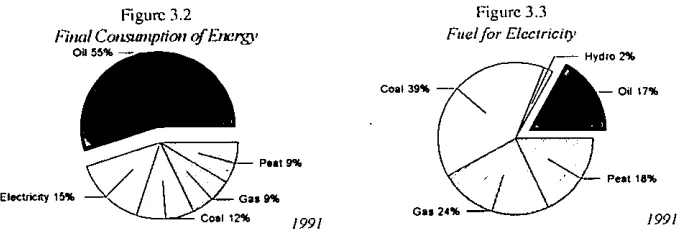
The distribution of final consumption of energy is shown in Figure 3.2. These figures differ from those in Figure 3.1 in that they show the consumption of the energy in its final "transformed" state, after it has been turned into electricity, petrol, etc.. Some of the primary energy is used itself in the transformalion process. Almost 22 per cent of final energy consumption is met
fi’om solid fuel - coal and peat. Over half of the coal and the vast bulk of the peat is used for heating by tile residential sector. Irehmd is unusual in the extent to which solid fuels are used for healing. Just over half the oil is used in the transport sector with most of the rest being used in the commercial and the industrial sectors.
Source." Department of Energy. Energy B;dance Sheets.
Figure 3.2 Figure 3.3
I.~iHtsl Colzsumptioo of Etler~, Fuel for Elcctrici0, Oil 55%
Coal3g% t7%
- Peat 18%
Gas 9%
Ga| 24% ° Coal 12~
1991 1991
As can be seen from Table 3.1, the sources of primary energy in Ireland are broadly similar to those in the rest of the EC with one exception. Whereas Ireland depends on peat for just under 15 per cent of i ls primary energy, in tile rest of the EC nuclear energy plays the same role. This diflk:rence has special significance when considering tile environmental impact of h’ish energy consumption (See
Fitz Gerald and McCoy, 1992).
Table 3. I : Primasy Energy Constmtption b~’ Fuel ( per cent)
Coal Peat Oil Gas Ntrclear Other
Ireland 22.4 13.2 48.3 15.4 0.0 0.7
EC 21.0 0.0 44.8 18.3 14.3 1.6
The data for Ireland are for 1991 ; the data lbr the EC are for 1989. Electricity accounts for around 15 per cent of final energy consunlpHon. Within total electricity consumption tile residential sector and Ihe industrial sector each accounted for around 39 per cent of the total. Over the 1980s the share of consumption of electricity by the residential sector tended to decline as consumption of natural gas by that sector picked up. However, both the share and the absolute consumption of electricity by the industrial sector increased over the period.
[image:27.529.81.421.191.310.2]radically different situation to tile 1970s when the bulk of Electricity generation was dependent on oil.
[image:28.529.208.374.259.348.2]The final consumption of energy by sector is shown in Figure 3.4. Industry, transport and the residential sectors each account for around 30 per cent of total energy consumption. The commercial sector accounts lot the rest - just over 10 per Eent. As can be seen from Table 3.2, this pattern of consunlption is not very different from that of a mtmber of other Northern European countries such as Belgium, France, Germany and the UK. A notable exception is Spain where the residential and commercial sector accounts for a much smaller share of consumption, possibly rEflEcting lower heating requirements in a milder climate.
Figure 3.4
Consumption of Energy by Sector. 1990
Source: Department of Energy, Energy Balance Sheets, Final Consumption.
Table 3.2: Energy Consumption by Sector. 1989 ( per cent) Belgium FranceGernlany Ireland Spain UK Industry 36.3 29.1 34.8 29.7 34.9 25.3
Tr:msport 25.0 32. I 27.8 28.6 42.2 31.9
Households & Commercial 38.8 38.8 37.4 41.7 22.9 42.8 Source: EUROSTAT. Note: Data for Ireland are for 1991.
The tdtimate objective of Irish Energy policy is the nfinimisation of the cost of energy supplies to the Irish economy. While the possibility of trade in oil and coal means that, subject to transport costs, market forces should Ensure that prices
in Ireland are competitive with those elsewhere in Northern Europe5 this is not necessarily the case for electricity anti gas. In both these cases the isolated nature of the Irish energy supply system has in the past restricted the possibility of
~’leasured in tonnes of oil equiv:dcnl - TOE.
[image:28.529.129.464.421.485.2]competition and it has potentially imposed additional costs. However. gas is in a more competitive environment than electricity as it faces competition in all markets from alternative fuels. This is reflected in the pricing policy of Bord Gais Eireann (BGE), where prices are set in relation to the price of substitute fuels. Electricity, on the other hand, is in many cases the only fuel suitable for particular uses having an effective monopoly of such markets.
Table 3.3 shows a comparison of the tax exclusive prices of electricity and gas to users for a range of countries in 1991. The prices have been converted to Irish pounds to facilitate comparisons. These data suggest that Irish electricity prices are certainly not out of line with those of other Northern European neighbours, in spite of the isolated nature of the Irish system. Generally German prices are high, reflecting the relatively costly use of domestic supplies of coal and the cost of protecting the environment. A report for the European Parliament (1992) estimates that electricity prices in Germany are raised by 10 per cent as a result of strict environmental controls. France has in each case the lowest price reflecting the preponderance of nuclear generation in that country.6
Table 3.3: Relative Energy Prices (Ta.v Exclusive), 1991. £1R Belgium France German.v Ireland UK £1R per kWh
Electricity - Households 0.09 0.07 0.08 0.07 0.07 Electricity - Industry 0.04 0.03 0.05 0.04 0.04
£1R per I0~ Kilocztlories (TOE)
Gas- Households 222.2 249.3 217.8 264.7 208.4
Gas - Electricity Generation 85.4 NA 89.4 59.4 NA Source: International Energy Agency, Energy Prices and Ta.res
For gas, Irish charges to consumers are, with one exception, the highest of the countries examined, though the difference is not very marked. It is difficult to obtain comparable data for prices to industry but the comparisons in DKM ( 1991 ) using EC data suggest that the price difference is not as great as some published figures might suggest. By contrast, the price of gas supplied for electricity generation was very low when compared with the situation in Belgium and Germany.
The relatively satisfactory price situation for gas and electricity in 1991 contrasts with the situation in the mid-1980s when Irish prices were well above
those in neighbouriug countries. This may have been partly due to relative inefficiency. However, an important reason for the difference was undoubtedly the cost of funding a rapid expansion in productive capacity in electricity and in distribution of gas. 7 If pricing were done on the basis of long-run marginal costs then prices would show less variability over time. It would appear that current prices are below the level of long-run marginal cost. As a result, as new capacity is installed over the 1990s, financing costs :.uld, therefore, prices will have to rise. Thus the favourable situation with regard to electricity prices is likely to deteriorate over the rest of the decade.
This cyclical pattern in relative electricity prices arises from the combination of the pricing policy adopted and the spasmodic nature of investnlenl in a small isolated system. When considering the effect of the structure of Ihe energy sector on Irish competitiveness this must be taken into ~.lcconnl.
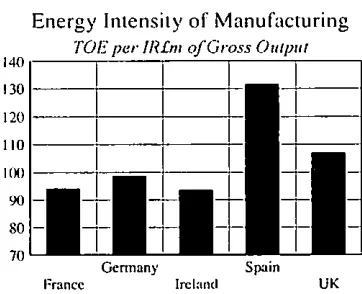
As outlined above, while energy prices in Ireland may at present be comparable with those of our Nortt~ern European neighbours this has not always been the case. Energy intensive industries did not establish in Ireland because it ’never had supplies of low cost energy and the Irish industrial structure reflects this. Despite this, as shown in Figure 3.5, the difference between the energy
[image:30.518.188.369.375.522.2]intensity of Irish industry and that of our neighbours is now quite small. As a result, the energy needs of Irish manufacturing are now not very different from those of other EC ueighbours.
Figure 3.5
Energy Intensity of Manufacturing
TOE per lR£m of Gross Output
140 130 110 120 101)
90 80 70
J-~I-anCC
I
I
I
I
I
I
I
I
I
I
I
I
Germany Spain Ireland UK
Som’ce: lEA, Energy Balances: UN, Industrial Statistics: Departmeat of Energy. Energy Balance Sheets: CSO. Census of Industrial Production.
This similarity of energy intensity, despite the absence of traditional energy intensive industries, seems surprising and it requires further study. Possible explanations are the small scale of most Irish plants and the limited usage of gas
by Irish industry compared to industry in other Northerrt EC members. The small scale of plant means that there is little scope for combined heat and power generation, an important fealure of some major plants in the other countries examined.
While the presence of major domestic supplies of primary energy ill the UK ;:rod the Netherlands is ;:m obvious eonlrast with the situation in Ireland, the other two major factors which make the Irish energy sector unusual are its dependence on fossil fuels, given the relatively low penetration of gas, and tile isolated nature of its gas and electricity sectors, hi the rest of this Chapter the importance of these two factors for energy policy is further discussed.
3. Energy Demand in the 1990s
In discussing tile future role of Irish energy policy it is usefid to make some forecasts of the likely evolution of energy demand and supply over the remainder of this decade. The level of economic activity over this period will be the most significant determinant of energy demand. An outline forecast for tile economy over the rest of the decade was prepared using the ESRI medium-term model and a related energy sub-model, broken down by five sectors and five fuel types. This system was used to prepare a forecast of tile denl;:md for total primary energy requirements (the data are presented exclusive of electricity). The parameters and elasticity measures used in this sub-model are b;:ksed on historical relationships between sectoral growth and energy use in the Irish economy over the last 20 years.
Forecasts for primary energy requirements are presented in Figure 3.6 and Table 3.4. These forecasts ;:ire based on assumptions about supply considerations, such as the availability of ;:m increased supply of natural gas through the interconnector after 1995. and the likely nlix of fuels used in each sector, given security of supply conditions and environmental target constraints. They also assume a moderate rise in the real price of energy over the decade.
Figure 3.6
PrimaO, Energy Use (’FOE)
per ten; ,4 verag¢ ,4nmtal Growth
5.0
401_A ! I___LI
3.g~ 2.0
1.0 0,0
"l’l’an s por t Commercial Total Industriul Residcnllal Utifilies
Table 3.4: Source of Primary Energy. Tonnes of Oil Equivalent (TOE)
1991 2000
Industrial 22.4 2 1.0
Transport 13.2 9.6
Residential 48.3 45.6
Comnlercial 15.4 23.0
Total 0.7 0.8
The annual growth rates in economic activity as measured by GDP and electricity demand are presented in Table 3.5. Relatively modest growth is forecast in the short term, but afler 1995 annual growth is forecasl to be close to 5 per cent per annum The likelihood of a return to rapid growth will have significant consequences for the energy sector. If we assume that the relationship between electricity demand and economic growth is simil:ar to what it has been over the last number of years then demand will have increased by nearly 50 per cent during this decade. (Tiffs relationship is discussed in detail in Chaptcr 6.) Such a growth scenario, which ignores the potential of the demand-side n~anagement and energy efficiency initiatives currently in operation, would suggest the need for a substantial increase in generation capacily.
Table 3.5: Outline Macro-Economic Forecast 1990-2000 (average atmual growth rates, pet" cent)
GDP 3.7
Electricity 4.3
4. Security of Supply
important factor in the development of the peat extraction industry in the post-war years. 111 the governnlenl report Energy Ireland, published in July 1978, considerable emphasis was put on this issue. This was not surprising following on the experience of temporary shortages after the first OPEC oil crisis.
Security of supply has traditionally had two components: the availability of primary energy domeslically and the diversification of energy sources away from dependence on one fuel or a small number of suppliers. These two aspects of security of supply must be considered together. Just because natural gas comes from an Irish source does not necessarily make it :a secure supply given thai it is piped through a single pipeline which is vtdnerable to accidents. Security of supply is also affected by the possibility of industrial action.
Measured in terms of these two aspects of security, energy policy has been very successful over the last Iwelve years. The dependence on imported energy hus been reduced from around 85 per cent in the late 1970s to around 66 per cent in 1991.s In addition, the dependence of the economy on oil has been greatly reduced with the gradual diversification of fuel sources. This diversification has obviously involved a major increase in use of gas; it has also seen a substantial
increase in the use of imported coal.
However, while the current situation on the security of energy supplies, measured by the proportion of primary energy sourced domestically, is more balanced than in earlier decades, the situation is likely to change rapidly over the next 10 years. The exhaustion of domestic gas supplies will itself increase dependence on imported energy supplies returning the economy to the position of earlier decades. In addition, in the absence of new investment, the peat industry is likely to decline in importance.
However, the installation of the gas pipeline will allow use of gas to maintain its share of demand, though any major increase could prove risky clue to the dependence on a single pipeline as the indigenous sources are used up. The integration of the electricity systems on this island could allow some further increase in the share of gas through spreading the risk of temporary loss of the pipe-line over a larger system.
The issue of security of supply places limits on the extent to which reliance should be placed on a single gas or a single electricity interconnector. While some fom~s of storage can be used to provide u temporary back-up to the g.as supply, the nature of the storage may pose problems. For electricity, storage is not an option. This aspect of security is now much more important than the question of the dependence on imported energy supplies. With the increasing integration of the EC energy system the issue of domestic sourcing is likely to decline in importance. The draft EC directives will contribute to this indirectly. However, just kS portfolios of assets are diversified to reduce risk, the need to
maintain diversity of fuel supply to avoid shocks from sudden price changes in the future remains important.
5. Energy and the Environment
Environmental concerns on trausfronlier issues like acid rain and the prospects of global warnling have gained much pronlinence over the last decade. The burning of fossil fuels for energy purposes is a major contributing factor in both of these problems. Acid rain is fomled by the combination of sulphur dioxide (SO2) and nitrogen oxide (NOx) emissions in the air, both of these are by-products of energy use, particularly from consunlption of coal, peat and oil. The possible consequences of the "Greenhouse Effect", inducing global wanning include rising sea-levels and climatic changes. Energy use is estimated to account for almost 50 per cent of man-made sources of greenhouse gases. The main greenhouse gas is carbon dioxide (CO.,) which is also a by-product of fossil fuel use.
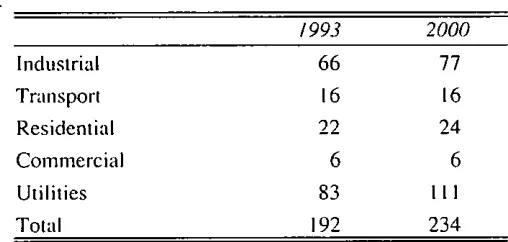
[image:34.518.146.400.475.596.2]International response to these issues has inevitably focused on the energy sector. Environmental targets have been set and timetabled for this decade and these will act :.is a constraint on Irish energy policy. The problem of acid rain is dealt with at an EC level by the 1988 Large Combustion Plant Directive (LCP), which has targeted reductions in SO, eulissions by 1993. Ireland received a higher ceiling limit for the power generation than the 1980 baseline level due an allowance for the then unbuilt Moneypoint plant. The ceiling under this directive for utilities is 124,000 tonnes of SO~. and our forecasts, presented in Table 3.6, would suggest that this 1993 target will be easily met (this assumes that coal with a I per cent sulphur content is used for electricity generation). In addition to obligations under the LCP directive, Ireland signed the Helsinki Protocol in 1990 at the beginning of its presidency of the EC. This protocol requires a 30 per cent reduction on 1980 levels of SO, emissions by 1993. In Ireland’s case this would impose a target for the whole economy of 157,000 tonnes, which our forecasts in Table 3.6 demonstrate will not be met on the basis of current policies.
Table 3.6: Sulphur Dioxide Emissions (thousand tonnes)
1993 2000
Industrial 66 77
Transport 16 16
Residential 22 24
Commercial 6 6
Utilities 83 I I I
Strategies lbr meeting this obligation include the use of low sulphur fuels, more use of natural gas (a sulphur free fuel) or the installation of desulphurisation equipment at power plants. McCoy (1991) examined the maeroeconomic impact of this obligation for Ireland. He suggests that the costs of meeting this objective may not prove to be too substantial for the economy if gas consumption can be expanded significantly. However. future commitments need to be carefully considered.
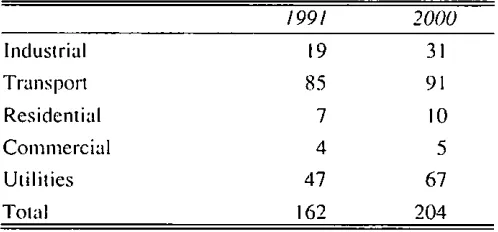
[image:35.518.121.370.236.352.2]The Sofia Protocol on NOx emissions called for stabilisalion of 1995 emissions at 1987 levels. Ireland would be extremely unlikely to meet such a target, see Table 3.7.
Table 3.7: Nitrogen O.ride (NO.r) Emissions (thousand lotmes)
1991 2000
Industrial 19 31
Trimsport 85 91
Residential 7 I 0
Commercial 4 5
Utilities 47 67
Total 162 204
In terms of carbon dioxide emissions the Rio Earth Summit of 1992 failed to agree on a binding climate change convention that contained firm targets.
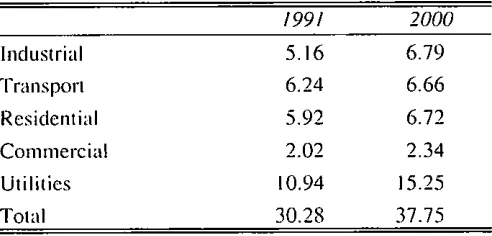
However. the EC have proposed targets in a comnmnity strategy to limit CO~. emissions and to improve energy efficiency. Tile target set is the slabilisation of Community CO2 emissions at the 1990 levels by Ihe year 2000. As part of that strategy the Commission proposed a combined lax on carbon and energy. Some member slales, including Ireland. seek a concession to increase their 1990 levels in order to pursue economic convergence. However. our forecasts suggest that h’ish emissions by 2000. even allowing for significant slructur:.d ch:.mges, will be over 20 per cent above the 1990 target level, see Table 3.8.
The influential Intergovernmental Panel on Climate Change (IPCC) have reported that reductions of about 60 per cent on current emissions would be required to avert serious problems clue to the greenhouse effect. If a constraint of this severity was put Oll tile energy sector the necessary structund changes would be enoFillous.
results I¥om the shilling of the tax base from labour to energy; the demand for energy is inelastic v,,hereas the demand for Iztbour is relatively elastic. The result is an overall improvement in the competitiveness of the trudz~ble sector.
Table 3.8: Carbon Dioxide Emissions (million tomles)
1991 2000
Industrial 5.16 6.79
Transport 6.24 6.66
Residential 5.92 6.72
Commerciul 2.02 2.34
Utilities 10.94 15.25
Total 30.28 37.75
Incorporating environmental constraints into energy policy has significant implications for policy makers. In the first instance, the presence of large and potentially serious environmentzd extermdities associated with energy use can provide zt legitimate reason for intervening in a free market. In the absence of iulervenlion the full social costs, private plus external, of energy use will not be taken into account and this will result in too high a level of energy use. Even given the uncertainty that surrounds environmental issues like global wzlrming, policy makers can be justified in taking a "precuutionary approach" in controlling energy use. The form of control used can be based on either regulations and standards or a ularkel based approach of taxes and/or tradable permits. Economic theory would come down strongly in favour of the lalter approach on the grounds of efficiency, yet there is a predominance of direct regulation in dealing with pollution matters which "reflects the bias toward the use of the tools of law enforcement and technical fix to achieve government ends" (Shortle, 1992).
In intervening in the energy ruarkel on environmental grounds policy-makers must still decide on what is the socially desirable level of energy use. This is a
Herculean IzLsk given that the policy-maker may have no better irfformation than the market participants. Satisfying the environmental constraint may also lead the policy-maker into conflict with other goals, like the social obligations to employment in the peal industry. When concerned about global or international environmental issues, domestic policy-makers should consider possibilities of better und che~tper solutions by financing clean-up activities in olher countries.
McCoy (1991) showed that. in terms of Irish macroeconomic performance, the governrnenl wotdd h:.lve achieved a belter resuh for the h’ish economy zmd Ihe
6. Competition and Ownership
The EC Conlmission proposals are designed to promote energy efficiency by opening up the EC market and increasing competition. Their emphasis is rather different from that of the energy reforms of the UK in the 1980s where the crucial question was that of ownership. The EC Commission proposals do not deal directly with the issue of ownership but, by auempting to free trade in electricity and gas, they aim to increase competition.
The problems posed by concentration on the issues of ownership have been highlighted by Helm (1991). The constraints placed on the reorganisation of the UK electricity industry meant thai a duopoly situation was creatod replacing the previous monopoly, with only a limited increase in competition. The resulting system depends heavily on regulation to ensure that the system runs efficiently in the sense of minimising the economic rents arising from the structure of ownership.
As outlined above, the EC Commission proposals involve the separation of the generation, transmission, and distribution of electricity to increase transparency in pricing electricity and gas supplies. These proposals recognise that the transmission of electricity and gas is normally a natural monopoly. However, it is quite possible to have competition in generation and competition between major consumers or distributors. It is hoped that by increasing transparency and allowing increased competition in generation and distribution, that efficiency can be increased.
Already there are pressures at a European level for increased freedom to trade energy. This issue has arisen in the case of Germany where major industrial consumers of expensive German electricity want the right to import cheap electricity from France or the Netherlands (European Parliament. 1992). If the new regime were introduced it would pose major problems for the eurretll German policy of burning expensive domestic coal and would require considerable changes in the German electricity system.
The introduction of such a regime at an EC level has major implications not just for the electricity and gas utilities but also for other suppliers of fuel. Increased competition from abroad or from the liberalisation of the domestic generation systems will put major pressures on the domestic suppliers of high cost primary energy: coal in Genrtany and tile UK, peat in Ireland. The implications of this policy for the British coal industry became apparent in 1993 with the closure of the majority of the remaining pits, raising a major political storm. It also raises the question as to whether the pricing of electricity from nuclear fuel takes full account of the clean-up costs associated with its decoramissioning.