White Rose Research Online URL for this paper: http://eprints.whiterose.ac.uk/92240/
Version: Accepted Version
Article:
Prestwich, A, Sniehotta, FF, Whittington, C et al. (3 more authors) (2014) Does theory influence the effectiveness of health behavior interventions? Meta-analysis. Health Psychology, 33 (5). pp. 465-474. ISSN 0278-6133
https://doi.org/10.1037/a0032853
[email protected] Reuse
Unless indicated otherwise, fulltext items are protected by copyright with all rights reserved. The copyright exception in section 29 of the Copyright, Designs and Patents Act 1988 allows the making of a single copy solely for the purpose of non-commercial research or private study within the limits of fair dealing. The publisher or other rights-holder may allow further reproduction and re-use of this version - refer to the White Rose Research Online record for this item. Where records identify the publisher as the copyright holder, users can verify any specific terms of use on the publisher’s website.
Takedown
If you consider content in White Rose Research Online to be in breach of UK law, please notify us by
APA Copyright Notice: This article may not exactly replicate the final version published
in the APA journal. It is not the copy of record. This is a preprint of an article whose final and definitive form has been published in Health Psychology © 2014 American Psychological
Association DOI: 10.1037/a0032853; Health Psychology is available online at
http://www.apa.org/pubs/journals/hea/ . The final and definitive form of the article can be found
at http://psycnet.apa.org/journals/hea/33/5/465/
Does theory influence the effectiveness of health behavior interventions? Meta-analysis.
Andrew Prestwich (University of Leeds) Falko F. Sniehotta (Newcastle University)
Craig Whittington (University College London) Stephan Dombrowski (Newcastle University) Lizzie Rogers (Birkbeck, University of London)
and
Susan Michie (University College London)
Correspondence concerning this article should be addressed to Andrew Prestwich, University of Leeds. E-mail: [email protected]
Abstract
Objective: To systematically investigate the extent and type of theory use in physical activity
and dietary interventions, as well as associations between extent and type of theory use with intervention effectiveness.
Methods: An in-depth analysis of studies included in two systematic reviews of physical activity
and healthy eating interventions (k = 190). Extent and type of theory use was assessed using the Theory Coding Scheme (TCS) and intervention effectiveness was calculated using Hedges’s g.
Meta-regressions assessed the relationships between these measures.
Results: Fifty-six percent of interventions reported a theory base. Of these, 90% did not report
links between all of their behavior change techniques (BCTs) with specific theoretical constructs and 91% did not report links between all the specified constructs with BCTs. The associations between a composite score or specific items on the TCS and intervention effectiveness were
inconsistent. Interventions based on Social Cognitive Theory or the Transtheoretical Model were similarly effective and no more effective than interventions not reporting a theory base.
Conclusions: The coding of theory in these studies suggested that theory was not often used
extensively in the development of interventions. Moreover, the relationships between type of theory used and the extent of theory use with effectiveness were generally weak. The findings
suggest that attempts to apply the two theories commonly used in this review more extensively are unlikely to increase intervention effectiveness.
Applying theory to the design and evaluation of complex behavior change interventions is viewed as good practice (Glanz & Rimer, 1995; MRC, 2008). Although there is some
evidence for an increasing trend of interventions to refer to a theoretical basis (Noar, Palmgreen, Chabot, Dobransky, & Zimmerman, 2009), a substantial proportion of studies do not, as noted in
a variety of reviews and commentaries (e.g., Albarracin et al., 2005; Davies, Walker, & Grimshaw, 2010; Hardeman, Johnston, Johnston, Bonetti, Wareham, & Kinmonth, 2002; Molloy, 2010). These reviews and commentaries have not included a detailed examination of
how theory has been used in the development and evaluation of interventions.
The associations between using theory as a basis for intervention design and intervention
effectiveness are not well understood. Some evidence suggests that reporting the use of theory to inform the development of behavior change interventions is associated with larger
intervention effects (Albada, Auseums, Bensing, & van Dulsem, 2009; Ammerman, Lindquist,
Lohr, & Hersey, 2002; Fisher & Fisher, 2000; Glanz & Bishop, 2010; Kim et al., 1997; Swann et al., 2003; Taylor, Conner, & Lawton, 2012; Webb, Joseph, Yardley, & Michie, 2010).
However, other reviews have detected small or no association between reported theory use in intervention design and intervention effectiveness (e.g., Albarracin et al., 2005; Roe et al., 1997; Stephenson et al., 2000) while one review indicated interventions reported to be based on theory
were less effective compared to those not reporting a theory basis (Gardner et al., 2011). These inconsistencies in the literature between theory application and intervention effects require an
in-depth examination of how theory has been used and whether using theory in different ways is associated with larger behavior change effects.
One possible reason for inconsistencies in the associations between theory use and
intervention effectiveness is that earlier reviews report theory use in simple categorical terms (yes/no) (e.g., Ammerman et al., 2002). More in-depth assessments of how theory has been
developments enable such an approach. One approach to specifying theory use in health behavior research is a general coding frame of four items: informed by theory; applied theory;
tested theory; built theory (Painter, Borba, Hynes, Mays, & Glanz, 2008). A more detailed method of specifying reported theory use is the 19-item Theory Coding Scheme (TCS, Michie &
Prestwich, 2010). The TCS specifies whether theory is mentioned, how theory is directly used in intervention design, how theory influenced interventions indirectly via the selection of
participants and via delivery to different groups of participants, how theory explains intervention
effects on outcomes and the implications of the results for future theory development. Theory can be used to inform interventions by highlighting the constructs or types of
individuals that should be targeted by the intervention (Michie & Prestwich, 2010) or to inform the selection and sequence of intervention strategies (Wingood & DiClemente, 1996).
Consequently, there are at least three major pathways through which basing an intervention on a
specific theory can influence intervention effectiveness: via the selection of specific behavior change techniques (BCTs) or a combination of these techniques which prove effective or
ineffective; influencing the inclusion of participants into the study who are likely to benefit from the intervention (and the exclusion of participants unlikely to benefit) and the tailoring of BCTs to individuals (tailoring) based on their theory-relevant characteristics. These pathways are not
necessarily related; for example, researchers could use theory to decide which participants are eligible for their study but not use theory to select the intervention behavior change techniques
or to tailor the intervention. As a consequence, interventions that apply theory more extensively to address each of these pathways could be more effective than studies that apply theory less extensively.
An important consideration when examining whether interventions using theory are more effective than those that do not is to assess how theory has been applied in the comparison
that use theory to tailor an intervention to both intervention and comparison conditions need to be differentiated from studies that use theory to tailor an intervention only to the intervention
condition. This is necessary as the intervention effect relates to the difference between the intervention and control groups. Reviews of the impact of theory use on intervention
effectiveness, therefore, need to consider whether theory has been used to develop the intervention in both the intervention and comparison conditions.
Aims
The current review had two aims: First, to use the TCS to assess the extent to which studies have reported using theory to develop interventions (Aim 1). Second, to investigate
whether differential theory use was associated with intervention effectiveness (Aim 2). In relation to this second aim, we investigated how much specific types of theory use (measured through individual items on the TCS), as well as the extent of theory use (measured through
composite scores of multiple items on the TCS) were associated with intervention effectiveness. These key analyses were re-run within five sets of sensitivity analyses. First, given
intervention effects reflect the difference between the intervention and comparison groups we coded theory use in both conditions. Consequently, within sensitivity analyses, we tested whether the associations between theory use in the intervention group and intervention
effectiveness changed when statistically controlling for theory use in the comparison condition. Second, we took into account the type of control (i.e., any active control vs. waitlist, no or
minimal intervention). Third, because just over a third of studies were conducted using
participants with, or at risk of, chronic diseases, we included this factor in the analyses. Fourth, due to concerns that studies that use theory to develop their interventions may be
methodologically more rigorous, we coded risk of bias and statistically controlled for this in an additional set of analyses. Finally, we identified and removed statistical outliers from the
Method
Studies
Studies included in the current review were based on two recent systematic reviews, including a review of the association between BCTs and physical activity and diet (Michie,
Abraham, Whittington, McAteer, & Gupta, 2009) and a review investigating BCTs within obese adults with, or at risk of, obesity-related co-morbidities (Dombrowski, Sniehotta, Avenell, MacLennon, & Araujo-Soares, 2012). The review covered both physical activity and healthy
eating because a number of studies targeted both of these behaviors and in order to maximize the scope of the review and the power of the analyses. The dataset for the review included 140
separate studies comprising 190 comparisons of interventions.
Inclusion/Exclusion Criteria
In the Michie et al. (2009) review, the inclusion criteria were: 1. Adults aged 18 or over;
2. Interventions targeting physical activity and/or healthy eating; 3. Use of experimental or quasi-experimental designs; 4. Incorporated objective, standardized, or validated outcome
measures; and 5. Use of cognitive or behavioral change strategies beyond simple provision of information. Their review excluded interventions sampling specific populations (i.e., pregnant women or recently postnatal women, athletes, individuals already engaged within another health
programs, individuals not living in the free-population, individuals with physical or mental health problems). In the Dombrowski et al. (2012) review, the inclusion criteria were: 1. Adults
with a mean/median age above 40, mean/median BMI above 30, and at least one other risk factor for morbidity or an already present co-morbidity; 2. Behavioral interventions targeting physical activity and/or healthy eating; 3. Randomized controlled trials with follow-up data at 12 weeks
or later; 4. Reported behavior change data for diet and physical activity by self-report or objective measures at baseline and follow-up. All studies included in this analysis, therefore,
eating, and reported measures of these behaviors and statistical information upon which effect sizes could be calculated.
Data Extraction
The following information was extracted from each study: (a) bibliographic information
(author, year of publication, associated papers), (b) behavioral outcomes (physical activity and/or healthy eating), (c) duration of intervention period, (d) intervention/control group information (BCTs used, theoretical basis, duration of intervention, use of multiple sessions, source of
delivery, format of delivery, type of control group), (e) risk of bias (f) data required for effect size calculations.
Theory use. The Theory Coding Scheme (TCS; Michie & Prestwich, 2010) was used to
code reported theory use for the development and evaluation of interventions1. Each of the 19 items within the TCS requires yes/no responses and has shown good inter-rater reliability. The
specific theory (e.g., SCT, TTM) upon which the intervention was reported to be based was also coded (item 5).
While items on the TCS were treated individually in some of the analyses, some of the TCS items were also combined to reflect the extent of theory use (see Table 1 for TCS items). Specifically we created three composite measures reflecting:
- (a) the extent to which each BCT reported by the authors was linked to a theory-relevant construct [BCTs theory-relevant constructs]. As there are three items on the TCS that
relate to this aspect of theory use (items 7-9), the composite score was determined using these three items. Of these items, studies coded ‘yes’ for item 7 (‘All intervention
techniques are explicitly linked to at least one theory-relevant construct’) reflects the
most optimal use of theory thus was weighted as +2 in the composite measure. Studies coded ‘yes’ for either item 8 (‘At least one, but not all, of the intervention techniques are
techniques are linked to a group of constructs’) were weighted as +1 to reflect some (but not extensive) use of theory. Studies coded ‘no’ to items 7, 8 and 9 were weighted 0 to reflect no theory use. Thus, the ‘BCTs theory-relevant constructs’ measure ranged
from 0 (no theory use) to +2 (optimal theory use).
- (b) the extent to which the constructs within the underlying theory were specifically
targeted by the BCTs [theory-relevant constructs BCTs]. As there are three items on the TCS that relate to this aspect of theory use (items 9-11), the composite score was determined using these three items. Of these items, studies coded ‘yes’ for item 10 (‘All
theory-relevant constructs are explicitly linked to at least one intervention technique’)
reflects the most optimal use of theory thus was weighted as +2 in the composite
measure. Studies coded ‘yes’ for either item 11 (‘At least one, but not all, of the theory
relevant constructs are explicitly linked to at least one intervention technique’) and/or item 9 (‘Group of techniques are linked to a group of constructs’) were weighted as +1
to reflect some (but not extensive) use of theory. Studies coded ‘no’ to items 9, 10 and 11 were weighted 0 to reflect no theory use. Thus, the ‘theory-relevant constructs BCTs’ measure also ranged from 0 (no theory use) to +2 (optimal theory use).
- (c) an ‘overall theory score’ was also generated based on all of the TCS items that relate
to using theory to develop the intervention (items 3-11). Studies received a +1 weight for each of the following: the intervention was based on a single theory (item 3); theory
was used to select recipients for the intervention (item 4); the intervention was explicitly based on a specific theory or combination of theories (item 5); theory was used to tailor intervention techniques to recipients (item 6). The sum of these items were added to the ‘BCTs theory-relevant constructs’ (see (a) above) and ‘theory-relevant constructs BCTs’ (see (b) above) composite scores, creating a scale from 0 (no theory use) to +8
type of theory application, a sensitivity analysis was used to test the impact of removing these from the overall composite score, providing an alternative overall theory score.
The TCS, where appropriate, was applied separately both to the intervention and
comparison conditions to take into account the use of theory in the study (see ‘Data Analysis’ and ‘Online supplement table’). This allowed the examination of whether theory use in the
intervention condition was associated with intervention effectiveness when controlling for theory
use in the comparison condition (see Michie et al., 2010; Williams, 2010).
For the TCS, pairs of coders independently coded the theory items from 42 studies. A Cohen’s kappa value between .61 and .80 reflects substantial agreement while a kappa value
above .80 reflects almost perfect agreement (Landis & Koch, 1977). On this basis, the levels of agreement were typically almost perfect (mean kappa=.88; median kappa=.89) and at least
substantial (>.71) for all theory items.
Risk of bias. Based on the Cochrane Collaboration’s tool for assessing risk of bias (Higgins,
Altman, Gøtzsche, Jüni, Moher, Oxman, et al., 2011), an assessment was made using the following items coded yes/no: (i) does the study report randomization?; (ii) was the allocation sequence concealed?; (iii) was there any blinding?; (iv) was incomplete data adequately addressed?; (v) Are
reports of the study free of suggestion of selective outcome reporting?; (vi) is the study free from any other bias?3
Data Analysis
To assess the extent to which studies have used theory to develop and evaluate interventions, the percentage of studies that were coded ‘yes’ for each item on the TCS4 was
To examine whether items from the TCS predicted intervention effects, a series of meta-regressions (using a random-effects model with restricted maximum likelihood estimation,
computed with the meta-reg command in Stata version 12.1, Stata Corp 2011) were conducted. In our analyses, the regression coefficients are the estimated increase in the effect size per unit
increase in the covariate(s). To assess the proportion of between-study variance explained by each covariate, the adjusted R2value is reported. Secondary meta-regression analyses were conducted to control for potential moderating factors. This was done by adding the following
factors to the meta-regression models: theory use in each control group (i.e., as assessed with the TCS), type of control group (i.e., any active control vs. waitlist, no or minimal intervention),
disease chronicity (i.e., chronic or at risk vs. non-chronic) and factors associated with the risk of bias (i.e., randomization, allocation concealment, blinding, missing outcome data, selective outcome reporting, and any other problems). Sensitivity analyses were conducted to assess the
impact of removing outlying effect sizes (determined using the Sample-Adjusted Meta-Analytic Deviancy Statistic; Huffcut & Arthur, 1995). Sensitivity analyses are reported as supplementary
online material (see online supplement table). Intervention effect size calculations followed the approach used in the original individual reviews, indexing effects as Hedges’s g (the difference
between two means divided by their pooled standard deviation, with correction for small sample
size) (Hedges & Olkin, 1985).
Results
Studies Included in the Review
The studies included in this review were published between 1990 and 2008. Across the 190 comparisons, the interventions were typically delivered by non-healthcare professionals
were self-reported but most of the studies (65.3%) used behavioral measures that had been previously validated. The total number of participants across the studies was 61,649.
Risk of Bias
In regard to risk of bias, the vast majority clearly reported that they randomized
participants to condition (94.2%). However, few clearly reported that the allocation sequence was concealed (15.8%) or that any form of blinding was used (25.3%). Across the 190
comparisons, few reported an adequate method to blind their participants (1.6%), the intervener
(1.1%), or outcome assessors (10.0%). Incomplete data was judged to be adequately addressed in most comparisons (56.8%). The comparisons were typically judged to be free from selective
reporting (96.3%) and free from other problems that could put them at high risk of bias (73.2%).
Findings
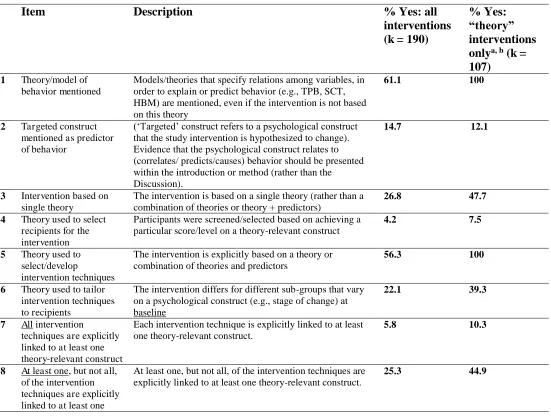
Table 1 outlines the 19 items within the TCS. These numbered items are subsequently
referenced while addressing the study aims below.
Aim 1: The extent to which studies reported using theory to develop and evaluate
their interventions.
Table 1 illustrates how theory was used across all 190 comparisons of interventions. Out of 190 interventions, 107 (56.3%) explicitly reported that they were based on theory (i.e., coded
yes to item 5). Of the 107 interventions reporting a theory base, 51 (47.7%) were reported to be based on a single theory (item 3), 8 (7.5%) reported using theory to recruit study participants
(item 4) and 42 (39.3%) reported using theory to tailor BCTs to recipients (item 6). Of these same 107 interventions, 11 (10.3%) reported explicit links between all BCTs within the intervention and the targeted theoretical constructs (item 7) while 10 (9.3%) interventions
reported targeting all the constructs within a specified theory with specific BCTs (item 10). Fifty-two (48.6%) tests of interventions reported measuring theoretical constructs
4 (3.7%) tests of interventions reported statistically significant mediated effects (item 16d). A similarly small number (3, 2.8%) reported suggestions for theoretical refinement on the basis of
their findings (item 19).
Insert Table 1 about here
Aim 2: Is reported theory use associated with intervention effectiveness?
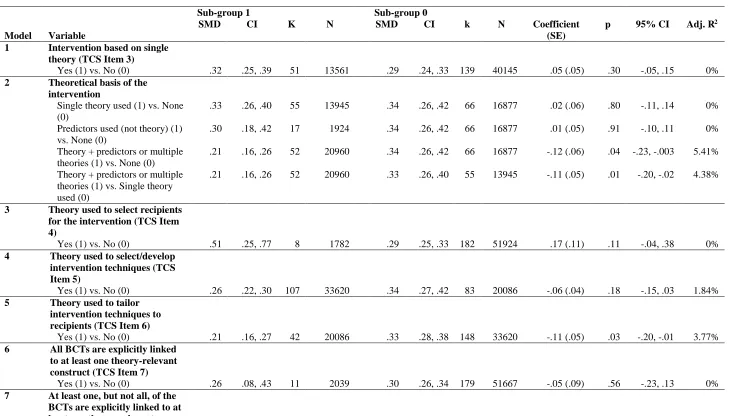
The relationship between reported specific theory use and intervention effectiveness is reported in Table 2 (see also the Supplement Table).
Insert Table 2 about here
Interventions reporting to be based on a single theory were associated with larger effects
(g = .33) compared to those reporting multiple theories or a combination of theory and additional theory-based predictors for intervention development (g = .23) (see model 2). Of the TCS items, using theory to determine which participants should be recruited into the study yielded the most
positive increase in effectiveness (g = .51 vs. .29; see model 3), although this variable did not explain any of the between-study variance. Studies that reported using theory to tailor the
intervention yielded smaller intervention effects than those that did not report this tailoring (g = .21 vs. .33; see model 5).
Interventions referring to a theory base were not more effective than those not explicitly
referring to a theory base (see model 4). Interventions reporting links between BCTs and theory-relevant constructs were not more effective than others (see models 6 to 10). Interventions
reported to be based on TTM or SCT were not different in terms of effectiveness, nor were they more effective than those interventions that were not reported to be based on these theories (see model 11).
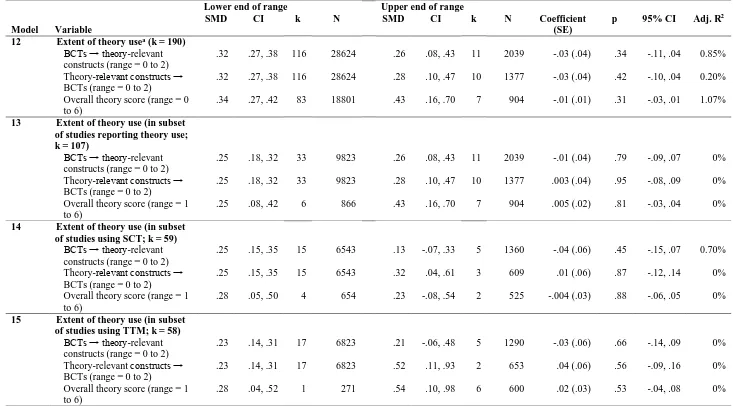
adjusted R2= 1.19%); the extent to which the constructs within the underlying theory were specifically targeted by the BCTs (‘theory-relevant constructs BCTs’; adjusted R2= 0.48%); the ‘overall theory score’ (adjusted R2= 1.21%). It should be noted that the seven studies that
scored most highly on the overall theory score produced, on average, a larger effect size than the
83 studies that scored the lowest score. However, when all studies were taken into account, there was no evidence that this represents a real effect. The same results were found in the subset of studies reporting theory use (model 13), using SCT (model 14), and using TTM (model 15).
Sensitivity analyses suggested that these results were relatively stable with respect to outliers (studies judged to be outliers were excluded from the analyses). In addition, the results
were similar when controlling for disease chronicity and use of theory in the control group and type of control group (these were included as a factors in the meta-regression analyses) (see online supplement table). In addition, when variables relating to the risk of bias were entered
individually into a meta-regression model, randomization appeared to be the most important factor associated with intervention effectiveness (i.e., studies reporting to use randomization
produced, on average, larger effects than non-randomized studies).5 Therefore, all models were re-run controlling for randomization (see online supplement table) and yielded similar effects. A sensitivity analysis using the alternative overall theory score produced similar results (B = -.02,
adjusted R2= 1.46%).
Discussion
This review has systematically investigated the extent and type of theory use in interventions to increase physical activity and healthy eating, as well as associations between theory use and intervention effectiveness. About half of the interventions reviewed were
reported to be explicitly based on theory. Of these, theory was rarely used extensively to develop or evaluate the intervention as defined by the TCS: few targeted all theoretical
intervention, used theory to tailor their intervention, used theory as an explicit basis for their intervention or based their intervention on a single theory. This limits the possibility of evidence
accumulation and of studies to experimentally evaluate specific theories and therefore to refine them on the basis of evidence.
The majority of the analyses revealed no association between theory use (assessed through individual TCS items or combinations of TCS items) and intervention effectiveness. Where there were significant associations these tended to be weak; thus, inferences made from
these findings should be considered cautiously. The finding that interventions that report using theory to select recipients yielded the largest intervention effects (albeit still small) is consistent
with results of a recent review examining internet-based interventions (Webb et al., 2010). However, this may be due to the selection of participants most likely to respond to interventions (e.g., because they are more motivated to change). Basing an intervention on multiple theories
appeared to be somewhat less effective than basing it on a single theory. Basing an intervention on two theories providing contradictory accounts of how behavior changes may explain this
(Dombrowski, Sniehotta, Avenell, & Coyne, 2007). A multi-theory approach without a clear rationale, described by Bandura (1998) as “cafeteria style research” (p. 628), may also fail to capitalize on the potentially beneficial impact that a coherent theory base may offer. We
attempted to enhance the confidence in our findings by co-varying a number of potential moderators in our analyses. Given the possibility that studies that make greater use of theory to
design their intervention would adopt more stringent methodological controls, these moderators included the type of control group (active control vs. delayed or no intervention control) and risk of bias. The results appeared generally robust within these sensitivity analyses and also in
relation to similar analyses taking into account the use of theory in the control group (see
Williams, 2010; Michie et al., 2010), outliers and disease chronicity within the target population.
reviews that argued that basing interventions on theory should increase effectiveness (e.g., Albada et al., 2009; Fisher & Fisher, 2000; Glanz & Bishop, 2010; Kim et al., 1997; Swann et
al., 2003), although these reviews typically assessed a wider range of theories and did not use a quantitative measure such as the Theory Coding Scheme. Specifically, our findings may suggest
that applying the two theories commonly used in this review more extensively is unlikely to increase intervention effectiveness. However, we note particular caveats.
It should be noted that our findings apply to the extent of theory use as measured by the
TCS and for the two theories with sufficient data to analyse, SCT and TTM. Second, the overall theory score was based on the summation of all relevant items. Particular combinations of
items, reflecting certain elements of theory use, may increase intervention effects. Third, caution should be taken in generalising the results on the basis of a null finding (i.e., no association between the extent of theory use and intervention effectiveness). Fourth, we were
only able to investigate theory use as reported in published articles, and this is likely to
underestimate actual practice (Lorencatto, Michie, West & Stavri, 2011). Ideally, full study and
intervention protocols would be publicly available to supplement this information, as they are often difficult to obtain from authors. Some journals now make this a requirement for
publication (e.g. Addiction, Implementation Science) and wider adoption of this practice would
be of great help to advancing our science. Fifth, previous research has suggested considerable discrepancies between protocol and delivery in practice (e.g., Borrelli, 2011; Hardeman et al.,
2008), which has implications for any investigation of associations between theoretical
underpinning and intervention content and effects (Michie et al., 2008). Fidelity thus needs to be taken into account when considering our own and other researchers’ findings in this area. A
precise estimate of the relationship between theory use and intervention effectiveness can only be obtained from studies with high fidelity of delivery. Sixth, a more comprehensive search
with any review. However, we have synthesized evidence from two substantial reviews leading to the inclusion of 140 studies. As a consequence, the results should be reasonably robust
against the omission of studies not identified through our search strategy.
This review demonstrates an in-depth analytic method for investigating how theories are
used and how they relate to intervention effectiveness. Using this method, we have found that theories (particularly SCT and TTM) are not typically used as extensively as they could be in the development of interventions and that applying SCT and TTM more extensively may not
increase effectiveness. However, developing more explicit links between type of theory, possible mediating pathways (including the selection of recipients; tailoring; mechanisms of
Footnotes
1Item 3 on the TCS (‘Intervention was based on a single theory’) was considered in
particular depth by comparing interventions based on a single theory, interventions based on multiple theories (or a combination of theory and predictors- constructs falling outside of the
stated theory) and interventions based only on predictors against no theoretical base (no theory and no predictors).
2The other items do not refer to using theory to develop their intervention thus were not
included in the composite measures reflecting extent of theory use.
3A sub-set of studies (14/140) was independently double-coded by two reviewers. For one of the items (‘Was the allocation sequence concealed?’), there was more than one
disagreement across the two coders. To enhance reliability, the codes for this item were double-checked prior to analysis.
4The analyses reported, unless specified, excluded the concept of ‘predictors’ (see Michie & Prestwich, 2010). ‘Predictors’, in the TCS, refer to constructs, falling outside of a theory, that
are identified as correlates of behavior and targeted for intervention. Where authors note their intervention is based on a specific theory plus predictors (e.g., Theory of Planned Behavior plus social support) or only predictors (e.g., social support), the predictors were ignored to more
clearly assess the impact of theory alone.
5Although we anticipated that the studies that made more extensive use of theory in the
References
Abraham, C., & Michie, S. (2008). A taxonomy of behavior change techniques used in
interventions. Health Psychology, 27, 379-387.
Albada, A., Ausems, M.G., Bensing, J.M., & van Dulmen, S. (2009). Tailored information about
cancer risk and screening: a systematic review. Patient Education and Counseling, 75, 155–171.
Albarracín, D., Gillette, J.C., Earl, A.N., Glasman, L.R., Durantini, M.R., & Ho, M.H. (2005). A
test of major assumptions about behavior change: A comprehensive look at the effects of passive and active HIV-prevention interventions since the beginning of the epidemic.
Psychological Bulletin, 131, 856-897.
Ammerman AS, Lindquist CH, Lohr KN, & Hersey J. (2002). The efficacy of behavioral interventions to modify dietary fat and fruit and vegetable intake: a review of the
evidence. Preventive Medicine, 35, 25–41.
Bandura, A. (1986). Social Foundations of Thought and Action: A Social Cognitive Theory.
Englewood Cliffs, N.J.: Prentice Hall.
Bandura, A. (1997). Self-Efficacy: The Exercise of Control. New York: W. H. Freeman. Bandura, A. (1998). Health promotion from the perspective of social cognitive theory.
Psychology & Health, 13, 623-649.
Borrelli, B. (2011). The assessment, monitoring, and enhancement of treatment fidelity in public
health clinical trials. Journal of Public Health Dentistry, 71, S52-S63.
Carver, C. S., & Scheier, M. F. (1981). Attention and self-regulation: A control-theory approach to human behavior. New York: Springer-Verlag.
Conn, V.S., Hafdahl, A.R., Brown, S.A., & Brown, L.M. (2008). Meta-analysis of patient education interventions to increase physical activity among chronically ill adults. Patient
Education and Counseling, 70, 157-172.
Conn, V.S., Hafdahl, A.R., & Mehr, D.R. (2011). Interventions to increase physical activity
among healthy adults: Meta-analysis of outcomes. American Journal of Public Health, 101, 751-758.
Craig, P., Dieppe, P., Macintyre, S., Michie, S., Nazareth, I., & Petticrew, M. (2008).
Developing and evaluating complex interventions: the new Medical Research Council guidance. BMJ, 337, a1655.
Davies, P., Walker, A.E., & Grimshaw, J.M. (2010). A systematic review of the use of theory in the design of guideline dissemination and implementation strategies and interpretation of the results of rigorous evaluations, 5, 14.
Dombrowski, S. U., Sniehotta, F. F., Avenell, A., & Coyne, J. C. (2007). Current issues and future directions in Psychology and Health: Towards a cumulative science of behaviour
change: Do current conduct and reporting of behavioural interventions fall short of best practice? Psychology & Health, 22, 869-874.
Dombrowski, S. U., Sniehotta, F. F., Avenell, A., MacLennon, G., & Araujo-Soares, V. (2012).
Identifying active ingredients in complex behavioural interventions for obese adults with obesity-related co-morbidities or additional risk factors for co-morbidities: A systematic
review. Health Psychology Review, 6, 7-32.
Fisher, J. D., & Fisher, W. A. (2000). Theoretical approaches to individual level change in HIV risk behaviour. In Handbook of HIV prevention, J.L. Peterson and R.J. DiClemente.
Kluwer Academic/Plenum Publishers, New York.
Gardner, B., Wardle, J., Poston, L., & Croker, H. (2011). Changing diet and physical activity to
Glanz, K., & Bishop, D.B. (2010). The role of behavioral science theory in development and implementation of public health interventions. Annual Review of Public Health, 31,
399-418.
Glanz, K. & Rimer, B.K. (1995). Theory at a Glance: A Guide for Health Promotion Practice.
Bethesda, MD: National Cancer Institute.
Hardeman, W., Johnston, M., Johnston, D.W., Bonetti, D., Wareham, N.J., & Kinmonth, A.L. (2002). Application of the Theory of Planned Behaviour in behaviour change
interventions: A systematic review. Psychology & Health, 17, 123-158.
Hardeman, W., Michie, S., Fanshawe, T., Prevost, A.T., McLoughlin, K., & Kinmonth, A.L.
(2008). Fidelity of delivery of a physical activity intervention: Predictors and consequences. Psychology and Health, 23, 11-24.
Hedges, L.V., & Olkin, I. (1985). Statistical methods for meta-analysis. Orlando: Academic
Press.
Higgins, J. P. T., Altman, D. G., Gøtzsche, P. C., Jüni, P., Moher, D., Oxman, A. D., et al.
(2011). The Cochrane Collaboration's tool for assessing risk of bias in randomised trials. BMJ, 343(7829).
Huffcut, A. I., & Arthur, W. (1995). Development of a new outlier statistic for meta-analytic
data. Journal of Applied Psychology, 80, 327–334.
Kim, N., Stanton, B., Li, X., Dickersin, K., & Galbraith, J. (1997). Effectiveness of the 40
adolescent AIDS-risk reduction interventions: A quantitative review. Journal of Adolescent Health, 20, 204-215.
Knapp, G., & Hartung, J. (2003). Improved tests for a random effects meta-regression with a
Lorencatto F., Michie, S., West, R., & Stavri Z. (2011). The content of smoking support behavioural support interventions: protocols vs published reports. UK Society for
Behavioural Medicine Annual Scientific Meeting, Stirling, 2011.
Medical Research Council, MRC (2008). Developing and evaluating complex interventions: new
guidance. Retrieved from
http://www.mrc.ac.uk/Utilities/Documentrecord/index.htm?d=MRC004871 13th May, 2011.
Michie S., Ashford S., Sniehotta, F.F., Dombrowski, S.U., Bishop, A. & French, D.P. (2011b). A refined taxonomy of behaviour change techniques to help people change their physical
activity and healthy eating behaviours – The CALO-RE taxonomy, Psychology & Health, 26, 1479-1498.
Michie, S., Hyder, N., Walia, A., West, R. (2011a). Development of a taxonomy of behaviour
change techniques used in individual behavioural support for smoking cessation. Addictive Behaviors, 36, 315–319.
Michie, S., Abraham, C., Eccles, M.P., Francis, J.J., Hardeman, W., & Johnston, M. (2011c). Methods for strengthening evaluation and implementation: specifying components of behaviour change interventions: a study protocol. Implementation Science 6:10.
Michie, S., Abraham, C., Whittington, C., McAteer, J., & Gupta, S. (2009). Effective
Techniques in Healthy Eating and Physical Activity Interventions: A Meta-Regression.
Health Psychology, 28, 690-701.
Michie, S., Hardeman, W., Fanshawe, T., Prevost, A.T., Taylor, L., & Kinmonth, A.L. (2008). Investigating theoretical explanations for behaviour change: the case of ProActive.
Michie, S., Johnston, M., Francis, J., Hardeman, W. & Eccles, M. (2008). From theory to intervention: mapping theoretically derived behavioural determinants to behaviour
change techniques. Applied Psychology: an International Review, 57, 660-680.
Michie, S., & Prestwich, A. (2010). Are interventions theory-based? Development of a theory
coding scheme. Health Psychology, 29, 1-8.
Michie, S., Prestwich, A., & De Bruijn, M. (2010). Importance of the nature of comparison conditions for testing theory-based interventions: Reply. Health Psychology, 29,
468-470.
Michie, S., Whittington, C., Hamoudi, Z., Zarnani, F., Tober, G., & West, R. (in press).
Identification of behaviour change techniques to reduce excessive alcohol use and their associations with outcome. Addiction.
Molloy, G.J. (2010). Increasing influenza vaccination rates: Where is the behaviour change
theory? Vaccine, 28, 3632.
Noar, S.M., Black, H.G., & Pierce, L.B. (2009). Efficacy of computer technology-based HIV
prevention interventions: a meta-analysis. AIDS, 23, 107–115.
Noar, S.M., Palmgreen, P., Chabot, M., Dobransky, N., & Zimmerman, R.S. (2009). A 10-year systematic review of HIV/AIDS mass communication campaigns: Have we made
progress? Journal of Health Communication, 14, 15–42.
Painter, J.E., Borba, C.P.C., Hynes, M., Mays, D., & Glanz, K. (2008). The use of theory in
health behavior research from 2000 to 2005: A systematic review. Annals of Behavioral Medicine, 35, 358-362.
Roe, L., Hunt, P., Bradshaw, H., & Rayner, M. (1997). Health promotion interventions to promote healthy eating in the general population: A review. London, Health Education
Authority.
StataCorp. (2011). Stata statistical software: Release 12 [Computer software]. College Station,
TX: Author.
Stephenson, J.M., Imrie, J., & Sutton, S.R. (2000). Rigorous trials of sexual behaviour
interventions in STD/HIV prevention: what can we learn from them? AIDS, 14, 115-124.
Swann, C.J., Bowe, K., McCormick, G., & Kosmin, M. (2003). Teenage pregnancy and parenthood: A review of reviews. London: Health Development Agency.
Taylor, N.J., Conner, M.T., & Lawton, R.J. (2012). The impact of theory on the effectiveness of worksite physical activity interventions: a meta-analysis and meta-regression. Health Psychology Review, 6, 33-73.
Webb, T. L., Joseph, J., Yardley, L., & Michie, S. (2010). Using the internet to promote health behavior change: A systematic review and meta-analysis of the impact of theoretical
basis, use of behavior change techniques, and mode of delivery on efficacy. Journal of Medical Internet Research, 12, e4.
Williams, D.M. (2010). Importance of the nature of comparison conditions for testing
theory-based interventions: Comment on Michie and Prestwich (2010). Health Psychology, 29, 467.
Wingood, G. M., & DiClemente, R. (1996). HIV sexual interventions for women: A review.
Table 1. Overview of theory use as defined by each item on the Theory Coding Scheme
Item Description % Yes: all
interventions (k = 190)
% Yes:
“theory”
interventions onlya, b (k =
107)
1 Theory/model of
behavior mentioned
Models/theories that specify relations among variables, in order to explain or predict behavior (e.g., TPB, SCT, HBM) are mentioned, even if the intervention is not based on this theory
61.1 100
2 Targeted construct
mentioned as predictor of behavior
(‘Targeted’ construct refers to a psychological construct
that the study intervention is hypothesized to change). Evidence that the psychological construct relates to (correlates/ predicts/causes) behavior should be presented within the introduction or method (rather than the Discussion).
14.7 12.1
3 Intervention based on single theory
The intervention is based on a single theory (rather than a combination of theories or theory + predictors)
26.8 47.7
4 Theory used to select recipients for the intervention
Participants were screened/selected based on achieving a particular score/level on a theory-relevant construct
4.2 7.5
5 Theory used to
select/develop
intervention techniques
The intervention is explicitly based on a theory or combination of theories and predictors
56.3 100
6 Theory used to tailor intervention techniques to recipients
The intervention differs for different sub-groups that vary on a psychological construct (e.g., stage of change) at baseline
22.1 39.3
7 All intervention
techniques are explicitly linked to at least one theory-relevant construct
Each intervention technique is explicitly linked to at least one theory-relevant construct.
5.8 10.3
8 At least one, but not all, of the intervention techniques are explicitly
At least one, but not all, of the intervention techniques are explicitly linked to at least one theory-relevant construct.
theory-relevant construct
9 Group of techniques are linked to a group of constructs
A cluster of techniques is linked to a cluster of constructs. 9.5 16.8
10 All theory-relevant constructs are explicitly linked to at least one intervention technique
Every theoretical construct within a stated theory (see item 5) is linked to at least one intervention technique.
5.3 9.3
11 At least one, but not all, of the theory relevant constructs are explicitly linked to at least one intervention technique
At least one, but not all, of the theoretical constructs within a stated theory are linked to at least one intervention technique.
25.8 45.8
12 Theory-relevant
constructs are measured
a) At least one construct of theory mentioned in relation to the intervention is measured POST-INTERVENTION.
27.4 48.6
b) At least one construct of theory mentioned in relation to the intervention is measured PRE AND POST-INTERVENTION.
23.7 42.1
13 Quality of Measures a) All of the measures of theory relevant constructs
had some evidence for their reliability
10.5 18.7
b) At least one, but not all, of the measures of theory relevant constructs had some evidence for their reliability
2.1 3.7
c) All of the measures of theory relevant constructs have been previously validated
12.6 22.4
d) At least one, but not all, of the measures of theory relevant constructs have been previously validated
3.2 5.6
e) The behavior measure had some evidence for its reliability
22.6 27.1
f) The behavior measure has been previously validated
65.3 72.0
14 Randomization of participants to condition
described (e.g., random number generator; coin toss)
c) Was the success of randomization tested? 82.6 86.9
d) Was the randomization successful (or baseline differences between intervention and control group statistically controlled)?
61.1 60.7
15 Changes in measured
theory-relevant constructs
The intervention leads to sig. change in at least one theory-relevant construct (vs. control group) in favor of the intervention.
14.2 25.2
16 Mediational analysis of
construct(s)
a) Mediator predicts DV? (or change in mediator
leads to change in DV) 6.3 11.2
b) Mediator predicts DV (when controlling for IV)? 1.6 2.8
c) Intervention does not predict DV (when controlling for mediator)?
1.6 2.8
d) Mediated effect statistically significant? 2.1 3.7
17 Results discussed in relation to theory
Results are discussed in terms of the theoretical basis of the intervention
28.9 46.7
18 Appropriate support for theory
Support for the theory is based on appropriate mediation OR refutation of the theory is based on obtaining appropriate null effects (i.e., changing behavior without changing the theory-relevant constructs).
5.8 10.3
19 Results used to refine theory
The authors attempt to refine the theory upon which the intervention was based by either: a) adding or removing constructs to the theory, or b) specifying that the
interrelationships between the theoretical constructs should be changed and spelling out which relationships should be changed
1.6 2.8
Note: DV = dependent variable; HBM = Health Belief Model; k = number of comparisons; SCT = Social Cognitive Theory; TCS =
Theory Coding Scheme; TTM = Transtheoretical Model.
a Interventions coded yes to item 5 of the TCS. b Interventions based on SCT (k=59), TTM (k=58), Theory of Planned Behavior/Theory
of Reasoned Action (k=11), Self-Regulation Theory (k=6), HBM (k=5), other (k=27); Some interventions are based on multiple
Table 2. Results from meta-regressions exploring the effect of theory on outcome
Model Variable
Sub-group 1 Sub-group 0
SMD CI K N SMD CI k N Coefficient
(SE)
p 95% CI Adj. R2
1 Intervention based on single theory (TCS Item 3)
Yes (1) vs. No (0) .32 .25, .39 51 13561 .29 .24, .33 139 40145 .05 (.05) .30 -.05, .15 0%
2 Theoretical basis of the intervention
Single theory used (1) vs. None (0)
.33 .26, .40 55 13945 .34 .26, .42 66 16877 .02 (.06) .80 -.11, .14 0%
Predictors used (not theory) (1) vs. None (0)
.30 .18, .42 17 1924 .34 .26, .42 66 16877 .01 (.05) .91 -.10, .11 0%
Theory + predictors or multiple theories (1) vs. None (0)
.21 .16, .26 52 20960 .34 .26, .42 66 16877 -.12 (.06) .04 -.23, -.003 5.41%
Theory + predictors or multiple theories (1) vs. Single theory used (0)
.21 .16, .26 52 20960 .33 .26, .40 55 13945 -.11 (.05) .01 -.20, -.02 4.38%
3 Theory used to select recipients for the intervention (TCS Item 4)
Yes (1) vs. No (0) .51 .25, .77 8 1782 .29 .25, .33 182 51924 .17 (.11) .11 -.04, .38 0%
4 Theory used to select/develop intervention techniques (TCS Item 5)
Yes (1) vs. No (0) .26 .22, .30 107 33620 .34 .27, .42 83 20086 -.06 (.04) .18 -.15, .03 1.84%
5 Theory used to tailor intervention techniques to recipients (TCS Item 6)
Yes (1) vs. No (0) .21 .16, .27 42 20086 .33 .28, .38 148 33620 -.11 (.05) .03 -.20, -.01 3.77%
6 All BCTs are explicitly linked to at least one theory-relevant construct (TCS Item 7)
Yes (1) vs. No (0) .26 .08, .43 11 2039 .30 .26, .34 179 51667 -.05 (.09) .56 -.23, .13 0%
construct (TCS Item 8)
Yes (1) vs. No (0) .27 .20, .33 48 13735 .31 .26, .35 142 39971 -.04 (.05) .40 -.14, .05 0%
8 Group of BCTs are linked to a group of theory-relevant constructs (TCS Item 9)
Yes (1) vs. No (0) .32 .22, .43 18 9462 .29 .25, .34 172 44244 .05 (.07) .46 -.09, .19 0%
9 All theory-relevant constructs are explicitly linked to at least one BCT (TCS Item 10)
Yes (1) vs. No (0) .28 .10, .47 10 1377 .30 .26, .34 180 52329 -.02 (.10) .88 -.22, .19 0%
10 At least one, but not all, of the theory-relevant constructs are explicitly linked to at least one BCT (TCS Item 11)
Yes (1) vs. No (0) .26 .19, .32 49 14379 .31 .27, .36 141 39327 -.05 (.05) .31 -.14, .04 0.42%
11 Specific theories:
TTM only (1) vs. SCT only (0) .31 .21, .41 22 7560 .41 .29, .53 22 5365 .09 (.09) .29 -.08, .26 0.96%
TTM and/or SCT (1) vs. Other theory (0)
.28 .23, .34 71 24200 .22 .12, .33 15 1845 -.04 (.08) .59 -.19, .12 0%
TTM and/or SCT (1) vs. No theory (0)
.28 .23, .34 71 24200 .34 .27, .41 85 19013 -.01 (.02) .52 -.05, .02 0%
Table 3. Results from meta-regressions exploring the extent of theory use on outcome
Model Variable
Lower end of range Upper end of range
SMD CI k N SMD CI k N Coefficient
(SE)
p 95% CI Adj. R2
12 Extent of theory usea (k = 190) BCTs theory-relevant constructs (range = 0 to 2)
.32 .27, .38 116 28624 .26 .08, .43 11 2039 -.03 (.04) .34 -.11, .04 0.85%
Theory-relevant constructs BCTs (range = 0 to 2)
.32 .27, .38 116 28624 .28 .10, .47 10 1377 -.03 (.04) .42 -.10, .04 0.20%
Overall theory score (range = 0 to 6)
.34 .27, .42 83 18801 .43 .16, .70 7 904 -.01 (.01) .31 -.03, .01 1.07%
13 Extent of theory use (in subset of studies reporting theory use; k = 107)
BCTs theory-relevant constructs (range = 0 to 2)
.25 .18, .32 33 9823 .26 .08, .43 11 2039 -.01 (.04) .79 -.09, .07 0%
Theory-relevant constructs BCTs (range = 0 to 2)
.25 .18, .32 33 9823 .28 .10, .47 10 1377 .003 (.04) .95 -.08, .09 0%
Overall theory score (range = 1 to 6)
.25 .08, .42 6 866 .43 .16, .70 7 904 .005 (.02) .81 -.03, .04 0%
14 Extent of theory use (in subset of studies using SCT; k = 59)
BCTs theory-relevant constructs (range = 0 to 2)
.25 .15, .35 15 6543 .13 -.07, .33 5 1360 -.04 (.06) .45 -.15, .07 0.70%
Theory-relevant constructs BCTs (range = 0 to 2)
.25 .15, .35 15 6543 .32 .04, .61 3 609 .01 (.06) .87 -.12, .14 0%
Overall theory score (range = 1 to 6)
.28 .05, .50 4 654 .23 -.08, .54 2 525 -.004 (.03) .88 -.06, .05 0%
15 Extent of theory use (in subset of studies using TTM; k = 58)
BCTs theory-relevant constructs (range = 0 to 2)
.23 .14, .31 17 6823 .21 -.06, .48 5 1290 -.03 (.06) .66 -.14, .09 0%
Theory-relevant constructs BCTs (range = 0 to 2)
.23 .14, .31 17 6823 .52 .11, .93 2 653 .04 (.06) .56 -.09, .16 0%
Overall theory score (range = 1 to 6)
standardized mean difference; vs. = versus; SCT = Social Cognitive Theory; TCS = Theory Coding Scheme; TTM = Transtheoretical Model.
a Only one study scored 7 or 8, therefore, for the purposes of the analysis, this study was recoded as having a score of 6. The total number of comparisons included in the model
Supplement table. Results from meta-regressions exploring the effect of theory on outcome – secondary and sensitivity analyses
Model Variable Controlling
theory use in control groupa
Controlling for type of control
groupb Controlling risk of bias: randomizationc Controlling for disease chronicityd Excluding outlierse Coefficient (adjusted R2)
Coefficient (adjusted R2)
Coefficient (adjusted R2)
Coefficient (adjusted R2)
Coefficient (adjusted R2) 1 Intervention based on single
theory (TCS Item 3)
Yes (1) vs. No (0) .05 (0%) .05 (0%) .04 (1.39%) .06 (0%) .08 (1.88%)
2 Theoretical basis of the intervention
Single theory used (1) vs. None (0)
- .01 (0%) .01 (1.56%) .02 (0%) .05 (0%)
Predictors used (not theory) (1) vs. None (0)
- .01 (0%) -.01 (3.10%) .01 (0%) .01 (0%)
Theory + predictors or multiple theories (1) vs. None (0)
- -.11 (3.47%) -.11 (8.12%) -.11 (3.95%) -.09 (10.02%)
Theory + predictors or multiple theories (1) vs. Single theory used (0)
- -.12 (2.55%) -.11 (2.13%) -.11 (3.95%) -.13 (11.23%)
3 Theory used to select recipients for the intervention (TCS Item 4)
Yes (1) vs. No (0) - - .16 (1.75%) - .15 (0%)
4 Theory used to select/develop intervention techniques (TCS Item 5)
Yes (1) vs. No (0) -.05 (1.67%) -.05 (0.60%) -.06 (4.70%) -.05 (1.09%) -.03 (0.78%)
5 Theory used to tailor intervention techniques to recipients (TCS Item 6)
Yes (1) vs. No (0) -.10 (3.14%) -.11 (2.59%) -.09 (5.49%) -.10 (2.96%) -.09 (5.65%)
6 All BCTs are explicitly linked to at least one theory-relevant construct (TCS Item 7)
7 At least one, but not all, of the BCTs are explicitly linked to at least one theory-relevant construct (TCS Item 8)
Yes (1) vs. No (0) -.04 (0%) -.03 (0%) -.02 (1.65%) -.03 (0%) -.03 (0%)
8 Group of BCTs are linked to a group of theory-relevant constructs (TCS Item 9)
Yes (1) vs. No (0) .07 (0%) .05 (0%) .04 (1.18%) .06 (0%) .08 (0%)
9 All theory-relevant constructs are explicitly linked to at least one BCT (TCS Item 10)
Yes (1) vs. No (0) -.02 (0%) -.01 (0%) -.03 (1.80%) -.01 (0%) .002 (0%)
10 At least one, but not all, of the theory-relevant constructs are explicitly linked to at least one BCT (TCS Item 11)
Yes (1) vs. No (0) -.06 (0%) -.05 (0%) -.03 (2.46%) -.05 (0%) -.05 (1.54%)
11 Specific theories:
TTM only (1) vs. SCT only (0) .09 (0.96%) .09 (0%) .10 (0%) .10 (0%) .07 (0%)
TTM and/or SCT (1) vs. Other theory (0)
-.04 (0%) -.05 (0%) -.05 (0%) -.04 (0%) -.05 (0%)
TTM and/or SCT (1) vs. No theory (0)
-.01 (0%) -.01 (0%) -.01 (3.50%) -.01 (0%) -.01 (0%)
12 Extent of theory use BCTs theory-relevant constructs (range = 0 to 2)
-.02 (0.51%) -.03 (0%) -.03 (3.507%) -.03 (0.07%) -.03 (1.70%)
Theory-relevant constructs BCTs (range = 0 to 2)
-.02 (0.54%) -.03 (0%) -.03 (2.78%) -.03 (0%) -.02 (0%)
Overall theory score (range = 0 to 6)
-.01 (0.97%) -.01 (0%) -.01 (3.72%) -.01 (0.23%) -.01 (0.32%)
13 Extent of theory use (in subset of studies reporting theory use; k = 107)
BCTs theory-relevant constructs (range = 0 to 2)
-.001 (0%) -.01 (0%) -.01 (0%) -.01 (0%) -.01 (0%)
Theory-relevant constructs BCTs (range = 0 to 2)
Overall theory score (range = 1 to 6)
.01 (0%) .01 (0%) .01 (0%) .01 (0%) .01 (0%)
14 Extent of theory use (in subset of studies using SCT; k = 59) BCTs theory-relevant constructs (range = 0 to 2)
-.04 (0%) -.05 (16.41%) -.04 (0%) -.04 (14.79%) -.04 (0.70%)
Theory-relevant constructs BCTs (range = 0 to 2)
.01 (0%) -.01 (10.29%) .01 (0%) -.004 (9.11%) .01 (0%)
Overall theory score (range = 1 to 6)
-.002 (0%) -.004 (9.84%) -.001 (0%) -.002 (9.12%) -.004 (0%)
15 Extent of theory use (in subset of studies using TTM; k = 58) BCTs theory-relevant constructs (range = 0 to 2)
-.02 (0%) -.02 (0%) -.02 (0%) -.02 (0%) -.03 (0%)
Theory-relevant constructs BCTs (range = 0 to 2)
.04 (0%) -.03 (0%) .04 (0%) .03 (0%) .03 (0%)
Overall theory score (range = 1 to 6)
.02 (0%) .02 (0%) .02 (0%) .02 (0%) .02 (0%)
Note: BCT = behavior change technique; SCT = Social Cognitive Theory; TCS = Theory Coding Scheme; TTM = Transtheoretical Model.
a Theory use in the control group (yes vs. no). b Type of control group (active control vs. waitlist or no intervention). c Randomization (yes vs. no). d
Disease chronicity (chronic or at risk vs. non-chronic). e Outliers (yes vs. no).