Assessing the health benefits of advice services: using research evidence and
logic model methods to explore complex pathways
Peter AllmarkPhD1, Susan BaxterBSc MEd MSc PhD2, Elizabeth GoyderMRCGP FFPH MD2, Louise Guillaume BSc MSc PhD2and Gerard Crofton-MartinBSc (Hons)3
1
Health and Social Care Research Centre, Sheffield Hallam University, Sheffield, UK,2Section of Public Health, School of Health and Related Research, University of Sheffield, Sheffield, UK and3Citizens Advice, London, UK
Accepted for publication 27 June 2012
Correspondence Peter Allmark
Health and Social Care Research Centre
Sheffield Hallam University 32 Collegiate Crescent Sheffield, S10 2BP UK
E-mail: [email protected]
What is known about this topic
• Poverty is positively associated with poor health.
•Research to date has reported that advice services lead to financial gain, but no direct evidence of physical health improvements and limited evidence of mental health improvements.
What this paper adds
• A causal pathway between welfare interventions and health and well-being improvements can be constructed from the available
evi-Abstract
Poverty is positively associated with poor health; thus, some healthcare commissioners in the UK have pioneered the introduction of advice ser-vices in health service locations. Previous systematic reviews have found little direct evidence for a causal relationship between the provision of advice and physical health and limited evidence for mental health improvement. This paper reports a study using a broader range of types of research evidence to construct a conceptual (logic) model of the wider evidence underpinning potential (rather than only proven) causal path-ways between the provision of advice services and improvements in health. Data and discussion from 87 documents were used to construct a model describing interventions, primary outcomes, secondary and ter-tiary outcomes following advice interventions. The model portrays com-plex causal pathways between the intervention and various health outcomes; it also indicates the level of evidence for each pathway. It can be used to inform the development of research designed to evaluate the pathways between interventions and health outcomes, which will deter-mine the impact on health outcomes and may explain inconsistencies in previous research findings. It may also be useful to commissioners and practitioners in making decisions regarding development and commis-sioning of advice services.
Keywords:health inequalities, logic model, poverty, primary care, social determinants of health, welfare benefits
dence. By identifying key elements in a causal pathway via a logic model, research can be used to identify plausible ways in which an intervention improves health and also where the gaps in evidence lie.
•Logic models can be used to help illuminate complex pathways from interventions to outcomes, which may be of benefit to both service planners and researchers.
Re-use of this article is permitted in accordance with the Terms and Conditions set out at http://wiley onlinelibrary.com/onlineopen# OnlineOpen_Terms
Introduction
the result of complexity, with significant challenges in establishing a clear causal pathway between intervention and health outcome.
Logic models (also known as impact or conceptual models) originate from the field of programme evalua-tion, and are typically diagrams or flow charts that con-vey relationships between contextual factors, inputs, processes and outcomes (Jolyet al.2007, Andersonet al. 2011). They are designed to read from left to right illus-trating pathways between inputs, strategies, outputs, and short-term, intermediate and longer-term outcomes. Logic models can provide a visual means of examining complex chains of reasoning and can be valuable in pro-viding a ‘roadmap’ to illustrate influential relationships and components between inputs and outcomes (Schmitz 1999, Kellog Foundation 2004). Most models described in the literature are developed via consultation exercises with experts in the field and are thus open to criticisms of being unsystematic and biased. Recent work by the team has, however, demonstrated the possibility for models to be constructed drawing on systematic review techniques (Baxteret al. 2010). The study reported here aimed to use these methods to explore available evi-dence regarding the potential impact of advice interven-tions on health outcomes.
Methods
This work used an innovative combination of logic model methods synthesising data collected using the underlying principles of the systematic review process. The research question for the review was: what are the elements in a causal pathway between advice interven-tions and health outcomes?
Inclusion criteria
The review searched for published peer-reviewed inter-national papers and grey literature from the UK, with broad study design inclusion criteria to maximise the range of work encompassed in the synthesis and to underpin development of the logic model. Research pub-lished in English up to February 2010 was eligible for inclusion; the start date was setde factoby the time span of the databases searched. Designs included were inter-vention studies, quantitative work reporting associations, qualitative studies, systematic reviews, literature reviews and discussion papers. Papers describing links between any type of advice intervention delivered in any setting, to any population, and including all forms of outcome measures and evaluation were considered. In addition to the peer-reviewed and grey literature, we sourced local and Welsh and English data from UK Citizens Advice; no Scottish data were available.
Search strategy
For the first wave of the process, relevant published liter-ature was identified via searching of the Medline, Embase, HMIC PscyINFO, SCI and SSCI, CINAHL, ASSIA, LISA, Sociological Abstracts, Cochrane Library, EPPI Centre and Google Scholar electronic databases. Search terms used were variants of citizens advice, advice and citizens advice bureau (the CAB does not use an apostrophe for the term ‘Citizens’).
Selection of studies for review
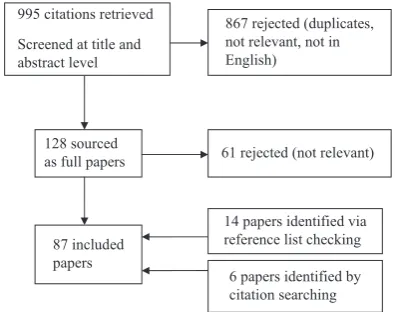
The initial searches retrieved 995 citations, which were screened at title and abstract level. One hundred and twenty-eight citations appeared relevant and were retrieved as full papers. The sifting and selection of papers for inclusion were carried out by two members of the research team. In addition to database searching, the reference lists of included papers were examined; there was citation searching of key papers, and experts in the field were contacted to suggest any further references. Figure 1 provides an illustration of the identification pro-cess.
Data extraction and synthesis
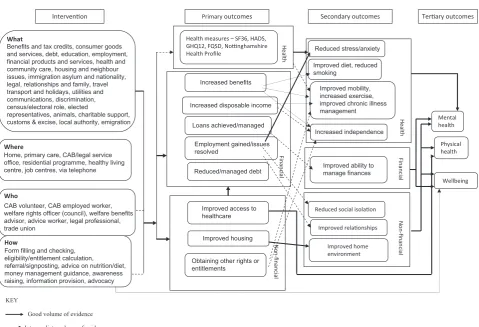
Papers meeting the inclusion criteria were read and data extracted using a standardised extraction form encom-passing author⁄date, details of any intervention, mea-sures used, reported outcomes linked to health and⁄or well-being, and links to other non-health impacts. See online Appendix S1 for a summary of individual studies. Following extraction, data from each column were exam-ined by the research team and the logic model was built column by column underpinned by the evidence (Figure 2). So, for example, the first column (the
interven-128 sourced
as full papers 61 rejected (not relevant)
87 included papers
14 papers identified via reference list checking
6 papers identified by citation searching 995 citations retrieved
Screened at title and abstract level
[image:2.595.331.529.539.695.2]867 rejected (duplicates, not relevant, not in English)
tion) was expanded by synthesising elements of interven-tions described across the set of papers. The second col-umn (primary outcomes) was developed by synthesising reported study measures and outcomes, and so on. The primary outcomes were the direct aims of the interven-tion, such as obtaining unclaimed benefits. We defined secondary outcomes as those (i) with evidence of causal links to the intervention via the primary outcomes reported in the literature and (ii) with already established links to health or well-being.
Quality appraisal
In contrast to standard systematic review methods, we set no quality standards on the papers reviewed other than their publication in peer-reviewed journals. We did, however, account for volume of evidence in our logic model. This has three standards, shown by differences in line thickness. The thick line indicates the greatest volume of evidence, for example, quantitative evidence from large-scale epidemiological studies. The thicker dotted line indicates less volume of evidence, for exam-ple, from before-and-after data. The thinnest dotted line
indicates a low level of evidence, for example, from one or two small-scale qualitative studies.
Results
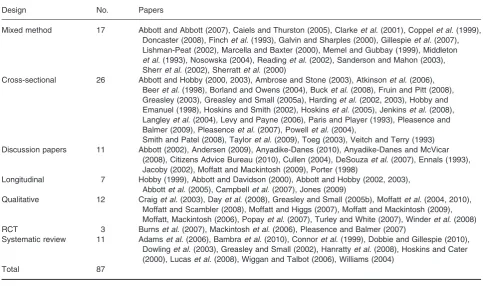
Our searches identified 87 documents that met the crite-ria for inclusion. Table 1 categorises the documents reviewed by study design. Data from the included docu-ments were used to construct the logic model, describing components of an advice intervention, the short-term or primary directly measured outcomes, the secondary or more indirect benefits following the intervention, and finally potential links between these outcomes and long-term improvement in health and well-being (see Figure 2). Some examples of the evidence underpinning each component of the logic model are outlined below; detailed information is in the online Appendix S1 (Sum-mary Table).
Components of an advice intervention
In the model, we have divided the intervention into four components: who delivers it, where it is delivered, what
a e M
How
Form filling and checking, eligibility/entitlement calculation, referral/signposting, advice on nutrition/diet, money management guidance, awareness raising, information provision, advocacy
What
Benefits and tax credits, consumer goods and services, debt, education, employment, financial products and services, health and community care, housing and neighbour issues, immigration asylum and nationality, legal, relationships and family, travel transport and holidays, utilities and communications, discrimination, census/electoral role, elected
representatives, animals, charitable support, customs & excise, local authority, emigration
Who
CAB volunteer, CAB employed worker, welfare rights officer (council), welfare benefits advisor, advice worker, legal professional, trade union
Where
Home, primary care, CAB/legal service office, residential programme, healthy living centre, job centres, via telephone
Improved housing Increased disposable income
Increased benefits
Employment gained/issues resolved
Reduced/managed debt
Obtaining other rights or entitlements
Loans achieved/managed
Improved access to healthcare
Wellbeing Physical health Mental health
Reduced social isolaƟon Increased independence Improved diet, reduced smoking
Improved mobility, increased exercise, improved chronic illness management
Improved home environment Improved relaƟonships Reduced stress/anxiety
Health
Non-fi
nanc
ial
Financial
Non-fi
nanc
ial
IntervenƟon Primary outcomes Secondary outcomes TerƟary outcomes
Health
Financial
Improved ability to manage finances Health measures – SF36, HADS,
GHQ12, FQSD, Noƫnghamshire Health Profile
KEY
Good volume of evidence
Intermediate volume of evidence
[image:3.595.49.529.89.416.2]Small volume of evidence
is delivered (the content of the intervention) and how (methods⁄format of delivery).
Primary outcomes
Short-term (primary) outcomes described in the included papers related to (i) health measures, (ii) financial gain and (iii) non-financial benefits.
Health
Fifteen papers used validated tools to assess whether there was a measurable impact of advice services on health (Memel & Gubbay 1999, Abbott & Hobby 2000, 2002, 2003, Greasley 2003, Langley et al. 2004, Powell et al. 2004, Abbott et al. 2005, Caiels & Thurston 2005, Mackintoshet al.2006, Campbellet al.2007, Pleasence & Balmer 2007, 2009, Jones 2009, Taylor et al. 2009). Only one paper (a review of evaluations of small UK-based debt advice initiatives) reported evidence of physical health gains; this related to the avoidance of stress-related problems (Williams 2004). No difference was found in the use of NHS services following the inter-vention (Abbott & Davidson 2000, Abbott & Hobby 2002). In contrast to the lack of quantitative evidence regarding direct physical health benefits, some qualita-tive data showed that recipients perceived that their physical health improved as a result of receiving addi-tional income (for example, Clarkeet al. 2001, Greasley
2003, Borland & Owens 2004, Greasley & Small 2005a,b, Moffatt et al. 2006a, 2010, Doncaster 2008, Moffatt & Scambler 2008).
In relation to mental health and emotional well-being, the most recent review (Adams et al. 2006) reported a statistically significant improvement in mental health measures, particularly depression, although one con-trolled trial did not find a positive mental health effect from debt advice (Pleasence & Balmer 2007).
Financial
The most commonly reported financial benefits arose from unclaimed benefit income and from help with man-aging debt. A 2006 systematic review found that the usual financial outcome was a lump sum followed by an increase in recurring benefits (Adamset al.2006).
Non-financial
[image:4.595.65.549.108.394.2]Five papers reported non-financial effects following an advice intervention (Reading et al. 2002, Ambrose & Stone 2003, Moffatt et al. 2004, Mackintosh et al. 2006, Doncaster 2008). Material benefits included free prescrip-tions and dental treatment, council tax exemption, respite care, meals-on-wheels, disabled parking permits, aids and adaptations around the home, help with energy use and a Community Care Alarm scheme. Wider prob-lems addressed fell into categories of housing, employ-ment and relationships.
Table 1 Summary of the included literature by study design
Design No. Papers
Mixed method 17 Abbott and Abbott (2007), Caiels and Thurston (2005), Clarkeet al.(2001), Coppelet al.(1999), Doncaster (2008), Finchet al.(1993), Galvin and Sharples (2000), Gillespieet al.(2007), Lishman-Peat (2002), Marcella and Baxter (2000), Memel and Gubbay (1999), Middleton et al.(1993), Nosowska (2004), Readinget al.(2002), Sanderson and Mahon (2003), Sherret al.(2002), Sherrattet al.(2000)
Cross-sectional 26 Abbott and Hobby (2000, 2003), Ambrose and Stone (2003), Atkinsonet al.(2006), Beeret al.(1998), Borland and Owens (2004), Bucket al.(2008), Fruin and Pitt (2008), Greasley (2003), Greasley and Small (2005a), Hardinget al.(2002, 2003), Hobby and Emanuel (1998), Hoskins and Smith (2002), Hoskinset al.(2005), Jenkinset al.(2008), Langleyet al.(2004), Levy and Payne (2006), Paris and Player (1993), Pleasence and Balmer (2009), Pleasenceet al.(2007), Powellet al.(2004),
Smith and Patel (2008), Tayloret al.(2009), Toeg (2003), Veitch and Terry (1993) Discussion papers 11 Abbott (2002), Andersen (2009), Anyadike-Danes (2010), Anyadike-Danes and McVicar
(2008), Citizens Advice Bureau (2010), Cullen (2004), DeSouzaet al.(2007), Ennals (1993), Jacoby (2002), Moffatt and Mackintosh (2009), Porter (1998)
Longitudinal 7 Hobby (1999), Abbott and Davidson (2000), Abbott and Hobby (2002, 2003), Abbottet al.(2005), Campbellet al.(2007), Jones (2009)
Qualitative 12 Craiget al.(2003), Dayet al.(2008), Greasley and Small (2005b), Moffattet al.(2004, 2010), Moffatt and Scambler (2008), Moffatt and Higgs (2007), Moffatt and Mackintosh (2009), Moffatt, Mackintosh (2006), Popayet al.(2007), Turley and White (2007), Winderet al.(2008) RCT 3 Burnset al.(2007), Mackintoshet al.(2006), Pleasence and Balmer (2007)
Systematic review 11 Adamset al.(2006), Bambraet al.(2010), Connoret al.(1999), Dobbie and Gillespie (2010), Dowlinget al.(2003), Greasley and Small (2002), Hanrattyet al.(2008), Hoskins and Cater (2000), Lucaset al.(2008), Wiggan and Talbot (2006), Williams (2004)
Secondary⁄indirect outcomes
We defined secondary outcomes as those (i) with evi-dence of causal links to the intervention via the primary outcomes reported in the literature and (ii) with already established links to health or well-being. For example, if data show that provision of a parking permit results in increased mobility for recipients, we recorded this as a secondary outcome. The secondary outcomes of interest in our model were those that either constituted or plausi-bly contributed to health and well-being. As with pri-mary outcomes, we have used the categories: health, financial and non-financial.
Health
The literature widely discusses links between financial difficulties, stress and illness (e.g. Jacoby 2002) and hence interventions to tackle these problems might be expected to reduce financial stress and improve health. An addi-tional indirect impact may be due to a counselling effect, that people felt their health improved as a result of being listened to (Veitch & Terry 1993, Lishman-Peat 2002, Moffatt & Mackintosh 2009).
A number of papers provided data reporting what recipients said they did with increased income and some of these changes in spending may be linked to health bene-fits (Paris & Player 1993, Moffattet al. 2004, Nosowska 2004, Adamset al.2006, Levy & Payne 2006, Moffatt & Hi-ggs 2007, Turley & White 2007, Doncaster 2008, Andersen 2009, Moffatt & Mackintosh 2009). Craiget al. (2003) cate-gorised these uses as increased spending on essentials such as food; spending to increase mobility, such as taxis; the provision of additional goods and services such as gar-deners; spending on large household items such as fridges; and spending on personal items such as presents for grandchildren. Improved mobility was also reported as an outcome of some of the other non-financial benefits such as disabled parking permits and adaptations to the house (Paris & Player 1993, Abbott & Hobby 2003, Greasley 2003, Toeg 2003, Caiels & Thurston 2005, Moffatt & Scambler 2008, Moffatt & Mackintosh 2009, Moffattet al.2010). Pro-vision of meals-on-wheels services, for example, may have potential to improve diet (Craiget al.2003).
Financial outcomes
Tayloret al.(2009) showed a strong association between what they term ‘financial capability’ (the ability of an individual to manage his⁄her money) and psychological well-being, such that changes in the former directly cor-relate with changes in the latter. Greater incapability is associated with stress and increased reporting of mental health problems, particularly depression. If an interven-tion can improve individuals’ financial capability, it is likely that mental health benefits will follow.
Non-financial outcomes
Other outcomes secondary to the direct impacts of advice services include reduction in social isola-tion (Moffatt et al. 2004), improvement in family and other relationships (Dobbie & Gillespie 2010) and improved home environment (Connoret al.1999, Abbott 2002).
Health and well-being
Following construction of the first three columns of the logic model from the included data, we further exam-ined the papers for evidence of links from reported out-comes to long-term health and well-being benefits. We were unable to find evidence underpinning these plausi-ble chains of reasoning in these papers and therefore conducted further searching across the wider literature, using search terms relating to debt, employment, dispos-able income, housing, health-care, mental health, physi-cal health and well-being to identify further evidence for this final step in the causal pathway between interven-tion and health outcomes.
This additional searching was able to locate papers that supported associations between many of the inter-mediate outcomes identified in the advice literature and longer term impacts on health and well-being. Studies linked improved housing and mental health benefits (Rymill & Hart 1992, Hopton & Hunt 1996, Glover 1999, Blackman & Harvey 2001, Peace & Kell 2001, Migitaet al. 2005, Ho et al. 2007, Egan et al. 2010, Liddel & Morris 2009). Also, evidence was found supporting a relation-ship between improved housing and physical health gains (Willis 2007, Romanet al.2009, Bambra 2010).
Discussion
believed that their health had improved, which may sig-nificantly impact an individual’s well-being.
A further obstacle to demonstrating a positive impact on health relates to countervailing forces in the popula-tion, such as a steeper than average trajectory of decline for the group entitled to advice (Abbott & Hobby 2000, 2002, 2003, Turley & White 2007). Therefore, the demon-stration of significant positive effects using standard baseline and outcome measures presents considerable challenges.
A further possible reason for the failure to find an effect is conceptual. RCTs and other trial designs focus on input and output. This has been termed a ‘black box’ view of mechanisms (Williams 2003, Connelly et al. 2007). This often works well with closed systems, such as human bodies and drugs; however, it is problematic with open systems, such as societies. Logic models, in contrast, take a systems approach and are able to portray elements and relationships within a system (Andersen 2009). The model developed here identifies how the intermediate outcomes set in train by advice services can lead towards improved health for its recipients. For example, there is evidence that financial benefits, such as disability allowance, added to non-financial benefits, such as disabled parking permits, improve people’s mobility. From other sources, we know that improved mobility improves physical and mental health. Linking these factors in a model conceptually, we can describe the pathway from financial benefits to improved mobil-ity and to a positive effect on well-being.
The largest proportion of the evidence we identified related to positive financial outcomes following advice interventions. This primary outcome was then most commonly linked to the secondary outcome of an improvement in mental health. In particular, the litera-ture reported a strong link between a reduction in debt and reduced stress or anxiety. We explored the potential to differentiate strength of evidence by using different thickness (or weighting) of the connecting arrows, using study design type or quantity of evidence as indicators of strength. The model we have developed includes these arrows; however, we have concerns that this may indicate only where links may be more feasible to dem-onstrate in empirical work, rather than representing true strength of relationships. The further development of methods for differentiating evidence in logic models is an area worth exploring in future studies.
This work may be criticised for departing from stan-dard systematic review methods in a number of ways relating to quality appraisal by including diverse sources of evidence, treating study designs as equal and not carry-ing out a critical evaluation of included papers. A stan-dard review would have excluded much of the literature sourced here. We would argue that while quality criteria
and likelihood of bias in study design are key aspects to consider, the building of the logic model was strength-ened by drawing on all available literature (cf. Dorwick et al.2009). As described above, questions of quality were considered in development of the model linkages. The type of included evidence must be considered, however, in drawing conclusions from this review. In terms of the review itself, our use of terms related to ‘advice’ might have resulted in the exclusion of relevant material from countries in which this term does not have the welfare implications it evidently has in Anglo-American contexts. This evidence-based logic model provides a frame-work to inform both researchers and practitioners. The model illuminates the complexity of elements at all phases of a causal pathway from intervention to long-term impacts on health and well-being.
For practitioners, the model has at least three uses. First, it provides a graphic representation of where evi-dence has been reported for associations between ele-ments. This is useful to support decisions regarding service provision. Second, it may be used to inform deci-sions regarding the type of provision to fund. Third, it may help practitioners to identify and develop linkages within existing services. The finding of some indications that those with fewer financial concerns might smoke less, for example, might encourage practitioners to com-bine the offer of a welfare benefits check-up with a stop-smoking service.
For researchers, the model indicates where research might be directed to test the causal chain. Currently, the link between advice and financial outcomes is well dem-onstrated, with further work required to investigate other relationships in the proposed model. An economic modelling approach to examine financial outcomes in relation to intervention costs would, however, be helpful. We believe that the model identifies the range of vari-ables and potential outcomes that should be considered in any studies, and provides a framework for future research.
Acknowledgements
We acknowledge Jo Abbott, Wendy Baird, Jo Cooke, Paolo Gardois, Melanie Gee, Geoff Green, Julie Hirst, Anthony Kessel, Steve Minter, Suzanne Moffatt, Sarah Salway, Deborah Shields, Rupert Suckling, Angela Tod, Guy Weston and Jane Woodford. Thanks to the two anonymous referees for this jour-nal for their advice.
Source of funding
South Yorkshire project. NIHR CLAHRC for South Yorkshire acknowledges funding from the National Institute of Health Research. The views and opinions expressed are those of the authors, and not necessar-ily those of the NHS, the NIHR or the Department of Health. CLAHRC SY would also like to acknowledge the participation and resources of their partner organisations, particularly Rotherham NHS. Further details can be found at http://www.clahrc-sy.nihr.ac. uk.
Conflict of interest
Gerard Crofton-Martin is National Development Officer for Citizens Advice, which is one of the main UK organisations that provide advice services of the type examined in this paper. His contribution to this paper was in providing data from Citizens Advice and in discussion of report drafts.
References
Abbott B. (2007) Workplace and employment characteris-tics of Citizens’ Advice Bureau (CAB) clients. Employee Relations29(3), 262–279.
Abbott S. (2002) Prescribing welfare benefits advice in pri-mary care: is it a health intervention, and if so, what sort?Journal of Public Health24(4), 307–312. URL http:// jpubhealth.oxfordjournals.org/cgi/content/abstract/24/ 4/307
Abbott S. & Davidson L. (2000) Easing the burden on primary care in deprived urban areas: a service model. Primary Health Care Research and Development 1 (04), 201–206.
Abbott S. & Hobby L. (2000) Welfare benefits advice in pri-mary care: evidence of improvements in health. Health and Social Care in the Community11, 168–174.
Abbott S. & Hobby L. (2002)What is the Impact on Individual Health of Services in Primary Health Care Settings Which Offer Welfare Benefits Advice. Health and Community Care Research Unit, University of Liverpool, Liverpool, UK. Abbott S. & Hobby L. (2003) Who uses welfare benefits
advice services in primary care. Health & Social Care in the Community11(2), 168–174.
Abbott S., Hobby L. & Cotter S. (2005) What is the impact on individual health of services in general practice settings which offer welfare benefits advice? Health & Social Care in the Community14(1), 1–8.
Adams J., White M., Moffatt S., Howel D. & Mackintosh J. (2006) A systematic review of the health, social and financial impacts of welfare rights advice delivered in healthcare settings.BMC Public Health6, 81.
Ambrose P. & Stone J. (2003) Eleven plus to one.Social Pol-icy11(2), 1–2.
Andersen S.H. (2009) Unemployment and subjective well-being a question of class?Work and Occupations36(1), 3– 25.
Anderson L., Petticrew M., Rehfuess E., Armstong R., Ueff-ing E., Baker P., Francis D & Tugwel P. (2011) UsUeff-ing
logic models to capture complexity in systematic reviews.Research Synthesis Methods,2, 33–42.
Atkinson A., McKay S., Kempson E. & Collard S. (2006) Levels of financial capability in the UK: results of a base-line survey.Public Money & Management47, 29–36. Anyadike-Danes M. (2010) What is the problem, exactly?
The distribution of Incapacity Benefit claimants’ condi-tions across British regions.Policy Studies31, 187–202. Anyadike-Danes M. & McVicar D. (2008) Has the boom in
incapacity benefit claimant numbers passed its peak? Fis-cal Studies29, 415–434.
Bambra C., Gibson M., Amanda S., Wright K., Whitehead M. & Petticrew M. (2010) Tackling the wider social deter-minants of health and health inequalities: evidence from systematic reviews.Journal of Epidemiology and Community Health64(4), 284–291.
Bambra C., Givson M., Sowden A., Wright K., Whitehead M. & Petticrew M. (2010) Tackling the wider social deter-minants of health and health inequalities: evidence from systematic reviews.Journal of Epidemiology and Community health64, 284–291.
Baxter S., Killoran A., Kelly M.P. & Goyder E. (2010) Syn-thesizing diverse evidence: the use of primary qualitative data analysis methods and logic models in public health reviews.Public Health124(2), 99–106.
Beer S.F., Marcella R. & Baxter G. (1998) Rural citizens’ information needs: a survey undertaken on behalf of the Shetland Islands Citizens Advice Bureau. Journal of Librarianship and Information Science30(4), 223–240. Blackman T. & Harvey J. (2001) Housing renewal and
men-tal health: a case study. [References]. Journal of Mental Health10(5), 571–583.
Borland J. & Owens D. (2004) Welfare Advice in General Practice: The Better Advice, Better Health Project in Wales. Citizens Advice Cymru, Bangor.
Buck A., Pleasence P. & Balmer N. (2008) Do citizens know how to deal with legal issues? Some empirical insights. Journal of Social Policy37, 661–681.
Burns T., Catty J., Becker T. et al.(2007) The effectiveness of supported employment for people with severe mental illness: a randomised controlled trial. Lancet 370, 1146– 1152.
Caiels J. & Thurston M. (2005)Evaluation of the Warrington District CAB GP Outreach Project. Chester College of Higher Education - Centre for Public Health Research, Chester, UK.
Campbell J., Winder R., Richards S.H. & Hobart J. (2007) Exploring the relationships between provision of welfare benefits advice and the health of elderly people: a longi-tudinal observational study and discussion of methodo-logical issues. Health & Social Care in the Community 15 (5), 454–463.
Citizens Advice Bureau (2010) Outcomes of advice. [WWW document]. URL http://www.citizensadvice.org.uk/ind ex/aboutus/outcomes_of_advice.htm (accessed on 20/8/ 2012).
Clarke K., Sarre S. & Glendinning C. (2001)FWA’s well fam-ily service evaluation report [WWW document]. URL https://www.escholar.manchester.ac.uk/uk-ac-man-scw: 4b277 (accessed on 29⁄5⁄2012).
Connor J., Rodgers A. & Priest P. (1999) Randomised stud-ies of income supplementation: a lost opportunity to assess health outcomes.Journal of Epidemiology and Com-munity Health53(11), 725–730.
Coppel D.H., Packham C.J. & Varnam M.A. (1999) Provid-ing welfare rights advice in primary care. Public Health 113(3), 131–135.
Craig G., Dornan P., Bradshaw J., Garbutt S., Mumtaz S., Syed A. & Ward A. (2003) Underwriting citizenship for older people.Benefits11(3), 187–192.
Cullen L. (2004) Out of the picture: CAB evidence on mental health and social exclusion [WWW document]. URL http://www.citizensadvice.org.uk/outofthepicture.pdf (accessed on 28⁄5⁄2012)
Day L., Collard S. & Hay C. (2008) Money Advice Out-reach Evaluation: Qualitative Outcomes for Clients. LSRC, London, UK. URL http://www.justice.gov.uk/down-loads/publications/research-and-analysis/lsrc/2008/ DebtOutreachOutcomesClients.pdf (accessed on 28⁄5⁄ 2012)
DeSouza M., Sycamore M., Little S. & Kirker S. (2007) The Pappworth Early Rehabilitation Programme: vocational outcomes.Disability and Rehabilitation29(8), 671–677. Dobbie L. & Gillespie M. (2010) The health benefits of
financial inclusion: a literature review report for NHS greater glasgow and clyde louise dobbie and morag gil-lespie scottish poverty information unit May 2010 [WWW document]. URL http://www.equalitiesin-health.org/documents/HealthBenefitsofFIfinalreport.pdf (accessed on 28⁄5⁄2012)
Doncaster P.C.T. (2008) Final Monitoring Report (GM08). Doncaster PCT (Grey Literature), Doncaster, UK. Dowrick C., Gask L., Edwards S. et al. (2009) Researching
the mental health needs of hard-to-reach groups: manag-ing multiple sources of evidence. BMC Health Services Research9, 226.
Dowling S., Joughin C., Logan S., Laing G. & Roberts H. (2003) Financial benefits and child health [WWW docu-ment]. URL http://www.barnardos.org.uk/income-study27_01.pdf (accessed on 28⁄5⁄2012)
Egan M., Kearns A., Mason P. et al. (2010) Protocol for a mixed methods study investigating the impact of invest-ment in housing, regeneration and neighbourhood renewal on the health and wellbeing of residents: the GoWell programme.BMC Medical Research Methodology10, 41. Ennals S. (1993) Providing citizens’ advice in general
prac-tice.British Medical Journal306, 1494.
Finch J., Patel B. & Nacra A. (1993) Citizens’ advice bureaux.British Journal General Practice43, 481–482. Fruin C. & Pitt P.I. (2008) Welfare benefit promotion within
a district general hospital rheumatology centre: a joint project with the local Citizens Advice Bureau. Musculo-skeletal Care6(4), 211–219.
Galvin K. & Sharples A. (2000) Citizens Advice Bureaux in general practice: an illuminative evaluation. Health and Social Care in the Community8(4), 277–282.
Gillespie M., Dobbie L., Mulvey G. & Gallacher Y. (2007) Money Advice for Vulnerable Groups: Final Evaluation Report. Scottish Executive, Glasgow, UK. URL http:// www.scotland.gov.uk/Publications/2007/03/22115958/0 (accessed on 28⁄5⁄2012)
Glover N. (1999) Mental health and housing: a crisis on the streets? Journal of Social Welfare and Family Law 21 (4), 327–337.
Greasley P. (2003)The Health Plus Project: Advice Workers in Primary Care in Inner City Bradford: Evaluation Report. Department of Community and Primary Care, School of Health Studies, University of Bradford, Bradford, UK. URL http://www.phn-bradford.nhs.uk/NR/rdonlyres/ 078B7453-4EAA-4B5C-93B1-C58E5A91C868/0/The-HealthPlusProject20012003.pdf (accessed on 28⁄5⁄2012) Greasley P. & Small N. (2002) Welfare Advice in Primary
Care. School of Health Studies, University of Bradford, URL http://www.judithemanuel.co.uk/docs/welfare.pdf (accessed on 28⁄5⁄2012)
Greasley P. & Small N. (2005a) Providing welfare advice in general practice: referrals, issues and outcomes.Health & Social Care in the Community13(3), 249–258.
Greasley P. & Small N. (2005b) Establishing a welfare advice service in family practices: views of advice work-ers and primary care staff.Family Practice22(5), 513–519. Hanratty B., Jacoby A. & Whitehead M. (2008) Socioeco-nomic differences in service use, payment and receipt of illness-related benefits in the last year of life: findings from the British Household Panel Survey.Palliative Medi-cine22(3), 248–255.
Harding R., Sherr L., Sherr A., Moorhead R. & Singh S. (2002) Evaluation of welfare rights advice in primary care: the general practice perspective. Health Social Care Community10(4), 417–422.
Harding R., Sherr L., Sherr A., Moorhead R. & Singh S. (2003) Welfare rights advice in primary care: prevalence, processes and specialist provision. Family Practice20 (1), 48–53.
Ho P.S., Kroll T., Kehn M., Anderson P.et al.(2007) Health and housing among low-income adults with physical dis-abilities.Journal of Health Care for the Poor and Underserved 18(4), 902–915.
Hobby L. (1999) More lolly, more jolly... strong association between low income and ill-health A. S, ed.Health Service Journal109(5671), 26.
Hobby L. & Emanuel J. (1998) Citizen’s Advice Bureaux in Primary Care in England and Wales A Review of Available Information. Health and Community Care Research Unit, Liverpool, UK.
Hopton J.L. & Hunt S.M. (1996) Housing conditions and mental health in a disadvantaged area in Scotland. Jour-nal of Epidemiology & Community Health50(1), 56–61. Hoskins R. & Cater D. (2000) Welfare benefits’ screening
and referral: a new direction for community nurses? Health Social Care Community8, 390–397.
Hoskins R.A.J. & Smith L.N. (2002) Nurse-led welfare ben-efits screening in a General Practice located in a deprived area.Public Health116(4), 214–220.
Hoskins R., Tobin J., McMaster K. & Quinn T. (2005) Roll-out of a nurse-led welfare benefits screening service throughout the largest Local Health Care Co-operative in Glasgow: An evaluation study. Public Health 119 (10), 853–861.
Jacoby M. (2002) Does indebtedness influence health? A preliminary inquiry The Journal of Law, Medicine & Amp; Ethics30, 560–571.
Jenkins R., Bebbington P., Brugha T., Bhugra D., Coid J., Singleton N. & Meltzer H. (2008) Mental disorder in peo-ple with debt in the general population. Psychological Medicine38, 1485–1493.
public health outcomes: a logic model approach.Journal of Public Health Management and Practice13(4), 349–356. Jones K., & Shiell A. (2009)Outcomes of a longitudinal study of
citizens advice service clients in wales [WWW document] URL http://www.citizensadvice.org.uk/index/policy/ study_<of_cab_clients_in_wales.htm (accessed on 28⁄5⁄2012)
Kellog Foundation (2004) The Logic Model Development Guide. Kellog Foundation, [WWW document] URL http://www.exinfm.com/training/pdfiles/logicModel. pdf (accessed 28⁄5⁄2012)
Langley C.et al.(2004) Using the Health Assessment Ques-tionnaire and welfare benefits advice to help people dis-abled through arthritis to access financial support. Rheumatology43(7), 863–868.
Levy J. & Payne M. (2006) Welfare rights advocacy in a specialist health and social care setting: a service audit. British Journal of Social Work36(2), 323–331.
Liddell C. & Morris C. (2009) Tackling fuel poverty and impacts on human health: a review of recent evidence. Energy Policy38, 2987–2997.
Lishman-Peat G.J.B. (2002) Welfare benefits take-up project in primary care in Wakefield.Benefits10, 45–48.
Lucas P.J., McIntosh K., Petticrew M., Roberts H. & Shiell A. (2008) Financial benefits for child health and well-being in low income or socially disadvantaged families in developed world countries. Cochrane Database of Systematic Reviews (Online) Issue 2. Art. No.: CD006358. URL http:// search.ebscohost.com/login.aspx?direct=true&db=cmed-m&AN=18425950&site=ehost-live (accessed on 28⁄5⁄2012) Mackintosh J., White M., Howel D., Chadwick T., Moffatt
S., Deverill M. & Sandell A. (2006) Randomised con-trolled trial of welfare rights accessed via primary health care: pilot study. BMC Public Health 6, pp. 162. doi: 10.1186/1471-2458-6-162. URL http://www.biomedcentral. com/1471-2458/6/162 (accessed on 28/5/2012)
Marcella R. & Baxter G. (2000) Citizenship information ser-vice provision in the United Kingdom: a study of 27 case agencies.Journal of Librarianship and Information Science32 (1), 9–25.
Marmot M. (2010)Fair Society, Healthy Lives: Strategic Review of Health Inequalities in England Post 2010. Department of Health, London, UK. URL http://www.instituteofhealth- equity.org/projects/fair-society-healthy-lives-the-marmot-review (accessed on 28⁄5⁄2012)
Memel D. & Gubbay D. (1999) Welfare benefits advice in primary care. British Journal of General Practice 49 (449), 1032–1033.
Middleton H., Maunder B., Vanes J. et al. (1993) Citizens’ advice in general practice.British Medical Journal307, 504. Migita R., Yanagi H. & Tomura S. (2005) Factors affecting the mental health of residents in a communal-housing project for seniors in Japan. Archives of Gerontology & Geriatrics41(1), 1–14.
Moffatt S. & Higgs P. (2007) Charity or entitlement? Gener-ational habitus and the welfare state among older people in North-east England. Social Policy & Administration 41 (5), 449–464.
Moffatt S. & Mackintosh J. (2009) Older people’s experience of proactive welfare rights advice: qualitative study of a South Asian community.Ethnicity & Health14(1), 5–25. Moffatt S. & Scambler G. (2008) Can welfare-rights advice
targeted at older people reduce social exclusion? Ageing and Society28(6), 875–899.
Moffatt M., Stacy R., Downey D. & Hudson E.S.W. (2004) The impact of welfare advice in primary care: a qualita-tive study.Critical Public Health14(3), 295–319.
Moffatt S., Mackintosh J., White M., Howel D. & Sandell A. (2006a) The acceptability and impact of a randomised controlled trial of welfare rights advice accessed via pri-mary health care: qualitative study.BMC Public Health6, 163.
Moffatt S., White M., Mackintosh J. & Howel D. (2006b) Using quantitative and qualitative data in health services research – what happens when mixed method findings conflict?BMC Health Services Research6, 28.
Moffatt S., Noble E. & Exley C. (2010) ‘‘Done more for me in a fortnight than anybody done in all me life.’’ How welfare rights advice can help people with cancer.BMC Health Services Research10, 259.
Nosowska G. (2004) A delay they can ill afford: delays in obtaining Attendance Allowance for older, terminally ill cancer patients, and the role of health and social care professionals in reducing them. Health & Social Care in the Community12(4), 283–287.
Paris J.A. & Player D. (1993) Citizens’ advice in general prac-tice.BMJ: British Medical Journal306(6891), 1518–1520. Peace R. & Kell S. (2001) Mental health and housing
research: housing needs and sustainable independent liv-ing.Social Policy Journal of New Zealand⁄Te Puna Whakaaro (Issue 17), 101–123.
Pleasence P. & Balmer N. (2007) Changing fortunes: results from a randomized trial of the offer of debt advice in England and Wales. Journal of Empirical Legal Studies 4 (3), 651–673.
Pleasence P. & Balmer N.J. (2009) Mental health and the experience of social problems involving rights: findings from the United Kingdom and New Zealand.Psychiatry, Psychology and Law16(1), 123–140.
Pleasence P., Balmer N. & Buck A. (2007)Health Profession-als as Rights Advisers: Rights Advice and Primary Healthcare Services. Legal Services Research Centre, Legal Services Commission, [WWW document]. URL http://lsrc.org. uk/publications/doctors.pdf (accessed on 28⁄5⁄2012) Popay J., Kowarzik U., Mallinson S., Mackian S. &
Bar-ker J. (2007) Social problems, primary care and path-ways to help and support: addressing health inequalities at the individual level. Part I: the GP per-spective. Journal of Epidemiology and Community Health 61(11), 966–971.
Popay J., Kowarzik U., Mallinson S., Mackian S. & Barker J. (2007) Social problems, primary care and pathways to help and support: addressing health inequalities at the individual level. Part II: lay perspectives.Journal of Epide-miology and Community Health61(11), 972–977.
Porter H. (1998) Prescribing citizen’s advice. The Health Summary (The Fundholding Summary) 1998XV(2), 9–10. Powell J., Langley C., Kirwan J., Gubbay D., Memel D.,
Pollock J., Means R. & Hewlett S. (2004) Welfare rights services for people disabled with arthritis integrated in primary care and hospital settings: set-up costs and mon-etary benefits.Rheumatology43(9), 1167–1172.
Reading R., Steel S. & Reynolds S. (2002) Citizens advice in primary care for families with young children. Child Health Care and Development28(1), 39–45.
evidence from Chicago.Journal of Public Health Policy30, S286–S308.
Rymill A. & Hart T. (1992) Breaking new ground: shared supported housing for people with mental health related difficulties.Australian Social Work45(4), 21–26.
Sanderson D. & Mahon J. (2003) An Interim Evaluation on the ‘‘Primary Care as a Community Resource’’ Project Final Report. [Grey Literature]. University of York, Doncaster, UK.
Schmitz C. (1999) Everything you Wanted to Know About Logic Models but were Afraid to Ask. Kellog Foundation, [WWW document] URL http://www.insites.org/docu-ments/logmod.htm (accessed on 28⁄5⁄2012)
Sherr L., Hardy R., Singh S. & Sherr A., Moorhead R. (2002) A Stitch in Time-Accessing and Funding Welfare Rights Through Health Service Primary Care. [WWW document] URL http://www.lho.org.uk/viewResource. aspx?id=8763 (accessed on 28⁄5⁄2012)
Sherratt M., Jones K. & Middleton P. (2000) A citizens’ advice service in primary care: improving patient access to benefits. Primary Health Care Research and Development 1, 139–146.
Smith M. & Patel A. (2008)Money advice outreach evaluation: cost and effectiveness of the outreach pilots [WWW docu-ment]. URL http://www.justice.gov.uk/downloads/pub- lications/research-and-analysis/lsrc/DebtOutreachCost-Effectiveness.pdf (accessed on 28⁄5⁄2012)
Taylor M., Jenkins S. & Sacker A. (2009)Financial capability and wellbeing. Evidence from the BHPS[WWW document]. URL http://www.fsa.gov.uk/pubs/occpapers/op34.pdf (accessed on 28⁄5⁄2012)
Toeg D. (2003) Proactive, targeted benefits advice for older people in general practice: a feasibility study. Health & Social Care in the Community11(2), 124–128.
Turley C. & White C. (2007)Assessing the Impact of Advice for People with Debt Problems. Legal Services Commission, London, UK.
Veitch T. & Terry A. (1993) Citizens’ advice in general practice. Patients benefit from advice.British Medical Jour-nal307, 262.
Wiggan J. & Talbot C. (2006) The Benefits of Welfare Rights Advice: A Review of the Literature. [WWW document] URL http://nawra.org.uk/Documents/Benefitsofwelfareright-sadvicelitreview.pdf (accessed on 28⁄5⁄2012)
Williams G.H. (2003) The determinants of health: structure, context and agency. Sociology of Health & Illness 25 (3), 131–154.
Williams T.O.M. (2004) Review of research into the impact of debt advice [WWW document] URL http://www.jus- tice.gov.uk/downloads/publications/research-and-analy-sis/lsrc/2005/impactlitrev.pdf (accessed on 28⁄5⁄2012) Willis L. (2007)Housing Subsidy and Self Perception of
Well-Being: Does Type of Housing Subsidy make a Difference in Residents’ Perceptions of Mental and Physical Health? Uni-versity of Missouri, Columbia, SC. URL https:// mospace.umsystem.edu/xmlui/handle/10355/4734 (accessed on 28⁄5⁄2012)
Winder R., Richards S.H., Wyatt K. & Campbell J. (2008) Receiving specialist welfare benefit advice within Social Services: a qualitative interview study of older people and their carers. Research, Policy and Planning 26 (1), 33–43.
Supporting Information
Additional Supporting Information may be found in the online version of this article:
Appendix S1 Summary table [for publication on web].