Constrained Voter Model
.
White Rose Research Online URL for this paper:
http://eprints.whiterose.ac.uk/87669/
Version: Accepted Version
Article:
Mobilia, M (2013) Commitment Versus Persuasion in the Three-Party Constrained Voter
Model. Journal of Statistical Physics, 151 (1). pp. 69-91. ISSN 0022-4715
https://doi.org/10.1007/s10955-012-0656-x
[email protected] https://eprints.whiterose.ac.uk/ Reuse
Unless indicated otherwise, fulltext items are protected by copyright with all rights reserved. The copyright exception in section 29 of the Copyright, Designs and Patents Act 1988 allows the making of a single copy solely for the purpose of non-commercial research or private study within the limits of fair dealing. The publisher or other rights-holder may allow further reproduction and re-use of this version - refer to the White Rose Research Online record for this item. Where records identify the publisher as the copyright holder, users can verify any specific terms of use on the publisher’s website.
Takedown
If you consider content in White Rose Research Online to be in breach of UK law, please notify us by
arXiv:1207.6270v2 [cond-mat.stat-mech] 26 Nov 2012
Mauro Mobilia
Commitment versus persuasion in the
three-party constrained voter model
Received: date / Accepted: date
Abstract In the framework of the three-party constrained voter model, where voters of two radical parties (A and B) interact with “centrists” (C and Cζ), we study the competition between a persuasive majority and a committed minority. In this model, A’s and B’s are incompatible voters that can convince centrists or be swayed by them. Here, radical voters are more persuasive than centrists, whose sub-population comprises susceptible agents C and a fractionζof centrist zealots Cζ. Whereas C’s may adopt the opinions A and B with respective rates 1+δA and 1+δB(withδA≥δB>0), Cζ are committed individuals that always remain centrists. Furthermore, A and B voters can become (susceptible) centrists C with a rate 1. The resulting competition between commitment and persuasion is stud-ied in the mean field limit and for a finite population on a complete graph. At mean field level, there is a continuous transition from a coexistence phase when ζ<∆c=δA/(1+δA)to a phase where centrism prevails whenζ≥∆c. In a finite population of size N, demographic fluctuations lead to centrism consensus and the dynamics is characterized by the mean consensus timeτ. Because of the com-petition between commitment and persuasion, here consensus is reached much slower (ζ<∆c) or faster (ζ≥∆c) than in the absence of zealots (whenτ∼N). In fact, whenζ<∆cand there is an initial minority of centrists, the mean consensus time grows asτ∼N−1/2eNγ, with N≫1 andγ=δA−ζ(1+ln(δA/ζ)) +O(δ2
A). The dynamics is thus characterized by a metastable state where the most persua-sive voters and centrists coexist whenδA>δB, whereas all species coexist when δA=δB. Whenζ≥∆cand the initial density of centrists is low, one findsτ∼ln N (when N≫1). Our analytical findings are corroborated by stochastic simulations.
Mauro Mobilia
Department of Applied Mathematics, School of Mathematics, University of Leeds - Leeds LS2 9JT, U.K.;
Keywords Opinion dynamics · Voter model ·Zealots · Consensus time· Metastability
PACS 02.50.-r·89.75.Fb·87.23.Kg
Mathematics Subject Classification (2000) 60J28·91D10·91A22
1 Introduction
Opinion dynamics aims at understanding how cultural change evolves [1, 2, 3]. This issue is closely related to problems arising in various disciplines in the life and behavioral sciences [4], and the recent years have witnessed a growing activity in applying the tools of statistical physics to their description [3, 5]. In models of opinion dynamics, each agent is typically represented by its “opinion” state (often labeled as a spin variable [6]) that is updated in response to the opinion of a lo-cal neighborhood, a mechanism of cultural dynamics documented in sociologilo-cal studies, see e.g. [7, 8]. Basic issues in opinion dynamics concern the time neces-sary for a consensus to be attained and the period during which cultural diversity is maintained [3, 5]. These questions are usually addressed by considering simple and insightful models, like the influential two-state voter model (VM), in which local opinions are copied and spread by imitation, see Sec. 2 below. It has recently been proposed that the evolution of cultural diversity would be more realistically described by models where the seek for consensus is limited by some form of in-compatibility [1, 2]. This idea has been investigated in an analytically amenable three-party constrained voter model (3CVM) [9, 10, 11] (see also Ref. [12]).
In this work, we generalize the 3CVM to study the competition between a persuasive majority and a committed minority. In our model, as in Refs. [9, 10, 11], the voters of two radical parties (A and B) are incompatible and do not interact among them, but they interact with a third species (“centrists”, C and Cζ). Here, radical A and B voters are considered to be more persuasive than centrists, whose sub-population comprises susceptible agents (C) and a small fractionζof “centrist zealots” (Cζ). The latter are committed individuals that always remain centrists, while a susceptible centrist adopts the opinion A with rate 1+δAwhen it interacts with an A-voter, and the opinion B with rate 1+δBwhen it interacts with a B-voter. Furthermore, each A and B individuals can become a (susceptible) centrist with rate 1. The parametersδA≥δB>0 hence represent the persuasion biases toward A and B, i.e. the respective persuasion strength of these radical voters. The dynamics is thus characterized by a competition between the persuasion strength of A and B voters opposed by the resistance of centrist zealots (Cζ). The questions that we address with this model are the following: (i) When and how does a committed minority prevail against a persuasive majority? (ii) How does the mean consensus time vary with the fraction of zealots and the persuasion biases?
that depends non-trivially onδA,δB,ζ and N. The mean consensus time in a large population with an initial minority of centrists is here shown to grow dramatically asτ∼N−1/2eNγ(δA,ζ)whenζ<∆c, and asτ∼ln N whenζ≥∆c. These results,
derived using the Fokker-Planck equation and the WKB approach, are in stark contrast with the mean consensus time obtained in the absence of centrist zealots (whenτ∼N [10, 11]). Our findings, corroborated by stochastic simulations, thus demonstrate that the presence of centrism zealotry either significantly slows down (ζ<∆c) or speeds up (ζ≥∆c) the approach to consensus.
While some aspects of the influence of committed agents in opinion dynamics have been considered in the literature, e.g. in Refs. [13, 14, 15, 16, 17] (see Sec. 2), this work differs from earlier studies in various respects: (i) We here consider a three-party (four-state) model whereas most of previous works, like Refs. [13, 14, 15, 16, 17], focused on two-state systems. (ii) Here, we study the competition between the degree of commitment in the population and the persuasion strength of two types of voters (three independent parameters), while no persuasion bias was considered in [15, 16, 17]. (iii) Furthermore, whereas most of the previous results were obtained in the mean field limit [16] or by means of numerical simu-lations [17], the exponentγ(δA,ζ)is here obtained analytically.
This paper is organized as follows: Next Section is dedicated to a brief review of the voter model and some of its variants, while the 3CVM with centrist zealots is introduced in Section 3. The mean field dynamics of such a model is discussed in Section 4. The section 5 is dedicated to the stochastic formulation of the dynamics in a finite population. The mean consensus time in the case of identical persuasion biases is studied in Section 6. In particular, the case of the long-lived coexistence of opinions and metastability is studied in terms of the Fokker-Planck equation (Sec. 6.1.1) and with the WKB method (Sec. 6.1.2). The mean consensus time in the general case of asymmetric persuasion biases is analyzed in Section 7. In the final section, our findings are summarized and our conclusions presented.
2 A brief review of the voter model and some of its variants: zealotry, commitment and incompatibility
As a contribution to a special issue on the “applications of statistical mechanics to social phenomena”, this work is dedicated to the study of the competition between commitment and persuasion in the three-party constrained voter model. Before presenting our new findings, it is useful to begin by providing some background material in the form of a brief review of some basic models and results.
Since the pioneering works by Schelling and Granovetter [7, 8], the impor-tance of relying on individual-based models to relate “micro-level to macro-level interactions” [8] in social dynamics has been recognized. As an inspiring example of this type of modeling approach, Schelling showed how homophily, that is the tendency of an individual to being bond with neighbors sharing similar character-istics, is important to understand the formation of social segregation [7].
neigh-bors and local fluctuations of the population composition. The VM is closely re-lated to the Ising model of statistical physics with the Glauber kinetics at zero temperature [18, 19]1, and also to the Moran model [20] commonly used to de-scribe evolutionary dynamics in the life and behavioral sciences [4]2. In the clas-sic two-state VM, each node of a graph is occupied by a “voter” in one of the two possible state, e.g. denoted A or B (or+/−,↑/↓, or “leftist/rightist”). These voters can be interpreted as having no self confidence and changing their state by simply adopting the opinion of a neighbor. Hence, in its simplest form the VM evolves according to the following rules:
– Pick a random voter.
– The selected voter adopts the opinion of one of its random neighbor.
– These steps are repeated until a consensus (where all individuals are of the same opinion, either all leftists or all rightists) is necessarily reached.
In the language of statistical physics, these rules and the VM define a Markov chain with absorbing states that is aptly described by a master equation [22]. One of the most appealing features of the VM is its mathematical tractability. Indeed, it is one of the rare models of non-equilibrium statistical physics to be exactly solv-able in any dimensions on regular lattices, and many of its properties are known analytically, see e.g. [3, 19, 22]. The most significant features of the VM are (i) the probability to attain a specific consensus state, (ii) the mean time to reach a consensus, and (iii) the two-point correlation functionG(r,t).
i. The consensus probability EA(x)(also called “exit probability”, or “fixation probability” by analogy with the evolutionary dynamics literature [4]) is the probability that a finite system consisting of an initial density x of A-voters eventually reaches the consensus state where all voters are in the state A. As the average opinion, also called “magnetization”, is conserved by the VM on any degree-regular graphs (like lattices and complete graphs), and since the VM always reaches consensus, one has EA(x) =x on any regular graphs. ii. On degree-regular graphs, it is known that the mean consensus timeτ (also
called “mean exit time” or “mean fixation time”) in a population of N voters scales asτ∼N2in one dimension (d=1) and asτ∼N ln N in two dimen-sions (d=2), whereas in dimensions d>2 one hasτ∼N (complete graphs correspond to d=∞). This implies that d=2 is the upper critical dimension of the VM. Moreover, it has recently been shown that the mean consensus time scales sublinearly with N on degree-heterogeneous graphs characterized by nodes of high-degree, i.e.τ∼Nα, where 0<α<1 depends non-trivially on the network’s degree-distribution [21]3.
1 These models are equivalent on one-dimensional lattices, but not in higher dimensions
where the Ising-Glauber model follows a majority rule, whereas the VM evolves according to a a proportional rule. As a consequence, while there is a surface tension in the two-dimensional Ising-Glauber model this is not the case for the VM, see [3, 19] and references therein.
2 The voter and Moran models are equivalent on regular graphs but lead to markedly different
dynamics on degree-heterogeneous networks, see e.g. [21].
3 It has also been shown that a class of models with voter-like dynamics and describing
iii. Significant insight into the spatial distribution of opinions is provided by the two-point correlation functionG(r,t). This quantity informs on the probability that two voters separated by a distance r are in the same state at time t. On lat-tices of dimension d,G(r,t→∞)decays asymptotically as rd−2in high dimen-sions (d>2). In low dimensions the spatial organization of the VM is charac-terized by coarsening, i.e. the slow formation of growing domains of a single opinion. As a consequence, the two-point correlation function asymptotically approaches the value 1 in low dimensions. More precisely, when t→∞and 0<r<√t, one finds 1−G(r,t)∼r/√t in d=1 and 1−G(r,t)∼ln r/ln t in d=2 [24].
While the VM has proved to be insightful and influential, it relies on oversim-plified assumptions like the total lack of self-confidence of all voters and the un-avoidable formation of a consensus. In fact, since Granovetter’s seminal work on “threshold models” [8], the influence on social dynamics of the population’s het-erogeneous response to stimuli is well established. In the opinion dynamics con-text, as a step toward the investigation of a simple model describing the dynamics of a heterogeneous population with different levels of confidence, we have pro-posed to investigate the two-state voter model in the presence of “zealots” [13, 14, 15]. The zealotry is implemented by assuming that a small fraction of the popula-tion consists of committed individuals (called zealots) that either favor a specific state (A or B) as in Refs. [13, 14], or adopt an opinion that never changes as in Ref. [15]. As a consequence of zealotry, the magnetization is not conserved in the VM with zealots, and the main features of these models are the following:
– In Ref. [13] it was shown that on low-dimensional lattices (when d ≤2) a
single zealot with a favored opinion (i.e. a voter with a bias toward one opin-ion, but whose state is not fixed) imposes the consensus in its favored state to an infinite group of voters, whereas in higher dimension the magnetization is non-uniform and decays with the distance from the zealot. Furthermore, the unanimity state imposed by the zealot is approached algebraically in one di-mension, as t−1/2, and much slower in two dimensions (∼1/ln t). It has also been shown that on a finite lattice of size N=Ld(where L is the lattice lin-ear size), the time necessary for the zealot’s opinion to spread is N2is d=1, N ln N in d=2, and N in higher dimensions.
– Ref. [14] was dedicated to the study of the VM in the presence of a small group of n zealots, each with a favored opinion and a specific bias toward its preferred state. The competition between zealots of different types was shown to prevent the formation of consensus and to lead to a non-trivial fluctuating steady state whose properties were investigated by exploiting a formal analogy with the electrostatic potential generated by n classical point charges. The approach toward the steady state was shown to be algebraic (∼t−1/2) and logarithmic (∼1/ln t) in one and two dimensions, respectively, and to be characterized by the formation of growing domains when the density of zealots is very small, i.e. n/N≪1. In this case, the size of the single-opinion domains was found to grow with the system size but to never span entirely the system.
zealots (of both types). It was thus shown that in all cases a small fraction of zealots is effective in maintaining a reactive state characterized by a Gaussian magnetization distribution with a width that decays as n−1/2.
The influence of committed agents in opinion dynamics has also been considered in other two-opinion dynamics models, see e.g. Refs. [16, 17, 25, 26]:
– The case of a committed minority of “inflexibles” in a two-state majority-rule model has been considered at mean field level in Ref. [16], where it was shown that an equal densities of inflexibles of each type prevent consensus from being achieved.
– The authors of Ref. [17] studied how the mean consensus time varies with the fraction of committed individuals in a two-opinion variant of the naming game [28] called the binary agreement model. In the model of Ref. [17], the population initially consists of a majority of individuals of one opinion and a fraction p of individuals of the other species. As in Ref. [15], the latter are committed individuals that never change state and impose their consensus after a mean time showed to grow exponentially or logarithmically with the popu-lation size, depending on whether p is below or above a critical threshold [17]. – The authors of [25] considered the confident voter model, in which each voter has two levels of commitment (“confident” and “unsure”) for each of the two possible opinions. The confident VM has been studied in the mean field limit, where the mean consensus time isτ∼ln N, whereas in one and two dimen-sions the mean consensus time scales respectively asτ∼N2andτ∼N3/2[25]. – Furthermore, the heterogeneous voter model in which each agent has its own intrinsic rate to change state has been considered in Ref. [26], where it was found that the time until consensus is reached is much longer in the heteroge-neous VM than in the classic voter model.
It is also worth noting that the influence on cooperation dilemmas of zealot-like individuals has recently been studied in the framework of evolutionary games [27].
In addition to voter-like models with committed individuals, there are vari-ous prototypical opinion dynamics models, whose outcome is characterized by a lack of consensus. Influential models of this type are the multiple-state Axel-rod model [1] and the bounded compromise model [2]. The key feature prevent-ing consensus in these models is a form of incompatibility: when the opinions of two agents are too different, they are deemed to be incompatible and there is no interaction between such individuals. This can lead to cultural fragmentation and a frozen stationary state where a mixture of incompatible states coexist. In its essence, the feature of incompatibility is captured by the so-called three-party con-strained voter model (3CVM) that can be regarded as a discrete three-state version of the bounded compromise model [9, 10]. In the 3CVM, there is no interaction between species A (“leftists”) and B (“rightists”) that are are incompatible. How-ever, A- and B-voters interact with a third species C, and thus compete to impose their own consensus according to the following rules:
– A centrist C can become an A-voter or a B-voter with rate 1+δ′ (and 0≤
|δ′| ≤1);
– A and B voters can become centrists C with a rate 1;
whereδ′ is a bias favoring either A and B (whenδ′>0), or C (whenδ′ <0). The 3CVM admits three absorbing fixed points, corresponding to the consensus with A,B and C, and a “polarization line” along which a frozen mixture of non-interacting A’s and B’s coexist. This 3CVM has been solved analytically on a complete graph and the probabilities of reaching each consensus state and the polarization line were determined, both when δ′=0 [10] and in the case δ′6= 0 [11]. Within an approach based on the Fokker-Planck equation [22], it was also shown that the mean exit times in the 3CVM scale linearly with the population size N when the intensity of the bias is weak (i.e. when N|δ′| ≪1 and N≫1) [10, 11]. The 3CVM has also investigated on regular lattices and found to exhibit slow kinetics in low dimensions [9] (see also [12]).
Aiming to study how the maintenance of cultural diversity is affected by the competition between persuasion and commitment, in this work we consider a three-party (four-state) opinion dynamics model that combines the main features of both the 3CVM and VM with zealots. The resulting model, whose detailed specification is given in the next section, is here used to study the competition between two radical opinions (A and B) that are incompatible and the voters of a third party that are less persuasive but on average more committed than A’s and B’s.
3 The three-party constrained voter model with centrist zealots
In this work, we introduce and study a three-party constrained voter model with centrist zealots on a complete graph (used for its tractability and because it is ar-guably a natural first choice in the context of social dynamics). Like the 3CVM [9, 10, 11], this model is characterized by a population of N individuals, j are of species A, k of type B andℓ are “susceptible” centrists (species C). Moreover, the population also comprisesℓζ committed centrists (zealots), denoted Cζ, that never change opinion, as in [15]. Hence, one has N= j+k+ℓ+ℓζ, with a fixed fractionζ ≡ℓζ/N of zealots Cζ. In the language of the voter model (see Sec. 2), the individuals of species A (“leftists”) and B (“rightists”) are voters of two radi-cal parties, while supporters of the third party (“centrism”) are either susceptible centrists (species C) or centrist zealots (type Cζ). As in the 3CVM, radical opin-ions are incompatible and there are no interactopin-ions between A’s and B’s, but these voters interact with a centrist neighbor according to the following evolutionary rules:
1. A susceptible centrist C can become an A-voter with rate 1+δAand a B-voter with rate 1+δB;
2. A- and B-voters can become susceptible centrists with a rate 1; 3. A- and B-voters do not interact: AB→AB;
4. Centrist zealots Cζalways remain in this state.
In the spirit of the VM and 3CVM, the dynamics of the system is thus implemented as follows:
(ii) if an A/B-centrist pair is picked, the population composition changes accord-ing to the followaccord-ing schematic moves:
AC →AA with rate 1+δA
BC→BB with rate 1+δB (1)
AC→CC and ACζ→CCζ with rate 1 BC→CC and BCζ→CCζ with rate 1;
(iii) if the randomly picked pair of neighbors consists of two radical voters (AA,BB or AB) or two centrists (CC,CCζor CζCζ), the composition of the population does not change;
(iv) these steps are iterated until centrism consensus is necessarily reached (see below).
In this work, we assume the existence of persuasion biases (or persuasion strengths)δA>0 andδB>0 toward opinions A and B, respectively. The quantities δA/Bmeasure the biases toward opinions A/B (against centrism) and thus reflect that A and B voters are more persuasive than centrists. Here, without loss of gener-ality, we assume thatδA≥δB>0. The limiting caseℓζ=δA=δB=0 corresponds to the 3CVM without zealots and no bias that was studied in Ref. [10], while the 3CVM with a symmetric bias but without zealots of Ref. [11] is recovered when ℓζ=0,δA=δB6=0.
From the rules (1), we expect a subtle competition between A and B voters, favored by their persuasion biases and seeking to impose their consensus, and centrist zealots that resist the spread of A’s and B’s and strive to promote centrism. We are particularly interested in such a competition when centrists are initially in the minority and the population is finite. In this situation, we will study the circumstances under which a committed minority can prevail against a persuasive majority. Another question of great interest concerns how the competition between persuasion and commitment leads to a long-lived (metastable) coexistence state along with the maintenance of a form of cultural diversity. These issues are studied in the mean field limit (Sec. 4) and in finite populations (Secs. 5-7).
4 Mean field analysis
At mean field level, one assumes a population of infinite size (N→∞) and ignore any random fluctuations. Hence, the densities a≡ j/N,b≡k/N and c≡ℓ/N, and the fractionζ≡ℓζ/N of (centrist) zealots, are treated as continuous variables obeying the following rate equations (REs):
d
dta(t) =a(t) [δAc(t)−ζ] d
dtb(t) =b(t) [δBc(t)−ζ]. (2)
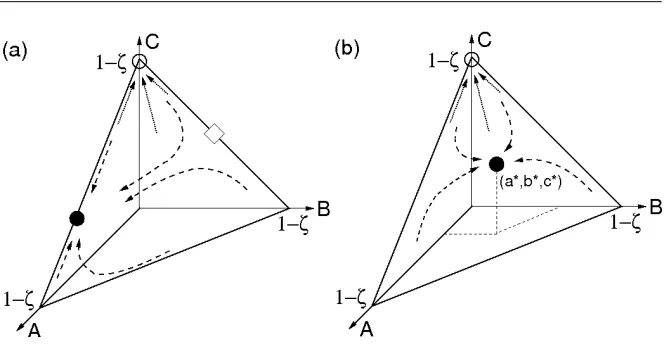
Fig. 1 Schematic phase portrait of the mean field dynamics (2). (a) Asymmetric biasesδA>
δB>0: whenζ<∆c, only the coexistence state (•) corresponding to a population of A-voters
and centrists is stable (flows in dashed arrows), while the fixed point associated with centrism consensus (◦) is unstable. Whenζ<δB/(1+δB)(as in this sketch), there is also an unstable
coexistence state (⋄) consisting of B-voters and centrists. Whenζ >∆c, the only stable fixed
point corresponds to the centrism consensus (dotted arrows). (b) Identical biasesδA=δB=δ>
0: the fixed point(a∗,b∗,c∗)(•) associated with the coexistence of the three parties is stable whenζ<∆c(flows in dashed arrows) and unstable otherwise (dotted arrows). See text.
biasesδAandδBare identical. In fact, we readily notice from (2) that in the ab-sence of bias (δA=δB=0), the system quickly evolves toward a population com-prising only centrists, whereas an interesting situation arises whenδA≥δB>0.
4.1 Mean field dynamics with asymmetric biases
WhenδA>δB>0, the mean field equations (2) are characterized by three fixed points(a,b,c)−→t→∞(a∗i,b∗i,c∗i)with i∈(1,2,3):
(a∗1,b∗1,c∗1) = (0,0,1−ζ),
(a∗2,b∗2,c∗2) = (1−ζ− ζ δA,0,
ζ
δA), (3)
(a∗3,b∗3,c∗3) = (0,1−ζ− ζ δB,δBζ ).
The non-trivial fixed point(a∗2,b∗2,c∗2)physically exists and is asymptotically sta-ble whenζ <∆c≡δA/(1+δA). Otherwise,(a∗
1,b∗1,c∗1)is the only stable fixed point when ζ ≥∆c. Furthermore, there is also another coexistence fixed point (a∗3,b∗3,c∗3)whenζ<δB/(1+δB), but a stability analysis reveals that it is always unstable (saddle point). As illustrated in Fig. 1(a), the mean field dynamics (2) therefore predicts that the system evolves toward the stable fixed point
(a(t),b(t),c(t))t−→→∞(a∗,b∗,c∗)≡ (
(a∗2,b∗2,c2∗) when ζ<∆candδA>δB (a∗
1,b∗1,c∗1) when ζ≥∆c.
This means that in the case of asymmetric persuasion biases withδA>δB, whenζ is below the critical threshold∆c=δA/(1+δA), the mean field dynamics leads to a coexistence state where the most persuasive voters (A’s) coexist with centrists. In this case, B-voters are absent form the final state. On the other hand, whenζ≥∆c the mean field dynamics evolves toward centrism consensus, with a population consisting only of susceptible and committed centrists.
4.2 Mean field dynamics with a identical biasδA=δB=δ>0
When the persuasion bias toward opinions A and B is identical, i.e.δA=δB=δ> 0, the rate equations (2) can be solved exactly. In fact, by adding the equations of (2) and using a(t) +b(t) =1−ζ−c(t), we obtain
d
dtc(t) =− d
dt(a(t) +b(t)) =−δ(1−ζ−c(t))[c(t)−ζ/δ]. (5)
This equation can be readily solved and by denoting the initial densities(a(0),b(0),c(0)) = (x,y,z), whenζ6=∆c, one finds:
c(t) =1−ζ+Kζexp(δ(1−ζ−ζ/δ)t)
1+K exp(δ(1−ζ−ζ/δ)t) , (6)
where K≡1δ−zz−−ζζ. When the biases toward A and B are identical, one hasdtd ab((tt))= 0, which implies that a(t)/b(t) =x/y is conserved by (2). Using this property to-gether with (6), we obtain a(t) = x
x+y
[1−ζ−c(t)]and b(t) = (y/x)a(t). Ac-cording to (6), the mean field dynamics is therefore characterized by an exponen-tially quick approach to the steady state densities(a∗,b∗,c∗), where
c(t)t−→→∞c∗= (
ζ/δ if ζ<∆c
1−ζ if ζ>∆c, (7)
and
a(t) = x yb(t)
t→∞ −→a∗=x
yb
∗=
(x(1−ζ(1+δ−1))
K(δz−ζ) if ζ<∆c
0 if ζ>∆c, (8)
as sketched in Fig. 1(b). This means that when the persuasion biases are iden-tical, and if the density ζ of centrist zealots is below ∆c, the mean field anal-ysis predicts the stable coexistence of A and B voters along with centrists. If ζ >∆c, the final state is again composed only of (susceptible and committed) centrists. Furthermore, in the critical caseζ =∆c, one has the long-time behav-ior c(t)−(1+δ)−1∼(δt)−1when t→∞. In this critical case one is left with a densityζ/δ= (1+δ)−1of susceptible centrists along with a fractionζof zealot centrists, but no A and B voters.
the transition from a coexistence and “multicultural” phase (ζ<∆c) to a phase dominated by centrism (ζ≥∆c) at the critical valueζ=∆c. As discussed in the next sections, this picture changes drastically when the population is of finite size and demographic fluctuations need to be taken into account.
5 Stochastic dynamics in a finite population
When the population is of finite size N, demographic (random) fluctuations signif-icantly alter the mean field dynamics and ultimately impose the centrist consensus. The latter is associated with the system’s unique absorbing state that consists of N−ℓsusceptible centrists (C) andℓζcentrist zealots (Cζ). While the system’s fate is known, we are here interested in the dependence of the consensus (exit) time on the population size and on the parametersδA,δBandζ. In particular, we study the circumstances under which cultural diversity is maintained (long-lived coexis-tence), and when consensus is quickly reached. These questions are addressed by modeling the evolution with continuous-time birth-death processes.
In the general case of different persuasion biases (δA≥δB), at each interaction the number of A and B voters can increase or decrease by one (i.e. j→ j±1 and k→k±1) with rates TjA,k±and TjB,k±, respectively (see (1)). The population’s com-position therefore evolves according to a bivariate birth-death process described by the probabilityPj,k(t)that at time t there are j voters of type A and a number k of B voters in the population. This probability obeys the master equation [22]:
dPj,k(t)
dt =T
A+
j−1,kPj−1,k(t) +T A−
j+1,kPj+1,k(t) +T B+
j,k−1Pj,k−1(t)
+TjB,k−+1Pj,k+1(t)−[TA+ j,k +T
A− j,k +T
B+
j,k +T B−
j,k ]Pj,k(t), (9)
where the state space is bounded since j,k∈[0,N−ℓζ]and, to account for the fact that j=k=0 corresponds to the absorbing state with only centrists (C’s and Cζ’s), one has T0±,0A=T0±,0B=0 andPj,k(t) =0 for j>N−ℓζand j<0, and for k>N−ℓζ and k<0. According to (1), the transition rate TjA,k+is associated with the reaction of the pair AC→AA and TjB,k+with BC→BB, while TjA,k−and TjB,k−are respectively associated with AC/Cζ→CC/Cζ and BC/Cζ →CC/Cζ. Since the probabilities of picking the pairs AC and ACζ are respectively jℓ/N(N−1)and
jℓζ/N(N−1), and similarly for the pairs BC and BCζ, the transition rates read
TjA,k+= (1+δA)j(N−ℓζ−j−k)
N(N−1) , T
A− j,k =
j(N−j−k) N(N−1) ,
TjB,k+= (1+δB)k(N−ℓζ−j−k)
N(N−1) , T
B− j,k =
k(N−j−k)
N(N−1) , (10)
where we have used j+k=N−ℓζ−ℓ.
onto a single-variate process described in terms of the probability Pℓ(t)of finding
ℓsusceptible centrists in the population at time t. This quantity obeys the master equation
dPℓ(t)
dt =T
+
ℓ−1Pℓ−1(t) +T
+
ℓ+1Pℓ+1(t)−
Tℓ++Tℓ−Pℓ(t), (11)
where, to account for the absorbing boundary conditions, we impose TN±−ℓ
ζ =0
and Pℓ(t) =0 for ℓ >N−ℓζ and ℓ <0. According to (1), and from the above
discussion, the interaction XC→X X , with X∈ {A,B}, is associated with the rate Tℓ−=TjA,k++TB+
j,k . In the same manner, T
+
ℓ corresponds to the reactions XY→CY ,
with Y∈ {C,Cζ}, and thus Tℓ+=TjA,k−+TjB,k−. The transition rates of the master equation (11) therefore read
Tℓ+=(N−ℓζ−ℓ)(ℓ+ℓζ)
N(N−1) , and T −
ℓ = (1+δ)
(N−ℓζ−ℓ)ℓ
N(N−1) . (12)
Here we are chiefly interested in the mean consensus time (MCT)τnecessary to reach the absorbing boundary(j,k, ℓ) = (0,0,N−ℓζ)starting from a population with initial densities(a(0),b(0),c(0)) = (x,y,z), whileζremains fixed. The MCT will be studied both for (9,10) and (11,12). In the case of identical persuasion bi-ases, the MCT of the birth-death process (11,12) will be obtained analytically. The direct treatment of the process (9,10) describing the 3CVM with asymmetric per-suasion biases is difficult, but its dynamics is exactly reproduced by the Gillespie algorithm used in our simulations [30]. Furthermore, in Sec. 7 we will use the an-alytical results obtained in Sec. 6 for the unbiased case to anan-alytically characterize the MCT also whenδA>δB.
6 Mean consensus time in the 3CVM with centrist zealots and identical persuasion biases
In this section, we study the mean consensus time (MCT) of the birth-death pro-cess defined by (11,12) when the persuasion biases are identical, i.e.δA=δB≡ δ>0, and the population size N≫1 is large (but finite). We consider the contin-uum limit and treat z=ℓ/N andζ=ℓζ/N as continuous variables. The transition rates (12) therefore become
T+(z)≡(1−ζ−z)(z+ζ), and T−(z)≡(1+δ)(1−ζ−z)z. (13)
In this setting, the MCT obeys the backward master equation [22, 11]
T+(z) +T−(z)τ(z) =∆
+T−(z)τ(z−∆) +T+(z)τ(z+∆), (14)
In principle (14) is solvable, but the formal exact solution is an unwieldy and non-enlightening expression [22]. A more tractable and insightful approach is pro-vided by system size expansions of (14) in powers of∆. In the realm of the diffu-sion theory [29, 22], one Taylor expands (14) to second order in∆ and obtains the backward Fokker-Planck equation (bFPE)
(T+(z)−T−(z))τ′(z) + ((T+(z) +T−(z))/2N)τ′′(z) =−1
This bFPE holds for all single-coordinate birth-death processes [22] and, with (13), here explicitly reads
(1−ζ−z)
−(δz−ζ)dτ(z) dz +
1
2N{(2+δ)z+ζ} d2τ(z)
dz2
=−1. (15)
This equation is supplemented by the absorbing and reflecting boundary condi-tionsτ(1−ζ) =0 andτ′(0) =0, respectively. The conditionτ(1−ζ) =0 ac-counts for the fact that the dynamics ends when z=1−ζ(i.e.ℓ=N−ℓζ) and the centrism consensus (absorbing state) is reached. The reflecting conditionτ′(0) =0 ensures that the system cannot be “exited” by the end z=0 (i.e. ℓ=0) [22]. Eq. (15) gives the MCT in the framework of the diffusion theory, which is cer-tainly an accurate approximation when the intensity of the deterministic drift is much less than the intensity of the fluctuations (∝N−1/2) [29, 31, 32]. The formal solution of (15) can be obtained by standard methods and reads [22]:
τ(z) =2N
Z 1−ζ
z
dv eNF(v)
Z v
0
du e
−NF(u)
(1−ζ−u) (ζ+ (2+δ)u), (16)
where
F(x)≡nx−m ln[(2+δ)x+ζ], (17)
with n≡ 2δ
2+δ and m≡
4ζ(1+δ) (2+δ)2 .
0 0.2 0.4 0.6 0.8 300
600 900 1200 1500 1800
z/(1-ζ)
τ
(
z
)
(a)
500 1000 1500 2000
2 3 4 5 6
N
lo
g1
0
τ
(0
)
(b)
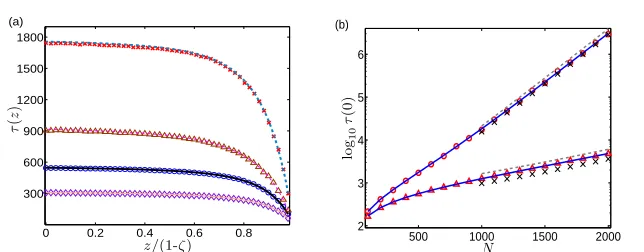
Fig. 2 (Color online). Functional dependence of the MCT whenζ <∆c andδA=δB=δ.
(a)τ(z)as function of the (rescaled) initial concentration of susceptible centrists z/(1−ζ). Results of stochastic simulations (symbols) averaged over 5×10⁴samples are compared with formula (16) (curves) for(δ,ζ) = (0.04,0.02)(×, thick dashed),(0.035,0.02)(△, thin dashed),
(0.06,0.04)(◦, thick solid), and(0.08,0.06)(⋄, thin solid). The population size is N=500. (b) Logarithm of the MCT as function of N withζ=0.02 andδ=0.04(◦)andδ=0.03(△)starting from a system without susceptible centrists: log10τ(0)has been computed using stochastic sim-ulations (symbols, averaged over 1000 samples with N=100−2000), and is compared with the predictions of (16) (solid) and the WKB results (26) (×). The (rescaled) asymptotic predictions (20) are shown as dashed lines.
6.1 Long-lived coexistence and consensus time
We first study the situation whereζ<∆cor, equivalently,δ>ζ/(1−ζ). In this case, the mean field rate equations (2) predict the coexistence of the three opin-ions with a densityζ/δ of susceptible centrists (see Fig. 1(b)). Here, by paying special attention to the interesting situation where ζ <δ ≪1 and N≫1, we analyze how this picture is altered by random fluctuations and how centrism con-sensus is ultimately reached. From the results of stochastic simulations reported in Fig. 2. it appears that the MCT decreases monotonically with the densityζof centrist zealots and increases with the persuasion biasδ. The MCT also appears to grow steeply (almost exponentially) with the population size N, see Fig. 2(b). Moreover, the results of Fig. 2(a) indicate thatτ≃τ(0)when the initial number of susceptible centrists is small (z≪1−ζ), which implies that in such a regime the MCT is essentially independent of the initial density z. Below, these observations are substantiated by the analysis of the functional dependence of the MCT onδ,ζ and N, first by using the Fokker-Planck equation and then with the WKB method.
6.1.1 Mean consensus time with the Fokker-Planck equation whenζ<∆c
In this section, we analyze the predictions of (16) whenζ <∆c and z≪1, and obtain the leading contribution of the mean consensus time in the framework of the Fokker-Planck equation (15) using a saddle-point approximation.
When N≫1 andζ<∆c, the function exp(−NF(u))has an isolated peak at u∗≡ζ/δand one can Taylor-expandF(u)around u∗which yields exp(−NF(u)) = exp(−NF
(u∗) + (u−u∗)2F′′(u∗)/2
[image:15.595.76.398.92.218.2]inner integral of the right-hand-side (RHS) of (16) with a saddle-point approxima-tion, yielding
Z v
0
du e
−NF(u)
(1−ζ−u) (ζ+ (2+δ)u)≃e−
NF(ζ/δ)Z ∞
−∞du e
−(N/2)(u−ζ/δ)2F′′(ζ/δ)
.
In setting the boundaries to ±∞we have assumed that the peak is sufficiently separated from the absorbing boundary, i.e. we henceforth assume that ζ/δ is well separated from the values 0 and 1. By performing the Gaussian integral, the expression (16) becomes
τ(z)≃ s
2πN ζ(1+δ)
e−NF(ζ/δ) 1−ζ(1+δ−1)
Z 1−ζ
z
dv eNF(v). (18)
As F(v) is an increasing function of v on ζ/δ <v≤1−ζ, the main contri-bution to the integral on the RHS of (18) arises from v≃1−ζ and therefore
R1−ζ
z dv eN F(v)
≃R1−ζ
z dv eN[
F(1−ζ)−(1−ζ−v)F′(1−ζ)]∼eNF(1−ζ)/N. Hence, with (18), and provided that the initial population does not mainly consist of suscepti-ble centrists (i.e. if z≪1), the leading contribution to the MCT in the realm of the diffusion approximation is
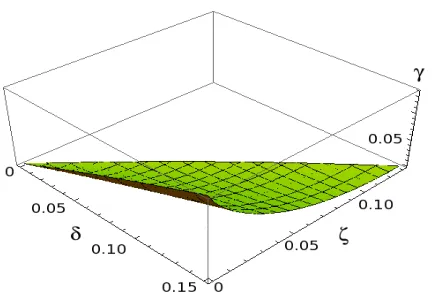
τ∼N−1/2eNγ(δ,ζ)≡N−1/2eN(F(1−ζ)−F(ζ/δ)), (19) where the functional dependence of the exponentγ(δ,ζ)≡F(1−ζ)−F(ζ/δ) is illustrated in Fig. 3.
As we are particularly interested in the limit of weak persuasion biases and small fraction of zealots, i.e.ζ<δ ≪1 (with z≪1−ζ), the expansion of the exponentγyieldsγ(δ,ζ) =δ−ζ(1+ln(δ/ζ))+O(δ3). With (19), one therefore obtains the following asymptotic result when N≫1:
τ ∼N−1/2eN(δ−ζ)
ζ
δ Nζ
. (20)
[image:16.595.76.397.129.160.2]Fig. 3 (Color online). Functional dependence ofγ on the parametersδ andζ whenζ <∆c
according to (19):γgrows and decreases monotonically withδandζ, respectively.
therefore the MCT decreases ifα>0 and increases otherwise. This nontrivial in-terplay betweenδ andζ is confirmed by the results of Fig. 2(a) and is illustrated in Fig. 3 where we see that the exponentγdecays along the lineδ−ζ=constant.
6.1.2 Metastability and WKB treatment when N(δ−ζ)≫1
The asymptotic behavior (20) of the MCT has been derived from the solution of the Fokker-Planck equation (15), by assuming thatζ<δ≪1. In this section, we use a complementary approach in terms of the Wentzel-Kramers-Brillouin (WKB) theory [33, 34] to obtain the MCT to the next-to-leading order in the limit where N(δ−ζ)≫1 whenζ<∆c.
While the mean field analysis (2) predicts the stable coexistence of all opin-ions in this regime, when the population is large but finite, the system lingers around the coexistence state (with a densityζ/δ of C’s) before centrism consen-sus is eventually reached. The dynamics is thus characterized by metastability, a phenomenon that is well described by the WKB method [33]. The WKB approx-imation is an asymptotic theory frequently used in the semi-classical treatment of quantum mechanics [33] that is also useful to study stochastic processes [34]. Recently, there have been numerous applications of the WKB approach to study problems of metastability arising in population dynamics, as well as in evolution-ary games and population genetics, see e.g. [31, 35, 32]. As the WKB method has never been used in the framework of opinion dynamics to the best of our knowl-edge, we here follow Refs. [31, 32] and outline the essence of the method and show how it can be used to compute the MCT when N(δ−ζ)≫1.
[image:17.595.128.347.94.243.2](z≪1−ζ), to ensure that the metastable state is always reached prior to consen-sus (see Fig. 1). In this setting, the mean consenconsen-sus timeτWKBis the decay time of the metastable state described by the centrism quasi-stationary probability distri-bution (QSD)πℓ. The QSD is obtained by approximating P0≤ℓ≤N−ℓζ≃πℓe−t/τWKB
and PN−ℓζ≃1−e−t/τWKB[31, 32]. Using these expressions in the master equation
(11), one obtains the quasi-stationary master equation
Tℓ+−1πℓ−1+Tℓ−+1πℓ+1−
Tℓ++Tℓ−πℓ=0, (21)
where an exponentially small termπℓ/τWKBhas been neglected and we have used
the transition rates (12). The decay time of the metastable state coincides with the MCT and is given by the flux of probability into the absorbing state, i.e.
τ−1
WKB=TN+−ℓζ−1πN−ℓζ ≃
dT+(1−ζ) dz
π(1−ζ)
N , (22)
where we have used the continuum limit z≡ℓ/N,πℓ≡πNz=π(z)and TN+−ℓζ−1≃
|dT+(1−ζ)/dz|/N, with the continuous rates (13) [31, 32]. According to (22), the calculation ofτrequires to solve the equation (21) for the QSD. This can fruitfully be done using the WKB approach [34], which is based on the ansatz
π(z)≃Ae−NS(z)−S1(z), (23)
where S(z) and S1(z) are respectively the system’s “action” and “amplitude”, while A is a normalization constant. The action is found by substituting (23) into (21) and by keeping the leading order in N, which yields T+(z)[eS′(z)
−1] + T−(z)[e−S′(z)
−1] =0, with S′≡dS/dz [34, 35, 31, 32]. With (13), one thus finds
S(u) =−
Zu
ln[T+(ν)/T−(ν)]dν=u ln
(
1+δ)u u+ζ
−ζln(u+ζ). (24)
The constantA is determined by normalization of the Gaussian approximation π(z)∼Ae−NS(z∗)−(N/2)S′′(z∗)(z−z∗)2
around the metastable state z∗=ζ/δ. A Gaus-sian integration yieldsA ∼eNS(ζ/δ)and, to leading order,π(z)∼e−N(S(z)−S(ζ/δ)).
With (22,24), the leading contribution to the MCT therefore reads [35, 31, 32]:
τWKB∼eNγWKB(δ,ζ)≡eN(S(1−ζ)−S(ζ/δ))= "
(1+δ)(1−ζ)
ζ
δ(1−ζ) ζ#N
(25)
It is worth noting that, to low orders inδandζ, the exponentγWKBof (25) reads
γWKB(δ,ζ)≡S(1−ζ)−S(ζ/δ) = (1−ζ)ln(1+δ)(1−ζ) +ζlnζ(1+δ−1) =δ−ζ(1+ln(δ/ζ))−(δ2−ζ2)/2+O(δ3).
The calculation of the subleading correction to the MCT (25) is feasible but more involved. In fact, it necessitates S1(z)and requires to match the ansatz (23) with the solution of the (21) linearized about the absorbing boundary z=1−ζ. Here, we quote the final result and refer to Ref. [31] for a detailed calculation and a related discussion4:
τWKB≃ s
2π N
1−ζ ζ
δ[(
1+δ)(1−ζ)]N (δ(1−ζ)−ζ)2
ζ
δ(1−ζ) Nζ
. (26)
As illustrated by Fig. 2(b), when the population size is sufficiently large and N(δ− ζ)≫1, (26) is in good agreement with the predictions of the FPE and with the results of stochastic simulations. Two additional remarks are in order:
i. In contrast to the prediction (16) of the diffusion approximation, the results (25,26) forτWKB only depend on the parametersδandζ but are independent of the initial density of centrists z, and thus are to be compared with τ(0). This is because the MCT is here computed from the metastable state, which is certainly always legitimate when the initial population does not consist of an overwhelming majority of centrists (i.e. provided that z,ζ≪1).
ii. The accuracy of the WKB approximation improves when N(S(1−ζ)−S(ζ/δ))≫ 1, see e.g. [31, 32], as illustrated in Fig. 2(b) where it is shown that the WKB results are more accurate whenδ=0.04 (and N>1000) than forδ=0.03.
6.2 Centrism consensus time whenζ≥∆c
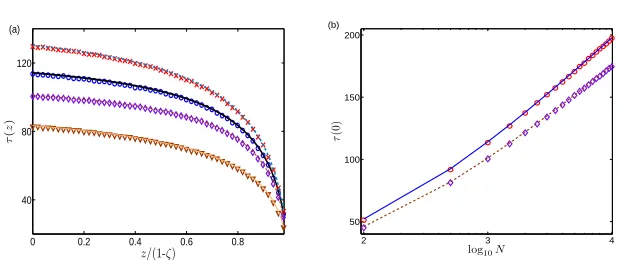
Whenζ≥∆c, the rate equation (6) is not characterized by an interior fixed point and the mean field rate equations (2) predict that centrism consensus is quickly reached (after a short coexistence of the three opinions). This mean field scenario essentially also holds in a finite population whenζ≥∆c, as illustrated by Fig. 4(a), where at fixed N it is found that
– the centrism consensus timeτgrows when the density z of susceptible centrists decays;
– τdecreases monotonically whenδdecreases andζ increases;
– at fixed value ofζ−δ,τincreases monotonically whenδandζdecrease;
– the parametersζ andδ appear to have only a weak effect on the MCT when
z→0;
– the predictions (16) obtained from the backward Fokker-Planck equations are in excellent agreement with the results of stochastic simulations.
Whenζ>∆c, the integrals in (16) are difficult to evaluate analytically since the function exp(−NF(u))has no isolated peaks and thus no saddle-point approxi-mation can be carried out. Nevertheless (16) can be studied numerically and it is
4 One slight difference with the generic result given in Ref. [31] lies in the fact that here the
0 0.2 0.4 0.6 0.8 40
80 120
z/(1-ζ)
τ
(
z
)
(a)
2 3 4
50 100 150 200
log10N
τ
(0
)
(b)
Fig. 4 (Color online). Functional dependence of the MCT whenζ ≥∆c andδA=δB=δ.
(a)τ(z)as function of the (rescaled) initial concentration of susceptible centrists z/(1−ζ)for various values ofδandζ. The results of stochastic simulations (symbols), averaged over 5×10⁴
samples are compared with formula (16) (curves) for(δ,ζ) = (0.04,0.06)(×, thick dashed),
(0.06,0.08)(◦, thick solid),(0.08,0.10)(⋄, thin dashed) and(0.035,0.08)(∇, thin solid). (b) The MCT as function of log10N, with N=100−10000: starting from a system without susceptible
centrists with(δ,ζ) = (0.06,0.08)(◦) and(δ,ζ) = (0.08,0.10)(⋄),τ(0)has been computed using stochastic simulations (symbols) and the formula (16) (solid/dashed lines).
found that when z→0, i.e. when the initial population consists only of A and B voters (along with centrist zealots, but no susceptible centrists), one has
τ∼ln N, when N≫1. (27)
This result, compatible with the above points (iv) and (v), is confirmed by Fig. 4(b) where, when N is large and increases, it is shown that
– τ(0)grows linearly with log10N, with a slope that appears to slightly increase whenζ andδ decrease, as shown in Fig. 4(b) when N≥1000;
– the formula (16) fully captures the dependence ofτ on N for all population
sizes in the range N=102−104.
7 Mean consensus time in the 3CVM with centrist zealots and asymmetric persuasion biases
When the biases toward A and B voters are different, i.e. whenδA>δB>0, the system’s dynamics is described by a bivariate birth-death process characterized by the master equation (9). The mean time to reach centrism consensus starting with a population comprising a fraction of x voters of type A and a density y of B-voters thus obeys the following backward master equation [22]:
τ(x,y) =∆+Tx−τ(x−∆,y) +Tx+τ(x+∆,y) +Ty−τ(x,y−∆) +Ty+τ(x,y+∆) +
1− Tx++Tx−+Ty++Ty−τ(x
,y), (28)
where ∆ =N−1. Since we consider a finite but large population size (N≫1), the transition rates Tx±,yare the continuous versions of (10), i.e. Tx+≡(1+δA)xz, Tx−≡x(z+ζ), Ty+≡(1+δB)yz and T−
[image:20.595.79.393.92.222.2](28) and even a size expansion is not very useful to make analytical progress. Yet, the bivariate master equation (28) can be simplified in the limits where x→0 and y→0, and the asymptotic behavior of the MCT can be obtained when the population size is large (see below). In fact, when y=0 and x=1−ζ−z>0, Ty±=0 while Tx±=T∓(z)and thereforeτ(x,0) =τδA(z=1−ζ−x), whereτδA
is the solution of the single-variate master equation (14) withδ replaced byδA. Similarly, when x=0 and y=1−ζ−z>0, one hasτ(0,y) =τδB(z=1−ζ−y). Building on our knowledge of the caseδA=δB(Sec. 6), we know that the solution of (14) increases monotonically withδ whenζ is kept fixed (see Fig. 2). Since δA>δB, this impliesτ(x,0) =τδA(z=1−ζ−x)>τ(0,y) =τδB(z=1−ζ−y). More generally, at fixed values of z andζ, the largest MCT is attained when the population of non-centrists consists of a maximum number of most persuasive radical voters, i.e. N−ℓ−ℓζ voters of species A. Similarly, the shortest MCT at fixed values of z andζis obtained when the initial sub-population of non-centrists only consists of N−ℓ−ℓζ voters of species B. Hence, the MCT respectively increases and decreases with the initial fraction of A-voters and B-voters in the population, and the quantitiesτδAandτδBare upper and lower bounds of the MCT [see Eqs (30,31)]:
τδB(1−ζ−x−y)≤τ(x,y)≤τδA(1−ζ−x−y), (29)
as illustrated by Figs. 5 and 6, see below. According to this discussion, we no-tice that a quantitative difference between the cases of asymmetric and identical persuasion biases lies in the influence of the initial condition: whenδA6=δB, the MCT depends on the specific initial densities x of A’s and y of B’s (not only on their sum, as in the symmetric case withδA=δB). In what follows, we show that when z≪1−ζthe asymptotic behavior of the MCT is independent of the initial condition when N(δA−δB)≫1 and N(δA−ζ)≫1: In this situation significant insight into its properties can be gained from the results of Sec. 6 combined with the mean field analysis of Sec. 4.
7.1 Long-lived coexistence and consensus time whenζ<∆candδA>δB
When ζ <∆c≡δA/(1+δA), the mean field analysis (Sec. 4) has revealed the asymptotic stability of the state where A-voters and centrists coexist. As seen in Sec. 6.1, when the population size is large but finite, we expect the coexis-tence state to be long-lived and to decay after a time growing exponentially with the population size N (to leading order). If the population initial composition is (x,y,z) = (1−ζ,0,0)and only consists of A-voters and centrist zealots, one re-covers a single-variate process (as in Sec. 6) and the MCT isτ(x=1−ζ,0) = τδA(z=0), where, in the realm of the Fokker-Planck equation,τδA(z)is directly
inferred from (16) using
τδ(z) =2N
Z1−ζ
z
dv eNFδ(v)Z v
0
du e−
NFδ(u)
(1−ζ−u) (ζ+ (2+δ)u), (30)
with
Fδ(u)≡
2δ 2+δ
u−4ζ(1+δ)
0 0.2 0.4 0.6 0.8 300
600 900 1200 1500 1800
z/(1-ζ) withx/yfixed
τ
(
x
,y
)
(a)
500 1000 1500 2000
2 3 4 5 6
N
lo
g10
τ
(
x
+
y
=
1-ζ
)
(b)
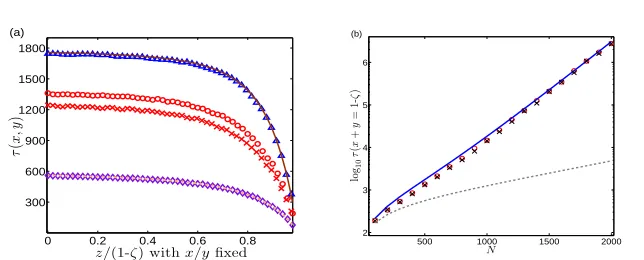
Fig. 5 (Color online). Functional dependence of the mean consensus time whenζ <∆cand
δA>δB, withζ=0.02. (a) The MCT as function of the rescaled initial density z/(1−ζ)with
the ratio x/y held fixed, see text. Here,(δA,δB) = (0.04,0.03)with x=y(◦)and y=1.5x(×),
the population size is N=500. The results of stochastic simulations (symbols) averaged over 2.5×10⁴samples are compared with the results obtained forδ
A=δB=0.04 (△, solid) and
δA=δB=0.03 (⋄, dashed). The analytical results (solid and dashed lines) are based on (30,31).
(b) Logarithm of the MCT as function of N (with N=100−2000) for the same parameters as in (a): log10τ(x+y=1−ζ)computed using stochastic simulations (◦,×) averaged over 103
samples is compared with the predictions of (30,31) forδ=0.04 (solid) andδ=0.03 (dashed).
Similarly, if the initial state is(x,y,z) = (0,1−ζ,0), one hasτ(0,1−ζ) =τδB(0). SinceδA>δBandτδ∼N−1/2eNγ(δ,ζ), with an exponentγ=Fδ(1−ζ)−Fδ(ζ/δ) that grows monotonically withδ whenζ is fixed (see Sec. 6.1 and Fig. 3), one hasτ(x,0) =τδA(0)∼N−1/2eNγ(δA,ζ)≫τ(0,y) =τδ
B(0)when N(δA−δB)≫1,
N(δA−ζ)≫1, and the initial density of susceptible centrists is vanishingly small (z→0).
In the case of a population with an arbitrary initial density (x,y,z) of A,B and C’s, the system almost surely reaches the metastable state(a∗
2,b∗2,c∗2) = (1− ζ−ζ/δA,0,ζ/δA), as prescribed by the mean field equations (2) [see (3) and Fig. 1(a)], before reaching centrism consensus. Hence, the less persuasive of the radical voters (B’s) quickly disappear from the population and the metastable state only consists of centrists and voters of the most persuasive party (A’s). Apart from the short transient necessary to reach the metastable state, the MCT is thus obtained from the mean time to reach consensus starting from the fixed point (a∗
2,b∗2,c∗2) where the population comprises only A-voters and centrists. In this situation, when N(δA−δB)≫1 and N(δA−ζ)≫1, the leading contribution to the mean consensus timeτ(x,y)is obtained from a single-variate backward mas-ter equation [like (14) of Sec. 6] and is given by τδA(z)with (30). In particular, when the initial density z of susceptible centrists is very small (i.e. z≪1−ζ) with N(δA−δB)≫1 and N(δA−ζ)≫1, one hasτ(x+y≃1−ζ)≃τδA(0)and, from the results (20) and (25), we infer the leading contribution to the MCT when δB<δA≪1 andζ≪1:
τ(x+y≃1−ζ)≃τδA(0)∼N−1/2eN(δA−ζ)
ζ
δA Nζ
[image:22.595.75.397.88.218.2]0 0.2 0.4 0.6 0.8 30
50 70 90
τ
(
x
,
y
)
z/(1-ζ) withx/yfixed (a)
2 3 4
60 100 140
log10N
τ
(
x
+
y
=
1-ζ
)
(b)
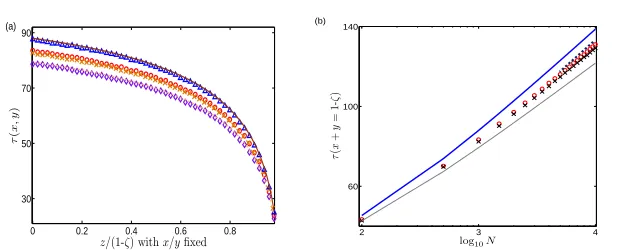
Fig. 6 (Color online). Functional dependence of the MCT whenζ ≥∆c andδA>δB, with
ζ=0.08. (a) The MCT as function of the rescaled initial density z/(1−ζ)with the ratio x/y held fixed, see text. Here,(δA,δB) = (0.04,0.03)with x=y(◦)and y=1.5x(×), the population size
is N=1000. The results of stochastic simulations (symbols), averaged over 3.5×10⁴samples,
are compared with results obtained forδA=δB=δ=0.04 (△, solid) andδ=0.03 (⋄, dashed).
The analytical results (solid and dashed) are based on (30,31). (b)τ(x+y=1−ζ)as function of N in a semi-logarithmic scale for the same parameters as in (a). Results of stochastic simulations (symbols) for N=100−10000 are compared withτδB(0)(thin solid) andτδA(0)(thick and, as a guide for the eyes, dashed line) obtained from (30,31), see text.
The results of stochastic simulations reported in Fig. 5 corroborate the above anal-ysis. In fact, Fig. 5(a) reveals the dependence of the MCT on the initial conditions: τgrows monotonically with z−1and x/y, but exhibits only a weak dependence on x/y. Moreover, the comparison with the case of identical biases illustrates that τδB(z=1−ζ−x−y)≤τ(x,y)≤τδA(z=1−ζ−x−y)which confirms (29).
Fig. 5(b) shows that asymptotically the MCT grows exponentially (to leading or-der) with the population size when N(δA−δB)≫1, N(δA−ζ)≫1 and z→0, in full agreement with the behaviorτ(x+y=1−ζ)≃τδA(0)predicted by
(30)-(32). The figure 5(b) also illustrates that the asymptotic behavior of the MCT is independent of the ratio x/y and therefore of the detailed composition of the initial population.
7.2 Mean consensus time whenζ≥∆candδA>δB
When ζ ≥∆c, the only stable fixed point corresponds to centrism consensus. From the analysis of Sec. 6.2, we know that in a finite population with initial composition (x=1−ζ,0,0), the MCT is τ(1−ζ,0) =τδA(z=0) and can be obtained from (30). Similarly, for an initial composition (0,y,0), the MCT is τ(0,1−ζ) =τδB(z=0). When N≫1 and the initial number of susceptible cen-trists is small, i.e. z=1−ζ−x−y→0, we have seen in Sec. 5.2 (see Fig. 4(b)) thatτδA(0)∼τδB(0)∼ln N. Furthermore, according to (29)τδAandτδBare upper and lower bounds of the MCT. The results of Sec. 6.2 hence imply
τδB(0)≤τ(x+y≃1−ζ)≤τδA(0), and therefore
[image:23.595.83.393.92.217.2]These findings are corroborated by the results of stochastic simulations re-ported in Fig. 6 that confirms (29): τδB(z=1−ζ−x−y)≤τ(x,y)≤τδA(z= 1−ζ−x−y). The dependence of the MCT on the initial conditions is illustrated in Fig. 6(a) whereτ(x,y)grows monotonically with z−1and x/y (held constant). We notice the dependence on x/y is particularly weak. Fig. 6(b) confirms the log-arithmic growth with N of the MCT when the population size becomes very large, in full agreement (33). In particular, the symbols in Fig. 6(b) are found to be aligned parallel to the thick and dashed lines when N≫1, which implies that asymptotically eτ(x,y)≃Q(x,y)eτδA(0) orτ(x,y)≃τδ
A(0) +ln Q(x,y), where the
function Q depends weakly on the initial densities(x,y).
8 Conclusion and discussion
After having reviewed the main properties of the paradigmatic voter model and of some of its generalizations accounting for zealotry, commitment and incompatibil-ity (Section 2), we have studied how a committed minorincompatibil-ity may resist a persuasive majority and how the resulting competition influences the maintenance of cultural diversity. Here, this line of investigation has been carried out in the framework of the three-party constrained voter model with “centrist zealots”. In fact, follow-ing the basic idea of the bounded-compromise and three-party constrained voter models, we have considered that individuals of two radical parties (A and B) are incompatible among them and compete to impose their consensus by convincing centrists that, in turn, can convince A’s and B’s. To reflect the fact that radical (A and B) voters are more persuasive than centrists, we have considered that there are persuasion biasesδAand δB toward opinions A and B (with δA≥δB). Fur-thermore, we have also assumed that the population includes susceptible centrists (C) and a small fractionζof centrist zealots (Cζ). Whereas C’s can radicalize and adopt either the state A or B, centrist zealots are committed individuals that always remain centrists and oppose the formation of any consensus that is not centrism. Hence, the persuasion of A’s and B’s is resisted and opposed by the commitment of centrist zealots. This results in a subtle competition between commitment and persuasion that has been studied in the mean field limit and in a well-mixed pop-ulation of finite size N (on a complete graph).