EUROPEAN COMMUNITIES
MONETARY COMMITTEE
TWENTY -
THIRD REPORT
ON THE ACTIVITIES
OF THE
MONETARY COMMITTEE
Brussels, 15 May 1982
This publication is also available in the following languages:
ISBN 92-825-
3113-ISBN 92-825-
3115-Cataloguing data can be found at the end of this publication
Luxembourg: Office for Official Publications of the European Communities, 1982
ISBN 92-
825-3114-Catalogue number: CB-35-82-522-
EN-~) ECSC-EEC-EAEC, Brussels 48 Luxenibourg, 1982
Summary
Foreword..."""""""""""""""""""""""""""""...
Introduction...
,... ,... ,...,... ,...,...
II. Community action and the activities of the Committee ...
III.
Working parties of the Monetary Committee...,...
List of members and alternates of the Monetary Committee...
Annex I : Opinion to the Council and the Commission on indexation mechanisms
(16 November 1981)...
...
Annex II
: Opinion on dollar interest rate and
exchange rate developments(25 June 1981) """""""""""""""""""""""""""""""""""""""""""""""""""""""""
""""""""
Annex III :
Opinion on the financial aspects of North-South relations(15 June1981) """""""""""'
..""""""""""""""""""""""""""""."'.""...,..
Annex IV : Report by the
Working Party on Harmonization of Monetary PolicyInstruments on 'The technical problems stemming from the co-existence
of monetary and exchange rate objectives within the EMS'
(22 October 1981) """"""..."...""""""""
FOREWORD
In 1981 the Committee held nine sessions; the Committees working parties and the
Alternates met on several occasions. The list of members in office during 1981 is annexed.
I. INTRODUCTION
1.
World economic trends in 1981 were subject to a number of unfavourable influences:the aftermath of the second oil shock of 1980; the worsening of domestically generated
imbalances (in particular budgetary imbalances); wide and sometimes erratic swings in
interest rates and exchange rate relationships with the United States dollar. The effects of
these factors on the
economies of the major country groupings varied, but on balanceactivity may have picked up slightly in the course of 1981. The volume of world trade remained at the same level as in 1980, since the volume of imports by members of the
Organization of Petroleum Exporting Countries continued to offset to some extent the low
level of other countries' imports
, which was
accounted for by a marked slowdown inconsumption and importation of oil. The imports of the non-oil developing countries
which have large external deficits to finance, increased at a slower rate in 1981. The
oil-producing countries' surpluses on current account decreased in 1981, after almost doubling
from 1979 to 1980. The industrialized countries recorded an aggregate deficit , although the
overall picture masks sharp individual differences.
2.
In the Community, the recession that began in 1980 continued into 1981. The rate ofinflation remained generally high , and unemployment continued to rise. On the other hand, the slowdown in imports combined with an improved export performance led to a reduction
in the current
deficit in spite of a
deterioration in the terms of trade over much of1981. These aggregates, of course, mask differences between the countries , particularly
between inflation rates.
The European Monetary
System (EMS)
continued to function satisfactorily, despiteconditions that were generally unfavourable to the convergence of economies, and in the
face of the destabilizing effects of wide variations in the exchange rates and interest rates of
third currencies. Fluctuations in exchange rates between participant currencies were much
smaller than during the 10 years prior to the inception of the system. There were however
two EMS parity adjustments in 1981: the first , on 22 March, involved only one currency; the
second, on 4 October, was the first general realignment since that of 23 September
1979. These two adjustments, though different in character , confirmed that the EMS can
II.
COMMUNITY ACTION AND THE ACTIVITIES OF THE COMMITTEE
3.
Against this general economic and monetary background, marked by strong pressuresand turbulence, the Committee felt it was more than ever necessary to strive for cohesion
and monetary stability in the Community: it concentrated on the operation of the European Monetary System and its possible development, on improving convergence of the economies
of the participating countries, and on international monetary relations.
4.
The Committee kept .a close watch on economic and monetary trends and on theresulting policies
, both at
Community level and' in the individual Member States.several occasions
, in the course of 1981, it
examined in detail particular aspects of theCommunitys economic situation. An in-depth discussion on balance of payments and
exchange rates in the European Monetary System allowed, for example , an examination of
the fundamental trends affecting the exchange rates of participant currencies.
Further-more, at its October meeting, the Committee studied the stance of monetary policy in
Member States in connection with the setting of monetary objectives for 1982, about to be
decided by the monetary authorities of most Member States.
5.
At a time of persistent disequilibria, aggravated by unstable exchange rate relationswith non-member countries and volatile interest rates
outside the Community, it
was increasingly necessary to ensure the smooth functioning of the EMS, and to monitor itsevolution. Both the realignment decisions taken in 1981 and in particular the general
realignment of 4 October - were preceded by discussions in the Committee; the decisions
taken by the Ministers were based on the Committees conclusions. Furthermore
important work was carried out by the Alternates on the technical aspects of the system
future development: This work culminated in a comrehensive inventory of the problems
raised by the systems development and in proposals for adequate solutions. The findings
were examined and discussed by the Committee, which identified a number of possible
developments. The European Council meeting in London on 26 and 27 November 1981
asked that this preparatory work lead to concrete proposals for reinforcing the system.
6.
The Committee, aware that the reinforcement of the European Monetary Systemdepends on considerably greater convergence of the economies of the participant countries
stepped up its work in this
field.First , it examined the effects of certain rigid systems of indexation on economic trends in the
Member States , and studied the possible monetary consequences, taking into account the
proposals put forward by the Commission in its communication to the Council of 23 July
1981. In particular, the Committee felt that indexation presented serious drawbacks in the
face of present adjustment requirements. No
indexation system should be operated insuch a way that it offsets for certain categories of income the consequences of economic
policy changes or of variations in the terms of trade. The Committees position on this
question is stated in the Opinion of 16 November 1981 to the Council and the Commission
(see Annex I).
Secondly, the Committee made thorough studies of the economic and monetary situation in
two countries with special difficulties
, Italy and Belgium. It
examined the conditionswhich had led the Italian authorities to take emergency measures on foreign currency
emphasized that the policy to be pursued must attack the fundamental problems of the
Italian economy; its position and recommendations were the subject of two oral statements
by the Chairman to
the Council. As
regards Belgium, the Committee noted theCommissions recommendation to the Government under Article 11 of the 1974 Decision on
convergence. It fully
approved the Commission s initiative, in particular as the smoothfunctioning of the European Monetary System requires stronger Community discipline; it
discussed the economic and monetary situation in Belgium on several occasions , together
with the corrective measures envisaged, and repeatedly confirmed its intention of closely
monitoring the implementation of principles expressed in the Commissions
recommenda-tion.
Thirdly, the Committee continued its regular examinations of the economies of the Member
States, independently from its discussions on exceptional situations or significant changes in
economic policy.
7.
The trends of dollar interest rates and exchange rates had a decisive impact throughoutthe world, including the Community. The Committee analysed the consequences of these
trends on several occasions, in the light both of the objectives of the US authorities and of
the possibilities open to the
European authorities to
guard against the effects of USpolicy. In an opinion to the Council and the Commission (see Annex II), the Committee
while firmly supporting the general anti-
inflationary thrust of US policy, expressedreservations on the
effects. of high
and volatile US interest rates, provoking strong fluctuations in the dollar exchange rate. In particular, the Committee stressed theoverriding importance, in an increasingly interdependent world, of close international
coordination and cooperation: no country should frame its domestic policies without due
regard to their
international consequences, and large economies and leading reservecurrency centres have a special responsibility in this respect.
8.
The Committee continued its work pursuant to the Council Decision of 8 May 1964 which provides that consultations shall take place within the- Monetary Committee inrespect of any important decision in the field of international monetary relations. The
Committee discussed the main points on the agenda of the Bretton Woods institutions; as it
does every year, it prepared the statement of the Council Presidency on behalf of the
Community to the IMF Interim Committee and the Annual Meeting of the IMF and the
World Bank.
With a view to the deliberations concerning North-South relations, the Committee
considered the monetary and financial aspects of the Commissions communication to the
Council of 7 May 1981 on Community policy for the North-South dialogue and, reaffirming
the approach
laid out in
its 1980 opinionsand reports on
recycling and on globalnegotiations , stated its position on the various aspects of international financial cooperation
and the responsibility ofthe Bretton Woods institutions (see Annex III). The Committee
believes that international financial cooperation should be developed with a view, in
particular, to associating the oil-exporting countries and industrialized countries in the
III.
WORKING PARTIES OF THE MONETARY COMMITTEE
9.
The Working Party on the H;armonization of Monetary Policy Instruments, a jointgroup of the Monetary Committee and the Committee of Governors of the Central Banks submitted in October its report on the technical problems stemming from the coexistence of
monetary and exchange rate objectives within the EMS. This report compares potential
conflicts and empirical evidence of conflicts between the two, given the requirement for
convergence towards stability, and analyses the techniques used to mitigate temporary
conflicts.
According to the report, it is unlikely that the potential for conflict willdisappear; only active coordination between monetary authorities in the EMS countries can
prevent the actual emergence of conflict situations.
10. The Working Party on Capital Markets completed its work on the development of
savings in equities in the Community countries, and continued to monitor trends in the
capital markets of the Member States and in the international capital market
, .
and reviewed
LIST OF
MEMBERS AND ALTERNATES OF THE MONETARY COMMITTEEChairman
Y. Haberer
Vice- Chairmen
Sir Kenneth Couzens
Dott. L. Dini
M. Horgan
Members
S. Andersen
J. Balfour
F. Boyer de la Giroday
M. Camdessus
D. Chalikias
(since 16 November 1981)
G. Drakos
(until 15 November 1981)
Dr. L. Gieske
Prof. L. Izzo (since 9 June 1981)
P. Jaans
G. Janson
R. Kirsch
C. Mavraganis
T. O'Grady Walshe
T. Padoa Schioppa
A. Prate
Dott. F. Ruggiero
(until 8 June
1981)Directeur du Tresor (Paris)
Second Permanent Secretary, HM Treasury (London)
Direttore Generale, Banca d'Italia (Rome)
Second Secretary, Department of Finance (Dublin)
Member of the Board of Governors, Danmarks
Nation-albank (Copenhagen)
Assistant director, Bank of England (London)
Director in the Directorate-General for Economic and
Financial Affairs, Commission of the European
Com-munities (Brussels)
Chef du service des affaires internationales .3. la
direc-tion du Tresor, ministere de l'economie (Paris)
Vice-governor
, Bank of Greece
(Athens)Vice-governor
, Bank of
Greece (Athens)Mitglied des Direktoriums der Deutschen Bundesbank
(Frankfurt-am-Main)
Consigliere, Ministero del Tesoro (Rome)
Commissaire au controle des banques (Luxembourg)
Directeur de la Banque nationale de Belgique
(Brus-sels)
Conseiller de gouvernement, Ministere des finances
(Luxembourg)
Deputy
director general, Ministry of Coordination(Athens)
Deputy General Manager, Central
Bank of
Ireland(Dublin)
Director-General for Economic and Financial Affairs
Commission of the European Communities (Brussels)
Premier sous-gouverneur de la Banque de France
(Paris)
Dr H. Schulmann
Drs A. Szasz
N. Ussing
J. van Ypersle de Strihou
Dr A. M. Wellink
Chairman of the Alternates
Dr W.
FlandorfferAlternates
Drs D .H. Boot
S. Boyer-Sj/Sgaard
J. Bull
A. Chalkiadis
M. Emerson
Drs F .A. Engering
R. Floc
(since 15 January 1981)
C. Georgoutsakos
(until 15 November 1981)
Mrs M. Hedley-Miller
P. Jurgensen
G. Lefort
(until 14 January 1981)
Dott. S.
Masera(until 7 June
1981)D. McCutcheon
(until 8 November 1981)
M. Papageorgiou
(since 16 November 1981)
D. Quigley
(since 9 November 1981)
J. Rey
G. Reynolds
Dr W. Rieke
Dott. F. Saccomanni (since 8 June 1981)
M. Schmit
J. Thomsen J. Vanormelingen P. Zimmer
Dott. A. Zodda
Staatssekretar, Bundesministerium der Finanzen
(Bonn)
Executive Director, De Nederlandsche Bank NY
(Am-sterdam)
Kommitteret, Det 0konomiske Sekretariat
(Copen-hagen)
Chef de Cabinet du Premier ministre (Brussels)
Thesaurier-
generaal bij het Ministerie van
Financien(The Hague)
Bundesministerium fUr Wirtschaft (Bonn)
De Nederlandsche Bank NY (Amsterdam) Danmarks Nationalbank (Copenhagen)
Bank of England (London)
Ministry of Coordination (Athens)
Directorate-
General for
Economic and FinancialAf-fairs, Commission of the European Communities (Brussels)
Ministerie van Financien (The Hague) Banque de France (Paris)
Bank of Greece (Athens)
H. M.
Treasury (London)Ministere de l'economie (Paris)
Banque de France (Paris)
Banca d'Italia (Rome)
Department of Finance (Dublin)
Bank of Greece (Athens)
Department of Finance (Dublin)
Banque nationale de Belgique (Brussels) Central Bank of Ireland (Dublin)
Deutsche Bundesbank (Frankfurt-am-Main) Banca d'Italia (Rome)
Ministere des finances (Luxembourg)
Det 0konomiske Sekretariat (Copenhagen)
Ministere des finances (Brussels)
Secretariat
Dr A. Kees
R. Barthelemy
(since 1 May 1981)
H. Carre
(until 30 April 1981)
A. Leipold
ANNEX I
OPINION TO THE COUNCIL AND THE
COMMISSIONON INDEXATION MECHANISMS
(16 November 1981)
At its meeting in Maastricht on 23 and 24 March 1981 the European Council took the view
that 'high .and divergent inflation rates are a threat both to the prospects of growth and to the economic and monetary cohesion of the Community. In this context the European Council also discussed the effects caused by rigid systems of indexation of incomes and
expressed the opinion that an adjustment of such mechanisms should be considered'. On
23 July 1981, the Commission issued a Communication to the Council on the principles of
indexation in the Community (COM (81) 457 final). Lastly, on 17 September, the Council
called upon the Coordinating Group and the Monetary Committee to examine this
Communication and to report on
it at a future
meeting.In response to these initiatives, and with a view to contributing to greater convergence of
economic trends within the EMS, the Monetary Committee has looked at this question; it
stresses however that since the implications of indexation are not solely monetary, the
Committees Opinion does not claim to cover all aspects of the problem, regarding which
other Community bodies might feel concerned. Furthermore, it notes that the question of
indexation, especially as regards its effects on competitiveness
, cannot be
examined inisolation from the other elements affecting labour costs and other production costs.
Struc-tural adaptation and the
re-establishment of European competitiveness require a globalapproach affecting the totality of production costs.
I. General observations
1.
Indexation is predominantly used as a means of offsetting the social consequences ofeconomic disequilibria. Yet indexation is by no means the only method to shield certain
sectors or groups in the economy from the detrimental effects of these disequilibria and
from inflation in particular. When such protection is effective , the result is clearly that the
economic agents enjoying it and only they become to some extent insensitive to
inflation. The return to a
more balanced economic situation, in
which the purchasingpower of money is stabilized , requires a conscientious effort of rigour and determination
difficult to realise in a rigidly indexed environment.
2.
In conformity with the Council's request, the Committee has examined theconvergence between the content of this document and most of the views expressed within
the Committee. In
particular it notes dose similarity in the analysis of the effects ofindexation, which leads the Commission, as the Committee, to consider that an essential
objective should be to adjust existing mechanisms so as to remedy their main disadvantages.
The Committee considers that the adjustment of indexation systems according to the
principles outlined below would constitute an important step towards achieving greater
convergence of economic performancewithiiJ. the Community and the maintenance of stable
exchange rate relationships within the EMS.
ll. Indexation of incomes
3.
The indexation systems applied in the Member States vary widely. Three MemberStates (Germany, the United Kingdom and Greece) have no system for indexing incomes
wages and salaries in particular. The situation in the others is very varied, ranging from indexation solely of the minimum wage (France) or the occasional introduction , in wage
agreements, of cost-of-
living adjustments (Ireland), to general indexation
(Italy, theBenelux countries and Denmark).
The indexation of retirement pensions and transfer incomes is fairly general. Lastly, the
adjustment of income tax allowances and thresholds , to prevent inflation from distorting the
progressive nature of taxation, must also be considered a form of indexation affecting the
formation of incomes.
4.
The Committee recognises that , during certain periods of relative price stability andmoderate adjustments of nominal incomes, indexation mechanisms may have settled pay
issues in a helpful way and encouraged the conclusion of agreements lasting more than one
year , avoiding overtrequent wage negotiations and thus lessening social conflict. Further
wage determination is a complex process, in which indexation
is only one of
many. elements. The Committee stresses, however, that in a period with large changes in relative
prices and the ensuing problems of structural adaptation of output and demand , the rigidity in economic adjustments introduced by automatic or semi-automatic compensation for price increases may constitute a considerable drawback. In practice indexation is often based on
a concept of maintenance not only of purchasing power but also on a specific basket of
expenditure which is irreconcilable with the need for income adaptation , substitution and structural change.
5.
In particular, the Committee emphasizes that if external economic relationships aresuddenly altered (deterioration in the terms of trade due to an inflationary shock or to a
change in exchange rate relationships), indexation impedes the necessary adjustments and
therefore tends to perpetuate the external
disequilibrium. Thesame is true of
priceincreases due to internal forces either demand or cost induced which will tend to be
perpetuated. Then again, if indirect taxation is increased in order to obtain certain
adjustment effects (e.g. on the structure of consumption), the effects may be neutralized by
the action of indexation; furthermore, higher taxation will, through indexation, push up
wage costs and help to damage
competitiveness. The room for manreuvre of theauthorities , in terms of monetary and taxation policy, is constrained by the existence of such
mechanisms.
6.
It is true that the rigidities and
distortions caused by de jure or de factoindexation arrangements do not necessarily take the form of more rapid inflation. Through
succeed in moderating the wage-price spiral and inflationary expectations. However, the
costs of taking monetary measures strong enough to offset the inflationary pressures of
indexation will emerge elsewhere , e.g. in terms of growth and employment , and such costs are likely to be higher than would be the case under a smooth income adjustment to changes
in external conditions or to fiscal policy measures.
7.
In view of these considerations, the Committee feels that the recourse to indexationpresents drawbacks for the conduct of economic policy faced with the need for adjustment
and makes it more difficult to defend the value of money. It is therefore of the opinion
that no additional indexation procedures should be introduced and that the scope of the
present systems should not be extended. Where such systems exist, it would be desirable
that, by a
combined action of the public authorities and the two sides of industry, theirscope be reduced so that they no longer undermine the effectiveness of certain economic
policy instruments.
To this end , no indexation system should be operated in such a way that it passes on from
prices into incomes the consequences of factors that are exogenous to the labour-business
relationship, such as economic policy changes or variations in the terms of trade. This
could be allowed for in the definition of the index
, or in the degree
and frequency ofcompensation, including, possibly, ad hoc agreements to forego indexation portions in
circumstances clearly characterized by imperative needs for economic adjustment.
The effort to reduce the
scope of indexation should extend to all its forms, includingproperty income and professional fees.
ID. Financial indexation
8.
The Commission Communication to the Council does not deal explicitly with financial indexation. However, the Commission has already had occasion to express its position onthe question of the protection of savings in times of inflation, 1 and the Committet"- itself has several times examined this specific question. Such examination highlighted in particular
the two major problems confronting an economy using indexation of financial assets: first
the risk of an extension in the application of indexation measures and of an accentuated
distortion in monetary functions, and second, the risk of disrupting financial circuits
entailed in the introduction of measures discriminating in favour of certain transactions.
9.
For these reasons amongst others, the
Committee requested that the inclusionindexation clauses in a foreign loan by a Member State be subject to prior consultation
within the Committee and that , as far as possible, there should be a similar consultation on
internal loans. The Committee has furthermore on several occasions 2 warned against the
opening of discussions on techniques which would endeavour to safeguard automatically the
real value of monetary or financial assets, whether they are held by developing or by other
countries. In the context of the adjustment of the Community loan mechanism, it also
indicated that for borrowings under this heading variable rate loans should not be given
preference over fixed rate borrowing and should in particular be avoided when borrowing directly from surplus countries.
1 Commission Communication to the European Parliament
- '
The protection of savings in times of inflation and the question of
indexation' (COM (77) 549 final - November 1977),
2 See in particular the Opinion on the financial aspec~ of
NOrth-&JiJth relations (Annex III).
3 Report to the Council and the Commission
on recycling (See Annex II of the 22nd Report on the activities of the Monetary
10. The Committee has not this time reconsidered the question of the indexation of
financial assets in detail. It is however of the opinion that generalizd financial indexation
should be opposed as it would be regarded as a capitulation to inflation and a demonstration
of the inability to eliminate the mechanisms that perpetuate inflationary pressures in our
economies, thus entrenching inflationary
expectations.
Financial assets and the returnsthey provide mustbe encouraged to adapt to overall economic conditions (not only to rates
of inflation). This
presupposes increased competition between financial intermediariesless segregation of financial channels and greater contractual freedom between debtors and creditors.
The Committee acknowledges that a high rate of inflation is likely to have undesirable
effects on the distribution of income and wealth between debtors and creditors. In such a
situation, marked by great uncertainties about future interest rates and about the time-scale
for the easing of inflation, certain limited forms of inflation-proofing may temporarily help
to meet the needs of lenders and borrowers alike, bringing them together on terms which
both fird acceptable; such forms give financial markets the necessary flexibility to adapt to
rapidly changing circumstances and thus protect the existence of a long~term
mar-ket. However also cetain other techniques for long term lending (such as variable rates)
may in some cases reduce the
effectiveness of interest rate management for monetaryauthorities, aligning financial market conditions automatically on those of the money
ANNEX II
OPINION ON DOLLAR INTEREST RATE
AND EXCHANGE RATE DEVELOPMENTS
(25 June 1981)
1. As requested by the Council on 15 June 1981, in full awareness that the difficulties
experienced by Community countries are of both internal and external origin , the Monetary
Committee has examined the consequences of dollar interest rate and exchange rate
developments for the Community economy. The present Opinion, adopted at its session
of 25 June
, sets out the main results of its discussion.
2.
In the 20 months since the change in techniques of monetary control announced by theFederal Reserve Board on 6 October 1979
, US
interest rates throughout the maturityspectrum have fluctuated over a very wide range, both in nominal and in real terms, thus
attracting unprecedented attention to their variations and their level. European interest
rates were broadly compelled to follow the upward movement of US rates , but did so on a
generally steadier course. Both short and long term nominal interest rates within the
Community are now either at or close to record levels , and in the lower inflation countries
real interest rates are also extremely high.
3.
Many factors affect exchange rates but , among these, high and variable US interestrates in 1980-81 have powerfully contributed to a marked fluctuation in the dollar exchange
rate around a
strongly rising trend against
EMS participating currencies, which havehowever remained remarkably stable vis-a-vis each other. In the twelve months to
mid-June 1981, the dollar has appreciated by between 35% and 42% against EMS currencies.
4.
It is in the interest of the
world economy that US inflation should come down asrapidly as possible: the Community should thus firmly support the general anti-inflationary
thrust of US policy. At the
same time it is important that the United States take intoaccount the international consequences of the choices in the framing and executing of
monetary, budgetary and public debt management policies, all the more so at the present
time when the prospects for improved growth and employment are so tenuous.
5.
The Committee considered the main problems raised by the above developmentstaking in turn the variability of interest rates , the level of interest rates and exchange rate
(a) variability of interest rates
changes in interest rates affect relative costs, resource allocation and economic
behaviour;
large and erratic variations in interest rates, and particularly large switch-back
movements over a considerable period, entail
on the one hand
~ a
climate ofuncertainty and wait and .see attitudes which upset investment decisions and - on the
other destabilize markets, especially at the long end;
high interest rate volatility entails an increased recourse to variable rate financing and to
short-term market instruments to finance longer term investments: although firms and
banks can then benefit more rapidly from a
fall in inflation, they become morevulnerable to adverse financial developments;
techniques of monetary control play an especially important role in determining interest
rate volatility; in the Committee s view these techniques should pay attention to the
trend movement in the target
aggregate rather than to short-term deviations;consequently, measures such as a staggering and a 'de-dramatization' of the publication
of money supply figures, with an emphasis on the medium-
term trend, have been
suggested as means to reducing interest rate
volatility. The
recourse to morediversified instruments for controlling the growth of the monetary aggregates would go
in the same
direction.(b) level of interest rates
high interest rates are a consequence of high rates of inflation and, at the same time , an
essential part of a determined fight against inflation through a strict monetary policy;
. ~
in general the level of interest rates can be reduced , whilst not relaxing anti-inflationary
policy, by substantially reducing the government deficit. This is not only valid for the
US, taking into account the savings rate, but also for Community member countries
where the policy mix is far from adequate and where relatively restrictive monetary
policies exist alongside large and persistent public sector deficits;
as fiscal treatment of interest rate payments by households in the US allows relatively
considerable deductions, interest rates have to be really very high to have an .effect on
personal borrowers;
while in most Community countries there are domestically-generated reasons for
relatively high interest rates, peaks in US rates may have led , in a number of member
countries, to higher interest rates than generally warranted by purely domestic
considerations;
excessively high real interest rates, if long continued, penalize productive investment at a
time when structural adjustment requires , for both internal and external reasons , and in
particular to reabsorb unemployment, an increase in the share of investments in
aggregate demand;
high interest rates weigh heavily on the service of the public debt of many industrialized countries;
high real interest rates add to the debt servicing burden of non-oil developing countries
which have had recourse to variable interest rate loans. This debt service is absorbing a
rising share of their export revenues, at a time when slow world growth restricts their
(c) exchange rates
the fluctuations of US short-term interest rates have been an important, although not
exclusive, cause of the marked variability of exchange rates and may have strengthened overshooting
' ;
-a
strong divergence of exchange rate trends from relative price and cost developmentscould store up further currency unrest in the future , because inflation differentials might
eventually predominate among the factors, including the current account positions
which affect exchange rates;
because of the depreciation of its currencies, Europe is now experiencing a new , strong
wave of import price increases
, analogous to that caused by an oil
shock; .developments since the transition to generalized floating in 1973 indicate that there is a
need for some degree of foreign. exchange intervention to deal with disorderly market
conditions and erratic movements, in line with IMF guidelines and articles. The US
policy on exchange rate intervention as recently outlined to Congress seems to go too far
in limiting its use in disorderly market conditions. In a world in which reserve holders tend to currency diversification, it is, in particular, essential that the reactions of the
authorities of the various reserve centres be mutually consistent and complementary.
6. On this occasion, the Committee wishes to stress that, although high and volatile US
interest rates and strongly fluctuating
exchange rates undoubtedly contribute to the
difficulties experienced by Community member countries, these difficulties are to a large
degree domestically-generated and that, as a general principle , responsibility for combating
inflation by all appropriate means begins at home.
In conclusion, the
Committee
stresses the over-riding importance, in an
increasinglyinterdependent world, . of close international coordination and cooperation: no country
ANNEX III
OPINION ON THE FINANCIAL ASPECTS OF NORTH-
SOUTH RELATIONS
(15 June 1981)
1.
Having received the Commission communication to the Council on Community policy for the North-South dialogue (COM (81) 68 of 7 May 1981), the Monetary Committeediscussed the financial aspects of this communication at its meeting on 10 June
1981.
Sincethese problems come within its sphere of
responsibility, the Committee has taken theinitiative of drafting the present Opinion.
General principles
2.
The Committee first of all notes a certain tendency to a dispersion of the discussionsand the definition of positions on the monetary and financial aspects of international
.relations; in this regard
, the
Committee considers it expedient to point out that:(i) at
Community level, the Council decision of 8May
1964 states that the mostappropriate method of ensuring a close coordination of the policies of the Member
States in this field is for the necessary consultations to be held within the Monetary
Committee;
(ii) at world level, the Bretton Woods institutions are responsible for dealing with these
problems. They have access to the
means of raising the
necessary funds and theprocedures to encourage borrowers to adopt the appropriate adjustment policies.
Furthermore
, the main
parties involved are suitably represented in theseinstitu-tions. The Community countries have a duty and an interest, in view of their weight in
these institutions, to maintain their role, to reinforce their action and to encourage
coordination between them.
3.
The Committee considers that the entirety and specificity of the responsibilities of theBretton Woods institutions .must be maintained, which does not exclude that the activities of
these institutions might be
developed by the means which the Committee has alreadyindicated in earlier Opinions , and in accordance with the conclusions of the last meetings of
the IMF Interim Committee and the
Development Committee. This
general principlemust underlie the approach to
international monetary
problems and the search forsolutions: it is thus in the framework of the Bretton Woods institutions that the financial
Financial aspects of North-South relations
4.
The Committee examined the 'financial aspects' section of the Commissioncommuni-cation, without however going into the details of the various proposals put forth therein and intends returning to them as and when required.
5.
Firstly, the Committee would re-affirm the view which it has already expressed in itsOpinions and Reports of 4 June, 10 October (on recycling) and 14 November 1980 (on
global negotiations). It is of the opinion that the bulk of the recycling activity will have to continue to be carried out through the international financial markets and the commercial
banks; that this important role played by the international banking system will have to be
supplemented by an expanded activity of the international organizations , primarily the
International Monetary Fund, the World Bank and the regional development banks; and
finally that the oil-exporting countries have a special responsibility in the financing of
international payments imbalances.
6.
Given the important role played by the international banking system in recycling, firmsupport must be given to efforts directed at safeguarding the soundness and stability of this
system. In
addition to this support, the Committee feels that the most stable forms ofprivate resource transfers , particularly direct investments, ought to be encouraged and
developed.
7.
The role played by the markets will however have to be supplemented and supportedby action
0.0 the part of theinternational institutions. As
regards the developmentinstitutions , they have a vital role to play, both as regards the transfer of resources and the
formulation of development principles. The Committee believes that these institutions are
capable of adapting to the requirements of a new situation , as they have proved in the past;
they should however be provided with the means to this end and the instruments at their disposal should be used to the best
effect. An
improved cooperation and a closecoordination between the international financing institutions must be sought and organized,
and co-financing or consortium operations enouraged. The Committee considers that, in
the .search for financing formulae, account should be taken of the varied situations of the
developing countries, and feels that an increase in public development aid to the poorest
countries is necessary to help them
overcome the serious difficulties they face. Themultilateral channels, which have so far shown their worth, must be given the financial
resources appropriate to their functions, along with a continuing flow of bilateral aid.
The Committee believes that international financial cooperation might be developed with a view to, in particular , associating the oil-exporting countries and industrialized countries in
the financing and exploitation of the energy resources of the non-oil developing countries.
. The Committee considers that firm support should be give.o to the proposal for extending
the activities of the World Bank in the energy field and for studying appropriate measures to
this end, including the possible setting up of a specialized
affiliate.
More generally, theCommittee calls for the development and reinforcement of international financial
coopera-tion in order to improve the stability of the financial system
, but reiterates its
warningsabout proposals which would lead to the opening of discussions on ways of protecting the
real value of the oil
surpluses.8.
With regard to the International Monetary Fund , it must be stressed that quotas mustremain its main .source of finance , while recognizing the need in current circumstances
The OPEC
surplus countries should furthermore play their full part in financing inter-national payments imbalances. Saudi Arabia has demonstrated its willingness to commititself in this direction, by concluding lending arrangements to the IMF. The Committee
notes that these loans have been made on the basis of market conditions and parallel loans made by various industrialized countries. It feels that other surplus countries should
also contribute to increasing the resources available to the IMF.
9.
In conclusion, the Committee emphasizes that an atmosphere of permanentnegotia-tion over internanegotia-tional monetary relanegotia-tions might well create uncertainty which would be
prejudicial to the stability of currencies and to the monetary system as a whole. The
Committee Will continue to examine the various aspects of international finance and will
ANNEX IV
TECHNICAL PROBLEMS STEMMING FROM THE CO-
EXISTENCEOF MONETARY AND EXCHANGE RATE OBJECTIVES
WITHIN THE EMS
Report by the Working Party on the
Harmonization
of monetary policy instruments
(22 October 1981)
Introduction
In February 1981 the
Committee of EEC Central Bank
Governors and the MonetaryCommittee expressed the wish that the Working Party on harmonization of monetary policy instruments should produce a report on the second of the three indents of a new mandate
This report, under the title of 'Technical problems stemming from the co-existence of
. monetary and exchange rate objectives within the EMS' is divided into five chapters: Monetary and exchange rate objectives in EEC countries;
Potential conflicts between monetary and exchange rate objectives due to EMS
membership;
Empirical evidence of conflicts between exchange rate and monetary objectives in the
EMS;
Mitigation of temporary conflicts between domestic monetary policy objectives and EMS exchange rate commitments;
Conclusions.
I.
Monetary and exchange rate objectives in EEC countriesA. Monetary objectives
In all EEC countries the principal objective of monetary policy is to set the appropriate
monetary framework for the attainment of final economic objectives. 2 To achieve these
ultimate aims, monetary policy is defined in terms of specific intermediate objectives for the financial variables (money or credit aggregates , interest rates , etc. ) which may be affected
I The full mandate is annexed to this report.
2 Final economic objectives in general concern inflation, growth, unemployment and the balance of payments (in particular the current
by the instruments available to the authorities. As shown below
, there are
, howeversubstantial differences between EEC countries with regard to the kind of intermediate
objectives chosen by the authorities and the degree of
commitment to their
achieve-ment. These differences are due to a variety of reasons and reflect differences in the
instrumental role of monetary policy in achieving final economic objectives.
Three large EEC countries (Germany, France , United Kingdom) all gear their monetary
policies predominantly to domestic objectives and especially to controlling inflation through
publicly-announced money supply targets. The publication of targets is seen as a way of providing the expectational framework for a reduction in inflation and influencing exchange
rate expectations. In addition, by representing a forward commitment ofthe authorities, it
constitutes an element of self-discipline in the conduct of policy, requiring the authorities to
take action to ensure the target is
respected. The United Kingdom (where targets arefurthermore formulated in the framework of a medium-term approach for a gradual
deceleration in money supply growth) has published target ranges for money supply growth over a number of years in the belief that clearly stated medium-term objectives will create a
more
favourable expectational framework. In
France and Germany the authoritiesconsider committing themselves in advance to a fixed path over several years as unrealistic
in view of the uncertainties with regard to the emergence of exogenous disturbances and
possible. changes in behaviour in the real and monetary sectors.
External considerations are particularly
valid for smallerEEC
countries with openeconomies, as, for example, Belgium , Denmark, Ireland and the
Netherlands. In
thesecountries publicly announced exchange rate commitments within the EMS largely play the
role of published monetary targets. In some of them the exchange rate commitment is
supported by the setting of an internal monetary objective. However, given the
impor-tance of the exchange
rate for
final
economic objectives, especially price stability,intermediate monetary objectives may be less binding or even only an indicator for the
authorities
, and the
setting of a medium-term objective is generally ruled out by theemphasis of monetary policy on external considerations. Furthermore, in certain cases the choice between an overall money supply approach and one based on monetary creation from domestic sources is dictated by the particular external position of the non-monetary sector (overall deficit or surplus).
In Italy almost continuous concern with an external deficit has favoured the choice of total
domestic credit as the most appropriate target variable. However
, when the
externalaccount is in surplus , the authorities place greater emphasis on the behaviour of monetary
aggregates to keep monetary conditions in line with the aim of a progressive reduction of
inflation. The high degree of substitutability between money and other financial assets has favoured the choice of broader aggregates such as M3 or total financial assets.
In all countries, whether they operate on a money supply or credit objective, a certain
degree of operational flexibility is generally maintained; the authorities accept departures
from the target path to take account of short-run fluctuations in money demand and/or to
counter exchange rate developments which are seen to jeopardize domestic final objectives. In cases of institutional or other permanent changes in demand for money, even the targets
may be adjusted.
B. Exchange rate objectives
The explicit exchange rate objective of all countries participating in the EMS exchange rate mechanism is to maintain their currencies in the EMS. At least in the short run this implies
longer run it is accepted that as the need arises and in particular as indicated by the
relative development of economic fundamentals in participating countries realignments
will take place.
The' economic motives of adherence to the EMS vary from country to country but all
countries recognize the value of a stable exchange rate system, with clearly defined bilateral
exchange rates, backed up with
substantial credit facilities. In several
countries EMSparticipation means achieving short":run stabilization of their currencies against most of their
principal trading partners, allowing them to trade in a stable exchange rate area. In a
number of countries adherence to the system is seen as facilitating the control of inflation by
placing constraints on domestic sources of inflation and in some countries as choosing a
strong currency option
' .
An additional.economic advantage , relevant in particular for the
larger member countries , is that , providing that there is convergence of economic policies
and final economic results, the EMS exchange rate mechanism allows the '
communitariza-tion' of external shocks by moderating what might have been extreme fluctuations in their
bilateral exchange rates vis-a-vis the US dollar whenever there are major movements between reserve currencies.
Greece and the United Kingdom have so far chosen not to participate in the exchange rate
mechanism
, though not for the
same reasons. For Greece, this has been
due to the
particularly high level of inflation when compared with that in other EMS countries, which
would have made participation extremely difficult. The United Kingdom authorities have
argued that it has
been differently placed from most other
member countries in twoimportant respects: first, sterling has been affected by the United Kingdom s new status asa
major oil producer; secondly, the UK economy is undergoing a period of adjustment, with
fundamental changes in economic policy aimed at substantially reducing the rate of inflation
by controlling the rate of monetary growth. Both of these developments are likely to have
substantial temporary and permanent effects on the exchange rate., which are, however
difficult to quantify.
Most member countries' primary and explicit exchange rate aim is thus the observance of
EMS margins. In addition to this general commitment, however, several countries note
the
particular operational benefits of amore
clearly defined position in the EMSband. Most countries are of the opinion that it is preferable or easier to maintain a more
precise position in the EMS band than accept the full margin of fluctuation. In Denmark
and Italy experience indicates that the amounts of intervention needed to stabilize their currencies in the EMS are normally lower when these currencies are in the upper part
around the middle of the band, whereas pressure tends to become self-reinforcing if the
lower limit is approached. Thus a short-term policy of maintaining their currencies in
defensible' positions within the EMS is followed. In the Netherlands the prime benefit of
participation in the EMS exchange rate mechanism has been to maintain a stable
DM-guilder exchange rate whenever the Deutsche Mark is strong in the EMS band, accepting
the consequent disciplining effects and making it easier to avoid changing the DM-guilder
central rate in the event of an EMS realignment. In contrast , the German opinion is that it
would be neither practical nor meaningful for Germany to .aim to maintain the Deutsche
Mark in a given area of the EMS band.
Finally, no participating country is indifferent to movements of third currencies, in
particular of the US dollar, as these movements affect their effective exchange rates, albeit
unevenly, and thus may hav~ an unfavourable effect on domestic inflation and the balance
of payments. It should be noted, however, that while smaller countries can hardly affect
larger countries (especially Germany, given the DM'
s role as an
alternative reservecurrency) carry more weight in influencing their dollar exchange rate or the position of the
EMS band as a whole against third currencies.
ll. Potential conflicts between monetary and exchange rate objectives due to EMS
membership
A.
Definition of conflict within the EMS exchange rate mechanismWithin the EMS, conflict between the exchange rate and monetary policy objectives of a
single country will arise when exchange rate commitments dictate a shift in policy 1 which, if
maintained, will undermine the chances of achieving the nations intermediate monetary
objectives and the final economic objectives. Furthermore, insofar as participation in the EMS exchange rate system results in an undesired movement against third currencies , the resultant effective exchange rate movement may lead to deviations from the final economic
objectives, indirectly reflecting conflict between EMS membership and monetary policy
objectives.
B. Examples of potential conflict
A number of
instances of potential conflict between EMS countries' exchange rate andmonetary policy objectives could arise. In some cases such conflicts can be assumed to be
of a temporary nature such as for
instance when one country finds its cyclical positiontemporarily out of phase
with that of its
EMS partners; when market
exchange rateexpectations move excessively in favour of or against a currency; or during the gestation
period of a domestic stabilization programme, when the benefits have still to be seen and
performance of key economic variables remains disappointing. In all these cases where the conflicts are not related to differences in fundamental economic performance, a solution through realignment is clearly unwarranted and the burden of countering tensions in the
EMS will fall primarily on monetary policy, although this may imply that certain domestic
objectives of monetary policy will have to be temporarily sacrificed.
In other cases where the conflict is of a more durable nature because of fundamental
differences in economic performance, two scenarios can be envisaged. First, a country
with a consistently better record on fundamentals than its partners may well find itself at the
top of a fully stretched EMS band. Intervention in the foreign exchange markets and a
resulting easing of monetary conditions, whilst called for in order to comply with EMS
commitments, may endanger not only the intermediate monetary objective but also the final
economic objectives. If the authorities choose instead to fend off inflows by easing
monetary policy, this might also conflict with domestic objectives. This scenario has most
frequently been illustrated by Germany.
The second scenario applies to a country with weak economic growth and high
unemploy-ment whose currency is at the bottom of the
EMS band.
The appropriate monetarymeasures or foreign exchange market intervention would depress economic activity further
1 Such a policy shift may occur either when the effective stance of monetary policy has to be altered in order to maintain the currency
within the given EMS margins, or in response to the presumption to act when the divergence threshold has been crossed , or to hold the
currency at a preferred position in the EMS band. The shift in effective stance can result from:
intervention in the foreign exchange markets, with expansionary or contractionary effects on domestic monetay conditions;
reducing the prospect of achieving the final economic objectives, although any risk of overshooting the intermediate monetary objective would be reduced. Since the EMS was
established this type of conflict has been characterized at certain times by Belgium.
In these scenarios where the conflict is of a more fundamental nature and the symptoms
those respectively of an undervalued or an overvalued currency the appropriate solution
should in principle
include a realignment of central rates. In generalthis has been
accepted
, as illustrated by the history of both the snake
arrangement and the EMS.In many cases however, the situation may well be less clear-cut. For instance a revaluation
may not be appropriate if the authorities are in doubt about the durability of
externaldemand.
Similarly a devaluation may be inappropriate if a nominal devaluation cannot bemade effective, for instance because of widespread wage indexation. There may also be
other reasons (either political or associated with developments in third currencies) why a
realignment is delayed although justified on strictly economic grounds; and last, but not
least, a realignment of course means that a difference in economic performance becomes
embodied in the exchange rate structure and that the hope of 'rolling back' the discrepancy
through the disciplinary effect of a fixed exchange rate system is given up.
For all these reasons the burden of countering tensions in the EMS may fall on monetary
policy for shorter or longer periods also in those cases where the conflict has the symptoms
of being of a more durable nature. Given that a more balanced policy response would be desirable in such circumstances , this would have to include economic and fiscal measures in addition to monetary policy action in cases of conflict arising from fundamental
incompati-bilities in the economy.
The movement of the EMS band against third currencies may in sOme cases offset and in
others reinforce conflict. For example, if a fully-stretched EMS band were appreciating
against third currencies as conflict emerged under the first scenario , then in the short run an
. increase in the effective exchange rate which could not be achieved through realignment
might be brought about by an appreciation against third currencies, reducing the risk of
higher inflation resulting fom the monetary action necessary to respect the EMS limits. the other hand, under the second scenario , where weak domestic economic activity was the
main preoccupation and not inflation control as in most other EMS countries, the situation
would not be helped by the appreciation of the band against third currencies and might even
be made worse
, at least in the short run.
Not only will the currency s appreciation againstthird currencies tend to depress export demand and strengthen import penetration , further
weakening economic activity, but its effective exchange rate will become increasingly
unrealistic, requiring a further tightening of monetary policy to check further exchange rate
weakness in the EMS bnd.
An additional consideration, disregarded in this analysis butimportant to note, is that EMS currencies -are normally affected to a different extent by
movements in third currencies. If third currencies weaken against the EMS band and the
currency alr~ady at the top, being a 'substitute reserve currency
' tends to
come understronger upward pressure than its EMS partners , tension in the EMS will be intensified.
In contrast, the effect of a downward movement of the EMS band against third currencies
would be the opposite, intensifying the inflationary risk for the currency at the top of the
EMS and easing the effect on economic activity of the weakest EMS currency, although in
this case imported inflation would be greater.
For a number of general reasons potential conflicts may not be felt or observed. One main
reason is that a response lag exists between monetary policy actions and final economic
following monetary policy action. This lack of coincidence implies that exchange rate
considerations may be given priority for some time without impinging materially on the
attainment of final
economic objectives provided the breathing-space offered by theresponse lag allows the
monetary authorities to return
to their earlier stance without renewed exchange rate pressures.Another reason why anticipated conflict may not be felt in practice is that authorities may, pragmatically, be prepared to accept a .certain amount of slippage from some or all of their
initial intermediate monetary and/or final
economic objectives as they see that theassumptions and expectations on which they were based are no longer valid or that changing
economic conditions require a different policy mix.
ill.
Empirical evidence of conflict between exchange rate and monetary objectives in theEMS
A. Summary of events within the EMS
Although the EMS exchange rate mechanism has occasionally experienced some tensions
since its start in March 1979 (see the attached chart No 2) and interventions have been
sizable, 1 there have been very few major conflicts between monetary policy objectives and
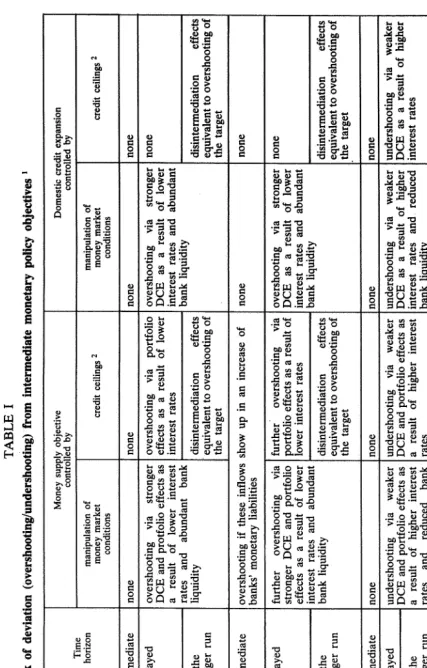
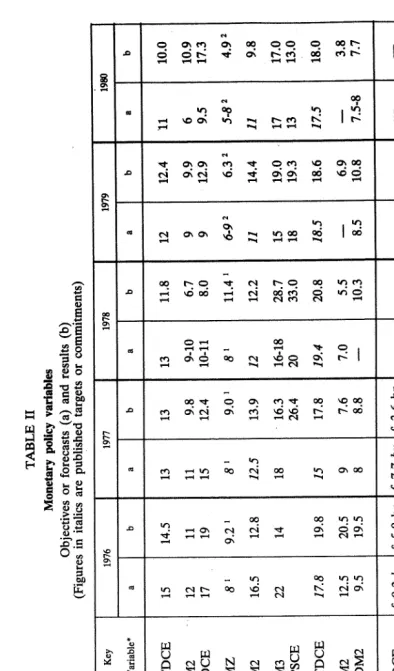
EMS exchange rate commitments. Monetary targets were met with relative accuracy in
the past two years (see the attached Table II), and the EMS exchange rate mechanism has
been maintained with
stabilization of exchange rates. Although this required fourrealignments, only two were general. Those monetary policy measures that were
neces-sary could be reversed after a while or proved to be necessary also for domestic
reasons. In the EMS, which covers a more varied group of countries than in the 'snake
economic performance was however more divergent.
Speculative capital movements based on expectations of a realignment of EMS central rates
occurred only during limited periods. In the summer of 1979 the Deutsche Mark came
under upward pressure as a result of the continuing uncertainty surrounding the exchange
rate of the US dollar and rumours of a parity realignment in connection with the review of some provisions of the EMS six months after its start. These flows may have been
accentuated by interest rate rises in Germany intended to avoid any excessive expansion of monetary aggregates which would have accommodated the inflationary impact of the energy
price increase. Whereas Germany succeeded in reducing the monetary impact of these
flows through sterilization measures, other countries, especially Belgium and Denmark, had
to tighten
their monetary
policies in order todefend their
currencies. After therealignment in September 1979 the tensions eased and the higher level of interest rates in
Germany s partner countries was considered necessary also for domestic reasons or was
considered unavoidable in view of the rise in US interest rates.
The weakness of the DM within the EMS exchange rate mechanism during the autumn of 1980 and the beginning of 1981 reflected several domestic and external developments.
Domestically, the Bundesbank did not allow monetary conditions to tighten in response to
interventions on foreign
exchange marketssince it regarded the
interest-rate related1 Interventions in EEC currencies from the beginning of the EMS until August 1981 amounted to the equivalent of more than USD 30
thousand million whereas interventions in USD (which also in part assist cohesion of EMS currencies) totaUd over USD 20 thousand
strengthening of the US dollar as a temporary phenomenon. Moreover, by early autumn
the domestic inflation rate had been brought down to a more acceptable level while the real
economy was somewhat weaker than expected.
The Bundesbank only changed its policy of offsetting all outflows of funds at unchanged interest rates when , in February, the Deutsche Mark suffered a new bout of weakness and it
became clear that a number of factors , including the persistant weakness of the German
current account also reflecting a loss of international market share and increasing import
penetration of the domestic market the lack of progress in energy policy and the Federal
Republics exposed political situation
, had led to
changes in market assessment of theDMIUS dollar exchange rate. In addition, the rise in import prices since mid-1980 had
begun to raise inflationary
expectations at home, while
recognition of re-acceleratingGerman inflation as well as the deterioration in the current account due to J-curve effects
contributed to the unfavourable shift in exchange market expectations against the Deutsche
Mark. The particular weakness of the Deutsche Mark , not only against the US dollar but
also against most other EMS currencies, meant that the period was marked by a fully
stretched EMS band, with the French franc generally at the top and by periodic intervention.
Speculative downward pressures on the French franc in May 1981 caused some conflicts not
only in France, which had to take drastic measures to stop speculation, but also in some
other EMS countries. The sale of Deutsche M~rk in support of the French franc did not
directly threaten the stance of German monetary policy. Nevertheless, at a time of
particularly high and rising US interest rates, it contributed to a further weakening of the
DM/US dollar exchange rate and the EMS band underwent a further depreciation vis-a-vis
the US dollar, which was already .at a higher level than thought desirable by some EMS countries. The conflict was, however, only temporary because the French policy measures
had a rapid effect on the exchange markets.
Tension because of pronounced expectations of EMS central rate realignments was thus
confined to fairly limited periods although divergence in economic performance
persis-ted. In
other periods, however, it could be held that the very stability of exchange rateexpectations led to undesirable capital movements , necessitating exchange market interven-tion , the reason being that nominal interest rate differentials were not offset by expectainterven-tions
of central rate realignments. In other words market participants thought they could take
advantage of prevailing high interest rates in high inflation countries without at least in
the short run
running a risk of
losing on the exchange rate.In the event there were only a few occasions affecting Denmark and Italy in 1979 and
France and Ireland in 1980- when domestically determined interest rate levels caused
disturbing capital inflows, and then solutions were generally rapidly found. In Denmark a temporary ban on the sale of government bonds to non-residents was introduced and after a while foreign demand for mortgage bonds also dwindled. France and Ireland had recourse
to measures sterilizing the expansionary effect on money market conditions of foreign
exchange inflows and discouraging further capital imports. In Italy, on the other hand, the
authorities accepted the easing of domestic monetary conditions in order not to strengthen the upward pressure on the lira , but the main motivation may have been the desire to favour
the pick up of economic activity after a
protracted period of low output and
highunemployment.
Similarly, the fact that intra-EMS capital flows have in some periods been guided mainly by nominal interest rate differentials has only rarely caused conflicts in those countries where
low inflation rates might be expected to warrant relatively low interest rates. Throqghout