Rochester Institute of Technology
RIT Scholar Works
Theses
Thesis/Dissertation Collections
8-1-1980
The effect of development temperature on Kodak
PR 10 instant print product using a comparative
system modulation transfer function for analysis
Jon E. Van Tassell
Follow this and additional works at:
http://scholarworks.rit.edu/theses
This Thesis is brought to you for free and open access by the Thesis/Dissertation Collections at RIT Scholar Works. It has been accepted for inclusion
in Theses by an authorized administrator of RIT Scholar Works. For more information, please contact
.
Recommended Citation
THE EFFECT OF DEVELOPMENT TEMPERATURE ON
KODAK PR
l~
INSTANT PRINT PRODUCT USING
A COMPARATIVE SYSTEM MODULATION
TRANSFER FUNCTION FOR ANALYSIS
by
Jon
E.
Van Tassell
B.A. State University of New York at Binghamton
(1978)
A thesis submitted in partial fulfillment
of the requirements for the deQree of
Master of Science in the School of
Photographic Arts and Sciences in the
College of Graphic Arts and Photography
of the Rochester Institute of Technology
August, 1980
Signature of the Author ...•... , ....
Photographic Science
and Instrumentation
ROCHESTER INSTITUTE OF TECHNOLOGY
COLLEGE OF GRAPHIC ARTS ANO PHOTOGRAPHY
PERMISSION FORM
Title of Thesis:
The Effect of Development on Kodak PR lOr
Instant Print Product Using a Comparative System Modulation
Transfer Function for Analysis.
I •
_ _"-J"-o-"n~E-,-.--,-V"-a""n--,-T"a,,s,,s,,e..:.l..:.l
hereby
grant permission to the Photographic Science and
Instrumentation Division, of R.t.T., to reproduce my thesis
in whole or in part.
Any reproduction will not be for
commercial use or profit.
(signature)
School of Photographic Arts and Sciences
Rochester Institute of Technology
Rochester, New York
CERTIFICATE OF APPROVAL
MASTER'S THESIS
The Master's Thesis of Jon E. Van Tassell
has been examined and approved
by
the thesis committee as satisfactory
for the thesis requirement for the
Master of Science degree
D~·.· Ed~~~d'
M:'
G~~~it~;.···
...
Professor John F. Carson
...
Or. Robert L. Lamberts
THE
EFFECT
OF
DEVELOPMENT
TEMPERATURE
ON
KODAK
PR
10^ INSTANT
PRODUCT
USING
A
COMPARATIVE
SYSTEM
MODULATION
TRANSFER
FUNCTION
FOR
ANALYSIS
by
Jon
E
.Van
Tassel 1
Submitted
to
the
Photographic
Science
and
Instrumentation
Division
in
partial
fulfillment
of
the
requirements
for
the
Master
of
Science
degree
at
the
Rochester
Institute
of
Technology
ABSTRACT
The
effects
of
temperature
of
development
upon
the
final
image
quality
of
Kodak
PR
lO^were
investigated.
Image
quality
was
defined
as
a
Modulation
Transfer
Function
obtained
using
a
Square
Wave
Log
Periodic
target
for
quanti
tative
analysis.
Analysis
of
Variance
tables
were
used
to
separate
experimental
error
from
actual
temperature
related
variability.
With
a
confidence
level
of
99%
the
temperature
of
development
was
found
to
affect
the
Modulation
Transfer
Function
of
this
product.
With
temperatures
below
48the
effect
was
greater
than
with
temperatures
above
78
but
not
relative
gamma,
change
in
density
maximum
and
change
in
relative
speed
points
over
much
of
the
temperature
range
ACKNOWLEDGEMENTS
The
author
expresses
his
appreciation
to
his
thesis
advisor,
Dr.
Edward
M.
Granger
of
the
Eastman
Kodak
Company,
for
suggesting
the
original
topic
and
for
providing
guidance
throughout
this
research.
Thanks
are
also
extended
to
the
Eastman
Kodak
Company
for
supplying
materials
and
equipment
which
aided
in
simplifying
certain
aspects
of
this
subject.
General
thanks
are
extended
to
many
of
the
students
and
faculty
of
the
Rochester
Institute
of
Technology
for
many
fruitful
discussions
and
suggestions.
Finally,
special
thanks
to
my
wife
and
family,
without
whom
much
of
what
follows
would
not
have
been
possible.
TABLE
OF
CONTENTS
LIST
OF
TABLES
Page
iv
LIST
OF
FIGURES
Page
v
INTRODUCTION
Page
1
HISTORICAL
BACKGROUND
Page
4
THEORETICAL
BACKGROUND
Page
16
HYPOTHESES
Page
22
PROCEDURE
Page
25
DISCUSSION
Page
30
RECOMMENDATIONS
Page
40
SUMMARY
Page
42
REFERENCES
Page
44
APPENDIX
Page
47
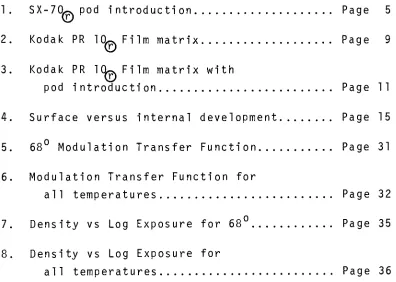
LIST
OF
TABLES
1.
ANOVA
Data
Comparing
All
Temperatures
Page
48
2.
ANOVA
Data
Comparing
Each
Temperature
Individually
to
the
68Fahrenheit
Data..
Page
49
3.
Modulation
Data
and
Mean
for
36
,48
and
57
Fahrenheit
Page
50
4.
Modulation
Data
and
Mean
for
68and
78Fahrenheit
Page
51
5.
Modulation
Data
and
Mean
for
88
Fahrenheit
Page
52
6.
Mean
Densities
for
Relative
Exposure
and
Temperature
Levels
Page
53
LIST
OF
FIGURES
1.
SX-70^-v
pod
introduction
Page
5
2.
Kodak
PR
ICUFilm
matrix
Page
9
3.
Kodak
PR
10^
Film
matrix
with
pod
introduction
Page
11
4.
Surface
versus
internal
development
Page
15
5.
68Modulation
Transfer
Function
Page
31
6.
Modulation
Transfer
Function
for
all
temperatures
Page
32
7.
Density
vs
Log
Exposure
for
68
Page
35
8.
Density
vs
Log
Exposure
for
[image:10.556.82.478.187.469.2]INTRODUCTION
In
recent
years
there
has
been
an
increase
in
the
quality
and
quantity
of
instant
films
and
cameras.
These
products
have
not
only
been
found
in
the
amateur
photographer's
photo
album
but
also
in
the
professional
photographer's
arsenal
of
equipment.
The
ease
of
operation
and
the
relatively
"instant"verification
of
exposure
have
made
these
products
popular
for
amateurs,
as
well
as
professionals.
The
verification
of
subject
matter
is
also
extremely
important
for
the
use
of
these
products
in
scientific
recording
applications.
The
inroads
that
these
products
have
made
into
the
commercial
market
is
best
exemplified
by
the
attention
that
the
Eastman
Kodak
Company
of
Rochester,
New
York,
has
recently
shown
to
this
area
of
the
market,
the
introduction
of
several
cameras,
a
professional
film
back,
ancillary
accessories
and
"instant"color
print/film.
The
quality
of
the
photographic
image
is
always
important
whether
it
is
used
as
an
artistic
instrument,
visual
notebook
or
memorabilia
recorder.
Unfortunately
it
has
not
proved
easy
to
define
a
"quality"image
in
qualita
tive
terms,
not
to
mention
objective
quantitative
analysis.
of
development
temperature
on
the
final
quality
of
a
photo
graphic
system
some
means
of
quantifying
these
results
had
to
be
chosen.
A
straight
forward
method
of
correlating
image
quality
to
the
System
Modulation
Transfer
Function
(SMTF)
of
a
photographic
system
was
presented
in
a
paper
by
E.M.
Granger
and
K.N.
Cupery.
Use
of
the
Subjective
Quality
Factor
(SQF)
mentioned
in
this
paper
was
not
made
but
the
square
wave
log
periodic
target
and
its
use
to
approximate
the
SMTF
of
a
photographic
system
was
used.
This
method
proved,
in
this
study,
to
be
an
extremely
easy
to
use
and
rapid
means
to
quantify
a
measure
of
system
performance
or
quality.
To
remove
any
possible
variability
introduced
to
this
study
by
specific
techniques
used,
all
SMTF
comparisons
were
made
to
a
set
of
"standard"SMTF's
generated
at
room
temperature.
This
standard
was
then
statistically
compared
to
SMTF's
generated
at
variable
temperatures
and
found
to
be
significantly
different.
These
differences
were
found
to
be
greater
than
error
could
account
for
and,
since
all
other
parameters
were
constant,
the
differences
were
attributed
to
the
temperature
variability
with
a
confidence
of
greater
than
99%.
Also
since
the
characteristics
of
the
film
changed
with
tempera
ture
a
comparison
was
made
of
density
versus
relative
log
exposure.
These
comparisons
show
a
change
in
the
density
obtained
from
a
constant
exposure
and
a
variable
development
temperature.
There
was
also
found
to
be
a
dependence
of
These
two
factors
would
also
produce
a
relative
speed
change
with
temperature
since
for
any
relative
exposure
a
variable
density
level
would
be
produced.
All
analysis
was
to
visual
response
only
but
purely
objectively,
color
shift
did
not
HISTORICAL
BACKGROUND
In
May
1973,
Dr.
Edwin
H.
Land
gave
a
paper
before
the
Royal
Photographic
Society
about
a
new
"Absolute
One-Step
Photography
System".
This
paper
was
later
reprinted
in
p
The
Photographic
Journal
and
described
in
some
detail
the
Polaroid
SX-7 0^.
i
nstant
color
system.
This
project
is
not
overly
concerned
with
the
general
optical
and
mechanical
aspects
of
this
system
except
where
they
apply
directly
to
the
pod
rupture-development
phase
and
will
therefore
delete
these
aspects
from
this
description.
The
SX-7CU.
f i lm/pri
nt
contains
15
or
more
layers
(Figure
1)
before
the
pod
is
introduced
into
the
matrix.
Exposure
is
made
through
a
transparent
sheet,
polymeric
acid
layer
and
a
timing
layer.
The
emulsion
is
negative
working
in
nature
with
the
reversal
step
being
introduced
by
immobilizing
the
dye-developer
local
to
an
exposed
and
developed
silver
halide.
The
steps
leading
to
this
reversal
begin
with
the
exposure
within
the
camera
body
itself.
The
final
step
of
the
exposure
cycle
is
to
eject
the
film/print
between
motorized
transport
rollers
which
rupture
a
pod
containing
opacifiers,
water
and
potassium
hydroxide
among
other
proprietary
species.
The
pod
contents
now
have
been
co
S-
S-<u o S- s- 4->
>>
H-> s- s- CD CD S- CD4->
n3 rC <d <D >-. Q. CD S- CD CD _J >
>>
Q- IO O>)
CD JCOJ -o f e
(O O _J i ro Q- oo
-E
1
Sh-cr. -l-> o
i i CD _l O
OO u Ol e cj 1 CD CD > i T3
<
>>
t=C CO <D > > CD CD CD CD 4-> IO > IO > CD S- I O S- > > -(->
E o _1 i
o3 S- i
Q CD +-> CD i CD E
CD 1
OJ .O (-> CJ
r-CD O +J Q CD
Sa s- C7> o -l->
lO r CD
(O co
>>
ro iE
na CD E CD e 1 l/l >-, Q. e Q Q. co CD CT> o
E
arCC CD i E Q
in CD m e
>>
T-to >-.
E
E
+-> OJ Ul rO CD Q o_e 1 r e 01 e
00
2
4-> m(t5 o r- 1 t
=C O E e e -it-:
i_ d- Q_ CD i CD CD T3 rO o
1 OJ 3 i CD cri CD
>>
ro C7> <D i CD S- rO q: CJ i03 l-> CO >- CD
is
CQE
i-i i -E3
S-CD
S- S- -!->
S- S- CD <D S- CD
-f-> CD CD
>>
L-L. CD S- CD CD s->>
O. ro O>,
CD XICD "O CD e lO O _l i (O O- in
-E 1
s.
>>
o _l i CD _l O00 o CD rd a| CD CD > 1 -a
<c
>5
_l </) CD > > CD CD CD Oi 4-> ro (O > CD S- iQ s- > > +->
E o _l CD S-t
Q CD A-> a> t CD E
CD .f E XI -t-> U r CD
o -4-> Q CD
S- s- O) #l ta i CD
ro co
>,
(O iE
<o CD e > i CO >-. Q. E Q Q. to CD CT> Q-
E
ia|
'
a| E Q OO CD OO E >- f|
co
>>
E
CD -f-> CD OO ro CD Q D.e CJ e OO
2
-l-> 00ro O 1 CD -=c O c E E ^
S- O- CC CD i CD CD -a ro CJ
1 ZH i CD U) CD
>>
ro1 CD s- O cc C_) i
CQ >- CLD
2:
CQ#r--and
an
anti
-abrasion
layer
covering
the
negatives.
Even
distribution
is
insured
by
the
precision
parallel
rollers
and
a
slight
curve
introduced
as
the
film
is
ejected
through
these
rol
1
ers
.The
potassium
hydroxide
now
becomes
extremely
impor
tant
since
it
acts
not
only
to
solubilize
the
"auxiliary"developer
and
initiate
the
first
developer
action
but
also
it
migrates
to
the
timing
layer
and
eventually
the
polymeric
acid
layer
where
the
potassium
reacts
in
an
exchange
reaction
with
hydrogen.
This
reaction
produces
the
desir
able
byproduct,
water,
which
now
aids
to
keep
the
entire
process
in
motion.
This
"removal"of
the
hydroxide
ion
causes
a
drop
in
the
pH
of
the
film
matrix
which
reduces
the
synergistic
opacifier
density
by
reducing
the
optical
density
of
the
phthalein
dye.
Both
the
"auxiliary"and
dye
developers
are
hydroquinone
(HpQ)
derivatives
and
remain
in
the
film
upon
completion
of
the
image
formation.
The
dye
developer
becomes
essentially
inactive
with
the
pH
drop
due
to
immobility
but
the
"auxiliary"developer
retains
its
mobility
to
continue
developing
any
grains
which
have
not
been
developed
and
were
exposed.
This
continues
until
the
pH
lowers
such
that
the
developer
can
no
longer
reduce
a
latent
image
at
which
point
it
becomes
inactive
if
not
immobi 1
e
.The
image
itself
is
formed
in
three
separate
layers.
layers
to
prevent
interactions
between
the
layers.
For
unexposed
regions
the
dye
developer
is
not
oxidized
and
therefore
remains
mobile
to
contribute
yellow,
magenta
and
cyan
respectively
from
the
blue,
green
and
red
sensitive
layers.
Conversely
where
each
layer
is
exposed
the
latent
image
is
reduced
by
the
"auxiliary"developer
which
in
turn
oxidizes
the
dye
developer.
This
reduces
the
mobility
of
this
species
to
such
an
extent
that
for
all
practical
3
purposes
it
is
immobile.
In
summary
this
product
is
a
negative
working
emulsion
with
a
reversal
step
introduced
by
localized
dye
immobility.
Exposure
is
through
the
front
portion
of
the
film
matrix
as
is
the
final
viewing.
This
necessitates
an
exposure
juxtaposition
incorporating
a
mirror
to
correct
left-right
handedness.
This
of
course
was
resolved
brilliantly
with
the
SX-7C>-n
si ngle
alens
reflex
camera.
The
introduction
by
the
Eastman
Kodak
Company
of
a
new
instant
print/film
and
camera
was
described
in
a
paper
by
4
W.T.
Hanson
Jr.
published
in
July
1976.
This
paper
describes
the
instant
print/film
in
some
detail,
including
some
of
the
essential
chemistry
steps
involved.
Although
similar
in
many
aspects
the
Kodak
product
has
many
pronounced
differences
which
show
an
alternate
approach
to
a
similar
problem.
It
is
due
to
this
new
approach
that,
I
feel,
will
make
the
Kodak
product
more
readily
adaptable
8
It
is
with
this
in
mind
that
this
study
was
directed
towards
some
of
the
limitations
of
this
product,
in
particular
the
effect
that
temperature
during
development
will
have
on
the
final
System
Modulation
Transfer
Function
(SMTF)
as
an
indicator
of
quality.
On
a
gross
level
the
Kodak
product
is
a
direct
reversal
emulsion
which
is
exposed
through
the
back
and
viewed
from
the
front.
This
eliminates
any
handed
ness
problems
and
enables
simplified
camera
use
and
adaptation
to
many
situations
with
little
ingenuity.
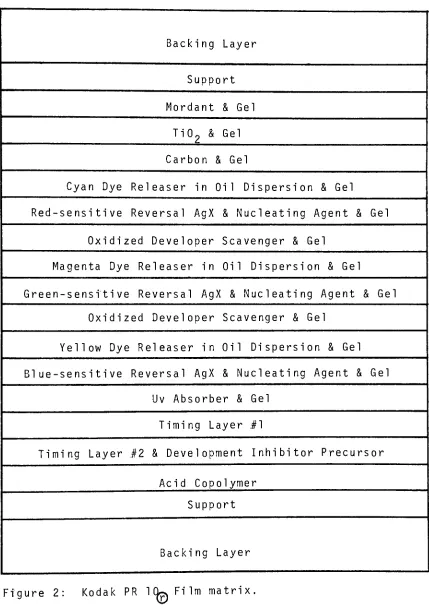
The
basic
film
matrix
of
the
Kodak
color
film/print
product
contains
in
excess
of
twenty
layers,
(Figure
2).
Exposure
of
the
film
is
through
the
backing
layer,
an
Estar
support,
an
acid
copolymer
layer,
two
timing
layers
and
an
ultraviolet
radiation
absorber
layer.
There
may
also
be
an
additional
layer
between
the
ultraviolet
absorber
and
timing
layer
number
one
which
may
act
as
an
anti
-abrasive
,or
the
ultraviolet
absorber
may
perform
this
dual
function.
All
of
the
layers
except
the
absorber
layer
could
be
called
a
cover
sheet
since
they
cover
the
image
forming
section
before
the
pod
is
introduced.
The
backing
layer
performs
a
dual
function,
it
is
used
to
maintain
the
flatness
of
the
matrix
before
and
after
the
exposure
but
can
also
be
used
as
a
corrective
filter.
This
correction
filter
can
be
used
to
correct
color
balance
and
with
the
appropriate
filter
choice
Backing
Layer
Support
Mordant
&
Gel
Ti02
&
Gel
Carbon
&
Gel
Cyan
Dye
Releaser
in
Oil
Dispersion
&
Gel
Red-sensitive
Reversal
AgX
&
Nucleating
Agent
&
Gel
Oxidized
Developer
Scavenger
&
Gel
Magenta
Dye
Releaser
in
Oil
Dispersion
&
Gel
Green-sensitive
Reversal
AgX
&
Nucleating
Agent
&
Gel
Oxidized
Developer
Scavenger
&
Gel
Yellow
Dye
Releaser
in
Oil
Dispersion
&
Gel
Blue-sensitive
Reversal
AgX
&
Nucleating
Agent
&
Gel
Uv
Absorber
&
Gel
Timing
Layer
il
Timing
Layer
#2
&
Development
Inhibitor
Precursor
Acid
Copolymer
Support
Backing
Layer
Figure
2:
Kodak
PR
ICUFilm
matrix
[image:19.556.65.494.72.680.2]10
solution
and
probably
neutralizes
it
in
a
similar
reaction
to
that
of
the
Polaroid's
with
water
as
a
desirable
byproduct.
The
copolymer
layer
must
be
able
to
reduce
the
alkalinity
from
a
pH
14
to
approximately
a
pH
of
4
to
5.
This
effectively
ceases
any
further
development
or
motion
of
the
mobile
species
present
in
this
product.
To
maintain
the
correct
timing
from
the
beginning
of
the
hydroxide
introduction
to
the
final
print,
two
timing
layers
are
needed.
These
layers
retard
the
hydroxide
ion
motion
through
them
by
a
charge
related
permeability
control,
The
layer
next
to
the
copolymer
layer
also
contains
a
development
inhibitor
precursor
which
is
released
by
the
hydroxide
presence.
This
hydrolyzed
developer
inhibitor
now
diffuses
throughout
the
negative
portion
of
the
film
matrix
and
restrains
any
further
development
of
the
remaining
silver
halide.
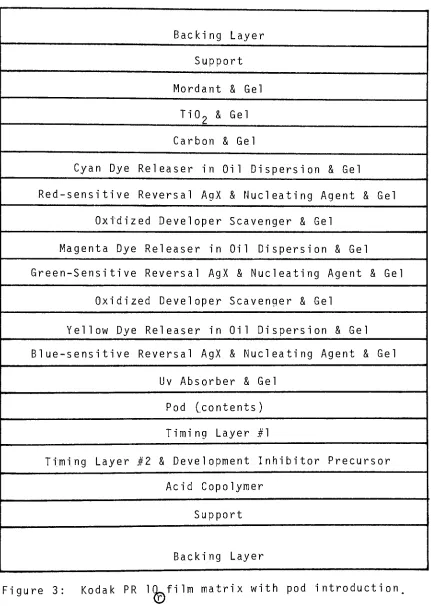
The
next
section
of
the
film
matrix
is
introduced
during
the
ejection
of
the
film
through
a
set
of
rollers.
These
precision
rollers
spread
a
thin
layer
of
the
pod
contents
between
the
ultraviolet
absorber
layer
and
the
number
one
timing
layer
(Figure
3).
The
pod
contains
the
developing
agent
(a
phenidone
derivative),
carbon
(to
seal
the
matrix
into
a
light
tight
"darkroom"),
water
and
thickener
(to
provide
a
liquid
medium
of
the
proper
viscosity
for
all
phases
of
the
process),
sodium
sulfite
and
11
Backing
Layer
Support
Mordant
&
Gel
Ti02
&
Gel
Carbon
&
Gel
Cyan
Dye
Releaser
in
Oil
Dispersion
&
Gel
Red-sensitive
Reversal
AgX
&
Nucleating
Agent
&
Gel
Oxidized
Developer
Scavenger
&
Gel
Magenta
Dye
Releaser
in
Oil
Dispersion
&
Gel
Green-Sensitive
Reversal
AgX
&
Nucleating
Agent
&
Gel
Oxidized
Developer
Scavenger
&
Gel
Yellow
Dye
Releaser
in
Oil
Dispersion
&
Gel
Blue-sensitive
Reversal
AgX
&
Nucleating
Agent
&
Gel
Uy
Absorber
&
Gel
Pod
Ccontents)
Timi ng
Layer
#1
Timing
Layer
J2
&
Development
Inhibitor
Precursor
Acid
Copolymer
Support
Backing
Layer
[image:21.556.64.495.70.676.2]12
retard
emulsion
fog formation)
and
potassium
hydroxide
(which
acts
to
raise
the
pH
of
the
entire
matrix
as
it
permeates
through
to
approximately
14).
The
hydroxide
ion
triggers
not
only
the
latent
image
development
but
also
the
development
inhibitor
to
stop
this
development.
Finally
with
the
removal
of
the
hydroxyl
ion
from
solution
and
the
corresponding
lowered
pH
all
remaining
species
are
immobi 1 ized
.The
last
section
of
the
film
matrix
is
the
integral
imaging
receiver
and
can
be
reduced
to
two
separate
layers
for
simplification.
The
first
group
of
layers
is
comprised
of
the
image
forming
section
and
includes
a
total
of
nine
layers.
There
are
three
direct
reversal
emulsion
layers,
red,
green
and
blue
sensitive.
These
emulsions
have
complementary
dye
releaser
in
oil
dispersion
layers,
cyan,
magenta
and
yellow
respectively.
The
three
direct
reversal
emulsion
layers
also
contain
a
nucleating
agent
which
aids
unexposed
silver
halides
obtain
a
superficial
"fogging"or
"nucleation"that
is
subsequently
reduced
to
silver
5
metal
by
an
appropriate
surface
developer.
In
the
case
of
the
Kodak
product
this
surface
developer
is
a
phenidone
derivative.
Thus
unexposed
regions
yield
oxidized
develop
ing
agent
(an
Electron
Transfer
Agent
(ETA))
which
in
turn
migrates
to
the
adjoining
dye
releaser
layer
where
it
now
oxidizes
a
dye
releaser.
This
transfer
of
an
electron
"rejuvenates"
13
ETA,
while
the
mobile
dye
releaser
is
later
hydrolyzed
to
yield
a
mobile
dye.
Scavenger
layers
between
the
emulsion
layers
(two
in
total)
act
to
"capture"any
oxidized
developer
(ETA)
and
stop
any
chance
of
unwanted
color
spread
The
final
remaining
layer
is
the
ultraviolet
absorber
layer
which
acts
to
reduce
the
effective
ultraviolet
sensitivity
of
the
emulsion.
The
second
group
of
layers
are
the
image
receiving
layers.
These
include
a
carbon
layer
to
seal
the
rest
of
the
matrix
into
a
light
tight
"darkroom",
titanium
dioxide
to
provide
a
white
background
for
the
image,
a
mordant
layer
to
act
as
a
dye-image
receiver,
a
support
layer
to
provide
overall
rigidity
and
a
backing
layer
similar
to
the
one
on
the
cover
sheet
section.
The
mordant
layer
is
comprised
of
a
group
of
positively
charged
monomers
linked
together
to
form
a
polymer
layer.
This
positively
charged
layer
forms
ionic
bonds
with
the
negatively
charged
dyes
and
additionally
holds
these
molecules
by
van
der
Waal's
forces.
This
is
a
"permanent"
bonding
providing
a
final
image
which
is
light
"fast".
The
general
color
balance
of
this
instant
film/print
product
is
"daylight",
yielding
sensitivity
from
the
low
four
hundred
nanometers
to
approximately
six
hundred
eighty
nanometers.
This
produces
an
emulsion
with
an
exposure
index
of
150
reasonably
fast
for
a
reversal
instant
color
14
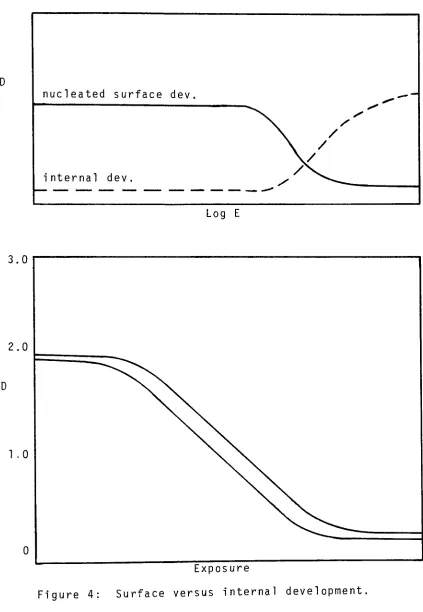
direct
reversal
emulsion
there
is
an
interesting
nucleated
surface
development
and
internal
development
relationship.
(Figure
4).
Thus
with
the
increased
developing
time
there
is
a
decrease
in
the
nucleated
surface
development
produced
density
with
an
inverse
internal
development
density
increase.
With
no
exposure
this
yields
a
maximum
density
of
slightly
under
2.0
and
a
minimum
density
of
pure
titanium
white.
The
lower
portion
of
Figure
4
shows
a
plot
of
red,
green
and
blue
density
versus
exposure
of
a
neutral
step
tablet
exposed
to
produce
a
neutral
gray.
In
summary
this
product
is
a
direct
reversal
working
emulsion
which
produces
a
final
color
via
an
Electron
Transfer
Agent
(ETA).
Exposure
is
through
the
back
of
the
product,
while
the
final
is
viewed
from
the
front.
This
has
eliminated
any
limitations
due
to
handedness
considerations,
although
probably
at
the
expense
of
addi
tional
film
design
complexity.
Total
processing
time
is
impossible
to
estimate
without
extensive
analysis
but
the
image
appears
90%
complete
within
10
minutes.
Final
image
stability
takes
longer
but
is
complete
within
a
24
hour
period.
These
times
are
at
"room
temperatures"and
will
be
15
nucleated
surface
dev
internal
dev,
Log
E
Exposure
[image:25.556.66.489.80.692.2]16
THEORETICAL
BACKGROUND
The
effects
of
temperature
variation
on
the
rates
of
chemical
reactions
are
in
many
cases
extremely
profound.
A
general
rule
of
thumb
being
that
as
the
temperature
increases
the
rate
of
the
reaction
increases.
This
rule
of
thumb
also
seems
to
hold
well
for
photographic
development
8,9,10,1
1,12,13
, . , , . . . .and
is
so
well
known
that
it
is
incorporated
in
many
black
and
white
film
data
sheets
14
Further
investigations
show
that
not
only
is
the
development
rate
affected,
but
other
photographic
rates
as
well,
including
8
1 5
for
instance
fixation
'and,
of
extreme
importance
to
this
study,
the
rate
of
diffusion
of
the
photographically
active
species
and
their
products.
The
complete
detailed
study
of
the
diffusion
chemistry/
physics
would
in
itself
be
a
thesis
topic,
if
not
a
lifes'study.
Since
this
paper
is
concerned
only
with
the
affects
of
the
temperature
of
development
on
the
final
System
Modulation
Transfer
Function
(SMTF),
the
diffusion
theory
will
be
discussed
only
where
it
applies
to
the
formation
of
the
hypothesis.
The
diffusion
of
the
photographically
active
species
within
this
film
matrix
(Figure
3)
will
be
broken
into
two
17
species
and
the
diffusion
of
the
oxidized
developer
to
the
corresponding
dye
releaser
layer
and
subsequent
migration
of
the
dye
to
the
image
receiver
or
mordant
layer.
Diffusion
rates
are
related
to
many
factors
which
are
in
turn
related
to
the
type
of
diffusion
mechanism
which
controls
the
molecular
motion.
Concentrations
of
ions,
salts,
pH,
electrical,
vacancy
density,
as
well
as
purely
gross
physical
constraints,
can
affect
the
diffusion
rates
providing
driving
forces
or
retardation
to
the
final
state
of
equilibrium.
With
the
introduction
of
the
pod
contents
the
immediate
effect
with
decreasing
temperature
will
be
a
change
in
viscosity
of
the
solvents.
This
will
physically
limit
the
mobility
of
all
the
active
species.
The
effect
will
probably
be
most
noticeable
upon
the
mobility
of
the
physically
larger
molecules.
This
means
that
the
mobility
of
the
hydroxide
ion
will
probably
be
the
least
impaired.
Since
this
ion
sets
the
"clock"for
the
start
and
finish
of
the
image
forming
processes
there
should,
indeed,
be
a
variable
amount
of
density
produced
as
the
temperature
deviates
from
the
optimum
conditions
for
which
this
emulsion
was
designed.
Also
since
the
largest
species,
the
dye
releaser
molecules,
will
also
have
to
diffuse
through
longer
path
lengths
due
to
the
physical
positions
of
their
respective
layers,
you
would
expect
density
to
be
reduced
with
the
yellow
dye
first,
magenta
second,
and
finally
the
18
red
exposures
one
would
expect
reduced
overall
density
starting
with
the
yellow
dye
portion
of
the
green
and
red
exposures,
followed
by
the
magenta
dye
portion
of
the
red
and
blue
exposure
and,
finally,
the
cyan
portion
of
the
green
and
blue
exposure.
At
this
point
there
has
been
no
consideration
of
the
directional
component
of
the
diffusion
rate.
Since
this
instant
product
is,
in
photographic
terms
at
least,
an
extremely
thick
film
through
which
the
dye
molecule
and
the
corresponding
Electron
Transfer
Agent
(oxidized
developer)
must
diffuse
through
to
find
the
"correct"mordant
or
dye
releaser
location,
there
must
be
a
prefer
ential
directionality
to
the
diffusion
rates.
This
is
to
say
that
the
diffusion
rates
toward
the
mordant
layer
(or
away
from
it)
are
probably
at
room
temperature
more
rapid
than
the
lateral
diffusion
rates.
This
is
important
to
maintain
the
proper
spread
function
for
visual
image
quality.
Without
this
constraint
the
chemical
spread
function
could
transform
the
optical
spread
function
into
an
unintelligible
blur
function.
Thus
the
basis
for
my
hypothesis
is
that
there
are
two
different
diffusion
rates,
purposely
introduced
or
not,
and
that
these
rates
will
be
differentially
temperature
dependent.
This
effect
will
be
detectable
as
a
dependence
of
System
Modulation
Transfer
19
The
use
of
a
Modulation
Transfer
Function
(MTF)
as
an
indicator
of
photographic
image
performance
has
been
well
documented
in
recent
years.18
Although
difficulties
have
been
found
with
both
macroscopic
and
microscopic
response
non-linearities,
as
discussed
in
a
paper
by
O.H.
Schade.
20
The
work
of
Lamberts
using
the
density
versus
log
exposure
curve
to
ascertain
the
"effective
exposure"has
removed
most
of
the
macroscopic
non-linearities
and
by
choosing
"correct"developers
to
reduce
or
eliminate
adjacency
effects
and
other
micro
non-linearities.
Ideally,
with
the
elimination
of
all
non-linearities,
the
Modulation
Transfer
Function
is
independent
of
both
exposure
and
development
time.
Unfortunately
in
many
cases,
if
not
most,
it
is
either
impractical
or
impossible
to
remove
all
non-linear
effects.
Fi
?
1
"?"?
"?"\
A
proposal
by
Kelly
'and
several
other
investigators
' ,include
an
additional
transfer
function
to
describe
these
non-linearities
has
proved
effective
if
not
difficult
to
derive.
The
obvious
advantages
of
Modulation
Transfer
Functions
(MTFs)
are
that
assuming
linear
systems
they
can
be
multiplied
together
to
form
a
System
Modulation
Transfer
?4
Function
(SMTF).
This
provides
a
greater
degree
of
objectivity
than
resolution
does
and
provides
a
superior
measure
of
system
or
component
performance
by
ascertaining
contrast
of
reproductionover
an
extended
frequency
range
20
with
non-linear
effects
present
a
Modulation
Transfer
Function
relative
to
an
exposure
and
development
condition
similar
to
those
that
will
be
used
in
actual
applications
make
it
extremely
useful
still.
This
has,
of
course,
been
recognized
by
film
manufacturers
who
now
provide
Modulation
Transfer
Function
information
on
many
of
their
film
products
.One
of
the
major
drawbacks
with
Modulation
Transfer
Function
(MTF)
measurements
has
been
in
producing
an
easy
method
of
exposing
the
film
with
the
appropriate
target.
The
utilization
of
an
edge
trace
and
subsequent
Fourier
transform
of
the
line
spread
function
derived
from
this
edge
trace
provides
a
function,
the
modulus
of
which
is
the
27
Modulation
Transfer
Function
(MTF).
Another
method
employs
the
production
of
a
sinusoidal
intensity
exposure
26
incident
upon
the
film
This
has
yielded
many
methods
in
an
attempt
to
side
step
the
practical
problems
which
have
2
fi
been
encountered.
One
of
the
easiest
of
the
practical
solutions
proposed
is
the
use
of
a
log
periodic
target
originally
introduced
by
Sayce
for
resolution
measurements.
Square
wave
target
Modulation
Transfer
Functions
(MTF)
have
since
then
been
used
frequently
but
have
been
shown
to
have
on
p
aQ
1
certain
inaccuracies.
'
Coltman
has
even
devised
a
function
to
"adjust"these
inaccuracies
to
produce
a
more
28
accurate
Modulation
Transfer
Function
CMTF)
21
T(u)
=L-(T'(u)
+
-i-T'(3u)
-iT'(5u)
+
....)
(D
The
use
of
a
square
wave
target
is
made
in
a
study
by
E.M.
Granger
and
K.N.
Cupery
to
calculate
a
purely
quantitative
approximator
to
image
quality.
The
Subjective
Quality
Factor
(SQF)
developed
within
this
study
using
a
log
periodic
square
wave
target
is
the
basis
for
the
use
of
a
similar
target
for
this
study.
The
target
is
a
series
of
bar/space
pairs
which
decreases
in
width
by
the
sequence
given
in
equation
2.
Log(
Wn
)
=Log
WQ
-nC2
(2)
Both
W
and
C^
are
"appropriate"constants
and
n
represents
the
n-th
bar/space
pair.
Thus
it
is
obvious
from
this
equation
where
the
name
Log
Periodic
Target
is
derived
from.
This
target
enables
with
a
single
exposure
to
produce
an
extended
range
over
which
the
system
can
be
evaluated.
It
is
also
interesting
to
note
that
when
the
Subjective
Quality
Factor
(SQF)
is
below
.9and
the
lens
Modulation
Transfer
Function
(MTF)
is
considered
the
actual
energy
distribution
due
to
truncation
is
very
close
to
being
sinusoidal.
Therefore
since
all
analysis
will
be
comparative
between
System
Modulation
Transfer
Functions
for
different
develop
ment
temperatures,
I
feel
that
the
use
of
this
target
is
22
HYPOTHESES
The
purpose
of
this
study
is
to
ascertain
if
the
temperature
at
which
Kodak
PR
10^
instant
film/print
product
is
exposed
and
developed
will
have
an
effect
on
the
final
image.
The
method
of
analysis
will
be
to
compare
the
System
Modulation
Transfer
Function
(SMTF)
generated
from
samples
at
a
series
of
different
development
temperatures.
Further
each
temperature
groups
System
Modulation
Transfer
Function
will
be
compared
to
the
System
Modulation
Transfer
Function
of
a
sixty-eight
degree
Fahrenheit
"control"group.
32
Analysis
of
Variance
(ANOVA)
tables
will
be
used
to
ascertain
variability
and
the
confidence
with
which
results
can
be
quantified.
Finally
the
density
versus
log
exposure
(relative)
curves
will
be
compared
to
ascertain
the
effects
of
temperature
on
the
contrast
or
slope
of
the
straight
line
portion
of
the
curve
and
the
relative
density
produced
at
a
gi ven
exposure
1
evel
.The
initial
hypothesis
which
will
be
investigated
is
that
the
temperature
of
development
of
Kodak
PR
1 0~
will
alter
the
System
Modulation
Transfer
Function
(SMTF)
obtained
using
a
Log
periodic
square
wave
target.
Statis
23
development
of
Kodak
PR
1 CW
will
not
alter
the
System
Modulation
Transfer
Function
(SMTF)
obtained
using
a
Log
periodic
square
wave
target.
The
results
of
this
test
should
immediately
show
if
there
is
an
effect
on
the
final
image,
but
what
that
effect
is
and
if
it
is
consistent
across
the
entire
temperature
range
needs
further
testing.
For
the
next
investigations
the
samples
developed
at
68
Fahrenheit
were
used
as
a
"control"group
to
test
a
series
of
null
hypotheses.
Five
hypotheses
were
investi
gated
which
stated
that
the
SMTF
produced
with
a
68F
development
temperature
is
different
than
the
SMTF
produced
at
the
test
development
temperatures.
To
approximate
a
reasonable
range
over
which
this
product
could
be
used,
I
tested
the
following
five
temperatures;
36,
48,
57,
78
and
finally
88Fahrenheit.
The
null
hypothesis
which
will
be
tested
for
each
temperature
is
that
the
SMTF
produced
at
a
68Fahrenheit
development
temperature
using
a
Log
periodic
square
wave
target
is
not
different
than
the
SMTF
produced
at
the
test
temperature.
The
results
of
these
hypothesis
tests
will
be
analyzed
both
quantitatively
and
qualitatively
to
obtain
overall
system
variability.
The
final
investigation
will
be
to
see
if
the
temperature
of
development
of
Kodak
PR
1 0-s has
an
effect
upon
the
macro
characteristics
of
the
image.
A
comparison
of
the
density
versus
relative
Log
exposure
curves
will
show
24
curve
has
been
affected.
Also
a
purely
qualitative
analysis
will
be
attempted
to
ascertain
if
the
relative
speed
has
been
affected
by
the
development
temperatures
investigated.
Although
any
experiment
can
be
expanded
almost
indefinitely,
I
feel
that
the
scope
of
this
investigation
is
25
PROCEDURE
The
film
under
study
was
Kodak
PR
1
(W
Instant
film,
obtained
directly
from
the
Eastman
Kodak
Company
of
Rochester,
New
York.
The
film
was
fresh
dated
and
from
the
same
emulsion
batch
(11802886).
Immediately
upon
receipt
of
the
film
it
was
stored
within
a
freezer
until
just
prior
to
its
use.
Test
film
was
removed
from
the
freezer
twenty-four
to
forty-eight
hours
prior
to
exposure.
This
time
was
spent
immersed
in
a
temperature
controlled
environment.
The
air
immersion
temperature
was
held
to
within
plus
or
minus
two
degrees
Fahrenheit
with
the
exception
of
the
eighty
-eightdegree
samples
which
were
held
to
plus
one
degree
and
minus
four
degrees.
Cooler
temperatures
were
held
more
constant
simply
because
the
temperature
control
box
was
held
within
a
refrigerator
adjusted
to
approximately
the
range
desired,
enabling
the
control
unit
to
easily
hold
the
final
tempera
ture
adjustment.
Exposure
was
made
within
the
film
holder
at
room
temperature
as
quickly
as
possible
and
returned
to
the
temperature
control
unit
(approximately
45
to
75
seconds
at
room
temperature
before
returning
to
the
development
temperature).
The
film
was
maintained
within
the
control
26
temperature
for
at
least
two
hours
prior
to
microdensi
tometer
scanning.
Exposure
was
made
using
a
Hico-Lite~
3
LT-K
with
four
xenon
flash
tube
heads.
This
unit
provides
a
"daylight
color
balance"and
when
used
at
full
power
a
flash
duration
of
one
five
hundredth
of
a
second.
Exposure
is
consistent
to
within
one
tenth
of
a
stop
or
better
and
the
entire
unit
was
factory
serviced
and
brought
to
within
specification
prior
to
any
exposures.
Since
all
analysis
is
comparative,
any
variability
due
to
the
pecularities
of
a
relatively
short
flash
exposure
should
be
removed.
The
four
flash
heads
were
placed
symetrically
at
forty-five
degree
angles
to
the
optical
axis
(horizontally),
and
plus
or
minus
six
inches
(vertically)
to
the
optical
axis.
The
distance
from
the
target
to
the
flash
heads
was
six
feet
eight
inches,
and
once
they
were
set
up
for
exposure
no
adjustment
to
their
position
was
made.
Proper
exposure
was
adjusted
with
two
optically
flat
inconnel
filters
placed
in
front
of
the
exposing
lens
(parallel
to
the
film
plane).
These
filters
were
Melles
Griot
inconnel
filters
numbers;
03
fng007
(961
-3362)
and
03
fngOl 5
(835-291
7
)
of
.3and
1.0
neutral
density
respectively.
Filters
were
used
to
adjust
the
exposure
to
maintain
a
small
f
number
(f/8)
and
still
use
the
flash
unit
at
full
power,
providing
the
longest
flash
duration.
Since
space
was
at
a
premium
27
have
been
the
simplest
solution.
The
film
was
held
during
actual
exposure
in
a
Kodak
instant