This is a repository copy of Controlled synthesis of monodisperse gold nanorods with
different aspect ratios in the presence of aromatic additives.
White Rose Research Online URL for this paper:
http://eprints.whiterose.ac.uk/82695/
Version: Accepted Version
Article:
Wang, Y, Wang, F, Guo, Y et al. (7 more authors) (2014) Controlled synthesis of
monodisperse gold nanorods with different aspect ratios in the presence of aromatic
additives. Journal of Nanoparticle Research, 16 (12). 2806. ISSN 1572-896X
https://doi.org/10.1007/s11051-014-2806-3
Reuse
Unless indicated otherwise, fulltext items are protected by copyright with all rights reserved. The copyright
exception in section 29 of the Copyright, Designs and Patents Act 1988 allows the making of a single copy
solely for the purpose of non-commercial research or private study within the limits of fair dealing. The
publisher or other rights-holder may allow further reproduction and re-use of this version - refer to the White
Rose Research Online record for this item. Where records identify the publisher as the copyright holder,
users can verify any specific terms of use on the publisher’s website.
Takedown
Controlled synthesis of monodisperse gold nanorods with
1different aspect ratios in the presence of aromatic additives
2Yun Wang • Feihu Wang • Yuan Guo• Rongjun Chen • Yuanyuan Shen •Aijie Guo • Jieying Liu • Xiao Zhang 3
• Dejian Zhou • Shengrong Guo 4
Y. Wang •F. Wang • Y. Shen • A. Guo • J. Liu • X. Zhang • S. Guo () 5
School of Pharmacy, Shanghai Jiao Tong University, 800 Dongchuan Road, Shanghai 200240, P. R. China 6
E-mail: [email protected] or [email protected] (S.G.) 7
Tel/ Fax: + 86 21 34204793 8
Y. Guo • S. Guo • D. Zhou () 9
School of Chemistry and Astbury Centre for Structural Molecular Biology, University of Leeds, Leeds LS2 9JT, 10
United Kingdom 11
E-mail: [email protected] (D.Z.) 12
R. Chen 13
Department of Chemical Engineering, Imperial College London, South Kensington Campus, London 11 SW7 2AZ, 14 United Kingdom 15 E-mail: [email protected] 16 17
AbstractThis paper reports the synthesis of monodisperse gold nanorods (GNRs) viaa simple seeded growth
18
approach in the presence of different aromatic additives, such as 7-bromo-3-hydroxy-2-naphthoic acid (7-BrHNA), 19
3-hydroxy-2-naphthoic acid (HNA), 5-bromosalicylic acid (5-BrSA), salicylic acid (SA) or phenol (PhOH). Effects of 20
the aromatic additives and hydrochloric acid (HCl) on the structure and optical properties of the synthesized GNRs 21
were investigated. The longitudinal surface plasmon resonance (LSPR) peak wavelength of the resulting GNRs was 22
found to be dependent on the aromatic additive in the following sequence: 5-BrSA (778 nm) > 7-BrHNA (706 nm) > 23
SA (688 nm) > HNA (676 nm) > PhOH (638 nm) without addition of HCl, but this was changed to 7-BrHNA (920 nm) > 24
SA (890 nm) > HNA (872 nm) > PhOH (858 nm) > 5-BrSA (816 nm) or7-BrHNA (1005 nm) > PhOH (995 nm) > SA
(990 nm) > HNA (980 nm) > 5-BrSA (815 nm)with the addition of HCl orHNO3respectively. The LSPR peak
26
wavelength was increased with the increasing concentration of 7-BrHNA without HCl addition, however, there was a 27
maximum LSPR peak wavelength when HCl was added.Interestingly,the LSPR peak wavelength was also increased 28
with amount of HCl added. The results presented here thus established a simple approach to synthesize monodisperse 29
GNRs of different LSPR wavelength. 30
31
Keywords:Gold nanorod • Seeded growth • Aromatic additive • LSPR peak wavelength • HCl 32
33
Introduction 34
35
Gold nanorods (GNRs) exhibit two distinct optical adsorption bands stemming from the longitudinal and transverse 36
surface plasmon resonances (LSPR and TSPR) (Sharma et al.2009). The maximum LSPR absorption wavelength is 37
linearly related to the aspect ratio (AR: ratio of length to diameter) of the GNRs (Charan et al.2012; Lohse and 38
Murphy2013; Menon et al.2012; Ye et al.2012). The GNRs, with unique AR-dependent optical properties, have 39
attracted a great deal of interests in many research areas, including bioprobe (Tian et al.2012), biomedical imaging 40
(Charan et al.2012; Wang et al.2013), spectroscopic detection (Huang et al.2012), drug delivery (Zhong et al.2013), 41
gene therapy (Wang et al.2013; Xu et al.2013) and photothermal therapy (Liu et al.2014; Song et al.2013; Wang et al. 42
2011). 43
GNRs are generally synthesizedviaa seed-mediated growth method (Grzelczak et al.2008) pioneered by Murphy
44
et al. (2001), improved by El-Sayed et al. (2003), and then developed by Ye et al. (2012). Surfactants are commonly 45
used in such a method, and the most widely used surfactant being cetyltrimethylammonium bromide (C16TABr) 46
(Gomez-Grana et al.2011). It was proposed that GNRs are stabilized by a partially-interdigitated bilayer of C16TABr 47
(Gomez-Grana et al.2011; Johnson et al.2002; Murphy et al.2005). The anisotropic growth of the GNRs is due to the 48
preferential binding of the cetyltrimethylammonium+ (C16TA+) head group to the {110} face of the seed gold 49
nanoparticle as it has higher surface energies than other faces (Gai and Harmer2002; Huang et al.2009). C16TABr 50
binding stabilizes this face and consequently crystal growth on this face is retarded. As a result, gold atoms are 51
preferentially deposited to the two end facets, leading to rod growth. This mechanism is also supported by density 52
functional theory simulation recently reported by Almora-Barrios et al. (2014). 53
Comment [y1]:Cite Feihu’s JCR paper, which has already has the page numbers
It has been found that the micellization behavior of C16TABr surfactant can be modifiedviaadding certain
54
aromatic compounds (Yoo et al.2010). Ye et al. (2012) proved that some aromatic additives can mediate the binding 55
between the C16TABr bilayers and certain facets of growing GNRs. The aromatic ring and carboxyl groups within the 56
additives are the possible binding sites to the surface gold (Michota and Bukowska2003; Wang et al.2010). The 57
interaction between halide ions and gold surfaces has also been investigated (Almora-Barrios et al.2014; Si et al. 58
2012). Interestingly, bromide anion (Br ) is hugely influential in the GNR growth. For example, Jin et al. (2010) 59
found that Br ion was a crucial shape-directing agent for GNR formation in the seed-mediated process, irrespective of 60
its origin (C16TABr or NaBr). The size and shape of GNRs could also be modulated by the pH (Edgar et al.2012; 61
Wang et al.2005; Ye et al.2013; Zhu et al.2010).Anincrease of OH ions of the growth solution could decrease the 62
amount of C16TA+surfactants adsorbed on the {110} face of the GNR (Wang et al.2005). Despite of significant 63
research over the past 10 years, there have been contradictory reports about how pH may affect the GNR growth (Ye et 64
al.2013; Ye et al.2012; Zhu et al.2010). Moreover, effects of different aromatic additives on the GNR shape and AR 65
are still not fully understood. 66
Herein, we have systematically studied how GNR growth can be affected by five different aromatic additives with 67
and without added hydrochloric acid (HCl) by the seeded growth method. We show that the pH and aromatic additives 68
are both important in determining the GNR AR and shape. It is possible to synthesis monodisperse GNRs with LSPR 69
spanning from ~660 nm to 960 nm. 70 71 Experimental section 72 73 Materials 74
The following chemicals were purchased commercially and used as received unless otherwise stated. Cetyltrimethyl-75
ammonium bromide (C16TABr, ≥99%), 7-bromo-3-hydroxy-2-naphthoic acid (7-BrHNA, ≥98%), silver nitrate 76
(AgNO3, 99.9999%) and ascorbic acid (AA, reagent grade) were purchased from Sigma-Aldrich. 5-bromosalicylic 77
acid (5-BrSA, >98.0%) was purchased from TCI Shanghai. 3-hydroxy-2-naphthoic acid (HNA, 98%) was purchased 78
from J&K Scientific Ltd. Salicylic acid (SA, 99.5%) and sodium borohydride (NaBH4, 98%) were purchased from 79
38.0 wt % in water) andnitric acid (HNO3, 65 ~ 68 wt % in water)were purchased from Sinopharm Chemical Reagent
81
Co., Ltd. All solutions were prepared with deionized (DI) water. 82
83
Synthesis of GNRs by an improved seeded growth method using aromatic additives 84
The seed solution for GNR growth was prepared as reported previously (Nikoobakht and El-Sayed2003). Briefly, a 5 85
mL solution of 0.5 mM HAuCl4was mixed with 5 mL of 0.2 M C16TABr solution. A 0.6 mL of freshly prepared 0.01 86
M ice-cold NaBH4aqueous solution was then injected into the Au 3+
-C16TABr solution under vigorous stirring (1200 87
rpm). After 2 min, the stirring was stopped and the solution color changed from yellow to brownish-yellow. The seed 88
solution was aged at 30 for 1.5 hours before use. 89
For the preparation of the growth solution, 0.54 g of C16TABr together with a certain amount of each additive 90
were dissolved in 15 mL of warm water (~ 60 ) in a 50 mL erlenmeyer flask (Ye et al.2012). The solution was then 91
cooled to 30 when a 4 mM AgNO3solution was added. The mixture was kept undisturbed at 30 for 15 min, after 92
which 15 mL of 1 mM HAuCl4solution and a small amount of HCl (12.1 M) was added. After 15 min of slow stirring 93
(400 rpm), 0.064 M AA was added, and then vigorously stirred for 30 s until the solution color became uniform and 94
stable. 95
At last, the seed solution was injected into the growth solution. The resultant mixture was stirred for 30 s and then 96
left undisturbed at 30 for 12 hours for the GNR growth. The resulting GNRs were separated from the reaction 97
solutionviacentrifugation at 11500 rpm for 25 min, washed with deionized water twice to remove any residual
98
reactants. The precipitates were re-dispersed in 2 mL of deionized water. 99
100
Characterization 101
Ultraviolet-visible-near infrared (UV-vis-NIR) spectra were recorded on a Hitachi U-2910 UV-vis-NIR 102
spectrophotometer. The morphology and size of the GNRs were measured using transmission electron microscopy 103
(TEM) (JEM-2100F, JEOL, Japan). 104
105
Results and discussion 107
108
Effects of aromatic additives 109
GNRs are mostly preparedviaa seeded growth approach using small gold nanoparticle seeds in the presence of 110
C16TABr in aqueous media. The overall chemical reaction (Edgar et al.2012) for the GNR synthesis can be described 111
in Equation (1) below: 112
113
Where C6H8O6is AA, a reducing agent that is oxidized to dehydroascorbic acid (C6H6O6) after the reaction and 114
C16TABr is used to direct GNR formation. 115
In a typical ‘seeded’ growth process, GNRs are prepared by adding gold nanoparticle seeds to an aqueous ‘growth 116
solution’ which consists of a mixture of C16TABr, HAuCl4, AA, and silver nitrate (Edgar et al.2012; Nikoobakht and 117
El-Sayed2003). A number of factors that affect the GNR synthesis have been investigated. These include temperature, 118
pH, gold nanoparticle seed, reactant concentration, single-component surfactant other than C16TABr, binary 119
surfactant mixturesetc.(Edgar et al.2012; Lai et al.2014; Murphy et al.2010; Wadams et al.2013; Wang et al.2005;
120
Ye et al.2013; Zhu et al.2010). More recently, Ye et al. (2012) reported that monodispersity and spectral tenability of 121
GNR could be achieved by using SA or 5-BrSA as additive. It might be because such aromatic additives can be 122
embedded within the C16TABr capping layers of GNRs, leaving the polar groups pointing away from the hydrocarbon 123
chain of C16TABr (Hassan and Yakhmi2000; Lin et al.1994), although the detailed mechanism is still unclear. Herein, 124
we have investigated effects of 5 different aromatic compounds with different functional groups and aromatic rings on 125
the synthesis of GNRs in an attempt to find out most effective additives. The chemical structures and structural 126
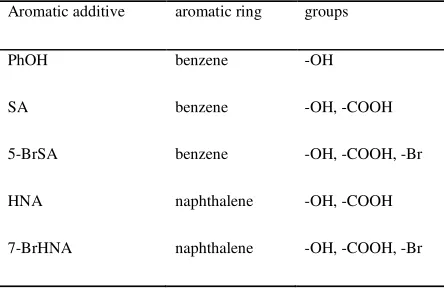
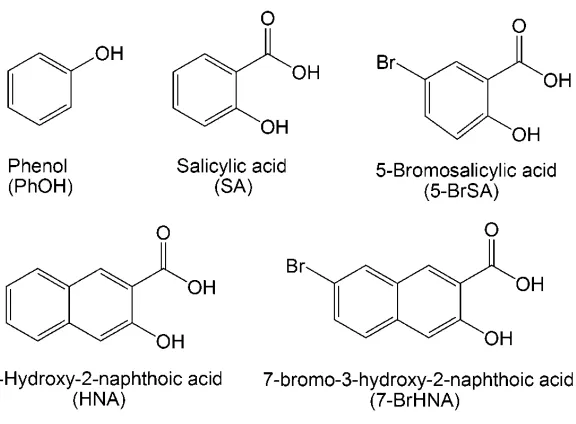
characteristics of these aromatic additives are shown in Fig.1and Table1. These compounds contain two different 127
aromatic rings (benzene and naphthalene ring) and 3 different functional groups (-Br, -COOH and -OH). 128
Without addition of HCl, the prepared GNR aqueous solutions are different in color, from red to blue, dependent 129
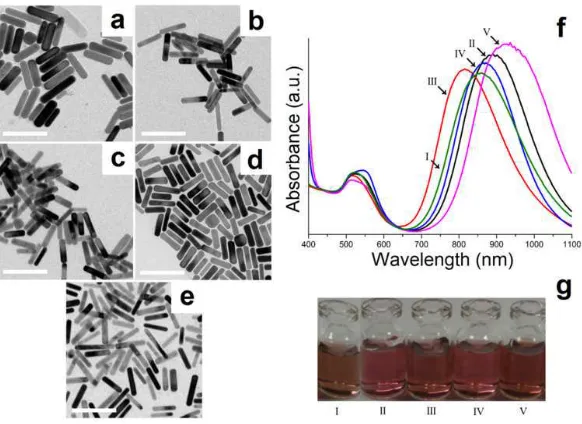
on the aromatic additives. Fig.2shows that the synthesized GNRs are relatively monodisperse and their UV-vis-NIR 130
a longer wavelength. These two bands are attributed to TSPR and LSPR, respectively. A close look of the GNR TEM 132
images reveals that the GNRs prepared in the presence of PhOH, SA, HNA, or 7-BrHNA are stubby sausage- or dog 133
bone-like shapes. Only those prepared in the presence of 5-BrSA are long cylindrical shape rod-like. 134
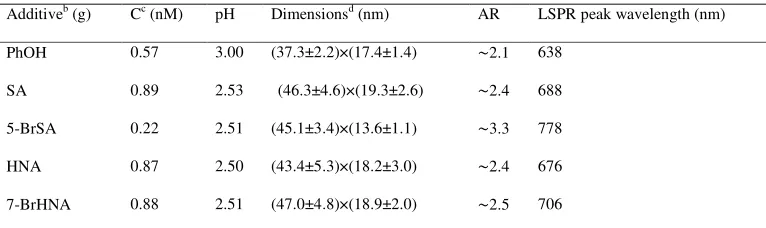
The concentrations, pH, dimensions, AR and LSPR peak wavelengths of the GNR solutions prepared in the 135
presence of aromatic additives are summarized in Table2. The AR of the GNRs was measured from the TEM images 136
in Fig.2a-e. The LSPR peak wavelength ( LSPR) of the GNRs is found to be positively and linearly correlated to the AR 137
viaequation (2) below: 138
LSPR= 112.5 × AR + 411.4 (2)
139
The above equation clearly indicates that the LSPR peak wavelength is strongly dependent on the AR of GNRs (Lohse 140
and Murphy2013): the bigger the AR, the longer the LSPR peak wavelength of GNRs. The TEM images of GNRs 141
(Fig.2a-e) are well correlated with their UV-vis-NIR spectra (Fig.2f). 142
As shown in Table2, the GNR LSPR peak wavelength is found to be dependent on the aromatic additives in the 143
following order: PhOH (638 nm) < SA (688 nm) < 5-BrSA (778 nm) and HNA (676 nm) < 7-BrHNA (706 nm). PhOH, 144
SA and 5-BrSA all have the same aromatic ring (benzene), while HNA and 7-BHNA are both naphthalene derivatives. 145
The differences in the LSPR peak wavelengths obtained here should be mainly due to the functional groups on 146
aromatic ring, and it appears that introduction of the -Br and -COOH groups to the aromatic rings is be beneficial for 147
making GNRs with high ARs (long LSPR peak wavelengths). 148
The LSPR peak wavelengths of GNRs synthesized using 5-BrSA or 7-BrHNA are longer than those without -Br. 149
Thus, aromatic additives with a Br group may facilitate the preparation of high AR GNRs, possibly due to a relatively 150
strong affinity of the Br atom with Au. Comparing the additives with the same functional group(s), GNRs synthesized 151
with 5-BrSA has a longer LSPR peak wavelength than that with 7-BrHNA, and this is also true for SA and HNA. This 152
indicates that the aromatic rings (benzene and naphthalene) in the additives also play a certain role in determining the 153
AR of the GNRs, possibly due to the different affinity of the aromatic rings to Au. Unlike the other 4 aromatic 154
additives, PhOH does not contain a -COOH group and hence is a much weaker acid (pKa ~9) compared to others all 155
containing a -COOH group (pKa ~4-5). As a result, the pH value of the resulting GNR solution with PhOH is higher 156
(pH 3.00) than others (ca2.5, see Table2). The solution pH has been found to influence the AR (hence LSPR peak
157
wavelength) of the synthesized GNRs (Wang et al.2005; Ye et al.2012; Zhu et al.2010). 158
Effect of HCl 160
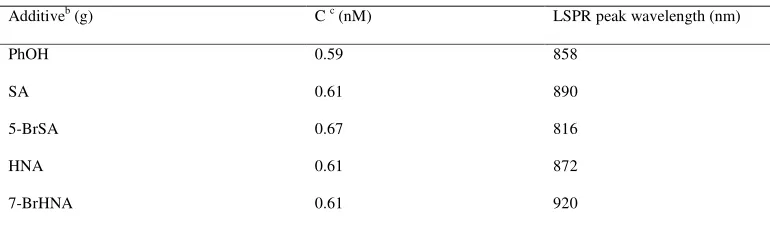
The effects of the aromatic additives on the GNR synthesis were changed dramatically when 300 L (~36 mmol)of 161
concentrated HCl solution was added in the growth solution (Fig. 2, 3). The synthesized GNR solutions were light 162
brown to light red and the GNRs were mostly cylindrical shape. Concentrations and LSPR peak wavelengths of the 163
GNRs in the final solutions are listed in Table3. Compared to Table2, the concentrations of resulting GNRs are 164
decreased from 0.87-0.89 to 0.61 nM for SA, HNA and 7-BrHNA after addition of HCl. However, the GNR 165
concentration with 5-BrSA is increased from 0.22 to 0.67 nM, while that for PhOH additive shows little difference. 166
The LSPR peak wavelength orders for the GNR solutions are as follows: 7-BrHNA (920 nm) > SA (890 nm) > HNA 167
(872 nm) > PhOH (858 nm) > 5-BrSA (816 nm). This order is completely different from that obtained without addition 168
of HCl as mentioned above. Moreover, the LSPR bands are stronger and also appear at longer wavelengths. This 169
indicates that the effect of HCl on the synthesized GNRs is significant even in the presence of aromatic additives. This 170
is unsurprisingly given the fact the formation of GNR (Equation 1) does release HCl into the reaction media. In 171
addition, many other factors could also influence the GNR growth, including formation of AgBr (Huang et al.2009; 172
Murphy et al.2010), aromatic electron system on the GNR surfaces (Michota and Bukowska2003; Wang et al.2010), 173
and the reducing power of AA (Wang et al.2005). 174
The reduction of gold ions into gold atoms can be determined by monitoring the optical absorbance of the GNRs
175
growth solutions at 440 nm (Rao and Doremus 1996, Sau and Murphy 2004). The bigger the absorbance, the more the
176
gold atoms formed. The change of the absorbance of the GNRs growth solutions with time can reflect the reduction
177
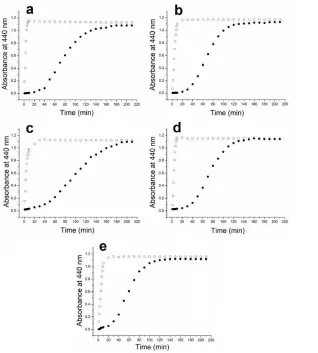
kinetics of gold precursor in the GNRs growth solutions. After addition of 30 mmol HCl into the growth solutions with
178
different aromatic additives, the pH values of the resulting GNR growth solutions change from 2.5 ~ 3.0 to 1.2, the
179
times to reach the absorbance plateau value (about 1.1) are prolonged from about 10 min to 2 ~ 3 h (Fig. 4). This
180
indicates that the reduction of gold precursors is significantly slowed down. Wang ever reported that the decreasing pH
181
value of the GNR growth solution would lower the reducing power of AA and the reducing rate of gold ions (Wang et
182
al. 2005).
183
The effects of the aromatic additives on the GNR synthesis were also changed dramatically when 36 mmol
184
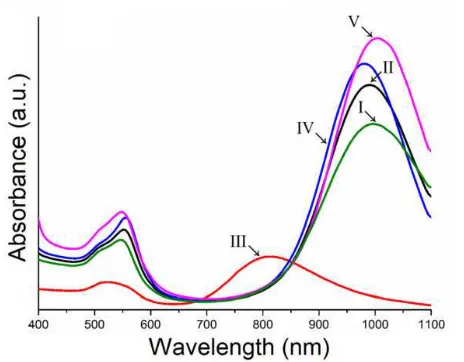
concentrated HNO3solution was added in the growth solution (Fig. 5). The LSPR peak wavelengths for the prepared
185
GNRs solutions are in the following order: 7-BrHNA (1005 nm) > PhOH (995 nm) > SA (990 nm) > HNA (980 nm) >
186
5-BrSA (815 nm). The LSPR peak wavelengths obviously increase after the addition of HNO3, similar to that of HCl.
HNO3is a strong acid as HCl, but it does not contain halides. The pH values of the resulting GNR solutions with
188
addition of 36 mmol concentrated HNO3are 1.2. This indicates that pH plays a certain role in the process of GNR
189
growth.Given the fact that the LSPR peak appears at the highest wavelength (biggest AR) with 7-BrHNA after 190
addition of HCl or HNO3. In this case, the effect of 7-BrHNA concentration was further investigated. 191
192
Effects of 7-BrHNA concentration 193
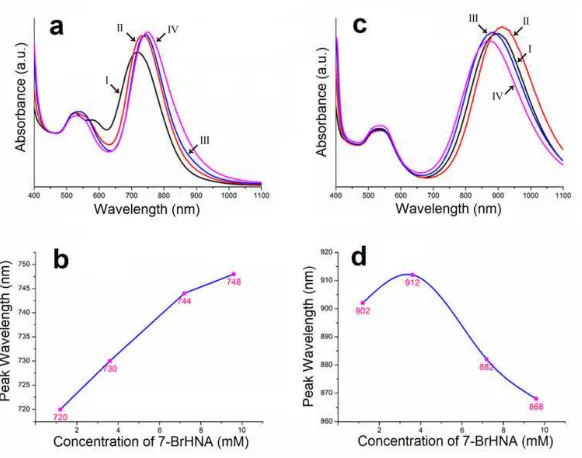
As shown in Fig.6, the LSPR band of GNR solution increases from 720 to 748 nm as the concentration of 7-BrHNA is 194
increased from 1.2 to 9.6 mM. Obviously, the concentration of the additive does have an impact on the GNR growth 195
and the LSPR wavelength. Without addition of HCl, there seems to have a trend that the more additive present in the 196
growth solution, the longer the LSPR peak wavelength for the obtained GNR. However, when HCl is added, there is a 197
maximum LSPR peak wavelength of 912 nm for GNR prepared at a certain concentration of 7-BrHNA (3.6 mM). At 198
the same concentration of 7-BrHNA, the LSPR is bigger after addition of HCl. 199
200
Effect of HCl amount 201
It remains a subject of considerable ongoing research interest how pH can be used to tune the LSPR wavelength of 202
GNRs despite several reported researches (Busbee et al.2003; Cheng et al.2011; Ye et al.2013; Ye et al.2012; Zhu et 203
al.2010). Fig. 7 shows that the LSPR wavelength is increased from 894 to 932 nm with the amount of HCl added is 204
increased from 200 to 350 L. This indicates that the ARs of GNRs synthesized in the presence of 3.6 mM 7-BrHNA 205
can be adjusted by changing amount of HCl added. The addition of HCl in the growth solution is beneficial for 206
preparing GNRs with bigger ARs and LSPR. 207
208
Controlled synthesis of GNRs 209
7-BrHNA is the most effective among the five aromatic additives studied here in terms of synthesizing GNRs with
210
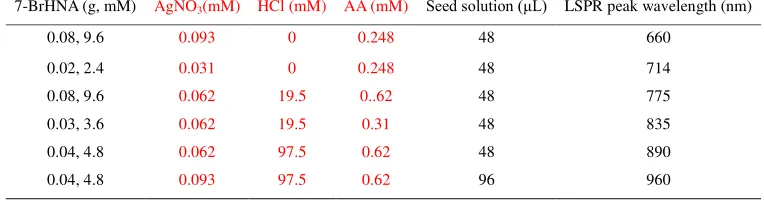
high ARs and long LSPR absorption bands. Fig. 8 shows the absorption spectra of a range of GNRs synthesized with
211
7-BrHNA as additive, the LSPR bands of GNRs can be systematically adjusted from 660 to 960 nm by changing the
212
amount of reactants (see Fig. 8 and Table 4).
Conclusion 215
In summary, monodisperse GNRs are successfully synthesizedviaa seeded growth approach in the presence of
216
aromatic additive (PhOH, SA, 5-BrSA, HNA, or 7-BrHNA). The LSPR wavelength of the synthesized GNRs can be 217
systematically adjusted in the near infrared region, providing a facile, controllable way for preparation of GNRs with 218
desired optical properties that may have broad biomedical applications. 7-BrHNA, a -Br and -COOH containing small 219
aromatic additive, is the most effective among the five aromatic additives studied here in terms of synthesizing GNRs 220
with high ARs and long LSPR absorption bands. 221
222
Acknowledgments This work is supported by National Natural Science Foundation of China (NSFC, Grant 223
No.81171439), the National Key Technology R&D Program of the Ministry of Science and Technology 224
(2012BAI18B01) and the European Research Council via a Marie Curie International Incoming Fellowship to S.G. 225
(grant No. PIIF-GA-2012-331281).Y. Guo. thanks the Wellcome Trust (U.K.) for providing a Career Re-entry Fellowship 226
(Grant No: 097354/Z/11/Z). 227
References 229
230
Almora-Barrios N, Novell-Leruth G, Whiting P, Liz-Marzán LM, López N (2014) Theoretical description of the role 231
of halides, silver, and surfactants on the structure of gold nanorods. Nano Lett 14:871-875 232
Busbee BD, Obare SO, Murphy CJ (2003) An Improved Synthesis of High Aspect Ratio Gold Nanorods. Adv Mater 233
15:414-416 234
Charan S et al. (2012) Development of chitosan oligosaccharide-modified gold nanorods for in vivo targeted delivery 235
and noninvasive imaging by NIR irradiation. Bioconjug Chem 23:2173-2182 236
Cheng J, Ge L, Xiong B, He Y (2011) Investigation of pH Effect on Gold Nanorod Synthesis. J Chin Chem Soc 237
58:822-827 238
Edgar JA, McDonagh AM, Cortie MB (2012) Formation of gold nanorods by a stochastic “popcorn” mechanism. ACS 239
Nano 6:1116-1125 240
Gai PL, Harmer MA (2002) Surface atomic defect structures and growth of gold nanorods. Nano Lett 2:771-774 241
Garg N, Scholl C, Mohanty A, Jin R (2010) The role of bromide ions in seeding growth of Au nanorods. Langmuir 242
26:10271-10276 243
Gomez-Grana S, Hubert F, Testard F, Guerrero-Martínez A, Grillo I, Liz-Marzán LM, Spalla O (2011) Surfactant (bi) 244
layers on gold nanorods. Langmuir 28:1453-1459 245
Grzelczak M, Pérez-Juste J, Mulvaney P, Liz-Marzán LM (2008) Shape control in gold nanoparticle synthesis. Chem 246
Soc Rev 37:1783-1791 247
Hassan P, Yakhmi J (2000) Growth of cationic micelles in the presence of organic additives. Langmuir 16:7187-7191 248
Huang H, Li C, Qu C, Huang S, Liu F, Zeng Y (2012) Sensitive detection of DNA based on the optical properties of 249
core–shell gold nanorods. J Nanopart Res 14:1-7 250
Huang X, Neretina S, El Sayed MA (2009) Gold nanorods: from synthesis and properties to biological and biomedical 251
applications. Adv Mater 21:4880-4910 252
Jana NR, Gearheart L, Murphy CJ (2001) Wet chemical synthesis of high aspect ratio cylindrical gold nanorods. J 253
Phys Chem B 105:4065-4067 254
Johnson CJ, Dujardin E, Davis SA, Murphy CJ, Mann S (2002) Growth and form of gold nanorods prepared by 255
Lai J et al. (2014) One-pot synthesis of gold nanorods using binary surfactant systems with improved monodispersity, 257
dimensional tunability and plasmon resonance scattering properties. Nanotechnology 25:125601 258
Lin Z, Cai J, Scriven L, Davis H (1994) Spherical-to-wormlike micelle transition in CTAB solutions. J Phys Chem 259
98:5984-5993 260
Liu X, Huang N, Li H, Wang H, Jin Q, Ji J (2014) Multidentate Polyethylene Glycol Modified Gold Nanorods for in 261
Vivo Near-Infrared Photothermal Cancer Therapy. ACS Appl Mater Interfaces 6:5657-5668 262
Lohse SE, Murphy CJ (2013) The quest for shape control: a history of gold nanorod synthesis. Chem Mater 263
25:1250-1261 264
Menon D, Basanth A, Retnakumari A, Manzoor K, Nair SV (2012) Green synthesis of biocompatible gold 265
nanocrystals with tunable surface plasmon resonance using garlic phytochemicals. J Biomed Nanotechnol 266
8:901-911 267
Michota A, Bukowska J (2003) Surface enhanced Raman scattering (SERS) of 4 mercaptobenzoic acid on silver and 268
gold substrates. J Raman Spectrosc 34:21-25 269
Murphy CJ et al. (2005) Anisotropic metal nanoparticles: synthesis, assembly, and optical applications. J Phys Chem 270
B 109:13857-13870 271
Murphy CJ et al. (2010) The many faces of gold nanorods. J Phys Chem Lett 1:2867-2875 272
Nikoobakht B, El-Sayed MA (2003) Preparation and growth mechanism of gold nanorods (NRs) using seed-mediated 273
growth method. Chem Mater 15:1957-1962 274
Orendorff CJ, Murphy CJ (2006) Quantitation of metal content in the silver-assisted growth of gold nanorods. J Phys 275
Chem B 110:3990-3994 276
Rao P and Doremus R (1996) Kinetics of growth of nanosized gold clusters in glass. J Non Cryst Solids 203:202-205.
277
doi: 10.1016/0022-3093(96)00483-8
278
Sau TK and Murphy CJ (2004) Seeded high yield synthesis of short Au nanorods in aqueous solution. Langmuir
279
20:6414-6420. doi: 10.1021/la049463z
280
Sharma V, Park K, Srinivasarao M (2009) Colloidal dispersion of gold nanorods: Historical background, optical 281
properties, seed-mediated synthesis, shape separation and self-assembly. Mater Sci Eng R Rep 65:1-38 282
Si S, Leduc C, Delville MH, Lounis B (2012) Short gold nanorod growth revisited: the critical role of the bromide 283
Song J, Pu L, Zhou J, Duan B, Duan H (2013) Biodegradable theranostic plasmonic vesicles of amphiphilic gold 285
nanorods. ACS Nano 7:9947-9960 286
Tian Y, Chen L, Zhang J, Ma Z, Song C (2012) Bifunctional Au-nanorod@ Fe3O4 nanocomposites: synthesis, 287
characterization, and their use as bioprobes. J Nanopart Res 14:1-11 288
Wadams RC, Fabris L, Vaia RA, Park K (2013) Time-Dependent Susceptibility of the Growth of Gold Nanorods to the 289
Addition of a Cosurfactant. Chem Mater 25:4772-4780 290
Wang C-H, Chang C-W, Peng C-A (2011) Gold nanorod stabilized by thiolated chitosan as photothermal absorber for 291
cancer cell treatment. J Nanopart Res 13:2749-2758 292
Wang C, Wang T, Ma Z, Su Z (2005) pH-tuned synthesis of gold nanostructures from gold nanorods with different 293
aspect ratios. Nanotechnology 16:2555 294
Wang X, Shao M, Zhang S, Liu X (2013) Biomedical applications of gold nanorod-based multifunctional 295
nano-carriers. J Nanopart Res 15:1-16 296
Wang Z, Zong S, Yang J, Song C, Li J, Cui Y (2010) One-step functionalized gold nanorods as intracellular probe with 297
improved SERS performance and reduced cytotoxicity. Biosens Bioelectroni 26:241-247 298
Xu C et al. (2013) Encapsulating gold nanoparticles or nanorods in graphene oxide shells as a novel gene vector. ACS 299
Appl Mater Interfaces 5:2715-2724 300
Ye X, Gao Y, Chen J, Reifsnyder DC, Zheng C, Murray CB (2013) Seeded Growth of Monodisperse Gold Nanorods 301
Using Bromide-Free Surfactant Mixtures. Nano Lett 13:2163-2171 302
Ye X et al. (2012) Improved size-tunable synthesis of monodisperse gold nanorods through the use of aromatic 303
additives. ACS Nano 6:2804-2817 304
Yoo H, Sharma J, Yeh H-C, Martinez JS (2010) Solution-phase synthesis of Au fibers using rod-shaped micelles as 305
shape directing agents. Chem Commun 46:6813-6815 306
Zhong Y, Wang C, Cheng L, Meng F, Zhong Z, Liu Z (2013) Gold nanorod-cored biodegradable micelles as a robust 307
and remotely controllable doxorubicin release system for potent inhibition of drug-sensitive and-resistant 308
cancer cells. Biomacromolecules 14:2411-2419 309
Zhu J et al. (2010) Additive controlled synthesis of gold nanorods (GNRs) for two-photon luminescence imaging of 310
cancer cells. Nanotechnology 21:285106 311
Table 1Chemical structural characteristics of the five aromatic additives 313
Aromatic additive aromatic ring groups
PhOH benzene -OH
SA benzene -OH, -COOH
5-BrSA benzene -OH, -COOH, -Br
HNA naphthalene -OH, -COOH
7-BrHNA naphthalene -OH, -COOH, -Br
314
Table 2Comparison of the concentration, pH, dimensions, AR and LSPR peak wavelength of the GNR solutions 316
prepared in the presence of different aromatic additivea 317
Additiveb(g) Cc(nM) pH Dimensionsd(nm) AR LSPR peak wavelength (nm)
PhOH 0.57 3.00 (37.3±2.2)×(17.4±1.4) 2.1 638
SA 0.89 2.53 (46.3±4.6)×(19.3±2.6) 2.4 688
5-BrSA 0.22 2.51 (45.1±3.4)×(13.6±1.1) 3.3 778
HNA 0.87 2.50 (43.4±5.3)×(18.2±3.0) 2.4 676
7-BrHNA 0.88 2.51 (47.0±4.8)×(18.9±2.0) 2.5 706
aThe amounts of C16TABr, AgNO3, AA and seed solution used for GNR growth are 0.54 g, 480 L, 120 L and 48 L,
respectively.
b
The concentration of additive in the growth solution used for GNR growth is 2.4 mM.
c: the calculated concentration of GNRs (Orendorff and Murphy2006)
d: measured from Fig.2a-e (At least 80 GNRs are counted for each set.)
318
Table 3Concentrations and LSPR peak wavelength of the GNR solutions prepared in the presence of aromatic 320
additive with addition of 300 L (36 mmol)concentrated HCla 321
Additiveb(g) Cc(nM) LSPR peak wavelength (nm)
PhOH 0.59 858
SA 0.61 890
5-BrSA 0.67 816
HNA 0.61 872
7-BrHNA 0.61 920
aThe amounts of C16TABr, AgNO3, AA and seed solution used for GNR growth are 0.54 g, 480 L, 300 L and 48 L,
respectively.
bThe concentration of additive in the growth solution used for GNR growth is 2.4 mM.
c: the calculated concentration of GNRs (Orendorff and Murphy2006)
322
Table 4Experimental conditions used for controlled synthesis of GNRs and LSPR peak wavelengths of the GNR 324
solutionsa 325
7-BrHNA (g, mM) AgNO3(mM) HCl (mM) AA (mM) Seed solution ( L) LSPR peak wavelength (nm)
0.08, 9.6 0.093 0 0.248 48 660
0.02, 2.4 0.031 0 0.248 48 714
0.08, 9.6 0.062 19.5 0..62 48 775
0.03, 3.6 0.062 19.5 0.31 48 835
0.04, 4.8 0.062 97.5 0.62 48 890
0.04, 4.8 0.093 97.5 0.62 96 960
a
The amounts of C16TABr used for GNR growth is 0.54 g.
326
Figure caption 328
Fig. 1Chemical structures of the five aromatic additives used in this study 329
Fig. 2 Characterization of GNRs synthesized under the conditions specified in Table 1. TEM images of GNRs 330
synthesized using PhOH (a), SA (b) 5-BrSA (c), HNA (d), or 7-BrHNA (e) as additive. UV-vis-NIR spectra (f) of 331
GNRs synthesized using PhOH (I), SA (II), 5-BrSA (III), HNA (IV), or 7-BrHNA (V) as additive, respectively. The 332
photos (g) of GNR solutions synthesized using PhOH (I), SA (II), 5-BrSA (III), HNA (IV), or 7-BrHNA (V) as 333
additive, respectively. Scale bars: 100 nm 334
Fig. 3Characterization of GNRs synthesized under the conditions specified in Table 3. TEM images of GNRs 335
synthesized using PhOH (a), SA (b), 5-BrSA (c), HNA (d), or 7-BrHNA (e) as additive. UV-vis-NIR spectra (f) of 336
GNRs synthesized using PhOH (I), SA (II), 5-BrSA (III), HNA (IV), or 7-BrHNA (V) as additive, respectively. The 337
photos (g) of GNR solutions synthesized using PhOH (I), SA (II), 5-BrSA (III), HNA (IV), or 7-BrHNA (V) as 338
additive, respectively. Scale bars: 100 nm 339
Fig. 4Fig. 4 Absorbances at 440 nm of the GNRs growth solutionsv.s.time using different aromatic additives: PhOH
340
(a), SA (b), 5-BrSA (c), HNA (d), or 7-BrHNA (e) with the addition of HCl (lower pH) (solid circle) and without
341
addition of HCl (higher pH) (empty circle).
342
Fig. 5UV-vis-NIR spectra of GNRs synthesized by using PhOH (I), SA (II), 5-BrSA (III), HNA (IV), or 7-BrHNA (V)
343
as additive, in the presence of HNO3.
344
Fig. 6Characterization of GNRs synthesized at different concentrations of 7-BrHNA as additive. UV-vis-NIR spectra 345
(a) and the LSPR peak wavelengths (b) of GNRs synthesized without addition of HCl, UV-vis-NIR spectra (c) and the 346
LSPR peak wavelengths (d) of GNRs synthesized with addition of 300 L HCl. The concentrations of 7-BrHNA in the 347
growth solution are 1.2 (I), 3.6 (II), 7.2 (III), 9.6 (IV) mM 348
Fig. 7Characterization of GNRs synthesized with 7-BrHNA as additive at different pH. UV-vis-NIR spectra (a) and 349
LSPR peak wavelengths (b) of the synthesized GNRs. The volumes of HCl added are 200 (I), 250 (II), 300 (III), 350 350
(IV) L 351
Fig. 8UV-vis-NIR spectra of the synthesized GNRs under the conditions in Table 4. The LSPR peaks of synthesized 352
354
Fig. 1Chemical structures of the five aromatic additives used in this study 355
[image:19.595.109.397.156.368.2]357
358
Fig. 2 Characterization of GNRs synthesized under the conditions specified in Table 1. TEM images of GNRs 359
synthesized using PhOH (a), SA (b) 5-BrSA (c), HNA (d), or 7-BrHNA (e) as additive. UV-vis-NIR spectra (f) of 360
GNRs synthesized using PhOH (I), SA (II), 5-BrSA (III), HNA (IV), or 7-BrHNA (V) as additive, respectively. The 361
photos (g) of GNR solutions synthesized using PhOH (I), SA (II), 5-BrSA (III), HNA (IV), or 7-BrHNA (V) as 362
additive, respectively. Scale bars: 100 nm 363
[image:20.595.105.397.183.395.2]365
Fig. 3Characterization of GNRs synthesized under the conditions specified in Table 3. TEM images of GNRs 366
synthesized using PhOH (a), SA (b), 5-BrSA (c), HNA (d), or 7-BrHNA (e) as additive. UV-vis-NIR spectra (f) of 367
GNRs synthesized using PhOH (I), SA (II), 5-BrSA (III), HNA (IV), or 7-BrHNA (V) as additive, respectively. The 368
photos (g) of GNR solutions synthesized using PhOH (I), SA (II), 5-BrSA (III), HNA (IV), or 7-BrHNA (V) as 369
additive, respectively. Scale bars: 100 nm 370
371
372
373
374
375
376
377
378
379
380
[image:21.595.104.395.157.369.2]382
[image:22.595.63.381.178.531.2]383
Fig. 4 Absorbances at 440 nm of the GNRs growth solutionsv.s.time using different aromatic additives: PhOH (a),
384
SA (b), 5-BrSA (c), HNA (d), or 7-BrHNA (e) with the addition of HCl (lower pH) (solid circle) and without addition
385
of HCl (higher pH) (empty circle).
386
387
388
389
390
392
393
394
395
396
Fig. 5UV-vis-NIR spectra of GNRs synthesized by using PhOH (I), SA (II), 5-BrSA (III), HNA (IV), or 7-BrHNA (V)
397
as additive, in the presence of HNO3.
398
399
[image:23.595.65.297.235.416.2]401
Fig. 6Characterization of GNRs synthesized at different concentrations of 7-BrHNA as additive. UV-vis-NIR spectra 402
(a) and the LSPR peak wavelengths (b) of GNRs synthesized without addition of HCl, UV-vis-NIR spectra (c) and the 403
LSPR peak wavelengths (d) of GNRs synthesized with addition of 300 L HCl. The concentrations of 7-BrHNA in the 404
growth solution are 1.2 (I), 3.6 (II), 7.2 (III), 9.6 (IV) mM 405
[image:24.595.105.396.159.388.2]407
408
Fig. 7Characterization of GNRs synthesized with 7-BrHNA as additive at different pH. UV-vis-NIR spectra (a) and 409
LSPR peak wavelengths (b) of the synthesized GNRs. The volumes of HCl added are 200 (I), 250 (II), 300 (III), 350 410
(IV) L 411
[image:25.595.104.394.186.292.2]413
414
Fig. 8UV-vis-NIR spectra of the synthesized GNRs under the conditions in Table 4. The LSPR peaks of synthesized 415
[image:26.595.106.400.181.404.2]