COMMISSION
OFTHEEUROPEAN
COMMUNITIES
JOINT RESEARCH CENTRE
Ispra Establishment
Italy
g r j A
-Γ Α ΐ ^ ^ ζ ·":'- ¡TV**
CONFIDENTIAL
COMMUNICATION
Category
1.3
Nr
3584
Copy
N2
WARNING
The information contained in this document is
communicated confidentially by the Commission of the European Communities to Member States, persons and undertakings and should not be passed to third parties.
(Euratom-Treaty, Article 13, a Regulation (EEC) No. 2380/74 of the Council of Ministers).
Management
of Nuclear Materials and
Radioactive Waste
PROGRAMME PROGRESS REPORT
Programme Progress Report JRC Ispra July-December 1978
MANAGEMENT OF NUCLEAR MATERIALS AND RADIOACTIVE WASTE
Abstract
This document is the progress report of the programme Management of Nuclear Materials and Radioactive Waste of the Joint Research Centre for the period July-December 1978.
The programme consists of three projects.
The main achievements during the reporting period were the following:
Project 1 : Evaluation of the long-term hazard of radioactive waste disposal The model developed for the evaluation of the probabilistic value of the geological barrier, is being applied to a clay formation.
The model developed for the calculation of pathways and dose rates to man has been applied to the assessment, for different fuel cycle strategies, of the long-term risk of the radioactive waste disposal in geological formations.
The examination of glass samples irradiated in a nuclear reactor, to simulate the long-term damage produced by alpha-particles in vetrified waste, have been completed.
Experiments on plutonium migration in sand columns have been carried out. The collaborative programme for an Integral Experiment on the plutonium waste measurement system of the Dounreay Nuclear Power Development Establishment (DNPDE) has been started.
Project 2 : Chemical separation and nuclear transmutation of actinides. Studies have been performed to determine the experimental conditions which make possible to keep plutonium in an extractable form during the operations of concentration and denitration of the HAW solutions.
Tests have been carried out on various steps of the OXAL process at fully active scale.
For the assessment on the nuclear transmutation of actinides progresses have been made concerning reactor physics calculations, fuel element design, evaluation of risk and technological implications on the nuclear fuel cycle.
Project 3 : Decontamination of reactor components
Analyses using scanning electron microscopy (SEM), Auger electron spectrometry (AES) and secondary ion mass spectrometry (SIMS) have been performed in order to investigate the physico-chemical structure of oxide layers and the mechanisms of chemical decontamination.
JOINT RESEARCH CENTRE
Ispra Establishment
Italy
Management
of Nuclear Materials and
Radioactive Waste
PROGRAMME PROGRESS REPORT
BEMÆRK
Den viden, som rummes i dette dokument, meddeles som fortrolig fra Kommissionen for de europæiske Fællesskaber til Medlemsstater, per-soner og virksomheder og ma ikke videreaives til trediemand. (Euratom-traktatens artikel 13og Minersterrldetsforordning)EOF) N° 2380/74).
Hverken Kommissionen for de Europæiske Fælleskaber eller nogen, som optraeder pa Kommissionens vegne er ansvarling for den eventuelle brug af information, som er indeholdt i det følgende.
ZUR BEACHTUNG
Die in diesem Dokument enthaltenen Kenntnisse werden von der Kom-mission der Europäischen Gemeinschaften den Mitgliedstaaten, Per-sonen und Unternehmen der Gemeinschaft vertraulich mitgeteilt und dürfen nicht an Dritte weitergegeben werden. (Euratom-Vertrag, Arti-kel 13, und Beschlussdes Ministerrates (EWG) Nr. 2380/74).
Weder die Kommission der Europäischen Gemeinschaften noch Perso-nen, die im Namen dieser Kommission handeln, sind für die etwaige Verwendung der nachstehenden Informationen verantwortlich.
NOTICE
The information contained in this document is communicated confi-dentially by the Commission of the European Communities to Member States, persons and undertakings and should not be passed on to third parties. (Euratom-Treaty, Article 13, and Regulation (EEC) No. 2380/74 of the Council of Ministers).
Neither the Commission of the European Communities nor any person acting on behalf of the Commission is responsible for the use which might be made of the following information.
AVERTISSEMENT
Les connaissances contenues dans le présent document sont communi-quées confidentiellement par la Commission des Communautées euro-péennes aux Etats membres, personnes et entreprises et ne peuvent être transmises à des tiers. (Traité Euratom, article 13, et règlement (CEE) N° 2380/74 du Conseil de Ministres).
Ni la Commission des Communautés européennes, ni aucune personne agissant au nom de la Commission, n'est responsable de l'usage qui pourrait être fait des informations ci-après.
AVVERTIMENTO
Le cognizioni contenute nel presente documento sono comunicate con-fidenzialmente dalla Commissione delle Comunità europee agli Stati membri, persone ed imprese e non debbono essere trasmesse a terzi. (Trattato Euratom, articolo 13, e regolamento (CCE) N° 2380/74 del Consiglio dei Ministri).
Né la Commissione delle Comunità europee, né alcuna persona che agisca per suo conto, è responsabile dell'uso che dovesse essere fatto delle informazioni che seguono.
OPMERKING
De kennis, die in dit document is vervat, wordt door de Commissie van de Europese Gemeenschappen vertrouwelijk aan de Lid-Staten, per-sonen en ondernemingen medegedeeld en mag niet aan derden worden doorgegeven. (Euratom-Ve'rdrag, artikel 13, en het besluit van de Mi-nisterraad (EEG) No. 2380/74).
CONTENTS
1. Introduction 3
2. Projects 7
2.1 The Evaluation of Long Term Hazard of
Radioactive Waste 7
Waste Hazard Analysis 7
Long-Term Stability of Conditioned Waste 9
Interaction of A c t i n i d e s with the Environment 11
Actinides Monitoring 12
2.2 Chemical Separation and
Nuclear Transmutation of Actinides 17
Chemical Separation of Actinides 17
Assessment Studies on
Nuclear Transmutation of Actinides 19
Actinide Cross Section Measurements 24
2.3 Decontamination of Reactor Components 27
3. Conclusions 31
1. INTRODUCTION
The safe and economic management of the radioactive waste, produced in the exploitation of nuclear
energy at an industrial level, requires a considerable effort of R&D.
The Joint Research Centre (JRC) started work In the field of radioactive waste management in 1973.
This programme is part of the activity of the JRC in the field of Nuclear Safety which includes also the
programme Reactor Safety and the programme Plutonium Fuel and Actinide Reasearch. The staff
allocated to the programme for 1978 consists of 63 research men, corresponding to about 6% of the
total JRC-staff. The programme is carried out at the Ispra Establishment with a participation of the
Karlsruhe Establishment.
The JRC programme Management of Nuclear Materials and Radioactive Waste has been oprganized
into three projects:
Evaluation of Long-Term Hazard of Radioactive Waste Disposal
comprising essentially the identification and the evaluation of the long-term hazard of the permanent
storage of radioactive waste in geological formations. This type of storage is considered at present to
be the most appropriate to solve the problem of radioactive waste.
Chemical Separation and Nuclear Transmutation of Actinides
The objective is to obtain a better appreciation of this advanced strategy for managing radioactive
waste by separating the actinides responsible for long-term risk, from the bulk of the fission products
and by their transmutation in nuclear reactors.
Decontamination of Reactor Components
The objective is to study the nature of the contaminated layers and the application of various
decontamination techniques in order to optimize the decontamination procedures required for the safe
operation and for the decommissioning of nuclear reactors.
The Commission of the European Communities started in 1975 an Indirect Action in this field. In this
Indirect Action, which is conducted by means of contracts with national laboratories, various aspects
of waste conditioning technologies are studied and a large coordinated action for the study of waste
disposal in various types of geological formations was established.
2. PROJECTS
2.1. The Evaluation of Long Term Hazard of Radioactive Waste
The long-term hazard of radioactive waste disposal in geological formations, which is largely due to the presence of actinides, is studied by the barrier approach based on the evaluation of the barriers provided between the disposed waste and man.
The barriers considered are the following:
- Segregation provided by disposing the waste in a deep geological formation
- Long-term stability of the waste conditioned in glass and bitumen
- Retention of actinides by geological media - Ecological distribution pattern of actinides.
The evaluation of the long-term hazard requires the development and application of waste hazard analytical mo dels and experimental studies for the quantification of the values of the different barriers.
In the field of models development we are passing from ge neric models in which the data are arbitrarily set on the ba sis of scientific considerations, to a more applied type of development in which the data are collected on specific experimental sites, not necessarily linked to any future disposal operation.
Concerning the experimental studies on the long-term stabi lity of the conditioned waste, both radiation damage studies on glasses and studies on the leaching of vitrified and bituminized waste are in progress.
Experimental studies on actinides distribution in the environment relate to the chemico-physical interactions be tween leached out actinides and geological media. The in teractions between the actinides and the biosphere are studied essentially by means of theoretical models, taking advantage of the large amount of experimental data gener ated by the indirect programme Radiation Protection of the Commission. Joint actions are being set up to strenghten the links between the two programmes.
Waste Hazard Analysis
OBJECTIVES
Aim of the study is to develop a methodology for the assessment of the risk linked to the disposal of different kinds of radioactive wastes into geological repositories. Probabilistic and deterministic approaches are used, in function of the nature of the barriers considered; for the probabilistic approach, the Fault Tree Analysis method is utilized, thus treating the geological barrier as a binary sys tem, which can only be either in functional or in failed state; for the deterministic approach, the potential levels of environmental radioactive pollution and the corresponding dose-rates to man are calculated, through development of appropriate physical and mathematical models.
For the second semester of 1978 the planned activities were:
A. Completion of the application of the Fault Tree Analysis to a specific experimental site (Belgian clay formation).
B. Refinement of generalized Model 11·2; its application to different fuel cycle strategies.
C. Application of data histogram treating techniques.
RESULTS
The methodology is now well established in its details, for both the probabilistic and the deterministic sections. A At present, the probabilistic section of the model is being applied to a specific site (the Belgian clay formation of Boom) to test the applicability of the Fault Tree Analysis to a real case. This work is being performed in close collaboration with the C.E.N, of Mol, to qualify the failure probabilities of a repository mined into a clay formation, as a function of time.
An upper section of the «tree» is shown in Fig. 1 where releases to three main receptors are considered.
RELEASE TO ENVIRONMENT RELEASE TO GROUND WATER RELEASE TO LAND SURFACE DIRECT RELEASE TO ATMOSPHERE
Fig. 1— Upper Section of the Fault Tree
Each release to a particular receptor develops into a detailed «Tree», down to various sets of primary events, which are listed in Table 1.
Probability values of occurrence for three different time intervals (2,000, 30,000 and 100,000 years) are being assessed for all the primary events.
Probability data in the form of hystograms can be handled by computer codes specially developed at the JRC Ispra for fault tree treatment.
Β The previous generalized Model 1 for the deterministic assessment of environmental pollution levels as a consequence of a containment failure has been improved by introducing a more detailed inventory of conditioned wastes, and by developing a leaching model for each waste type; as a rule, we have:
R, = f(a, l,C,,Q) where:
R, is the release rate of isotope i, σ is the specific surface of the waste I is the leaching rate
C, is the concentration of isotope i
Q is the quantity of waste undergoing leaching.
Table I — List of Primary Events
D
2) 3) 4) 5) 6) 7) 8) 9) 10) 11) 12) 13) 14) 15) 16) 17) 18) 19) 20) 21) 22) 23) 24) 25)Presence of ground water above
Presence of pressurized ground water below Migration with retention (outside the clays) Migration without retention (outside the clays) 3rd order Fault
2nd order Fault 1st order Fault
Extrusive magmatic activity Explosive magmatic activity Diapirism (2nd order only)
Glacial overburden (loss of plasticity) Permafrost
1st order glacial action 2nd order glacial action
Subsidence (2nd order only [loss of plasticity] 1st order stream erosion
2nd order stream erosion 1st order denudation 2nd order denudation
Pumping of contaminated ground water Drilling exposing water to aquifers
1st order human activities causing waste rise 2nd order human activities
1st order meteorite - causing release to atmosphere 2nd order meteorite - causing release to ground water
GROUNDWATER RADIONUCLIDE RETENTION FAULTING PHENOMENA MAGMATIC ACTIVITY DIAPIRISM GLACIAL PHENOMENA GE0M0RPH0L0GIC PROCESSES HUMAN ACTIONS METEORITES
This model has then been applied to an hypothetical waste repository, to compare two different fuel cycle strategies on the basis of their long-term risks: they are the once-through strategy and the uranium and plutonium recycle strategy in LWRs.
The following conclusions were reached:
1) The long-term risk linked to the once-through strategy is about two orders of magnitude higher than that due to the recycle strategy since, in the latter option, the plutonium destruction largely exceeds the build-up of transplutonium isotopes.
2) Should the release occur within a few thousands of years after repository closure, the risk would be governed mainly by inhalation of plutonium isotopes; on the other hand, if the release should occur after more than 105 years, Ra226 will be the risk-governing isotope.
Ra226 if formed from the decay chain Pu238 - U234 - Th230 -Ra226. The conclusion can be drawn that a better control of plu- tonium losses into any waste kind could decrease sub-stantially the risk at any time.
Besides, in the case of Mox-fuel, the presence In the waste of Cm242 parent of Pu238 is the major source of Ra226 build up inHLW.
3) These conclusions are valid only in the case of no soil retention by the geochemical barrier; otherwise, neptunium, technetium and iodine isotopes could become the dominant nuclides, but at a substantially lower level important.
A survey of the existing models describing the environmental behaviour of radioactive pollutants has been performed3.
C The methodology of treating large data uncertainties by probability distributions has been described in the previous Programme Progress Report4. This methodology has been completed by establishing functional relations between risk 8
and input data uncertainties. An analytical relationship can thus be obtained which shows the influence of data uncertainties on the results. This method could serve especially to identify those variables which have the greatest impact on the risk. A paper is in preparation5.
COLLABORATION WITH EXTERNAL ORGANIZATIONS
- The collaboration with the C.E.N. - Mol has been already mentioned.
- A collaboration with the indirect action programme Radiation Protection has been established for the development of environmental models and the related radioecological research.
CONCLUSIONS
The methodology developed at the JRC - Ispra for the assessment of the long-term risk is ready and available. The applicability of its probabilistic section to a specific site is being verified, and preliminary results are satisfactory. A similar application for the deterministic section of the model is planned, with the objective to identify, for specific site parameters, what are the experimental studies which can better contribute to decrease the uncertainty of the risk evaluation.
PLANNED ACTIVITIES
The Fault Tree Analysis for the experimental site in the Belgian clay formation will be completed.
REFERENCES
1 F. GIRARDI, G. BERTOZZI, M. D'ALESSANDRO: «Long-term Risk Assessment of Radioactive Waste Disposal in Geological Formations»
Report EUR-5902 (1978)
2 Management of Nuclear Materials and Radioactive Waste — Programme Progress Report of the Joint Research Centre, January-June 1977, N. 3440
3 G. BIGNOLI, G. BERTOZZI: «Modelling of Artificial Radioactivity Migration in Environment: ASurvey».
To be published as EUR-Report
4 Management of Nuclear Materials and Radioactive Waste -Programme Progress Report of the Joint Research Centre. January-June 1978. No. 3528
Long-Term Stability of
Conditioned Waste
OBJECTIVES
The aim of this study is to obtain information on long-term behaviour of conditioned high- and medium-level waste, in the framework of studies of Waste Hazard Analysis.
The planned activities for the second semester of 1978 were the following:
- Completion of the post-irradiation examination of the glasses, irradiated in the HFR reactor, at Petten,
- Continuation of the glass leaching tests,
- Extension of the stability tests to bitumlnized waste, - Verification of accelerated tests of radiation damage on
vitrified high activity waste.
RESULTS
Post-Irradiation Examination of Irradiated Glasses
The irradiation carried out in the HFR at Petten on glass samples containing uranium was intended to simulate, by the damage caused by fission frangments, the long-term damage produced by the decay of alpha-emitting nuclides in vetrified HAW.
A maximum of fission density of 4x10¹⁷ fissions/cm3, which corresponds to 2x10²² displaced atoms/cm3- was calculated for the irradiated samples.
This fission density corresponds to a damage period for vetrified HAW of about 105 years.
During the reporting period the post-irradiation analyses of the glass samples have been completed with the measurement of the stored energy. Measurements of leaching rates and densities had been previously carried out on the irradiated samples.
The stored energy values are reported in Fig. 1.
These values are in good agreement with those measured in radiation damage experiments carried out in other laboratories using glasses loaded with alpha-emitters. Thus it can be concluded that the simulation of alpha-damage using fission fragments gives realistic results. A final report on the experiment is in preparation.
Glass Leaching Tests
The aim of the glass leaching tests is the evaluation of the long-term weight loss and the systematic study of the sur face layer composition in order to clarify the leaching me chanism. 2D 19- 18-17 16 15 14 13 12
/
/
/ o o/
/
/
Λ
/
/
/
/
/
/
/
/
Θ/
/
ΙΟ11 10ΙΒ
fission/cm3
[image:15.595.36.557.44.530.2]10"
Fig. 1 Stored Energy Measured in Glass Samples Irradiated in the HFR Reactor (Energy Reased up to 550 °C)
During the reporting period the analysis of the leached sur faces has been completed, in connection with leaching tests In pure water of 1 year duration at 80°C and 50°C. The results of the analysis of the leached surface show that in the initial period most of the leaching is due to a solution mechanism while in a second time the weight loss due to release of microcollolds is predominant.
It can be concluded that, due to this mechanism, the as sumption of an homogeneous leaching of the glass seems confirmed.
A final report on the experiment is in preparation.
Experiments are in progress to study the influence of the water composition on the leaching rate.
After the completion of the leaching tests using water condi tioned by percolation through a silica sand, a new series of tests has been initiated using water which was previously contacted by clay.
Stability Tests on Bituminized Waste
Stability tests on simulated bituminized waste are in progress In order to verify the dependence of leaching on the solubility of the bitumen-incorporated salt and to clarify the mechanism of the long-term leaching.
The tests have been delayed by difficulties encountered in the preparation of homogeneous salt-bitumen mixtures. Fig. 2 shows the surface of a sample loaded with 40% NaN03 after leaching with HCl for 24 hours. White dots re present small cavities from which the crystals of NaN03 were leached. The distribution of the crystals appears to be quite homogeneous.
Verification of the Validity of Accelerated Tests of Radiation Damage on Vetrified High-Activity Waste
Fig. 2 — Metallographic Photograph of the Surface of a Leacted Bitumen — 40% NaOH3 Samples — Showing the Homogeneity of the Distribution
The specificity and the greater sensitivity of spectral absorption determination provide the necessary complement to microcalorimetric studies, for detection and monitoring of various types of damage.
Absorption measurements cover systematically the range from 1 9 0 0 Á to 25,000 Å, with special attention for the u.v. region, where the dominant products of damage are known to give more specific effects.
"Interesting results have been obtained by comparing optical effects in samples of pure Si02 irradiated with light
or heavy ions. The effects are illustrated in Fig. 3, where the intensities of the so called B2 and ΕΊ - bands obtained with proton or Ni6* irradiations of identical samples are shown. The first of these bands, which is ascribed To an electronic vacancy centred around a real atomic displacement, is strikingly different in the two cases, being almost negligible In the proton-bombarded samples where the total damage content in D.P.A. is greater. This effect confirms previous findings, i.e. the displacement products are stabilized in a form that depends drastically on the way of production for equal numbers of displacements. In the case of protons such displacements are formed by small cascades; the oppo site applies with respect to heavy ions. These consider ations point to a possible role of complex self-annealing and radiation-annealing effects, of obvious importance for better evaluation of simulation tests.
0.6- 0.5- 0.4-Q d 0.3- 0.2-
0.1-B2 band
/·> I 1 1 1 1 1 1 I 1 t / 1 / 1 1 1 t E', band ^,.'
\ /
\S/—^_j
3 4 5 6
E(eV)
- dotted line: heavy ion N i *6 (46.5 Mev, total dose 0.1 DPA)
[image:16.595.39.287.44.228.2]- full line: protons (1 Mev, total dose 0.2 DPA)
Fig. 3 — Optical Absorption Measurements on Heavy Ions and Protons Irradiated SiO ¡
10
[image:16.595.303.554.130.373.2]A preliminary series of post-irradiation annealings, gave also rise to interesting observations.
Fig. 4 shows an example of complete annealing of the B2 displacement centre which is obtained after heating at 650"C. Intermediate observations showed that partial destruction is already effective at 300"C. The relatively low range of temperatures in which displacement damage is removed gives a hint for further investigations of thermal eifects.
0.6 -|
0.5
0.4-I
0.3
0.2H
0.1
3 4 5 6
E (eV)
— full line: after heavy ion irradiation (46.5 Mev, total dose 0.1 DPA)
— dotted line: after annealing at 650 °C
Fig. 4— Annealing Effect at 650°C in Ion-Bombarded Si02
COLLABORATION WITH EXTERNAL ORGANIZATIONS
The collaboration with AERE, Harwell, concerning irradiation experiments and theoretical investigations, has been continued.
PLANNED ACTIVITIES
For the first semester of 1979 the following activities are planned.
Radiation Damage on Glasses
The results obtained in the irradiation experiments in the HFR have shown the validity of the damage simulation by fission fragments.
This method has the advantage to make possible the simula-tion of extremely long damage periods without increasing considerably the experimental effort.
Thus a new irradiation experiment has been planned (BONI III) where a fission density of 2x10IB fissions/cm3 will be reached.
The fission density corresponds to a damage period for vetrified HAW of about IO6 years, value which seems very difficult to reach with the loading of glasses with alpha-emitters.
Leaching Tests
The leaching tests on glasses and bitumen will be continued.
Verification of the Validity of Accelerated Tests of Radiation Damage on Vitrified High Activity Waste
[image:16.595.32.287.569.798.2]1) To correlate the calorimetrie results previous obtained with the optical measurements to get a sight of all defects formed.
2) To study the annealing as a function of temperature and impurities present in the samples.
3) To study the dipendence of stored energy on the type of
Applying the above relation we extended the original conduction model by
1) first computating the Rayleigh number associated with the pool from equation (1)
2) in case convection occurs, i.e. Rats > 580, the Nusselt
number Nu, is evaluated from equation (4)
3) substituting the conductivity value λ in the upper layer by a new effective value according to equation (9).
Interaction of Actinides with
the Environment
OBJECTIVES
The objective of this study is to obtain an understanding of the interaction of actinides with geological media and groundwaters following their eventual leaching from vitrified high level waste stored in geological formations.
For the second half of 1978, the planned activity was to pursue the experiment on column migration and to analyze the size and charge of the chemical species of actinides liberated from the leached glass. Also experiments under high lithostatic and hydrostatic pressure were foreseen.
RESULTS
Experiments have been performed to evaluate the consequences of an accidental release from a clay for mation taking as an example the geochemical conditions existing around the Boom formation in Belgium.
A water pathway has been established which flows over the alpha-bearing glass prepared in the laboratory, and then through columns containing soil samples.
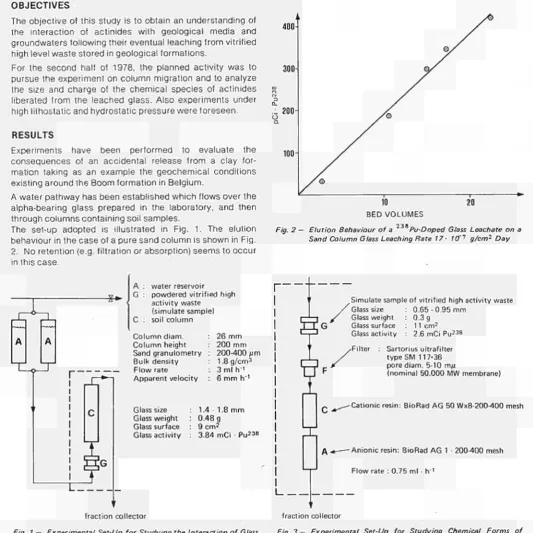
The set-up adopted is illustrated in Fig. 1. The elution behaviour in the case of a pure sand column is shown in Fig. 2. No retention (e.g. filtration or absorption) seems to occur in this case.
A : water reservoir G : powdered vitrified high
activity waste (simulate sample) C : soil column
Column diam. Column height Sand granulometry Bulk density Flow rate Apparent velocity
26 m m 200 mm 200-400 Mm
1.8 g / c m3
3 ml h'1
6 mm h"1
Glass size Glass weight Glass surface Glass activity
1.4 - 1.8 m m 0.48 g 9 c m2
3.84 mCi · P u2 3 8
Fig. 1
fraction collector
Experimental Set-Up for Studying the Interaction of Glass Leachates with Deep Soil
The experiment with the Belgian subsoils are still in progress with water composition typical of the aquifer of this zone.
The soil contamination profile of the Pu and Am activity leached over several months from glass will be determined and presented in a next report.
Parallel to these experiments, investigations of the chemical species of actinides produced by the leached glass have been initiated. The Fig. 3 shows the set-up adopted: in this case a water pathway has been established which flows over crashed and sieved Pu-bearing glass and then through an ultrafiltration system followed by cationic-anionic resins.
During a 34 days experiment the total activity measured was 1.58··0, of 238Pu, corresponding to a leaching rate of 4.8 χ 10"' g/cm2 χ day. The ultrafilter retained 20.1% of the leachate activity while 60,6% and 19,0% were found on the cation and anion exchange resins respectively. 0,3% was retained on the fraction collector.
BED VOLUMES
2 3 8
Fig. 2 — Elution Behaviour of a Pu-Doped Glass Leachate on a Sand Column Glass Leaching Rate 17· 10"1 g/cm2 Day
Γ
Simulate sample of vitrified high activity waste Glass size
Glass weight Glass surface Glass activity
0 . 6 5 - 0 . 9 5 mm 0.3 g
11 cm2
2.6 mCi P u « 8
?'
^FiIter : Sartorius ultrafilter type SM 117-36 pore diam. 5-10 m/i
(nominal 50.000 MW membrane)
-Cationic resin: BioRad AG 50 Wx8-200-400 mesh
-Anionic resin: BioRad AG 1 - 200-400 mesh
Flow rate : 0.75 ml · h"1
fraction collector
Fig. 3 — Experimental Set-Up for Studying Chemical Forms of Glass Leachates
[image:17.595.35.569.247.781.2]CONCLUSION AND PLANNED ACTIVITIES
The long term experiments in progress will be continued with plutonium and americium isotopes.
Parallel to columns experiments, an exploratory programme will be started on the use of several chemical analytical techniques which appear promising for valence state determination of plutonium in very.diluted solution.
Experiments will be also undertaken to confirm the applicability of such methods to simulated aquatic surface ecosystem where chemical speciation may play an essen-tial role in altering the biogeochemlcal behaviour of these elements, thus affecting their fate and distribution in the environment. As previously reported, this development is being carried-out in close cooperation with the indirect programme Radiation Protection.
Preliminary experiments under high lithostatic pressure have been undertaken in order to determine the types of problems that will arise on application of these techniques for radioisotopic migration studies. An experimental set-up designed to withstand operating pressures up to 20 - 25 atm. is being constructed.
Actinides Monitoring
OBJECTIVES
The study aims at the development of a methodology for plutonium waste monitoring. For the reporting period theoretical and experimental work was planned concerning development of reference instruments and methods in the framework of an Advisory Laboratory.
RESULTS
Reference Monitor for Passive Gamma Assay
This monitor is described in Chapter III of our guide1. The assembling of the apparatus was completed and Its text is in course. The experimental verification of the interpretational model for the reference monitor as outlined in the guide, will be started after the completion of the test.
Upgraded Reference Monitor for Passive Neutron Assay
This monitor is described in Chapter IV of our guide1. Upgrading of the existing reference monitor consists in: a) increasing the efficiency of the neutron detector
assembly
b) flattening the spatial response of the neutron detector assembly
c) providing variability of the energy response of the neutron detector assembly
d) reducing the dead time of the signal processing uni (computerized system)
Substantial progress has been achieved only for the signal processing unit. The circuits have been developed and tested. Commercially available units such as data processor with peripheric units have been purchased.
The new signal processing unit allows for dead time reduction by an order of magnitude.
12
Active Neutron Assay
Chapter V of our guide1, dedicated to active neutron assay, was drafted.
In the first section an insight is given (by means of one group, one dimensional diffusion theory) into the problems of neutrons transport from an external source into a multiplying and scattering medium.
This section deals also with other fundamentals of the active neutron assay technique concerning instrumentation. In section 2 the reference monitor is described.
This monitor is composed of a (Sb-Be) neutron source located in a cylindrical lead pile, which also incorporates the detectors for source and induced fission neutrons.
Discrimination between source and fission neutrons is accomplished by neutron energy biasing. The mathematical model is based on the Nordheim theory of heterogeneous multiplying media2.
Integral Experiment
The collaborative programme for an Integral Experiment on the Pu waste measurement system of the Dounreay Nuclear Power Development Establishment (DNPDE) was agreed upon.
The objectives of this Integral Experiment are:
a) determination of statistical data (as defined in ref.1 Chapter II) related to the probable errors in radiometric assay of waste streams;
b) determination of systematic errors in radiometric assay of waste streams.
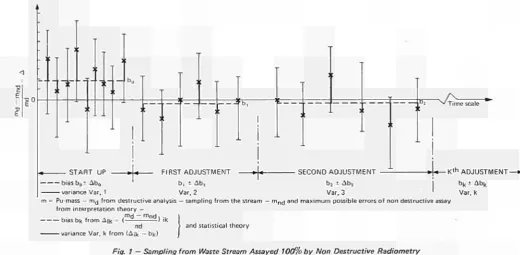
A schematic illustration of the method is shown in Fig. 1. The experiment consists in 100% throughput radiometric assay of waste streams and sampling for chemical analysis of selected items from the streams. The chemical analysis results are confronted with radiometric assay results. In the collaborative agreement the work load is divided as follows: - DNPDE Dounreay provides for the historical data and
experimental data (as defined in ref.1 Chapter II) for both the radiometric assay and the chemical analysis;
- JRC Ispra provides for interpretation of radiometric assay using historical and experimental data from DNPDE, evaluates statistical data and determines systematic errors in radiometric assay.
The experimental programme was initiated recently by: a) installation of our computerized analyzer for passive
neutron assay in DNPDE
b) calibration of DNPDE passive neutron monitors, e.g. response to a bare Pu source and to Pu distributed in matrix materials. The method is outlined ¡n Chapter IV of our guide1.
c) bench mark measurements in order to check the theoretical predictions, performed by means of computer codes (ANISN and MONK), concerning the neutron spectrum in the thermal region in active neutron assay by the 14 MeV neutron generator of DPNDE. First results concerning points b) and c) are expected in November 1978.
The collaborative agreement foresees a report in August 1979 on the first results from passive neutron assay and active neutron assay by the 14 MeV active neutron monitor.
Sample Preparation
I
o » _ -=
= Ί ^« START UP bias b0± Ab0
variance Var, 1
FIRST ADJUSTMENT b, ± Ab, Var, 2
SECOND ADJUSTMENT b5 ± Ab2
Var. 3
Time scale
Kt n ADJUSTMENT
-bk 1 Abk
Var, k m = Pu-mass — m j from destructive analysis — sampling from the stream — mncj and maximum possible errors of non destructive assay
from interpretation theory -bias bk from Δ||< = ( md - mnd
nd ) ik and statistical theory - variance Var, k from (A¡k — bk)
Fig. 1 — Sampling from Waste Stream Assayed 100% by Non Destructive Radiometry
of the presence of compact Pu sources and for the evaluation of their influence on the monitor response. To this purpose the following procedure is adopted:
- measurement of spontaneous fission neutrons emerging from the waste drum
- centrifugaron of the waste drum
- repetition of the spontaneous fission neutron
If
measurements comparison of centrifugation. the results of
the results obtained before and after
the measurements before and after centrifugation are similar, we may conclude that compact Pu sources are absent or if present they are located near to the periphery of the drum.
The interpretation based on the homogeneous Pu density distribution yields in the latter case an overestimation of the Pu content.
If the results of the measurement after centrifugation are considerably higher we may conclude that compact Pu sources moved from internal positions towards the periphery of the drum. Knowing the relationship between source position and monitor response (Chapter IV of the guide) and the average migration length of compact sources due to centrifugation we may correct relative to homogeneous plutonium density distribution.
The mock up experiments are designed for the determina-tion of the average migradetermina-tion length of compact Pu03 sources as function of their geometric size, initial location in the drum, density of the cellulose matrix, and rotation speed of the centrifuge. Pu03 is simulated by lead having almost the same mass density.
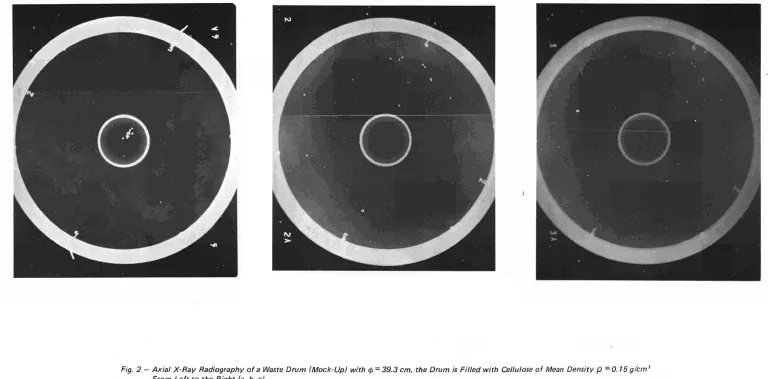
The local position of compact sources is identified from X-rays photographs of the waste drum.
An example of such an experiment is shown in Fig. 2. The experimental programme was interrupted due to heavy vibrations of the centrifuge at high rotation speed. We have to overcome this problem before continuing the experimen-tal programme.
X-Ray Transmission Pattern
Gamma-ray absorption by heavy matrix material and plutonium lumps is a serious problem in passive gamma assay of wastes. Experimental investigations on the
usefulness of X-ray transmission techniques for visualization of gamma absorbers in solid wastes are in progress. To this purpose an X-ray machine ranging up to 400 kV high voltage was set up for X-ray photographs on waste drums. This facility was utilized for the X-ray photographs shown in Fig. 2.
COLLABORATION WITH EXTERNAL ORGANIZATIONS
Contract with EUREX (CNEN, Saluggia, Italy) concerning the testing of on-line alpha-monitor.
Contract with the Institut de Physique Nucléaire (University of Lyon, France) for an expertise on the preparation of the guide.
Collaboration contract with Dounreay Nuclear Power Development Establishment (DNPDE) on an Integral Experiment.
CONCLUSIONS
The objectives for the reporting period have been reached asfar as concerns:
- Integral Experiment (Dounreay)
- Passive neutron assay (upgrading of reference monitor) - Active neutron assay (Chapter V of guide)
- Passive gamma assay (assembling of reference monitor) The progress of other planned activities was limited.
Testing of a liquid alpha monitor in a fuel reprocessing plant was delayed further. This depends on the conditions of the plant which are unfavourable for our testing programme. Feasibility studies on samples preparation by centrifuging of waste drums had to be interrupted due to technical difficulties. Systematic studies on X-ray transmission pattern of waste drums were stopped due to the priority given to other points of the programme.
PLANNED ACTIVITIES
For the following semester are planned:
1) bench mark and calibration measurements in the frame of the Integral Experiment
2) design of an upgraded detector assembly for passive neutron assay
3) development of the upgraded signal processor (hardw and software) for passive neutron assay
[image:19.595.33.554.35.290.2]Fig. 2 - Axial X-Ray Radiography of a Waste Drum (Mock-Up) with φ = 39.3 cm, the Drum is Filled with Cellulose of Mean Density β -0.15 g/cm' From Left to the Right (a, b, ci
ai 10 Pb Spheres with φ =0.15 cm Are Located Near the Drum Axis
bl The Drum Was Rotated with Maximum 2300 rpm Pb Spheres Migrated to Wards the Periphery, Cellulose Has Been Compacted
[image:20.842.36.806.33.412.2]4) design of the reference monitor for active neutron assay 5) experimental verification of the interpretational model
for the passive gamma reference monitor.
REFERENCES
1 Monitoring of Plutonium Contaminated Solid Waste Streams. A Technical Guide for Design and Analysis of Monitoring Systems. Chapter I:
G. BIRKHOFF, A. NOTEA: «Planning of Monitoring Systems» EUR5635(1977)
Chapter II:
G. BIRKHOFF, L. BONDAR, A. NOTEA: «Principles and Theory of Radiometric Assay»
EUR 5636(1977) Chapter 111:
G. BIRKHOFF, A. NOTEA: «Passive Gamma Assay» EUR 5637 (1977)
Chapter IV:
G. BIRKHOFF, L. BONDAR: «Passive Neutron Assay» EUR 6027 (1978)
Chapter V:
G. BIRKHOFF: «Active Neutron Assay» To be published in 1979
2.2. Chemical Separation and Nuclear Transmutation of Actinides
If the separation of the actinides from fission products is demonstrated to be possible, it will open up a number of alternative waste management options in which the disposal of actinides, largely responsible for the long-term risk, and fission products can be considered separately. One option which would provide an ultimate solution for actinlde wastes is the transmutation to short-lived isotopes by neutron bombardment in reactors.
In the framework of the activity of the OECD Nuclear Energy Agency in the field of radioactive waste, the Commission has been chosen as leading organization for the studies on the chemical separation and nuclear transmutation of actinides.
The activity of the JRC in this field includes experiments on the chemical methods required for actinides separation from HAW and assessment studies on the possibility of actinides transmutation in nuclear reactors.
For the chemical separation of actinides from HAW, oxalate precipitation (OXAL Process) and solvent extraction by HDEHP and TBP are being investigated.
The assessment studies include, in addition to the reactor physics aspects, the implications of the nuclear transmutation on the nuclear fuel cycle (actinide fuel element design, modifications in the nuclear plants, increase of cost and risk).
In order to improve the accuracy of the reactor physics calculations a programme of neutron cross section measurements ¡s carried out.
The JRC activities are planned ¡n such a way as to have a maximum of information emerging in the second half of 1979. It Is, in fact, intended to prepare by the end of 1979 a major report dealing with a critical evaluation of the feasibility of the chemical separation and nuclear transmutation of actinides.
Chemical Separation of Actinides
OBJECTIVES
The experimental studies on the feasibility of the chemical processes (OXAL, HDEHP and TBP) proposed for the HAW partitioning were continued.
For the reporting period, it was planned to initiate the denitration tests on fully active HAW and to continue HDEHP batch-extraction and OXAL process tests (Actinide/REs partitioning), already initiated on fully active laboratory scale. Assessment studies of the engineering feasibility of the proposed HAW partitioning processes are in progress and a first evaluation is expected by the end of 1978.
RESULTS
HDEHP Extraction Process
Denitration tests on simulated HAW solutions were continued in order to optimize the operating conditions and to clearly identify the parameters of the process.
As already mentioned1, if suitable process conditions are applied during the HAW denitration it would be possible to minimize the coprecipitation of plutonium with other hydrolysable metal-ions (Mo, Zr, Nb, Fe) and to maintain it in extractable form even at low acidity conditions. The simultaneous co-extraction of plutonium, americium and curium can thus be attained subsequently in a single step. Denitration tests on fully active HAW solutions were also initiated. For this purpose U03 samples, Irradiated at a burnup of about 36,000 MWD/t and cooled for 3.5 years, were dissolved and processed. Successive batch extraction stages of this feed solution were utilized to simulate the Purex process and to obtain a 4,000 litres/t HAW raffinate. A preliminary test on fully active HAW denitration has confirmed the possibility to maintain the plutonium in an extractable form even at low acidity conditions.
An actinlde (Pu, Am) residue of a few % was however measured in the precipitate.
Further fully active demonstration tests are under way; the utilization of an improved filtration system is foreseen. A patent application has been introduced on the use of HAW denitration process for specific purposes (i.e. ¡nextractable Pu solubilization).
TBP Extraction Process
The TBP extraction process is applied to about ten-fold concentrated HAW In order to minimize the amount of nitrates to be added as salting agents.
During the HAW concentration and subsequent interim storage precipitates are normally formed on which plutonium is irreversibly adsorbed.
Laboratory tests carried out during 19772 have shown that the fraction of adsorbed plutonium can be minimized provided a nitric acid concentration above 5 M/l is maintained during the concentration process. However, Pu-bearing precipitates could form again during the necessary interim storage of the concentrated HAW solutions.
Therefore it is important for the TBP flowsheet to find process conditions suitable for re-converting to an extractable form the plutonium fraction coprecipitated during the HAW concentration and/or subsequent interim storage, and this is undoubtedly a challenging problem. For this end an optimization of the final HAW denitration step is presently being studied for making still soluble and extractable the plutonium fraction previously coprecipitated and adsorbed on precipitates during the concentration and thestorageof HAW.
Preliminary denitration tests carried out on a synthetic concentrated HAW solution gave encouraging, although still non conclusive results.
Further experiments will be carried out in order to confirm these results and to better define the operating conditions.
OXAL Process
Experimental tests on fully active laboratory scale, have been continued.
To this purpose a fully active HAW solution, prepared2 by dissolution and process of U02 fuel, irradiated at a burnup of 25,000 MWD/t, was utilized.
HAW (5000 l/t)
Formic + Oxalic Acids
\ u u
Actinides + R. Es
O x a l a t e s
DTPA pH = 3
Centrifugation
? <
X
m
■ * - < Γ α. υ co c o *-■ o UI
f
coc C
o E
ΙΌ D m
õ
ã U Q
Actinides + RES Oxalates
HAW effluent
Sr, Ba and F.P. traces
Pu, Np
[image:24.595.39.550.23.289.2](Zr, Mo, U, Fe) (1) Am, Cm
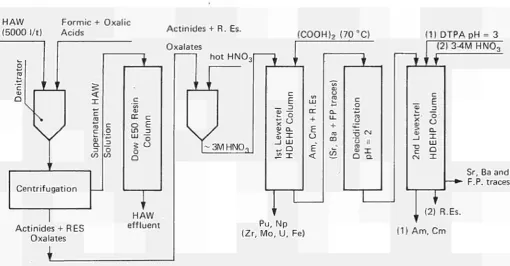
Fig. 1 Process Scheme for the Actinide + Rare Earths Oxalate Separation and Successive Separation of Actinides from Rare Earths by Column Extraction Chromatography
The operating conditions were the same already applied on simulated HAW solutions1.
According to the process scheme shown in Fig. 1 the following steps have been carried out in hot cell on the fully active HAW solution:
- Acidity reduction (from - 4 M HN03 to pH ~ 0.5) and precipitation of the actinide + REs oxalates by simultaneous addition of formic and oxalic acid.
- Centrifugation of the precipitate
- Flowing of the supernatant through a DOWEX 50 resin column to remove the residual actinides
- Dissolution of oxalates by hot concentrated nitric acid - Flowing of the actinide + REs nitrate solution (3 M
HN03) through the 1" HDEHP/LEVEXTREL column and subsequent elution of the adsorbed plutonium and zirconium by oxalic acid at 70°C.
- Acidity reduction of the collected column effluent (containing Am, Cm and REs) to pH ~ 2
- Flowing of this solution through the 2'"' HDEHP/LEVEXTREL column to adsorb trivalent actinides and rare earths on it and to carry out subsequently their. partitioning by selective elution.
< able 1 -Percent Distribution of Actinides, R.Es and Some F.Ps Measured for Different Streams of the OXA L Process
% ELEMENT DISTRIBUTION (1)
Am Cm Pu R.Es Sb Ru Cs (1) (2) (4) Oxalate precipitate >99.9 >99.9 > 9 9 > 9 5 3.6 1.8 0.9 HAW effluent from DOWEX50
resin column <0.02 <0.02 n.d. (2>
<0.01
71.9 83.6+12.6<4>
7.6+89.2 (4)
1st HDEHP/ /LEVEX chr. column n.f. (3) n.f. (3) > 9 9 n.f. <3>
n.f. (3>
n.f. (3>
n.f.(3>
Referred t o the amounts present in the origin solution
Not defected (3) Not fixed HAW e f f l u e n t * column washing ( H N 03 solut
pH ~ 0 . 5 )
Oxalic acid ELUATE2 from 1st column n.d. (2) n.d. (2)
> 9 9
n.d.(2> n.d. (2> n.d.<2> n.d.<2>
al HAW
ion.
The results, reported in Table I, show that high actinide separation yields can be obtained by oxalate precipitation. A further reduction of the actinide content is obtained by means of the DOWEX 50 column.
Table I shows also that high yields can be attained for the plutonium adsorption on the T" HDEHP/LEVEXTREL column and for the subsequent elution by means of oxalic acid. The experiments on the actinide/REs partitioning using the 2·"' HDEHP/LEVEXTREL column are in progress.
Engineering Feasibility Assessment of Actinide Separation Processes
A study has been started to assess the engineering and feasibility aspects of the separation of the actinides from HAW generated in nuclear fuel reprocessing.
For the chemical separation processes much relevant information is available in the literature, but adaptation to actual HAW arislngs is generally lacking; there is a need to propose conceptual flows sheets and to determine whether the separation processes can be modified and adapted to achieve the necessary separation factors and in turn can be integrated into a functional waste processing facility. Three conceptual flowsheets have been proposed based on TBP, HDEHP and OXAL processes.
The assessment of these flow-sheets is performed assuming that only established and proven technologies will be utilized.
For this purpose a review of the separation equipments used in the nuclear industry (mixer-settlers, pulsed columns, filters and centrifuges) is underway.
Work has proceeded in close co-operation and collaboration with the radiochemistry section enabling detailed dis-cussion on the process chemistry and problems en-countered or anticipated for e.g. decontamination factors, precipitation processes, types of precipitates etc. The majority of the bench-scale experiments have been performed on simulated waste make-up solution with only a small amount of experiments being performed up to now, on fully active waste solution. This introduces at present difficulties and uncertainties into the assessment which is greatly dependent on good chemical data for real waste processes.
CONCLUSIONS
The project activities are in progress generally according to the planning. However, some experiments on fully active HAW are proceeding more slowly than scheduled due to the fact that a significant part of the experimentally Involved staff (3 chemical technicians) has left the Ispra laboratories. New recruitments are under way. In the mean time a partial replacement has been accomplished by a temporary transfer of personnel from other programmes.
PLANNED ACTIVITIES
During the next six months it is planned:
to conclude HDEHP batchextraction tests on fully active laboratory scale.
to conclude denitration tests under simulated conditions (5,000 l/t and concentrated HAW) and on fully active laboratory scale 5000 l/t HAW).
to continue the experiments on the separation of the actinides from rare earths at fully active laboratory scale to continue the studies for a conceptual design of a HAW
partitioning plant.
After the completion of the HDEHP batchextraction tests, similar tests on the TBP process or, alternatively HDEHP countercurrent extraction tests, under simulated conditions, will be initiated.
REFERENCES
1 Programme Progress Report «Management of Nuclear Materials and Radioactive Waste», JRClspra Establishment, JanuaryJune 1978
No. 3528
2 Programme Progress Report on «Management of Nuclear Materials and Radioactive Waste» JRClspra Establishment, JulyDecember 1977
No. 3486.
Assessment Studies on
Nuclear Transmutation of Actinides
OBJECTIVES
The aim of this activity is to evaluate the neutronphysical and technological feasibility and cost/risk implications of the trasmutation of actinides other than fuel in fission power reactors. An overall strategy for transmuting those actinides, produced by the European Community power generating system, should be proposed giving indications as to the reactor type to be preferred as transmutation device and the way of introducing the actinides in the reactor. Taking account of the results for risk and cost analysis, a choice between the various possible recycle strategies should be carried out.
RESULTS
Corrected Isotopie Concentration forFBR Pins
In the previous Programme Progress Report1, isotopie
concentrations and geometries for minor actinides containing fuel pins to be irradiated in the NA 1 FBR were given. These values had to be adjusted due to the following reasons:
a radial gap of 150 μ is now assumed in order to allow swelling. Consequently, the pellet diameter was reduced from 6 to 5.7 mm;
since curium is expected to occur mainly in form Cm203,
a theoretical density of 10.66 g/cm3 instead of 11.1
g/cm3 has to be used for the oxide;
the depleted uranium, proposed as diluent, is a fertile material which increases eventually the specific power generation. Therefore, the initial minor actinides content has to be reduced more than in the case of an inert diluent.
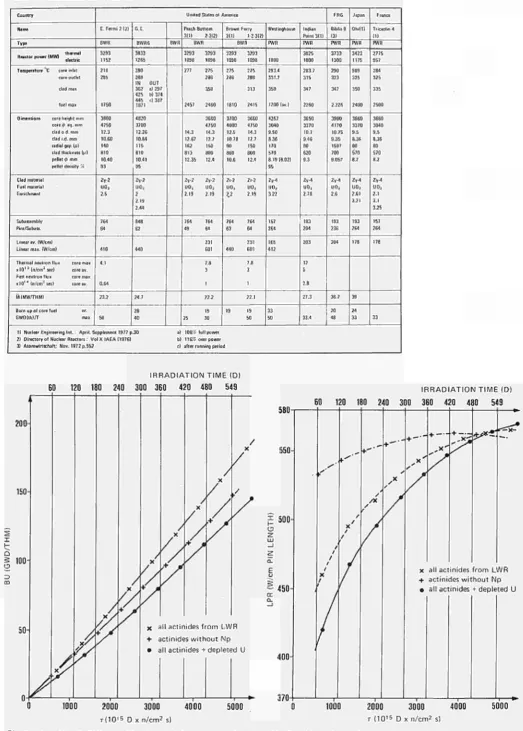
The correct Isotopie compositions required to obtain a maximum power rating of 566 W per cm of pin length, at the end of the irradiation period, are reported ¡n Table 1.
The stechlometries assumed for the oxides are Np02,
Am018, CmOjjj.
Table I — Initial Isotopie Composition in Grams of Metals and Oxides for FBR Fuel Pins
u
Np Am Cm
e =
ALL ACTINIDES
g/cm metals — 1.235 0.377 0.0997 1.712 g/cm oxides — 1.402 0.422 0.109 1.933
WITHOUT Np
g/cm metals — 1.663 0.441 2.104 g/cm oxides — 1.860 0.485 2.345
WITH DEPLETED URANIUM g/cm metals 0.681 0.834 0.254 0.067 1.836 g/cm oxides 0.772 0.947 0.284 0.074 2.077
The dependence of the burnup on irradiation time and fluence is shown ¡n Fig. 1. The variation of the linear power rating as function of the same parameters is given in Fig. 2. The relative small Increase of the linear power rating of the pin where byproduct actinides without Np are recycled represents an argument for recycling only Am/ Cm through the FBR.
Temperature Profiles for FBR Pins
Radial temperature profiles for different geometric configurations of FBR fuel pins are being calculated at the Karlsruhe Establishment of the JRC (Transuranium Institute) by means of computer codes. The results will be published in the next Programme Progress Report. The scope of this work is to guarantee that the maximum temperature ¡n the pin does not exceed the melting point of the fuel material.
Collection of the Performance Data of LWRs
Neutron physical calculations have indicated the LWRs as possible devices for the actinides transmutation. An additional enrichment ¡n fissile material is required when selfgenerated actinides are blended with normal fuel in order to compensate the low fissiontocapture ratio for by product actinides to be transmuted in a thermal reactor. An even higher enrichment is necessary when actinides are introduced in LWRs in form of target pins. As a high enrichment can influence the thermal properties of the fuel element, the performance data for LWRs, collected for large power plants (10001300 MWe)are reproduced in Table II.
The data will be employed in the design work for byproduct actinidebearing LWR fuel pins in line with the results concerning the FBR.
[image:25.595.310.564.264.398.2]Table II - Characteristics of L WRs
Country
Ham
Type
, . , „ . thermal Reactor power (MW)
electric Tempeialure °C Core inlet
core outlet clad max fuel max Dimensions core height mm
core >;. eq. mm clad 0 d. mm clad i.d. mm radial gap (μ) clad thickness (μ) pellet 0 mm pellet density % Clad material
Fuel material Enrichment
Subassembly Puis/Suba ss. Linear av. (W/cm) Linear max. (W/cm) Thermal neutron flux core max x 1 01 3 ( n / c m1 sec) coreav. Fast neutron flux core max x l O1 4 [ n / c m1 seel core av. M I M W / T H M I
Burn up of core fuel av. G W O I t h l / l max
1) Nuclear Engineering Int. : April. S 2) Directory of Nuclear Reactors : V 3) Alomwtrtschaft: Nov. 1972 p.5S2
E. Fermi 2 (2)
BWR 3293 1152 218 285 1750 3800 4 7 5 0 12.3 10.60 140 SI0 10.40 9 3 Zy-2 U O ,
2.5 764 64 410 4.1 0.64 23.2 50
jpplement 1977 ρ I X I A E A (1976)
United States of America G.E. BWR6 3S33 1265 280 288 I N O U T 362 al 297 425 bl 374 « 5 cl 387 1871 4820 3700 12.26 10.64 115 810 10.41 95 Z y 2 U O , 2 2.19 2.44 8-18 62 440 24.7 28 40 BWR
Peach Bottom 311) 2-3(21
BWR
3293 3 2 9 3 1098 1098 277 275
286 358 2457 2 4 6 0
3GG0 4 7 5 0 14.3 14.3 12.67 12.7 162 150 813 800 12.35 12.4
Z y 2 Z y 2 U O , U O , 2.19 2.19
764 764 49 64
231 EOI 7.8 3 1 22.2 19
25 3 0
Brown Ferry 311) 1-2-3(2)
BWR 3293 1098 275 286 1810 3700 4 8 0 0 12.5 10.78 90 860 10.6 Zr-2 U O , 2_.2 764 G3 440 3293 1098 275 286 313 2415 3EE0 4750 14.3 12.7 150 800 12.4
Z r 2 U O , 2.19 764 64 231 G01 7.8 3 1 22.1 19
30 a) 100% full power b) 116% over power c) after running period
19 50 Westinghoute PWR 1000 293.4 331.7 350 1200 (av.) 4267 3040 9.50 8.36 170 570
8.19 (8.021 95 Zy-4 U O , 3.22 157 264 165 412 33 50 Indian Pomi 3(11
PWR 3025 1000 283.7 315 317 2260 3650 3370 10.7 916 80 620 9.3 Zy-4 U O , 2.78
I 9 3 204 203 12 5 2.8 27.3 33.4 FRG Biblis Β (3) PWR 3733 1300 290 323 347 2.226 3900 4 1 7 0 10.75 9.35 150? 700 9.05? Zy-4 U O ,
2.6 193 236 204 36.7 20 48 Japan O h i ( l )
PWR 3423 1175 989 325 350 2400 3660 3370 9.5 8.36 80 570 8.2 Zy-4 U O , 2.61 3.21 193 2E4 178 33 24 33 France Tricastin 4 (1) PWR 2775 957 284 325 335 2500 3660 3040 9.5 8.36 80 570 8.2 Zy-4 U O , 2.1 3.1 3.25 157 264 178 33
I R R A D I A T I O N T I M E (D)
300 360 420 4B0 549 I R R A D I A T I O N T I M E (D)
60 120 180 240 300 360 420 480 549
200-x r-*^ Q g Ü7 CO
2000 3000
τ ( 1 01 5 D χ n/cm2 s)
Fig. 1 — Burn-Up of Different Fins Inserted in the Ν A 1 ( φ =
18.92 ■ 10ls n/cm2 -si as Function of Fluence and Irradiation Time
20
Fig. 2 ■
2000 3000
τ ( 1 01 5 D χ n/cm2 s)
[image:26.595.26.550.46.778.2]Reactor Physics Calculation for LWRs
In order to improve the calculation techniques for the build up and transmutation of byproduct actinides in LWRs, available at the JRC Ispra, test calculations were performed with the multigroup, spacedependent burnup computer programs LASER and EREBUS2. The calculational results
for fuel actinides are In general in a good agreement with experimental data for irradiated fuel from Yankee Rowe, Trino Vercellese, and Obrigheim reactors. An isotopie chain for byproduct actinides is being implemented in EREBUS. Due to inherent limitations for the maximum number of isotopes and the sort of decay schemes some approximations have to be applied when constructing the byproduct actinide isotopie chain of EREBUS.
Generation and Improvement of
FBR Cross Section Libraries
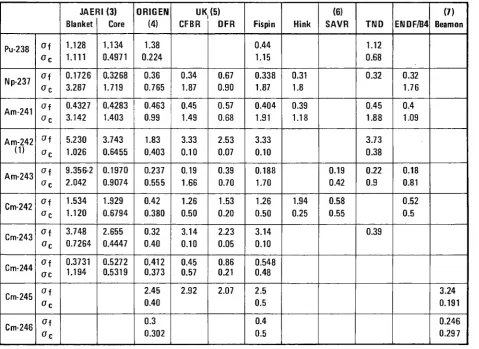
The results for the linear power rating of minor actinide containing fuel pins as function of the Irradiation time depend on the capture and fission cross sections. The results given in one of the preceding subsections have been obtained using the onegroup crosssections of the ORIGEN code. A comparison between these data and the ones of other sources is reproduced in Table III. It shows the discrepancies between the libraries included in the burnup codes ORIGEN and FISPIN (<jf of Pu238, Cm2.42, Cm243;
ac Of Pu238; Np237, Am241, Am242(1 ), Am243, Cm243).
Moreover, the influence of the reactor spectrum on the effective onegroup cross sections may be realized by confronting once the results of JAERI for a soft blanket spectrum with those of a medium core spectrum and the other time the results of a UK set for a medium core spectrum of an oxidefuelled FBR with those of the hard spectrum of a metalfuelled assembly. Strong variations may be observed in a¡ of Np237, Am243 and Cm244 as well as in rjcof Np237, Am241.
It may be concluded that work has still to be performed in order to verify and to improve the data library ofORIGEN studying the effects of different reactor spectra on one or fewgroup cross sections as well as of different differential or multigroup cross sections. This work aims at the generation of a new FBR library for minor actinides.
Differential and multigroup cross sections for byproduct actinides have been collected from different sources. Neutron spectra of various FBRs have also been derived. By means of a computer program, the differential cross sections will be collapsed to onegroup cross sections in order to estimate the effect of the various error sources and to generate a consistent data set which will be introduced into ORIGEN.
Shielding Thickness of Fabrication Facilities of Fuels Containing By-Product Actinides
The minor actinide elements (Np, Am, Cm, Cf) of concern In the transmutation concept, are characterized by a high neutron emission due to spontaneous fission and (αn) reactions. In handling such hazardous materials the composition and wall thickness of the fabrication facilities should be dimensioned in order to limit the radiation exposure of personnel to a level of 2.5 m Rem/h.
On the other hand, at the moment when actinides are eventually recycled for transmutation, also the plants for the fabrication of fuels containing recycled plutonium will eventually require additional shielding and special fabrication technologies such as remote and automated operations.
In order to make possible an evaluation of the additional costs in fabrication deriving from the actinides recycling, calculations of the shielding thicknesses, necessary to reduce the neutron dose to 2.5 m Rem/h, have been performed for the following fuels8:
Table III — Comparison of One-Group Cross Section for FBRs Taken from Different References
[image:27.595.48.528.447.796.2]