This is a repository copy of An investigation of the effects of the common cold on simulated driving performance and detection of collisions.
White Rose Research Online URL for this paper: http://eprints.whiterose.ac.uk/83325/
Version: Accepted Version
Article:
Jamson, SL and Smith, AP (2012) An investigation of the effects of the common cold on simulated driving performance and detection of collisions. BMJ: British Medical Journal, 2 (4). ISSN 2044-6055
https://doi.org/10.1136/bmjopen-2012-001047
[email protected] https://eprints.whiterose.ac.uk/ Reuse
Unless indicated otherwise, fulltext items are protected by copyright with all rights reserved. The copyright exception in section 29 of the Copyright, Designs and Patents Act 1988 allows the making of a single copy solely for the purpose of non-commercial research or private study within the limits of fair dealing. The publisher or other rights-holder may allow further reproduction and re-use of this version - refer to the White Rose Research Online record for this item. Where records identify the publisher as the copyright holder, users can verify any specific terms of use on the publisher’s website.
Takedown
If you consider content in White Rose Research Online to be in breach of UK law, please notify us by
An investigation of the effects of the common cold on simulated driving performance and detection of collisions: A laboratory study
Andrew P. Smith professor of psychology1, Samantha L. Jamson principal
research fellow2
1
Centre for Occupational and Health Psychology, School of Psychology, Cardiff University, 63 Park Place, Cardiff CF10 3AS, UK
2
Institute for Transport Studies, University of Leeds
Correspondence to: Andrew Smith [email protected]
Abstract
Objective The aim of the present research was to investigate whether
individuals with a common cold showed impaired ability on a simulated driving task and the ability to detect potential collisions between moving objects.
Design The study involved comparison of a healthy group with a group with colds. These scores were adjusted for individual differences by collecting further data when both groups were healthy and using these scores as covariates. On both occasions volunteers rated their symptoms and carried
out a simulated driving session. On the first occasion volunteers also carried out a collision detection task.
Setting University of Leeds Institute for Transport Studies
Sample Twenty five students from the University of Leeds. 10 volunteers were healthy on both occasions and 15 had a cold on the first session and were healthy on the second.
Main outcome measures In the collision detection task the main outcomes were correct detections and response to a secondary identification task. In the simulated driving task the outcomes were: speed; lateral control; gap
acceptance; overtaking behaviour; car following; vigilance and traffic light violations.
Results Those with a cold detected fewer collisions and had a higher divided attention error than those who were healthy. Many basic driving skills were unimpaired by the illness. However, those with a cold were slower at responding to unexpected events and spent a greater percentage of time driving at a headway of less than 2 seconds.
Conclusions The finding that having a common cold is associated with
Introduction
Studies of simulated driving have played a major role in transport policy and practice. One of the early studies1, published in the British Medical Journal, demonstrated an increase in driving error following ingestion of alcohol. Changes in state due to drugs like alcohol can be countered by appropriate legislation. Other factors, such as driver fatigue, are more difficult to legislate against – there’s no breathalyser for fatigue! In the case of professional drivers some causes of fatigue, such as time spent driving, can be controlled. This is more difficult when one considers driving outside of work or when one
has to deal with fatigue produced by other factors (low levels of circadian alertness).In these situations, information campaigns2 have to be used to prevent and manage driver fatigue, although legislation relating to being in a fit state to drive could be applied. The aim of the present research was to investigate whether individuals with a common cold showed impaired ability on a simulated driving task and the ability to detect potential collisions between moving objects.
Minor illnesses such as the common cold produce a state of reduced alertness which is associated with impaired psychomotor function and cognitive abilities3, 4, 5, 6. These impairments manifest themselves as slower reaction times to unexpected events and a reduced ability to sustain attention. These are important skills involved in driving and one might, therefore, expect that individuals with such illnesses will be involved in morecrashes. Anecdotal evidence, largely consisting of case reports, suggests that this is the case7. This has been confirmed in a survey8 and extrapolation of this to the whole driving population suggests that 125,000 people in the UK have a crash while suffering from a cold or influenza. Results from a driving hazard perception task8 confirmed laboratory findings that reaction times are 10% slower when the person has a cold. Again, if one applies this to a real-life driving situation it would mean that it would add 1m (3.3ft) to stopping distance if travelling at
2.3m (7.5ft) onto the normal stopping distance of 96m (315ft) if travelling at 70mph (113km/h).
Research using a simple driving simulator9 (resembling a computer game) has shown that people with an upper respiratory tract illness responded more slowly to unexpected events and were more likely to steer inaccurately. Another study10 using a very realistic driving simulator found that basic driving skills were not impaired but that situational awareness was reduced when the person had a cold. The present study continued to examine this topic in detail, using a sophisticated simulation that incorporates the skills necessary for safe driving. In addition, the study also included a laboratory task which evaluated participants’ ability to detect potential collisions11 which is a key skill in driving but also something that cannot be repeatedly examined in a simulator.
Method
The study was carried out with the approval of the ethics committee, School of
Psychology, Cardiff University, and the informed consent of the volunteers.
Experimental design
A mixed design was employed whereby two groups of participants (Sample 1 and Sample 2) were tested on two occasions (Session 1 and Session 2). Those participants in Sample 1 were healthy on both occasions, whilst those in Sample 2 reported symptoms of minor respiratory illnesses in Session 1, but were symptom free in Session 2. Participants carried out the driving simulation task on both occasions but only carried out the collision detection task on the first session.
Procedure
the experimental procedure and sign the consent form if they agreed to take part. They then completed a symptom checklist, a self report questionnaire designed to evaluate the severity of their symptoms using a 5 point rating scale (0=not all to 4= very severe). If volunteers scored above 8 on symptoms typical of a cold (pain in chest, sore throat, headache, sneezing, runny nose, blocked nose, hoarseness, cough, hot/cold, sweating, shivering, fever, and phlegm) they were included in the cold group. Healthy volunteers were only included if they had a symptom score of 3 or less (based on the upper respiratory tract symptoms and other symptoms of minor illnesses such as digestive problems).Volunteers were excluded if they were taking medication for their colds. All volunteers were tested when their illness had been present for at least 24 hours and no longer than 96 hours.
The laboratory task was then completed, followed by a familiarisation period on the driving simulator. Volunteers were asked to drive as naturally as possible through the road network. The secondary (choice reaction) task was
also explained to them. On completion of the drive, volunteers were asked to contact the experimenter after seven symptom free days in order to confirm a second session. Those who were healthy at session 1 returned for their second session approximately a week later. When they returned for this session, they completed the same symptom checklist and driving simulator task. After completion, they were debriefed, and their expenses paid.
OMEDA (Object Movement Estimation under Divided Attention)
OMEDA11 is a computerised dual-task with two parts. Part 1 of OMEDA allows experimenters to obtain an individual’s error in Time-To-Collision (TTC) estimation. Different target speeds can be simulated, as can various degrees of occlusion. A secondary task is also incorporated in the form of a visual divided attention task. This requires the identification of peripheral duplication of stimuli presented centrally (in this case geometrical shapes).
same secondary task as for Part 1. Participants do not need to be computer literate in order to be able to do this task, as the response keys are a foot pedal (for the primary task) and a hand button (for the secondary task).
In Part 1 the participant is presented with a computer screen where the corners are covered by green triangles and in the centre of the screen is a yellow circle. The yellow circle varies in size between two and 250 pixels. From one of the four corners (randomly allocated), a red target, in the form of a circle travels towards the middle of the screen. Once it reaches the edge of the yellow circle, it travels underneath it and it is not visible. Therefore, the larger the circle, the more difficult is the task, due to a longer occlusion time. The participant is asked to estimate exactly when the target reaches the middle of the computer screen. They are instructed to press a foot pedal at the exact point the target reaches the middle.
In order to simulate divided attention, whilst participants are estimating when
the target reaches the middle of the screen, they are required to complete a pattern matching task. When the target is moving, five shapes appear on the screen (one overlaid on the yellow circle and one in each of the four corners). Participants are instructed to press a hand button immediately if the shape in the middle matches any of those in the four corners of the screen.
Figure 1: OMEDA computer screen
Data collected are target speed, size of the occlusion circle, time under the occlusion circle, actual time to contact (TTC), estimated TTC and TTC error, errors in shape detection.
In Part 2, the participants are presented with the same screen as in Part 1. However, the primary task now involves two targets moving towards the centre of the screen, emerging at different times and travelling at different speeds. The targets reach the centre of the screen either at the same time (a hit), almost at the same time (a near miss) or at a noticeable time difference (a miss). The participant is required to press the foot pedal only if and when the targets reach the centre of the screen at the same time (i.e. only for hits). The secondary task is the same as for Part 1. The data collected includes the error in estimating TTC and the error in shape estimation, under different occlusions and target speeds
Driving Simulator
The experiments were carried out on a fixed based driving simulator at the University of Leeds presenting a 120º forward view and 50º rear view. The system features a fully interactive Silicon Graphics (Onyx RE²) driving simulator with a six degree of freedom vehicle model. A servo motor linked to the steering mechanism provides control over handling torque and speed and digitised samples of engine, wind, road noise and other vehicles are provided. Photo-realistic scene texturing allows presentation of various road types and features.
Prior to the experimental drive, participants completed a fifteen minute
familiarisation drive. The drive comprised urban, rural and motorway sections,
similar to the experimental drive, but contained none of the scenarios under
investigation. Once the familiarisation drive was completed, drivers were
deemed ready to proceed to the next stage. The experimental route was approximately 22 miles in length and comprised of urban, rural and motorway environments, providing a range of speed limits between 30 and 70 mph. Other cars in the scenario provided the opportunity of simulating overtaking scenarios, gap acceptance tasks and car-following situations. The road environment also featured traffic lights and pelican crossings in order to instigate possible violation scenarios; and sub-standard curves were included in both the urban and rural sections.
Speed measurements were taken every 10 metres throughout the whole journey. In addition, indices of safety critical behaviour such as minimum time to collision in following tasks and the incidence of overtaking manoeuvres
were recorded. Traffic light violations, speed violations and curve negotiation behaviour were also noted.
Three car following situations were engineered requiring drivers to maintain their desired headway over a section of road. They were unable to pass the slow moving car in front due to oncoming traffic. These situations allowed measurement of minimum time to collision and variation in headway. In addition, two overtaking scenarios were created: here oncoming traffic was present, but it had sufficient gaps to allow the driver to pass. Propensity to overtake and proximity to the oncoming car were measured. An additional overtaking scenario was created, again using a slow moving vehicle in front. Here drivers were constrained by double white lines; if they chose to overtake, a violation was recorded.
incorporated into the road network. The first required the driver to merge from the minor road onto the major road, making a left turn. Traffic on the major road was approaching from the right with varying gaps. The second required the driver to make a right turn across oncoming traffic from a major to a minor road. Again the cars were separated with varying gaps.
Attention to surprise events was measured in terms of performance on a choice reaction task incorporated into the road network. Drivers were required to respond to red and green squares that appeared in front of them. If the square was green, they were asked to ignore it and continue driving. If the square was red, they were asked to continue driving, and to flash the headlights once, in response. Throughout the whole drive there appeared three red and three green squares in a random sequence. In subsequent drives the positioning of the squares was changed, in order to prevent associative learning effects. Their response to the stimuli was recorded in terms of reaction time, false/correct hits and missing responses.
Participants
Sample 1 (Healthy) Sample 2 (Colds)
Males/females 4/6 10/5
Mean age (males) 20 years (range: 18-21) 20 years (range: 18-25)
Mean age (females) 22 years (range: 20-24) 21 years (range: 19-24)
Results
Symptom checklist
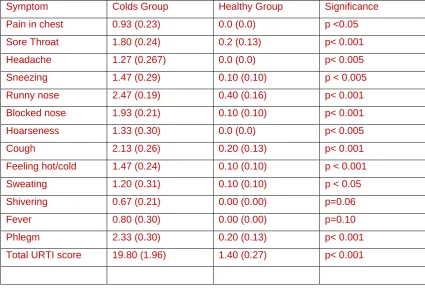
The symptom checklist showed significant differences in self-reported health. In the first test session, volunteers with a cold scored on average 19.8 (out of a maximum of 52), whilst on their return, this average score fell to 2, which was similar to the scores for those who were healthy on both occasions.
Symptom scores for all of the upper respiratory tract symptom scales are shown in Table 1. All of the individual symptoms showed significant differences between the groups except for fever and shivering. This suggests that the participants had colds rather than influenza.
OMEDA
Performance data on both parts of the OMEDA task are presented. Part 1 of the task provides indication of accuracy in terms of time-to-collision estimates of a moving target. Absolute error (in seconds) was computed for both the healthy and unhealthy groups. Performance on the secondary task was also recorded, using the number of errors made in identifying the presence of a matching shape in the periphery of the screen. Part 2 of OMEDA provides data relating to the ability to detect a collision between two moving targets. The results are shown in Table 2.
.
error of TTC: Healthy group: 0.40; Ill group: 0.44). In addition, they found the primary task easy enough to be able to perform well on the secondary task, with only a total of four identification errors across the whole sample (Shape identification error: Healthy group: 0.01; Ill group: 0.03). However, when the task became more difficult in Part 2 of the OMEDA, performance decrements were found for those with colds. Healthy individuals were more likely to identify correctly both collisions and non-collisions. Those with colds appear to be impaired to the extent that they were less likely to be able to identify if the moving targets would or would not collide under various degrees of occlusion. Performance on the secondary task was also degraded, such that those who were suffering from a cold made more errors in identifying the matching shape in the periphery of the screen.
Driving performance
In order to control for individual differences in driving ability, analyses of co-variance, with the session 2 data as covariates, were carried out on the driving data. Preliminary analyses showed that the two groups were not
significantly different at session 2 (when both groups were healthy).
Speed
For the purpose of data analysis, the experimental road network was divided into sections according to speed limit. Of these sections, where the driver was in free flowing conditions (i.e. not engaged in a car following task) standard deviation of speed across the section was derived. Analyses of covariance showed no effect of having a cold on standard of speed (Healthy group: mean=4.76 m/s, s.e.= 0.36; Ill group: mean=4.82 m/s, s.e.= 0.30, F <1).
Lateral control
Gap acceptance
Two gap acceptance tasks were included in the road network. The first required the drivers to merge left into traffic approaching from the right, whilst the second required drivers to turn right across oncoming traffic. Gaps in the traffic increased by 1 second, with each vehicle, and the size of the gap that drivers accepted as well as a minimum time to collision to the on-coming car was calculated. There were no significant effects of cold status on gap acceptance.
Overtaking behaviour
In addition to the car following tasks detailed above, two scenarios were created to examine overtaking behaviour. Drivers encountered lead cars travelling below the posted speed limit on a straight stretch of road. There was little opposing traffic, providing the opportunity for drivers to overtake. Both overtaking attempts and successful overtakings were recorded. However it was found that these values were identical (thus once committed to an overtaking manoeuvre, drivers tended to complete it). There was no
difference in overtaking behaviour between the two groups.
Car following
It can be seen that those drivers who reported cold symptoms spent a larger proportion of time at a shorter headway (in the safety critical area of less than 2 seconds).
Vigilance
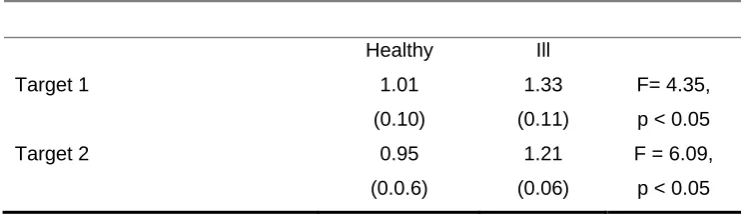
A choice reaction task required drivers to differentially respond to randomly appearing targets in the visual scene. It was hypothesised that there may be differences in either response times or error rates depending on the health status of the participants. Such differences may arise as a result of decreases in vigilance associated with cognitive impairment. Probably due to the ease of the task, a floor effect was found with regards to the error rates in that drivers demonstrated a high degree of accuracy. Further analysis of the response times to targets however, revealed a significant difference between response times of the healthy and ill volunteers with those with a cold being significantly slower (see Table 3).
Collision with a pedestrian
A critical event was added as an additional measure of vigilance. At a pedestrian crossing a pedestrian stepped into the road and crossed in front of the driver’s path. This event was staged such that drivers were able, with severe braking, to avoid collision with the pedestrian, if braking was initiated immediately. In the first session, the healthy volunteers had no collisions whereas those with a cold had 8 (chi-square = 7.06, p < 0.01). In the second session both groups had zero collisions.
session it was moved to half way along the network. Secondly, as a measure of anticipation, speed measures were recorded within the vicinity of the event. Thus, speed was measured at 50 metres before the event (50 metres was chosen as drivers could see the pedestrian but had not yet begun to brake). In addition, speed was also measured at the point at which they initially began to brake. There were no significant difference in these values between the first and the second driving session. This indicates that drivers were not anticipating the event in the second session.
These results demonstrate that drivers with reported symptoms of minor respiratory illnesses are impaired to the extent that they have longer response times and thus negative safety effects with regards to critical events in the driving environment.
Traffic light violations
A situation was created whereby drivers were forced to make a rapid stop/go decision at one set of traffic lights which turned from green to amber as
drivers approached. In concordance with the previous results found on the longer response times and reaction to surprise events, drivers who reported cold symptoms violated the traffic lights twice as often as drivers who were symptom free. However, due to the small number of violations this effect was not significant.
Discussion
having to perform at night. The OMEDA task also demonstrated that those suffering from a cold were less able to detect potential collisions. Comparison with a previous study11 using elderly participants (over 65 years) shows that the detection performance of young adults with a cold falls to that of elderly drivers. There is now a need for an information campaign to provide accurate information about the potential hazards associated with driving while suffering from an upper respiratory tract illness.
There is also evidence that the direct effects of having a cold are not the only ones that need to be considered. A number of studies have shown that individuals who are ill are more susceptible to the effects of other factors which could influence driving (alcohol13; prolonged work14; and noise15). Research also shows that impairments associated with the common cold are not restricted to the time the person is symptomatic but may be observed in the incubation period and a few days after symptoms have gone6.
One must now ask what underlies the effects here. Previous research has
shown that the low alertness state associated with a cold can be reversed by a drug which increases the turnover of central noradrenaline16. Indeed, ingestion of caffeine, which increases alertness, has been shown to remove the cold induced performance impairments seen in laboratory tasks17. This suggests that a further study examining whether caffeine can remove the effects found here is required. Similarly, it will be important to determine whether medications aimed at producing symptomatic relief also remove the behavioural problems associated with the common cold.
than those seen here. Similarly, further research is required to address the issue of awareness of these effects by using information campaigns and prevention by using countermeasures that increase alertness.
References
1. Drew GC, Colquhoun WP, Long HA. Effect of small doses of alcohol on a skill resembling driving. British Medical Journal 1958; 994-998.
2. http://www.dft.gov.uk/publications/think-fatigue/
3. Smith AP. Respiratory virus infections and performance. Phil. Trans. R.
Soc., London, 1990; B 327: 519 - 528.
4. Smith A, Thomas M, Kent J. Nicholson K. Effects of the common cold on mood and performance. Psychoneuroendocrinology 1998; 23: 733-739. 5. Bucks RS, Gidron Y, Harris P, Teeling J, Wesnes KA, Perry VH. Selective
effects of upper respiratory tract infection on cognition, mood and emotion processing: A prospective study. Brain, Behavior and Immunity 2008; 22: 399-407.
6. Smith AP. Respiratory tract illnesses and fatigue. In: Matthews, G.,
Desmond, P.A., Neubauer, C., & Hancock, P.A. (Eds.), The Handbook of
Operator Fatigue. Farnham, Surrey, UK: Ashgate Publishing. ISBN:
978-0-7546-7537-2. 2012; Pg 291-305.
7. Tye J. The invisible factor: An Inquiry into the Relationship between Influenza and Accidents. London: British Safety Council. 1960.
8. http://www.insurance.lloydstsb.com/personal/general/mediacentre/sneeze _and_drive.asp
9. Smith A. Effects of the Common Cold on simulated driving. In
Contemporary Ergonomics 2006. Editor: P.D.Bust. ISBN10 0415398185.
2006. Pg.621-624.
11. Read N, Ward N, Parkes A. The role of dynamic tests in assessing the fitness to drive of healthy and cognitively impaired elderly. Journal of
Traffic Medicine 2000; 28: 34-35S.
12. Carsten OMJ, Groeger JA, Blana E, Jamson AH. Driver performance in the EPSRC Driving Simulator: A validation study. Final report to EPSRC Contract No. GR/K56162. 1997.
13. Smith AP, Whitney H, Thomas M, Brockman P, Perry K. A comparison of the acute effects of a low dose of alcohol on mood and performance of healthy volunteers and subjects with upper respiratory tract illnesses.
Journal of Psychopharmacology 1995; 9: 225-230.
14. Smith AP, Thomas M, Whitney H. Effects of upper respiratory tract illnesses on mood and performance over the working day. Ergonomics 2000; 43: 752-763.
15. Smith AP, Thomas M, Brockman P. Noise, respiratory virus infections and performance. Proceedings of 6th International Congress on noise as
a public health problem. Actes Inrets 1993; 34: Vol 2, 311-314.
16. Smith AP, Sturgess W, Rich R, Brice C, Collison C, Bailey J, Wilson S, Nutt DJ. 1999 Effects of idazoxan on reaction times, eye movements and mood of healthy volunteers and subjecst with upper respiratory tract illnesses. Journal of Psychopharmacology 1999; 13:148-151.
Table 1: Upper respiratory tract symptoms reported by colds and healthy groups on
first testing session (scores are the means, s.e.s in parentheses. Significance tested by
a Mann-Whitney test)
Symptom Colds Group Healthy Group Significance
Pain in chest 0.93 (0.23) 0.0 (0.0) p <0.05
Sore Throat 1.80 (0.24) 0.2 (0.13) p< 0.001
Headache 1.27 (0.267) 0.0 (0.0) p< 0.005
Sneezing 1.47 (0.29) 0.10 (0.10) p < 0.005
Runny nose 2.47 (0.19) 0.40 (0.16) p< 0.001
Blocked nose 1.93 (0.21) 0.10 (0.10) p< 0.001
Hoarseness 1.33 (0.30) 0.0 (0.0) p< 0.005
Cough 2.13 (0.26) 0.20 (0.13) p< 0.001
Feeling hot/cold 1.47 (0.24) 0.10 (0.10) p < 0.001
Sweating 1.20 (0.31) 0.10 (0.10) p < 0.05
Shivering 0.67 (0.21) 0.00 (0.00) p=0.06
Fever 0.80 (0.30) 0.00 (0.00) p=0.10
Phlegm 2.33 (0.30) 0.20 (0.13) p< 0.001
Table 2. Performance of healthy and unhealthy drivers on the divided attention part of the OMEDA task.
Healthy Cold Chi-square Significance
Missed collisions 6% 5% .122 p = 0.727
Detected collisions 27% 22% 3.67 p = 0.012
Correct misses 35% 27% 5.32 p = 0.002
False hits 31% 27% .971 p = 0.325
Table 3. Significant effects of health status on outcomes from the driving task
a. Mean percentage of time spent at a headway of less than 2 seconds (s.e.s in
parentheses)
Healthy Ill
39.2%
(5.4)
51.7
(4.3)
F = 4.80,
p <0.05
b. Mean response times (seconds) in choice reaction task (s.e.s in parentheses)
Healthy Ill
Target 1 1.01
(0.10)
1.33
(0.11)
F= 4.35,
p < 0.05
Target 2 0.95
(0.0.6)
1.21
(0.06)
F = 6.09,
Contributors
APS wrote the research proposal, designed the study, wrote the statistical analysis plan, analysed the data and drafted and revised the paper. He is guarantor.
SJ implemented the study, analysed the data and revised the paper.
Copyright
“The Corresponding Author has the right to grant on behalf of all authors and does grant on behalf of all authors, an exclusive licence (or non exclusive for government employees) on a worldwide basis to the BMJ Publishing Group Ltd and its licensees , to permit this article (if accepted) to be published in BMJ editions and any other BMJPG products and to exploit all subsidiary rights, as set out in our licence”
(http://resources.bmj.com/bmj/authors/checklists-forms/licence-for-publication)”
Disclosure
"All authors have completed the Unified Competing Interest form at