COMMISSION OFTHE EUROPEAN COMMUNITIES
JOINT RESEARCH CENTRE Ispra Establishment Italy
CONFIDENTIAL COMMUNICATION
Category 1.3 Nr 3486
DECLASSIFIED
m 111« I H I I Jill?
s
as
*
■ :
Copy N2 014
WARNING
The information containec in this document is
communicated confidentially by the Commission of the European Communities to Member States, persons and undertakings and should not be passed on to third parties.
(Euratom-Treaty, Article 13, and Regulation (EEC) No. 2380/74 of the Council of Ministers).
Management
of Nuclear Materials and
Radioactive Waste
ABSTRACT
This document is the progress report of the Programme Management of Nuclear Materials and Radioactive Waste of the Joint Research Centre for the period July - December 1977. The programme consists of three projects. The main achievements during the reporting period were the following:
Project 1 : Evaluation of the Long-Term Hazard of Radioactive Waste Disposal The Boom clay formation (Belgium) has been chosen as the test case for the development of a site specific model of the geological barrier. The Fault-Tree Analysis is being used to quantity the probabilistic value of the barrier.
The results of leaching tests on glasses seem to confirm that the release of the elements Is obtained not only by a solution process, but also by a colloidal phenomenon.
In the field of the actinides monitoring a guide is in preparation; chapter IV of this guide on Passive Neutron Assay has been completed.
Project 2 : Chemical Separation and Nuclear Transmutation of Actinides
In the field of actinides separation by solvent extraction the batch tests on simulated high activity waste solutions using HDEHP and TBP have been completed. The prepratlon of waste to be used for fully active experiments has been started by dissolution and processing high burn-up fuels.
Gamma- and neutron emission by actinides have been calculated in order to assess the prob-lems generated by the presence of the actinides in the nuclear fuel cycle.
Project 3 : Decontamination óf Reactor Components
This project initiated at the beginning of 1977. A review paper on the state of the art in the field of decontamination of LWR components is almost completed.
JOINT RESEARCH CENTRE Ispra Establishment Italy
Management
of Nuclear Materials and
Radioactive Waste
PROGRAMME PROGRESS REPORT
B E M Æ R K
Den viden, som rummes i dette dokument, meddeles som fortrolig fra Kommissionen for de europæiske Fællesskaber til Medlemsstater, per-soner og virksomheder og ma ikke videreaives til trediemand. (Euratom-traktatens artikel 13og Minersterrådetsforordning(EDF) N° 2380/74). Hverken Kommissionen for de Europæiske Fælleskaber eller nogen, som optræder pa Kommissionens vegne er ansvarling for den eventuelle
brug af information, som er indeholdt i det følgende .
ZUR BEACHTUNG
Die in diesem Dokument enthaltenen Kenntnisse werden von der Kom-mission der Europäischen Gemeinschaften den Mitgliedstaaten, Per-sonen und Unternehmen der Gemeinschaft vertraulich mitgeteilt und dürfen nicht an Dritte weitergegeben werden. (Euratom-Vertrag, Arti-kel 13, und Beschluss des Ministerrates (EWG) Nr. 2380/74).
Weder die Kommission der Europäischen Gemeinschaften noch Perso-nen, die im Namen dieser Kommission handeln, sind für die etwaige Verwendung der nachstehenden Informationen verantwortlich.
NOTICE
The information contained in this document is communicated confi-dentially by the Commission of the European Communities to Member States, persons and undertakings and should not be passed on to third parties. (Euratom-Treaty, Article 13, and Regulation (EEC) No. 2380/74 of the Council of Ministers).
Neither the Commission of the European Communities nor any person acting on behalf of the Commission is responsible for the use which might be made of the following information.
AVERTISSEMENT
Les connaissances contenues dans le présent document sont communi-quées confidentiellement par la Commission des Communautées euro-péennes aux Etats membres, personnes et entreprises et ne peuvent être transmises à des tiers. (Traité Euratom, article 13, et règlement (CEE) N° 2380/74 du Conseil de Ministres).
Ni la Commission des Communautés européennes, ni aucune personne agissant au nom de la Commission, n'est responsable de l'usage qui pourrait être fait des informations ci-après.
A V V E R T I M E N T O
Le cognizioni contenute nel presente documento sono comunicate con-fidenzialmente dalla Commissione delle Comunità europee agli Stati membri, persone ed imprese e non debbono essere trasmesse a terzi. (Trattato Euratom, articolo 13, e regolamento (CCE) N° 2380/74 del Consìglio dei Ministri).
Né la Commissione delle Comunità europee, né alcuna persona che agisca per suo conto, è responsabile dell'uso che dovesse essere fatto delle informazioni che seguono.
OPMERKING
De kennis, die in dit document is vervat, wordt door de Commissie van de Europese Gemeenschappen vertrouwelijk aan de Lid-Staten, per-sonen en ondernemingen medegedeeld en mag niet aan derden worden doorgegeven. (Euratom-Ve'rdrag, artikel 13, en het besluit van de Mi-nisterraad (EEG) No. 2380/74).
TABLE OF CONTENTS
page
1. Introduction 3 2. Projects 7
2.1. The Evaluation of Long Term Hazard of Radioactive
Waste Disposal 7 2.1.1. Waste Hazard Analysis 8
2.1.2. Long Term Stability of Conditioned Waste 11 2.1.3. Interaction of Actinides with Environment 16
2.1.4. Actinides Monitoring 20
2.2. Chemical Separation and Nuclear Transmutation of Actinides . . . 23
2.2.1. Chemical Separation of Actinides 24 2.2.2. Assessment Studies on Nuclear Transmutation of
Actinides 31 2.2.3. Actinide Cross Section Measurements 38
2.3. Decontamination of Reactor Components 40
3. Conclusions 45 4. JRC Publications 50
- 3
1. INTRODUCTION
The safe and economic management of the radioactive waste, produced in the exploitation of nuclear energy at an industrial level, requires a considerable effort of R&D.
The Joint Research Centre (JRC) started work in the field of radioactive waste management in 1973. This p r o g r a m m e is part of the activity of the JRC in the field of Nuclear Safety which includes also the p r o g r a m m e Reactor Safety and the p r o g r a m m e Plutonium Fuel and Actinide R e s e a r c h . The staff allocated to the p r o g r a m m e for 1977 consists of 63 r e s e a r c h men, corresponding to about 6% of the total JRC-staff. The p r o g r a m m e is c a r r i e d out at the Ispra Establishment with a participation of the K a r l s -ruhe Establishment.
The JRC p r o g r a m m e Management of Nuclear Materials and Radioactive Waste has been organized into three projects:
- Evaluation of L o n g - T e r m Hazard of Radioactive Waste Disposal, comprising essentially the identification and the evaluation of the long-t e r m hazard of long-the permanenlong-t slong-torage of radioaclong-tive waslong-te in geologi-cal formations. This type of storage is considered at present to be the m o s t appropriate to solve the problem of radioactive waste.
- Chemical Separation and Nuclear Transmutation of Actinides
The objective is to obtain a better appreciation of this advanced s t r a tegy for managing radioactive waste by separating the actinides r e s -ponsible for long-term risk, from the bulk of the fission products and by their transmutation in nuclear r e a c t o r s .
- Decontamination of Reactor Components
The objective is to study the nature of the contaminated layers and the application of various decontamination techniques in o r d e r to optimize the decontamination procedures required for the safe operation and for the decommissioning of nuclear r e a c t o r s .
The Commission of the European Communities started in 197 5 also an Indirect Action in this field. In this Indirect Action, which is conducted by means of contracts with national l a b o r a t o r i e s , various aspects of waste conditioning technologies a r e studied and a large coordinated a c tion for the study of waste disposal in various types of geological f o r m a -tions was established.
ι,
7 -2. PROJECTS
2.1. THE EVALUATION OF LONG TERM HAZARD OF RADIOACTIVE WASTE DISPOSAL
The l o n g - t e r m hazard of radioactive waste disposal in geological forma-tions,which is essentially due to the p r e s e n c e of actinides, is studied by the b a r r i e r approach which is based on the evaluation of the b a r r i e r s provided between the disposed waste and man.
The b a r r i e r s considered a r e the following:
- Segregation provided by disposing the waste in a deep geological formation,
- L o n g - t e r m stability of the waste conditioned in glass and bitumen, - Retention of actinides by abiotic environment,
- Ecological distribution pattern of actinides.
The evaluation of the long-term hazard requires the development and application of waste hazard analytical models and experimental studies for the quantification of the values of the different b a r r i e r s .
In the field of models development we a r e passing from generic models in which the data a r e a r b i t r a r i l y set on the basis of scientific considerations, to a m o r e applied type of development in which the data a r e collected on specific experimental s i t e s , not necessarily linked to any future disposal operation.
c ies Concerning the experimental studieson the long-term stability of th conditioned waste both radiation damage studies on glasses and stud on the leaching of vitrified and bituminized waste a r e in p r o g r e s s . In p a r t i c u l a r at the beginning of 1977 a study has been started to verify the validity of the accelerated irradiation tests which a r e c a r r i e d out in various laboratories to simulate long-term alpha-damage.
8
-2 . 1 . 1 Waste Hazard Analysis
OBJECTIVES
The a i m of this study is to get a comprehensive view of radioactive waste h a z a r d , with p a r t i c u l a r emphasis on the quantitative value of the b a r r i e r s y s t e m placed between waste and mankind. This aim will be pursued through the development and application of a s s e s s m e n t methodologies, such as Fault T r e e Analysis for the probabilistic a s s e s s m e n t of the value of geological containment, and c r i t i c a l pathway analysis for the determination of environmental levels of r a d i o -active pollution and corresponding dose r a t e s to man.
F o r the second s e m e s t e r of 1977 the planned activities w e r e :
A. To s t a r t the application of probabilistic analysis of the r i s k to specific disposal sites (Belgian clay formations),
B. to initiate a c r i t i c a l revision of the model used to calculate pathways and dose r a t e s to man,
C. to develop a p r e l i m i n a r y a s s e s s m e n t of the impact of radionuclide r e l e a s e into an aquatic e c o s y s t e m .
RESULTS
A. The Boom clay formation has been chosen as the t e s t c a s e for the development of a site specific model of the geological b a r r i e r . Fault T r e e Analysis is being used to quantify the probabilistic value of the b a r r i e r .
The n e c e s s a r y geological information has been gathered, m o s t of it having been supplied by C . E . N. -Mol. Three different r e c e p t o r s have been identified, namely groundwater, land surface and a t m o s p h e r e , corresponding to t h r e e different top events of the Fault T r e e s .
B. A revision of the actinide r e l e a s e and distribution model has been initiated, through a m o r e careful examination of some points. The waste inventory has been re-evaluated by taking into account t h r e e different options for the LWR fuel cycle, namely:
- the throw-away mode, - the uranium-only recycle,
- the uranium and plutonium recycle.
9
-C. A study has been undertaken to develop a methodology for the
a s s e s s m e n t of the distribution of artificial radioactivity in a coastal m a r i n e ecosystem.
The various environmental compartments have been identified and the p r o c e s s e s occurring within them have been outlined. The prelimi nary results have been presented in a technical note /!_/.
COLLABORATION WITH EXTERNAL ORGANIZATIONS
The collaboration established with C . E . N . -Mol for a s s e s s i n g the suita bility of certain clay formations to accommodate waste produced by Bel
gian nuclear power plants, has already been described above.
A collaboration with laboratories involved in the Indirect Action p r o g r a m me Radiation Protection is foreseen; preliminary contacts have been e s t a blished with some of them, the objective being to provide the n e c e s s a r y data input for the radioisotope distribution models.
The first meeting of the Working Group Risk Analysis Linked to the D i s posal of Radioactive Waste in Geological F o r m a t i o n s (sub-group of fiche 7 of the Indirect Action p r o g r a m m e Management and Disposal of Radio active Waste) was held in B r u s s e l s on 21-22 November 1977.
The aim of the group is essentially to facilitate a detailed and timely ex change of information among experts and to favour the establishment of common c r i t e r i a for risk evaluation. The JRC a s s u r e s a permanent s e c r e t a r i a t for the group.
CONCLUSIONS
The methodologies previously developed for a generic geological forma tion, have proved to be adaptable to real disposal sites without major difficulties. The preliminary a s s e s s m e n t of the riskinvolved for future generations shows it to be very small, both in t e r m s of event probability and of resulting dose rates to man, should the r e l e a s e occur; inhalation appears as the c r i t i c a l pathway.
PLANNED ACTIVITIES
i o
-JRJEr jr E í v E Ì X C E o
[\] MURRAY, C . N . , AVOGADRO, Α . ,
11
-2 . 1 . -2 L o n g - T e r m Stability of Conditioned Waste
OBJECTIVES
The aim of this study is to obtain information on long-term behaviour of conditioned high- and m e d i u m - l e v e l waste, which is n e c e s s a r y for waste hazard evaluation.
The planned activities for the second half of 1977 were, as for the first s e m e s t e r , the following:
- P o s t - i r r a d i a t i o n examination of glasses irradiated in the Petten Reactor, - Continuation of the glass leaching t e s t s ,
- Extension of the stability tests to bituminized waste,
- Checking of the validity of damage simulation by means of accelerated t e s t s . This is a new activity started in 1977, which requires an initial period of evaluation of possible irradiation means and of physical p a r a -m e t e r s to be -m e a s u r e d .
RESULTS
Post-Irradiation Examination of Irradiated Glasses
The irradiation c a r r i e d out in the HFR at Petten was intended to simulate, by the damage caused by fission fragments, the damage produced by the a l p h a - p a r t i c l e s . A maximum of fission density of 4 · 10 fissions/cm-5, which corresponds to 2 -10 displaced a t o m s / c m , was calculated for the irradiated s a m p l e s .
The relative fission densities have been evaluated by the analysis of two fission products, respectively Cs-137 and Ce-144. The results obtained a r e in agreement with the nuclear code calculations with exception of one sample. F r o m the point of view of the fission density distribution the irradiation can be considered satisfactory.
The measuring of the leaching coefficients has been completed. The leaching coefficient was m e a s u r e d at 100°C by the Soxhlet test method. The tests lasted normally two weeks and the samples were weighed every week. No relation was observed between the fission density and the leaching coefficient. Besides the values of the irradiated samples a r e p r a c t i -cally the s a m e as those of the non-irradiated g l a s s e s .
1 2
-A s i m i l a r behaviour was observed by Peymal [\J on borosilicate glasses but the i n c r e a s e was effective for lower equivalent dose. Due to delay in the delivery of a DTA (Differential T h e r m a l Analysis) apparatus of high sensitivity, the m e a s u r e m e n t s of stored energy were not possible. They will be c a r r i e d out at the beginning of 1978.
A preliminary report was presented at the F i r s t HFR U s e r s Sympo-sium, held in Petten, October 1977.
Glass Leaching Tests
The study on the glass leaching is centered on the evaluation of the long-t e r m weighlong-t loss and on long-the syslong-temalong-tic slong-tudy of long-the surface layer compo-sition in o r d e r to clarify the leaching mechanism.
A test at 80°C was terminated after 9700 h of leaching. A t e s t at 50°C will be terminated in 3 months.
P r e l i m i n a r y results of surface analysis show that the composition of the surface layer changes largely during the leaching test. P a r t i c u l a r l y after a certain time some oscillations of composition appear. It s e e m s con-firmed that the r e l e a s e of the elements is obtained not only by a solution p r o c e s s but also by a colloidal r e l e a s e .
Stability Tests on Bitumen
Some preliminary tests on bitumen have been initiated in o r d e r to verify the dependence of leaching on the solubility of the b i t u m e n - i n c o r p o r a t e d
salt and to clarify the mechanism of the l o n g - t e r m leaching.
F r o m the preliminary tests it appears clearly that the model of the d i s -solving sphere utilized for the glasses is not applicable to bitumen. A model of constant leach rate coupled with a constant surface s e e m s m o r e likely. A s e r i e s of tests have been initiated with the a i m of m e a s u r i n g the amount of salt leached and the salt distribution inside the s a m p l e .
Checking of the Validity of the Damage Simulation on Glasses by Means of Accelerated T e s t s
P r e l i m i n a r y irradiation tests have been performed at Ispra and Harwell. Amorphous silica samples, 100 urn thick, were i r r a d i a t e d by 1 MeV alpha particles at a flux of 3. 5 - 1 01 3o < / c m2. sec, until a total i n t e g r a -ted flux of 10 oc/cm" was attained. During the irradiation, the s ani pie t e m p e r a t u r e was kept below 2 5°C.
Other samples, having the same dimensions, were i r r a d i a t e d by N i+ 6 heavy ions, using the Variable Energy Cyclotron available at AERE, Harwell. The irradiations were performed at an energy of 46. 5 MeV,
13
-and 2 -and 4 . 1 0 i o n s / c m . sec respectively. When a nominal value of 25 eV is assumed for the displacement energy of an atom in SiO^, the mentioned doses a r e expected to produce 2. 5 dpa, after a l p h a p a r -ticle irradiations and 0. 25 and 0. 5 dpa after heavy ion i r r a d i a t i o n s . The range of 46. 5 MeV Ni ions in silica can be evaluated to be of the o r d e r of 10 urn. This value was obtained by means of a computer simu-lation of the heavy ion irradiation experiment.
The energy stored by the irradiated samples has been m e a s u r e d by t h e r m a l analysis. DSC 910 and DSC 990 Dupont c a l o r i m e t e r s have been used. The obtained results a r e shown in Fig. 2 and a r e compared with data reported by Roberts et al. fzj, after neutron irradiation of
3.4 · 10 n / c m , equivalent to about 1 dpa. A quantitative analysis of the data is being performed for a comparison with analogous data o r i ginated by irradiation with irradiation sources inserted within the s a m -ples.
COLLABORATION WITH EXTERNAL ORGANIZATIONS
F o r the checking of the validity of damage simulation on glasses, colla-borations have been established with the Stazione Sperimentale del Vetro,
Murano (Italy) and with AERE, Harwell (UK).
CONCLUSIONS
The leaching tests c a r r i e d out in the reporting period s e e m to confirm that in the evaluation of the waste hazard a mechanism of homogeneous dissolution of the glasses can be assumed.
Concerning the checking of the validity of the damage simulation, the first r e s u l t s , i. e. t h e r m a l analysis s p e c t r a of alpha- and heavy ions irradiated s a m p l e s , a r e very encouraging because of the stored energy m e a s u r e d being high enough to offer the possibility of a comparison with the results obtained in other l a b o r a t o r i e s .
PLANNED ACTIVITIES
In the first s e m e s t e r of 1978 the following activities a r e planned: - Radiation Effects on Glasses
Measuring of the stored energy in the glasses irradiated in the HFR at Petten. Redaction of the final report.
- Leaching Tests on Glasses
Begin 14 Begin
-ning of tests in water conditioned by percolation through a column of sand and clay.
Leaching Tests on Bitumen
Beginning of systematic tests on leaching of bitumen loaded with salts of different solubilities.
Checking of the Validity of the Damage Simulation on Glasses by Means of Accelerated Tests
F u r t h e r irradiations a r e planned in the near future, at various dose rates and integrated doses, including electrons a c c e l e r a t e d at 1 MeV or m o r e , in o r d e r to allow the observation of the effects of various types of particles on the atomic mechanisms of damage in amorphous silica. Samples of m o r e complex compositions, i. e. b o r o s i l i c a t e s , will also be examined.
Theoretical studies of formation, recombination and agglomeration of defects in these m a t e r i a l s will also be pursued, in collaboration with the Theoretical Physics Division of AERE, Harwell.
REFERENCES
/l_/ LE CLERC, P . , "Action des rayonnements sur les v e r r e s " , B.I. S. T. , 7, Nov. 1965
[Ζ] ROBERTS, F . P . , JENKS, G. H. , BOPP, C D . , "Radiation Effects
15
-100° 200° 300° 400°
Temperature (°C)
500° 600°
300° 400° Temperature (°C)
100° 200° 300° 400°
Temperature ( C)
500° 600°
16
2 . 1 . 3 Interaction of Actinides with Environment
OBJECTIVES
The objective of this study is the quantitative description of the behaviour of the actinides in t e r r e s t r i a l and aquatic environments following loss from a geological repository containing alpha-bearing w a s t e s .
F o r the second half of 1977 the planned activities w e r e :
a) Production of a borosilicate glass spiked with Pu-238 and s t a r t - u p of the study of the chemical c h a r a c t e r i z a t i o n of the leaching solution.
b) S t a r t - u p of the experimental activity on plutonium m i g r a t i o n through s u b - s o i l columns.
c) Continuation of the study of Pu-behaviour in an aquatic s y s t e m in o r d e r to determine the distribution and size range of formed p a r t i c l e s as a function of pH and redox potential.
RESULTS
Glass Production
Due to the late delivery of Pu-238 the initial production of Pu-238 spiked glass had to be postponed until November 1977. The standard production p r o c e d u r e s for the b o r o s i l i c a t e glass a r e now well established and con-s i con-s t of t h r e e con-s u c c e con-s con-s i v e fucon-sioncon-s of glacon-scon-s m a t r i x powder (60% S i 02, 18. 8% B2O3, 6.2% A 1203, 15% N a20 ) containing 20% of simulated waste oxides. The initial two fusions a r e c a r r i e d out in nickel crucibles under a n o r m a l a t m o s p h e r e , the last fusion is made in a graphite crucible in an i n e r t a t -m o s p h e r e of argon at 1200°C. This is undertaken in o r d e r to reduce the molybdate phase formed in the previous m e l t s .
Examination of slices of glass under a metallographic m i c r o s c o p e showed that the m a t r i x contained evenly distributed metallic inclusions probably composed of nickel and molybdenum.
Laboratory Simulation
a) Migration Studies
17
-Two aliquots of each of the three sediments were contaminated in the laboratory with Pu237 (+ 4 form chloride solution) by n e u t r a -lizing a spiked solution to pH 6 - 8 ; sorption of the plutonium by the sediments was continued for 2 days. After this time the contamina-ted sediment was t r a n s f e r r e d to the top of columns containing iden-tical but non-contaminated sediment. Lake, estuarine and seawater were passed through the corresponding columns over a period of 100 days, the pH of the water being controlled at either pH 8. 0 or pH 6. 0. The flow rate through the columns was adjusted to about 5 m l / h . Measurement of the break-through activity was c a r r i e d out every second day. At the end of the 100 days the columns were frozen to
20 C and then sliced into approximately 1 cm lengths. The d i s t r i -bution of activity was then m e a s u r e d by gamma-counting; the results for the first four columns a r e shown in Fig. 1.
The data indicate that the method employed is adequate to determine the evolution of the migration of plutonium in the sediment columns. The identification of the migrating species will form the basis of a subsequent part of the experimental p r o g r a m m e over the next year; this will also include the determination of the chemical and m i n e r a l o -gical c h a r a c t e r i s t i c s of various soils and sediments used in the present p r o g r a m m e .
b) Aquatic Distribution and T r a n s f e r of Actinides
P r e l i m i n a r y studies were performed on the size distribution and evo-lution of suspended particulate m a t e r i a l containing plutonium with time and pH variations. The results obtained indicate that in a fresh-water environment particles ^ 1. 2 urn a r e rapidly formed (or particles already in the water absorbing very quickly the added plutonium) and these settled out of the water column in a few days. The transfer of plutonium from the water or the suspended particulate m a t t e r to bio-logical organisms seemed to i n c r e a s e over the first two weeks and then to d e c r e a s e slightly, coming to an intermediate steady level for the remaining 2. 5 months of the experiment. During this latter period the water activity was below 2. 5 p C i / m l .
COLLABORATION WITH EXTERNAL ORGANIZATIONS
During the reporting period contact was made with the following national institutes :
- Deutsches Hydrographisches Institut, Hamburg, Germany, - Biologische Anstalt Helgoland, Hamburg, Germany,
- CNEN, Laboratorio per lo Studio della Contaminazione Radioattiva del Mare, Fiasche riño, Italia,
18
-CONCLUSIONS AND PLANNED ACTIVITIES
a) Owing to the delayed delivery of plutonium-238, the planned studies on physico-chemical c h a r a c t e r i z a t i o n of solutions leached from glass will be s t a r t e d at the beginning of 1978.
These will be studied using a variety of separation techniques, ini tially consisting of ultrafiltration, solvent extraction and selective c ο -ρ re cipitation.
b) Following the p r e l i m i n a r y experiments c a r r i e d out in 1977, a s y s t e matic investigation on migration of plutonium and a m e r i c i u m leached from glass, with soil and sediment columns will be s t a r t e d .
o/ /o
100' 90-80. 70.
60-
50-Lake sediment Pb =1.85 g/cm3
70
50
30
20
10
Column diameter = 20 mm 0.1 μΟι Pu-237 per column
Sea sediment Pb = 1.6 g/cm3
(280 bed volumes) 20 C
80 C <390 bed volumes)
5 10 COLUMN DEPTH (cm) COLUMN DEPTH (cm)
Fig. 1 — Migration behaviour of Plutonium into lake and sea sediment
vO
20
-2 . 1 . 4 Actinides Monitoring
OBJECTIVES
The study aims at the development of a methodology for plutonium waste monitoring in compliance with pertinent regulations. This goal is going to be pursued in the framework of an Advisory Laboratory. In the plan ning for the reporting period, we scheduled theoretical and experimental work concerning the development of reference i n s t r u m e n t s and methods based on passive gamma and passive neutron techniques.
RESULTS
During the reporting period the major activity was concerned with:
1. Experimental verification of the interpretational model for sponta neous fission neutron m e a s u r e m e n t s (passive neutron a s s a y ) .
2. Interpretation of spontaneous fission neutron m e a s u r e m e n t s on pluto nium-contaminate d solid and liquid w a s t e s .
3. Writing Chapter IV of our Guide [\] " P a s s i v e Neutron A s s a y " .
The Interpretational Model
The interpretational model [\J for passive neutron a s s a y has been tested experimentally in o r d e r to verify the theoretical prediction of some i m portant neutron interaction effects on the rate of a u t o - c o r r e l a t e d neutron detection signals.
The fast neutron removal effect by hydrogenous m a t r i x m a t e r i a l s was m e a s u r e d for a set of 10 wooden cylinders ranging in equivalent sphere
radius [\] between 4 and 20 cm. Two types of wood having densities of
about Ρ = 0. 39 g / c m and 0. 60 g / c m ' were studied. The comparison with theoretical predictions shows agreement within experimental e r r o r s .
T h e r m a l neutron induced fission effect was verified by interpreting spon taneous fission neutron m e a s u r e m e n t s with aqueous plutonium-solutions of 1. 5 1 volume, ranging in plutonium density between 0. 66 g/l to 66. 0 g/l. It was found that the form of the experimental curve was described fairly well by the theory but the theoretical scale factor was about 30% too high.
The Interpretation of P a s s i v e Neutron Measurements
21
-w e r e continued, t a k i n g a d j u s t e d p a r a m e t e r s of t h e r m a l n e u t r o n induced f i s s i o n effects a s outlined a b o v e . In a c c o r d a n c e with w a s t e m o n i t o r i n g o b j e c t i v e s a s outlined in C h a p t e r II of ref. / l y , the e r r o r l i m i t s s p a n the r a n g e of m a x i m u m p o s s i b l e d e v i a t i o n f r o m the quoted r e s u l t . T h e p o s s i b l e b i a s of t h e s e r e s u l t s and t h e i r v a r i a n c e s will be d e t e r m i n e d by d e s t r u c t i v e a n a l y s i s of s o m e s e l e c t e d w a s t e i t e m s . T h i s d e s t r u c t i v e a n a l y s i s will be m a d e by the P l u t o n i u m L a b o r a t o r y of C N E N , C a s a c c i a .
C h a p t e r IV of o u r Guide " P a s s i v e N e u t r o n A s s a y " h a s b e e n w r i t t e n . It is going to be p u b l i s h e d a s a E U R - r e p o r t .
C O L L A B O R A T I O N WITH E X T E R N A L ORGANIZATIONS
C o n t r a c t with E U R E X S a l u g g i a , Italy, c o n c e r n i n g the t e s t i n g of o n - l i n e a l p h a - m o n i t o r ( 1 7 8 - 7 7 P I P G I , M a y l 6 t h , 1977).
C o n t r a c t with the I n s t i t u t de P h y s i q u e N u c l é a i r e ( U n i v e r s i t y of Lyon, F r a n c e ) for a n e x p e r t i s e on the p r e p a r a t i o n of the g u i d e .
C o l l a b o r a t i o n with the P l u t o n i u m F a b r i c a t i o n P l a n t (CNEN, C a s a c c i a , Italy) for the p l u t o n i u m d e t e r m i n a t i o n in solid w a s t e .
C o n t a c t s with D. N. R. E . ( D o u n r e a y , United Kingdom) in view of a colla-b o r a t i o n on the m o n i t o r i n g of the c o n t a m i n a t e d s o l i d w a s t e s t r e a m s .
CONCLUSIONS
T h e d e v e l o p m e n t of the i n t e r p r e t a t i o n a l m o d e l for p a s s i v e n e u t r o n m e a -s u r e m e n t -s on p l u t o n i u m - b e a r i n g m a t e r i a l -s in g e n e r a l and p a r t i c u l a r l y on p l u t o n i u m c o n t a m i n a t e d s o l i d s , h a s b e e n continued and p a r t i a l l y t e s -ted e x p e r i m e n t a l l y . The e x p e r i m e n t a l t e s t s on fast n e u t r o n r e m o v a l effects d e m o n s t r a t e the v a l i d i t y of o u r t h e o r e t i c a l a p p r o a c h . The t h e o r e -t i c a l p r e d i c -t i o n s of -the -t h e r m a l n e u -t r o n - i n d u c e d f i s s i o n effec-t w e r e h i g h e r by about 30% with r e s p e c t to the e x p e r i m e n t s . F o r c l a r i f i c a t i o n of this d i s c r e p a n c y we need m o r e a c c u r a t e e x p e r i m e n t a l d a t a . Such e x p e r i m e n t s w e r e s c h e d u l e d for the r e p o r t i n g p e r i o d , but w e r e d e l a y e d due to lack of qualified p e r s o n n e l . T h e s e e x p e r i m e n t s will p r o b a b l y s t a r t in e a r l y May 1978.
T h e e x p e r i m e n t a l t e s t s on a liquid a l p h a - m o n i t o r in the E U R E X plant (CNEN, Saluggia) have not b e e n i n i t i a t e d e i t h e r . T h e s e a r e s c h e d u l e d now for the beginning of 1978 d e p e n d i n g on the p o s s i b i l i t i e s of E U R E X .
S o m e a c a d e m i c s t u d i e s on p l u t o n i u m m o n i t o r i n g on the b a s i s of o u r Guide [\] w e r e s t a r t e d in a U n i v e r s i t y (two P h . D . - and one m a s t e r - t h e s e s ) . T h o s e s t u d i e s will p r o v i d e the e n l a r g e m e n t of the s c i e n t i f i c b a s i s in this
22
-In o r d e r to achieve the final goal, being the establishment of an Advi sory Laboratory for the plutonium waste monitoring, the staffing of this activity has to be improved, otherwise we must eventually r e s t r i c t the work to the development of the methodology only.
PLANNED ACTIVITIES
F o r the following s e m e s t e r a r e planned:
1. E x p e r i m e n t a l verification of the validity of the reference monitor for passive g a m m a - a s s a y as conceptually defined in Chapter III of our Guide.
2. As 1. , but for passive n e u t r o n - a s s a y .
3. Testing of an on-line liquid alpha-monitor under operational condi tions of a fuel r e p r o c e s s i n g facility.
4. Writing Chapter V of our Guide: "Application of Active Neutron Assay. "
REFERENCES
[\] "Monitoring of Plutonium-Contaminated Solid Waste S t r e a m s : A Guide for Design and Analysis of Monitoring S y s t e m s " ,
BIRKHOFF, G., NOTEA, A. , Chapter I: "Planning of Monitoring S y s t e m s " , EUR 5635e (1976);
BIRKHOFF, G., BONDAR, L. , NOTEA, Α . , SEGAL, Y . , Chap t e r Π: " P r i n c i p l e s and Theory of Radiometric A s s a y " , EUR 5636e (1976);
BIRKHOFF, G. , NOTEA, Α. , Chapter III: "Application of P a s s i v e G a m m a - A s s a y " , EUR 5637e (1976);
23
-2.2. CHEMICAL SEPARATION AND NUCLEAR TRANSMUTATION OF ACTINIDES
If the separation of the actinides from fission products is demonstrated to be possible, it will open up a number of alternative waste m a n a g e -ment options in 'which the disposal of actinides, responsible for the long-t e r m risk, and fission produclong-ts can be considered separalong-tely. One op-tion which would provide an ultimate soluop-tion for actinide wastes is the transmutation to shortlived isotopes by neutron bombardment in r e a c -t o r s .
In the framework of the activity of the OECD Nuclear Energy Agency, in the field of radioactive waste, the Commission has been chosen as leading organization for the studies on the chemical separation and nu-c l e a r transmutation of anu-ctinides. The JRC, during the reporting period, has edited the Proceedings of the F i r s t Technical Meeting on the Nuclear Transmutation of Actinides, held at the J R C - I s p r a , March 16-18, 1977 (sponsored by the Nuclear Energy Agency of the OECD).
The activity of the JRC in this field includes experiments on the radio-chemical methods required for actinides separation and a s s e s s m e n t studies on the possibility of actinides transmutation in nuclear r e a c -t o r s . The a s s e s s m e n -t s-tudies will consider, in addi-tion -to -the reac-tor physics a s p e c t s , the implications on the fuel cycle of this advanced s t r a -tegy (technological developments required, increase of cost and risk). In o r d e r to improve the accuracy of the r e a c t o r physics calculations a p r o g r a m m e of neutron c r o s s section m e a s u r e m e n t s is c a r r i e d out.
24
-2 . -2 . 1 C h e m i c a l S e p a r a t i o n of A c t i n i d e s
O B J E C T I V E S
T h e o b j e c t i v e of t h i s a c t i v i t y is to d e v e l o p on a l a b o r a t o r y s c a l e a c o m p l e t e p r o c e s s f l o w - s h e e t for a c t i n i d e r e m o v a l f r o m HAW. T o t e s t the f e a s i b i l i t y of the p r o p o s e d HAW p a r t i t i o n i n g f l o w - s h e e t s (OXAL, H D E H P a n d T B P p r o c e s s e s ) t r a c e r and fully a c t i v e l a b o r a t o r y s c a l e e x p e r i m e n t s h a v e t o be c a r r i e d out u n d e r b a t c h and c o u n t e r c u r r e n t ope-r a t i n g c o n d i t i o n s .
D u r i n g the r e p o r t i n g p e r i o d it w a s t h e r e f o r e p l a n n e d to c o m p l e t e the b a t c h e x t r a c t i o n t e s t s on H D E H P and T B P a s w e l l a s on O X A L p r o c e s
-s e -s u -s i n g a -s i m u l a t e d HAW -s o l u t i o n and to -s t a r t e x p e r i m e n t -s u -s i n g a fully a c t i v e HAW s o l u t i o n to be p r e p a r e d in t h e h o t c e l l of the L M A l a -b o r a t o r y .
R E S U L T S
1. H D E H P E x t r a c t i o n P r o c e s s
M o s t p r o c e s s s t e p s of t h e H D E H P f l o w - s h e e t h a v e a l r e a d y b e e n t e s t e d u n d e r s i m u l a t e d c o n d i t i o n s and r e s u l t s h a v e b e e n r e p o r t e d in the p r e c e d i n g P r o g r a m m e P r o g r e s s R e p o r t [\] and in the e x t e r n a l p u b l i c a t i o n ¿ÍJ.
D u r i n g the r e p o r t i n g p e r i o d the following i n v e s t i g a t i o n s h a v e b e e n c a r r i e d out on s i m u l a t e d HAW s o l u t i o n s :
- S e l e c t i v e B a c k - e x t r a c t i o n of T r i v a l e n t A c t i n i d e s
One of the o p e r a t i n g c o n d i t i o n s of t h e H D E H P p r o c e s s JYJ s t i l l u n d e r i n v e s t i g a t i o n a t t r a c e r l e v e l , w a s the t y p e of c a r b o x y l i c a c i d to be e m p l o y e d a l o n g with D T P A for s e l e c t i v e s t r i p p i n g of t r i v a l e n t a c t i n i d e s f r o m l o a d e d H D E H P .
T h e o b t a i n e d r e s u l t s h a v e shown t h a t no s i g n i f i c a n t d i f f e r e n c e e x i s t s b e t w e e n b a c k - e x t r a c t i o n k i n e t i c s m e a s u r e d u s i n g l a c t i c o r g l y c o l i c a c i d .
- D e - a c i d i f i c a t i o n of HAW by E x t r a c t i o n of N i t r i c A c i d
T o r e d u c e the a c i d i t y of HAW a n a l t e r n a t i v e o p t i o n to the d e n i z a -tion by f o r m i c a c i d , could be the c o u n t e r c u r r e n t e x t r a c t i o n of HNO^ f r o m HAW by T B P ¿ï, 4j.
25
-P r e l i m i n a r y tests showed the possibility of reducing the acidity of a simulated HAW solution from 4. 5 to 0. 1 M/l of nitric acid by a counter cur rent extraction using 50% T B P in dodecane. The formation of precipitates and of interfacial cruds has been o b s e r -ved. Experiments a r e being done in o r d e r to find r e m e d i e s .
2. T B P Extraction P r o c e s s
The behaviour of residual plutonium during the preparation of con-centrated and denitrated HAW as foreseen by the T B P flow-sheet ¿5/ has been experimentally investigated on simulated HAW solutions.
- Plutonium Behaviour During HAW Concentration
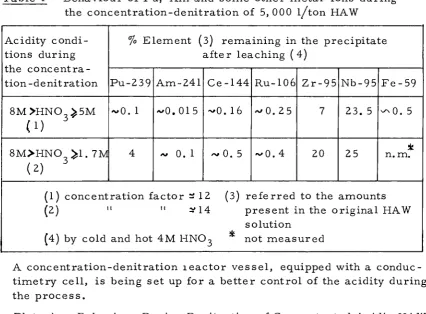
The concentrated acidic HAW solution was obtained by successive concentration-denitration steps taking care that the acidity is main-tained during the whole process within defined l i m i t s . The obmain-tained experimental results a r e reported in Table 1.
[image:31.595.103.530.365.679.2]They show that the adsorption of plutonium on the precipitates can be minimized by keeping, during the concentration-denitration, an acidity level not lower than 5 M/l of nitric acid.
Table 1 - Behaviour of Pu, Am and some other metal-ions during the concentration-denitration of 5, 000 l/ton HAW
Acidity condi-tions during the concentra-tion-denitration
8M>HNO , > 5 M
8M>HNO VL. 7M (2)
% Element (3) remaining in the precipitate after leaching (4)
Pu-239
v 0 . 1
4
Am-241
~0.015
~ 0. 1
Ce-144
- 0 . 16
~ 0 . 5
Ru-106
~ 0 . 2 5
~ 0 . 4
Z r - 9 5
7
20
Nb-95
23. 5
25
F e - 5 9
^ 0 . 5
* n. m.
(1) concentration factor - 12 (3) referred to the amounts (2) " " *14 present in the original HAW
solution
at
(4) by cold and hot 4M HNO, not m e a s u r e d
A concentration-denitration reactor vessel, equipped with a conduc-timetry cell, is being set up for a better control of the acidity during the p r o c e s s .
26
-However their production cannot be avoided during the subsequent denitration step, when the HAW acidity is significantly reduced. E x p e r i m e n t a l denitration tests by formic acid showed that p r e c i p i -tates containing 2-10% of residual plutonium were produced. A possibility to prevent them would be offered by a selective ex-t r a c ex-t i o n of pluex-tonium from concenex-traex-ted acidic HAW provided ex-thaex-t the residual plutonium is originally p r e s e n t in extractable form. The results obtained from b a t c h - e x t r a c t i o n tests performed with HDEHP were satisfactory fSj.
3. OXAL P r o c e s s
E x p e r i m e n t a l t e s t s on simulated HAW solutions have been continued in o r d e r to optimize the oxalate precipitation and the a c t i n i d e / R E s separation s t e p s . During the reporting period special attention was paid to the second step. Instead of using the solvent extraction t e c h -nique, a p r o c e s s based on column extraction chromatography was
selected, using as stationary phase HDEHP supported on LEVEXTREL, a product manufactured by BAYER.
- Description of the P r o c e s s
The actinide and REs oxalates precipitated as previously described / Ï , 6 / a r e dissolved by hot nitric acid (final acidity 2 3 M/l). P U , Np, (Zr, Mo, U, Fe) a r e fixed on the chromatographic column, whereas other components (Am, Cm, REs + Sr, Ba and F P s t r a c e s ) r e m a i n in the solution flowing through the column.
The fixed elements a r e eluted at 60-80°C by means of a saturated oxalic acid solution.
The solution flowed through the first column, is de-acidified up to a pH value of 2; Am, Cm and REs a r e fixed on a second LEVEXTREL column whereas Sr, Ba and F P s t r a c e s flow through the column.Am and Cm can then be selectively eluted by a DTPA solution buffered at pH 3 and REs by a 3-4M HNO3 solution.
Results obtained from experimental t e s t s on simulated HAW showed that the separation of actinides by the OXAL p r o c e s s is quite s a t i s -factory. Separation yields of about 99. 5% for plutonium and neptunium and 99. 8% for a m e r i c i u m and c u r i u m can be in fact attained.
The A m and Cmfraction retain 5% of the r a r e earths initially p r e -sent. An additional purification cycle is n e c e s s a r y if a lower REs content is wanted.
4. Experiments on Fully Active HAW Solutions
The p r e p a r a t i o n of fully active HAW solutions by dissolution of UO£ fuels, i r r a d i a t e d at a burnup of about 25, 000 MWD/t, and by s i m u l a -tion of the PUREX p r o c e s s using solvent extrac-tion, has been
27
-LMA laboratory. So tests on real HAW solutions for the OXAL and HDEHP p r o c e s s e s will be started in January 1978.
The construction of two new chemical lead cells was finished. These cells a r e being equipped for countercurrent experiments. An analytical laboratory is also being equipped for the analysis of HAW s a m p l e s . E m i s s i o n spectroscopy using a copper spark source, will be used.
5. Engineering Implications of Actinides Separation
An investigation of the problems related to the development of full-scale radiochemical separation plants, based on the laboratory sheets, was initiated. As a first step detailed sheets and flow-diagrams a r e being laid-out.
CONCLUSIONS
The completion of batch experiments on HDEHP and TBP, as well as on the OXAL process using a simulated HAW solution, is the most impor-tant objective fulfilled during the reporting period.
Sufficiently high separation yields for Pu, Np, Am and Cm have been m e a s u r e d (see Table 2), according to the different process flow-sheets. Concerning the OXAL process preliminary experiments c a r r i e d out on
real waste from reprocessing plants, confirmed the results of the expe-riments on simulated HAW solutions. These p r o c e s s e s have to be tested now on fully active HAW solutions.
Due to some delay in the hot cell preparation, the s t a r t - u p of this phase of the work will be possible in January 1978.
PLANNED ACTIVITIES
During the following s e m e s t e r it is planned:
- to initiate HDEHP and T B P batch-extraction tests on real HAW,
- to continue OXAL process tests (oxalate precipitation and actinide/REs separation) on real HAW,
- to initiate countercurrent tests on simulated and traced HAW,
28
Table 2 - P e r c e n t separation yields m e a s u r e d by HDEHP and T B P extraction and oxalate precipitation t e s t s , performed in batch on simulated HAW solutions
P r o c e s s Flow-sheet
T B P
Extraction P r o c e s s
(option 1)
HDEHP
Extraction P r o c e s s
(option 1)
Modified
OXAL P r o c e s s
Actinide Separation Method Solvent Extraction Denitra-tion + oxalate precipita-tion Elem. P u Am (Cm) P u Np Am (Cm) P u Np Am (Cm)
P r o c e s s (1) Conditions
0.2 5M HDEHP ~ 4M HNO
30% T B P
~ 4M HNO
30% T B P
1.3 M NaN03 0.6M A^NO^) 0. 17M H N 03
0.2 5M HDEHP
« 4 M HNO
0.25M HDEHP p H ~ 2
Simultaneous addition of for-mic and oxalic acid
Separation Yields (%)
>99.8 W
(2) 75 v ;
> 9 9 . 9 ^
>99. 8 (2)
80<2>
96.2 <2>
99.5
99.2
99.8
(1) for simulated HAW solutions at different concentration levels: ~ 500 1/ton U for T B P and ~ 5 , 000 l/ton U for HDEHP and OXAL
p r o c e s s e s ,
[image:34.595.67.506.88.752.2]Actinides+ R.Es
Oxalates
(C00H)2 (60°C) (1) DTPA pH - 3
hot HNO,
Lr
~ 3MHN0,
i
O l
X ω
o
_ l 0
^ Γ
e
E
3 O
o
α .
I E LU
α
χ
Ριι,Νρ (Zr, Mo, U, Fe)
^. Sr, Ba and F.P. traces
INJ v£3
(1) Am, Cm
30
-R E F E -R E N C E S
¡\J P r o g r a m m e P r o g r e s s R e p o r t on " M a n a g e m e n t of N u c l e a r M a t e r i a l s and Radioactive Waste", J R C I s p r a E s t a b l i s h m e n t , J a n u a r y J u n e
1977, n. 3440
fzj C E C I L L E , L. , LANDAT, D . , MANNONE, F . , R a d i o c h e m . , R a d i o a n a l . L e t t e r s 31 (1) 2938 (1977)
[ζ] L I U E N Z I N , J . O. , SVANTESSON, I. , HAGSTRÖM, I. , P r o c . of the Conf. on Waste Management, Tucson, A r i z o n a (1976), Conf. 761020, p . 303 (1977)
[\] LLLJENZIN, J . O. , SVANTESSON, I . , HAGSTRÖM, I . , " S e p a r a tion of Actinides from HAW Solutions", KKR 770827 (1977)
[b] C E C I L L E , L. , LANDAT, D. , MANNONE, F . , R a d i o c h e m . R a d i o a n a l . L e t t e r s 31 (1) 1928 (1977)
31
2. 2. 2 A s s e s s m e n t Studies on Nuclear Transmutation of Actinides
OBJECTIVES
The aim of this activity is to evaluate the neutron-physical and techno-logical feasibility and c o s t / r i s k implications of the transmutation of actinides other than fuel in fission power r e a c t o r s . An overall s t r a t e -gy for transmuting those actinides, produced by the European Commu-nity power generating system, should be proposed giving indications as to the reactor type to be p r e f e r r e d as transmutation device and the way of introducing the actinides in the r e a c t o r . Taking account of the results for risk and cost analysis, a choice between the various pos-sible recycle strategies should be c a r r i e d out.
RESULTS
Organizational Work
Considerable effort has been made to reorganize the work due to an increase of staff and to establish contacts with groups inside and out-side the European Community. A m a s t e r plan for the activity has been elaborated defining 20 tasks which have to be investigated before being able to judge this advanced waste management scheme. This plan con-tains descriptions of each task, suggestions for its technical execution, and time schedules.
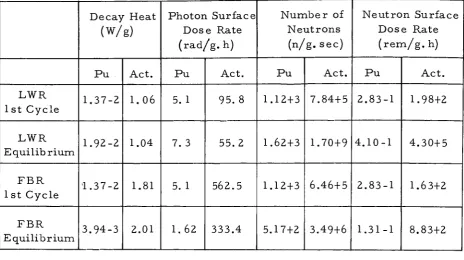
Radiation P r o p e r t i e s of Materials within the Fuel Cycle
32
-Table 1 Radiation P r o p e r t i e s of Plutonium and Actinides
LWR 1st Cycle
LWR E q u i l i b r i u m
F B R 1 st Cycle
F B R E q u i l i b r i u m
Decay Heat (W/g) P u 1.372 1.922 1.372 3.943 Act. 1.06 1.04 1.81 2.01
Photon Surface Dose Rate ( r a d / g . h )
P u 5.1 7. 3 5. 1 1. 62 Act. 95. 8
55.2
562.5
333.4
N u m b e r of N e u t r o n s ( n / g . s e c )
P u 1.12+3 1.62+3 1.12+3 5.17+2 Act. 7.84+5 1.70+9 6.46+5 3.49+6
N e u t r o n Surface Dose Rate ( r e m / g . h )
P u
2.831
4 . 1 0 1
2.831 1.311 Act. 1.98+2 4.30+5 1.63+2 8.83+2
Risk Analysis
A c o m p u t e r p r o g r a m is being developed to quantify the r e d u c t i o n of l o n g t e r m h a z a r d obtained by recycling actinides o t h e r than fuel back to fission r e a c t o r s .
As p a r a m e t e r s a r e included different r e c y c l e s t r a t e g i e s , the t r a n s m u tation r a t e , the total t i m e i n t e r v a l during which n u c l e a r e n e r g y will be g e n e r a t e d , the e x t r a c t i o n efficiencies for m i n o r a c t i n i d e s and plutonium as well as the routine l o s s e s during the individual fuel cycle o p e r a t i o n s . M o r e o v e r , work has been initiated to set up a methodology to calculate the additional r i s k due to the p r e s e n c e of actinides o t h e r than fuel in the fuel cycle.
At l e a s t as far as the operational p e r s o n n e l of the fuel cycle facilities is concerned, the r i s k will be d e t e r m i n e d in t e r m s of the dose r a t e to m a n . A collection of r e l e a s e data for the v a r i o u s c o n s t i t u e n t s within the fuel cycle has been s t a r t e d , distinguishing between r e a c t o r o p e r a tion, r e p r o c e s s i n g and fuel element m a n u f a c t u r i n g .
Ç??.*£Íkution j*f_tke JRC Ka r l s ruhe E s tablis hment Α. Neutron Rates Obtained in the Rapsodie R e a c t o r
[image:38.595.92.557.94.354.2]33
-mine, amongst other things, the breeding gain.
Lists requested by IAEA Working Groups ¿1, 2 / require a c c u r a -cies between 10 and 30%. Some of these nuclides have been ana-lyzed. The r e s u l t s , when compared with microscopic data of dif-ferent origin ¿3, 4, 5y, a r e in some instances in good agreement (Table 2).
The concept of nuclear incineration of minor actinides in a fast reactor needs r a t h e r p r e c i s e neutron c r o s s sections in o r d e r to improve the economics of the p r o c e s s . Some of the nuclides of interest were included in the TACOexperiment, and the a b s o r p -tion-, c a p t u r e - and fission-cross sections a r e given in Table 3.
B. Methodology of Actinide Prediction
Several methods a r e used in predicting the actinide build-up in power reactor fuels:
- reactor physics ' calculations which do not usually include the cal-culation of the minor actinides (Np, Am, Cm),
- zero-dimensional, one-group calculations of the ORIGEN-type, - isotope correlations (IC) which require historical data.
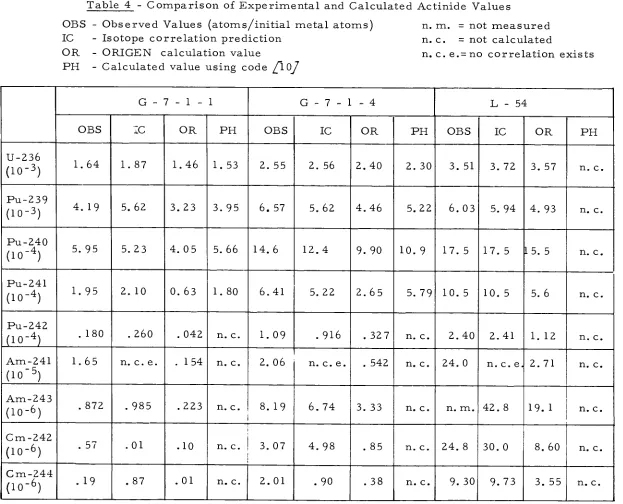
In o r d e r to a s s e s s the amount of information required to apply these methods and to compare their prediction capabilities, t r i a l calculations on previously a n a l y z e d / 6 , lj fuel from TRINO VERCEL-LESE were performed.
Reactor physics ' calculations a r e based on extensive information about r e a c t o r operation, usually only accessible to the operator. ORIGEN also requires information on the fuel history and is heavily dependent on a library of neutron cross section data. On the other hand, the IC method does not need information which is not normally available.
P r e l i m i n a r y results from 3 samples show that for most of the nucli-des the prediction capabilities of reactor physics and IC a r e
34
-Table 2 - Comparison Between Measured and Evaluated Neutron Reaction Rates of Selected Fission Products
Isotope Nd-143 Nd-144 Cs-133 Nd-146 Nd-148 Nd-150 TACO 7.876 2.419 10. 850 3.017 3. 982 4.794
f f t .
ref. [\]
7. 874 2. 998 13.990 3. 875 4.247 10. 1
i o "3
ref. [Ζ]
8.408 2. 967 12.590 3. 720 3. 914 7.045
ref. / V
5.665 -10.986 -Accuracy required (%) 20
-10 - 3 0
20
20
-Table 3 - Neutron Reaction Rates of Selected Heavy Nuclides Mea sured in the TACO-Experiment
Isotope Np-237 Am-241 Am-243 φσ-t . Absorption 7.452 9.245 8.330
i o "2
[image:40.595.78.489.98.320.2] [image:40.595.79.478.395.531.2]Table 4 - Comparison of Experimental and Calculated Actinide Values
OBS - Observed Values (atoms/initial metal atoms) n. m. = not m e a s u r e d IC - Isotope c o r r e l a t i o n prediction
OR - ORIGEN calculation value
PH - Calculated value using code /lO_/
n. c. = not calculated
n. c. e. = no correlation exists
U-236 ( I O "3)
P u - 2 3 9 (10-3)
P u - 2 4 0 (IO"4)
P u - 2 4 1
( i o -4)
P u - 2 4 2
( i o -4)
A m - 2 4 1 ( I O "5)
A m - 2 4 3 ( 1 0 - 6 )
C m - 2 4 2 (10-6)
C m - 2 4 4 ( I O "6)
G - 7 - 1 - 1
OBS 1.64 4. 19 5. 95 1. 95 . 180 1.65 . 872 . 57
. 1 9
IC
1. 87
5. 62
5 . 2 3
2. 10
. 2 6 0
n. c. e.
. 985
. 0 1
. 8 7
O R
1.46
3 . 2 3
4. 05
0. 63
. 042
. 154
. 2 2 3
. 1 0
. 0 1
P H 1. 53 3. 95 5.66 1. 80 n. c. n. c. n. c.
G - 7 - 1 - 4
OBS
2. 55
6. 57
1 4 . 6
6 . 4 1
1.09
2. 06
8. 19
n. c. ! 3. 07 ι
η . c. 2 . 0 1
IC
2. 56
5. 62
1 2 . 4
5. 22
. 9 1 6
η. c. e.
6. 74
4 . 9 8
. 90
O R
2 . 4 0
4 . 4 6
9 . 9 0
2 . 6 5
. 327
. 542
3. 33
. 85
. 3 8
P H 2. 30 5.22 10. 9 5. 79 η. c.
η . c.
η. c.
η . c.
η . c.
L - 54
OBS
3. 51
6 . 0 3
17. 5
10. 5
2 . 4 0
2 4 . 0
n. m .
24. 8 9. 30 IC 3. 72 5. 94 17. 5 10. 5
2 . 4 1
η . c. e.
4 2 . 8
30. 0
9 . 7 3
O R
3. 57
4. 93
15. 5
5 . 6
1. 12
2 . 7 1
19. 1
8.60
3. 55
P H
η . c.
η. c.
η. c.
η. c.
η . c.
η . c.
η . c.
η. c.
η . c.
. 36
COLLABORATION WITH EXTERNAL ORGANIZATIONS
The c o n t r a c t with the A u s t r i a n A c a d e m y of Science c o n c e r n i n g the d e velopment of a c o m p u t e r p r o g r a m for c a l c u l a t i n g c r o s s s e c t i o n s by models for the nucleus h a s b e e n prolonged for four m o n t h s in o r d e r to p e r m i t the i n t r o d u c t i o n of the " s e c o n d c h a n c e " f i s s i o n effect.
P r e l i m i n a r y contacts have b e e n e s t a b l i s h e d with GfK K a r l s r u h e , KFA J ü l i c h and CNEN, C a s a c c i a , which should lead to c o n t r a c t s of c o l l a b o r a t i o n to be defined in the n e a r future.
CONCLUSIONS
A p a r t from the fact that the scientific c o o r d i n a t i o n and the p r e p a r a t i o n of p r o p o s a l s for c o l l a b o r a t i o n with o t h e r i n s t i t u t i o n s has a b s o r b e d s o m e m a n p o w e r , w o r k has p r o c e e d e d n o r m a l l y . The p a p e r studies c o n c e r n i n g the fuel cycle i m p l i c a t i o n s , h o w e v e r , should be intensified. Thus it is absolutely n e c e s s a r y that the i n c r e a s e of p e r s o n n e l a l l o c a tion scheduled for 197 8 be kept.
PLANNED ACTIVITIES
During the next r e p o r t i n g period, the following r e s u l t s a r e expected: Updated LWR l i b r a r y of n u c l e a r data which should p e r m i t to r e p r o duce e x p e r i m e n t a l l y d e t e r m i n e d isotope d i s t r i b u t i o n s of i r r a d i a t e d LWR fuel s a m p l e s ;
A collection of fuel e l e m e n t p e r f o r m a n c e data;
Radiation p r o p e r t i e s of m a t e r i a l s within the t h o r i u m fuel c y c l e .
R E F E R E N C E S
[\] P r o c . IAEA P a n e l on F i s s i o n P r o d u c t N u c l e a r Data, IAEA, Vienna (1974)
[z] A d v i s o r y Group Meeting on F i s s i o n P r o d u c t N u c l e a r Data, P e t t e n , N e t h e r l a n d s (1977)
[zj I n t e r n a t i o n a l N u c l e a r Data C o m m i t t e e R e p o r t INDC (CCP) 3 9/u. Vienna (1974)
[Α.] BENZI, V . , R E F F O , G. , " F a s t N e u t r o n Radiative C r o s s Sec tions of Stable N u c l e i " , CCDNNW/lO (1969)
37
-/ q -/ BRESESTI, A . M . é t a l . , EUR 4909e (1972) flj BARBERO, P. é t a l . , EUR 5605e (1976) f%] HAUG, H . O . , KFK-1 945 (1974)
/ 9 / CLAIBORNE, H . , ORNL-TM 3964 (1972)
38
-2 . -2 . 3 A c t i n i d e C r o s s S e c t i o n M e a s u r e m e n t s
O B J E C T I V E S
F o r a s s e s s m e n t s t u d i e s of the n u c l e a r t r a n s m u t a t i o n of a c t i n i d e s a s a w a s t e m a n a g e m e n t a l t e r n a t i v e , f i s s i o n c r o s s s e c t i o n m e a s u r e m e n t s a s function of e n e r g y a r e p e r f o r m e d in o r d e r to c h e c k o r i m p r o v e t h e s e d a t a . At p r e s e n t cr^ of A m - 2 4 1 is m e a s u r e d a s function of e n e r g y in the r a n g e of 0 . 0 0 6 MeV 4 E 4 1 MeV. T w o d i f f e r e n t t e c h n i q u e s a r e a p p l i e d . One r e l a t e s the d e t e c t e d p r o m p t f i s s i o n n e u t r o n s to the f i s s i o n
c r o s s s e c t i o n , w h i c h r e q u i r e s the k n o w l e d g e of V1 i . e . the n u m b e r of
p r o m p t f i s s i o n n e u t r o n s e m i t t e d p e r f i s s i o n . In the o t h e r t e c h n i q u e the f i s s i o n f r a g m e n t s a r e d e t e c t e d f\J w h i c h a r e e m i t t e d f r o m t h i n t a r g e t s a f t e r the f i s s i o n e v e n t .
In both m e t h o d s the 3 MeV V a n de Graaff a c c e l e r a t o r of the I n s t i t u t e for A p p l i e d N u c l e a r P h y s i c s of the GfK, K a r l s r u h e h a s b e e n u s e d a s n e u t r o n s o u r c e . T h e f i r s t c r o s s s e c t i o n m e a s u r e m e n t s w e r e s t a r t e d d u r i n g 1976 w i t h t h e f i r s t t e c h n i q u e . T h e f i s s i o n f r a g m e n t d e t e c t i o n m e t h o d is b e i n g a p p l i e d d u r i n g l a t e 1977.
R E S U L T S
T h e N e u t r o n D e t e c t i o n Method
T h e a n a l y s i s of the e x p e r i m e n t a l d a t a h a s b e e n t e r m i n a t e d for the d e t e r m i n a t i o n of t h e f i s s i o n c r o s s s e c t i o n , t h e n e u t r o n e n e r g y and i t s r e -s o l u t i o n . W o r k h a -s -s t i l l to be done for t h e a n a l y -s i -s of the e r r o r -s . W o r k w a s c o n t i n u e d w i t h the m e a s u r e m e n t d a t a o b t a i n e d w i t h t h i c k L i t a r g e t s (6 k e V 4 E 4 120 k e V ) . T h e s e t a r g e t s p r o d u c e d a w h i t e n e u t r o n s p e c t r u m b u r s t of a b o u t 0. 8 ns d u r a t i o n for i r r a d i a t i o n of the t e s t t a r g e t s fz, Z]'. T h e o b t a i n e d b a c k g r o u n d a n d i s o t o p e c o r r e c t e d t i m e - o f - f l i g h t s p e c t r a p e r m i t t e d the a n a l y s i s of a b o u t 26 e n e r g y i n t e r v a l s w h i c h w e r e c o n d e n s e d to 7 c r o s s s e c t i o n v a l u e s . T h e s e c o n d e n s e d c r o s s s e c t i o n v a l u e s with i n c r e a s e d e n e r g y r e s o l u t i o n a r e r a t h e r i n s e n s i t i v e to t h e a n a l y s i s p r o c e -d u r e (unfol-ding, unfol-ding a n -d s m o o t h i n g , no unfol-ding, no unfol-ding a n -d s m o o t h i n g ) of the t i m e - o f - f l i g h t s p e c t r a . T h e d a t a o b t a i n e d a g r e e w e l l w i t h t h o s e of Shpak fí/ but a r e up to a f a c t o r of 40 s m a l l e r t h a n t h o s e l i s t e d in the E N D F B - I V d a t a file.
39
-F i s s i o n -F r a g m e n t Detection
The gas s c i n t i l l a t i o n c h a m b e r has been installed at the Van de Graaff of the GfK, K a r l s r u h e during July 1977. F i r s t m e a s u r e m e n t s were p e r formed during S e p t e m b e r 1977. The a n a l y s e s of the data suggested s o m e modifications on the e l e c t r o n i c s and a new m e a s u r e m e n t s e r i e s was s t a r t e d during late 1977.
COLLABORATION WITH EXTERNAL ORGANIZATIONS
The activity is based on a collaboration between the GfK, K a r l s r u h e , Institute for Applied N u c l e a r P h y s i c s and the J R C I s p r a . The GfK p r o vides the 3 MeV Van de Graaff as a neutron s o u r c e , its operation i n s t r u m e n t a t i o n and c o m p u t e r soft and h a r d w a r e . The execution of the e x p e r i m e n t s is a c o m m o n effort and the data analysis is in charge of the JRCstaff.
CONCLUSIONS
The m e a s u r e m e n t of the Am241 fission c r o s s section was justified due to the l a r g e d i s c r e p a n c i e s existing between ENDFBIV data and those of ref. / 4 y . Our m e a s u r e m e n t s confirm r a t h e r the data of ref.
/V-PLANNED ACTIVITIES
It is envisaged to complete during the first s e m e s t e r of 1978 the fission c r o s s section m e a s u r e m e n t s on A m 2 4 1 . During this period a decision will be taken on a possible continuation of the c r o s s section m e a s u r e m e n t s on other a c t i n i d e s .
REFERENCES
flj R A P P E L E R , F . , Ph. D. t h e s i s University of Karls ruhe, 1972
fZj HAGE, W. , HETTINGER, H. , K Ä P P E L E R , F . , KUMPF, S. , WISSHAK, Κ. , P r o c e e d i n g s F i r s t Technical Meeting on Nuclear T r a n s m u t a t i o n of Actinides, I s p r a (Italy), March 1618, 1977, EUR 5897e,f
fzJ HAGE, W. , HETTINGER, H. , K Ä P P E L E R , F . , KUMPF, S. , WISSHAK, Κ. , P a p e r p r e s e n t e d at the Neutron I n t e r l a b . S e m i n a r , GfK, K a r l s r u h e , September 1416, 1977
40
2.3. DECONTAMINATION OF REACTOR COMPONENTS
OBJECTIVES
The main objective is to improve the knowledge of the m e c h a n i s m s of reactor component contamination and of the techniques used for their decontamination.
At the last meeting of the Advisory Committee for the P r o g r a m m e Management (October, 1976), the m e m b e r s suggested to orient the activity towards the waste problems related to decontamination pro-c e s s e s and depro-commissioning operations. These suggestions have been taken into account in the definition of the 1978 activities.
RESULTS
General Orientation
In order to be able to better define where the main i n t e r e s t lies of utilities, a contract has been given to the firm Laborelec (Belgium). The scope of the contract is to perform an inquiry in the different power stations in order to define the need in Europe of decontamina-tion and the scope of the decontaminadecontamina-tion operadecontamina-tions. The final report has been received and is now underway to be published as a E U R - r e p o r t .
A bibliographic review on the state of the a r t in the field of decontami-nation of p r i m a r y circuit components of LWR is almost concluded and a report is in preparation. This report also takes into account the papers presented at the Conference on Water C h e m i s t r y of Nuclear Reactor Systems (Bournemouth, October 1977), such as to p e r m i t a very recent updating.
Effect of T h e r m a l and Redox Cycling
The scope of this activity is to analyze the effect of t h e r m a l cycling and of variation of oxygen concentration on the r e l e a s e of m a t e r i a l from the layer deposited on the surface.
A h i g h - t e m p e r a t u r e water loop, which was used previously for the study of the influence of the water chemistry on m i c r o s u s p e n s i o n ge-neration, has been adapted to these new t e s t s .
41
mainly magnetite, under these conditions even ferric oxide was p r e -sent. A more detailed analysis of the surface layer is underway.
P r e l i m i n a r y Tests on Various Decontamination Techniques
Some preliminary tests have been performed on the electrochemical method. If an intimate contact between the brush and the surface is maintained, a good decontamination can be obtained. The conditions a r e those typical of electropolishing.
Some preliminary tests with chemical methods (citrox and alkaline permanganate) have shown that the efficiency of the t r e a t m e n t depends strongly on the composition and age of the sample and on the concen-tration of the reagents. A systematic study seems n e c e s s a r y .
PLANNED ACTIVITIES
F o r the first s e m e s t e r of 1978 the following activities a r e planned: - Effect of T h e r m a l and Redox Cycling
The effect of t h e r m a l cycling on w.ell-consolidated layers will be examined, following the release of soluble cations and suspended p a r t i c l e s . The surface composition will be followed.
- Physico-Chemical Structure of Oxide Layers
The c o r r o s i o n and deposited layers follow a continuous evolution. A study will be performed trying to define the change arising during the life of the layer. The study will be performed also on contami-nated l a y e r s .
- Systematic Study of Chemical Decontamination
A systematic study will be initiated in o r d e r to define what a r e the conditions which allow to minimize the waste arising.
- P r e l i m i n a r y Evaluation of the Decommissioning of the ISPRA-I Reactor