Colorimetric Binding Phase for the
Diffusive Gradients in Thin Films
Technique
Russell William McGifford
B.Sc. (Hons)
Submitted in fulfilment of the requirements
for the Degree of
Doctor of Philosophy
University of Tasmania
Declaration
This thesis contains no material which has been accepted for a degree or diploma by
the University or any other institution, except by way of background information
and duly acknowledged in the thesis, and to the best of the my knowledge and belief
no material previously published or written by another person except where due
acknowledgement is made in the text of the thesis, nor does the thesis contain any
material that infringes copyright.
Russell William McGifford
This thesis may be made available for loan and limited copying in accordance with
the Copyright Act 1968.
Russell William McGifford
Abstract
Passive sampling is a useful method for contaminant analysis and monitoring, and of
the techniques available the Diffusive Gradients in Thin Films (DGT) technique is
particularly applicable for use in transition metal studies. However, analysis of the
metal-accumulating DGT 'binding phase' is typically expensive and
time-consuming, which limits the technique's application. In order to improve on the cost
and speed of analysis, and to allow in-field analysis, a colorimetric binding phase
was developed. By employing metallochromic reagents adsorbed onto ion-exchange
resins a colour change was obtained as a result of the binding of metal ions, with the
degree of change being proportional to the quantity of complexed metal. This
reagent-adsorbed resin was immobilised on adhesive paper labels to provide a
robust, cheap and effective colorimetric binding phase.
Quantification of metal loading on these binding phases was undertaken through use
of UV-Vis reflectance or Computer Imaging Densitometry (CID), the latter
employing a flat-bed scanner for improved ease of analysis. Analytically robust
metal quantification was found to be achievable using these methods, with the CID
method equivalent in performance to the reflectance method. The use of a variety of
metallochromic reagents was explored, with different reagents noted to provide
colorimetric responses for different metal ions.
A typical detection limit, provided by Methylthymol Blue adsorbed to Dowex 1x8
particular Zincon was seen to provide a selective response to Cu(II) at neutral pHs
and is a promising candidate for deployment of these colorimetric DGT binding
Acknowledgements
The author would like to acknowledge the help and assistance provided by the following people and groups;
Dr. Andrew Seen for his invaluable assistance, guidance and patience throughout the length of the project. Andrew's supervision has allowed me enough room to plumb the depths of research. The understanding and knowledge of how to perform
research and run a project has been, personally, far more valuable than the content of the reasrch itself, and Andrew's supervision style has allowed me to fully explore the nooks and crannies therein. Combined with a sharp eye for detail which has given (some would say hammered in!) me appreciation for the necessity of careful work, from planning to reporting results, and the benefits of precise work, Andrew's help has been genuinely appreciated. My sincere thanks!
Prof. Don McWilliams' help for his assistance during the initial studies into C18 immobilisation during my brief foray into organic synthesis.
Assoc/Prof. Dominic Geraghty for the use of, and guidance with, the microscope photography suite.
Prof. Paul Haddad and Prof. Pavel Nesterenko for their tuition and assistance, particularly with the dye studies involved in the project. Prof. Haddad's assistance with the thesis was invaluable, as was his extensive research experience for early guidance. Prof. Nesterenko's depth of knowledge on the colorimetric agents involved in this work were a terrific boon.
Ms. Tahlia Watts for her assistance in the laboratory during the end of 2009 and for the invaluable help since then. Words could never be thanks enough.
for making me feel welcome in Hobart regardless of the time since the last visit, it still felt like coming home in many ways.
Glossary and Abbreviations
Prelude
Glossary and Abbreviations
AAS — Atomic Absorption Spectroscopy
ANZECC — The Australian and New Zealand Environment Conservation Council
APDTC — Ammonium pyrrolidine dithiocarbamate
ARMCANZ — The Agriculture and Resource Management Council of Australia and New Zealand
BPhen — Bathophenanthroline
CAS — Chrome azurol S
Chelex 100 — A transition-metal chelating resin that is commercially available and widely used in typical DGT deployments.
Channel — Either the red (R), green (G) or blue (B) colour of a single pixel when an image is scanned.
Chromogenic Chelating Agent — a colorimetric reagent with the ability to strongly bind metal analytes.
CID — Computer Imaging Dens itometry, a technique where colour density is measured through the use of imaging software and a luminosity scale.
Colorimetric Reagent — A compound capable of providing a colour change on interaction with an analyte of interest, particularly a divalent metal cation. Includes Thromogenic Chelating Agents'.
DeDTC — Diethyl dithiocarbamate
DGT — Diffusive Gradients in Thin Films, a passive sampling technique where analyte is collected in a binding phase and the rate of analyte collection is controlled by the use of a known diffusion distance and the analyte's coefficient of diffusion.
Disc — a circular piece of paper label, typically 1 inch in diameter. DMG — Dimethyl glyoxime
DPCI —Diphenyl carbazide
DPCO — Diphenyl carbazone
DTC - Dithiocarbamate
Dye — A shorthand notation for an Indicator dye, sim. `Colorimetrie Reagent'.
EBT — Eriochrome black T
Equilibration — the process of exposing a resin-dye to the solution matrix providing the associated resin swelling.
Immobilisation — the process of confining a dye or resin such that it is held stationary with regards to physical movement and diffusion.
LED — Light Emitting Diode
Loading — quantity of dye on resin, or metal on resin-dye, expressed as Knol g -1 or lig cm-2 , respectively.
Matrix — The chemical compound of which a resin is made, with consideration of the cross-linking and porosity properties.
MTB — Methylthymol blue, an indicator dye.
MTB(2) and MTB(10) — referring to Dowex 1x8 with MTB adsorbed from dye solutions buffered to pH 2 and 10, respectively.
NATA — The National Association of Testing Authorities, Australia oCPC — ortho-cresolphthaline complexone
PAN — 1-(2-pyridylazo)-naphthol
PCV — Pyrocatechol violet
PSDVB — Polystyrene divinylbenzene, a typical resin substrate (matrix). Resin-disc — disc with resin adhered.
Resin-dye — Shorthand for a resin-adosrbed dye.
RSD — Relative Standard Deviation, one standard deviation expressed as a percentage of the value it is associated with.
Scanner — Refers to a commercially available flat-bed document scanner. TAN — 1-(2-thiazolylazo)-2-naphthol
UHQ — Ultra-High Quality water, resistivity of 18 ± 1 MS-I cm.
Prelude
Table of Contents
1
—Synopsis and Direction
1
1.1 — Monitoring Through Sampling 2
1.2 — Passive Sampling 4
Figure].] 6
1.3 — Colorimetric Application 7
1.4 — Study Summary 9
2
—Colorimetric Reagent Immobilisation Methods
162.1— A Review of Established Colorimetric Reagent 17
Immobilisation Methods
2.1.1 — Rationale 17
2.1.2 — Reagent Immobilisation 19
2.1.3 — Chemical Grafting 22
2.1.4 — Adsorption 26
2.1.5 — Chelating Agent Loaded Resins 28
2.1.6 — Summary 31
2.2 — Experimental 33
2.2.1 — Metal Test Solutions 33
2.2.2 — C18 Functionalised Chromatography Paper 33
Table 2.1 34
2.2.3 — Dye Deposition 35
2.2.4 — PVC Membrane 36
2.2.5 — Polyacrylamide Gels 36
2.2.6 — Dye Immobilisation on Resin 37
2.2.7 — Adhesive Labels 38
2.3 — Results and Discussion 39
2.3.1 —C18 Immobilisation 39
2.3.2 — Takahashi's Method 40
2.3.3 — PVC Membrane 42
2.3.4 — DGT Resin-gel Immobilisation 41
Figure 2.1 43
2.3.5 — Adhesive Label 'Discs' 44
Figure 2.2 46
Table 2.2 48
2.4 — Conclusion 49
iv Table of Contents
Prelude
3— Methylthymol Blue Binding Phase
563.1 — Colorimetric Binding Phase Development 57
3.1.1 — General Chemicals 57
3.1.2 — Dye Immobilisation 58
Figure 3.1 60
3.2 — Experimental 62
3.2.1 — General Chemicals 62
3.2.2 — Dye Immobilisation 62
3.2.3 — MTB-Disc Metal Complexation 63
3.2.4 — Metal Extraction and Analysis 65
3.2.5 — UV-Vis Spectroscopy 66
3.2.6 — Dye Stability 68
3.2.7 — Statistics 67
3.3 — Results and Discussion 69
3.3.1 — Binding Phase Construction 69
Figure 3.2 70
3.3.2 — Metal Interactions 73
Figure 3.3 74
Figure 3.4 75
Figure 3.5 77
3.3.3 — Cu(II) Complex Retention and Stability with 79
Adsorbed MTB(10)
Figure 3.6 80
3.3.4 — Cu(II) Uptake by MTB Binding Phase Discs 83
3.3.4.1 — ICP-MS Results 83
Figure 3.7 a & b 86 3.3.4.2 — UV-Vis Analysis of Directly Exposed Discs 89
Figure 3.8 90
Figure 3.9 a & b 91
Figure 3.10 a & b 92
Figure 3.11 a & b 95 3.3.4.3 — Homogenous Colouration from DGT 96
Cu(II) Uptake
Figure 3.12 98
3.3.5 — Dye Bleaching and Analytical Use 98
Figure 3.13 99
Figure 3.14 100
Figure 3.15 101
Table of Contents
Prelude
4— Computer Imaging Densitometry Analysis
1064.1 — Colour Quantification Using Consumer Flat-bed Scanners 107
4.1.1 — Digital Colorimetric Analysis 107
4.1.2 — Consumer Hardware and Function 109
4.1.3 — Dye Analysis 112
4.2 — Experimental 114
4.2.1 — Scanner Characterisation 114
4.2.2 — OD Analysis of MTB Discs 115
4.3 — Scanner Characterisation 116
4.3.1 — Software Use 116
4.3.2 — CID Application 117
Figure 4.1 119
Figure 4.2 122
Figure 4.3 123
4.3.3 — Temperature Dependence of Scanner Response 124
Figure 4.4 125
4.3.4 — Comparison with UV-Vis Reflectance Analysis 127
Figure 4.5 128
Table 4.1 129
4.4 — Analysis of MTB(10) Discs 130
4.4.1 — CID Analysis of Homogeneous MTB(10) Discs 130
Figure 4.6 a, b & c 131
4.4.2 — Analysis of Inhomogeneous MTB(10) Discs 134
Figure 4.7 135
Figure 4.8 a, b & c 136
4.4.3 — Understanding CID Response 138
4.5 — Conclusion 142
5
—Exploration of Alternative Dyes
1465.1 — Consideration of Other Dyes 147
5.2 — Experimental 152
5.2.1 — Typical Chemicals 152
5.2.2 — UV-Vis Absorbance Studies 152
5.2.3 — Resin Immobilisation of Dyes 153 5.2.4 — Quantitative Metal Interaction Tests 154
5.2.5 — Disc Capacity Tests 155
5.2.7 — Complex Matrix Tests 156 5.2.8 — Metal Exteraction and AAS-GF Analysis of 157
Dye Extracts
5.2.9 — Colorimetric Analysis — UV-Vis Reflectance and CID 158
5.3 — Results and Discussion 159
5.3.1 — Screening of Potential Dyes 159
5.3.2 — Cu(II) Response in XO, EBT, PAN and TAN 162
Table 5.1 164
Figure 5.1 a & b 166
Figure 5.1 c & d 167
Figure 5.1 e & f 168
Figure 5.1 g & h 169 5.3.3 — Colorimetric Response in XO, EBT, PAN and TAN 170
Figure 5.2 a, b & c 171
Figure 5.2 d, e &f 172
Figure 5.2 g, h & i 173
Figure 5.2 j, k & 1 174
Figure 5.3 176
5.3.4 — Exploring Zincon Performance 177
Figure 5.4 a & b 179
Figure 5.5 a, b & c 181
Figure 5.6 a & b 183
Figure 5.7 a, b & c 184
Table 5.3 186
5.4 — Conclusion 190
6— Conclusion
192Appendix 1 195
Chapter 1
Synopsis and Direction — More Simple Metal
Monitoring
As living beings our interactions with the world around us are our life, and our waste
can have negative impacts on the world and, therefore, ourselves. hi Cradle to
Cradle Braungart and McDonough [1] discuss the waste produced as a result of the
industrialisation of the world we live in, and its impact on ourselves. Of this waste, a
portion causes further damage when released beyond its source — into the greater
world, generally referred to as the 'environment'. Stopping the release of this
damaging waste is a key priority for developed countries, however it is no easy task
to find the damaging components of this waste; let alone stop the production of
them. The extent of this waste is hinted at in the 1970 Report of the Study of Critical
Environmental Problems (SCEP) [2], which in the space of a single month compiled
more than 300 pages concisely detailing known issues and recommendations for the
monitoring and control of these issues. This was done in order to prevent significant
damage to industries, populations, and the environment at large. Since this time
many issues have expanded further; for example climate change, which is given a
total of 10 pages in the SCEP report but is currently the focus of significant
world-wide study, as evidenced by the 4 th Intergovernmental Panel on Climate Change
report of 2007 [3].
The SCEP report highlighted many significant issues and, nearly forty years later,
many of these are still of concern. As outlined in the 1972 Stockholm Declaration
[4], the presence of harmful substances is of major concern to the quality of the
environment, which is in turn of major concern for the quality of human life. Large
quantities of potentially harmful substances exist in the modern environment
('contamination'), many from anthropogenic sources, and the release of these
substances continues. Preventing these substances from reaching a level in which
significant harm can be inflicted ('pollution') requires the monitoring of areas at
risk. Prevention, however, has not always been successful, and in polluted areas
remediation must be performed accompanied by monitoring to ensure recovery.
Monitoring is therefore a key element in prevention and remediation, and an
essential part of the monitoring process is the representative sampling of the
environment to enable quantification of these contaminating substances [2].
1.1 — Monitoring Contaminant Concentrations
Sampling processes are complicated by the variable nature of the environment and
the wide variety of contaminants potentially present. Aerial, waterborne, and solid
contaminants all pose separate sampling challenges, and the variation within each of
these environmental phases poses yet more complications, with the impact of
pollutants on the biota itself the final point of concern [5]. Water poses a key
monitoring phase, both due to its ubiquity in the environment and its role as the
primary interface between the biota and the environment [6]. As such, the sampling
of water is of utmost importance for monitoring contaminants and managing the
effects they have on the environment.
Current water sampling techniques are mostly based on removing physical water
samples from the environment for analysis, either through manual 'grab' sampling
Introduction Chapter 1
laboratory and analysed there, using the appropriate technique for the analyte of
interest. This technique provides, at best, a measure of the analyte's concentration in
the sampled water at the time of analysis [7]. At issue here is that the concentration
of most analytes in the water body will fluctuate temporally depending on natural
occurrences, such as periods of heavy rain [8], or from intermittent human activities,
such as herbicide application [9]. Obtaining a representative sample can therefore be
difficult, and while auto (grab) samplers provide a reasonable solution to acquiring
samples over an extended period of time their expense and reliability limit their
application, plus processing the samples required for the necessary temporal
resolution adds significant expense.
In addition to issues with collecting representative samples, current sampling
techniques do not provide expedient answers, and their accuracy can be heavily
affected by handling techniques. Guidelines have been developed in many countries
to minimise these affects by standardised sample handling techniques, such as the
ANZECC (Australian and New Zealand Environment and Conservation Council)
water quality guidelines [10]. However application of the guidelines may be
difficult, and in situations with large times between sampling and analysis, such as
remote sampling in Antarctica, application of the guidelines may not be possible.
As well as these problems, laboratory handling and analysis pose further issues.
Time consuming laboratory standardisation may be required via inter-laboratory
comparison of results, for instance NATA (National Association of Testing
Authorities) accreditation and inter-laboratory studies [11], along with the use of
Thus the multiple steps in sample collection, storage, and analysis result in a
significant amount of time expended, with the potential for significant financial cost
in order to obtain results for a single, small portion of a water body at an instant in
time. This expense can result in the abandonment of monitoring programs, or more
likely programs not being adopted in the first place.
1.2 - Passive Sampling
The issues associated with grab sampling and handling of samples have resulted in
work on developing alternative methods for environmental sampling. Passive
sampling has been one of the more important technologies to have come out of this
work, and currently provides a variety of methods for sampling organic and
inorganic contaminants [13]. A passive sampling device is placed in the
environment and accumulates analyte, based on the interaction of the bulk solution
with the collection medium of the device. Research on water-based passive sampling
has grown substantially since 1987, with nearly 50 journal publications a year as of
2005 [7]. Two general sampling regimes determine analyte uptake in passive
samplers, equilibrium-based and kinetic-based passive samplers [7].
Equilibrium-based samplers rely on the partitioning of analytes into a collecting medium, the
extent of which is determined by the partition coefficient of the analyte between the
collecting medium and bulk solution. The ability of analyte to penetrate the
membrane containing the medium provides some selectivity. Ultimately equilibrium
Introduction Chapter 1
medium is removed and analysed [12]. Kinetic samplers typically contain a solid or
liquid sorbent for analyte collection with highly favourable thermodynamics for
analyte collection, and use a known diffusion distance to maintain the analyte
collection rate as proportional to solution concentration [7]. The second method,
therefore, provides accumulation of analytes, while allowing for the rate of
accumulation to be controlled proportional to the bulk concentration.
Under the kinetic regime a passive sampler provides the time-weighted average
concentration of that analyte in the sampled environment, over the sampling period.
An advantage of kinetic based passive sampling is in-situ preconcentration of the analyte, improving the detection limit of the method used for analysis. When a
non-polar organic phase is used, such as a C18 derivitised membrane or oil, organic
analyte preconcentration can be readily achieved [13]. In the case of inorganic
sampling this can be achieved but a smaller range of mediums are available. It is
typically achieved with a solid chelating resin such as Chelex 100 [7]. With the
analyte collection rate controlled by diffusion from the bulk solution, through a
diffusive medium with similar properties to the solution, calculation of the analyte's
time-weighted average concentration can be achieved. Of these techniques, one of
the more flexible and accurate ones for aqueous metal sampling is the Diffusive
Gradients in Thin-Films technique [14].
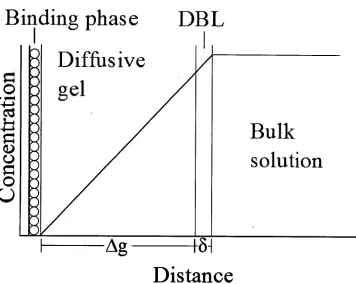
The Diffusive Gradients in Thin-films (DGT, schematic representation shown in
Figure 1.1) technique is a diffusion-based inorganic sampling method [15]. It uses a
polyacrylamide gel providing similar analyte diffusion coefficients to water (see
[17]), and collection of analytes in a Chelex 100 'binding phase' which readily
accumulates trace metal cations, especially transition metals [18].
•
Binding phase DBL
lB
Diffusive
gel
Co
nce
n
tra
tio
n
Bulk
solution
[image:19.561.124.480.98.382.2]Ag 16-1
Distance
Figure 1.1 — A schematic representation of DGT theory and device structure adapted from [16]. Used with permission from Macmillan Publishers Ltd: NATURE
[15], copyright 1994.
Since the metal uptake into the binding phase is driven by the analyte concentration
gradient across the polyacrylamide diffusive gel, and with the metal being bound by
the binding phase such that the metal ion concentration in solution at the binding
phase is effectively zero, the concentration of the analyte in the bulk solution (Cb)
can be determined according to the DGT equation [19];
Introduction
Chapter 1
where M is the mass accumulated in the binding phase, Ag is the thickness of the diffusion layer, D the analyte-specific diffusion coefficient, a the sampling window
area and t the time of sampler deployment. This equation is derived from Fick's first
law of diffusion [15]. Accordingly, deployment of the device results in a metal
loading proportional to both solution concentration and deployment time.
The use of a metal chelating resin as a binding phase results in a deployment device
that readily preconcentrates metal analytes, requiring only extraction for analysis
[19]. This preconcentration ability allows for short deployment times to accumulate
detectable quantities of analytes from solutions of relatively low concentration, for
instance it is possible to detect some analytes in pmol L'1 solutions after
deployments of a single day [7].
The DGT sampling method has been used for a number of marine [20,21], fresh
[22,23] and sediment or soil pore-water [24,25] studies of labile metal contaminants,
as well as more exotic matrices such as acid mine drainage [26]. The DGT methods
can also be used to provide some indication of the bio-available fraction of metals
[27], which is difficult to achieve with other methods (see page 78, [28]).
1.3 — Colorimetric Application
The use of Chelex 100 resin, as is typical for DGT, still necessitates that the sampler
be stored and transported to a laboratory, and then extracted for analysis, with the
associated expenses and time delays. If it were possible to avoid the extraction step
and obtain a result directly from the binding phase these costs and delays would be
alleviated, as well as removing the potential for error introduced by storage and
extraction. The design of a binding phase which produces a colour change on metal
adsorption, and which is proportional to the amount of metal adsorbed, would enable
quantification by examination of the binding phase using photometric techniques, or
even by comparing to a colour chart. This has been shown in passive sampling for
sulfide and iron(II) [29,30], although the iron(II) technique used required
post-deployment chemical processing. If colour change could be obtained in-situ, post-deployment laboratory work would be essentially removed.
A current commercial example of this is the Merckoquant® Test Strips, which
provide measurement of a selection of common inorganic ions through the use of
'dip sticks', in which colour intensity is dependent on analyte concentration. When
combined with a hand-held reflectance spectrophotometer, accurate results can be
obtained to low mg L-1 levels [31]. A combination of this type of technique with
DGT's preconcentration ability has the potential to significantly improve detection
limits and to allow accurate in-field analysis of time-weighted average metal
concentrations, without the expense and time involved in laboratory analysis.
A colorimetric technique would also involve a further change to the general DGT
system, in that metal response would be largely dye-specific. This is similar to the
application of DGT samplers for sampling sulfide, where sulfide reacts with
impregnated AgI to provide a colour change selective for sulfur species [30]. A wide
variety of colour-responding metal dyes is available, as discussed in the essential
Handbook of Organic Analytical Reagents [32], most of which show colour response to only a few metals. For instance bathophenanthroline may be employed
for its well-known coloured Fe(II) and Cu(I) reaction, or dimethyl glyoxime's
9 Introduction
Chapter 1
selection of metal-specific dyes may allow the development of specific binding
phases.
This would, however, require analytes of interest to be known before hand, and that
the dyes deployed are chosen to suit those analytes. While this limits the device's
use for exploratory studies, in a monitoring situation it provides an easier method for
collecting the relevant data. A colorimetric system would allow immediate visual
confirmation of bound metals, avoiding the costly removal, extraction and analysis
of samplers yet to accumulate sufficient metal to reach their limit of detection. As
well as this, any system for quantifying colour change or intensity allows for a
quantitative metal response to be obtained. Commercially available hand-held
reflectance spectrophotometers, scanners, digital cameras, or even a comparative
colour chart, may therefore give simple and quick metal quantification.
Quantification would be available within hours of sampler removal rather than
taking days to weeks, avoiding the need for storage and associated issues, as well as
extraction and expensive instrumentation. A further advantage of such a system
would be that a deployed sampler could be analysed periodically to provide a
temporal profile of metal uptake into the DGT sampler. An analyte-specific binding
phase would also minimise the remote chance of a binding phase becoming
saturated with non-analyte metal species to the exclusion of the analyte itself.
1.4 — Study summary
The aim of this study was to immobilise a colorimetric agent for specific metal
Primary objectives were the finding of a suitable method for retaining a colorimetric
agent; testing of a prototype system utilising a colorimetric agent; and finally
expanding the system to a range of dyes in order to explore the potential for
selectivity and expand the analyte range.
Retaining a colorimetric agent was considered achievable and a variety of methods
were available in literature (Chapter 2). Further to this, immobilised colorimetric
agents have been explored in the past as a method to improve UV-Vis
spectrophotometry sensitivity, where the adsorption of the reagent onto a solid
surface had significantly improved analytical sensitivity [33]. The use of
immobilised, non-colorimetric, chelating agents has also been studied in depth (see
[34,35]) leading to current uses, such as that of chelation ion chromatography [36].
This range of potential metal chelating agents allows for flexibility in the application
of the overall sampler design, but for the purposes of this project a more focused
method was needed. The potential methods that could be used to develop this device
were examined under the criteria of: metal binding capacity of the immobilised dye;
the suitability of the solid substrate as a DGT binding phase; the method of analysis;
and the interaction of the binding phase with water and the analyte metal(s).
To this end it was found that the immobilisation of colorimetric chelating agents,
referred to synonymously as 'dyes', was the most practical method. Indeed, the
adsorption of these dyes onto a stable matrix of high surface area allows for a
physically robust colorimetric material. Immobilisation of the resin was then
achieved in an inexpensive fashion to provide a stable and useable sampling device
Introduction 11 Chapter 1
Once immobilised and formed into a suitable binding phase a single dye
(methylthymol blue), seen to be promising in preliminary trials, was tested both for
DGT sampler functionality, in terms of metal uptake in relation to time and bulk
concentration, and to assess whether metal loadings were quantifiable by colour
response (Chapter 3). Visibly responding binding phases for use in DGT have been
reported for sulfide measurement [30], as have metal-selective binding phases
[37,38], with success. For sulfide, Davison et al. [30] developed a binding phase
with immobilised AgI, providing a colour change proportional to Ag 2 S, and
quantified the grayscale change with a desktop scanner. For this study it was
proposed that UV-Vis reflectance would be used as a primary analysis technique,
and the coloured response obtained from a desktop scanner would also be assessed
due to its potential to provide an easier and less expensive method of analysis.
This use of a desktop scanner proved to be an effective and inexpensive alternative
to UV-Vis reflectance measurement, with comparable analytical properties seen in
the two methods (Chapter 4). Some limitations were observed with scanner use,
however a wide range of dyes were still seen to be useable. The relative ease of use
and cost of the desktop scanner system meant that it was considered the method of
choice.
Once the basic methods for dye immobilisation, DGT function askssment, and
analysis were determined with a single dye, the method was extended to explore
other dyes (Chapter 5). The wealth of information available on colorimetric
chelating agents allows the selection of potential dyes, and many are commercially
available. However most dyes require, at minimum, pH buffering for correct
tested for function under environmental conditions. In order to do this a testing
regime was established allowing the rapid quantification of dye response and metal
loading. This process has enabled the selection of several metal-specific
immobilised dyes providing colorimetric quantification of metal loadings, with a
Introduction 13
Chapter 1
References
[1] W. McDonough, M. Braungart, Cradle to Cradle: Remaking the Way We Make Things, North Point Press, San Fransisco, 2002.
[2] C.L. Wilson, W.H. Matthews, et al., Man's Impact on the Global Environment. Massachusetts Institute of Technology. 1970.
[3] IPCC, Contribution of Working Groups I, II and III to the Fourth Assessment Report of the Intergovernmental Panel on Climate Change. IPCC. 2007.
[4] UNEP, United Nations Conference on the Human Environment, Stockholm, 1972.
[5] D.W. Connell, G.J. Miller, Chemistry and Ecotoxicology of Pollution, John Wiley & Sons, Inc., New York, 1984.
[6] R. Hague, J. Falco, S. Cohen, C. Riordan, in: R. Hague (Ed.), Dynamics, Exposure and Hazard Assessment of Toxic Chemicals, Ann Arbor Science, Ann Arbor, 1980, p. 47.
[7] B. Vrana, et al., Trends in Analytical Chemistry, 24 (2005) 845.
[8] M.C. Gromaire-Mertz, S. Garnaud, A. Gonzalez, G. Chebbo, Water Science & Technology, 39 (1999) 1.
[9] W.A. Battaglin, E.T. Furlong, M.R. Burkhardt, Concentration of Selected Sulphonylurea, Sulphonamide, and Imidazolinone Herbicides, Other
Pesticides, and Nutrients in 71 Streams, 5 Reservoir Outflows, and 25 Wells in the Midwestern United States, 1998. U.S. Geological Survey. 2001.
[10] ANZECC and ARMCANZ, Australian and New Zealand guidelines for fresh and marine water quality. Australian and Newzealand Environmental and Conservation Council/Agriculture and Resource Management Council of Anustralian and New Zealand. 2000.
[12] P. Mayer, J. Tolls, J.L.M. Hermens, D. Mackay, Environmental Science and Technology, 37 (2003) 185A.
[13] T. Gorecki, J. Namiesnik, Trends in Analytical Chemistry, 21 (2002) 276.
[14] L. Sigg, F. Black, J. Buffle, J. Cao, R. Cleven, W. Davison, J. Galceran, P. Gunkel, E. Kalis, D. Kistler, M. Martin, S. Noel, Y. Nur, N. Odzak, J. Puy, W. van Riemsdjik, E. Temminghoff, M.-L. Tercier-Waeber, S. Toepperwien, R.M. Town, E. Unsworth, K.W. Warnken, L. Weng, H. Xue, H. Zhao,
Environmental Science and Technology, 40 (2006) 1934.
[15] W. Davison, H. Zhang, Nature, 367 (1994) 546.
[16] DGT Research, DGT —for measurements in waters, soils and sediments. 2003.
[17] B.L. Lamer, A.J. Seen, Analytica Chimica Acta, 539 (2005)349.
[18] B. McDuffle, P. Figura, Analytical Chemistry, 49 (1977) 1950.
[19] H. Zhang, W. Davison, Analytical Chemistry, 67 (1995) 3391.
[20] M.R. Twiss, J.W. Moffett, Environmental Science and Technology, 36 (2002) 1061.
[21] L. Giusti, H. Zhang, Envionmental Geochemistry and Health, 24 (2002) 47.
[22] K.W. Warnken, Davison, W., Zhang, H., Galceran, J. and Puy, J., Environmental Science and Technology, 41 (2007) 3179-3185.
[23] M. Leermakers, Y. Gao, C. GabeIle, S. Lojen, B. Ouddane, M. Wartel, W. Baeyens, Water, Air and Soil Pollution, 166 (2005) 265.
[24] H. Zhang, F.-J. Zhao, B. Sun, W. Davison, S.P. McGrath, Environmental Science and Technology, 35 (2001) 2602.
[25] H. Zhang, W. Davison, A.M. Tye, N.M.J. Crout, S.D. Young, Environmental Toxicology and Chemistry, 25 (2006) 664.
Chapter 1
[27] M. Camusso, A. Gasparella, Societa Chimica Italiana, 96 (2006).
[28] D.C. Adriano, Trace elements in terrestrial environments: biogeochemistry, bioavailability and risks of metals, Springer, 2001.
[29] D. Jezequel, et al., Estuarine, Coastal and Shelf Science, 72 (2007) 420.
[30] P.R. Teasdale, S. Hayward, W. Davison, Analytical Chemistry, 71 (1999) 2186.
[31] R. Wetselaar, G.D. Smith, J.F. Angus, Communications in Soil Science and Plant Analysis, 29 (1998) 729.
[32] K. Ueno, T. Inamura, K.L. Cheng, Handbook of Organic Analytical Reagents, CRC Press, 1992.
[33] K. Yoshimura, H. Waki, S. Ohashi, Talanta, 23 (1976) 448.
[34] M.L. Marina, V. Gonzalez, A.R. Rodriguez, Mircochemical Journal, 33 (1986) 275.
[35] D. Bilba, D. Bejan, L. Tofan, Croatia Chemica Acta, 71 (1998) 155.
[36] P.N. Nesterenlco, P. Jones, Journal of Separation Science, 30 (2007) 1773.
[37] J.M. Pates, M.A. French, H. Zhang, S.E. Bryan, R.C. Wilson, Analytical Chemistry, 77 (2005) 135.
[38] P. Divis, M. Leermakers, H. Docekalova, Y. Gao, Analytical and Bioanalytical Chemistry, 382 (2005) 1715.
Chapter 2
Colorimetric Reagent Immobilisation
Methods
Reagent immobilisation methods
Chapter 2
2.1 — A Review of Established Colorimetric Reagent
Immobilisation Methods
2.1.1 - Rationale
In order to develop a colorimetric DGT technique it is necessary that a method is
found to provide a color change upon exposure to metal analytes. From this point
the remaining features of the technique can be developed, but the color method will
be at the core of the process. In the DGT technique the binding phase is responsible
for accumulation of metal ions and therefore is responsible for the final chemical
interaction with analytes before extraction. Considering this, altering the binding
phase to not only bind metal ions specifically and strongly but to also provide a
colorimetric response would provide an effective method for colored metal
interaction and could be easily incorporated into the DGT technique. Colorimetric
binding phases would therefore entail a method for strongly binding metal analytes,
and a method for providing a color change in response to analyte quantities. Ideally,
this would involve reagents capable of these interactions immobilised on a solid,
robust substrate to provide chemical stability and reliability in use.
Reagents providing these color properties do exist as a wealth of chromogenic
chelating agents, many are highlighted by Ueno et al. in the Handbook of Organic Analytical Reagents [1]. For instance, the well-known reaction of
bathophenanthroline with Fe(II) or Cu(I) may be employed. Other established
chromogenic chelating reagents are potentially suitable, such as the transition
metal-sensitive dye xylenol orange. The typical use of these reagents, referred to here-on
as 'dyes', is as a metal indicator for wet chemistry techniques, or as a colorimetric
spot test for relatively high metal concentrations, typically in the high mg range.
As such, the novelty in applying these dyes to DGT deployment is in the method
used for the immobilisation of a suitable chromogenic chelating agent.
While dye-based colorimetric spot tests for a variety of analytes have long been
common place, methods for improving these tests have been largely neglected in
favour of alternative analytical techniques. Modern chromatographic techniques or
methods such as inductively coupled plasma, combined with sensitive detection
such as mass spectrometry, allow substantially more precise quantification of
samples and markedly lower detection limits than visual colorimetric methods.
However, these techniques require a substantially larger investment of time and
resources, therefore reducing the number of analyses that can be performed under
any given budget. For this reason, some research is still performed on colorimetric
techniques with relatively simple detection, such as visual observation or UV-Vis
spectroscopy. An aim of this project is, therefore, to lower the detection limits of
these colorimetric techniques. As there is a pre-concentrating effect with DGT use
this should be readily achieved.
A further important characteristic of the binding phase is the capacity for metal ion
accumulation, as the DGT binding phase must act as an 'infinite sink'. In short, this
means that for correct function it must be possible for the analyte to be accumulated
regardless of the amount already accumulated [2]. In practice, limits are set with the
typical Chelex 100 binding phases, though they are large enough that they are not
typically constraining. In the system hypothesised here, the amount of immobilised
Reagent immobilisation methods
Chapter 2
be expected to be stoichiometric [3]. The use of an immobilised dye system would,
therefore, also have an upper limit to the amount of analyte that could be
accumulated. This would subsequently lead to an upper limit on the assessable
analyte solution concentration.
Ease of fabrication and the cost of the binding phase medium are also of concern in
that they make the technique more accessible when compared to conventional
techniques, such as current DGT use, but these are secondary to other functional
concerns. Chemical stability of the adsorbed dye will be of paramount importance
because colorimetric quantification will be dependent on the consistency of the dye
response. This is particularly important as the deployment times of a DGT sampler
are rarely less than 24 h and, therefore, ample time would be provided for dye loss
and degradation. The main additional factors to consider were the robustness of the
dye immobilisation method, the cost of the binding phase medium and the ease of
fabricating the binding phase into a suitable form. A review of methods employing
chelating reagents is undertaken below.
2.1.2 — Reagent Immobilisation
Over the last five decades colorimetric techniques have been largely replaced with
direct physical methods such as inductively coupled plasma combined with
emission/absorbance spectrophotometry or mass spectrometry. As discussed earlier,
these are preferred over colorimetric techniques due to the greater sensitivities and
are still of use. In order to make use of these reagents it is typically necessary to
immobilise the reagent, which can be achieved through a variety of techniques.
A wealth of metal-specific chelating agents have been developed and applied to
ion-selective electrode (ISE) membranes, where immobilisation is provided through
containment in a membrane [4-8]. These reagents can provide highly specific metal
interactions, and due to these interactions, only the analyte of interest is able to cross
the membrane. However, for ISE, rapid exchange is necessary to allow the analyte
to move from the solution, to a complex with the selective reagent, and then on to
the inner electrode solution. As such, a strong, permanent binding of the analyte to
the reagent was not a property of these chelating agents, and this property is of
particular importance for DGT. However, this technique has been modified for use
in PVC membranes by placing a proton sensitive chromoionophore along with a
metal-selective ionophore, to produce the sensing portion of an optode [9]. While
this technique was quite sensitive for lead [5], and could be adapted to a DGT
binding phase, the chromoionophores used are quite expensive. Further to this, it
was required that the ionic strength and pH be carefully controlled for correct
function and this is not easily achievable in natural waters. This last detail in
particularly makes ISE-like membranes difficult to apply to environmental DGT
situations, otherwise the technique is colorimetric and would allow the use of
strongly binding chelating agents.
Immobilisation in the manner described above, or 'capture', of the reagent could
also be achieved by using water-insoluble reagents that are impregnated into the
binding phase during synthesis. This method has been used for DGT by suspending
Reagent immobilisation methods
Chapter 2
[ 1 0]. In this case a layer of insoluble AgI was formed as the gel set, which upon
reacting with sulfide in the sample solution caused Ag2S to form, which is also a
highly water insoluble compound. Although this technique was practical, it required
that the reagent and product are both water-insoluble. This would greatly limit the
colorimetric reagents that could be used with this technique, particularly as many
known reagents are water soluble to at least a small degree [1].
The above techniques for immobilisation of colorimetric reagents were effective and
could be applied to DGT use but they also have limitations. In order to develop an
appropriate method it is necessary to consider what the final form of the device
should be. The use of a robust support, or substrate, would be of advantage to DGT
and environmental use. Bilba et al. [1 1] discuss that polymeric supports, such as
polymeric resins or cellulose, make ideal substrates for reagent immobilisation and
that three main methods exist to obtain immobilisation. Chemical grafting of the
reagent to the support has the benefit of forming a particularly stable product,
although is time-consuming and potentially expensive. Ionic interactions of the
substrate with the reagent were considered to be a simpler but still stable method,
and adsorption of the reagent onto the substrate was the simplest form discussed.
These adsorption and ionic interaction methods were considered separately by Bilba
et al. [11], but as noted by Ordemann and Walton [12] ionic interaction and
adsorption typically occur concurrently when reagents such as those discussed above
are immobilised using either of these methods. As polymeric substrates would be
both inexpensive and physically robust these immobilisation methods are discussed
in greater depth below.
2.1.3 — Chemical Grafting
Chemical grafting of the colorimetric reagent on to a fibrous polymeric support,
such as cellulose, is a practical method for formation of a binding phase and has
resulted in some success. For example, the commercial EXPAPIER product provide
preconcentration of ionic analytes [13] using a cellulose acetate disc of 4.7 cm
diameter which had been functionalised with either the chelating agent sodium 2-
hydroxypropyliminodiacetate, a sulfonate group, or a quartemary ammonium
ion-exchange group. In particular, the EXPAPIER product has been used to
preconcentrate divalent metal cations for X-Ray fluorescence spectrometry analysis
with reasonable accuracy [14]. Non-commercial cellulose applications have also
been reported, such as the application of aminoalkyl-derived cellulose to the
preconcentration of divalent metal cations as reported by Nakamura et al. [15],
where adsorption of metal ions from mildly acidic solutions was readily achieved.
Carofiglio [16] reported a potentially DGT-suitable grafting method based on the
'one-pot' synthesis of azo dyes onto a cellulose membrane. In this manner a variety
of dyes can be immobilised quickly, allowing for the rapid testing of novel dyes to
determine their suitability as colorimetric metal-chelators. As well as cellulose
fibres, other fibres such as cotton [17] and polyacrylonitrile [18] have been used for
similar applications. Indeed, any substrate which can be chemically modified is
potentially of use, which greatly expands the options available for immobilisation of
Reagent immobilisation methods
Chapter 2
Silica gel has been widely examined as a grafted chelating agent support [19-22].
This is of particular interest as silica provides a good contrast for colorimetric agents
due to its strong reflectance of visible light. The grafting of chelating agents, such as
8-hydroxyquinoline, onto silica gel has allowed the selective preconcentration of
metal analytes for analysis by spectroscopy techniques. In a recent study, silica gel
was used to immobilise xylenol orange and the UV-Vis absorption of the silica gel
solution was measured to obtain metal loadings directly [23]. This showed that silica
gel could be used successfully for colorimetric metal sensing and the use of
`silochrome' gel has been reported to allow colorimetric Cu(II) and Zn(II)
determination with PAN as the chelating agent [24]. However, these silica
techniques do not allow for the actual fixation of the silica gel, containment was by
using a chromatography column packed with the gel. As such, application to a
binding phase would require a further method for fixing the silica gel, potentially by
'capture' in a material such as a poly-acrylamide hydrogel, or containment behind
the diffusive layer. Glass-fibre filters are a potential solution to this, but are untested
as supports in this context.
Similarly, nonporous TiO2 has been used to provide a suitable solid substrate for
grafting of chelating agents. Originally developed with electrical properties in mind,
TiO2 membranes are optically transparent above 380 nm and, as such, are excellent
solid supports for colorimetric techniques [25]. TiO 2 has been used as a colorimetric
substrate for a technique detecting the hydroxide radical [26], cyanide [27], oxygen
[28,29] and mercury [30-32]. Titanium dioxide powder is comparable in cost to
ion-exchange resins, in the order of $1 per gram during 2009, and the method for
forming films that are potentially suitable for DGT binding phase use is well
understood [30]. As such TiO2 is a promising support for the chemical grafting of
dyes.
Chemical grafting of the colorimetric reagent onto a support suitable for
colorimetric applications has been shown for a variety of analytes and substrates.
Grafting is an intuitively stable method for colorimetric reagent immobilisation, as a
covalent bond is formed between the mechanically robust substrate and the
chemically active sensing species. However, chemical grafting is a time-consuming
technique and requires further reagents to obtain the product, which raises the cost
of grafted materials. In addition to this, the stability of grafted materials is generally
not substantially higher than that of many adsorbed reagents [11]. As adsorption is a
significantly simpler method for reagent immobilisation, it was thought to be a more
appropriate method for obtaining inexpensive binding phases.
2.1.4 — Adsorption
Adsorption of colorimetric reagents onto a substrate has provided suitable
colorimetric analyte detection such as for Hg [30]. In this case TiO2 sensors
employed a ruthenium-dye complex, adsorbed onto the TiO 2 surface, to provide a
colorimetric response to Hg(II) at 600 nm. This is a promising technique but,
long-term stability of the sensor was not assessed and, due to the lack of response of other
divalent metal ions to the ruthenium complex, this technique has not been applied to
any other analytes. Indeed, many substrates are capable of absorbing substances for
colorimetric work. However, the suitability of polymeric resins for the adsorption of
25 Reagent immobilisation methods
Chapter 2
resins are presently employed in binding phases for DGT work, they are a proven
substrate and are considered as the preferred substrate for adsorption.
As mentioned, the usefulness of polymeric resins for colorimetric work has been
understood for some time. In 1976 Yoshimura et al. [34] proposed a method for
providing colorimetric analysis of Cr(III), Fe(III), Cu(II) and Co(II) that was
substantially more sensitive than previous aqueous colorimetric techniques through
application of resins. This was achieved by adsorption of the dye-analyte mixture to
an ion-exchange resin. In this way the colored complex was concentrated on the
surface of and, to a lesser extent, within the resin beads. Using UV-Vis absorption
spectrophotometry sensitivity was improved by 1 to 3 orders of magnitude over
direct measurement of dye-metal solutions. This improvement was all the more
significant as the resin method required the use of one tenth the path length typically
used for aqueous studies and, therefore, was effectively a further order of magnitude
more sensitive than the direct results indicate. This was improved upon over the
following decade with new dyes and resins allowing an expansion of the range of
analytes to which this method can be applied [35,36].
As adsorption is a promising technique it is worth discussing the method of
colorimetric reagent adsorption as understood in the literature. Ordemann and
Walton showed that as neutral organic substances were adsorbed on the
cation-exchanging Dowex XAD-2 they were more strongly adsorbed in line with
increasing aromaticity, as demonstrated by increasing retention times during column
chromatography [12]. Interaction between the substance and the
polystyrene-divinylbenze polymer of the resin, through the aromatic m-orbitals, was proposed as
with a selection of neutral nitrogen-based chelating dyes [37]. This effect is
highlighted by an experiment involving a selection of organic species, all containing
a single sulfonate functional group but with increasing aromatic character, being
adsorbed to an anion-exchange resin. Adsorption strength was tested by exposure to
NaC1 solutions in an attempt to elute the adsorbed compounds. As the concentration
of NaC1 was increased it was seen that the stability of the adsorbed species was
proportional to their aromaticity. The least aromatic compounds were completely
desorbed at NaC1 concentrations of less than 0.1 mol 1:1, and the most aromatic
compounds remained completely adsorbed at NaC1 concentrations of greater than 1
mol 1.-1 [38]. As such it is seen that the aromatic character and the ionic nature of a
compound both impact on its stability when adsorbed to an ion-exchange resin.
For neutral compounds, though, Walton [39] postulates that the use of ion-exchange
resins for adsorption is still beneficial, in terms of solvent kinetics. This is as greater
water permeability is available due to the solvation of the ion-exchange sites. For
ionic dyes, of which many contain sulfonic groups and aromatic moieties [40],
exchange resins have increased utility due to the beneficial solvent kinetics,
ion-exchange processes, and the influence of and Tr-orbital interactions.
As these compounds are used to interact with cationic metal species it is reasonable
to consider the effect this would have on the adsorption strength should the sulfonate
group be involved. To examine the sulfonate's interaction with metal ions versus
ion-exchange sites, Akaiwa compared the half extraction pH profiles for a variety of
metals in a resin-adsorbed 5-sulfo-8-quinolinol system to those in a chloroform
dissolved 8-quinolinol system, where the compound was effectively the same but
Reagent immobilisation methods
Chapter 2
a dye when adsorbed is similar to performance in non-polar solvents. Good
agreement was noted between the values, indicating the sulfonate group in the resin
system was not being used for metal interaction, most likely due to an ionic
interaction with the fixed cationic sites on the resin. As such it is worth noting that
those dyes having sulfonate groups may be favored where adsorption is used for
immobilisation and metal interactions are expected.
In some situations ionic sites were noted to be the primary cause of adsorption. For
instance, adsorption of Tiron on the anion-exchangers Amberlyst A-26 and
Amberlite IR-400 was noted to correspond closely to the capacity of the exchanger,
and hence, the number of ionic sites [41]. This indicates that Tiron was not
adsorbing using TC interactions in the absence of ionic sites, and that the ionic sites
were essential. Tiron has two sulfonic acid groups and two hydroxyl groups while its
aromatic character is due to a single benzene moiety, resulting in significant ionic
character. For DGT functionality where deployment in marine environments is
desirable, reliance on ionic interactions may be detrimental due to the presence of
counter-ions which could potentially desorb ionic species without significant
aromatic character. With the larger aromatic moieties, a combination of
ion-exchange and physical adsorption is observed, as discussed, resulting in dyes that
are stable at high ionic strengths [42-44]. A further effect on resin adsorption is the
resin counter-ion, as discussed by Marina et al. [40]. This can be controlled before
dye loading so that a counter-ion with low resin affinity is present to improve dye
adsorption. This indicates a necessity to ensure that ions, which the ion-exchange
resin will adsorb preferentially to the colorimetric reagent, are not present during
deployment.
2.1.5 — Chelating Agent Loaded Resins
During the 1970s, methods for selectively preconcentrating metal ions by using a
`chelating agent-loaded resin' were being developed, such as that by Akaiwa [45].
Here, selections of chelating agents were adsorbed onto a suitable resin for use in
the separation and preconcentration of trace elements prior to neutron activation
analysis. A chelating agent-loaded resin consists of an anion-exchange resin with a
chelating agent adsorbed, such as the colorimetric reagent Zincon. Marina et al.
published a review of similar work in 1986 with an exhaustive list of the resin and
chelating agent combinations investigated to that point [40]. The majority of these
resins were used for selective separation and preconcentration of metal ions, though
some colorimetric work is mentioned where a suitable ligand had been immobilised
before exposure to the analyte solution. Indeed, much work has been performed
employing colorimetric ligands but with non-colorimetric detection methods [46].
The large body of work in this area shows that the adsorption of dyes onto a
polymeric resin support is a promising technique to examine.
It has been noted by Bilba et al. that the adsorption of chelating reagents can prove a
better choice than chemical grafting as the kinetics of solution interaction are more
favorable [11]. As well as this the stability of the reagent on the resin is not less than
with grafting when deployed in conditions of near-neutral pH, as would be expected
environmentally. The potential stability of adsorbed reagents was highlighted by
Paull et al. [47] through the application of commercial resins, modified with
adsorbed xylenol orange, to chromatography. Under regular usage, in pH ranges of
0.5 to 11 with 0.5M KNO3present, X0 was not noticeably desorbed after a year's
29 Reagent immobilisation methods
Chapter 2
where probes may be deployed for long periods. Deployments of a month in high
ionic strength matrices, such as seawater, have been reported [48,49], and even
longer deployments have been undertaken [50].
For adsorption, therefore, the choice of resin plays a role in the usefulness of the
adsorbed chelating agent. Commercially available resins have been most commonly
used [34,35,38,42-44,46,47,51-55] though custom made resins with porous
structures have also been used to provide a deeper understanding of the effect of
resin cross-linking and porosity on adsorption [41].
In consideration of this, the porosity and composition of the resin plays a role in
controlling the rate of analyte uptake, as shown by Egawa et al. [56]. They described
a custom highly-porous poly(acrylonitrile-co-divinylbenzene) resin with amidioxime
for chelation of uranium in a seawater matrix. When compared to other similar
preconcentration methods, the amidioxime resin provided a high rate of uranium
uptake, which they attributed to the highly porous structure. Larson et al. compared
different levels of cross linking in cationic and anionic resin systems noting that as
cross linking increases so too does the sorptive capacity of the resin, up to a point
where excessive cross linking may sterically hinder dye access to the pores [57].
Variation in cross linking, and hence, porosity [58], is readily available
commercially, allowing a suitable off-the-shelf resin to be chosen. Commonly these
resins have used a polystyrene divinyl-benzene (PSDVB) matrix, which can result in
unfavorable kinetics due to the hydrophobic resin matrix preventing water and any
adsorbed species interacting with each other. The inclusion of ion-exchange groups
exchange groups, and for aqueous monitoring deployment only unmodified PSDVB
resins are of concern [11].
In regard to neutral resins, Lundgren and Schilt [37] were among the first to study
adsorption of a selection of chelating dyes on a commercial PSDVB non-ionic resin,
XAD-2. The adsorption was found to be of a type consistent with monolayer
Langmuir adsorption, with dye retention proportional to aromaticity. In order to
overcome the hydrophobic resin nature it was necessary to wet the resin in methanol
before use, but once wetted in this fashion water compatibility was not an issue.
Stability of the dye's adsorption on to the resin, once metals were bound, was
heavily dependent on solution pH and the presence of anions. A lower pH decreased
adsorption stability and the presence of anions was seen to increase the stability of
the metal-dye complex on the resin. While this system was used for
chromatography, and quantification was not by colorimetry, the suitability and
stability of correctly wetted neutral resins as substrates for neutral chelating agents is
demonstrated, provided deployment conditions do not contribute to desorption.
However this cannot be guaranteed, and the use of ion-exchange resin is preferred.
These PSDVB resins provide a promising set of substrates, due to the structural
stability provided by the hydrophobic cross-linked structure [11]. This is useful in
marine deployment where the complex matrix of seawater and potential for
biological degradation meant structural stability is an important consideration during
deployment. As marine deployment is not as chemically harsh as the conditions used
for some chromatographic techniques [47], PSDVB matrix resins should be entirely
31 Reagent immobilisation methods
Chapter 2
but form the bulk of resin substrates available [59], and due to the factors discussed
above were exclusively used for the work reported in this thesis.
Many studies into resin-loaded chelating agents have not been colorimetrically
focused, but there have been several studies into this area after Yoshimura's initial
work employing PSDVB resins [34]. Colorimetric studies using UV-Vis
spectrophotometry have been successful, and a summary of this work is provided by
Bilba et al. within their review of general chelating agent-loaded resins [11]. As well
as colorimetric detection, fluorometric detection has been reported by Compano et
al. [53] using the fluorometric properties of resin-adsorbed 8-
(benzenesulfonamido)quinoline. This allowed cadmium(II) and zinc(II) to be
detected in a flow-through cell, and provided accurate quantification of the metals at
concentrations of less than 2 jig L-1. The demonstrated colorimetric ability of these
chelating agent loaded resins, and the compatibility of the PSDVB resin with a wide
variety of analytes and matrices, shows suitability for the previously mentioned
criteria of colorimetric response, solid binding of the analyte and robustness of the
binding phase. Due to the relatively small amount of information available on the
colorimetric use of these resins it was necessary to examine these properties
in-house.
2.1.6 - Summary
A variety of methods have been discussed for the immobilisation of colorimetric
chelating agents. The creation of a robust, stable binding phase was the ultimate goal
considered the most appropriate method for achieving this. Containment of the agent
within a membrane, such as in ISE membranes, had buffering concerns and had not
been shown to work with strongly chelating agents. Water insoluble agents have
been shown to work for DGT, though the limited range of water insoluble
colorimetric agents meant this was not a promising method. Chemical grafting was
seen to be a robust technique, but more costly than adsorption which was seen to be
equally as suitable.
To these ends, a PSDVB based resin method would be most promising. It was,
however, considered pertinent to trial a selection of relatively un-tested methods
alongside adsorption onto PSDVB resins to find a technique that allowed the
inexpensive, stable immobilisation of a colorimetric dye while providing the
necessary capacity and kinetics for DGT binding phase use. To this end two
containment methods were trialed, C18 functionalised paper and using a PVC
membrane, as well as a novel method described by Takahashi et al. [62].
Immobilisation of a modified PSDVB resin was tested using the typical
polyacrylamide gel technique, as well as a novel method utilising adhesive label
Reagent immobilisation methods
Chapter 2
2.2 — Experimental
2.2.1 — Metal Test Solutions
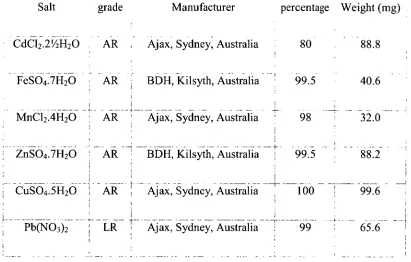
Metal solutions of Fe(II), Cu(II), Mn(II), Cd(II), Pb(II) and Zn(II) were prepared
individually for response tests in acid washed 200.0 mL volumetric flasks. These
solutions contained one of the metal salts listed in Table 2.1 at the masses shown,
2.00 mL of a 1.0 M phosphate buffer at a pH of 6.8, prepared from Na2HPO4 and
NaH2PO4 (99%+ puriss. Grade, Riedel-de Haen, Seelze, Germany), and were made
to the mark with ultrapure water (17+ M1-1 cm-', Thermo Scientific, Dubuque, USA).
Weights were measured on an Ohaus Analytical Plus balance (AP-250D-0, Ohaus
Australia, Port Melbourne, Australia).
For storage, acid-washed 250 mL polycarbonate bottles (Sarstedt, Ingle Farm,
Australia) were used to avoid metal loss through glass adsorption. Stock solutions of
100 mg Li were subsequently made by using the weights shown in Table 1
increased by a factor often, and these were also stored in 250 mL plastic Sarstedt
bottles.
2.2.2 — C18 Functionalised Chromatography Paper
Synthesis of octadecanoyl chloride was undertaken using 9.59 g (3.38x10 -2 mol) of
99% LR grade octadecanoic (stearic) acid (Ajax, Melbourne, Australia) with
addition of 7.6 g (6.4 x10⁻²mol) of 100% SOC12 (BDH, Sydney, Australia) and 1
drop of 99% DMF (BDH, Sydney, Australia). After 27 min of gentle refluxing all
Table 2.1 — Metal salts used for metal response test solutions. The weights at right were dissolved in 200 mL to give approximately 10 mg L-1 solutions.
Salt grade Manufacturer percentage Weight (mg)
• CdC12.2'/2H20 AR Ajax, Sydney, Australia 80 88.8
FeSO4.7H20 AR BDH, Kilsyth, Australia 99.5 40.6
• MnC12.4H20 ART Ajax, Sydney, Australia 98 — 32.0
ZnSO4.71{20 AR BDH, Kilsyth, Australia 4- 99.5 88.2
CuSO4.5H20 AR Ajax, Sydney, Australia 100 99.6
Pb(NO3)2 LR T Ajax, Sydney, Australia 1 99 65.6
octadecanoic acid was consumed and the excess SOC12 was removed by gentle
heating. The light brown oil product was decanted and kept in a desiccator.
A 1 gram quantity of the octadecanoyl chloride was added to a 1 cm2 piece of
Whatman Chr 17 or Whatman P81 chromatography paper. Further tests were
performed using 0.25 g of pyridine added pre-reaction to the paper. After the
octadecanoyl chloride exposures, a waxy residue was left on the paper surface,
which was removed by rising with ethyl acetate (AR grade, Chem Supply,
Melbourne, Australia). Dipyridine was absorbed into the C18 phase from aqueous
solutions, from Me0H solutions (HiPerSolv, BDH, Sydney, Australia) and from
ethyl acetate solution (AR grade, Chem Supply, Melbourne, Australia). Absorption
[image:47.565.101.512.143.405.2]