Seeing Beauty
A Visual Exploration of Transformative Experience.
by
Alyssa Simone
BVA Hons, First Class, University Medal, The University of Sydney
Submitted in partial fulfilment of the requirements for the degree of
Signed statement of originality
This thesis contains no material which has been accepted for a degree or diploma by
the University or any other institution, except by way of background information and
duly acknowledged in the thesis. To the best of my knowledge and belief, it
incorporates no material previously published or written by another person except
where due acknowledgement is made in the text.
Signed statement of authority of access to copying
This thesis may be made available for loan and limited copying in accordance with
the Copyright Act 1968.
Abstract
This thesis is concerned with developing a visual language to explore the concept of
immaterial reality as encountered through transformative experience.
Many individuals have had unique, and often profound, transformative experiences
which have made them aware of a different order of reality. Following the experience,
there is a certainty within the individual that an intangible aspect of reality exists,
traditionally referred to as the immaterial or spiritual. The experiences are not
exclusive to, or necessarily associated with, traditional forms of institutionalised
religion and they are not automatically related to the occult. They can occur to any
individual, regardless of age, sex, race or their location in time and space. The
experiences are imbued with an archetypal form of beauty which permeates the
individual’s vision of existence. This deepened vision becomes part of their daily
experience of reality.
Utilising archetypal imagery, light, pattern, symmetry, and geometry, I visually
explore my transformative experiences. The exploration of the archetypal concepts of
transformation, duality and the immaterial, has resulted in a body of work comprised
of installations that incorporate video, photography and sound. Each of the seven
works draws from my own subjective experience of reality, creating a highly
personal, meditative, and immersive environment.
Personal transformative experience has prompted me to examine the metaphysical
questions surrounding the human condition. This has resulted in a multidisciplinary
theoretical framework for my art practise. I have engaged with writings from
psychology, philosophy, mythology, modern physics and comparative religion,
including the works of C.G. Jung, Joseph Campbell, Fritjof Capra and Paul Davies.
The same questions of existence stimulated by my transformative experiences have
inspired artists throughout recorded history. My research is contextualised by
contemporary artists who explore matters pertaining to the immaterial aspects of
transformative experiences, while others explore humanity’s spiritual connection with
nature, or imbue their work with an invisible presence through an engagement with
human perception.
I seek to contribute to my field through an examination of ancient archetypal symbols
and ideas using new technologies. Thus I have utilised, computer generated imagery
and digitally generated audio to represent the experience of revelation and create a
metaphor for spiritual transformation. Additionally, my work links the idea of
transformation and revelation to experiences of childhood; both through the recreation
of experiences from my childhood as well as drawing on more recent events with my
own children. These aspects combine to render an individual vision of a universal
Acknowledgements
I offer my fondest regards and deepest thanks to all of those who supported me in any
respect during the completion of my PhD, especially, Janelle Mendham who has
reminded me of the true meaning of friendship.
I am deeply indebted to Byron Drogemuller, who unconditionally offered me his love,
encouragement, intelligence, humour, guidance, insight and experience throughout
my degree. In addition to all that I have mentioned he cared for our beautiful children,
Ash and Amélie, who were both born during my candidature. I would like to show my
Contents
Introduction...1
Part I: Transformative Experience: a deeper view of reality
Introduction ...6Beyond Normal Perception...6
A Personal Experience ...8
Transcendent Experience ...8
Synchronicity ...14
Transformative Experience and Modern Physics ...19
Spirit Photography ...22
An Archetypal Experience...31
An Ineffable Experience ...33
A Contemporary Experience...35
A Deeper Perception ...43
Part II: Transformative Experience and Art
Introduction ...46Art and the Invisible ...47
The European Cathedral: A Contemporary Installation Space ...48
Bill Viola and Transformative Experience ...51
Geometry ...58
Art and Nature ...73
Perception and the invisible ...75
An Invisible Presence ...77
Conclusion ...80
Part III: Seeing Beauty: a personal exploration of
transformative experience
Introduction ...81Port Arthur and the spirit photograph ...81
Synchronicity ...94
Archetype ...96
Finding a visual Language for Transformative Experience ...102
Threshold ...104
Lumen ...110
Synaesthesia ...113
Colours of the Darkness ...117
Psyche ...121
Conclusion ...124
Part IV: An individual vision of a universal experience
Conclusion ...125Appendices
Appendix I: Bibliography ...127Appendix II: List of Illustrations ...140
Appendix III: List of Submitted Work ...149
Introduction
Humans experience reality through their five senses, Seeing Beauty visually explores a reality beyond normal perception. As a child, deeply fascinated by
the human body, my parents presented me with a highly detailed pop-up
book on the subject. It was in this book that I discovered that the human eye
actually perceives reality upside down and the brain then reverses the image
(Fig. 1).
Figure 1Image from my pop-up book.
Subsequent to discovering this information I spent a great deal of time
opening my eyes quickly in an endeavour to see the world upside-down
before my brain altered it. (I assumed that there was a lag time between the
eye seeing and the brain interpreting.) I became fascinated with this
in-between moment, it held a truth about reality which I thought, if I could only
Seeing Beauty is a visual exploration of personal transformative experience. My investigation aims to develop a visual language to explore the concepts
of transformation, metamorphosis, duality and the immaterial, as
encountered through these events. To create my work, I have drawn directly
from experiences which have altered my perception of reality. To achieve
this I employ; archetypal imagery, light, pattern, symmetry, nature and
geometry to produce a final body of work comprising of seven installations
that incorporate video, digital animation, photography and audio.
Through my investigation I seek to contribute to a vast visual language of
the transformative experience. My particular view of transformative
experience conveys a unique vision of an archetypal experience which is not
associated with any religion, occult practices or traditional belief systems. I
have utilised still and moving photographic images, installation
incorporating found objects, computer generated imagery and various forms
of audio to represent the transformative experience. Additionally, linking the
idea of transformation and revelation to experiences of childhood; both
through the recreation of past experiences from my own childhood as well as
drawing on more recent events with my own children, renders an individual
vision of a universal experience.
While this investigation focuses on the transformative experience and the
immaterial aspects of existence associated with this, I have long created
works that explore the mysterious aspects of life. My previous works took
the form of an examination of the intangible in-between moments
experienced in material existence. She Hesitates (Fig. 2) is a series of photographs of a figure just appearing or disappearing into or out of the
frame. The work draws on the dream, or the film. The images are a depiction
of the moments where one does not seem to exist, as in film where
Figure 2 Alyssa Simone, She Hesitates, 1999.
A work I created immediately prior to commencing my investigation
foreshadowed many of the concerns I have explored through my research.
The video piece was an intuitive response to W.B. Yeats’ poem Before the World Was Made.
If I make the lashes dark And the eyes more bright And the lips more scarlet, Or ask if all be right From mirror after mirror, No vanity's displayed: I'm looking for the face I had Before the world was made.
William Butler Yeats, 1933.1
The work depicted a mirror image of me trying on necklace after necklace
(Fig. 3). A monologue accompanies the image, this was spoken from the
perspective of the girl in the reflection. She described her mirror world as a
world of silence and explained that she only existed when her material
counterpart observed her. Every time she ceased to be observed, she ceased
1
to exist. She calls this her death. Each time she dies she sees her material
counterpart’s true face – the face she had before the world was made.
Figure 3 Alyssa Simone, Before the World Was Made, 2003.
While my previous work was largely an intuitive response to existence, my
investigation into the transformative experience has given me a conscious
existential awareness, allowing me to see connections between ideas and
concepts which previously seemed unconnected. My investigation has
resulted in seven works which draw from my subjective experience of
reality, creating a highly personal, meditative, immersive environment.
My exegesis is divided into three main parts and a conclusion.
Part one provides a detailed discussion of what entails a transformative
experience. It outlines the role it has played throughout history and its
archetypal nature. Included in this discussion are detailed accounts of the
various transformative experiences I have encountered over the course of my
life. Following this I outline the difficulties one happens upon when
describing experiences which go beyond everyday experience. I then
examine the place of the transformative experience in a contemporary
Western context. Finishing with an explanation of the effects the experiences
Part two examines the artists, both in an historical and contemporary context,
who contextualise my work. I discuss artists who engage in a visual
exploration of transformative experience, the immaterial aspects of reality,
the limits of human perception and humanity’s deep connection with nature.
Through these artists’ works we encounter the spiritual, the invisible and the
underlying fabric of reality expressed through geometry. These works
engage us in the vast mysteries of existence impenetrable to normal human
perception.
Part three outlines how my investigation was pursued. It aims to reveal my
journey of visual exploration into transformative experience. It begins by
describing the experiences which sparked my investigation. Followed by
detailed accounts of the various processes I undertook to create each of the
seven works.
The final chapter concludes the exegesis with a summary of the
Part I: Transformative Experience: a deeper view
of reality
Part one of my exegesis is divided up into six sections, presenting a detailed
discussion of transformative experience. It introduces the concept of
transformative experience by defining the term within the context of my
investigation. The section entitled A Personal Experience discusses the various events which I have based my investigation on in detail. An
Archetypal Experience places the transformative experience in an historical context and emphasises the important role the experience has played
throughout humanity’s existence. An Ineffable Experience discusses the ineffable nature of such events and how attempts have been made to
overcome the inadequacies of language. A Contemporary Experience
discusses the place of the transformative experience in the materialistic
West. It outlines various movements which have acted as an antidote to the
dominant paradigm, the most recent renewing both an academic and general
interest in transcendent experience through the use of entheogens. Finally, A Deeper Perception concludes this section by outlining the effects the
transformative experience has on individuals.
Beyond Normal Perception
The term transformative experience can be widely interpreted to comprise a
myriad of possible experiences. It is undeniable that a large variety of human
experience often alters an individual’s general outlook on life and potentially
changes behaviour. Experiences such as the epiphany, a phenomenon
defined as ‘a sudden intuitive insight into the essential meaning of
something’2, have the ability to enhance and enrich human existence.
However, such experiences are not examined. For the experience to be
2
transformative in the context of my investigation, I have confined the meaning of the term to those experiences which alter the individual’s
perception of reality.
Many individuals have had unique and often profound transformative
experiences which have made them aware of a different order of reality. The
experience expands the individual’s vision of material existence, convincing
them there is more to reality than they had previously known. Following the
experience there is a certainty within the individual that there exist aspects of
reality intangible to the human senses; these aspects have been traditionally
referred to as the immaterial or spiritual. The experiences are not exclusive
to, or necessarily associated with, traditional forms of institutionalised
religion and they are not automatically related to the occult or occult
practises. They can occur to any individual, regardless of age, sex, race or
their location in time and space. The awareness the experience affords the
individual is frequently seen by them as life enhancing, often providing them
with existential meaning, resulting in people who are happier and more
empathetic. The experiences are imbued with a type of beauty which
transcends the everyday meaning of the word. It is an archetypal form of
beauty, which following the experience, permeates the individual’s vision of
existence. This deepened vision becomes part of their daily experience of
reality.
Albert Einstein acknowledged this form of beauty in his essay, The World as I See It:
The Fairest thing we can experience is the mysterious... A knowledge of the existence of something we cannot penetrate, of the manifestations of the profoundest reason and the most radiant beauty, which are only accessible to our reason in their most elementary forms – it is this knowledge and this emotion that constitute the truly religious attitude; in this sense and this sense alone, I am a deeply religious man.3
3
Einstein spoke of the sense of wonder and amazement, of the knowledge of
the existence of that which is impenetrable to human perception, as the most
beautiful emotion. A transformative experience bestows on the individual an
awareness of this reality which exists beyond normal perception.
A Personal Experience
My investigation seeks to contribute to a dialogue on transformative
experience and the immaterial aspects of reality experienced through such
events. In the following section, I discuss the various personal transformative
experiences I aim to explore through my visual practice. I examine four
broad areas of personal experience which include; transcendent experience,
synchronicity, modern physics and spirit photography. The discussion of
each form of transformative experience includes an example of personal
experience. I begin my discussion with the more profound experiences
which fall under the general term of transcendent experience.
Transcendent Experience
…like watching people dancing through an open window. They seem a little mad at first,
until you realise they hear the song you are watching.4
The transcendent experience is a naturally occurring phenomenon within the
human being. It is a spontaneous, sudden, short-lived, profound and deeply
personal insight into existence. It is defined as an experience whereby an
individual perceives or experiences that which is ‘beyond the limits of
normal perception’.5 To paraphrase Maxwell and Tschudin, the individual
4
Chéroux, C. The Perfect Medium: photography and the occult. Yale University Press, New Haven, CT, 2005, p. 12.
5
gains an awareness of a reality which transcends them, a reality which
extends beyond their experience of the everyday.6
Over the last century psychologists have employed numerous terms to
describe experiences which transcend the perception of everyday reality.
Often the terms adopted to describe these experiences are burdened with
problems of interpretation. Originally, when discussing experiences of a
transcendent nature, the term ‘religious experience’, coined by W. James in
his lectures of 1901–1902, was used.7 The term religious experience is now
generally used and understood to be an experience particular to the concept
of institutionalised religion. Today, transcendent experience is the most
accepted term used to replace the often misinterpreted religious experience,
as the events are seldom associated with the beliefs surrounding traditional
religious systems. Maslow states that following the experience each
experient ‘discovers, develops and retains their own religion’.8 The term
mystical experience is also fraught with difficulties of interpretation, as the
experience may not always be associated with traditional ideas of
mysticism.9
In their book Seeing the invisible, Maxwell and Tschudin outline the characteristics of the various transcendent experiences and divide the
experiences into individual categories. While each category is defined by
their own distinctive characteristics, there seems to be two elements common
to all transcendent experiences. These are; a heightened perception of reality
and an altered perception of time and space.
Auditory and visual perception are the most common senses effected during
the experience. Individuals often refer to the intensity or brilliance of light,
‘the field of my vision grew brighter, a kind of dancing brightness like heat
6
Maxwell, M. & V. Tschudin. Seeing the Invisible: modern religious and other transcendent experiences. London, New York: Arkana, 1990, p. 14.
7
James, W. The Varieties of Religious Experience: a study in human nature. Collins, London, 1963, p. 489.
8
Maslow, A. Religions, Values, and Peak-Experiences. The Viking Press, New York, 1970, p. 28.
9
over sand...’10 They also report synaesthesia, (a mixing of the senses) such as
seeing music or tasting colours. One experient describes his experience of
synaesthesia as, ‘The sun sang and the road sang. The music shone.’11
Regardless of the form the heightened sense takes, the experiences are
described as a glimpse ‘of something more real than obvious reality’.12
The events which occur within a transcendent experience are perceived by
the individual to be independent of the generally accepted view of
space-time. Time is often perceived by the experient as merely an abstract
construct of the logical mind rather than a finite fact. It has been described as
‘something that has no beginning or end and therefore, enfolds everything
and all time’.13 Individuals, who report an altered perception of time and
space, often state the experiences are, with a few exceptions, transitory and
short lived. Despite this they also describe them in terms of endlessness or
timelessness.14 Often associated with an altered perception of time is a
feeling of oneness with the universe.
The transcendent experiences which occur with the most frequency are
characterised by a sense of unification, they are referred to as mystical and
peak experiences. The individual describes a loss of the ego and experients
commonly describe a connection with all things, regardless of scale. An
experient expresses their experience of oneness as being ‘…perfectly
conscious of where I was and of my immediate physical surroundings, but
for that brief moment it was as though my whole self was able to expand to
and encompass the furthermost star’.15 Maxwell and Tschudin state that this
sense of oneness imparts an intuitive understanding of a universal source of
knowledge.16 In other words, the individual gains an insight into reality and
their place within the universe. This is illustrated by the following example
10
Maxwell, M. & V. Tschudin. Seeing the Invisible: modern religious and other transcendent experiences. London, New York: Arkana, 1990, p. 50.
11
Ibid., p. 48. 12
Ibid., p. 15. 13
Ibid., p. 19. 14
Ibid., p. 18. 15
Ibid., p. 136. 16
of a mystical experience I had on a return journey home from Nepal at the
age of 20:
I was travelling on a bus looking out of the window, when quite unexpectedly I saw a glimpse of the ocean. In that moment my entire field of vision became luminous, everything seemed to glow with an intense, warm light. The source of the light did not come from the sun, it seemed to be emanating from within the things which made up my field of view. My consciousness seemed to expand outwards into everything and at the same time everything contracted into me. With this expansion and contraction there was a sense of knowing. A knowledge that existed on all levels was revealed to me. I had the sensation that the past, present and future were an inseparable whole, and that the concept of time was a mere abstraction. I was filled with a sense of beauty, and with this beauty was a feeling of love. It was a type of love I had not experienced before, I felt love and loved, it was all encompassing, all pervading and all consuming, there was no separation.
In the example above, immediately prior to the experience my focus was on
the ocean. Nature frequently plays an essential role in the mystical
experience and is perhaps partly responsible for triggering the event. The
individual’s attention is often focused on a natural phenomenon, this can
range from a magnificent sunset to a humble pot plant, or like for William
Blake, the grains of sand. While standing on a beach contemplating grains of
sand in his hand, Blake experienced a mystical experience which shaped his
life. He immortalised this experience in this famous verse from his poem
Auguries of Innocence:
To see a world in a grain of sand And heaven in a wild flower,
Hold infinity in the palm of your hand And eternity in an hour.17
While the mystical experience seems to occur quite spontaneously, the peak
experience is triggered by situations such as love, sex, childbirth, dance and
17
aesthetic insight.18 In the following example, the situation which triggered
my experience was love:
We walked through the gardens on our way back to the car hand in hand, brilliant smiles on our faces. On our path we came across some stairs. I began to walk up the stairs still holding his hand. Everything I am about to describe happened simultaneously and the experience lasted for only a few moments. Time changed, it slowed down almost to a halt. I felt as if I was moving in extreme slow motion. My vision became filled with a golden light, the light became so intense I could hardly see. For that moment, myself and everything around me seemed to disintegrate and become light. I lost the sensation of touching the ground. I remember the light as being incredibly beautiful and of being filled with it. I experienced intense emotion – an emotion of beauty which was at the same time love. The experience came with a profound sense of knowing, a knowing that all was as it should be and it had always been and always will be.
A transcendent experience can also be induced by the group of psychoactive
plants and chemicals known as entheogens.19 For the transcendent
experience to be induced with entheogens the physical and emotional
situation of the individual is of utmost importance. Maslow claims that
substances such as, ‘LSD and psilocybin in the right people under the right
circumstances can produce a peak experience’.20
In my early 20s I had the opportunity to try the entheogen Lysergic acid
diethylamide or LSD. Before I took it, I researched the effects of the
substance and read The Psychedelic Experience, written by Timothy Leary, Richard Alpert & Ralph Metzner. The book is based on the Tibetan Book of
18
Maxwell, M. & V. Tschudin. Seeing the nvisible: modern religious and other transcendent experiences. London, New York: Arkana, 1990, p. 197.
19
‘The term entheogen is used to supplant the pejorative term hallucinogen and the ethnocentric neologism psychedelic when discussing psychotropic or psychoactive plants and chemicals’. (See: St. John, G (ed). Rave Culture and Religion. Routledge, London, 2004. p. 125). The term entheogen was first coined by Ruck, Bigwood, Staples, Ott, and Wasson in 1979 and literally means ‘becoming the god within’. (See: Ruck, C. Bigwood, J. Staples, D. Ott, J. & R. Wasson. ‘Entheogens’, Journal of Psychedelic Drugs, Vol. 11, Jan– Jun(1-2) 1979, pp. 145–6).
20
the Dead and is described as a manual that carefully outlines the possible range of experiences obtained through the use of entheogens. Following my
research, I chose to ingest the LSD on a warm summer’s day in St David’s
Park, Hobart. Unexpectedly I had a very powerful revelatory experience
which I feel is summed up succinctly by the words of American comedian,
Bill Hicks: ‘… all matter is merely energy condensed to a slow vibration, we
are all one consciousness experiencing itself subjectively, there is no such
thing as death, life is only a dream, and we are the imagination of ourselves.’
There are several other transcendent experiences which fall outside of my
experience; however they are very closely related. Some are defined by
particular factors occurring within the experience. These factors include; a
sense of presence which is referred to as a numinous experience, and
experiences involving visions or voices known as prophetic or visionary
experiences. Additionally, closely related to the transcendent experience is
the near-death experience. This experience is defined by the various stages
common to the experience, including; a feeling of peace and quiet, a buzzing
noise, moving through a dark tunnel, an out of body experience, meeting
others and finally, a being of light. While not every individual who dies and
recovers, almost dies or believes they are going to die, has a near-death
experience, a significant proportion do. The effects the near-death
experience has on individuals are often similar to that of the other
transcendent experiences.
While, the transcendent experience is a profound subjective, intuitive insight
into a different order of reality, there are other more subtle experiences
which are sometimes easy to overlook. One such experience is
Synchronicity
Synchronicity was coined by psychologist Carl Gustav Jung, he describes it
as ‘the simultaneous occurrence of a certain psychic state with one or more
external events which appear as meaningful parallels to the momentary
subjective state…’21 In other words, the subject experiences one or more
meaningful coincidences. Despite the use of the word coincidence, the
occurrence and sequence of the events are at times so bizarre that it is
difficult to put them down to mere coincidence. In his book entitled,
Synchronicity: an acausal connecting principle, Jung illustrates the term by describing an experience he had while treating a patient:
A young woman I was treating had … a dream in which she was given a golden scarab. While she was telling me this dream I sat with my back to the closed window. Suddenly I heard a noise behind me, like a gentle tapping. I turned round and saw a flying insect knocking against the window pane from outside. I opened the window and caught the creature in the air as it flew in. It was the nearest analogy to a golden scarab that one finds in our latitudes, a scarabaeid beetle, the common rose-chafer (Centonia aurata), which contrary to its usual habits had evidently felt an urge to get into a dark room at this particular moment.22
The events in a synchronicity experience often occur in an order which do
not follow the classical view of causality, that is, the notion of cause and
effect. If causality was in effect in the above example, the patient would
have dreamt of the scarab following the event and not before. Thus Jung
declares synchronicity to be independent of the concept of space-time and he
refers to it as an acausal event.23 To further illustrate how these events can
become increasingly complex, here is a description of an experience I had
about a year ago:
21
Jung, C.G. Synchronicity: An Acausal Connecting principle. Routledge, London and New York, 2006, p. 36.
22
Ibid., p. 31. 23
While working in my studio one afternoon I completely lost track of time. I usually tell the time from my computer and I felt it was rather mad to turn it on just to see the time. I expressed lament for my wrist watch that I had lost two years previously. The watch had held considerable sentimental value. I lost the clock face in the grass at the back of our house while racing to the car one morning to catch the ferry. I searched everywhere for it but could not find it. Although I had given up on finding my watch, I wished for it back. Knowing it was lost, I was forced to make the decision to buy a new one. The day after my lament for my old watch, I was at home looking out of the back door. In the period between losing my watch and this point in time, we had excavated the area at the back of the house where I had lost my watch. The dirt from the excavation had been dumped in four different places, near the water tank, in the middle of the paddock, near the fruit trees and at the base of a dam. About a year after the dirt had been dumped, a massive pumpkin plant spontaneously grew at the base of the dam about thirty meters from our house. We were quite amazed at the plant and wondered where the seed had come from as our vegetable garden was some fifty metres in the opposite direction. On this day I noticed for the first time that the enormous plant seemed to be growing several huge pumpkins. I walked over to investigate, as I was interested to see how many pumpkins had started to grow. After briefly examining the plant I turned and began to walk back towards the house. I had taken about five steps when I came across the clock face of my watch sitting face up on the dirt. I picked it up. The feeling I had in the instant I saw my watch was one of a magical quality, it made me giggle. It was a little dirty but seemed intact. I took the watch to the jeweller the next day and had a new battery put in it. It worked perfectly. Incidentally, I was quite excited about finding my watch and told people the story of how I had found it. But each time I told someone the story about finding my watch, it would stop for about 15 minutes. I stopped telling the story …
Synchronicity challenges the physicist’s classical view of causality, forcing
the individual to reconsider the basic meaning of change, probability,
coincidence and the singular events in our lives.24 The acausal principle is
illustrated in the above example by the spontaneous growth of the pumpkin.
24
It seems that the pumpkin grew there in order for me to find my watch. Its
growth was timed such that the day after I expressed a wish for my watch,
the pumpkins had grown to such a size that they sparked my interest enough
to go over and look at them. Although I had viewed the plant several times, I
had never seen the watch. Additionally, I would never have gone near the
base of the dam if the pumpkin had not spontaneously grown there. If the
watch had been found randomly, there would not be a story, however, it was
found face up on top of the dirt the day after I had expressed a wish for it
back. Furthermore, the experience of synchronicity was not new to me, I had
been experiencing it since childhood and by this stage I had read Jung’s
book on the subject. Jung points out that the conscious acknowledgement of
synchronicity causes it to happen with greater frequency. He claimed that
when he was on, what he refers to as the right path, meaningful coincidences seemed to happen quite regularly, he almost expects them.25 His description
of the right path is not a new idea, it parallels the concepts of the way or
karma within Eastern Mysticism. Jung claimed that synchronicity makes a significant ‘impression on people and seems to have a certain numinous
quality’.26 By numinous he means a magical quality, a presence which enters
the individual’s daily life, often manifesting itself as a heightened awareness
of the sublime nature of existence.
Jung states that the possibility that events like the ones described above are
coincidences is highly unlikely. He proposes that it is more reasonable to
suggest that acausal events are the result of an unexplainable phenomenon.
He says that, ‘It is difficult to look around the macro physical world and
point out acausal events, but that does not mean they do not exist. Their
existence or at least their possibility follows logically from the premise of
statistical truth’.27 This means that, the series of meaningful coincidences as
described above are statistically more likely to be the consequence of what
he refers to as an unexplainable phenomenon than a coincidence. He also suggests that the occurrence of such unexplainable phenomenon implies a
25
Jung, C.G. Synchronicity: An Acausal Connecting principle. Routledge, London and New York, 2006, p. 13.
26 Ibid. 27
hidden order of reality that is concealed from normal perception. Jung
proposes that within the Western view of reality we seem to be overlooking
this hidden order of reality.
The Western view of reality is largely based on the ideas of what Jung refers
to as empirical science. This form of science is based on the scientific
methodology that is described as ‘predicated on hypothesis formation,
observation, experimentation, measurement, prediction, [and] replication’28.
It is the testable, quantifiable view of reality, the traditional reductionist
viewpoint of science. Jung states that, ‘the experimental method of enquiry
aims at establishing regular events which can be repeated; consequently,
unique or rare events are ruled out of account’.29 Even today this form of
science is often presented as knowledge containing absolute truths. In reality
empirical science is a collection of statistical truths, there are no absolutes.
The scientific method of experimentation calls for a given occurrence to be
true up to a certain percentage for it to be fact, no scientist will ever quote a
result to be 100 percent definite. In addition, we frequently overlook the fact
that scientists form theories and then endeavour to find evidence to support
or disprove those theories. It is important to remember that theories are only
that, theories. It follows that, this manner in which science operates causes it
to be in constant flux, the facts are forever changing. The film director
Andrei Tarkovsky described science as a never ending staircase of
knowledge of the world which ‘is successively replaced by new knowledge,
with one discovery often being disproved by the next for the sake of a
particular objective truth’.30
Jung also points out that it is important to consider that, every answer is
‘influenced by the kind of question asked and the result is always a hybrid
28
Aldridge, A. Religion in the Contemporary World: a sociological introduction. Polity Press, Cambridge, U.K. , Malden, Mass, 2000, p. 209.
29
Jung, C.G. Synchronicity: An Acausal Connecting principle. Routledge, London and New York, 2006, p. 7.
30
product’.31 Astrophysicist, Sir Arthur Eddington explains this through an
analogy of a fisherman:
In a seaside village, a fisherman with a rather scientific bent proposed as a law of the sea that all fish are longer than one inch. But he failed to realise that the nets used in the village were all of a one-inch mesh.32
Jung concludes in Synchronicity that the ‘so called scientific view of the world is a psychologically based partial view of reality which misses out aspects of reality which cannot be grasped statistically’.33
According to Jung, the experience of synchronicity is the result of an order
of reality we cannot perceive. Although traditional forms of empirical
science have failed to provide explanations for these unique events, a
particular aspect of modern Physics, the study of the subatomic world known
as quantum physics further substantiates Jung’s argument. He states that the
‘discoveries of modern physics have changed the scientific picture of the
world, that is, they have shattered the absolute validity of natural law and
made it relative’.34 This is due to the fact that ‘…in subatomic quantities,
prediction becomes uncertain because they no longer behave in accordance
with the known natural laws’.35 In other words, the subatomic world itself is
of a different order in that it behaves in accordance with its own laws.
Therefore, statistical truths (as far as they are truths), which are the basis of
empirical science, are only valid when dealing with macro physical
quantities, that is, they are relative only to the macro physical world, hence,
Einstein’s Theory of Relativity.36 In order to fully understand the meaning of this statement, the discoveries of modern physics, in particular quantum
physics, must be explained.
31
Jung, C.G. Synchronicity: An Acausal Connecting principle. Routledge, London and New York, 2006, p. 7.
32
Zee, A. Fearful Symmetry: The Search for Beauty in Modern Physics. Macmillan Pub. Co., New York, 1986, p. 280.
33
Jung, C.G. Synchronicity: An Acausal Connecting principle. Routledge, London and New York, 2006, p. 7.
Transformative Experience and Modern Physics
All things by immortal power, Near or far,
Hiddenly,
To each other linked are, That thou canst not stir a flower, Without troubling of a star.
Francis Thompson.37
Like many artists I am inspired by the intriguing findings of science,
especially the form of science which asks you to believe in the invisible. I
was walking past the Uni bookshop one day, a book caught my eye, this
particular book changed the way I view reality. The book was Other Worlds
by physicist Paul Davies. It was my introduction to quantum physics and
began a long fascination with the subject which extended into fundamental
physics. While it partly confirmed aspects of reality I knew intuitively, it
opened up a plethora of new possibilities. Transforming the way I thought
about reality and providing me with a language in which to describe many of
my own experiences. The following is a description of what I discovered
from Paul Davies book, Other Worlds:
Quantum physics developed out of two important theories, Quantum Theory
and the Theory of Relativity.38 Quantum theory began as an attempt to
explain certain technical aspects of subatomic physics.39 Between 1900 and
1930 several scientific discoveries were made which changed the way in
which reality is viewed. One of the most significant was that, on the atomic
level ‘matter remains in a state of suspended animation of unreality until an
actual measurement or observation is performed.’40 To put it simply,
subatomic particles do not appear to exist in this reality until someone
37
Davies, P. Other Worlds: Space, Superspace and the Quantum Universe. Penguin, London, 1990, p. 56.
38
Davies, P. God and the New Physics. Penguin, Ringwood, Victoria, 1984, p. vii. 39
Davies, P. Other Worlds: Space, Superspace and the Quantum Universe. Penguin, London, 1990, p. 11.
40
observes them. ‘This curious state of limbo corresponds to atoms being
caught between many worlds, undecided where to go.’41 ‘If accepted
literally, it leads to the conclusion that … the universe that we actually
perceive – is not the only one.’42 Our universe exists in a ‘superspace’ of
universes, some vastly different, others almost identical, and these ‘are not
always completely disconnected from our own: they overlap our perceived
universe and jostle its atoms.’43 The implications of this are indeed mind
boggling. It implies that ‘reality … is not a property of the external world on
its own but is intimately bound up with our perception of the world …’44
This conclusion carries great significance … ‘for unlike all the previous
scientific revolutions, which have successively demoted humankind from the
centre of creation to the role of mere spectator of the cosmic drama, quantum
theory reinstates the observer at the centre of the stage.’45 Further to this,
laboratory experiments carried out in the 1970s and 1980s ‘have
demonstrated that atoms and subatomic particles, which people usually
envisage as microscopic things, are not really things at all … Yet we are all made of atoms … ’.46
These discoveries have significant implications to the nature of reality, how
we view it and our part in it. It seems that we are more intimately connected
to nature than we once supposed.
In response to the discoveries of quantum physics, a small number of
modern physicists, the intellectual descendents of Einstein, began to search
for a single theory to explain the ‘fundamental design of nature’.47 Known as
fundamental physicists, they seek a single unifying theory to explain reality
on all levels, including the unruly subatomic world. These physicists found
that they had to re-evaluate and change the way they thought about reality,
41
Davies, P. Other Worlds: Space, Superspace and the Quantum Universe. Penguin, London, 1990, p. 13.
42
Ibid., p. 11. 43
Ibid., p. 12. 44 Ibid. 45 Ibid. 46 Ibid. 47
‘they learned to approach their subject in totally unexpected and novel ways
that seemed to turn commonsense on its head and find closer accord with
mysticism than materialism’.48
The general notions about human understanding … which are illustrated by discoveries in atomic physics are not in the nature of things, wholly
unfamiliar, wholly unheard of, or new. Even in our own culture they have a history, and in Buddhist and Hindu thought a more considerable and central place. What we shall find is an exemplification, an encouragement, and a refinement of old wisdom.49
Fundamental physics lead them towards ‘a view of the world which is very
similar to the views held in Eastern Mysticism’.50 The new way of thinking
these physicists and other academics were grappling with, is a more holistic
view of reality which includes humanity’s intimate connection with the
universe. Similar to the experience of the transcendent experience, it is a
view which involves the notion that there is a basic oneness to the universe,
as physicist, Fritjof Capra, points out in the Tao of Physics:
The basic oneness of the universe is not only the central characteristic of the mystical experience, but is also one of the most important revelations of modern physics. It becomes apparent at the atomic level and manifests itself more and more as one penetrates deeper into matter, down into the realm of subatomic particles.51
It is said that fundamental physicists can have a similar experience to a
transcendent experience when they gain insight from an intricate knowledge
of the order of the universe. The opposite also seems to be true, that a
transcendent experience somehow gives the individual an intuitive
understanding of the universe similar to the knowledge acquired by a
48
Davies, P. God and the New Physics. Penguin, Ringwood, Victoria, 1984, p. vii. 49
Capra, F. The Tao of Physics: an exploration of the parallels between modern physics and Eastern mysticism. Flamingo, London, 1992, p. 22.
50
Davies, P. God and the New Physics. Penguin, Ringwood, Victoria, 1984, p. vii. 51
fundamental physicist. Both the physicist and the individual who undergoes
a transcendent experience perceives a oneness and harmony that is expressed
in the recognition of the pattern, symmetry and order of the universe. The
spiral for example, exists on all levels of reality from the seashell to the
structure of our galaxy.
While the astounding discoveries of modern physics have not been fully
integrated into Western culture, Paul Davies has discerned that ‘fundamental
physics is pointing the way to a new appreciation of humans and their place
in the universe’.52 Theologians, philosophers, psychologists, sociologists,
artists and anyone ‘in search of a deeper meaning in their lives, find their
beliefs about the world very much in tune with the new physics’.53
According to the discoveries of modern physics, once again, any number of
unexplainable phenomenon are possible; the list is limited only by our
imagination. One such phenomenon which may possibly be validated by the
findings of modern physics is spirit photography.
Spirit Photography
A unique characteristic of photography has always been its ability to record the visible, material world with truth and accuracy. Yet from the 1860s onward, photography has also been enlisted to provide proof of the immaterial: auras and apparitions; séances and levitations; transfigurations and the spirits of the deceased.54
So far I have illustrated that there are several ways you can step outside of
the ordinary way of seeing. In the case of spirit photography the camera is
partly doing this for you. The term spirit photography refers to photographs
which contain an anomaly which was not visible at the time of taking the
52
Davies, P. God and the New Physics. Penguin, Ringwood, Victoria, 1984, p. vii. 53
Ibid. 54
photograph; this anomaly is attributed to the presence of a spirit of the
deceased. Spirit photography can be found in both an historical and
contemporary context.
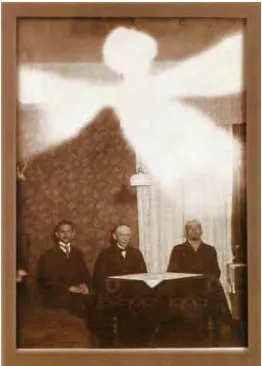
Historical spirit photography dates back to the late 19th and early 20th
centuries. These photographs were manipulated by the photographers of the
time, and contained an apparent apparition appearing out of the background
(Fig. 4).
Figure 4 William Mumler, Master Herrod with the spirits of Europe, Africa and America, 1870-72.
Approximately forty years after the invention of the camera, a large
spiritualist movement was witnessed in the West. The occult became
fashionable and boasted advocates, including Sir Arthur Conan Doyle. It was
believed that the camera, following Muybridge’s photographs55, could see
things the naked eye could not, and the spiritualist movement advocated the
use of the camera as proof of an afterlife. Later, in the early 20th century,
spirit photographs were created to take advantage of those who lost loved
ones during World War I. The spirit photographs of this time were generally
formal portraits of individuals, with an apparition often surrounded by an
55
ethereal mist, or ‘ectoplasm’ as it was often called. Some photographs
contained objects such as flowers or written messages from the dead (Fig. 5).
Figure 5 M.J. Vearncombe, Psychograph, 1919.
An exhibition on historic spirit photography was housed at both the Maison Europeenne de la Photographie in Paris and the Metropolitan Museum of Art in New York in 2005. Le troisieme oeil: La photographie et l’occulte or
The Perfect medium: Photography and the Occult displayed a large collection of images of historic spirit photography and photographs of
mediums of the late 19th and early 20th centuries (Fig. 6).
The exhibition includes several photographic experiments, such as;
photographs of fluids and the photography of thought, known as
thoughtography and skotography (Fig. 7) which is an image of a spirit taken
without a camera or light.
Figure 7 Madge Donohoe, Skotograph, c.1930.
Clearly, because of the widespread knowledge of the use of photographic
manipulation, these images are not accepted as evidence of a spirit within
contemporary Western society.
Contemporary spirit photography is somewhat different to its historical
counterpart. Present-dayphotographs contain abstract anomalies which
cannot be attributed to common photographic artefacts. These anomalies are
attributed by many individuals to spirits of the dead and are categorised by
enthusiasts into three main types: ‘orbs’, ‘ectoplasmic vapour’ and
‘vortices’. A ‘vortex’ is a tornado-like anomaly within a photograph.
‘Ectoplasmic vapour’ is identified by a white swirling mist varying in
opacity.
The most common anomalies in the contemporary spirit photograph are
known as ‘orbs’. They appear as balls of white light which vary in size,
captured individually or in groups. Some have been photographed moving
around the frame, leaving a trail of motion blur behind them (Fig. 8).
Figure 8 Debbie Malone, Photograph of orbs moving around frame, c.2001.
Several other forms of photographic anomalies which do not fit into these
categories appear as lights, unexplained shadows or unexplained objects.
Contemporary spirit photography enthusiasts exist throughout the Western
world. They have devised a new language and theories to describe the
unexplainable anomalies within these photographs. They use an array of
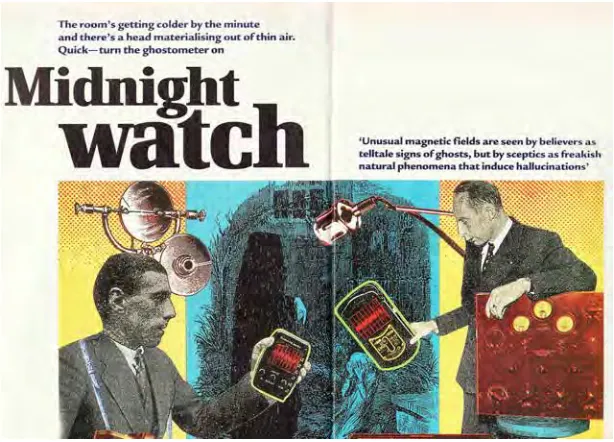
equipment including; still cameras, video cameras, digital audio recorders,
electromagnetic field meters, thermal scanners, motion detectors and infrared
night vision scopes (Fig. 9).56 Despite all their efforts with the application of
such equipment, most contemporary spirit photographers agree that the best
equipment in their endeavour to prove the existence of spirits is still the
camera.
56
Figure 9 The New Scientist, Midnight Watch, 1999.
The anomalies captured in spirit photographs are elusive, transient and
unpredictable. These unexplainable phenomenon do not to comply with the
scientific method and as far as scientific understanding is concerned, the true
nature of the anomalies may remain an enigma. Despite the fact that the
spirit photograph is not hard scientific evidence of the existence of spirits,
the experience can cause a shift in perception. Some individuals who take a
spirit photograph can have a similar experience to synchronicity.
Many of these individuals describe an accompanying physical experience in
addition to capturing the photographic anomaly. The dual cognitive and physical experience causes a profound change in their perception of reality.
Ultimately, the experience provides them with an insight and understanding
of their existence which was previously absent. My first experience of spirit
photography illustrates the change in perception caused by the capture of an
orb within a photograph:
photograph’ were outlined on a website called the International Ghost
Hunters Society. As we drove through the dark streets towards the cemetery, I briefed the others on the standards and protocols of the ghost hunt … They are as follows;
• ask the spirits of the dead for permission to take their photograph • no smoking
• no alcohol
• no ouija boards or séances
• do not take photographs during adverse weather conditions such as
rain, mist, fog, snow or windy/dusty conditions
• remove all dust spots and fingerprints from camera lens • avoid shooting with flash at reflective or shinny surfaces
• avoid shooting when foreign objects are floating near the camera • show reverence and respect in chosen areas
• a positive mental attitude is important for all investigations.
We parked the car. It was a clear, calm moonlit night. We walked tentatively towards the cemetery. The graves were covered in vines and the closeness of the graves began to make me feel a little claustrophobic. Once on a wide open path, I relaxed. After walking around for a little while, we began to take photographs. We each shot off a role of film and Paul shot 40 photographs on his digital camera. We were not expecting too much as this was an
experiment. We were open to what would happen. It was fun, a little adventure for all of us. We did something we would never normally do and that was good for us. We returned home to look at the digital photos. We looked carefully at each one and towards the end there was an orb in a photograph. We were amazed and excited. We were determined to capture more and to find out more about this phenomenon. We endeavoured to keep our minds open and not jump to conclusions. But even so it began to change my view of the world.
Our reliance on direct retinal experience as the basis of our beliefs in reality
is deeply imbedded in Western culture. In this sense the photograph is an
object of immense power and influence in our society. It is not difficult to
think of images which have changed the world as we know it. It is generally
the photograph represents truth. What continues to make photography
distinct is the original presence, a referent in the material world that at some
time did really exist.57 Reality may have been transcribed, manipulated or
enhanced, but photography does not cast doubt on reality’s actual
existence.58 The snapshot in particular continues to exemplify this element of
truth for many individuals within our society. The photographic image has
been described as ‘the simultaneous presentation of life and death, and it is
… neither life nor death, but the haunting of one by the other’.59 It is at once
proof of existence and life as it records presence and in the same instance it
is an absence. The photograph is the death of a moment which can never be
relived and each photograph is a reminder of ones own mortality.60
Photography becomes an entanglement of absence and presence, death and
life.
Although the concept of spirit photography is not entirely acceptable to
contemporary Western society’s version of reality, it does have an effect on
some individuals. It changes them, provides them with comfort, hope, beauty
and a sense of awe in existence. Here is one such story from a woman who
saw an image in a window, (images seen in the patina of objects are known
as simulacrums):
While on a ghost tour in a small town about an hour out of Sydney, I met a woman also in the tour during the tea break. After talking to her a little about spirit photography and the tour we were on, she very carefully produced a photograph from her handbag. She held it to her chest and said to me, ‘I want to show you something.’ I felt from her tone and body language that she was about to show me something very precious to her. The photograph she handed to me was a snapshot of herself in her kitchen, it was taken at night and she was standing in front of a window. She told me it was taken shortly after her father had died. She pointed to the darkened window where there was a type of mist which appeared to me to be condensation on the window.
57
Batchen, G. Burning with Desire: the conception of photography. The MIT Press, Cambridge, Mass, 1997, p. 212.
58 Ibid. 59
Ibid., p. 193. 60
She pointed to a particular spot in the window and said ‘There, that is my fathers face.’ I tried hard to see the face but could not. Seeing my confusion, she then lay the photograph on the table and masked it with other pieces of paper so the area where her father’s face appeared was all that was visible. I still did not see the face but I did see her desperation for me to see it and I said, ‘Yes, I can see it.’ She smiled a smile of relief and said, ‘When I saw this photograph I knew my father hadn’t really left me, he is with me all the time.’
The photograph was imbued with meaning and it was the photograph itself
which proved to this woman the existence of an afterlife and provided her
with the comfort she needed in her time of grief. The photograph was proof
for her of truths about reality and existence.
When we consider the intimate relationship photography has had with death,
the orders and levels of representation within the spirit photograph become
increasingly complex. The photograph is described as a simultaneous
representation of absence and presence. The spirit photograph acts as a
medium between two worlds. The living and the dead are at once
represented in a space between life and death. Therefore, the spirit
photograph is ‘a space of uncertainty, a troubling movement back and forth
in the very grain of photography’s logic.61 It disturbs identity, system and
order and does not respect boundaries and rules.62 The dead are transformed;
photography reanimates them into a new existence, a new meaning. The
spirit photograph is death that does not entirely part from life, it can be
described as ‘death infecting life and life infecting death,’ and therefore,
according to Kristeva, it is abject.63
While these entities are abject in their in-between, ambiguous space, their
existence is edged with the sublime. The sublime moment comes in the
61
Batchen, G. Burning with Desire: the conception of photography. The MIT Press, Cambridge, Mass, 1997, p. 173.
62
Kristeva, J. Powers of Horror: an essay on abjection. Columbia University Press, New York, 1982, p. 5.
63
realisation of love beyond death and at these moments ‘the abject collapses
in a burst of beauty that overwhelms us … ’64
An Archetypal Experience
The transcendence of biological nature is a universal phenomenon of humankind.65
Humans have had experiences that have altered their perception of the
everyday world throughout human history.66 The awareness of the
immaterial aspects of reality that the transformative experience produces is
evident in our ancestors long before the existence of modern Homo sapiens,
extending back into the early Palaeolithic era. Evidence of the belief in the
immaterial in early hominid species is found in the form of art and music,
commonly used in ritual. The use of ritual implies belief in another higher
order of reality to which the humans are subject to. Evidence of ritual burial,
implying a belief in an afterlife, is found later in the Palaeolithic period,
when Neanderthals and archaic Homo Sapiens inhabited the planet.67 In light
of this evidence, Hay argues that it is feasible to assume that transformative
experiences are part of our biological make up and are accordingly,
archetypal.68
An archetype is ‘the original pattern or model from which copies are made: a
prototype’.69 Jungian archetypes are imbedded deep within the human
psyche, they are described as, ‘a pervasive idea, image or symbol that forms
64
Kristeva, J. Powers of Horror: an essay on abjection. Columbia University Press, New York, 1982, p. 210.
65
Aldridge, A. Religion in the Contemporary World: a sociological introduction. Polity Press, Cambridge, U.K. , Malden, Mass, 2000, p. 27.
66
Maxwell, M. & V. Tschudin. Seeing the Invisible: modern religious and other transcendent experiences. London, New York: Arkana, 1990, p. 11.
67
Campbell, J. Historical Atlas of World Mythology. Perennial Library, Harper & Row, New York, 1988, p. 25.
68
Hay, D. Exploring Inner Space: scientists and religious experience. Penguin, Harmondsworth, 1982, p. 9.
69
part of the collective unconscious’.70 The collective unconscious is the
concept that there are unconscious ideas and experiences that are universally
fundamental to all human beings, they are ‘inborn’.71 Due to their biological
nature within the human species, archetypes remain the same from culture to
culture, traversing time and space. Each culture applies a different cultural
costume to the archetype. This is known as mythology.
Fundamentally mythologies assist the self conscious human being in coming
to terms with their own death, the ultimate transformative experience. The
human beings awareness of their mortality is generally referred to as the human condition. The conscious awareness of the past and the future
prompts human’s to pose fundamental questions regarding creation, life and
death. The response to such questions of existence shape the basis of
religious and philosophical thought across the planet. Resulting from the
metaphysical contemplation of the human condition are various theories.
While the various schools of thought may differ widely in certain aspects,
there is a surprising amount of agreement between them. In The Perennial Philosophy, Aldous Huxley examines a selection of sacred texts from the various world religions to demonstrate they are in their essence in
agreement.72 The idea that all religions and systems of belief are
fundamentally the same is referred to as the common core theory.73 The differences are usually in the form of habits, behaviours and dogmas. In
general these differences are dictated by the particular time and space each
experient found themselves in. Maslow claims that the differences between
religions are superficial, peripheral and expendable.74
Jung refers to the transformative experience as the rebirth archetype.
Evidence of the rebirth archetype is found in all forms of human mythology.
70
Simpson, J. & E. Weiner. The Oxford English Dictionary. Oxford University Press, Oxford, 1989.
71
Jung, C. G. Four Archetypes: mother, rebirth, spirit, trickster. Routledge, London, 2001, p. 2.
72
Hay, D. Exploring Inner Space: scientists and religious experience. Penguin, Harmondsworth, 1982, p. 90.
73 Ibid. 74
Muhammad isolated in a cave, Jesus alone in the desert for 40 days and 40
nights, and Buddha deep in meditation under a Bohdi tree, are all good
examples of this. Maslow states that at the essence of ‘every known high
religion has been the private, lonely, personal illumination, revelation, or
ecstasy of some acutely sensitive prophet or seer’.75 The transformative
experiences of these particular individuals are used by each religion to
authenticate it. It is reasonable then to hypothesise that these religions and
their mythology are based on the same kind of experience, the rebirth
archetype.
An Ineffable Experience
Transformative experiences go beyond what we know about reality and
therefore, by its very nature, are outside the realm of language.76 Language
relies on common experience in order for us to communicate ideas. When
the experience extends beyond what is commonly experienced by all
linguistic difficulties become apparent. Often individuals are unable to find
the adequate language necessary to describe transformative experience and
in this sense the experiences are ineffable.
Plato’s Allegory of the Cave, from The Republic illustrates the problems which arise when discussing subject matter which falls outside of everyday
understanding:
… Behold! human beings living in a underground den, which has a mouth open towards the light … here they have been from their childhood, and have their legs and necks chained so that they cannot move, and can only see before them, being prevented by the chains from turning round their heads. Above and behind them a fire is blazing at a distance, and between the fire and the prisoners there is a raised way … Like ourselves, … they see only
75
Maslow, A. Religions, Values, and Peak-Experiences. The Viking Press, New York, 1970, p. 19.
76
their own shadows, or the shadows of one another, which the fire throws on the opposite wall of the cave … To them, … the truth would be literally nothing but the shadows of the images.77
Plato describes individuals in the cave who are released from the chains.
They are able to turn around see the fire, the others, themselves and the
outside world. They then endeavour to describe to those who had only the
experience of the shadows, what a reality more real than their shadow reality
was like. Plato’s allegory highlights the inadequacy of language when
attempting to describe experiences which extend beyond normal perception.
Transformative experience highlights the inadequacies of language. Joseph
Campbell stated that, ‘the ultimate word in our English language for that
which is transcendent is God’.78 For many experients descriptions fall well short of the actual event and they find words ‘a pale reflection of the sublime
character of the experience’.79 Consequently, transcendent experiences are
often described using metaphors like; ‘behind the veil,’ ‘an opening of a
window’, or ‘the lifting of the corner of a curtain’.80
As the ideas of Quantum physics begin to penetrate main stream Western
society, ideas surrounding transcendent experience, synchronicity,
fundamental physics and spirit photography are beginning to change.
Physicist, David Bohm invented new terms to describe his theories. For
example, the ‘holomovement’ is a term Bohm invented to describe the
underlying structure of the universe. Doug Renselle has taken this concept
one step further and has invented a whole language based around Bohm’s
theories. This language is called Quantonics and looks like this: ‘Frææ wihll issi ihntrinsihc, but mihtigatæd by mahssihve ænsehmbles ¤f frææ wihllings,
ihncluding nature's ¤wn frææ wihllings.’81 Bohm’s theory of the
77
Plato. The Republic. Translated by Desmond Lee, Penguin, Harmondsworth, England, 1955, p. 256.
78
Campbell, J. The Power of Myth. with Bill Moyers, Doubleday, New York, 1988, p. 49. 79
Ibid., p. 18. 80
Maxwell, M. & V. Tschudin. Seeing the Invisible: modern religious and other transcendent experiences. London, New York: Arkana, 1990, p. 15.
81