Data Descriptor:
A comprehensive
database of thermal
developmental plasticity in reptiles
Daniel W. A. Noble1, Vaughn Stenhouse1,2, Julia L. Riley1,3, Daniel A. Warner4,
Geoffrey M. While5, Wei-Guo Du6, Tobias Uller7& Lisa E. Schwanz1
How temperature influences development has direct relevance to ascertaining the impact of climate change on natural populations. Reptiles have served as empirical models for understanding how the environment experienced by embryos can influence phenotypic variation, including sex ratio, phenology and survival. Such an understanding has important implications for basic eco-evolutionary theory and conservation efforts worldwide. While there is a burgeoning empirical literature of experimental
manipulations of embryonic thermal environments, addressing widespread patterns at a comparative level has been hampered by the lack of accessible data in a format that is amendable to updates as new studies emerge. Here, we describe a database with nearly10,000phenotypic estimates from155species of reptile, collected from300studies manipulating incubation temperature (published between1974–2016). The data encompass various morphological, physiological, behavioural and performance traits along with growth rates, developmental timing, sex ratio and survival (e.g., hatching success). This resource will serve as an important data repository for addressing overarching questions about thermal plasticity of reptile embryos.
Design Type(s) data integration objective • database creation objective
Measurement Type(s) developmental plasticity
Technology Type(s) data item extraction from journal article
Factor Type(s)
Sample Characteristic(s) Testudines • temperature • Squamata • Sphenodontia • Crocodylia
1Evolution & Ecology Research Centre, School of Biological, Earth, and Environmental Sciences, University of
New South Wales, Sydney, New South Wales2052, Australia.2School of Biological Sciences, Victoria University, Wellington6037, New Zealand.3Department of Biological Sciences, Macquarie University, Sydney, New South Wales 2109, Australia.4Department of Biological Sciences, Auburn University, Auburn, Alabama 36849, USA.
5School of Biological Sciences, University of Tasmania, Hobart, TAS 7005, Australia. 6Institute of Zoology,
Chinese Academy of Sciences, Beijing100101, China.7Department of Biology, Lund University, Sölvegatan37, 223 62 Lund, Sweden. Correspondence and requests for materials should be addressed to L.E.S. (email: l. [email protected]).
OPEN
Background & Summary
Conditions experienced early in life are known to impact phenotypes in profound ways that can have long-lasting effects on fitness1,2. Understanding the extent to which developmental environments impact phenotypes is important for addressing many fundamental questions in ecology and evolutionary biology3–5 , as well as predicting the effect environmental change will have on populations both locally and globally1,6. Ectothermic vertebrates in particular are sensitive to variation in early developmental temperature, which often is mediated by local climatic conditions, landscape features as well as maternal nest site choice or maternal basing behaviour. In reptiles (turtles and tortoises, tuatara, lizards, snakes and crocodilians), there is a growing empirical literature testing the effects of early thermal environments (i.e., incubation temperatures) on the phenotypic development of a broad range of physiological, morphological and performance traits7–11. Nonetheless, there is currently no database collating and summarising this vast literature in a way that is amenable to updates as the literature grows or that can be expanded to address not only questions on the impacts of temperature, but also other environmental conditions (e.g., moisture, pH) that may be relevant to phenotypic development and survival.
Here, we describe a large database on the effects of incubation temperature on phenotypic traits in oviparous reptiles. Our database differs from others (e.g., BioTraits12), in that it focuses primarily on thermal developmental plasticity by collating studies manipulating temperatures experienced during pre-hatching developmental periods only. Furthermore, ours is the first database on thermal developmental plasticity to provide an updatable platform summarising phenotypic effects of incubation temperatures. A smaller, preliminary version, of the dataset was thoroughly analysed in a related manuscript1 and future plans are to expand the data to capture other environmental drivers of phenotypic variation, such as moisture, pH, and oxygen concentrations. In addition, although the database focuses on oviparous species, it can be expanded to include environmental effects on embryos of viviparous species.
As the database grows, we believe that it can be used to address a wide variety of questions. For example, some of the questions that are currently or have previously been addressed with the database include:
● What are the overall magnitude of effects of incubation duration on phenotypic development? Qualitative syntheses of this research area have provided an unclear picture of both the magnitude of effect temperature has on phenotypic development, and whether complex patterns alluded to in these reviews13–15can be explained by species-specific or study-level attributes. Using aspects of these data Noble et al.1 have shown strong overall effects, independent of temperature differences between studies, but found little support for the hypothesis that much of the variation in effects could be explained by phylogeny. Nonetheless, more robust phylogenetic analyses may provide greater insight.
● Do the effects of early thermal conditions persist late in life?The life-long consequences of adverse early environmental conditions are topics of both theoretical and applied interest, and while immediate effects are well documented2,16, we still know little about whether long-term effects exist, and if so, what the consequences are for population dynamics and life-history evolution16. Nobleet al.’s1analysis suggests that thermal environments can affect the phenotype later in life, however, a more detailed analysis of what predicts variation among species will be worthwhile.
● Do extreme developmental temperatures elicit developmental stress?Novel environmental conditions, including extreme temperatures, are predicted to affect phenotypic variation17 and can lead to compromised survival1through developmental stress. We are currently using the database on a more targeted set of traits explore the generality of this prediction.
● What are the shapes of developmental reaction norms? While previous analyses suggest that many thermal reaction norms for traits exhibit the expected ‘thermal performance curve’ shape1, we are currently exploring the database in more detail on sub-samples of the data to understand the shapes of reaction norms for specific traits that are highly represented in the data (e.g., body size and mass).
● How realistic thermal fluctuations change the impact thermal developmental environments have on phenotypic development?Previous analyses suggest that more natural,fluctuating conditions decrease the magnitude of phenotypic effects. However, as the database grows and more detailed and realistic thermal conditions are applied experimentally, resolving uncertainty surrounding this question will be possible. It will also be important in establishing the impact thermal conditions have in nature, where temperatures typically vary on daily and longer time scales.
The Reptile Development Database can be accessed freely online via a user-friendly webpage (www.repdevo.com) that stores and lodges all versions of past databases in addition to the most up-to-date version. This ensures reproducibility of analyses as the database is upup-to-dated and evolves to include new types of data. Unpublished data can be submitted through downloaded data templates, and queries can be sought by emailing the team (contact details are on the webpage).
Methods
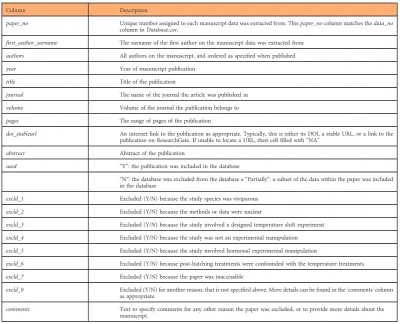
We searched for published literature (1974–2016) describing experiments that manipulated incubation temperature (i.e., pre-hatching developmental period only) in reptiles inWeb of Science(v5.13.2) using the following ‘title’ or ‘abstract’ search terms: temperature* AND incubat*, along with one of the following: reptil*, lizard*, squamat*, snake*, turtle*, chelon*, testudin*, crocodil*, alligator*, tuatara*, sphenodon*. In addition, we considered all citations in three major reviews of the topic13–15, and included any additional papers from these sources not identified in our searches. For data currently included in this database, the studies had the following attributes: 1) research on an oviparous reptile (Class Reptilia; excluding birds); 2) employ an experimental manipulation of incubation temperature of eggs; 3) present data on hatching success, incubation duration, or post-hatching phenotypes; 4) consist of eggs that did not receive exogenous hormone application and yolk removal; 6) there was not a substantial delay between oviposition and experimental incubation (e.g.,>48-hours). In some cases, papers could not be accessed and/or were in languages that were non-translatable. While we attempted to translate where possible, those that could not be were excluded from the database (approximately 8 studies). We included 684 publications from the primary scientific literature that were relevant based on the title of the paper. If exclusion of papers was not possible based on the title of the publication, we assigned a unique identification number to each publication and considered the abstract and full text for exclusion/inclusion criteria.‘Citations.csv’(Table 1; [Data Citation 1]) details the publications considered based on their full-text, and we provide reasons for their exclusion (if excluded) along with full reference information.
Following exclusion / inclusion based on the criteria we had a dataset of 300 publications from which we extracted complete or partial data. From each publication, we extracted data into‘Database.csv’ as
Column Description
paper_no Unique number assigned to each manuscript data was extracted from. Thispaper_nocolumn matches thedata_no
column in Database.csv.
first_author_surname The surname of thefirst author on the manuscript data was extracted from
authors All authors on the manuscript, and ordered as specified when published
year Year of manuscript publication
title Title of the publication
journal The name of the journal the article was published in
volume Volume of the journal the publication belongs to
pages The range of pages of the publication
doi_stableurl An internet link to the publication as appropriate. Typically, this is either its DOI, a stable URL, or a link to the publication on ResearchGate. If unable to locate a URL, then cellfilled with“NA”
abstract Abstract of the publication
used “Y”: the publication was included in the database
“N”: the database was excluded from the database a“Partially”: a subset of the data within the paper was included in the database
excld_1 Excluded (Y/N) because the study species was viviparous
excld_2 Excluded (Y/N) because the methods or data were unclear
excld_3 Excluded (Y/N) because the study involved a designed temperature shift experiment
excld_4 Excluded (Y/N) because the study was not an experimental manipulation
excld_5 Excluded (Y/N) because the study involved hormonal experimental manipulation
excld_6 Excluded (Y/N) because post-hatching treatments were confounded with the temperature treatments
excld_7 Excluded (Y/N) because the paper was inaccessible
excld_8 Excluded (Y/N) for another reason, that is not specified above. More details can be found in the 'comments' column as appropriate.
[image:3.595.155.556.47.371.2]comments Text to specify comments for any other reason the paper was excluded, or to provide more details about the manuscript.
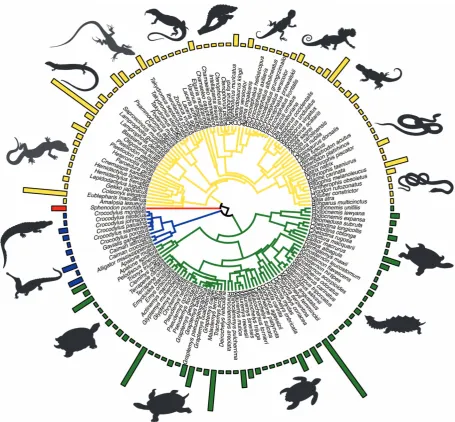
N=10 species). Traits classified under the category morphology were the most-commonly collected data (Fig. 2).
These methods, as well as further exclusion criteria, were used for and described in a meta-analysis of a subset of the data1.
Code Availability
Code for technical validation (see below) can be found on the Zenodo archived repository [Data Citation 1].
Data Records
Data Record 1
RepDevo is hosted by GitHub (https://github.com/RepDevo/ReptileDevelopmentDatabase) and provided a unique, stable DOI on Zenodo [Data Citation 1]. This zip file contains csv files of the: 1) citation information, 2) extracted data and 3) metadata.
Technical Validation
We have implemented a number of tests that check the database prior to new releases and major updates by using thetestthat23package in R. The tests check the database for structural integrity (i.e., its internal organization), variable consistency (i.e., correct naming rules) as well as data integrity checks (i.e., outliers, correct data types). Additionally, sub-samples of the data have been thoroughly checked by multiple collectors prior to the release of v1.0.0. The online database can also easily be expanded and corrected if errors are identified. Data will be updated annually with new studies and any errors identified corrected.
Usage Notes
[image:5.595.133.556.48.316.2]downloaded from the webpage (www.repdevo.com). However, minimally the specific version should be specified when the data are used to ensure reproducibility of any resulting analyses.
We have been fairly inclusive in our database and many studies report or manipulate a multitude of factors at once, including moisture conditions, oxygen concentrations or measure phenotypes at different ages, temperatures or post-incubation treatments. Our database contains all these data, and so, any future work should take care to extract relevant data based on the question of interest. We have been careful to indicate the population, species, moisture conditions and any post hatching manipulations (e.g., temperature) or measurements (e.g., age) that data are derived from. Some studies confound incubation treatment with year and we have tried to be careful in identifying the specific year in which the experimental manipulation took place to ensure that comparisons of temperatures across different years is not undertaken. In addition, experimental designs can vary substantially among studies (e.g., random allocation of eggs to treatment, split-clutch designs, etc.). This variation could influence results and care should be taken when calculating effect sizes and comparing results of studies with different designs. To account for this, we have also categorized experimental designs that can be considered by users.
References
1. Noble, D. W. A., Stenhouse, V. & Schwanz, L. E. Developmental temperatures and phenotypic plasticity in reptiles: a systematic review and meta-analysis.Biological Reviews, 93, 72–79. doi:10.1111/brv.12333 (2018).
2. Monaghan, P. Early growth conditions, phenotypic development and environmental change.Philosophical Transactions of the Royal Society of London B Biological Sciences363,1635–1645 (2008).
3. Schwarzkopf, L. & Andrews, R. M. Are moms manipulative or just selfish? Evaluating the "maternal manipulation hypothesis" and implications for life-history studies of reptiles.Herpetologica68,147–159 (2012).
4. Shine, R. A new hypothesis for the evolution of viviparity in reptiles.The American Naturalist145,809–823 (1995). 5. While, G. M., Uller, T. & Wapstra, E. Offspring performance and the adaptive benefits of prolonged pregnancy: experimental tests
in a viviparous lizard.Functional Ecology23,818–825 (2009).
6. Schwanz, L. E. & Janzen, F. J. Climate change and temperature-dependent sex determination: can plasticity in maternal nesting behavior prevent extreme sex ratios?Physiological and Biochemical Zoology81,826–834 (2008).
7. Du, W., Zheng, R. & Shu, L. The influence of incubation temperature on morphology, locomotor performance, and cold tolerance of hatchling Chinese Three- Keeled pond turtles,Chinemys reevesii.Chelonian Conservation and Biology5,
294–299 (2006).
8. Du, W.-G., Warner, D. A., Langkilde, T., Robbins, T. & Shine, R. The physiological basis of geographic variation in rates of embryonic development within a widespread lizard species.The American Naturalist176,522–528 (2010).
9. Warner, D. A., Moody, M. A., Telemeco, R. S. & Kolbe, J. J. Egg environments have large effects on embryonic development, but have minimal consequences for hatchling phenotypes in an invasive lizard.Biological Journal of the Linnean Society105,
25–41 (2012).
10. Warner, D. A. & Shine, R. Fitness of juvenile lizards depends on seasonal timing of hatching not offspring body size.Oecologia 154,65–73 (2007).
11. Warner, D. A. & Shine, R. Maternal nest-site choice in a lizard with temperature-dependent sex determination.Animal Behaviour 75,861–870 (2008).
12. Dell, A. I., Pawar, S. & Savage, V. M. The thermal dependence of biological traits.Ecology94,1205 (2013).
13. Birchard, G. F. inReptilian incubation: Environment, evolution and behaviour103–123 (Nottingham University Press, 2004). 14. Deeming, D. C. inReptilian incubation: Environment, evolution and behaviour229–252 (Nottingham University Press, 2004). 15. Deeming, D. C. & Ferguson, M. W. J inEgg incubation: Its effects on embryonic development in birds and reptiles
(eds Deeming, D. C. & Ferguson, M. W. J.) Ch. 10, 147–171 (Cambridge University Press, 1991).
16. Lindström, J. Early development andfitness in birds and mammals.Trends in Ecology & Evolution14,343–347 (1999). 17. O'Dea, R. E., Noble, D. W. A., Johnson, S. L., Hesselson, D. & Nakagawa, S. The role of non-genetic inheritance in evolutionary
rescue: epigenetic buffering, heritable bet hedging and epigenetic traps.Environmental Epigenetics2,1–12 (2016).
18. Chevin, L. M. & Hoffman, A. A. Evolution of phenotypic plasticity in extreme environments.Philosophical Transactions of the Royal Society of London B Biological Sciences372,20160138 (2017).
19. Lande, R. Evolution of phenotypic plasticty in colonizing species.Molecular Ecology24,2038–2045 (2015). 20. Tummers, B. DataThief software, version 3.0 http://datathief.org/ (2006).
21. Kumar, S., Stecher, G., Suleski, M. & Hedges, S. B. TimeTree: A Resource for Timelines, Timetrees, and Divergence Times.
Molecular Biology and Evolution34,1812–1819 (2017).
22. Uetz, P., Freed, P. & Hošek, J.The Reptile Databasehttp://www.reptile-database.org/ (2018). 23. Wickham, H.testhat:Get started with testing.The R Journal3,5–10 (2011).
Data Citation
1. Noble, D.et al. Zenodohttps://doi.org/10.5281/zenodo.1188482 (2018).
Acknowledgements
Author Contributions
Working group organisers: L.S. and D.W.A.N. All authors contributed to paper screening, literature searches, data collection and organisation, and updating the database. D.W.A.N. and J.R. wrote tests for technical validation of the database. D.W.A.N. and L.S. wrote the data descriptor and all authors contributed to its writing and editing.
Additional information
Table 2 is only available in the online version of this paper. Competing interests: The authors declare no competing interests.
How to cite this article: Noble, D. W. A. et al. A comprehensive database of thermal developmental plasticity in reptiles.Sci. Data5:180138 doi: 10.1038/sdata.2018.138 (2018).
Publisher’s note: Springer Nature remains neutral with regard to jurisdictional claims in published maps and institutional affiliations.
Open AccessThis article is licensed under a Creative Commons Attribution 4.0 Interna-tional License, which permits use, sharing, adaptation, distribution and reproduction in any medium or format, as long as you give appropriate credit to the original author(s) and the source, provide a link to the Creative Commons license, and indicate if changes were made. The images or other third party material in this article are included in the article’s Creative Commons license, unless indicated otherwise in a credit line to the material. If material is not included in the article’s Creative Commons license and your intended use is not permitted by statutory regulation or exceeds the permitted use, you will need to obtain permission directly from the copyright holder. To view a copy of this license, visit http://creativecommons. org/licenses/by/4.0/
The Creative Commons Public Domain Dedication waiver http://creativecommons.org/publicdomain/ zero/1.0/ applies to the metadatafiles made available in this article.