Aggregation of Incomplete Judgments
Zoi Terzopoulou( )and Ulle Endriss
Institute for Logic, Language and Computation University of Amsterdam
{z.terzopoulou,u.endriss}@uva.nl
Abstract. Suppose you need to determine the correct answer to a com-plex question that depends on two logically independent premises. You can ask several agents to each evaluate either just one of those premises (which they can do with relatively high accuracy) or both premises (in which case their need to multitask will lower their individual accuracy). We first determine the optimal rule to aggregate the individual judg-ments reported by the agents and then analyse their strategic incentives, depending on whether they are motivated by (i) the group tracking the truth, by (ii) maximising their own reputation, or by (iii) maximising the agreement of the group’s findings with their own private judgments. We also study the problem of deciding how many agents to ask for two judgments and how many to ask for just a single judgment.
1
Introduction
Paper 1 Paper 2
Professor 1 Yes − Professor 2 No Yes Professor 3 No Yes
Assuming that professor 1 has a higher probability to be correct than profes-sor 2 about the first paper, but also taking into account that profesprofes-sor 3 agrees with professor 2, what is the best way to aggregate the given judgments if the committee wants to be as accurate as possible on Alice’s evaluation? M Judgment aggregation [11, 12, 15] is a formal framework for group decision making concerned with the aggregation of individual judgments about several logically interconnected propositions into one collective judgment. Along the lines of Example 1, the propositions can be separated into the premises (e.g., excellency of Alice’s papers) and the conclusion (e.g., Alice’s hiring), where the conclusion is satisfied if and only if all premises are. Given two independent premisesϕandψand a group of agents, each of which answers specific questions regarding the premises, in this paper we consider two cases of practical interest: (i) Free assignment:Each agent chooses with some probability whether to report an opinion only on the first premise, only on the second premise, or on both. (ii) Fixed assignment:Each agent is asked (and required) to report an opinion
only on the first premise, only on the second premise, or on both.
Our main goal is to achieve an aggregate judgment on the conclusion that has— in expectation—high chances to reflect the truth. Notably, under the assumption that the agents are sincere about the judgments they obtain after contemplating their appointed premises, we find that the optimal aggregation rule is always a weighted majority rule assigning each agent a weight that depends on the size of her submitted judgment. We may think of this as ascoring rule [17].
But a further problem arises, namely that the agents may behave strategi-cally, trying to manipulate the collective outcome to satisfy their own prefer-ences. We examine the three most natural cases for the preferences of an agent in our context, i.e., preferences that prioritise outcomes that are close to (i) the truth, (ii) the agent’s reported judgment, or (iii) the agent’s sincere judgment. In addition, we study how an agent’s incentives to be insincere relate to the information the agent holds about the judgments reported by her peers.
Finally, knowing in which scenarios the agents are sincere, we ask (from a mechanism-design point of view): Which fixed assignment is the most efficient one, meaning that it achieves the highest probability of producing a correct collective judgment? Our answer here depends heavily on the number of agents in the group as well as on exactly how accurate the agents are individually.
all agents report opinions on all propositions under consideration. Under this assumption, Bovens and Rabinowicz [4] and de Clippel and Eliaz [6] compare two famous aggregation rules (for uniform and varying individual accuracies, re-spectively): thepremise-based rule (according to which the collective judgment on the conclusion follows from the majority’s judgments on the premises) and the conclusion-based rule (which simply considers the opinion of the majority on the conclusion), concluding that most of the time the premise-based rule is superior. Strengthening this result, Hartmann and coauthors [13, 14] show that the premise-based rule is optimal across wider classes of aggregation rules too. Generalising the model further, Bozbay et al. [5] study scenarios with any num-ber of premises and agents with incentives to manipulate the collective outcome, and design rules that are optimal truth-trackers, but again assuming complete reported judgments. Also focusing on strategic agents, Ahn and Oliveros [2] won-der “should two issues be decided jointly by a single committee or separately by different committees?” This question differs essentially from the one addressed in our work, since our model accounts for the lower accuracy of the agents who judge a greater number of issues.
This paper proceeds as follows. In Sect. 2 we present our basic model. In Sect. 3 we provide our central result about the optimal aggregation rule for truth-tracking with incomplete judgments and in Sect. 4 we conduct a game-theoretical analysis of our model. We then engage with finding the optimal fixed assignment for sincere agents in Sect. 5, and we conclude in Sect. 6.
2
The Model
Let ϕ and ψ be two logically independent premises and c = (ϕ∧ψ) be the corresponding conclusion, and assume that all three propositions are associated with a correct answer “yes” or “no”, where a positive answer on the conclusion is equivalent to a positive answer on both premises. Each agentiin a groupN =
{1, . . . , n} withn>2 holds asincere judgmentJi∗ ⊆ {ϕ, ϕ, ψ, ψ} that contains at most one formula from each pair of a premise and its negation: ϕ ∈ Ji∗
(ϕ ∈ Ji∗) means that agenti judges ϕ as true (false). Clearly, agent i cannot judge the conclusion without having judged both premises, but her judgment on the conclusion would follow directly from her judgment on the two premises in case she had one. We denote byJ the set of all admissible individual judgments. We say that two judgmentsJ, J0agreeon their evaluation of a proposition if they both contain either the non-negated or the negated version of that proposition. Anaggregation rule F is a function that maps every reported profile J = (J1, . . . , Jn)∈ Jnof individual judgments to a set of collective judgmentsF(J).
F is resolute if|F(J)|= 1 for every profileJ. A collective outcomeJ ∈F(J) is a logically consistent setJ ⊆ {ϕ, ϕ, ψ, ψ, c, c}that contains exactly one formula from each pair of a proposition and its negation (namely, it iscomplete). We write
We defineN1ϕ (N2ϕ) to be the sets of agents who report a judgment on one (two) premise(s) and say “yes” (and analogously for “no”) onϕ. We also define
nϕ1 =|N1ϕ|andnϕ2 =|N2ϕ|to be the relevant cardinalities of these sets.
We denote bypthe probability that agent i’s judgment Ji∗ is correct on a premise wheni judges both premises and by q the relevant probability when i
only judges a single premise (assuming that the probability of each agent i’s judgment being correct on a premise ϕis independent (i) of whetherϕ is true or false and (ii) of what i’s judgment on premise ψ is). We assume that the probabilitiespandqare the same for all agents, but the agents make their judg-ments independently of each other. We shall moreover suppose that all agents’ judgments are more accurate than a random guess, but not perfect, and that agents judging a single premise are strictly more accurate than those judging both premises, i.e., that 1/2< p < q <1. Then,P(J∗) denotes the probability of the sincere profile J∗to arise and P(J∗−i|J∗
i) the probability that the judg-ments of all agents besidesiform the sincere (partial) profileJ∗−i, given thati
has the sincere judgmentJi∗. Formally, for a fixed assignment:
P(J∗) =P(ϕtrue)·P(J∗|ϕtrue) +P(ϕfalse)·P(J∗|ϕfalse) where P(J∗ | ϕtrue) = qnϕ1pnϕ2(1−q)nϕ1(1−p)nϕ2, and similarly for P(J∗ |
ϕfalse). Theaccuracy P(F) of a resolute aggregation ruleF is defined as:
P(F) = X
J∗∈Jns.t. F(J∗) andJNagree onc
P(J∗)
3
Optimal Aggregation
We now define the (irresolute) aggregation ruleFirropt, such that for all profilesJ:
Firropt(J) = argmax J complete consistent
X
i∈N
wi· |J∩Ji|
where wi= log1−qq if|Ji|= 1, wi = log1−pp if |Ji|= 2, andwi = 0 if|Ji|= 0. Observe that the base of the logarithm in the definition ofwi is irrelevant.
Firropt functions as a weighted-majority rule on each premise separately, as-signing to the agents weights according to the size of their reported judgments, and subsequently picks that evaluation of the conclusion that is consistent with the collective evaluation of the premises [17]. Then, Fopt is a resolute version
ofFirropt that, if the obtained collective judgments are more than one, randomly chooses one of them for the collective outcome.
For a resolute aggregation ruleF, the probabilityP(F) depends on the prob-abilitiesP(F correct onϕ) andP(F correct onψ), which, for simplicity, we call
P(F) = 1 4
PϕPψ+ PϕPψ+ (1−Pϕ)(1−Pψ) +Pϕ(1−Pψ)+ PϕPψ+ (1−Pϕ)(1−Pψ) + (1−Pϕ)Pψ+ PϕPψ+Pϕ(1−Pψ) + (1−Pϕ)Pψ = 1
2+
PϕPψ
2 (1)
Given a (fixed or free) assignment, let us denote byJϕF (JϕF) andJψF (JψF) the sets of all possible profiles of reported judgments that lead to a “yes” (“no”) collective answer onϕandψunder the ruleF, respectively. Then:
Pϕ= 1 2
X
J∗∈Jϕ F
P(J∗|ϕtrue) +1 2
X
J∗∈Jϕ F
P(J∗|ϕfalse) (2)
Now, for a fixed assignment and a profileJ∗, we have that:
P(J∗|ϕtrue)> P(J∗|ϕfalse) ⇔ qnϕ1pn
ϕ
2(1−q)n ϕ
1(1−p)n ϕ
2 >(1−q)n ϕ
1(1−p)n ϕ 2qn
ϕ 1pn
ϕ 2 ⇔
nϕ1log q 1−q+n
ϕ 2log
p
1−p > n
ϕ 1log
q
1−q+n
ϕ 2log
p
1−p
(3)
Analogously, we consider a free assignment where agentimakes a sincere judg-ment on premiseϕwith probability pϕi, on premiseψ with probabilitypψi, and on both premises with probabilitypϕ,ψi . Given a sincere profileJ∗:
P(J∗|ϕtrue) = X i∈N1ϕ∪N(1,ϕ)
X
j∈N2ϕ∪N(2,ϕ)
pϕipϕ,ψj qnϕ1pn ϕ
2(1−q)n ϕ
1(1−p)n ϕ 2
DefiningP(J∗|ϕfalse) similarly, we have as in as in Equation 3:
P(J∗|ϕtrue)> P(J∗|ϕfalse) ⇔ nϕ1log q
1−q+n
ϕ 2log
p
1−p > n
ϕ 1log
q
1−q+n
ϕ 2log
p
1−p
(4)
Theorem 1 states the main results of this section. The proof technique we use is a standard method in research onmaximum likelihood estimators [9].
Theorem 1. For any fixed (or free) assignment and sincere judgments, Fopt∈
argmaxFP(F). For every other aggregation rule F0 ∈ argmaxFP(F), F0 only differs fromFopt on the tie-breaking part.
Proof. For a fixed assignment, it follows from Equations 2 and 3 that Pϕ (and
Pψ) will be maximal if and only ifF assigns to the agents weights as in Fopt. Equation 1 implies that maxFP(F)6 12+
maxFPϕmaxFPψ
2 , soP(F) is maximal if and only ifFopt(or a rule that only differs fromFopton the tie-breaking part)
4
Strategic Behaviour
In this section we study the incentives of the agents to report insincere judgments when the most accurate ruleFopt is used. We examine in detail both fixed and
free assignments. An agent’s incentives to be insincere will of course depend on the type of her preferences. We analyse three natural and disjoint cases regarding these preferences, assuming that all agents have the same preference type: First, the agents may want the group to reach a correct judgment—these preferences are called truth-oriented. Second, the agents may want to report an opinion that is close to the collective judgment, no matter what that judgment is— these preferences are calledreputation-oriented. Third, the agents may want the group’s judgment to agree with their own sincere judgment—these preferences are calledself-oriented.1
To make things formal, we employ tools from Bayesian game theory. We wish to understand when sincerity by all agents is an equilibrium:
Given that agentiholds the sincere judgmentJi∗, and given that the rest of the agents are going to be sincere no matter what judgments they have, is sincerity (i.e., reportingJi∗) a best response of agenti?
We examine the interim and the ex-post case. In both cases agent i already knows her own sincere judgment, but in the former case she is ignorant about the judgments of the rest of the group (only knowing that they have to be probabilistically compatible with her own judgment), while in the latter case she is in addition fully informed about them (this can happen, for example, after some communication action has taken place).
CallT ∈ {“truth”, “reputation”, “self”}the type of the agents’ preferences. Let us denote by UT
i (Ji,J∗−i),J ∗
the utility that agent i gets by reporting judgmentJi, when the sincere profile of the group isJ∗and all other agentsj6=i report their sincere judgmentsJj∗. EUT
i (Ji,J∗−i), Ji∗
stands for the expected utility that agent i gets by reporting judgment Ji, when her sincere judgment isJi∗and all other agentsj report their sincere judgments for any possible such judgments. More precisely, we have that:
Uitruth (Ji,J∗−i),J ∗
=|Fopt(Ji,J∗−i)∩JN|
Uireputation (Ji,J∗−i),J ∗
= |Fopt(Ji,J∗−i)∩Ji|
Uiself (Ji,J∗−i),J ∗
=|Fopt(Ji,J∗−i)∩Ji∗|
Also, for anyT ∈ {“truth”, “reputation”, “self”}:
1For instance, doctors making judgments about their patients may simply care
EUiT (Ji,J∗−i), J ∗ i
=X
J∗ −i
UiT (Ji,J∗−i),J ∗
P(J∗−i|Ji∗)
We proceed with formally defining strategyproofness in our framework, namely the situation where all agents being sincere forms an equilibrium. Given a pref-erence typeT ∈ {“truth”, “reputation”, “self”}and a (fixed or free) assignment, we say thatsincerity always gives rise to an interim equilibrium if and only if
Ji∗∈argmaxJi∈AiEUT
i (Ji,J∗−i), Ji∗
for all agentsiand sincere judgmentsJi∗, where Ai ⊆ J is the set of all judgments that agenti is can potentially report under the given assignment. Similarly, sincerity always gives rise to an ex-post equilibrium if and only if the above holds, whereEUT
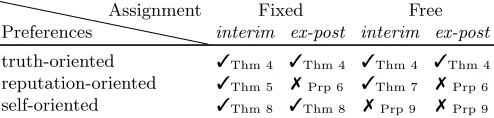
i is replaced byUiT. Table 4 summarises our results, where “3” stands for strategyproofness and “7” designates the existence of a counterexample.
Preferences
Assignment Fixed Free
interim ex-post interim ex-post
truth-oriented 3Thm 4 3Thm 4 3Thm 4 3Thm 4
reputation-oriented 3Thm 5 7Prp 6 3Thm 7 7Prp 6
[image:7.612.183.430.287.346.2]self-oriented 3Thm 8 3Thm 8 7Prp 9 7Prp 9
Table 1.Strategyproofness results.
Two fundamental lemmas are in order (the proofs are easy and thus omitted). First, we verify the basic intuition that when an agent holds more information about the reported judgments of the rest of the group, then her incentives to ma-nipulate increase. Second, we stress that whenever we can find a counterexample ofex-post strategyproofness under fixed assignments, the same counterexample works for free assignments too.2
Lemma 2. For any assignment and type of preferences, ex-post strategyproof-ness implies interim strategyproofstrategyproof-ness.
Lemma 3. For any type of preferences, ex-post strategyproofness under free as-signments implies ex-post strategyproofness under fixed asas-signments.
4.1 Truth-oriented Preferences
When all agents have truth-oriented preferences and when the ruleFoptis used
to aggregate their reported judgments, it directly is in everyone’s best interest to be sincere—given that the rest of the group is sincere as well—irrespective of whether the assignment materialised is fixed or free and whether the agents know the judgments of their peers. Intuitively, the agents can trust that the ruleFoptwill achieve a collective judgment that is as accurate as possible.
2The other direction does not hold. Importantly, a counterexample may go through
Theorem 4. For any fixed (or free) assignment and truth-oriented preferences:
(i) sincerity always gives rise to an interim equilibrium
(ii) sincerity always gives rise to an ex-post equilibrium
Proof. By Lemma 2, we only need to prove case (ii). For an arbitrary sincere profileJ∗= (Ji∗,J∗−i), we have thatUitruth (Ji,J∗−i),J∗
=|Fopt(Ji,J∗−i)∩JN|, whereJN captures the true evaluation of the propositions. Now suppose, aiming for a contradiction, that there is an insinsere judgmentJi of agent isuch that
|Fopt(J
i,J∗−i)∩JN| > |Fopt(Ji∗,J ∗
−i)∩JN|. This means that Fopt(Ji,J∗−i) 6=
Fopt(J∗ i,J
∗
−i). Then, for a suitable aggregation rule F0 6= Fopt, we can write
Fopt(J
i,J∗−i) =F0(Ji∗,J ∗
−i) and derive that|F(Ji∗,J ∗
−i)∩JN|>|Fopt(Ji∗,J ∗ −i)∩
JN|. But this is impossible, because according to Theorem 1Fopthas to maximise
aggrement withJN. Hence, it holds that|Fopt(J
i,J∗−i)∩JN|6|Fopt(Ji∗,J ∗ −i)∩
JN| for all Ji, which implies that Utruth
i (Ji,J∗−i),J ∗
6Utruth
i (Ji∗,J ∗ −i),J
∗
for allJi and concludes the proof.
4.2 Reputation-oriented Preferences
When the agents care about the positive reputation they obtain by agreeing with the collective judgment of the group, their incentives to behave insincerely heavily depend on whether they already know the judgments of their peers. Of course: if an agent knows precisely what the collective judgment of the group will be, she can simply change her reported judgment to fully match that collective judgment. On the other hand, we will see that if an agent does not know exactly what the sincere judgments of her peers are, it is more attractive for her to remain sincere (as—knowing that her sincere judgment is more accurate than random—she can reasonably expect the group to agree with her).
Theorem 5. For any fixed assignment and reputation-oriented preferences, sin-cerity always gives rise to an interim equilibrium.
Proof.Given a fixed assignment, an agenti, and a sincere judgmentJi∗, let us call
Pdis the probability that agenti will disagree with the group on the evaluation
of premiseϕ. Let us assume that agent i’s judgmentJi∗concerns both premises
ϕ and ψ (the proof is analogous when Ji∗ concerns only premise ϕ). Now, let us denote by Pg the probability that the group is collectively correct on their evaluation ofϕ. Recalling thatp >1/2 is the probability that agentiis correct on her evaluation of ϕ, it holds that:
Pdis 6p(1−Pg) + (1−p)Pg=p+Pg(1−2p) Now, we have that p+Pg(1−2p) 6 1/2 if and only if Pg >
p−1/2
2p−1 = 1/2, which holds since all members of the group are more accurate than random. So, Pdis 6 1/2, which means that it is more probable for the group’s
holds for premise ψ as well. Therefore, agent i has no better option than to report her sincere judgment on the premises that are assigned to her. Formally,
EUireputation (Ji,J∗−i), Ji∗
is maximised when Ji=Ji∗.
Proposition 6. For reputation-oriented preferences, there exists a fixed (and thus a free, from Lemma 3) assignment where sincerity does not always give rise to an ex-post equilibrium.
Proof.Consider a fixed assignment where all agents in the group are asked about both premisesϕ andψ, agenti has the sincere judgmentJi∗={ϕ, ψ}, and all other agentsj have sincere judgmentsJj ={ϕ, ψ}. Agentiwould increase her utility by reporting the insincere judgmentJi={ϕ, ψ}.
Theorem 7. For any free assignment and reputation-oriented preferences, sin-cerity always gives rise to an interim equilibrium.
Proof. Consider an arbitrary free assignment and an agent iwith sincere judg-mentJi∗. Since the given assignment is uncertain, agentican potentially report any judgment set she wants, that is, Ai = J. Suppose that her sincere judg-mentJi∗has size|Ji∗|=k∈ {1,2}. First, following the same argument as that in the proof of Theorem 5, we see that agenticannot increase her expected utility by reporting a judgmentJi6=Ji∗with|Ji|=k. We omit the formal details, but the intuition is clear: the group has higher probability to agree with the sincere evaluation of agention each premise than to disagree with it.
However, we also need to show that agent i cannot increase her expected utility by reporting a judgmentJi 6=Ji∗with|Ji| 6=k. The case where|Ji|> kis straightforward: if agentihas no information about one of the premises, the best she could do is reporting a random judgment on that premise, but this would not increase her expected utility. Thus, we need to consider the case where|Ji|< k, and more specifically the only interesting scenario with |Ji∗| = 2 and |Ji| = 1. Say, without loss of generality, that Ji = {ϕ}. Let us call P
ϕ ag,2 (P
ψ ag,2) the probability that the group will agree with agent i on her evaluation of ϕ (ψ) given that agentireports her sincere judgment on both premises, and let us call
Pag,1ϕ the probability that the group will agree with agention her evaluation of
ϕgiven that she reports her a judgment only on premiseϕ. We have that:
EUireputation (Ji∗,J∗−i), Ji∗
=Pag,2ϕ +Pag,2ψ and
EUireputation (Ji,J∗−i), Ji∗
=Pag,1ϕ
Analogously to the proof of Theorem 5, it holds thatPag,2ϕ >1/2 and Pag,2ψ >
1/2, soPag,2ϕ +Pag,2ψ >1. This means thatPag,1ϕ 6Pag,2ϕ +Pag,2ψ (becausePag,1ϕ 61 is a probability value), so, it is the case that EUireputation (Ji,J∗−i), Ji∗
6
EUireputation (Ji∗,J∗−i), Ji∗
. We conclude that agent i cannot increase her
4.3 Self-oriented Preferences
Suppose the agents would like the collective outcome to agree with their own sincere judgment. Now, having a fixed or a free assignment radically changes their strategic considerations: under fixed assignments the agents can never in-crease their utility by lying, while there are free assignments where insincere behaviour is profitable. The critical difference is that when the agents are free to submit judgments of variable size, they can increase the weight that the optimal aggregation rule Fopt will assign to their judgment on one of the two premises
by avoiding to report a judgment on the other premise, thus having more op-portunities to manipulate the outcome in favour of their private judgment. Theorem 8. For any fixed assignment and self-oriented preferences:
(i) sincerity always gives rise to an interim equilibrium
(ii) sincerity always gives rise to an ex-post equilibrium
Proof. By Lemma 2, we only need to show case (ii). Given a fixed assignment, an agent can only report an insincere opinion by flipping her sincere judgment on some of the premises she is asked about. But if she did so, Fopt could only favour a judgment different from her own, not increasing her utility. Thus, every
agent always maximises her utility by being sincere.
Proposition 9. For self-oriented preferences, there exists a free assignment such that sincerity does not always give rise to an interim (and thus also not to an ex-post, from Lemma 2) equilibrium.
Proof.Consider a group of three agents and a free assignment as follows: Agent 1 reports an opinion on both premises ϕ, ψ with probability 1/2, and only on premise ϕ or only on premise ψ with probability 1/4 and 1/4, respectively. Agent 2 reports a judgment on both premisesϕ, ψwith probability 1, and agent 3 reports a judgment only on premiseϕwith probability 1. Suppose that agent 1’s truthful judgment is J∗
1 ={ϕ, ψ}. Suppose additionally thatq > p2 p2+(1−p)2. In such a case, if agent 1 decides to report her sincere judgment on both premises, she will always be unable to affect the collective outcome onϕaccording to the ruleFopt, and she will obtain an outcome that agrees with her sincere judgment
onψ with probability p(p+1−2p) + (1−p)(1−p+p2) =p2+p+ 1<1. How-ever, if agent 1 reports the insincere judgmentJ1={ψ}instead, she will always obtain a collective outcome onψthat is identical to her own sincere judgment, corresponding to a higher expected utility of value 1. Thus, we can conclude that
J1∗∈/argmaxJ1∈A1EU self
1 (J1, J2∗, J3∗), J1∗
.
5
Optimal Fixed Assignment
the correct answer on the conclusion with different probability. In this section we are interested in finding the optimal (viz., the most accurate) such assignment. Let us denote by n1 6 bn2c the number of agents that will be asked to report a judgment only on premise ϕ. For symmetry reasons, we assume that the same number of agents will be asked to report a judgment only on premiseψ, and the remaining n−2n1 agents will be asked to report a judgment on both premises. Givenn1, Pϕ,n1(Fopt) is the probability of the aggregation ruleFopt producing a correct evaluation of premiseϕ, and since we assume that the same number of agents that will judge ϕ will also judge ψ, it will be the case that
Pϕ,n1(Fopt) = Pψ,n1(Fopt). As in Sect. 3, the accuracy of Fopt regarding the conclusion isPn1(F
opt) = 1 2+
Pϕ,n1(F
opt)P
ψ,n1(F
opt)
2 =
1 2+
Pϕ,n1(F
opt)2
2 . Thus, we will maximisePn1(F
opt) if and only if we maximiseP
ϕ,n1(F
opt):
argmax 06n16bn 2c
Pn1(Fopt) = argmax 06n16bn 2c
Pϕ,n1(Fopt)
The optimal assignment depends on the specific number of agentsn, but also on the valuespandq of the individual accuracy. For small groups of at most four agents, we calculate exactly what the optimal assignment is for anypandq; for larger groups, we provide results for several indicative values ofpandq. Proposition 10. For n= 2,argmaxn
1Pϕ,n1(F
opt) = 1. Thus, when there are
just two agents, it is optimal to ask each of them to evaluate one of the two premises (n1= 1) rather than asking both to evaluate both premises (n1= 0).
Proof.Forn= 2 we have two options:n1= 0 orn1= 1. We consider them sep-arately. It is the case thatPϕ,0(Fopt) =p2+122p(1−p) =p, whilePϕ,1(Fopt) =
q > p. Thus, argmaxn
1Pϕ,n1(F
opt) = 1.
Proposition 11. For n = 3, argmaxn1Pϕ,n1(Fopt) = 1 if and only if q >
p2(3−2p).
Proof. For n = 3 we have two options: n1 = 0 or n1 = 1. We consider them separately. It is the case that Pϕ,0(Fopt) = p3+ 32
p2(1−p) = p2(3−2p), while Pϕ,1(Fopt) =q (because the judgment of the agent who reports only on premise ϕ will always prevail over the judgment of the agent who reports on both premises). Thus, argmaxn
1Pϕ,n1(F
opt) = 1 if and only ifq
>p2(3−2p).
Thus, if agents who evaluate both premises are correct 60% of the time, then in case there are three agents, you should ask two of them to focus on a single premise each if and only if their accuracy for doing so is at least 64.8%. Proposition 12. For n = 4, argmaxn1Pϕ,n1(F
opt) = 1if q < p2
(1−p)2+p2 and argmaxn1Pϕ,n1(F
Proof.We provide a sketch. We have three options:n1= 0,n1= 1, orn1= 2.
Pϕ,0(Fopt) =p4+
4 3
p3(1−p) +1 2
4 2
p2(1−p)2=p2(3−2p)
Pϕ,1(Fopt) =
q(p2+ 2p(1−p) +(1−2p)2) + (1−q)p22 ifq=(1−p)p22+p2
q ifq > (1−p)p22+p2
q(p2+ 2p(1−p)) + (1−q)p2 ifq < p2 (1−p)2+p2
Pϕ,2(Fopt) =q2+ 1
2q(1−q) =q
The claim now follows after some simple algebraic manipulations, by distinguish-ing cases regarddistinguish-ing the relation ofqto (1−p)p22+p2. Now, for an arbitrary number of agentsnand a number of agentsn1who judge only premiseϕ(and the same forψ), we have the following:
Pn1,ϕ(Fopt) = n−2n1
X
k=0
Xn1
`=0 s.t.`∈W
P(k, `, n, n1, p, q) + 1 2
n1
X
`=0 s.t.`∈T
P(k, `, n, n1, p, q)
– kcounts how many of the agents that judge both premises are right onϕ. – `counts how many of the agents that judge onlyϕare right onϕ.
– W ={`|`log1−qq +klog1−pp >(n1−`) log1−qq + (n−2n1−k) log1−pp}. – T ={`|`log1−qq +klog1−pp = (n1−`) log1−qq + (n−2n1−k) log1−pp}. – P(k, `, n, n1, p, q) = n−k2n1 n`1pk(1−p)n−2n1−kq`(1−q)n1−`.
For large groups withn>5 it is too complex to calculate the optimal assignment analytically in all cases. We instead look at some representative values ofpandq. For that purpose, we define a parameterαthat intuitively captures the agents’
multitasking ability, as follows:α= pq−−0.50.5. Clearly, 0< α <1, and the smallerα
is, the worse multitaskers the agents can be assumed to be.
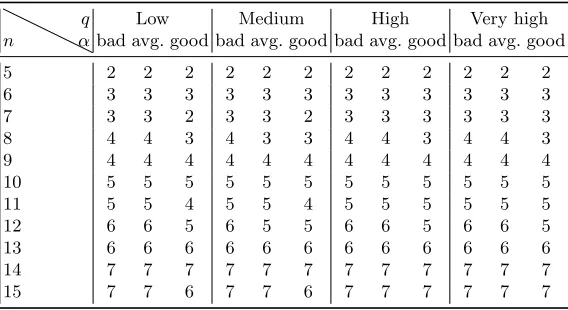
We consider three types for the agents’ multitasking ability:good, average, andbad, corresponding to values forαof 0.8, 0.5, and 0.2, respectively. In addi-tion, we consider four types for the agents’ accuracy on a single question: very high, high, medium, andlow, corresponding to values for q of 0.9, 0.8, 0.7, and 0.6, respectively. Table 2 demonstrates our findings regarding the optimal assign-ment in terms of the numbern1 for these characteristic cases, for groups with at most 15 members.3,4 In general, we can observe that the better multitaskers the agents are, the lower the numbern1that corresponds to the best assignment is. This verifies an elementary intuition suggesting that if the agents are good at multitasking, then it is profitable to ask many of them about both premises, while if the agents are bad at multitasking, it is more beneficial to ask them about a single premise each.
3For any assignment, collective accuracy converges to 1 as the size of the group
grows larger. Thus, our analysis is most interesting for groups that are not very large.
4
n
q α
Low Medium High Very high
bad avg. good bad avg. good bad avg. good bad avg. good
5 2 2 2 2 2 2 2 2 2 2 2 2
6 3 3 3 3 3 3 3 3 3 3 3 3
7 3 3 2 3 3 2 3 3 3 3 3 3
8 4 4 3 4 3 3 4 4 3 4 4 3
9 4 4 4 4 4 4 4 4 4 4 4 4
10 5 5 5 5 5 5 5 5 5 5 5 5
11 5 5 4 5 5 4 5 5 5 5 5 5
12 6 6 5 6 5 5 6 6 5 6 6 5
13 6 6 6 6 6 6 6 6 6 6 6 6
14 7 7 7 7 7 7 7 7 7 7 7 7
[image:13.612.164.448.115.270.2]15 7 7 6 7 7 6 7 7 7 7 7 7
Table 2.Optimal assignment in terms of the number of agents who should be asked about premiseϕonly, for different group size, individual accuracy, multitasking ability.
6
Conclusion
We have contributed to the literature on the truth-tracking of aggregation rules by considering scenarios where the agents may not all judge the same number of issues that need to be decided by the group. Assuming that multitasking is detrimental to the agents’ accuracy, we have found what the optimal method to aggregate the judgments of the agents is, and we have analysed the incentives for strategic behaviour that the agents may exhibit in this new context.
For this first study on the topic a few simplifying assumptions have been made. First, we have assumed that all agents have the same accuracy and that there are only two premises. Our analysis can be naturally extended beyond this case, considering different accuracies and more than two premises: the optimal aggregation rule would still be a weighted majority rule, agents with truth-oriented preferences would still always be sincere, while agents who care about their reputation or their individual opinion would still find reasons to lie—but careful further work is essential here in order to clarify all relevant details. Sec-ond, we have assumed that the exact values of the agents’ accuracies are known, but this is often not true in practice. Thus, to complement our theoretical work, our results could be combined with existing experimental research that measures the accuracy of individual agents on specific application domains, ranging from human-computer interaction [1] to crowdsourcing [7].
References
2. Ahn, D.S., Oliveros, S.: The Condorcet jur(ies) theorem. Journal of Economic Theory 150, 841–851 (2014)
3. Ariely, D., Zakay, D.: A timely account of the role of duration in decision making. Acta Psychologica108(2), 187–207 (2001)
4. Bovens, L., Rabinowicz, W.: Democratic answers to complex questions—an epis-temic perspective. Synthese150(1), 131–153 (2006)
5. Bozbay, I., Dietrich, F., Peters, H.: Judgment aggregation in search for the truth. Games and Economic Behavior87, 571–590 (2014)
6. de Clippel, G., Eliaz, K.: Premise-based versus outcome-based information aggre-gation. Games and Economic Behavior89, 34–42 (2015)
7. Cohensius, G., Porat, O.B., Meir, R., Amir, O.: Efficient crowdsourcing via proxy voting. In: Proceedings of the 7th International Workshop on Computational Social Choice (COMSOC-2018) (2018)
8. de Condorcet, M.: Essai sur l’application de l’analyse `a la probabilit´e des d´ecisions rendues `a la pluralit´e des voix. Imprimerie Royale (1785)
9. Dawid, A.P., Skene, A.M.: Maximum likelihood estimation of observer error-rates using the EM algorithm. Applied Statistics28(1), 20–28 (1979)
10. Edland, A., Svenson, O.: Judgment and decision making under time pressure. In: Time Pressure and Stress in Human Judgment and Decision Making, pp. 27–40. Springer (1993)
11. Endriss, U.: Judgment aggregation. In: Brandt, F., Conitzer, V., Endriss, U., Lang, J., Procaccia, A.D. (eds.) Handbook of Computational Social Choice, pp. 399–426. Cambridge University Press (2016)
12. Grossi, D., Pigozzi, G.: Judgment Aggregation: A Primer, Synthesis Lectures on Artificial Intelligence and Machine Learning, vol. 8. Morgan & Claypool Publishers (2014)
13. Hartmann, S., Pigozzi, G., Sprenger, J.: Reliable methods of judgement aggrega-tion. Journal of Logic and Computation20(2), 603–617 (2010)
14. Hartmann, S., Sprenger, J.: Judgment aggregation and the problem of tracking the truth. Synthese187(1), 209–221 (2012)
15. List, C., Pettit, P.: Aggregating sets of judgments: An impossibility result. Eco-nomics and Philosophy18(1), 89–110 (2002)
16. Payne, J.W., Bettman, J.R., Johnson, E.J.: Adaptive strategy selection in decision making. Journal of Experimental Psychology: Learning, Memory, and Cognition 14(3), 534 (1988)
17. Terzopoulou, Z., Endriss, U., de Haan, R.: Aggregating incomplete judgments: Ax-iomatisations for scoring rules. In: Proceedings of the 7th International Workshop on Computational Social Choice (COMSOC-2018) (2018)