The dimensionality of niche space allows bounded
and unbounded processes to jointly in
fl
uence
diversi
fi
cation
Matthew J. Larcombe
1
, Gregory J. Jordan
2
, David Bryant
3
& Steven I. Higgins
1,4
There are two prominent and competing hypotheses that disagree about the effect of
competition on diversi
fi
cation processes. The
fi
rst, the bounded hypothesis, suggests that
species diversity is limited (bounded) by competition between species for
fi
nite ecological
niche space. The second, the unbounded hypothesis, proposes that innovations associated
with evolution render competition unimportant over macroevolutionary timescales. Here we
use phylogenetically structured niche modelling to show that processes consistent with both
of these diversi
fi
cation models drive species accumulation in conifers. In agreement with the
bounded hypothesis, niche competition constrained diversi
fi
cation, and in line with the
unbounded hypothesis, niche evolution and partitioning promoted diversi
fi
cation. We then
analyse niche traits to show that these diversi
fi
cation enhancing and inhibiting processes can
occur simultaneously on different niche dimensions. Together these results suggest a new
hypothesis for lineage diversi
fi
cation based on the multi-dimensional nature of ecological
niches that can accommodate both bounded and unbounded evolutionary processes.
DOI: 10.1038/s41467-018-06732-x
OPEN
1Department of Botany, University of Otago, PO Box 56, Dunedin 9054, New Zealand.2Biological Sciences, University of Tasmania, Private Bag 55, Hobart,
Tasmania 7001, Australia.3Department of Mathematics and Statistics, University of Otago, PO Box 56, Dunedin 9054, New Zealand.4Plant Ecology, University of Bayreuth, Universitätstraße 30, 95447 Bayreuth, Germany. Correspondence and requests for materials should be addressed to
M.J.L. (email:[email protected]) or to S.I.H. (email:[email protected])
123456789
S
pecies diversity has increased dramatically over geological
time
1. Reconstructions using the fossil record are
ambig-uous about the causes of, and constraints on, this increase
2–4.
One important open question is whether the rate of species
accumulation slows as diversity increases, or is independent of
diversity
4–6. The unbounded hypothesis implies that time, and
the rate of evolution within clades (monophyletic branches of
phylogenies), control diversi
fi
cation and that there is essentially
no limit on total diversity
3. Alternatively, the bounded hypothesis
suggests that diversity-dependent processes limit species
rich-ness
7. This limit may be a true carrying capacity, or if extinction
is not zero, it is simply the equilibrium between speciation rate
and extinction rate
8. Several mechanisms may cause
diversity-dependent dynamics (see ref.
9for a review), and the most widely
recognised of these involves competition for limited ecological
niche space
7. Resolving this debate is essential for understanding
limits to biodiversity, and why diversity is unevenly distributed in
space and time and between clades.
Previous attempts to discriminate between bounded and
unbounded diversi
fi
cation have focused on modelling species
accumulation as inferred from phylogenies
10,11and fossil
assemblages
5,6,12, and to a lesser extent testing how ecological
niche evolution impacts diversi
fi
cation
13,14. The results to date
have been inconclusive and often contradictory
2–4,15,16,
indicat-ing that a more nuanced explanation may be required
4,16. Here
we quantify the extent to which both bounded and unbounded
processes in
fl
uence species accumulation in the conifers. Our
analysis exploits methodological advances that allow us to infer
multi-dimensional physiological niche properties for large suites
of species
17,18. We use these data to discriminate between the
distinctive niche characteristics predicted by the bounded and
unbounded hypotheses. Speci
fi
cally we test support for the
bounded hypothesis
’
prediction that diversi
fi
cation should slow as
niche overlap increases within clades
2,8and the unbounded
hypothesis
’
prediction that niche evolution accommodates
increasing diversity by allowing the partitioning or expansion of
niche space
3,19,20.
Conifers are an ecologically important, globally distributed
order of plants (Fig.
1
; Supplementary Fig. 1) that are ideal for
this analysis. This large, well-studied lineage has well-de
fi
ned
clades, excellent distribution data
21, and is ancient enough (>300
myo
22) to assess how species accumulate through time. We use
distribution data and a process-based species distribution model
(SDM) to infer physiological niche parameters for each of 455
living conifer species (75% of extant conifers). The niche
para-meters are combined with a robust fossil calibrated phylogeny
22,
and interpreted statistically using a range of traditional
approa-ches including correlation analysis and rate through time plots, as
well as an a priori conceptual model of how niche and
phylo-genetic parameters relate to species richness. This conceptual
model postulates that species richness can be impacted both
directly and/or indirectly by clade age, multivariate niche
evolu-tion rate, and two novel metrics: clade niche size and the clade
competition index. Clade niche size is the projected potential
niche size (number of geographic grid cells occupied by all species
in the clade) corrected for clade species number (see Methods).
The clade competition index is the product of niche overlap and
geographic overlap between species within clades. The parameters
of the conceptual model were estimated using phylogenetically
constrained Bayesian path analysis. We conduct the analysis at
two phylogenetic levels, using 10 large clades and 42 smaller
clades. Our analysis shows that bounded and unbounded
diver-si
fi
cation processes contribute more-or-less equally to diversi
fi
-cation in conifers, and indicates that niche dimensionality may be
the mechanism by which these opposing forces work together.
Results and discussion
Quantifying diversi
fi
cation processes
. We produced diversi
fi
-cation rate through time plots for the full phylogeny and each of
the 10 large clades (Supplementary Fig. 2). This showed a range of
patterns including increases, slowdowns, long periods of stasis
and multiple rate changes, which is consistent with both bounded
and
unbound
processes
in
fl
uencing
diversi
fi
cation
in
conifers
9,23,24. However, it has been shown that a number of
factors may confound patterns of diversi
fi
cation derived from
phylogenies in this way, and they are likely to be especially
problematic in old lineages with unobservable extinction
2,23,24.
Therefore given that conifers are an ancient lineage (>300 million
years old) that are believed to have been strongly in
fl
uenced by
Cenozoic extinctions
25, we pursued other forms of evidence to
identify diversi
fi
cation dynamics in this group.
To begin, we estimated the extent of correlations between
indices of diversi
fi
cation, species competition, species richness
and niche size. These analyses suggest that both bounded and
unbounded processes in
fl
uenced diversi
fi
cation (Fig.
2
). In line
with bounded diversi
fi
cation, the clade competition index was
negatively related to species richness, and, as predicted by the
unbounded hypothesis, niche evolution was positively correlated
with species richness (Fig.
2
). There was no clear relationship
between clade niche size and species richness, suggesting that
niche partitioning is an important diversi
fi
cation process (Fig.
2
).
That is, if speciation was largely occurring as a result of niche
expansion
—
where adaptation facilitates new species accessing
new ecological space
—
we would predict a positive relationship
between clade niche size and species richness because new species
expand the total clade niche size. Conversely, if speciation is
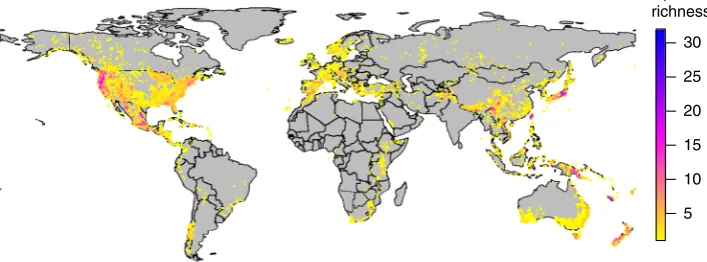
5 10 15 20 25 30 Species richness
Fig. 1Conifer species richness. Global species richness patterns in 455 conifer species based on cleaned empirical distribution data used here to analyse
[image:2.595.120.474.581.712.2]occurring via specialization and the division of existing clade
niche space (i.e., niche partitioning) we would predict no
relationship between clade niche size and species richness because
adding new species does not expand total clade niche size. The
correlations further suggested a negative relationship between the
niche evolution rate and clade competition index. Unfortunately,
these simple correlation analyses cannot elucidate the relative
effects nor the role of indirect effects of the factors on clade
species richness. For these reasons we performed a
phylogeneti-cally constrained path analysis.
The path analyses revealed that diversi
fi
cation in conifers was
in
fl
uenced in almost equal measure by bounded and unbounded
processes (Fig.
3
). In line with the bounded hypothesis,
competition with relatives (clade competition index) had a strong
negative effect on species richness, which suggests that available
niche space can limit species accumulation. This effect was strong
in both the 10 (
r
=
−
0.85) and 42 (
r
=
−
0.96) clade analyses.
Support for the unbounded hypothesis was evidenced by our
fi
nding that niche evolution rate contributed positively to species
richness, suggesting that higher niche evolution rates within
clades allow more species to accumulate. This effect was stronger
in the 10 clade analysis (
r
=
0.61) than in the 42 clade analysis (
r
=
0.35). Furthermore, we found that clade niche size had neutral
(42 clade analysis) or negative (10 clade analysis) in
fl
uence on
species richness, again suggesting that niche partitioning
constitutes the main mode of niche evolution in conifers. The
negative effect of clade niche size (10 clade analysis) is somewhat
counter-intuitive since it suggests that clades with smaller niche
volumes accommodate more species. However, this pattern is
consistent with niche partitioning accompanied by allee effects
and/or competition
8,26driving random extinction processes that
lead to a reduction in clade niche size as postulated in Fig.
4
. In
fact the signi
fi
cant direct effects of competition (
r
=
−
0.52) and
niche evolution (
r
=
−
0.19) on clade niche size, and relatively
strong negative effect of clade age (
r
=
−
0.21) on species richness
(Fig.
3
a), are consistent with such competition driven extinction
0.25 0.30 0.35 0.40 0.45 2.5
3.0 3.5 4.0 4.5
Clade competition index
Species richness
4 5 6 7 8 9 10 2.5
3.0 3.5 4.0 4.5
Niche evolution rate
Species richness
200 250 300 350 400 450 2.5
3.0 3.5 4.0 4.5
Niche size
Species richness
0.25 0.30 0.35 0.40 4
5 6 7 8
9
10
Clade competition index
Niche evolution rate
0.3 0.4 0.5 0.6 0.7 0.8 1.0
1.5 2.0 2.5 3.0 3.5
Clade competition index
Species richness
0.0 0.5 1.0 1.5 2.0 2.5 1.0
1.5 2.0 2.5 3.0 3.5
Niche evolution rate
Species richness
50 100 150 200 250 1.0
1.5 2.0 2.5 3.0 3.5
Niche size
Species richness
0.3 0.4 0.5 0.6 0.7 0.8 0.0
0.5 1.0 1.5 2.0 2.5
Clade competition index
Niche evolution rate
a
b
10 clade analysis
42 clade analysis
Fig. 2Associations between species richness and diversification metrics. Scatter plots between clade species richness and selected clade metrics for two
divisions of the conifer phylogeny intoa10 large clades andb42 smaller clades. Straight lines indicate significant linear effects detected using phylogenetic
generalized least squares (PGLS) regressions. The presence of multiple correlations made interpretation difficult; for this reason, we performed a path
analysis (Fig.3)
–0.19 (0.06)
–0.88 (0.21)
Niche evolution rate
0.61
–0.52 (0.06)
0.44 (0.18)
10 clade analysis (455 species)
42 clade analysis (429 species)
Parameters measuring bounded diversification
Parameters measuring unbounded diversification Clade niche
size
–0.88
Species richness
Clade age
–0.21
Clade competition
index
–0.85
–0.75 (0.22)
–0.99 (0.22)
–0.21 (0.16)
0.13 (0.08)
–0.03 (0.06)
Niche evolution rate
0.35
0.15 (0.07)
0.35 (0.08)
Clade niche size
–0.03
Species richness
Clade age
–0.06
Clade competition
index
–0.96
–0.54 (0.11)
–0.77 (0.07)
–0.06 (0.07)
–
– –
–
+
– –
+
+/– The direction of significant effects (solid arrows) –
a
b
Fig. 3Path analysis of variation in conifer species richness. Bayesian path
analysis showing the relative effects of niche and phylogenetic parameters
on clade species richness for 455 conifer species ina10 large clades andb
42 smaller clades. Total effect size is shown in bold, while direct effects and their standard deviation are shown along the vertices. Solid lines indicate
[image:3.595.53.541.58.299.2] [image:3.595.308.547.371.642.2]processes unfolding through time
8. The lack of evidence for this
causal pathway in the 42 clade analysis probably re
fl
ects the much
younger average clade age (17 my compared with 112 my), and
smaller clade sizes, which mean that partitioning and extinction
processes (Fig.
4
) will be less frequent and therefore more dif
fi
cult
to detect. This interpretation is consistent with previous work
suggesting extinction played a pivotal role in the diversi
fi
cation of
conifer clades in the Cenozoic, while younger clades are primarily
shaped by recent speciation
25.
We note that our clade competition index under-estimates
competition because it may not capture all potential competitive
interactions. Our measure quanti
fi
es expected competition
between members of a clade based on overlap in geographic
space and niche space (see Methods). It is an underestimate
because, although competition is likely to be most intense
between close relatives (i.e., members of the same clade),
competitive interactions with more distantly related species are
also likely and not captured by our metric
27–29. Incorporating
competition with distantly related species, although possible,
would require additional data and necessitate additional
assump-tions. It is also possible that our clade competition index fails to
detect some forms of competition that might constrain
diversi
fi
cation rates. For example, it is possible that competition
between ecologically similar species may prevent them from
becoming sympatric as has been reported in some bird
lineages
30,31. Such processes could limit range expansion and
potentially reduce diversi
fi
cation rates if range expansion
increases the likelihood of diversi
fi
cation
—
for example by
increasing the probability of allopatric speciation
9.
Although
much
previous
work
has
favoured
either
bounded
2,10,14,28or unbounded
3,32,33processes driving diversi
fi
-cation, our results are consistent with observational
12,19,
theoretical
16and modelling
4,12work, which suggests that both
bounded and unbounded processes in
fl
uence diversi
fi
cation. For
example, much of the empirical evidence is consistent with
diversi
fi
cation slowing, rather than reaching an asymptote
16,19.
This led Cornell
16to propose the
“
damped increase
”
hypothesis,
which in line with our results, suggests that competition induced
by niche
fi
lling reduces diversi
fi
cation rate, while specialisation or
new ecological opportunities counteract this effect
16. Others have
extended these ideas to show that the incongruity between strict
bounded and unbounded views could be overcome by allowing
diversity-accumulation-models to vary between periods of either
bounded or unbounded diversi
fi
cation
4. These studies do not,
however, provide a population/species level mechanism that
could drive shifts in diversi
fi
cation processes
4.
Niche dimensionality and diversi
fi
cation
. To address this
mechanistic basis, we examined whether niche dimensionality can
drive variation in diversi
fi
cation processes
4,34. We used a range of
statistical procedures to determine if variation exists in the
evolu-tionary
fl
exibility of niche traits at three levels: (1) across the
phy-logeny; (2) within clades; and (3) between clades. Across the full
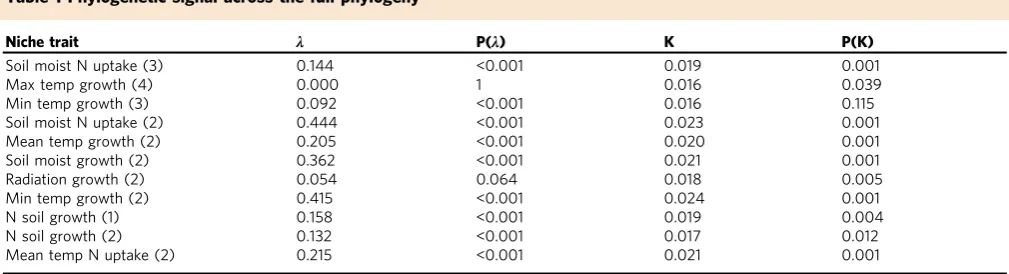
phylogeny we found variation in the level of conservatism
(phylo-genetic signal) between traits (with Pagel
’
s
λ
values ranging from
<0.01 to 0.42; Table
1
), suggesting variation in the evolutionary
fl
exibility of niche dimensions. This variation between traits was also
evident within clades, for example in Clade 7,
Pinus
(Table
2
). In
fact, mixed effects modelling show that signi
fi
cant variation exists in
evolutionary rate between traits after accounting for random
varia-tion between clades (
trait
:
F
10,90=
62.5,
P
=
<0.0001), suggesting
that trait evolution rates do, on average, vary within clades.
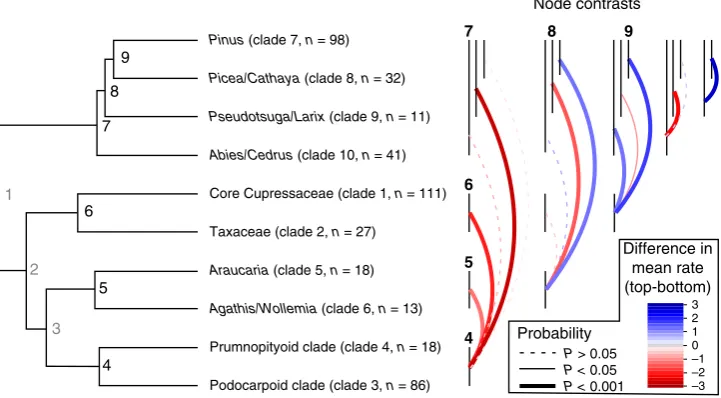
We also found that the evolution rate of traits varies between
clades, for example, Fig.
5
summarises how the evolution rate of
traits varies across the clade-level phylogeny after accounting for
non-independence associated with phylogenetic relationships
(using phylogenetic independent contrasts
35). This analysis
indicates that trait evolution rate varies signi
fi
cantly across the
terminal nodes of the clade-tree (node:
F
8,80=
6.4,
p
< 0.0001).
Diversification via niche partitioning
Clade niche size
Time 1
n = 2
Time 2
n = 5
Present
n = 4 Extinction gap
Allee effects and/or competition drive extinction
Clade niche size = time 1 Clade niche size < time 1
Fig. 4Extinction driven reduction in clade niche size. Example of how niche
partitioning combined with extinction associated with allee effects and/or competition, can result in a negative relationship between clade niche size
and species richness as found in Fig.3a. Different coloured curves
[image:4.595.47.290.304.482.2]represent species
Table 1 Phylogenetic signal across the full phylogeny
Niche trait λ P(λ) K P(K)
Soil moist N uptake (3) 0.144 <0.001 0.019 0.001
Max temp growth (4) 0.000 1 0.016 0.039
Min temp growth (3) 0.092 <0.001 0.016 0.115
Soil moist N uptake (2) 0.444 <0.001 0.023 0.001
Mean temp growth (2) 0.205 <0.001 0.020 0.001
Soil moist growth (2) 0.362 <0.001 0.021 0.001
Radiation growth (2) 0.054 0.064 0.018 0.005
Min temp growth (2) 0.415 <0.001 0.024 0.001
N soil growth (1) 0.158 <0.001 0.019 0.004
N soil growth (2) 0.132 <0.001 0.017 0.012
Mean temp N uptake (2) 0.215 <0.001 0.021 0.001
Phylogenetic signal in the 11 key niche traits based on a conifer phylogeny covering 455 species and estimated using Pagel’sλand Blomberg’s K. Thep-value (P) forλis estimated using the likelihood
ratio test. Thep-value for K is estimated from a randomization test based on 1000 simulations of the data. The numbers in parentheses indicate the position of the specific trait in the growth or resource
[image:4.595.45.550.565.702.2]Looking at the terminal nodes is interesting because it provides
inference regarding the descendent clades, and Fig.
5
shows that
high rates of trait evolution are often associated with increases in
diversity, and vice versa. For example, nodes that give rise to
relatively high diversity clades (e.g., nodes 4, 7 and 9; Fig.
5
) tend
to have have signi
fi
cantly higher trait evolution rates than nodes
that give rise to lower diversity clades (i.e., nodes 5 and 8; Fig.
5
).
The only exception to this pattern is node 6, which is parent to
the high diversity Clade 1 (
n
=
111), and has a relatively low trait
evolution rate (Fig.
5
). Interestingly, Clade 1 also has the lowest
clade competition index of any clade in our analysis, possibly
suggesting that in the absence of strong competition, diversi
fi
ca-tion has advanced without a parallel increase in trait evoluca-tionary
rates. Allopatric speciation in an ecologically specialised, and well
dispersed linage might explain this type of pattern. The most
diverse genus in Clade 1,
Juniperus
, is unusual among conifers in
its preference for relatively arid, warm climates and calcareous
soils, furthermore the evolution of
“
berry-like
”
fruits is thought
have driven extensive dispersal and allopatric speciation in the
genus
36. Together, the above results imply that trait evolutionary
rates vary within and between conifer clades, and in combination
with competitive interactions this variation can explain shifts in
clade-level diversity.
Such variation in the evolutionary
fl
exibility of traits and
competition between species within clades may accommodate the
operation of both bounded and unbounded processes. This can be
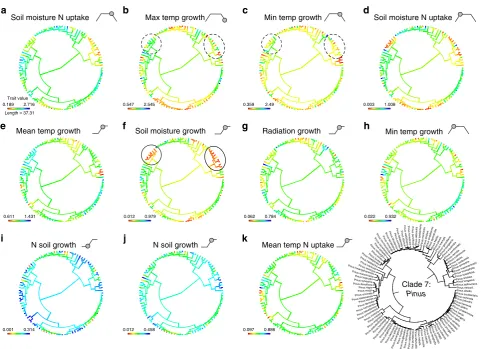
seen more clearly by focussing attention on single clades. For
example, in Clade 7 (
Pinus
, Fig.
6
), the effect of soil moisture on
growth (Fig.
6
f) is highly conserved in the sub-clades highlighted
with solid ellipses, suggesting that interspeci
fi
c competition is likely
to be high along this niche dimension in these sub-clades. However,
these same sub-clades are labile in terms of their temperature
requirements for growth (traits b and c, highlighted with dashed
ellipses in Fig.
6
b, c), indicating that evolution and specialisation are
possible along these niche dimensions (Fig.
6
). Analogous patterns
[image:5.595.49.550.71.198.2]can be seen in the other
Pinus
sub-clades (Fig.
6
) and the other
Table 2 Phylogenetic signal within Clade 7 (
Pinus
)
Niche trait λ P(λ) K P(K)
Soil moist N uptake (3) 0.569 0.003 0.080 0.005
Max temp growth (4) 0.000 1.000 0.076 0.011
Min temp growth (3) 0.000 1.000 0.058 0.286
Soil moist N uptake (2) 0.623 0.026 0.097 0.001
Mean temp growth (2) 0.167 0.051 0.092 0.001
Soil moist growth (2) 0.609 0.033 0.079 0.003
Radiation growth (2) 0.000 1.000 0.079 0.005
Min temp growth (2) 0.104 0.208 0.072 0.015
N soil growth (1) 0.000 1.000 0.067 0.076
N soil growth (2) 0.000 1.000 0.062 0.159
Mean temp N uptake (2) 0.004 0.894 0.077 0.004
Phylogenetic signal in the phylogeny of 111 species ofPinusfor 11 key niche traits, estimated using Pagel’sλand Blomberg’s K. Thep-value (P) forλis estimated using the likelihood ratio test. Thep-value
for K is estimated from a randomization test based on 1000 simulations of the data. The numbers in parentheses are as Table1
Podocarpoid clade (clade 3, n = 86) Prumnopityoid clade (clade 4, n = 18) Agathis/Wollemia (clade 6, n = 13) Araucaria (clade 5, n = 18) Taxaceae (clade 2, n = 27)
Core Cupressaceae (clade 1, n = 111) Abies/Cedrus (clade 10, n = 41) Pseudotsuga/Larix (clade 9, n = 11) Picea/Cathaya (clade 8, n = 32) Pinus (clade 7, n = 98)
Difference in mean rate (top-bottom)
2 1
–1 –2 0 3
–3
P > 0.05
P < 0.001 P < 0.05
Probability
4 5 6
9
8
7
1
2
3
4 5 6
7 8 9
Node contrasts
Fig. 5Phylogenetic independent contrasts of niche evolution rate. Left: clade-level conifer phylogeny showing terminal nodes (4–9) in bold black, internal
nodes (1–3) in grey (not consider in the contrasts). Taxonomic information about the groups, as well as their clade number and species richness (Clade #,
n=species richness) are given at the tips. Right: Contrasts between the terminal nodes. The vertical bars correspond to the terminal nodes (labelled once
in bold to match those on the tree), and the coloured arcs show the difference in mean niche evolution rate between the nodes (calculated by subtracting the mean of the top node from the mean of the bottom node). For example the red line joining nodes 5 and 4 indicates that the niche evolution rate at node
5 is 1.3 lower than node 4. Significance is indicated by line thickness and type. The pattern that emerges is that the nodes which give rise to clades with high
species richness (e.g., nodes 4 and 9) have significantly higher niche evolution rates than nodes giving rise to clades with low species richness (with the
[image:5.595.118.479.252.451.2]clades (Supplementary Fig. 3). Population level studies investigating
how individual traits respond under direct interspeci
fi
c competition
in actively diversifying linages are needed to help clarify how these
processes operate at the ecological level.
By considering the multi-dimensional nature of niche
evolu-tion, we have shown how bounded and unbounded diversi
fi
cation
processes may simultaneously control diversi
fi
cation rates. Niche
dimensionality has long been thought to promote diversity by
partitioning resources and facilitating coexistence
37, and there is
considerable empirical support for this hypothesis
34. Most
previous assessments of how niche characteristics impact
macro-diversi
fi
cation have used low dimensional proxies of the
niche such as body size
14or climatic range
13. In contrast, our
assessment of multiple, physiological niche traits, reveals that
both diversity-limiting competition, and diversity-promoting
evolution may operate concurrently. At the population level
these processes are likely to be separated in space and/or time
—
in
line with models by McPeek
38and Marshall and Quental
4,
respectively. For example, populations along environmental
gradients could experience variation in the opportunity for
specialisation or niche expansion along some niche dimensions
but experience competition along other niche dimensions
38.
Similarly, changes in the environment could induce temporal
variation in selection pressure that affects the interplay between
conservative and labile niche traits
4.
In summary, we have identi
fi
ed how processes that de
fi
ne the
niche geometry of conifer clades can jointly promote and
constrain diversi
fi
cation. Our results con
fi
rm that the contrasting
processes that underpin bounded and unbounded diversi
fi
cation
have both operated during the evolution of a major lineage. Our
study thereby provides an analysis framework for a new
multi-dimensional-niche hypothesis that uni
fi
es the bounded and
unbounded hypotheses
4,12,16,19.
Methods
Data acquisition and preparation. Geo-referenced collection data for all conifer
species were extracted from the Global Biodiversity Information Facility (www.gbif.
org). These data were supplemented by published species records not in GBIF
from39–44. Climate estimates were made for each point record, using Worldclim45.
Data was cleaned manually byfirstly eliminating duplicate records, then for
con-sistency with species distribution descriptions39, and then by comparing
World-clim estimates of altitude, with the altitudes provided with each site record. Where Worldclim altitudes were inconsistent with the altitude in species descriptions by more than 300 m, we replaced these records with estimates from nearby sites with altitudes consistent with the descriptions.
Estimating physiological niche traits. We estimated the physiological niche traits of the study species using a physiologically-based approach to species distribution
modelling17. This method uses the Thornley transport resistance (TTR) model of
plant growth46to estimate the niche traits that match the observed distribution of
species. The TTR model46, is an ordinary differential equation that models how
plant growth is influenced by carbon uptake, nitrogen uptake, and the allocation of
0.189 2.716
Trait value
0.547 2.545 0.359 2.49 0.003 1.008
0.611 1.431 0.012 0.979 0.062 0.784 0.022 0.932
0.001 0.314 0.012 0.458 0.097 0.886
Pinus nelsonii
Pinus balfouriana Pinus longaeva Pinus aristata Pinus quad
rifolia
Pinus monoph ylla
Pinus maximar tinezii
Pinus pinceana
Pinus r zedowskii Pinus edulis Pinus culminicola
Pinus remota Pinus cembroides Pinus squamata
Pinus b ungeana Pin us ger ardiana Pin us krempfii Pin us peuce Pin us fle xilis Pin us ayacahuite Pin us strobi formis Pin us stro bu s Pin us monticola Pin us lamber tiana sil u a ci bl a s u ni P ar ol fi vr a p s u ni P Pi n us k o ra iensis Pin us w a llichiana Pi n us sibir ica Pi n us dalatensis Pi nus pumila Pi nus bhutanica Pi
nus fenz
eliana Pi
nus ar mandii Pi nus mor risonicola Pin us canar iensis Pi nus pinaster Pinu
s rox burghii Pinus pinea Pinu
s brutia Pinus halepensis Pin
us heldreichii Pinus me
rkusii Pinus resinosa
Pinus hw angshanensis Pinus massoniana Pinus tropicalis Pinus sylvestris Pinus densiflora Pinus nigra Pinus mugo Pinus uncinata Pinus taiwanensis
Pinus kesiya
Pinus densata
Pinus luchuensis
Pinus tab
uliformis
Pinus yunnanensis Pinus conto rta Pinus clausa
Pinus virginiana Pinus pseudostro bus
Pinus ha rtwegii
Pinus montezumaePin us ar izonica Pin us engelmannii Pin us d
evoniana Pin us jeffr eyi Pin us du rangensis Pin us coulte ri Pin us douglasianaPin
us torre yana Pin us sabiniana a s or e d n o p s u ni P at a u n et t a s u ni PPin us radiata Pin us m u ricata Pi n us patula Pi nus teocote
Pi nus leiop
hylla Pi
nus lumholtzii Pi
nus greggii Pi
nus cubensis Pin us la wsonii Pi nus p ringlei Pinu s ooca rpa Pinu s car ibaea Pi nus serotina Pin us rigida Pin us pungens PinPinus prus taedaaeter
missa Pinus glab ra Pinus herre rae Pinus palust ris Pinus echinataPinus occidentalis
Pinus elliottii
Length = 37.31
Radiation growth Soil moisture growth
Mean temp growth
Soil moisture N uptake Max temp growth Min temp growth
N soil growth
Soil moisture N uptake
Min temp growth
N soil growth
Clade 7: Pinus Mean temp N uptake
a
b
c
d
e
f
g
h
i
j
k
Fig. 6Niche dimensionality inPinus. Phylogenies of Clade 7 (Pinus) showing ancestral state reconstructions of the 11 most important niche dimensions in
order of importance (a–k). The bottom right panel shows the same phylogeny with species names. Sub-clades withinPinuswith conservative (solid ellipse)
and labile (dashed ellipse) niche dimensions are highlighted and discussed in the text (see Results and Discussion). Thefilled circle on trapezoid and step
[image:6.595.57.541.46.395.2]carbon and nitrogen between roots and shoots. It explicitly separates the physio-logical processes of resource uptake from biomass growth. The implementation by
Higgins et al.17relates the uptake and growth processes to environmental forcing
variables. Specifically, the model considers how carbon uptake might be limited by temperature, soil moisture, solar radiation and shoot nitrogen; nitrogen uptake might be limited by temperature, soil moisture and soil nitrogen; and growth and
respiration loss might be influenced by temperature. The model runs on a monthly
time step, which allows it to explicitly consider how seasonalfluctuations in the
forcing variables interactively influence plant resource uptake and growth. Higgins
et al.17provides a full description of the model and its assumptions.
We use the cleaned presence dataset described above to identify locations where the species occur. A variety of methods for simulating absence points (often called pseudoabsence points) are available, but the method adopted is regarded as a
relatively small source of error47. Our method balances the number of presence and
absence points and stratifies the selection of absence points by environment type.
To define environment types we use a partitioning algorithmclara48to classify the
TTR environmental forcing variables into 25 environmental zones. We further restricted the selection of absence points to the zoological realm(s) where the species occurs and to distances >0.25 degrees from the presence points. This approach helps ensure that a representative range of environmental zones are included in the absence samples and that they are selected within a dispersal zone that is potentially reachable on an ecological time scale (i.e., the zoological realms). The model predicts the potential biomass of an individual plant as a function of
the environmental forcing variables at a site. Following the work of Higgins et al.17,
we assume thatpi, the probability of a species occurring at sitei, is described by the
complementary loglog of the modelled plant biomass at siteiand that the
likelihood of observing the presence–absence data (yi) at siteiis described by the
Bernoulli distribution. To estimate the parameters, we used the differential
evolution optimization algorithm49tofind the set of parameters that maximizes
this likelihood over all sites. The modelfits were evaluated by examining the
confusion matrix (a matrix comparing the number of true positives, true negative, false positives and false negatives), with particular weight given to the false negative rate, i.e., instances where the model predicts the species to be absent, but it is actually present (Supplementary Data 1).
Like most species distribution modelling techniques, our analysis predicts the potential niche of a species. In most situations biotic interactions and dispersal limitations will prevent species occupying the full extent of their potential niche. With this in mind we restrict projection of potential species ranges to the subset of
environmental zones (see above) present in each species’occurrence data; this
prevents predictions beyond the data domain used for estimating the model parameters. We calculated the niche size of species in two ways: (1) projecting species ranges for the world, and (2) using a resampled dataset that assumes that the worlds environmental zones are equally common. This second method corrects for any bias in projected range size introduced by variation in the extent of different environmental zones, but maintains the covariance structure of the
environmental data50. To create a dataset where each environmental zone is
equally common, we created a resampled dataset of the environmental data. We
again useclarato classify the global TTR input data into 50 environmental zones.
We then sampled afinite number (1000 in our case) of locations from each of 50
environmental zones, which produces an environmental dataset where each environment zone is equally represented. We projected the range sizes of species in this resampled environmental space. Analyses conducted using geographic locations and resampled locations yielded very similar results. The analysis based on resampled locations is presented in the main manuscript while the analysis based on geographic locations is available in Supplementary Fig. 4.
Phylogenetic methods. We used the fossil calibrated conifer phylogeny of Leslie
et al.22, which is based on two chloroplast genes and two nuclear genes. We
pruned this 487 species tree to match the 455 species for which we had good distributional data. Although a clade is any monophyletic group in a phylogeny, the ability to detect effects in clade-wise analysis will be in part reliant on having
enough variation in clade size51. Therefore we developed two clade classifi
ca-tions. Thefirst inclusive division is based on tree topology at deeper well
sup-ported nodes, and it aimed to retain major taxonomic groups such asPinus,
resulting in 10 clades (Supplementary Data 1). The second lower division is based on a time-slice approach at Eocene/Oligocene boundary (33.9 ma). Using the tree topology closer to the tips than this becomes more difficult. This second approach produced 68 clades, 28 of which included a single species. These single species were dropped from the analysis, leaving 42 clades and 429 species in the second analysis (Supplementary Data 1). We recognize that removing single species clades might bias rate estimates because these are the clades with the
lowest diversification. However, the dataset still covers a wide range of clade
species richness (2–45 species), and meaningful estimates for single species
cannot be calculated for most subsequent metrics used in our analysis (e.g., niche evolution rate, clade niche overlap, clade geographic overlap etc.). Furthermore, this potential bias only affects the 42 clade analysis and the general agreement between the 10 and 42 clade analyses (see Results and Discussion) suggests that any effect is inconsequential.
We produced diversification rate through time plots using BAMM (Bayesian
analysis of macroevolutionary mixtures). BAMM was run on the full tree of
455 species with following parameter settings: the sampling fraction was set at 0.762; the priors were estimated from the tree using setBAMMpriors in
BAMMtools52in R, the expected number of shifts was one, the lambda initial prior
was 12.414, the lambda shift prior was 0.003414, the mu initial prior was 12.414 and the lambda time variable prior was 1; MCMC was run for 2,000,000 generations, write frequency was 2000, print frequency was 100, and the acceptance rate was 10; all other settings were set to the BAMM defaults. Clade-level BAMM runs were done using clade-level phylogenies pruned from the full phylogeny, sampling fractions adjust to reflect exact clade coverage, and priors were adjusted
using setBAMMpriors. Rate through time plots with confidence shading were
produced in BAMMtools for the full tree and each of the 10 clades separately (Supplementary Fig. 2).
Clade-level metrics. For each clade we calculate the following metrics: age; niche size (number of geographic grid cells occupied by all species in the clade) is the projected potential niche size; niche evolution rate; and clade competi-tion index. The crown age of the clade was calculated directly from the tree
using the branching time function in APE53,54. When assessing niche size, we
needed to control for the number of species in the clade. In the 10 clade analysis, the smallest clade contained 12 species. Instead of using the direct niche size of each of a clade, we instead randomly subsampled subsets of 12 species from each clade, computing the niche size for each subsample, and taking the mean of these values. The resampling was repeated 10,000 times. In the 42 clade analysis we used the same procedure, except that subsamples of size 2 were used.
The calculation of niche evolution rate involves using a multivariate model. The TTR species distribution model estimates 24 parameters associated with plant
growth (see above). For this reason wefirst extracted the most informative of the 24
niche parameters for the analysis, specifically we used phylogenetically corrected
principal components analysis (PCA)55to identify which model parameters had
the most influence on shaping niche space in our dataset. PC 1 to 8 explained over
94 percent of the variation in the dataset. The most influential parameters were
identified based on the eigenvector loadings >0.3, and vector plots were used to
exclude correlated parameters. This procedure identified 11 parameters (Figs5,6)
which were ranked in order of importance by summing the effect of each trait on each PC weighted by the proportion of the variance explained by that PC. For the
10 clade analysis, these 11 parameters werefit together in a multivariate Brownian
motion (BM) model of evolution in OUCH56. In the 42 clade analysis, because
some clades had only two species there were insufficient degrees of freedom to use
a multivariate model, and a univariate Brownian motion (BM) model of evolution
wasfitted using the most important parameter (the effect of soil moisture on N
uptake3; see Figs5,6). Following13, the trait evolution model was used to calculate
the variance–covariance matrix for the traits in each clade. The diagonal elements
of this trait matrix represent the phylogenetic rate of character evolution which were summed to provide a multivariate (or univariate) rate parameter for each
clade—the niche evolution rate13.
The bounded hypothesis proposes that competition plays a key role in limiting diversification. Competition is likely to be most intense between close relatives due
to similar physiological requirements (or niches) wherever species co-occur8. To
estimate competition, we produce a metric which summarises the degree of expected niche overlap and observed geographic overlap between species within
clades. Schoener’s index57of niche overlap was estimated for each pair of species
from the projected species distributions (i.e., the potential niche of the species) in
SPAA58, and the subsequent matrix was rescaled so the values range between 0 and
1. For each pair of species we computed the the average distance between each geo-referenced occurrence record for one species and each geo-geo-referenced occurrence record in the other. These values were also normalised over all pairs of species to produce a matrix of values between 0 and 1. We subtracted each value from 1 to
give measures of species overlap. The competition index for two species is defined
to be the product of the niche overlap and the measure of geographic overlap. The
“clade competition index”for a clade is defined as the average of the competition
indices between all species in the clade.
This formulation of the clade competition index ensures that, if species are randomly permuted, the expected value of the index for a clade is simply equal to the mean competition index between all pairs of species (by the linearity of expectation). Hence, the expected clade competition index is independent of clade size. We further verified the lack of bias by simulation. We randomly shuffled the species names at the tips of the phylogeny, to produce 10 clades of the same size as those in our analysis, but with a random compliment of species. We then calculated the clade competition index for each randomised clade as above and stored this result. This process was repeated 10,000 times. The average clade competition score (based on the 1000 replicates) was then plotted against species richness for comparison with the empirical data (see Supplementary Fig. 5). We used least squares regression to test the relationship between clade species richness and the randomised clade competition index, with the expectation that any bias in the
metric would result in a significant deviation from zero.
Phylogenetic generalized least squares (PGLS) regression models were used to look for significant correlations, with the clade competition index and niche evolution rate square root transformed to meet the assumptions of normality.
We developed an a priori conceptual model (Fig.3) to estimate the relative
effects of clade niche size, niche evolution rate, clade age and the clade competition
index on species richness. The unbounded model predicts that specific evolutionary
characteristics, controlled by phylogenetic niche conservatism, lead to clade-specific diversification rates. This has two consequences: (1) when the effect of diversification rate is factored out older clades will have more species than younger
clades; and (2) positive diversification will involve niche evolution that manifests as
either the expansion or partitioning of clade niche space as species accumulate. In line with these predictions our model allows: (1) clade age to directly influence
species richness; and (2) niche evolution rate to influence species richness both
directly, and indirectly, via its effect on clade niche size, with the direct relationship between clade niche size and species richness indicating the mode of niche evolution (expansion or partitioning). Conversely, the bounded diversity model predicts that competition for limited resources places a limit on species number. It has long been recognised that competition is likely to be most intense between close relatives, because the ecological requirements of relatives are likely to be similar due
to phylogenetic niche conservatism. Our clade competition index quantifies
competition between the species within a clade. Therefore we allow the clade competition index to directly effect species richness, however, because the clade
competition index quantifies interactions between niches, it is also allowed to
indirectly influence species richness via its effect on the niche evolution rate, and clade niche size.
We used Bayesian path analysis to calculate the effects in the path diagram
(Fig.3), while accounting for non-independence associated with phylogenetic
relationships59. The total effect of each model parameter on the response variable
(species richness) was calculated from the direct and indirect effects following
Schumacker and Lomax60. All model parameters were normalised and centred to a
mean of zero and constant standard deviation. Following Rabosky et al.61, we use
relative log-transformed species richness. For each analysis (10 and 42 clade), the full phylogenetic tree was collapsed to the clade level, and the inverse of the
variance–covariance matrix from this clade-tree was used to explicitly correct for
the phylogenetic dependencies between clades. Modelling was undertaken using
JAGS62running three chains for 15,000 iterations, after a burnin of 25,000, and
thinning the chains to everyfifth sample. Normal uniformed priors we used for the
path effects. The package coda63was used to produce trace plots for diagnosing
convergence.
Niche trait analysis. We used a phylogenetic trait analysis to quantify the evo-lution of individual niche dimensions at the level of the full phylogeny and within clades. This analysis focused on the 11 niche dimensions identified above.
Phylo-genetic signal across the full phylogeny and in detail for clade 7 (pinus), was
estimated using Pagel’sλ64, with significance assessed using likelihood ratio tests,
and Blomberg’s K65, with simulations to assess significance, in PHYTOOLS55. The
PHYTOOLS function“contMap”was used to produce ancestral state
reconstruc-tions for each of the 11 most important niche traits. We also made clade-level ancestral reconstructions of the 11 main niche dimensions for the 10 large clades to visually assess variation in the conservation of niche dimensions within clades
(Fig.6; Supplementary Fig. 3).
A second round of niche evolution modelling focused on estimating the evolution rate of 11 primary niche dimensions independently for each clade in the 10 clade analysis. This was done as above, except single variate BM models
werefitted in OUCH rather than multivariate models. These clade-level trait
evolution rates were used in two subsequent analyses. Firstly, in order to test for
clade-level variation in evolution rate between traits, wefitted linear mixed
models treating log-transformed evolution rate as the dependent variable, trait as
afixed effect and clade as a random effect using the R package nlme66. Secondly,
in order to account for non-independence associated with the phylogenetic relationships, we rescaled the log-transformed evolution rate for each trait using
phylogenetic independent contrasts in the R package ape54. This procedure
produced phylogenetic independent estimates of the mean trait evolution rate
for each node in the 10 clade phylogeny (Fig.5). We used analysis of variance to
determine if PIC evolution rate varied between different nodes, and computed
contrasts between all terminal nodes using the Tukey honest significant
difference (Fig.5; Supplementary Table 1).
Code availability. Computer code that supports thefindings of this study are
available from the corresponding author upon request.
Data availability
The data that support thefindings of this study are available from the corresponding
author upon request.
Received: 26 July 2017 Accepted: 17 September 2018
References
1. Sepkoski, J. J. A kinetic model of phanerozoic taxonomic diversity. III.
Post-Paleozoic families and mass extinctions.Paleobiology10, 246–267 (1984).
2. Rabosky, D. L. & Hurlbert, A. H. Species richness at continental scales is
dominated by ecological limits.Am. Nat.185, 572–583 (2015).
3. Harmon, L. J. & Harrison, S. Species diversity is dynamic and unbounded at
local and continental scales.Am. Nat.185, 584–593 (2015).
4. Marshall, C. R. & Quental, T. B. The uncertain role of diversity dependence in
species diversification and the need to incorporate time-varying carrying
capacities.Philos. Trans. R. Soc. Lond. B Biol. Sci.371,https://doi.org/10.1098/
rstb.2015.0217(2016).
5. Sepkoski, J. J. A kinetic model of phanerozoic taxonomic diversity II. Early
Phanerozoic families and multiple equilibria.Paleobiology5, 222–251 (1979).
6. Alroy, J. The shifting balance of diversity among major marine animal groups.
Science329, 1191–1194 (2010).
7. Rabosky, D. L. Ecological limits and diversification rate: alternative paradigms
to explain the variation in species richness among clades and regions.Ecol.
Lett.12, 735–743 (2009).
8. Rabosky, D. L. Diversity-dependence, ecological speciation, and the role of
competition in macroevolution.Annu. Rev. Ecol., Evol., Syst.44, 481–502
(2013).
9. Moen, D. & Morlon, H. Why does diversification slow down?Trends Ecol. &
Evol.29, 190–197 (2014).
10. Rabosky, D. L. & Lovette, I. J. Density-dependent diversification in North
American wood warblers.Proc. R. Soc. Lond. B: Biol. Sci.275, 2363–2371
(2008).
11. Derryberry, E. P. et al. Lineage diversification and morphological evolution in a large-scale continental radiation: the neotropical ovenbirds and
woodcreepers (aves: Furnariidae).Evolution65, 2973–2986 (2011).
12. Ezard, T. H. G., Aze, T., Pearson, P. N. & Purvis, A. Interplay between
changing climate and species’ecology drives macroevolutionary dynamics.
Science332, 349–351 (2011).
13. Title, P. O. & Burns, K. J. Rates of climatic niche evolution are correlated with
species richness in a large and ecologically diverse radiation of songbirds.Ecol.
Lett.18, 433–440 (2015).
14. Price, T. D. et al. Nichefilling slows the diversification of Himalayan
songbirds.Nature509, 222–225 (2014).
15. Price, T. The debate on determinants of species richness.Am. Nat.185,
571–571 (2015).
16. Cornell, H. V. Is regional species diversity bounded or unbounded?Biol. Rev.
88, 140–165 (2013).
17. Higgins, S. I. et al. A physiological analogy of the niche for projecting the
potential distribution of plants.J. Biogeogr.39, 2132–2145 (2012).
18. Evans, M. E., Merow, C., Record, S., McMahon, S. M. & Enquist, B. J. Towards
process-based range modeling of many species.Trends Ecol.&Evol.31,
860–871 (2016).
19. Valentine, J. W. Niche diversity and niche size patterns in marine fossils.J.
Paleontol.43, 905–915 (1969).
20. Wiens, J. J. The niche, biogeography and species interactions.Philos. Trans. R.
Soc. Lond. B: Biol. Sci.366, 2336–2350 (2011).
21. Farjon, A. & Filer, D.An Atlas of the World’s Conifers: An Analysis of Their
Distribution, Biogeography, Diversity and Conservation Status(Brill, Leiden, 2013).
22. Leslie, A. B. et al. Hemisphere-scale differences in conifer evolutionary
dynamics.Proc. Natl Acad. Sci. USA109, 16217–16221 (2012).
23. Rabosky, D. L. Ecological limits on clade diversification in higher taxa.Am.
Nat.173, 662–674 (2009).
24. Liow, L. H., Quental, T. B. & Marshall, C. R. When can decreasing
diversification rates be detected with molecular phylogenies and the fossil
record?Syst. Biol.59, 646–659 (2010).
25. Crisp, M. D. & Cook, L. G. Cenozoic extinctions account for the low diversity
of extant gymnosperms compared with angiosperms.New Phytol.192,
997–1009 (2011).
26. Rosenblum, E. B. et al. Goldilocks meets Santa Rosalia: an ephemeral
speciation model explains patterns of diversification across time scales.Evol.
Biol.39, 255–261 (2012).
27. Diamond, J. M. Niche shifts and the rediscovery of interspecific competition:
why didfield biologists so long overlook the widespread evidence for
interspecific competition that had already impressed Darwin?Am. Sci.66,
322–331 (1978).
28. Silvestro, D., Antonelli, A., Salamin, N. & Quental, T. B. The role of clade
competition in the diversification of North American canids.Proc. Natl Acad.
Sci. USA112, 8684–8689 (2015).
29. Darwin, C.On the Origin of Species by Means of Natural Selection, or the
Preservation of Favoured Races in the Struggle for Life(John Murray, London, 1959).
30. Freeman, B. G. Competitive interactions upon secondary contact drive
31. Pigot, A. L. & Tobias, J. A. Species interactions constrain geographic range
expansion over evolutionary time.Ecol. Lett.16, 330–338 (2013).
32. Belmaker, J. & Jetz, W. Relative roles of ecological and energetic constraints,
diversification rates and region history on global species richness gradients.
Ecol. Lett.18, 563–571 (2015).
33. Hedges, S. B., Marin, J., Suleski, M., Paymer, M. & Kumar, S. Tree of life
reveals clock-like speciation and diversification.Mol. Biol. Evol.32, 835–845
(2015).
34. Harpole, W. S. et al. Addition of multiple limiting resources reduces grassland
diversity.Nature537, 93–96 (2016).
35. Felsenstein, J. Phylogenies and the comparative method.Am. Nat.125, 1–15
(1985).
36. Mao, K., Hao, G., Liu, J., Adams, R. P. & Milne, R. I. Diversification and biogeography of Juniperus (Cupressaceae): variable diversification rates and
multiple intercontinental dispersals.New Phytol.188, 254–272 (2010).
37. Hutchinson, G. E. Cold spring harbor symposium on quantitative biology.
Concluding Remarks22, 415–427 (1957).
38. McPeek, M. A. The ecological dynamics of clade diversification and community
assembly.Am. Nat.172, 270–284 (2008).
39. Farjon, A.A Handbook of the World’s Conifers (2 vols.), vol. 1 (Brill, Boston,
2010).
40. Zhao, X. et al. Genetic variation and selection of introduced provenances of
Siberian Pine (Pinus sibirica) in frigid regions of the Greater Xing’an Range,
Northeast China.J. For. Res.25, 549–556 (2014).
41. Petrova, E., Goroshkevich, S., Belokon, M., Belokon, Y. S. & Politov, D.
Distribution of the genetic diversity of the Siberian stone pine,Pinus sibirica
Du Tour, along the latitudinal and longitudinal profiles.Russ. J. Genet.50,
467–482 (2014).
42. Timoshok, E., Timoshok, E. & Skorokhodov, S. Ecology of Siberian stone pine (Pinus sibiricaDu Tour) and Siberian larch (Larix sibiricaLedeb.) in the Altai
mountain glacial basins.Russ. J. Ecol.45, 194–200 (2014).
43. Larionova, A. Y., Ekart, A. K. & Kravchenko, A. N. Genetic diversity and
population structure of Siberianfir (Abies sibiricaLedeb.) in middle Siberia,
Russia.Eurasia. J. For. Res.-Hokkaido Univ. (Jpn.)10, 185–192 (2007).
44. Hantemirova, E., Berkutenko, A. & Semerikov, V. Systematics and gene
geography of Juniperus communis L. inferred from isoenzyme data.Russ. J.
Genet.48, 920–926 (2012).
45. Fick, S. E. & Hijmans, R. J. Worldclim 2: new 1-km spatial resolution climate
surfaces for global land areas.Int. J. Climatol.37, 4302–4315 (2017).
46. Thornley, J. H. Modelling shoot: Root relations: the only way forward?Ann.
Bot. (Lond.)81, 165–171 (1998).
47. Barbet-Massin, M., Jiguet, F., Albert, C. H. & Thuiller, W. Selecting
pseudo-absences for species distribution models: how, where and how many?Methods
Ecol. Evol.3, 327–338 (2012).
48. Kaufman, L. & Rousseeuw, P. J.Finding Groups in Data: An Introduction to
Cluster Analysis(John Wiley & Sons, Antwerp, 2009).
49. Ardia, D., Boudt, K., Carl, P., Mullen, K. M. & Peterson, B. G. Differential
evolution with Deoptim.R. J.3, 27–34 (2011).
50. Higgins, S. I. & Richardson, D. M. Invasive plants have broader physiological
niches.Proc. Natl Acad. Sci. USA111, 10610–10614 (2014).
51. Wiens, J. J. The causes of species richness patterns across space, time, and
clades and the role of“ecological limits”.Q. Rev. Biol.86, 75–96 (2011).
52. Rabosky, D. L. et al. Bammtools: an R package for the analysis of evolutionary
dynamics on phylogenetic trees.Methods Ecol. Evol.5, 701–707 (2014).
53. Paradis, E. & Claude, J. & Strimmer, K. Ape: analyses of phylogenetics and
evolution in R language.Bioinformatics20, 289–290 (2004).
54. Paradis, E.Analysis of Phylogenetics and Evolution with R(Springer Science &
Business Media, New York, 2011).
55. Revell, L. J. phytools: an R package for phylogenetic comparative biology (and
other things).Methods Ecol. Evol.3, 217–223 (2012).
56. Butler, M. A., King, A. A. & Crespi, B. J. Phylogenetic comparative
analysis: a modeling approach for adaptive evolution.Am. Nat.164,
683–695 (2004).
57. Schoener, T. W. Nonsynchronous spatial overlap of lizards in patchy habitats.
Ecology51, 408–418 (1970).
58. Gotelli, N. J. Null model analysis of species co-occurrence patterns.Ecology81,
2606–2621 (2000).
59. Gonzalez-Voyer, A. & von Hardenberg, A.An Introduction to Phylogenetic
Path Analysis. (Springer Berlin Heidelberg, Berlin, Heidelberg, 2014).
60. Schumacker, R. E. & Lomax, R. G.A Beginner’s Guide to Structural Equation
Modeling(Psychology Press, New York, 2004).
61. Rabosky, D. L., Slater, G. J. & Alfaro, M. E. Clade age and species richness are
decoupled across the eukaryotic tree of life.PLoS Biol.10,https://doi.org/
10.1371/journal.pbio.1001381(2012).
62. Plummer, M. et al. Jags: a program for analysis of Bayesian graphical models
using Gibbs sampling. InProceedings of the 3rd International Workshop on
Distributed Statistical Computing, vol. 124, 125 (Vienna, 2003).
63. Plummer, M., Best, N., Cowles, K. & Vines, K. Coda: convergence diagnosis
and output analysis for MCMC.R. News6, 7–11 (2006).
64. Pagel, M. Inferring the historical patterns of biological evolution.Nature401,
877–884 (1999).
65. Blomberg, S. P., Garland, T. Jr & Ives, A. R. Testing for phylogenetic signal in
comparative data: behavioral traits are more labile.Evolution57, 717–745
(2003).
66. Pinheiro, J., Bates, D., DebRoy, S., Sarkar, D. & R Core Team.nlme: Linear
and Nonlinear Mixed Effects Models.http://CRAN.R-project.org/ package=nlme. R package version 3.1–128 (2016).
Acknowledgements
We thank Bill Lee, Richard Gill, Esther Dale and members of the Eucalypt Genetics Research Group (University of Tasmania) for key discussion about the ideas. The work was funded by Te Aparangi Marsden Fund grant UOO1411, and ARC Discovery Grant DP160100809.
Author contributions
All authors were involved in developing the ideas and designing analyses. G.J.J. provided the distribution data. M.J.L. and S.I.H. undertook the analysis. M.J.L. lead the writing. All authors contributed to the text. S.I.H., D.B. and G.J.J. secured funding for the research.
Additional information
Supplementary Informationaccompanies this paper at https://doi.org/10.1038/s41467-018-06732-x.
Competing interests:The authors declare no competing interests.
Reprints and permissioninformation is available online athttp://npg.nature.com/ reprintsandpermissions/
Publisher's note:Springer Nature remains neutral with regard to jurisdictional claims in
published maps and institutional affiliations.
Open Access This article is licensed under a Creative Commons Attribution 4.0 International License, which permits use, sharing, adaptation, distribution and reproduction in any medium or format, as long as you give appropriate credit to the original author(s) and the source, provide a link to the Creative Commons license, and indicate if changes were made. The images or other third party
material in this article are included in the article’s Creative Commons license, unless
indicated otherwise in a credit line to the material. If material is not included in the
article’s Creative Commons license and your intended use is not permitted by statutory
regulation or exceeds the permitted use, you will need to obtain permission directly from
the copyright holder. To view a copy of this license, visithttp://creativecommons.org/
licenses/by/4.0/.