Aggregating Dependency Graphs into Voting Agendas in Multi-Issue Elections
St´ephane Airiau, Ulle Endriss, Umberto Grandi, Daniele Porello,
and
Joel Uckelman
Institute for Logic, Language and Computation
University of Amsterdam
{
s.airiau,u.endriss,u.grandi,d.porello,j.d.uckelman
}
@uva.nl
Abstract
Many collective decision making problems have a combinatorial structure: the agents involved must decide on multiple issues and their preferences over one issue may depend on the choices adopted for some of the others. Voting is an attractive method for making collective decisions, but conducting a multi-issue election is challenging. On the one hand, requiring agents to vote by expressing their prefer-ences over all combinations of issues is computa-tionally infeasible; on the other, decomposing the problem into several elections on smaller sets of issues can lead to paradoxical outcomes. Any prag-matic method for running a multi-issue election will have to balance these two concerns. We identify and analyse the problem of generating an agenda for a given election, specifying which issues to vote on together in local elections and in which order to schedule those local elections.
1
Introduction
Many problems where a group of agents need to make a de-cision have a combinatorial structure: for each of a set of variables the agents need to choose a value, and each agent has preferences over combinations of such choices. Examples include voting in multiple referenda, where we have to decide which of a set of propositions to accept, or electing a com-mittee, where we have to decide how to fill each seat. Voting in combinatorial domains has been studied in AI for some time, due both to its relevance to multiagent systems and to the fact that methods developed in knowledge representation for modelling preferences provide important tools for
tack-ling some of the challenges it raises [Chevaleyreet al., 2008;
Lang and Xia, 2009; Liet al., 2010; Rossiet al., 2004].
When the issues to be decided upon are independent from each other, then running a separate election for each issue is a
good solution. However, if some of the voters havepreferential
dependenciesamong issues, then this can lead to paradoxical outcomes, because voters will have to commit to a vote on one issue before all the other issues their preferences depend on
have been settled [Bramset al., 1998]. Voting on all the issues
in a single election instead is not feasible for computational reasons: there will be too many combinations for the voters
to rank and asking them to rank only some of them will yield
too little information to select a winner [Chevaleyreet al.,
2008]. A useful middle way is to votesequentially:hold local
elections on each issue in sequence and reveal the outcome of one election before the next one takes place [Lacy and Niou,
2000]. When there exists anagenda(i.e., a way of scheduling
these local elections) that is compatible with the preferential dependencies of all the voters, then we avoid the paradoxes typically encountered [Lang and Xia, 2009].
A generalisation of this idea is to hold alocal electionfor
every combination of issues that cannot be decomposed due to preferential dependencies of some of the voters. If no local election is for a combination of a large number of issues (e.g., up to three issues), then the agents should be able to express a ranking over the relevant combinations, and a standard voting procedure can be used. In this paper, we isolate this problem of
agenda choice. We do this by introducing choice functions that take the preferential dependencies of the voters (rather than their full preference information) as input and that produce an agenda determining the order in which local elections for (small) combinations of issues are to be held. We make several concrete proposals for such choice functions that allow us to both keep the complexity of local elections at a manageable level and to limit social choice-theoretic paradoxes arsing from the voters’ uncertainty over their preferences.
The agenda choice problem is central to the challenge of voting in combinatorial domains, but it has not previously been identified as a research question in its own right. Rather than proposing a “solution” to this difficult problem, we intro-duce a technical framework in which to study it. Our specific suggestions for agenda choice functions should be considered examples against which to measure future proposals.
Much previous work on voting in combinatorial domains concentrating on computational issues has assumed that the preferences of voters are represented using CP-nets [Boutilier
et al., 2004]. We do not make this assumption, but our frame-work is compatible with preferences being modelled as CP-nets. Like us, Lang and Xia [2009] address the problem of running several local elections to manage a large multi-issue election. They study a domain restriction on preference pro-files that guarantees that voters can vote issue-by-issue without provoking a paradoxical outcome. Other related work includes
the contributions of Liet al.[2010], who propose an algorithm
struc-ture (the opposite of our setting), and of Rossiet al.[2004],
who introduce so-calledmCP-nets, a language for describing
profiles of CP-nets (rather than aggregating them).
The remainder of this paper is organised as follows. Sec-tion 2 defines our formal framework, including the problem of choosing an agenda. Section 3 then makes several proposals for procedures to make that choice. Section 4 proposes ax-ioms for agenda choice functions and analyses to what extent our proposed procedures satisfy these. Before concluding, Section 5 reports on an experiment highlighting the need to balance computational and social choice-theoretic concerns when deciding on a function to choose an agenda.
2
Formal Framework
Next, we introduce our framework for multi-issue elections and the problem of selecting an agenda for such an election.
2.1
Multi-Issue Elections
LetI ={1, . . . , p}be a set ofp∈Nissues. Each issuei∈ I
is associated with a finitedomainDi(a set of possible values)
with|Di| ≥ 2. The Cartesian product of our domains is a
combinatorial domainD=D1× · · · ×Dp. For any subset
I⊆ I, we writeD[I]as a shorthand for the Cartesian product
of the corresponding domains×i∈IDi.
LetN ={1, . . . , n}be a set ofn∈Nvoters(oragents).
Each voteri∈ N is equipped with apreference relationi
onD. We take eachito be apreorder, i.e., a binary relation
that is reflexive and transitive. For two alternativesx, y∈ D,
xiymeans that voteriweakly prefersxovery. We write
xi y (strict preference) ifxi ybut noty i x. If both
xiyandy i x, theniis indifferent betweenxandy. If
neitherxiynoryix, theniis unable to rank them. Let
Pre(D)be the set of all preorders onD.
Remark 1 While most work in social choice theory takes preferences to be linear or weak orders [Taylor, 2005], for applications in AI it has been argued that it is appropriate to work with more general structures, such as preorders, as agents may lack the cognitive and computational resources to fully rank all alternatives and as eliciting all relative rankings may be costly and unnecessary [Piniet al., 2008].
Definition 2 Avoting procedurefor votersN and domainD is a functionV : Pre(D)N →2D\ {∅}.
That is,V maps profiles of preorders overDsupplied by the
voters inN to nonempty sets of winning alternatives inD.
(This is the standard definition of avoting correspondence,
except that we allow for preorders in the input [Taylor, 2005].)
2.2
Preferential Dependence
Next we define what it means for one issue to be
preferen-tially dependenton another issue, given a particular preference
relation. But let us first consider an example.
Example 3 This example is due to Lang and Xia [2009]. Sup-pose the residents of a town need to collectively decide whether to build a swimming pool (S) or a tennis court (T). If a voter’s preference isST ST¯ ST¯ S¯T¯, then her preferences for one issue are not affected by the choice made for the other (e.g., she always prefers having the swimming pool). But if her
preferences areST¯ ST¯ S¯T¯ ST (she wants a swim-ming pool only in case building the tennis court is rejected), then we say that she exhibits a preferential dependence.
We now define issueito be preferentially dependent on issuej,
given some preference relation, if there exists a situation
where knowing the values chosen for all domains other than
Djis not sufficient to decide which of two given values inDi
should be (weakly) preferred according to.
Definition 4 We say that issuei∈ I ispreferentially depen-denton issue j ∈ I given preference relation , if there exist values x, x0 ∈ Di, y, y0 ∈ Dj, and a vector of
val-ues~z ∈ D[I \ {i, j}]for the remaining domains such that x.y.~zx0.y.~zbutx.y0.~z6x0.y0.~z.
Preferential dependence induces an irreflexive directed graph
onI, with an edge fromitojwheneverjdepends oni.
Definition 5 Adependency graphis an irreflexive directed graph onI. The set of all such graphs isDG(I).
Remark 6 Dependency graphs are reminiscent of CP-nets [Boutilieret al., 2004], a language for compact preference representation. Note that here we do not introduce any spe-cific language. Instead, we consider the class of all possible preorders (CP-nets can only express a fraction of these).
2.3
Choosing an Agenda
Suppose our voters want to choose an alternative fromD. In
principle, standard voting procedures, adapted for use with
preorders [Endrisset al., 2009], could be used, but in practice
this will be computationally infeasible. Instead, we want to
partitionDinto several smaller domains and run a sequence
of elections for these smaller domains. Which partition and
which sequence, i.e., whichagenda, should we choose?
Definition 7 Anagendafor the issues inI is a linear order on a partition ofI. The set of all agendas onIisAG(I).
IfI⊆ Iis one of the subsets in the partition, then there will
be alocal electionto choose an alternative from the domain
D[I]; that is, all the issues inIwill be voted on at the same
time. The linear order defined over the partition determines the order in which these local elections are held.
Definition 8 Ameta-agendaforI is an acyclic graph on a partition ofI. The set of all meta-agendas onIisMAG(I).
Sometimes it will be unnecessary to specify a fixed ordering for two local elections (for instance, if none of the issues in
the first depend on any in the second, andvice versa, for any
of the voters). In such a case it suffices to specify a meta-agenda representing an entire class of meta-agendas, namely all linear orders extending that meta-agenda.
Example 9 The following is an example for a meta-agenda on four issuesI ={1,2,3,4}:
{2} {1,4} & .
{3}
Our main object of study in this paper are functions that take as input the dependency graphs over issues of the individ-ual agents and return a meta-agenda (or, more precisely, a nonempty set of meta-agendas, to account for possible ties):
Definition 10 Ameta-agenda choice function(MACF) is a functionF: DG(I)N →2MAG(I)\{∅}.
2.4
Designing a Voting Procedure
Before we turn to the study of MACFs, the main topic of this paper, let us briefly sketch how we can design a voting
procedure for electing an element of D using a particular
MACF. Such a voting procedure will have three components:
(1) a MACF that takes the (reported) dependency graphs of
the voters as input and returns a set of meta-agendasS;
(2) an agenda selection functionfAG: 2MAG(I)\ {∅} →
AG(I)that selects an agendaAfrom those represented
by the meta-agendas inS; and
(3) avoting procedure selection functionmapping any
possi-ble subset ofIto a voting procedure for that subset. This
function specifies which voting procedure should be used
for each of the local elections inA.
The agenda selection function plays a similar role as a tie-breaking rule in standard voting theory. The voting procedure selection function can, in principle, specify a different local procedure for each possible combination of issues. A more natural choice, however, is to use a single voting procedure (e.g., the Borda or the plurality rule [Taylor, 2005]) for all local elections; or to specify a function that, say, selects the Borda rule for small elections (e.g., four issues of fewer) and the plurality rule otherwise. For simplicity, let us assume that
all local voting procedures areresolute(they always return a
unique winner, i.e., they incorporate a tie-breaking rule). We now have a practical voting procedure: the MACF
to-gether withfAGdetermines an agenda, and then, following
that agenda, local elections are run using the selected local voting procedure(s). After each local election, the voters are informed about the issues that have been settled.
3
Meta-Agenda Choice Functions
In this section we define several concrete meta-agenda choice functions. We do this by defining aggregation procedures on dependency graphs; the resulting graphs can then be trans-formed into meta-agendas by means of a process known as
graph condensation. We also discuss some of the properties of the MACFs proposed and of the agendas they generate.
3.1
Preliminaries
As a first proposal, consider the following simple idea:
Example 11 To aggregate a profile of dependency graphs (G1, . . . , Gn)into a meta-agenda, we construct a collective
dependency graphG∗. Consider each (ordered) pair of issues (i, j)in turn, and include an edge fromitojinG∗iff a
ma-jority of agents claims thatj depends oni. G∗ determines a meta-agenda: partitionG∗into its maximal strongly con-nected components and link componentsxandyiff there is an edge inG∗from one of the nodes inxto one of those iny. We call this method edgewise majority choice.
Transforming a graphG∗ on I into an acyclic graph on a
partition ofI(i.e., into a meta-agenda) is known as
condensa-tionin graph theory. All procedures we will define aregraph
aggregation proceduresF : DG(I)N →DG(I)that have to be combined with condensation to obtain a MACF.
We will assess the quality of agendas in terms of the
com-plexitythey introduce (measured in terms of the number of issues involved in a local election) and the extent to which
they generateuncertaintyamongst the voters as to how they
should vote in a local election over an issue that depends on other issues that have not yet been decided.
Example 12 Suppose three agents each have linearly ordered dependencies over three issues:a→1b→1c,b→2c→2a,
andc →3 a →3 b. If we use edgewise majority choice to
find an agenda, then the result is an election with maximal complexity: all three issues need to be decided together.
Example 13 Suppose three agents have only one dependency each:a→1b,b→2c, anda→3c. Edgewise majority choice
suggests to vote separately on each issue. If the selected order isc→b→a, then each agent will face a local election where she will be uncertain about her preferences.
The notion of uncertainty can be made precise in several ways.
One option is to use adependency violation measure.
Definition 14 Let G∗ and Gi be dependency graphs. We
say thatGi has a dependency violationinG∗ iff (x, y) ∈
Giand(x, y)∈/G∗for some(x, y)∈ I × I.
Definition 15 Adependency violation measureis a function H : DG(I)N ×DG(I)→NwithH(G1, . . . , Gn, G∗) = 0
iff noGi, fori≤n, has a dependency violation inG∗.
Examples for choices ofHinclude the sum of violations
be-tween theGis and G∗, the number of agent/election pairs
where the agent experiences at least one uncertainty, the maxi-mal number of violations experienced by any one agent, the number of agents experiencing some violation, etc.
3.2
Quota-Based Choice Functions
One way to balance complexity and uncertainty is to generalise edgewise majority voting by allowing for arbitrary quotas:
Definition 16 Edgewise choicewith quotaq, forq ∈ [0,1], is the graph aggregation procedure mapping(G1, . . . , Gn)to
G∗=
(x, y)∈ I2 : |{i : (x, y)∈G
i}| ≥q·n .
That is, under this rule we will respect a dependency iff at least
q·nagents express this dependency. By increasing the quota
we can reduce the size of the biggest cycle, while by lowering it we can minimise the number of dependency violations.
3.3
Canonical Agendas
We now define a MACF that does not allow for dependency
violations. We call it thecanonicalMACF: the output is a
unique meta-agenda that merges all individual preferential dependencies without adding any new ones.
In combination with graph condensation, this defines the
canonical MACF. The following properties are easy to verify:
Proposition 1 The canonical MACF is equivalent to the MACF based on edgewise choice with quota n1.
Proposition 2 The canonical MACF minimises the size of the largest local election amongst all MACFs without dependency violations.
Canonical agendas are not difficult to compute and we can easily design an algorithm that will run in quadratic time. If the size of the largest cycle is reasonably small, then this represents a good method of choosing voting agendas.
But how often will we get a canonical agenda with “small”
local elections? Take an agendaAschedulingpsingle-issue
elections in turn, and consider how many dependency graphs
there are that are compatible withA. Thekth issue may or
may not depend on any number of thek−1issues scheduled
before it (but it must not depend on any of the issues scheduled
after it). Thus, there arePp
k=1(k−1) = p(p−1)
2 potential
dependencies that may or may not be realised, i.e., there are
2p(p2−1) dependency graphs that are compatible withA. When
the agenda may contain elections on combinations of at most two issues each, then eliciting the preferences still requires relatively little effort, but this increases the number of depen-dency graphs compatible with it:
Proposition 3 An agenda with local elections of size at most 2 is compatible with exponentially more dependency graphs than an agenda with local elections of size 1.
Proof. An agenda with one-issue elections is compatible with
2p(p2−1) graphs. If we allow for one election on a combination
of 2 issues, then this doubles the number of compatible graphs
(we can add one more edge). Forpissues, we can schedule
up tobp
2celections of size 2. Thus, by iterating the previous
argument, an agenda where all (or all but one) elections have
size 2 is compatible with2p(p2−1) ·2b
p
2cgraphs.
Lang and Xia [2009] make a similar point and show that
there are exponentially morelegal(compatible with a linear
agenda) preference profiles than there are profiles with
sepa-rable(dependency-free) preferences.
3.4
Constraint-Based Choice Functions
Next we introduce a general class of MACFs balancing the size of local elections and the severeness of dependency violations.
Definition 18 Given a dependency violation measure H, the constraint-based graph aggregation procedure FH
k,` is
the function mapping each profile of dependency graphs (G1, . . . , Gn)to the set of dependency graphs
{G∗:H(G1, . . . , Gn, G∗)≤kandmc(G∗)≤`},
wheremc(G∗)is the size of the maximal cycle inG∗.
Note that while constraint-based procedures yield sets of graphs and quota-based procedures yield single graphs, both can be extended to MACFs via graph condensation. The
MACF based on FH
k,` is the function returning all
meta-agendas with maximal cluster size`that result in an
aggre-gated number of dependency violations of at mostk, when
these violations are measured usingH. That is,krelates to
the parameter of uncertainty identified earlier, while`directly
corresponds to the parameter of complexity.
Constraint-based procedures will often be computationally
intractable. For instance, ifHis the maximal Hamming
dis-tance, then there is a simple reduction from the CLOSEST
STRINGproblem, which is known to be NP-hard [Liet al.,
1999]. A full complexity analysis of the family of constraint-based procedures is an important project for future work.
In Definition 18 one of the two parameters (kand`) can
be kept fixed whilst performing an optimisation on the other.
This is the case for the canonical MACF, where`is optimised
fork := 0. Another special case of this approach is the
following, which we calldistance-basedMACFs. The bound
on “computational badness” is irrelevant here (namely, the
size of the maximal cluster is`:=n).
Definition 19 Thedistance-basedgraph aggregation proce-dureFd,gfor distance metricd: DG(I)×DG(I)→Ron
dependency graphs and aggregation functiong :RN →R
is the function mapping each profile of dependency graphs (G1, . . . , Gn)to the set of dependency graphs
argminG∗∈DG(I)g(d(G1, G∗), . . . , d(Gn, G∗)).
4
Axiomatic Analysis
Inspired by applications of theaxiomatic methodin social
choice theory, particularly voting theory [Taylor, 2005] and judgment aggregation [List and Puppe, 2009], we now formu-late a number of axioms reflecting basic desirable properties of MACFs, and we analyse to what extent some of the MACFs defined in Section 3 satisfy these axioms.
The first axiom postulates that the set of meta-agendas com-puted should be independent of the identity of the voters.
Definition 20 A meta-agenda choice function F satisfies
anonymity if F(G1, . . . , Gn) = F(Gσ(1), . . . , Gσ(n)) for
any profile of dependency graphs(G1, . . . , Gn)and any
per-mutationσ:N → N of the set of voters.
The next axiom is a form of neutrality, which we call
dependency-neutrality. Given a meta-agenda M and two
issuesa, b ∈ I, we say that M respects the (potential)
de-pendency ofbona, if either (1)aandbare part of the same
subset (i.e., will be decided upon in the same local election), or
if (2)abelongs to a subset preceding the subset containingb
(i.e.,awill be decided upon in a local election that will take
place before the local election involvingb). Our neutrality
axiom requires MACFs to be neutral wrt. these kinds of
de-pendencies. It stipulates that if for two edges(a, b)and(a0, b0)
it is the case that for each voterieither both(a, b)and(a0, b0)
or neither of them occur ini’s dependency graph, then any
meta-agenda returned byFshould either respect both of the
corresponding potential dependencies or neither of them.
Definition 21 A meta-agenda choice function F satisfies
dependency-neutrality if, for any profile of dependency graphs(G1, . . . , Gn)and any issuesa, b, a0, b0∈ I, it is the
case that whenever(a, b) ∈ Giiff(a0, b0)∈ Gi for all
vot-ersi∈ N then any meta-agenda inF(G1, . . . , Gn)respects
The third axiom we introduce isreinforcement. It is closely modelled on the standard reinforcement axiom familiar from voting theory and stipulates that if we aggregate two separate profiles of dependency graphs and the resulting sets of meta-agendas have a nonempty intersection, then aggregating the union of these two profiles should result in precisely the meta-agendas in that intersection. To express this axiom formally we need to index MACFs by the sets of voters they are used
with:FN⊆N: DG(I)N⊆N →2MAG(I)\{∅}. That is,F is
now a family of MACFs, one for every possible electorate.
Definition 22 A meta-agenda choice function F satisfies
reinforcement if FN(G~) ∩FN0(G~0) = S 6= ∅ implies
FN∪N0(G∪~ G~0) =Sfor any disjoint electoratesN, N0⊆ N
and dependency graph profiles G~ ∈ DG(I)N and G~0 ∈
DG(I)N0for these electorates.
Some of our MACFs satisfy all three axioms:
Proposition 4 Any quota-based MACF (including the canon-ical MACF) satisfies anonymity, neutrality and reinforcement.
Proof. For lack of space, we only sketch the main ideas. Anonymity is immediately seen to be satisfied, as all of the functions covered are symmetric wrt. dependency graphs in the input. Dependency-neutrality is satisfied by virtue of the fact that the procedures concerned decide on which dependencies to respect one by one, always using the same criterion for inclusion. To see that reinforcement is satisfied, first observe that a quota-based MACF always returns a single meta-agenda;
the claim then follows easily from the definitions.
In our context, reinforcement is in fact a very weak property.
However it isnot satisfied by all procedures. For instance,
constraint-based procedures will typically not satisfy it, be-cause a bound on the number of violations can be much more easily respected in a small electorate than in a large one.
Finally, we state two results for distance-based MACFsFd,g
that relate the properties of the distancedand the aggregatorg
to the corresponding MACF. Elkindet al.[2010] prove similar
results in the context of voting procedures defined in terms of consensus profiles and distances between profiles. For the
next result, we require the notion of asymmetricaggregator
g: RN → R. An aggregator g is symmetric if for every
permutationσ:N → N it is the case thatg(x1, . . . , xn) =
g(xσ(1), . . . , xσ(n))for all(x1, . . . , xn)∈RN.
Proposition 5 Ifgis a symmetric aggregator, then the MACF based onFd,gis anonymous for any distanced.
We omit the simple proof. For the next result, we need to
define what constitutes aneutral distance between graphs.
Letσ:I → I be a permutation of the vertices of the graph
G. We can extendσtoGin the obvious manner by defining
the edges ofσ(G)as follows:(a, b)∈ Eσ(G)if and only if
(σ−1(a), σ−1(b)) ∈ G. A distance ddefined on graphs is
neutral ifd(G, G0) =d(σ(G), σ(G0))forG, G0∈DG(I).
Proposition 6 Ifdis a neutral distance, then the MACF based onFd,gis dependency-neutral for any aggregatorg.
The proof is tedious but conceptually not difficult.
0 1 2 3 4 5 6 7 8 9 10
1 2 3 4 5 6 7 8 9 10
cluster size
quota
[image:5.612.318.552.55.224.2]max largest cluster size avg largest cluster size min largest cluster size
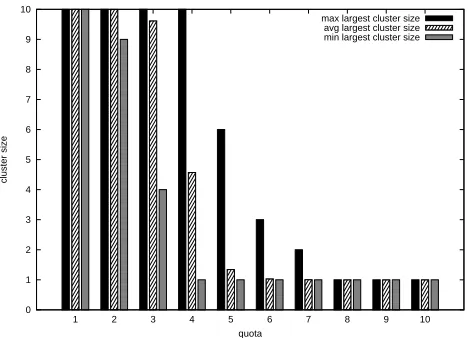
Figure 1: Largest cluster size for edgewise voting with 10 agents, 10 issues, and a full range of quotas
5
Experiments
While the canonical MACF rules out dependency violations, it will often result in local elections that involve too many issues to be feasible in practice. Constraint-based MACFs do allow us to balance computational and social choice-theoretic needs, but they are (typically) computationally intractable. This leaves the quota-based edgewise choice functions, which are appealing due to their conceptual and computational sim-plicity, but which do not give us direct control over either the size of local elections or the number of dependency violations. In this section we report on an experimental study of edgewise choice functions in view of these two criteria.
To generate an input profile, we fix a graphG0from which
we generaten perturbed copies (one for each agent). For
each copy, we delete each edge inG0with probabilityr1, and
we add each edge not present inG0with probabilityr2. For
our experiments,G0is a graph where each of thepissues is
involved in exactly one dependency relation andr1 =r2=
0.2. Thus, our agents have sparse dependency graphs that
differ, but not too dramatically.
For each quota1from1to10, we generated1000 10-agent,
10-issue instances, and computed the resulting meta-agendas.
Figure 1 shows the minimum, average, and maximum largest cluster size found in these meta-agendas. (For example, with
a quota of4agents, the largest cluster in the meta-agendas
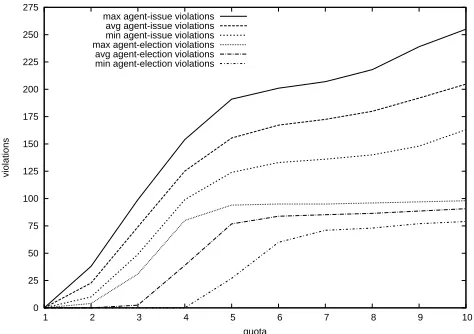
contained an average of4.57issues.) Figure 2 shows, for the
same instances, the number of dependency violations
accord-ing to two measures: (1) theagent-issueviolations, i.e., the
sum of the dependency violations over all voters, and (2) the
agent-electionviolations, i.e., the number of pairs of an agenti
and a local electionEsuch that, according toi, an issue inE
depends on an issue to be decided in a later election.
Edgewise choice with quotas1and10, respectively,
gener-ate the union and intersection graphs of the profiles; hence, the
meta-agendas for quota1are monolithic while for quota10
they are atomic. High quotas will produce more violations
1
0 25 50 75 100 125 150 175 200 225 250 275
1 2 3 4 5 6 7 8 9 10
violations
quota max agent-issue violations
[image:6.612.56.293.56.223.2]avg agent-issue violations min agent-issue violations max agent-election violations avg agent-election violations min agent-election violations
Figure 2: Number of violations for edgewise voting with 10 agents, 10 issues, and a full range of quotas
than lower quotas; a quota of1will produce no violations
at all. Note the dramatic change which occurs over quotas
3–5. When the quota increases from3to4, the average cluster
size halves, and (more than) halves again from4to5. The
minimum cluster size drops precipitously over the same range. At the same time, the rate of increase in number of
viola-tions begins to decline around quota4. With10agents, a
quota of4gives a good balance between low maximum
clus-ter size—which limits the number of alclus-ternatives in any local election—and low numbers of dependency violations.
6
Conclusions
Voting in combinatorial domains is a highly challenging prob-lem, with no general solution in sight. In this paper, we have
introduced the notion of ameta-agenda choice functionas
a manner of isolating the choice of a suitable agenda, given only the preferential dependency information provided by the voters, from the rest of the problem.
We have introduced several procedures for making this choice in practice, ranging from the canonical procedure that does not violate any preferential dependencies, over constraint-based procedures in which violations of dependencies and the size of local elections can be balanced explicitly, to the con-ceptually simple quota-based edgewise choice functions, in which a dependency is respected only if a certain number of voters ask for it to be respected. We have also formulated a number of simple axioms for meta-agenda choice functions, suggesting that this aspect of the more general problem of vot-ing in combinatorial domains is in itself a candidate for deeper axiomatic analysis, and we have established some basic results regarding the satisfaction of these axioms by our procedures. Finally, we have reported on an experimental study of the class of quota-based procedures as a means of exemplifying the dilemma faced by a designer of a voting procedure for multi-issue elections when having to balance computational and social choice-theoretic considerations.
We believe that the main contribution of this paper is of a conceptual nature: to isolate the problem of agenda choice as
an important subtask in mastering the challenges of voting in combinatorial domains and to provide a technical framework for studying this subtask. Of course, this raises more questions than it does answer, and there are numerous directions for future work that should be explored. We only mention three of the most pressing ones here. First, it will be important to understand how the properties of the (meta-)agenda choice function and the properties of the local voting procedures to-gether determine the properties of the overall voting procedure. Second, there are a number of different assumptions that we could make regarding the “attitudes” of voters when faced with a local election for which they are uncertain about their preferences (e.g., they might be optimists, assuming that the remaining issues will be decided in their favour). The question then arises how these attitudes influence election outcomes. Third, we require a better understanding of the reduction in elicitation complexity achieved by first eliciting only preferen-tial dependencies and then votes on small domains rather than directly eliciting a vote on the full combinatorial domain.
References
[Boutilieret al., 2004] C. Boutilier, R.I. Brafman, C. Domshlak, H.H. Hoos, and D. Poole. CP-nets: A tool for representing and reasoning with conditional ceteris paribus preference statements.
Journal of Artifcial Intelligence Research, 21:135–191, 2004. [Bramset al., 1998] S.J. Brams, D.M. Kilgour, and W.S. Zwicker.
The paradox of multiple elections. Social Choice and Welfare, 15(2):211–236, 1998.
[Chevaleyreet al., 2008] Y. Chevaleyre, U. Endriss, J. Lang, and N. Maudet. Preference handling in combinatorial domains: From AI to social choice.AI Magazine, 29(4):37–46, 2008.
[Elkindet al., 2010] E. Elkind, P. Faliszewski, and A.M. Slinko. On the role of distances in defining voting rules. InProc. 9th Inter-national Joint Conference on Autonomous Agents and Multiagent Systems (AAMAS-2010), 2010.
[Endrisset al., 2009] U. Endriss, M.S. Pini, F. Rossi, and K.B. Ven-able. Preference aggregation over restricted ballot languages: Sincerity and strategy-proofness. InProc. 21st International Joint Conference on AI (IJCAI-2009), 2009.
[Lacy and Niou, 2000] D. Lacy and E.M.S. Niou. A problem with referendums.Journal of Theoretical Politics, 12(1):5–31, 2000. [Lang and Xia, 2009] J. Lang and L. Xia. Sequential composition of
voting rules in multi-issue domains.Mathematical Social Sciences, 57:304–324, 2009.
[Liet al., 1999] M. Li, B. Ma, and L. Wang. Finding similar regions in many strings. InProc. 31st Annual ACM Symposium on Theory of Computing (STOC-1999), 1999.
[Liet al., 2010] M. Li, Q.B. Vo, and R. Kowalczyk. An efficient procedure for collective decision-making with CP-nets. InProc. 19th European Conference on AI (ECAI-2010). 2010.
[List and Puppe, 2009] C. List and C. Puppe. Judgment aggregation: A survey. InHandbook of Rational and Social Choice. Oxford University Press, 2009.
[Piniet al., 2008] M.S. Pini, F. Rossi, K.B. Venable, and T. Walsh. Aggregating partially ordered preferences.Journal of Logic and Computation, 19(3):475–502, 2008.
[Rossiet al., 2004] F. Rossi, K.B. Venable, and T. Walsh. mCP Nets: Representing and reasoning with preferences of multiple agents. InProc. 19th AAAI Conference on AI (AAAI-2004), 2004. [Taylor, 2005] A.D. Taylor.Social Choice and the Mathematics of