D
ynamic
soD
mulching
anD
use
of
recycleD
amenDments
to
increase
bioDiversity
,
resilience
anD
sustainability
of
intensive
organic
fruit
orcharDs
anD
vineyarDs
Yearly reports on crops yield and quality
as influenced by soil management
(2018-2019)
Università Politecnica delle Marche
P.zza Roma 22, 60121 Ancona, Italy
Fruit Growing Institute
Ostromila12 str. 4004, Plovdiv, Bulgaria
Laimburg Research Centre
Laimburg 6 I-39051 Vadena (BZ), Italy
Research Institute of Horticulture
(Instytut Ogrodnictwa)
Al. 3 Maja 2/3 96-100 Skierniewice, Poland
CTIFL French technical Interprofessional Centre for Fruits and Vegetable
22 rue Bergère, 75009 Paris, France
FiBL - Research Institute of Organic Agriculture
Ackerstrasse 113, 5070 Frick, Switzerland
University Hohenheim
Schloss Hohenheim 1, 70599 Stuttgart, Germany
1. SELECTIVE WEEDING, INTERCROPPING AND LIVING MULCHES
An external input-based organic soil management, now largely spread in intensive organic cultivation, has potential negative environmental impact due to the increasing cost of energy, and to the risk connected to the dependency on off-farm inputs. Furthermore, orchard floor and soil management influences soil biological fertility and water quality. To ensure a permanent ground cover has been demonstrated to increase the total C content and the active C and N pools in the soil (Sanchez et al. 2003). Using a trunk-to-trunk cover crop mix under the cherry trees has been shown to reduce NO3 leaching by 90% compared to herbicide treated soil. Nevertheless, permanent soil cover risks to be competitive with crops for water. A deep knowledge of mulches and crop physiology and interaction is therefore required to schedule an appropriate management. Sanchez et al. founded no evidences of cherry yield reduction in a 5 years-time span, in the presence of living mulches, in treatments with the same N and water management.
Other studies indicated that, in a 3-years experiment, mulching with live mixed crop succeeded in increasing cumulative yield, without affecting fruit firmness and color, with an appropriate water supply (Granatstein and Millinix 2008).
However, it has to be stressed that mulches resulted particularly effective on sites with good background soil fertility, with frequent mowing, and where climate or irrigation minimize risk of moisture stress (Hammermeister 2016).
DOMINO results
No data on the effect of different weed management techniques on the main crop yield are available for the first year of activity, even though the experiments have been set in all countries by spring 2019. A full set of data would be available only after 2020 harvest.
Valorization of secondary crops
When horticulture species have been used as living mulches there would be a chance for a secondary income for the farmer, but the compatibility of such a harvest with the pest management of the main crop has to be carefully taken into account.
[image:4.595.39.487.271.652.2]At UNIVPM three varieties of strawberry has been tested as mulching (Fig.1).
Figure 1. Strawberry’ varieties and Potentilla used as living mulches in an apricot at UNIVPM
3
Figure 1. Strawberry’ varieties and Potentilla used as living mulches in an apricot at UNIVPM.
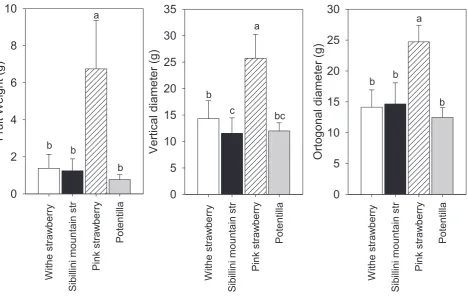
Two out of the 3 varieties of strawberries tested produced small size fruits. Fruits generally had a weight ranging from 1 to 2 g, with the only exception of the pink strawberry producing fruits with a size comparable with common commercial cultivars (Fig.2).
Figure 2 Strawberry fruit weight and diameter. Data are reported as mean ± standard deviation. Different letters indicate significant differences according to Tukey LSD test (p<0,05).
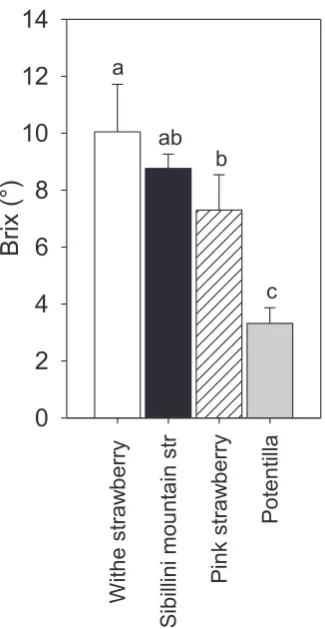
Despite the small size, all the varieties tested had a total soluble solid (TSS) content, expressed as Bix°, perfectly comparable with most commercial cultivars (Caner et al. 2008, Azodanlou et al. 2004), and even particularly high for the with strawberry (Fig.3). The
4
Figure 2 Strawberry fruit weight and diameter. Data are reported as mean ± standard deviation. Different letters indicate significant differences according to Tukey LSD test (p<0,05).
Despite the small size, all the varieties tested had a total soluble solid (TSS) content, expressed as Bix°, perfectly comparable with most commercial cultivars (Caner et al. 2008, Azodanlou et al. 2004), and even particularly high for the with strawberry (Fig.3). The white strawberry in particular has been demonstrated, in the past particularly, rich in total antioxidant capacity and phytochemicals such as flavones, flavonols, anthocyanins, and phenolic acids (Giampieri 2018). For such characteristics and the resulting strong flavour the with strawberry has been successfully employed for artisanal ice cream production in a local ice-cream parlor.
white strawberry in particular has been demonstrated, in the past particularly, rich in total antioxidant capacity and phytochemicals such as flavones, flavonols, anthocyanins, and phenolic acids (Giampieri 2018). For such characteristics and the resulting strong flavour the with strawberry has been successfully employed for artisanal ice cream production in a local ice-cream parlor.
Figure 3. Strawberry fruit Brix °. Data are reported as mean ± standard deviation. Different letters indicate significant differences according to Tukey LSD test (p<0,05).
5
Figure 3. Strawberry fruit Brix °. Data are reported as mean ± standard deviation. Different letters indicate significant differences according to Tukey LSD test (p<0,05).
Pest management schedule and mulching valorization
The 2019 spring was exceptionally rainy in Central Italy. On March 1st apricot phenological stage was at the emergence of inflorescence ranging from buds swelling to sepal open. At that time the strawberries were at its leaf development stage and the treatment with Cu applied to the apricot did not affected its development. After apricot blooming 3 treatments with sulfur where needed to protect apricot production. It was possible to delay the first treatment until May 10. It was possible to previously harvest the first production of strawberries before the first spraying. Thereafter one treatment was needed about every 10 days.
The white strawberry, the earlier variety in the trial, started flowering at the end of March, when apricot ranged from full flowering to flowers fading. In May 10, when the first treatment with sulfur was applied the white strawberry was already at the stage of maturity of fruits for its first berries. The second treatment with sulfur was applied when 85% of the plants had overcame the stage of beginning of ripening. The product supplied was the Tiovit jet. Considering its 5 days of preharvest interval, it appears how, the valorization of the products could be particularly complex especially in rainy years.
Even harder it resulted the valorization of strawberies transplanted under the vineyard. Here the sulfur applications were more numerous, and the product used () had a preharvest interval of 20 days.
Pest management schedule and mulching valorization
The 2019 spring was exceptionally rainy in Central Italy. On March 1st apricot phenological stage was at the emergence of inflorescence ranging from buds swelling to sepal open. At that time the strawberries were at its leaf development stage and the treatment with Cu applied to the apricot did not affected its development. After apricot blooming 3 treatments with sulfur where needed to protect apricot production. It was possible to delay the first treatment until May 10. It was possible to previously harvest the first production of strawberries before the first spraying. Thereafter one treatment was needed about every 10 days.
The white strawberry, the earlier variety in the trial, started flowering at the end of March, when apricot ranged from full flowering to flowers fading. In May 10, when the first treatment with sulfur was applied the white strawberry was already at the stage of maturity of fruits for its first berries. The second treatment with sulfur was applied when 85% of the plants had overcame the stage of beginning of ripening. The product supplied was the Tiovit jet. Considering its 5 days of preharvest interval, it appears how, the valorization of the products could be particularly complex especially in rainy years.
Even harder it resulted the valorization of strawberies transplanted under the vineyard. Here the sulfur applications were more numerous, and the product used () had a preharvest interval of 20 days.
The preliminary experience highlighted the need for the adoption of sulfur-based products whom use is allowed in organic farming on both species, either the main crop and the mulching. A great attention should be payed to the preharvest interval, scheduling secondary crop harvest accordingly.
2. Application of fertilizer and amendments from by-products
Figure 4. Experimental trial in Dąbrowice
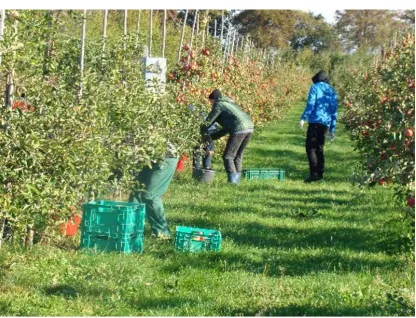
Four blocks with 20 plants each were established also for each treatment with 6-year-old trees (Fig.4). Plant growth was measured starting from the end of the season, to minimize the effect of previous management practices on the parameter and to allow a comparison of the treatments. Yield was measured classifying the apples into marketable and not marketable categories based on the size of the fruit (minimum diameter about 60 mm, as required by EU Regulation 543/2011). The total yield (sum of the two categories) ranged between about 54 (vinassa) and 77 kg/ha (keratin). The yield resulted significantly higher for plant treated with keratin in comparison to all other treatments. However, when considering the two quality categories, a higher amount of the marketable fruits was produced by three treatments: keratin, clover pellet and liquid digestate.
6
2.
Application of fertilizer and amendments from by-products
A trial, testing local organic fertilizers, was established in late spring 2018 on an apple orchard
located in Dąbrowice, at the Experimental Orchard of INHORT . The trial was set with the following
treatments, each providing an amount equivalent to 70 kg/ha N: dry animal manure as a reference
organic fertilizer, yeast stillage (vinasse), liquid digestate, keratin, clover pellet. The control was
unfertilized.
Figure 4. Experimental trial in Dąbrowice
Four blocks with 20 plants each were established also for each treatment with 6-year-old trees
(Fig.4). Plant growth was measured starting from the end of the season, to minimize the effect of
previous management practices on the parameter and to allow a comparison of the treatments.
Yield was measured classifying the apples into marketable and not marketable categories based on
the size of the fruit (minimum diameter about 60 mm, as required by EU Regulation 543/2011). The
total yield (sum of the two categories) ranged between about 54 (vinassa) and 77 kg/ha (keratin).
The yield resulted significantly higher for plant treated with keratin in comparison to all other
treatments. However, when considering the two quality categories, a higher amount of the
marketable fruits was produced by three treatments: keratin, clover pellet and liquid digestate.
References
R. Azodanlou, C. Darbellay, J.-L.Luisier, J.-C. Villettaz, R.Amadò (2004) Changes in flavour and
texture during the ripening of strawberries. Eur Food Res Technol 218: 167–172
References
R. Azodanlou, C. Darbellay, J.-L.Luisier, J.-C. Villettaz, R.Amadò (2004) Changes in flavour and texture during the ripening of strawberries. Eur Food Res Technol 218: 167–172
C. Caner, M. Seckin Aday, M. Demir. (2008) Extending the quality of fresh strawberries by equilibrium modified atmosphere packaging Eur Food Res Technol 227:1575–1583 DOI 10.1007/s00217-008-0881-3
F. Giampieri, S. Afrin, D.Steward, G.J. Mcdougall, R. Brennan, L. Blyth, M. Gasparrini, L. Mazzioni, F. Capocasa, J.M. Alvarez-Suarez, S. Bompadre, P. Brás de Oliveira. ,C.Santos , M. Masias, P. Agudo, J. Crespo, B. Mezzetti, T.Y. Forbes Fernandez , M. Battino. Phytochemical Composition and Cytotoxic Effects on Liver Hepatocellular Carcinoma Cells of Different Berries Following a Simulated In Vitro Gastrointestinal Digestion. 2018. Molecules. doi: 10.3390/molecules23081918.
D. Granatstein, K. Mullinix. 2008 Mulching Options for Northwest Organic and Conventional Orchards. HORTSCIENCE VOL. 43; 45-50
A.M. Hammermeister Organic weed management in perennial fruits. 2016. Scientia Horticulturae 208 28–42