JOURNAL
OF
VIROLOGY, Jan.
1994,
p. 379-389
Vol.
68,
No.
I
0022-538X/94/$04.00+0
Copyright
(C
1994,
American Society
for
Microbiology
Nucleotide
Sequence
of Human Adenovirus Type 12 DNA:
Comparative Functional Analysis
JORG
SPRENGEL, BIRGIT SCHMITZ, DAGMAR
HEUSS-NEITZEL,t
CHRISTIANE ZOCK,
AND
WALTER
DOERFLER*
Institute of Genetics, University of Cologne, Cologne,
Germany
Received 12
August
1993/Accepted
6
October 1993
A
fresh inoculum of human
adenovirus type 12
(Adl2)
was
obtained from the American Type Culture
Collection and passaged once on human embryonic kidney cells, and Ad12 DNA was prepared from the
first-passage yield to avoid higher passages which might have generated host-virus DNA recombinants. The 18
PstI
fragments of
Adl2
DNA were
cloned into the pBluescript KS vector, and the entire nucleotide sequence of
both strands from
all
18 fragments was determined by using successive oligodeoxyribonucleotide primers.
Adl2
DNA
extends over 34,125 nucleotide pairs, and its molecular weight is calculated to be about 22
x
106.
The
nucleotide sequence of
Adl2
DNA
was subjected to computer analyses that determined possible open reading
of
frames on the two strands, the leader sequences, the position of the virus-associated RNA coding region,
possible TATA, and polyadenylation signals. The distribution of the
Adl2
open reading frames was
similar to
that
in the
previously sequenced Ad2 DNA, but there were also distinct
differences.
Adl2
DNA has an
inverted
terminal redundancy of 161 nucleotides, compared with 102 nucleotides in Ad2 DNA. There were stretches of
sequence identity between Ad2 and
Adl2
DNAs at both termini; the overall sequence
similarity between the two
viral
genomes
ranged between
59%
(polypeptide IX) and 77% (in the E2 region), with high homology also in
the sequences for
the adenovirus DNA polymerase.
Over a
period of several decades,
we
have
used human
adenovirus
type
12
(Adl2)
and
its
genome
for studies of
the
molecular
biology of mammalian cells and the molecular
mechanism of viral oncogenic transformation
(see references
13, 15,
and
18
for
recent
reviews). Adenoviruses
have been very
valuable
models in
molecular biology
and oncology,
and
many
aspects
of
adenovirology
are
still under
intensive investigation.
The main
topics of research
on
Adl2
in this laboratory have
been the
mechanism of Adl2
DNA
integration into the
mammalian
genome
(1
1,
16,
43,
44),
the de novo
methylation
of
integrated Adl2
genomes
in
hamster cells
(29, 42),
and
the
abortive
interaction of Adl2 virions
with hamster cells
(12, 50,
51).
Nucleotide
sequences
in a number
of adenovirus
genomes
have
been
determined
previously
and have
been compared
(48).
The
nucleotide
sequences
of the
genomes
of Ad2
(33)
and
AdS
(6)
have
previously been completely determined.
It is
beyond
the scope
of this
paper to
list all the
published partial
sequences
of all
human
adenoviruses.
Several laboratories
have contributed
partial nucleotide
sequences
of
Adl2
DNA in
the
past,
and these sequences are
summarized
in Table 1.
MATERIALS AND METHODS
From a fresh
Adl2 inoculum
(ATCC VR-863)
purchased
from
the
American
Type Culture
Collection, Adl2
was
prop-agated
once
on
human
embryonic
kidney (HEK) cells,
and the
PstI fragments of
the DNA
isolated from the
purified
virions
were
cloned into the
pBluescript
KS vector
by
standard
procedures.
The nucleotide sequences of all
fragments
were
*
Corresponding
author.
Mailing
address:
Institute of
Genetics,
University
of
Cologne,
Weyertal 121,
D-50931
Cologne,
Germany.
Phone: 49-221-470-2386.
Fax:
49-221-470-5163.
t
Present address:
Diagen, Hilden,
Germany.
determined
in an
Applied Biosystems
373A sequencer
by
using
appropriate
19- to
24-nucleotide-pair primers and the chain
termination method
(37).
The
nucleotide
sequence
of
both
DNA
strands
was
determined
over
the
entire
molecule
(see
the
primer locations
in
Fig.
1).
The
nucleotide
sequence
of
34,125
bp
of the Adl2 genome has been
communicated
to
the
EMBL
data
library and will
be
published separately (22a). Here,
we
present a
functional
analysis of
the
nucleotide
sequence
of
AdM2
DNA
and
comparisons with the
known
nucleotide
sequences
of some
of the other
human
adenovirus
genomes.
We
have shown
previously that,
in
productively
infected
human
cells,
Adl2 DNA can
recombine
with host DNA. This
recombination
event can
generate
symmetric Adl2-host
DNA
recombinant
(SYREC)
molecules
(9).
In one
instance, the
SYREC2
DNA
consisted of
a
long inverted
tandem repeat
of
the
left terminal
2,081 bp of
Ad
12
DNA
and
of
human
cellular
DNA
(8).
To
avoid the
potential contamination of the Adl2
nucleotide
sequence
with
human
cellular
sequences, we
pre-pared
DNA
from
a
fresh, low-passage
Adl2 inoculum. All 18
PstI fragments (A
to
R)
of Adl2 DNA were
subsequently
cloned from this
independently
derived DNA
preparation
into
the
plasmid
vector
pBluescript
KS. We have shown
by
PstI
cleavage of
this
DNA,
by
agarose
and
polyacrylamide gel
electrophoreses,
and
by Southern
blotting
followed
by
hybrid-ization
to
32P-labeled
Adl2 DNA that
fragments
smaller than
the
409-bp PstI
R
fragment
were
not
generated by
the
cleavage
of
Adl2
DNA
with
PstI
(data
not
shown).
The
polyacrylamide
gels
used in this
analysis
resolved
fragments
as
small
as
50
bp.
Thus
PstI fragments
A
to
R
represented
the
entire
nucleotide
sequence
of
Adl2
DNA. In
Fig. 1,
the
PstI
map
of Adl2
DNA,
as
derived
from the nucleotide sequence, is
presented
with all
the
primers
used in the sequence
determination
of both DNA
complements.
In
the
functional
analysis
of the
nucleotide
sequence
of
Adl2 DNA the
following
software programs
were
used.
Data
bases
were
searched
with the programs blastn
(1),
tblastn
(1),
379
on November 9, 2019 by guest
http://jvi.asm.org/
TABLE 1.
Nucleotide sequences of
Adl2 DNA
EMBL
data
Nucleotide
Location in
the
Adl2
genome
Reference(s)
bank identifier
nos.
X73487
1-34125
Complete genome
This report
AD1201
1-3957
Left end
3
ADXH3G
1-2320
HindIll
G
fragment
41
AD12EIA
1-530
ElA gene
37
ADXTR1
8-202
Left ITR
38,
46
ADLEIBH12
1488-3861
E1B
region
3,
26
ADLE2B
4831-10470
E2B
region
39
ADRMUVI
16548-17705
Virion precursors pMu and
pVI
21
AD12PROT
20400-21203
Endoprotease gene
25
AD1203
20966-22901
Parts
of the 23- and 100-kDa
proteins
27
ADERE4
30624-34117
Early region E4
24
AD12ITR
33758-34124
Left ITR transferred to the
right
end
36
ADXTR2
33980-34118
Right ITR
38, 46
blastp
(1), fasta (31),
or
tfasta
(31). The overall alignment of
the nucleotide
sequences
of Ad2 and Adl2
DNA was
per-formed with the
program
clustalV
(23).
For
the
construction of
maps
and
patterns,
other
published procedures
were
used
(10).
The
following data bases
were
explored:
EMBL DNA
release
33
and
updates
(40), SwissProt Protein release
23
(2),
TFD
Transcription
Factor
Database release
6
(22),
and EPD
Euca-ryotic
Promoter
Database release
33
(5). The amino acid
translation of DNA,
performed with the
program
MAP,
was
presented
in one
single file in which
open
reading frames
(ORFs)
and the
DNA sequence
were
merged. The
program
pepex was
written
here. This
program
allowed
us to
derive the
peptide
sequence
with
a
specified
size
range
and
to
write it into
a
separate sequence
file in
an
appropriate
data
format. This
program
and the
tools
necessary to extract
the
needed
infor-mation from the different data bases
were
realized in the
programming language PERL, which
was
suited
(49)
to
such
purposes.
The hardware used
was a
VAX
model 3200,
oper-ating
system
VMS
5.3, and
a
Decstation model DECst
5000/
125, operating
system
Ultrix 4.2, both from
Digital Equipment
Co.
Computer analyses
of the
reported
Adl2
DNA
nucleotide
sequence
also
ascertained that this
sequence was not
contam-inated with nucleotide
sequences
derived from
the
pBluescript
KS, pBR322,
or
A DNA vectors.
Human
cellular
DNA
se-quences
known from the
SYREC2
DNA
molecule
(8)
were not
detected in
the
Adl2
nucleotide
sequence
either.
Nucleotide sequence accession number.
The nucleotide
se-quence
of
34,125
bp of the Adl2
genome
has been
communi-cated to
the
EMBL
data
library under EMBO accession
number X73487.
RESULTS
Molecular
weight
and
base,
dinucleotide,
and
trinucleotide
compositions
of
Adl2
DNA.
Table
2
compiles
the
base,
dinu-cleotide,
and
trinucleotide compositions of Adl2
DNA.
The
molecular weight calculated from the nucleotide
composition
of the Adl2
DNA
molecule
amounts to
22
x
106
and
compares
with values of
19.5 x
10'
and 22.1
x
106
as
determined
previously by velocity sedimentation
at
alkaline
pH
and
by length
measurements
with
the
electron
microscope of
the
Adl2
DNA
molecule, respectively (17).
The
DNA
molecule of Ad2 is 1,812
nucleotide pairs longer
than Adl2
DNA
(Tables
2 and
3).
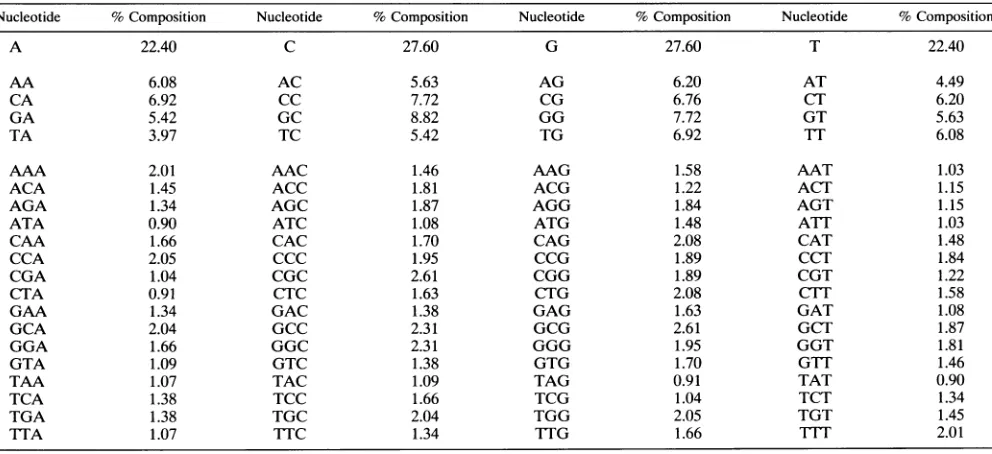
A
comparison of
dinucle-otide and trinucledinucle-otide
frequencies between Ad2 and Adl2
DNA
reveals that the 5'-CG-3'
dinucleotide is
underrepre-sented
in
Adl2 DNA, like in cellular
DNA
but unlike
in
Ad2
DNA,
whereas 5'-TA-3' and 5'-AT-3'
are
low in
Ad2
DNA.
There
are
striking overrepresentations of
AAA
and
17FF in
Adl2
DNA
(Table 2).
ITRs
in
Adl2
DNA.
Inverted terminal
repeats
(ITRs)
are
characteristic of
adenovirus
DNAs.
The
ITR
of
Adl2
DNA
is
a
perfect match of 161 nucleotide pairs
(Fig. 2a),
as
previously
reported (46).
It
is striking that beyond the perfect
ITR,
there
are
regions between nucleotides 162 and
237 on
the left and
nucleotides 33873
and
33948 of the opposite
strand on
the
right end of the Adl2
molecule
which exhibit about
64%
homology
(Fig.
2,
bottom).
In
Ad2
DNA,
the
ITR
extends
over
102
nucleotides, and beyond that
sequence
only
occasional
homologies exist (Fig. 2b). Nucleotide
sequence
comparisons
between the left
(Fig. 3a) and right (Fig. 3b) terminal 500
PstI
C
PstI
B
J
OR
F
J
N K
PstI
A
PstI
D
Pstl E
G
H
P
I
M L
FIG. 1.
PstI
restriction map of
Adl2
DNA.
The locations of all the primers used in the determination of the nucleotide sequence of the
rightward-transcribed strands (arrows pointing to the left) and of the leftward-transcribed strands (arrows pointing to the right) are indicated. As
a
safeguard against possible sequencing
errors,
the nucleotide sequences of both strands were determined.
on November 9, 2019 by guest
http://jvi.asm.org/
NUCLEOTIDE SEQUENCE
OF Adl2 DNA
381
TABLE 2. Base,
dinucleotide, and trinucleotide compositions of double-stranded
Adl2
DNA'
Nucleotide
%
Composition
Nucleotide
%
Composition
Nucleotide
% Composition
Nucleotide
% Composition
A
26.74
C
23.26
G
23.26
T
26.74
AA
8.72
AC
5.79
AG
6.19
AT
6.04
CA
6.95
CC
5.73
CG
4.40
CT
6.19
GA
5.27
GC
6.47
GG
5.73
GT
5.79
TA
5.81
TC
5.27
TG
6.95
TT
8.72
AAA
3.12
AAC
1.82
AAG
1.90
AAT
1.88
ACA
1.85
ACC
1.42
ACG
0.97
ACT
1.55
AGA
1.43
AGC
1.71
AGG
1.50
AGT
1.55
ATA
1.28
ATC
1.16
ATG
1.72
ATT
1.88
CAA
1.98
CAC
1.40
CAG
1.84
CAT
1.72
CCA
1.88
CCC
1.32
CCG
1.03
CCT
1.50
CGA
0.86
CGC
1.54
CGG
1.03
CGT
0.97
CTA
1.18
CTC
1.26
CTG
1.84
Cl-lT
1.90
GAA
1.72
GAC
1.12
GAG
1.26
GAT
1.16
GCA
1.76
GCC
1.47
GCG
1.54
GCT
1.71
GGA
1.52
GGC
1.47
GGG
1.32
GGT
1.42
GTA
1.45
GTC
1.12
GTG
1.40
GTF
1.82
TAA
1.89
TAC
1.45
TAG
1.18
TAT
1.28
TCA
1.46
TCC
1.52
TCG
0.86
TCT
1.43
TGA
1.46
TGC
1.76
TGG
1.88
TGT
1.85
TTA
1.89
TTC
1.72
TTG
1.98
IlTT
3.12
"
The analyses cover 34,125 nucleotides.
nucleotides of Ad2 and
Adl2
DNA
reveal numerous stretches
on the
functional map of
Adl2
DNA
(see Fig. 7). Nevertheless,
of
short nucleotide sequence homologies.
the region of high homology between
Ad2
and
Adl2 DNAs in
A
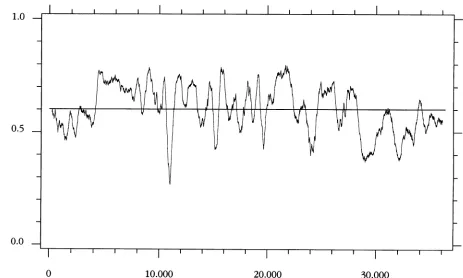
similarity score between the entire nucleotide sequences
alignment positions 5000 to 8000
(Fig. 4) corresponds to the
of Ad2 and
Adl2
DNAs
is presented in
Fig. 4. For this
coding regions of the Ad2 and
Adl2
DNA
polymerases. The
comparison
a
window
of 500
nucleotides was used and shifted
similarity between the two viral nucleotide sequences falls off
by
one
position along the alignment. There
are
many
regions of
in
the extensively
spliced E3 and
E4
regions in the right halves
greater than
70% homology between the two DNA sequences.
of
the genomes. The low
similarity value around position 11000
Of course, such
an
overall
alignment
must
be
interpreted
with
is due
to a
computational
alignment algorithm
and
to
the
fact
caution. Since this alignment
reflects relative positional infor-
that about 250
nucleotide pairs
in
this region of Ad2
DNA
are
mation in
the
two
adenovirus genomes,
including gaps in the
lacking in Adl2
DNA.
alignment, it is not possible to superimpose this alignment map
Parts
of
the
Adl2
DNA
sequence
were
determined
previ-TABLE
3. Base,
dinucleotide, and trinucleotide composition of double-stranded Ad2 DNA'
Nucleotide
%
Composition
Nucleotide
%
Composition
Nucleotide
%
Composition
Nucleotide
%
Composition
A
22.40
C
27.60
G
27.60
T
22.40
AA
6.08
AC
5.63
AG
6.20
AT
4.49
CA
6.92
CC
7.72
CG
6.76
CT
6.20
GA
5.42
GC
8.82
GG
7.72
GT
5.63
TA
3.97
TC
5.42
TG
6.92
TT
6.08
AAA
2.01
AAC
1.46
AAG
1.58
AAT
1.03
ACA
1.45
ACC
1.81
ACG
1.22
ACT
1.15
AGA
1.34
AGC
1.87
AGG
1.84
AGT
1.15
ATA
0.90
ATC
1.08
ATG
1.48
ATT
1.03
CAA
1.66
CAC
1.70
CAG
2.08
CAT
1.48
CCA
2.05
CCC
1.95
CCG
1.89
CCT
1.84
CGA
1.04
CGC
2.61
CGG
1.89
CGT
1.22
CTA
0.91
CTC
1.63
CTG
2.08
CIT
1.58
GAA
1.34
GAC
1.38
GAG
1.63
GAT
1.08
GCA
2.04
GCC
2.31
GCG
2.61
GCT
1.87
GGA
1.66
GGC
2.31
GGG
1.95
GGT
1.81
GTA
1.09
GTC
1.38
GTG
1.70
GTT
1.46
TAA
1.07
TAC
1.09
TAG
0.91
TAT
0.90
TCA
1.38
TCC
1.66
TCG
1.04
TCT
1.34
TGA
1.38
TGC
2.04
TGG
2.05
TGT
1.45
TTA
1.07
TTC
1.34
TTG
1.66
ITT
2.01
"
The
analyses
cover
35,937
nucleotides.
VOL.
68,
1994
on November 9, 2019 by guest
http://jvi.asm.org/
[image:3.612.60.556.488.715.2]0
-....100
...200
300
...I...400
...500
...
...
...
...
...:...
...
....... ...
..
...
... ...
-...
......
... ...
... ... ....-... ...
...
... ... ...I... ...
...I... ...
...
...
... ...*...
...
...
...
... ... ...I...I... ...
... ...
...I... I.,...I...
... ...
33,700
...-......
......
... :... ... ...
...:....
...
... ...
...I...I...I...I...I...
:::O:
...... ...
.... ... ...
... ...
33,800
...
...
...
...
c
q
...
..
...
....
...
...
... ... ...
...
...
...
...
... ...
... ...
...
...
...-......
...
... ...
33 ,900
...... ...
... ...
...
... ...I...
...
...
.. ...
I...I ... ...
...
...
...-. ... ...
::::
...I... ....
...
...
.34,000
...
...
....I...I...
...
...*...*...
...I...
...
...
on November 9, 2019 by guest
http://jvi.asm.org/
VOL.
68,
1994
~~~~~~~~~~~~~~~~~~~~~NUCLEOTIDE
SEQUENCE OF Adl2 DNA
383
L
O
100
200
300
400
D
...
.
.
.
.
.
.
.
.
.
.
.
.
.
.
.
.
.
.
.
.
::: ::::::::::::: ::::::::::::: ::::: :: ::: ::::::::::::::::::::: :::::::: ::::::::::::::::::::::::: :::::::::::::::::
,...
::::::::::::::::::::::::::::::::::::::::::::::::::::::::::::::::::::::::::::::::::::::::::::::::::::::::::::::::::::::::::::::::::::::::::::::::::::::::::::::::::::::::::::::::::::::::::::::::::::::::::::::::::::::::::
:::::::::::::::::::::::::::::::::::::::::::::::::::::::::::::::::::::::::::::::::::::::::::::::::::::::::::::::::::::::::::::::: :::::::::::::::::::::::::::::::::::::::::::::::::::::::::::::::::::::::::::::::::::::::::::
,...
...
:::::::::::::::::::::::::::::::::::::::::::::::::::::::::::::::::::: ::::::::::::::::::::::::::::::::s::::::::::::::::::::::::::::::::::::::::::::::::::::::::::::::::::::::::::::::
...
...
. :::::::::::::::-:::::::::::-:w: :::::::::: ::::: :::::::::::::::::::::::::::::::::::::::::::: ::::::::: :::::::: ::::::::: :::::::::::::::::: ::-:::::::::::::-:-:: :::::::: ::: ::: :::: :::::::::::::::::::::::::::::::::::: :: :::::::::::::::::::::::::::: ::::::: ::::::::::::::: :::::::::::::::::::: :::: :: :::::: :: :::::::::::::::::::::::::::::::::::::::::::::::::::::::::::::::::: ::::::: ::: :::::::::::::: :::::::-:::::::::::::::::::::: ::-::.: :::::::::::::::::::::::::::::::::::::: ::::::::: ::::::::::::::::::::::::::::::::::::::::::: :::::::::-:::: :::::: :-::::::::::::::::::::: ::::::::::::::::::::::::::::::::::::::::::::::::::::::::::::::::::::::::::::::::::::::::::::::::::::::::::::::::::::::::::::::::::::::::::: :::::::::::::::::::::::::::::::::::::::::::::::::::::::::::::::::::::: ::: :::::::::::::::::::::::X:::::::::::::::::::::::: :::::::::::::::::::::::: ::::::::::: ::::::::::'::::::::::::::::::::::::::::::::::::::: :::::::::::::::::: :::::::::::::: ::-::::-::::-:-:::::::::-::::.-..:::-::-:.::-: :.:.:.:.::::::::::::::::::::::::::::::::::-::::: :::::::::::::::::::::::::::::::::::::::::::::: :::::::::::::::::::::::::::::::::::::::::::::::::::::::::::::::::::::::::::::::::::::::::::::::::::::::::::::::::::::::::::::::::::::::::::::::::::::::::::::::::::::::: :::::::::::::::::::::::::::::::::::::::: ::::::::::::::::::::::::::::::::::::::::::::::::::::::::::::::::::::::::::::::::::::::::::::::::::::::::::::::::::: :::::::::::::::::::::::::::::::::::::::::::::::::::::::::::::::: ::::::::::::::::::::::::: :::::::::::::::::::: ::-::-:::::::::::::-:::::-:-:*:::-::: :::-:-:::-::-:-:::-:-:-::-::-:-:-:-:-:-:::::-::-:-::::::-:::-::::::::::-:-:-:-:::-:-:-:::::::::-:-:::::: ::--::::::::::::::::::::::::::::::::::::: ::::: :: ::::::-:-:::::::::::::::::::::::::::::::::: ::::::::::::::::::::::::::: ::::: -::-:::::::::::::::::-::-:::::::-:: :- :::::::::: ::::::::::::::::::::::: ::::::::::::::: ::::: :::::::::::::::::::::::::::::::-:-:::-:::::::-:::::::::::: ::::::::::::::::: :::: ::::::::::::::::::::::::::::::::::::::::::::: ::::::::: ::::::: ::::::::::::::: :::::::::::::::::::::::::::::::::::::: ::: ::::::: ::::::::::::: ::::::::::::::::: :::: :::::::::-::::::: :-:-::::::: ::::: ::::::: :-::: ::::::::::::::::::::::::::::::::::::: ::: ::::::: ::: ::: :::::: ::::::::::::::::::::::::::::::::::::::::: ::: ::::-:::::::::::::::::: ::::-::t:: :::::::::::::::::::::::::::::::::::::::::::: ::::: ::::::::::::::::::::::::::: :: ::::::::::::::: ::-:*:::::::-::::-:::::::::::-::*:+::...:9::::.:.:.:*::::::::::::::::::::::::::::::::::::::::::::::::::::::::::::::::::::::::::::::::::::: ::::::::::::::::::::::::::::::::::::::-::::::::::::: :-: ::::::::::::::::::::::::::::::::::::::::::::::::-::::::::::::::::::::::::::::::::::::::::::::::::::::::::
:::::::::::::::::::::::::::::::::::::: ::::::::::::::: ::::: ::::::::::::::::::::::::::::::::::::::::::: ::::::::::::::::::::::::::::::: ::::::::::::::::::: ::::::::::: :::::::::::::::::::::::::::::::::::::::::::::: :: :::::::::::::::::::::::: ::: :-:-:-:::::::::::::::::: ::: ::: ::::::::: ::::: :-:-::: :-: :-:-:-:-:-: :-:-:-:-:-:-:-:-: :*:-:::::::::::::::::::: :-:: :-::: :-::::: : :-:-: :: ::: ::::::::::::::::::: :::::: :: :-:::::: ::::::::::::::::: :::::::::::::::::::::::::::::::: :: :::: :::: :::::: :: :::::::::: :::::::::::::::::::::::::::::::::::::::::::::: :-:-:::::::::::::::::::::::::::::::::::::::::: :-:-:::::::::::::::::::::::::::::::::::::::::::::::::::::::::::::::::::::::::::::::::::::::::::::::::::::::::::::::::::::::::::::::::::::::::::::::::::::::::::::::::::::::::::::: ::::::::::::::::::::::::::::::::::::::::::::-:::::::::::::::::::::::::::::::::::::::::::::::::::::::::::::::::::::::::::::::::::::::::::::::::::::::::::::::::::::::::::::::::::::::::::::::::::::::::::::::::::::::::::::
:::::::::::::::::::::::::::::::::::::::::::: ::::::::::::::::::::::::::::: :::::::::::::::::::::::::::::::::::::::::::::::::::::::::::::::::::::::::::::::::::::::::::::::::::::::::::::::::::::::::::::::::::::::::::::: :::::::::::::::::::::::::::::::::::::::::::::::::::::::::::::::::::::::::::::::::::::::::::::::::::::::::::::::::::::::::::::::::::::::::::::::::::::::::::::::::::::::::::::::::::::::::::::::::::::::::::::::::::::::::: ::::::::::::::::::::::::::::::::::::::::::::::::::::::::::::::::::::::::::::::::::::::::::::::::::::::::::::::::::::::::::::::::::::::::::::::::::::::::::::::::::::::::::::::::::::::::::::::::::::::::::::::::::::::::::
:::.-.-.::.---:
::::
:::::::::::::::::::::::::::::::::::::::::::::::: ::: ::::: ::::::::::::::::::::::::::::::::::::::::::::::::::::::::::::::::::::::::::::::::::::::::::::::::::::::::::::::: :::::::::::::::::::::::::::::: :::::::::::::::::::::::::::::::::::::::::::::::::::::::::::::: :: ::::::::::::::: ::::::::::::::::::::::::::::::::::::::::::::::::: ::: ::: ::::::::::::::::::::::::: :::: :::::::::: :::::::::::::::::::::::::::::::::::::: :: :: :: :::::::::::::::::::::::::::: ^r :::::::::::::: :-:: :-: :-:::::: :-:-: :-: :-: :-:::::::::::::::::: :-:-:-::: :-:-:-: ::::::: :::::::::::::::::::-: ::::::::::: ::::::::::::::: :-:-: :::::::::::::::::::::::::::::: \ s :::::::::::::::: :-:::::::::::: :::-:::::::::::::::::::::::: ::::::::: :-::::: ::::::::::::::::::::: ::::::::::: :::::::::::::-:: ::: ::::::::::::::::::::::::::::::
s ::: :::::::::::::::: ::::::::::::::::::::::::::::: ::::::::: :::-::::::::::::::::::::::::::::::::::::::::::::::::::::::::::::::::::::::::::::::::::::::::::::::::::::::::::::::::::::::::::::::::::::::::::::::::: :::-:::::-:::-:::::::: ::: :::::::-::::::::::::::::::: ::::::: :::::::::::::::::::::::::::::::::::::::::::::::::::::::::::::::::::::::::::::::::::::::::::::::::::::::::::::::::::::::::::::::::::::::::::::::::::: > :-::::::::-:::::: :-: ::::: :-:-:::::::::::::::::::::::::::::::::::::::::::::::::::::::::::::::::::::::::::::::::::::::::::::::::::::::::::::::::::::::::::::::::::::::::::::::::::::::::: ::::::::::::::-:::::::::::::::::-:::::::::::::::::::::::::-:::::::::::::::::::::::::::::::::::::::::::::::::::::::::::::::::::::::::::::::::::::::::::::::::::::::::::::::::::::::
t sj ::::::::::::::::::::::::::::::: ::::::::::::::::::::::::::::::::::::::::::::::::::::::::::::::::::::::::::::::::::::::::::::::::::::::::::::::::::::::::::::::::::::::::::::::::::::::::::::::::::::::::::::::::::::
v ::::::::::::::::::::::::::::::::::::::::: :::: :::::::::::::::::::::::::::::::::::::::::::::::::::::::: :::::::::: ::: :::::: :-::::-::::::-:-:-::::-::-:::-:-:-::::::-:-::::-:::::-:-:-:-::-::-:::-::::-::-::-::::: :-::-:-:::::-:-:-::-:-::::-::-:-:-:-:*::::-::-::-:-:-: :-:-::-:-::-:-::-: :::::::-::-::::::-:-::-:::::-:: :::-::::: :-:::: :-::: ::::#:::::::::::::::::::::::::::::::::: ::::: ::::::::::: ::::: :: :::::: ::::::: :::::::::: ^ \ ::::::::::::::::::::::::::::::::::::::::::-.-.-:::::: :::::::::::: :: :: ::::: ::::::::: :: :::::::::::::::::::::::::::::: :: ::: ::::::::::::: :: :: :::::::::::::::::::::::::::::::
:::::::::::::::::::::::::::::::::::::::::::::::::::::::::::::::::::::::: :::::::::::::::::::::::::::::::::: :::::::::::::::::: ^ v :::::.::::: ::::::::.:::::: ::::::::::: :::::::::::: ::::::::::::::::::::::::::::::::::: ::::::::: ::::::::::: :::
::::::::::::::::::::::::::::-:::::-:::::-:-:-::-:::::::-::::::::::::::::::::::::::::::::::::::::::::::::::::::::::::::::::::::::::::::::::::::::::::::::::::
- ::::::::::::::::::::::::::::::::::::::::::::::::::::::::::: ::::::::::::::::::: ::::::::::::::::::::::::::::::::::::::::::::::::::::::::::::::::::::::::::::::::::: ::: " \ :-:::::-:-:::::-::-::::::::: :::-:::::: :-: ::: ::::-:::: ::-:::::::::::::::: ::::::: :::::::::: :::::: :::::::: :::::::::: :: :::::: ::::::::::::::::::::::::::::::::::::::::::::::::::::: :::::::::::::::: ::::::::::::: :::::::::::::::: ::::::::::::::::::::::::::::::::::::::::::::::::: ::: :::::::::: ::: ::::::::::::: ::::::: :::::::::::::::::::::::::::::::::::::::::::::::::::::::::::::::::::::::::::::::::::::::::::::::::::::::::::::::::::::::::::::::::::::::::::::::: ::::::::: :::::::::::::w ::::::::: :-:-: :-::-:-:-:-: :-: :-:-:-:-:.: :f: :.: :.:.: :.: :. .:::::::::::::::::::::::::::::::::::: ::: :
::::::::::::::::::-:-::-:::-::::-::::-::::::-:::-:-:-:-:-:-:-:::-:::-:-:-:-::-:::-:::-:-:-::-::-:-:-::-:-:-:-:-::-:-:-::::-:-:-:-::::::-:::-:-::F-:-::::-::
::::::::: ::: ::::::::: ::::::::::: ::::::::::::::::::::::::::::::::::::::::::::::::::::::::::::::::::::::::::::::::::::::::::::::::::::::::::::::::::::::::::: .:::::: :: :::::::: :: ::: :: :::::::::: :::::: :::::: ::::::::::::::::: :::::::::::::::::::: ::::::::: ::: :: :: :::: :::: ::::::::::::::::::::::::::::::::::::::::::::::::::: ::: ::: :::::::::::::::::::::::::::::::::::::::::::::::::::::::::::::::::::::::::::::: :.:.:.:.:::: :::::.:.::::.:::. :: :.: ::': ::::: :::: :::::::.::::: ::::: :::::::: :: ::::::::::::::::::::::::::::::::::::::::::::::::::::::::::::::::::::::::::::::::-:: :-:: :-: :-: :-: :-:*:*: :-: :-:::::: ..: .-. :-.:: :-:::::::::: :-: :-: :-:-:-:-: .:::: ... ::::::::::::::'-'.'.-.'.'-.-,-,-.,.-':.,....,.',,.,.,:.::.,.'-":':
::::::::::::::::::::::::::::::::::::::::::::::::::: :::::::: ::::::::::::::: ::: :::::::::::::: :: ::::::::::::::::::::::::::::::::::::::::::::::::::::::::::::::: ::::::::::::::::::::::::: :::::::::::::::::::::::::::::::::::::::::::::::::::::::::::::::::::::::: ::: :::::::::::::::::::::::::::::::::::::::::::::::::::::::-:'::::::::::::::::::::::::::::::::::::::::::::::::::::::::::::::::::::::::::::::::::::::::::::::::::::::::::::::::::::::::::::::::::::::::::::::::::::::::::::::::::::::::::::::::::::::::::::::::::::::::::::::::::::::-:: :::::-:::::::::::::::::::::::::::::::::::::::::::::::::::::::::::::::::::::::::::::::::::::::::::::::::::::::::::::::::::::::::::::::::::::::::::::::::::::::::::::::::::::::::::::::::::::::::::::::::::::::::::::::::::
:-:': :::-:-:-:'::':-: :-:':': :-:': :-: :':':': :':-: :s :':-:-:':':-:-:':':':':':':-:':':': :-: :-: :-:'::: :':':':: :-: :': :':':-: :-::: :': :':: :'::: :': :':'::::::::
:':::-::::::::::::::::::::::::::::::::::::::::::::::::::::::::::::::::::::::::::::::::::::::::::::::::::::::::::::::::::::::::::::::::::::::::::::::::::::::::::::::::::::::::::::::::::::::::::::::::::: ::::: ::::::::::: :::::::::::::::::::::::::::::: ::::::::::::::::::::::::::::::::::::::::::::::::::::::::::::::: :::::::::::: :::::::::::::::::::::: ::: ::::::: ::: :::: ::::::
*-.-.-.---.--.--.-.-.-.-.-.-.-.-.-+-.-++-.-.-.--.-.--.--.-.-.---.-.-.--.-.-.--+.+...
*::::::-:::::::::::::::-::::::::::-::::::::::::::::::::::::::::::::: ::::::: ::::: ::::::::::::::::::.::::::: :::*:
:::::::::::::::::::::::::::::::::::::::::::::::::::::::::::::::::::::::::::::::::::::::::::::::::::::::::::::::::::::::::::::::::::::::-::::::::::::::::::::::::::::::::::::::::::: ::::: :::-: :-: :::::-:: ::: :-:: ::::::::::::::::::::::::::::::::::::::::::::::::::::::::::::::::::::::::::::::::::::::::::::::::::::::::::::::::::::::::::::::::::::: :::::::::: :::::::::: ::::::::: ::: ::::::: ::: :: ::::
.---.-.---.-.-.-.-.-.-.-.--...--.-.-.----.-+.+v*+*...
....
::::::::::::::::::::::::::::::::::::::::::: ::::::::::::::::::::::::::::::::::::::::::::::::::::::::::::::::::::::::::::: :::::::::-::::::::::::::::::::::::::::::::
:-::::::::::::::::::::::::-::::: ::::-::::-::::s:-:::-:-::::-::::::::::-::::: ::: ::::-:-::::::::::::-::.: :::::: ::.::: ::::::::::::::
*:::-::::::::::::::::::::::::::::: :::::: ::::e.::::-.j::: :: ::::::::::::::::::::::::.:::-:-:::::::-:-:-:::-:-:-::::::::::::-:-:: :::::::::::::::::::::::::::::::: :::::::::jo::::::::::e ::::::::::: :-:::-:::::-:-:-::::::::::::: :-:::::: ::: ::::::::::::::::::::::::::::::::::::::::::::::::::::::::::
..--+.+-.-.-.-.-.--.-.--.-...-.-.-.-.-.-.-.-.
.-.-.-.4--...--.-.--.-.4.4...+.v++++++
::::::::::::::::::::::::::::::::::::::::..::::::::: ::::::::::::::::::::::::::::::::::::::::::::::::::-:-:::::::::::::::::::::::::::::::::::::::::::::::::::::::::::::
;s:#
::::::::::::::::::::::::::::::::::::::::::::::::::::::::::::::.-::::::::::::::::::::: ::::::::::::::::::::::::::::::::::::::::::::-:::-:-::::::::: ::;::::::::::::::-: :-:-:::: :-::::::::: :-::::::::
:::::::::::::::::::::::::::::::::::::::::::::::::::::::::::::::::::::::::::::::::::::::::::::::::::::::::::::::::::::::::::::::::::::::: :-::::::::::: :::::::::::: ::::::: ::::::: ::::::::::: :::::::::::::::::::::: ::::::::::::::::::::::::::::::::::::::::::::::::::::::.-:::::::::::::::::::::::::.-::::::::::::::::::::::::::::::::::::::::: :::::: ::::::::: :::: :::::: :::::::::::::::::::::::::::::::::::::::::: ::: :: :: :: ::::::::: :: :: ::::::::: ::::::::::::::::.-::::::::::::::::::::::::::::::::::::::::::::::::::::::::::::::: ::::: :-::::: :-:-:::::::::-::::::::::::::::::::::::::::::::::::::::::::::::::::::::::::::::::: :::::::::::::::::::::::::::::::::: :::::::::.-::::::::::::::: ::::::::::::::::::::::::: :::::::::::::::::::::::-:::::::::::::-::::::: ::::::::::::::::::::::::::::: :::::::::::::::::::::::::::::::::::::::::::::: ::::::::::::::::::::::::::::::::::::::::::.-:::::::::::::::::::::::::::::::::::::::::::::::::::::::::::::::-:::::::: ::::::: ::: ::::: ::::::::::::::::::::::::::::: :::::::::::::::::::::::::::::::::::::::::::::: ::::::::::::..:::::::::::: :::: ::::::: ::::::::::::::::::::::::::::::::::::::::::::::::.:::::::::::::::::::::::::::-:::::::::::::-:-::-:::::::::
::::::::::.:::::::::::::::::::::::::::::::::::::::::::::::::::::::
::::::::::::::::::::::::::::::::::::::::::::-:-:::::::-:-::-::-::::::::::::-:-::-:-::
::: :::::::::::::::::::: ::::::::::::::::::::::::::::.:::::::::::::::::::::::::::::::::::::::::::::::::::::-::::::-:::::: :-:-:::-::: :::::::-:-::::::::::::::::::::::::::::::::::::::::::::::::::::::::::::::::::::::::::::::::::::::::::::::::::::::::::::::::::::::::::: :-w:::::::::::: ::: :::::::::: ::: ::::::::::::::::: :::::::
r
'
.
.
'
.
.
.
.
'
.
.
.
.
'
.
.
.
.
1
CATCATCATAATASACCTTATTrlGCASTGAAGCCAATATGATAASGAGGGGGTGGAGTTrCTCACGTG_TGGGAACGGGGCGGGTGACGT
100
llllllllllllllllllllllllllllllllllllllllllllllllllllllllllllllllllllllllllllllllllllllllllllllllllll
35937
CATCAT_
_
GCCTCCAGTTTGTGACGTGGCGCGGGGCGTGGGAACGGGGCGGGTGACGT
35838
101 AG ....
TAGTGTGGCGGAAGTGTGATGT 124
ll
lll l ll l ll l
llll
|
35S37
AGGTIwITAaCGCCGAGTAACNGCATCT 35dlO
l
FIG.
2-ontinued
VOL.
68, 1994
on November 9, 2019 by guest
http://jvi.asm.org/
(a)
(b)
100
200
300
400
500
,I1.
-.-.-.
0
:-...
-i:.
:: ::--.
~
-
d- ::- R- -:--:-.5
400
300
N
U7
200
100
0
U0
34,100
34.000
33,900
33,800
33,700
[image:6.612.76.557.84.325.2]Adenovirus
Type 2
Adenovirus
Type
2
FIG. 3.
Comparisons of the ITRs of Adl2 and Ad2 DNAs for the left
(a)
and
right
(b)
termini.
Comparisons
were
performed
as
described in
the
legend
to
Fig.
2.
1
.0
II
2
.C
-.E
0.5
0.0
0
10.000
20.000
30.000
FIG. 4. Overall
similarity scores of the entire nucleotide sequences of
AdI2
and
Ad2 DNAs. The
program Clusta V was used to construct these
scores.
The numbers
on
the
abscissa indicate positions in the alignment between Ad2 and
Adl2
DNAs, not sequence numbers, since the two
nucleotide sequences differ in
length.
on November 9, 2019 by guest
http://jvi.asm.org/
[image:6.612.84.547.414.692.2]NUCLEOTIDE SEQUENCE OF Adl2 DNA
385
10000
15000
20000
25000
30000
nudeotides
FIG.
5.
Restriction
maps
of Adl2 DNA. From
top to
bottom the PstI, EcoRI, BamHI, HindIII, HhaI, and
MspI
restriction
maps
of
Adt2 DNA,
derived from the
primary nucleotide
sequence, are
shown. The bottom-most
row
presents
all 1,500 5'-CG-3'
sequences
in Adl2
DNA.
The
program
MAPPLOT
was
used for the
construction of these
maps.
The length scale in nucleotides is shown above the figure.
ously (for
a
review,
see
reference
48). At that time, different
laboratories reported
some
variation in
the
sequence
of
the
eight
left
terminal nucleotides. This
variation might reflect
different
origins of the Adl2 inocula used in different
labora-tories and
might,
at
the
same
time, be
a
consequence
of the
ability
of Adl2
DNA
to
recombine
with host
DNA
(9). The
Adl2
DNA, which
we
obtained from the American
Type
Culture Collection
and
passaged only
once,
had the
5'-termi-nal
sequence
5'-CCTATCTAATAATATA
...(Fig. 2), which
was
also
one
of
the results
in
the
earlier comparison (48).
Restriction
maps
for the Adl2
genome.
In
Fig.
5
selected
restriction
maps
of
the Adl2
genome
are
presented. Some
restriction
maps
of Adl2
DNA
have been published
elsewhere
(45).
At the time
of
this
writing,
restriction
enzymes
that
did
not
cleave
Adl2
DNA
were
not
known.
It
was
of interest
that
the
restriction
endonuclease BstEII
from Bacillus
stearother-mophilus,
with
the
recognition
sequence
5'-GGTNACC-3'
(28),
could
cut
Adl2
DNA
only
once
at
nucleotide 3444.
Thus,
about
90%
of
the Adl2
genome
can
be cloned
as
one
contiguous fragment.
Since
one
of
our
motivations
to
determine the
nucleotide
sequence
of Adl2 DNA has been
to
facilitate
more
detailed
studies of the
patterns
of de
novo
methylation
in
integrated
Adl2
DNA,
a
presumptive
defense
mechanism of the host
(14),
it is
worth
mentioning
that
the
presence
of
75
5'-CCGG-3'
(HpaII-MspI)
and of 181
5'-GCGC-3'
(HhaI)
rec-ognition
sites
(MspI
and HhaI
maps
are
shown in
Fig.
5)
contrasts
with
the
presence
of
1,500
5'-CG-3'
sequences
(bottom
row
in
Fig. 5),
which
are
the
preferred
target
sites
for
the host cell DNA
methyltransferase
system.
Thus, by
analyz-ing
the
methylation
status
of
HpaII
and HhaI
recognition
sequences,
as
is
frequently
done in work
on
DNA
methylation,
one
would
score
only
about
17% of the
sequences
that
could
become
methylated
in
the
integrated
Adl2 DNA. This
obvious
discrepancy
constitutes
a
problem
for much of the work
on
DNA
methylation
and
can
be
overcome
only by applying
the
genomic
sequencing
method
(7, 32, 34, 47).
This
method
permits
the
determination of
5'-methyldeoxycytidine
residues
at
all
5'-CG-3'
sequences.
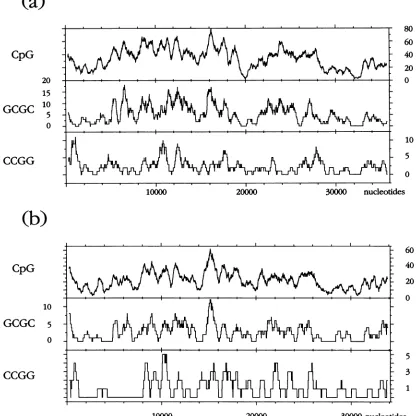
A
graphic
evaluation of the
5'-CG-3',
5'-GCGC-3', and 5'-CCGG-3' sequences in the Ad2
(Fig.
6a)
and Adl2
(Fig. 6b)
DNAs
is
presented
in
Fig.
6.
The
patterns
of
distribution
show gross
similarities but differ in
many
details.
ORFs, promoters,
TATA
sequence,
and
polyadenylation
[image:7.612.60.560.77.294.2]signals
in the
Adl2
genome.
In
Fig. 7, the ORFs detected in
TABLE 4.
Mapping
of known promoter sequences and
comparison
with the
Adl2 nucleotide
sequence
presented
here
EPD
no.a
Adenovirus
Name
Estimated %
Nucleotide no.
esimilarity
Start"
Endb
EPD30061
Adl2
ElA Pl
99
9
407
EPD11197
Adl2
Ela P2+
99
9
546
EPD07149
Ad2
Ela
63
47
480
EPD1119S
Ad5
Ela
62
47
480
EPD11196
Ad7
Ela
71
153
480
EPD17110
Sa7p
Ela
65
8
476
EPDO7151
Ad7
Elb
56
995
1326
EPDO7152
Adl2
Elb
100
1029
1628
EPD26036
Adl2
MLPC
99
5303
5902
EPDO7159
Ad2
MLP
74
5303
5902
EPD11203
AdS
MLP
74
5303
5902
EPD11204
Ad7
MLP
73
5303
5899
EPD11202
AdS
IX
60
2878
3464
EPDO7158
Ad7
IX
61
2877
3469
EPD07157
Ad2
IX
59
2877
3467
EPDO7154
Ad2
E3
72
25548
25963
EPD11199
Ad5
E3
76
25770
25963
EPD11200
Ad5
IVa2
74
(rev)d
6089
5491
EPDO7156
Ad2
IVa2
74
(rev)
6089
5491
EPD11201
Ad7
IVa2
73
(rev)
6089
5491
EPDO7153
Ad2
E2a
75
(rev)
25963
25423
EPDO7160
Ad2
E2 late
74
(rev)
24943
24472
a
These
identifiers
present the nomenclature
of the
Eucaryotic
Promoter
Database
(EPD).
bNucleotide
numbers in the Adl2 DNA sequence determined in this
study.
c
MLP,
major
late promoter.
d
Sequence
on
leftward-transcribed
DNA
strand.
5000
VOL.
68,
1994
on November 9, 2019 by guest
http://jvi.asm.org/
[image:7.612.314.558.454.683.2](a)
CpG
20
15
GCGC
1G
0
CCGG
(b)
CpG
10
GCGC
5
0
CCGG
80
60
40
20
0
10
5
0
60
40
20
0
5
3
1
[image:8.612.98.517.85.501.2]10000
20000
30000
nucleotides
FIG. 6.
Distribution of the
CpG,
GCGC,
and CCGG sequences
across
the Ad2
(a)
and
Adl2
(b)
DNA
molecules. The program Window
was
used
to
generate these patterns.
the Adl2
nucleotide sequence in
all
three
reading
frames
and
on
both
complements of Adl2
DNA are
presented.
The
ORFs
were
derived
from
the nucleotide
sequence and have not yet
been
independently
confirmed. This
figure
also shows
some
of
the
Adl2
promoters, the TATA sequence, and
polyadenyla-tion
signals.
The
symbols
used
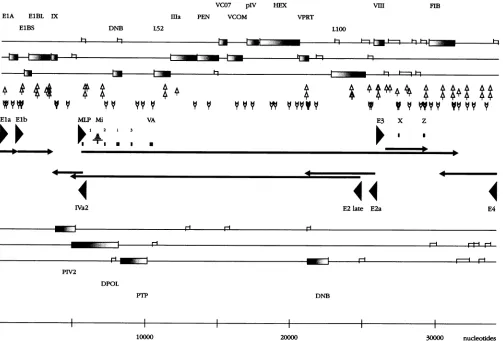
in
this
composite
map are
explained
in the
legend
to
Fig.
7.
ORFs shorter
than
80
nucleotides are not
considered
significant
and have not been
included in
Fig.
7.
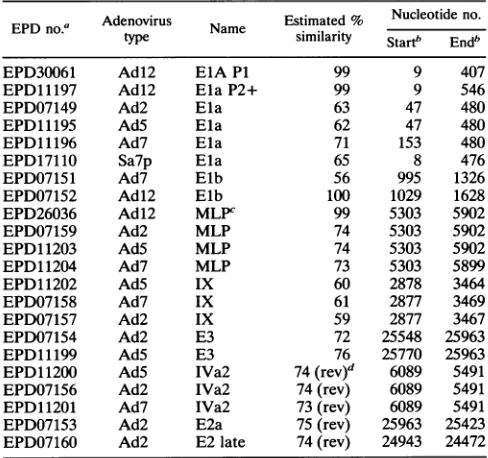
In
Table 4, the nucleotide sequences in
Adl2
DNA
with
similarities
or
near
identities to known and
published
se-quences
from other adenovirus
promoters
were
listed.
Al-though it is
very
likely
that the
Adl2
DNA
sequences
corre-spond
to
the named genes of
other
adenoviruses, this
possibility
has not been
confirmed by functional
tests
in most
instances.
The
nomenclature for the
Adl2
ORFs
should
therefore be
regarded
as
preliminary
and must
await
functional
confirmation.
We
refrained from sequence
comparisons of
splicing
sig-nals, since such
assignments
on
the
Adl2
DNA sequence
would be
misleading
if
based
solely
on
nucleotide
sequence
analyses. With
a
few
exceptions, such comparisons could
not
yet be backed up
by mapping
data
for
Adl2-specific
mRNAs
on
the
Adl2 genome as
obtained from biochemical
experi-ments.
DISCUSSION
We
have
determined
the sequence
of
the
34,125 nucleotide
pairs in
the Adl2 DNA
molecule
and
have
compared
this
sequence
with the
structures
of
other adenovirus genomes,
in
particular that
of
Ad2
DNA
(4).
In
many
aspects,
the
distri-bution of viral
functions
on
the
Adl2
genome
reflects that
in
Ad2
DNA
with
minor
differences. The functional
map
of Adl2
DNA
is
in
agreement
with
the
mapping of the early Adl2
on November 9, 2019 by guest
http://jvi.asm.org/
NUCLEOTIDE SEQUENCE OF Adl2 DNA
387
ElA
E1BL
IX
ElBS
VC07
pIV
HEX
IIIa
PEN
VCOM
DNB
L52
th3
hi
==
4t
hi
X~~~~~~~~~~~~~~~~~~~~~~~~L
LLI
t=
4
4~
i
44
44
4
4~444u*4
44
4
4
44
4
Ela
Elb
MLP Mi
VA
E3
X
Z
a