Rochester Institute of Technology
RIT Scholar Works
Theses Thesis/Dissertation Collections
7-2016
Knowledge-based Decision Making for Simulating
Cyber Attack Behaviors
Stephen Frank Moskal
Follow this and additional works at:http://scholarworks.rit.edu/theses
This Thesis is brought to you for free and open access by the Thesis/Dissertation Collections at RIT Scholar Works. It has been accepted for inclusion in Theses by an authorized administrator of RIT Scholar Works. For more information, please [email protected].
Recommended Citation
Knowledge-based Decision Making for
Simulating Cyber Attack Behaviors
by
Stephen Frank Moskal
A Thesis Submitted in Partial Fulfillment of the Requirements for the Degree of Master of Science
in Computer Engineering
Supervised by
Professor Dr. Shanchieh Jay Yang Department of Computer Engineering
Kate Gleason College of Engineering Rochester Institute of Technology
Rochester, New York July 2016
Approved by:
Dr. Shanchieh Jay Yang, Professor
Thesis Advisor, Department of Computer Engineering
Dr. Michael Kuhl, Professor
Committee Member, Department of Industrial and Systems Engineering
Dr. Andres Kwasinski, Associate Professor
Thesis Release Permission Form
Rochester Institute of Technology Kate Gleason College of Engineering
Title:
Knowledge-based Decision Making for Simulating Cyber Attack Behaviors
I, Stephen Frank Moskal, hereby grant permission to the Wallace Memorial Library to reproduce my thesis in whole or part.
Stephen Frank Moskal
Dedication
Acknowledgments
First and foremost, the biggest thanks and highest praise goes out to Dr. Jay Yang who
reached out to me when I was a second year undergrad student and miraculously stuck with
me throughout this long but incredible experience. I cannot express how grateful I am to
have someone who believed in me for this long and continue to do so into the next chapter
of my career, this could not be done without you and here’s to the next couple of years. I
would also like to thank Dr. Michael Kuhl for sticking with me, putting up with me, and
introducing me to a side of engineering that I would not get otherwise. Then to Dr. Andres
Kwasinski for stepping up to the plate and being apart of my committee so late in the game
and I greatly appreciate it. Finally a big thanks to the original CASCADES team, Ben
Wheeler and Derek Kreider for the ongoing support to make this project something that we
Abstract
Knowledge-based Decision Making for Simulating Cyber Attack Behaviors
Stephen Frank Moskal
Supervising Professor: Dr. Shanchieh Jay Yang
Computer networks are becoming more complex as the reliance on these network
in-creases in this era of exponential technological growth. This makes the potential gains
for criminal activity on these networks extremely serious and can not only devastate
or-ganizations or enterprises but also the general population. As complexity of the network
increases so does the difficulty to protect the networks as more potential vulnerabilities are
introduced. Despite best efforts, traditional defenses like Intrusion Detection Systems and
penetration tests are rendered ineffective to even amateur cyber adversaries. Networks now
need to be analyzed at all times to preemptively detect weaknesses which harbored a new
research field called Cyber Threat Analytics. However, current techniques for cyber threat
analytics typically perform static analysis on the network and system vulnerabilities but few
address the most variable and most critical piece of the puzzle – the attacker themselves.
This work focuses on defining a baseline framework for modeling a wide variety of
cyber attack behaviors which can be used in conjunction with a cyber attack simulator to
analyze the effects of individual or multiple attackers on a network. To model a cyber
at-tacker’s behaviors with reasonable accuracy and flexibility, the model must be based on
aspects of an attacker that are used in real scenarios. Real cyber attackers base their
de-cisions on what they know and learn about the network, vulnerabilities, and targets. This
attacker behavior model introduces the aspect of knowledge-based decision making to
cy-ber attack behavior modeling with the goal of providing user configurable options. This
capabilities, opportunities, intent, and preferences. The proposed knowledge-based
deci-sion making model is implemented to enable the simulation of a variety of network attack
behaviors and their effects. This thesis will show a number of simulated attack scenarios to
Contents
Dedication. . . iii
Acknowledgments . . . iv
Abstract . . . v
1 Introduction. . . 1
1.1 Importance of Cyber Security . . . 1
1.2 Difficulty in Cyber Threat Analytics . . . 2
1.3 Variability of a Cyber Attack . . . 3
1.4 Problem Statement . . . 4
1.5 Motivation for Cyber Attack Behavior Modeling . . . 5
2 Related Work . . . 7
2.1 Attack Graph Generation and Analysis . . . 7
2.2 Behavioral Models . . . 9
2.2.1 Game Theory . . . 10
2.2.2 Agent Based Behavior Modeling . . . 11
2.2.3 Cyber Attack Ontologies . . . 12
2.3 Cyber Attack Simulators and Analysis Tools . . . 14
2.4 Summary . . . 15
3 Methodology . . . 17
3.1 Making of a Cyber Attacker . . . 17
3.2 Cyber Attack Scenario Frameworks . . . 20
3.3 Modeling the Attacker’s Knowledge . . . 22
3.3.1 Skills, Rules, and Knowledge . . . 23
3.3.2 Network Knowledge . . . 24
3.3.3 Opportunity: Using the Knowledge To Choose A Kill Chain Stage . 25 3.3.4 Fuzzy Logic Parameters . . . 27
3.4 Modeling Attacker Skills and Preferences . . . 35
3.4.1 Capabilities: The Attacker’s Skill Set . . . 35
3.4.2 Preferences: What the Attacker Chooses To Do Next . . . 37
3.5 Combining Capabilities, Opportunity, Intent, and Preference Models . . . . 39
4 Design Implementation . . . 41
4.1 General Process for Determining Attack Actions . . . 43
4.2 Attacker Knowledge Modeling . . . 44
4.2.1 Knowledge Base . . . 46
4.2.2 Machine Knowledge . . . 47
4.2.3 Attack Records . . . 49
4.2.4 Updating the Knowledge Base . . . 50
4.3 Initialization of the Attack Action Sets . . . 51
4.4 Intent and Opportunities . . . 52
4.4.1 Cyber Attack Kill Chain . . . 53
4.4.2 Choosing Kill Chain Stage Using Knowledge: Implementation . . . 56
4.5 Attacker Capabilities . . . 59
4.6 Attacker Preferences . . . 60
4.6.1 Variably Weighted Preferences Values . . . 61
4.6.2 Preference Parameters To Determine Weights . . . 63
4.7 Choosing an Attack Action . . . 64
4.7.1 No Actions To Select . . . 65
5 Experiments and Results Analysis . . . 66
5.1 CASCADES Setup . . . 66
5.1.1 Virtual Terrain Setup . . . 67
5.1.2 Attacker’s Intent . . . 71
5.1.3 Attacker Behavior Configurations . . . 71
5.2 Analysis . . . 74
5.2.1 Base Network Configuration . . . 74
5.2.2 Misconfigured Network . . . 80
6 Conclusion and Future Work . . . 85
6.1 Conclusion . . . 85
6.2 Future Work . . . 86
6.2.1 Knowledge Upgrades . . . 87
6.2.3 CASCADES Future Work . . . 88
Bibliography . . . 90
List of Tables
3.1 Kill chain stages as defined by various groups and companies . . . 21
3.2 The initial list of the fuzzy logic parameters available to the user from the simulation . . . 29
3.3 The base set of attacker preferences that can be modified by the user . . . . 39
4.1 List of variables that represents one instance of the attacker’s machine knowledge . . . 49
4.2 The list of variables being tracked by the simulator as statistics of the at-tacker’s actions. . . 50
4.3 Weighting functions available to the user for some of the preference functions. 62 4.4 The user configurable variables that are used to control the attacker’s pref-erences. . . 64
5.1 List of the machines on the virtual terrain and their access permissions. . . . 69
5.2 The modified VT permissions with the misconfigurations in bold. . . 70
5.3 ABM configuration summaries for each attacker. . . 73
5.4 ABM preference summary for each of the attackers. . . 74
5.5 Average number of steps taken by each of the attackers . . . 74
5.6 Failed attack rate for each type of attackers on the base network . . . 75
5.7 Average number of steps taken by each of the attackers on the misconfig-ured network . . . 80
5.8 Failed attack rate for each type of attackers on the misconfigured network . 80 5.9 Average percent change of attack steps between the base network configu-ration and the misconfigured network . . . 80
List of Figures
2.1 Example of the cyber kill chain defined by MITRE. . . 14
3.1 Example setup of the linguistic variable “total failed actions” describing what is acceptable and unacceptable . . . 26
3.2 The flow of the kill chain stage selection using fuzzy logic showing the inputs of the knowledge and intent. . . 27
3.3 Example fuzzy rule set for each of the kill chain stages in the MVKC . . . . 31
3.4 The distribution of membership for each of the kill chain stages in the MVKC 32 3.5 The membership function of the kill chain stages when the attacker has no knowledge on the network, choosing recon . . . 32
3.6 The membership function of the kill chain stages after the attacker has re-cent performed recon scans, choosing breach . . . 33
3.7 The membership function of the kill chain stages after finding a machine with intent, choosing exfiltration . . . 34
3.8 The membership function of the kill chain stages after finding a machine with intent, choosing exfiltration . . . 34
4.1 ABM basic black box design where the core logic only makes a single call to the ABM. . . 42
4.2 Internal ABM states to determine the final attack action from the attacker’s intent, opportunities, capabilities, and preferences. . . 43
4.3 The general process for the determine attack action method for the attacker behavior model called by the simulation core logic. . . 45
4.4 UML diagram describing the attacker’s knowledge design. . . 46
4.5 UML diagram describing the Knowledge Fields enumerated type. . . 50
4.6 UML diagram showing the three different stages . . . 54
4.7 An example of a FCL file for JFuzzyLogic for the ABM. . . 57
4.8 An example of the state definition in the fuzzy logic representing indepen-dent states. . . 58
4.9 UML diagram describing the attacker’s capabilities design. . . 60
5.2 Visual representation showing the connections and machines in the virtual terrain being used. . . 68
5.3 Comparison of the number of attack steps each attacker took over 1000
separate simulations. . . 75
5.4 Comparison of the occurrences of the recon and breach stages for each
attacker type on the base configured network. . . 77
5.5 The percentage of times a service was exploited by each of the attackers on
the base network. (Services pertaining to intent are bolded) . . . 79
5.6 Comparison of the number of attack steps each attacker took over 1000
separate simulations on the misconfigured network . . . 81
5.7 Comparison of the occurrences of the recon and breach stages for each
attacker type on the misconfigured network. . . 82
5.8 The percentage of times a service was exploited by each of the attackers
Chapter 1
Introduction
1.1
Importance of Cyber Security
As the world becomes more and more technologically advanced and reliant on computers
to keep track of their lives or run their businesses, the importance of keeping these systems
secure becomes critical in every day life. However, in most cases, people do not realize how
important cyber security is until their credit card numbers are stolen or their customers data
is taken. This ignorance only has been realized widespread in late-2013 when the large
corporation Target was infected with malware compromising the identities of over 70
mil-lion people worldwide [38]. FireEye, the company who was monitoring Target’s network
at the time, reports that the median number of days between when the attack is successful
to when the attack is discovered is 146 days [8]. Even though Target had many defenses
implemented and detected the malware relatively early, enterprise level networks still can
be extremely difficult and expensive to secure due to the configuration of the network like
the services installed and access control.
To combat cyber attacks, defense tools and tactics like firewalls, intrusion detection
systems (IDS), and penetration testing are used to help mitigate these threats. However
most tools like firewalls and IDS’s only protect from attacks that are happening live and
if they fail, there is nothing they can do further. Penetration testing, although can be very
of the tester. The issues with these techniques is that if the attacker has compromised the
network in some way, it’s usually too late. This is why recently the research community has
focused performing analytics on cyber attacks and threats to measure the effects and impact
of certain attacks before the attack can actually happen. Cyber-threat analytics fills the gap
between detecting cyber attacks and defending against cyber attacks predicting what could
happen in various scenarios.
1.2
Difficulty in Cyber Threat Analytics
Prediction in any field of work is usually expected to come with some amount of uncertainty
and inaccuracies, with meteorology being the extreme case since that is almost never 100
percent correct. As expected cyber attacks are no exception to this proposition however
unlike weather prediction which has literally hundreds of years of previous weather data,
there is little available data of detailed cyber attack information to base predictions off
of. The issue is because of the sensitivity and complexity of this data most of the victims
are hesitant to release this information. Sensitivity in the sense that releasing detailed
information about an attack can expose even more vulnerabilities and information against
them which could also negatively impact them from a business standpoint. These attacks
are also complex requiring detailed logs and step-by-step analysis of vulnerabilities and
techniques used during the attack which needs the actual attacker’s input to retrieve that
data. Like meteorology where robustness is added to models of the weather to become as
accurate as possible without physically modeling every variable possible, same concept can
be applied to cyber attack modeling to reduce the number of variables to make up for the
high uncertainly models. By modeling the networks and cyber attacks to various degrees it
1.3
Variability of a Cyber Attack
To understand the difficulty of the prediction and modeling of a cyber attack, understanding
the variability and complexity of an attack is key. First, the network and its configuration
plays a major role in an attack. An average network may be hundreds to thousands of
ma-chines with various permissions, programs, and protection. Each of these dictate the sort
of attacks that could happen on the network and is critical modeling an attack with some
amount of realism. Permissions dictate whom can communicate, whom can be accessed
from the Internet, etc. Access control is key to stopping unauthorized users accessing
someone who they should not. Programs or services installed on a machine in a network
defines the types of vulnerabilities that are available to an attacker. Management of the
ser-vices can reduce the types of attacks that can happen on the machine. Then lastly the cyber
attack defenses implemented on a network, a firewall for example, can impede attackers
and possibly detecting attackers during the attack acting as a deterrent. It is obvious that
to model the effects of an attack on the network that you must model a network but there
is variability in the sense of the granularity the network is modeled. One may choose to
model the network at a packet-level or use a real network, each has their pros and cons.
At a high level however, networks are relatively static and only introduces variability
in the terms of what is possible in an attack. However the most variable aspect of a cyber
attack is the attacker themselves. Modeling only the network could reveal what is possible
to be done from an vulnerability perspective, but not whether or not it is actually possible to
be done by someone. Since every human is different, the process at which an attacker will
attack a network will vary between each attacker. This is interesting from a research
per-spective since by modeling the attacker one can not only seeif their network is vulnerable
buthowit is vulnerable. Given the same network one attacker may approach the network
differently than another, take different paths, and use different vulnerabilities which may
effect the network very differently. One attacker maybe successful in ex-filtrating a critical
may run in and take what they can find quickly setting off many alarms. Understanding the
differences between attackers and their behaviors can be used to analyze the effects of the
attacks and then can be used for early detection and prediction later.
Interesting research has been conducted in the past 10 years to address the variability
in cyber attacks and cyber attack behaviors to better analyze the impact of these attackers.
On one side research has been done in using the vulnerabilities in the network to expose
possible and realistic attack paths [18, 36, 52, 12]. However the downside to this approach
is that these techniques only takes in account the vulnerabilities on the network exposing
no real differences between types of attackers. Other works have addressed this issue by
modeling the capabilities and opportunities of adversaries [46] or applying the
method-ology of Game Theory [50] to model the attacker and defense. None of these methods
model the attacker based of information that the attacker gains throughout the attack. The
information the attacker gains throughout the attack plays a critical role into what decisions
the attacker makes. This concept can be seen in the agent based modeling techniques in
the adversary simulation tool NeSSi2 [15] and the attacker behavior model in the
Multi-stage Attack Scenario Simulation (MASS) [31]. These however fail to provide a structure
in which the attacker learns specific details about the targets and be able to dynamically
change goals and strategies through out the attack. This sort of knowledge based design
to model an attacker allows for a flexible description of cyber attackers that provides the
capability to model proactive and reactive behaviors.
1.4
Problem Statement
Previous works have identified two major factors that are dependent on each other for
accurate prediction and modeling of cyber threats: the network configuration and the
at-tacker. However this dependency between the threat and the target plays a role in both how
successful an attacker is to achieving their goal and how secure the network is.
should not be successful in achieving their goal. Likewise, a world-class attacker may find
paths and vulnerabilities that professionals and analysts may miss due to the complexity of
the network configurations and possibilities. This is the ongoing problem that penetration
testers and threat analytic tools have tried to solve, expose possible vulnerabilities in a
net-work. However, the other issue is how to analyze this dependency between the attacker and
network and measure effects the attacker has on a network but also how network’s
config-uration effects the behaviors and intentions of the attacker. Current works that do address
both the attacker and the network configurations face issues with: generating realistic
at-tack scenarios, are inflexible with the types of atat-tacks modeled, or are extremely difficult to
configure to model certain scenarios. This is again due to the complexity of the attacker’s
decision processes themselves and with the number of variables to consider when modeling
a network. This work strives to find a balance between the model complexity of the cyber
attacker along with the description of the network to measure the effects each of the models
have on one another by examining the attacker’s actions taken when attacking a network.
1.5
Motivation for Cyber Attack Behavior Modeling
The motivation for this work is continuing on previous work by Moskal et al. [30, 31]
where cyber attacks where modeled and simulated to analyze the possible attacks that could
happen on the network. The main focus of this work is to model the cyber attacker’s
behavior in a manner that allows for flexible description of many different types of attackers
while maintaining reasonable realism in the types of attacks that can be performed. By
modeling an attacker more like the way an attacker would actually think, this allows us
to understand the differences different attackers have on the same network or how a single
attacker can effect different types of network. This flexibility may help to alleviate the skills
and time needed to perform this type of analysis on a network. The key goal is to develop a
framework to model the decision process of an attacker based on both deterministic factors
simulation. While the goal is not to be able to comprehensively model every type of attacker
behavior but to identify what needs to be modeled to describe an attacker, much like what
was identified for the network above.
By modeling cyber attackers more akin to how an actual cyber attacker would make
decisions based on skills, rules, and knowledge, it is possible synthesize attacker behavior
data that would be difficult to achieve otherwise. Combining both rule based and
knowl-edge based attack action generation provides robust and diverse attack track generations
while still providing realistic results because rules and knowledge are in constant check
with each other. Meaning that the rules can not be applied if the knowledge is not
devel-oped enough and the flexibility of the knowledge can’t be used if the rules are too restrictive.
Applying this design to simulations allows for a deeper understanding of what is the impact
of many different types of attackers by analyzing the types of attacks were performed and
being able to what the attacker needed to know to perform the attacks. Then finally this
feeds back to the possible end user who is trying to protect their networks from attacks that
penetration testers did not think of or other tools that do not have the defenses to defend
against. This gives a deeper understanding of how the vulnerabilities are being used and
how it can impact the network before the attack can happen which then something can be
Chapter 2
Related Work
Cyber-threat analytics is a relatively young field and is diverse in the types of approaches
taken to perform predictive analysis of cyber attackers. These approaches consist of
vul-nerability assessments and mitigation, analytical approaches such as using attack graphs
and game theory, and cyber attack modeling and simulation. Each have their own benefits
and downfalls, where no approach is necessarily better than another due to the difficulty of
predicting human behavior in the first place. In the later part of this chapter, we will shear
the trade off between model accuracy, description flexibility, and ease of use. In the current
work, one or two of three of these aspects are satisfied while significantly impacting the
other aspects. Current works use mathematical models such as attack graph generation or
game theory or other more theoretical approaches such as agent based modeling, attack
ontologies, or simulations to aid in the analysis of adversaries.
2.1
Attack Graph Generation and Analysis
The purpose of network penetration test is to expose potential weaknesses in a network
that is available to a potential attacker. With knowing the vulnerabilities of a network,
the tester/attacker can then exploit them to further penetrate the network to learn more
information. A penetration tester will use this information to expose more weaknesses
until they have exhausted all their possible options. This is developing what is known as
network. This process was traditionally done by hand either by the attacker or the analysis
team and can be a tedious process. In 2002, Sheyner et al.[44] formalized the process to
automatically generate an exhaustive set of possible attack graphs given a network. Attack
graphs are generated using by describing the network and the attacker’s knowledge of that
network and then describing the set of states that describe the actual attacks that can happen.
Given a large network the number of possible attack paths could be extremely large.
The follow up work by Jha et al.[19] proposed two methods to find which attack graphs
are most critical and which defense techniques are most effective. The automatic attack
graph generation still requires every different type of possible attack to be modeled. In
their paper, Jha et al.only 4 possible types of attacks. In the case of Sheyner et al.[44] a
network of two hosts with a IDS and firewall was modeled. This produced an attack graph
of 5948 nodes with 68364 edges which is extremely large for very few types of attacks
and an unrealistically small network. This method of analysis does not have the flexibility,
scalability, or the ease of use needed to successfully assess the networks weaknesses.
Qui et al.[36] in 2004 used attack graphs to generate patterns of IDS alerts to aid in the prediction of future and ongoing attacks. Using these attack graphs and cyber attack
domain knowledge, the likelihood of attack goals being performed can be evaluated to
pre-dict future attacks. Immediately, this is an issue because this method requires every attack
graph to be converted into a casual network and a cyber security expert must analyze it it
for its likelihood. This has two problems, first attacks that do not strictly follow the attack
plan cannot be modeled and the likelihood is based solely on the expertise of the expert. In
2010, Xie et al.[52] addressed this uncertainty of variation of attacks, successfulness, and
accuracy of sensor alert data by combining attack graphs with Bayesian networks. This
introduced bringing in real world vulnerability databases like the National Vulnerability
Database (NVD) and the Common Vulnerability Scoring System (CVSS) to use real world
data to give some basis for the likelihood without needing expert knowledge for every
In 2014, Kotenkoet al.[24] evaluates real-time attack graph generation for predicting the likelihood of the attacker’s next steps based off of various security events. From the
security event, a base skill level of the attacker can be determined which then can be used
with CVSS to determine the possibility of the next steps based on the position of the
at-tacker on the network. A common issue between the aforementioned works is developing
the base attack graph that describes the scenario and goals of the attacker. With the use of
Common Attack Pattern Enumeration and Classification (CAPEC) from MITRE, Kotenko
et al.[25] was able to generate attack graphs based off the real-world scenarios and use those scenarios to provide more realistic predictions and other attack graphs based off their
previous works.
2.2
Behavioral Models
In the previous section, the works presented analyzes the network security based off the
possible attacks that could be performed on the network given one or more scenarios. In
these cases, the scenarios are defined and different attackers could share the same goal but
whether or not they are successful is a different problem. Understanding the attacker’s
impact on the network is important because realistically not every vulnerability can be
closed and some may prioritize which vulnerabilities to address due to time. If there is a
exploit that can be performed by any person and have a detrimental impact to the network
(ex. Heartbleed from 2014) should have a higher priority than an exploit that only the top
1% of attackers could perform on a non critical machine. The earlier attack graph works
from Jha et al.[19] and Quiet al.[36] only exposed various paths an attacker could take
and not whether or not an attacker would. Where the more recent attack graph works such
as Xieet al.[52] and Kotenkoet al.[25] used publicly available cyber attack scenario data
to create attack paths that were identified as realistic but still not accounting for attacker
skills or behaviors. Current techniques, as shown in this section, apply techniques like
an attacker makes throughout an attack.
2.2.1 Game Theory
Applying game theory to the cyber domain seems to be a fitting application because cyber
security naturally has two players which are most commonly referred to as the red team vs
the blue team. The red team are the attackers who are trying to penetrate the network to
achieve some goal. The blue team are the defenders, which could be the network
admin-istrator, the penetration testers, or the intrusion detection system. Game theory works well
in this case because the red and blue team have contradictory goals and they are
compet-ing against each other. The red team is trycompet-ing to break the defenses of the blue team and
the blue team is trying to stop the red team at any phase. Royet al.[39] in 2010 performed
comprehensive research of various cyber security related game theory works and compared
their usefulness. They came to three conclusions: 1) Current stochastic game models only
consider perfect information and assume the defender can detect every attack. 2) State
transition probabilities are fixed and do not consider changing knowledge in the model and
3) Models assume that all actions are synchronous (every action has a reaction) which is
not realistic since the defense is not always aware of the offense and vise versa.
Since then, Wang et al.[50] improved on the attacker versus defense relationship by
introducing the Nash equilibrium and having a non-cooperative offensive vs. defensive
model. This provided significant gains in network security yet also, proved to be
computa-tionally intensive even with an unreasonable assumption that the skills of the attacker’s are
all equal. In 2016 machine learning was applied with game theory by Chunget al.[5] to aid
in reducing false positives. As mentioned in [39], IDS’s are never 100 percent correct. It
was also assumed that the defense does not have any knowledge about the attacker’s skill
or intent. Q-Learning was used as a model-free reinforcement learning technique to learn
the optimal policy that will maximize the effectiveness of the technique being used. This
where the data for the attacker’s were developed from National Center of Supercomputing
Applications (NCSA) where only a few attacker behaviors were present.
2.2.2 Agent Based Behavior Modeling
Agent based modeling is a technique that measures the effect of one or many autonomous
agents on a particular system. Agent based modeling is used to re-create and predict the
behaviors of very complex algorithms by using a very simple rule based system. Agent
based modeling is popular in applications that exhibit a swarm like behavior like epidemic
spreads [2] or the interaction of crowds of people in an area [34]. For example, the people
in the crowd are agents and they are monitoring their speed, the position of other people,
and trying to get to their goal which is a position in the system. Each agent is simply trying
to minimize the time it takes to arrive at their goal, however other agents may impede each
other. Bottlenecks can be then found in the system by examining the areas in which the
most agents slow down [27]. Recently, this same methodology and technique was applied
to the cyber security domain taking various approaches to defining the agents.
In 2005, Kotenko [22] applied the Agent Based Model to describe the interactions of
botnets in a Distributed Denial of Service (DDoS) attack. Kotenko modeled the steps and
actions to successfully perform a DDoS attack including the different initialized agents
needed to perform the simulation. Two different types of agents were used in this work,
the adversary attacking system which are the automated botnets attacking the system and
then the security defense system which is the intrusion detection systems (IDS) and
fire-walls. For each type of agent, a state machine was created to describe the functionality
and behaviors of the agent. For the attacker agent, the state machine comprised of the
steps and outcomes of seven different methods to perform a DDoS. On the defense side,
the agents were trained to perform certain scans on different levels of the network model
(system, network, and global) and report their findings whether or not malicious activity
NS2 and the OMNeT++ INET Framework. Where normal users, attackers, and
defend-ers were modeled together and the effects of a botnet was examined on a network. It was
shown that the collaborative team based attacks were much more successful at performing
a comprehensive DDoS attack on a network, as one would predict.
Then in 2011, Grunewaldet al.[15] released an Agent based adversary detection and
simulation tool called NeSSi2. The methodology was to model the entire network and
at-tackers as agents in a packet based simulation to avoid complex mathematical models. The
provided a simulation that could handle many different types of scenarios that could not be
easy to perform in a real world environment. Each machine, router, and firewall are created
as agents in an attempt to detect and identify DoS attacks in the network. NeSSi2 supports
two types of attacks, Worm-spread scenarios which is similar to an epidemic spread
prob-lem and botnet based attack like seen before. Each attacker is also modeled as an agent,
picking one of these attacks and performing it on the network. NeSSi2 simulates basic web
traffic like HTTP requests and other applications in the hopes that the attacker’s behaviors
can be identified in the simulation.
2.2.3 Cyber Attack Ontologies
Cyber attack ontologies describes the relationships between each of the factors of a cyber
attack and their dependencies on each other. For example, it can describe all of the details
in a vulnerability for it to be possible, like services and OS’s, user permissions, down to
the requirements of the attacker like specific domain knowledge. The ontology can be
described in a low level like specific vulnerabilities or the attacker’s individual behaviors
to very high level to just the attacker’s high level intentions. In 2002, Gorodetskiet al.[14]
applied the methodology to the cyber domain and described the requirements of the top
level ontology of a cyber attacker in three steps. First, all attacks are intention centered
meaning that there must be a reason for the attack. Second, attacks correspond to the
attacking the target network. Lastly, an attack intention can be represented as a collection
of sub-intentions. This is describing the multistage attacks where there may be multiple
steps before the attacker can achieve their overall goal.
Shepardet al.[43] in 2005 used their knowledge-based artificial intelligence inference
system called CycSecure to develop a knowledge base about an network to perform
secu-rity analysis. By running a set of Cyc daemons on the host machines on a network the
Cyc system can develop the base map of the network and then ontologies developed from
security experts and natural language processing from various sets of data (not disclosed)
can be used to analyze the network. Cyc provides support for over 12,000 services, 683
vulnerability types, 354 types of software faults at the time. However these ontologies still
need to be reviewed by a security expert and the authors admit that each of the ontologies
require 10-20 minutes of review each. In 2010 Conesa et al.[9] analyzed the usability of
the more versatile and general version of CycSecure called ResearchCyc and found it to be
unorganized, difficult to use, and inflexible with out expert knowledge makes it difficult to
use for research purposes. There has been no response to this paper and no further progress
on CycSecure as been made since.
The Structured Threat Information Expression (STIX) from MITRE is a schema
co-developed with the Department of Homeland Security to better describe cyber threat
in-formation. The STIX schema captures high-level concepts such as observables/indicators,
incidents, TTP (Tactics, Techniques, and Procedures), targets, courses of action, and threat
actors. This framework also defines what is called the “Cyber Kill Chain” which describes
the phases or steps an attacker commonly takes throughout the overall campaign. An
ex-ample of the different stages of the cyber kill chain can be seen in Figure 2.1.
The different “sides” of the attacks are important because it depending on what side the
attacker is on, different defensive measures need to be taken. The left side of the kill chain
represents the preparation phase of the attack where preventative defensive techniques can
Figure 2.1: Example of the cyber kill chain defined by MITRE.
of the attack, the attacker has compromised the target in some way and the defensive
strat-egy changes to a damage control focus instead of preventative techniques. STIX focuses
on individual attack campaigns and organizes it to represent the attack and the kill chain
position by the tools the threat actor used, techniques/behaviors they exhibit, the interaction
between threat actors, and the observables.
2.3
Cyber Attack Simulators and Analysis Tools
Simulation is an appealing approach to cyber-threat analytics because it provides
repeat-able results can is relevant to the specific application of the user. Simulations are usually
robust and can be tuned to provide different results under certain circumstances. However
as with most simulations, the simulation is only as good as the model being simulated.
In manufacturing processes where simulations are widely used for measuring process
effi-ciency, specific parameters and variables are defined to describe the possible actions in the
simulation like part failure rates for example. In the case of cyber attacks the complexity is
much higher because the variability of the network, complexity of the vulnerabilities, and
the attacker themselves has to be taken into account.
Mentioned previously NeSSi2 from Grunewalet al.[15] developed a cyber attack
sim-ulator in which a network was modeled and simulated the effects of distributed denial of
service (DDoS) attacks and work propagation. NeSSi2 performs well in applications where
there is propagation of some threat not only in cyber attack applications but also testing the
DDoS, it does not model various other types of cyber attacks that require compromising
multiple machines as it is focused on modeling the defense for DDoS attacks mostly.
In 2014, Moskalet al.[31] developed the Multistage Attack Scenario Simulator (MASS)
which is the predecessor to the Cyber Attack Scenario and Network Defense Simulator
(CASCADES) used in this work. MASS introduced the idea of modeling cyber attacks
by modeling the network and its services which determines the vulnerabilities on the
net-work along with describing a cyber attack scenario with the use of the Scenario Guidance
Template (SGT). MASS also factored in the attacker’s behavior by modeling the skills and
preferences of the attacker. This produced reasonable results for a given attack scenario
producing multistage attacks using real vulnerability data and modeling intrusion detection
systems. Where it fell short was that it did not actually model the attackers personality nor
did it model the actual actions that the attacker could perform. Instead the behaviors were
abstracted down to some numeric parameters like stealthiness or persistence which where
difficult to describe and configure. The simulator itself was unpredictable and extremely
difficult to configure but it laid out the framework and base for the next generator simulator
CASCADES.
2.4
Summary
Modeling cyber attacks and attackers is a difficult problem because of all the possibilities.
Attack graphs are shown to be useful but provide scalability issues that is dependent on
network description and flexibility issues because of the massive amount of possible attack
scenarios available. Simulation is an interesting concept and still a growing field but is hard
to prove its validity because of the lack of cyber attack data available. In simulation there
is a trade off between realism of attack scenarios because the simulation can be custom
tailored to a single attack type and being able to simulate a wide variety of scenarios with
potentially less accuracy. This work presents a method to generate attack plans and
Chapter 3
Methodology
Current techniques of modeling cyber attacker behaviors either lack the robustness to
pro-vide realistic attack scenarios or fail to reflect the reactive and dynamic nature of cyber
attackers, as noted previously. To achieve realistic cyber attacker behaviors it is necessary
to understand what is a cyber attack at a high level. Then to address the dynamics of an
attack it is important to understand the decision process an attacker makes throughout an
attack. What makes one cyber attacker different to another? This can be answered by
looking at what makes one person different from another person, completely leaving out
the cyber aspect out of it. Identical twins for example are biologically the same/similar but
it is their experiences, their skills, and what they know that makes them different to their
identical counterpart. Describing a person’s full skill set or experiences is impractical as
the complexity of the model will be unreasonable. The main goal of this work is to identify
key components of a cyber attacker and assess the realism and flexibility of modeling cyber
attack behaviors in this form.
3.1
Making of a Cyber Attacker
The purpose of this work is not to model every possible behavior a cyber attacker may
have but to develop a framework to investigate information needed to sufficiently model
a variety of attacks. The reasons why a person would target and attack a network can be
law defines three aspects of a crime which can be applied to any crime: means, motive, and
opportunity. Means is the ability the adversary could commit the crime, motive is the reason
the adversary committed the crime, and opportunity is if the adversary had the chance to
commit the crime. This can be applied to cyber attacks as the means whether the attacker
has the skills to perform the attack, the motive is the goals and intent the attacker has for
performing an attack, and opportunity is the vulnerabilities on the network. Holsopple
et al.[16] touched upon this by using the capabilities and opportunities of ongoing attacks to predict future attack scenarios. The definition of a cyber threat as given by Gasper from
U.S. ARL [13] is the combination as capabilities, opportunity, and intent (COI) lining up
with the law definition. These three aspects of a cyber threat are critical in describing the
skills, goals, and attack surfaces the attacker has on a network.
The issue of describing cyber attackers with only COI is that it does not describe the
personality of the attacker. For example two attackers may have similar skill sets, the same
intent, and are exposed to the same attack surface. What is left out is how the attacker
uses skills and opportunity. One attacker may choose to be extremely aggressive and attack
as fast as possible, getting in and out regardless of the alarms that were set off. Where
another may choose to be very methodical in choosing their next attack and staying “under
the radar” as much as possible. These differences need to be taken into consideration as
these have very different impacts on the victim network. Comparing and contrasting these
two examples are interesting as they have the same COI but the approaches and outcomes
are very different. The first attacker may have been detected and some threat mitigation
could have been performed, but the second one may have not been detected and it is critical
to understand how they can be detected. This work proposes that not only capabilities,
opportunity, and intent are required to model a cyber attacker but the preferences of the
attacker must be considered to allow for diverse models.
The attacker behavior is defined as the decision process to develop a sequence of attack
capabilities, opportunity, intent, and preferences (COI+P) to choose an attack action which
is only part of their overall behavior. However the order in which the COI+P is used has
a drastically different meaning to the overall decision process. We propose to order these
as intent, opportunity, capabilities, and preferences. Intent is first because the attacker
will have some reason/goal for the attack. This goal can be as high level as just affecting as
many machines as possible or to extract some information from a particular server. Without
intent being first, there is no meaning to why the attacker is attacking the network. Then
opportunity to perform the intent is second due to the attacker knowing what they want to
do and the opportunity is if they know enough to perform the attacker’s intent. The notion
of the attacker knowing information about the target is a topic that will be addressed later.
If the attacker does not have the opportunity for the intent, then the attacker must reevaluate
their next steps. Next, is the capabilities of the attacker which determines if the attacker
has the skills to perform the intent actions if they have the opportunity. It is unlikely that
an attacker will address their skill set before their intent and opportunities. Then lastly, is
what does the attacker prefer to perform. With their COI determined, there may be many
different options available to the attacker and this can only be realized after the other three
have been determined.
This is the logical organization of each of these models, however it is recognized that
this is not necessarily the optimal order for all cases. As seen later in the design, the order
will not play a large role in determining an action. It does change the literal meaning of the
process. For example if the capabilities is taken in account first then it would seem that the
attacker is developing their attack around their skill set which may be the case for some, but
most attacks are developed around some goal. This COI+P framework describes at a high
level of how an attack action chosen but still does not define a structure of how real attacks
progress. COI+P provides no logical structure of the types of attacks an attacker performs
3.2
Cyber Attack Scenario Frameworks
There has been large debate on what steps an attacker makes to compromise a network. The
military defense contractor Lockheed Martin developed the Cyber Attack Kill ChainR[1]
in 2013 which defined a set of steps an attacker would take to complete a specific goal.
These steps include reconnaissance, exploitation, installation of malware, and extraction to
name a few. This gives a solid baseline of the steps it takes to take control over a network
but does not encompass the types of scenarios for all of the attacks. It certainly does not
necessarily apply to all of the types of attacks or attackers, some may not choose to clean
their traces where others will certainly cover their tracks. Since then other companies have
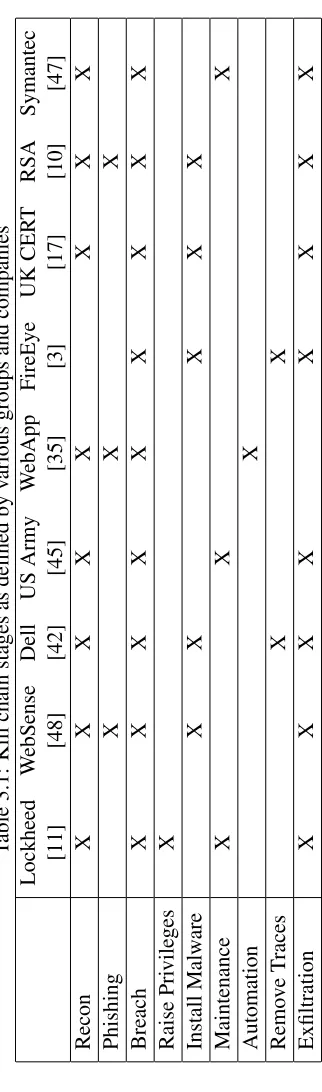
developed their own definitions of a kill chain that applies to their particular field. As seen
in Table 3.1 is different versions of kill chains defined by other companies.
Although these kill chains range from typical cyber attacks to specific types of cyber
attacks, there are some patterns that are present in most of them. It can be seen that most of
the defined kill chains share three states: reconnaissance, breach, and exfiltration. Recon is
critical to an attack because it is where the attacker discovers information about the network
and possible target(s). Breach is the exploitation phase, each attack consists of exploiting
a machine whether it is a denial of service or control of the machine. Finally the last stage
exfiltration is where the attacker will perform their goal like extracting data or taking down
a machine. We define the kill chain stages recon, breach, and exfiltration as the Minimum
Viable Kill Chain (MVKC). The MVKC is the minimum steps that the attacker must take
to provide realistic results for modeling. It is to note that these steps do not need to be
taken in order necessarily but is defined as the typical order of an attack. For example in a
multistage attack a attacker may not be able to perform their goal after they have breached
the first machine, more recon and breaching may need to be performed.
As shown, the MVKC is the minimum number of kill chain stages required to model
a realistic cyber attack but more stages may be required to describe more technical attack
be implemented to account for different stages and the differences between them. Each
of these different stages all correspond to a different part of the attack or a different set
of actions. This poses an interesting issue because since there is no actual order for these
stages, when is it appropriate to “perform” one of these stages? When the attacker performs
recon over a breach is up to the attacker but what information is the decision based off of?
The answer is the same as any decision process in any field which is knowledge, what the
attacker knows.
3.3
Modeling the Attacker’s Knowledge
Knowledge plays a large role in the overall evolution of a cyber attack. What an attacker
knows about a network determines their next steps and how they will progress to achieve
their goal. Defining what key elements of an attack or network is important to model
as knowledge is necessary to then develop a model to describe how an attacker uses this
knowledge. It is important to note that in this context, knowledge refers to the
informa-tion known about a particular network and not the skills and experiences of the attacker
themselves. This is an important distinction as the overall decision making process takes in
account the knowledge gained from the network with the skills of the attacker. Modeling
the knowledge an attacker develops throughout an attack provides interesting benefits as it
provides realism in the sense that an attacker can only make decisions on information about
the network that is known about. Very rarely will an attacker perform a breach or
exfiltra-tion type attack without some prior knowledge. Even in the case of a random script kiddie,
there is still a discovery phase looking for targets in which the attacker is learning about
the field and searching for targets. As these random attacks fail, the “attacker” develops
more and more information about the target(s). This applies also to advanced meticulous
attackers that will learn about their network, understanding what is out there and choosing
3.3.1 Skills, Rules, and Knowledge
Before describing the details of what needs to be represented as attacker’s knowledge, first
the description of a knowledge-based design should be defined. Using the knowledge as
the driving force of the decision-making process is a double-edged sword. On one side,
using knowledge provides the capability of realistic attack scenarios while being able to
understand what the attacker needed to know to perform that attack. While the other side
describing this sort of behavior may become complex from a user stand point, as one cannot
expect a user to describe all of the rules possible for the attacker. Applying case-based
approaches to the cyber domain like from Kolodneer [20] is not appropriate due to cyber
attackers not always following a ridged set of rules, as most cyber attacks are situational.
Where the skills, rules, and knowledge based design from Rasmussen [37] provides a much
more flexible design for how a cyber attacker makes decisions.
Rasmussen [37] defines three different types of decision making: skills, rules, and
knowledge. Skills are the impulsive decisions that are based off of experience like catching
a ball, you don’t think about it. The rule level is the “if... then” type of decisions similar to
the case based approaches. Where the knowledge level is where there is no direct solution
to the problem and the person has to think of a solution. An example of this is a physics
problem where the solution to the problem is not known however the person goes through
problem solving techniques to extract the solution out of what is known. This model is
a good fit in this case because it combines the deterministic problem solving in the case
where the attacker has a clear direction for the next attack attack action and also the more
probabilistic methods in the case that the next step is not well defined because the goal is
not possible at a given time for example. This work uses this design as a base to not strictly
rely on rules to define the attacker behaviors which will be addressed in the design and
3.3.2 Network Knowledge
Cyber attackers when infiltrating a network choose their actions based on some sort of
information that they have learned previously or during the attack. This applies to all
attackers from script kiddies to the most elite attackers. Script kiddies must have some
sort of target even if it is a shotgun approach where the attacker randomly targets machines
to discover if they are vulnerable, some knowledge is gained from this technique as it is
used to plan their next action depending on the result. Similarly elite hackers may have a
target in mind and will perform reconnaissance techniques to learn more information about
their target to carefully plan their next action. These statements above are vague as the
definition of information/knowledge gain in the context of a cyber attacker has not been
defined. Defining the set of data that an attacker can learn and most importantly use to
choose their actions plays a major role in the validity of a knowledge based model.
To define what is the critical information an attacker needs to perform an attack, it is
necessary to evaluate two popular tools that are used by hackers and penetration testers.
NMap[32], a network scanning tool, and Metasploit [28], a penetration testing tool, are
two pieces of software that are widely used in the field of computing security. NMap is the
standard program among hackers of all skill levels and understanding it is a critical step
for hackers to acquire more information about their target. NMap provides the capability
of discovering hosts, operating system fingerprinting, port scanning, and service scanning.
NMap also provides scripts for more advanced service detection, user privileges, and
ex-ploitation, however we are more interested in the base functionality as this is information
that every remote attack requires. Thus at a minimum, the attackers knowledge base must
contain IP addresses, open ports, operating system, and services running on the targets.
This is reinforced by evaluating the basic needs of Metasploit to perform an exploit. At the
very least to successfully compromise a machine, Metasploit requires some target IP(s), the
target port, and a service to exploit with the correct OS installed. Metasploit also requires
attacker must know that the vulnerability exists on the network.
At a base, the knowledge needed to successfully perform an attack is IP addresses, open
ports, services, and vulnerabilities. The only major part that is left out is the actual topology
of the network itself. Both NMap (short for Network Map) and Metasploit is aware of
the permissions of the machines on the network when used correctly. It is critical to the
overall attack scenario that the attacker understands the network as a whole and who can
communicate with who. This is because certain machines can only be accessed by certain
other machines deeper down in the network due to firewalls and permissions. By modeling
the attacker’s awareness of permissions, it will allow the capability for attackers to base
decisions based of the source machine and target machines later on as a preference. This
allows the fine tuning of the attacker’s behavior in the case there is a specific preference to
use one source over another.
3.3.3 Opportunity: Using the Knowledge To Choose A Kill Chain Stage
One of the key design requirements of this knowledge-based behavior model is flexibility.
Instead of describing few behaviors in great detail like done in previous works, the goal is
to describe a wide variety of behaviors based off of real world parameters the reflect how
attackers react when they learn new information. Due to the nature of the data that the
simulated attacker is making decisions on (i.e., network sizes, services, service types,
ma-chines, etc.), probabilistic models like Game Theory for example may be difficult to define
many behaviors easily. Where a purely rule based system, while easier to define, struggles
to handle situations where there is no direct rule corresponding to the current situation. A
good model will provide the ease of a rule based system with the uncertainty and diversity
of a probabilistic model. Introducing Fuzzy Logic into this model is an appropriate choice
because it handles the case where there is uncertainty in what the attacker should do next
but still driven by a set of rules.
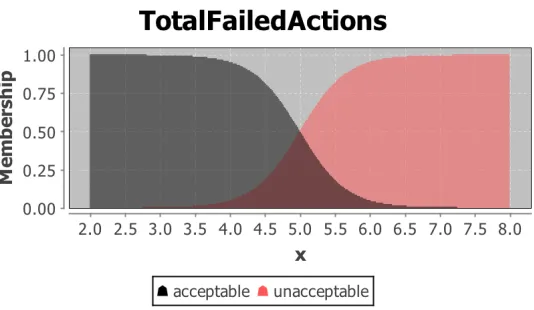
Figure 3.1: Example setup of the linguistic variable “total failed actions” describing what is accept-able and unacceptaccept-able
There is situations where the attacker will be unsure on their next steps because they may
not have enough information about their target to attack. This is where the fuzzy logic
plays a role since it takes into account that certain situations are not as simple as a coin flip
or a “if... then” rule. In this case, a set of input parameters from the simulation will be
the inputs to the fuzzy logic controller which then they will be used to drive the rules to
choose a kill chain stage. The user then can use these input parameters to configure a set of
thresholds or distributions that are used as the linguistic variables. The user then can also
describe the set of rules using the linguistic variables which will drive the membership for
each of the kill chain stages. This membership can be seen in Figure 3.1 where the variable
“total failed actions” is given as input to the fuzzy logic controller and is evaluated to either
acceptable or unacceptable based on value.
It should be noted that this model does not preserve any order of the kill chain stages
explicitly. In the descriptions of the kill chains from other organizations, each of them had
their own order in which the stages should be completed to correctly describe a complete
kill chain. This automatic ordering of the kill chain stages is left out in this model because
the criteria for entering a stage is purely situational and based off the opportunity to perform
these stages. If the user chooses to enforce the kill chain stage order then it is required to
automatically enforced. The use cases for defining flexible ordering of states could be for
covering up traces after attacks or some other action that relies on a previous state.
3.3.4 Fuzzy Logic Parameters
The parameters that are used for the fuzzy logic as the inputs to determine the kill chain
stage must be defined carefully as the selection of the kill chain stage is critical to the
overall functionality of the ABM. These parameters must be flexible enough to control
many different types of attackers, scaleable to any size network, and most importantly based
off values real attackers make decisions based upon. Reflecting back on the MVKC of
Recon, Breach, and Exfiltration, a base set of variables can be created that can differentiate
the different stages the attacker can perform based off the knowledge. How these variables
are explicitly used will not be covered in this section because the usage is up to the user to
define the thresholds of the membership.
Addressing the requirements of the fuzzy parameters the first is flexibility. Each attacker
has their own agenda on what is their reasons to perform one of the kill chain states. For
example, one attacker may find that service scanning one machine out of 3 known is enough
to switch to the breach stage. Where another attacker may want to explore all the possible
actions before moving on. This also can be applied to when the attacker stops their attack.
Some attackers may not want to continue much farther after failing a few attempts. Whereas
an script kiddie for example may try every possibility before giving up. This allows for a
wide variety of behaviors that can be controlled by manipulating just a few parameters. The
[image:40.612.97.519.593.660.2]general process of evaluating the kill chain membership can be seen in Figure 3.2
The next requirement in the parameters is that they must scale regardless of the network
size. This is because the behavior should be invariant to the size of the network. An
attacker from a small network should be able to be applied to a large network and the
only thing that should change is the number of steps taken. By no means does this mean
because an attacker is successful on a small network that they would be successful in an
enterprise network. What this means is that the ABM should not have to be changed if the
network has changed. For analysis purposes, one of the main goals of this work is to be
able to test a wide variety of behaviors over the same or different networks. An example
of invariance to scale is if we choose the variables for our rule set as the number of known
machines and number of service scans. The issue with these variables is that it is only an
ever increasing value as the attack progresses as the attacker is constantly learning more and
more information. Whereas if the ratio of these two parameters are taken in consideration,
the attacker can progress through the network learning as much information as they please
before moving on regardless of the network size.
Lastly to address the realism aspect of the these parameters. This is and will always be
a debated topic on what is and isn’t realistic. As mentioned before, the goal of this work
is not to make every attack as realistic as possible but to simulate them to a reasonable
level. Thus parameters must be defined in a manner where a real attacker will make these
“state transitions” upon. This work proposes the idea of taking into account newly acquired
knowledge. For example if an attacker finds out recently the services of an potential
tar-get machine, then the attacker may be inclined to tartar-get it to compromise. However this
has an interesting complication because what is considered “new” knowledge? What is
considered new for one attacker maybe very different than that of another attacker. This
work proposes a range in which the attacker finds information new for a fixed time period.
As the simulation progresses, information will become less “fresh” as more information is
uncovered and this is defined as the knowledge decay. With these requirements defined,
Table 3.2: The initial list of the fuzzy logic parameters available to the user from the simulation
Variables Description Values
Known Machines Number of machines known by the attacker 0-* Service Scanned Number of machines scanned by the attacker 0-* Scanned-Pinged Ratio Service Scanned Machines / Known Machines 0-1 Newly Discovered Number of machines ’recently’ discovered 0-* Newly Scanned Number of machines ’recently’ service scanned 0-* Newly Compromised Number of machines ’recently’ compromised 0-* Newly Scanned-Pinged Ratio NewlyScannedMachines / NewlyDiscoveredMachines 0-1 Machines With Intent Number of machines with intent services known on them 0-* Success Rate Over all types of attacks, successfulActions/allActions 0-1 Total Successful Actions Over all types of attacks, the count of successful actions 0-* Total Failed Actions The total count of failed actions 0-* No Attack Count Count of where the attacker failed to choose an attack 0-*
Each of these parameters are a representation of the information contained within the
knowledge base or the records about the attack its self. Known machines represents the
count of machines that the attacker has performed a discovery reconnaissance type action
upon and likewise service scanned is the count of those machines that a service discovery
reconnaissance type action has been performed upon. It is assumed that a machine must be
known before it can be service scanned, meaning that the service scanned machines will
always be less than or equal to the number of machines known. The ratio of these two
variables can be taken representing how thorough the attacker is to learning the maximum
possible information about the network available. A ratio of zero with a non-zero value for
known machines means the attacker has not service scanned any of the available machines
whereas a ratio of one denotes that the attacker has explored and service scanned every
possible machine and potentially knows all the possible information they can at that given
point of time.
To represent information based off of the time at which the information was learned, a
set of parameters called “newly discovered/scanned/compromised” is defined to describe
the time at which the machine was accessed. The attacker can decide what is
that machines were discovered, scanned or compromised. This can be used to control the
thresholds on when the attacker will switch to recon to breach if machines were recently
scanned for example. Like with known machines and scanned machines, the ratio of the
newly discovered and scanned machines can be used to control how thorough an attacker is
to scan these individual machines. To address the differences between what each attacker
considers new knowledge, a decay function shown in (3.1) where s is the current attack
step,rangeis the number of steps the attacker back the attacker considers, anddecayis the
weight value for the knowledge.
yweighted = s
X
i=s−range
decays−i∗numActionsi (3.1)
This decay function provides the capability to favor the knowledge that was most
re-cently gained and use it to determine the kill chain stage. The variable decay is used to
modify how much to favor knowledge from step to step andrangeis used as a limit to how
far back in the attack scenario to apply this decay function for the knowledge. If range
is set to zero, then all of the knowledge will be considered. A separate decay function is
defined for discovered, scanned, and compromised machines allowing the possibility of
independently controlling each of the knowledge variables.
To aid the attacker in performing their intent, the machines with intent variable is
de-fined for the fuzzy logic. This counts all of the machines that the attacker has knowledge
on that the current intent can be performed upon. Then lastly, certain parameters that are
not directly based off the knowledge are available to better control the running model
it-self. These are statistics like the attacker’s success/failure rate and the amount of times the
attacker could not choose an action (no attack action). This is primarily designed to control
the special stop kill chain stage which is used to terminate the current attack scenario. In
the case where the attacker fails too many times or the scenario diverges, the attack scenario
can be ended safely and predictably. This is the second instance where the model can be
3.3.5 Using Parameters To Choose Kill Chain Stage
This model relies heavily on the variability of the knowledge at any given point and the
knowledge is condensed down into the set of parameters seen previously in Figure 3.2.
These parameters are configured as a set of linguistic variables in the fuzzy logic controller
driving a set of rules defining the behaviors of the attacker in terms of a kill chain stage.
Fuzzy logic is well suited for applications where there is not a clear boolean decision
pro-cess for a situation and instead evaluating the membership of a function based on partial
truths. In this case fuzzy logic is used the address the uncertainties the attacker may have on
the rules defined. This represents the differences between attackers who may have a clear
direction with well defined rules for certain situations and attackers who may be unclear on
their next steps.
An example fuzzy rule set is defined in Figure 3.3 where a singl