“COMPARISON OF THREE DIFFERENT PHYSIOTHERAPEUTIC
INTERVENTIONS IN IMPROVING HAMSTRING FLEXIBILITY IN INDIVIDUALS WITH HAMSTRING TIGHTNESS”A DISSERTATION SUBMITTED TO THE TAMILNADU
Dr. M.G.R MEDICALUNIVERSITY, CHENNAI,
AS PARTIAL FULFILLMENT OF THE
MASTER OF PHYSIOTHERAPY DEGREE
CERTIFICATE
Certified that this is the bonafide work of Mr.M.Ramesh of K.G. College
of Physiotherapy, Coimbatore submitted in partial fulfillment of the
requirements for the Master of Physiotherapy Degree course from the Tamil
Nadu Dr.M.G.R. Medical University under the Registration No: 27102204 for
the April 2012 Examinations.
A Dissertation on
“COMPARISON OF THREE DIFFERENT PHYSIOTHERAPEUTIC
INTERVENTIONS IN IMPROVING HAMSTRING FLEXIBILITY IN INDIVIDUALS WITH HAMSTRING TIGHTNESS”
has been submitted in partial fulfillment for the requirement of the
Master of Physiotherapy degree,
April 2012
Internal Examiner External Examiner
“
COMPARISON OF THREE DIFFERENT PHYSIOTHERAPEUTIC INTERVENTIONS IN IMPROVING HAMSTRING FLEXIBILITY IN INDIVIDUALS WITH HAMSTRING TIGHTNESS”
Under the guidance of,
Principal: ………...
Prof. S. Ramesh, MPT, Principal,K.G.College of Physiotherapy, K.G.Hospital, Coimbatore - 641035.
Guide: ………
Mr. P.Sivasankar, MPT, Professor,
K.G. College of Physiotherapy, K.G.Hospital,
Coimbatore - 641035.
A DISSERTATION SUBMITTED TO THE TAMILNADU Dr. M.G.R MEDICAL UNIVERSITY, CHENNAI,
AS PARTIAL FULFILLMENT OF THE MASTER OF PHYSIOTHERAPY DEGREE,
ACKNOWLEDGEMENT
First and foremost, I wish to acknowledge my heartfelt gratitude to the
LORDALMIGHTY for his presence and guidance throughout my study period.
My most sincere appreciation to those who mean the most to me. I am
indebted to my beloved family for their prayerful support, inspiration, love and
encouragement.
Gratitude can never be expressed in words, but this only a deep
perception, which makes the words, to flow from ones heart.
With great awe, I wish to express my admiration and gratitude to our
respected Chairman Padmashree. Dr. G. Bakthavathsalam., K. G. Hospital,
Coimbatore for allowing me to use the facilities of the hospital and institution
for this study.
I am extremely grateful to our madam Mrs. Vaijayanthi Mohandas,
Director of Education, K.G. College of Health Sciences for her concern for the
betterment of students.
I express my heart-full gratitude to Prof. S. Ramesh, MPT., Principal,
K.G. College of Physiotherapy for his constant and unwavering encouragement,
I am extremely thankful to Prof. B. Arun, MPT, CMPT; Vice
Principal, K.G. College of Physiotherapy and other faculties of physiotherapy
for the valuable suggestions which greatly enhanced the contents.
It gives me immense pleasure to express my gratitude in thanking my
guide Prof. P.Sivasankar, MPT., Professor, K.G. College of Physiotherapy for
his judicious piece of information’s, expert suggestion and incessant
reassurance during every stage of this study.
I would like to take this opportunity to thank all the Staffs of the
Physiotherapy department, K.G. Hospital, Coimbatore for their help during the
course of my study.
It is my pride to render special thanks to all My Subjects, who made my
dream in to reality by their active participation in this study.
I would like to record my special thanks to the Librarian for their kind
patience, support and help toward the study.
Last but not the least my sincere thanks to all My friends for their
CONTENTS
S.NO CHAPTER PAGE NO
I. INTRODUCTION 1
1.1 Need for the study 5
1.2 Statement of the problem 5
1.2 Aims 5
1.3 Objectives 6
1.4 Keywords 6
1.5 Hypothesis 7
II. REVIEW OF LITERATURE 8
III. METHODOLOGY 24
3.1 Study design 24
3.2 Study setting 24
3.3 Study duration 24
3.4 Population studied 24
3.5 Criteria for selection 25
3.6 Variables 26
3.7 Parameter 26
3.8 Measurement tools 26
3.9 Procedure 27
3.10 Statistical tools 30
IV. DATA ANALYSIS AND INTERPRETATION 31
V. ANALYSIS OF RESULTS 45
VI. DISCUSSION 49
VII. SUMMARY AND CONCLUSION 55
VIII. LIMITATIONS AND RECOMMENDATIONS 57
IX. BIBLIOGRAPHY 58
LIST OF TABLES
S.NO TABLES
Page No.
1. One way ANOVA for pre test values of hamstring flexibility between and within all groups
31
2. One way ANOVA for post test values of hamstring flexibility between and within all groups
32
3. Paired ‘t’test - Pre test and post test values
of Group A 33
4. Paired ‘t’test - Pre test and post test values
of Group B 35
5. Paired ‘t’test - Pre test and post test values
of Group C 37
6. Unpaired ‘t’ test - Comparison between
the post test values of Group A and B 39
7. Unpaired ‘t’ test - Comparison between
the post test values of Group B and C 41
8. Unpaired ‘t’ test - Comparison between
the post test values of Group C and A 43
[image:9.612.94.490.116.632.2]
LIST OF FIGURES
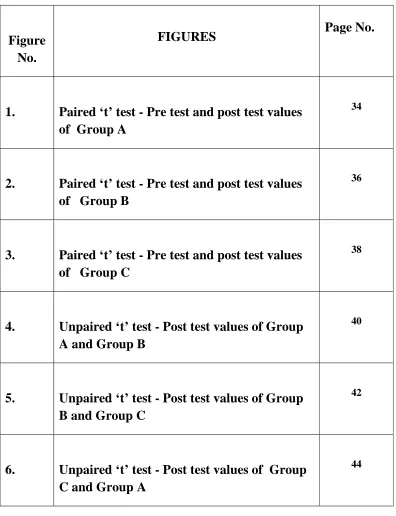
Figure No. FIGURES Page No.1. Paired ‘t’ test - Pre test and post test values of Group A
34
2. Paired ‘t’ test - Pre test and post test values of Group B
36
3. Paired ‘t’ test - Pre test and post test values of Group C
38
4. Unpaired ‘t’ test - Post test values of Group A and Group B
40
5. Unpaired ‘t’ test - Post test values of Group B and Group C
42
6. Unpaired ‘t’ test - Post test values of Group C and Group A
44
I. INTRODUCTION
Hamstring is the common muscle which undergoes for adaptive
shortening comparing with other major muscle groups.
Hamstring refers to the three posterior thigh muscles or to the tendons
that make up the borders of the space behind the knee. They usually refer to the
posterior thigh muscle or the tendons of the semitendinosus, semimembranosus
and biceps femoris. The three muscles of the posterior thigh will flex the knee
while all but the short head of biceps femoris extend the hip.
Tight hamstring affect posture, gait, and the way that the body moves
during exercise. Hamstring tightness occurs due to immobilization of a tissue in
a shortened position which results in decreased elasticity of normal tissue, a
change in the length tension relationship of the muscle and loss of flexibility.
Flexibility, weakness and neuro muscular control are the primary
contributing factors that lead to the hamstring tightness. Frequency and duration
of muscle stretching may interfere with improvement of flexibility. The reduced
flexibility involve biomechanical, neurological and molecular changes.
A lack of flexibility in the hamstring muscles will contribute to any
hamstring problem or can be the cause of problem. When the hamstring
Tight hamstrings pull the pelvis and hips out of their natural alignment,
compromising posture as result, the back flattens and losing some of its natural
curve.
The loss of flexibility can also cause pain arising from muscle, connective
tissue or periosteum. (Hardy 1989, Tillman and Cummings 1992)
Lack of motion also results in increased cross bonding or adherence
between collagen fibres (Cummings and Tillman, 1992)
If hamstring become evenly tight, they become much more prone to
injury and also because of the length tension relationship with the quadriceps,
the knee joint can become unbalanced and more likely to develop osteoarthritis.
Loss of flexibility of hamstrings may lead to decrease in lumbar lordosis,
reduction of muscle strength, and quadriceps dysfunction during gait.
Physiotherapy management for improving flexibility of hamstrings includes
static stretching, ballistic stretching, mulligans traction straight leg raise, muscle
energy technique, ultrasound therapy and short wave diathermy along with
stretching exercises. These techniques were significant in improving the
hamstrings flexibility.
Stretching techniques such as cyclic stretching and static stretching have
Gains in flexibility are dependent as the duration of stretching position
and researcher show the best “stretch – hold position” is 30 seconds (Bandy
1994)
(Feland et al 2001) reported that longer hold times during stretching of
the hamstring muscles resulted in a greater rate of gains in range of motion.
With regard, to important role of hamstring flexibility, restoration of its normal
length is necessary. In this reason, different methods such as ultrasound therapy
and stretching were studied ( Guffy and Kuaust 1997 )
Researchers were emphasised on the thermal effects of continuous
ultrasound compared to other heating modalities in increasing flexibility
(Lehmann et al 1968; Sonnen1997)
(Falconer et al 1992) showed that ultrasound increases soft tissue
extensibility and may be an effective adjunct in the treatment of knee
contractures secondary to connective tissue shortening.
The muscle energy technique is claimed to be effective for a variety of
purposes including lengthening a shortened muscles, as a lymphatic or venous
(Bourdillonj 1998) suggested that muscle energy technique may be
useful, where muscle shortening is the primary factor. The restrictions which
taken place as a result of tight, shortened muscles is usually accompanied by
1.1 NEED FOR STUDY
According to the previous literature, muscle energy technique,
ultrasound therapy with active static stretching, passive static stretching were
significant in improving the hamstring flexibilty in individuals with hamstring
tightness. But there was no study which compares the effect of muscle energy
technique and ultrasound therapy with active static stretching, passive static
stretching in improving the hamstring flexibility in individuals with hamstring
tightness.
1.2 STATEMENT OF THE PROBLEM
Effect of muscle energy technique and ultrasound therapy with active
static stretching, passive static stretching in improving the hamstring flexibility
in individuals with hamstring tightness.
1.3 AIM
To compare the effect of muscle energy technique and ultrasound therapy
with active static stretching, passive static stretching in improving the hamstring
1.4 OBJECTIVE OF THE STUDY
• To study the effect of muscle energy technique in improving the
hamstring flexibility in individuals with hamstring tightness.
• To study the effect of ultrasound therapy with active static stretching in
improving the hamstring flexibility in individuals with hamstring
tightness.
• To study the effect of passive static stretching in improving the hamstring
flexibility in individuals with hamstring tightness.
• To compare the effect of muscle energy technique and ultrasound therapy
with active static stretching, passive static stretching in improving the
hamstring flexibility in individuals with hamstring tightness.
1.5 KEY WORDS
Hamstring tightness
Muscle energy technique
Ultrasound therapy
Stretching
Hamstring flexibility
1.6 HYPOTHESIS
1.6.1 NULL HYPOTHESIS
There is no significant difference between the three different
physiotherapeutic interventions in improving hamstring flexibility in individuals
with hamstring tightness.
1.6.2 ALTERNATE HYPOTHESIS
There is significant difference between the three different
physiotherapeutic interventions in improving hamstring flexibility in individuals
II.REVIEW OF LITERATURE
HAMSTRING TIGHTNESS
¾ Kishner and Colby et al., (2002)
Stated that adequate mobility of soft tissues and joints is thought to be an
important factor in prevention of injury (or) reinjury to soft tissues.
¾ Andrew Kusiak., (2001)
Stated that flexibility is a key component for prevention of injury and
rehabilitation, stretching decreases injury and improves performance in
sports for overall fitness. Hamstring as one of the commonest muscles
often gets tight as the biomechanics of hamstrings are complex because
they pull over two joints - hip and knee. Therefore, their efficacy in
producing force at knee is dictated by the angle of hip joint. Greater
hamstring force is produced with hip in flexion when hamstring is
lengthened over joint, regardless of knee position (Andrew Kusiak
2001). Tight hamstrings can have profound effect on seated postural alignment. Posterior pelvic tilt is a primary effect, with resultant kyphotic
thoracic spine and stress on cervical spine either hyper extended or
tighter hamstrings. For example; if right hamstrings are tighter, the pelvis
will rotate towards left ( Jiawei Han, Micheline Kamber 2001 ).
Reduced hamstring muscle flexibility has been implicated in lumbar
spine dysfunction, with number of studies showing positive correlation
between decreased hamstrings, flexibility and low back pain
(Abraham Silberschatz, Henry Korth, Sudarshan S 2001).
¾ Pawlak Z., (1998)
Stated that muscle tightness is a limiting factor for optimal physical
performance and an important intrinsic factor for sports injury.
¾ Sarhmann.S et al., (1997)
Stated that muscle tightness and hypertonicity has a significant impact on
the neuromuscular control. Muscle tightness affects the normal length
tension relationship.
¾ Zachazewski et al.,(1989)
Stated that loss of flexibility of hamstring may lead to decrease in lumbar
lordosis, reduction of muscle strength and quadriceps dysfunction during
¾ Cummings, GS, Crutchfeld, CA, Barnes et al., (1983)
Stated that tightness is referred to mild shortening of a healthy
musculotendinous unit otherwise referred to as a mild transient
contracture. A muscle that is “tight” can be lengthened to all but the outer
limits of its range. Normal individual who do not regularly participate in
a flexibility program can develop mild myostatic contractures or
tightness, particularly in two joint muscles such as hamstrings, rectus
femoris or gastronemius.
MUSCLE ENERGY TECHNIQUE
¾ Ahmad Faheem, Ahmad Shamin,et al., (2010)
Conducted a study to compare the impact of muscle energy technique and
eccentric training on popliteal angle/hamstring flexibility in Indian
collegiate males. Twenty Indian collegiate males with age between 18-25
years, having tightness in hamstring muscles were included in the study.
Hamstring tightness was measured by popliteal angle/active knee
extension test. One group was treated with muscle energy technique and
the other with eccentric training. They concluded that muscle energy
technique using post isometric relaxation resulted in maximum
¾ Wassim M et al., (2009)
Studied the efficacy of muscle energy technique on hamstring muscles
flexibility in normal Indian collegiate males. Hamstring muscle flexibility
was measured active knee extension test. They concluded that muscle
energy technique is significantly improving the hamstring flexibility in
collegiate males.
¾ Azadeh Shadmehr, Mohmmed Reza Hadian, Sedigheh Sadet Naiemi, Shohreh Jalaie et al.,(2009)
Concluded that the hamstring stretches in normal young women using
either static stretch or muscle energy technique had similar effects on
restoring flexibility to hamstrings.
¾ JishaThampi et al., (2007)
Stated that post isometric relaxation and static stretching are effective in
reducing the hamstring tightness. When both groups are compared post
¾ Ching shan anita et al, (2003)
Stated that muscle energy technique appeared to be more effective than
passive stretching for increasing hamstring extensibility immediately post
treatment and still at 1 hour later.
¾ Ballantyne F, Fryer G, MC.Laughlin P et al., (2003)
Conducted a study to find the effectiveness of muscle energy technique
in increasing passive knee extension and to explore the mechanism
behind any observed change. Forty asymptomatic subjects between the
age of 18 to 45 years were randomly allocated to experimental and
control group. Experimental group was given with muscle energy
technique and Control group was given with no treatment. They
concluded that muscle energy technique produced an immediate increase
in passive knee extension. This observed change is due to an increased
tolerance to stretch.
¾ Feland J et al (2001), Mehta M et al (2002)
Stated that muscle energy technique has been shown to improve muscle
¾ Chaitow, L, Clark, MA, Ellerin, BE, Heflet, D et al,(1999),(2001)
Stated that muscle energy techniques are manipulative procedures that
have evolved out of osteopathic medicine and are designed to lengthen
muscle and fascia and mobilise joints. The procedures employ voluntary
muscle contraction by the patient in a precisely controlled direction and
intensity against a counterforce applied by the practitioner, Because
principle of neuromuscular inhibition are incorporated into this approach,
another term used to describe these techniques is post isometric
relaxation.
¾ Lewit, Libenson, Murphy et al., (1999)
Stated that post isometric relaxation is an excellent technique for treating
neuromuscular component muscle of a stiff, shortened or tight muscle.
¾ Chaitow L, Liebenson CL et al., (1997)
Stated that muscle energy technique have the ability to relax over active
muscles or stretch tight muscles and their associated fascial components
when connective tissue or visco elastic changes have occurred.
¾ Chaitow L et al., (1997)
Stated that the isometric contraction should be held for 10 seconds. This
tendon organ, which has a neurophysiologic inhibitory effect on the
muscle spindle, this provides the opportunity to take the muscle into a
new range of motion. Following the isometric contraction, there is a
latency period of approximately 25 to 30 seconds, during which the
muscle can be stretched.
¾ Bandy et al., (1997)
Identified that 30 seconds as the optimal duration for an effective stretch
Muscle energy technique which can maintain muscle elongation for this
duration may produce increased muscle length by a combination of creep
and plastic change in the connective tissues. (Fryer G 2000, Ross A
Clark 2008) An increase in flexibility after muscle energy technique (MET) occurred due to biomechanical or neuro-physiological changes or
due to an increase in tolerance to stretching (Freyer G. et al 2000,
Richard L, et al 1993)
¾ Lederman E., (1997)
Stated that passive stretching a muscle principally stretches the
connective tissue elements arranged parallel with the muscle fibres. It
has been proposed that when the stretched muscle isometrically
tougher “in series” connective tissue elements, which are not normally
tensioned by passive stretch. Thus post isometric relaxation may
principally be a biomechanical event: a combination of viscoelastic creep
and plastic change in parallel and series connective tissue elements of the
muscle, above and beyond that obtained by passive stretch.
¾ Kuchera & Kuchera (1992), Denslow et al., (1993)
Stated that effect of muscle energy technique may result from the
inhibitory golgi tendon reflex, activated during the isometric contractions
that leads to reflex relaxation of the muscle, as a result of post isometric
relaxation (PIR).
¾ Lewit et al (1999), Greenman et al.,(1989)
Suggested that in muscle energy technique, the holding time of 7-10
seconds is more effective than 3-5 seconds.
¾ Chaitow L,(19970, Evjenth O (1984), Holt LE et al., (1976)
Stated that muscle energy techniques are manually applied stretching
technique that use principles of neurophysiology of relax over active
muscles and / or stretch chronically shortened muscles. In autogenic
a brief latent period. Measurements of the Hoffman reflex ( representative
of the excitability of the alpha motor neuron pool ) show that activity is
decreased for 25 to 30 seconds following muscle energy technique,
whereas inhibition from static stretching lasts only 3 to 5 seconds. These
effects are neurophysiologically mediated (Michael A Clark,2007)
ULTRASOUND THERAPY WITH ACTIVE STATIC STRETCHING
¾ Meroni R, Cerri CG, Lanzarini C, Barindelli G, Morte GD, Gessaga V, Cesana GC, De Vito G et al., (2010)
compared the effect of passive and active stretching technique on
hamstring flexibility of healthy subjects. Hamstring flexibility was
assessed by active knee extension test. They concluded that active
stretching showed greater gain in hamstring flexibility than passive static
stretching group.
¾ Shadmehr a, Astaneh H N et al., (2009)
Studied the effect of continous versus pulsed mode of ultrasound therapy
on flexibility of short hamstrings in young healthy male population. They
effective than non thermal properties of pulsed ultrasound for increasing
flexibility of shortened hamstring.
¾ Nichole Lee Lounsberry et al.,(2008)
Stated that the ultrasound treatment produced greater immediate gains in
hamstring extensibility than moist heat packs treatment.
¾ Buker N., Aslan E., Kitis A., Carluk U et al.,(2008)
Stated that the superficial (or) deep heat applications before static
stretching exercises showed positive effects to increasing flexibility of
hamstring muscles.
¾ A.Akbari, H.Moodi, A.A.Moein and R.Nazok et al., (2006)
Stated that the gains in range of passive knee extension obtained in
continuous therapeutic ultrasound and 30 seconds stretch group were
significantly greater than continous therapeutic ultrasound and 15 seconds
¾ Winstein, C, Iyer MB, Mitz AR et al, (2004)
Stated that when tension develops in a muscle the golgi tendon organ
fires and inhibits alpha motor neuron activity thereby decreases tension in
the muscle tendon unit being stretched. If a low intensity, slow stretch
force is applied to muscle, the stretch reflex is less likely to be activated
as the golgi tendon organ fires and inhibits tension in muscle, allowing
the parallel elastic component ( the sarcomeres ) of the muscle to remain
relaxed and lengthen
¾ Odunaiya N.A, Hamzat T.K, Ajayi O et al., (2004)
Stated that statically stretching tight hamstrings for any duration between
15 and 120 seconds on alternate days for six weeks would significantly
increase its flexibility. The effect was also sustained for upto 7 days post
intervention.
¾ Draper, DO, Castro, JL, Feland B, Richard, MD et al, (2004)
Stated that, superficial heat such as hot packs, paraffin or deep heating
modalities such as ultrasound, short wave diathermy provide different
mechanism to heat tissues. These thermal agents are used primarily to
heat small areas such as individual joints, muscle group, or tendon and
¾ TraeSakiyoTashiro et al., (2003)
Stated that the clinically practical parameters of thermal ultrasound in
conjunction with active static stretching is an effective way of increasing
hamstring extensibility but ultrasound application location didn’t showed
difference in increasing knee extension range of motion in a healthy
population.
¾ Mitchell FL., (1993)
Stated that warming up soft tissue prior to stretching is a common
practice in rehabilitation and fitness programs. It is well documented in
human and animal studies that as increase in intramuscular temperature
increases the extensibility of contractile and noncontractile soft tissues
(Knight KL 1989, Wessling KC et al 1987). Warming up prior to exercise reduces postexercise muscle soreness and the risk of injury to
soft tissues (Zachazewski JE 1990).
¾ Folconer et al., (1992)
Stated that ultrasound increases soft tissue extensibility and may be an
effective adjunct in the treatment of knee contractures secondary to
¾ Gordon and Ghez et al.,(1991)
Stated that active static stretching may be effective in increasing the
length of muscle due to the prolonged stretching which allows the muscle
spindle to adapt over time and cease firing.
¾ Low and Reed et al.,(1990), Dyson et al.,(1987)
Stated that low absorption of ultrasound waves is seen in tissues that are
in water content (eg.,fat), whereas absorption is higher in tissues rich in
protein (e.g., skeletal muscle).
¾ Ziskin et al., (1986)
Stated that an increasing in tendon length following continuous
ultrasound therapy is due to change of their viscosity and plasticity.
¾ Coakley et al.,(1978)
Stated that ultrasound at a frequency of 1MHZ is absorbed primarily by
tissues at a depth of 3 to 5cms and is therefore recommended for deeper
injuries and in patients with more subcutaneous fat.
Elevation of collagen tissue temperature affects on the mechanical and
collagen. Thus, pain and discomfort was reduced during stretching and
collagen fiber ability to tolerate greater forces was increased.
¾ Lehman et al., (1968)
Emphasized on the thermal effects of continuous ultrasound compared to
other heating modalities in increasing hamstring flexibility.
PASSIVE STATIC STRETCHING
¾ Carolyn Kisner and Lynn Allen Colby., (2007)
Stated that, if a slow stretch force applied to muscle, the golgi tendon
organ fire and inhibits the tension in the muscle, allowing the parallel
elastic component (the sarcomere ) of the muscle to lengthen.
¾ Odunaiyan.A., Hamzatt.k., et al.,(2005)
The study shows that statically stretching tight hamstrings for any
duration between 15 and 120 seconds on alternate days for 6 weeks
¾ A.P. Marques, A.A.P. Vasconcelos, et al., (2001)
Stated that stretching exercises performed three times a week were
sufficient to improve flexibility and range of motion compared to subjects
exercising once a week, with results similar to those of subjects who
exercised five times a week.
¾ WD Bandy.,(1994)
Suggested that duration of 30 seconds is an effective time of stretching
for enhancing the flexibility of the hamstring muscles.
¾ Bandy,WB, Irion,JM et al (1994)
Carried out daily stretching of the hamstring muscle for 15, 30, or 60
seconds they determined that 30 and 60 second stretches increased range
of motion more than a 15 second stretch but there was no significant
difference in the effectiveness of 30 and 60 second stretches.
¾ Gaidosik et al .,(1991)
Stated that static stretching increased straight leg raise with concomitant
increases in the maximal hamstring length and the maximal resistance to
ACTIVE KNEE EXTENSION TEST
¾ C.M. Norris et al.,(2005)
Stated that active knee extension test along with goniometry, accurate
surface making and manual monitoring of the test leg is a reliable
measure of hamstring muscle length.
¾ M.Mathews et al.,(2005)
Stated that active knee extension test represents maximum length of the
hamstring muscles.
¾ Denise M. Cameron, Richard W. Bohannon et al.,(1985)
Stated that active knee extension test is said to be a useful alternative test
to the straight leg raise test for providing an indication of hamstring
muscle length.
¾ Gajdosik R.L et al.,(1983)
Stated that active knee extension test produces high reliability co-efficient
III. METHODOLOGY
3.1 STUDY DESIGN:
Pre test and post test experimental group study design.
3.2 STUDY SETTING:
Study will be conducted at Physiotherapy Out Patient Department, KG College
of Physiotherapy, Coimbatore.
3.3 STUDY DURATION:
Total duration was one year. Each individual received the treatment for the
duration of two weeks.
3.4 POPULATION STUDIED
45 individuals with hamstring tightness who fulfilled the predetermined
inclusive and exclusive criteria were selected and divided into 3 experimental
group by simple random sampling method. Each group consists of 15 patients.
3.5 CRITERIA FOR SELECTION
3.5.1 INCLUSIVE CRITERIA:
¾ Age between 18 to 25 years
¾ Both males and females
¾ Normal individuals with tight hamstrings ( inability to achieve
greater than 160° knee extension with hip at 90° flexion)
3.5.2 EXCLUSIVE CRITERIA:
¾ Acute or chronic low back pain.
¾ Acute or chronic hamstring injury.
¾ Soft tissue injuries around knee.
¾ Pregnancy.
¾ Metal implants in lower extremity.
3.6 VARIABLES:
3.6.1 INDEPENDENT VARIABLES:
¾ Muscle energy technique.
¾ Ultrasound therapy with Active Static stretching.
¾ Passive Static Stretching.
3.6.2 DEPENDENT VARIABLES:
¾ Hamstring flexibility.
3.7 PARAMETERS:
¾ Hamstring flexibility
3.8
MEASUREMENT TOOLS:3.9
PROCEDURE GROUP AMUSCLE ENERGY TECHNIQUE
Technique used: Post isometric relaxation
Individual’s position: Supine lying
Ask the individual to assume supine position. Therapist flexes the affected
hip fully and then extends the flexed knee with the back of lower leg resting on
the shoulder of the therapist who stands facing the head of the table. Individual
is asked to flex ie.causing downward pressure against the therapists shoulder
with back of lower leg at the same time therapist resist the individual voluntary
effort so that, slight isometric contraction of hamstrings develops and
individuals hold this for 10 seconds, after this effort, the individual is asked to
exhale and relax the muscle completely. Then the therapist takes the muscle to
its new restriction barrier without stretch. Starting from its new barrier, the same
procedure is repeated two or three more times.
Frequency of Treatment: Once in a day
GROUP B
ULTRASOUND THERAPY WITH ACTIVE STATIC STRETCHING
ULTRASOUND THERAPY
Individual’s position: Prone lying
Parameters
Frequency: 1MHZ
Mode: Continuous
Intensity: 2 W/cm²
Area of application: Hamstring area
Duration: 5 minutes daily
Frequency of treatment: Once in a day
Treatment duration: Two weeks
ACTIVE STATIC STRETCHING
TECHNIQUE USED
Active static stretching
INDIVIDUALS POSITION
PROCEDURE
Individual was asked to perform the hamstring stretch by standing erect
with foot planted on the floor and toes pointing forward. The heel of the foot to
be stretched is placed on a plinth with toes directed towards ceiling. Individual
then flexed forward at the hip, maintaining the spine in neutral position while
reaching the arms forward.
The subjects is continued to flex the hip until a gentle stretch is felt in the
posterior thigh. Then hold this position for 30 seconds and then relax for 10
seconds and repeat the same procedure for three more times a day.
Frequency of treatment: Once in a day
Treatment duration: Two weeks.
GROUP C
PASSIVE STATIC STRETCHING
Individual was asked to relax, and therapist flexed the individual’s hip and
extended their knee until the point of maximum stretch tolerance of their
hamstring muscle. This was held for 30 seconds and then placed back into a
neutral position.
Frequency of treatment: Once in a day
3.10 STATISTICAL TOOLS
Analysis of variance (ANOVA):
Analysis of variance is a statistical technique specially designed to test
whether the means of more than two quantitative populations are equal.
The basic principle of ANOVA is to test for differences among the means of the
populations by examining the amount of variations within each of these
samples, relative to the amount of variation between the samples.
Formula:
Where, S12 is
S22 is
IV.DATA ANALYSIS AND INTERPRETATION
TABLE-I
ANOVA
One way ANOVA for pre test values of hamstring flexibility between and within all groups
TABLE-II
ANOVA
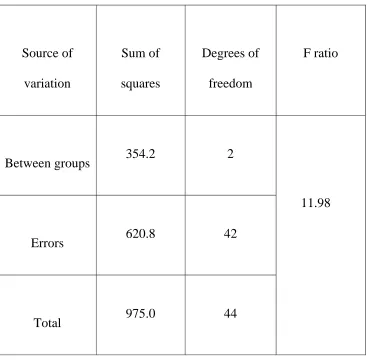
One way ANOVA for post test values of hamstring flexibility between and within all groups
TABLE-III
PAIRED‘t’ TEST
PRE TEST AND POST TEST VALUES OF GROUP A
GROUP A - MUSCLE ENERGY TECHNIQUE
HAMSTRING FLEXIBILITY – ACTIVE KNEE EXTENSION
S.NO
GROUP A MEAN
STANDARD DEVIATION
‘t’ VALUE
1. Pre test 134 3.67
21 .0
GRAPH I
GRAPHICAL REPRESENTATION OF PRE AND POST TEST VALUES OF GROUP A (MUSCLE ENERGY TECHNIQUE)
TABLE-IV PAIRED‘t’ TEST
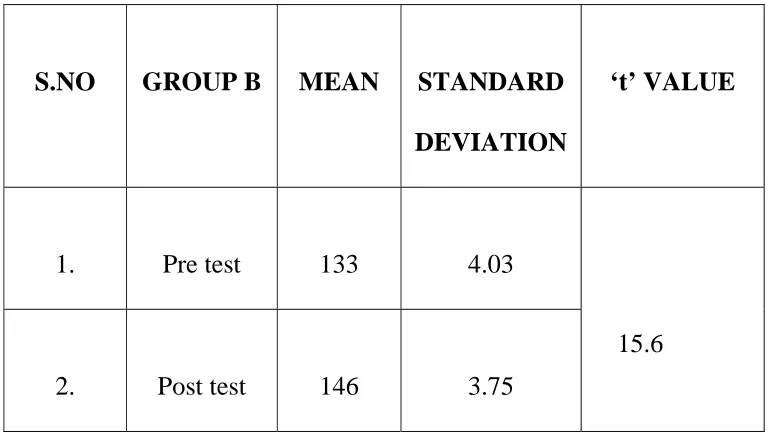
PRE TEST AND POST TEST VALUES OF GROUP B
GROUP B - ULTRASOUND THERAPY WITH ACTIVE STATIC STRETCHING
HAMSTRING FLEXIBILITY – ACTIVE KNEE EXTENSION
.
S.NO GROUP B MEAN STANDARD DEVIATION
‘t’ VALUE
1. Pre test 133 4.03
15.6
GRAPH II
GRAPHICAL REPRESENTATION OF PRE AND POST TEST VALUES OF GROUP B (ULTRASOUND THERAPY WITH STATIC STRETCHING)
TABLE-V
PAIRED‘t’ TEST
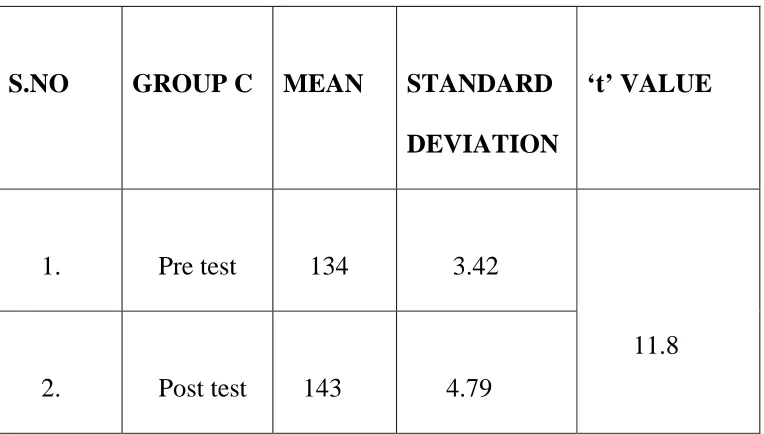
PRE TEST AND POST TEST VALUES OF GROUP C
GROUP C- PASSIVE STATIC STRETCHING
HAMSTRING FLEXIBILITY – ACTIVE KNEE EXTENSION
S.NO GROUP C MEAN STANDARD DEVIATION
‘t’ VALUE
1. Pre test 134 3.42
11.8
2. Post test 143 4.79
GRAPH- III
GRAPHICAL REPRESENTATION OF PRE AND POST TEST VALUES OF GROUP C (PASSIVE STATIC STRETCHING)
TABLE-VI
UNPAIRED‘t’ TEST
POST TEST VALUES OF GROUP A AND B
HAMSTRING FLEXIBILITY – ACTIVE KNEE EXTENSION
S.NO GROUPS MEAN STANDARD DEVIATION
‘t’ VALUE
1. Group A 146 3.75
3.07
GRAPH-IV
GRAPHICAL REPRESENTATION OF POST TEST VALUES FOR GROUP A AND GROUP B:
TABLE-VII
UNPAIRED‘t’ TEST
COMPARISON BETWEEN THE POST TEST VALUES OF GROUP B AND C
HAMSTRING FLEXIBILITY – ACTIVE KNEE EXTENSION
S.NO GROUPS MEAN STANDARD DEVIATION
‘t’ VALUE
1. Group B 143 4.79
2.04
2. Group C
GRAPH- V
GRAPHICAL REPRESENTATION OF POST TEST VALUES FOR GROUP B AND GROUP C:
TABLE-VIII UNPAIRED‘t’ TEST
COMPARISON BETWEEN THE POST TEST VALUES OF GROUP C AND A
HAMSTRING FLEXIBILITY – ACTIVE KNEE EXTENSION
S.NO GROUPS MEAN STANDARD DEVIATION
‘t’ VALUE
1. Group C 143 4.79
4.83
GRAPH-VI
GRAPHICAL REPRESENTATION OF POST TEST VALUES FOR GROUP C AND GROUP A:
V.ANALYSIS OF RESULTS
:
45 individuals with hamstring tightness were divided into three groups.
Group A were treated with muscle energy technique. Group B were treated with
ultrasound with active static stretching and group C with passive static
stretching. Hamstring flexibility was measured by active knee extension test.
Statistical analysis was done by using one way analysis of variance
(ANOVA) and Student‘t’ test. One way analysis of variance (ANOVA) was
done to find out any variance between the groups and within all samples in all
three groups. Paired ‘t’ test was used to find out the improvement within the
group. Unpaired ‘t’ test was used to find out the difference between the groups.
One way analysis of variance (anova)
Pre test values of hamstring flexibility between and within all groups
The observed F ratio for analyzing the variance between the groups in the
critical region (critical value) is 3.22. This is lesser than calculated value of
0.1465. So there is no significant difference in hamstring flexibility between the
Post Test Values Of Hamstring Flexibility Between And Within All Groups
The observed F ratio for analyzing the variance between the groups in the
critical region (critical value) is 3.22. This is greater than calculated value of
11.98. So there is a significant difference in improving hamstring flexibility
between the groups after the application of treatment intervention.
Paired‘t’ test:
Group A – Muscle Energy Technique
Using Paired‘t’ test with 14 degrees of freedom and 5% at level of
significance, the calculated ‘t’ value is 21.0 which is greater than table ‘t’ value
1.761.This test showed that there is a significant effect of muscle energy
technique in improving the hamstring flexibility in individuals with hamstring
tightness.
GROUP B – Ultrasound Therapy With Active Static Stretching
Using Paired‘t’ test with 14 degrees of freedom and 5% at level of
significance, the calculated ‘t’ value is 15.6 which is greater than table ‘t’ value
with active static stretching in improving the hamstring flexibility in individuals
with hamstring tightness.
GROUP C – Passive Static Stretching
Using Paired‘t’ test with 14 degrees of freedom and 5% at level of
significance, the calculated ‘t’ value is 11.8 which is greater than table ‘t’ value
1.761. This test showed that there is a significant effect of passive static
stretching in improving the hamstring flexibility in individuals with hamstring
tightness.
Unpaired‘t’ test:
(a) Comparing post test values of active knee extension test between Group A and Group B:
Post test values of Group A and Group B is analysed by Unpaired‘t’ test.
The calculated‘t’ value is 3.07 which is lesser than table‘t’ value 1.701 at 5%
level of significance. This test showed that there is no significant difference
between the effect of muscle energy technique and ultrasound therapy with
active static stretching in improving hamstring flexibility in individuals with
hamstring tightness.
Post test values of Group B and Group C is analysed by Unpaired‘t’ test.
The calculated‘t’ value is 2.04 which is greater than table‘t’ value 1.701 at 5%
level of significance. This test showed that there is a significant difference
between the effect of ultrasound therapy with active static stretching and
passive stretching in improving hamstring flexibility in individuals with
hamstring tightness.
(c) Comparing post test values of active knee extension test between Group C and Group A:
Post test values of Group C and Group A is analysed by unpaired‘t’ test.
The calculated‘t’ value is 4.83 which is greater than table‘t’ value 1.701 at 5%
level of significance. This test showed that there is a significant difference
between the effect of passive static stretching and muscle energy technique in
improving hamstring flexibility in individuals with hamstring tightness.
VI. DISCUSSION
This study was done to find out the effect of three different
physiotherapeutic interventions in improving hamstring flexibility in individuals
with hamstrings tightness.
45 subjects who fulfilled inclusive and exclusive criteria were selected and
divided into 3 groups as 15 in each group. Group A underwent muscle energy
technique, Group B underwent ultrasound therapy with active static stretching,
and Group C underwent passive static stretching. Hamstring flexibility was
measured by using active knee extension test.
Statistical analysis was done by using one way analysis of variance (ANOVA),
unpaired ‘t’ test and paired ‘t’ test.
One way analysis of variance (ANOVA) was done to find out any
variance between the groups and within all the samples in all the three groups.
One way ANOVA for pretest values of hamstrings flexibility showed that there
was no significant difference between and within the three groups in improving
hamstrings flexibility. One way analysis of variance (ANOVA) for post test
between and within the three groups in improving hamstring flexibility in
individuals with hamstrings tightness.
Further in this study, Paired‘t’ test was used to find out improvement within the
group and Unpaired ‘t’ test was used to compare the effect between the two
groups.
In group A, Paired‘t’ test showed that there was significant effect of
muscle energy technique in improving hamstring flexibility in individuals with
hamstrings tightness. This result was consistent by previous studies as follows
Postisometric relaxation may principally be a biomechanical event: a
combination of viscoelastic creep and plastic change in parallel and series
connective tissue elements of the muscle, above and beyond that obtained by
passive stretch. Lederman E 1997.
Effect of muscle energy technique may result from the inhibitory golgi tendon
reflex, activated during the isometric contractions that leads to reflex relaxation
of the muscle, as a result of post isometric relaxation (PIR). Kuchera & Kuchera
1992, Denslow 1993 et al.
Muscle energy technique using post isometric relaxation resulted in maximum
improvement as compared to eccentric training on hamstring flexibility. Ahmad
Muscle energy technique is significantly improving the hamstring flexibility in
normal Indian collegiate males.Wassim M et al 2009.
In group B, Paired‘t’ test showed that there was significant effect of ultrasound
therapy with static stretching in improving hamstring flexibility in individuals
with hamstrings tightness. This result was consistent by previous studies as
follows
Increasing in tendon length following continuous ultrasound therapy is due to
change of their viscosity and plasticity (Ziskin et al 1986). Active static
stretching may be effective in increasing the length of muscle due to the
prolonged stretching which allows the muscle spindle to adapt over time and
cease firing. Gordon and Ghez et al 1991.
The gains in range of passive knee extension obtained in continuous therapeutic
ultrasound and 30 seconds stretch group were significantly greater than
continuous therapeutic ultrasound and 15 seconds stretch group in subjects with
tight hamstrings. A.Akbari, H.Moodi, A.A.Moein and R.Nazok et al 2006.
In group C, Paired‘t’ test showed that there was significant effect of passive
static stretching in improving hamstring flexibility in individuals with
¾ If a slow stretch force applied to muscle, the golgi tendon organ
fire and inhibits the tension in the muscle, allowing the parallel elastic
component ( the sarcomere ) of the muscle to lengthen. Carolyn Kisner
and Lynn Allen Colby., 2007
Daily stretching of the hamstring muscle was carried out for 15,30, or 60
seconds, it was determined that 30 and 60 second stretches increased range of
motion more than a 15 second stretch but there was no significant difference in
the effectiveness of 30 and 60 second stretches. Bandy, WB, Irion, JM et
al1994.
When comparing the posttest values of group A and B by using Unpaired‘t’ test.
The results showed that there was significant difference between the effect of
group A and B in improving hamstring flexibility. So muscle energy technique
is better than ultrasound therapy with active static stretching in improving
hamstring flexibility in individuals with hamstrings tightness. This may be due
to Muscle energy techniques are manually applied stretching technique that use
principles of neuro physiology to relax over active muscles and / or stretch
chronically shortened muscles. In autogenic inhibition after a muscle contracts
it is automatically in a relaxed state for a brief latent period. Measurements of
the Hoffman reflex (representative of the excitability of the alpha motor neuron
energy technique, whereas inhibition from static stretching lasts only 3 to 5
seconds. These effects are neurophysiologically mediated.Chaitow L,1997
Evjenth O Holt LE, et al 1984. An increase in flexibility after muscle energy
technique (MET) occurred due to biomechanical or neuro-physiological
changes or due to an increase in tolerance to stretching. Freyer G. et al 2000,
Richard L, et al 1993.
When comparing the posttest values of group B and C by using unpaired‘t’ test.
The results showed that there was significant difference between the effect of
group B and C in improving hamstring flexibility. So ultrasound therapy with
active static stretching is better than passive static stretching in improving
hamstring flexibility in individuals with hamstrings tightness.
Elevation of collagen tissue temperature affects on the mechanical and physical
characteristics of tissues and facilitates deformation of the collagen. Thus, pain
and discomfort was reduced during stretching and collagen fiber ability to
tolerate greater forces was increased.Coakley 1978.Emphasized on the thermal
effects of continuous ultrasound compared to other heating modalities in
increasing hamstring flexibility Lehman et al 1968.Active static stretching
showed greater gain in hamstring flexibility than passive static stretching group.
Meroni R, Cerri CG, Lanzarini C, et al 2010.
When comparing the posttest values of group A and C by using unpaired‘t’ test.
group A and C in improving hamstring flexibility. So muscle energy technique
is better than passive static stretching in improving hamstring flexibility in
individuals with hamstrings tightness. Muscle energy technique has been shown
to improve muscle extensibility than passive static stretching both in the short
and long term. Feland J et al 2001, Ferber R et al 2002, Mehta M et al 2002.
Passive static stretching fire the golgi tendon organ and inhibits the tension in
the muscle, allowing the parallel elastic component (the sarcomere ) of the
muscle to lengthen. Where the ultrasound therapy with active static stretching
elevates the collagen tissue temperature and increases the extensibility of the
soft tissues.
In case of muscle energy technique, effects are neurophysically mediated.
Following muscle energy technique, alpha motor neuron pool excitability was
decreased for 25 to 30 seconds during which the muscle can be stretched or
taken to new restriction barrier whereas inhibition from static stretching lasts
only 3 to 5 seconds. Therefore an increase in muscle length may be due to
biomechanical event: a combination of viscoelastic creep and plastic change in
parallel and series connective tissue elements of the muscle, neurophysiological
changes, increase in tolerance to stretching.
This study concluded that muscle energy technique is better than ultrasound
therapy with active static stretching and passive static stretching improving
VII. SUMMARY AND CONCLUSION
The aim of this study was to compare the effect of three different
physiotherapeutic interventions in improving hamstring flexibility in
individuals with hamstring tightness.
45 subjects were selected in the age group between 18 to 25 years after
due consideration of inclusion and exclusion criteria. The subjects were allotted
into three groups.
Group A received muscle energy technique group B received ultrasound
therapy with active static stretching and group C received passive static
stretching. Hamstring flexibility was measured by active knee extension test.
The values of outcome measures were recorded before the beginning of
treatment regime and at the end of treatment regime.
Statistical analysis was done by using student‘t’ test and one way analysis
of variance, Paired‘t’ test was used to find out the improvement within the
and one way analysis of variance was used to find out any variance between the
groups and within all samples in all three groups.
The results showed that there was a significant difference between muscle
energy technique, ultrasound therapy with active static stretching and passive
static stretching in improving hamstring flexibility in individuals with hamstring
tightness.
This study concluded that muscle energy technique is more effective than
ultrasound therapy with active static stretching and passive static stretching in
VIII. LIMITATIONS AND RECOMMENDATIONS
¾ Sample studied was small and the study reduces the generalising ability
therefore study with a much larger population is recommended.
¾ This is a short term study, a long term study is necessary to make the
results valid
¾ Hamstring flexibility can also recorded by passive knee extension test.
¾ Study can be aimed to find out the effect of muscle energy technique with
the other modalities such as hot pack, short wave diathermy and other
interventions such as proprioceptive neuromuscular facilitation
techniques, eccentric training, for further research.
¾ Follow up study can be conducted in order to find out lasting effect of the
IX.BIBLIOGRAPHY
JOURNALS:
Andrew Kusiak. Rough Set Theory: A Data Mining Tool for Semiconductor Manufacturing. IEEE Transactions on Electronics
Packaging Manufacturing 2001; 24(1):44-50.
Abraham Silberschatz, Henry Korth, Sudarshan S. Database System Concepts, Database Books. McGraw-Hill.
Azadeh Shadmehr, Mohd Reza Haidian, Sedigheh Sadat, Naiemi, Shohreh Jalaie, Hamstring flexibility in young women following passive stretch and muscle energy technique, Department of Physical Therapy,Shahid Beheshty University of medical science, Tehran.2009;Vol 22,No
3,143-148.
A pilot study, The effects of active release technique on hamstring flexibility; Journal of Manipulative Physiological Therapeutics, 2009,Vol 29, Issue 3.
group on passive knee extension, Journal of medical science, 2006; 6(6);
968-973.
Buker N, Aslan E, Altug F, Kitis A,Carluk U., The effect of two different physiotherapy method [superficial (or) deep heat applicationsbefore static stretching exercises]on hamstring muscle flexibility, Journal
of Romanion Sports Medicine Society; 2008, Vol 16.
Bandy.W.J., and J.M.Irion., M.Briggler., The effect of static stretching on the flexibility of hamstring muscles, Physical therapy;1994,74,845-850.
Denise M. Cameron, Richard W. Bohannon, Relationship between active knee extension test and active straight leg raise test measures,Physical therapy, 1985,65,1478-1482.
Feland J.B.,J.W.Myrev and S.S.Schulthies,. The effect of duration of stretching of the hamstring muscle group for increasing range of motion,physical therapy., 2001, 81;1100-1117.
Gajdosik, R.L., Effect of static stretching on the maximal length and resistance to passive stretch of short hamstring muscles, journal of
orthopaedic and sports physical therapy, 1991, 14, 250-255.
Kottke FJ, The rationale for prolonged stretching for the correction of shortening of connective tissue, Archieves of Physical Medicine and
Rehabilitation, 1966, 345-352.
Mohd .Waseem, Shibili Nuhmani and C.S.Ram, The efficacy of muscle energy technique on hamstring muscle flexibility in normal Indian
collegiate males, Calicut Medical Journal 2009; (7) e4.
Meroni, Roberto PT; Cerri, Cesare Giuseppe MD, Lanzarin, Carlo, Guido, Comparison of Active Stretching Technique and Static StretchingTechnique on Hamstring Flexibility
;
Journal of Sport Medicine; 2010 -Vol 20 - Issue 1 , 8-14
.
Odunaiya N.A, Hamzat T.K., Ajayi O.F., The Effects of Static Stretch Duration on the Flexibility of Hamstring Muscles; Department of
Physiotherapy College of Medicine, University of Ibadan,2005.
Pawlak Z. Rough set theory and its applications to data analysis. Cybernetics and Systems 1998; 29: 661-688.
Robert JM.Wilson K., Effect of stretching duration on active and passive range of motion in lower extremity, British Journal of Sports
Medicine, 1999, 259-263.
Shadmehr A, Hadian M.R, Naimi S.S Jalaie S, Mokhtari A., The effect of muscle energy technique on flexibility of the short hamstring
Shadmehr.A., Astaneh.H.N., Continous vs pulsed ultrasound therapy on flexibility of short hamstring muscles, Tehran University of medicalscience,2009, 1310-1313.
Taylor DC, Dalton JD, Seaber AV, Garret W, viscoelastic properties of musle tendon units: The biomechanical effects of stretching. The
American Journal of Sports Medicine, 1990, 18(3), 300-309.
Wilkinson A, “stretching the truth” a review of literature on muscle stretching, Australian Journal of Physiotherapy, 1999, 283-287.
BOOKS:.
Anderson B, Stretching, Shella Publishing, Bolinas, California1980.
Carrie M. Hall, Lori Thein Brody, Therapeutic exercise – Moving toward function, Lippincott Williams and Wilkins, 1999.
Chaitlow L, Liebenson C, Muscle energy technique, 2nd edition, Donald R Murphy, London 2001, 95-106.
Cynthia C Norkin, D. Joyce White, Measurement of joint
motion-A guide to goniometry, 2nd edition, Jaypee Brothers Med
Elizabeth Domhalt, Physical Therapy Research Principles and Applications, WB.Saunders Company, Philadelphia, 1993.
Florence and Elizabeth, Kendell and Patrica, Muscle testing and function; Williams and Watkins 2003.
Greenman P, Principles of Manual Medicine. 3rd edition. Philadelphia: Lippencott Williams and Watkins; 2003.
Jagmohan Singh; Textbook of electrotherapy, 1st edition, Jaypee Brothers Med Publishers (P) Ltd, 2005, 226-246.
Krusen, Cole T.M, “Measurement of Musculoskeletal Functions”
Handbook of Physical Medicine and Rehabilitation, 3rd edition,
WB.Saunder Co.
Kothari C.R, Research Methodology, Methods and Technique 2nd edition, Vishva Prakasham, Newdelhi 2001.
Kisner,C and L.A. Colby, Therapeutic exercise foundation and
technique. 4th edition, Philadelphia, Davis FA Company, 2002,
171-216.
Low,J. and A.Reed, Electrotherapy Explained; Principles and
Practise ,1st edition .,Oxford, Butterworth, Heinemann,1990,
Lewit K; Manipulative Therapy in rehabilitation of the locomotor
system, 2nd edition, London. Butter worth, 1991; 30-32.
Mitchelle H.Cameron PT, OCS Physical Agents in Rehabilitation- Research to practice, WB.Saunders Company,
1999.
Pushpal Kumar Mitra, Handbook of practical electrotherapy, 1st edition, Jaypee Brothers med Publishers (P) Ltd, 2006.
R.S.N.Pillai, V.Bagavathi, Statistics theory and practise, S.Chand and Company Ltd, Newdelhi 1997.
Sheila Kitchen, Electrotherapy- Evidence based practise, WB.Saunders Company Ltd, 1996.
Travell, Janet and David Simons, myofascial pain and dysfunction, Baltimore; William and Wilkins, 1983, Vol 1, 1992,
Vol 2.
William E. Prentice, Michael L. Voight, Techniques in musculoskeletal rehab, McGraw- Hill, Newyork 2001.
X.APPENDIX
APPENDIX I
SUBJECTS’ PROFILE:
Name: Age: Sex:
Occupation:
Date of admission:
Chief complaints:
History:
Past medical history:
Present medical history:
Drug history:
Associated problems:
Pain history:
Site:
Side:
Onset:
Type:
Nature:
Intensity:
Frequency:
Aggravated factors:
Reliving factors:
Vital signs:
Temp:
Pulse:
Resp. Rate:
B.P:
ON OBSERVATION
Built:
Posture:
External Appliances:
Deformities:
Swelling:
Gait:
Skin changes:
Patient’s expression:
Patient’s attitude:
ON PALPATION:
Tenderness:
Warmth:
Oedema:
Pulse:
Trigger point:
Taut band:
ON EXAMINATION
Range of motion:
Region
Active ROM Passive ROM
Right Left Right Left
End feel:
Muscle power:
Muscle tightness:
Muscle girth:
Accessory movements:
Deep tendon reflex:
Sensation:
Limb length discrepancy:
Gait:
Deformity:
Functional assessment:
Special test:
Investigations:
Diagnosis:
Problem list:
Aims:
Means:
APPENDIX II
ACTIVE KNEE EXTENSION TEST
The subject was in supine position with hip flexed 90 degrees and knee
flexed. Pelvis was strapped down to the table for stabilization and controls the
accessory movements. The fulcrum of the goniometer was centered over the
lateral condyle of the femur with the proximal arm secured along the femur
using greater trochanter as a reference. The distal arm was aligned with the
APPENDIX III
CONSENT FORM
This is to certify that I ____________________________ freely and
voluntarily agree to participate in the study “ Comparison Of Three Different
Physiotherapeutic Interventions In Improving Hamstring Flexibility In Individuals With Hamstring Tightness”.
I have been explained about the procedures and the risks that would occur
during the study.
Participant:
Witness:
Date:
I have explained and defined the procedure to which the subject has
consented to participate.
Researcher:
Date: