Rochester Institute of Technology
RIT Scholar Works
Theses
Thesis/Dissertation Collections
6-1-1969
Genre Painting
Lydia Mugambi
Follow this and additional works at:
http://scholarworks.rit.edu/theses
This Thesis is brought to you for free and open access by the Thesis/Dissertation Collections at RIT Scholar Works. It has been accepted for inclusion
in Theses by an authorized administrator of RIT Scholar Works. For more information, please contact
.
Recommended Citation
title
page
title
of
thesis
Genre Painting
Author
LYDIA ZAWEDDE
MUGAMBI
Candidate
for
the
Master
ofFine
Arts
College
ofFine
andApplied
Arts
Rochester
Institute
ofTechnology
Date
ofSubmission
June
1,
1969
Adv i
sorsChairman,
Fred
Meyer
Osmond
Guy
AW
I I
DEDICATION
1 1 1
TABLE
OF
CONTENTS
T
i
1
1
eP
ag
ei
Dedication
ii
Table
ofContents
iii
Index
ofIllustrative
Material
iv
Statement
ofThesis
Proposal
vAlternate
Proposals
viPart
One
Definition
ofGenre
Painting
1
Historical
Background
ofGenre
Painting
...1
Part
Two
My
Own
Paintings
15
Letter
24
Notes
onPaintings
26
IV
INDEXING
OF
ILLUSTRATIVE
MATERIAL
Figure
Page
1.
Sibley's
Dress
Department
2.
Sibley's
Women's
Lounge
3.
My
Family
4.
The
Unmade
Bed
5.
The
Bathroom
6.
The
Children
7.
Sewing
8.
The
Bananas
9.
The
Fruits
10.
Woman
Carrying
Flowers
11.
Woman
Selling
Fabrics
12.
The
Old
Campus
13.
A
Village
in
Snow
14.
The
Green
15.
The
Homestead
16.
The
Sunflowers
17.
Spring
Magnolia
andForsythia
18.
The
Bus
Ride
STATEMENT
OF
THE
THESIS
PROPOSAL
The
purpose ofthe
Thesis:
The
purpose ofthis
thesis
is
to
depict
in
paintingsmy
impressions
ofeveryday
scenestaken
out ofAmerica
andmy
owncountry,
Uganda
asI
rememberit.
1 1
.Scope:
The
thesis
willbe
based
dn
the
everyday
life
ofthe
peoplein
this
country
asI
have
seen
it
and also asI
rememberit
in
my
home
country.
I
will research and observe scenesof people
in
their
normal situations andthrough
this
and alsoby
imagination
I
willbuild
up
subjects
for
my
paintings.I
willcarry
out research on
the
Genre
Painters,
such artists asPierre
Bonnard,
Thomas
Hart
Benton,
Marsden
Hartley,
Edouard
Vuillard
and others.I
willalso read about
the
French
andGerman
Impres
sionists whom
I
find
very
inspiring
in
their
use of colours andfreedom
in
their
way
ofpainting.
I
willbe
visiting
publicplaces,
such as
supermarkets,
stores,
movietheaters,
andhomes,
so asto
get someinspiration
for
the
subject matter.I
will paint about eightto
ten
paintingsfrom
whichI
will choosethose
whichbest
suitmy
thesis.
I
willbe
VI
III
.Procedure:
Research
andPainting
willbe
carried outsimul
taneously
.IV
.Alternate
Proposals:
PART
ONE
Definition
ofGenre
Painting
Genre
Painting
(zhan're,
zanre;
French
wordzar.)
It
is
the
representationin
painting
ofeveryday
life,
in
whichthe
particular,
the
individ
ual character andthe
commonplace are stressed.It
is
curiousthat
mostEuropean
languages
usethe
French
wordgenre,
which means 'kind,
' 'sort,
' or 'variety,'to
categorizethe
type
ofpainting
that
depicts
scenes ofeveryday
life.
Precisely
when andhow
this
special usagebecame
currenthas
notbeen
determined.
The
properdefinition
ofthe
category
of genre
painting
wasdebated.
When
the
first
com prehensive surveys ofDutch
painting
werepublished,
the
publishersfelt
it
necessary
to
offer anapology
for
using
aterm
that
"is
really
more negativethan
positive,
and whichis
generally
appliedto
works of small scale whichdo
notfall
into
any
definite
class."
Although
the
term
was notEnglish,
it
wasconveniently
adoptedin
the
text.
The
seventeenthcentury
Englishmen
sometimes called genre pictures 'drolleries,'but
the
Dutchmen
ofthat
erahad
no generic namefor
the
branch
ofpainting
their
country
men
developed
into
a specialty.When
they
wantedto
refer
to
apainting
ofdaily
life,
they
merely
des
cribedit.
Historical
Background
ofGenre
Painting
Interest
in
this
type
ofpainting
occurredin
Greek
vasepainting
in
the
fourth
century,
B.C.
andbecame
generalin
the
Hellenistic
Period
(third
and secondcenturies,
B.C.).
Scenes
ofmusicians,
soldiers'
activities,
servants'
behaviour
in
courts,
1-and other
common,
everyday
subjects were painted ontheir
vases.After
the
secondcentury,
B.C.,
there
was a
lull
untilthe
late
Middle
Ages.
In
the
fourteenth
century,
genre scenes againbecame
common and are
found
in
illuminated
manuscripts andchurch
decoration,
usually
to
illustrate
Biblical
events and
themes,
such asthe
"Labours
ofthe
Months,"or were made
to
express amoral,
illustrate
a proverb orconvey
an allegoricalidea.
There
area
few
genre scenesin
Italian
artduring
the
Renaissance.
During
the
late
sixteenthcentury,
animportant
group
of
Baroque
artists,
led
by
Caravaggio,
depicted
anony
mous people
doing
ordinary
things
just
for
the
sakeof
showing
man's actionsin
his
milieu.They
chosesubject matter such as
tavern
anddomestic
scenes.They
inspired
Dutch
andFlemish
painters who camein
contact with some painterslike
Terbrugghar
andHonthorst
whotravelled
to
the
Netherlands;
thus,
exposing
the
Caravaggiosti
c style of painting.North
ofthe
Alps,
however,
genrepainting
persistedfrom
the
Middle
Ages.
Among
the
Flemish
in
the
sixteenthcentury,
Pieter
Bruegel
,the
Elder,
a painter anddesigner
ofprints,
was one ofthe
foremost
artistsin
the
history
ofFlemish
painting.In
his
series,
"The
Seasons," althoughsurpassing
the
limits
of puregenre,
Pieter
Bruegel
introduced
atype
of picturethat
became
increasingly
popular,
particularly
in
the
low
countries.His
workinfluenced
his
fol
lowers
deeply
andthere
are numerous copies andfree
in
the
Flemish
villages and onthe
farms,
he
is
always
fresh
andinteresting.
His
art providesa
remarkably
instructive
andironic
picture ofthe
occupations,
amusements,
superstitions,
andweaknesses of
his
contemporaries,
andvividly
presents
the
Flanders
ofhis
day,
torn
by
religiousstrife and
suffering
from
Spanish
oppression.He
painted and made prints of peasant
life.
He
de
lighted
in
observing
the
droll
behaviour
ofthe
peasants;
how
they
ate,
drank,
danced,
"capered,
or made
love,
all of whichhe
was well ableto
reproduce
cleverly
andpleasantly
in
whatevermedium
he
was using.The
peasant men and womenhe
represented were portrayed representationally,
betraying
their
characterin
the
way
they
walked,
danced,
stoodstill,
or moved.The
expressionson
the
faces
ofthe
people andtheir
movementsas well as
the
physical surroundingslooked
familiar
and were of great
importance
in
his
paintings.Such
paintings as
"The
Blindman" and"The
Corn
Harvest.""The
Corn
Harvest"depicts
men and womenworking,
eating,
andresting
in
the
cornfield.
Another
of
his
outstanding
paintings,
"The
Peasant
Wedding"("The
Wedding
Banquet"),
has
aconvincing
air ofa
busy,
happy
gathering
of peoplefeasting.
It
is
so much
down-to-earth
that
youfeel
part ofthe
painting
orthe
occasion.Even
whendepicting
reli giousscenes,
such asin
"The
Procession
to
Calvary,"Bruegel
's
peasants appearto
rely
more ontheir
primi'tive
strengththan
on religion.While
Bruegel
wasthe
foremost
genre painterof
painting
than
any
other nation.The
sturdy,
independent
Dutch
Protestants
whobanned
everything
classical and
Italian,
madedemands
upontheir
paint ersto
"paint
its
portrait."This
phrase saysevery
thing
in
that
the
Dutch
painting
ofthat
period wasbut
only
the
exteriorimage
ofHolland,
faithful
withno embellishment.
Portraits
ofmen,
squares,
streets,
country
places,
the
sea andsky,
werethe
paintingsthat
wereto
be
seenin
the
Dutch
schoolfrom
then
to
its
decline.
Thus,
a new subject matter:Genre;
and
intimate
landscape
wasborn.
While
Bruegel
is
known
for
his
peasant andlow-life
scenes,
Frans
Hals
was considered as an originator
or creator ofthe
wholecategory
of'gay
life
painting.'
By
the
time
Hals
began
producing
his
characteristic
pieces,
this
category
ofpainting
was
simultaneously
flourishing
in
Haarlem,
Amsterdam,
and
Utrecht
by
"Little
Masters"who often show a
great
deal
ofindividuality
andoriginality
and cannot
be
classified as mereimitators
ofthe
greatones.
Large
pictures were paintedby
Pieter
Aertsen,
his
nephew and closefollower
Joachim
Bueckelaer,
etc.These
frequently
represent rathersolemn,
gesticulating
lifesize
figures
in
akitchen
or a market crowded withfruits,
vegetables,
meat,
poultry,
fish
and game.A
Biblical
eventis
sometimesdepicted
in
the
background.
This
type
of genrepainting
has
its
rootsin
the
panoramic scenes
depicted
by
Pieter
Bruegel
andhis
school and was
brought
to
the
northby
a wave ofFlemish
setting
the
principaldirection
ofthe
genre specialists
.The
gay
life
of cavaliers andtheir
fashionable
women companions were calledthe
'Merry
Company.1These
pictures were much more popularthan
those
showing
the
predicament ofthe
poor.A
discussion
ofDutch
paintings of peasants shouldbegin
withAdriaen
Brouwer
whoin
his
early
work was stillinspired
by
the
art ofBruegel.
The
crudeness ofthe
gnome-liketypes
and vividlocal
colour showBruegel
's
influence.
His
paintings showkeen
obser vation andbiting
humour.
Such
apainting
as'Bitter
Draught'in
whichhe
paintsthe
face
of a man expressing
the
bitterness
ofhis
beer.
Brouwer
stands outas a man who was
completely
athome
withthe
common people andhe
seemsto
sharethe
pleasures and pains ofthese
peoplein
his
genre pictures.This
dis
tinguishes
him
from
those
artists who remain neutral spectators or even show acondescending
attitude whenthey
representthemselves
as gentlemenvisiting
a villagekermis.
Brouwer's
originality
and power of expression are notonly
seenin
his
paintings such asthe
"Bitter
Draught,"and
"The
Pancake
Man,"Rembrandt,
the
outstanding
painter andetcher,
also contributed
to
genre painting.Although
the
works werefew
in
number,
they
show remarkableorig
inality.
While
in
cosmopolitanAmsterdam
atthe
beginning
ofhis
career,
Rembrandt
wasstrongly
exposed
to
the
greatinternational
trends
ofBaroque
art.
His
first
teacher
wasPieter
Lastman,
aDutch
painter,
whoin
Rome
had
learned
how
to
look
atCaravaggio's
miniatures.Rembrandt
startedpainting
*
in
the
manner ofhis
teacher,
depicting
Biblical
andmythological stories
-but
he
wastoo
activeto
be
satisfied with onetradition
alone.He
startedpainting
portraits.The
majority
ofhis
single portraits
arehalf
lengths,
some arethree-quarter,
andthere
are afew
full-lengths.
He
distinguished
him
self
from
otherAmsterdam
portrait specialistsby
maintaining
ahigh
standard of characterization andpictorial execution
throughout
his
vast production.Besides
portraits,
he
painted'conversational
pieces'of
everyday
life;
scenes such as"The
Night
Watch,'showing
officers of acompany
ofthe
burgher
guardemerging
from
the
town
gatein
the
light
ofthe
early
morning
sun.With
its
dramatic
contrasts oflight
and
shade,
its
richbrilliant
colours,
its
bold
fore-shortenings andnoisy
commotion,
he
attained a powerful
tension,
althoughin
this
particularpicture,
he
lost
some ofhis
patrons.He
wasusually
ableto
satisfy
the
taste
ofthe
wealthy
burghers,
however,
fully
describing
their
elegantclothes,
and couldportraits and
for
alwaysendowing
his
group
portraits withdramatic
tension.
Rembrandt
andhis
followers
were exceptions ratherthan
typical
representatives ofDutch
art andtaste.
Portraiture,
urban and rurallife,
werethe
most significant
subjects,
and each ofthem
shows a greatdeal
of variation.In
portraiture,
it
was notonly
the
single portraitbut
variouskinds
ofgroup
portraits whichthe
Dutch
cultivated.Such
things
as regentpieces,
ananatomy
lesson
andshooting
companies.In
the
latter
subjects,
we observe even greatervariety;
the
low
life
orpeasant
activity,
the
gay
life,
the
military
scenes,
and
the
domestic
life
ofthe
well-to-do.Each
had
its
own richdevelopment
and attracted such greattalents
asFrans
Hals,
young
Brouwer,
Vermeer,
Pieter
de
Hooch,
andJan
Steen.
In
the
works ofVermeer,
we seethe
climax ofDutch
genrepainting
with pictures ofeveryday
scenes ofpurely
human
significance.These
suppliedthe
Dutch
with small picturesto
hang
ontheir
walls,
pictures of
their
homes,
their
courtyards,
their
streets,
andtheir
everyday
activities.Genre
as a subject matterfor
the
painter wasinfrequent
be
fore
these
'Little
Dutchmen'of
the
seventeenth century
notonly
popularizedit
but
usually
kept
it
on ahigh
level
of artistictreatment
as well.There
were otherDutch
genre painters ofdomestic
life,
apartfrom
Vermeer
andPieter
de
Hooch.
Thore-Burger,
the
rediscoverer
ofVermeer,
suggestedthat
after
Rembrandt,
the
outstanding
painter wasTer
Borch
7-Eugene
Fromentin,
the
nineteenthcentury
enthusiast ofDutch
art,
claimedthat
the
greatestfigure
ofthe
Dutch
school,
afterRembrandt,
wasJacob
Van
Ruisdeal.
Around
1900,
the
sensitiveDutch
critic andartist,
Jan
Veth,
wanted
to
raiseAelbert
Cuyp
to
rank withthe
highest.
Others
whohad
learned
to
appreciatethe
qualities ofimpressionist
painting
singled outFrans
Hals
andthere
were
those
who gave preferenceto
Vermeer
andPieter
de
Hooch.
All
the
work ofthis
century
canbe
saidto
be
genrein
character,
andit
representsthe
highest
point reached
by
this
approachto
painting.In
France,
genrepainting
did
not occur untilthe
period of
the
Rococo
in
the
eighteenth century.This
style of ornament was
particularly
popular aboutthe
time
ofLouis
XV.
Dainty
roomsfor
conversation or cardplaying,
slenderproportions,
never-ending
movementin
easy
curves with adefinite
avoidance of straightlines
and
angles,
light
smooth colours were characteristic ofthe
Rococo.
Such
a roomis
incomplete
withoutthe
peoplefor
whomit
wasbuilt.
These
people wore elegant costumesof
lustrous
satins andbrocades.
The
paintings of a wholegroup
of painters of courtlife,
Watteau,
Boucher,
Hattie
Fragonard,
to
mentiononly
afew,
became
interested
in
de
picting
the
activities ofthe
court.This
predilectionfor
stating
mattersin
terms
of actuallife
persistedin
France
untilthe
end ofthe
nineteenth century.Honore
Daumier
was anoutstanding
promoter of genrein
this
period.For
forty
years,
Daumier
satirizedParis
by
his
lithographs
and painted afew
paintings,
too.
His
daily
task
ofreaching
essentialsthrough
simplificationinfluenced
his
painting
in
the
samedirection.
In
his
painting
'The
Uprising,'
he
simplifies allthe
otherfig
ures and paints a
dynamic
figure
in
the
foreground
withlight
anddark
curves which symbolizethe
threatening
moodlife
deeply,
andlooked
through
to
its
ugly
side.It
is
because
he
created aform
asconcisely
powerful ashis
satire wasbiting
that
his
artis
so compelling.In
England,
genrepainting
alsohas
been
popularsince
the
time
ofWilliam
Hogarth.
An
engraver,
illus
trator,
and printer ofthe
seventeenthcentury,
Hogarth
started
producing
oil portraitsdone
in
groups;
'conver
sational
pieces'!
Although
he
observed men and womenof all social and economic
groups,
he
concentrated primarily
onthe
middle class ofLondon,
whichhe
knew
well.He
painted as aportraitist,
amoralist,
andsatirist,
and
in
sodoing,
he
wasin
character withhis
century.In
his
portraiture,
he
was objective anddirect.
As
amoralist,
he
played on variousfacts
or aspects oflife
which,
in
his
rational and unsentimentallow
churchmorality,
he
consideredto
be
either good orbad.
His
satirical
rendering
ofthe
life
ofhis
times,
especially
in
prints,
rankshim
withthe
great satirical novelistsof
the
eighteenthcentury
as adelineator
ofEnglish
social
history.
In
the
following
period,
genrepainting
was popular
particularly
whenLeslie
andWilkie
werepainting
English
rurallife.
In
orientalart,
genrepainting
does
not appear asa recognized
form
untilthe
seventeenthcentury
whenin
both
China
andJapan
there
was a markedincrease
in
the
number of
everyday
scenesin
paintings andin
prints,
and
the
popularity
ofthe
form
has
persisted,
particularly
in
China.
In
African
art,
genre scenes appear ondifferent
kinds
of art objects.As
they
have
few
paintings assuch,
except
for
some cave paintings on which genre scenes weredepicted,
one mustinvestigate
the
use ofeveryday
activities
in
their
other art work.Door
panels and mouldingstake
full
advantage ofit.
The
panels are often crowded with
tiers
ofdetailed
carving
depicting
processionsof chiefs or
European
invaders
onthe
march,
or sceneswhich
have
somehistorical
or social significance.They
often show a nice sense of
humour
in
their
subject matter.
In
Nigeria,
there
aremany
bronze
plaques,
somedating
asfar
back
asthe
seventeenthcentury,
whichdepict
guards and attendantsin
the
palacedoing
dif-ferent
things.
Some
showthe
Portuguese
as colonialists.Some
ofthese
scenes were carved onivory.
Such
things
as wide
decorative
bracelets,
bowls
andivory
tusks
werefound
in
the
lower
Congo.
These
carvedivory
tusks
arefound
on royal altars andburial
chambers.Some
are stylized and some are naturalistictrends
ofYoruba
andBenin
workrepresenting
kings,
with supporting
attendants on either side.Genre
scenes are alsofound
onthe
woven screens ofthe
Congo
people andthe
Banyaruanda.
These
arevery
stylizeddue
to
the
material
used which areusually
notvery
flexible.
Wall
decoration
gave riseto
the
use ofeveryday
scenesin
their
painting.The
Ibo
tribe
ofNigeria
has
some examples of
these
wall paintings of peoplein
canoes andothers of
girls,
snakes,
anddancers.
They
are painted withgay
coloursby
ahired
artist ofthe
tribe
ofIbibio
In
the
nineteenthcentury,
there
was significantmovement
in
American
art,
depicting
American
scenes.By
the
!840s,
the
native genre school wasflourishing.
As
was natural
in
a nation stilllargely
agricultural,
country
life
furnished
the
favourite
themes:
ruraldances,
cornhusking
andapple-paring
parties,
gooseraffles,
of a
large
part ofthe
population even ofthose
whomoved
to
the
cities.Most
ofthe
artists and patronswere
country
boys.
The
artists'pictures offered an
escape
from
the
growing
complexity
and ugliness ofcity
life
into
what was remembered as a simple andpurer world.
This
sentimental recollection ofthe
oldfarm
life
was animportant
element ofthe
nineteenthcentury
American
mind,
in
both
art andliterature.
One
of
the
outstanding
artists ofthis
time
wasGeorge
Caleb
Bingham,
who painteddirectly
out ofthe
actualities ofthe
life
he
knew,
the
vigorous,
lusty
life
ofthe
Mississip
pi
River
andits
people..Eastman
Johnson
waspainting
rural workers who
"preached
nougly
doctrine
of discontent,"but
showed adevotion
to
the
family
anddomestic
virtues.There
was muchhumour,
of agenial,
good-naturedkind,
without edge or
earthinessj
comparedto
the
European
painters
like
Daumier
andMillet,
the
American
painterswere optimistic and sentimental.
It
wasthe
art of ayoung,
growing
democracy,
optimistic andexpansive;
idealistic
in
evenits
most naturalistic phases.Marsden
Hartley,
after years of cosmopolitanism and abstract experimentation,
returnedto
his
nativeMaine
and paintedits
seacoast,
mountains,
and simple peoplesurrounding
the
area.Mary
Cassatt
painted children withtheir
mothersattending
to
them.
The
artist whohas
alwaysinspired
meis
Thomas
Benton,
who wasborn
in
1889,
and whohas
painted
the
everyday
life
ofthe
peoplein
the
southwest andmidwest who
have
surroundedhim.
Benton's
Americans,
living
anAmerican
life,
wereto
be
seen on walls andeasel paintings.
His
Negro
preachers andgamblers,
cowboys
anddancing
Indians,
racketeers,
crooners andstrip-teasers,
etc.The
modelling
ofhis
figures
emphasizedbulging
muscles,
and wereelongated,
which madethem
look
like
people seenfrom
the
side on motion-picture screens.11-He
sketchedthe
nation as a whole andtravelled
constantly,
painting
different
areas ofthe
country.Among
the
moderntwentieth
century
painters,
I
have
been
very
muchinspired
by
Pierre
Bonnard
andEdouard
Vuillard,
both
French,
who werefriends
andgenre painters.
Bonnard
become
friendly
withKer-Xavier
Roussel
,Edouard
Vuillard,
Serusier
andDenis
Ranson.
They
formed
agroup
calledNabi
,Hebrew
for
Prophet,
so asto
spreadthe
new gospel"of
painting.Bonnard
paintedhis
first
painting
underthe
guidanceof
Paul
Gauguin,
who encouragedthe
wholegroup
to
the
use of colours.
Bonnard
always observed and noteddown
what
he
saw andfelt,
drawing
andpainting
everything
that
lived
and moved aroundhim.
His
first
work wasinspired
by
Japanese
art.They
weredecorative
compositions?
delicate
but
sober colours.His
borrowing,
though,
did
not affecthis
native wit and creativity.All
this
contributedto
his
later
work anddetailed
oriental patterns could
be
seen onhis
tablecloths
and walls
in
his
paintings.He
loved
nature,
things,
and people.
"Subtle
anddiscriminating,
his
artis
aconstant source of pleasure
to
the
eye.It
has
the
freshness
of aday-break,
of unsulliedyouth,
the
sudden
glory
of anewly
openedflower,
ablossoming
*almond tree."
Bonnard
delighted
in
everything:the
crowds and all
that
surroundedthem,
houses,
shops,
walls,
trees
along
the
avenues,
rivers,
sky
and peopleeverywhere.
He
depicted
womenin
delightful
feminine
attitudes.
Vuillard
andBonnard
were closefriends
andthey
loved
to
paintthe
quiethappiness
ofhome
life,
family
gatherings roundthe
lamp.
In
this
field
ofgenre
paintings,
there
waslittle
difference
between
their
work.They
both
workedusing
brighter
andbolder
colours
but
Vuillard
struck a work ofdeep
seriousnessas
though
he
aimed atcreating
an atmosphere of silentmeditation.
He
lived
withhis
young
mother,
afterhis
father's
death.
He
nevertired
ofpainting
her.
He
stuck
to
the
worldintimate
to
him,
his
home
and mother'sworkroom or
the
out-of-doors,
the
familiar
parade ofpeople
in
the
parks and gardens ofParis.
His
subjectmatter
has
a closer relationto
the
Impressionists
than
the
Symbolists
to
whomhe
historically
belonged.
Bonnard
lived
withhis
wife,
Martha.
Soon
there
were children
playing
in
their
garden andBonnard
painted
his
lively
family.
Scenes
brimming
over withgaiety
and
light.
In
the
review ofhis
exhibition,
they
saidabout
his
work"No
other artistinterprets
so perceptively
the
many-sidedlife
of ourstreets,
the
teeming
crowdsof
hurrying
people,
sudden splashes of colour glimpsedthrough
alight
veil ofParisian
mist.None
depicts
moretellingly
the
quaint poses struckby
children,
the
fragile
grace of a quite
young
girl."
With
colour,
disregarding
the
naturalhues
ofobjects,
he
created a new worldin
which shadows
may
be
golden,
cloudsred,
the
sea palegreen,
leafage
pink.Yet,
onoccasion,
he
kept
to
naturalcolours
but
evenso,
he
gavethem
a newsonority
by
the
use of unfamiliar
harmonies.
Bonnard
paintedthe
worldas
he
sawit,
through
his
owneyes,
concernedonly
withexpressing
his
responseto
whathe
saw.Characteristic
of
his
artis
its
fusion
offantasy
and commonsense,
boldness
andprudence,
enthusiasm and strictdiscipline.
13-It
wasfrom
naturethat
he
drew
his
inspiration
andPART
II
MY
OWN
PAINTINGS
This
year,
whenI
set outto
paint,
I
did
notknow
exactly
whatkind
of paintingsI
wasgoing
to
do.
I
had
no subject matter on whichI
had
decided
to
concentrate.
I
did
many
paintings ofdifferent
subjectsin
differing
techniques
and colours.I
wantedto
experiment
by
giving
myselffreedom
withoutlimitation
until
I
had
found
whatI
wantedto
do.
In
nearly
every
painting,
I
experimentedby introducing
something
new.In
the
first
quarter ofthe
schoolyear,
nearly
all of
my
paintings variedin
colour andtechnique.
Different
sizes ofcanvas,
composition andtexture.
In
the
second schoolquarter,
I
still was notpainting
in
any
strictmanner,
I
had
avariety
ofthings
going
on.
I
workedmainly
onbig
canvases.Although
I
had
no proposed subjectmatter,
norset
technique
oraim,
I
found
that
whenI
finished
painting
for
two
quarters,
most ofmy
paintingshad
the
sametheme
asif
I
had
been
pursuing
it
from
the
beginning.
Most
ofthe
paintingsdepicted
everyday
scenes,
human
activities.The
few
landscapes
I
paintedwere of
the
common placesI
knew,
which were also partof
the
everyday
life
ofthe
peopleI
painted.I
musthave
been
fascinated
by
whatI
have
been
seeing
aroundme
and,
coupled withmy
imagination,
I
painted moregenre paintings
than
anything
else.When
I
wasworking
part-time as a salesgirl atSibley's
Department
Store,
I
wasfascinated
by
the
shoppers,
the
busy
atmosphere(especially
onthe
weekends and on
holidays)
and peoplebuying
and selling.15-I
K
Although
I
was alwaystoo
busy
to
sketch or paintthem,
that
impression
remained and whenI
decided
on genre as a
theme,
I
used afew
ofthe
scenesthat
were
very
vividin
my
mind.I
paintedthe
"Sibley's
Dress
Department"(figure
1).
I
wentto
the
store anddid
many
sketchesof
different
things
soldin
the
women'sdepartment.
I
finally
painteddresses
onracks,
withhats
in
the
fore
ground.
The
resultis
avery
colourfulpainting
ofthe
women's
department.
Another
painting
derived
from
Sibley's
wasthe
"Sibley's
Women's
Lounge"(figure
2).
There
is
abeau
tiful,
comfortable women'slounge
atSibley's
where oldladies,
especially
in
winter,
sit and relax aftershopping
has
wornthem
out.There
are someinteresting
charactersthere.
Tired
old women sitaround,
sleep,
read,
writeletters
andgossip
withtheir
oldfriends.
There
arethose
who come regularly.There
are some wholook
lonely
and
probably
cometo
find
someoneto
talk
to.
They
areusually
dressed
in
oldfashioned
dresses,
hats
andshoes,
while others put on
bright,
modish ones.In
connectionwith
this
painting,
I
wrote a small verse:-THE
OLD
When
age comes and conquers youthStrength
goes and weakness comesforth.
Friends
decrease
and relatives arefew
-You
lose
the touch thatkeeps
you a new-For
the towns are toofast
For
your tiredbodies
tolast.
The
homes,
toocold,
are quiet anddull
For
thelonely
oldladies
tobear.
Where
did
your offsprings goU
H
^
Y
rI _________
_______________
r>77rf7;
And
wheredid
your offspring's offsprings goWho
shouldkeep
youalive,
too?Where
arethey
:that
you should sit alonewith none to converse
and none to
gossip
and yet so much to ponder?
Besides
department
stores,
I
have
been
depicting
domestic
scenes.One
such workis
ofhusband
smoking
apipe,
sitting
withmy
little
son.I
sketchedthem
unobtrusively
whenthey
werewatching
something.I
wastrying
not so muchto
painttheir
portraitsbut
rather
to
getthe
mood.Although
there
is
somelike
ness of
my
husband
in
the
painting,
"My
Family,"(fig
ure
3),
the
work wasdone
withouthim,
soit
is
moreof an
imaginary
manthan
aliteral
one,
maybe.I
usedmy
home
as aninspiration
for
subject matter
because
it
is
the
only
placeI
know
very
well.I
painted
"The
Unmade
Bed,"(figure 4),
inspired
by
my
bed
whichI
never wantto
leave,
especially
in
the
winter
mornings.I
very
oftenjump
out ofit
withjust
enough
time
left
to
prepare myself andto
run and catcha
bus
to
school.Coming
back
home
oneevening,
I
found
an unmade
bed,
soI
decided
to
paintit.
I
paintedthe
bed
asthe
centralimportant
object,
using
softlines.
Everything
in
the
painting
is
angular and plain so asto
emphasizethe
softness and comfort ofthe
bed,
itself,
Most
ofthe
pictureis
underplayedby
using
dark,
flat
colours.
The
bed,
the
chair,
andlampshade
stand outbecause
ofthe
light
coloursI
used.My
bathroom
inspired
an "erotic"painting,
"The
Bathroom"
(figure
5).
I
changedits
arrangement so as-17-If*"
i
I
z
to
get abetter
composition.
The
coloursin
the
painting
aredifferent
from
those
in
the
bathroom.
I
usedvibrating
mauve,
yellow,
green,
andbrown
to
create an eroticfeeling
or moodin
the
painting;
and
I
used some neutralflat
graysto
bring
outthe
full
intensity
ofthose
vibrating,
bright
colours.I
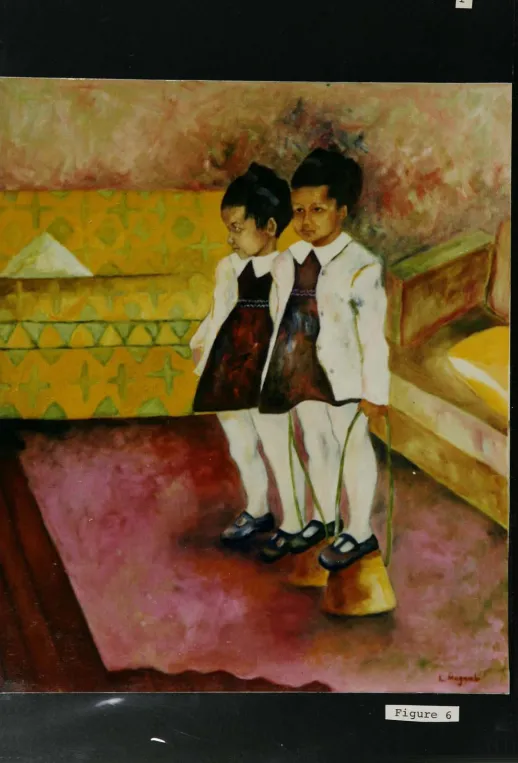
painted"The
Children"(figure
6)
afterI
spentChristmas
withfriends
whohad
two
little
girls.They
had
dressed
up
for
the
day
and wereplaying
withthe
'walking
buckets.'In
the
painting,
they
areposing
to
have
their
picturetaken.
I
tried
to
capturethe
delicate,
shy
faces
ofthe
children.I
paintedthem
in
ahomely
atmosphere,
whileemphasizing
the
colour andsimplicity
ofthe
design
ofthe
sofa.The
bright
purple carpet was a contrast with
the
dark
brown
floor.
I
did
apainting,
"Sewing"(figure
7),
because
it
is
afamiliar
scenein
my
household.
I
like
sewing
and often somefriends
come over and we sew.I
sketchedmy
girlfriend,
dressed
in
"Busuti,"my
nationaldress
from
Uganda.
I
painted a ratherdark
room withthe
windowas
the
source oflight,
falling
onthe
colourfulfabrics
on
the
table.
The
landscape
through
the
window showsthe
coming
ofspring
with allthe
flowering
shrubs.This
is
aquiet,
domestic
subject made moreinteresting by
the
contrasts of
light
anddark.
I
have
done
afew
stilllifes.
In
one,
"The
Bananas"(figure
8),
I
usedmy
fruit
and vegetables withthe
Kiganda
knife
in
the
foreground.
Most
ofthe
colours are simple withflat
areas which contrast withthe
active,
colourfuldesign
on adark
fabric,
andthe
fruits.
Bananas
aremy
r
I
MM
I
grewup
eating.I
have
sandin
the
background
andsome areas
in
the
foreground,
whichI
appliedto
the
canvas
to
increase
textural
interest,
andthen
covered with paint.
"The
Fruits"(figure
9)
alsois
painted on sandon canvas.
In
this
painting,
I
wasinterested
in
the
limitation
of colours.It
is
paintedsimply,
withflat
colour areasin
the
background
andforeground,
while
the
fruits
are painted with moredetail.
Besides
depicting
everyday
activities,
I
have
also painted a
few
imaginary
paintings.These
areimaginary
scenes of people's activitiesin
Uganda,
where
I
comefrom.
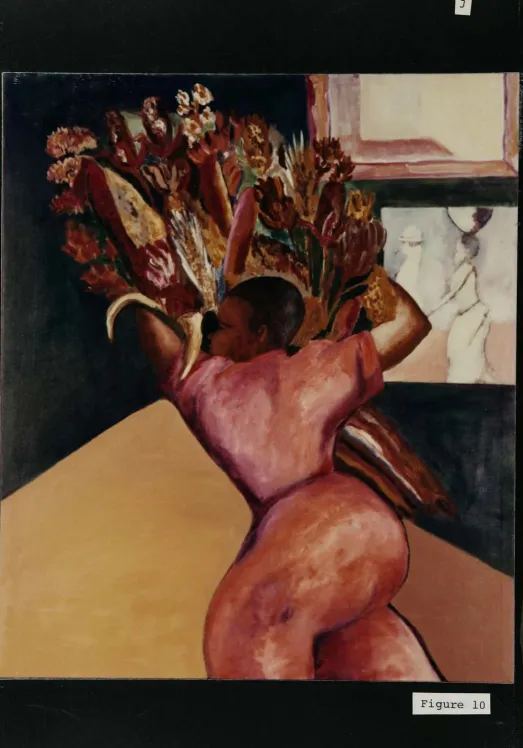
One,
"Woman
Carrying
Flowers"(figure
10),
is
apainting
of a womanin
a nationaldress,
striding
acrossthe
canvascarrying
flowers.
I
wantedto
emphasizethe
powerful movement ofthis
woman while she was
carrying
abunch
offlowers
in
an unusual way.
Women
in
my
country
carry
things
in
many
ways andthat
is
what motivated meto
paintthis
painting.
In
the
background,
through
the
windows,
I
depicted
another common scene of passers-by.Another
imaginary
painting
is
that
of anAfrican
woman
selling
fabrics
in
an open market place(figure
11).
Far
from
the
big
cities andtowns
athome,
youfind
big
open markets where all sorts ofthings
aresold.
I
have
depicted
only
one small section of sucha market.
Some
ofthe
fabrics
have
African
designs
and
the
whole sceneis
gay
and colourful as seen underthe
tropical
sunshine.In
genrepainting,
landscape
becomes
so
much apart of
human
activitiesthat
I
have
paintedfour
paintings
showing
familiar
places.One
picture,
"The
Old
_-!
**
"
-__
V
lM*
V
i
J__i
[image:36.545.17.541.13.762.2]Campus
(figure
12),
I
paintedfrom
the
window ofmy
studio on
the
oldRochester
Institute
ofTechnology
campus.
I
did
nottry
to
achieve aliteral
reproduction
ofthe
exactscene,
but
ratherto
useit
as astimulus.
Some
ofthe
colours,
for
example,
werein
spired
by
those
whichI
actually
saw onthe
scene,
while others were
imaginary,
usedto
suitthe
kind
ofpainting
I
wanted.Vivacious
andvibrating
coloursplaying
againstcool,
quietgrays,
whilethe
light
brightens
some,
give an effect of ahappy
dreamland.
Big
forms
arein
contrast with small ones.All
these
made a
familiar
placeinto
an unfamiliar one.I
paintedthree
morelandscapes
which,
althoughcommonplace
scenes,
are paintedprimarily
from
imagina
tion
andmemory
ofmy
own country.One
is
"The
Green"(figure
14),
in
whichI
wantedto
showthe
rich greenfoliage
ofthe
tropics
withthe
colourful village andsky.
"The
Homestead"(figure
15),
depicts
smallthatch
ed
houses
which mark ourgreen,
colourful countryside."The
Village
in
Snow"is
animaginary
scene ofhow
avillage at
home
wouldlook
if
there
were snow(figure
13)
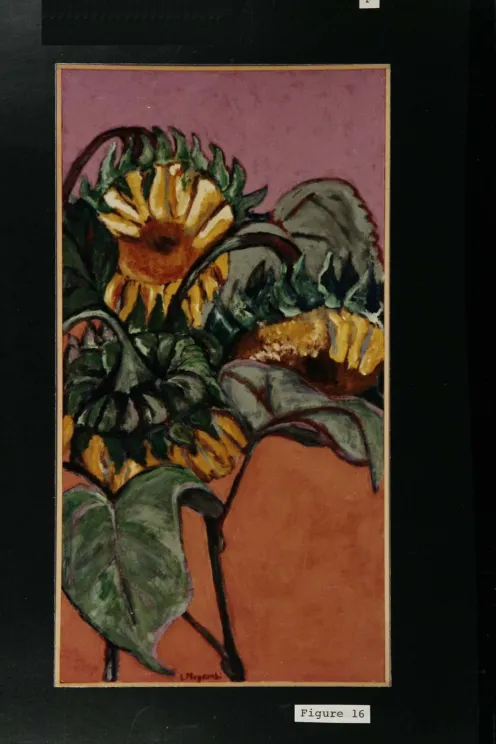
I
paintedtwo
works offlowers.
"The
Sunflowers"(figure
16)
is
one whichI
paintedfrom
my
neighbour'sgarden.
They
are painted on a rough canvas of sand."The
Spring
Magnolia
andForsythia"
(figure
17)
is
ascene
I
sawthrough
a window.These
flowers
coverall
the
trees.
There
are noleaves.
The
variety
ofcolours
in
the
magnolia arevery
fascinating;
andthey,
nextto
the
bright
yellowForsythia,
give afeeling
ofthe
whole scenebursting
with colour.I
|H___ frsfa
____________
_________________________
for
bringing
outthe
characteristics
ofthese
flowers
better,
soI
used sand whereI
paintedthe
flowers,
andmodelling
paste
onthe
rest ofthe
canvas .
In
my
paintings,
I
was motivatedby
acuriosity
about
people
doing
ordinary
things
in
everyday
life;
the
things
they
use andthe
placesthat
surroundthem.
My
aimhas
notbeen
to
reproducethe
exact scene ofpeople
doing
particular
things,
but
ratherto
have
ascene
that
has
inspired
me as aguiding
line
andfrom
it
makethe
painting
the
way
I
wantedit
to
be.
This
is
to
give myselfthe
freedom
of notbeing
enslavedby
reproducing
the
actual scene.The
final
workhas
to
be
independent
andto
speakstrongly
for
itself,
even
if
its
inspiration
is
part ofit.
In
sodoing,
I
had
the
liberty
to
be
moreimaginative
in
orderto
improve
my
paintings orto
bring
outtheir
unusualmood.
Most
ofmy
sketcheshave
been
quick,
just
try
ing
to
catchthe
scene oractivity
withoutmaking
abig
fuss
overdetail.
Therefore,
I
have
not paintedportraits of people
in
my
paintings,
but
rathertheir
characteristics and poses
in
certain situations.This
gave me a chance
to
bring
in
my
culturalbackground,
which plays a
big
rolein
my
paintings:in
the
subjectmatter,
mood,
and coloursthat
I
use.The
coloursI
have
usedin
my
paintings are a reflection
ofthe
inspiration
I
inherited
from
my
spiritual culture as well as
from
the
bright,
fresh
coloursof
the
tropics
I
grewup
with.Being
onthe
equatorwhere
the
sun shinesthe
whole yearround,
making
allthe
colourslook
asbright
asthey
couldbe,
made meV
y
X
love
colourfulthings.
The
bright
greenfoliage
ofthe
trees,
the
colourful
flowers
growing
wild onthe
countryside,
the
undulating
hills
coveredby
avariety
of greens and yellows
in
contrastto
the
red orblack
soil under a
blue
sky.All
these
are alwaysfresh
in
my
mind whenI
ampainting.
In
contrast withthe
fresh,
clear and
bright
coloursI
usein
my
paintings,
I
useneutral and
gray
colours so asto
bring*
out
the
fullness
of
the
bright
ones.I
have
playedthe
dark
againstthe
bright
orlight;
the
cool againstthe
warm;
the
colourfulagainst
the
drab.
This
has
brought
someinteresting
variety
in
the
paintings.Colour
has
played such abig
rolein
my
paintingsthat
all ofthem
look
colourful,
decora
tive,
and gay.I
have
always enjoyedthe
works of artists who werecolourful,
such asPierre
Bonnard,
Paul
Gauguin,
Georges
Braque,
the
Impressionists,
just
to
mention afew.
To
quote
Paul
Gauguin
whenhe
wasadvising
Bonnard,
who waspainting
his
first
work underGauguin's
supervision,
"How
do
you seethis
tree?
It's
green,
isn't
it?
Then
put
the
finest
green youhave
on your palette.And
that
shadow?
Bluish,
isn't
it?
Don't
fail
to
makeit
asblue
as
possible."
The
principaldoctrine
ofthe
Nabi
group
derived
from
Gauguin,
who saidthat
"all
artis
decoration."Albert
Aurier,
the
young
critic,
the
Nabi's
chief spokesman,
said,
atthe
conclusion of an article onGauguin,
"Painting
canonly
have
been
createdto
decorate
withthoughts,
dreams,
andideas
the
blank
walls ofhuman
buildings."
on
canvas.
The
acrylicshave
workedvery
wellfor
me.Their
main advantageis
that
they
dry
quickly,
so youcan
paint
quickly
andthere
is
nounnecessary
wasting
of
time.
You
can put one colour ontop
ofthe
otherwithout
waiting
long.
Although
anadvantage,
it
couldalso
be
adisadvantage,
however.
Sometimes,
the
acrylicsdry
soquickly
that
youhave
to
think
and workvery
fast
to
getthe
effect you wantbefore
they
aredry.
It
is
especially
difficult
if
you wantto
run one colourinto
another while
they
areboth
wet.Yet,
the
acrylics givea
fresh,
clear,
andbright
colour,
which endearsthem
to
me.
Two
ofmy
paintings aredone
with oils on canvas.The
oils,
unlikeacrylics,
do
notdry
quickly.This
slows
down
the
rate of painting.Sometimes,
if
youmix colours with
too
muchlinseed
oil andvarnish,
youmight
have
to
waitfor
a couple ofdays
before
they
dry.
This
oftenhelps
if
you wantto
rundifferent
colourstogether.
I
have
afew
rough canvases on whichI
put sand.On
some,
I
putit
all overthe
canvas;
onsome,
I
limit
it
to
only
certain areas.The
sand givesthe
painting
a
very
interesting
texture.
It
absorbs alot
of coloursthough,
so youhave
to
use quite alot
of paint.I
alsohave
afew
canvases made out ofburlap.
I
stretchthem
with a cheese cloth at
the
back
sothat
the
big
holes
can
become
small enoughto
be
covered with gesso.On
some
canvases,
I
have
been
successfulin
covering
mostof
the
holes
but
onsome,
I
stillhad
afew
holes
showing.
I
have
experimentedusing
modelling
paste ontwo
paintings and
have
found
it
exciting.23-Dear
friend*
:Alter
tiring
youwith
allyou
have, jutt read,
I
thought
it
better
to
conclude
my thetit
by
witting
you a
relaxing le.tto.ti.
I
want
youto
know
that
I
have,
enjoyedpainting
thete
painting*.
It
hat
notbeen
always eaty.There
were
bright
day*
whan
everything
earn outright
-the
way
I
wouldhave
liked
them
to;
when
everybody
bounded
happy
andalive;
when all who
looked
atmy
workwere
impretted
andencouraging;
and when eventhe
weather
teemedto
treat
mekindly.
And
yetthere
wereday*
whenI
mitted abut
by
a minute andhad
to
waitlor
another wholehour
in
the
Rochester
cold,
bitter
winter!
Day*
wheneverybody
teemedto
take
melor
granted.
Day*
whenthote
wholooked
atmy
workdid
not change a
thade,
or atll they
were thocked or perplexed
by
my
way
o{
doing "my
thing."Dayt
whenmy
poor
brain
failed to
think
correctly
on apainting;
how
to
improve it in
general.Dayt
when evenmaking
a new canvat wat tuch
hard
labour that
all corner*came out uneven at
il
youhad
neverin
yourll{e
handled
a taw!Thete
werethe
bad
dayt
andtogether
with
the
gooddayt,
I
managedto
live
alull
lile.
A-^ter
all,
lile
without upt anddownt
wouldbe
very
dull.
The
writing
ol
the
thetit
hat
been
greatlun,
although
I
had
alew
tleeplett nightt .Once,
whenI
d~eamt
I
wa~
having a
d~inQ
with
Remb~andt! Su~ely
~uQh
a
d~eam wa~
a
~e~ult
06 the
~t~ain
I
wa~
going
th~ough.
I
hope you will enjoy
~eading
my
the~i~
-and
pe~hap~ d~eam
about it!
Adieu
-Lydia Mugambi.
-25-NOTES
ON
PAINTINGS
Figure
1
,2,
3
4
6
7
8
14
15
16
Page
ab
f
,9
h
10.
j
11
.k
12.
1
13.
m"Sibley's
Dress
Department" 60"x
48",
acrylics on canvas"Sibley's
Women's
Lounge"60"
x
47
1/2",
acrylics on canvas"My
Family"61
1/2" x56",
acrylics on canvas"The
Unmade
Bed"30
l/2"x
48
1/2"acrylics,
sand on canvas"The
Bathroom" 39"x 48"
acrylics on
burlap
"The
Children"34
3/4"x
40
1/2"oils on canvas
"Sewing"
Oils
on canvas39
1/2"
x 48"
"The
Bananas"22
l/5"x
29
1/5"acrylics,
sand on canvas"The
Fruits"16"
x
24
3/4",
acrylics,
Sand
on canvas"Woman
Carrying
Flowers"34"
x
40",
acrylics on canvas"Woman
Selling
Fabrics"Acrylics
on canvas,24
3/4"
x
34
1/2""The
Old
Campus"35"
x
48
1/2",
acrylics on canvas"A
Village
in
Snow"20
l/2"x
20
1/2"Acrylics,
sand,
modelling
pasteon
burlap
"The
Green"36"
x
46
1/2",
acrylics on canvas"The
Homestead"14
1/2" x16
1/2",
acrylics on canvas"The
Sunflowers"37"
x
19
3/4"
[image:51.545.115.501.126.696.2]NOTES
ON
PAINTINGS
(continued)
Figure
17.
Page
q
Figure
18.
Page
r"Spring
Magnolia
and Forsythia"36
1/4"x 44"
acrylics,
sand,
modelling
pasteon
burlap
"The
Bus
Ride"48
3/4"x 26"
Acrylics
on wood27-BIBLIOGRAPHY
1
.2.
3.
4.
5.
6.
7.
8.
9.
10.
11
.12.
13.
14.
15.
16.
Iner,
Helen.
Art
Through
the
Ages.
larcourt,
Brace
&
Company,
Inc.
1926)
;on,
Thomas
Hart.
An
Artist
in
America.
lalcyon
House,
New
York
1937)
Gard
(H
Benton,
(Halcyon
House
Cla
redH.
Mil HI'
I I _. I
vnai^jruii nuuse, nevi
York
1937)
ark,
Kenneth.
Rembrandt
andthe
Italian
Renaissance
(New
York
University
Press,
New
York
1966)
.hill,
Holger
andBarr,
Jr.,
Alfr
Art
in
America,
a completeSurve
(Halcyon
House,
New
York
1939)
-Estienne,
Charles.
Gauguin
(Cleveland,
Ohio,
The
World
Publishing
Co.
1964
Goodrich,
Lloyd.
Three
Centuries
ofAmerican
Art.
^t-ieveiana,
umo, ine woriaKUDiisnmg
to.Goodrich,
Lloyd.
Three
Centuries