THE INFLUENCE OF PUTTY WASH IMPRESSION TECHNIQUE ON DIMENSIONAL ACCURACY OF 2 COMMERCIALLY
AVAILABLE VINYL POLY SILOXANE IMPRESSION MATERIALS - AN INVITRO STUDY
A Dissertation Submitted to
The Tamil Nadu Dr. M.G.R. Medical University, Chennai
in partial fulfillment of the requirements for the degree of
Certificate
This is to certify that the dissertation titled “THE INFLUENCE OF PUTTY WASH IMPRESSION TECHNIQUE ON DIMENSIONAL ACCURACY OF 2 COMMERCIALLY AVAILABLE VINYL POLY SILOXANE IMPRESSION MATERIALS - AN INVITRO STUDY” is a bonafide record of work carried out under my guidance by Dr. M. KANMANI during
the period of 2004-2006. This dissertation is submitted in partial
fulfillment for the degree of Master of Dental Surgery awarded by
Tamil Nadu Dr. M.G.R. Medical University, Chennai in the branch of
Prosthodontics. It has not been submitted partially or fully for the
award of any other degree or diploma.
Dr. E. SUBRAMANIAM, M.D.S.,
Guide
Professor and Head,
Department of Prosthodontics,
Acknowledgement
I consider it my utmost privilage and honour to express my most
sincere and heart-felt gratitude to my guide Dr.E. Subramaniam,
M.D.S., Professor and Head of the Department, Department of
Prosthodontics, for his enthusiastic and overwhelming support
bestowed upon my endeavours, encouragement and kindness not only
during this study but all throughout my postgraduate course.
My sincere thanks to Dr. C. Kumaravelu M.D.S., Principal, Tamil
Nadu Govt. Dental College & Hospital, Chennai-3 for permitting me to
use the facilities in the college.
I am grateful to Dr. K.S.G.A.Nasser, M.D.S. Professor,
Department of Prosthodontics for his encouragement during the course
of the study.
I owe my sincere thanks to Dr.C.Thulasingam, M.D.S., Professor,
Department of Prosthodontics, for his encouragement and valuable
suggestions during the course of the study.
My sincere thanks to Dr. C. Sabarigirinathan, M.D.S., Assistant
I also express my thanks to Assistant Professor, Dr. K. Vinayagavel
M.D.S., Dr. T. Jayanthikumari, MDS, and Dr. V. Balaji M.D.S., Department of Prosthodntics, TamilNadu Government Dental College and
Hospital, Chennai-3 for their valuable help whenever I needed.
I owe my sincere thanks to Dr.P.Manohar, Ph.D., Assistant
Professor, Department of Physics, MIT, Chrompet, for permitting me
to work in their department in the final phase of this study.
I acknowledge the help rendered by Mr. R. Ravanan, M.Sc.,
M.Phil., Lecturer, Department of Statistics, Presidency college, in
calculation of the statistical data.
My special thanks to Mr. Raja Mohideen, Razyaa Graphics who
helped me in printing and completion in the final phase of the study.
Above all I would like to thank God Almighty for his Grace and
CONTENTS
S.No Title Page No
1.
INTRODUCTION 1
2.
AIM OF THE STUDY
4
3.
REVIEW OF LITERATURE
5
4.
MATERIALS AND METHODS
22
5.
RESULTS 30
6.
DISCUSSION 47
7.
SUMMARY
55
8.
CONCLUSION 58
INTRODUCTION
Impression is an imprint of the teeth and adjacent structures for uses in dentistry. Impression materials in one substance or combination of substances are used for making an impression or negative reproduction. Various impression techniques are used in making a negative likeness (GPT-4).
History reveals that waxes were used as an Impression material during 18th & 19th century. Later in 19th century plaster and compound were used for making impression. But both plaster and compound do not have sufficient elastic property to register the undercut areas79,80.
In various stages Agar, Zinc Oxide Eugenol, alginate and elastomers were developed for impression making. These materials have been modified chemically and physically for use in dentistry. Initially elastomer group consisted exclusively of polysulfide & condensation silicone impression material24.
Polysulfide and condensation silicone impression materials sets by an condensation polymerization reaction leading to release of volatile by products which there by causes shrinkage11,17,24,85,
In 1960, Elastomers like polyether and addition reaction silicone or vinyl poly siloxane impression materials were introduced. They are widely used for obtaining dimensionally accurate impression particularly for crown and Bridges.
In contrast to polysulfide & condensation siloxane impression materials, vinyl poly siloxane sets by an addition polymerization reaction without the production of volatile by product. The significance of accuracy in the process of fabricating restorations should be understood24.
Elastomeric impression materials are subject to dimensional changes in several factors, like the process of polymerization in which it involves cross linking of the polymer chains, can result in a reduction of spatial volume. Continuous polymerization reactions take place even after removal of the impression. The changes due to the effect of temperature, influence of material volume, bulk of the material. The condition under which the material stored and disinfection of impression8,26,30,46,108
Clinical techniques involved with impression making have been extensively investigated and potential consequences also have been reported3,7,39.
There is much discussion in the dental literature regarding the effect of the impression technique on accurate fit of cast restorations. An accurate impression technique will result in precise fitting cast restoration. This is one factor that determines the restorations longevity. Impression materials have improved to such an extent on accuracy more with technique than by the material itself. Further more, the “WASH THICKNESS” is also an essential factor that influences the accuracy of elastomeric impression materials24,28,30,58,68,69,70.
AIM OF THE STUDY
The aim of the study is to assess the
1) Accuracy of 2 commercially available vinyl poly siloxane impression materials.
2) Accuracy among one step putty wash and 2 step putty wash impression technique for the two impression materials.
3) Accuracy within 2 step putty wash impression technique employing various forms of spacers such as
a. Polyethylene sheet
b. Scrapping
REVIEW OF LITERATURE
A cast cannot contain more information than the impression from which it is made62. From the day when the first impression was made
until now there has always been a quest for a material that gives an exact reproduction of the details. Numerous research have been conducted and their results analysed to determine the best material and the best impression technique.
Robert S. Lewebke, et al (1979)87 assessed the effect of delayed and second pours on elastomeric impression material accuracy overall no significant difference was found in accuracy between first and second pours.
on the basis of linear dimensional change occurring as a function of time between making an impression and pouring the die. The dies were measured and compared to a master model to determine the linear change in the impression material. One material produced an overall larger die, but the greatest increase in size deviated from the master model by only 0.1%. Permagum putty-wash material consistently produced undersized dies, with the greatest change being 0.3%. Three materials randomly produced smaller or larger dies, differing from the master model by only 0.08% for the smallest die to 0.07% for the largest. No consistent pattern of increase or decrease in die size occurred with time. Dies produced at 168 hours were as accurate as those produced at 10 minutes.
de Araujo PA, Jorgensen KD (1985)26
Craig RG (1985)23
evaluated automatic mixing system for an addition silicone impression material. The automatic mixing system of an addition silicone impression material yields mixes and set material that comply with ADA specification no. 19 when testing is started at 0.5 minute rather than the specified 1.5 minutes. This change is reasonable because there is zero mixing time rather than the usual 45-60 second needed for standard two-paste rubber impression materials. Uniform mixing of base and catalyst occurs with the automatic system, with a fourth to a fifth as many bubbles in the mix as for comparable mixes obtained by hand spatulation. The properties and accuracy of the system are excellent and typical of addition silicones, including excellent recovery from deformation, low dimensional change on setting, and low flow. A wash or two-phase impression technique may be used with equal clinical accuracy.
Johnson GH, Craig RG (1986)46
produced significantly shorter dies (-0.24% to -0.37%) than addition silicones (-0.08%). Among addition silicones Cinch produced more than twice a much vertical change (-0.16%) than other three products (-.06%), Since castings made from a short die will not seat completely on the prepared tooth these results support the use of three of the four addition silicones tested.
Roger E. Johnson, et al (1987)89
assessed the dimensional changes of elastomers during cold sterilization. The addition reaction vinyl poly siloxane materials demonstrated great stability during both wet and dry storage.
Jack D. Gerrow, Robert L Schaider (1987)40 compared the compatibility of elastomeric materials, type IV dental stones and liquid media on the basis of the reproduction of surface detail on a test cast. The result of this investigation suggest that care not be taken to choose compatible impression materials and dental stones.
Chee WW, Donovan TE (1989)17 studied the effect of very high viscosity (putty) polyvinyl siloxane impression material with both the conventional double-mix and single-mix putty wash technique. Three of the materials reproduced the 20 microns groove in one half of the samples tested, while the remainder failed to do so.
Murakami H, Takechana S, Abe T, Tejima R (1989)67
Marshak B et al., (1990)58
assessed that a precise impression is imperative for the construction of an accurately fitting indirect cast restoration. The putty wash technique is commonly used in making impression with silicone impression in this study a technique is presented ensuring exact reseating of the putty impression tray and creation of a uniform wash space which are essential for accurate results.
Soh G, Ghong YH (1991)96
evaluated the relationship of viscosity to porosities in automixed elastomeric impression technique and concluded that putty wash impression generated significantly less voids than medium viscosity impressions for all materials. The finding of these study suggested that putty wash impression produced significantly less porosities than medium viscosity impression and consequently offer better tear strength for impression.
Pfeiffer P, et al (1991)78
Tait CM, Rosen M, et al., (1991)98
evaluated the effects of impression technique on accuracy of stone models and concluded that the putty wash plus putty wash spacer techniques both give accurate impression. This study was designed to compare the accuracy of initial and repour models obtained from an impression recorded in a hydrophilic addition curing silicone and determine whether or not this accuracy is affected by the impression technique employed and whether any inter action between impression techniques and levels of pour existed.
Dennis R. curren, Jess U. Mikerul and James sandrik in (1991)28 assessed the relationship of the wettability of an elastomeric impression material and its interaction with the gypsum shurry is an improvement factor. This study examined the relative pourability of several impression materials by counting the number of resultant voids in artificial stone casts.
Tjan AH et al., (1992)102
evaluated the dimensional accuracy and bond strength of addition silicones. A cross matching study was conducted to evaluate the effect on dimensional accuracy and tensile bond strength between the materials when intermixing branch of addition silicone impression materials in a putty wash impression and concluded that the actual differences in percent deviation between the intermixed groups and their respective reference groups are very small, they are presumed to be insignificant clinically.
Hung SH et al (1992)39 compared the accuracy of one step versus 2 step putty wash addition silicone impression technique. 5 addition silicone impression materials were tested. Accuracy of addition silicone impression material is affected more by material than technique. Accuracy of the putty wash one step impression technique except at one of the six dimensions where one step was more accurate than 2 step.
Abuasi HA et al., (1994)3
investigated the accuracy of one stage polyvinyl siloxane impressions recorded in metal and plastic stock trays using regular and soft putties and concluded that the putty wash plastic tray combination is unsatisfactory. Metal trays reduce in distortion with some putty wash systems but not with others.
Bard Idris et al (1995)7
compared the putty wash one step and 2 step technique for making addition silicone impression. For each technique 15 impressions were made of a stainless steel base to which 3 tapered posts were attached. Stone models were made of all impressions. The results indicated that the interabutment distances increased slightly compared with the stainless steel model for both techniques, but the differences between techniques were not considered to be clinically important. The intraabutment measurements for the abutment without undercut increased, whereas abutments with undercuts decreased. These variations from the stainless steel model were also clinically insignificant.
Johnson GH, Craig RG (1995)45
of pouring. and repetition of pouring. There was little change in dimension among abutment preparations for all materials, for all times of pour, and with a repeat pouring.
Tan E, Chai J et al., (1996)99 evaluated the dimensional accuracy of polyvinyl siloxane impression material by evaluating the dimensional accuracy of stone dies of impression of a standard model made at successive time intervals and concluded that working time with this method generally were about 30 seconds longer than there recommended by the manufacturer.
Richards MW et al., (1998)84
assessed the dimensional accuracy of one step putty wash impression technique using the one step polyvinyl siloxane impression technique, this study compared the effect of putty material working time on the dimensional accuracy of recovered improved stone casts.
Corso M et al., (1998)21
compensated for the contraction that occurred from polymerization shrinkage.
Penaflor CF et al., (1998)74 compared dimensional accuracy of single mix, double mix with spacer, double mix with cut out and double mix impression technique using addition silicone impression material and concluded that the double with cut out and double mix technique presents the least difference from the master model as compared to the other technique.
Eriksson A, Oekert et al., (1998)31 evaluated the accuracy of addition silicone impression by using syringe tray technique and concluded that mechanical mixing without a vacuum and a tray designed similar to a perforated stock tray gave most accurate impression.
Nissan DMD, (2000)70
et al., assessed the accuracy of 3 putty wash impression techniques using the same impression material (polyvinyl siloxane) in a laboratory model. For each technique, 15 impression were made of a stainless steel master model that contained 3 complete crown abutment preparation, which were used as a positive control. Accuracy were assessed by measuring 6 dimensions (interabutment and intraabutment) on stone dies poured from impression of the master model. Overall discrepancies of the 2 step technique with 2 mm relief putty wash impression technique were significantly smaller than that in the 1 step.
Fenske C (2000)32 evaluated the influence of five impression techniques on the dimensional accuracy of master model and concluded that double mix technique is recommended for impression of supra gingival preparations.
Hondrum SO (2001)38
Lamy M, et al (2001)52
assessed the impression technique which allows to obtain in a single stage the impression of the abutment as well as their neighbouring teeth. The impression technique described was the double mix method. This method is based on the use of 2 elastomers with different viscosities, but form the same group thus allowing a simultaneous polymerization.
Cox Jr, Brandl RL, Hughes HJ (2002)22 evaluated the dimensional accuracy of elastomeric impression, 35 addition silicone impression were made of cast metal copings cemented onto natural teeth prepared as complete crown abutments. The impression were poured in type IV die stone. Buccolingual and Inter abutment dimensions were measured the plastic double arch tray loaded with heavy viscosity addition silicone and a low viscosity wash produced the least accurate combination inter and intra abutment dimensions and concluded the more rigid tray impression material combinations more accurately replicated stone dies.
Nissan J et al (2002)69
discrepancies of the groups using wash thickness of 1 and 2 mm were smaller than the group with 3 mm wash thickness. Therefore wash bulks of 1& 2 mm were most accurate for fabricating stone die using poly vinyl siloxane impressions.
Thongthammachat S et al., (2002)101 evaluated the influence on dimensional accuracy of dental casts made with elastomeric impression materials and concluded that accurate casts can be made with either stock trays or custom trays. Silicone impression material has better dimensional stabilities.
Omar R, Abdullah MA, Sherfudhin H. (2003)72
compared the accuracy of stone models obtained from 2 stage, pre spaced putty wash impression under conditions in which known volumes of wash material were introduced during the second stage of the impression. It is concluded that putty recoil, resulting from compression by excess wash material, plays a significant role in the undersizing of working dies, although the level of clinical relevance is less clear.
Petrie CS, Walker MP (2003)77
Rodrigues Filbo LE et al (2003)88
assessed the handling of vinyl polysiloxane impression putties with latex gloves and said to interfere with the setting of these impression materials. The aim of this study is to evaluate the effect of handling technique on the setting of vinyl polysilaxane impression putties using several types of gloves and concluded that setting inhibition depends on the kind of vinyl polysiloxane impression material and the kind of gloves used, but when the initial mixing was performed with the spatula this setting inhibition was over come.
Cynthia S. Petrie, et al (2003)25
assessed the dimensional accuracy of 2 hydrophilic vinyl polysiloxane impression materials. The dimensional accuracy for both hydrophilic VPS impression materials was not significantly affected by the dry moist or wet environment.
Chen Sy, Liang WM et al (2004)18 assessed accuracy of 5 commercially available silicone impression materials and concluded 2 addition type silicone material aquasil and Exaflex had the greatest accuracy.
differences in dimensional changes when hand and cartridge - mix techniques were compared at the same measuring time for the tested polyvinyl siloxane material.
Donovan TE, Chee WW (2004)29 outlines the ideal properties of impression materials and explains the importance of critical manipulating variable. Available impression materials are analysed relative to these variables and several “specialized” impression techniques are described. Special attention is paid to poly vinyl siloxane impression material because they have become the most widely used impression materials.
Forrester - Baker L et al., (2005)34
compared the dimensional accuracy between three different addition cured silicone impression materials and concluded that any change in measured dimensions occurring during impression making, was compensated for in some way by the casting process.
Wadhwani CP, Johnson GH et al (2005)109
assessed the accuracy of 2 types of fast setting elastomeric impression materials. Differences detected were small and may not be of clinical significance.
MATERIALS AND METHODS
The accuracy of the impression was evaluated indirectly by measuring several clinically relevant dimensions on gypsum casts recovered from impressions of a master model.
A machined standard mild steel die was made to serve as a model, which simulating 3 unit fixed partial denture. Reference lines were inscribed on the top and axial surfaces of abutments, which are used to assess the dimensional changes with help of traveling microscope.
The materials used were listed in the tabular column as given below:
Materials Manufacturer Consistency
Addition Silicone 3M ESPE
i) Putty (7312)
ii) Syringeable (7302) Low viscosity
Addition Silicone Ivoclar vivadent virtual
i) Putty (Regular set) ii) Syringeable Low viscosity (Regular set)
Tray Adhesive 3M ESPE
Tray Adhesive Ivoclar vivadent virtual
Die Stone Ultra rock Type IV
Methods:
For each technique 10 impression of the master model were made for 2 (Vinyl polysiloxane) materials.
These are grouping of the samples.
Group I (3m) Group II (Vivadent)
Gr. I – A Gr. I – B Gr. I – C Gr. I – D
Group I: 3M polyvinyl siloxane material used for Accuracy evaluation.
Group IA: Simultaneous one step putty wash impression
techniques.
Group IB: 2 step putty wash polyethylene spacer impression
technique.
Group IC: 2 Step putty wash scrapping impression technique
Group ID: 2 step putty wash 2mm coping impression technique. Group II: Ivoclar vivadent virtual poly siloxane material used
for accuracy evaluation.
Group IIA: Simultaneous one step putty wash impression
technique.
Group IIB: 2 step putty wash polyethylene spacer impression
technique.
Impression materials were mixed in standardized proportions according to the manufacturer’s recommendations. The tray adhesives were used evenly over the tray’s surface.
GROUP IA: SIMULTANEOUS ONE STEP PUTTY WASH:
Impression Technique:
Here putty and wash impression materials were used simultaneously. Thin coat of 3M ESPE tray adhesive was applied on the tray and allowed to dry for minimum of 5 mts. Putty base and catalyst measured in equal volume and mixed until a homogenous colour is achieved within 30 seconds. The mixed putty was placed in a adhesive coated tray. Simultaneously the syringable low viscosity material was dispensed directly over the master model. The unset putty was placed over the low viscosity material and allowed to set for 12mts.
GROUP I B: 2 STEP PUTTY WASH POLY ETHYLENE SPACER IMPRESSION TECHNIQUE:
GROUP I C:
2 STEP PUTTY WASH SCARAPPING IMPRESSION TECHNIQUE:
In this technique preliminary impression was taken with putty impression material. Later final impression taken with low viscosity material. Thin coat of 3MESPE tray adhesive was applied on the tray and allowed to dry for minimum of 5 mts. Putty base and catalyst measured in equal volume and mixed until a homogeneous colour is achieved with in 30 seconds. The mixed putty was placed in an adhesive coated tray.
Then the tray with unset mixed putty was placed over the master model and allowed to set. To save time, the tray can be removed prior to complete set and allow the putty to set for a minimum of 10 mts. Later with sharp knife scrapping of the putty materials were done to get minimum 2 mm space. Syringeable material was dispensed on the scrapped putty impression in the tray. The tray was reseated and allowed to set on the master model for 12 mts.
GROUP ID:
2 STEP PUTTY WASH COPING IMPRESSION WITH 2 MM RELIEF:
sound step, the copings were removed and the wash material was added. The impression material was allowed to set on the master model for 12 minutes.
All these same techniques were followed for impression making with Ivoclar Vivadent VPS impression material. They were considered as Group IIA, Group IIB, Gr. II C & Gr. II D.
Setting time, according to the manufacturers was doubled to compensate for impression making at room temperature instead of at mouth temperature.
All impressions were stored at room temperature for 1 hr as per manufacturer instruction. Type IV dental stone was mixed by hand spatulation as per the water powder ratio specified by manufacturer. The model was poured with improved stone.
Diagram of master model displaying interabutment (RC, CL,RL) and Intraabutment (R,CL) measurement
Traveling Microscope has 2 main scales graduated on steel plates. One is fixed horizontally and another vertically to measure both the horizontal and vertical displacements of the microscope. These fixed main scales are provided with vernier which slide over main scale on moving the microscope. The model is placed on the horizontal base of the traveling microscope adjusted to view the model.
The vertical and horizontal crosswire is made to coincide with vertical & horizontal line on the model by moving the head slightly while viewing if the cross wire shifts with respect to the focussed point, then by pulling the eye piece slightly out or pushing in adjustment is made to avoid error.
Main scale and vernier scale reading (R1) are taken. Then the
microscope is moved along the same direction and the crosswire made to coincide with the line present in the next abutment of the model.
RL
RC CL
R C L
The difference between these 2 readings (R1 & R2) gives the
distance between the 2 posts in the model. In this study with this method distance between (R-C, C-L, R-L, R, C, L) distances are determined. Each distance on the stainless steel model at each measurement location was measured 10 times.
The mean and standard deviation or all distance measurements are calculated and used as the standard measurement for comparison between the 2 techniques with 2 materials.
DATA ANALYSIS:
The percentage deviation of each distance of the putty wash one step / 2 step technique from the stainless steel master model was computed by calculating difference between the mean of each distance on the stone models “MSM” and the mean of each corresponding distance on the master model multiplied by 100.
Percentage deviation = MSM – MMM
MMM x 100
3M PVS Putty Material
IVOCLAR Virtual PVS Putty Material
3M & Virtual Tray Adhesives
Four Putty WashTechniques of
3M PVS Material
Simultaneous One Step Two Step Polyethylene Putty Wash Technique Spacer Technique
Two Step Scrapping Two Step Coping Technique Technique
Four Putty Wash Techniques of
Virtual PVS Material
Simultaneous One Step Two Step Putty Wash Putty Wash Technique Technique
Two Step Scrapping Two Step Coping Technique Technique
Stone Model of Group I A
Stone Model of Group I C
Stone Model of Group II A
Stone Model of Group II C
Stone Models of Group I (ABCD)
Master Model on the Traveling
Microscope
Traveling Microscope View of
Master Model
RESULTS
The present in vitro study was conducted to study the influence of putty wash impression technique on the accuracy of 2 polyvinyl siloxane impression material. The technique used in this study were simultaneous one step putty wash and 2 step putty wash technique with spacer. The 2 poly vinyl siloxane impression material used were 3 M PVS (Group I) ivoclar vivadent virtual PVS material (Group II).
The accuracy of impression material was assessed by comparing the measurements, intra-abutment & Inter-abutment obtained from master model with measurement of the stone model.
The results of the accuracy of the impression material obtained by measuring intra & inter-abutment distances is evaluated and tabulated (4.1 - 4.3). They were then subjected to statistical analysis.
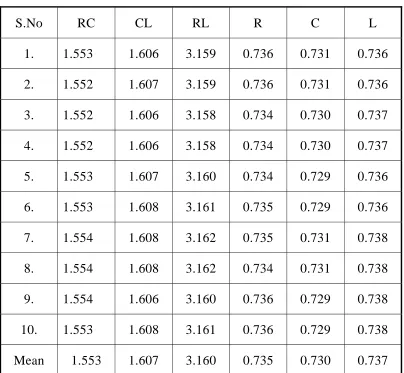
Table. 4.1
Interabutment (RC, CL, RL) & Intraabutment (R,C,L) measurements of the master model
S.No RC CL RL R C L
1. 1.553 1.606 3.159 0.736 0.731 0.736 2. 1.552 1.607 3.159 0.736 0.731 0.736 3. 1.552 1.606 3.158 0.734 0.730 0.737 4. 1.552 1.606 3.158 0.734 0.730 0.737 5. 1.553 1.607 3.160 0.734 0.729 0.736 6. 1.553 1.608 3.161 0.735 0.729 0.736 7. 1.554 1.608 3.162 0.735 0.731 0.738 8. 1.554 1.608 3.162 0.734 0.731 0.738 9. 1.554 1.606 3.160 0.736 0.729 0.738 10. 1.553 1.608 3.161 0.736 0.729 0.738 Mean 1.553 1.607 3.160 0.735 0.730 0.737
Table 4.2 Interabutment (RC,CL,RL) & Intraabutment (R,C,L) measurement of the stone dies obtained from the groupI (3M PVS Material) using four different putty wash technique.
Group IA Group IB
Interabutment Intraabutment Interabutment Intraabutment Model No RC CL RL R C L Model No RC CL RL R C L
1. 1.553 1.422 2.975 0.696 0.624 0.711 1. 1.447 1.653 3.100 0.717 0.676 0.717 2. 1.542 1.421 2.963 0.695 0.623 0.714 2. 1.449 1.652 3.101 0.714 0.676 0.715 3. 1.536 1.422 2.956 0.692 0.622 0.712 3. 1.448 1.651 3.099 0.716 0.674 0.714 4. 1.540 1.422 2.962 0.694 0.621 0.711 4. 1.446 1.648 3.094 0.715 0.673 0.717 5. 1.538 1.426 2.964 0.693 0.625 0.709 5. 1.442 1.649 3.091 0.719 0.672 0.716 6. 1.539 1.424 2.963 0.697 0.626 0.706 6. 1.450 1.646 3.096 0.718 0.671 0.712 7. 1.540 1.419 2.959 0.690 0.620 0.716 7. 1.451 1.652 3.103 0.717 0.676 0.713 8. 1.543 1.420 2.963 0.694 0.624 0.715 8. 1.447 1.651 3.098 0.720 0.674 0.714 9. 1.541 1.422 2.963 0.692 0.624 0.714 9. 1.446 1.653 3.099 0.716 0.676 0.715 10. 1.540 1.421 2.961 0.693 0.620 0.711 10. 1.447 1.653 3.100 0.717 0.676 0.717
Mean 1.540 1.421 2.962 0.693 0.622 0.712 1.447 1.650 3.098 0.715 0.674 0.715
Group IC Group ID
Interabutment Intraabutment Interabutment Intraabutment Model No RC CL RL R C L Model No RC CL RL R C L
1. 1.540 1.540 3.080 0.680 0.730 0.621 1. 1.600 1.559 3.159 0.723 0.728 0.720 2. 1.541 1.543 3.084 0.678 0.728 0.625 2. 1.598 1.557 3.155 0.721 0.725 0.719 3. 1.543 1.540 3.083 0.680 0.729 0.626 3. 1.601 1.554 3.155 0.719 0.726 0.718 4. 1.542 1.538 3.080 0.682 0.732 0.624 4. 1.596 1.601 3.197 0.725 0.728 0.721 5. 1.540 1.540 3.080 0.681 0.731 0.623 5. 1.600 1.558 3.158 0.728 0.729 0.722 6. 1.539 1.536 3.075 0.679 0.730 0.619 6. 1.601 1.555 3.156 0.723 0.732 0.720 7. 1.538 1.542 3.080 0.676 0.726 0.620 7. 1.592 1.557 3.149 0.723 0.724 0.719 8. 1.540 1.541 3.081 0.678 0.730 0.624 8. 1.594 1.556 3.150 0.724 0.721 0.716 9. 1.536 1.543 3.079 0.680 0.731 0.621 9. 1.596 1.559 3.155 0.721 0.726 0.721 10. 1.542 1.540 3.082 0.681 0.730 0.620 10. 1.602 1.558 3.160 0.726 0.728 0.722
Table 4.3 Interabutment (RC,CL,RL) & Intraabutment (R,C,L) measurement of the stone dies obtained from the groupII (Virtual PVS
Material) using four different putty wash technique.
Group IIA Group IIB
Interabutment Intraabutment Interabutment Intraabutment Model No RC CL RL R C L Model No RC CL RL R C L
1. 1.459 1.604 3.063 0.625 0.690 0.672 1. 1.541 1.557 3.098 0.628 0.673 0.709 2. 1.456 1.603 3.059 0.624 0.689 0.671 2. 1.538 1.555 3.093 0.627 0.674 0.701 3. 1.458 1.604 3.062 0.623 0.690 0.670 3. 1.540 1.556 3.096 0.629 0.676 0.708 4. 1.462 1.603 3.065 0.621 0.691 0.669 4. 1.539 1.554 3.093 0.626 0.671 0.706 5. 1.460 1.592 3.062 0.627 0.694 0.668 5. 1.541 1.557 3.098 0.630 0.672 0.707 6. 1.457 1.599 3.056 0.622 0.685 0.672 6. 1.539 1.554 3.093 0.631 0.675 0.709 7. 1.461 1.601 3.062 0.625 0.688 0.671 7. 1.542 1.555 3.097 0.628 0.676 0.708 8. 1.459 1.602 3.061 0.624 0.690 0.670 8. 1.546 1.557 3.103 0.625 0.673 0.709 9. 1.461 1.604 3.065 0.623 0.692 0.672 9. 1.542 1.559 3.101 0.627 0.672 0.709 10. 1.458 1.602 3.060 0.625 0.691 0.671 10. 1.541 1.557 3.098 0.626 0.671 0.706
Mean 1.459 1.602 3.061 0.623 0.690 0.670 1.540 1.556 3.096 0.627 0.673 0.707 Group IIC Group IID
Interabutment Intraabutment Interabutment Intraabutment Model No RC CL RL R C L Model No RC CL RL R C L
STATISTICAL ANALYSIS
The values were statistically analysed by using, 1) One way anova
2) Dunean’s multiple range test 3) Student T test
ONE WAY ANOVA:
One way anova is employed to compare the means of 3 or more independent groups of observations. The observed variability in the samples is subdivided into 2 components.
a) Variability of the observation within a group about the group means.
b) Variability of the group means between group about the overall mean.
DUNCAN’S MULTIPLE RANGE TEST:
The mean of the all groups for each property evaluated was then compared by using Duncan’s multiple range test calculated at 0.05% significant.
The Duncan’s grouping is represented as alphabets in Superscript. Different alphabets denotes that values are significant at 5% level.
Table 4.4 Means and standard deviation of interabutments (RC, CL, RL) and intraabutment (R,C,R) (Occlusogingival) measurements on the master and stone models for the 4 impression techniques Group I
(3M vinyl poly siloxane impression material)
Master Model Simultaneous 1 Step putty
wash technique
2 Step putty wash poly ethylene Spacer Technique
2 step putty wash scrapping Technique
2 Step putty wash coping technique
Location
Mean SD Mean SD Mean SD Mean SD Mean SD
Right to centre 1.553 0.001 1.541 0.005 1.447 0.002 1.540 0.002 1.598 0.003
Centre to Left 1.607 0.001 1.422 0.002 1.651 0.002 1.540 0.002 1.557 0.002
Right to Left 3.160 0.02 2.963 0.005 3.098 0.004 3.080 0.002 3.154 0.004
Right 0.735 0.001 0.694 0.002 0.717 0.002 0.680 0.002 0.723 0.003
Centre 0.730 0.001 0.623 0.002 0.674 0.002 0.730 0.002 0.727 0.003
Table 4.5 Means and standard deviation of interabutments (RC, CL, RL) and intraabutment (R,C,R) (Occlusogingival) measurements on the master and stone models for the 4 impression techniques Group II
(Ivoclar vivadent virtual vinyl poly siloxane impression material)
Master Model Simultaneous 1 Step putty
wash technique
2 Step putty wash poly ethylene Spacer Technique
2 step putty wash scrapping Technique
2 Step putty wash coping technique
Location
Mean SD Mean SD Mean SD Mean SD Mean SD
Right to centre 1.553 0.001 1.459 0.002 1.541 0.002 1.558 0.001 1.554 0.002
Centre to Left 1.607 0.001 1.602 0.002 1.556 0.002 1.508 0.001 1.575 0.002
Right to Left 3.160 0.02 3.061 0.003 3.097 0.003 3.066 0.002 3.129 0.003
Right 0.735 0.001 0.624 0.002 0.628 0.002 0.620 0.003 0.673 0.002
Centre 0.730 0.001 0.690 0.002 0.673 0.002 0.687 0.002 0.680 0.002
Table 4.6 - Percentage of deviation (%) and absolute change (µm) from master model of each impression technique – Group I (3M material)
Location % µm % µm % µm % µm
Inter preparation R-C -0.773 -12 -6.825 -106 0.837 –13 2.898 45
Inter preparation C-L -11.512 -185 2.738 -44 –4.169 – 67 –3.111 –50
Inter preparation R-L -6.234 197 -1.962 -62 –2.532 – 80 –0.190 –6
Occlusogingival R –5.578 –41 –2.449 –18 –7.483 –55 –1.633 –12
Occlusogingival C –14.658 –107 –7.671 –56 0 0 –0.411 –3
Table 4.7 - Percentage of deviation (%) and absolute change (µm)
from master model of each impression technique. Group II (Ivoclar Vivadent virtual material)
Location % µm % µm % µm % µm
Inter preparation R-C -6.053 -94 -0.773 -12 0.322 5 0.064 1
Inter preparation C-L -0.311 -5 -3.174 -51 –6.161 – 99 –1.991 –32
Inter preparation R-L -3.133 -99 -1.994 -63 –2.975 – 94 –0.981 –31
Occlusogingival R –15.102 –111 –14.558 –107 –15.646 –115 –8.435 –62
Occlusogingival C –5.479 –40 –7.808 –57 –5.890 –43 –6.849 –50
Table 4.8. Results of one way anova & Duncan multiple range test
S.No Measurement Technique Group I (3M Material) P value Group II (Virtual Material) P value
1. R-C A B C D 1.5412c 1.4473a 1.5401b 1.5980d <0.001** 1.4591a 1.5409b 1.5582d 1.5544c <0.001** 2. C-L A B C D 1.4217a 1.6508d 1.5403b 1.5571c <0.001** 1.6024c 1.5561b 1.5082a 1.5747d <0.001** 3. R-L A B C D 2.9629a 3.0981c 3.0804b 3.1543d <0.001** 3.0615a 3.0970c 3.0664b 3.1291d <0.001** 4. R A B C D 0.6936b 0.7169c 0.6795a 0.7233d <0.001** 0.6239b 0.6277c 0.6203a 0.6730d <0.001** 5. C A B C D 0.6229a 0.6744b 0.7297d 0.7267c <0.001** 0.6900d 0.6733a 0.6865c 0.6800b <0.001** 6. L A B C D 0.7119b 0.7150c 0.6223a 0.7198d <0.001** 0.6706b 0.7072c 0.6480a 0.7130d <0.001**
Table 4.9 Type A:
One step putty wash technique of 3M PVS & Ivoclar virtual PVS Material
Group I Group II
Mean SD Mean SD P value
Right to centre 1.541 0.005 1.459 0.002 Centre to left 1.422 0.002 1.602 0.002 Right to left 2.963 0.005 3.061 0.003 Right 0.694 0.002 0.624 0.002
Centre 0.623 0.002 0.690 0.002
Left 0.712 0.003 0.671 0.001
< 0.001**
Note ** denotes significant at 1% level.
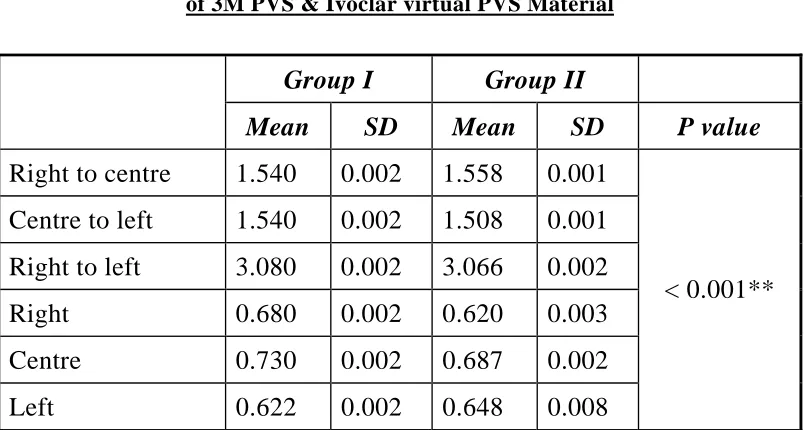
Table 4.10 Type B:
Two step putty wash Poly ethylene spacer technique of 3M PVS & Ivoclar virtual PVS Material
Group I Group II
Mean SD Mean SD P value
Right to centre 1.447 0.002 1.451 0.002 Centre to left 1.651 0.002 1.556 0.002 Right to left 3.098 0.004 3.097 0.003 Right 0.717 0.002 0.628 0.002
Centre 0.674 0.002 0.673 0.002
Left 0.715 0.002 0.707 0.002
< 0.001**
[image:62.612.103.510.419.614.2]Table 4.11 Type C:
Two step putty wash Scrapping technique of 3M PVS & Ivoclar virtual PVS Material
Group I Group II
Mean SD Mean SD P value
Right to centre 1.540 0.002 1.558 0.001 Centre to left 1.540 0.002 1.508 0.001 Right to left 3.080 0.002 3.066 0.002 Right 0.680 0.002 0.620 0.003
Centre 0.730 0.002 0.687 0.002
Left 0.622 0.002 0.648 0.008
< 0.001**
Note ** denotes significant at 1% level.
Table 4.12 Type D:
Two step putty wash Coping technique of 3M PVS & Ivoclar virtual PVS Material
Group I Group II
Mean SD Mean SD P value
Right to centre 1.598 0.003 1.554 0.002 Centre to left 1.557 0.002 1.575 0.002 Right to left 3.154 0.004 3129 0.003 Right 0.723 0.003 0.673 0.002
Centre 0.727 0.003 0.680 0.002
Left 0.720 0.002 0.713 0.002
[image:63.612.108.507.479.666.2]Interpretation of the results:
Table 4.1 shows Interabutment (RC,CL,RL) & Intraabutment (R,C,L) measurements of the master model. Each distance on the master model at each measurement location was measured 10 times & the mean was used as the control to compare distance on the stone model obtained by the four impression techniques.
Table 4.2 shows the Interabutment (RC,CL,RL) & Intraabutment (R,C,L) measurement of the stone dies obtained from the groupI (3M PVS Material) using four different putty wash technique.
Table 4.3 shows the Interabutment (RC,CL,RL) & Intraabutment (R,C,L) measurement of the stone dies obtained from the groupII (Virtual PVS Material) using four different putty wash technique.
showed significant difference from that of the master model dimension mean R-L (3.160).
The Intra-abutment measurement of stone die obtained from Group ID (2 step coping) putty wash technique mean - R (0.723), C(0.727), L (0.720) showed less dimensional changes in vertical direction compare to the dimension of master model R (0.735), C(0.730), L (0.737). The values obtained using Group IB (poly ethylene spacer technique) mean R (0.717), C (0.674), L (0.715) & Group IC technique (Two step scrapping technique) R (0.680), C(0.730), L (0.622) and Group IA technique (one step putty wash technique (R (0.694), C (0.623), L (.712) where significantly different from the measurements of master model Mean R (0.735), C (07.30), L(0.737).
technique (2 step scrapping technique - Mean RL (3.066). The measurements of the stone obtained with Group II A technique (one step technique - mean RL (3.061) showed significant difference from that of the master model dimension mean R-L (3.160).
The Intra-abutment measurement of stone die obtained from Group II D (2 step coping) putty wash technique mean - R (0.673), C (0.680), L (0.713) showed less dimensional changes in vertical direction compare to the dimension of master model R (0.735), C (0.730), L (0.737). The values obtained using Group II B (poly ethylene spacer technique) mean R (0.628), C (0.673), L (0.707) & Group II C technique (Two step scrapping technique) R (0.620), C(0.687), L (0.648) and Group IIA technique (one step putty wash technique (R (0.624), C (0.690), L (0.671) where significantly different from the measurements of master model Mean R (0.735), C (07.30), L(0.737).
The absolute change in (µm) inter & intra abutment measurements of the stone die obtained from Group I D technique (coping putty wash technique) RL (–6µm), R (–12µm), c (–3µm), L (–17µm) was comparatively less than all other techniques. Group I B (poly ethylene spacer technique) R-L (–62µm), R (–18µm), C(–56µm), L (–22µm), Group I C (scrapping putty wash technique) RL (–80µm), R (–55µm), C (0µm), L (–115µm). The one step putty wash technique showed maximum absolute change among all the techniques evaluated. RL (–197µm), R (–41µm), C (–107µm), L (–25µm).
Table 4.7 shows the percentage deviation and absolute change of group II (Ivoclar vivadent virtual material).
among all the techniques evaluated. RL (–99µm), R (–111µm), C (–40µm), L (–66µm).
Table 4.8 shows the one-way anova & Duncan’s multiple range test results.P value < 0.001 reveals a significant difference at 1% level.Duncan grouping denoted by different alphabets in superscript shows significance at 5% level.
Dimensional Accuracy of 3M PVS & Virtual
PVS material
Mean of Right to Left
Dimensional Accuracy of Four Putty Wash techniques of 3 M PVS material at 95% Confidence
DISCUSSION
Techniques, methods and materials are passing and changing, but underlying principles and fundamentals remain constant.
It must be remembered that any procedure, technique or material advocated for impression making, must be selected with the thought in mind of what will be the greatest good for the quality and greatest length of time62
.
Making a model or cast is an important step in prosthodontics and FPD’s in particular. Cast can be obtained from gypsum products using an impression mold which is the negative likeliness of a dental structure. In order to construct an accurate cast restoration, an accurate representation of oral structures is essential and this solely depends on the impression materials employed80.
The viscosity and flow behaviour of the impression material control the ease of mixing, amount of air trapped during mixing, accuracy of reproduction of tissue details.
Setting time can be described as the time elapsing from the beginning of mixing until the curing process has advanced sufficiently to allow retrieval of impression with minimal of distortion.
An ideal impression material showed accurately reproduce oral structures without distortion and dimensional change.
The viscoelastic properties of elostomeric impression materials play a major role in successful application as high accuracy impression materials. These materials are introduced into the mouth as viscous paste, which are then converted into viscoelastic solid at the end of setting reaction.
This viscoelastic property of elostomeric impression materials allows accurate reproduction of both hard and soft structures of oral cavity including the undercuts and interproximal spaces.
Several impression methods are followed with these impression materials. The most common are one step and two step putty wash technique. The putty wash technique was originally developed for condensation silicone to minimize the polymerization shrinkage and was later also employed for addition silicone.
Hung et al39 used a variety of addition - type silicone impression materials to investigate the effects of technique and choice of material on accuracy and concluded that the choice of the material is important for the accuracy with addition silicone material.
T Jan et al102 said that a variation expected when different brands of addition silicone materials are used.
Craig46 stated that the choice of technique was the more critical factor. Based on the previous studies an in vitro study was conducted.
An alterative to the 2 stage procedure is the single stage procedure in which the wash material is syringed in to place and simultaneously putty loaded impression tray seated over the light body material in a single step. The main disadvantage with this one step technique is that the lighter viscosity putty material will displace less viscous wash material resulting in the reproduction of critical areas of the tooth preparation in putty rather than in light body.
This is the critical point to be considered because the putty is too viscous to replicate the required details. Moreover with this single step technique distortion (or) incomplete details reproduction can occur because of excessive pressure applied to the setting putty.
In this study 2 poly vinyl siloxane impression materials (Group I 3M PVS material and Group II virtual PVS Material) were selected to evaluate the accuracy of one step and 2 step putty wash impression technique using various forms of spacers. Each group was divided into 4 subdivisions and they were named as (A,B,C,D)
Group IA, & Group II A represents - simultaneous one step putty wash technique.
Group I B & II B represents - two step poly ethylene spacer putty wash technique.
Group I C & II C represents - two step scrapping putty wash technique.
Group I D & II D represents - two steps 2 mm copping putty wash technique for two materials accordingly.
The accuracy of the material was evaluated by measuring the intra-abutment (R,C,L) and inter-intra-abutment (RC, CL, RL) distances on the stone model and comparing these with the measurements obtained from the master model. The accuracy was evaluated using traveling microscope (suswax optic) capable of measuring upto 1 µm. The results were tabulated and were subjected to statistical analysis using one way anova, Duncan multiple range test & student T-test.
The results revealed significant difference between one step and 2 step putty wash technique.
Among the 2 groups tested group II showed less dimensional change with one step putty wash technique (Group II - 99 µm Group I - 197) than group I.
Group I showed less dimensional change with all types of 2 step putty wash technique than Group II.
All the 3 modes of 2 step putty wash technique used in this invitro study produced better results than one step technique.
The differences seen in 2 technique tested may be due t the difference in the wash bulk. In the one step technique employed in this study the putty material irrespective of 2 group tested displaced the wash material resulting in the die reproduction in putty medium rather than an wash medium. The uncompensated putty contraction may be the cause for the dimensional changes encounted with one step technique. This result is consistent with earlier studies by Chee and Donovan29.
Though 2 step putty wash technique produced better results than one step technique, the wash bulk obtained with various forms of spacer produced a significant different within the various types of 2 step putty wash impression technique.
In the poly ethylene spacer and scrapping method the wash bulk could not be controlled which allowed differential contraction resulting in uneven dimensional changes45,46.
SUMMARY
A precise impression is necessary for fabricating an accurately fitting cast restoration. This is one factor that determines the restorations longevity. In this study two commercially available poly vinyl siloxane impression materials were selected.
Poly vinyl siloxane impression materials are extremely popular because of their combination of excellent physical properties, handling characteristics and dimensional stability. Its excellence clinical features remain unaffected if simple measures are guarded.
This study presents several impression techniques using 2 commercial available PVS and recommends, the one technique that provides the most accurate impression, utilizing the superior qualities of the PVS. The 2 materials used were 3 m Poly vinyl siloxane and ivoclar vivadent PVS. The impression technique which was used to find the accuracy was one step putty wash simultaneous technique, 2 step putty wash scrapping technique, 2 step putty wash poly ethylene spacer technique, and 2 step putty wash 2 mm coping technique.
Gr.IIB, Gr.IIC, Gr.IID.GroupI represents 3M PVS material. Similarly Gr.IA represents one step putty wash simultaneous impression technique. Gr.IB represents 2 step putty wash scrapping technique, Gr.IC represents 2 step putty wash polyethylene spacer technique, Gr.ID represents 2 step putty wash 2 mm coping technique as mentioned above with Ivoclar vivadent material.
The accuracy of the impression technique was measured from the stone model using traveling microscope and compared with master model. One way analysis of variance (ANOVA) was used to compare the differences among the 4 putty wash impression techniques and the master model for each measurement. The results of the study showed that there was a significant difference between one step and 2 step putty wash impression technique.
In the one step impression technique, where no control of wash bulk and thickness exists, is considered to be the least accurate impression method. Furthermore, the direct contact between the less refined putty material and the tooth preparation, as well as the high prevalence of air bubble entrapment, seriously compromises restoration longevity.
accurate and reliable impression due to complete control of the wash bulk and thickness.
CONCLUSION
Within the limitations of the study it can be concluded that;
1) There is significant difference existing between one step and 2 step putty wash impression technique.2 step putty wash method irrespective of spacer technique used produced more dimensionally stable dies than one step technique.
2) There is significant difference existing among two step putty wash impression technique when different spacers are used for wash material. 2 mm coping spacer for wash material produced stone dies with minimal dimensional change compared to other spacer technique.
3) Among the 2 PVS material 3M PVS material produced better results, with two step technique than virtual material.
BIBLIOGRAPHY
1. ABDELAZIZ KM, HASSAN AM, HODGES JS
Reproducibility of sterilized rubber impression. Braz Dent J. 2004; 15 (3).
2. ABDULLAHAH MA
Effect of frequency and amplitude of vibration on void formation in dies poured from polyvinyl siloxane impression.
3. ABUASI HA (1994)
Accuracy of one stage PVS impression material and plastic stock trays.
4. ADABO GL, ZANAROTTI E, FONSEEA RG, CRUZ CA,
Effects of disinfectant agents on dimensional stability of elastomeric impression materials.
J. Prosthet dent, 1999 May; 81 (5).
5. ALAIN THOUATI, ETIENNE DEVEAUX, ALAIN IOST
Dimensional stability of seven elastomeric impression materials. J. Prostho dent July 1996 Vol.76, No.1.
6. AZIZOGHI MA, CATANIA EM, WEINER S
Comparison of the accuracy of working casts made by the direct and transfer coping procedures.
7. BARD IDRIS, FIRANK HOUSTON, NOEL ELAFFEY
8. BERG JC, JOHNSON GH, LEPE X, ADAN-PLAZA S.
Temperature effects on the rheological properties of current polyether and polysiloxane impression materials during setting. J Prosthet Dent 2003; 90: 150-61.
9. BOENING KW, WALTER MH, SCHUETTE U.
Clinical significance of surface activation of silicone impression materials.
J. Dent 1998 Jul-Aug 26 (5-6)
10. BOULTON JL, GAGE JP, VINCENT PF
A laboratory study of dimensional changes for 3 elastomeric impression materials using custom and stock trays.
Aust Dent J. 1996 Dec. 41 (6). 11. BRADEN M, ELLIOT JC.
Characterization of the setting process of silicone dental rubbers, J Dent Res 1966; 45: 1016-23.
12. BRETT ROBINSON P, STEPHEN M., DUNNE, BRAIN J. MINAR,
An in vitro study of a surface wetting agent for addition reaction silicone impressions.
J. Prosthet Dent 1994; 71: 390-3
13. BUTTA R, TREDWIN CJ, NERBIT M, MOLES DR.
Type IV gypsum compatibility with five addition - reaction silicone impression material.
14. CEY HAN JA, JOHNSON GH, LEPE X
The effect of tray selection, viscosity of impression material, and sequence of pour on the accuracy of dies made from dual arch impression.
J. Prosthet dent 2003 Aug. 90(2) 15. CEYHAN JA, JOHNSON GH, LEPE X
The effect of tray selection, viscosity of impression material and sequence of pour of the accuracy of dies made from dual arch impression.
J. Prosthet dent 2003 Aug; 90 (2).
16. CHANDER P.K. WADHWANI, CHEN H. JOHNSON, XAVIER
LAPE,
Accuracy of newly formulated fast - setting elastomeric impression materials.
J. Prosthotdent 2005: 93; 530-9.
17. CHEE WW, DONOVAN TE
Polyvinyl siloxane impression materials: a review of properties and techniques.
J Prosthet Dent 1989; 68: 728-32. 18. CHEN SY, LIANG WM, CHEN FW.
Factors affecting the accuracy of elastomeric impression materials.
19. CHO GC, CHEE WW
Distortion of disposable plastic stock tray when used with putty vinyl polysiloxane impression materials.
J Prosthet dent 2004 Oct 92 (4). 20. CHONG YH, SHO G, LIN KE
Effect of loading and syringing on void formation in automixed addition silicone elastomes
J. Oral rehabil 1993 Nov. 20 (6).
21. CORSO M, ABANOMY A, DI CANZIO J, MORGANO SM
The effect of temperature changes on the dimensioning stability of polyvinyl siloxane.
J. Prosthet dent 1998 Jan; 79 (6). 22. COX JR, BRANDT RL, HUGHES HJ
A clinical pilot study of the dimensional array of double arch and complete arch impression. (2002)
23. CRAIG RG
Evaluation of an automatic mixing system for an addition silicone impression material.
J am Dent assoc 1985 Feb. 110 (2). 24. CRAIG RG.
25. CYNTHIA S. PETRIE, MARY P. WALKER, AISLING M. O’MAHONY
Dimensional accuracy of 2 hydrophilic vinyl polysiloxane impression materials under dry, moist and wet conditions. J. Prosthodent Oct. 2003, Vol. 90 No.4.
26. de ARAUJO PA, JORGENSEN KD
Effect of material bulk and undercuts on the accuracy of impression materials.
J Prosthet dent 1985 Dec 54 (6). 27. de ARAUJO PA, JORGENSEN KD
Improved accuracy by reheating addition reaction silicone impression.
J Prosthet Dent 1986 Jan 55 (1).
28. DENNIS R CULLEN, JESSU. MIKERUL AND JAMES L.
The wettability of an elastomeric impression material and interaction with gypsum slurry. (1991)
29. DONOVAN TE, CHEE WW
A review of contemporary impression materials and techniques Dent clin North Am. 2004 Apr. 48 (2).
30. EAMES WB, SIEWEKE JC, WALLACE SW, ROGERS LB. Elastomeric impression materials; effect of bulk on accuracy. J prosthet Dent 1979; 41: 304-7.
31. ERIKSSON A, OCKERT – ERIKSSON G (1998)
32. FENSKE C.
The influence of five impression technique on the dimensional accuracy of master models.
Braz dent. J. 2000, 11 (1).
33. FINGER W, OH SAWA M
Accuracy of stone - casts produced from selected addition type silicone impression
Scand J Dent res. 1983 Feb. 91 (1).
34. FORRESTER BAKER L, SEYMOUR KG, SAMARA WICKRAMA D,
PATEL M.
A comparison of dimensional accuracy between three different addition cured silicone impression materials.
Eur J. Prosthodont Roster Dint 2005 Jan.
35. GEEBARD S., AOSKAR, ZALKIND
Effects of impression materials and techniques on the marginal fit of metal castings.
J. Prosthet Dent 1994; 71:1-6. 36. GERROW JD, PRICE RB,
Comparison of the surface detail reproduction of flexible die material systems.
J. Prosthet Dent 1998 Oct 80(4).
37. HABIB AN, SHEHATA MT
The effect of the type and technique used for impression making on the accuracy of elastometric impression materials.
38. HONDRUM SO,
Changes in properties of non aqueous elastomeric impression materials after storage of components.
J. Prosthet dent 2001 Jan 85 (1).
39. HUNG SH, PARK JH, TIRA DE, EICK JD
Accuracy of one step versus 2 step putty wash addition silicone impression technique.
J. Prosthet Dent 1992 May; 67(5).
40. JACK D GERROW, ROBERT L SCHAIDER (1987)
Compatibility of elastomeric materials type IV dental stones and liquid medium on the basis of the reproduction of surface detail on that cast.
41. JAGGER DC, AL JABRA O, HARRISON A.
The effect of a range of disinfectants on the dimensional accuracy of some impression materials.
Eur J Prothodont Restor Dent. 2004 Dec. 42. JANICE P. DONALD (1994)
Bond strength between putty impression and subsequent wash application.
43. JEFFERY R. COX, ROBERT L. BRANDT AND HAROLD
A clinical pilot study of the dimensional accuracy of double -arch and complete -arch impressions.
44. JOHN B. TWEENER, JAMES A. COMMITTEE, PETER C.MOON
Linear dimensional changes in dental impressions after immersion in disinfectant solutions.
J. Prosthodent Dec. 1988 Vol.60.
45. JOHNSON GH, CRAIG RG
Accuracy of four types of rubber impression materials compared with time of pour and a repeat pour of models. J. Prosthet Dent. 1995 Apr 53 (4)
46. JOHNSON GH, CRAIG RG
Accuracy of addition silicones as a function of technique J. Prosthet Dent 1986 Feb 55 (2).
47. JOHNSON GH, DRENNON DG, POWELL GL,
Accuracy of elastomeric impressions disinfected by immersion. J Am Dent Assoc 1988; 116:525.
48. JOHNSON GH, LEPE X, AW TC
The effect of surface moisture on detail reproduction of elastomeric impression.
J Prosthet Dent 2003 Oct 90 (4).
49. LACY AM, FUKUI H, BELLMAN T, JENDRESEN MD,
Time-dependent accuracy of elastomeric impression materials. Part II: Polyether, polysulfides and polyvinylsiloxane.
50. LAMPE I, HEGEDUS C
Comparative evaluation of the shrinkage of addition type silicone impression material using hand-mix and cartridge mix technique.
2002 Dec; 95 (6).
51. LAMPE I, MARTON S, HEGEDUS C.
Effect of mixing technique on shrinkage rate of one polyether and 2 polyvinyl siloxane impression materials.
Int J Prosthodont 2004 Sep-Oct; 17(5); 590. 52. LAMY M (2001)
2 elastomer with different viscosities used to obtain difference impression technique.
53. LARRY E. BREEDING, DONNA L. DIXON
Accuracy of casting generated from dual arch impression. J. Prosthodent Oct. 2000, Volume 84, No.4.
54. LAUFER BZ, BAHARAV H, CARDASH HS
The linear accuracy of impression and stone dies as affected by the thickness of the impression margin.
Int J Prosthodont 1994 May 7(3). 55. LEPE X, JOHNSON GH,
Accuracy of polyether and addition silicon after long-term immersion disinfection.
56. LU JX, ZHANG FM, CHEN YM, QIAN M.
The effect of disinfection on dimension stability of impression. 2004 Aug. 13 (4).
57. MARCINAK CF, DRANJHN RA
Linear dimensional changes in addition curing silicone impression materials.
J. Prosthet Dent 1982 Apr 47(4).
58. MARSHAK B. ASIF D. PILO R.
A controlled putty wash impression technique J Prosthet Dent 1990 Dec. 64 (6).
59. MARTINE LJ, VON FRAUNHOFER JA.
The effects of custom tray material on the accuracy of master casts
J prothodont 1998 Jun; 7(2). 60. MC CABE JF, CARRICK TE
Recording surface detail on moist surfaces with elastomeric impression materials.
Eur. J. Prosthodont 2006 March. 14. 61. MCCABE JF, WILSON HJ.
Addition curing silicone rubber impression materials: an
appraisal of their physical properties. Br Dent J 1978; 145:17-20.
62. MERRILL G. SWENSON
63. MILLAR BJ, DUNNE SM, ROBINSON PB,
In vitro study of the number of surface defects in monophase and 2 phase addition silicone impression
J. Prosthet dent 1998 Jul; 80(1). 64. MILLSTEIN P, MAYA A, SEGURA C,
Determining the accuracy of stock and custom tray impression / casts.
J. Oral Rehabil 1998 Aug. 25 (8).
65. MOHD ZAINAL ABIDEIN, MOHD SULONG AND DERRICK
Properties of tray adhesive on addition silicone (1991).
66. MORGANO SM, MILOT P, DUCHARME P, ROSE L.
Ability of various impression materials to produce duplicate dies from successive impression.
J Prosthet dent 1995; 73: 33-40.
67. MURAKAMI H, TAKCHANA S, ABE T, YAMAMOTO Y,
WATANABE M, TEJIMA R, TAKIGAWA T
Dimensional change and deformation on stone dies for full cast crown. Different according to impression methods using vinyl silicone impression materials.
68. NISSAN J. ROSNER O, BARNEA E, ASSIF D.