This is a repository copy of
Baths and becks
.
White Rose Research Online URL for this paper:
http://eprints.whiterose.ac.uk/1810/
Article:
Gupta, A.F. (2005) Baths and becks. English Today, 21 (1). pp. 21-27. ISSN 1474-0567
https://doi.org/10.1017/S0266078405001069
[email protected] https://eprints.whiterose.ac.uk/ Reuse
See Attached
Takedown
If you consider content in White Rose Research Online to be in breach of UK law, please notify us by
USING rather informally collected data, I look here at two well-known variables in the English of England: first, whether there is a short or long vowel in words such as grass and bath; second, what regional words people know for
streams. The treatment of these variables is consistent over time, and seems to have little to do with social status or carefulness of speech.
Introduction
In order to teach aspects of sociolinguistics to Year 2 students at the University of Leeds, from 2000–2003, in two different academic years, I asked them to gather data on features known to vary in some way or another (by region, social class, or age) and which had been mapped on the basis of the data from the Sur-vey of English Dialects (Orton & Wright 1974, Orton et al.1978, Upton et al.1994). Results were collected, discussed, and collated. In 2003, the project concerned variation in both pronunciation (as regards the vowel in words like bath and grass) and word geography (as regards local equivalents for the word ‘stream’, such as beck and burn).
In 2004, the University of Leeds held an alumni day, and I decided it would entertain and inform the visitors if they were asked to place their own usage of linguistic variables on a map. For this, I selected two variables that, as revealed by the students’ work, had a strongly geographical pattern in England. The variables were:
● whether a long or a short vowel was used in such words as ‘bath’ and ‘grass’
● the use of alternative words for a ‘stream’
The results from these ventures were so strik-ingly like the results from the Survey of English Dialects (SED), done many years earlier and with very different respondents, that I thought it worth discussion. However, it must be borne
in mind that my studies were carried out for the purposes of teaching, and did not therefore follow the demands of subject selection and methodology that would apply to a formal research project. In addition, as only England was covered by SED, the analysis of my data excludes responses from beyond England.
The respondents
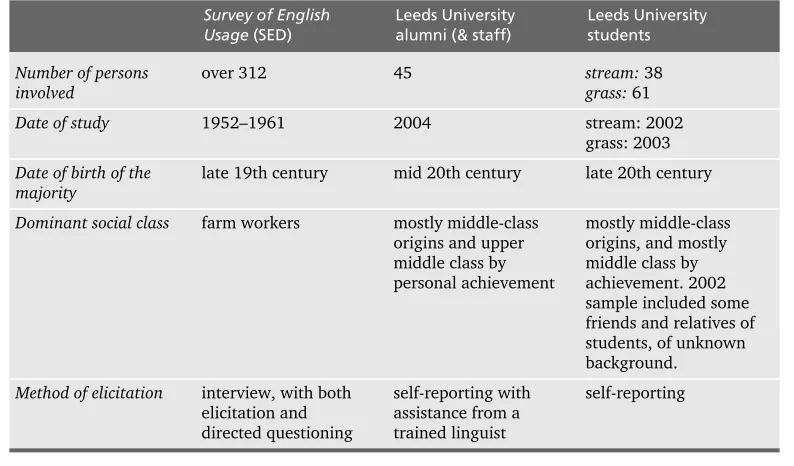
The respondents for the three studies were very different (see Table 1).
● SED The data was collected from 312 loca-tions in England in 1952–1961. Most respondents were elderly farmworkers. Responses were elicited.
● Alumni and staff (henceforth, ‘alumni’)I col-lected data at Leeds on an alumni day in 2004, from 45 people drawn from the alumni (the largest single group of whom graduated in the 1950s) and the staff of the School of English (various ages). Respon-dents were asked where they were from, and were invited to note down any difficulties they had about answering the questions, due to relocation during adolescence. They were asked first to indicate whether they had the same vowel in grassas in cator as in
palm and father,then to supply the word for a stream used in their places of origin.
● StudentsIn 2002, I got information from 38 University of Leeds students of English from
Baths and becks
A N T H E A F R A S E R G U P TA
A report on two prominent dialectal variables in England
2 2 E N G L I S H T O D A Y 8 1 January 2005 England, aged 19–25. Respondents were
shown a photograph, and were asked to name the thing shown, with the prompt ‘This is too small to be a river. What is it?’ They were told, ‘If you use more than one word for the thing, list them all, with your most usual one first.’ In 2003, data were obtained from 81 speakers from England, consisting of University of Leeds students of English, and their friends and family mem-bers, 67 of whom were under the age of 30. Respondents were asked to read the sen-tence ‘In summer, students picnic on the grass’ and their performance was classified by the student.
The alumni and students of Leeds could be said to be middle class, in contrast with the farm workers surveyed by the SED. Three genera-tions are represented here: the SED respon-dents, born largely at the end of the nineteenth century; the alumni and staff of Leeds, the majority of whom were born in the middle of the twentieth century; and the Leeds students, the majority of whom were born in the 1970s and 80s.
The BATHlexical set
Nearly all dialects of England have a clear dis-tinction between a short vowel in the TRAP lex-ical set, and a long vowel in the PALM lexlex-ical
set (for the concept of lexical sets, see Wells 1982). The BATH set is a set of words in which some accents have the same vowel as TRAP and others the same vowel as PALM (Wells 1982 I:133ff). Outside England, the pattern of distribution is complicated due to rhoticity (the pronunciation of rin all positions) and to the presence of accents with little or no distinction between short and long vowels, but within England, the treatment of the BATH set is a shibboleth used to distinguish northern accents of England (with a short vowel) from southern accents (with a long vowel). It is only in those few areas of England that preserve rhoticity, especially the southwest (Wells 1982 II: 345f), that this is not a straightforward issue of allo-cation of word to a long or short vowel.
The BATH lexical set is not homogeneous in terms either of its history or its current treat-ment. Some of the words in this set (such as
[image:3.493.47.444.54.287.2]aunt, dance, chance) have a complex history, with origins mostly in borrowings into Middle English from French. They entered English with an au spelling which, according to Dob-son (1968 II:786), corresponded to a diph-thong that was later monophdiph-thongised into a short a in some areas and a long a in other areas. The North-South divide based on the allocation of this lexical set to a long or short vowel goes back to the fourteenth century (Dobson 1968 II: 555f): this is a very old
Table 1: Data sources
Number of persons over 312 45 stream:38
involved grass:61
Date of study 1952–1961 2004 stream: 2002 grass: 2003 Date of birth of the late 19th century mid 20th century late 20th century majority
Dominant social class farm workers mostly middle-class mostly middle-class origins and upper origins, and mostly middle class by middle class by personal achievement achievement. 2002
sample included some friends and relatives of students, of unknown background.
Method of elicitation interview, with both self-reporting with self-reporting elicitation and assistance from a
directed questioning trained linguist
Survey of English Leeds University Leeds University
dialectal feature indeed. Others (such as grass) are from Old English short a or short æ, and were lengthened in accents of Southern Eng-land, especially before fricatives, a develop-ment seen as being ‘vulgar’ by writers of the eighteenth and nineteenth century (Muggle-stone 1995: 90ff). The lexical set is unstable, with a number of words (such as plaster, chaff, and mass) fluctuating within the same accent (Wells 1982 I:135). The word on which I col-lected responses, grass, is a core member of the BATH lexical set, which is likely to follow the predictable pattern for allocation to lexical set by the speaker.
Wells and Mugglestone (1995) both attribute social as well as geographical signifi-cance to the allocation of a long or short vowel to the BATH lexical set.
Wells (1982:134) claims that ‘[i]n the north of England ... there is sociolinguistic variation between the two’, although:
[r]etention of a short vowel in BATH words extends much further up the social scale than does the retention of unsplit/υ/. In Cannock [Staffordshire] the BATH vowel was found to be a consistent short /a/in the three lowest social classes, variable for the next-to-highest, and long/a/only for the highest of the five social classes recognized in the study (Heath 1980). There are many educated northerners who would not be caught dead doing something so vulgar as to pronounce STRUT words with [υ], but who would feel it to be a denial of their identity as northerners to say BATH words with anything other than short [a].
(Wells 1982 II:354).
Mugglestone (1995:90) says that:
Its realization as a long [ɑ] (as in modern southern enunciations of fast) now, of course, functions as one of the primary markers of a non-localized ‘standard’, or RP, accent and, although its transformation to this salient feature of ‘talking proper’ is now seemingly secure, it is perhaps salutary to remember that this was by no means so well established in the late nineteenth century.
Of course? We shall see. Mugglestone uses [ɑ] to represent the ‘southern’ BATH vowel. It should be borne in mind that many accents of England, including many of those in the south, have an [a] rather than an [ɑ], and that the use of [a] as opposed to [ɑ] in those regions really is a sociolinguistic variable, with the back vowel having higher prestige. In the south-west the very distinction between short
and long vowels may be of less phonological importance than elsewhere in England (Wells II:345). It is strange that the entire north seems to be classed as non-standard by Mugglestone, while the entire south is represented by only its highest prestige variant. Mugglestone’s associ-ation of non-localized, ‘standard’, and RP is something I will return to.
The boundary between short and long vow-els in SED, in the word last, runs roughly on the line shown in Figure 1: a line can be drawn west from The Wash, which lifts slightly fur-ther north as it comes near the Welsh border. North of the line, there are short vowels in last, and south of it long vowels. The division is almost perfect, with anomalous responses con-centrated on a band along the line. Exactly the same pattern was found by me with very dif-ferent respondents fifty years later.
Both the alumni and the students had no hesitation giving instant answers for their pro-nunciation of grass. Few indicated that they changed their pronunciation depending on social or geographical circumstances. Many of these respondents (unlike those in SED) had experienced considerable geographical mobil-ity and not many of these claimed to have changed pronunciation as a result of the move. One of the alumni said that he had lived in London for a number of years and might some-times use a long vowel, rather than his native short vowel. One of the students (from
‘grass’ long 96% ‘grass’ short
[image:4.493.256.450.33.261.2]93%
2 4 E N G L I S H T O D A Y 8 1 January 2005 London, living in Yorkshire) indicated
alterna-tion between the long and short vowel in grass,
presumably as a result of a move to the north. There are a few individuals who will accom-modate to the pattern of a new region after relocation. But there was no indication what-soever that any respondent away from the bor-der zone (such as a respondent from Loughborough) varied the vowel according to social context, as would be the case if this was indeed a sociolinguistic variable in the Labovian sense of showing patterned stylistic and social variation (Labov 1970). The elicita-tion of the terms from both students and alumni was one which should have promoted the supply of a high number of self-conscious, high-prestige variants, and these respondents (unlike those of the SED) were from high social classes.
The distribution of long and short vowels in the BATH lexical set is astonishingly consistent over time (Table 2). With one exception, the most southerly students to claim a short vowel in grasswere from Northampton and Bedford-shire, and (again with one exception) the most southerly alumnus to claim a short vowel was from Wolverhampton. It was apparent from the students that respondents on or near the line (such as from Birmingham) varied. The overall pattern of distribution in England (Fig-ure 1) is the same as that identified by the Sur-vey of English dialects, using data from people born about a century earlier than the current respondents (Orton et al.1978: Ph 4). One stu-dent from Essex unexpectedly had the short vowel in grass, despite commenting that the short vowel was characteristic of the north and midlands. The interviewer did not comment on this anomaly – there may be an error. In 2004,
one respondent from Bristol indicated that he used the short vowel in grass. Bristol lies in the south-western area where the treatment of long and short vowels is unusual for England. This respondent indicated that he did not want to sound ‘rustic’ (the impression presumably that would be given by [a]), and that his choice of the short rather than long vowel might have been under the influence of his northern parents.
Comments recorded by the students indicate that many people are aware of the geographi-cal distribution of this feature. Forty-eight respondents made comments that clearly indi-cated they knew of this as a northern/southern shibboleth. One respondent (from Leamington Spa) associated the southern variant with older speakers and the northern variant with younger ones. Leamington Spa is right on the boundary, and thus an area where socially meaningful patterns might be found: in these areas it would be interesting to establish whether the direction of change is to the north-ern or southnorth-ern form. Eight members of the student group made comments relating to cor-rectness, three from the north of England (Boston, Doncaster, Preston) identifying the short vowel as correct, one suggesting that the long vowel was wrong because there is ‘no r in it’ (a reference to the use of [ɑ] in the START lexical set, where historically the vowel was lengthened in accents of England due to the loss of /r/).
[image:5.493.45.445.63.191.2]Four students (one each from Reading and Leicester and two from Cambridge) indicated that the long vowel was ‘correct’, ‘better Eng-lish’, or ‘well-spoken’. And one diplomatic Lon-doner expressly said that both were correct. Nineteen respondents indicated that having a
Table 2 Responses north and south of the SED line (either response on the boundary line classed as congruent)
North of SED line 74 6 93
Student data 47 4 92
Alumni data 27 2 93
South of SED line 2 51 96
Student data 1 36 97
Alumni data 1 15 94
long vowel in grassis more prestigious than the short vowel (but 10 of those did not mention the regional distribution at all). However, being ‘posh’ is not a positive thing for some of these respondents. Many of the northerners were noticeably hostile to /DZrɑs/, describing it as ‘comical’, ‘snobbish’, ‘pompous’ or even ‘for morons’.
There are only six anomalous long vowel users north of the line (one each from Preston, Manchester, Yorkshire, and Hexham, and two from Cheshire, which is close to the border for this variable). There are undoubtedly a few high prestige speakers from the north of Eng-land who use a traditional variety of RP, but they are few. For these individuals, the alloca-tion of the lexical set BATH to a long or short vowel might be a sociolinguistic variable, but they are very few indeed.
The treatment of words in the core BATH set, such as grass, is an excellent regional marker. Most English respondents associate the variation with the North and South of Eng-land. Though some have strong preferences for one or another alternative, a relatively neutral regional identification is the most common reaction. There is no justification for the claims by Wells and Mugglestone that this is a soci-olinguistic variable in the north, though it is a sociolinguistic variable in the areas on the bor-der (as shown by Heath 1980), and the varia-tion between [a] and [ɑ] is a sociolinguistic variable in many locations of both north and south. It has been suggested (e.g. Mees 1987, Trudgill 1988, Kerswill & Williams 2002) that London accents are a major influence around the country. I see no evidence that London is spreading north in the BATH lexical set.
Most of those who describe and codify RP allocate this lexical set to the long vowel (such as Wells 1990, OED,though Upton et al.2001 operate with a definition of RP that allows for a short vowel). However there are many north-erners whose vowel quality matches conven-tional descriptions of RP, but who have a short vowel in this lexical set. It may be because of this trivial difference between northern RP and southern RP that some linguists have started to use the (slightly offensive) term ‘Southern Standard British English’ rather than using just ‘RP’, which implies an accent that is non-regional within England. But to me it seems that it would be strange not to use the label RP
for accents like this, simply because of the allo-cation of a small set of words.
Words for stream
At an international level, words for ‘stream’ are well known heteronyms (Görlach 1990, Gupta 2001). Within England, the distribution of words for ‘stream’ (or ‘rivulet’ as it is called in the SED reports) is more complex than the dis-tribution of long and short vowels in grass
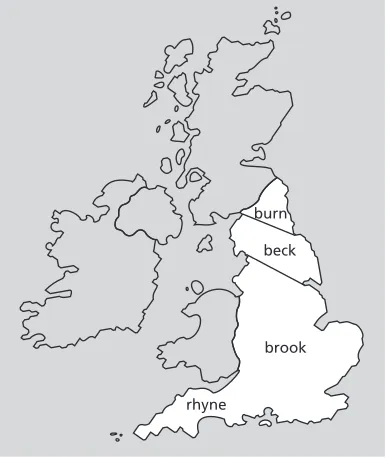
(Upton et al. 1994). There are more alterna-tives, and geographical factors enter into play: there are, for example, considerable physical differences between waterways in low-lying Norfolk (where there is a lot of drained land) and mountainous Cumberland. Nevertheless, in SED a general pattern emerges: of burnin the far north, beckin the rest of the north, and
brookover a wide area of the Midlands and the south. There are several other words of local occurrence and some respondents who have no word other than stream.
Once again, a similar distribution was found from the Leeds respondents (Figure 2). With the exception of one respondent, describing herself as coming from ‘north west London’ (who gave her word as wadi, presumably reflecting a South Asian association), the stu-dent responstu-dents supplied only beck and
brook, congruent with their location. The alumni day respondents added burn, from two respondents further north, and rhine, from two respondents from Somerset. The methodology used with the students did not discourage
brook burn
beck
[image:6.493.257.451.395.624.2]rhyne
2 6 E N G L I S H T O D A Y 8 1 January 2005
stream, and 23 respondents, from all regions, supplied only stream. In the alumni-day study, where subjects were invited to give alterna-tives to stream, 7 respondents from London and 2 from York said they knew only stream.
Respondents had less clear-cut answers on this variable than on the grass variable. The alumni often had to think about their responses, sometimes quoting place-name evi-dence, and they volunteered a great deal of additional information, indicating that many of them had acquired new words for streams as they moved around the country (or world). Older subjects are likely to have experienced greater personal mobility, and (as in this case) may have acquired regional words from sev-eral places. Although the student respondents all had the experience of living in Leeds, none of those from other regions suggested beck, and their residence there as students seems to have made little lexical impact: they behaved much more like the SED respondents who had always lived in the same place. The responses from the older respondents showed an expec-tation that a stream was likely to be named in a way congruent with, not one’s own origins, but the location of the stream. There was no evidence of this kind of adaptation being rou-tinely made in the case of grass. It is not clear whether the difference in this respect between the younger and older respondents reflects a real change (the dominance of stream): it is possible that the younger respondents will learn that streams have regional names later in life, when they live in a place with more contact with residents than they do as students.
Regional words appear in place names, and are all candidates for local standards – the words offered here all have entries in the OED
indicating their status as local regional words (including wadi and rhine), and all are rou-tinely used in texts such as local newspapers. A Greek student respondent, who supplied ‘stream, beck, brook, channel, rivulet’ illus-trated rather nicely how speakers of English need to learn a variety of words, some of them regional: creekwould have been a useful addi-tion to her list, especially outside the British Isles. These local words for ‘stream’ are not restricted to those native to a region, with accents from the region, but are to be used by all those referring to the physical feature in the region. Whereas moving the pronunciation of
grassfrom one lexical set to another is seen as
changing a badge of identity, the same speaker is able to use rhine in Somerset and beck in Leeds without any sense of betrayal of her roots. It is as if the term is associated with the terrain, just as in world Englishes words are associated with specific cultural institutions. Of all aspects of language the lexicon is the most permeable.
Conclusion
These two linguistic variables operate at a high level of consciousness. Both are stable over time, and carry geographical rather than social meaning. The choice of a word for ‘stream’ is conditioned in part by a speaker’s region of origin, such that terms like burn,
brookand beckwill be applied to the physical feature wherever it is seen, but these are terms with a localised standard usage, and speakers regularly acquire and use new het-eronyms when they relocate, adding them to a repertoire of geographically specialised words. The allocation of a group of words in a small lexical set to either a long or a short vowel is an important marker of northern and southern identity within England. For some speakers, the use of a short vowel in this lexical set may be the only phonological mark of a northern identity. Few speakers allocate this lexical set in a way that is not characteristic of their region of origin. North of a narrow border zone, where the use of a long vowel may be more prestigious, there is no evidence that this functions as a sociolinguistic variable: speakers are not more likely to use a long vowel in more formal styles.
In sociolinguistic research it is sometimes forgotten that not all linguistic variables are sociolinguistic variables. Within England, it is reasonable to identify RP as a high-prestige accent in most locations, and this has worked helpfully in much sociolinguistic research. But the use of RP as a default high-prestige variety should not preclude the identification of regional variants of RP. The social should not be confused with the regional. It is not helpful to equate RP with accents of southern England, nor to equate southern accents with a ‘stan-dard’ accent. Just as there are local high pres-tige accents and local standard lexical items in Englishes outside England, there are features of English accents which are geographical rather than social, and there are local standard
References
Görlach, Manfred. 1990. ‘Heteronymy in International English.’ In English World-Wide, 11:2, pp. 239–74. Gupta, Anthea Fraser. 2001. ‘Realism and imagination
in the teaching of English.’ In World Englishes20 (3), pp. 365–81.
Kerswill, Paul. 2002. ‘Koineization and
accommodation.’ In J. K. Chambers, Peter Trudgill & Natalie Schilling-Estes, eds, The handbook of language variation and change, pp. 669–702. London: Blackwell.
—, & Ann Williams. 2002. ‘ “Salience” as an explanatory factor in language change: evidence from dialect levelling in urban English.’ In Mari C. Jones & Edith Esch, eds., Language change: the interplay of internal, external and extra-linguistic factors, pp. 81–110. New York: Mouton de Gruyter. Labov, William. 1970. ‘The study of language in its
social context.’ In Studium Generale23, pp.30–87. Mees, Inger. 1987. ‘Glottal stop as a prestige feature in
Cardiff English.’ In English World-Wide8:1, pp. 25–39.
Mugglestone, Lynda. 1995. ‘Talking proper’: the rise of accent as social symbol.Oxford: Clarendon Press.
Orton, Harold, & Nathalia Wright. 1974. A word geography of England.London: Seminar Press —, Stewart Sanderson, & John Widdowson. 1978. The
linguistic atlas of England.London: Croom Helm. Oxford English Dictionary, 2nd edn, 1989, ed. J. A.
Simpson & E. S. C. Weiner, in Additions 1993–7 (with Michael Proffitt), and 3rd edn (in progress) Mar 2000 (ed. John Simpson), OEDOnline <http://oed.com>. Oxford: University Press. Trudgill, Peter. 1988. ‘Norwich revisited: recent
linguistic changes in an English urban dialect’. In English World-Wide9:1, pp. 33–49.
Upton, Clive, David Parry, & J. D. A. Widdowson. 1994. Survey of English Dialects: The dictionary and grammar.London & New York: Routledge. —, William Kretzschmar, Rafal Konopka and Ray
Konopka. 2001. The Oxford Dictionary of
Pronunciation for Current English.Oxford: University Press.
Wells, J. C. 1982. Accents of English, Vols. I–III. Cambridge: University Press.