This is a repository copy of How about building a transport model of the world?.
White Rose Research Online URL for this paper: http://eprints.whiterose.ac.uk/2447/
Conference or Workshop Item:
Timms, P.M. (2002) How about building a transport model of the world? In: Nordic Research Network on Modelling Transport, Land-Use and the Environment, September 27-29, 2002, Haugesund, Norway..
[email protected] https://eprints.whiterose.ac.uk/ Reuse
See Attached
Takedown
If you consider content in White Rose Research Online to be in breach of UK law, please notify us by
Universities of Leeds, Sheffield and York
http://eprints.whiterose.ac.uk/
Institute of Transport Studies University of Leeds
This is an author produced version of a paper given at the Nordic Research Network on Modelling Transport, Land-Use and the Environment. Please visit their website at: http://www.infra.kth.se/tla/tlenet/
White Rose Repository URL for this paper: http://eprints.whiterose.ac.uk/2447
Published paper
Timms, P.M. (2002) How about building a transport model of the world? Nordic Research Network on Modelling Transport, Land-Use and the Environment Sixth Workshop, Haugesund, Norway. September 27-29, 2002
Nordic Research Network on Modelling Transport, Land-Use and the Environment Sixth Workshop, Haugesund, Norway
September 27-29, 2002
HOW ABOUT BUILDING A TRANSPORT MODEL OF THE WORLD?
PAUL TIMMS [email protected]
Institute of Transport Economics, Oslo (TØI) and Institute for Transport Studies, Leeds (ITS)
ABSTRACT
The paper provides a specification, created by the recently completed BLUEPRINT project, for a world transport network model. The model should be able to make predictions (up to 100 years into the future) of transport flows throughout the world and hence make predictions of global climate-changing emissions arising from transport. Furthermore, the model should: cover both passenger and freight traffic; feature all modes of transport (road, rail, non-motorised, water, air and pipeline); and represent both local traffic and long-distance traffic. The paper describes how the model will be structured as the combination of a global model (distinguishing between approximately 30 different geographic regions of the world) and a number of regional and sub-regional models. Wherever feasible, existing regional models will be used in this system, or at least simplified versions of such models. The overall modelling system should be owned jointly by an international network of world transport modellers, welcoming easy entry to other modellers who subscribe to the underlying spirit of the network. The paper recognises the scientific complexities associated with the uncertainties of predicting 100 years into the future and with difficulties arising from the likely differences in modelling philosophy between the (already existing) regional models that might be used in the modelling system. In order to tackle these complexities, the paper defines a number of philosophy of science reference points. At the core of these reference points is the distinction between objectivity and subjectivity. The paper finishes with a number of suggestions for next steps in building the model.
1 INTRODUCTION
The recently completed BLUEPRINT project (BLUEPRINT, 2001) has generated a “blueprint” for the development of an Integrated Assessment Model (IAM) for use in the assessment of policies that effect climate change. The project was sponsored by the Tyndall Centre, a national UK government-funded consortium for trans-disciplinary climate change research launched in November 2000. It was agreed at an early stage in the project that the approach to be used in constructing the IAM was to provide a framework for the flexible integration of various modules (computer models) simulating key factors that are relevant to climate change. Such factors include climate, agricultural production, economic development, technological development and transport amongst others. The purpose of this paper is to report the results of BLUEPRINT with respect to the creation of a transport module within the IAM.
The project recommended that a transport network model should be constructed that can make predictions (up to 100 years into the future) of transport flows and hence climate-changing emissions arising from transport throughout the world. This model should be able to:
• cover both passenger and freight traffic;
• feature all modes of transport (road, rail, non-motorised, water, air and pipeline); • represent both local traffic and long-distance traffic;
• distinguish between (approximately) 30 different geographic regions of the world • take into account scenarios/policies (differentiated by region) concerning:
o the level of building new transport infrastructure;
o pricing of transport (including subsidy of modes that are more "climate-friendly");
o new transport technologies for vehicles and fuel;
o technologies that allow alternatives to transport such as e-communications;
o changing social and political attitudes towards transport, particularly with respect to the desire and need to travel, and the use of more “environmentally friendly” modes;
o differing levels of car ownership;
o globalisation with respect to the movement of capital, manufacturing and labour;
o carbon trading between countries;
o differing development patterns of "developing countries".
Furthermore, it was agreed that it should be straightforward for users throughout the world to customise the model to suit local needs (and hence assess local initiatives to control transport related emissions). This would be accomplished by providing the possibility for collaborating partners throughout the world to make easy linkages with regional models representing, say, one of the zones in the global model in finer detail. On the one hand this would be useful for exchanging data with already existing regional models and would, on the other hand, encourage the creation of new regional models. Finally, it was required that the computer run time of the model should be short, so that the model could be used in an iterative sequence of models (such as climate, agriculture and economics) without leading to overall excessive run times for the IAM.
From the above specification, it follows that the transport model will involve a collection of reasonably simple sub-models, one defined on a global level and others defined on different regional levels. Any one specific application of the overall modelling system will use only those sub-models that are appropriate to the needs of the application, and the model structure must be flexible enough to take account of the differing needs of different applications. In the case that complex regional models already exist, there is likely to be a need to create new (simple) models that mimic them. An example of a complex regional model that could feasibly be available would be an amalgamation of a number of Scandinavian national freight and passenger models.
In the remainder of this paper, the overall modelling concept (including both models and scenarios) will be referred to as “TranWorld”. Many interesting questions arise directly from the above specification, and the discussion of these questions provides the main basis of this paper. The questions, and the respective sections in which they are addressed, are:
• How will international collaboration be achieved? (Section 2)
• What scientific approach can be taken to the inevitable uncertainties of predicting 100 years into the future and to the likely differences in modelling philosophy between (already existing) regional models that might be used in TranWorld? (Section 3)
• What overall model structure should be used (Section 4).
• What type of mathematical models will be used in TranWorld (Section 5)
Section 6 then describes a relatively new family of transport models known as Sketch Planning Models (SPMs), which can provide a useful basis for developing the models in TranWorld. In particular, Section 6 describes a model of Europe (named EURO9) which represents transport on a similar scale to that required by the global model in TranWorld. Finally, Section 7 provides a brief summary of the paper and suggestions for ways forward to build TranWorld.
2 AN INTERNATIONAL NETWORK OF WORLD TRANSPORT MODELLERS
Various approaches could be taken towards the building of a world transport network model, depending upon how it is to be used and who is to own it. In one approach, that can be termed nationally-focussed, such a model could be owned by one particular region/country who wish to use it in order to assess the results of global measures upon the particular interests of that region/country. Much of this assessment could be made by using a model which is geographically restricted to the region/country of interest. However, given that the (direct) effects of the global measures on other parts of the world will lead to (secondary) effects on the “home” region/country, this type of isolationalist model would be insufficient. There would therefore be a need to model the region/country within an overall world context.
Assuming a nationally-focussed approach within a world context, the model representation would (implicitly or explicitly) distinguish between a geographical core (made up of the region/country owning the model) and a geographical periphery (everywhere else in the world). The researchers building the model would presumably live and work within the core area. A question then arises as to how essential data and scientific predictions concerning the periphery might become available to them. The obvious solution would be to “buy in” expertise, by paying researchers from the periphery to provide the necessary input to the model.
Inevitably, though, there would be a tendency in this case for more model development to be carried out in richer areas of the world than poorer areas, thus leading to a greater number of models of higher quality in the former than the latter. In the context of setting climate change policies, models will increasingly be used by national governments (and regional associations such as the EU) to enhance bargaining positions with respect to international agreements on curbing climate-changing gases. An imbalance in model ownership between richer and poorer countries would serve to enhance the interests of the former at the expense of the latter. If research is seen as a nationalistic exercise (so that the main purpose of research for the individual researcher is to help their own nation get competitive advantage over other nations) then such an approach is justified.
However, there is another approach to research which sees it in an internationalist perspective, and which can be termed an internationally-focussed approach. Such a perspective pays more attention to the needs of people throughout the world to live and
cooperate together as opposed to the need for competition between nations. Clearly the choice between this perspective and the nationalistic perspective is a political one. However, if the internationalist perspective is chosen, the nationally-focussed approach to building a world model described above is inadequate and an alternative approach is required. In general, the creation of such an alternative approach is challenging, given the reality that most research is in fact currently nationally-focussed and that researchers are conditioned to fulfil the roles defined for them by this environment.
In the context of a world transport model, a contention of this paper is that the alternative approach is best served by setting up an international network of world transport modellers. Such a network could cooperate on building the model with the conscious aim of providing for the needs of everybody in the world as opposed to only those in wealthier countries. An essential feature of the resulting model would be an agreement of common ownership of it by all the researchers involved with building it, irrespective of their sources of funding. Thus the researchers from richer countries would not be “more important” in the network than the researchers from poorer countries. Furthermore, membership of the international network should be open, on an ongoing basis, to all those who are interested in building a world model and who subscribe to the basic philosophy of common ownership of the model. Clearly, an activity such as that outlined above would need careful coordination. In particular, at any one time, it would require “a core group” of researchers to guide its development and ensure that scientific standards are met. For the enterprise to be truly international, the researchers involved with this core group should be as representative as possible of different parts of the world. Furthermore, there should be an underlying principle of rotating the membership of the group, so that management of the network does not become unduly associated with particular “personalities”.
3 NEED FOR A PHILOSOPHY OF SCIENCE PERSPECTIVE
Any attempt to make predictions of 100 years into the future will inevitably be scientifically challenging, as will any attempt to link together already-existing regional models which have potentially different modelling approaches. In order to address these issues transparently in TranWorld, there is a need to define at the outset a high level "philosophy of science" standpoint, which will be used to initiate an on-going (and hopefully lively) discussion that will underlie the model-building process.
To help define this standpoint, we use a list of pairs of “rival” concepts underlying modelling methods as given by SCENARIOS (1998):
• Subjective versus objective • Rationalist versus empiricist • Forecasting versus backcasting
• Substitutability versus exchangeability
These pairs of concepts are now used in the rest of this section in order to provide a scientific orientation for TranWorld. Particular attention is paid (in 3.1) to the distinction between objectivity and subjectivity, and this discussion provides the basis for examining more practical scientific approaches later in the section. In general, the results of Section 3 will lead directly to the construction of the model structure to be described in Section 4.
3.1 Subjective versus objective
At the outset of building any model, it is useful to make a distinction between the subjective and objective elements in the model. In general, objective elements will need to be seen as being impersonal, so that the results are not dependent upon any personal characteristics of the model-builder or model-user. Two types of objectivity can be identified:
• Pure objectivity, which is based upon deduction; and
• Pragmatic objectivity, which relies upon a particular scientific theory.
In general, when models use mathematical and logical processes they are using pure objectivity, whilst when they use theories requiring observed data they are using some form of pragmatic objectivity. In the latter case, two different overall approaches can be identified, rationalism or empiricism, depending upon the respective emphasis on prior theory or empirical observation. These are discussed further in 3.2 below.
As opposed to objectivity, subjective elements are based upon the personal judgment of the model-builder or are left to the discretion of the model-user. All transport models typically have subjective elements though this aspect is often hidden, particularly with respect to subjective judgments made by the model-builder. Arguably, such subjectivity should be recognized and treated explicitly in all modelling exercises. However, in a transport model which aims to make predictions for 100 years into the future, to do so is essential. Any prediction over such a timescale will inevitably feature a high degree of uncertainty with respect to most of the issues listed in Section 1 (such as, for example, the changing social and political attitudes towards transport and the differing development patterns of "developing countries"). Estimates about any of these issues must involve a high degree of subjective judgement on the part of the model-builder. Furthermore, in a model that represents the whole world, there will inevitably be a large degree of transferral of data/results/equations from one part of the world to another. The appropriateness or otherwise of such transferral, which can be referred to as analysis of transferability, is often a matter of personal judgement and hence a subjective element in the modelling process. An overview of subjectivity in transport models has been given by Timms (2001).Although this overview makes particular reference to the estimation of Origin/Destination trip matrices, the underlying concepts apply generically to the model-building process. The paper states that the key concept in any subjective method used by the model-builder concerns the reliance upon “beliefs” as opposed to (objective) “facts”. An important question here concerns what such beliefs actually represent, especially since they have presumably been formed with a certain degree of awareness of facts. Three main approaches to subjectivity can be identified and are discussed in the following subsections:
• Individualistic subjectivity • Deterministic subjectivity • Collective subjectivity
3.1.1 Individualistic subjectivity
The notion of individualistic subjectivity is that each individual is free to think whatever they want. This notion is an attractive one in a liberal democratic society. Taken to its extreme, it results in an existentialist philosophy which can be an extremely powerful method of personal liberation, particularly for people “dispossessed” by society. However, in the specific context of constructing a world transport model, which needs to be believable by people from many different backgrounds and cultures, there is a need for transparency that cannot be provided by individualistic subjectivity in isolation. Thus whilst individualistic
subjectivity is useful to help researchers gain inspiration in thinking up new ideas, it cannot provide the substantive basis for a model-building process.
3.1.2 Deterministic subjectivity
“At the other extreme” from individualistic subjectivity is deterministic subjectivity. Such an approach, whilst still recognising formal subjectivity, is based upon the notion that there is only one assumption that any individual can reasonably make with regard to their personal beliefs. All other assumptions are unreasonable and so worthless. An interesting defence of this approach is given by Garrett (1989) with respect to the use of maximum entropy techniques in physical sciences, and might very well be appropriate in such (natural science) fields. However in the essentially social science environment of building a world transport model, the ideological straitjacket demanded by deterministic subjectivity is frightening.
3.1.3 Collective subjectivity
The third notion of subjectivity, collective subjectivity, can be seen as lying somewhere between individualistic and deterministic subjectivity. Whilst it accepts that more than one subjective viewpoint is acceptable, it requires that any such viewpoint should clearly serve a collective purpose. In the case of building a world transport model, the collective purpose could be seen as “helping world society” as interpreted (collectively) by the researchers in the world network described in Section 2. No pretence is made here that the use of collective subjectivity is a simple process. However, given the need expressed above to recognise subjectivity and the inadequacy of the more simplistic concepts of individualistic subjectivity and deterministic subjectivity, the need to use the concept of collective subjectivity is clear.
3.2 Rationalist versus empiricist
As described above, pure objectivity concerns mathematical and logical processes that (given certain axioms) are self-evidently “true”. Whilst such processes are important when building models, they cannot by themselves create a model, since a model has a need also for scientific theory and observed data. The relative emphasis on either theory or observation leads to an essential distinction in modelling approach, which we can define as either
rationalist (if theory is more important) or empiricist (if observation is more important).
Supporters of empiricist methods will argue that such methods are more “realistic” (and hence more objective) since they represent fact rather than hypothesis. For short term predictions (such as predictions on traffic flows for determining traffic signal settings), this argument is very powerful. On the other hand, for long term predictions in which sophisticated explanations of behaviour are required (as in our world model) it is more appropriate to take a rationalist approach. However, given the multiple diverse rationalist theories available for explaining behaviour, it can be seen that the choice of which theory to use is essentially subjective, and dependent upon the needs for which the model is to be used. Thus the choice is one that must be made in the context of collective subjectivity. It can be seen immediately here that the borderline between rationalism and collective subjectivity is not always obvious.
A second problem for empiricism concerns the issue of transferability mentioned above, concerned in the case of TranWorld with the transferral of data/results/equations/models from one part of the world to another. An observation made in one particular location can have no relevance to any other location without using a transferability model (which justifies the use of any transferral). In many applications, such a model is implicit and extremely vague, betraying a subjectivity on the part of the model-builder which is not transparent. Such practice relies upon individualistic subjectivity (as described above) and represents bad
modelling practice. Rather, the transferability model should, wherever possible, be based upon rationalist theory, and should at a minimum fulfil the social requirements of collective subjectivity.
3.3 Forecasting versus backcasting
Sections 3.1 and 3.2 have provided a set of philosophical reference points for helping to understand the nature of the models that we are building. Given these reference points, we can now define practical philosophical techniques to guide model construction. For a model that is to make long term predictions into the future we have two main techniques:
forecasting and backcasting. Forecasting uses rationalist models to track changes in the
transport system over time, starting from the present day and extrapolating forward according to currently-accepted scientific theory. On the other hand, backcasting supposes a particular future scenario and examines the transport policies that might be required in order to attain this scenario. Whilst political processes might be considered in a forecasting approach, they typically feature in the background as given exogenous inputs. In a backcasting approach, however, political processes (and an underlying political science philosophy) are very much in the foreground, being central to attempts to define future scenarios.
On the surface, forecasting is an essentially objective activity whilst backcasting is an essentially subjective activity. However, it is hoped that the discussion in 3.1 and 3.2 shows that the distinction between objectivity and subjectivity is often not clearly enough defined to make simplistic categorisations of this type. In fact, any forecasting process is likely to have many subjective aspects whilst backcasting will have many objective aspects, especially if an effort is made to construct future scenarios that are internally consistent. Whilst much intellectual energy can (and has been) used up in deciding which of these two techniques is “better”, this paper argues that it is far more fruitful to use both in conjunction. In practice, a large number of future scenarios (for, say, 50 or 100 years ahead) will be defined for TranWorld. Some of these scenarios will be created by forecasting approaches and could make use of systems dynamics models such as ASTRA (2002). Other scenarios will be constructed with a backcasting approach by identifying alternative political images of the future with respect to a large number of politically-oriented issues that are seen to be important for determining future transport patterns. These issues should allow for the possibility of differences between different parts of the world, and should at least include: • the level of world and regional economic integration of capital and labour;
• the growth or decline of free market capitalism; • the growth or decline of democratic socialism;
• the level of growth of environmental awareness and its associated effects upon government and international legislation;
• the growth or decline of a culture of individualistic consumerism; and
• the level of growth of awareness that high levels of inequality (both within countries and between countries) are not socially sustainable.
The main requirements for scenarios are that, firstly, someone (at least) in the international network should believe in their possibility and that, secondly, they should be internally consistent. Once a set of future scenarios is created, it will probably be pragmatic to identify a number of scenario groups, where the scenarios in each group have some underlying similarity that distinguish them from those in other groups. The model predictions made by TranWorld will then make different sets of estimates with respect to each group, rather than for each scenario.
3.4 Substitutability versus exchangeability
As indicated above, it will be important in TranWorld that the global model will be able to link with regional models. However, three important issues arise:
• Where regional models already exist they might be complex and it might not be feasible to use them on-line in an iterative modelling application. It follows that such models would need to be replaced in the modelling system by simpler models which aim to “give the same results” as the more complex models.
• Even if an already-existing regional model is not too complex for use in an iterative modelling system, it might have a different scientific basis to (some of the) other regional models in TranWorld. Different types of regional model might yield significantly different results or types of result, even when used for the same region with the same data set. In some applications (particularly when the regional models are being used to generate input to the global model) it might be appropriate to replace the already-existing regional model with a model that was more scientifically consistent with the other models in TranWorld.
• In the case that a new regional model needs to be built (due to the lack of an already-existing model), it is assumed that it will use a scientific basis in line with the overall philosophy of science adopted by TranWorld. However, a choice will still need to be made over the alternative feasible specifications of mathematical form (i.e. model equations) and associated calibration parameters. Rather than one particular specification always being the “best”, it will certainly be the case that different specifications are appropriate for different applications.
Underlying all theses issues is the question as to whether two alternative models “give the same results”, and hence can be used interchangeably. To help with this issue, we define the concepts substitutability and exchangeability as follows. Two models are substitutable if: (i). they use the same form of input in terms of data items
(ii). they produce the same form of output in terms of data items
(iii). the numerical output produced by the two models, for any fixed set of input data, is “the same”
Clearly there is some vagueness about the term “the same”. Whilst attempts should be made to make some objective definition for this term, inevitably a certain amount of subjective judgement is required to assess whether (iii) is satisfied. If two models are substitutable, the issues described above about scientific philosophy are non-problematic (at least in a pragmatic sense) and the decision as to which to use can be made on purely practical grounds.
On the other hand, two models are exchangeable if they satisfy (i) and (ii) above, but not (iii). These can be seen as minimum requirements if one model is to replace another model in a modelling system. With respect to the TranWorld modelling system, there needs to be an agreed collective subjective judgement as to whether it is justifiable to replace a regional model by another model that is exchangeable but not substitutable.
4 OVERALL MODEL STRUCTURE
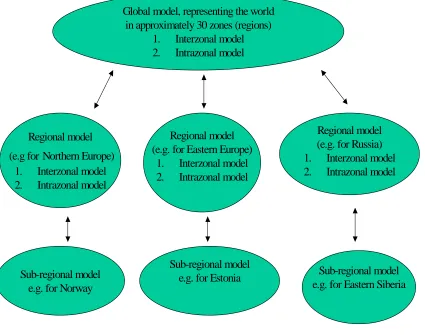
The structure of the models within TranWorld can be represented in Figure 1. On the highest level is the global model which represents the world in approximately 30 zones. An initial definition for such a zoning system is given below in 4.1. Within this global model are two sub-models: an interzonal model representing flows between zones, and an intrazonal model representing flows within zones. Both interzonal and intrazonal models will represent freight and passenger transport for different modes (road, rail, non-motorised, air, water and pipeline), and will distinguish between journey purpose where appropriate.
On the next level in the model hierarchy we have regional models, where a region corresponds to a zone within the global model. The examples given in Figure 1 are for regional models of Northern Europe, Eastern Europe and Russia. However, examples could have been given for any of the zones listed in 4.1. The zoning systems for regional models should, in the first instance, be at the discretion of the partners in the international network who are responsible for the regional model concerned. In general, though, zones of regional models would be expected to be countries if the region is not a country in its own right. Furthermore, regional models would, like global models, be expected to have both interzonal and intrazonal sub-models.
Finally, there is likely to be the need for sub-regional models. For Northern Europe, this could correspond to models of individual Nordic countries (Norway, Sweden, Denmark and Finland); for Eastern Europe, to models of individual Baltic states (Estonia, Latvia, Lithuania); for Russia, to models of individual socio-economic regions (North, North-West, Northern Caucasus, Western Siberia, Eastern Siberia, Far-East, Central, Urals, Povolzhsky and Central-Chernozemnyl).
An important issue with respect to the system shown in Figure 1 concerns model aggregation, concerning both demand and supply. With respect to demand, it is typically straightforward to aggregate data when moving from a sub-regional level to a regional level or from a regional level to a global level. However, it is much more difficult to disaggregate data when moving in the opposite direction. With regard to supply (i.e. roads, railway lines, shipping lanes etc), it is problematic either to aggregate or to disaggregate data. A great amount of research effort will be needed to resolve these issues.
4.1 Zoning system of the global model
A suitable zoning system for the world model (the highest level in Figure 1) would need to result from a “top-down” / “bottom-up” iterative process. The list given below represents the first (top-down) step in this process, on the understanding that it should be refined by local expertise provided by members of the international network:
• Latin America: (1) Brazil; (2) Southern South America; (3) Northern South America;
(4) Central America and the Caribbean; (5) Mexico. • North America: (6) USA; (7) Canada
• Europe: (8) Great Britain and Ireland; (9) Northern Europe; (10) Central Europe; (11)
Southern Europe; (12) Eastern Europe; (13) Russia.
• Africa: (14) North Africa; (15) West Africa; (16) East Africa; (17) Southern Africa;
• Asia: (18) Middle East; (19) Western Asia; (20) Central Asia; (21) India; (22)
Bangladesh; (23) South East Asia; (24) Indonesia; (25) China; (26) Korea; (27) Japan. • Rest of the world: (28) Australia and New Zealand; (29) Pacific.
Various questions can immediately be posed about this list, such as whether very large countries (such as China and India) be should disaggregated into more than one zone on the global level. However, such questions in the first instance should be answered by researchers from the respective countries, who will be aware of the relative advantages and disadvantages of alternative zoning systems.
Global model, representing the world in approximately 30 zones (regions)
1. Interzonal model 2. Intrazonal model
Regional model (e.g for Northern Europe)
1. Interzonal model 2. Intrazonal model
Regional model (e.g. for Eastern Europe)
1. Interzonal model 2. Intrazonal model
Regional model (e.g. for Russia) 1. Interzonal model 2. Intrazonal model
Sub-regional model e.g. for Estonia Sub-regional model
e.g. for Norway
[image:12.595.109.534.206.541.2]Sub-regional model e.g. for Eastern Siberia
Figure 1: Model structure of TranWorld
5 MATHEMATICAL MODELS
On the global level, the specification made by BLUEPRINT considered that the interzonal model should consist of a traditional four stage transport model, with sub-models estimating demand, distribution of trips between zones, modal split and assignment. Whilst the need for generation and mode choice models is probably uncontroversial, some justification should be given as to why distribution and assignment models are required.
A distribution model is required on the global level in order to identify simultaneously the origins and destinations of trips, an important facet when, for example, assessing
scenarios/policies concerned with globalisation and carbon trading between regions. A distribution model is also required in order to provide globally consistent inputs and outputs of traffic flows to the regional models with which the global model is intended to interact. An assignment model is necessary for establishing the level of "through traffic" for any particular region, which is important both from a policy point of view (particularly for the inhabitants of the region concerned) and in order to provide input to regional models.
The intrazonal model will consist of a three stage transport model, with sub-models estimating demand, distribution of trips between differing journey lengths (formally classified in "distance classes"), and modal split. The intrazonal model will cover all trips (including intra-urban trips) that lead to the production of climate-changing gases.
Equation 1 gives a general model formulation for a combined distribution and mode choice model and serves as an example of how the global model could be built. This approach reflects that used in the development of Sketch Planning Models, which are described further below in Section 6. Interzonal trips are estimated as a function of zonal factors (production and attraction) and the generalised modal costs of moving between zones. A set of different scenarios for production and attraction will be created under a multidisciplinary approach that combines macroeconomic style forecast estimates with subjectively assessed backcast estimates (as discussed above in 3.3). These estimates will take into account different possibilities with regard to the future transport behaviour for passengers and freight. Furthermore, relevant output from regional and national models will be used where appropriate. A suggestion for the intrazonal mathematical models is that they use an analogous model format as that given in Equation 1.
T
ijm=
P
ip*
A
jp* f t
( )
ijmpA
kp* f t
( )
iklpkl
∑
p
∑
Equation 1
Legend:
Tijm... Number of trips from i to j by mode m;
Pip... Production in zone i for purpose p;
Ajp... Attraction in zone j for purpose p;
tijmp... Impedance from i to j by mode m for purpose p; and
f(tijmp) ... Friction factor from i to j by mode m for purpose p.
6 SKETCH PLANNING MODELS
For many years, as computers have become more powerful, there has been a tendency for computer-based transport models to become more complex, thus maintaining the relatively long run times used by simpler models on old-fashioned computers. In reaction to this overall trend, there has been some development in recent years of reasonably simple computer models. One group of models in this category are "Sketch Planning Models" (SPMs), which use traditional transport network modelling techniques but are highly aggregate and are hence fast to implement with a standard PC. Such SPMs are particularly
useful in situations where obtaining high levels of accuracy about the future is a completely spurious activity (given the existence of real-world political, scientific and behavioural uncertainties), and also in situations where transport models need to be run in conjunction with other models. SPMs typically represent the geographical area of interest in 30 zones or less, and consider both interzonal and intrazonal movements. In the past, the Technical University of Vienna has developed SPMs representing areas such as Europe (including Russia), Eastern Austria / Czech Republic, and the cities of Vienna, Madrid, Edinburgh, Oslo, Stockholm and Helsinki. Knoflacher et al (2000) and Pfaffenbichler and Emberger (2000) describe the development of these SPMs.
Of these SPMs, the one that is most relevant to the world transport model described in this paper is the EURO9 model of Europe which was developed in the SAMI project (SAMI, 2000). For this project, a model was required which had a very short run time since it was to be used in an iterative optimisation procedure that would find optimal European transport policies. The model has the following underlying features:
• it represents Europe (including European Russia) in nine zones, as shown in Figure 2. • it considers a future target year of 2015.
• it considers both interzonal and intrazonal trips.
• the total number of interzonal trips in 2015 (created by a generation sub-model) is assumed fixed, though there is the possibility of redistribution of trips by OD pair in response to changing costs.
• intrazonal trips are distinguished by 5 distance classes, and all intrazonal trips are considered, including short (less than 10 km) pedestrian and cyclist trips.
• the total number of intrazonal trips in 2015 (created by a generation sub-model) is assumed fixed, though there is the possibility of redistribution of trips between distance classes in response to changing costs.
• it represents the following policy measure types:
o "small scale" investment in infrastructure
o pricing, legislation, standards and regulations (resulting in changed journey times and journey costs)
o European-wide transport policy measures
o policy measures applied to specific regions of Europe (e.g. peripheral, core, East, West, North, South)
• it represents mode-switching between:
o three modes (rail, air, and road) for interzonal passenger travel
o three modes (road, rail and water) for interzonal and intrazonal freight traffic
o five modes (pedestrian, bicycle, car, public transport and air modes) for intrazonal passenger trips
• it represents a limited level of interzonal route choice for road and rail modes. • it creates output data consistent with targets on CO2 reduction
It is assumed in the EURO9 model that all the transport measures listed above can be represented as combinations of:
• Increases/decreases in capacity (equivalent to decreases/increases in average travel time) by mode, purpose and zone;
• Changes in monetary costs of making a trip, by mode, purpose and zone.
The zoning system used in EURO9 is shown in Figure 2. As can be seen, it is slightly more disaggregate than the zoning system for Europe in the TranWorld system, which contains
only 6 zones (as listed in 4.1 above) for the same region. However, the European part of the global model in TranWorld could be adapted to fit the specifications of the EURO9 model if felt appropriate. This is an example of the iterative “top-down/bottom-up” procedure of constructing a global model which was mentioned in 4.1.
Zones
C
E
N
NW
OE
S
SE
SW
W
[image:15.595.95.541.152.451.2]SAMI transport model zones
Figure 2: SAMI transport model zones in the EURO9 model
7 SUMMARY AND SUGGESTED NEXT STEPS
This paper has described the specification of a world transport model resulting from the BLUEPRINT project. This model is relatively simple in terms of size (representing the world in approximately 30 zones) but has the possibility of linking with regional models that provide more detail for specific parts of the world. It has been stated that the model (and associated regional models) should be built as part of a collaborative world effort by an international network of world transport modellers. Furthermore, equal ownership rights to the model should be enjoyed by all members of the network, and there should be easy entry to the network to all researchers who agree with the spirit of the enterprise. The paper has recognised the scientific complexities associated with the uncertainties of predicting 100 years into the future and with the likely differences in modelling philosophy between (already existing) regional models. In order to tackle these complexities, the paper has defined a number of philosophy of science reference points that will provide the basis for ongoing discussion. At the core of these reference points is the distinction between objectivity and subjectivity.
Considering the next steps that are required to achieve the above goal, the ideal way forward would be for researchers autonomously in different parts of the world to find research grants
to help build the model. Realistically, though, in some cases this will be a slow process. However, it would be useful for an email list to be formed of all people interested in the network to help build momentum for the enterprise. It should be stressed that the international dimension provided by such a list should be of use in helping researchers obtain (national) research funds, since the promise of international collaboration often makes a research application seem stronger.
ACKNOWLEDGEMENTS
The authors thank the Tyndall Centre and the European Commission for funding much of the above research.
REFERENCES
• ASTRA (2002) Documents on the ASTRA Systems Dynamics Model at http://www.iww.uni-karlsruhe.de/ASTRA/
• BLUEPRINT (2001) Case for support for the BLUEPRINT project. Tyndall Centre for Climate Change Research (http://www.tyndall.ac.uk).
• Garrett, A.J.M. (1989) Probability, philosophy and science: a briefing for Bayesians. In
Maximum Entropy and Bayesian Methods, J. Skilling (ed.), 107-116. Kluwer Academic
Publishers
• Knoflacher H., Pfaffenbichler P. C., Emberger G. (2000) A Strategic Transport
Model-based Tool to Support Urban Decision Making Processes. Proceedings of the 2nd
International Conference on Decision Making in Urban and Civil Engineering, Editor: J.-C. Mangin, M. Miramond, 1, INSA Lyon (Fr), ESIGC Chambery (Fr), ENTPE Vaulx-en-Velin (Fr), ETS Montral (Ca), Lyon, 20-22 November 2000
• Pfaffenbichler P. C., Emberger G. (2001) Sketch planning transport models - a potential
tool to forecast transport demand in Eastern Europe?, Proceedings of the International
Conference "Cost Effective Infrastructure and Systems to Improve Cargo and Passenger Transport in Eastern Europe”, Budapest, October 16-19, 2001
• SAMI (2000) Optimisation of CTP instruments. Deliverable 3 of the SAMI project. EU 4th Framework Programme (Transport).
• SCENARIOS (1998) State of the Art: Descriptions in passenger and freight modelling in
relation to external developments. Deliverable D10 of the SCENARIOS project. EU 4th
Framework Programme (Transport).
• Timms (2001) A philosophical context for methods to estimate origin-destination matrices using link counts. Transport Reviews, 21, pp 269-301.