This is a repository copy of
The use of cochlear implantation
.
White Rose Research Online URL for this paper:
http://eprints.whiterose.ac.uk/122570/
Version: Published Version
Monograph:
Summerfield, Q. and Tomlinson, J. (1996) The use of cochlear implantation. Other.
Guidance Note for Purchasers (96/03). Trent institute for Health Services Research,
Universities of Leicester, Nottingham and Sheffield , Sheffield. ISSN 1900733048
Reuse
This article is distributed under the terms of the Creative Commons Attribution-NonCommercial (CC BY-NC) licence. This licence allows you to remix, tweak, and build upon this work non-commercially, and any new works must also acknowledge the authors and be non-commercial. You don’t have to license any derivative works on the same terms. More information and the full terms of the licence here:
https://creativecommons.org/licenses/
Takedown
If you consider content in White Rose Research Online to be in breach of UK law, please notify us by
WORKING GROUP ON ACUTE PURCHASING
THE USE OF COCHLEAR IMPLANTATION
December 1996
GUIDANCE NOTE FOR PURCHASERS 96/03
THE USE OF COCHLEAR IMPLANTATION
Q Summerfield
J Tomlinson
Published by the Trent Institute for Health Services Research
© 1996 Trent Institute for Health Services Research, Universities of Leicester,
Nottingham and Sheffield.
ISBN 1900733048
Referencing information:
Summerfield Q and Tomlinson J.
The use of
Cochlear Implantation.
Sheffield: Trent
Institute for Health Services Research, Universities of Leicester, Nottingham and
Sheffield, 1996. (Guidance Note for Purchasers : 96/03.)
Further copies of this document are available (price £6.00) from:-
Suzy Paisley
Information Officer
Trent Institute for Health Services Research
Regent Court
30 Regent Street
SHEFFIELD S1 4DA
Tel
0114 222 5420
Fax
0114 272 4095
E-mail [email protected]
ABOUT THE TRENT INSTITUTE FOR HEALTH SERVICES RESEARCH
The Trent Institute for Health Services Research is a collaborative venture between the
Universities of Leicester, Nottingham and Sheffield with support from NHS Executive Trent.
The Institute:
provides advice and support to NHS staff on undertaking Health Services Research
(HSR);
provides a consultancy service to NHS bodies on service problems;
provides training in HSR for career researchers and for health service professionals;
provides educational support to NHS staff in the application of the results of research;
disseminates the results of research to influence the provision of health care.
The Directors of the Institute are: Professor R L Akehurst (Sheffield);
Professor C E D Chilvers (Nottingham); and
Professor M Clarke (Leicester).
Professor Akehurst currently undertakes the role of Institute Co-ordinator.
FOREWORD
Individuals or small groups in each District Health Authority in Trent have historically
considered evidence on the likely effectiveness of new procedures or therapies in
conjunction with their cost, making judgements on whether these should be supported.
Since all or most Health Authorities face the same issues, there tends to be repetition in
analysis and this can be wasteful of scarce professional expertise.
There are national attempts to remedy this situation by providing information on the
effectiveness of interventions and these are welcomed. There remains, however, a
significant gap between the results of research undertaken and their incorporation into
contracts.
Following a request from purchasers, a network has been established in the Trent Region to
allow purchasers to share research knowledge about the effectiveness of acute service
interventions and to determine collectively their purchasing stance.
ScHARR, which houses the Sheffield Unit of the Trent Institute for Health Services
Research, facilitates a Working Group on Acute Purchasing. A list of interventions for
consideration is recommended by the purchasing authorities in Trent and approved by the
Purchasing Authorities Chief Executives (PACE) and the Trent Development and Evaluation
Committee (DEC). A public health consultant from a purchasing authority leads on each
topic and is assisted, as necessary, by a support team from ScHARR which provides help
including literature searching, health economics and modelling. A seminar is then led by the
consultant on the particular intervention where purchasers and provider clinicians consider
research evidence and agree provisional recommendations on purchasing policy. The
CONTENTS
Page
EXECUTIVE SUMMARY
1
1.
INTRODUCTION
2
1.1 Cochlear Implantation : Incidence and Pathology
2
2.
COCHLEAR IMPLANTATION : SUMMARY OF EVIDENCE
5
OF EFFECTIVENESS
2.1 Evidence of Effectiveness for Adults
5
2.2 Evidence of Effectiveness for Children
9
2.3 Conclusion on Direction of Evidence and its Quality
10
3.
COST AND BENEFIT IMPLICATIONS OF ADOPTING
12
INTERVENTION
3.1 Costs of Providing Cochlear Implantation
12
3.2 Cost-utility
13
3.3 Sustaining and Improving Cost-effectiveness
15
3.4 Emerging Trends
18
4.
OPTIONS FOR PURCHASERS AND PROVIDERS
20
5.
DISCUSSION AND CONCLUSION
21
LIST OF TABLES AND FIGURES
Page
Table 1 Expected Demand for Cochlear Implantation in a District with a Total
4
Population of 0.5 m
Table 2 Outcomes from Cochlear Implantation for Post-lingually Deafened
7
Adults
Table 3 Outcomes from Cochlear Implantation for Pre-lingually Deafened
11
Children
Table 4 Costs of Cochlear Implantation and Long-term Management
12
(1996 price levels)
Table 5 Cost/QALY of Cochlear Implantation and Other Therapies
13
Table 6 Charges for Adult Cochlear Implantation set by Hospitals in Trent or
14
within Easy Reach of Trent
Table 7 Charges for Paediatric Cochlear Implantation set by Hospitals in Trent
15
EXECUTIVE SUMMARY
Cochlear Implantation (CI) is a rapidly evolving health technology which restores useful
forms of auditory sensation to people who are profoundly deaf, through electrical stimulation
of the auditory nerve with electrodes implanted in the inner ear (the cochlea). The primary
intention is to reduce disability and to improve the quality of life by increasing the capacity
for using spoken language.
CI is suitable for two classes of client:
(a) children and adults who lost their hearing after learning spoken language; and
(b) young children who either lost their hearing before acquiring spoken language or who
were born deaf.
There are approximately 4,000 suitable candidates for CI in the UK. Current uptake patterns
suggest that 1,600 will seek and receive CI. A district with a population of 0.5 million would
expect up to one new post-lingually deafened client every two years, and two new
pre-lingually deafened clients per year. There would also be a backlog of up to 20 post-pre-lingually
deafened clients and up to 12 pre-lingually deafened clients.
The discounted cost of implantation and long-term management is £36,400 for adults and
£57,400 for children. The cost per QALY for CI is £13,300 (range £10,200 to £30,500).
The cost effectiveness of CI is likely to be improved by ensuring that the intervention is
provided by appropriately trained specialist teams, with sufficient workload to maintain their
skills, operating in specialist centres. Patient selection should also be encouraged to ensure
that CI is provided to those patients most likely to benefit.
It is recommended that, for patients meeting the candidature criteria set out in this guidance,
purchasers should agree funding for the provision of CI in specialist Cochlear Implantation
Centres, within agreed guidelines governing candidature and with the assurance that the
2
1.
INTRODUCTION
1.1
Cochlear Implantation : Incidence and Pathology
Cochlear Implantation (CI) is a rapidly evolving health technology which restores useful
forms of auditory sensation to people who are profoundly deaf, through electrical stimulation
of the auditory nerve with electrodes implanted in the inner ear (the cochlea). The primary
intention is to reduce disability and improve quality of life by increasing the capacity for using
spoken language. CI was introduced to the NHS through a 4-year Government initiative
(1990-1994) during which central funds partly underwrote the costs of provision by selected
provider units.
(i)
Implant SystemsImplant systems consist of external and internal components. Externally, a microphone,
worn above the ear, is connected to a speech processor, typically carried on a belt or in a
pocket, which in turn is linked to a transmitter coil placed on the outside of the head. The
processor converts the signal from the microphone into a form suitable for radio-frequency
transmission, through the scalp, to a receiver-stimulator package which is placed in a well
fashioned surgically in the skull behind the ear. The receiver-stimulator decodes the
radio-frequency signal and converts it into electrical pulses which are sent to an array of
electrodes implanted surgically in the inner ear.
The preferred form of implant system is ‘multi-channel’. Such systems divide the acoustic signal into a set of discrete frequency bands. The pattern of energy in different bands is
represented by the pattern of electrical stimulation on different members of the array of
implanted electrodes. In this way, the normal mapping between acoustical frequency and
place of stimulation in the cochlea is partly restored.
(ii)
Management of PatientsManagement of patients involves four phases:
(a) pre-operative assessment and counselling, to determine suitability and to ensure
informed consent to treatment;
(b) surgery;
(d) long-term maintenance, to diagnose and remedy technical problems and, periodically, to
upgrade processors.
(iii)
Causes of Profound Deafness and Prospects for PreventionProfound deafness has many causes. It may be present at birth or develop at any point in
life. Prospects for prevention during the next decade of more than a small proportion of
cases are limited. It is estimated 1 that there are 150,000 people in the UK with profound
hearing impairment (an average reduction of sensitivity of 95 decibels (dB) or more
compared with normal hearing in the ear which has better hearing; a person with this degree
of hearing loss would be characterised as having a ‘hearing level’ of 95 dB).
(iv)
Candidates for CICI is suitable for two classes of client:
(a) children and adults who lost their hearing after learning spoken language (‘post-lingually’ deafened clients); and
(b) young children who either lost their hearing before acquiring spoken language or who
were born deaf (‘pre-lingually’ deafened clients).
1.1.1 Demand for CI
(i)
Post-lingually-deafened Children and AdultsCandidature is defined by the intersection of :
(a) profound deafness;
(b) post-lingual acquisition;
(c) an inability to obtain material benefit from acoustic hearing aids;
(d) physical and intellectual fitness for surgery and rehabilitation; and
(e) a strong commitment to treatment.
The application of constraints (b)-(d) limits the number of candidates in the UK to
approximately 4,000. Current patterns of uptake imply that 1,600 of them will seek and
receive CI. 2
4
Candidature is defined by the intersection of:
(a) profound deafness;
(b) an inability to obtain material benefit from acoustic hearing aids; and
(c) a strong commitment to treatment on the part of parents and teachers.
Approximately 220 children are born with profound hearing loss each year in the UK. A
further 80 lose this degree of hearing by the age of five, primarily as a result of meningitis.3
It is estimated that CI will be sought on behalf of a high proportion of this population and that
as many as two thirds will be clinically suitable to receive the service.
(iii) Uptake of Services to Date
Approximately 800 adults and 600 children have received CI in the UK. Approximately
15,000 people have received CI world-wide.
(iv) Expected Demand
Table 1 provides estimates of the demand for CI in the UK, developed from epidemiological
data on the prevalence and incidence of profound deafness, and on the uptake of CI
[image:12.595.64.534.524.614.2]services. 2
Table 1:
Expected Demand for Cochlear Implantation in a District with a
Total Population of 0.5m
CLIENT GROUP BACKLOG ANNUAL INCIDENCE
Post-lingually deafened clients
(children and adults).
14 (range 11-20, minus cases
already implanted)
0.5 cases (i.e. 1 case every 2
years) (range 0-2)
Pre-lingually deafened clients
(children 2-6 years)
10 (range 7-12, minus cases
already implanted)
2.
COCHLEAR
IMPLANTATION
:
SUMMARY
OF
EVIDENCE
OF
EFFECTIVENESS
2.1
Evidence of Effectiveness for Adults
Acquired profound deafness is a chronic condition for which CI is an elective treatment of
last resort. As candidature for CI is defined partly by the inability to benefit from alternative
therapies, randomised controlled trials (RCTs) comparing CI with other therapies have not
been conducted. Instead, repeated-measures, involving tests on the same patients before
and after implantation, have been used. These show consistent evidence of benefit in terms
of improved communication skills and increased quality of life.
Table 2 summarises outcomes measured in the UK during the MRC evaluation of the
National CI Programme.2 These data were obtained from adults (18 years and older) who
could not understand speech without lip-reading using acoustic hearing aids. The outcomes
were first measured 9 months after implantation and were maintained without change when
re-measured 18 months after implantation.
These levels of outcome were shown when patients were equipped with 2nd-generation
implant systems. Similar levels have been shown elsewhere in the world by patients
equipped with 2nd-generation systems. Higher levels are now reported from patients using
3rd-generation systems.
The single most important outcome from CI is continued use of the implant system, because
patients have the option of ceasing to use the device if it brings no benefit. The asymptotic
level of elective non-use, estimated by survival analysis 5 years after implantation, is 8%.2
Thus, by this measure, the ratio of the number of patients benefiting to the number treated
6
In addition to the outcomes listed in Table 2, the family and friends of patients reported:
amelioration of major difficulties of communication in relationships;
less need to simplify messages;
less fatigue engendered in patients by the need to ensure that messages had been
understood;
less need to assist patients to communicate with others; and
Table 2:
Outcomes from Cochlear Implantation for Post-lingually
Deafened Adults
2OUTCOME MEASURE % PATIENTS DISPLAYING OUTCOME
COMMENTS
1. Suitable referral willing to proceed with treatment
50% Sophisticated techniques for
assessing candidature make improved accuracy of pre-referral assessment unlikely. 2. Evidence of use
All day while awake At least 10 hours per day At least 4 hours per day
50% 80% 90%
Data from patients with multi-channel devices. Lower rates of use recorded from patients with single-channel devices.
3. Evidence of non-use 2 years after implantation
5 years after implantation
3-5% (multi-channel) 10% (single-channel) 8% (multi-channel)
8% non-use rate at 5 years estimated by survival analysis to be the asymptotic rate of
elective non-use. Half of patients who subsequently became non-users were implanted early in the Programme.
4. Identified some common environmental sounds
97% 25% of patients identified more
than 75% of sounds correctly. 5. Identified more words correctly in
sentences when using implant in combination with lip-reading than when lip-reading alone.
95%
6. Greater benefit to lip-reading than achieved pre-operatively with acoustic hearing aid
80-90% Data from sub-set of patients
with sufficient residual hearing for pre-operative testing with hearing aid(s) to be feasible. 7. Identified some words correctly in
sentences without lip-reading
Demonstrated some understanding of questions posed over the
telephone by an unfamiliar talker
Improved quality and/or intelligibility of own speech
50%
35%
70%
Score of 10% correct or greater; 15% of patients scored 50% or more correct. (>50%
corresponds to useful ability to converse without lip-reading.)
Score of 10% correct or greater; 15% of patients scored more than 50% correct. (>50% correct corresponds to useful ability to converse using telephone.)
Most of remaining 30% already produced speech of acceptable quality and/or intelligibility. 8. Tinnitus attenuated or eliminated 50% Two-thirds of implanted patients
experienced tinnitus pre-operatively; tinnitus was attenuated or eliminated in half of them.
9. Reduction in self-reported hearing handicap
90%
10. Improvement in quality of life measured retrospectively with
96% Average change in quality of life
8
managed with hearing aids.
11. Positive change in health-related quality of life measured
retrospectively with EuroQol visual-analogue scales
94% Average change +0.23 on scale
where 1 and 0 correspond to best and worst imaginable states of health.
12. Occupational status No change 40% were in paid employment
pre- and post-operatively.
13. Satisfaction with job No change
14. Extent of unpaid work No change
15. Average no. of people on whom patients relied for help in overcoming problems of communication
6 (pre-op) 3.5 (post-op)
Average amount of help required from each helper was also reduced.
16. Medical/Surgical complications a) Mortality
b) Major problem
c) Failure of implanted device
d) Revision surgery
e) Minor problem
nil 10% (adults) 7% (children) 1.6% (adults) 0.7% (children) 4.3% (adults) 2.2% (children)
25% (adults and children)
No. of operations monitored: 244 (adults)
136 (children)
Including: damage to VIIth nerve causing facial paralysis;
infection or necrosis of skin flap; cholesteatomas; mispositioning or movement of the electrode array. All treated successfully by revision surgery or medical management. Probability of complications declines steeply over first 10 patients managed by a surgeon.
Overcome by medical
management or by retuning or replacing processors.
High rate of technical problems due to lack of robustness of external components, notably Nucleus processors and Ineraid percutaneous connectors.
2.2
Evidence of Effectiveness for Children
For this client group, the immediate goal is to provide access to sound; the medium and
language leading first, to improved scholastic attainment and, then, to enhanced social
independence and quality of life in adulthood.
An RCT, though theoretically desirable, would be of impractically long duration, and might
now be considered unethical for clearly defined candidates. The most powerful research
designs have involved longitudinal case-control comparisons of children with implants and
children managed with hearing aids or tactile aids.4,5 These studies have shown that children
selected for CI typically have hearing levels exceeding 110 dB. With implants, these children
function better than children with the same hearing levels who are managed with hearing
aids or tactile aids. They function about as well as less impaired children with hearing levels
of 90-100 dB who are equipped with hearing aids. Such children generally make good use
of hearing aids and develop useful forms of spoken language. The linkage encourages the
belief that children with implants will go on to develop spoken language.
Since 1991, paediatric CI in the UK has undergone radical changes in attitude and level of
activity following the results of a trial in North America that led to the endorsement by the
Food and Drug Administration of an implant system for use with children. The MRC
Evaluation obtained observational data on initial outcomes from children implanted in the UK
and reviewed the literature internationally, reaching the following conclusions:
Post-lingually deafened children: Good outcomes are generally obtained for children of all
ages, provided that there is a strong commitment to CI by the child, family, and teachers;
outcomes are particularly good when implantation occurs soon after the onset of
profound deafness; evidence of speech understanding is often displayed within a few
months of implantation.
Pre-lingually deafened children: Generally, there is evidence of the ability to detect and
distinguish environmental sounds within a few months of implantation; evidence of the
perception and production of speech emerges slowly, often not until the implant has been
used for 1-3 years. The best outcomes are displayed when children are implanted before
the age of 5 years; disappointing outcomes are often reported when children are
implanted after the age of 10-13 years. A strong informed commitment to CI by
family and teachers is essential.
10
2.3
Conclusion on Direction of Evidence and its Quality
For post-lingually deafened adults and children, there is strong, statistically robust evidence
of effectiveness for appropriately selected candidates.
For pre-lingually deafened children, there is strong evidence of positive initial outcomes for
appropriately selected candidates. It is not yet clear what levels of skills in spoken language
will be attained, nor to what extent these will be translated into enhanced scholastic
achievements. Thus, although initial outcomes are promising, further longitudinal
evaluation of outcomes from implanting pre-lingually deafened children is necessary.
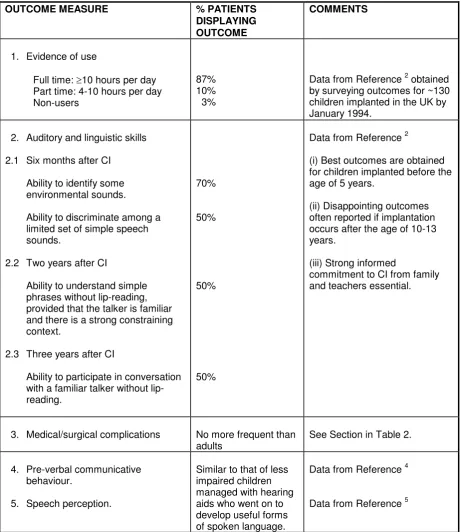
Table 3:
Outcomes from Cochlear Implantation for Pre-lingually Deafened
Children
OUTCOME MEASURE % PATIENTS DISPLAYING OUTCOME
COMMENTS
1. Evidence of use
Full time: 10 hours per day Part time: 4-10 hours per day Non-users
87% 10% 3%
Data from Reference 2 obtained by surveying outcomes for ~130 children implanted in the UK by January 1994.
2. Auditory and linguistic skills
2.1 Six months after CI
Ability to identify some environmental sounds.
Ability to discriminate among a limited set of simple speech sounds.
2.2 Two years after CI
Ability to understand simple phrases without lip-reading, provided that the talker is familiar and there is a strong constraining context.
2.3 Three years after CI
Ability to participate in conversation with a familiar talker without lip-reading.
70%
50%
50%
50%
Data from Reference 2
(i) Best outcomes are obtained for children implanted before the age of 5 years.
(ii) Disappointing outcomes often reported if implantation occurs after the age of 10-13 years.
(iii) Strong informed
commitment to CI from family and teachers essential.
3. Medical/surgical complications No more frequent than adults
See Section in Table 2.
4. Pre-verbal communicative behaviour.
5. Speech perception.
Similar to that of less impaired children managed with hearing aids who went on to develop useful forms of spoken language.
Data from Reference 4
12
3.
COST AND BENEFIT IMPLICATIONS OF ADOPTING INTERVENTION
CI is a new health technology which does not replace a previous or alternative intervention.
The costs of CI are, therefore, true additional costs. Savings are most likely to occur within
the budgets of education and social services as a result of reduced dependency on special
education, on special equipment for daily living, and on social support in adulthood.
3.1
Costs of Providing Cochlear Implantation
The MRC evaluation measured the costs of providing CI and estimated the future costs,
listed in Table 4 (inflated to 1996 price levels). Costs of provision to adult clients were
averaged over nine service providers. Costs of provision to children were measured in a
single hospital and may not be representative of the cost of providing paediatric implantation
generally. The costs of long-term management are listed twice, first with future costs
discounted to present price levels at 6% per annum, and second with future costs not
[image:20.595.64.531.469.601.2]discounted. All sums in Table 4 include the cost of the implant system (£13,000).
Table 4:
Costs of Cochlear Implantation and Long-term Management (1996
price levels)
TIME-PERIOD ADULTS CHILDREN
Assessment, implantation, rehabilitation in first year
£23,600 £27,300
Assessment, implantation,
rehabilitation, and maintenance for a total of 12 years
£31,800 (future costs discounted) £33,000 (future costs not
discounted)
£47,900 (future costs discounted)
£53,000 (future costs not
discounted) Assessment, implantation,
rehabilitation, and maintenance over life-time
£36,400 (future costs discounted) £49,700 (future costs not
discounted)
£57,400 (future costs discounted)
£119,600 (future costs not
discounted)
Current charges for CI services by providers in Trent Region, or within easy access from
3.2
Cost-utility
The MRC evaluation estimated the cost-utility of CI for post-lingually deafened adults.
Sensitivity analysis was used to set plausible limits on the range of estimates. Given that the
average age at the time of implantation in the UK has been 49 years, future costs and
benefits were aggregated over an expected further life-time of 26 years. Future costs were
discounted to present price levels at 6% per annum. The results, inflated to 1996 price
levels, are:
£13,300 per QALY (range £10,200 - £30,500) if future benefits are discounted at 6% per
annum.
£6,600 per QALY (range £5,100 - £15,300) if future benefits are not discounted.
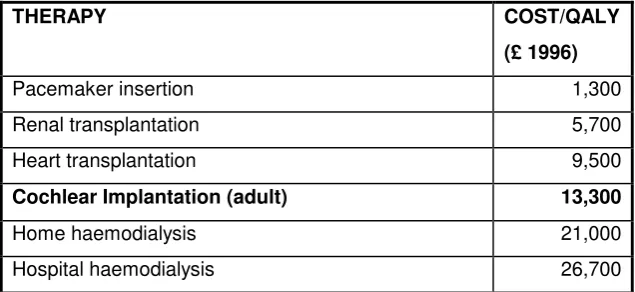
According to these estimates, the cost-utility of CI falls in the middle of the range of
frequently quoted estimates for therapies in the UK (Table 5) and represents acceptable
value for money.
These calculations were based on measurements made during the introduction of CI to the
NHS. Technical improvements in implant systems leading to better outcomes, and increases
in the efficiency of patient management, should improve cost-effectiveness. Further
[image:21.595.66.384.501.647.2]research is required to establish whether the expected changes occur.
Table 5:
Cost/QALY of Cochlear Implantation and Other Therapies
THERAPY COST/QALY
(£ 1996)
Pacemaker insertion 1,300
Renal transplantation 5,700
Heart transplantation 9,500
Cochlear Implantation (adult) 13,300
Home haemodialysis 21,000
14
Table 6:
Charges for Adult Cochlear Implantation set by Hospitals in Trent
or within Easy Reach of Trent
PROVIDER CHARGES (£)
Assessment Implantation + 1st Year
Years 2-3 (price / year)
Year 4+ Do follow up costs cover upgrades?
Total at 5 years (not discounted)
Total at 12 years (not discounted) Queen’s Medical Centre, Nottingham 1996/97 1995/96 1,500 3,000 24,500 24,500 1,350 1,350 1,350 1,350 Yes Yes 31,400 32,900 40,850 42,350 University Hospital, Birmingham (formerly QEH)
483 24,584 1,416 1,416 Yes 30,731 40,643
Addenbrookes,
Cambridge 1,215 22,860 1,700 1,700 Yes 30,875 42,775
Royal Infirmary,
Bradford 670 25,142 + 227 yr 1
1,339 1,159 Yes 31,035 39,148
Royal Infirmary,
Manchester 448 28,038 1,402 1,402 Yes 34,094 43,908
Royal Hallamshire,
Table 7:
Charges for Paediatric Cochlear Implantation Set by Hospitals in
Trent or within Easy Reach of Trent
PROVIDER CHARGES (£)
Assessment Implantation + 1st Year
Years 2-3 (price / year)
Year 4+ Do follow up costs cover upgrades?
Total at 5 years (not
discounted)
Total at 12 years (not discounted) Queens Medical Centre, Nottingham
1,115 27,000
(includes assessment ) 4,250 (covers both years)
2,000 Yes 35,250 49,250
Children’s
Hospital, Birmingham
1,585 26,476
(includes assessment
) +2,660 yr 1
1,860 1,860 Yes 36,576 49,596
Addenbrookes, Cambridge
1,215 29,200
(includes assessment
)
1,700 1,700 Yes 36,000 47,900
Royal Infirmary, Bradford
824 25,142
(excludes assessment
) +490 yr 1
2,307 (yr 2) 2,153 (yr 3)
1,993 Yes 34,902 48,853
Royal Infirmary, Manchester
448 30,734 1,225 1,225 Unknown 36,082 44,657
3.3
Sustaining and Improving Cost-effectiveness
The following are the key considerations in sustaining and improving the cost-effectiveness
of CI services.
3.3.1 Professional Composition of CI Teams
A multi-disciplinary team is required with training and experience appropriate to the age
group of clients to whom services will be directed. Team members should have received
specific training in their roles as specified by Summerfield and Marshall.2 The size of a team
shouldreflect its caseload. Teams should include:
medical/surgical skills from an ENT surgeon with established interests in neuro-otology;
scientific/technical skills from medical physicists or clinical audiologists;
rehabilitative skills from professionals with experience in speech therapy, hearing
16
a programme co-ordinator from one of the above grades to whom the lead surgeon
delegates responsibility for the day-to-day management of the programme.
In addition, access to a clinical psychologist is advisable.
3.3.2 Choice of Impant Systems
Modern multi-channel devices are strongly preferred. Devices should be of proven reliability
and should be familiar to implant teams in order to minimise complication rates in surgery,
failure rates of implanted components, time spent tuning, and time spent diagnosing
problems. In choosing devices, teams should:
obtain evidence of effectiveness and reliability from manufacturers and from the clinical
scientific literature;
obtain assurance of long-term support from manufacturers;
select devices that have been awarded the CE mark of the European Union;
develop a high level of expertise with each device they provide.
3.3.3 Maintaining Skills
Consensus of opinion suggests that at least 12 new adult and/or child cases are
required per CI centre per year for viability. The incidence of medical/surgical
complications falls with increasing experience of surgeons. There is no absolute number
recommended to maintain skills.
3.3.4 Siting of CI Centres
CI is a low-volume treatment. A sustained throughput of patients is required to ensure the
long-term viability of CI programmes. Provision should be concentrated in provider units
located within easy access of the main population centres in the UK.
In view of the size of the backlog of patients, there may be proposals to establish additional
provider units. However, the incidence of new candidates, according to current criteria, is
unlikely to sustain all centres that already exist. Purchasers should consider the merits of
concentrating purchasing on a small number of expert providers who manage high-volume
programmes.
Cost-effectiveness will be optimised by selecting patients who are most likely to benefit, and
least likely to develop complications or become non-users. The following criteria are
relevant:
Adults
Profound bilateral deafness of cochlear origin (average hearing level >95 dB);
Onset of profound deafness after acquiring spoken language;
No material benefit from acoustic hearing aids (average aided thresholds greater than
about 60 dB(A));
No material ability to understand speech using acoustic hearing aids (typically score less
than 10% correct on a test requiring the identification of words in sentences without
lip-reading);
No morphological abnormality of the inner ear that would prevent the placement of electrodes close to surviving fibres of the auditory nerve; Intellectually fit and mentally alert (no major psychological contra-indications; IQ>70);
Committed to their own health care and to the proposed treatment.
Outcomes from adult implantation are highly variable, although positive for the great
majority of patients individually. Statistically, the best outcomes tend to be achieved by
patients with three characteristics:
Recent onset of profound deafness;
Some measurable residual hearing;
Proven skills in spoken language demonstrated by good lip-reading.
Children with post-lingual deafness
The criteria listed above for adults apply here also.
Children with pre-lingual deafness
Profound bilateral deafness of cochlear origin (average hearing level >95 dB);
No material benefit from acoustic hearing aids (average aided thresholds greater than
about 60 dB(A);
Generally, age 2 years and older; CI may be indicated for some post-meningitics before
the age of 2;
18
Strong commitment to treatment and to spoken language on the part of parents and
teachers;
Implantation between the ages of 1 and 4 (i.e. before school entry) produces the best
outcomes statistically. After the age of 10-13 years, outcomes are often poor and CI
should not generally be encouraged; however, exceptional cases do arise, but should be
justified on an individual basis.
3.3.6 Competition Between Manufacturers
Consortia of providers should be encouraged to negotiate favourable prices for bulk
purchase of implant systems with established manufacturers.
3.3.7 Purchasing Strategy
To ensure that responsibilities are clearly located for:
(a) justifying decisions to treat in relation to criteria of candidature;
(b) furnishing audit and outcomes data; and
(c) long-term maintenance of patients and devices.
A complete service for an individual client should be purchased from a single provider.
Primary providers may engage secondary providers located closer to patients’ homes to
provide aspects of pre-operative assessment and long-term maintenance.
3.4 Emerging Trends
3.4.1 Candidature
In the USA, outcomes achieved by traditional candidates using 3rd-generation implant
systems exceed those achieved by less impaired patients who obtain measurable, but very
slight, benefit from hearing aids.5 As a result, criteria of candidature have been relaxed to
include some of these ‘marginal hearing-aid users’. One aim is to enable early provision to clients with progressive hearing losses. Further multi-centre research is needed in the UK to
assess the cost-effectiveness of CI for this new group, and to specify revised protocols for
assessing candidature. For the immediate future purchasers should continue to use
In the USA, cost-savings have been achieved in the management of patients by reducing
in-patient stays to one night and by minimising the amount of therapeutic rehabilitation
provided to adult patients. Further research is needed to establish whether these changes
are compatible with sustained cost-effectiveness.
3.4.2 Developments in Technology
There is no alternative technology on the horizon. Within the next two years, smaller implant
processors, styled like ‘behind-the-ear’ hearing aids, will appear. Over the next decade, totally implantable devices with advanced technical specifications may be developed, along
with less advanced devices in which current levels of technology are consolidated at lower
cost. Over the last decade, the real cost of implant hardware has fallen slightly, despite
20
4.
OPTIONS FOR PURCHASERS AND PROVIDERS
The following options were discussed during and after a seminar held by the Trent Institute’s
Working Group on Acute Purchasing:
Option 1 Purchasers should agree to fund only in the context of formal multi-centre
clinical studies.
Option 2 Present arrangements should continue. Funding should be agreed for
provision:
In Cochlear Implantation centres;
Within agreed guidelines governing candidature;
With the assurance that the results of audit are reported.
Option 3 Funding should be agreed for widespread provision, extending beyond
5.
DISCUSSION AND CONCLUSION
After discussion at the Trent seminar between representatives of purchasers and providers
of Cochlear Implantation, it was concluded that:
There was strong evidence of the effectiveness of CI for adult and child clients meeting
the criteria of candidature in this Guidance Note. (Those criteria are listed in the
Summary Matrix overleaf). For this group of clients, Option 2 above should be adopted
i.e., purchasing should continue as at present from established CI centres.
For non-traditional candidates, i.e. patients who gain measurable but slight benefit from
acoustic hearing aids, Option 1 above should be adopted i.e., purchasing should be
agreed only in the context of formal multi-centre clinical studies.
Prior to purchasing, evidence was required of:
levels of experience of the surgeon and other team members;
rationale for choice of devices;
number of clients implanted at the centre to date;
incidence of major complications, including those leading to decisions to explant
devices;
incidence of elective non-use of devices by implanted clients.
Purchasers should purchase the complete service for a client (assessment, implantation
rehabilitation, and maintenance) from the same provider.
Purchasing consortia should be considered in view of the small number of clients for
each individual purchaser.
Purchasers should consider the merits of concentrating purchasing on a small number of
expert providers, who manage high volume programmes.
Provider consortia should be encouraged to negotiate more favourable prices for bulk
22
6.
COCHLEAR IMPLANTATION: SUMMARY MATRIX
CLIENT GROUP
CRITERIA OF CANDIDATURE
LIKELY UPPER LIMITS ON DEMAND IN A BENCH-MARK DISTRICT WITH A
POPULATION OF 0.5 m
OPPORTUNITIES TO IMPROVE COST-EFFECTIVENESS
AUDIT
BACKLOG ANNUAL RECURRENT DEMAND All clients Profound bilateral
deafness of cochlear origin (average hearing levels >95 dB). No material benefit
from acoustic hearing aids (average aided thresholds >60 db(A)). No morphological
abnormality of the inner ear that would prevent the placement of electrodes close to surviving fibres of the auditory nerve. Encourage concentration of services. Ensure appropriately trained and experienced multi-disciplinary team. Ensure at least 12
new patients implanted by centre per year.
Ensure provision of modern
multichannel implant systems of proven
effectiveness and reliability with which the team is familiar.
Encourage competition between manufacturers. Structure Composition, training, and experience of team. Rationale for
choice of devices.
Process
Number of
patients being implanted annually. Arrangements for long-term maintenance of patients and devices.
Outcomes Incidence of
major complications, including those leading to decisions to explant devices. Incidence of
older children
acquired after learning spoken language. No material ability to
understand speech using acoustic hearing aids (typically score less than 10% correct on a test requiring the identification of words in sentences without lip-reading). Intellectually fit and
mentally alert (no major psychological contra-indications; IQ>70).
Committed to their own health care and to the proposed treatment.
11-20) (less patients already implanted).
(i.e. 1 patient every 2 years with a likely range from no patients to 2 patients per year).
over 12 years: ~£33,000 Cost-utility: £13,300/QALY (assuming 26 years of use, with upgrades, and future costs and benefits discounted at 6% per year)
Gain in accuracy of speech-perception compared to pre-operative state. Gain in
quality-of-life compared to pre-operative state. Younger children
Profound deafness
acquired either before or after learning spoken language. Strong commitment to
treatment and to spoken language by family and teachers, and, if possible to assess, the client. Preferably under the
age of 5 years, allowing implantation before school entry. After the age of 10-13
years, outcomes are often poor and treatment should not be encouraged.
10 (range: 7-12) (less patients already implanted).
2 (range: 0-4) (i.e. 2 patients per year with a likely range from no patients to 4 patients per year).
Cost of treatment over 12 years: ~£53,000
Outcomes Observational
24
REFERENCES
(1) Davis, AC. Hearing in Adults. London: Whurr. 1995.
(2) Summerfield AQ, Marshall DH. Cochlear Implantation in the UK 1990-1994. London:
HMSO Books, 1995.
(3) Davis AC, Parving A. Towards appropriate epidemiological data on childhood hearing
disability: a comparative study of European birth cohorts 1982-88. Journal of
Audiological Medicine. 1993; 3: 35-47.
(4) Tait M, Lutman ME. Comparison of early communicative behaviour in young children
with Cochlear Implants and with hearing aids. Ear and Hearing. 1994; 15: 352-361.
(5) Geers A, Moog J. The CID Sensory Aids Study. Volta Review 96 (Monograph). 1995.
(6) Consensus Development Panel on Cochlear Implants in Adults and Children. Cochlear
Implants in adults and children. Journal of the American Medical Association. 1995; 274:
Other papers published by the Trent Institute for Health Services Research are listed
below:-Guidance Notes for Purchasers
96/01 Working Group on Acute Purchasing: The use of DNase in £6.00 Cystic Fibrosis (1996) by JN Payne, S Dixon, NJ Cooper and
CJ McCabe.
96/02 Working group on Acute Purchasing: Tertiary Cardiology (1996) £6.00 by J Tomlinson, J Sutton and CJ McCabe.
Discussion Papers
No. 1. Patients with Minor Injuries : A Literature Review of Options for their £7.00 Treatment Outside Major Accident and Emergency Departments
or Occupational Health Settings (1994) by S Read.
96/01 Working Group on Acute Purchasing: The role of Beta Interferon £7.50 in the Treatment of Multiple Sclerosis (1996) by RG Richards,
CJ McCabe, NJ Cooper, SF Paisley, A Brennan and RL Akehurst.
96/02 The Mid-level Practitioner: A Review of the Literature on Nurse Practitioner £10.00 and Physician Assistant Programmes (1996) by P Watson, N Hendey,
R Dingwall, E Spencer and P Wilson.
96/03 Evaluation of two Pharmaceutical Care Programmes for People with £10.00 Mental Health Problems Living in the Community (1996) by A Aldridge,
R Dingwall and P Watson.