White Rose Research Online URL for this paper:
http://eprints.whiterose.ac.uk/1985/
Article:
Wilson, R C orcid.org/0000-0001-7265-3033 and Hancock, E R
orcid.org/0000-0003-4496-2028 (1997) Structural matching by discrete relaxation. IEEE
Transactions on Pattern Analysis and Machine Intelligence. pp. 634-648. ISSN 0162-8828
https://doi.org/10.1109/34.601251
[email protected] https://eprints.whiterose.ac.uk/ Reuse
Items deposited in White Rose Research Online are protected by copyright, with all rights reserved unless indicated otherwise. They may be downloaded and/or printed for private study, or other acts as permitted by national copyright laws. The publisher or other rights holders may allow further reproduction and re-use of the full text version. This is indicated by the licence information on the White Rose Research Online record for the item.
Takedown
If you consider content in White Rose Research Online to be in breach of UK law, please notify us by
Structural Matching by Discrete Relaxation
Richard C. Wilson and Edwin R. Hancock
Abstract—This paper describes a Bayesian framework for performing relational graph matching by discrete relaxation. Our basic
aim is to draw on this framework to provide a comparative evaluation of a number of contrasting approaches to relational matching. Broadly speaking there are two main aspects to this study. Firstly we focus on the issue of how relational inexactness may be quantified. We illustrate that several popular relational distance measures can be recovered as specific limiting cases of the Bayesian consistency measure. The second aspect of our comparison concerns the way in which structural inexactness is controlled. We investigate three different realizations of the matching process which draw on contrasting control models. The main conclusion of our study is that the active process of graph-editing outperforms the alternatives in terms of its ability to effectively control a large population of contaminating clutter.
Index Terms—Structural graph matching, discrete relaxation, energy minimization, Bayesian, graph edit, clutter, MAP estimation,
SAR images, infrared images.
—————————— ✦ ——————————
1 I
NTRODUCTIONELATIONAL structure matching has been a task of
piv-otal importance since the inception of machine vision. It was the seminal paper of Barrow and Popplestone [1] that first established the relational graph as a practical rep-resentation for scene matching. Moreover, the subsequent paper of Barrow and Burstall [2] presented some viable structural matching techniques based upon the idea of searching for maximal cliques in the association graph. More recently, Horaud and Skordas [20] have exploited these concepts in the domain of stereo correspondence. However, these early structural matching techniques are only effective when exact relational descriptions are to hand. Effective relational matching must be capable of ac-commodating two classes of error. The first of these are initialization errors which result from ambiguities in object appearance. These ambiguities may be the consequence of either unary attribute variations or uncertainties in the measurement acquisition process. The second source of error is structural disturbance of the relational descriptions under match. These structural errors result from either poor initial image segmentation or the presence of noise and clutter. Based on these observations, there are two impor-tant modeling issues. The first of these is the way in which consistency of match is measured. Perhaps of even greater importance for practical vision systems, is the way in which structural corruption caused by clutter or noise is identi-fied. In other words, the goal is not only the location of op-timally consistent matches, it is also the rectification of structural errors.
Because of the pivotal importance of relational matching in high and intermediate level vision, a diverse family of algorithms have been developed with the aim of meeting
these dual goals of gauging consistency and overcoming structural errors. For instance, the quest for a measure of relational consistency has been central to the work of Shapiro and Haralick [27] and of Boyer and Kak [3]. The control of structural errors was not only the motivation be-hind Barrow and Popplestone’s [1] idea of searching for maximal subgraphs of the association graph, it also led San-feliu and Fu [24] to their graph edit process. However, al-though individually effective, the available algorithms originate from distinct methodological foundations. In con-sequence their relationship to one-another is not easily ap-preciated. Moreover, there has been little attempt to pro-vide any objective experimental comparison. Our aim in this paper is therefore to provide both a theoretical and ex-perimental comparison of a number of contrasting match-ing techniques. The framework for this study is a recently reported Bayesian approach to relational matching that is capable of both gauging consistency and rectifying struc-tural errors [31], [32].
1.1 Related Literature
It was precisely the observation that effective relational matching is limited by both initialization error and struc-tural error that stimulated much of the classical work on structural pattern recognition of the 1980s. In a nutshell, this work aimed to realize relational matching by inexact means. Shapiro and Haralick not only identified the diffi-culties associated with the search for subgraph isomor-phisms when the graphs under match are corrupted reali-zations of one-another [26], but also proposed a relational distance metric which could be used to gauge structural differences [27]. According to Shapiro and Haralick [26], missing or extraneous entities are accommodated by in-serting null nodes into the graphs without penalty. A simi-lar idea was pursued by Sanfeliu and Fu [24] who propose a distance measure based on the number of structural edit operations needed to transform corrupted graphs into their exact equivalents. The edit operations include node rela-beling, node deletion or insertion together with an
analo-0162-8828/97/$10.00 © 1997 IEEE
————————————————
• The authors are with Department of Computer Science, University of York, York, Y01 5DD, England. E-mail: {wilson; erh}@minster.york.ac.uk. Manuscript received 7 Mar. 1996; revised 21 Apr. 1997. Recommended for accep-tance by L. Shapiro.
For information on obtaining reprints of this article, please send e-mail to: [email protected], and reference IEEECS Log Number 104924.
gous set of operations for edges. Associated with each class of operation is an associated cost. Structural matching at-tempts to minimize the global cost. This graph edit idea has recently been extended by Messmer and Bunke [22] who develop an error tolerant technique for locating subgraph isomorphisms in a large model base. Wong and You [34] have taken some steps towards placing the inexact graph matching problem on an information theoretic footing by introducing the concept of the entropy associated with a structural match. Some of the practical advantages of structural matching have been demonstrated by Kim and Kak [21] who show how discrete relaxation can be used to match bi-partite graphs representing range-images and CAD models.
Despite the progress made in the structural matching of inexact graphs, one of the perceived limitations of the ap-proach has been its exclusively symbolic nature and its fail-ure to draw on the wealth of measfail-urement information available in realistic matching problems. This shortcoming has been addressed by Boyer and Kak [3] who develop a structural matching technique that measures attribute de-viations between graphs using the logarithmic conditional information. Christmas, Kittler, and Petrou [5] draw on a Gaussian model of binary attribute relations to compute compatibility coefficients in a Bayesian relaxation scheme. This evidence combining approach is a probabilistic relaxa-tion scheme which represents a significant enhancement of the ideas originally pioneered by Rosenfeld, Hummel, and Zucker [23] and first exploited in the graph-matching do-main by Faugeras and Price [7]. Yang and Kittler [35] ex-tend these ideas to higher order attribute relations using the apparatus of mean-field theory [13]. Notwithstanding their successes, these attribute-based methods place heavy de-mands upon the reliable estimation of the underlying model parameters [4], [8], [33].
Interest in the matching of symbolic structures has re-cently received a renewed impetus with the success of as-pect graphs as a hierarchical representation of 3D shape [6], [10] and with the need to index into large model-bases [25]. Moreover, in a recent series of papers [31], [32] we have demonstrated that the rejection of structural methods as an effective means of matching may be regarded as premature. Basic to our recent work is the idea of developing a finer way of gauging the cost of symbolic consistency using an explicit model of the various types of noise and segmenta-tion error anticipated to be present. Key to the approach is the construction of a Bayesian model of relational inexact-ness. The underlying model is extremely simple and as-sumes that matching errors occur with a uniform and memoryless probability distribution. This model leads to an exponential measure of relational consistency which draws on the Hamming distance between the structural units of the graphs under match.
1.2 Paper Overview
The techniques described above represent a disparate family of algorithms for measuring relational consistency and correcting structural errors. However, they originate from distinct methodological foundations, and in conse-quence their relationship to one-another is not easily
ap-preciated. Moreover, there has been little attempt to pro-vide any objective experimental algorithm comparison. Our aim in this paper is to take advantage of our Bayesian framework [31], [32] to provide both a theoretical and ex-perimental comparison.
We commence our study by showing how the expo-nential Bayesian consistency measure approximates the conventional relational distance metric [27] and the action of a Hopfield associative memory [18], [28], [29] under suitable limiting conditions. The conventional relational distance measure corresponds to conditions when the uni-form probability of matching errors is vanishingly small; the Hopfield memory corresponds to the case when the match error-probability is close to 1/2. Although each of these approximate methods is inferior in performance to the compound exponential functional, we are able to es-tablish operating conditions under which they prove to be most effective.
Turning our attention to the control of clutter, there are a number of ways in which this new measure of relational consistency may be exploited to enhance the matching process when noise is a limiting factor. The most straight-forward of these is to attempt to locate the most consistent matches while simultaneously labeling clutter in an optimi-zation process. This is the strategy adopted by Boyer and Kak [3], and, by Christmas, Kittler, and Petrou [4]. Here the structure of the graphs remains unmodified in the matching process; in other words, extraneous nodes are simply tagged with a null-label. A second strategy is to use the consistency measure to identify candidate matches for in-clusion in an association graph; clutter may then be rejected by employing a constraint filtering process [2], [31] similar to that originally described by Barrow and Popplestone [1]. This is a hybrid technique which combines optimization ideas with classical constraint filtering techniques. A third, and novel alternative, is to use the consistency measure to control the reconfiguration of the graphs in an active matching strategy [32] using graph-edit operations. In this way clutter is excluded by deleting nodes and reconfigur-ing the edge set of the graphs. Although this process has many of the conceptual ingredients of the graph edit proc-ess of Sanfeliu and Fu [24], it differs in two important re-spects. Firstly, the Bayesian measure of relational consis-tency implicitly gauges the cost of structural errors using only a single model parameter. Secondly, the MAP frame-work directly couples the structural edit operations to the attributes of the raw image entities. Our second aim in this paper is therefore to show how these alternative strategies for controlling clutter can be accommodated within our framework for modeling relational consistency. Moreover, we offer some comparison of their relative robustness to noise and clutter.
approxima-tions of the exponential consistency measure and identifies the relationship to various alternatives described elsewhere in the literature. Section 6 explores different strategies for controlling clutter and noise. Section 7 presents a compara-tive sensitivity analysis of both the different consistency measures and the different clutter control mechanisms. Real-world experiments are presented in Section 8. Finally, Section 9 presents some conclusions and suggests directions for further investigation.
2 R
ELATIONALG
RAPHSWe abstract the matching process in terms of attributed relational graphs [3], [10], [4], [27]. We use the triple
G = (V, E, $) to denote the graphs under match, where V is the set of nodes, E is the set of arcs, and $= {xi, "iŒV} is a set of unary measurements associated with the nodes. Our aim in matching is to associate nodes in a graph
G1 = (V1, E1, $1), where $1=
n
x1u," Œu V1s
, representingdata to be matched against those in a graph G2 = (V2, E2,
$2), where $
2 2
2
=
n
xv," Œv Vs
, representing an available relational model. This matching process is facilitated using constraints provided by suitable relational subunits of the model graph G2. Unmatchable nodes originating from noiseor clutter elements are accommodated by augmenting the model-graph nodes with a null-label f. In other words, this null-label may be used to tag data-graph nodes for which no acceptable match exists in the model. Formally, the matching is represented by a function f:V1ÆV2 < f from
the nodes in the data graph G1 to those in the augmented
model graph G2. The function f consists of a set of
Carte-sian pairs drawn from the space of possible matches be-tween the two graphs, i.e., fÕV1¥ (V2 < f). The function
provides a convenient device for indexing the nodes in the data graph G1 against their matched counterparts in the
model graph G2. We use the notation (u, v) Œf to denote the
match of node uŒV1 against node vŒV2< f.
In performing the matches of the nodes in the data graph
G1 we will be interested in exploiting structural constraints
provided by the model graph G2. We use subgraphs that
consist of neighborhoods of nodes interconnected by arcs. For convenience we refer to these structural subunits or N-ary relations as super-cliques. The super-clique of the node indexed j in the graph G1 with arc-set E1 is denoted by the
set of nodes Cj = j< {i| (i, j) ŒE1}. We use the notation Rj u u u
Cj =
F
HG
1, 2, . . . ,I
KJ
to denote the N-ary symbolic relation represented by the nodes of the super-clique CjÃV1 in the data graph G1. The
matched realization of this super-clique is denoted by the relation
Gj
C
f u f u f u
j =
F
HG
c h c h
1 , 2 , . . . , ( ) .I
KJ
Our aim is to modify the match to optimize a measure of global consistency with the constraints provided by the model graph G2. The constraints available to us are
pro-vided by the N-ary symbol relations on the super-cliques of the model graph G2. The critical ingredient in developing
our matching scheme is the set of feasible structure pre-serving mappings between each super-clique of graph G1
and those of graph G2. The set of feasible mappings, or
dic-tionary, for the super-clique Cj is denoted by Qj = {Si} where
Si = i< {j| (i, j) ŒE2}. Each element Si of Qj is therefore a
relation formed on the nodes of the model graph; we de-note such consistent relations by Si = (v1, v2, ...). The
diction-ary of feasible mappings for the super-clique Cj consists of
all the consistent relations that may be elicited from the graph G2.
[image:4.571.290.462.468.534.2]In practice, the dictionary of relations must be con-structed so as to allow for super-clique size differences due to node loss and merging. We accommodate this effect by padding model graph super-cliques with sufficient dummy nodes so as to raise them to the same cardinality as their data-graph counterparts. The nodes of the padded model-graph relations are then permuted so as to preserve the cyclicity of the non-dummy nodes. An illustrative example is shown in Fig. 1. This process effectively preserves the adjacency structure of the surviving model graph nodes while leaving dictionary invariant to potential scene trans-lations, scalings or rotations. The idea of padding relations in this way was originally suggested by Shapiro and Haralick [27], [26]. However, whereas Shapiro and Haralick’s dummy nodes are inserted without penalty, our consistency model described in Section 4 associates a prob-ability with insertions.
Fig. 1. Example of super-clique mapping.
3 MAP E
STIMATIONOur aim in performing graph matching is to iteratively re-label the nodes of the data graph so as to optimize a global MAP criterion. From the standpoint of information theory, we therefore seek the matched configuration of nodes that has maximum a posteriori probability with respect to the available unary measurement information. More formally, the aim is to realize an iterative label reassignment process that optimizes the quantity
P f p f P f p
| , , |
,
$ $ $ $
$ $
1 2
1 2
1 2
c
h
=c
c
h b g
h
(1)respectively, the conditional measurement density and the probability density function for the sets of unary measure-ments. We commence our development by making the as-sumption that the different pairs of unary measurements are conditionally independent of one-another given the current state of match. Under these conditions, the joint conditional density appearing on the right-hand side in (1) may be factorized over the set of Cartesian pairs that con-stitute the matching function. Suppose that xu1 is the unary attribute residing at the node u of the data graph G1 and
that xv2 is the unary attribute on the node v of the model graph G2. Measurement independence allows us to
factor-ize the joint-conditional density in the following manner over the Cartesian pairs (u, v) belonging to the matching function f
p f p u v u v
u v f
$ $
1 2
1 2
, | , | ,
,
c
h
d
i
b g
=
Œ
’
x x (2)As a result of this assumption and applying the Bayes theorem, the above expression can be recast in terms of the a posteriori matching probabilities P u v
d
, | ,x xu1 v2i
and the matching priors P(u, v) for the match f(u) = vp f p u v p
P u v
u v
u v f
u v
$ $
1 2
1 2
1 2
, | , | , ,
,
,
c
h
d
i
d
c h
i
b g
=
Œ
’
x x x x (3)Because the unconditional measurement densities
p($1, $2) and p
u v
x x1, 2
d
i
are independent of the match labels and are hence a static property of the data under consid-eration, the local optimum of the a posteriori probability may be located by applying the following iterative decision rule to update the matching configurationf u P u v
P u v P f
v V
u v
a f
=d
c h
i
b g
Œ »
arg max , | , , 2
1 2
f
x x
(4) In the above formula, arg maxv VŒ »
2 f indicates that the assigned label v at the node u in the data graph G1 is such as
to maximize the a posteriori probability over the space of feasible matches V2< f.
Essentially, we are concerned with developing an itera-tive reassignment process for locating an optimal match that satisfies certain constraints upon relational consistency. In order to apply this global optimization strategy we re-quire three additional ingredients. These are:
1) a model of the a posteriori matching probabilities, 2) a model of the joint prior, and
3) an effective algorithm control strategy.
The most critical of these is a means of modeling the joint priors P( f) so as to gauge the overall consistency of the sur-viving relational structure. It is the modeling of relational consistency that is the focus of our attention in the next sec-tion of this paper. The issues of control are discussed in Section 6. Details of the modeling of a posteriori matching probabilities are application dependent and are hence de-ferred until we address the issue of experimental validation of the technique in Section 8.
4 R
ELATIONALC
ONSISTENCYIn this section we describe the development of our rela-tional consistency measure [31], [32]. The underlying mod-eling of structural consistency is Bayesian and commences from the joint prior for the individual super-clique matches [31], [32], i.e., P(Gj). This model of the matching probability can be viewed as providing a means of imposing con-straints on consistent relational matches. Rather than im-posing attribute constraints, we draw on an objective Baye-sian model of relational corruption which is posed at the symbolic level. This results in a consistency metric which is a compound exponential function of relational distance (Hamming distance). Underlying this metric is a purely symbolic model of relational consistency, namely, the dic-tionary of structure preserving mappings Qj. Attribute rela-tions are the modeling province of the a posteriori matching probabilities P u v
d
, | ,x xu1 v2i
.As we noted in Section 2, the consistent labelings avail-able for gauging the quality of match are represented by the set of relational mappings from Cj onto G2, i.e., Qj. As
de-manded by the Bayes rule, we compute the probability of the required super-clique matching by expanding over the basis configurations belonging to the dictionary Qj
P j P j S P Si i
Si j
G G
Q
e j
=e
j c h
Œ
Â
| . (5)The development of a useful relational consistency measure from this expression requires models of the proc-esses at play in matching and of their roles in producing errors. These models are represented in terms of the joint conditional matching probabilities P(Gj|S
i) and of the joint
priors P(Si) for the consistent relations in the dictionary. In
developing the required models we will limit our assump-tions to the case of matching errors which are memoryless and occur with uniform probability distribution.
To commence our modeling of the conditional prob-abilities, we assume that the various types of matching er-ror for nodes belonging to the same super-clique are memo-ryless. In direct consequence of this assumption, we may factorize the required probability distribution over the symbolic constituents of the relational mapping under con-sideration. As a result the conditional probabilities P(Gj|S
i)
may be expressed in terms of a product over label confu-sion probabilities
P j Si P f uk vk
k Si
G| |
e
j
=d
c h
i
=
’
1
(6) Our next step is to propose a two component model of the processes which give rise to erroneous matches. The first of these processes is initialization error, which we aim to rectify by iterative label updates. We assume that initiali-zation errors occur with a uniform and memoryless prob-ability Pe. The second source of error is structural
is not only the motivation of the structural edit operations of Sanfeliu and Fu [24], but also of the null match process of both Boyer and Kak [3] and Christmas, Kittler, and Petrou [4]. It is the effective control of these structural errors which is our main concern in Section 6. For the time being we as-sume that structural errors can also be modeled by a uni-form distribution which occurs with probability Pf. In other words, if the match allocated to the node uk is null or if a
match to a dummy node is being considered, then a uni-form probability Pf is assigned. As we shall demonstrate experimentally in Section 7, this uniform modeling of structural errors is somewhat naive. For instance, it fails to account for simple situations such as a structurally consis-tent island being surrounded by a sea of background nodes. In-fact, when we develop our constraint filtering strategy, we altogether circumvent the need for a distribution de-scribing structural errors. In the case of graph-editing, on the other hand, the uniform probability Pf can be more eas-ily understood as being the prior associated with the node deletion hypothesis. At this point, suffice to say that we introduce the distribution of Pf largely for reasons of formal expediency.
Under these dual assumptions concerning the nature of matching errors the confusion probabilities appearing un-der the product of (6) may be assigned according to the following distribution rule
P f u v
P f u v
P P f u v
P P f u v
k k
k k
e k k
e k k
c h
d
i
c h
e
jc
h
c h
e
j
c h
| = = = - - = - π
R
S
||
T
|
|
f f f fif or dummy
if if
1 1
1
(7)
As a natural consequence of this distribution rule the joint conditional probability is a function of three distinct quantities
• The first variable is the total number dummy nodes padding the model graph relation Si to the same size
as the data graph super-clique Cj. This quantity,
which is denoted by y(Gj, Si), is equal to the size
dif-ference between the structure preserving mapping Si
and the data graph super-clique Cj, i.e., y(Gj, Si)= |Cj|
-|Si|. It conveys only information concerning the
structural compatibility of the super-cliques under comparison and is not directly related to the overall consistency of match.
• The second quantity is the number of null-labels as-signed to the nodes of the data super-clique Cj, which
we denote by Y(Gj). This quantity conveys informa-tion concerning the degree of noise or clutter residing in a data-graph super-clique.
• The third quantity measures the consistency of match between the non-null elements of the data-graph re-lation Gj and the non-dummy nodes of the model-graph relation Si. This quantity counts the number of
locations at which there are conflicts between the cur-rent matching assignment Gj residing on the super-clique Cj and those non-dummy assignments
de-manded by the relational mapping Si. In other words,
our measure of relational consistency is the Hamming distance H(Gj, Si) between the non-null matches
be-longing to Gj and the unpadded components of the feasible relational mapping Si. Since it excludes
dummy nodes and null-matches, the Hamming dis-tance H(Gj, Si) is directly concerned neither with the
measurement of structural differences nor the clutter fraction.
With the three variables counting the number of null matches, dummy nodes and matching errors, the joint con-ditional probability of matching is equal to
P S P
P P P P
j i
S
e
H S
e
C H S S
j i j
j i j j i j j i
G G Y G
G G Y G G
| ,
, , ,
e
j
e
j
e
jc
h
e
j e j
e
j
e
j e j e
j
= - - -+ - - -f y f f y
1 1 1 (8)
Collecting terms together, we arrive at the following ex-pression for the conditional matching probability
P S
P P P
P P P P j i e C e S e e H S j
j i j
j i
G
G Y G G
|
, ,
e
j
e
jc
h
e
j
e
jc
h
c
h
e
j e j
e
j
= - --
-L
N
M
M
O
Q
P
P
-L
N
M
M
O
Q
P
P
+ 1 11 1 1
f
f f
y
(9)
All that now remains is to specify our model for the joint priors of the structure preserving mappings drawn from the dictionary, i.e., P(Si) "SiŒQj. Here we assume that each
of the mappings is equi-probable, i.e.,
P Si
j
c h
= 1 Q .Drawing on this model, our final development is to re-write the power-terms appearing in (9) using the natural expo-nential function. Substituting the resulting simplification of (9) into (5), we arrive at the following expression for the joint matching probability
P
K
k H S k S
j C
j
e j i j i j
S
j
i j G
Q Q G G Y G
e j
e
j
{
e
j
e j
}
=
-
F
H
+ +I
K
L
NM
O
QP
Œ
Â
exp , f y ,(10) where
KC Pe P C
j
j =
c
1-he
1- fj
.ex-pression are related to the matching-error probability and the null match probability. It is a straightforward matter to show that ke PPe
e
=ln
c
1-h
and k PeP P ff f
=
c
1-he
1-j
. The probability distribution may be regarded as providing a natural way of softening the hard relational constraints operating in the model graph. The most striking and critical feature of the expression for P(Gj) is that the consistency of match is gauged by a series of exponentials that are compounded over the dictionary of consistently mapped relations. As we shall demonstrate in the next section, it is this feature that distinguishes it from alternatives reported in the literature [3], [4]. Each relational mapping contributes a single expo-nential to the probability of match. In consequence, our method is able to operate in a robust manner when the space of relational mappings is large. We illustrate this point experimentally in Section 7 where we compare our exponential consistency measure with one based upon a linear sum of Hamming distance. Moreover, the impor-tance of the different constraints is graded by a natural symbolic measure of relational affinity, namely Hamming distance; relational mappings of large Hamming distance contribute insignificantly while those of small Hamming distance dominate.Finally, we construct a global relational consistency measure Q so as to model the joint prior P( f). Our philoso-phy is to approximate the joint prior by averaging the su-per-clique matching probabilities over the nodes of the data graph. The consistency of the current match is therefore measured by the quantity
Q
V j VP j =
Œ
Â
11 1
G
e j
(11)With this measure to hand we are now in a position to make iterative updates in the matching function f using the MAP decision rule given in (4). However, before we pro-ceed to detail algorithms for controlling and updating the match, we pause to consider how the relational consistency measure Q relates to some alternatives reported elsewhere in the literature.
5 A
PPROXIMATING THEC
ONSISTENCYF
UNCTIONALThe novel feature of our relational consistency measure Q is its compound exponential structure; this distinguishes it from many alternatives described in the literature. Our aim in this Section is to elucidate the relationship with these alternative approaches by considering suitable limiting conditions for the exponentials appearing in (10).
5.1 The Hard Limit
We commence our comparative investigation by consider-ing the conditions under which our exponential consistency measure performs the function of counting consistently matched super-cliques. Our motivation for exploring this limit is that clique counting lies at the heart of Shapiro and Haralick’s relational distance metric [26]. The Shapiro and Haralick scheme minimizes the numbers of inconsistently matched N-tuples from the graphs under match. It is there-fore equivalent to our method which attempts to maximize
the number of consistent super-cliques. The clique counting limit occurs when ke Æ•, i.e., when Pe Æ 0. Under these
conditions the exponential Hamming distance functions appearing in equation (10) approach their Dirac delta-function limits, i.e.,
P
K
k H S k S
j C
j
j j i
S
j i
j
i j G
Q
Y G G G
Q
e j
e j
e
e
j
j
e
j
~
exp- , exp- ,
Œ
Â
f d fy
(12)
The combined exponential function exp
L
NM
-kfe
ye
Gj,Sij
+ye j
Gjj
QP
O
effectively weights those consistently matched fragments of the super-cliques according to how many dummy nodes are added or how many null-labels are assigned. Provided that Pf < 1
2, then the larger the number of assigned
null-labels or dummy nodes the smaller the weight. Shapiro and Haralick [26] allowed null insertions with zero associated penalty. In order to nullify the effect of the exponential weighting, we must choose the value of Pf so that kf = 0. This is the case provided Pf = 1
2.
Under these conditions each super-clique contributes to the overall consistency of match Q in a binary way; insistent super-cliques make a zero contribution while con-sistent super-cliques contribute an amount
KC
j
j Q .
In other words, the probability distribution P(Gj) counts the number of zero Hamming distance super-cliques, and the goal of relational matching process is to maximize the quantity
Q V
K
H S
H
C j j V
j i S
j
i j =
Œ Œ
Â
Â
11 1 Q
G
Q
d
e
e
,j
j
(13)As a result of performing updates to maximize QH, the
consistently matched portion of the graph will consist of those super-cliques for which there is a relational mapping of zero Hamming distance; the set of nodes satisfying this condition is denoted by W = {iŒV1 | $SiŒQj.st.H(Gj, Si) =
0}. Moreover, most of the computations involved may be effected by table look-up to identify the existence or other-wise of zero Hamming distance configurations.
seed the relaxation scheme. Moreover, since the consistent super-cliques are unique in their label structure, the itera-tive overheads associated with the matching process are considerably reduced. Once a super-clique has zero Ham-ming distance, there is no further improvement to be gained by label updates; the nodes contained within it may be removed from the set under consideration for further updating. One way of controlling the matching process is to rank super-cliques according to their Hamming distance. In this way islands formed by abutting zero Hamming dis-tance super-cliques may be identified. The available com-putational resources may be concentrated at the perimeters of the islands to extend the regions of consistency. In this way the updating process may be propagated as a “brush fire” from the consistently matched portions of the graph, obviating the need for exhaustive iterative search. In-fact, this type of optimization process is closely related to tabu-search [14], [15]; a detailed report describing the use of tabu search in conjunction with the framework outlined in this paper can be found in the recent account of Williams, Wil-son and Hancock [30].
5.2 The Soft Limit
The second interesting limit of our graph-matching crite-rion is the case when the exponentials may be approxi-mated in a linear way. This is the case when keH(Gj, Si) Æ
0. This limit occurs when the constant ke approaches zero,
i.e., when the error probability Pe~1
2. Under these
condi-tions the compounding of exponentials under the sum-mation in (10) can be approximated by a linear sum of Hamming distances over the set of relational mappings,
P K k
k S k H S
j C
j
j
j i S
e j i
j
i j G
Q
Y G
G G
Q
e j
e j
e
j
e
j
~ exp
exp , , . . .
- ¥
- - +
Œ
Â
f
fy 1
(14)
Again it is interesting to consider the case in which there is zero penalty associated with null matches and dummy nodes, i.e., Pf = 1
2. Under these conditions, maximization of
the global consistency measure Q is achieved by minimiz-ing the followminimiz-ing aggregate Hammminimiz-ing-distance measure between the two graphs
QA KC H S
j j V
j i S
j
i j =
Œ Œ
Â
Â
QG
Q
1
,
e
j
(15)Several features of this approximation deserve further comment. In the first instance, the minimization of a lin-ear function of Hamming distance as a measure of total error is precisely the function performed by the Hopfield memory in the associative recovery of patterns. In the case of a binary label set, the computation of compound Hamming distance can be effected on simple linear neu-rons. This observation immediately raises issues relating to the limitations of the method. In the Hopfield memory, it is well known that the linear compounding of Hamming
distance restricts the number of patterns that can be effec-tively recalled due to inter-pattern competition [11]. The linear approximation may therefore only be anticipated to work effectively when the set of relational mappings is small.
An obvious way of overcoming this storage difficulty is to prune all but the salient structure preserving map-pings from the dictionary. One heuristic yet effective strategy is to delete structure preserving mappings which correspond to matches for which there is little ob-servational evidence. In fact, the weighting of Hamming distance according to the exponential size difference factor exp [-kfy(Gj, Si)] provides a natural way of
ex-cluding structurally inconsistent matches. An alternative is to tailor a specific pruned dictionary to each individ-ual node using information concerning the initial matching probabilities.
6 C
ONTROLLING THEM
ATCHINGP
ROCESSIn the previous section we concentrated on how consistency is measured. On its own, attempting to optimize the global consistency measure Q, will only have the effect of rectify-ing initialization errors. Of greater practical importance is the identification and correction of structural errors caused by the addition of noise or clutter. Our aim in this section is to describe three contrasting strategies which exploit the consistency concept to overcome structural errors during the matching process [31], [32]. The first of these draws di-rectly upon the rather naive uniform probability model de-scribed in Section 4 and attempts to label clutter segments with a null label f while simultaneously correcting initiali-zation errors. The second strategy uses the classical concept of the association graph [2]. Operating without regard to null matches, i.e., with Pf = 0, we first attempt to correct initialization errors and then construct the association graph for the optimal set of matches. Clutter is then identi-fied in a post-processing operation that involves searching for maximum cliques of the association graph [31]. The fi-nal strategy is to use our consistency measure to identify nodes that are potential structural errors. By deleting these nodes from the graph and reconfiguring the edge-set we perform an active matching process [32]. This latter tech-nique aims to simultaneously optimize not only the labeled match of the graph but also to restore its intrinsic relational structure so as to rectify both sources of error described in Section 4.
6.1 Null Labeling by Optimization
Our aim here is to simultaneously both rectify initialization error and label extraneous nodes in an optimization process that aims to maximize the a posteriori probability of match
f u P u v P u v
K
k H S k S
v V
u v C
j j C
e j i j i j
S
j
u
i j
a f
d
c h
i
e
j
{
e
j
e j
}
=
-
F
H
+ +I
K
L
NM
O
QP
Œ
Œ
Œ
Â
Â
arg max , | , ,
exp , ,
2
1 2
x x
Q
G G Y G
Q
f y
(16)
In applying the decision rule of (16), the control of the parameters Pe and Pf becomes an issue of critical impor-tance in regulating the number of null matches. Analysis of (10), reveals that it does not become energetically favorable for an erroneous match to switch to the null category until
Pe < -PfP f
1 .
Since our ultimate aim is to eliminate initialization error, we take the view that the parameter Pe should be treated in
the spirit of a control variable much like the temperature in an annealing process [12]. Accordingly, we reduce Pe to a
small terminal value according to some deterministic itera-tion dependent schedule. The probability of structural er-rors Pf, on the other hand, is a fixed property of the graphs and should remain at a constant value that reflects prior expectations concerning the level of structural corruption.
As we will demonstrate experimentally in Section 8, the null-labeling idea is most effective when the data represents a subgraph of the model. Here there is little structural cor-ruption of the structure preserving mappings in the dic-tionary and the probability distribution appearing in (8) is relatively justifiable. In other words, the process can ac-commodate initialization errors but not structural errors.
6.2 Constraint Filtering Applied to the Association Graph
The optimization scheme described in the previous subsec-tion iteratively corrects initializasubsec-tion errors while identify-ing extraneous nodes as belongidentify-ing to the null category. One of the difficulties with this scheme lies in controlling the value of the null match probability Pf. If this is set too high then there is a danger of labeling the entirety of nodes as null. If, on the other hand, the value of Pf is too low then a substantial fraction of extraneous nodes will remain mis-matched. An alternative strategy which is less demanding in terms of parameter control is to locate a set optimal matches with disregard to the null label f. Clutter is then removed by constraint filtering aimed at identifying con-sistently matched subgraphs. One strategy that suggests itself is to draw on the association graph idea of Barrow and Burstall [2]. Nodes in the association graph represent putative matches; the edges indicate that the matched nodes are connected in both the data and model graphs. Consistently matched subgraphs are maximal cliques of the association graph.
Our strategy in exploiting the association graph to iden-tify structural errors is as follows. We first locate a set of matches so as to optimize the configuration probability given in (10) by setting the value of Pf to 12, i.e., by disre-garding the null-label f. In other words
f u
P u v P u v
K
k H S
v V
u v C
j j C
e j i
S
j
u i j
a f
d
i
c h
e
j
=
-Œ
Œ Œ
Â
Â
arg max , | ,, exp ,
2
1 2
x x
Q
G
Q (17)
The net anticipated effect of this process is to eliminate initialization errors. However, residual inconsistencies per-sist in the form of the erroneous matching of segments for which no feasible match exists. We therefore require a post-processing step which discards unmatchable elements to a null category. This is applied once the optimization process reaches convergence and no further iterative improvements in the consistency of match occur. In keeping with the phi-losophy of the association graph we commence by forming a new graph G1¢ =
c
V E1¢, 1¢h
which contains the consistently labeled portions of G1. To form G1¢ we first eliminate arcswhose mapping does not appear in G2 to construct the new
edge-set E1¢ =
{
c
u u1, 2h c h c h
|d
f u1,f u2i
ŒE2}
. We next remove disjoint nodes which are no longer connected by an arc; these nodes have no support and may therefore be consid-ered to be unmatchable. The resulting node set is denoted by V1¢ =n
u u v| ,c h
Œ ¢E v1, ŒV1s
. Disjoint nodes are consigned to the null category, i.e., uœ ¢ fiV1 f ua f
=f. The graph G1¢ now consists of a number of internally connected yet po-tentially disjoint patches, in which all the nodes satisfy the arc consistency constraint. Suppose that Li denotes the in-dex-set of one of these disjoint graph partitions. If there arep such partitions, then ¢ =
=
V i
i p
1
U
1Land there are no interconnecting edges, i.e., if iπj then Li¥Lj « ¢ = ∆E
e
j
1 .If correct matching were the only process which generated consistency, then G1¢ would contain only the correctly la-beled portion of the graph. However, a small amount of spurious consistency is generated from local matches be-tween unmatchable segments and regions of G2. Since the
probability of accidentally forming a partition of size |Li| in the initial labeling is equal to V i
2 - L
we gauge the over-all consistency of each partition by the number of nodes contained within it. In practical matching applications the regions of spurious consistency are small, typically much smaller than correctly labeled regions, and in this case it is sufficient to reject those regions whose size falls below some threshold value T
If, on the other hand, the structural errors uniformly per-meate the graphs then a finer editing strategy is required.
6.3 Active Matching With Graph-Edit Operations
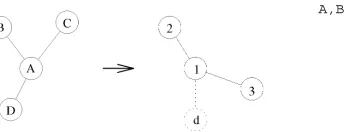
[image:10.571.35.261.376.490.2]Under conditions of extreme structural error, relational fragmentation will severely limit the matching methods described in Sections 6.1 and 6.2. The basic problem origi-nates from topological disruption of the consistent relations residing in the dictionary by the addition of structural er-rors. For instance, if the relational structure being matched is a Delaunay graph representing a Voronoi tessellation of the image plane, then a single additional clutter node may create many additional graph edges [32]. One way of over-coming this problem is to edit-out extraneous nodes. In this way the relational structure of the data graph is recon-structed in an active matching process. This process is il-lustrated in Fig. 2. As originally proposed by Sanfeliu and Fu [24], graph editing was realized as a cost minimization process. There were separate edit operations and associated costs for node deletion or insertion, edge deletion or inser-tion, and, for edge or node relabelings. Because we confine ourselves to Delaunay graphs, our edit operations are con-siderably simplified. The reason for this is that the edge-sets associated with node insertions or deletions are automati-cally generated from the Voronoi tessellation. In other words, our edit process only involves node insertion or deletion, and, node relabeling.
Fig. 2. An example of Delaunay graph editing by node deletion. The original graph is shown on the left, while the edited graph resulting from a node deletion is shown on the right.
We have recently shown how this process of active graph reconfiguration or editing can be realized as a MAP estimation process similar to that described in Section 3 [32]. However, rather than confining itself purely to node relabeling, the algorithm now encompasses the possibility of node insertions or deletions together with the implied modification of the Delaunay edge-set. Details of the deri-vation are outside the scope of this paper. The basic idea is to gauge the net effect of deleting a node by examining those contributions to the consistency measure that arise from modification of the super-cliques containing the node in question. This set is constructed by identifying those nodes that form a super-clique with node u in graph G1, i.e., Cu-{u}, and determining the new super-clique set for these
nodes in the reconfigured graph G1¢. We let cu+ denote the super-clique set of object u in graph G1 and cu
denote the corresponding super-clique set in the reconfigured graph
¢
G1. With this notation the change in the MAP criterion caused by the deletion of the node u is proportional to
D
Q
G
Q
u
C j j
e j i
S
P K j k H S
u i j
-Œ Œ
=
-Â
Â
fc
exp
e
,j
(19)By contrast, when considering the change in the MAP criterion caused by re-insertion of the node u it is the super-clique set cu+ to which we turn our attention. The corre-sponding change to the MAP criterion is proportional to
D
Q
G
Q
u
u f u C
j j
e j i
S
P u f u
P u f u
K
k H S
j
u i j
+
Œ Œ
=
-+
Â
Â
, | ,exp ,
a f
e
j
a f
c
h
a f
e
j
x x ,
1 2
c
(20)
The decision criteria for node deletion or re-insertion are as follows. We delete node u provided D+u <D-u and rein-state it provided D+u >D-u. In other words, the rule for as-signing nodes to the null category is
D+u <D-u fi f u
a f
=f (21) Once the graph has been reconfigured or edited in this purely structural manner, labeling consistency must be re-stored to those portions of the graphs to have undergone structural modification. This is effected by modifying the labels assigned to the nodes of the data-graph. Adhering to our MAP philosophy, the labeling consistency is main-tained provided that the mapping function f is updated in the following wayf u
P u v
P u v
K
k H S
v V
u v C
j j
e j i
S
j
u i j
a f
d
i
c h
e
j
=
-Œ
Œ + Œ
Â
Â
arg max , | , exp ,
2
1 2
x x
, c Q Q G (22)
The graph reconfiguration process of (21) and the node relabeling operation of (22) combine to perform a function analogous to Sanfeliu and Fu’s graph edit operations [24]. Rather than requiring the specification of a series of heuris-tic cost terms, the dual operations of node deletion or in-sertion, and, node relabeling are both regulated by the null match probability Pf and the error probability Pe. Since the
parameter Pe fulfills the role of a control variable which
imposes incremental hardening on the constraints residing in the dictionary, our structural error model has only one free parameter Pf. This provides certain advantages in terms of ease of control over the heuristic edit costs of San-feliu and Fu [24].
7 S
ENSITIVITYA
NALYSISsecond aspect of our experimental study concerns the dif-ferent strategies adopted in the control of structural errors. Here we give some direct performance assessment of the three alternative strategies described in Section 6.
In order to provide some objective performance meas-ures, we have conducted the bulk of our experiments using synthetic relational graphs. In order to embark on this study, we have seeded Voronoi tessellations from random dot patterns and computed the associated Delaunay graph. The nodes of the graph are therefore the random dots, while the arcs indicate that the associated Voronoi regions are adjacent to one-another. In order to simulate the effects of clutter and segmental dropout, we have both added dots at random locations and deleted random dots from the patterns used to seed the Voronoi tessellation. This has the effect of corrupting the topology of the associated Delaunay graph.
In addition to the structural errors introduced by dom dot insertions and deletions, we have also added ran-dom initialization errors. Associated with each node in the Delaunay graph is a uniformly distributed random unary attribute vector. This unary attribute is used to compute initial match probabilities. Uncertainties in the measure-ments used in the discrete relaxation scheme are modeled by randomly perturbing the unary attributes of the data-graph with a Gaussian error distribution so as to produce a specified fraction of initial matching errors. The initial matching probabilities are computed from exponential dis-tributions of the Mahalanobis distance between attribute-vector pairs computed using an estimate of the variance-covariance matrix S, i.e.:
P u v
P
u v
u v
T
u v
u w
T
u w
w V
, | , exp
exp x x
x x x x
x x x x
1 2
1 2
1 2 1 1 2
1
2 1 2
1 1 2
1
2
d
i
e
j
d
i
d
i
d
i
d
i
=
-- -
-L
NM
O
QP
- -
-L
NM
O
QP
-Œ
Â
fS
S
(23)
Where appropriate, initial null matches are assigned a probability P(u, f) = Pf which is independent of the attrib-ute values. Our assumed model for the matching priors is one of uniformity over the model graph i.e., P(u, v)= (|V
2|)
-1
. In our simulation studies, we use only a single scalar attribute at each node. For the majority of the ex-periments described here, the unary attribute errors are generated so that the level of initialization error from the winner-take-all assignment of matches is approximately 50 percent.
7.1 Consistency Measure
Our first set of experiments are aimed at comparing the effectiveness of the different limiting approximations to the compound exponential consistency measure developed in Section 5. The two cases of interest are the hard-limit and the linear limit; the respective limits under which the ap-proximations apply are, PeÆ 0 and PeÆ 12.
7.1.1 The Hard-Limit
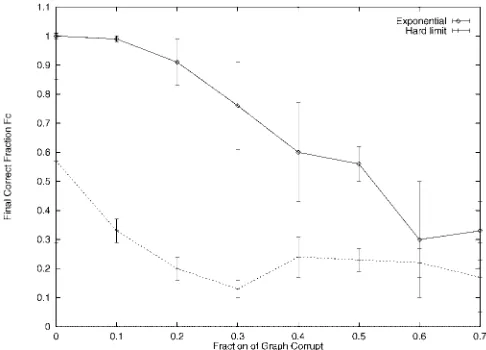
[image:11.571.292.535.276.451.2]Turning our attention first to the case of the hard limit, Fig. 3 shows the final fraction of correct matches as a function of the fraction of added clutter as defined above. The dotted curve is the result of applying the approximation of (13), while the solid curve is the result of applying the exponen-tial consistency measure. For each of the points in the graph, the matching algorithm has been initialized in a state where 50 percent of the matches are incorrectly assigned. The exponential form of the consistency criterion consis-tently outperforms its hard-limiting counterpart until the fraction of graph corruption exceeds 60 percent. Moreover, even when the graphs are perfect realizations of one-another, the hard limit is only capable of rectifying some 10 percent of the initialization errors. In other words, the hard limit is not only sensitive to structural errors in the graphs, it is also extremely limited in its capacity to recover from significant levels of initialization error.
Fig. 3. Comparison of performance of the hard-limit (dotted curve) with the exponential criterion (solid curve).
7.1.2 The Linear Limit
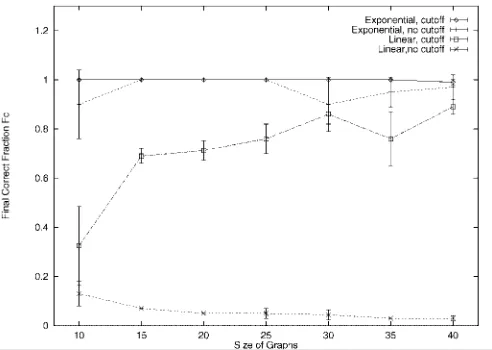
[image:12.571.26.272.228.407.2]To commence our investigation of the linear form of the consistency measure we have performed some experiments on uncorrupted graphs. Here the only source of error is due to mis-initialization. Fig. 5 shows the final fractional accu-racy as a function of graph size when the initialization error is 50 percent. The dotted curve is the result obtained using the exponential consistency measure while the lower dashed-curve is the result of applying the linear approxi-mation. Whereas the exponential form recovers a com-pletely consistent labeling irrespective of graph size, the linear form results in a degradation in performance which increases with graph size. In the latter case, the match is effectively a random configuration of symbols.
[image:12.571.285.531.342.520.2]Fig. 4. Recovery from initialization errors for the hard-limit (diamond points) and the exponential criterion (dotted curve).
Fig. 5. Comparison of linear and exponential forms: exponential (dotted curve); linear (dashed curve); pruned exponential (solid curve); pruned linear (dot-dashed curve).
By applying the dictionary pruning strategy, the results described above can be dramatically improved. Each dic-tionary is pruned by excluding 80 percent of the mappings on the basis of initial match probabilities. In the case of the linear consistency measure which is shown as a dot-dashed curve, final matching accuracies of between 60 percent and
90 percent can be obtained. Moreover, as the graph size increases the relational mappings become less ambiguous and the matching performance increases. As shown by the solid curve, in the case of the exponential consistency measure, the pruning process results in a small improve-ment in performance. This effect is attributable to the fact that the pruning strategy reduces matching ambiguities for large graphs.
Having established that the linear consistency measure can be rendered operable under conditions in which errors are dominated by mis-initialization, we proceed to investi-gate the effects of structural corruption. Fig. 6 compares the pruned linear consistency measure with its exponential counterpart using the data described in Section 7.1.1. The graphs used in this study are relatively large (40 nodes) and hence represents the domain where the linear approxima-tion can be anticipated to be effective in controlling initiali-zation errors. The dotted-curve in Fig. 6 reveals that al-though inferior to the exponential consistency measure, the pruned linear form considerably outperforms the hard limit (Fig. 3). This is an interesting observation. It indicates that even drawing on Hamming distance in a suboptimal way is more effective than the relatively coarse consistent clique counting of Shapiro and Haralick [27].
Fig. 6. Comparison of pruned linear and exponential consistency measures.
7.2 Clutter Control
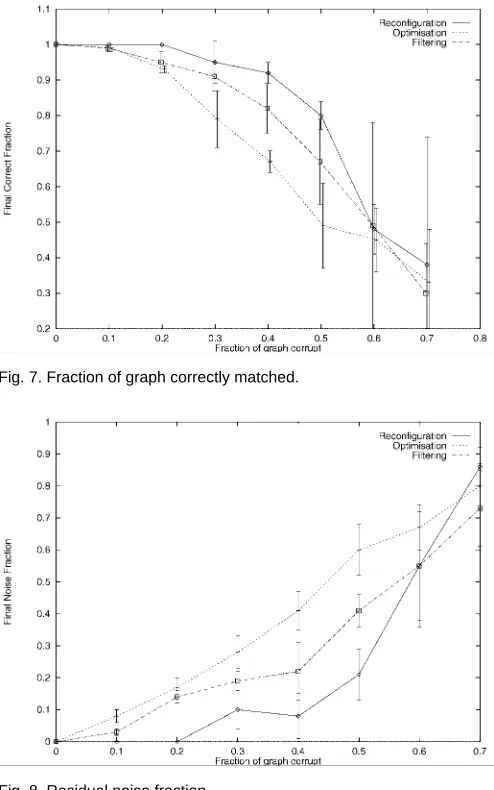
[image:12.571.26.272.447.622.2]exceeds 20 percent. Even when the clutter fraction is as high as 50 percent, then 80 percent matching accuracy is achiev-able. By contrast, the two remaining methods are 10-20 per-cent more susceptible to error. However, it is interesting to note that the constraint filtering technique has a tangible performance edge over null-labeling. This is largely attrib-utable to the difficulties encountered in controlling the pa-rameter of the null match. For comparison, Fig. 8 shows the fraction of residual noise after matching; this represents the fraction of added noise which is not assigned to the null category. Again, the best performance is obtained using graph-edit operations, with null-labeling delivering the poorest performance.
[image:13.571.31.277.218.403.2]Fig. 7. Fraction of graph correctly matched.
Fig. 8. Residual noise fraction.
8 R
EAL-W
ORLDI
MAGERYHaving presented a sensitivity analysis for the various re-alizations of our matching scheme, in this section we will confront real-world data. We provide two examples of the application of our matching framework. In both applica-tions we are concerned with matching aerial image data against digital map data. The first example the application involves the matching of road networks detected in infra-red line scan images. Here the fidelity of the ground truth
information is good and, additionally, the segmentation process is effective in providing a stable relational descrip-tion for matching. As a result there are few structural errors and in consequence the control of clutter is not an issue of critical importance. The second application is far more manding. It involves the matching of hedge structures de-tected in synthetic aperture radar images. Here there are two factors which make the effective control of structural errors an issue of critical importance. Firstly, the imagery is dominated by speckle noise which results in significant clutter. The second limitation stems from the poor quality of the ground truth map information for hedge structures. This is due largely to the fact that they are the artifacts of vegeta-tion and are subject to the vagaries of changing land-use.
8.1 Aerial Infrared Images
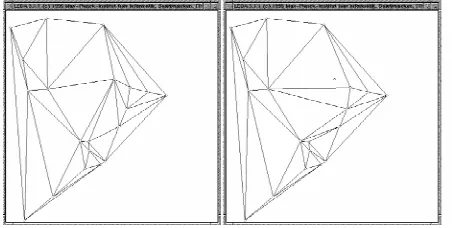
We are interested in comparing the effectiveness of the various consistency measures described in Section 5 when applied to the matching aerial scenes against digital map data. For the experimental aspects of this study we take the application of matching road networks detected in the im-age data against their corresponding map representation. The image data under study was obtained using an infrared line scan sensor. In addition to the transformational differ-ences due to changes of viewpoint and scale, there is barrel distortion in the horizontal direction due to the geometry of the line-scan process. This effect is most marked at the im-age periphery. Imim-age scan in the vertical direction is con-trolled by aircraft motion across the ground. Irregularities in the aircraft flight-path due to banking or turbulence in-troduce vertical scanning distortions. An example image is shown on the left-hand side of Fig. 9 while the right-hand image is the digital map data available for matching. The left-hand image in Figs. 10 and 11 represents digital map data while the right-hand image shows the road network segmented from the image data using a relaxational ridge detector [19].
the numbers T-junctions which are correctly matched, in-correctly matched or null matched. Also listed in Table 1 is the prevailing value of the label-error probability.
TABLE 1 RESULTS OF MATCHING
Iteration Correct Incorrect Null Pe
0 46 63 0
-1 57 52 0 0.300
2 68 41 0 0.234
3 67 42 0 0.182
4 73 36 0 0.142
5 75 34 0 0.110
6 76 33 0 0.086
7 76 25 8 0.067
8 79 17 13 0.052
9 76 16 17 0.041
10 80 11 18 0.032
Under similar initial matching conditions, when the hard limiting criterion of (13) is applied the corresponding frac-tion of correct matches in the final labeling is 0.34. Al-though this result is inferior, the match is still useful. By contrast the soft limiting criterion of (15) is completely inef-fective in locating any kind of useful global match; it is dominated by null matches and matching errors.
[image:14.571.39.259.109.248.2]
(a) (b) Fig. 9. Aerial infrared image (left) and digital map (right)}
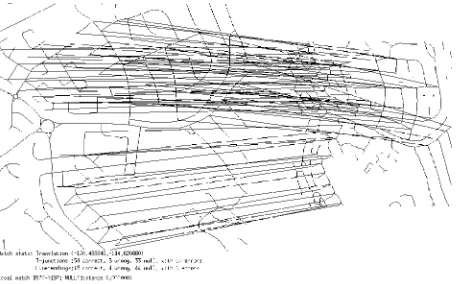
Fig. 10. Correct matches between the map (left) and the infrared data (right).
8.2 Synthetic Aperture Radar Data
Evaluation of our methodology for rectifying structural errors is concerned with matching hedge structures seg-mented from synthetic aperture radar (SAR) images against their cartographic representation in a digital Ordnance
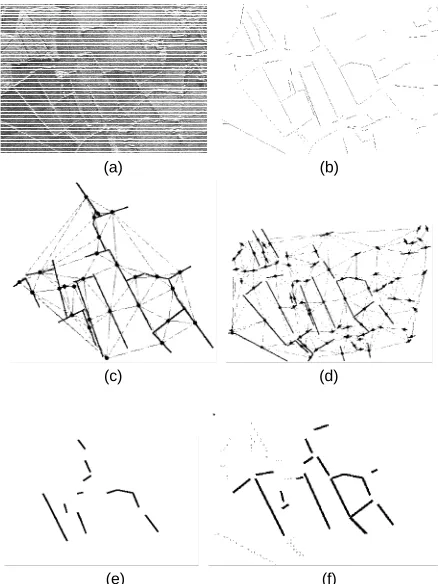
[image:14.571.285.531.239.384.2]Sur-vey map. The hedge structures responsible for radar reflec-tions appear as intensity ridges in the raw data. As with the infrared data, we again perform feature detection by ap-plying a relaxation operator to the output of a set of orien-tational line-detectors. The primitives used in matching are linear segments extracted from the raw feature contours. Fig. 12 illustrates the processing operations applied to the raw SAR image together with the results of applying the graph edit operations described in Section 6.3. Fig. 12a. shows the original SAR image. The extracted hedge fea-tures used in matching are shown in Fig. 12b. The relational graphs used in the matching process are Delaunay trian-gulations computed from the linear segments in the SAR data and the digital map. Figs. 12c and 12d show the model and data graphs used for matching.
Fig. 11. Incorrect matches between the map (left) and the infrared data (right).
The initial matches between the linear segments ex-tracted from the SAR data and their map representation are established on the basis of the affinity between the vectors of the angle differences between model and data lines using (22).
The experimental matching study is based on 95 linear segments in the SAR data and 30 segments contained in the map. However only 23 of the SAR segments have feasible matches within the map representation. Fig. 12e shows the initial matches for the line segments in the SAR data; the black lines are correct matches while the gray lines are matching errors. With the same coding scheme Fig. 12f shows the final result once the iterative graph-edit process has converged. Here those lines edited from the graphs have been deleted from the figure. Comparing Figs. 12e and 12f, it is clear that the main effect of the graph-edit opera-tions, has been to delete the majority of the clutter segments from the SAR data graph. To give some idea of relative per-formance merit, in the case of the initial matching configu-ration 20 of the 23 matchable segments are correctly identi-fied with 75 incorrect matches, while after application of the graph-editing method the final graph contains 19 correct matches, only 17 residual clutter with 59 nodes deleted from the data graph.
[image:14.571.43.254.349.466.2] [image:14.571.25.263.494.636.2]