arXiv:1901.04448v1 [hep-th] 14 Jan 2019
Towards machine learning in the
classification of
Z
2
×
Z
2
orbifold compactifications
Alon E. Faraggi1, Glyn Harries1, Benjamin Percival1 and John Rizos2 1 Department of Mathematical Sciences, University of Liverpool, Liverpool L69 7ZL, UK 2 Department of Physics, University of Ioannina, Ioannina, Greece
E-mail: [email protected]; [email protected]; [email protected]; [email protected]
Abstract.
Systematic classification of Z2×Z2 orbifold compactifications of the heterotic–string was
pursued by using its free fermion formulation. The method entails random generation of string vacua and analysis of their entire spectra, and led to discovery of spinor-vector duality and three generation exophobic string vacua. The classification was performed for string vacua with unbroken SO(10) GUT symmetry, and progressively extended to models in which the
SO(10) symmetry is broken to theSO(6)×SO(4),SU(5)×U(1),SU(3)×SU(2)×U(1)2and
SU(3)×U(1)×SU(2)2 subgroups. Obtaining sizeable numbers of phenomenologically viable
vacua in the last two cases requires identification of fertility conditions. Adaptation of machine learning tools to identify the fertility conditions will be useful when the frequency of viable models becomes exceedingly small in the total space of vacua.
1. Introduction
String theory provides a viable framework to explore the synthesis of quantum mechanics with gravity. It gives rise to a multitude of phenomenological models that reproduce the main features of the Standard Model (SM), such as the presence of three generations with the correct gauge charges. A realistic string vacuum should reproduce the detailed structure of the Standard Model spectrum, including the masses of elementary particles and flavour mixing. A desirable
property of phenomenological string vacua is the SO(10) embedding of the SM states, which
is motivated by the observed gauge charges and couplings. Existence of fundamental scalar doublets to facilitate electroweak symmetry breaking is indicated by the observation at the LHC of a scalar resonance compatible with the SM Higgs particle. The observed mechanism is compatible with a perturbative elementary coupling. Supersymmetrising the SM spectrum maintains the perturbative coupling up to the heterotic–string unification scale, thus enabling consistent perturbative unification of the Standard Model with gravity.
fundamental matter and interactions. On the other hand, it should be also acknowledged that our current understanding of string theory is rudimentary and progress may take longer than that available for winning contemporary accolades. At present there is no concrete criteria that singles out a specific string vacuum, or particular class of string models, as phenomenologically preferable. Contemporary research in string phenomenology aims to explore large classes of string compactifications and their properties.
2. Realistic string models in the free fermionic formulation
Among the most realistic string models constructed to date are the heterotic–string models in the
free fermionic formulation [1]. These models correspond to toroidalZ2×Z2orbifolds with discrete
Wilson lines [2]. They produce an abundance of three generation models with various unbroken
SO(10) subgroups, includingSU(5)×U(1) [3, 4]; SO(6)×SO(4) [5, 6]; SU(3)×SU(2)×U(1)2
[7, 8]; SU(3)× U(1)×SU(2)2 [9, 10], whereas the subgroup SU(4)×SU(2) ×U(1) does
not produce viable models [11]. The free fermionic models produced the first known Minimal Standard Heterotic String Models (MSHSM) [7, 8] that give rise solely to the spectrum of the Minimal Supersymmetric Standard Model (MSSM) in the observable charged sector, and have been used to study many of the issues pertaining to the phenomenology of the Standard Model and unification [14]. Other classes of string compactifications are investigated [15].
In the free fermionic construction of the heterotic string in four dimensions all the extra degrees of freedom needed to cancel the conformal anomaly are represented
as free fermions propagating on the two dimensional string worldsheet [1]. In the
conventional notation the 64 lightcone gauge worldsheet fermions are denoted by:
Left-Movers: ψ1µ,2, χi, yi, ωi (i= 1,· · · ,6)
Right-Movers
¯
φA=1,···,44 =
¯
yi , ω¯i i= 1,· · ·,6
¯
ηi U(1)i i= 1,2,3
¯
ψ1,···,5 SO(10)
¯
φ1,···,8 SO(16)
where the six compactified coordinates of the internal manifold correspond to {y, ω|y,¯ ω¯}1,···,6
and the different symmetry groups generated by sixteen complexified right–moving fermions are indicated. String vacua in the free fermionic formulation are defined in terms of boundary condition basis vectors that denote the transformation properties of the fermions around the noncontractible loops of the worldsheet torus, and the Generalised GSO (GGSO) projection
coefficients of the one loop partition function [1]. The free fermion models correspond toZ2×Z2
orbifolds with discrete Wilson lines [2].
3. Realistic free fermionic models – old school
Three generation free fermionic models were constructed since the late eighties [3, 7, 5, 9]. The early models were built by following a trial and error method, using a common structure that underlined all the models, which consisted of a common set of five basis vectors known as the
NAHE–set [13], denoted as {1, S, b1, b2, b3}. The gauge symmetry at the level of the NAHE–
set is SO(10)×SO(6)3 ×E
8, with forty–eight multiplets in the spinorial 16 representation of
SO(10), arising from the three twisted sectors of the Z2×Z2 orbifold b1,b2 and b3. The basis
vector S producesN = 4 spacetime supersymmetry, which is broken to N = 2 by the inclusion
of b1 and to N = 1 by the inclusion of both b1 and b2. The action of b3 either preserves or
The second stage in the old school free fermionic model building consisted of augmenting the NAHE–set with three or four additional basis vectors. The basis vectors beyond the NAHE–set
break theSO(10) gauge group to one of its subgroups and simultaneously reduce the number of
generations to three. In the standard–like models of [7] the additional basis vectors are denoted
as {α, β, γ}. They reduce theSO(10) gauge symmetry to SU(3)×SU(2)×U(1)B−L×U(1)R.
and the weak hypercharge is given by the combination
U(1)Y =
1
2(B−L) +T3R ∈SO(10)!
Each of the sectors b1, b2 and b3 gives rise to one generation which form complete 16
representations of SO(10). The models contain the required scalar states to break the gauge
symmetry further and to produce a quasi–realistic fermion mass spectrum [14].
4. Classification of fermionic Z2×Z2 orbifolds – modern school
Since 2003 systematic classification of Z2×Z2 orbifolds has been pursued by employing the
free fermionic model building tools to derive and analyse the spectrum and leading coupling of these heterotic–string vacua. The initial classification method was developed in [16] for type II
superstring. It was extended in [12] to string vacua with unbrokenSO(10) gauge group; and to
vacua with: SO(6)×SO(4) subgroup in [6];SU(5)×U(1) subgroup in [4];SU(3)×SU(2)×U(1)2
subgroup in [8]; SU(3)×U(1)×SU(2)2 subgroup in [10]. In the free fermionic classification
method the string vacua are generated by a fixed set of basis vectors, consisting of between
twelve to fourteen basis vectors, B={v1, v2, . . . , v14}.The models with unbrokenSO(10) gauge
group are generated with a basis of twelve basis vectors
v1=1 = {ψµ, χ1,...,6, y1,...,6, ω1,...,6 | y¯1,...,6,ω¯1,...,6,η¯1,2,3,ψ¯1,...,5,φ¯1,...,8},
v2 =S = {ψµ, χ1,...,6},
v3 =z1 = {φ¯1,...,4},
v4 =z2 = {φ¯5,...,8}, (1)
v4+i =ei = {yi, ωi|y¯i,ω¯i}, i= 1, . . . ,6, N = 4 Vacua
v11=b1 = {χ34, χ56, y34, y56|y¯34,y¯56,η¯1,ψ¯1,...,5}, N = 4→N = 2
v12=b2 = {χ12, χ56, y12, y56|y¯12,y¯56,η¯2,ψ¯1,...,5}, N = 2→N = 1.
where the first ten basis vectors preserve N = 4 spacetime supersymmetry and the last two
correspond to the usual Z2×Z2 orbifold twist. The third twisted sector is obtained as the basis
vector combination b3=b1+b2+x, where the x–sector arise as the basis vector combination
x=1+S+
6
X
i=1
ei+
2
X
k=1
zk={ψ¯1,···,5,η¯1,2,3}. (2)
This vector combination plays an important role in the free fermionic systematic classification
method as it induces a map between sectors that produce SO(10) spinorial and vectorial
representations. The breaking of the SO(10) symmetry to the SO(6)×SO(4) subgroup is
obtained by including in the basis the vector [6]
v13=α={ψ¯4,5,φ¯1,2}, (3)
whereas the breaking to theSU(5)×U(1) subgroup is obtained with the vector [4]
v13=α={ψ1
,...,5
and the breaking to the SU(3)×SU(2)×U(1)2 is obtained by including both vectors in (3)
and (4) as two separate vectors,v13 and v14 in the basis [8]. The breaking of theSO(10) gauge
symmetry to the SU(3)×U(1)×SU(2)2 subgroup is achieved with the inclusion of the basis
vector
v13=α={ψ1
,2,3
= 1
2 , η
1,2,3= 1
2 , φ
1,...,6
= 1
2 , φ
7
}, (5)
With a fixed set of boundary condition basis vectors the free fermionic classification method
follows with variation of the GGSO projection coefficients. The general formula for the
Generalised GSO (GGSO) projections on the states from a given sector ξ is [1]
eiπ(vj·Fξ)|Si
ξ =δξC
ξ
vj
!∗
|Siξ . (6)
The independent phases in a given string model can be enumerated in matrix form. For example,
in the SO(6)×SO(4) models 66 phases are taken to be independent
1 S e1 e2 e3 e4 e5 e6 z1 z2 b1 b2 α
1 −1 −1 ± ± ± ± ± ± ± ± ± ± ±
S −1 −1 −1 −1 −1 −1 −1 −1 1 1 −1
e1 ± ± ± ± ± ± ± ± ± ±
e2 ± ± ± ± ± ± ± ± ±
e3 ± ± ± ± ± ± ± ±
e4 ± ± ± ± ± ± ±
e5 ± ± ± ± ± ±
e6 ± ± ± ± ±
z1 ± ± ± ±
z2 ± ± ±
b1 ± ±
b2 ±
α ,
where the diagonal terms and below are fixed by modular invariance constraints. The remaining
fixed phases are determined by imposing N = 1 spacetime supersymmetry and the overall
chirality of the chiral and supersymmetry generators. Varying the 66 phases randomly scans a
space of 266(approximately 1019.9)Z
2×Z2 heterotic–string orbifold models. A particular choice
of the 66,±1 phases corresponds to a distinct string vacuum with massless and massive physical
spectrum. The analysis proceeds by developing systematic tools to analyse the entire massless spectrum, as well as the leading top quark Yukawa coupling [18].
The power of the classification method is rooted in the structure of the set of basis vectors
in eq. (1). The Z2 ×Z2 orbifold has sixteen fixed points per twisted plane. Each of these
fixed points can give rise to massless states in different representations of the unbroken four dimensional gauge group. The basis vectors in eq. (1) enables the analysis of the GGSO
projection of each of these states individually. For example, states that arise in the 16spinorial
representation of SO(10) are obtained from theBpqrs(1,2,3) sectors given by
Bpqrs1 = S+b1+pe3+qe4+re5+re6
= {ψ1,2, χ1,2,(1−p)y3y¯3, pω3ω¯3,(1−q)y4y¯4, qω4ω¯4,
(1−r)y5y¯5, rω5ω¯5,(1−s)y6y¯6, sω6ω¯6,η¯1,ψ¯1,···,5}
Bpqrs2 = S+b2+pe1+qe2+re5+se6
where p, q, r, s = 0,1, whereas states that arise in the 10 vectorial representations of SO(10)
are obtained from the sectors Bpqrs(1,2,3)+x, with the x–vector given in eq. (2). Thus, the initial
classification was developed in [12] for sectors producing spinorial 16 and 16 representations
and progressively extended to cover the entire Fock space. From the form of eq. (6) it is noted
that whenever the overlap of periodic fermions in a sector ξ and the vector vj is empty, the
operator on the left side of the equation is positive. Hence, depending on the choice of the GGSO phase on the right side of eq. (6), the given state is either in or out of the spectrum.
For example, for the spinorial representations from the twisted plane Bpqrs1 , and adopting the
notation Cvi
vj
= exp[iπ(vi|vj)] with (vi|vj) = 0,1, we can assemble the projectors into an
algebraic system of equations of the form
∆1U161 =Y161 ⇐⇒
(e1|e3) (e1|e4) (e1|e5) (e1|e6)
(e2|e3) (e2|e4) (e2|e5) (e2|e6)
(z1|e3) (z1|e4) (z1|e5) (z1|e6) (z2|e3) (z2|e4) (z2|e5) (z2|e6)
p q r s =
(e1|b1)
(e2|b1)
(Z1|b1) (z2|b1)
(7)
With similar for the second and third twisted sectors. The number of solutions in a twisted sector
is fixed by the relative rank of the ∆1matrix and the augmented matrix ∆1, Y1
16
. The computer
code determines whichp, q, r, s combinations survive the projectors and produce physical states.
Similar expressions are obtained for the the entire massless states producing sectors. In a similar manner to the projectors the chirality of the surviving states is obtained. Thus, the entire physical spectrum is determined, for a given randomly generated GGSO configuration. Models that satisfy specific phenomenological requirements are fished out and their charges and couplings can be analysed in greater detail. Using this free fermionic classification methodology several seminal results were obtained. The first, illustrated in figure 1, is the discovery of a duality
under the exchange of the total number of (16+16) spinorial and10vectorial representations of
SO(10), and hence dubbed as spinor–vector duality [17]. This duality, akin to mirror symmetry,
results from the breaking of the right–movingN = 2 worldsheet supersymmetry and is a general
property of heterotic string vacua in which the right–movingN = 2 worldsheet supersymmetry is
broken. In the heterotic–string models with (2,2) worldsheet supersymmetry the SO(10) gauge
symmetry is enhanced to E6, and these vacua are self–dual under spinor–vector duality. This
enhancement resembles the same phenomenon underT–duality in which an enhanced symmetry
is generated at the self–dual point. The two cases, however, operate with respect to different
sets of moduli. Whereas T–duality acts with respect to the internal compactified space moduli
fields, spinor–vector duality operates with respect to the Wilson line moduli fields [17].
0 2 4 6 8 10 12 14 16 18 20 22 24 0 2 4 6 8 10 12 14 16 18 20 22 24
0 2 4 6 8 10 12 14 16 18 20 22 24
[image:5.595.106.521.258.312.2]0 2 4 6 8 10 12 14 16 18 20 22 24
Figure 1. Density plot illustrat-ing the spinor–vector duality in the
space of Z2 ×Z2 heterotic–string
vacua. The plot shows the ber of models with a given
num-ber of (16+16) and10
representa-tions ofSO(10) and is invariant
un-der exchange of rows and columns, reflecting the spinor–vector dual-ity underlying the entire space of vacua.
0 10 20 30 40 50 60 102
104
106
108
102
104
106
108
# of massless exotic multiplets
#
of
[image:6.595.71.239.111.219.2]models
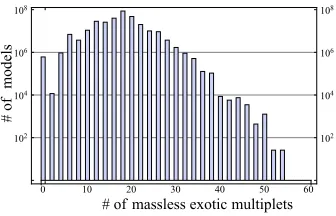
Figure 2. Number of 3–generation models versus total number of
exotic multiplets in SO(6)×SO(4)
models.
0 1 2 3 4 5 6 7 8 9 10 11 12 0
2 4 6 8
Numberof
Models
ng
Figure 3. Number of exophobic models versus number of
genera-tions inSU(5)×U(1) models.
exophobic string vacua [6]. Heterotic–string vacua in which theSO(10) symmetry is broken to
a subgroup, while maintaining the SO(10) embedding of the weak hypercharge, necessarily give
rise to states in the spectrum that do not satisfy the SO(10) charge quantisation conditions.
Some of these states may carry fractional electric charge, which is highly constrained by experiments. However, the exotic states may be confined to the massive spectrum, and not arise as massless states. Such vacua are dubbed as exophobic string vacua. As illustrated in figures 2 and 3, three generation exophobic string vacua were found in the space of fermionic
Z2×Z2 orbifolds with SO(6)×SO(4) gauge symmetry but not with SU(5)×U(1). The two
figures demonstrate again the utility of the free fermion classification method in extracting definite properties of the entire space of scanned vacua. Additional results from the random
classification method include the derivation of a string derived extra Z′ model [19], and string
derived SU(6)×SU(2) GUT model [20].
5. What do we need machine learning for?
As elaborated in the section 4 the free fermionic classification method provides a powerful tool
to extract definite properties and results from the space of Z2×Z2 heterotic–string orbifolds.
In this section we would like to illustrate how the random classification method reaches the limit of its utility. It demonstrates the need for the application of novel computer methods in the classification program. The limitation of the random search method is apparent when
considering the classification of the vacua with SU(3)×SU(2)×U(1)2 (Standard–like Models
(SLM)) [8] or SU(3)×U(1)×SU(2)2 (Left–Right Symmetric (LRS)) [10] SO(10) subgroups.
Unlike the SO(6)×SO(4) and SU(5)×U(1), both SLM and LRS cases contain two vectors
that break the SO(10) symmetry. In the case of SLM models the basis necessarily contains
both vectors v13 of eq. (3) and v14 of eq. (4). The number of independent GGSO phases hence
increases from 66 to 78, or 1019.8 compared to 1024.5. In the case of the LRS models the single
basis vectorv13≡αin eq. (5) is sufficient to break theSO(10) symmetry to the LRS subgroup.
However, the vector 2α break the SO(10) symmetry as well. The consequence in both cases is
the proliferation of sectors that break theSO(10) symmetry and give rise to exotic states. Table
1 shows the results of a random scan in a space of 1011SLM heterotic–string vacua, where heavy
Higgs states are those required to break the extra U(1) symmetry embedded in SO(10), to the
Standard Model weak hypercharge. Here we note a distinction with respect to the SLM models
using the “old school” method. To break the extraU(1) along supersymmetric flat directions at
high scale requires the existence in the spectrum of the string SLM the SM singlet state in the
16 representation ofSO(10), and its complex conjugate. The “old school” SLM models do not
[image:6.595.261.431.113.223.2]Constraints Total models in sample
No Constraints 100000000000
(1) + Three Generations 28878
(2) + SLM Heavy Higgs 0
(3) + SLM Light Higgs 0
[image:7.595.69.375.110.196.2](4) + SLM Heavy & Light Higgs 0
Table 1. Number of SLM models with phenomenological constraints for sample of 1011models.
Model singlets with 1/2U(1)Z′ charge, which are used to break theU(1)Z′ symmetry along flat
directions. As seen from table 1 models containing the standard heavy Higgs states are also not obtained in the random search approach. Moreover, models with light Higgs are not found either. The difficulty stems from the fact that the frequency of three generation models with viable Higgs spectrum is highly diminished. In table 2 we display similar data in the case of LRS models. The results again illustrate the relative scarcity of viable models in the total sample of vacua. In the case of LRS models we find a three generation model with viable Higgs spectrum
at a frequency of 3/1010. These results demonstrate the limitation of the random search method
for extracting phenomenologically viable models from the total space.
Constraints Total models in sample
No Constraints 100000000000
(1) + Three Generations 89260
(4) + SLM Heavy & Light Higgs 29
Table 2. Number of LRS models with phenomenological constraints for sample of 1011models.
6. Towards machine learning
To remedy the situation a new strategy is required. One possible approach is the genetic algorithm approach developed in [21]. However, while this approach is efficient in extracting phenomenologically viable models, the insight into the structure underlying the larger space of vacua is lost, as it does not provide a classification algorithm. Hence, global properties, like the spinor–vector duality cannot be gleaned in this approach. Consequently a new strategy is required. The basic principle of the new strategy is to reduce the total number of vacua in the space which is being scanned by identifying some condition on the GGSO phases that are amenable for extracting phenomenologically viable vacua.
In the case of the SLMs fertility conditions are identified at the SO(10) level, i.e. involving
phases in the 12×12 sub–matrix of the total 14×14 complete matrix of the Standard–like models
[7]. These fertility constraints reduce the total number of independent phases to 44. At the
SO(10) level we perform a random search. As each SO(10) breaking stage reduces the number
of generation by a factor of two, we require SO(10) models with at least twelve generations.
Each one of the extracted SO(10) models is now amenable to produce three generation SLMs.
We refer to these phase configurations as fertile cores. Around each of these fertile cores we now
perform a complete classification of the remaining GGSO phases involving theSO(10) breaking
vectorsαandβ. Using this methodology generates some 107 SLMs, including new Standard–like
Models with novel features that were not obtained in the “old school” trial and error method,
including models with additional vector–like Q and Q and N and N states. Adaptation of
[image:7.595.72.379.371.428.2]7. Conclusions
The Z2 ×Z2 orbifold provide a case study how string theory may relate to the Standard
Model particle data. Early constructions consisted of isolated examples of three generation
models, whereas the more modern random classification method yielded of the order of 107
viable three generation models with differing SO(10) subgroups. In addition to producing
viable three generation models for phenomenological investigations, the classification method
provided penetrating insight into the global properties of the space of (2,0) heterotic–string
compactification, viae.g. the observation of spinor-vector duality. However, the random method
has reached the limit of its usefulness, as seen in the case of the SLMs and LRS models. The case is therefore made for adopting novel computer methods, such as reinforced learning into the classification program, with the basic question at hand whether a computer code can identify the fertility conditions that are amenable for phenomenological considerations.
Acknowledgments
AEF would like to thank the Weizmann Institute, Tel Aviv University, and Sorbonne University for hospitality.
References
[1] Antoniadis I, Bachas C and Kounnas C 1987 Nucl. Phys.B28987; Kawai H, Lewellen D C and Tye S H H 1987 Nucl. Phys.B2881.
[2] Faraggi A E 1994 Phys. Lett.B326 62; 2002Phys. Lett. B544207; Kiritsis E and Kounnas C 1997 Nucl. Phys.B503117; Faraggi A E Forste S and Timirgaziu C 2006 JHEP 060857; Donagi R and Wendland K (2009)J. Geom. Phys.59942. Athanasopoulos P, Faraggi A E, Groot Nibbelink S and Mehta V M 2016
JHEP 160438.
[3] Antoniadis I, Ellis J, Hagelin J and Nanopolous D V 1989Phys. Lett.B23165. [4] Faraggi A E, Rizos J and Sonmez H 2014Nucl. Phys.B886202.
[5] Antoniadis I, Rizos J and Leontaris G 1990Phys. Lett.B245161. [6] Assel Bet al 2010 Phys. Lett.B683306; 2011Nucl. Phys.B844365.
[7] Faraggi A E, Nanopoulos D V and Yuan K, 1990Nucl. Phys.B335347; Faraggi A E 1992Phys. Lett.B278 131; 1992 Nucl. Phys.B387239; Cleaver G B, Faraggi A E and Nanopoulos D V 1999Phys. Lett.B455 135; Faraggi A E, Manno E and Timiraziu C 2007Eur. Phys. Jour.C50701.
[8] Faraggi A E, Rizos J and Sonmez H 2018Nucl. Phys.B9271. [9] Cleaver G, Clements D and Faraggi A E 2001Phys. Rev.D63066001. [10] Faraggi A E, Harries G and Rizos J 2018Nucl. Phys.B936472.
[11] Cleaver G, Faraggi A E and Nooij S 2003Nucl. Phys.B67264; Faraggi A E and Sonmez H 2015Phys. Rev.
D91066006.
[12] Faraggi A E, Kounnas C, Nooij S E M and Rizos J 2004Nucl. Phys.B69541.
[13] Faraggi A E and Nanopoulos D V 1993 Phys. Rev.D483288; Faraggi A E 1999 Int. J. Mod. Phys.A14 1663.
[14] For review and references see e.g.: Faraggi A E Galaxies(2014)2223.
[15] For a comprehensive review see e.g.: Ibanez L E and Uranga A M,String theory and particle physics: An introduction to string phenomenology, Cambridge University Press 2012.
[16] Gregori A, Kounnas C and Rizos J 1999Nucl. Phys.B54916.
[17] Faraggi A E, Kounnas C and Rizos J 2007Phys. Lett.B64884; 2007 Nucl. Phys.B774208; Angelantonj C, Faraggi A E and Tsulaia M 2010JHEP 1007004; Faraggi A E, Florakis I, Mohaupt T and Tsulaia M 2011 Nucl. Phys.B848332; Athanasopoulos P, Faraggi A E and Gepner D 2014Phys. Lett.B735357. [18] Christodoulides K, Faraggi A E and Rizos J 2011 Phys. Lett.B70281; Rizos J 2014Eur. Phys. Jour.C74
010.
[19] Faraggi A E and Rizos J 2015 Nucl. Phys.B895233. [20] Bernard Let al 2013Nucl. Phys.B8681.
[21] Abel S and Rizos J 2014 JHEP1408010.